No U.S. Injuries Following IRGC Navy Lazing Incident at Sea 

GULF OF OMAN (Aug. 14, 2023) Aviation Boatswain’s Mate (Handling) 3rd Class Ezequiel Rodriguez signals to a U.S. Marine Corps AH-1Z Viper helicopter from Marine Medium Tiltrotor Squadron 162, 26th Marine Expeditonary Unit (MEU), during flight operations aboard the amphibious dock landing ship USS Carter Hall (LSD 50) in the Gulf of Oman, Aug. 14, 2023. Components of the Bataan Amphibious Ready Group and 26th Marine Expeditionary Unit are deployed to the U.S. 5th Fleet area of operations to help ensure maritime security and stability in the Middle East Region. (U.S. Navy photo by Mass Communication Specialist 2nd Class Moises Sandoval)

Release from U.S. Naval Forces Central Command public affairs 

***** 

MANAMA, Bahrain – Statement from U.S. Naval Forces Central Command Spokesman Cmdr. Rick Chernitzer: 

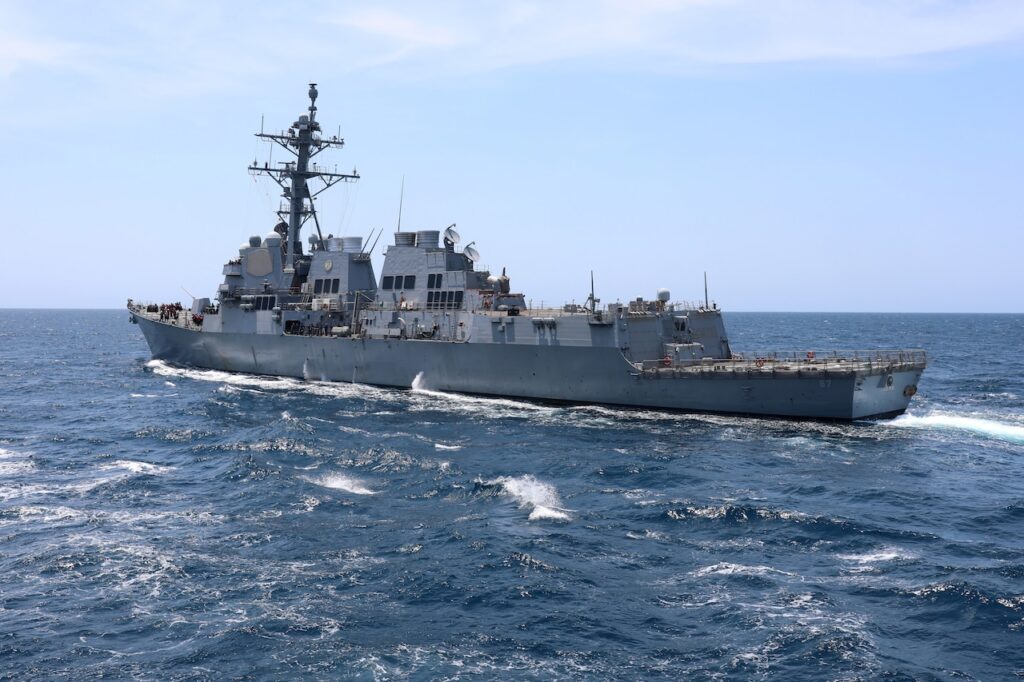
“Iran’s Islamic Revolutionary Guard Corps Navy (IRGCN) interacted in an unsafe and unprofessional manner with a U.S. AH-1Z Viper attack helicopter, assigned to the 26th Marine Expeditionary Unit (Special Operations Capable), as the aircraft was conducting routine operations in the international airspace of the Arabian Gulf, Sept. 27. The interaction took place at approximately 7:30 p.m. local time. The aircraft is attached to Marine Medium Tiltrotor Squadron (VMM) 162 (Reinforced), deployed aboard the Wasp-class amphibious assault ship USS Bataan (LHD 5), on a scheduled deployment to the Middle East Region. 

“IRGCN vessels shone a laser multiple times at the aircraft while in flight. Fortunately, no injuries were reported and the aircraft was not damaged. 

“These are not the actions of a professional maritime force. This unsafe, unprofessional, and irresponsible behavior by the Iranian Revolutionary Guard Corps Navy risks U.S. and partner nation lives and needs to cease immediately. 

“U.S. naval forces remain vigilant and will continue to fly, sail and operate anywhere international law allows while promoting regional maritime security.” 


SECNAV Announces Navy’s Disruptive Capabilities Office 

Release from the Secretary of the Navy Public Affairs  

***** 

Sept. 28, 2023

Secretary of the Navy Carlos Del Toro today announced the creation of the Navy’s Disruptive Capabilities Office (DCO), during remarks at the Naval Research Laboratory (NRL) Centennial Exhibition at the Pentagon, Sept. 28. 

This new organization, said Secretary Del Toro, “will push the bounds of rapidly delivering warfighting capability though the innovative application of existing and new systems, and harnessing today’s exponential growth in technology.”   

For the full remarks, please visit https://www.navy.mil/Press-Office/Speeches/display-speeches/Article/3540853/secnav-delivers-remarks-at-nrl-100th-anniversary-ceremony/ 


Flag Officer Announcement 

Release from the U.S. Department of Defense 

***** 

SEPT. 28, 2023 

Secretary of Defense Lloyd J. Austin III announced today that the president has made the following nomination: 

Navy Rear Adm. (lower half) Heidi K. Berg for appointment to the grade of rear admiral. Berg is currently serving as assistant deputy chief of naval operations for Operations, Plans, and Strategy, N3/N5B, Office of the Chief of Naval Operations, Washington, D.C. 

Below is the official biography for Berg: 

Rear Adm. Berg is a native of LaCrosse, Wisconsin. She is a graduate of the U. S. Naval Academy. She studied Russian at the Defense Language Institute, and Arabic at the Kalimat Institute in Cairo, Egypt. Berg holds a Master’s degree in Modern Middle Eastern Studies and Arabic from Oxford University, UK. 

Operational tours include Navy Security Group Activity in Rota, Spain, where Berg flew over 1000 hours as a communications intercept evaluator onboard EP-3E aircraft in support of Operations Provide Promise/Sharp Guard. She deployed onboard the USS Kidd (DDG 993), Cruiser Destroyer Group 12 onboard the USS Saratoga (CV 60), and the USS Key West (SSN 722).  She served on the Sixth Fleet aboard the USS LaSalle (AGF 3) in Gaeta, Italy, where she participated in initial talks with the post-Soviet Russian Navy.  She supported global crisis response at Naval Security Group Menwith Hill in Harrogate, UK. In 2012, Berg deployed to Afghanistan as director of the International Security Assistance Force (ISAF) Red Team at ISAF HQ in Kabul. As director, she led alternative analysis and provided strategic assessments to the ISAF Commander. 

She commanded the Navy Information Operations Command in Bahrain, where she was responsible for providing airborne and surface Signal Intelligence support to Iraqi Freedom, Enduring Freedom, and Persian Gulf maritime operations. She also commanded the Navy Element of the Defense Intelligence Agency, and the Joint Military Intelligence Training Center. 

Staff assignments include serving as the Airborne SIGINT Requirements Officer (N2N6) on the Chief of Naval Operations (OPNAV) Staff; Information Operations Strategy and Policy (N3IO) at OPNAV; deputy for Plans and Policy at Fleet Cyber Command/U.S. TENTH Fleet; deputy National Intelligence Officer for Military Issues at the National Intelligence Council; Military Advisor to the deputy director of National Intelligence, where she supported daily intelligence briefings to the President and National Security Council; Information Warfare and Foreign Area Officer Director (PERS-47) at Navy Personnel Command, Strategic Advisor (OOZ) to the Chief of Naval Operations; and Acting Director, Navy Digital Warfare Office. 

As a flag officer, Berg served as the director of Intelligence (J-2) at U.S. Africa Command, and as the director of Strategy, Plans and Policy (J-5) at U.S. Cyber Command. 


HII Marks Arkansas (SSN 800) Construction Milestone at Newport News Shipbuilding

Release from HII 

***** 

NEWPORT NEWS, Va., Sept. 27, 2023 (GLOBE NEWSWIRE) — HII shared today (NYSE: HII) that its Newport News Shipbuilding (NNS) division has reached a significant milestone in the construction of Virginia-class submarine Arkansas (SSN 800). 

Arkansas (SSN 800) is now “pressure hull complete,” meaning that all of the hull sections were joined to form a single, watertight unit. 

“It’s exciting to reach pressure hull complete, because it’s a visible sign that construction has progressed to the point where Arkansas really starts to take its final shape,” said Jason Ward, NNS vice president of Virginia-class submarine construction. “We absolutely understand the important mission ahead for Arkansas and are working with urgency to get this powerful national security asset to the Navy as soon as possible.” 

NNS is one of only two shipyards capable of designing and building nuclear-powered submarines. The advanced capabilities of Virginia-class submarines increase firepower, maneuverability and stealth. 

This milestone comes following the christening of Massachusetts (SSN 798) and keel authentication of Oklahoma (SSN 802) at NNS so far in 2023. 

Photos accompanying this release are available at: https://hii.com/news/hii-arkansas-ssn-800-newport-news-shipbuilding-pressure-hull-2023

Arkansas is the Navy’s 27th Virginia-class fast attack submarine. The ship’s sponsors are the six women of the historic group known as the Little Rock Nine, the first African American students to attend all-white Central High School in Little Rock, Arkansas, during desegregation. NNS honored all nine members, including the three men, during the November 2022 keel authentication ceremony. 


First Flight III Destroyer Jack H. Lucas Sails Away From HII’s Ingalls Shipbuilding

Release from HII 

***** 

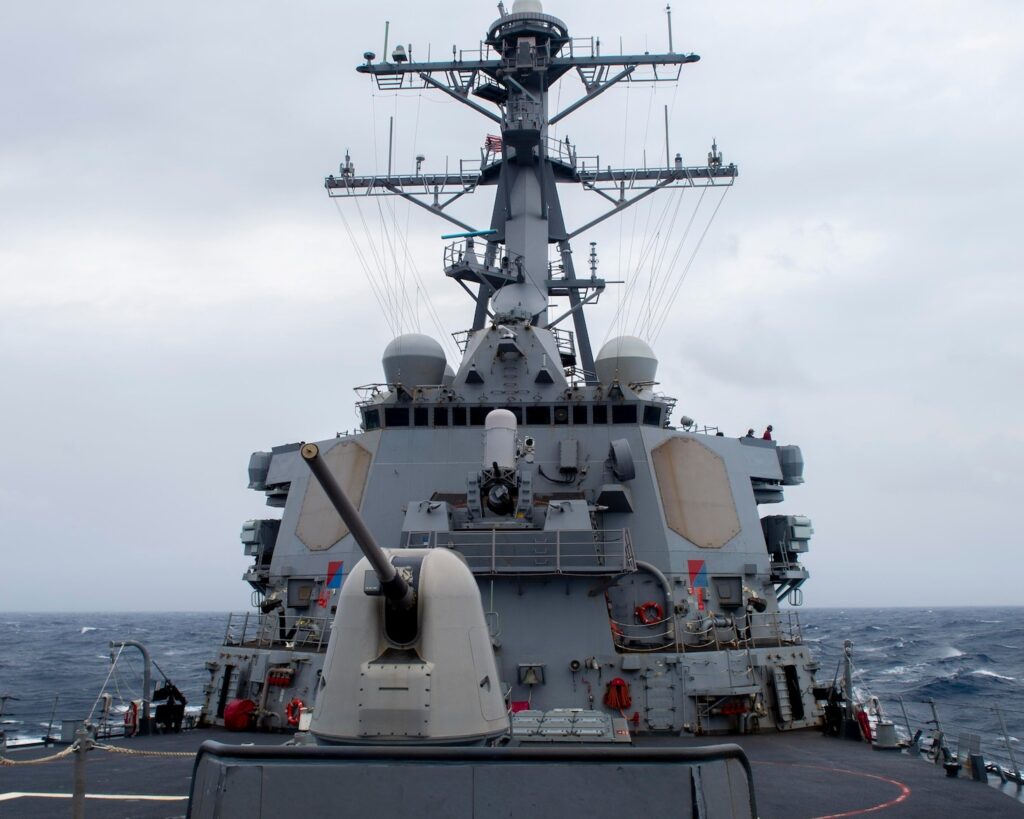
PASCAGOULA, Miss., Sept. 26, 2023 (GLOBE NEWSWIRE) — The first Flight III Arleigh Burke-class guided-missile destroyer Jack H. Lucas (DDG 125) departed HII’s (NYSE: HII) Ingalls Shipbuilding division Tuesday. DDG 125 will be commissioned Oct. 7, 2023 at a ceremony in Tampa, Florida, before sailing to its homeport in San Diego. 

“Watching Jack H. Lucas sail away is a proud moment for our entire DDG shipbuilding team,” Ingalls Shipbuilding DDG Program Manager Ben Barnett said. “Our shipbuilders will follow this first Flight III destroyer with honor as it joins the fleet as one of the most highly capable destroyers we have delivered.” 

Ingalls has delivered 35 Arleigh Burke-class destroyers to the U.S. Navy including the Jack H.Lucas (DDG 125), in June of this year. Additionally, Ingalls has four other Flight III destroyers currently under construction including Ted Stevens (DDG 128), Jeremiah Denton (DDG 129), George M. Neal (DDG 131) and Sam Nunn (DDG 133). 

Flight III Arleigh Burke-class destroyers incorporate a number of design modifications that collectively provide significantly enhanced capability. DDG 125 includes the AN/SPY-6(V)1 Air and Missile Defense Radar (AMDR) and the Aegis Baseline 10 Combat System that are designed to keep pace with the threats well into the 21st century. 

Photos accompanying this release are available at: https://hii.com/news/hii-ingalls-shipbuilding-jack-h-lucas-ddg-125-sailaway-2023

Arleigh Burke-class destroyers are highly capable, multi-mission ships and can conduct a variety of operations, from peacetime presence and crisis management to sea control and power projection. Guided missile destroyers are the backbone of the U.S. surface fleet and are capable of fighting multiple air, surface and subsurface threats simultaneously. 


SECNAV Del Toro Calls for a New, Bold Maritime Statecraft in Era of Intense Strategic Competition 

Release from Secretary of the Navy Public Affairs 

***** 

Sept. 26, 2023 

Secretary of the Navy Carlos Del Toro today called for a “new maritime statecraft” to prevail in an era of intense strategic competition, during remarks at the John F. Kennedy School of Government at Harvard University, Sept. 26.  
 
During his speech, Secretary Del Toro stated that maritime statecraft, in a broad sense, encompasses not only naval diplomacy, but a national, whole-of-government effort to build comprehensive U.S. and allied maritime power, both commercial and naval. 

Read the Full Release Here: 

https://www.navy.mil/Press-Office/Speeches/display-speeches/Article/3538420/secnav-delivers-remarks-at-harvard-kennedy-school/


Fairbanks Morse Defense Teams with Massa Products Corporation and Industrias Ferri S.A. to Expand Product, Service Capabilities

Release from Fairbanks Morse 

***** 

BELOIT, Wis.September 26, 2023 – Fairbanks Morse Defense (FMD), a portfolio company of Arcline Investment Management (Arcline), is expanding its product and service capabilities through agreements with Massa Products Corporation (Massa) and Industrias Ferri S.A. (Ferri).   

Through its exclusive North American maritime defense agreement with Massa, a longstanding leader in cutting-edge design and manufacturing of sonar and ultrasonic products, Fairbanks Morse Defense expands its service capabilities with sonar transducer systems, cables, and connectors.  

“Massa Products Corporation is excited to collaborate with FMD,” said Dawn F. Massa Stancavish, President/CEO & CINO, Massa Products Corporation. “We feel that competency is our bond at a time when our Navy needs to count on the industry to deliver high-quality reliable products and services in real-time.”  

Industrias Ferri S.A. has supported maritime industry clients as a leading manufacturer of deck equipment and auxiliary machinery for over five decades. This sales and service agreement will expand the breadth of product and service offerings of Fairbanks Morse Defense by bolstering the company’s ability to provide U.S. Navy, Military Sealift Command, and U.S. Coast Guard customers with OEM equipment, parts, overhauls, and other services for accommodation ladders, gangways, and other deck machinery.  

“Ferri is dedicated to providing high-quality manufacturing and support to the maritime industry. We have developed our technical expertise for over 50 years, and we look forward to bringing this knowledge and skill to our new collaboration with Fairbanks Morse Defense,” said Patricio Fernández, CEO, Industrias Ferri S.A. 

In addition to providing support for turnkey service solutions for Fairbanks Morse Defense customers, Massa and Ferri will have access to FMD’s global network of highly trained field service technicians and the defense contractor’s strategically located service centers.  

“Massa and Ferri are highly respected leaders in their fields, and our collaborations with them increase our ability to respond quickly to our customer’s needs with the right parts, services, and maintenance so they are always mission ready,” said Jay McFadyen, Chief Commercial Officer and President of FMD Services.  

Fairbanks Morse Defense currently powers more than 80% of the Navy’s ships with medium-speed applications. The defense contractor has rapidly expanded its array of best-in-class marine technologies, OEM parts, and turnkey services for marine defense customers through expansion and the acquisitions of companies such as Ward Leonard, Hunt Valve, Maxim Watermakers, Federal Equipment Company, Research Tool & Die, and Welin Lambie. Additional exclusive product and service capability agreements can be found on the Fairbanks Morse Defense website.  


HENSOLDT Provides US Coast Guard with Naval Radars

Release from HENSOLDT 

***** 

Follow-on contract to equip Legend-class National Security Cutters 

ULM, Germany – 25 September 2023 – Sensor solutions provider HENSOLDT is equipping the US Coast Guard’s Legend-class National Security Cutter (NSC) with its proven TRS-3D multi-mode naval radar. The US Coast Guard awarded HENSOLDT a follow-on contract worth approximately $10 million to deliver a further radar in its latest ‘Baseline D’ version to be installed at the Coast Guard training center (TRACEN), Petaluma, California. Up to now, HENSOLDT has delivered 12 radars to the US Coast Guard’s NSC program. 

“With more than 50 radars in service with Coast Guards and Navies worldwide, our TRS-3D naval radar has proven itself”, HENSOLDT CEO Thomas Müller says. “We are making sure that our customers capitalize on continuous technology enhancements.” 

The TRS-3D Baseline D, with the US designation AN/SPS-75, utilizes gallium nitride (GaN) and solid-state emitter technology to deliver traditional TRS-3D robust performance while improving reliability and options for future development. HENSOLDT’s TRS-3D radars have been aboard every NSC since the program’s inception. TRS-3D is a three-dimensional, multi-mode naval radar for air and surface surveillance, target acquisition, self-defense, gunfire support and aircraft control. It automatically detects and tracks all types of air and sea targets, alleviating crew workload requirements. 

HENSOLDT has decades of experience in radar and actively drives the further development of key technologies in this field. In addition to naval and ground-based air defence radars, the company’s portfolio also includes fighter radars as well as ground surveillance and space radars. 


USS Bunker Hill Decommissioned 

SAN DIEGO (Sept. 22, 2023) – The crew of the Ticonderoga class guided-missile cruiser USS Bunker Hill (CG 52) stand at attention during the ship’s decommissioning ceremony. Bunker Hill was decommissioned after more than 37 years of distinguished service. Commissioned Sept. 20, 1986, Bunker Hill served in the U.S. Pacific Fleet and supported Operation Desert Shield, Operation Desert Storm, and participated in the establishment of Operation Southern Watch. (U.S. Navy photo by Mass Communication Specialist 2nd Class Claire M. DuBois)

Commander, Naval Surface Force, U.S. Pacific Fleet

*****

From Julie Ann Ripley  

22 September 2023 

SAN DIEGO — USS Bunker Hill (CG 52), the 11th ship of the Ticonderoga class guided-missile cruiser, recognized more than 37 years of naval service during a decommissioning ceremony at Naval Base San Diego, Sept. 22. 

During the ceremony guest speaker, Bunker Hill’s second commanding officer, Vice Adm. Rodney Rempt, USN, Ret., wished the current crew fair winds and following seas as they bid farewell to their ship. 
 
Bunker Hill’s final commanding officer, Capt. Jason Rogers reflected on the service of his crew and those who came before, addressing the decommissioning of this distinguished vessel. 
 
“With great pride, I acknowledge the dedication and valor of the sailors who served aboard this ship for the past 37 years,” said Rogers. “The USS Bunker Hill’s legacy is a testament to our commitment to national security. As we lower the flag one final time, we honor the past while embracing the Navy’s future. Our sailors’ unwavering dedication and the ship’s service will never be forgotten. Today’s decommissioning ceremony, September 22, 2023, marks the end of an era, but the spirit of Bunker Hill lives on in all of us.” 
 
Capt. Rogers also retired from active service during the ceremony. Marine 1st Lt. Mathieu Rogers, assigned to 1st Marine Regiment, 1st Marine Division, reflected on his father’s lifelong guidance. “You demonstrated that finding your passion and sticking to it, not giving up,” said 1st Lt. Rogers turning to his father, “is not only a rewarding thing to do, it’s the right thing to do.” 
 
Bunker Hill maintained a crew of 40 officers, 31 chiefs, and 300 enlisted Sailors. The ship was built in Pascagoula, Mississippi, by Ingalls Shipyard Company and commissioned Sept. 20, 1986, at Charlestown in Boston. It was the first U.S. surface warship to be equipped with the below-deck, advanced MK 41 Vertical Launching System (VLS), a multi-warfare missile-launching system capable of striking targets in the air, on and under the ocean surface, and on land. 
 
Bunker Hill operated in the North Arabian Sea and Gulf of Oman, supporting 10 Earnest Will convoys in 1987. The ship arrived in its new homeport of Naval Base Yokosuka, Japan the following year. At the end of January 1991 the ship launched its first Tomahawk Land Attack Missiles (TLAMs), a total of 28, against targets in Iraq from its station in the North Arabian Gulf, in support of Operation Desert Storm. It also supported Operations Desert Shield. In 2008, it was one of the Coalition ships from the British-led Combined Task Force (CTF) 150 maintaining a presence off the east coast of Africa in response to the recent events in Somalia. The following year it was the first guided-missile cruiser to receive a complete set of upgrades as part of the Navy’s Cruiser Modernization program including a new Aegis Weapons System, the Cooperative Engagement Capability (CEC), and SPQ-9B Radar. The guided-missile cruiser made full speed from off the coast of Panama to reach Haiti, joining U.S. military efforts on the Caribbean island devastated by a massive earthquake in 2010. 
 
The first and second U.S. Navy ships named Bunker Hill honored the Revolutionary War battle fought primarily on adjacent Breed’s Hill at Charlestown, Massachusetts, on June 17, 1775. 
 
The battle occurred in the midst of the larger siege of the city of Boston, when the Americans learned that the British intended to deploy troops to some of the heights surrounding the city in order to command its vital harbor. Nearly 1,200 patriots marched stealthily onto the peninsula on the night of the 16th and 17th and dug defensive positions. Despite the colonists’ secrecy, the British detected the move and their ships and batteries opened fire on the positions while they landed troops to carry the newly established works. American reinforcements during the battle raised their strength to about 2,400 men, and the British to more than 3,000, though not all the men on either side took a direct part in the fighting. American snipers in Charlestown harassed the British until their ships fired incendiary shot that set much of the town ablaze. In the meanwhile, the British resolutely assaulted the colonist’s positions twice, and both times the patriots, with equal resolution, fired into the regulars and Royal Marines and scythed them down. The British regrouped and attacked a third time as the patriots began to run out of ammunition, and finally drove the Americans back at the point of the bayonet. The Americans inflicted twice the number of casualties on their assailants—an estimated 450 patriots fell as opposed to 1,054 regulars and Royal Marines. The colonist’s valiant defiance imbued them with confidence that they could stand up to the British, while the crown’s losses shook their officers and they often maneuvered prudently to avoid direct assaults against entrenched patriots in subsequent battles. 
 
The decommissioning of CG 52 supports department-wide business process reform initiatives to free up time, resources, and manpower in support of increased lethality. 
 
Modern U.S. Navy guided-missile cruisers perform primarily in a Battle Force role. These ships are multi-mission surface combatants capable of supporting carrier battle groups, amphibious forces or operating independently and as flagships of surface action groups. Cruisers are equipped with Tomahawk cruise missiles giving them additional long range strike warfare capability. Some Aegis Cruisers have been outfitted with a Ballistic Missile Defense (BMD) capability. 
 
The mission of CNSP is to man, train, and equip the Surface Force to provide fleet commanders with credible naval power to control the sea and project power ashore. 


VCNO Hosts 25th International Seapower Symposium in Newport 

Vice Chief of Naval Operations Adm. Lisa Franchetti welcomed international heads of Navy and Coast Guard from nearly 100 nations at the U.S. Naval War College in Newport, Rhode Island, September 19-22, for the 25th International Seapower Symposium (ISS). 

Release from the Office of Navy Information 

*****

NEWPORT, R.I. – Vice Chief of Naval Operations Adm. Lisa Franchetti welcomed international heads of Navy and Coast Guard from nearly 100 nations at the U.S. Naval War College in Newport, Rhode Island, September 19-22, for the 25th International Seapower Symposium (ISS). 

First held in Newport in 1969, and biennially thereafter, ISS offers a forum for dialogue between international navies, coast guards, and the Marine Corps to bolster maritime security by providing opportunities to collaborate, develop trust, and further navy-to-navy training. 

“Every Navy and Coast Guard represented here contributes to the stability of the global maritime commons,” said Franchetti. “Whether you are countering drug trafficking, human smuggling, illicit weapons transfers, illegal and unregulated fishing or piracy, policing territorial waters, delivering humanitarian aid, food, or medicine to people in need, assisting mariners stranded at sea, escorting cargo transports or tankers, or deploying forces forward, each nation here is a vital link in the chain that forms the global maritime security network.” 

Throughout this year’s symposium, themed “Security Through Partnership,” panels and speakers highlighted the multinational role of allies and partners in competition, crisis, and conflict. 

“We have the opportunity to choose engagement over withdrawal, to promote integration over fragmentation, to favor inclusion over exclusion, to champion collaboration over protectionism, and to choose principles over sheer power, as the basis for a partnership that benefits everyone,” said Franchetti. 

In addition to VCNO, delegates heard remarks from Secretary of the Navy Carlos Del Toro, U.S. Ambassador to Australia Caroline Kennedy, and U.S. Naval War College President Rear Adm. Peter Garvin. 

“The United States has always been a maritime nation,” said Kennedy. “From our earliest days, our history was shaped by the sea. As an Atlantic and Pacific power dependent on trade and commerce, the U.S. Navy has always been at the center of our national identity, working to explore and understand the oceans, and keep the seas free and open for all.” 

The symposium included three regional briefs, four panels, and featured delegates from more than 35 countries through a variety of presentations throughout the week. 

Some topics and interest areas discussed included seabed infrastructure; illegal, unreported, and unregulated maritime activity; artificial intelligence; and people. Secretary Del Toro conveyed the significance of discussing these topics as a group. 

“It’s important to recognize that the dialogues we had this week doesn’t end at the closing ceremony. Our entire department is excited to continue engaging with each nation long after we leave Newport,” said Del Toro. “It’s in our collective interest to work together in defense of our shared ideals and preserve a maritime common that is free and open for all to use for the benefit of every nation around the globe.” 

The War College also hosted a technology demonstration consisting of seven exhibit stations showcasing cutting edge U.S. Navy unmanned technology capabilities. ISS delegates had the opportunity to witness real-world applications for selected equipment, gaining concrete technical knowledge, and interacting directly with U.S. Navy subject matter experts. 

As the week concluded, Franchetti thanked the delegates and their spouses for their trust and confidence in the U.S. Navy as a maritime partner. 

“The United States Navy is truly honored to have been able to host you here in Newport, and it was a great privilege for me personally to have spent the last few days with you,” remarked Franchetti. “This symposium is one of the most important events our Navy does, and it’s so meaningful because all of you choose to invest your time and share your thoughts with one another.” 

The next International Seapower Symposium will be held in Newport in 2025.