Navy UAS Surpass 1 Million Hours in ISR Operations
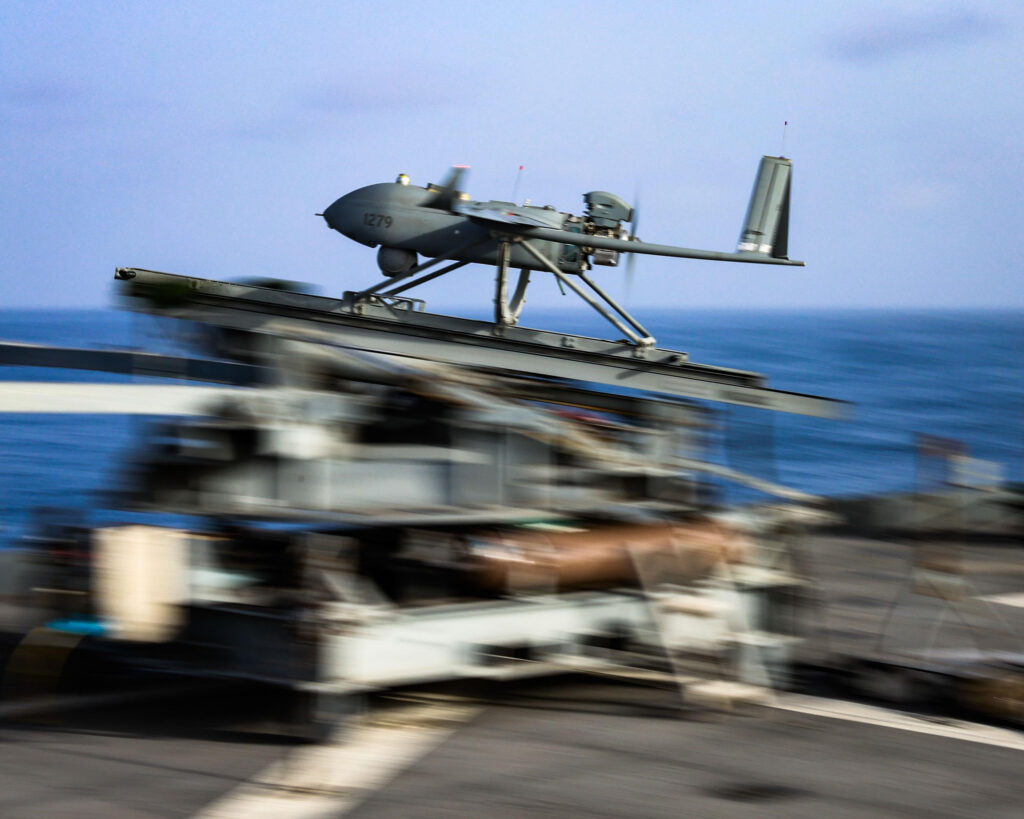
A Textron MQ-19 Aerosonde Unmanned Aircraft System launches from the expeditionary sea base ship USS Hershel “Woody” Williams (ESB-4).
From the Navy and Marine Corps Small Tactical Unmanned Aircraft Systems Program Office, April 9, 2026
PATUXENT RIVER, Md. – The Navy and Marine Corps Small Tactical Unmanned Aircraft Systems (UAS) Program Office announced its Intelligence, Surveillance and Reconnaissance (ISR) Services UAS have surpassed 1 million flight hours supporting operations on land and at sea.
Sailors achieved the milestone during routine mission support in the U.S. 6th Fleet.
Since the program’s inception in 2005, the program office has completed more than 50 UAS installations aboard Navy and Military Sealift Command (MSC) ships and operated from more than 50 land-based locations worldwide. The ISR Services team ensures ships across the 4th, 5th, 6th and 7th fleets, as well as land-based operations worldwide, are equipped to provide day-and-night ISR support to joint force and coalition partners.
“Every hour flown represents more than mission success—it reflects the resilience of our people, the trust of our partners and the impact we’ve had on history,” said Gregg Skinner, program manager. “Together, we’ve supported operations in every corner of the globe, advanced unmanned systems into the fight and stood ready in times of uncertainty.”
More than a dozen ships are currently equipped with ISR Services UAS, enabling naval vessels to launch and recover aircraft in support of missions. Sea- and land-based systems include the Boeing Insitu MQ-27 ScanEagle and the Textron MQ-19 Aerosonde, both providing day-and-night surveillance and around-the-clock mission support to the warfighter.
UAS installations are optimized to help transfer full-motion video and other sensor data to personnel in critical locations. The information gathered by these systems plays a vital role in tactical operational decision-making and long-term intelligence gathering, strengthening the Navy and Marine Corps’ ability to maintain maritime domain awareness and operational readiness.
NRL’s Advanced Payloads Soar into Orbit Aboard STPSat-7 Mission
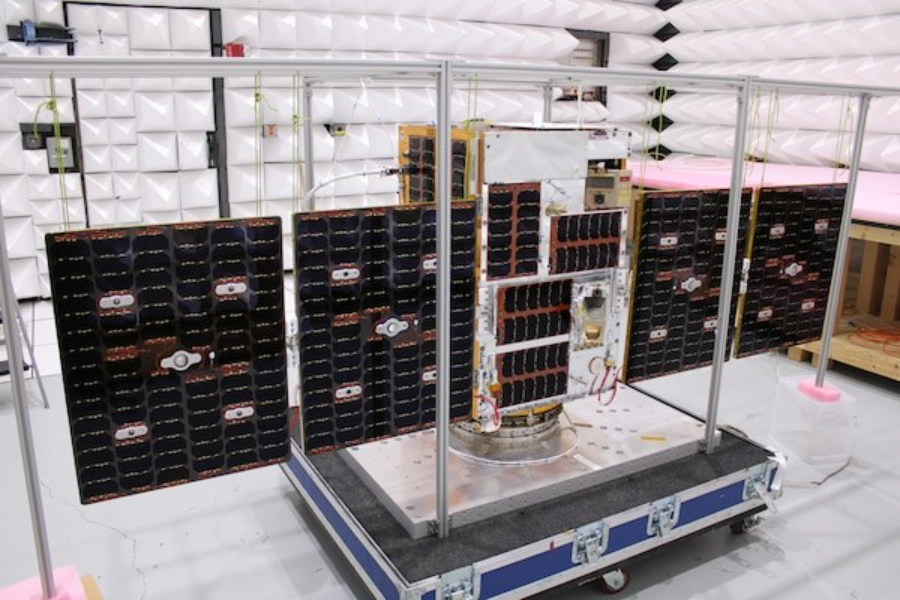
Department of War (DoW) Space Test Program’s (STP) STPSat-7 payload, at NASA Marshall Space Flight Center, Huntsville, Ala., June 25, 2025. (Photo by DoW Space Test Program)
From Emily Winget U.S. Naval Research Laboratory Corporate Communications, April 7, 2026
WASHINGTON,D.C. – U.S. Naval Research Laboratory (NRL) successfully launched three advanced experimental payloads aboard the Department of War (DoW) Space Test Program’s (STP) Satellite-7 mission at approximately 4:33 a.m. PDT on April 7 from Vandenberg U.S. Space Force (USSF) Base, Calif.
NRL’s payloads included the Lasersheet Anomaly Resolution and Debris Observation (LARADO) instrument; the Global Navigation Satellite System (GNSS) Orbiting Situational Awareness Sensor (GOSAS); and the Gadolinium Aluminum Gallium Garnet (GAGG) Radiation Instrument (GARI-1C).
The STPSat-7 spacecraft is aboard the STP-S29A mission, which uses a Northrop Grumman Minotaur IV launch vehicle, marking a significant step forward in advancing U.S. space-based capabilities for the U.S. Navy and national security. By improving understanding of the space environment and testing next-generation satellite technologies, NRL is ensuring the United States maintains its technological advantage and protects critical assets in orbit.
LARADO
One of the key NRL payloads, LARADO will directly address the growing threat of orbital debris.
“LARADO is the next step in ensuring situational awareness in space,” said Andrew Nicholas, NRL Sensor Development and Applications Section Head and LARADO principal investigator. “The instrument will detect and characterize small orbital debris that cannot be observed from the ground. This is vital to understanding the space environment and will provide essential data to update orbital debris models. These updates are important to the orbital debris research community, engineers designing spacecraft to survive and minimize growth to the debris environment, satellite operators, and policy makers.”
The LARADO concept began in 2012. In FY22, NASA’s Heliophysics Division Space Weather Program’s Orbital Debris and Space Situational Awareness portfolio within its Science Mission Directorate began funding the development of the LARADO instrument for STPSat-7.
GOSAS
GOSAS will improve the reliability of navigation and communication systems for warfighters.
“The GOSAS is a CubeSat-compatible, programmable dual GPS receiver designed to characterize the orbital GNSS environment and produce high quality ionospheric space weather products,” said Scott Budzien, Ph.D., NRL research physicist and GOSAS principal investigator. “Understanding and predicting space weather is critical for ensuring the accuracy of GPS and the integrity of military communications.”
GOSAS is a follow-on to the NRL experiment GROUP-C (GPS Radio Occultation and Ultraviolet Photometry-Collocated) experiment on the International Space Station from 2017-2023 that serendipitously detected GPS ground interference. GOSAS originated in 2020 with the mission of increasing GPS accuracy for the warfighter.
GARI-1C
GARI-1C is set to pave the way for future defense applications from space, including detecting weapons of mass destruction. The NRL team takes technology developed for ground-based applications and tests its performance in space. Since most commercial-off-the-shelf components are not radiation-hardened, understanding how they respond to the harsh radiation environment of space is critical for future operational use.
“GARI-1C is designed to space-qualify new gamma-ray detector technology for space-based defense applications,” stated Lee Mitchell, Ph.D., NRL Research Physicist and GARI-1C principal investigator. “This detector technology offers improved energy resolution, lower power consumption and reduced size compared to similar systems, which is key to developing more advanced and efficient sensors for detecting threats from orbit.”
The DoD/DoW Space Test Program (STP) was founded in 1966 to provide flight opportunities for all DoD/DoW research and development activities in an economic and efficient manner. Under the U.S. Space Systems Command, STP supports mission design, payload-to-bus integration, space vehicle-to-launch vehicle integration, and on-orbit operations for S&T payloads that exhibit potential military utility. By advancing scientific knowledge and capability, STP is foundational to ensuring continuous STP advantage in the space domain.
“The success of this mission, achieved through a powerful collaboration with the DoW’s Space Test Program, highlights how cutting-edge research and development are fundamental to preserving America’s strategic edge in space,” said USSF Lt. Col. Brian Shimek, system program manager and director for STP.
NRL’s Space Science Division conducts a broad-spectrum of Research, Development, Test & Evaluation in solar-terrestrial physics, astrophysics, upper and middle atmospheric science, and astronomy. The Division’s Military Deputy, Lt. Elijah Ray, is embedded with DoW STP at Kirtland Air Force Base, N.M., as NRL’s on-site liaison for space experiment coordination and advocacy.
About the U.S. Naval Research Laboratory NRL is a scientific and engineering command dedicated to research that drives innovative advances for the U.S. Navy and Marine Corps from the seafloor to space and in the information domain. NRL, located in Washington, D.C. with major field sites in Stennis Space Center, Mississippi; Key West, Florida; Monterey, California.
NRL offers several mechanisms for collaborating with the broader scientific community, within and outside of the Federal government. These include Cooperative Research and Development Agreements (CRADAs), LP-CRADAs, Educational Partnership Agreements, agreements under the authority of 10 USC 4892, licensing agreements, FAR contracts, and other applicable agreements.
U.S. Navy and Royal Danish Navy Conducted Medical Evacuation Near Greenland, Highlighting Arctic Interoperability
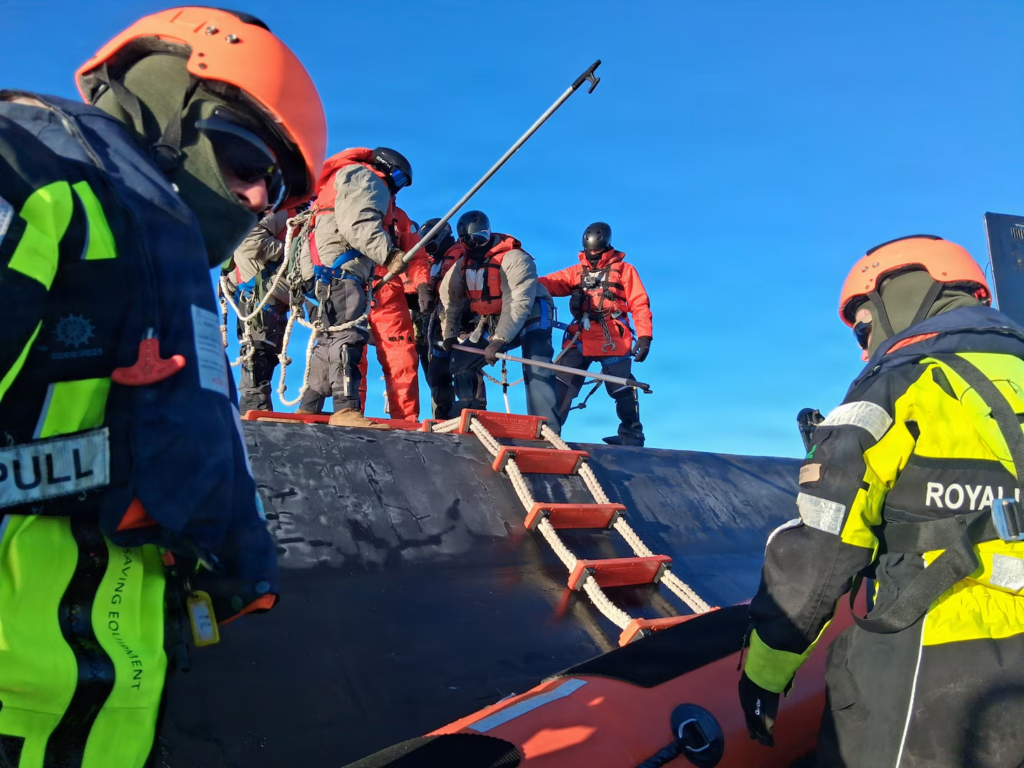
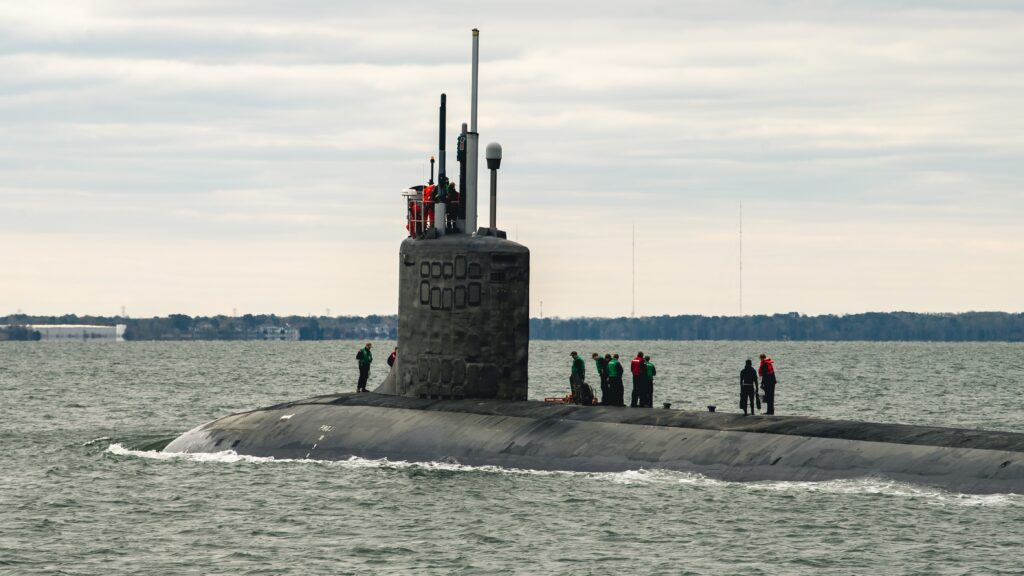
NUUK, Greenland (Feb. 21, 2026) – Members of the Royal Danish Navy assigned to the offshore patrol vessel HDMS VAEDDEREN (F 359) embark the Virginia-class fast-attack submarine USS Delaware (SSN 791) ) in preparation for a personnel transfer. Delaware is operating in the U.S. Naval Forces Northern Command (NAVNORTH) area of operations. NAVNORTH is the maritime component of U.S. Northern Command (USNORTHCOM) and is responsible for homeland defense, maritime security, and theater security cooperation in the Arctic and North American maritime approaches. (Courtesy photo)
PETERSON SFB, Colo.– A recent medical evacuation of a U.S. Navy Sailor off the coast of Greenland demonstrated the importance of international partnerships and readiness in the Arctic.
In late February, while preparing for Ice Camp 2026, a Sailor aboard the Virginia-class fast-attack submarine USS Delaware (SSN 791) required urgent medical attention. Severe weather conditions prevented evacuation to other locations, prompting the submarine to divert toward Greenland. U.S. naval forces coordinated with the Danish Joint Arctic Command, which dispatched the Royal Danish Navy offshore patrol vessel HDMS Vaedderen (F 359) to assist.
Crews from both nations worked together to transfer the Sailor at sea.
The MEDEVAC occurred as U.S. forces were preparing for Ice Camp 2026, an Arctic operation focused on testing and refining capabilities in the region. These efforts underscore the shared commitment of the U.S. and its allies to Arctic security and regional stability.
USS Ashland Completes Ship Wartime Repair and Maintenance in the Philippines
Hull Maintenance Technician 2nd Class Christian Deang, assigned to Southwest Regional Maintenance Center, welds a fan unit bracket aboard Whidbey Island-class dock landing ship USS Ashland (LSD 48) as part of ship wartime repair and maintenance exercise (SWARMEX) in Cebu, Philippines, March 25, 2026. (U.S. Navy photo by MCSN Maliq J. Martin)
From USS Ashland Public Affairs, April 6, 2026
Whidbey Island-class amphibious dock landing ship USS Ashland (LSD 48) completed a ship wartime repair and maintenance exercise (SWARMEX), April 5, as part of its scheduled port visit to Cebu.
These exercises are routinely conducted to maintain readiness and proficiency. This iteration follows Arleigh Burke-class guided-missile destroyer USS Pinckney (DDG 91) in Singapore in February 2026, demonstrating Ashland’s ability to conduct maintenance and repair while forward deployed and away from homeport.
“This exercise allowed us to work shoulder-to-shoulder with our Philippine allies to conduct complex repairs while keeping USS Ashland ready to respond to any contingency in the region,” said Cmdr. Adam Peeples, Ashland’s commanding officer. “We cannot thank the Philippines enough for their gracious hospitality, and our visit signifies the unwavering resolve our two nations share in preserving a free and open Indo-Pacific.”
SWARMEX consisted of three distinct, concurrent elements: expeditionary repair availability, battle damage assessment and repair table-top exercise, and continuous maintenance availability.
“Our Sailors really came together as a team to meet the challenges of this exercise,” said Peeples. “The skills we learned increase our capability to keep USS Ashland in top material condition and help our forces maintain peace through strength.”
Ashland and embarked Marines from I Marine Expeditionary Force make up Task Force Ashland (TF Ashland), which is conducting routine operations in U.S. 7th Fleet. TF Ashland is a flexible, purpose-built task force that can operate independently or integrate with other naval assets, showcasing a key component of Distributed Maritime Operations (DMO). This model provides combatant commanders with more options to maintain presence and build partner capacity.
U.S. 7th Fleet, the Navy’s largest forward-deployed numbered fleet, routinely interacts and operates with allies and partners in supporting peace, stability, and prosperity and preserving a free and open Indo-Pacific region.
HII Redelivers USS New Jersey from Post-Shakedown Availability
NEWPORT NEWS, Va., April 03, 2026 (GLOBE NEWSWIRE) — HII’s (NYSE: HII) Newport News Shipbuilding division has completed post-shakedown availability (PSA) work on Virginia-class fast attack submarine USS New Jersey (SSN 796). The submarine was redelivered to the U.S. Navy Friday.
“Maintaining our nation’s undersea maritime supremacy is strengthened by the redelivery of USS New Jersey,” said Jason Ward, NNS vice president of new construction submarine programs. “Our combined NNS-Navy team is focused on the mission and understands the importance of getting this submarine to the fleet.”
The PSA, a maintenance period that typically follows delivery of new ships, included combat systems and electronics upgrades, as well as general maintenance on the submarine.
Norfolk Naval Shipyard Undocks USS John Warner
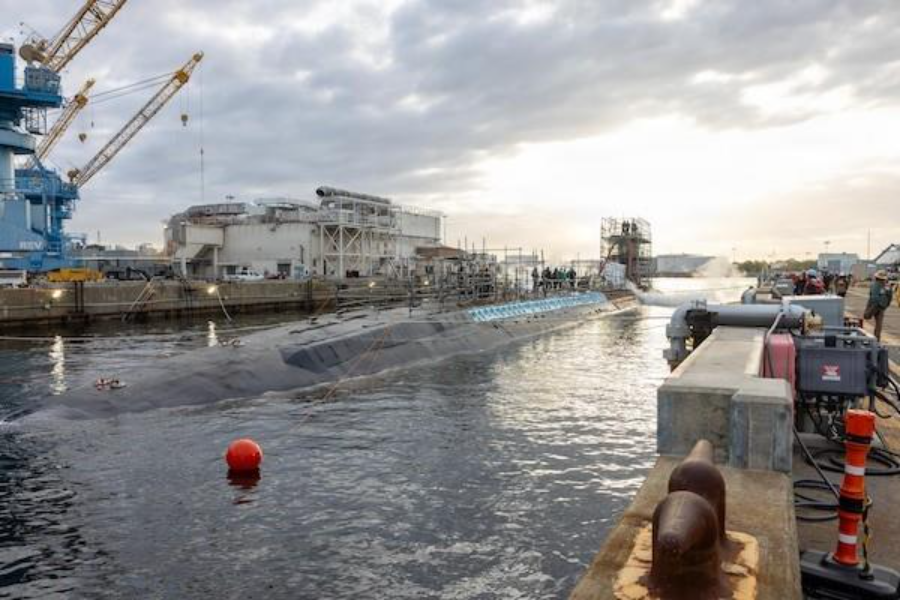
Norfolk Naval Shipyard (NNSY) successfully undocked USS John Warner (SSN 785) last month, meeting a major milestone in the Virginia-class submarine’s Extended Drydocking Selected Restricted Availability (EDSRA). (Photo by Daniel DeAngelis)
From Michael D Brayshaw, Norfolk Naval Shipyard, April 2, 2026
Norfolk Naval Shipyard (NNSY) successfully undocked USS John Warner (SSN 785) last month, meeting a major milestone in the Virginia-class submarine’s Extended Drydocking Selected Restricted Availability (EDSRA).
During an EDSRA, the submarine is drydocked to undergo hull, propulsion system, and modernization upgrades, allowing the submarine to remain fully operational for its planned service life. Virginia-class submarines are critical vessels in maintaining national security given their operational versatility and nuclear-powered fast attack capability.
John Warner has been a pivotal availability for the Navy as the first Virginia class Block III drydocking at any of the nation’s four public shipyards. Block III refers to the redesigned submarines procured during the third Virginia-class acquisition contract.
NNSY’s preparations for John Warner involved extensive teaming and knowledge sharing with Portsmouth Naval Shipyard and Pearl Harbor Naval Shipyard and Intermediate Maintenance Facility, having previously executed Virginia-class CNO availabilities.
“NNSY’s commitment to learn and reach out for knowledge from the other shipyards for critical work evolutions has been a major key to the success of the project,” said Charles Brock, NNSY Submarine Program Manager. “The Virginia-class shipyard community is a very close-knit group that leans in to help one another. Because this is the first Block III EDSRA for the corporation there were many opportunities where NNSY was able to share lessons learned with the other shipyards to help them as well. Additionally, the team’s drive to work all possible solutions and then execute the best one was critical.”
In a demonstration of the shipyard’s ability to adapt and overcome first-time challenges, John Warner undocked with the crew able to move back aboard, mast and periscope installation completed, and command and control system testing started, a trifecta feat not accomplished on a submarine availability at NNSY since 2001.
“The powerful collaboration between our crew and the shipyard delivered the most materially ready submarine I’ve undocked,” said Cmdr. Nicholas Tuuk, John Warner commanding officer. “This achievement allows us to now fully focus on forging a crew of master submariners, ready to execute any mission when we return to the fleet.”
Undocking with more than 95 percent of the production work complete, remaining availability work will focus on testing and crew readiness to support critical operations and sea trials.
NNSY established a Submarine Maintenance Operations Center (SMOC) Detachment in 2025 to provide timely depot-maintenance submarine deliveries back to the fleet. The SMOC assists project teams including John Warner’s in resolving issues such as material and resource needs, work package modifications, and technical adjudication. By aligning resources with readiness priorities, the Navy is able to provide more available ships and submarines to defend US interests globally and support critical operations.
“Clearly identifying the project’s needs and expecting a reciprocal response and commitment has been one of the key elements to the success of John Warner,” said Brock. “It has kept the team and all support aligned to what was needed and when it was needed. Additionally, the team employed a process of setting aggressive goals with specific dates to steer the shipyard in the direction needed to complete these major key events.”
“It’s a great win for our shipyard and Navy taking such a huge step toward delivering a Virginia-class submarine back to the fleet and ready to meet the mission,” said Rear Adm. Kavon Hakimzadeh, shipyard commander. “I thank everyone for their efforts so far and we now rally around John Warner to urgently complete all remaining work as a committed team to return this critical asset supporting our nation’s warfighting readiness.”
Commissioned on Aug. 1, 2015, John Warner is the 12th Virginia-class attack submarine and the first ship bearing the name of Senator John Warner who served the Commonwealth of Virginia for three decades until his retirement in 2009. Warner also served as Chairman of the Senate Armed Services Committee from 1999 to 2001, and again from 2003 to 2007.
As one of the largest, most historic and multifaceted shipyards in the nation, Norfolk Naval Shipyard’s mission is to repair, modernize and inactivate Navy warships and training platforms to maximize readiness and availability for fleet tasking.
Former Sen. Sam Nunn Visits Ingalls Shipbuilding for Update on His Namesake Destroyer
From HII
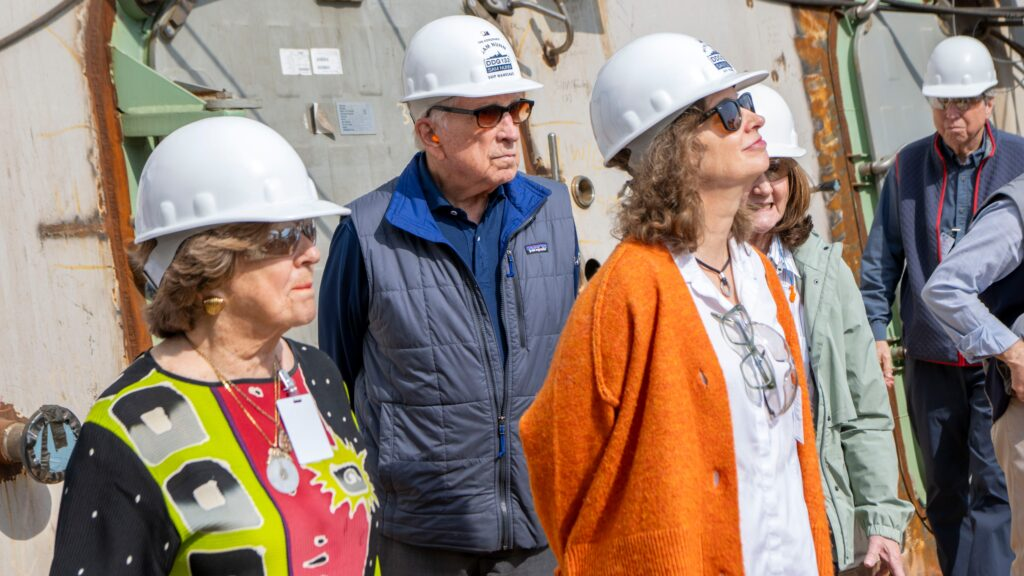
PASCAGOULA, Miss., April 03, 2026 (GLOBE NEWSWIRE) — HII’s (NYSE: HII) Ingalls Shipbuilding division recently welcomed former U.S. Sen. Sam Nunn, his wife, Colleen Nunn, and their daughter and ship sponsor Michelle Nunn, for a visit to the shipyard. The visit included a construction update and tour of the future USS Sam Nunn (DDG 133), a Flight III Arleigh Burke-class destroyer named in honor of the senator, and marked their return to Ingalls following the ship’s keel authentication ceremony.
“It was an honor to welcome Sen. Nunn and Michelle Nunn to Ingalls to see first-hand the progress taking place on DDG 133 and to highlight the ship’s advancing construction path toward launch,” Ingalls Shipbuilding President Brian Blanchette said. “Our shipbuilders take tremendous pride in building a ship that will carry Sen. Nunn’s name and his legacy of enduring commitment to national defense.”
During the 24 years of service in the U.S. Senate, Nunn became one of the nation’s most influential voices on defense policy. He spearheaded major initiatives including Department of Defense Reorganization Act and the NunnLugar Cooperative Threat Reduction Program, which led to the deactivation of more than 7,600 nuclear warheads from former Soviet Union republics. The future USS Sam Nunn honors this legacy of strengthening America’s defense and advancing global security.
Nunn expressed appreciation for the shipbuilders working to bring DDG 133 to life. “It is exciting and deeply humbling to see this powerful destroyer taking shape and to witness the exceptional craftsmanship of the Ingalls team,” Nunn said. “I am grateful for the vital role Ingalls plays in ensuring our nation’s strength and readiness.”
Future USS Sam Nunn (DDG 133) is the fifth Flight III Arleigh Burke-class destroyer to be built at Ingalls. Flight III destroyers incorporate substantial design and system upgrades including the AN/SPY 6(V)1 Air and Missile Defense Radar and the Aegis Baseline 10 Combat System that significantly enhance the U.S. Navy’s integrated air and missile defense capabilities and ensure readiness against evolving threats well into the 21st century.
To date, Ingalls Shipbuilding has delivered 36 Arleigh Burke-class destroyers to the U.S. Navy, including the first Flight III, USS Jack H. Lucas (DDG 125) and Ted Stevens (DDG 128). The four Flight III destroyers currently under construction include: Jeremiah Denton (DDG 129), George M. Neal (DDG 131), Sam Nunn (DDG 133), and Thad Cochran (DDG 135). Additionally, Ingalls is in early pre-planning and material procurement phases for John F. Lehman (DDG 137), Telesforo Trinidad (DDG 139), Ernest E. Evans (DDG 141), Charles French (DDG 142), Richard J. Danzig (DDG 143), Intrepid (DDG 145) and Robert Kerrey (DDG 146).
HII’s Ingalls Shipbuilding Launches Guided Missile Destroyer George M. Neal
From HII, April 1, 2026
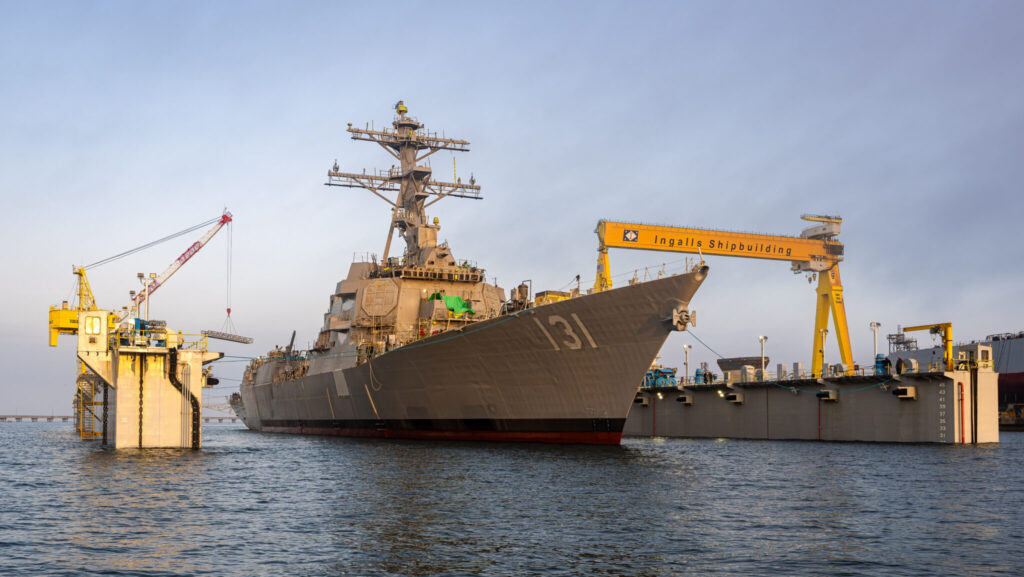
PASCAGOULA, Miss., April 01, 2026 (GLOBE NEWSWIRE) — HII’s (NYSE: HII) Ingalls Shipbuilding division successfully launched future USS George M. Neal (DDG 131) today, marking a major construction milestone for the fourth Flight III Arleigh Burke-class destroyer to be built at the shipyard.
In the weeks leading up to launch, shipbuilders completed key construction work, secured major components and performed inspections to ensure the ship was ready to enter the water. The ship was then translated from land into the dry dock, where teams conducted final checks before flooding the dock and allowing the destroyer to float for the first time.
“Launching DDG 131 is a direct reflection of the hard work and dedication of our Ingalls shipbuilders,” said Chris Brown, Ingalls Shipbuilding DDG 51 program manager. “Seeing the ship reach the water for the first time is a proud moment for everyone involved and a real testament to the people who make this work possible for our U.S. Navy.”
DDG 131 is named for George M. Neal, a Korean War veteran and an aviation machinist’s mate third class who was awarded the Navy Cross for his heroic actions while attempting to rescue a fellow service member under enemy fire.
As a Flight III Arleigh Burke-class destroyer, DDG 131 represents the next generation of surface combatants for the U.S. Navy, featuring the Flight III AN/SPY-6 (V)1 radar system and the Aegis Baseline 10 combat system, designed to counter threats well into the 21st century.
Following today’s launch, George M. Neal will move into the next phase of construction, which includes outfitting, systems activation and testing in preparation for sea trials.
Army and Navy Continue Tests of Hypersonic Missile
From the Department of War, April 2, 2026
The U.S. Army’s Portfolio Acquisition Executive Fires, in partnership with the U.S. Navy’s Portfolio Acquisition Executive Strategic Systems Programs, conducted a successful launch of a common hypersonic missile from Cape Canaveral Space Force Station, Florida, on March 26, 2026.
The Army and Navy partnership to field a common hypersonic missile across land- and sea-based platforms supports the National Defense Strategy by accelerating timelines, reducing costs, and delivering a highly survivable capability to defeat time-sensitive, heavily defended, and high-value targets at speeds exceeding Mach 5.
George H. W. Bush Carrier Strike Group Departs for Deployment
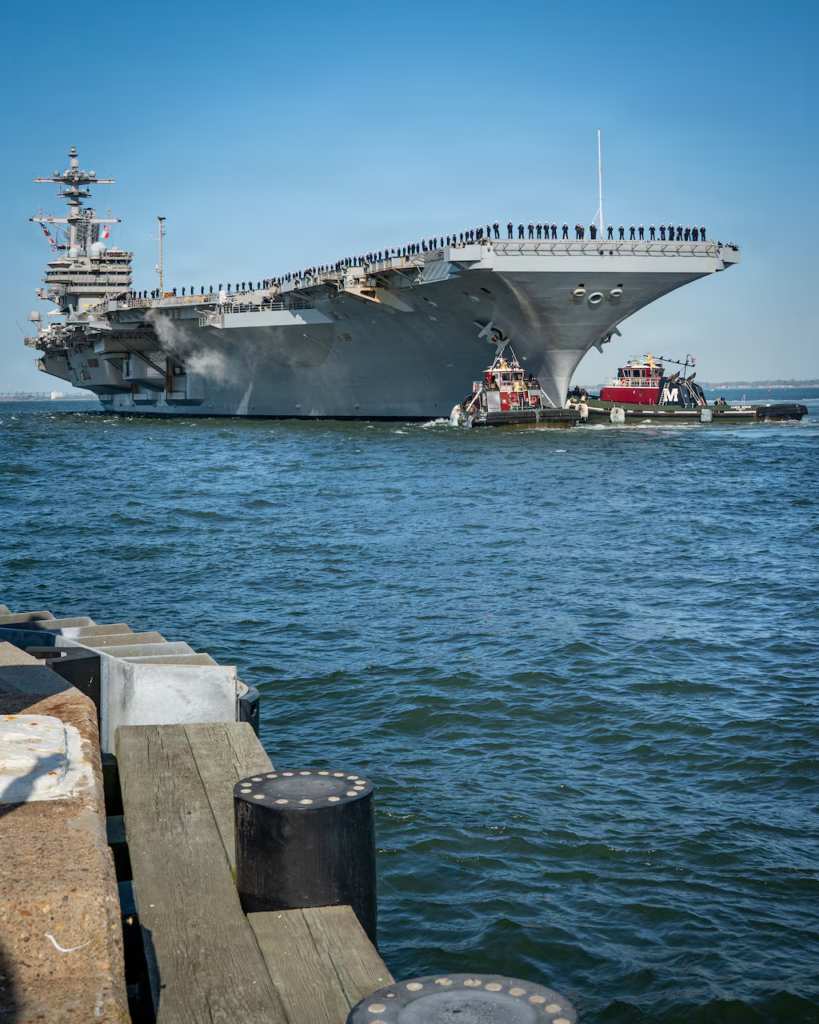
NORFOLK, Va. – The George H. W. Bush Carrier Strike Group (GHWBCSG) departed Norfolk for a regularly scheduled deployment, March 31, 2026.
“I am proud of every single member of this Strike Group. Our Sailors are ready and able to do the nation’s bidding,” said Rear Adm. Alexis T. Walker, commander, Carrier Strike Group Ten, embarked with the GHWBCSG.
GHWBCSG deploying ships consists of the flagship USS George H.W. Bush (CVN 77) and three Arleigh Burke-class destroyers: USS Ross (DDG 71), homeported in Norfolk, Va; USS Donald Cook (DDG 75) and USS Mason (DDG 87) homeported in Mayport, Fla. Mason is the GHWBCSG Air and Missile Defense Commander.
“The crew embodies our ship’s motto ‘Freedom at Work,'” said Capt. Bibeau, commanding officer of George H. W. Bush. “Our Sailors are exceptionally trained, highly motivated, ready to accomplish any assigned mission, and well poised to defeat any threat while deployed.”
Carrier Air Wing (CVW) 7 embarked on George H. W. Bush consists of nine aircraft squadrons: Strike Fighter Squadron (VFA) 83, “Rampagers,” Strike Fighter Squadron (VFA) 103, “Jolly Rogers,” Strike Fighter Squadron (VFA) 105, “Gunslingers,” Strike Fighter Squadron (VFA) 131, “Wildcats,” Electronic Attack Squadron (VAQ) 140, “Patriots,” Airborne Command and Control Squadron (VAW) 116, “Sun Kings,” Helicopter Sea Combat Squadron (HSC) 5, “Nightdippers,” Helicopter Maritime Strike Squadron (HSM) 46, “Grandmasters,” and Fleet Logistics Multi-Mission Squadron (VRM) 40, “Mighty Bison.”
GHWBCSG last deployed from August 2022 to April 2023 and spent the entirety of its deployment in the U.S. Naval Forces Europe–U.S. Naval Forces Africa area of operations. While in the Mediterranean, the ship participated in and supported a multitude of multinational exercises to increase NATO capability and deter aggression in the region.