USS OMMANEY BAY (CVE 79) DISCOVERY TO BE DISCUSSED AT ESCORT CARRIER HISTORY SYMPOSIUM
27 July 2023
For Immediate Release:

WASHINGTON, DC – The Naval Order of the United States (NOUS) National Capital Commandery welcomes the Escort Carrier Sailors and Airmen Association (ESCAA) to the nation’s capital for a planned final reunion convention which will feature a day-long symposium on Friday August 25, 2023.

Escort Carriers often dubbed “Jeep Carriers” came into existence during World War II, serving with both the U.S. and Royal Navies in the Battle of the Atlantic to deter German U-Boats attacks on cross-Atlantic convoys. They provided the backbone to what became known as Hunter-Killer groups. One such group, centered around the escort carrier Guadalcanal, would capture the German submarine U-505 on June 4, 1944. Escort carriers also served in the Pacific. During the Battle for Leyte Gulf, the Gambier Bay was sunk by enemy gunfire and a Kamikaze claimed St. Lo. On January 4, 1945, another Kamikaze claimed Ommaney Bay off the Philippines and this past July 10th, 2023, the Naval History and Heritage Command confirmed its discovery. A briefing on this discovery by Naval History and Heritage Command underwater archaeology staff is planned for the symposium.

Escort Carriers went on to serve with the U.S. Navy in the Korean and Vietnam conflicts and with other navies. Given their significant contribution to naval history as illustrated by Ommaney Bay, the NOUS National Capital Commandery invites those interested in this unique aspect of naval aviation history to attend a one-day history symposium to be held at the Crystal City Doubletree Hotel in Arlington, Virginia. ESCAA has convened an impressive program with NOUS Companion Dr. David F. Winkler, author of a forthcoming book on the Navy’s first aircraft carrier Langley, serving as moderator. Other experts who have accepted invitations to speak include Cdr. Stan Fisher of the U.S. Naval Academy History Department, Archaeologist Bradley A. Krueger, historians Robert Cressman and Guy Nasuti of the Naval Heritage and History Command, and Travis Bickford of the Library of Congress. The symposium has the strong support of the Director of the Naval History and Heritage Command, Rear Adm. Samuel Cox, USN (Ret.) who has invited convention attendees to tour the Navy Museum the following day and will be the featured speaker at the convention’s closing banquet that following evening.

For those interested in attending the one-day symposium which will include a lunch, the registration is found at www.ecsaa.org/symposium . For those interested in attending the entire reunion convention that includes the symposium, city tour, memorial service and banquet, further information can be found here at www.ecsaa.org/convention.

Though this is the last reunion event for the ESCAA, the NOUS National Capital Commandery commends this organization for its intent to forge on with a mission of preserving the legacy of this unique warship class. Promoting events such as this Escort Carrier History Symposium falls within the mission of the NOUS National Capital Commandery. For more on the Naval Order and eligibility to join, visit https://nouscap.org.

Media inquiries about the Escort Carrier History Symposium can be sent to ESCAA president Dave Ryan at [email protected].


Department of the Navy Two-Year Review

Release from the Secretary of the Navy 

***** 

Department of the Navy Two-Year Review 

09 August 2023 

Statement from Secretary of the Navy Carlos Del Toro: 

Today marks my second anniversary as your Secretary of the Navy, and it continues to be an honor to serve by your side.  In that time, our Navy and Marine Corps team has made much progress advancing our three enduring priorities:  Strengthening Maritime Dominance, Building a Culture of Warfighting Excellence, and Enhancing Strategic Partnerships.  Together, we are improving readiness and modernization in order to ensure we can always fulfill our mission to be combat-ready; our future depends on the work we do today to create a more ready, modern, and capable Navy and Marine Corps team. 

Visiting you at naval bases, shipyards, depots, training ranges, tarmacs, and runways world-wide, I have witnessed firsthand the progress you have made towards improving the training, readiness, and modernization of our fleet and force.  Along with your senior leaders throughout the Department, I strive to ensure you have the resources you need today and well into the future.  Thanks to your collective efforts, we have worked effectively with Congress via the President’s Budget Requests for Fiscal Years (FY) 2022-24 to increase the Department of the Navy’s top line budget by more than $47 billion, a 23% increase from FY 2021.  There is still much work to be done, and this increased investment in our fleet and force by the American people is a sacred trust that reflects the centrality of the Navy and Marine Corps to our national security strategy in this era of competition. 

Read the full memo HERE


TEXTRON SYSTEMS AWARDED UNCREWED AIRCRAFT SYSTEM (UAS) CONTRACTOR-OWNED/CONTRACTOR-OPERATED CONTRACT FOR THREE LITTORAL COMBAT SHIPS (LCS) BY U.S. NAVY

Release from Textron Systems 

***** 

August 9, 2023 

AEROSONDE®AIR 

AEROSONDE® UNCREWED AIRCRAFT SYSTEM (UAS) SUPPORTING SEVENTH U.S. NAVY SHIP WITH EXTENDED RANGE ISR SERVICES 

Hunt Valley, Maryland, AUGUST 9, 2023 – Textron Systems Corporation, a Textron Inc. (NYSE:TXT) company, announced today that it has been awarded an initial contract valued at up to $19.5 million by the U.S. Navy’s Naval Air Systems Command (NAVAIR) to provide UAS operational support to two Independence Class LCS and one Freedom Class LCS variants. This award joins the Expeditionary Sea Base (ESB)-4 and ESB-5, as well as two DDG- class ships, bringing the total number of U.S. Navy ships supported by the Aerosonde® UAS system to seven.  

Textron Systems will deploy its Aerosonde UAS to provide mission overwatch and extended intelligence, surveillance and reconnaissance (ISR) services with enhanced mission payloads as seen aboard the ESB-5. 

“Contractor-owned/contractor-operated contracts like this support the Navy’s continued investments in uncrewed assets for their ships,” said Wayne Prender, Senior Vice President, Air Systems. “We’ve seen the benefits of our Aerosonde UAS for DDG and ESB- class ships already, and we’re honored to be expanding into this new ship class, allowing us to continue supporting maritime domain awareness and missions while delivering operational and logistical capabilities.”  

The Aerosonde system continues to set the standard for mission readiness and ease of use, amassing more than 600,000 flight hours serving multiple U.S. customers and allies. It is designed for expeditionary land- and sea-based operations with both fixed-wing and vertical takeoff and landing (VTOL) options. Textron Systems has provided turnkey, UAS operations for customers around the world for more than 10 years. 


USS Porter, USNS William Mclean Perform Vertical Launch System Re-Arm Demonstration 

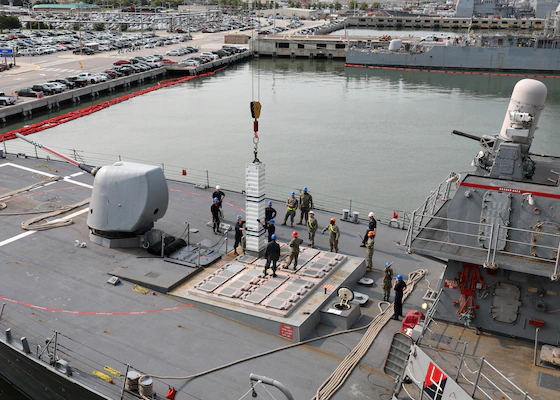
NORFOLK, Va. (August 3, 2023)–Sailors assigned to the Arleigh Burke-class destroyer USS Porter (DDG 78) and Navy Expeditionary Logistics Support Group’s Expeditionary Reload Team stow simulated ordnance in the ship’s MK 71 Vertical Launch System (VLS) during a VLS re-arm demonstration held pier-side on Naval Station Norfolk, Aug. 3. The VLS demonstration was part of U.S. Fleet Forces Command’s Large Scale Exercise 2023 which provides a venue to test and refine current and new technologies and platforms to reinforce our current position as a supreme maritime force and provide feedback used to inform future innovation. (U.S. Navy photo by Bill Mesta)

Release from U.S. Fleet Forces Command 

***** 

NORFOLK, Va. – The crews of the Arleigh Burke-class destroyer USS Porter (DDG 78) and Military Sealift Command’s (MSC) dry cargo ammunition ship USNS William McLean (T-AKE 12) performed a MK 41 Vertical Launch System (VLS) re-arm, pier-side, at Naval Station Norfolk, Aug. 3. 
 
The Navy conducted the demonstration to provide proof of concept that a dry cargo ammunition ship can reload the weapons system pier-side and while the ship is at sea, with a goal of expanding the capability of VLS reloading in expeditionary environments. 
 
“The Navy has been considering alternative vessels to move ordnance into a theater without an on-shore infrastructure to support,” according to Jerit Vanauker, of MSC’s Taluga Group. “One of the situations considered was the ability to re-arm VLS for Navy combatant ships in a contested environment, and so we considered the idea to use an MSC dry cargo ammunition ship.” 
 
In addition to the crews of Porter and William McLean, U.S. 2nd Fleet, Navy Expeditionary Combat Command’s (NECC) Navy Expeditionary Logistics Support Group (NAVELSG), the Carderock Division of the Naval Surface Warfare Center (NSWC) and NSWC Picatinny supported the VLS re-arming. NECC’s expeditionary reload team from NAVELSG are expertly trained in ordnance transfer and handling and can operate in remote, complex, and austere environments to ensure naval forces remain forward and mobile. 
 
“MSC’s role in developing and executing VLS is vital,” Vanauker stated. “We will bring the ordnance, and platform to deliver ordnance, in support of VLS re-arming of our combatant ships, so they can get back in the fight without traveling long distances to be resupplied.” 
 
During the demonstration, Porter pulled into the naval station and moored ‘skin-to-skin’ along-side William McLean, which was moored to the pier. The ships’ crews installed marine bumpers between the vessels to prevent damage to the ships during the VLS re-arm. 
 
Once the ships were safely moored, the VLS team aboard William McLean prepared two simulated ordnance packages for delivery. 
 
“The VLS handling team prepared and reviewed the necessary procedures, ordnance handling equipment (OHE) and tools to conduct the VLS re-arm,” said Vanauker. “All procedures were reviewed, OHE and tools were inspected and a safety brief was conducted.” 
 
“Once inspection was complete, the canister was loaded into the tilt-fixture and vertical strong-back, secured and then attached to the crane hook,” he continued. “The tilt-fixture and vertical strong-back allows the canister to be tilted into a vertical position with assistance from the ship’s crane.” 
 
Using the Mclean’s crane, two simulated missiles were lifted from the ship’s flight deck and swung over to Porter’s forward weapons cells. Porter’s VLS team received the simulated ordnance and stowed the missiles aboard in the ship’s MK 41 Vertical Launch System. 
 
“The crane operator, with assistance from the Signalman, swung the simulated ordnance over to Porter, placing it over the open module cell hatch, and lowered into alignment with the available cell,” Vanauker continued. “In all, performing a VLS re-arm is a very simple evolution which requires patience and focus.” 
 
The crane for the VLS re-arm demonstration was operated by Boatswain’s Mate Justin Bradley, one of William McLean’s Civil Service Mariners (CIVMARs). 
 
“This was the first VLS re-arm to take place aboard William McLean,” according to Capt. John Stulz, USNS William McLean’s Master. “Our CIVMARs secured the USS Porter alongside, operated the crane and provided support on deck for this evolution. Cargo and ordnance operations are a part of daily life for MSC ships.” 
 
“The crew of the William McLean performed with precision and professionalism during this movement, just like our counterparts do every day around the globe,” Stulz added. 
 
The VLS re-arm demonstration was conducted as part of U.S. Fleet Forces’ Large Scale Exercise 2023 (LSE). 
 
“Expeditionary logistics allow the Navy to quickly return to maintaining maritime dominance,” said Rear Adm. Brad Andros, Commander, Navy Expeditionary Combat Command. “Operating in support of Military Sealift Command during Large Scale Exercise 2023 provides our expeditionary reload teams the opportunity to train to different platforms so that they can continue to sustain capacity and increase the persistent combat power of naval forces.” 
 
LSE 2023 provided a venue to test and refine current and new technologies and platforms to reinforce our current position as a supreme maritime force and provide feedback used to inform future innovation. LSE 2023 includes six Navy and Marine Corps component commands and seven U.S. numbered Fleets, including U.S. Fleet Cyber Command/U.S. 10th Fleet, operating seamlessly across 22 time zones. 


Keel Authenticated for Future USNS Lucy Stone 

Release from Naval Sea Systems Command

***** 

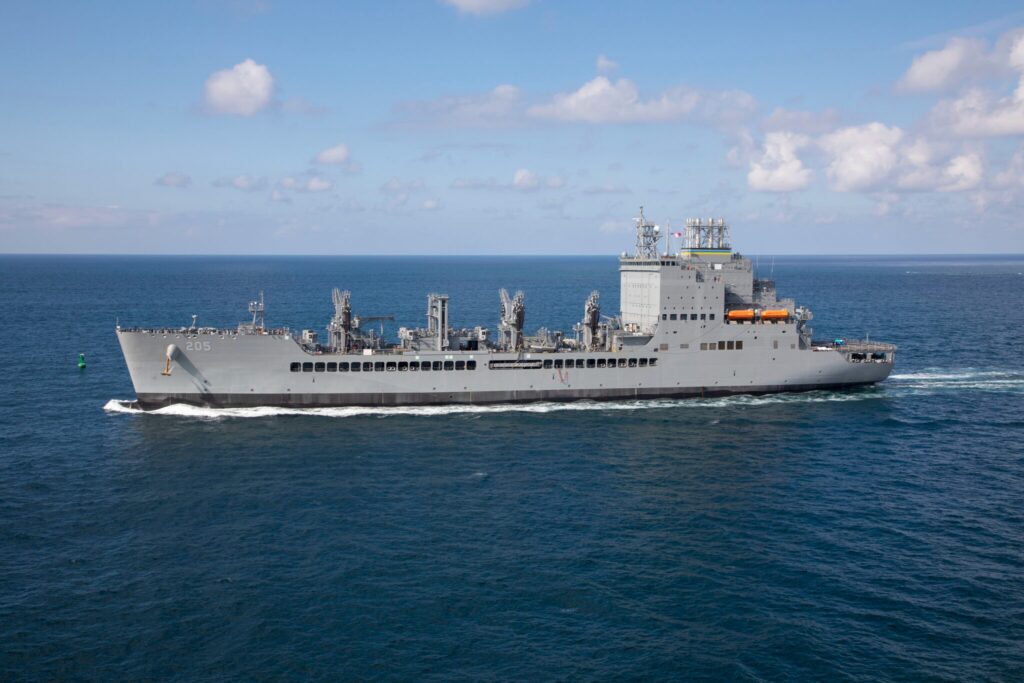
SAN DIEGO – The keel for the future USNS Lucy Stone (T-AO 209), the Navy’s 5th John Lewis-class fleet replenishment oiler, was laid at General Dynamics National Steel and Shipbuilding Company’s (GD NASSCO) shipyard in San Diego, August 8. 

A keel laying is the recognition of the start of a ship’s construction. It is the union of a ship’s modular components and the authentication or etching of an honoree’s initials into a ceremonial keel plate. In recognition of their steadfast spirit and patriotic devotion over the past two decades to unite approximately 100 ships with ship sponsors, ship introduction specialists and ship sponsors Alicia Aadnesen and Debbie Simmons etched their initials into the keel plate of the future USNS Lucy Stone. 

The ship is named for American suffragist Lucy Stone, who joined other notable advocates such as Elizabeth Cady Stanton, Susan B. Anthony, Ernestine Rose, and Antoinette Brown Blackwell to petition for suffrage and abolition in the 19th century. Her efforts as a founder of the Women’s National Loyal League were essential to the passage of the Thirteenth Amendment abolishing slavery. 

“The future Lucy Stone’s keel laying is a significant milestone, and we are excited to mark the beginning of great achievements to come for this ship,” said John Lighthammer, program manager, Auxiliary and Special Mission Shipbuilding Program Office. “The fifth John Lewis-class oiler will enhance the fleet’s ability to refuel ships at sea.” 

The oilers feature substantial volume for oil, a significant dry cargo capacity and aviation capability. The vessels have double hulls to protect against oil spills and strengthened cargo and ballast tanks.  T-AOs will add capacity to the Navy’s Combat Logistics Force and become the cornerstone of the fuel delivery system. 

GD NASSCO is also in production on future T-AOs, USNS Earl Warren (T-AO 207), USNS Robert F. Kennedy (T-AO 208) and USNS Sojourner Truth (T-AO 210). They are also under contract on future USNS Thurgood Marshall (T-AO 211), USNS Ruth Bader Ginsburg (T-AO 212) and T-AO 213. 

As one of the Defense Department’s largest acquisition organizations, PEO Ships is responsible for executing the development and procurement of all destroyers, amphibious ships, special mission and support ships, and boats and craft. 


USS Carl M. Levin (DDG 120) Arrives Home 

Release from Commander, Naval Surface Group Mid-Pacific

***** 

07 August 2023 

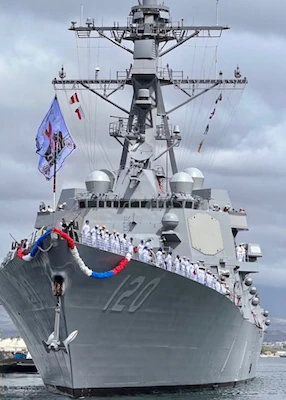
PEARL HARBOR, HI, UNITED STATES – The Navy’s newest Arleigh Burke-class guided-missile destroyer, USS Carl M. Levin (DDG 120), and its crew arrived at the ship’s new home port of Pearl Harbor, Hawaii, Aug. 7. 
 
USS Carl M. Levin is the first naval ship named in honor of Michigan’s longest serving senator, the late Carl M. Levin, for his years of service as a longtime member and chairman of the Senate Armed Services Committee. 
 
Levin began his career as an attorney, professor, and assistant attorney general in Michigan and was elected to the Senate in 1979. Levin chaired the Senate Armed Services Committee from 2001 – 2003 and from 2007 until his retirement. He was Michigan’s first Jewish senator and the state’s longest-serving senator, serving for 36 years before retiring in 2015. 
 
“USS Carl M. Levin honors the legacy and achievements of a great American senator who always placed service of others above self,” said Cmdr. Kelly Craft, Carl M. Levin’s commanding officer. “Symbolized in U.S. steel, the crew has worked tirelessly to bring her to life and sail her to our homeport of Pearl Harbor, Hawaii. We are proud to join our comrades in the defense of Hawaii, ready to take on any challenge and always remain tenacious in the fight.” 
 
During Carl M. Levin’s transit to Hawaii, the ship made port calls to major naval ports including Newport, Rhode Island., Norfolk, Virginia, Mayport, Florida, and San Diego, California. Additionally, the crew stopped in Oranjestad, Aruba, before continuing through the Panama Canal and visiting Manta, Ecuador. Throughout their journey, Carl M. Levin accomplished numerous certifications and evolutions including, underway replenishments at sea, flight quarters, gun shoots, small boat operations, and many more. 
 
The ship was christened on Oct. 2, 2021 at the Bath Iron Works in Bath, Maine, and commissioned in on June 24, 2023, in Baltimore. 
 
The mission of Commander, Naval Surface Group Middle Pacific is to manage the overall warfighting capability of the Surface Combatant Force homeported at Joint Base Pearl Harbor-Hickam, Hawaii; to coordinate the manning, operations, combat systems, engineering, maintenance, training, logistics, administration, and support of assigned units to achieve the highest levels of combat readiness. 
 
As in integral part of U.S. Pacific Fleet, U.S. 3rd Fleet operates naval forces in the Indo-Pacific in addition to providing realistic and relevant training necessary to execute the U.S. Navy’s timeless roles of sea control and power projection. U.S. 3rd Fleet works in close coordination with other numbered fleets to provide commanders with capable, ready forces to deploy forward and win in day-to-day competition, in crisis, and in conflict. 

PEARL HARBOR, HI, UNITED STATES – The Navy’s newest Arleigh Burke-class guided-missile destroyer, USS Carl M. Levin (DDG 120), and its crew arrived at the ship’s new home port of Pearl Harbor, Hawaii, Aug. 7. 
 
USS Carl M. Levin is the first naval ship named in honor of Michigan’s longest serving senator, the late Carl M. Levin, for his years of service as a longtime member and chairman of the Senate Armed Services Committee. 
 
Levin began his career as an attorney, professor, and assistant attorney general in Michigan and was elected to the Senate in 1979. Levin chaired the Senate Armed Services Committee from 2001 – 2003 and from 2007 until his retirement. He was Michigan’s first Jewish senator and the state’s longest-serving senator, serving for 36 years before retiring in 2015. 
 
“USS Carl M. Levin honors the legacy and achievements of a great American senator who always placed service of others above self,” said Cmdr. Kelly Craft, Carl M. Levin’s commanding officer. “Symbolized in U.S. steel, the crew has worked tirelessly to bring her to life and sail her to our homeport of Pearl Harbor, Hawaii. We are proud to join our comrades in the defense of Hawaii, ready to take on any challenge and always remain tenacious in the fight.” 
 
During Carl M. Levin’s transit to Hawaii, the ship made port calls to major naval ports including Newport, Rhode Island., Norfolk, Virginia, Mayport, Florida, and San Diego, California. Additionally, the crew stopped in Oranjestad, Aruba, before continuing through the Panama Canal and visiting Manta, Ecuador. Throughout their journey, Carl M. Levin accomplished numerous certifications and evolutions including, underway replenishments at sea, flight quarters, gun shoots, small boat operations, and many more. 
 
The ship was christened on Oct. 2, 2021 at the Bath Iron Works in Bath, Maine, and commissioned in on June 24, 2023, in Baltimore. 
 
The mission of Commander, Naval Surface Group Middle Pacific is to manage the overall warfighting capability of the Surface Combatant Force homeported at Joint Base Pearl Harbor-Hickam, Hawaii; to coordinate the manning, operations, combat systems, engineering, maintenance, training, logistics, administration, and support of assigned units to achieve the highest levels of combat readiness. 
 
As in integral part of U.S. Pacific Fleet, U.S. 3rd Fleet operates naval forces in the Indo-Pacific in addition to providing realistic and relevant training necessary to execute the U.S. Navy’s timeless roles of sea control and power projection. U.S. 3rd Fleet works in close coordination with other numbered fleets to provide commanders with capable, ready forces to deploy forward and win in day-to-day competition, in crisis, and in conflict. 


Office of Naval Research, NIWC Pacific host 26th international RoboSub Competition

Release from Naval Information Warfare Center, Pacific 

***** 

Office of Naval Research, NIWC Pacific host 26th international RoboSub Competition 

07 August 2023 

From Mason Piedfort, Naval Information Warfare Center, Pacific 

SAN DIEGO – The Office of Naval Research (ONR) and Naval Information Warfare Center (NIWC) Pacific hosted RoboNation’s 26th international RoboSub Competition at NIWC Pacific Transducer Evaluation Center (TRANSDEC) July 31 – Aug. 6. 

ShapeStudent participants from across the globe built robotic submarines designed to overcome simplified versions of challenges relevant to the autonomous underwater vehicle (AUV) field.

“The Navy employs unmanned systems in every domain — in the air, on the sea, and under the sea,” said Vice Chief of Naval Operations Adm. Lisa Franchetti, who attended Aug. 2. “The innovation and creativity we see through programs like RoboSub push the imagination of what is possible in unmanned platforms. These competitors represent the leaders of the future who will bring solutions to some of our most difficult challenges in the fleet and industry.” 
 

This year 35 teams represented five countries: the U.S., Canada, Bangladesh, India, and Singapore. Teams are affiliated with high schools, university undergraduate and graduate programs, and non-profit organizations. 
 
Though teams compete for various amounts of prize money, cross-team cooperation is common at RoboSub, in what RoboNation Program Manager Julianna Smith called a spirit of “cooperatition,” a combination of cooperation and competition. 
 
In the spirit of cooperatition, Team Inspiration, a local team affiliated with non-profit organization Advancing Science, Technology, and Art, hosted a visiting team who arrived to the competition early for dinner at a teammate’s home in the San Diego suburbs. 
 
“It’s rewarding to work with the other teams,” one Team Inspiration member said. “We get to learn from them and then pass that knowledge down to younger teams, not just here at RoboSub but at all the robotics events we do. We help mentor kids interested in robotics both locally and globally and check in with them on Zoom and Discord often.” 
 
The Ohio State University team helped several teams with mechanical fixes throughout the competition. “Of course we want to win, but not because one of the competitors had an issue we could have helped them fix,” one student team leader said. 
 
Students from local team “SDSU Mechatronics,” affiliated with San Diego State University, drove back and forth from their facility to retrieve spare parts for other teams. “When I first joined RoboSub, I worried that it would be overly competitive, but the atmosphere is completely different,” an SDSU Mechatronics team member said. “One of the best parts of RoboNation events is that all the schools help each other out — and as a local team, we want to be a part of that.”  
 
Teams submitted pre-event technical design documentation before arriving at the TRANSDEC. During the competition, volunteer judges evaluated the teams’ performances in underwater autonomy challenge tasks, team presentations, and system assessments. Judges inspected vehicles for design, craftsmanship, technical innovation, and visual impact. 
 
“From my perspective as both the Chief of Naval Research [CNR] and the Naval Science, Technology, Engineering, and Math [STEM] Executive, RoboSub is truly a valuable and important event for fostering greater naval innovation,” said CNR Rear Adm. Kurt Rothenhaus, who also visited the competition Aug. 2. “Not only do we get to meet the next generation of talented scientists and engineers, but we also introduce them to some of the most pressing challenges faced by our Sailors and Marines. This is especially prevalent as autonomous systems and capabilities play an increasingly important role in current and future battlescapes.” 
 
In one of the six challenges, autonomous underwater vehicles navigated through one of two gates; in another, the vehicles dropped path markers into bins and earned bonus points for dropping markers in bins coinciding with the gate passed through earlier. 
 
“Teams have been in the pool at TRANSDEC nearly non-stop,” said Travis Moscicki, NIWC Pacific lead for RoboSub, on the third day of the competition. “Hands down, the number one indicator of performance is time spent in water. This highlights the exact reason we hold the event — there is no substitution for experience.” 
 
Moscicki, who holds a doctorate in ocean engineering, participated in RoboNation robotics competitions as a student before his employment at NIWC Pacific. Now he’s getting to watch how teams evolve year after year. “One team pointed out that at last year’s event they encountered many gremlins (engineer speak for an issue!), but they weren’t sure how to solve them,” he said. “This year, they are still encountering gremlins, but are finding they have solutions. Progression is what RoboSub is all about.” 
 
This year, the National University of Singapore team took first place for the second year in a row, Brac University from Bangladesh took second place, and the University of Alberta from Canada took third place in the autonomy task challenges. Teams also won awards for design documentation, mentorship, ingenuity, data sharing, and “cooperatition.” 
 
NIWC Pacific hosted RoboSub from 2002 to 2019. This year marked the competition’s return to the TRANSDEC pool, which contains six million gallons of water and is 300 feet by 200 feet in size. Its design eliminates all extraneous man-made or natural biologic noises and permits precise control of surface and underwater conditions. 
 
NIWC Pacific and ONR research, develop, and deliver integrated capabilities to the fleet. Both regularly contribute to STEM outreach programs which help develop talent and partnerships for the future. 
 
“The Navy is built on the keel of STEM education, leveraging scientific understanding, critical thinking and problem-solving skills to take us where we need to go,” Franchetti said. “Our Sailors and civilians are out there every day developing, operating and maintaining the most complex ecosystems of warfighting functions; integrating propulsion, power, weapons, combat and information systems we need remain the greatest Navy in the world.” 


SECNAV Names Future Navajo-Class Towing, Salvage, and Rescue Ship Solomon Atkinson 

Release from the Secretary of the Navy Public Affairs 

***** 

07 August 2023 

Secretary of the Navy (SECNAV) Carlos Del Toro announced today that a future Navajo-class Towing, Salvage, and Rescue (T-ATS) ship will be named in honor of Solomon Atkinson, a pioneering Navy SEAL and an Alaskan Native of the Metlakatla Indian Community, Annette Islands Reserve. Del Toro made the announcement on the Metlakatla’s Founders Day, Aug. 7. 

ShapeThe name selection of USNS Solomon Atkinson (T-ATS 12) follows the tradition of naming towing, salvage, and rescue ships after prominent Native Americans or Native American tribes.    

“I am honored to name the next T-ATS after Solomon Atkinson, a man who achieved many firsts, even in the face of adversity, and continued to lead,” said Del Toro. “Atkinson’s achievements as a SEAL have left behind an enduring legacy, not just in the Special Warfare Community, but with our nation’s astronauts as well. I am pleased to ensure that his name will extend globally to all who views this great ship.” 

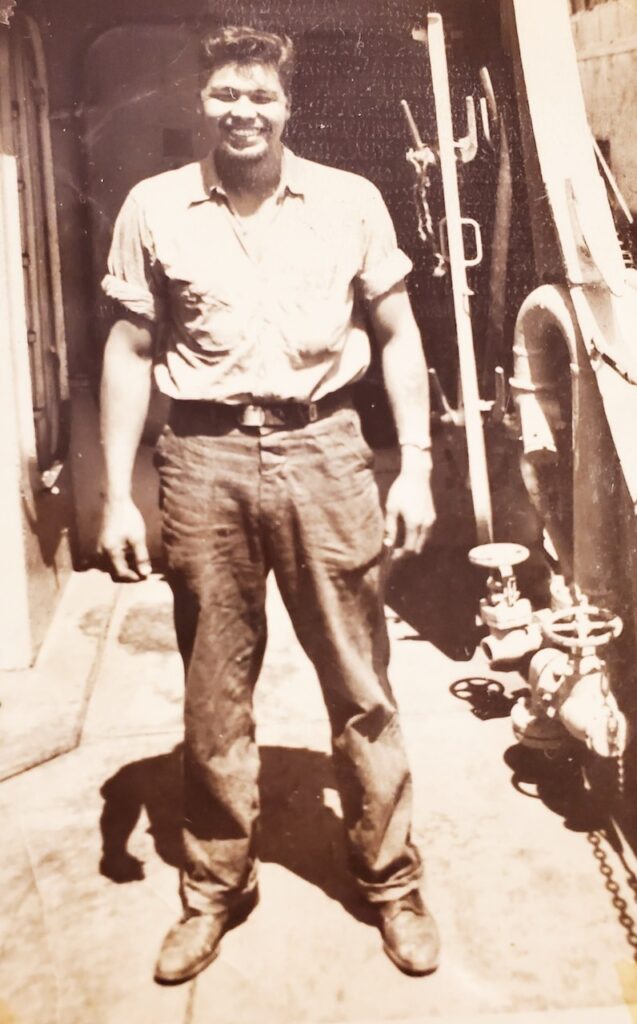
Born in 1930 in Metlakatla, Alaska, Solomon Atkinson was raised by his parents on the sole Indian Reserve in Alaska. Atkinson worked as a commercial fisherman before enlisting in the U.S. Navy in 1952. A year later, Atkinson volunteered for the underwater demolition teams and became a frogman, the precursor to present day SEALs. In 1962, Atkinson became one of the first Navy SEALs and was a plank owner for SEAL Team 1. As a SEAL, he deployed to Korea and completed three combat tours in Vietnam. His Vietnam service-related awards include a Bronze Star, a Navy Commendation Medal with Combat “V,” and a Purple Heart. Atkinson also had the distinction of training numerous astronauts, including Neil Armstrong and Buzz Aldrin, in underwater weightless simulations at the Underwater Swimmers School in Key West, Florida. Atkinson retired from active naval service in 1973 as a Chief Warrant Officer 4 and returned to Metlakatla, where he continued to serve his people and state on the Indian Community Council and Board of Education, as founder and president of the first veterans’ organization on Annette Island, and as mayor of Metlakatla. Upon his passing in 2019, an honor guard from SEAL Team 1 served as pallbearers at his funeral. 

“Chief Warrant Officer 4 Solomon “Sol” Atkinson embodied the spirit of dedication to family, community, and country,” said Rear Adm. Keith Davids, commander, Naval Special Warfare Command. “His pioneering role as one of the first U.S. Navy SEALs, and his unwavering commitment to service both in and out of uniform, serves as an inspiration for the entire Naval Special Warfare community. Naming the USNS Solomon Atkinson in his honor is a testament to his remarkable legacy and the enduring impact he has left on NSW, the Navy, and the nation.” 

Along with the ship’s name, Del Toro announced the sponsors for the future USNS Solomon Atkinson as his widow, Joann Atkinson and their two daughters, Michele Gunyah and Maria Hayward, who, in their role, will represent a lifelong relationship with the ship and crew. 

“There exists a long-held Tsimshian tradition, ‘akadi lip a’algyaga sm’ooygit,’ loosely translated ‘a chief never speaks for himself’,” said sponsor, Maria Hayward. “Through all of his time as a U.S. Navy UDT and SEAL, as well as a leader of veterans and Native Alaskans, Sol lived this ethos. And, here today, in the shadow of Sol’s death, he holds to it still. Thank you to the U.S. Navy for speaking to Solomon’s honor and helping his family and fellow Frogmen shout his legacy to the seven seas!” 

Navajo-class ships will provide ocean-going tug, salvage, and rescue capabilities to support Fleet operations. The current capabilities are provided by Powhatan-class T-ATF Fleet Tugs and Safeguard-class T-ARS Rescue and Salvage vessels, which began reaching the end of their expected service lives in 2020. Navajo-class ships will be capable of towing U.S. Navy ships and will have 6,000 square feet of deck space for embarked systems.  

More information on our towing, salvage, and rescue ship programs can be found here.  


3,000 Sailors and Marines Arrive in Middle East aboard USS Bataan, USS Carter Hall

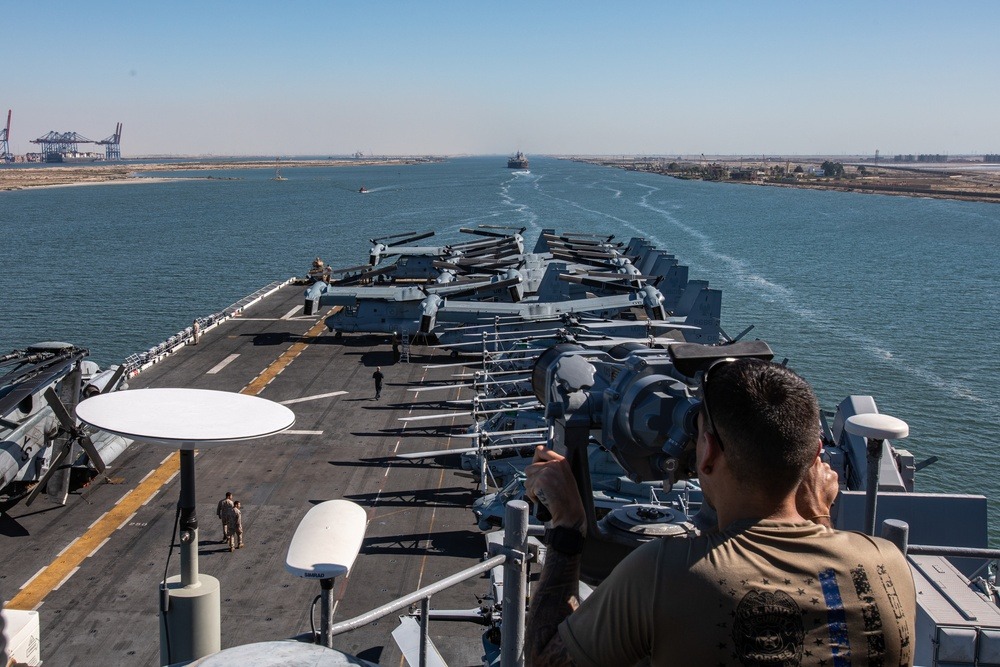
A U.S. Navy sailor from USS Bataan (LHD 5) stands watch as the amphibious assault ship transits the Suez Canal with the 26th Marine Expeditionary Unit (MEU), Aug. 6, 2023.

Release from U.S. Naval Forces Central Command Public Affairs 

***** 

From U.S. Naval Forces Central Command Public Affairs 

MANAMA, Bahrain – More than 3,000 U.S. Sailors and Marines of the Bataan Amphibious Ready Group (ARG) and 26th Marine Expeditionary Unit (MEU) arrived in the Middle East, Aug. 6, as part of a pre-announced Department of Defense deployment. 

Amphibious assault ship USS Bataan (LHD 50) and dock landing ship USS Carter Hall (LSD 50) entered the Red Sea after transiting from the Mediterranean Sea through the Suez Canal. Bataan ARG/26th MEU units bring to the region additional aviation and naval assets, as well as more U.S. Marines and Sailors, providing greater flexibility and maritime capability to U.S. 5th Fleet.  

An amphibious assault ship can carry more than two dozen rotary-wing and fixed-wing aircraft, including MV-22 Osprey tilt-rotor aircraft and AV-8B Harrier attack jets in addition to several amphibious landing craft. A dock landing ship also supports operations for various rotary-wing aircraft, tactical vehicles and amphibious landing craft.  

The Bataan ARG departed Norfolk, Virginia on July 10 with Amphibious Squadron 8, Fleet Surgical Team 8, Tactical Air Control Squadron 21, Helicopter Sea Combat Squadron 26, Assault Craft Unit 4, Beach Master Unit 2 and the 26th MEU. 

The 26th MEU, based in Camp Lejeune, North Carolina, is capable of conducting amphibious missions, crisis response and limited contingency operations to include enabling the introduction of follow-on forces and designated special operations. 

The U.S. 5th Fleet area of operations encompasses approximately 2.5 million square miles of water space and includes the Arabian Gulf, Gulf of Oman, Red Sea, parts of the Indian Ocean and three critical choke points at the Strait of Hormuz, Suez Canal and Strait of Bab al-Mandeb. 


U.S. Nuclear-Powered Submarine Visits Western Australia, First Since AUKUS Announcement

Release from U.S. 7th Fleet 

***** 

04 August 2023 

ROCKINGHAM, Western Australia (Aug. 4, 2023) – USS North Carolina (SSN 777) docked at HMAS Stirling, a naval base in Western Australia, today following participation in Talisman Sabre 2023. 

This marks the first visit by a Virginia-class submarine to the country since the leaders’ announcement of the Australia, United Kingdom, and United States (AUKUS) Optimal Pathway. 

Initially announced in September 2021, the AUKUS partnership is designed to bolster the security and defense capabilities of the three nations and promote security in the Indo-Pacific region. 

“North Carolina’s presence in HMAS Stirling is an example of the United States’ full commitment to the AUKUS partnership starting with a promised increase in SSN port visits to Australia in 2023,” said Mr. Abe Denmark, Senior Advisor for AUKUS to the Secretary of Defense. “These port visits are an essential step for Australia to build the necessary operational capabilities and skills to steward and operate its own fleet of nuclear-powered attack submarines.” 

The Optimal Pathway is a phased approach that represents an ambitious plan to provide Australia with a conventionally-armed, nuclear-powered submarine capability at the earliest possible date while ensuring Australia’s capacity to safely operate, maintain and regulate this technology, and setting the highest standards for nuclear non-proliferation.  

  • Phase One includes increased SSN port visits aimed to expand Australia’s knowledge of SSNs ahead of establishing Submarine Rotational Force-West (SRF-W) as early as 2027. SRF-W will start a rotational presence of up to four Virginia-class submarines (US), and one United Kingdom Astute class submarine at HMAS Stirling. 
  • Phase Two begins in the early 2030s, pending approval from the U.S. Congress, with the United States selling Australia three Virginia class submarines, with the potential to sell up to two more if needed. 
  • Phase Three sees the combination of a base British submarine design and advanced United States technology to deliver SSN-AUKUS, the future attack submarine for both Australia and the United Kingdom. Australia plans to deliver the first Australian-built SSN-AUKUS in the early 2040s. 

“Australia, the United Kingdom, and the United States share a long history of security cooperation around the world,” said Rear Adm. Chris Cavanaugh, Commander, Submarine Group (CSG) 7. “I am impressed every day by our ability to work together seamlessly during undersea warfare training and operations.” 
 
CSG 7 directs forward-deployed, combat-capable forces across the full spectrum of undersea warfare throughout the Western Pacific, Indian Ocean, and Arabian Sea. 

U.S. 7th Fleet is the U.S. Navy’s largest forward-deployed numbered fleet, and routinely interacts and operates with allies and partners in preserving a free and open Indo-Pacific region.