USS Canberra (LCS 30) Arrives in Sydney Ahead of Commissioning
Release From Commander, Littoral Combat Ship Squadron ONE Public Affairs Office

Courtesy Story, Littoral Combat Ship Squadron ONE Public Affairs


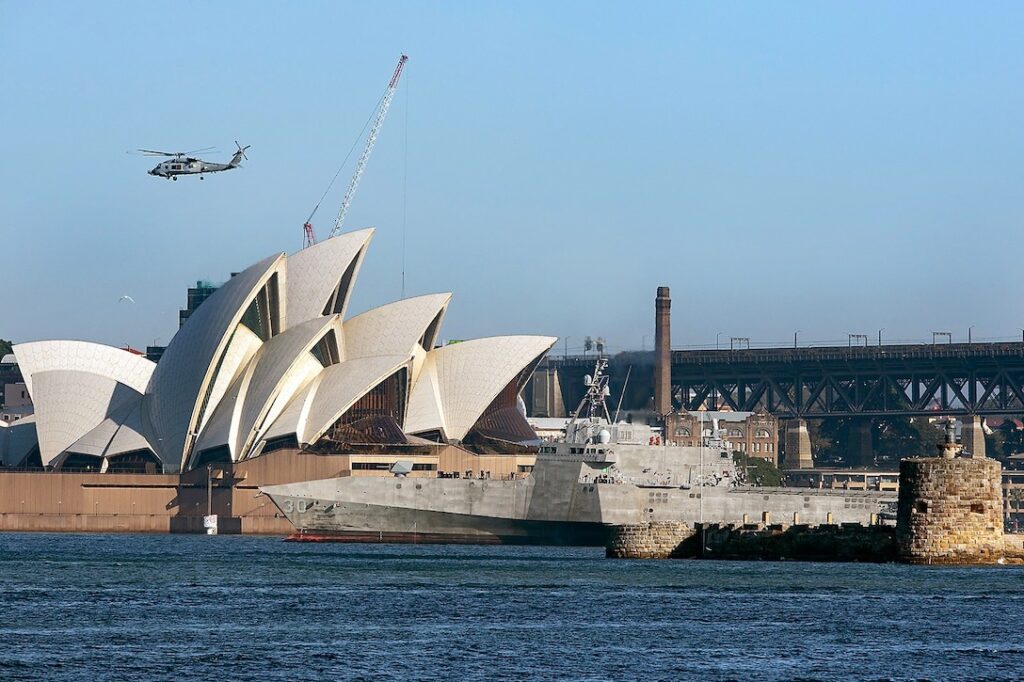
SYDNEY (July 18, 2023) Independence-variant littoral combat ship USS Canberra (LCS 30) arrived in Sydney, Australia, July 18, ahead of the ship’s ceremonial commissioning.

USS Canberra entered Sydney Harbour in formation with Canberra-class landing helicopter dock HMAS Canberra before mooring pierside at the Royal Australian Navy’s Fleet Base East.

“We are thrilled to be here in Sydney this week, and to show this city our fast, optimally-manned ship that sails across the seas as a symbol of our navies’ dedication to each other,” said Capt. Marc Crawford, Commodore of Littoral Combat Ship Squadron ONE. “For more than one hundred years, our nations have stood side-by-side; today is no different.”

The U.S. ship is named for Australia’s capital and the original HMAS Canberra that was sunk at the Battle of Savo Island during World War II while fighting alongside the U.S.

“To sail last night and rendezvous with USS Canberra was an absolute privilege, not just for myself but for the Army, Navy and Air Force crew members on HMAS Canberra,” said. Capt. Brendan O’Hara, commanding officer of HMAS Canberra. “Having another ship named Canberra, there is an automatic bond as mariners between those ships straight away. We look forward to supporting their ship’s company throughout the course of this week, particularly for the commissioning ceremony this Saturday.”

While in Sydney, the ships’ crews will partake in sports competitions, community relations activities, and learn more about the other country’s culture and traditions.

Those interested in viewing the ceremony live may do so on DVIDS at www.dvidshub.net/webcast/32033 beginning at 10:00 a.m. AEST on July 22, 2023.

Homeported in San Diego as a part of Littoral Combat Ship Squadron ONE, USS Canberra is a fast, optimally-manned, mission-tailored surface combatant that operates in near-shore and open-ocean environments, winning against 21st-century coastal threats. LCS like USS Canberra integrate with joint, combined, manned and unmanned teams to support forward presence, maritime security, sea control, and deterrence missions around the globe.

For more information on the USS Canberra commissioning, please visit
https://www.dvidshub.net/feature/CanberraCommissioning and http://images.defence.gov.au/S20232084.
LCACs 105-107 Receive Lift of Opportunity Aboard USS Gunston Hall

Release from Naval Sea Systems Command

*****

By Team Ships Public Affairs

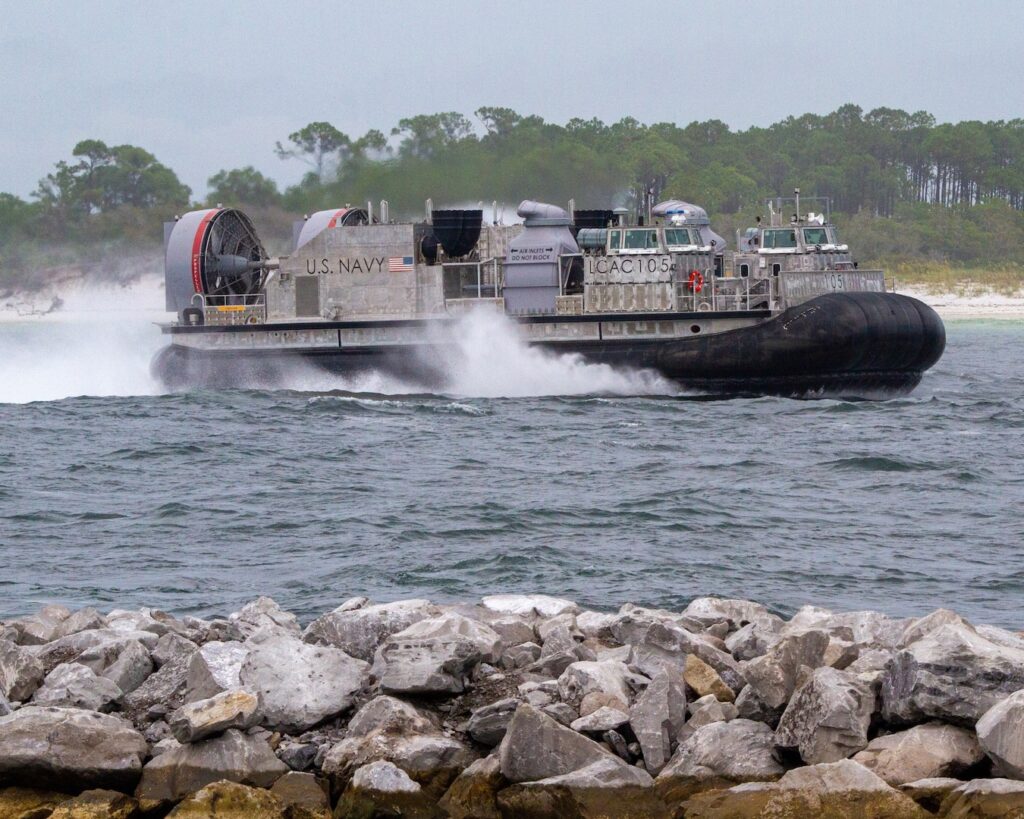
Washington Navy Yard – Ship to Shore Connector (SSC), Landing Craft, Air Cushions (LCAC) 105-107 received a lift of opportunity (LOO) aboard USS Gunston Hall (LSD 44), on July 14.

LCACs 105-107 have been at Naval Surface Warfare Center Panama City Division for post-delivery test and trials following their delivery to the Navy by Textron Systems.

The leadership on the USS Gunston Hall worked with Program Executive Office (PEO) Ships, Naval Surface Warfare Center Panama City Division, and Assault Craft Unit FOUR (ACU 4) as LCACs 105-107 entered the well deck for transport.

“SSC LCACs are in serial production and actively providing much-needed agility and speed to our fleet,” said Capt. Jason Grabelle, program manager, Amphibious Assault and Connectors Programs, PEO Ships. “The flexibility of LCACs, combined with their technology, provide our Navy and Marine Corps team with capability for today and the future fight.”

Later this month, the Gunston Hall team will offload these three crafts to their new home at ACU 4 in Little Creek, Virginia. ACU 4 is the parent unit for LCACs on the east coast. LCACs 101-104 arrived at ACU 4 in February 2022.

SSC LCACs are built with configurations, dimensions, and clearances similar to the legacy LCACs they replace – ensuring that this latest air cushion vehicle is fully compatible with existing, well deck-equipped amphibious ships, the Expeditionary Sea Base, and the Expeditionary Transfer Dock. LCACs are capable of carrying a 74-ton payload. They primarily transport weapon systems, equipment, cargo, and assault element personnel through a wide range of conditions, including over-the-beach.

As one of the Defense Department’s largest acquisition organizations, PEO Ships is responsible for executing the development and procurement of all destroyers, amphibious ships, special mission and support ships, boats, and craft.


USS JAMES E. WILLIAMS RETURNS FROM NATO DEPLOYMENT

Release from U.S. Fleet Forces Command

*****

By Ensign Blaise De Oliveira, USS James E. Williams Public Affairs

14 July 2023

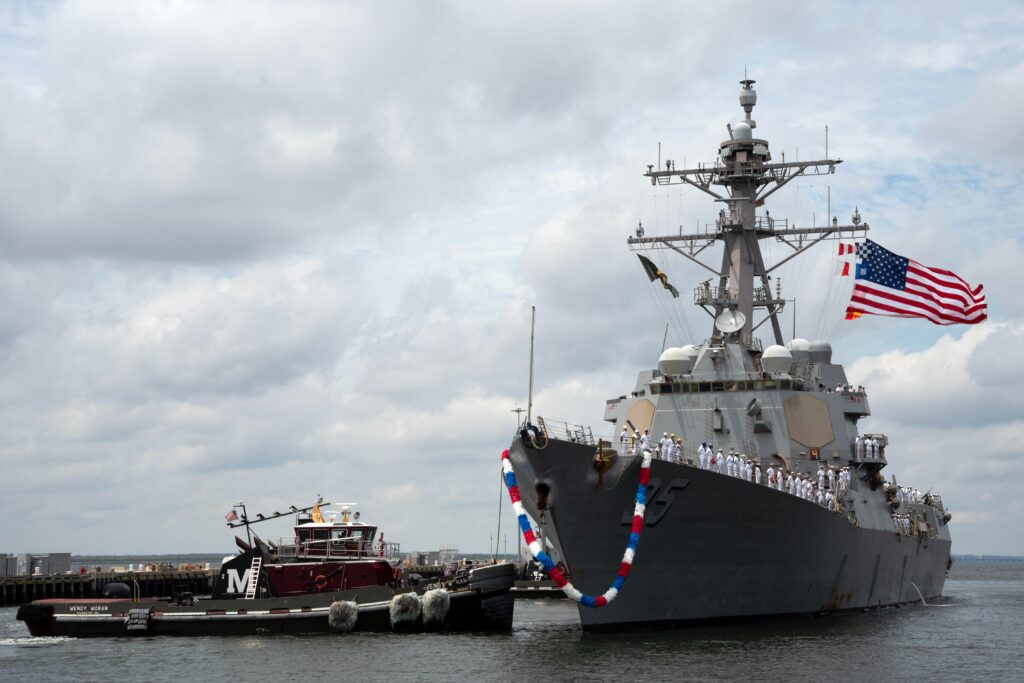
NORFOLK, Va. — Arleigh Burke-class guided-missile destroyer USS James E. Williams (DDG 95) returned to Naval Station Norfolk from a seven-month NATO deployment, July 14.

James E. Williams served as the flagship for Standing NATO Maritime Group (SNMG) 2, commanded by Rear Adm. Scott Sciretta.

James E. Williams deployed in December 2022 and relieved Arleigh Burke-class guided-missile destroyer USS Forrest Sherman (DDG 98) as SNMG 2 flagship. As the flagship, James E. Williams led a multinational maritime group in joint operations through the Mediterranean Sea, providing forward presence, ensuring stability in the region, and supporting deterrence and defense of NATO territory.

The James E. Williams crew traveled more than 36,000 nautical miles, conducted more than 45 sea and anchor evolutions, transited 20 straight, logged more than 600 hours of flight operations, and conducted 22 replenishments-at-sea.

“As our deployment ends, I could not be more proud of the hard work, true dedication, pride and professionalism that our Sailors have demonstrated on this deployment,” said Cmdr. Robert Ireland, commanding officer of James E. Williams. “James E. Williams got real, got better, and provided Commander, NATO Allied Maritime Command and U.S. 6th Fleet with a tactically proficient, operationally ready, and strategically focused asset to project NATO’s united resolve to deter and defeat our nation’s and Alliance’s adversaries.”

While working with 12 countries on joint operations, the crew visited 12 different cities in Croatia, France, Greece, Italy, Montenegro, Spain and Türkiye. While in port, Sailors strengthened relationships with our critical Allies, participating in social events with Sailors from other navies and touring local regions.

Through this wide range of exercises, operations and port visits, the crew demonstrated their unrelenting commitment to the mission and to the region. They spent 225 days away from homeport, truly demonstrating the fulfillment of their ship’s motto: Lead from the Front.

HMS Duncan (D37), a Royal Navy Daring-class air-defense destroyer, properly relieved James E. Williams as SNMG 2 flagship during a ceremony in Taranto, Italy, June 30. With the completion of the hand-over

turn-over, the United Kingdom commenced a one-year rotation in command of SNMG 2 under the leadership of Cdre. Paul Stroude.

As a NATO task group, SNMG 2 prioritizes its mandate to enhance the collective readiness, responsiveness, deployable readiness, integration and interoperability of its forces. Its focus is on deterrence and defense against all adversaries in the maritime domain, upholding freedom of navigation, securing maritime trade routes and protecting the main lines of communication.

SNMG 2 is a multinational integrated task group that projects a constant and visible reminder of the Alliance’s solidarity and cohesion afloat. This continuous maritime capability performs a wide range of tasks, including exercises and real-world operations in periods of crisis and conflict. SNMG 2 is one of four Standing Naval Forces that operate under NATO Allied Maritime Command, headquartered in Northwood, United Kingdom.


SECNAV Names Future Navajo-Class Towing, Salvage, and Rescue Ship Billy Frank Jr.

Release from Secretary of the Navy Public Affairs 

***** 

July 13, 2023 

From Secretary of the Navy Public Affairs  

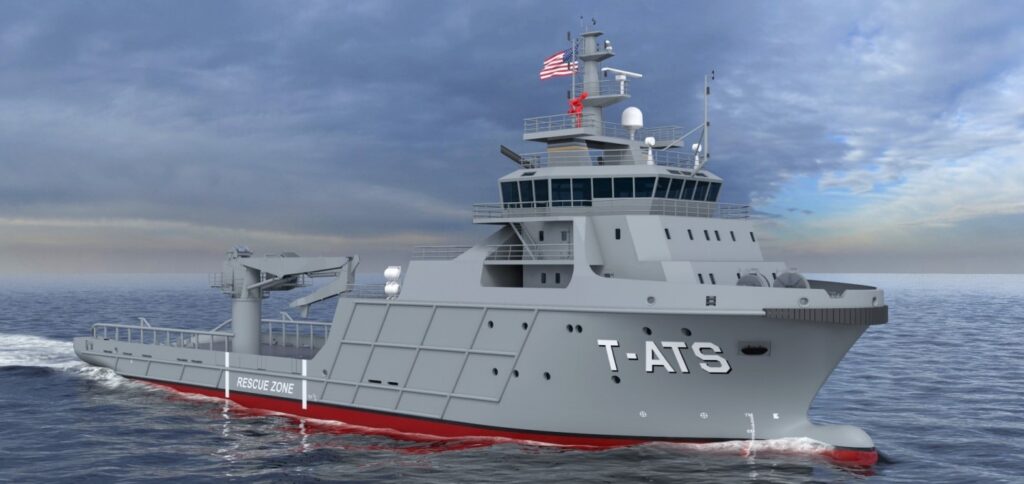
WASHINGTON – Secretary of the Navy (SECNAV) Carlos Del Toro announced, today, that a future Navajo-class Towing, Salvage, and Rescue ship will be named USNS Billy Frank Jr. (T-ATS 11).   

The future T-ATS 11 honors Billy Frank Jr., who was a Nisqually tribal member and is an iconic Native American environmental leader and treaty rights activist. The name selection follows the tradition of naming towing, salvage, and rescue ships after prominent Native Americans or Native American tribes.   

“I am honored for the opportunity to name a naval ship after Billy Frank Jr., a man who was a proponent and leader for Native American rights,” said Del Toro. “Billy Frank Jr. spent his life serving others and his namesake ship will do the same as it travels around the world enabling humanitarian assistance and the maintenance of freedom.” 

William “Billy” Frank Jr. was born in 1931 as a member of the Nisqually tribe in Washington.  After serving as a military policeman in the U.S. Marine Corps during the Korean War, Frank returned to Washington where he became an electrical lineman and continued to fish on his traditional grounds.   

By the 1960s, the local salmon fishery was in decline due to increased sport and commercial fishing.  In response, state officials began targeting and arresting Native American fishermen like Frank, blaming the decline in salmon stock on them instead.  Escalating arrests and raids led to protests at the state capitol and “fish-ins” arranged by Frank and others.  Over the course of these demonstrations, Frank was arrested over 50 times and became the face of the movement.   

In 1974, the matter was taken up by the Federal District Court in Tacoma, Washington.  Judge George H. Boldt ruled in favor of the Native Americans for their right to fish in their “usual and accustomed places.”  Frank went on to serve as chair of the Northwest Indian Fisheries Commission for over 30 years and received the Albert Schweitzer Prize for Humanitarianism and the Martin Luther King Jr. Distinguished Service Award, among other accolades.  He passed away in 2014. His son, Willie Frank III, serves as the chairman of the tribal council of the Nisqually tribe. 

The Navajo-class will provide ocean-going tug, salvage, and rescue capabilities to support Fleet operations. The current capabilities are provided by Powhatan-class T-ATF Fleet Tugs and Safeguard-class T-ARS Rescue and Salvage vessels, which reach the end of their expected service lives starting in 2020. Navajo-class ships will be capable of towing U.S. Navy ships and will have 6,000 square feet of deck space for embarked systems. 

More information on our towing, salvage, and rescue ship programs can be found here. 


Philly Shipyard Wins Contract for Hospital Ship Design Study 

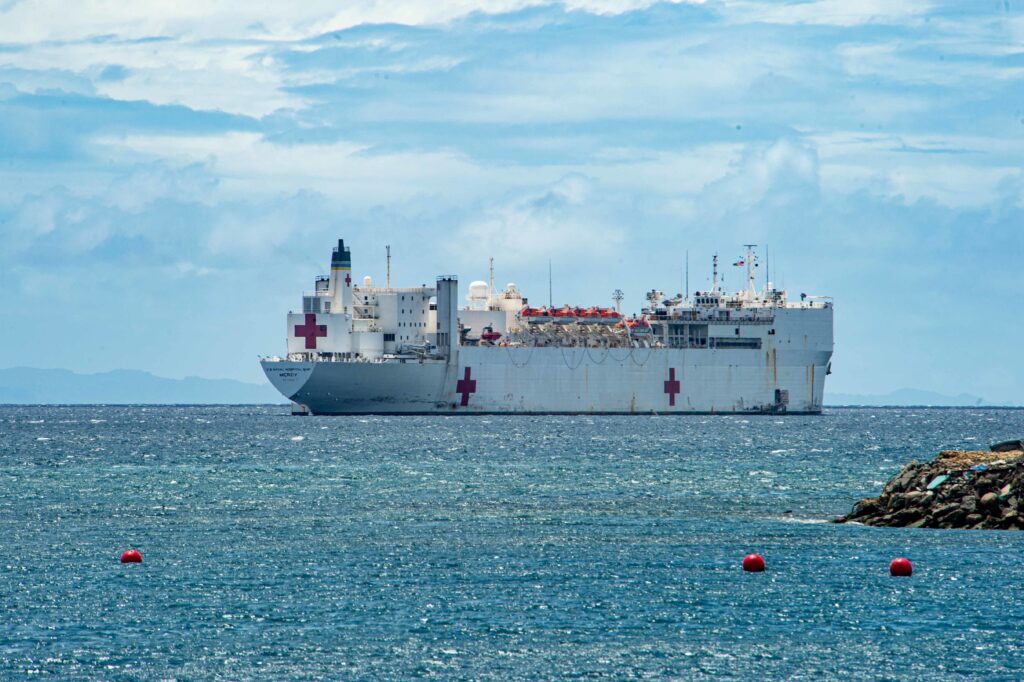
HONIARA, Solomon Islands (Sept. 1, 2022) The Military Sealift Command hospital ship USNS Mercy (T-AH 19) sits at anchor upon its arrival off the coast of Honiara, Solomon Islands during Pacific Partnership 2022. Now in its 17th year, Pacific Partnership is the largest annual multinational humanitarian assistance and disaster relief preparedness mission conducted in the Indo-Pacific. Pacific Partnership is a unifying mission that fosters enduring friendships and cooperation among many nations. The year’s mission in Solomon Islands will include participants from the United States, Japan and Australia (U.S. Navy photo by Mass Communications Specialist 3rd Class Raphael McCorey)

Release from Philly Shipyard 

***** 

July 12, 2023 

PHILADELPHIA – Philly Shipyard, Inc. (“Philly Shipyard”), the sole operating subsidiary of Philly Shipyard ASA (Oslo: PHLY) today announced the contract award to conduct the T-AH(X) Hospital Ship Feasibility Study for Gibbs and Cox, a Leidos Inc. company. The six-month design study will cover a solution for preliminary designs to replace the two current hospital ships – USNS Mercy and USNS Comfort – owned by the U.S. Navy and operated by Military Sealift Command (MSC). Philly Shipyard will subcontract to Vard Marine Inc. (“VARD”) to provide engineering and technical services for this effort. 

“This contract win highlights our commitment to pursuing and securing work in the government market,” said Steinar Nerbovik, Philly Shipyard President and CEO. “Along with our current commercial and government backlog of shipbuilding projects, we have completed previous design studies for the U.S. Navy and are very interested in pursuing government opportunities that fit our production delivery cycles and skill sets. We are excited and grateful to team up, once again, with Vard Marine on this important industry study.” 

Philly Shipyard and VARD will leverage design work performed as part of a special study completed for the U.S. Navy’s Common Hull Auxiliary Multi-Mission Platform (CHAMP) program, which was won in 2019. 

 About Philly Shipyard 

Philly Shipyard, Inc. (PSI) is a leading U.S. shipbuilder that is presently pursuing a mix of commercial and government work. It possesses a state-of-the-art shipbuilding facility and has earned a reputation as a preferred provider of oceangoing merchant vessels with a track record of delivering quality ships, having delivered around 50% of all large ocean-going Jones Act commercial ships since 2000.  PSI is the sole operating subsidiary of Philly Shipyard ASA. Philly Shipyard ASA is listed on the Euronext Expand Oslo (Oslo: PHLY) and is majority-owned by Aker Capital AS, which in turn is wholly-owned by Aker ASA (Aker). Aker is an industrial investment company that exercises active ownership to create value. Aker has ownership interests in oil and gas, renewable energy and green technologies, maritime assets, marine biotechnology and industrial software, and its portfolio includes companies like Aker BP, Aker Horizons, Aker BioMarine, Cognite, and Aker Solutions. For more information about Philly Shipyard, visit www.phillyshipyard.com


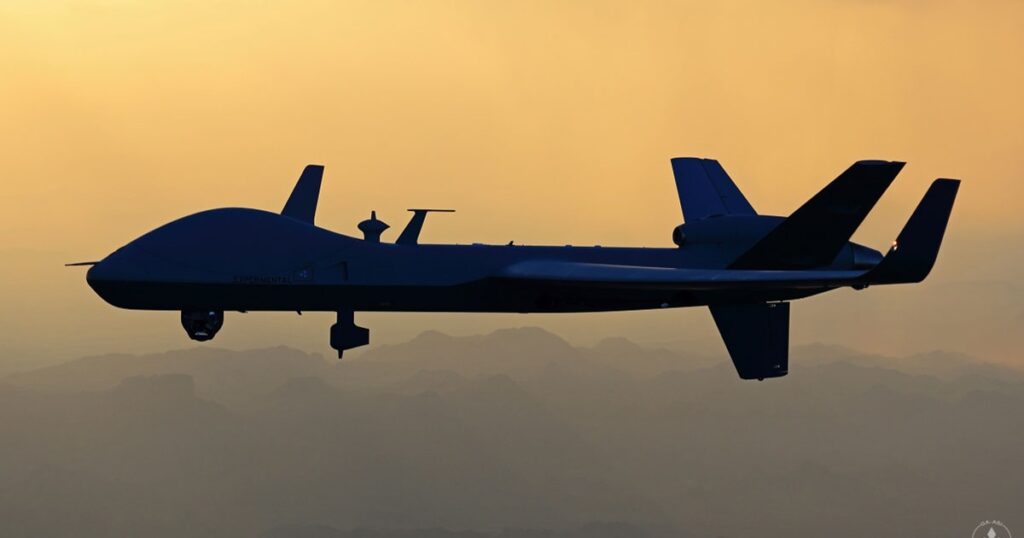
GA-ASI’S UNMANNED AIRCRAFT CROSS 8 MILLION FLIGHT HOURS

Release from General Atomics Aeronautical Systems, Inc. 

New MQ-9B SkyGuardian®/SeaGuardian® Models Add More Than 4,000 Hours  

***** 

SAN DIEGO – 14 July 2023 – General Atomics Aeronautical Systems, Inc. (GAASI) today announced that its family of Unmanned Aircraft Systems (UAS), which includes the Predator®, Reaper, Gray Eagle, Avenger®, and MQ-9B SkyGuardian®/SeaGuardian® lines, has surpassed eight million flight hours. GA-ASI aircraft have completed 566,000 total missions in nearly 40 countries around the world.  

Adding to the total are 13 MQ-9B SkyGuardian/SeaGuardian UAS that have flown more than 4,000 flight hours, including the new Protector RG Mk1 being delivered to the United Kingdom’s Royal Air Force. The first three Protectors are currently undergoing Integrated Test, Evaluation, and Acceptance trials. In addition, MQ-9Bs are being operated by the Japan Coast Guard (JCG) and Japan Maritime Self-Defence Force (JMSDF), as well as supporting various U.S. Navy exercises.  

“GA-ASI continues to be a leader in developing reliable, cost-efficient, and sustainable unmanned aircraft systems that perform advanced operations for our customers around the world,” said GA-ASI CEO Linden P. Blue. “Eight million flight hours is another achievement on our list of historic firsts, which demonstrates our relentless commitment to quality.” 

The exact aircraft and customer that achieved the milestone is unknown, as it’s estimated that more than 50 Predator-class Medium-Altitude, Long-Endurance (MALE) RPA are airborne worldwide every moment of every day.  

GA-ASI aircraft average 40,000 hours per month, supporting programs with the U.S. Air Force, U.S. Army, U.S. Marine Corps, NASA, the Italian Air Force, the UK Royal Air Force, the French Air Force, the United Arab Emirates Armed Forces, the Spanish Air Force, the Royal Netherlands Air Force, the Indian Navy, the Polish Air Force, JCG, JMSDF, and others, with more customers coming online soon. Missions include helping protect ground units on the battlefield, supporting first responders in the wake of natural disasters, and providing critical ISR around the world. These aircraft systems continue to maintain some of the highest mission-capable rates in the U.S. Air Force and U.S. Army aircraft inventories.  

GA-ASI has produced more than 1,000 aircraft and nearly 500 Ground Control Stations (GCS) in more than three decades of business. In addition to UAS and GCS, GA-ASI produces Processing, Exploitation, and Dissemination (PED) systems, as well as sensor payloads that deliver radar and video imagery, detect moving targets on the ground and over water, and provide Signals Intelligence (SIGINT) on signals of interest. GA-ASI has also developed a Detect and Avoid (DAA) system to facilitate the safe integration of unmanned aircraft systems into civil airspace in addition to combat environments. 

The Predator-series family includes Predator A and Predator XP, Predator B/MQ-9A Reaper, Predator B Extended Range (ER), Guardian, Gray Eagle, Gray Eagle ER, Predator C Avenger/ER, and MQ-9B SkyGuardian/SeaGuardian. 


Northrop Grumman to Design Autonomous Vertical Takeoff and Landing Aircraft for DARPA

Release from Northrop Grumman 

***** 

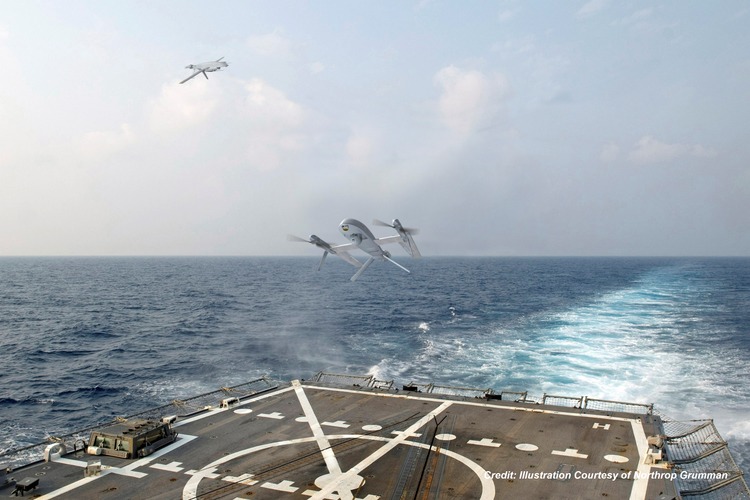
REDONDO BEACH, Calif. – July 13, 2023 – Northrop Grumman Corporation (NYSE: NOC) has been awarded a contract by the Defense Advanced Research Project Agency’s (DARPA) Tactical Technology Office to design an autonomous vertical takeoff and landing (VTOL) uncrewed aircraft system capable of operating from a moving Navy ship at sea. 

  • SAN DIEGO – 14 July 2023 – General Atomics Aeronautical Systems, Inc. (GAASI) today announced that its family of Unmanned Aircraft Systems (UAS), which includes the Predator®, Reaper, Gray Eagle, Avenger®, and MQ-9B SkyGuardian®/SeaGuardian® lines, has surpassed eight million flight hours. GA-ASI aircraft have completed 566,000 total missions in nearly 40 countries around the world.  
  • The AdvaNced airCraft Infrastructure-Less Launch And RecoverY (ANCILLARY) demonstrator will be designed as a cost-efficient, multiple-mission capable vehicle built on an agile platform that is runway independent. 
  • Northrop Grumman’s ANCILLARY demonstrator will be capable of carrying a large 60-pound sensor payload with greater endurance of 20 hours’ time on station and mission radius range of 100 nautical miles, which is more than current systems, without using significant additional infrastructure aside from what is on board the air vehicle. The system will also have capability to land on a ship in adverse weather conditions. 
  • The aircraft will be capable of performing intelligence, surveillance, reconnaissance and targeting missions, and supporting expeditionary missions for special operations forces and logistical missions with significant affordability impacts for ship-to-shore transition of parts and supplies. 

Expert: 

Tim Frei, vice president, research and advanced design, Northrop Grumman: “In collaboration with DARPA, Northrop Grumman will work to significantly enhance how future autonomous vertical lift aircraft will operate at sea and ashore. The ANCILLARY program enables us to combine our digital engineering expertise with extensive knowledge and insights from past successes in developing and operating uncrewed vertical lift aircraft for the U.S. Navy.” 

Details on DARPA ANCILLARY: 

DARPA’s ANCILLARY program aims to develop and flight demonstrate an X-plane with the critical technologies required for a leap-ahead in long endurance, VTOL unmanned air system (UAS) performance. The UAS would be able to launch and recover from ship flight decks and small austere land locations in adverse weather without additional infrastructure equipment, thus enabling expeditionary deployments. Unlike large VTOL systems, the small UAS size would allow many aircraft to be stored and operated from one ship creating a tactical beyond-line-of-site, multi-intelligence sensor network capability. 


Flag Officer Announcement

Release from the U.S. Department of Defense 

***** 

JULY 13, 2023 

Secretary of Defense Lloyd J. Austin III announced today that the president has made the following nomination: 

Navy Rear Adm. John B. Skillman for appointment to the grade of vice admiral with assignment as deputy chief of naval operations for Integration of Capabilities and Resources, N8, Office of the Chief of Naval Operations, Washington, D.C.  Skillman is currently serving as director, Programming Division, N80, Office of the Chief of Naval Operations, Washington, D.C. 

Navy Captain Michael T. Spencer for appointment to the grade of rear admiral (lower half).  Spencer is currently serving as commander, Naval Aviation Warfighting Development Center, Fallon, Nevada. 


Air Industries Group Receives Two Contracts Totaling $5.2 Million for US Navy E-2D Aircraft and F-35 Joint Strike Fighter Components

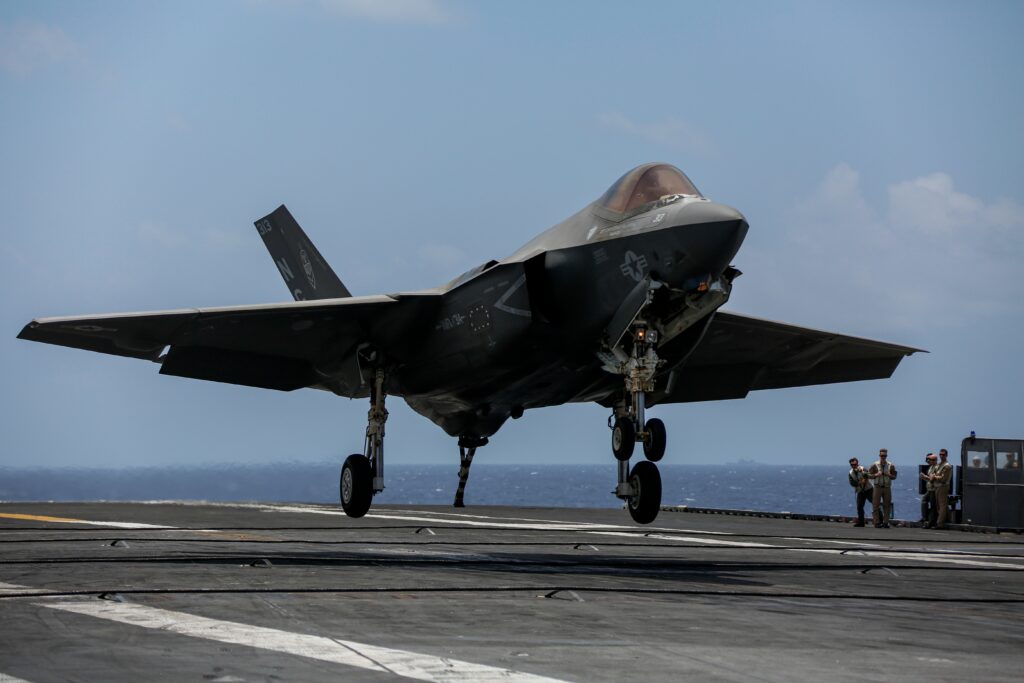
PACIFIC OCEAN (July 30, 2022) An F-35C Lightning II, assigned to the “Black Knights” of Marine Fighter Attack Squadron (VMFA) 314, prepares to make an arrested landing on the flight deck of the Nimitz-class aircraft carrier USS Abraham Lincoln (CVN 72). The Abraham Lincoln Carrier Strike Group is underway conducting routine operations in the U.S. 3rd Fleet. U.S. Navy photo by Mass Communication Specialist 3rd Class Michael Singley)

Release from Air Industries Group 

***** 

JUL 11, 2023 

BAY SHORE, N.Y.–(BUSINESS WIRE)–Jul. 11, 2023– Air Industries Group (the Company) (NYSE American: AIRI), an integrated Tier 1 manufacturer of precision assemblies and components for mission-critical aerospace and defense applications, and a prime contractor to the U.S. Department of Defense, today announced that it has been awarded two new contracts valued at a total of $5.2 million to produce components for the U.S. Navy E-2D aircraft and F-35 Joint Strike Fighter. 

The first order is valued at $2.0 million for E-2D arresting gear components. The order originates from a long-time customer of Air Industries Group, which has manufactured these flight safety components for many years. Deliveries under this new order are expected to begin in 2025. 

The second order is valued at $3.2 million for F-35 arresting gear components for the CV and CTOL versions of the aircraft. This order is from a new, non-U.S. customer for Air Industries Group. Deliveries under this order are expected to begin in the fourth quarter of 2023. 

Mr. Lou Melluzzo, CEO of Air Industries, commented: “We are very pleased to have received two sizeable orders for mission-critical components. The E-2D aircraft is essential to controlling the airspace above U.S. Navy carrier battlegroups. Air Industries has supported the E-2D for many years and is proud to continue to do so. 

“The new order for the F-35 aircraft is particularly gratifying as it is from a non-U.S. customer. Our business development strategy has focused on broadening our customer base and expanding our geographic reach. This contract from a European manufacturer is a positive step in both regards.” 


NAVAIR Selects Mercury to Deliver Digital Head-Up Display for T-45 Goshawk Training Aircraft 

Release from Mercury Systems Inc. 

***** 

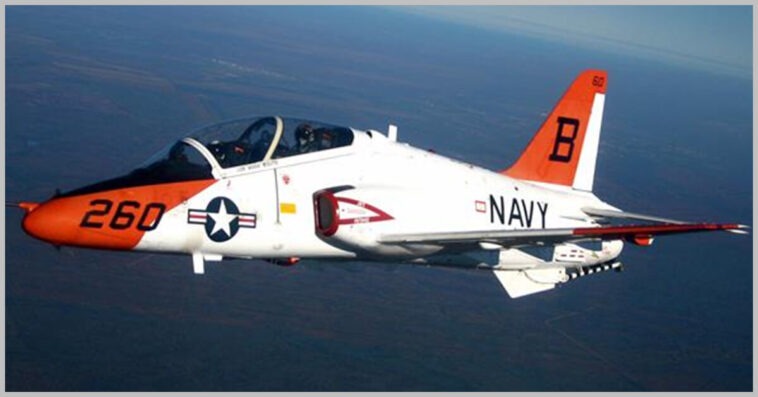
ANDOVER, Mass., July 12, 2023 (GLOBE NEWSWIRE) — Mercury Systems, Inc. (NASDAQ: MRCY, www.mrcy.com), a technology company that delivers processing power for the most demanding aerospace and defense missions, received a five-year contract worth as much as $83 million from the U.S. Naval Air Systems Command to deliver high-definition, digital Head-Up Display (HUD) systems for the T-45 Goshawk training aircraft. This firm-fixed-price delivery order was issued under a previously awarded basic ordering agreement. The Navy is the first customer to adopt Mercury’s HUD1080 technology that enables aviators to see critical flight and weapons data in real-time without taking their eyes off the sky. 

Under this program, Mercury expects to deliver nearly 300 HUD systems, with the first $45 million production order awarded in conjunction with this contract. The T-45 Goshawk is a tandem-seat jet trainer used to train Navy and Marine Corps aviators to fly the U.S. military’s most advanced fighter jets, including the F/A-18E/F Super Hornet, F-35 Lightning, and the EA-18G Growler, as well as tactical airborne early warning aircraft such as the E-2 Hawkeye. The new T-45 HUD with an integrated camera is based on Mercury’s low-profile HUD design that minimizes pilot discomfort, enhances situational awareness, and maximizes an aviator’s field-of-view. It is also DAL-A certifiable—the highest level of design assurance that can be applied to airborne systems—allowing it to be used for critical flight and mission tasks such as landing on aircraft carriers. 

Why It Matters 
Pilots must understand a wealth of rapidly changing data while flying, and a HUD allows them to maintain awareness of this information without having to take their eyes off the sky to look down at multiple instruments. Current training aircraft use older analog HUD systems that have a bulky design, are out of production, and cannot integrate with the modern enhanced vision systems used in today’s fighter jets. The integration of Mercury’s HUD into the T-45 solves the obsolescence problem for the aircraft and ensures pilots are trained in an operationally realistic environment, as the systems are compatible with upcoming T-45 avionics upgrades. 

“The introduction of the HUD1080 expands Mercury’s display technology portfolio and our ability to deliver mission-ready technology and solutions for all aspects of the avionics ecosystem,” said Mitch Stevison, Executive Vice President and President of Mercury’s Mission Systems division. “We look forward to delivering our digital HUD for the T-45 Goshawk, ensuring today’s student pilots have the technology to train for current and future missions.”