By U.S. Naval Forces Central Command Public Affairs | July 05, 2023
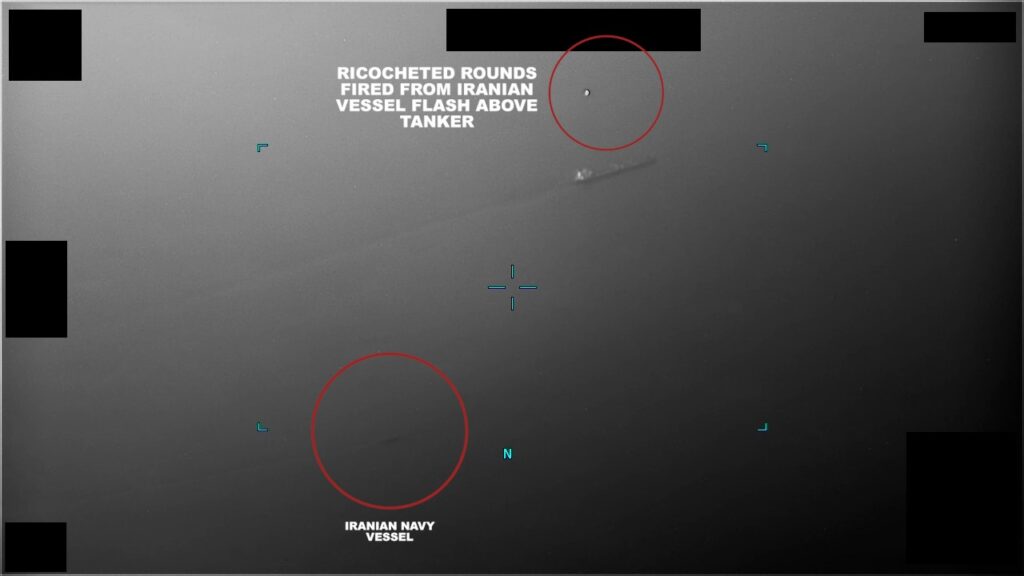
GULF OF OMAN — On July 5, U.S. forces prevented two attempted commercial tanker seizures by the Iranian Navy after the Iranians had opened fire in one of the incidents near the coast of Oman.
Both of these incidents occurred in international waters.
At 1 a.m. local time, one Iranian naval vessel approached the Marshall Islands-flagged oil tanker TRF Moss in international waters in the Gulf of Oman. The Iranian vessel departed the scene when U.S. Navy guided-missile destroyer USS McFaul (DDG 74) arrived on station. Additionally, the U.S. Navy deployed surveillance assets, including MQ-9 Reaper and P-8 Poseidon maritime patrol aircraft.
Approximately three hours later, the U.S. Navy received a distress call from Bahamian-flagged oil tanker Richmond Voyager while the ship was more than 20 miles off the coast of Muscat, Oman, and transiting international waters toward the Arabian Sea. Another Iranian naval vessel had closed within one mile of Richmond Voyager while hailing the commercial tanker to stop.
McFaul directed course toward Richmond Voyager at maximum speed as the merchant tanker continued its transit. Prior to McFaul’s arrival on scene, Iranian personnel fired multiple, long bursts from both small arms and crew-served weapons. Richmond Voyager sustained no casualties or significant damage. However, several rounds hit the ship’s hull near crew living spaces. The Iranian navy vessel departed when McFaul arrived.
In May, the United States increased the rotation of ships and aircraft patrolling the Strait of Hormuz with partners following an uptick in Iranian merchant vessel seizures. The increased force presence supports multinational efforts under the International Maritime Security Construct and bilaterally with partner nations to deter threats to commercial shipping and reassure regional mariners.
“I couldn’t be prouder of the entire [U.S. Naval Forces Central Command] team, especially the exceptional effort by the McFaul crew, for immediately responding and preventing another seizure,” said Vice Adm. Brad Cooper, commander of U.S. Naval Forces Central Command, U.S. 5th Fleet and Combined Maritime Forces. “We remain vigilant and ready to protect navigational rights in these critical waters.”
Since 2021, Iran has harassed, attacked or seized nearly 20 internationally flagged merchant vessels, presenting a clear threat to regional maritime security and the global economy.
Marine Exchange of Southern California Commemorates 100 Years of Maritime Excellence
San Pedro, July 1, 2023
The Marine Exchange of Southern California, a beacon of maritime operations, is proud to announce its centennial anniversary. For a remarkable 100 years, the Marine Exchange has steadfastly promoted the safety, security, efficiency, reliability, and environmental soundness of the Marine Transportation System in the Southern California region.
Since its establishment 1 July 1923, the Marine Exchange of Southern California has been a cornerstone of the maritime industry, fostering collaboration, innovation, and excellence in the region. Over the past century, it has seamlessly navigated the changing tides to meet the evolving needs of the industry, providing invaluable services and support to a vast array of maritime stakeholders. The Marine Exchange maintains records of ship arrivals and departures stretching back to its inception and has evolved into the Maritime Information Center and Vessel Traffic Service for the Los Angeles-Long Beach Port Complex.
As the compass navigating maritime operations in Southern California, the Marine Exchange operates around the clock to chart the course of the smooth flowing commerce and safeguarding the vital waterways of the region. With its state-of-the-art vessel tracking systems, comprehensive maritime information services, and efficient communications networks, the Marine Exchange has revolutionized the way ships navigate and operate in the four major ports of Southern California: Port Hueneme, Los Angeles, Long Beach, and San Diego, as well as the offshore marine oil terminal at El Segundo. For example, the Marine Exchange worked with Industry and Public Sector Partners to develop the new queuing system for labor, which helped manage, increase safety, and increase air quality, the record-breaking backup of container ships during 2020-2022, which reached a peak of 109 on 9 January 2022.
To commemorate this remarkable milestone, the Marine Exchange brought together industry leaders, government officials, and stakeholders in a Centennial Celebration to pay homage to its rich maritime heritage and a century’s worth of contributions to the maritime community. On June 29, the Marine Exchange kicked off their 100th year with a celebration featuring a ceremony, speeches, cake-cutting, and an exhibition showcasing 100 years’ worth of keepsakes and photos. In attendance was a range of industry professionals and elected officials including Long Beach Vice Mayor Cindy Allen, MX Board President Bob Clark, President of the Long Beach Board of Harbor Commissioners Sharon Weissman and Commissioner Bonnie Lowenthal, Los Angeles Harbor Commissioners Diane Middleton and Lee Williams, Port of Los Angeles Deputy Executive Director and LA Port Police Chief Tom Gazsi, US Coast Guard Captain Stacey Crecy, ILWU Local 94 Vice President Duane Martinez, Los Angeles City Councilmember Tim McOsker, and representatives from the offices of California State Senator Steven Bradford, Assemblymember Mike Gipson, and Assemblymember Josh Lowenthal.
21 members of the Coast Guard Auxiliary Divisions 5 and 6 provided safety and security support throughout the event.
“We are thrilled to celebrate this momentous milestone in our history,” said Captain Kip Louttit, USCG, Retired, Executive Director of the Marine Exchange of Southern California. “For 100 years, we have been at the forefront of maritime operations, and this anniversary is a testament to our unwavering commitment to a safe, secure, efficient, reliable, and environmentally sound Marine Transportation System in Southern California waterways. We are proud to honor our storied past and engage with the maritime community to chart a course for an even brighter future.” For more information about the Marine Exchange of Southern California’s centennial celebration, please visit their official website at mxsocal.org, or contact [email protected]
Ingalls Shipbuilding Successfully Completes Builder’s Trials for Calhoun (WMSL 759)
PASCAGOULA, Miss., June 30, 2023 (GLOBE NEWSWIRE) — HII’s (NYSE: HII) Ingalls Shipbuilding division announced today the successful completion of builder’s sea trials for the U.S. Coast Guard‘s newest national security cutter, Calhoun (WMSL 759). The ship successfully tested propulsion and auxiliary equipment, as well as various ship systems.
“Every successful sea trial is a major accomplishment for our shipbuilders, and the NSC team has worked hard to ensure the Coast Guard receives another highly capable and advanced cutter for the fleet,” Ingalls Shipbuilding NSC Program Manager Amanda Whitaker said. “Our team will continue to prepare NSC 10 for the next set of trials and ensure that this ship will be ready to undertake the most challenging Coast Guard missions.”
For over two decades, Ingalls Shipbuilding has served as the sole designer and provider of the Coast Guard Legend-class national security cutter. The flagship of the Coast Guard fleet, national security cutters are capable of embarking and supporting a wide range of Coast Guard, Navy and NATO manned and unmanned aircraft. National security cutters have proven to be ideal platforms for drug interdiction, global illegal fishing, disaster relief and defense support operations.
NSC 10 is named to honor Charles L. Calhoun, the first Master Chief Petty Officer of the U.S. Coast Guard. Calhoun served in the U.S. Navy for three years during World War II and was honorably discharged in 1946 as a torpedoman second class. He enlisted in the Coast Guard that same year and held varying positions of leadership over the course of his career.
Ingalls has delivered nine Legend-class national security cutters to the Coast Guard further enabling their important missions around the globe.
Naval Air Warfare Center Teams Up With Military Sealift Command, U.s. Marines To Test Unmanned Aerial System Concept In An Expeditionary Environment
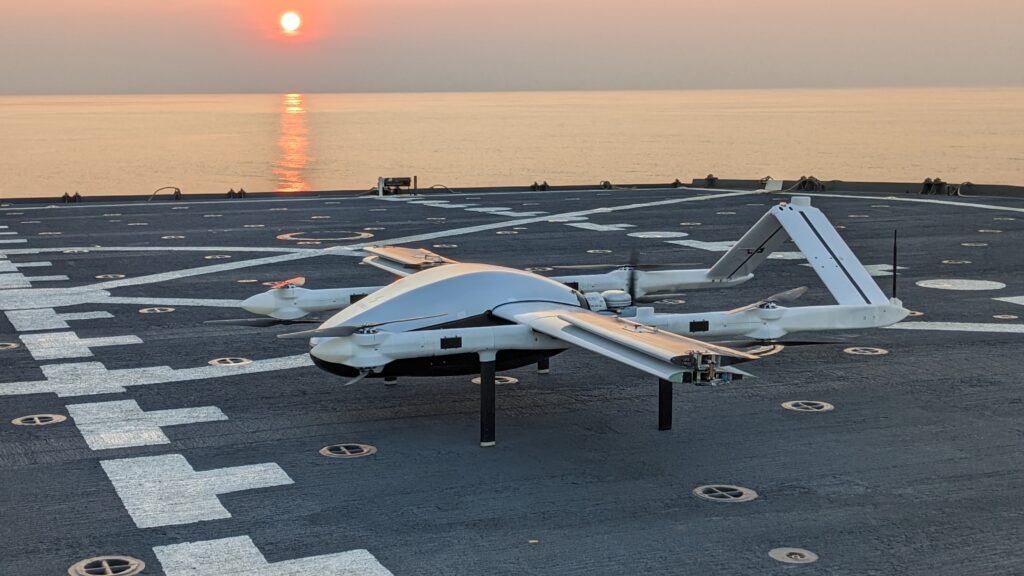
ATLANTIC OCEAN (June 10, 2023)- A view of a Blue Water Logistic Unmanned Areal System on the flight deck of the fleet replenishment oiler USNS Patuxent (T-AO 201) while the ship was underway in the Atlantic Ocean, June 10. (U.S. Navy photo by John Bruening/released)
ATLANTIC OCEAN – A team of contracted civilian Unmanned Aerial System (UAS) specialists from Texas-based Skyways teamed up with the Naval Air Warfare Center Aircraft Division’s (NAWCAD) Rapid Prototyping and Experimentation Division and UX-24 Unmanned Test Squadron, the U.S. Marine Corps, Military Sealift Command and the crew of MSC’s fleet replenishment oiler USNS Patuxent (T-AO 201) to test the Blue Water Logistics UAS’s ability to support expeditionary material transportation, while the ship was at sea in the Atlantic Ocean, June 11-12.
The Blue Water Logistics UAS, produced by Skyways, features a removable internal cargo bay capable of transporting small payloads of material from one location to another, autonomously.
The team performed UAS test flights as part of U.S. Fleet Forces Command and U.S. Marine Forces Command’s Fleet Battle Problem 23-1.
“The UAS specialist, shore-side Marines and USNS Patuxent successfully completed the first integration of a logistics drone into a Fleet exercise,” according to John Bruening, Military Sealift Command Taluga Group Director. “Over the course of two days, the UAS flew simulated re-supply missions in support of U.S. Marine Corps troops ashore in North Carolina; making multiple deliveries of parts during Fleet Battle Problem 23-1.”
The team used two drones to performed five UAS test flights off the coast of North Carolina. Three of the flights demonstrated the UAS’s ability to deliver simulated critical repair parts autonomously from USNS Patuxent to Marines operating in an expeditionary environment ashore. The UAS also successfully made two autonomous flights transporting simulated cargo from the Marines ashore to the fleet replenishment oiler at-sea.
“Data analysis has shown that 90% of the high priority parts that are delivered from MSC’s Combat Logistic Force ships weigh less than 50 pounds,” Bruening stated. “Instead of using a helicopter or sailing ships close together to transfer these parts, we hope to use a logistics drone, which not only saves wear and tear on helicopters, it also provides flexibility to the warfighter while in support of Distributed Maritime Operations.”
The team also performed additional UAS flights in the vicinity of USNS Patuxent to test some of the Blue Water’s new capabilities and technologies.
“The Blue Water UAS flights were very successful and we met all of our objectives,” according to Bruening. “We proved that we can operate the logistic drones from ships as well as from the shore in support of the Navy and Marine Corps.”
U.S. Fleet Forces Command and U.S. Marine Forces Command conducted Fleet Battle Problem-23, June 9-13, on-land and off the coast of Camp Lejeune, North Carolina, and the Virginia Capes to further develop integrated maritime capabilities with the II Marine Expeditionary Force and U.S. 2nd Fleet.
“There was a lot of excitement aboard USNS Patuxent and with the ashore team to see this new capability,” said Bruening. “The harsh maritime environment adds technical challenges, but the Blue Water UAS team is ready to attack those issues and increase worldwide logistics delivery capability.”
Going forward, MSC and the Blue Water UAS team plans to continue adding capabilities to the drone as well as incorporate lessons learned from this underway period, according to Bruening.
“We will have to change the way we think about logistics when we start using unmanned systems,” concluded Bruening. “When the Skyways UAS launched from USNS Patuxent, the radar controller asked for a status check of the drone and to report how many people were in the aircraft as that question is always asked after an aircraft takes off. I answered ‘None, it’s a logistics drone.’ A new era has started!”
In 2021, earlier versions of Blue Water UAS successfully performed ship to ship cargo delivery from the fleet replenishment oiler USNS Joshua Humphreys (T-AO 188) and the guided missile destroyer USS Bainbridge (DDG 96). Also in 2021, a Blue Water UAS demonstrated the ability to deliver simulated supplies to the aircraft carrier USS Gerald
12 June 2023
ATLANTIC OCEAN – A team of contracted civilian Unmanned Aerial System (UAS) specialists from Texas-based Skyways teamed up with the Naval Air Warfare Center Aircraft Division’s (NAWCAD) Rapid Prototyping and Experimentation Division and UX-24 Unmanned Test Squadron, the U.S. Marine Corps, Military Sealift Command and the crew of MSC’s fleet replenishment oiler USNS Patuxent (T-AO 201) to test the Blue Water Logistics UAS’s ability to support expeditionary material transportation, while the ship was at sea in the Atlantic Ocean, June 11-12.
The Blue Water Logistics UAS, produced by Skyways, features a removable internal cargo bay capable of transporting small payloads of material from one location to another, autonomously.
The team performed UAS test flights as part of U.S. Fleet Forces Command and U.S. Marine Forces Command’s Fleet Battle Problem 23-1.
“The UAS specialist, shore-side Marines and USNS Patuxent successfully completed the first integration of a logistics drone into a Fleet exercise,” according to John Bruening, Military Sealift Command Taluga Group Director. “Over the course of two days, the UAS flew simulated re-supply missions in support of U.S. Marine Corps troops ashore in North Carolina; making multiple deliveries of parts during Fleet Battle Problem 23-1.”
The team used two drones to performed five UAS test flights off the coast of North Carolina. Three of the flights demonstrated the UAS’s ability to deliver simulated critical repair parts autonomously from USNS Patuxent to Marines operating in an expeditionary environment ashore. The UAS also successfully made two autonomous flights transporting simulated cargo from the Marines ashore to the fleet replenishment oiler at-sea.
“Data analysis has shown that 90% of the high priority parts that are delivered from MSC’s Combat Logistic Force ships weigh less than 50 pounds,” Bruening stated. “Instead of using a helicopter or sailing ships close together to transfer these parts, we hope to use a logistics drone, which not only saves wear and tear on helicopters, it also provides flexibility to the warfighter while in support of Distributed Maritime Operations.”
The team also performed additional UAS flights in the vicinity of USNS Patuxent to test some of the Blue Water’s new capabilities and technologies.
“The Blue Water UAS flights were very successful and we met all of our objectives,” according to Bruening. “We proved that we can operate the logistic drones from ships as well as from the shore in support of the Navy and Marine Corps.”
U.S. Fleet Forces Command and U.S. Marine Forces Command conducted Fleet Battle Problem-23, June 9-13, on-land and off the coast of Camp Lejeune, North Carolina, and the Virginia Capes to further develop integrated maritime capabilities with the II Marine Expeditionary Force and U.S. 2nd Fleet.
“There was a lot of excitement aboard USNS Patuxent and with the ashore team to see this new capability,” said Bruening. “The harsh maritime environment adds technical challenges, but the Blue Water UAS team is ready to attack those issues and increase worldwide logistics delivery capability.”
Going forward, MSC and the Blue Water UAS team plans to continue adding capabilities to the drone as well as incorporate lessons learned from this underway period, according to Bruening.
“We will have to change the way we think about logistics when we start using unmanned systems,” concluded Bruening. “When the Skyways UAS launched from USNS Patuxent, the radar controller asked for a status check of the drone and to report how many people were in the aircraft as that question is always asked after an aircraft takes off. I answered ‘None, it’s a logistics drone.’ A new era has started!”
In 2021, earlier versions of Blue Water UAS successfully performed ship to ship cargo delivery from the fleet replenishment oiler USNS Joshua Humphreys (T-AO 188) and the guided missile destroyer USS Bainbridge (DDG 96). Also in 2021, a Blue Water UAS demonstrated the ability to deliver simulated supplies to the aircraft carrier USS Gerald R. Ford (CVN 78).
US Navy Submarine Industrial Base Celebrates Growing Workforce
The Navy’s Submarine Industrial Base Program’s (SIB) Workforce Development Team in partnership with Department of Defense suppliers hosted more than 700 new workforce members for Talent Pipeline Project Signing Day events this summer in Philadelphia; Hampton Roads, Virginia; and Pittsburgh.
These events recognize members who have completed trade skills training and are embarking on careers at small and medium-sized defense industrial base suppliers.
The talent pipelines, administered by the Navy’s Submarine Industrial Base (SIB) Program and its partners, address critical industrial base workforce needs by connecting career and technical training providers, students, and companies in the SIB. The program’s goal is to sustain a maritime and defense industrial base-focused talent pipeline, enabling employers to further develop their workforce through recruiting, hiring, training, and retaining skilled employees with critical trade skills.
Senior Navy leaders, industry, non-profit, education partners, and federal and state elected officials who support workforce development efforts were in attendance to recognize the new workforce members.
The Philadelphia Signing Day was held on May 4, followed by the Hampton Roads event on June 3 and the Pittsburgh event on June 20.
During his address at the Philadelphia signing day, Matt Sermon, Executive Director, Strategic Submarines, said, “To those of you embarking on a career in national security, what you do is vital to defending the American way of life. The only way that America will keep pace with the technological savvy and industrial might of our competitors is with the American worker, with American innovation, leveraging technology, capacity building, and technical rigor. Thank you for your contributions to the industrial base.”
The Philadelphia program is in its second year and during this year’s Signing Day, more than 165 employees that participated in the inaugural event in May 2022 were in attendance to celebrate their one-year anniversary.
For many, participation in a talent pipeline has been life-altering. At the Hampton Roads Signing Day mother of four and newly minted welder, Cassandra Blythe, shared her personal journey that led to a career at SIB supplier, Advex. Blythe tragically lost her husband and was looking for a new way to provide for her family.
“I chose the Certified Welding Program at Virginia Peninsula Community College,” said Blythe. “It was drastically different from what I was used to, but not totally unfamiliar. My two grown sons both have careers in welding for the defense industry, they offered support and dared me to give it a try.”
Following in her family’s footsteps, Blythe’s daughter applied and was accepted to the welding program at New Horizons in Hampton, Virginia for the 2023-2024 school year. Blythe said she hopes to encourage women of all ages and inspire girls to seek a trade that is rewarding and fulfilling.
Over the next 10 years, America’s submarine industrial base will need to hire 100,000 skilled employees to meet the Navy’s growing demand for submarine construction through 2040.
“You are part of truly something special,” said Admiral Daryl Caudle, Commander, U.S. Fleet Forces Command, during his keynote address at the Hampton Roads Signing Day. “No one else can do what our industrial base can do, anywhere in the world. No one else is able to sustain a combat fleet of conventional and nuclear-powered warships, at such a high tempo over the class lifecycle of thirty, forty, or even fifty years. No one else is so critical to our ability to deliver deterrence, sea control, and power projection at our timing and tempo. You all should be extremely proud. I know I am. It’s impossible to see the talent before me today and not be excited and confident in the future of our country.”
The Navy is on a journey to recapitalize its sea-based strategic deterrence and to guarantee a capable and enduring undersea presence. To do so, it must address challenges to SIB capability, capacity, and workforce development.
Speaking at the Pittsburgh event, Rear Admiral Scott Pappano, Program Executive Officer, Strategic Submarines said, “This event is to recognize the men and women who are taking the next step in their journey to join the defense industrial base. They are the future of this nation and will define where this nation goes in the next decade, the next generation, the next century. It all starts here, tonight.”
Rear Admiral Pappano spoke about the importance of America’s submarine fleet in the context of increasing global threats and stressed the crucial importance of the manufacturing sector.
“The most important thing we need right now is to re-establish manufacturing and continue to grow manufacturing. I’m very glad we’re doing that here in Pittsburgh.”
Having launched the Hampton Roads and Pittsburgh Pipeline Projects this year, the Navy plans to build on the positive momentum with plans for five Signing Day events next year, adding events in Long Island, New York and Boston as SIB moves toward meeting workforce demand.
For more information on the Navy’s Submarine Industrial Base Program’s Talent Pipeline Program visit:
ARLINGTON, Va. — The U.S. Navy’s effort to expand its cyber warfare capabilities took another step with the establishment of the Cyber Warfare Technician (CWT) rating in its enlisted force.
The CTWs will conduct both offensive and defensive cyber warfare.
The action came only two days after the Navy established Maritime Cyber Warfare Officer designator for information warfare officers who focus on cyber warfare.
As announced in a June 29 directive from the chief of naval operations, all Sailors in the existing Cryptologic Technician-Networks (CTN) rating will convert to the CTW rating. In addition, the CTWs will no longer be formally associated with the family of cryptologic ratings.
The Navy currently had 2,288 Sailors rated as CTNs as of last week, most of whom were already working in cyber warfare, said Naval Information Forces Force Master Chief Laura Nunley, speaking to reporters in a press conference last week. More than 93% of the CTNs already were working in cyber warfare.
“We are looking at further opportunities to expand that to some of the supporting roles and possibly cross-rate into there, and then we’re also looking into recruiting aspects of bringing in more enlisted to the new cyber warfare technician [rating].” Nunley said.
“All CTNs will be required to change their rating badge to the new CWT rating badge within twelve months of release of this message,” the directive said.
The new rating badge was designed by CTN2 Kelly Bullard.
Vice Admiral Kelly Aeschbach, commander, Naval Information Forces, told reporters in the press conference that most of the current Navy cyber forces are on in shore duty in the Navy’s cyber mission force predominantly at Fort Meade, Maryland; Hawaii; Pensacola, Florida; Fort Gordon, Georgia; and San Antonio, Texas.
“Those are aligned with our big National Security Agency presence and the Navy Information Operations Command integrated in each of those locations,” Aeschbach said, noting that most of the cyber warriors are organized in teams ashore.
The admiral said that she expects “over the next couple of years as we mature both the [Maritime Cyber Warfare Officer] and the [CWT] ratings and we deliver some new capabilities afloat, that we will likely see some new opportunities” for cyber warriors to serve afloat.
Aeschbach said that the Navy is trying to frontload training of CWTs so that they are “fully trained before they arrive at command, which was something that was not happening two years ago. We’ve made a lot of progress in that area, and we’re also providing much more substantial mentoring,” she said.
“When you talk about the substantial mentoring, and when you talk about the growth of the cyber mission force, and that’s slowing down the growth of the teams, we did take some of the near-term operational growth to actually create dedicated training and mentoring teams, which is modeled on how we train in aviation and in the surface community where we always have a small component of the force focused on what we call force generation or training and keeping units and teams standard up to a certain level one our folks are inside a certain unit,” the admiral said. “And we already are seeing some impact from that. We will put the operational growth back. It will still happen; it’s just going to happen at a little bit slower pace as we get to the total number of teams over the two to four years.”
Graphic rendering of the future USS Lafayette (FFG 65), named in honor of Marquis de Lafayette and his service during the American Revolutionary War. USS Lafayette is the fourth of the new Constellation-class frigates, scheduled to commission in 2029. The Constellation-class guided-missile frigate represents the Navy’s next generation small surface combatant.
Secretary of the Navy (SECNAV) Carlos Del Toro announced in Paris that a future Constellation-class guided-missile frigate will be named USS Lafayette (FFG 65), June 29.
The future USS Lafayette will honor Marquis de Lafayette and his service during the American Revolutionary War.
A member of the French nobility, the young Lafayette took a fervent interest in the cause of the American revolutionaries, and in December 1776, was contracted into service as a major general in the Continental Army. In 1779, he returned briefly to France, where he successfully advocated for military aid for the Americans. He was wounded at the Battle of Brandywine, where British soldiers shot him in the leg. After his recovery, Lafayette joined Gen. George Washington as a member of his personal staff, forming a bond that has been characterized as the one shared between a father and his son.
“Their shared ideals—that all people deserve liberty and the pursuit of happiness, as well as an unflinching commitment to democratic governance—are the foundation upon which the relationship between France and the United States of America continue to build upon today,” said Secretary Del Toro during remarks at the naming ceremony in Paris. “Just think, were it not for the Marquis de Lafayette’s willingness—along with that of tens of thousands of his compatriots—to fight alongside our Continental Army and Navy during our Revolutionary War centuries ago, we might not be here together this evening.”
In 2002, Congress posthumously made Lafayette an honorary U.S. citizen.
Three previous Navy vessels have been named in honor of Lafayette: a sidewheel ironclad ram, a transport ship (AP 53), and a ballistic missile submarine (SSBN 616).
USS Lafayette, the fourth of our new Constellation-class frigates, is scheduled to commission in 2029. The other ships in the class are USS Constellation (FFG 62), USS Congress (FFG 63), and USS Chesapeake (FFG 64).
USS Lafayette and her sister ships bring with them increased lethality, survivability, and the capabilities that our Joint Force requires to conduct operations around the world with our partners and allies.
“Just as her namesake, the Marquis de Lafayette did almost 250 years ago, USS Lafayette and her crew will stand ready to answer our Nation’s call to defend our shared principles around the world, ensuring that our global maritime commons remain free and open for all who wish to use them for lawful activities,” said Secretary Del Toro.
U.S. Ambassador to France Denise Bauer said, “The vital American-French alliance owes much to our historic naval partnership and to the early leadership of the Marquis de Lafayette, and so it is entirely fitting that the United States Navy will name a vessel in honor of this legendary hero.”
The Constellation-class guided-missile frigate represents the Navy’s next generation small surface combatant. This ship class will be an agile, multi-mission warship, capable of operations in both blue-water and littoral environments, providing increased combat-credible forward presence that provides a military advantage at sea.
The Constellation-class will have multi-mission capability to conduct air warfare, anti-submarine warfare, surface warfare, electronic warfare, and information operations.
Specifically, the class includes an enterprise air surveillance radar, Baseline Ten Aegis combat system, a Mk 41 vertical launch system, communications systems, Mk 57 gun weapon system countermeasures, and added capability in electronic warfare and information operations with design flexibility for future growth.
A ship naming celebration will also take place at George Washington’s Mount Vernon in Virginia on July 3, 2023.
Find more information on Constellation-class guided-missile frigates here.
Navy Accepts Delivery of Ship to Shore Connector, Landing Craft, Air Cushion 107
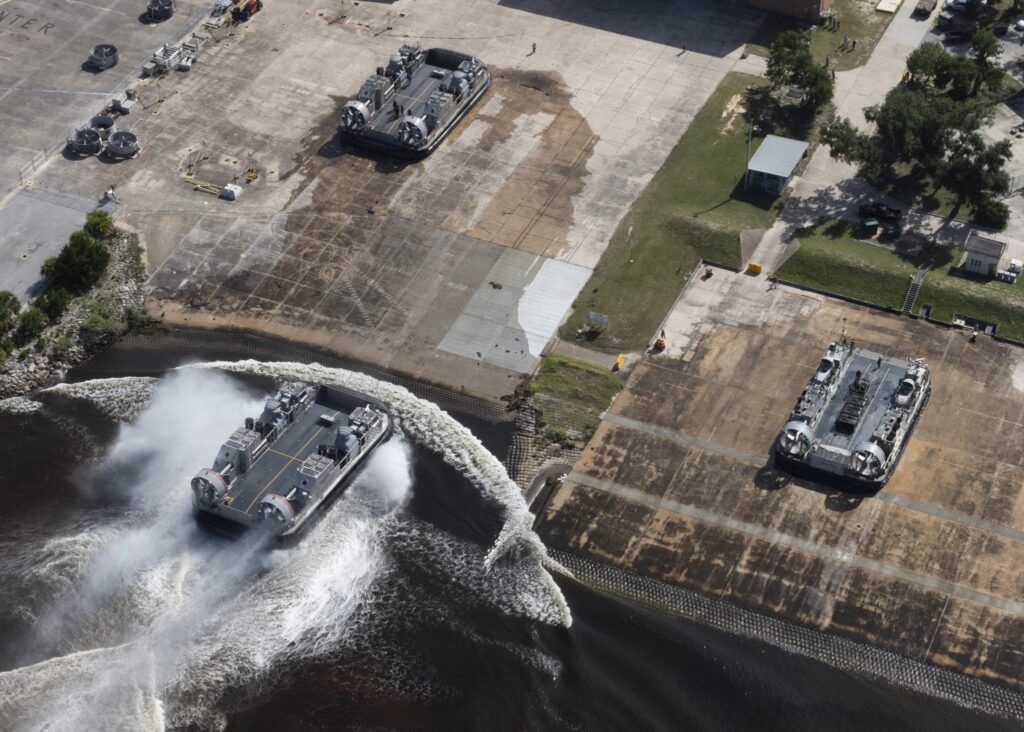
Two LCAC 100-class ship-to-shore connectors are shown at Panama City, Florida, along with an older LCAC 1-class craft (right). U.S. NAVY / Ronald Newsome
New Orleans, Louisiana – The Navy accepted delivery of the next-generation landing craft, Ship to Shore Connector (SSC), Landing Craft, Air Cushion (LCAC) 107, on Jun. 28.
The delivery of LCAC 107 comes after completion of Acceptance Trials conducted by the Navy’s Board of Inspection and Survey, which tested the readiness and capability of the craft to effectively meet its requirements.
“Delivery of LCAC 107 will immediately benefit the Navy and Marine Corps team as it provides capability around the globe,” said Capt. Jason Grabelle, program manager for Amphibious Assault and Connectors Programs, Program Executive Office (PEO) Ships. “SSC provides the fleet with agility and speed to assist with current and future mission requirements.”
LCACs are built with configurations, dimensions, and clearances similar to the legacy LCACs they replace – ensuring that this latest air cushion vehicle is fully compatible with existing, well deck-equipped amphibious ships, the Expeditionary Sea Base and the Expeditionary Transfer Dock. LCACs are capable of carrying a 60 to 75-ton payload. They primarily transport weapon systems, equipment, cargo, and assault element personnel through a wide range of conditions, including over-the-beach.
Textron Systems is currently in serial production on LCACs 108-119.
As one of the Defense Department’s largest acquisition organizations, PEO Ships is responsible for executing the development and procurement of all destroyers, amphibious ships, special mission and support ships, boats and craft.
Navy establishes the Maritime Cyber Warfare Officer (MCWO) Designator — 1880
SUFFOLK, VA. – The Navy has announced the establishment of the Maritime Cyber Warfare Officer (MCWO) Designator via Naval Administrative Message (NAVADMIN) 143/23.
The 2023 National Defense Authorization Act (NDAA), signed into law on Dec. 23, 2022, directed the Secretary of the Navy, in coordination with the Chief of Naval Operations, to establish a cyber warfare operations designator for officers within 180 days after enactment of the NDAA.
Previously, the Navy has utilized officers within the Information Warfare (IW) community, including Cryptologic Warfare (CW) and Information Professional (IP) to fill billets across the Cyber Operations Forces (COF). The establishment of MCWO will allow officers to build expertise and professional experience within the COF.
Vice Adm. Kelly Aeschbach, commander of Naval Information Forces and the Navy’s Information Boss, explained how the Navy developed its plan to establish the MCWO designator.
“The Navy is committed to meeting current and future cyber capability requirements. Naval Information Forces and key leaders in IW domain closely examined the IW construct and determined it did not adequately support multiple tours in the cyber mission area. Creation of the MCWO designator creates a career path for those officers to specialize in the cyber mission and develop their unique and critical skillset.”
The establishment of the MCWO designator is a major milestone in expanding the Navy cyber mission and recognizes the critical need for cyber specialization among the Navy officer line community. MCWOs are experts in cyberspace operations, focused on both Offensive Cyberspace Operations (OCO) and Defensive Cyberspace Operations (DCO).
“IW Officers have been absolutely critical to addressing threats in cyberspace – ensuring our Navy and joint force stay in competition,” continued Aeschbach. “The Navy is committed to developing cyber specialization and skill sets among the MCWO Community to pace this competition, and to prevail in conflict if they are ever called to do so.”
NAVIFOR’s mission is to generate, directly and through our leadership of the IW Enterprise, agile and technically superior manned, trained, equipped, and certified combat-ready IW forces to ensure our Navy will decisively DETER, COMPETE, and WIN.
Nimitz Carrier Strike Group Returns to San Diego from Deployment
230628-N-KU796-1026 San Diego (June 28, 2023) U.S. Navy Sailors prepare to man the rails of the aircraft carrier USS Nimitz (CVN 68). Nimitz arrives in San Diego concluding a seven-month deployment to U.S. 3rd and 7th Fleet areas of operations (AO). Nimitz’s presence in U.S. 3rd and 7th Fleet AOs reinforced the United States’ commitment to fly, sail and operate wherever international law allows in support of a free and open Indo-Pacific region. (U.S. Navy photo by Mass Communication Specialist 2nd Class Samuel Osborn)
SAN DIEGO, Calif. – Ships from the Nimitz Carrier Strike Group (Nimitz CSG) returned to San Diego June 28, concluding a seven-month deployment to U.S. 3rd and 7th Fleet areas of operations (AO).
Sailors assigned to Ticonderoga-class guided-missile cruiser USS Bunker Hill (CG 52), Arleigh Burke-class guided-missile destroyer USS Decatur (DDG 73) and the embarked air wing of Carrier Air Wing (CVW) 17 returned home with the arrival of USS Nimitz (CVN 68) in San Diego. Nimitz will depart San Diego for its return to homeport in Bremerton, Washington at a later date.
Hawaii-based ships attached to Carrier Strike Group (CSG) 11, Arleigh Burke-class guided-missile destroyers USS Chung-Hoon (DDG 93) and USS Wayne E. Meyer (DDG 108), returned to homeport on June 20 and 27, respectively.
“For seven months, the Nimitz Carrier Strike Group demonstrated our ironclad commitment to partners and allies in the Indo-Pacific region,” said Rear Adm. Jennifer Couture, commander, CSG-11. “During this deployment, Sailors of every rank and rate displayed a vigorous work ethic and a humble devotion to duty and I want to thank them and their families for their sacrifice. I am humbled to serve alongside determined professionals and observe their excellence at every level. Our strike group returns home stronger, smarter, and more resilient than ever before.”
While in the U.S. 7th Fleet AO, CSG-11 conducted deterrence and presence operations; multinational exercises; integrated multi-domain training; long-range maritime strike exercises; anti-submarine warfare; information warfare operations; air defense operations; multiple ship navigation; and formation maneuvering and refueling-at-sea operations. U.S. 7th Fleet is the U.S. Navy’s largest forward-deployed numbered fleet.
Nimitz executed six port calls – Guam; Singapore; Busan, South Korea; Laem Shabang, Thailand; Sasebo, Japan and Pearl Harbor, Hawaii – and hosted two formal “Big Top” receptions in South Korea and Thailand. The aircraft carrier also embarked foreign dignitaries, military officials, ambassadors, and international media, and operated with the joint force and several nations, including Australia, Canada, France, Japan, the Philippines, Republic of Korea and Singapore. Alongside allies and partners, the Nimitz CSG’s presence in U.S. 7th Fleet reinforced the United States’ commitment to fly, sail, and operate wherever international law allows in support of a free and open Indo-Pacific region.
Nimitz – the oldest-serving U.S commissioned aircraft carrier in the world – completed its 350,000th arrested aircraft landing on April 22, 2023 while sailing in the South China Sea. The milestone was piloted in an F/A-18F Super Hornet from the “Fighting Redcocks” of Strike Fighter Squadron (VFA) 22 by Capt. Craig Sicola, Nimitz commanding officer, and Cmdr. Luke Edwards, commanding officer of VFA 22. Nimitz is the first active U.S. aircraft carrier to reach this milestone.
Nimitz’s embarked air wing consisted of the “Fighting Redcocks” of Fighter Attack Squadron (VFA) 22, “Mighty Shrikes” of VFA-94, “Kestrels” of VFA-137, “Blue Diamonds” of VFA-146, “Sun Kings” of Carrier Airborne Early Warning Squadron (VAW) 116, “Cougars” of Electronic Attack Squadron (VAQ) 139, “Battlecats” of Helicopter Maritime Strike Squadron (HSM) 73, “Screamin’ Indians” of Helicopter Sea Combat Squadron (HSC) 6 and “Providers” of Fleet Logistic Support Squadron (VRC) 30.