HII’s Ingalls Shipyard Has Capacity for More Navy Shipbuilding
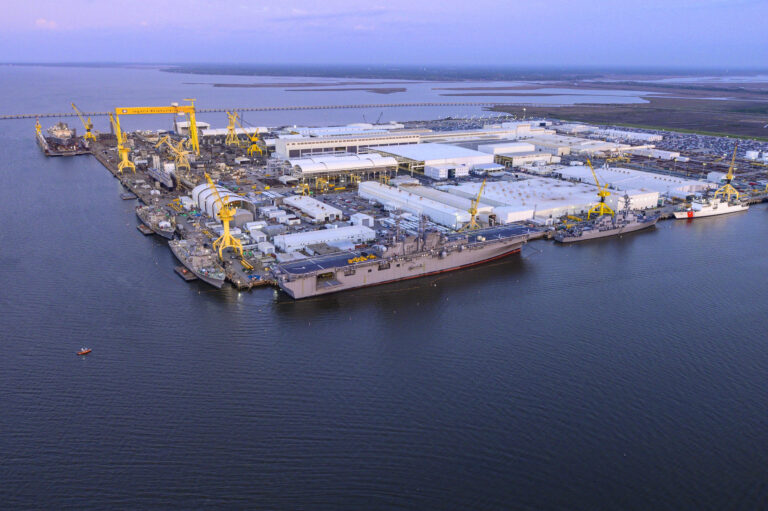
An aerial image of HII’s Ingalls Shipbuilding.
*****
ARLINGTON, Va. — HII’s Ingalls Shipyard is always looking for opportunities for more shipbuilding work and its yard has the capacity to take on more work, a senior company official said, including future awards of new classes of frigates and medium landing ships.
“We’re looking at all of our opportunities, said George Nungesser, Ingalls’ vice president for Program Management, speaking June 27 to reporters during the Modern Day Marine expo in Washington, noting that Ingalls is interested in being a second construction shipyard for the Constellation-class guided-missile frigates currently being built by Fincantieri’s Marinette Marine shipyard in Wisconsin. “We know surface combatants!”
The Ingalls shipyard builds Arleigh Burke-class guided-missile destroyers (DDGs), San Antonio-class amphibious platform dock ships, and America-class amphibious assault ships for the U.S. Navy and Legend-class national security cutters (NSCs) for the Coast Guard.
The company delivered the first Flight III Arleigh Burke-class DDG, the future USS Jack H. Lucas (DDG 125), June 27, and the 10th NSC, the future USCGC Calhoun (WMSL 759) began its first sea trials the same day.
Asked if Ingalls was interested in bidding on the Navy’s future medium landing ship (LSM) program, Nungesser said, “We’re always interested in future ship classes, future endeavors. With a legacy of over 85 years, we’re pretty agile. We will continue to monitor the program development of that particular program and look forward to working with the Navy to see where this goes, when it something comes out as an RfP [Request for Proposals].”
Nungesser said the Ingalls shipyard currently has excess capacity, noting that the company has invested more than $1 billion in Shipyard of the Future initiatives that were completed last year. He noted that hiring and retaining the work force is a more challenging aspect industry-wide, and that Ingalls has funded a number of initiatives with local educational institutions to attract young people toward the shipbuilding trades.
“We do not meet the needs of our customers without our work force, and we are pleas with the trends that we are seeing in terms of hiring, retention, and developing talent,” he said.
“What we need — including our defense industry base — is a strong, consistent demand signal from the government to keep this shipbuilding industry healthy and responsive,” he said. “A strong demand signal enables companies to plan for the future, to hire, to train, and retain a skilled work force, and also promote investment in new equipment, facilities, and technologies.
HII Delivers First Flight III Destroyer Jack H. Lucas (DDG 125) to U.S. Navy
PASCAGOULA, Miss. (June 27, 2023) — HII’s (NYSE: HII) Ingalls Shipbuilding division delivered the first Flight III Arleigh Burke-class guided missile destroyer, Jack H. Lucas (DDG 125), to the U.S. Navy today. Delivery of DDG 125 represents the official transfer of the ship from the shipbuilder to the Navy.
“Delivering the first Flight III ship reflects the relentless efforts of our shipbuilders and those of our Navy and supplier partners,” said Kari Wilkinson, president of Ingalls Shipbuilding. “We are committed to maintaining a consistent and resilient destroyer production team in order to be ready to support the Navy and our country.”
Jack H. Lucas (DDG 125) is the first Flight III Arleigh Burke-class destroyer being built for the U.S. Navy by Ingalls and incorporates a number of design modifications that collectively provide significantly enhanced capability. DDG 125 contains a myriad of offensive and defensive weapons designed to support maritime defense needs well into the 21st century. Flight III configured destroyers include the AN/SPY-6(V)1 Air and Missile Defense Radar (AMDR) and the Aegis Baseline 10 Combat System that is required to keep pace with the threats of the future.
Ingalls has delivered 35 destroyers to the U.S. Navy including DDG 125, with four Flight IIIs currently under construction including Ted Stevens (DDG 128), which is scheduled to be christened in August. Additionally Jeremiah Denton (DDG 129), George M. Neal (DDG 131) and Sam Nunn (DDG 133) are under construction at Ingalls.
Arleigh Burke-class destroyers are highly capable, multi-mission ships and can conduct a variety of operations, from peacetime presence and crisis management to sea control and power projection, all in support of the U.S. military strategy and the joint force. Guided missile destroyers are the backbone of the U.S. surface fleet and are capable of fighting multiple air, surface and subsurface threats simultaneously.
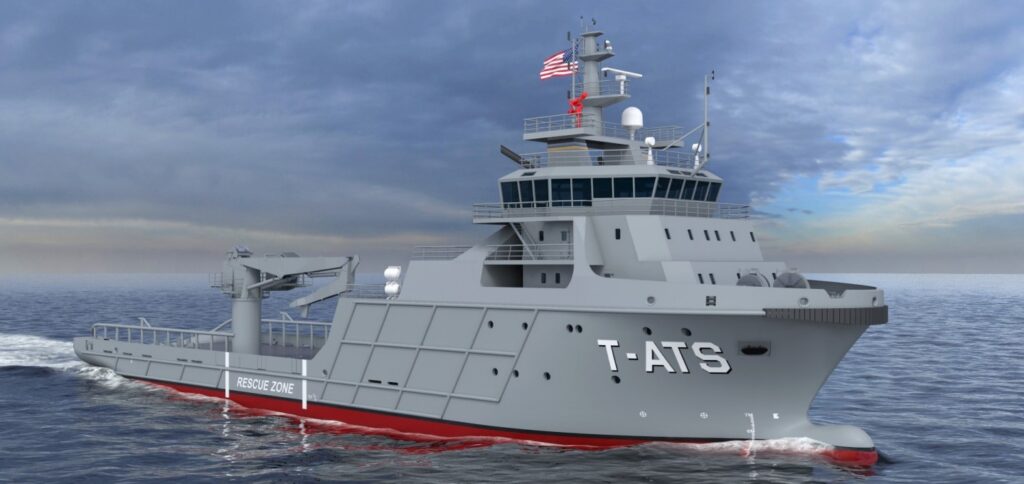
Mobile, Ala. – Austal USA was awarded a $79.2 million U.S. Navy contract option for the construction of T-ATS 15, a Navajo-class Towing, Salvage, and Rescue Ship. With the award, the company is now under contract for five T-ATS, with T-ATS 11 and T-ATS 12 under construction on Austal’s state-of-the-art steel assembly line.
T-ATS will provide ocean-going tug, salvage, and rescue capabilities to support U.S. Navy fleet operations and will be a multi mission common hull platform capable of towing heavy ships. These ships will also be able to support current missions, including oil spill response, humanitarian assistance, and wide area search and surveillance.
“Construction of the T-ATS program is well underway at Austal USA. We are very pleased with the performance of our steel panel line,” Austal USA President Rusty Murdaugh said. “This contract award, bringing our total T-ATS program to five ships, illustrates the Navy’s continued confidence in our team’s demonstrated ability to deliver valuable capability on-budget and on-schedule.”
Austal USA will utilize its proven ship manufacturing processes and innovative methods that incorporate lean manufacturing principles, modular construction, and moving assembly lines to build these ships, all housed under the company’s state-of-the-art enclosed steel production facility. Construction on T-ATS 15 will commence in early 2024 with delivery planned for the end of 2027.
In addition to T-ATS, Austal USA began construction earlier this month on the Navy’s Auxiliary Floating Dry Dock Medium. These two programs along with the contracts awarded for the U.S. Coast Guard Heritage-class Offshore Patrol Cutters and the Navy’s TAGOS-25 ocean surveillance ships will keep the company’s steel production facility busy producing quality vessels for our Nation’s defense many years into the future.
Mobile, AL – The keel for the future USNS Point Loma, Expeditionary Fast Transport Ship (EPF 15), the second of the Spearhead-class EPF Flight II configuration, was laid at Austal USA, June 27.
The keel-laying ceremony represents the joining together of a ship’s major modular components on land, and is a significant milestone in ship production. The keel is authenticated with the ship sponsors’ initials etched into a ceremonial keel plate that is later incorporated into the ship. EPF 15’s sponsor is Mrs. Beth Asher.
“The keel laying is the beginning of a ship’s journey, and we look forward to the many milestones ahead,” said Program Executive Office, Ships Strategic and Theater Sealift Program Manager Tim Roberts. “EPF 15 will build on the capabilities established by the Flight I configuration, providing a wide variety of mission tools, when and where our fleet needs support.”
EPFs operate in shallow waterways. These versatile, non-combatant transport ships are used to quickly move the troops, military vehicles, and equipment needed to support:
Overseas contingency operations
Humanitarian assistance
Disaster relief
Special operations forces efforts
Theater security cooperation activities
Emerging joint sea-basing concepts
The Flight II is a modified configuration that allows the ship to deploy as a fast transport or with Role 2 enhanced (2E) medical capability, or both. Medical capability includes an intensive care unit, ward beds, limited X-ray, laboratory, and dental support. Additional capabilities which support the ship’s medical mission include V-22 flight operations and the ability to deploy 11-meter rigid hull inflatable boats.
As one of the Defense Department’s largest acquisition organizations, PEO Ships is responsible for executing the development and procurement of all destroyers, amphibious ships, sealift ships, support ships, boats and craft.
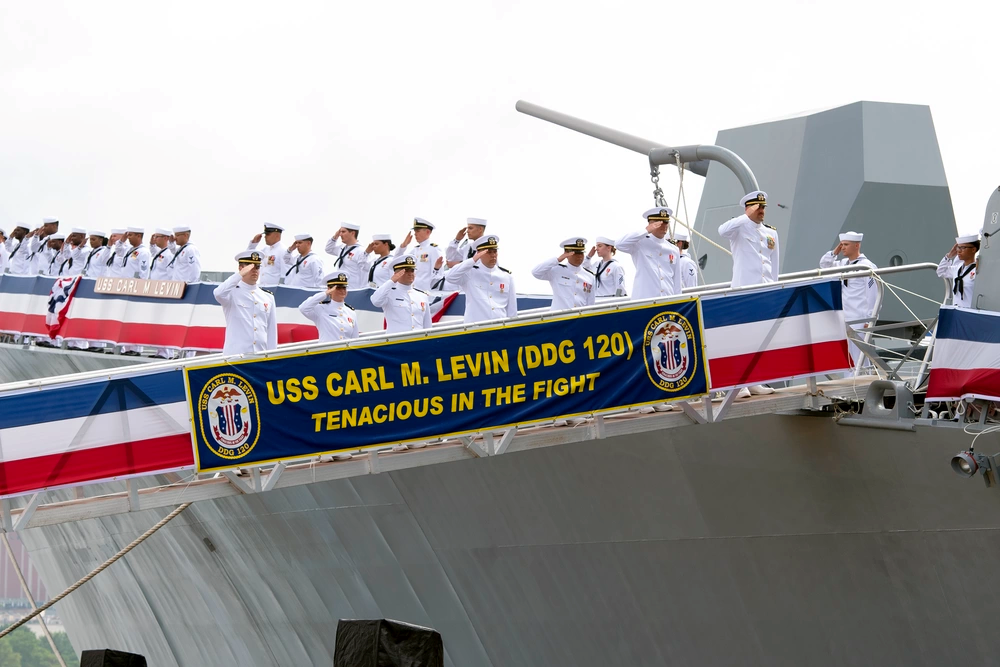
Baltimore, MD — The U.S. Navy commissioned its newest Arleigh Burke-class guided-missile destroyer USS Carl M. Levin (DDG 120), June 24 in Baltimore.
The Honorable Carlos Del Toro, the 78th Secretary of the NavyPrinciple, was the principal speaker.
“It is imperative that we, the United States of America, stand ready to support our international partners and our allies as we confront common challenges,: said Del Toro. “In order to do so, our nation needs to maintain a strong joint force. Our nation needs to maintain a strong Navy and Marine Corps as the foundation upon which the success of that joint force exists. This ship before you and our entire naval fleet supports not just the strike force, but our entire nation by guaranteeing our unencumbered access to a free and open maritime commons and serves as the lifeblood of our economy.”
Guest speakers for the event also included Adm. Michael M. Gilday, 32nd Chief of Naval Operations; the Honorable Justin Williams, Deputy Mayor, City of Baltimore, Maryland; Rear Adm. Thomas J. Anderson, Program Executive Officer, Ships; and Mr. Charles F. Krugh, President, General Dynamics Bath Iron Works.
“Senator Levin lived a life of service with integrity, and his example inspires us as we commission this ship with this crew today,” Gilday said. “The men and the women of the USS Carl Levin represent some of the best and the brightest in our Navy. They are ready! They are prepared to go into harm’s way if required and they will carry out the orders of our nation.”
The ship’s sponsors are Sen. Carl M, Levin’s three daughters, Kate Levin Markel, Laura Levin, and Erica Levin. All three sponsors participated in the keel laying, mast stepping, and christening ceremonies.
Gilday continued, “To the ship’s sponsors, Senator Levin’s daughters Kate, Laura, and Erica, thank you for your family’s support to our Navy and to our Sailors. It is not lost on us that the man that we call professor, Assistant Attorney General, and Senator, you call Dad. Thank you for sharing his legacy with us and we hope that you feel welcome as extended members of our big Navy family.”
Laura Levin spoke on behalf of herself and sisters Kate and Erica to recall their father’s life of service.
“Dad noted that for more than 50 years, Senate Armed Services Committee members had managed to work through their disagreements to pass the Defense Authorization bill with bipartisan support for a single reason. As Dad put it, those who served in the military ‘have inspired us, year after year, to come together across lines of party and ideology to support them,” Laura reflected. “They not only protect us, they unite us.’ So as we gather to send off this great ship, the three of us remember our Dad by thanking and congratulating the entire crew of the USS Carl M. Levin who protect us and also unite us.”
During the ceremony, USS Carl M. Levin’s commanding officer Cmdr. Kelly Craft, reported the ship ready. Sen. Levin’s daughters, Kate Levin Markel, Erica Levin, and Laura Levin, gave the traditional order to “Man our ship and bring her to life!”
“It’s been an honor and a privilege to have served as the Commanding Officer of a Pre-Commissioning Unit. It was amazing being able to sail down the Kennebec and out to sea for the first time,” Craft said. “There’s nothing like being able to bring the crew together and accomplish the mission. We’ve still got thousands of miles to travel before we make it to our home port of Hawaii, but I know this crew is the right crew for the job. They will remain tenacious in the fight, and they will lead this ‘greyhound’ to be the most feared warship in the world.”
Deputy Mayor Justin Williams’ pride in Baltimore’s Navy connection was evident. “From the days of clipper ships traversing the high seas during the revolutionary war…our city’s legacy has been long intertwined with the Navy’s legacy.” He continued, “as we commission the USS Carl Levin, we pay homage to the generations of sailors and shipbuilders who call Baltimore home. This mighty vessel will carry the torch of Baltimore’s naval legacy.”
The USS Carl M. Levin is the first naval ship named in honor of Michigan’s longest serving Senator, the
late Carl M. Levin for his years of service as a longtime member and chairman of the Senate Armed Services Committee (SASC).
Levin began his career as an attorney, professor, and assistant attorney general in Michigan and was elected to the Senate in 1979. He was Michigan’s first Jewish senator and the state’s longest-serving senator, serving for 36 years before retiring in 2015. In the Senate, his top priority was the economic well-being of Michigan families. He was a consistent voice for support of American manufacturing and was one of the Senate’s strongest advocates for policies that would help American manufacturers compete globally.
As chairman of SASC, Levin focused on taking care of the men and women of the military and their families, supporting pay raises and improvements in treatment and other policies for wounded warriors. He led oversight efforts to improve efficiency and reduce cost overruns in expensive weapons programs. Levin also supported military action to eliminate the al-Qaida threat in Afghanistan, investigated Pentagon spending practices, and played a key role in overturning the “Don’t Ask, Don’t Tell” rule that prohibited gay service members from openly acknowledging their sexual orientation before 2011.
Arleigh Burke-class guided-missile destroyers are the backbone of the U.S. Navy’s surface fleet. These highly capable, multi-mission ships conduct a variety of operations, from peacetime presence to national security providing a wide range of warfighting capabilities in multi-threat air, surface and subsurface.
The mission of CNSP is to man, train, and equip the Surface Force to provide fleet commanders with credible naval power to control the sea and project power ashore.
The ship will transit to her homeport at Joint Base Pearl Harbor-Hickam, Hawaii.
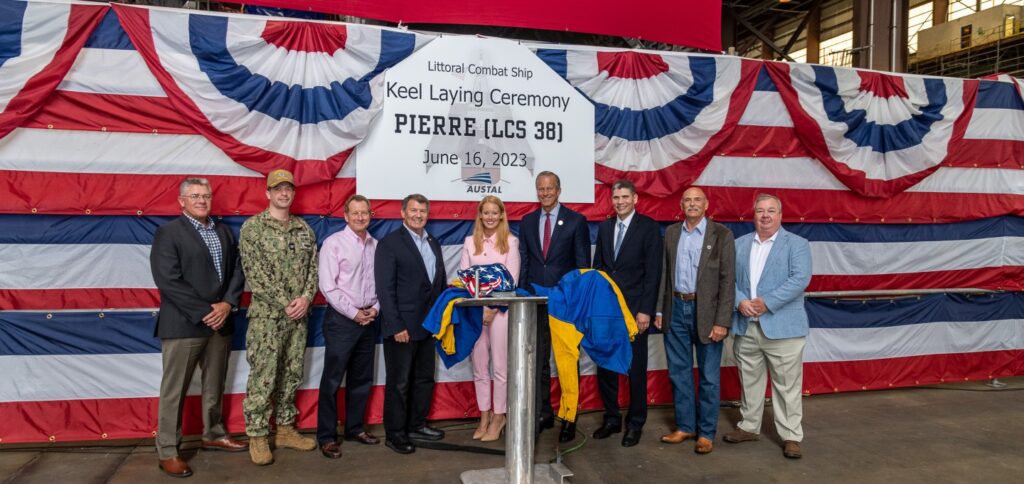
MOBILE, Ala. – Austal USA hosted a keel laying ceremony late last week for the future USS Pierre (LCS 38) Independence-variant Littoral Combat Ship at the company’s Gulf Coast shipyard. Ship sponsor Larissa Thune Hargens, with the assistance of Hon Tran – a 13-year Austal USA veteran A-class welder, authenticated the keel by welding her initials into a keel plate that will be welded to the hull of the ship.
The future USS Pierre is the final Independence-variant Littoral Combat Ship being built by Austal USA in Mobile, Ala. LCS 38 is the second U.S. Navy ship named for the South Dakota capital city. The original USS Pierre (PC-1141) was a submarine chaser built during World War II.
“Keel laying represents a major milestone in the construction of a ship,” said Dave Growden, vice president of new construction. “While every keel laying we celebrate is special, this one has added significance as it starts to close the line of a highly successful program.”
The ceremony was widely attended by community and Navy leaders and Austal USA shipbuilders. Notably, in a strong statement of support for the future USS Pierre, from the South Dakota delegation, Senator John Thune and Senator Mike Rounds attended the event along with the Mayor of Pierre, Mayor Steve Harding.
“This is a special honor for the city of Pierre and all of South Dakota,” said Thune. “It’s also a good day for the Navy and the men and women of our joint forces. I’m particularly humbled, of course, to have had the privilege of introducing my daughter Larissa as the ship’s sponsor – a proud dad moment.”
Hargens, a native of South Dakota, graduated from Bethel University. The call to serve runs deep in her family, Hargens is involved with a non-profit incentive program that helps limited-income pregnant women in Sioux Falls, her father is U.S. Senator John Thune and her grandfather was awarded the Distinguished Flying Cross for extraordinary achievement while participating in aerial flight in Fighting Squadron 18 (VF-18) on the USS Intrepid (CV-11) during World War II.
“I am so honored and grateful for this incredible opportunity to sponsor the future USS Pierre,” stated Hargens. “It is a privilege to be a part of this time-honored tradition and to have my initials welded to a plate that will become a part of the ship’s keel. I look forward to participating in the important milestones throughout the life of the USS Pierre, and to building a lifelong relationship with the ship and the sailors that will make up her crew. May God bless the USS Pierre.”
Independence-variant Littoral Combat Ships are fast, optimally-manned, mission-tailored surface combatants that operate in near-shore and open-ocean environments, winning against 21st-century coastal threats. Austal USA has delivered 17 LCS to the Navy since 2009, most of which have been deployed with the Pacific Fleet. The shallow-draft Independence-variant LCS have been opening up places for the Navy to operate where they had not been for years. The ship’s steerable water jets allow for effective maneuverability in and out of austere ports. With the capacity to deploy Naval Strike Missile and employ mine counter measure the ship can conduct key missions throughout the Pacific making them a highly functioning platform.
Pierre is planned for delivery in fiscal year 2025 and will be homeported in San Diego, Calif., along with the other Independence LCSs that have been delivered to the fleet.
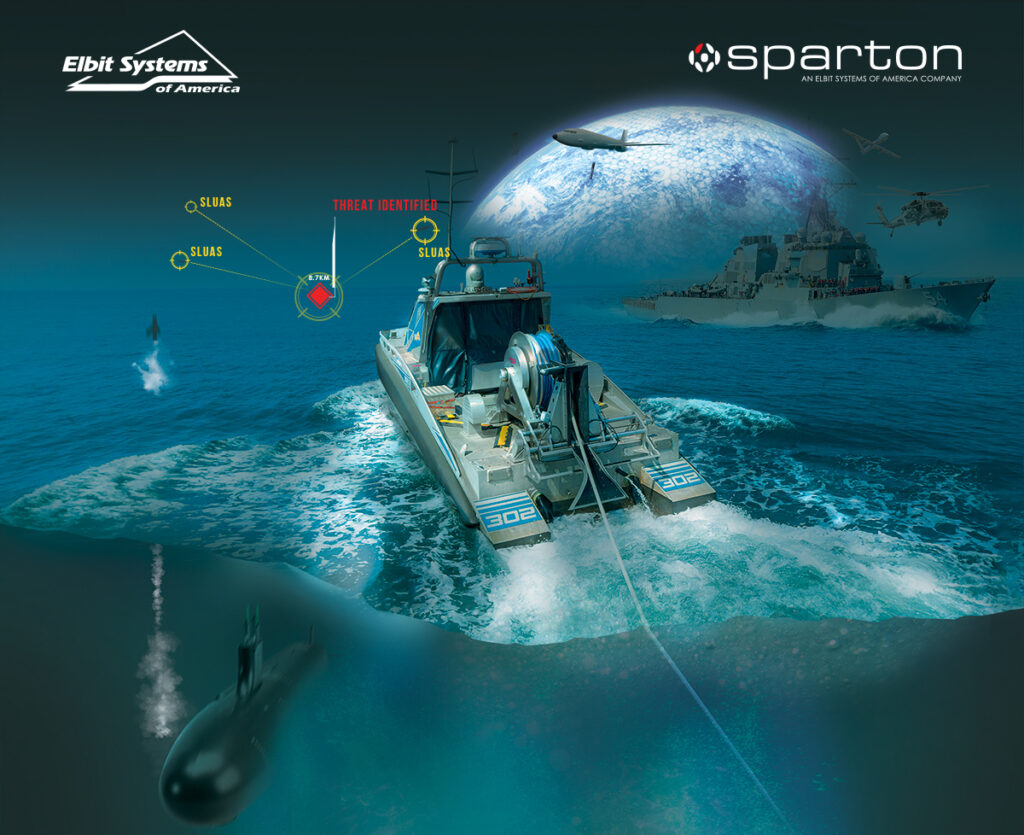
Elbit America Selected for U.S. Navy Information Warfare Research Project
The IWRP supports implementation of the Naval Operational Architecture to enable Joint All Domain Command and Control (JADC2), and ensure connectivity of U.S. and allied forces across land, air, sea, space, and cyberspace. Elbit America’s autonomy prototype will extend the reach of those forces by leveraging attritable systems to covertly find, fix and track maritime targets, as directed by operational commanders.
Elbit America’s prototype includes various solutions and expertise from across its enterprise, including Sparton and Logos Technologies subsidiaries, as well as partners, Alare Technologies, and Nauticus Robotics. The prototype leverages unique autonomy, artificial intelligence, automatic target recognition, and undersea payload delivery capabilities.
“Elbit America’s advanced prototype will enhance distributed maritime operations by employing attritable multi-domain unmanned systems that can collaborate autonomously to identify and report targets of interest, while operating in contested environments,” said the company’s Vice President of Maritime Business Jeff Hoyle.
“Our selection as a prime contractor for the Navy’s Information Warfare Research Project validates that our company’s portfolio is in alignment with the U.S. National Defense Strategy. We are committed to strengthening our country’s national security and we’re investing in critical maritime technologies such as unmanned systems and sensors, attritable payloads, and undersea connectivity solutions to ensure that we can continue to innovate capabilities most needed by our customers,” said the company’s President and CEO Raanan Horowitz.
Navy to Commission Guided-Missile Destroyer Carl M. Levin
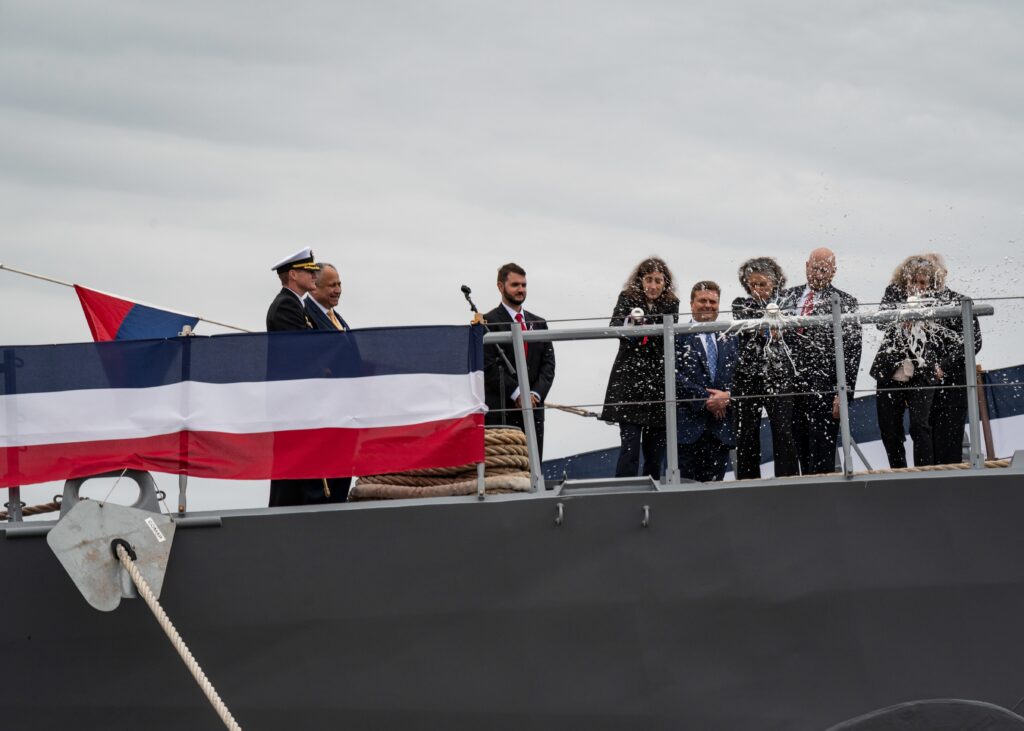
BATH, Maine (Oct. 2, 2021) Secretary of the Navy (SECNAV) Carlos Del Toro observes as the ship sponsors christen the Arleigh Burke-class guided-missile destroyer USS Carl M. Levin (DDG 120), Oct. 2, 2021, at General Dynamics Bath Iron Works shipyard. The ship’s namesake, late U.S. Sen. Carl M. Levin, retired in 2015 and was the longest-serving senator in Michigan history. (U.S. Navy photo by Mass Communication Specialist 2nd Class T. Logan Keown)
The Navy will commission its newest Arleigh Burke-class guided missile destroyer, USS Carl M. Levin (DDG 120), during a 10:00 a.m. EDT ceremony on Saturday, June 24, in Baltimore, Maryland.
The Honorable Carlos Del Toro, Secretary of the Navy, will deliver the commissioning ceremony’s principal address. Remarks will also be provided Admiral Michael Gilday, Chief of Naval Operations; the Honorable Justin Williams, deputy mayor of the City of Baltimore; and Mr. Charles F. Krugh, president, General Dynamics Bath Iron Works. The ship’s sponsors are Senator Levin’s daughters, Kate Levin Markel, Erica Levin, and Laura Levin.
The ship’s namesake served in the U.S. Senate for 36 years from 1979-2015. As the longest serving senator in Michigan state history, Levin became a staunch supporter of the armed services through his work and leadership as Chairman and Ranking Member of the Senate Committee on Armed Services. Levin passed away on July 29, 2021.
The ship, which will be homeported at Joint Base Pearl Harbor-Hickam, will be the 72nd Arleigh Burke-class destroyer to be commissioned, with 17 additional ships currently under contract for the DDG 51 program. The ship is configured as a Flight IIA destroyer, which enables power projection and delivers quick reaction time, high firepower, and increased electronic countermeasures capability for anti-air warfare. The USS Carl M. Levin is 509.5 feet long and 59 feet wide, with a displacement of 9,496 tons. It will be homeported in San Diego.
The ceremony will be live streamed at: https://www.dvidshub.net/webcast/31729. The link becomes active approximately ten minutes prior to the event (9:50 a.m. EDT)
Northrop Grumman Manufactures Two Thousandth Solid Rocket Motor for US Navy’s Trident II D5 Progam
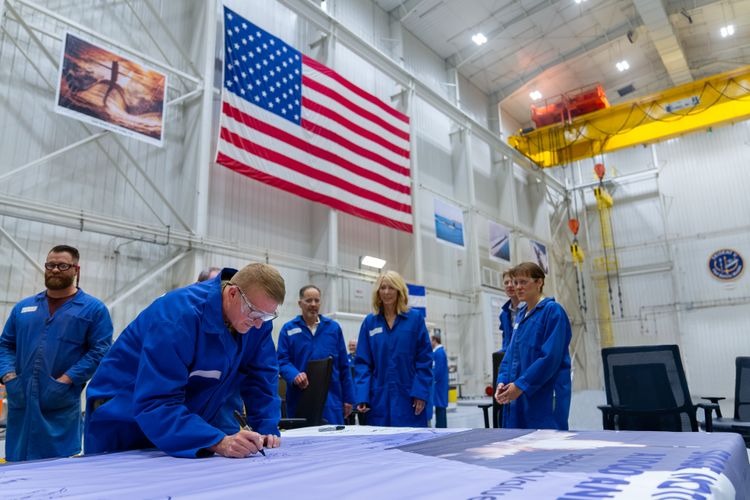
Vice Admiral Johnny R. Wolfe, director of strategic systems programs, U.S. Navy, signs a Trident II D5 Banner in a manufacturing facility where the systems solid rocket propulsion is built. (Photo Credit: Northrop Grumman)
MAGNA, Utah. – June 22, 2023 – Northrop Grumman Corporation (NYSE: NOC) has successfully manufactured two thousand solid rocket motors for the U.S. Navy’s Trident II D5 Submarine Launched Ballistic Missile (SLBM) system with the completion of first-stage A1000 and second-stage B1000 motors.
Northrop Grumman has manufactured:
More than 800 first-stage tactical motors
More than 800 second-stage tactical motors
More than 370 third-stage tactical motors since assuming the scope of work in 1996
And successfully cast over 86 million pounds of propellant for D5 motors
The system is provided to the U.S. Navy by prime contractor Lockheed Martin, which develops and produces the missile and support equipment. It has completed 190 successful flight tests since deployment with no motor failures. The Trident II D5 missile will continue to serve as the seaborne leg of the U.S. Nuclear Triad for decades to come.
Expert: Wendy Williams, vice president, propulsion systems, Northrop Grumman: “Our customers rely on our solid rocket motors to conduct their most important missions. The unmatched reliability, record-breaking mission success and planned life expectancy of the Navy’s SLBM system speaks to the design of the propulsion and our ability to consistently produce critical motors.”
Details on Trident II D5: The Trident II D5 SLBM is a three-stage, solid-fuel, inertially guided missile with a range of 4,000 nautical miles. The missile is launched by the pressure of expanding gas within the launch tube. When the missile broaches the waterline, it enters the boost phase, expending its first, second and third-stage rocket motors. Northrop Grumman manufactures solid-propulsion boost motor systems for all three stages of the Trident II missile under a contract from prime contractor Lockheed Martin.
For nearly 70 years, Northrop Grumman has partnered with Lockheed Martin and the Navy to provide solid rocket motors for the SLBM system. Completion of motors A1000 and B1000 represents the longevity of the Trident II D5 program, the nation’s commitment to deterrence and the role of the company’s solid rocket propulsion as an essential national security asset.
As part of the celebration of this milestone, U.S. Navy Vice Admiral Johnny Wolfe, Director for Strategic Systems Programs, visited Northrop Grumman’s Bacchus, Utah, campus where the Trident II D5 motors are cast and assembled.
“The unmatched reliability and performance of our sea-based nuclear deterrent is made possible by a dedicated team of military, civilian and industry partners who bring expertise and dedication to a truly extraordinary mission,” said Vice Admiral Wolfe. “The propulsion systems and their performance are critical to the success of that mission.”
Northrop Grumman and its legacy companies have supported the Navy’s deterrence mission for over six decades, supplying propulsion for the nation’s Fleet Ballistic Missile submarine-launched systems starting with Polaris, Poseidon C3, Trident I C4 and then Trident II D5, which is less than halfway through its expected service life.
USS Wyoming Successfully Tests Trident II D5LE Missiles
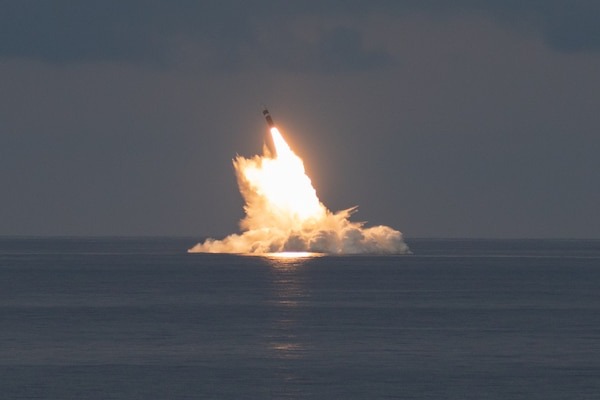
ATLANTIC OCEAN (Sept. 17, 2021) An unarmed Trident II D5LE missile launches from the Ohio-class ballistic missile submarine USS Wyoming (SSBN 742) off the coast of Cape Canaveral, Florida, during Demonstration and Shakedown Operation (DASO) 31. This launch was part of the U.S. Navy Strategic Systems Program’s DASO certification process. The primary objective of DASO is to evaluate and demonstrate the readiness of the SSBN’s Strategic Weapon System (SWS) and crew before operational deployment following the submarine’s engineered refueling overhaul. (U.S. Navy photo by Chief Mass Communication Specialist David Holmes/Released)
This successful test was part of a Demonstration and Shakedown Operation, designated DASO-31. The primary objective of a DASO is to evaluate and demonstrate the readiness of the SSBN’s Strategic Weapon System (SWS) and crew before operational deployment following the submarine’s engineered refueling overhaul.
“The DASO test, and others like these, underscore our readiness and capability for 21st Century Strategic Deterrence,” said Rear Adm. Thomas E. Ishee, USSTRATCOM director of Global Operations. “SSBN crews undergo constant training and regularly planned testing to ensure the weapons systems remain ready and reliable. The Sailors and support element who make up the silent service prove every day they are capable and prepared to protect America and its allies.”
This launch marks 184 successful missile test flights of the Trident II (D5 & D5LE) SWS.
“Today’s [Sept. 17] test demonstrates the unmatched reliability of our sea-based nuclear deterrent, which is made possible by a dedicated team of military, civilian and industry partners who bring expertise and dedication to the mission that is truly extraordinary,” said Vice Adm. Johnny R. Wolfe, director of the Navy’s Strategic Systems Programs. Further, “This same team is now developing the next generation of the Trident Strategic Weapon System, which will extend our sea-based strategic deterrent through 2084.”
The Trident strategic weapon system is highly accurate and reliable. The Trident II (D5) missiles recently underwent a life extension program to address potential impacts from aging and obsolescence. The life-extended missiles – Trident II (D5LE) – are now being deployed to the Fleet and will serve for the remaining service life of U.S Ohio-class and United Kingdom Vanguard-class SSBNs, and as the initial load-out for the U.S. Columbia-class and U.K. Dreadnought-class SSBNs.
USS Maine (SSBN-741) successfully executed the Navy’s last DASO in February 2020 off the coast of San Diego, California. The Navy’s most recent flight test – a Commander’s Evaluation Test – was a series of four launches in February 2021 off the coast of Florida. Each of these flight tests were of the life-extended Trident II (D5LE) missiles.
Flight test missiles are not armed, and safety of the public and the crew conducting the mission is paramount. The launches were conducted from the sea, the missile flew over the sea, and landed in the sea. At no time did the missile fly over land.
The missile test was not conducted in response to any ongoing world events, nor as a demonstration of power. Test launches – including DASOs – are scheduled years in advance.
A credible, effective nuclear deterrent is essential to our national security and the security of U.S. allies. Deterrence remains a cornerstone of national security policy in the 21st century.
Strategic Systems Programs is the Navy command that provides cradle-to-grave lifecycle support for the Navy’s strategic weapon systems. This includes training, systems, equipment, facilities and personnel responsible for ensuring the safety, security- and effectiveness of the nation’s Submarine Launched Ballistic Missile (SLBM) Trident II (D5LE) strategic weapon system.
SLBMs are the sea-based leg of the nation’s strategic nuclear deterrent Triad that also includes the U.S. Air Force’s intercontinental ballistic missiles (ICBM) and nuclear-capable bombers. Each part of the Triad provides unique capabilities and advantages.
The sea-based leg makes up the majority – approximately 70 percent – of the U.S.’s deployed strategic nuclear deterrent Triad. The SLBM is the most survivable leg of the triad, provides a persistent presence, and allows for flexible concepts of operations.