USS Detroit Deploys to Support Regional Cooperation and Security
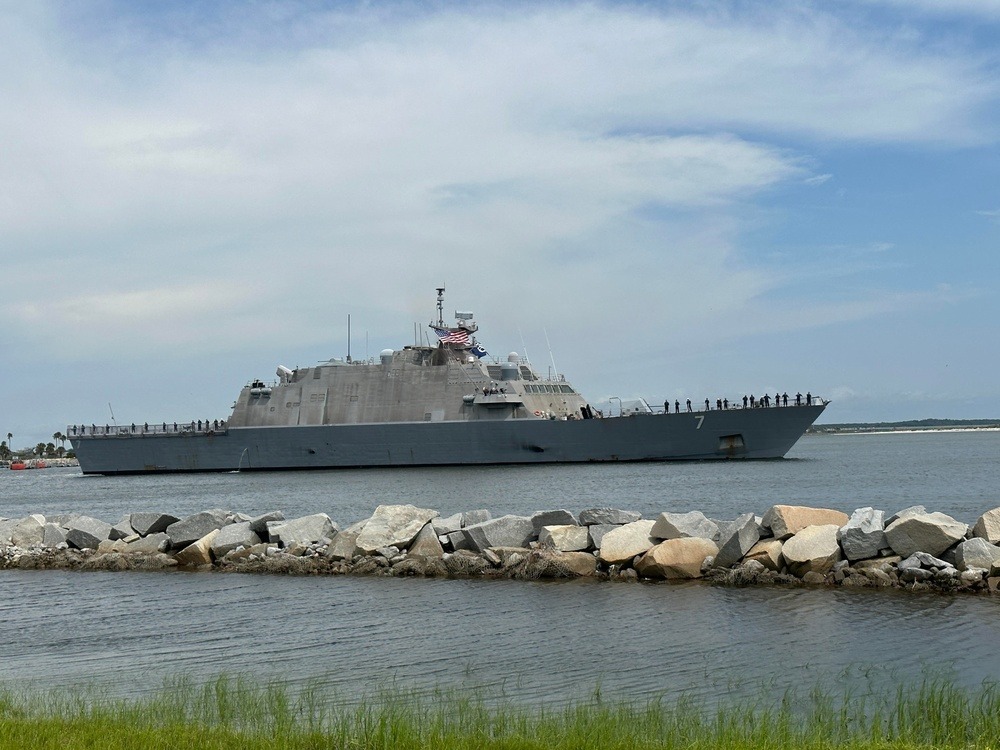
Photo By Lt. Anthony Junco | NAVAL STATION MAYPORT, Fla. — The Freedom-variant littoral combat ship USS Detroit (LCS 7) deployed to support Regional Cooperation and Secuity. Detroit is one of 4 ship assigned to Surface Division 21. see less | View Image Page
MAYPORT, Fla. – The Freedom-variant littoral combat ship USS Detroit (LCS 7), along with Helicopter Sea Combat Squadron (HSC) 28, detachment 11, got underway June 21 to support operations in U.S. Southern Command area of responsibility.
Detroit will support counter-narcotics operations in the Caribbean and Eastern Pacific. Detroit’s operations will involve practical exercises and exchanges with partner nation maritime services, supporting U.S. 4th Fleet interoperability and reinforcing the U.S. position as the regional partner of choice.
“We look forward to building upon the successes of USS Milwaukee (LCS 5) and USS Little Rock (LCS 9) in our return to the U.S. Southern Command area of responsibility,” said Cmdr. Kyle Hickman, commanding officer of Detroit. “The crew has been extremely dedicated in its preparation and is ready for 4th Fleet tasking.”
The deployment of an LCS to the region aims to demonstrate the U.S. commitment to regional cooperation and security. The LCS’s shallow draft provides unparalleled opportunities for port access, making the ship an ideal vessel for these types of engagements.
Detroit will initially be manned by its crew of more than 100 Sailors, including a U.S. Coast Guard law enforcement detachment; and an aviation detachment, who will operate an embarked MH-60 helicopter.
“The crew executed a very difficult training cycle,” said Cmdr. Bruce Hallett, executive officer of Detroit. “They exceeded all expectations.”
LCS is a fast, agile, mission-focused platform designed to operate in near-shore environments, winning against 21st-century coastal threats. It is capable of supporting forward presence, maritime security, sea control, and deterrence.
New CNR Takes Helm at Office of Naval Research
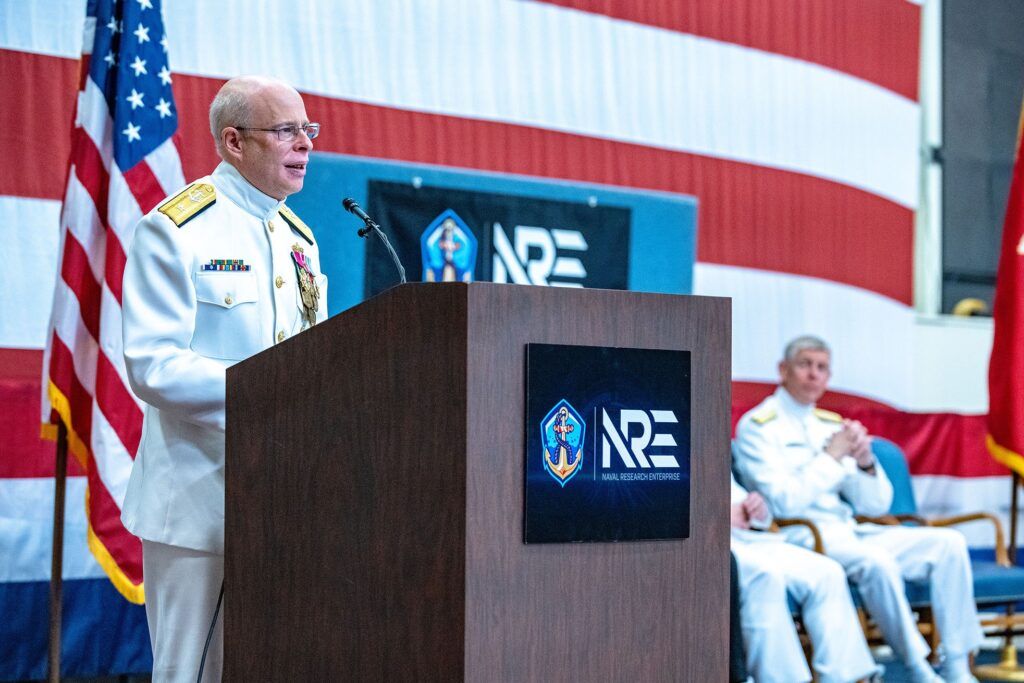
Chief of Naval Research (CNR) Rear Adm. Kurt Rothenhaus addresses the audience during a change-of-command ceremony for the Office of Naval Research on June 16, 2023. Held at the Naval Research Laboratory in Washington, D.C., the event saw Rothenhaus succeed Rear Adm. Lorin Selby, who retired after a distinguished naval career, as CNR. (U.S. Navy photo by Michael Walls)
For Immediate Release: June 21, 2023 By Warren Duffie, Jr., Office of Naval Research
ARLINGTON, Va.—The Office of Naval Research (ONR) ushered in a new era of leadership on Friday, June 16, as Rear Adm. Kurt Rothenhaus — was sworn in as the new Chief of Naval Research (CNR).
The change-of-command ceremony took place at the Naval Research Laboratory in Washington, D.C. Remarks were given by the Hon. Frederick Stefany, assistant secretary of the Navy for Research, Development and Acquisition, as well as Adm. Daryl Caudle, commander, U.S. Fleet Forces Command.
ONR supports science efforts around the world, from basic and conceptual research to applied research and quick-turnaround technologies requested by Sailors and Marines. Established in 1946 by public law, ONR’s mission is to “plan, foster and encourage scientific research in recognition of its paramount importance as related to the maintenance of future naval power, and the preservation of national security.”
“I’m excited by the opportunity to serve the Navy and nation as chief of naval research,” said Rothenhaus. “ONR is a vital organization ensuring the Sailors and Marines we have the privilege of serving have the weaponry and technology needed to prevail, now and in years to come. I feel a sense of urgency, as we face increasingly capable potential adversaries.”
Concurrent with the duties of CNR, Rothenhaus will also serve as the Naval STEM (science, technology, engineering, mathematics) Executive.
He takes ONR’s helm after serving as the program executive officer, Command, Control, Communications, Computers and Intelligence (PEO C4I).
Rothenhaus succeeds Rear Adm. Lorin Selby, himself a decorated submarine commander, naval engineer and acquisition officer, who is retiring after a distinguished naval career.
“ONR has an inspiring history of groundbreaking scientific achievements,” said Rothenhaus. “I’m honored to join the team — its sense of mission and passion for innovation are exceptional. I look forward to continuing the terrific work and strategic agility that Rear Adm. Selby and the ONR team have accomplished during his time as CNR.”
Selby had a remarkable tenure as CNR. He assumed his role in 2020 during the COVID-19 pandemic and he implemented a vision for reimagining naval power — “the small, the agile and the many,” which involves small, unmanned, autonomous platforms that can be constructed, tested and adapted quickly; can be built in large numbers; and are less expensive than larger platforms.
To spur faster, more collaborative and more effective testing and experimentation, Selby promoted the ONR-sponsored SCOUT initiative, a multiagency campaign to identify new ways to bring novel capabilities to warfighter challenges, experiment with them in realistic operating conditions, and operationalize them in partnership with the fleet and force.
Selby also helped lead efforts to revitalize the Department of the Navy’s Naval STEM Coordination Office, and he emphasized greater virtual and remote-learning activities in order to remove geographic barriers, increase the number of students reached, and bolster its commitment to diversity.
Warren Duffie Jr. is a contractor for ONR Corporate Strategic Communications.
RTX awarded $264 million US Navy modification contract to produce AIM-9X missiles
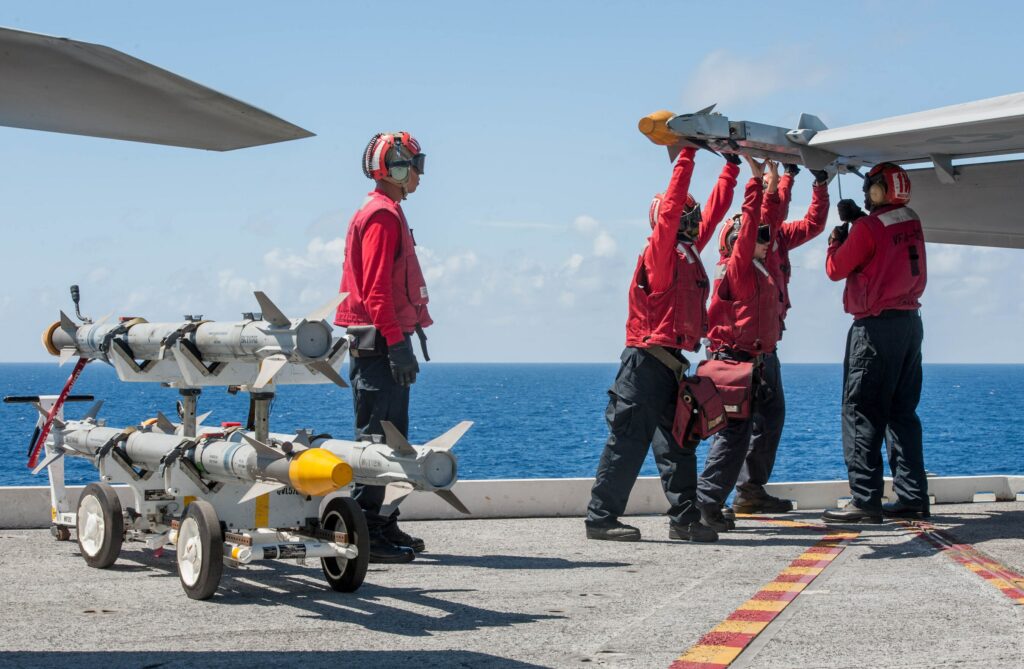
Sailors remove an AIM-9X® SIDEWINDER® air-to-air missile from an F/A-18F Super Hornet on the flight deck of the of the U.S. Navy’s only forward-deployed aircraft carrier, USS Ronald Reagan (CVN 76). (Photo: U.S. Navy)
TUCSON, Ariz., June 19, 2023 /PRNewswire/ — RTX (NYSE: RTX) was awarded a $264 million modification to a production Lot 23 contract originally awarded in December 2022. Under the modification, Raytheon, an RTX business, will produce and deliver 571 AIM-9X® SIDEWINDER® missiles and associated parts for the U.S. Navy, U.S. Air Force, and foreign military sales customers.
“AIM-9X is the world’s most advanced, combat-proven infrared missile, providing advanced capabilities to the U.S. and our international allies,” said Kim Ernzen, president of Naval Power at Raytheon. “The weapon’s versatility and inherent growth potential makes it a triple-threat missile offering an unmatched level of lethality and survivability to counter threats.”
Included in the modification, Raytheon will also provide captive air training systems, containers, spare assets, and related kits and support equipment. The majority of work will be performed within the continental U.S. and is expected to be completed in August 2026.
The AIM-9X SIDEWINDER missile is a triple-threat missile that can be used for air-to-air engagements, surface-attack, and surface-launch missions without modifications. A U.S. Navy-led joint program with the U.S. Air Force, the AIM-9X SIDEWINDER also has 31 Foreign Military Sales partners. The advanced infrared-tracking, short-range missile is combat proven in several theaters around the world.
General Dynamics Electric Boat Christens Submarine Iowa (SSN 797)
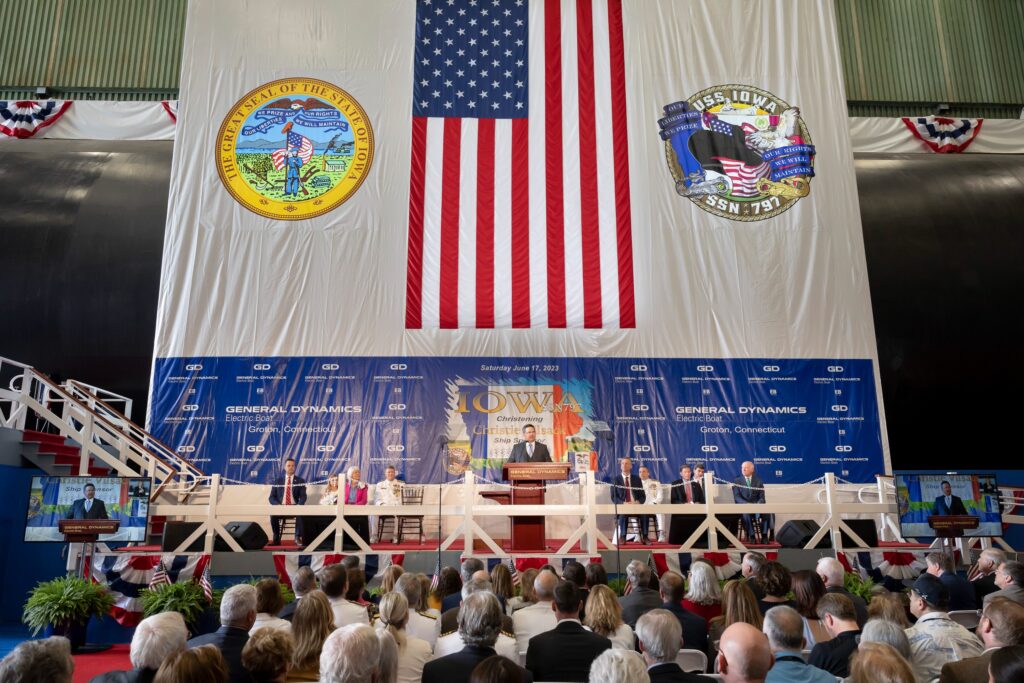
GROTON, Conn. (June 17, 2023) – General Dynamics Electric Boat christened the Virginia-class submarine Iowa (SSN 797) today at its shipyard in Groton, Conn. Electric Boat is a business unit of General Dynamics (NYSE: GD).
“I am proud of Electric Boat’s shipbuilders, and thank them for the skills, capabilities and commitment they bring to their work every day, resulting in this magnificent ship,” said Kevin Graney, president of General Dynamics Electric Boat. “Along with their dedication and hard work, Electric Boat’s shipbuilders have a long history of innovation. We invest in cutting-edge tools and technology to deliver advanced capabilities in acoustic superiority, enhanced stealth, innovative weapons and new missions. We are committed to helping the U.S. Navy outpace our adversaries and ensure our nation’s continued dominance in the undersea domain.”
Christie Vilsack, an Iowa educator and advisor with a 50-year career in education and public service, serves as the ship’s sponsor.
“In the name of the United States, I christen thee Iowa. May God Bless her and all who sail in her,” she declared before breaking a bottle of sparkling wine from Iowa on the ship’s hull to commemorate the christening.
The christening took place in the shipyard’s Virginia-class assembly building in front of an audience of more than 3,000 people, including Electric Boat shipbuilders, members of the ship’s crew, U.S. Navy personnel and government officials. The event was viewed live at numerous watch parties across the state of Iowa.
The keynote address was delivered by Under Secretary of the Navy Eric Raven.
“The Iowa will join the fleet at a critical time when our nation will need the most capable, most ready, most agile, and most lethal undersea fighting force to strengthen our nation’s ability to keep the peace, or restore it, through decisive action,” he told the crowd. “Iowa will add next-generation capabilities to our Joint Force. She will also be one of the first specifically designed and built to accommodate female and male service members, a commitment to supporting a culture of inclusion.”
Iowa is the 24th submarine in the Virginia class, designed for the full range of 21st-century mission requirements, including anti-submarine and surface ship warfare and special operations support.
Electric Boat and its partner Newport News Shipbuilding share constriction of the Virginia class in a teaming agreement. Iowa is the 12th submarine in the class to be delivered by Electric Boat.
The submarine will be the fourth U.S. Navy warship to carry the name Iowa and succeeds the battleship USS Iowa (BB 61). Commissioned in 1943, the ship transported President Franklin Delano Roosevelt to numerous international conferences before transferring to the Pacific Theatre to support the island-hopping campaigns and the Japanese Surrender at Tokyo Bay. The ship is now a museum vessel at the Port of Los Angeles.
A video of the ceremony along with more information on the Iowa is available at ebchristenings.com.
General Dynamics Electric Boat designs, builds, repairs and modernizes nuclear submarines for the U.S. Navy. Headquartered in Groton, Connecticut, the company employs more than 20,500 people. More information about General Dynamics Electric Boat is available at www.gdeb.com.
NSWC Panama City engineers help Republic of Korea develop air-cushion vehicle
NSWC Panama City engineers help Republic of Korea develop air-cushion vehicle
By Naval Surface Warfare Center Panama City Division Public Affairs
Naval Surface Warfare Center Panama City Division (NSWC PCD) is helping cement relationships with U.S. allies in the Indo-Pacific region via Foreign Military Sales (FMS) Programs that also help our own Navy innovate.
NSWC PD Expeditionary Systems Division, FMS, Air Cushion Vehicles Program is supporting the Republic of Korea (ROK) Navy as they develop an Air Cushion Vehicle (ACV). The ROK “Landing Ship Fast II (LSF-II),” shares size and design features of the U.S. Navy’s Landing Craft Air Cushion (LCAC).
The LSF-II is a 90-metric ton hovercraft with a top speed of 40 knots. LSF-II crafts 633 and 634 will join two earlier LSFs already in service with the ROK Navy. As first-in-class for the LSF-II, crafts 633 and 634 serve as prototypes of the redesigned LSF concept; a total fleet of 18 LSF-IIs is planned.
NSWC PCD personnel helped modify the Navy’s LCAC Command, Control, Communication, Computers, and Navigation (C4N) System for use on ROK’s domestically produced LSF-II.
ROK’s Defense Acquisition Program Administration (DAPA) first requested modified Navy C4N systems for LSF-II craft 633 and 634, funded under FMS case KS-P-GRL, from the NAVSEA International Fleet Support Program Office in 2018. Due to similarities between the ROK Navy LSF-II and the U.S. Navy LCAC, the modified C4N system was feasible from a technical perspective. In April 2019, the NSWC PCD team used the mature baseline of the USN’s LCAC C4N system to begin redesigning a C4N system for the LSF-II craft.
For the ROK variant, the NSWC PCD C4N system team remapped the communication links between the craft’s subsystems and the C4N system, and then modified all of the software to accept and process the inputs. The team also developed LSF-II- specific craft drawings. Even with an established Navy baseline, this extensive work required the USN and ROK teams work together to find and track all the changes needed to make the C4N system fit and operate within the LSF-II.
Initial component deliveries started in early 2021, while Hanjin Shipbuilding and Construction (HJSC) was still constructing the craft at Yeongdo Shipyard in Busan, ROK. The Panama City C4N system team has provided onsite subject matter expertise to support HJSC with installation, software integration, and startup of the C4N systems since April 2022. The first two C4N systems were completed and delivered in mid-2022.
Korea’s Hanjin Shipyard successfully initiated the main engines and inflated the bags within the skirting system on LSF-II Craft 633 for the first time December 9, 2022. This significant milestone demonstrated a core C4N capability for controlling the engine functions used to get up “on-cushion,” providing lift and propulsion for the craft. Panama City personnel Bill Chong and Randy Martin were there.
“One of the more challenging parts of starting this project was more about terminology association. For instance, the USN views the Control, Alarm, and Monitoring System (CAMS) as a subset of the C4N system,” said Martin, NSWC PCD team electrical engineer. “ROK Navy’s CAMS terminology encompassed all of the USN C4N system, in addition to all electrical components inside the command module. It took some time before we saw eye-to-eye in terms of what we were providing to ROK Navy.”
FMS Program Manager Robert Woodall, also from NSWC PCD, credited one engineer’s Korean language skills with helping overcome potential obstacles.
“Some of the biggest barriers were language, cultural, and time differences that made communication with the Koreans difficult for reviewing and updating the C4N design package,” said Woodall. “For most of the modification program, we were doing this on a bi-weekly basis. Fortunately, we have an excellent electronics engineer, Chae “Bill” Chong, on the team who also happens to be fluent in Korean.”
Chong played a vital role as the USN team’s main interpreter – an experience that also taught him about Korean business culture.
“Working with the Koreans to provide C4N capabilities for their ACV [LSF-II] has been very rewarding and exciting. One of the most striking differences in working with them is the level of respect displayed by Koreans,” said Chong. “They always bowed and shook our hands – using both hands – as they greeted us. They always did their best to show their appreciation and gratitude working with U.S. Navy. Looking at the LSF-II Craft 633 going through a sea trial at Chinhae, Republic of Korea, I saw how far the project has come along with the many challenges we all had to overcome due to the COVID-19 pandemic. I’m so proud to be representing U.S. Navy support in this FMS effort and to be a part of this amazing NSWC PCD team.”
With the continued success of the C4N system development, the U.S. / ROK partnership has grown into an expanded FMS purchase agreement for four additional systems; another 12 systems may be added in a follow-on FMS procurement. This long-term working partnership with the ROK team to mature the LSF-II’s C4N system, and the follow-on logistics support needed for continued upgrades, will strengthen collaboration for decades.
Developing the C4N system for the ROK customer also benefits the USN LCAC program, by addressing hardware obsolescence issues that have been on the horizon for Navy logistics.
“Obsolescence is a continuous problem we have to deal with,” said USN C4N Technical Area Expert Bill Buffkin. “With the C4N baseline we are using, we had already resolved some of those issues that would have impacted the Koreans, and since then, we have come up with other solutions that will benefit the U.S. Navy. It is much more efficient to have one team keeping up with this technology for both parties.”
David Mercer, C4N software engineer, explained that this development has enabled exploration of new design alternatives for features and improvements to Navy hovercraft.
“Working on the Korean system has given us an opportunity to perform improvements to our software implementation and processes,” said Mercer. “We are working with continuously evolving software and cybersecurity requirements, which are present for the Korean system as well, and by working on the Korean applications it has become a multiplier that benefits both Korea and the USN to keep to the forefront for both for performance and maintainability.”
NSWC PCD will provide in-country technical support for integration and grooming of the C4N systems while the ROK shipyard completes construction and conducts sea trials for LSF-II 633 and 634 throughout Fiscal Year 2023.
Navy to Christen Submarine Iowa
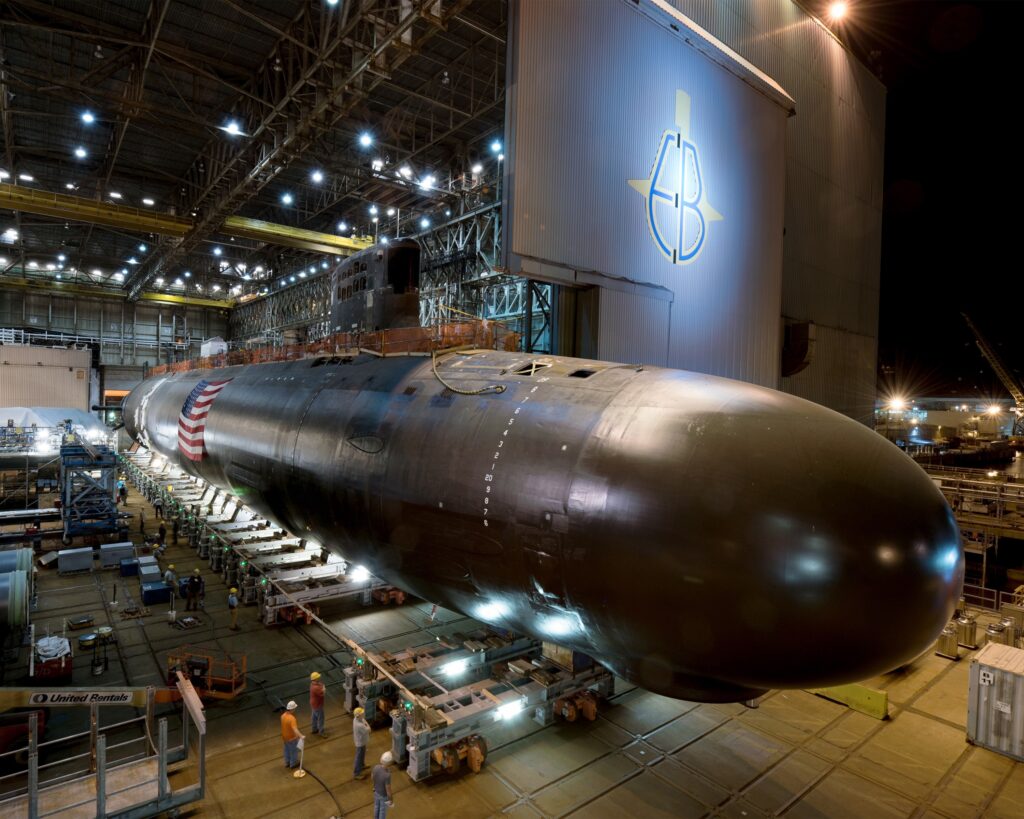
“A Virginia-class attack submarine is readied for its christening ceremony at the General Dynamics Electri Boat shipyard in Groton, Connecticut. Credit: General Dynamics
The Navy will christen one of its newest Virginia-class fast-attack submarines, the future USS Iowa (SSN 797), during a 10 a.m. EDT ceremony Saturday, June 17, 2023, General Dynamics Electric Boat in Groton, Connecticut.
The principal speaker will be the Honorable Erik Raven, Under Secretary of the Navy. Remarks will also be provided by the Honorable Senator Richard Blumenthal; Vice Adm. Frank Morley, principal military Deputy Assistant Secretary of the Navy (Research, Development and Acquisition); Mr. Kevin Graney, president of Electric Boat; Mr. Bryan Caccavale, vice president, Huntington Ingalls Newport News Shipbuilding; U.S. Representative, Iowa’s 3rd District, Zach Nunn; and U.S. Representative, Connecticut’s 2nd District, Joe Courtney.
In a time-honored Navy tradition, the submarine’s sponsor, Mrs. Christie Vilsack, will christen the boat by breaking a bottle of sparkling wine across the bow. Vilsack, an Iowa native, most recently served as the education advisor to the chancellor of Colorado State University. She also served as the senior advisor for International Education at USAID during the Obama Administration. As Iowa’s First Lady, she led a focus on education and advocacy for Iowa’s public libraries. She and her husband Mr. Tom Vilsack, the Secretary of Agriculture, live in rural Iowa.
The future USS Iowa (SSN 797) is the fourth U.S. Navy vessel and first submarine named in recognition of the state. Previous ships named after the state were battleships, as well as, a converted merchant ship that was never activated.
Virginia-class submarines are built to operate in the world’s littoral and deep waters while conducting anti-submarine warfare; anti-surface ship warfare; strike warfare; special operations forces support; intelligence, surveillance, and reconnaissance; irregular warfare; and mine warfare missions. Their inherent stealth, endurance, mobility, and firepower directly enable them to support five of the six maritime strategy core capabilities – sea control, power projection, forward presence, maritime security and deterrence. These capabilities allow the submarine force to contribute to regional stability and preservation of future peace while operating everywhere international law allows, so everyone else can too.
Company will train over 100,000 U.S. and allied sailors globally
FALLS CHURCH, Va.– General Dynamics Information Technology (GDIT), a business unit of General Dynamics (NYSE:GD), announced today that it was awarded a $383 million training support services contract by the Naval Surface Warfare Center Dahlgren Division in Virginia. The contract, awarded on behalf of Surface Combat Systems Training Command (SCSTC), has a one-year base period and four option years.
SCSTC provides the Navy and its allies with highly trained warfighters to maintain, operate, and tactically employ surface combat systems across the spectrum of operations. Over the life of the contract, GDIT will train more than 100,000 U.S. and allied sailors in classroom and simulation settings ashore and aboard Navy warships around the globe. Specifically, the company will provide instructor support, curriculum development, training aids and program management services.
“For over 30 years, we have supported a wide range of Navy training activities,” said Brian Sheridan, GDIT’s senior vice president for Defense. “We are looking forward to continuing to provide the Navy with modern training services to strengthen its overall fleet operations and warfighting readiness.”
The contract expands the company’s training support services portfolio across the Department of Defense. In April, GDIT was awarded a $1.7 billion Flight School Training Support Services contract to support the U.S. Army. The company’s experience with delivering modern training environments spans live, virtual and constructive solutions and multi-domain operations training.
USS PORTER RETURNS FROM DEPLOYMENT
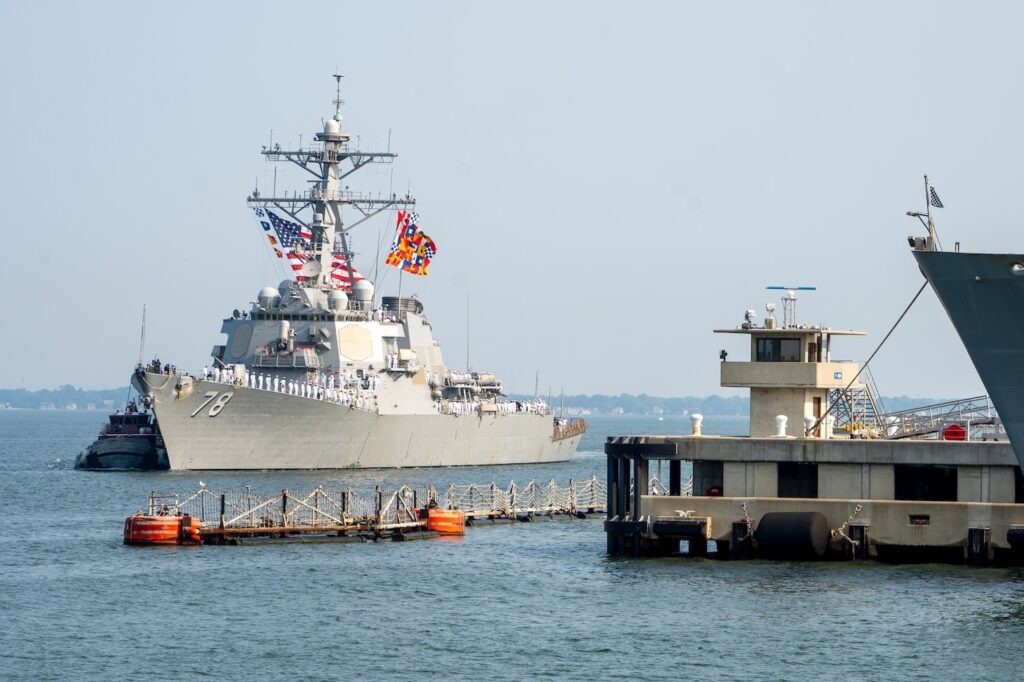
NORFOLK, Va. – The Arleigh Burke-class guided-missile destroyer USS Porter (DDG 78) returns to Naval Station Norfolk following a four-month deployment, June 16, 2023. Porter deployed to the U.S. Naval Forces Europe-Africa (NAVEUR-NAVAF) area of operations. (U.S. Navy photo by Mass Communication Specialist 2nd Class Anderson W. Branch)
16 June 2023
NORFOLK, Va. — The Arleigh Burke-class guided-missile destroyer USS Porter (DDG 78) returned to its homeport of Naval Station Norfolk, June 16, 2023, following a four-month deployment to the U.S. Naval Forces Europe-Africa (NAVEUR-NAVAF) area of operations.
Porter spent two months of its patrol in the Baltic Sea, participating in passing exercises and joint operations with NATO-Allied and partner navies from Lithuania, Poland, Germany, Sweden, the United Kingdom, and Estonia.
“Over the last four months, Porter lived up to its nickname of ‘Freedom’s Champion’,” said Cmdr. Joe Hamilton, Porter’s commanding officer. “The crew was outstanding in every warfare area and truly set the standard. From presence operations in the Baltic Sea, to port visits in allied nations, to large-scale exercises with our Allied and partner nations, Porter demonstrated we’re ready to execute any mission, any time.”
Following its time in the Baltic Sea, Porter steamed to the North Atlantic Ocean to participate in exercise Formidable Shield 2023, a biennial integrated air and missile defense (IAMD) exercise, which included more than 20 ships and 35 aircraft; eight ground units consisting of radars, National Advanced Surface-to-Air Missile System (NASAMS), and High Mobility Artillery Rocket System (HIMARS); and nearly 4,000 personnel from across the Alliance.
During Formidable Shield 2023, Porter conducted two live-fire missile events from the UK Ministry of Defence’s Hebrides Range, successfully firing three Standard Missile-2 (SM-2) interceptor missiles and destroying all targets.
“The amount of preparation poured into an exercise like this is incredible, and the Porter crew performed superbly from laying the groundwork to executing missiles on target,” Hamilton said about Formidable Shield. “The opportunity to conduct live-fire missile exercises like this isn’t one we get every day, and we made the most of the opportunity.”
Throughout the deployment, the crew conducted scheduled port visits to Rostock, Germany; Funchal, Portugal; Klaipeda, Lithuania; Tallinn, Estonia; Kalundborg, Denmark; Gdynia, Poland; Kiel, Germany; Rota, Spain; and Faslane, Scotland. During these port visits, Porter Sailors were able to experience local cultures and forge bonds with their hosts. Porter also hosted a number of distinguished visitors during its time in ports, including President of Estonia Alar Karis; U.S. Consul General Jason Chue, U.S. Consulate General in Hamburg, Germany; German Navy Rear Adm. Jürgen zur Mühlen, Commander, German Maritime Forces Staff, Director of Operations, and Deputy Fleet Commander, German Navy Headquarters; and U.S. Ambassador to Estonia George P. Kent.
“We’re always grateful for an opportunity to strengthen our relationship with NATO-Allied and partner nations,” said Hamilton. “Visits like these give the crew the opportunity to experience cultures, customs, and traditions that they may not have been able to otherwise.”
After arriving at Naval Station Norfolk, the crew was greeted by Rear Adm. Sean Bailey, commander of Carrier Strike Group 8 and Capt. Edward Pledger, deputy commander of Destroyer Squadron 22. Pledger presented a plaque recognizing Porter as the 2022 Destroyer Squadron 22 Battle Effectiveness award winner. The Battle “E” is presented to units whose crews consistently exhibit excellence in wartime capabilities and optimal mission readiness. Porter’s Battle ‘E’ is a result of a clean sweep of all CEAs for maritime warfare (Black ‘E’), engineering/survivability (Red ‘E’), command and control (Green ‘E’), safety (Yellow ‘E’), and health and wellness (Green ‘H’).
Porter’s deployment to the NAVEUR-NAVAF area of operations came months after a homeport shift from Naval Station Rota, Spain to Naval Station Norfolk in October 2022. Porter spent seven years in Spain as part of the Forward Deployed Naval Forces-Europe force, conducting eleven patrols in that time period. The patrols took Porter throughout the U.S. Sixth Fleet area of operations, including the Baltic, North, Norwegian, and Mediterranean Seas, as well as the Eastern Atlantic Ocean.
U.S. 2nd Fleet, reestablished in 2018 in response to the changing global security environment, develops and employs maritime forces ready to fight across multiple domains in the Atlantic and Arctic in order to ensure access, deter aggression and defend U.S., allied, and partner interests.
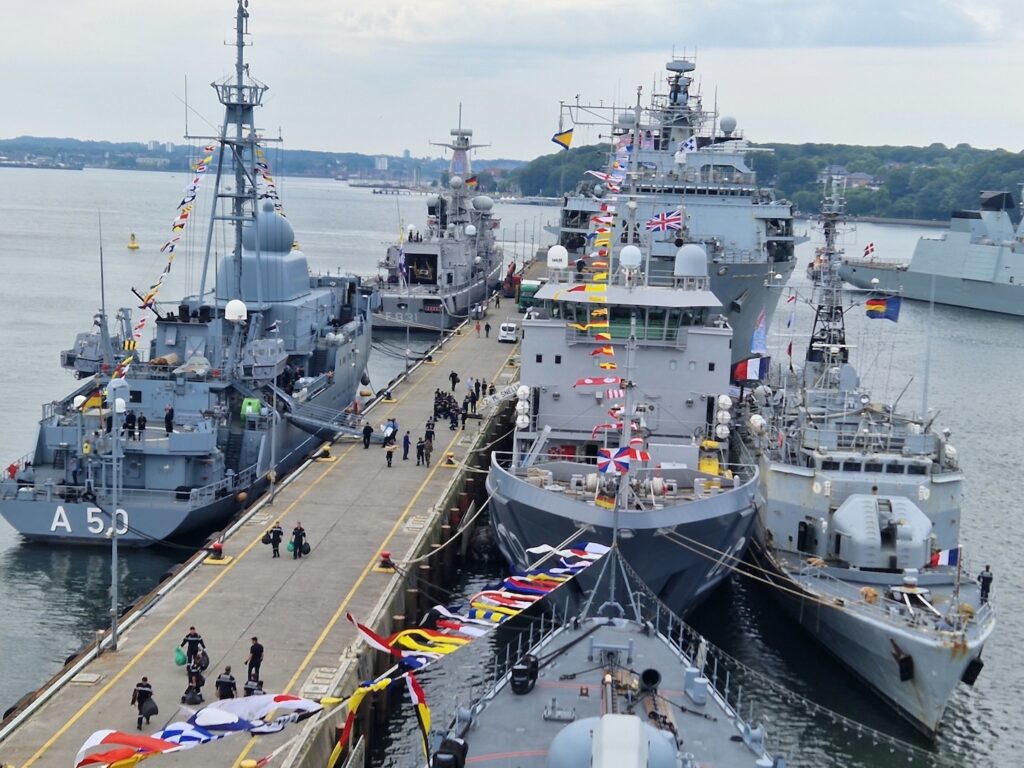
KIEL, Germany – Nineteen NATO Allies and one NATO partner nation, Sweden, concluded the 52nd iteration of exercise Baltic Operations 2023 (BALTOPS 23) in Kiel, Germany, June 16, 2023.
During their time in port, participants will pause to reflect on the accomplishments and bonds forged throughout the 13-day Baltic regional exercise involving 50 ships, over 45 aircraft, and 6,000 personnel.
While addressing BALTOPS 23 participants and media in Kiel, Vice Adm. Thomas Ishee, Commander of Naval Striking and Support Forces NATO (STRIKFORNATO) and U.S. Sixth Fleet, spoke to the dynamic and critically important milestones achieved during BALTOPS 23.
“After two weeks of intense, combined operations across the Baltic region, we have grown as a team by operating as a team,” said Ishee. “BALTOPS 23 has lived up to its intent by validating our collective defense capability, proving that NATO’s maritime readiness is stronger than ever. Our strength is built on the mutual trust between Allies and Partners developed in operations, activities, and exercises such as BALTOPS 23. The seamless interoperability demonstrated over the last two weeks proves that NATO is ready to deter and defend, if necessary.”
Participating nations include Belgium, Canada, Denmark, Estonia, Finland, France, Germany, Italy, Latvia, Lithuania, the Netherlands, Norway, Poland, Portugal, Romania, Spain, Sweden, Türkiye, the United Kingdom, and the United States.
These nations, working alongside each other not only at-sea and across the Baltic Region but also at the STRIKFORNATO headquarters in Oeiras, Portugal, collaborated to deliver a realistic training scenario designed to test the flexibility, adaptability, and capabilities of the participating combined forces.
The milestones represented by BALTOPS 23 were significant. While Finland has routinely participated in previous iterations of BALTOPS, this year marked the first time Finland joined the exercise as a NATO Ally. Additionally, BALTOPS 23 incorporated new ways of working cooperatively with civilian merchant mariners to ensure NATO’s maritime cooperation adroitness with international stakeholders.
“Preserving freedom of navigation and protecting trade in the Baltic Sea remains central to the defense of Europe and to preserving our way of life,” said Ishee. “The opportunity to exercise the important role of the NATO Shipping Centre as our principal connection with maritime industry has yet again brought context and additional challenges for the preparation of our warfighters at sea in a complex and potentially contested environment.”
As the exercise culminated on June 14th, Germany celebrated the 175th anniversary of its Navy. An important ally within both BALTOPS and NATO, Germany significantly contributed to this year’s success. NATO’s Standing NATO Maritime Group One (SNMG-1), led by Rear Adm. Thorsten Marx, hosted German Chancellor Olaf Scholz aboard the German frigate Mecklenburg-Vorpommern (F218), highlighting the international scope of BALTOPS 23 and the complex NATO defensive capabilities it brings to all participating nations.
On land, international teams conducted explosive ordnance disposal training, sharing tactics and national capabilities in bomb-disposal and remote-controlled explosive defusing. Simultaneously, on shore, U.S., British, Romanian, Italian, Polish and Lithuanian forces conducted combined amphibious-landing operations across Latvia, Lithuania and Poland. Separately, land and sea-based mine countermeasure ships and teams honed their skills by conducting real world unexploded historical mine clearance from wars past, continuing to use BALTOPS 23 as both a training opportunity while also clearing real dangers from the Baltic Sea.
During the exercise at-sea, ships conducted tactical maneuvering drills, anti-submarine warfare training, gunnery and small caliber live fire events, mine countermeasures operations, and air defense exercises. Notable participants included the Swedish submarine HSwMS Uppland (Upd), the U.K.’s HMS Albion (L 14) landing platform dock (LPD), the Italian Navy ITS San Marco, and aircraft from other nations including, Poland, Portugal, Türkiye, and the United States.
One of this year’s major milestones was the incorporation and effective usage of Unmanned Surface and Underwater Vehicles (USV/UUV). Like previous iterations, UUV’s were deployed throughout the Baltic Sea to test and evaluate the latest advancements in mine hunting technology and sea-floor mapping. The deployment of UUV’s demonstrated their effectiveness at creating a comprehensive under-sea picture and enhance operational capabilities of NATO mine countermeasure teams. The USV, deployed for the first time in BALTOPS, also conducted joint personnel recovery exercises. Teams utilized the USV’s for patient transport between ships, as well as direct recovery and rescue operations at-sea.
While operating in one of the most dynamic waterways in the world, training in BALTOPS 23 incorporated additional areas of focus. Representatives from the U.S. Space Force and other national space agencies evaluated combatant-commanders’ decision-making skills when presented with unique space-domain obstacles. Simulating complications like solar flares and adversary space-domain actions, commanders were tasked with responding to jamming, space weather, and GPS accuracy.
Though still prioritizing the training inherent in BALTOPS 23, as well as the dynamic challenges of maritime navigation, the exercise recognized the importance of pastoral and spiritual support strategies. These strategies, augmented by a combined team of chaplains from multiple participating nations, were executed to strengthen participants’ decision-making abilities during crucial moments. The successful integration of chaplain support within the intricate maritime environment demonstrated the Alliance’s capacity to overcome obstacles and limitations, regardless of the warfighting domain it operates within.
Looking towards the future, preparations have already begun for next year’s exercise, which will take into account the valuable lessons gleaned from BALTOPS 23 and aim to expand upon its achievements in BALTOPS 24.
STRIKFORNATO, headquartered at Oeiras, Portugal, is a rapidly deployable and scalable headquarters, under the operational command of SACEUR, capable of planning and executing full spectrum joint maritime operations including maritime Ballistic Missile Defence, primarily through integration of U.S. and other nations’ carrier and amphibious forces into NATO operations to provide assurance, deterrence, and collective defence for the Alliance.
Headquartered in Naples, Italy, NAVEUR-NAVAF operates U.S. naval forces in the U.S. European Command (USEUCOM) and U.S. Africa Command (USAFRICOM) areas of responsibility. U.S. Sixth Fleet is permanently assigned to NAVEUR-NAVAF, and employs maritime forces through the full spectrum of joint and naval operations.
Naval Air Warfare Rapid Capabilities Office Approved in HASC Chairman’s NDAA Mark
*****
ARLINGTON, Va.— A rapid capabilities office for U.S. naval aviation is included in the chairman’s mark for the 2024 National Defense Authorization Act in order to speed up development and delivery of critical technologies and systems to naval aviation forces by using “alternative or rapid acquisition pathways for procurement.”
The Naval Air Warfare Rapid Capabilities Office, to be co-located with the Naval Air Systems Command headquarters at Naval Air Station Patuxent River, Maryland, would have the following missions, according to the draft legislation:
‘‘(1) to contribute to the development and testing of low-cost, rapid reaction targeting and weapon systems, electronic warfare and other non-kinetic capabilities, and integrated targeting solutions to fulfill naval and joint military operational requirements;
(2) to contribute to the rapid development, testing, and fielding of new unclassified and classified naval air warfare capabilities.
The office would be led by a designee of the secretary of the Navy and would report to the chief of naval operations. The office would be overseen by a board of directors to include the secretary of the Navy, the chief of naval operations, the commander, Naval Air Systems Command, and the commander, Naval Air Forces.
‘‘The Secretary of the Navy shall ensure that the head of the Office may use available alternative or rapid acquisition pathways for procurement,” the draft said. “The Joint Capabilities Integration and Development System process shall not apply to acquisitions by the Office.”