Triton integral in joint force exercise focused on data collection and dissemination ahead of initial operational capability this year
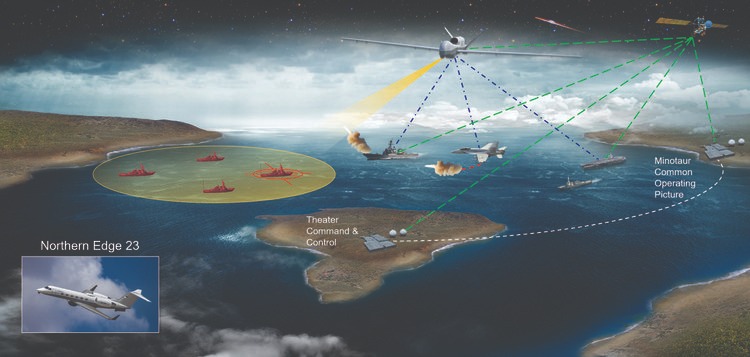
SAN DIEGO – June 15, 2023 – Northrop Grumman Corporation’s (NYSE: NOC) MQ-4C Triton flying test bed (FTB) recently completed a demonstration of persistent long-range targeting during this year’s Northern Edge 2023 military training exercise. Conducted around the Gulf of Alaska, this demonstration highlighted Triton’s potential to enhance joint, distributed maritime operations, and further support sea-control in contested environments. Triton is preparing for initial operational capability (IOC) later this year.
“Northern Edge strengthens the readiness and operational capabilities of joint forces so the ability to test and demonstrate critical long-range targeting capabilities with Triton helps ensure we’re ready to effectively operate and respond to contingencies in the Pacific or anywhere in the world,” said Capt. Josh Guerre, Persistent Maritime Unmanned Aircraft Systems program manager.
The Triton FTB exercise scenarios, executed during multiple flights over seven days, focused on tasking, collection, processing, exploitation and dissemination of information to help maintain a robust common operating picture. During the exercise, the Triton FTB tracked and monitored all maritime traffic within its broad visual field. Upon receipt of the data, ground operators at Joint Base Elmendorf-Richardson in Anchorage were able to process and disseminate the Gulf of Alaska maritime common operating picture to command and control units using Triton’s Minotaur mission interface.
“Northern Edge helps the joint force integrate platforms like Triton to outpace emerging threats,” said Jane Bishop, vice president and general manager, global surveillance, Northrop Grumman. “Testing and demonstrating Triton’s developing technologies, along with its unprecedented maritime multi-intelligence, surveillance, reconnaissance and targeting capability, helps ensure our warfighters can prevail in complex environments.”
The exercise showcased Triton’s developing technologies involving artificial intelligence, machine learning, edge processing and enhanced communications.
Triton’s participation in Northern Edge was executed in collaboration with the U.S. Navy’s Persistent Maritime Unmanned Aircraft Systems Program Office (PMA-262) as well as operational commands.
PUTLOS, Germany – As in previous years, U.S. Sixth Fleet is partnering with the U.S. Naval research enterprise to bring the latest advancements in emerging unmanned technologies to conduct mine countermeasures (MCM) operations. To forward these efforts, Sailors and Marines are experimenting and integrating with Unmanned Underwater Vehicles (UUVs), Unmanned Aerial Vehicles (UAVs), and Unmanned Surface Vehicles (USVs).
As an ideal setting for experimenting and testing new capabilities and technologies in a cooperative maritime environment, exercise Baltic Operations (BALTOPS) 23 showcases growing U.S. Sixth Fleet unmanned systems capabilities.
As in previous years, U.S. Sixth Fleet is partnering with the U.S. Naval research enterprise to bring the latest advancements in emerging unmanned technologies to conduct mine countermeasures (MCM) operations. To forward these efforts, Sailors and Marines are experimenting and integrating with Unmanned Underwater Vehicles (UUVs), Unmanned Aerial Vehicles (UAVs), and Unmanned Surface Vehicles (USVs).
“The BALTOPS exercise series is a great opportunity to experiment,” said Anthony Constable, an Office of Naval Research science advisor to U.S. Sixth Fleet. “BALTOPS is well-supported by Allies and partners, and because the exercise has such a strong history, it gives us ample opportunity to collect operator feedback on how they can best utilize the systems. Additionally, it allows us to showcase new technology to our NATO partners for future collaboration.”
Unmanned systems provide additional warfighting capability at sea and become a force multiplier to traditional manpower. Also, unmanned systems allow navies to take on greater operational risk by removing or distancing warfighters from high threat areas while maintaining a tactical and strategic advantage.
For this year’s BALTOPS, planners primarily focused experimentation on four capabilities:
In-Stride Detect to Engage Sequence. UUVs with automatic target recognition technology and advanced communications capabilities conducted real-time mission analysis and sent a sonar image of a potential underwater mine to Explosive Ordnance Disposal (EOD) technicians within minutes of traveling over the item. This capability significantly reduces MCM operational timelines from hours to minutes.
Launching UUVs using a USV. UUVs, which scan the ocean floor for potential mines, are currently delivered to contested areas by operators using rigid hull inflatable boats (RHIB) or other manned small vessels. Using USVs to deliver UUVs reduces the risk of fatalities or injury by ordnance and allows operators to stay safe while the UUV scans the area.
Very Shallow Water and Surf Zone Operations. Shallow water areas represent some of the most hazardous areas to operate for marines and sailors. In this scenario, members of the experimentation task unit facilitated an autonomous collaboration test using a UAV and USV to map an underwater area, allowing boats and personnel to approach a beach site safely.
Joint Personnel Recovery. The JPR scenario involves sending the USV out to a distressed pilot, recovering the personnel, and bringing them back to a safe location – all unmanned, and remotely controlled from a nearby vessel.
Joe Klein, the Joint Personnel Recovery Program Manager for BALTOPS 23, emphasized the unique aspects of implementing a USV in a JPR scenario.
“I thought this was a great opportunity,” Klein said, referencing the USV. “This is the first time that we’ve done (JPR) with a USV, and it’s a relatively simple scenario, but we’re interested in the communications aspect, like ‘How do you vector the USV into positions,’ and ‘how do we strap the recovery target into the vehicle, as an unmanned system?’ So we’re working through those dilemmas, while also testing it as a solution to some of our problems… You can assume more risk with a USV – it has a pretty low profile, it’s not easy to spot compared to our usual, larger recovery force… it adds resources to recovering in high-threat areas.”
U.S. Sixth Fleet (SIXTHFLT) and STRIKFORNATO-led BALTOPS 23 is the premier annual maritime-focused exercise uniting 19 NATO Allies and one NATO to provide complex training designed to strengthen the combined response capability critical to preserving the freedom of navigation and security in the Baltic Sea. U.S. European Command and U.S. Naval Forces Europe-Africa (NAVEUR-NAVAF) have promoted the traditional U.S.-led or bi-lateral exercises as opportunities for NATO to improve interoperability as a collective force, using NATO command and control systems as a foundation for the exercise design.
For over 80 years, NAVEUR-NAVAF forged strategic relationships with our Allies and Partners, leveraging a foundation of shared values to preserve security and stability.
Headquartered in Naples, Italy, NAVEUR-NAVAF operates U.S. naval forces in the U.S. European Command (USEUCOM) and U.S. Africa Command (USAFRICOM) areas of responsibility. SIXTHFLT is permanently assigned to NAVEUR-NAVAF and employs maritime forces through the full spectrum of joint and naval operations.
STRIKFORNATO, headquartered at Oeiras, Portugal, is a rapidly deployable and scalable headquarters, under the operational command of SACEUR, capable of planning and executing full spectrum joint maritime operations including maritime ballistic missile defense, primarily through integration of U.S. and other nation’s carrier and amphibious forces into NATO operations to provide assurance, deterrence, and collective defense for the Alliance.
Teledyne FLIR: Autonomous operations and lean crewing set to drive a greater reliance on thermal cameras in maritime sector
*****
UK, 15 June 2023, Teledyne FLIR is predicting an increase in the use of thermal and visual cameras in the maritime sector as the growth of autonomous vessels and leaner crewing gathers pace.
With technological advances, autonomous shipping is set to be one of the fastest growing areas of shipping in the years ahead and the industry will inevitably move to a greater reliance on sensors. However, crew minimisation creates new challenges, particularly in high traffic areas and port entrances where sensor data to shore is more important than ever. High cargo can also obstruct the view from the bridge of vessels, so adding cameras can help to fulfil the need for sight in those areas.
Teledyne FLIR has been selling cameras to the Unmanned Surface Vehicle (USV) market for both research and scientific purposes, as well as military for a number of years and Christer Ahlbäck, senior sales manager in Maritime Thermal for EMEAI shares his thoughts on what the landscape ahead looks like.
“Multispectral cameras are one of the most important sensors in the future of shipping. For autonomous vessels, data is crucial when combined with other systems. Sensors are already critical components in modern shipping but will become even more important. A radar will identify objects, but the camera will confirm what that object is, adding intelligence to target detection. To have eyes on board to visually see what is going on and what is out there, really takes navigation to the next level.
“Using sensors in autonomous vessels provides a level of situational awareness that would be impossible for human operators to achieve. Detecting potential obstacles, weather patterns, Slew to Cue radar targets and the ability to track objects, allowing the ship to make decisions based on real-time data. Integrating sensors ensures the information is as reliable as possible.”
Teledyne FLIR’s wide range of marine thermal cameras offer industry leading thermal imaging in total darkness, optical zoom, active gyro stabilisation and radar tracking. Some cameras are designed around a cryogenically cooled thermal sensor for amazing clarity and enable extended range of unparalleled target tracking.
“FLIR products integrated on autonomous vehicles offer heightened safety and efficiency, providing a level of awareness impossible for humans,” said Christer.
Cameras and sensors in the shipping industry are already on the increase as the use of autonomous vessels becomes more widespread and the minimisation of crews becomes a reality. This investment in equipment for shipping companies wanting to stay competitive will be vital.
The Department of the Navy (DoN) and the United States Special Operations Command Join Forces to Supercharge Early Threat Warning Systems
*****
Arlington, VA – Applied Signals Intelligence, CACI, DRS Advanced ISR, Resonant Sciences, and Roke USA have been awarded the Joint Threat Warning System (JTWS) Directional Finding/Omnidirectional Antenna project through the Strategic & Spectrum Missions Advanced Resilient Trusted Systems (S²MARTS) Other Transaction Authority (OTA) to develop a direction-finding antenna for Joint Threat Warning Systems.
A Joint Threat Warning System (JTWS) is an integrated system used by government and military organizations to monitor and analyze potential threats to national security. It is a type of early warning system designed to detect, collect, analyze, and report potential threats to our nation. These threats can range from terrorist activities to natural disasters.
Joint threat warning systems are essential for providing early warning and protection to military personnel and other organizations. This directional finding/omnidirectional antenna will provide a crucial capability to the JTWS, allowing it to detect and identify threats from electromagnetic signals. By modifying the latest antenna technology commercially available, these companies will produce improvements in the ability to collect, process, locate and exploit Signals of Interest (SOI) enhancing the mission performance of providing timely, relevant, and responsive threat avoidance information.
The JTWS Directional Finding/Omnidirectional Antenna project will ultimately provide early threat warnings to military personnel and can analyze the direction of arrival (DOA) of signals, providing lifesaving detailed information to those who need it most. By providing timely warnings and the directional of the potential threat, the JTWS Directional Finding/Omnidirectional Antenna project will help to alert the public and government officials to possible security risks and allow for appropriate actions to be taken to prevent or mitigate the threat. Additionally, the JTWS helps to coordinate responses between government and military organizations and facilitates the sharing of information between these organizations.
“These early threat warning systems are an invaluable tool for the protection of our nation, and as technological capabilities advance, we must upgrade these systems as well,” stated S²MARTS Deputy Director Tony Kestranek. “This helps to protect the safety and security of our nation, our citizens, and our infrastructure.”
The JTWS project has a total projected value of $9.3 million dollars and is anticipated to be released within a 17-month period.
Navy Awards Kratos $46.7M Contract for Submarine Ballistic Missile Reentry Systems
SAN DIEGO, June 05, 2023 (GLOBE NEWSWIRE) – Kratos Defense & Security Solutions, Inc. (NASDAQ: KTOS), a Technology Company in the Defense, National Security and Global Markets, has been awarded a contract by the Naval Surface Warfare Center Dahlgren Division (NSWCDD) for thermo-mechanical and aerothermal ground testing of thermal protection system materials in ballistic reentry and reentry-like environments in its Kratos SRE business unit in Birmingham, Alabama. The five-year contract includes options with a total value up to $46.7 million, with an initial award of $8.6 million under a cost-plus-fixed-fee contract.
The effort will test materials supporting technical efforts for the U.S. and the U.K. with direct oversight from the NSWCDD Reentry Systems Office. The support includes sample preparation, instrumentation, testing and gathering thermo-mechanical data on materials at extremely high temperatures and in high heat flux/shear environments. The contract enables Kratos SRE to conduct ground testing of thermal protection materials at external ground test facilities and produce flight hardware for the Navy. It requires the unique ability to test and collect data at maximum temperatures of 5,500 degrees Fahrenheit to properly test materials in reentry-like environments.
Michael Johns, Senior Vice President of Kratos SRE, said, “We are honored to support NSWCDD for this important program and are proud that we have been able to do so for decades. We bring a unique capability to this program and through the hard work of our expert team, we look forward to helping our nation as part of the larger Navy team.”
Dave Carter, President of Kratos’ Defense & Rocket Support Services Division, said, “Our division has a long and valued relationship with the Navy supporting research rocket and ballistic missile target programs. The addition of the NSWCDD RSO work by adding KSRE to our division team is exciting, and we look forward to continuing our role as a trusted provider for the Navy.”
Kratos SRE, formerly part of Southern Research and acquired by Kratos in May 2022, is an advanced concept group within Kratos’ Defense & Rocket Support Services (KDRSS) Division. SRE currently employs about 175 engineers, technicians and program support professionals conducting work in support of the space community, the Department of Defense and other national security customers.
USCGC Sycamore begins Exercise Argus from Nuuk, Greenland
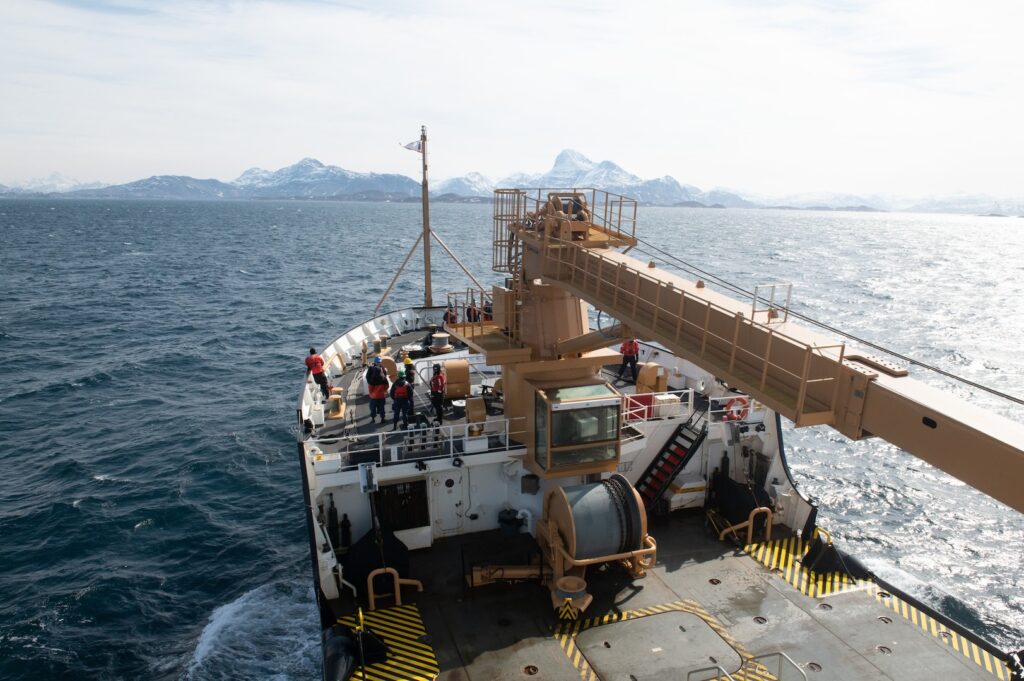
NUUK, Greenland— The crew of USCGC Sycamore (WLB 209) arrived in Nuuk, Greenland, Saturday, in support of Exercise Argus 2023.
During the port visit, U.S. Coast Guard Cmdr. Chad Conrad, Sycamore’s commanding officer and Lt. Anthony Figueroa, Sycamore’s executive officer, met with organizers of the joint, large-scale exercise to discuss plans for Exercise Argus in Southern Greenland.
The crew of Sycamore departed Nuuk Tuesday for the start of the exercise, which includes navigation, damage control, and search and rescue training events.
Exercise Argus is an annual training event designed to enhance capabilities of international partners for responding to search and rescue and marine environmental events in the Arctic region. The exercise takes place from June 12-16, 2023, and affords participating nations opportunities to advance effective partnerships, collaboration and interoperability for a variety of issues affecting the high North region.
The exercise will include maritime and air assets from Greenland, Denmark, France and the United States. Participation in Exercise Argus highlights our collective commitment to safety, environmental protection and international partnerships in the region.
This stop is the second port call for Sycamore’s crew after leaving St. John’s in Newfoundland, Canada.
Sycamore is a 225-foot buoy tender home-ported out of Newport, Rhode Island, with a crew of 48. Sycamore’s primary missions include maintaining aids-to-navigation, promoting economic security through navigation safety of the Marine Transportation System, supporting search and rescue, domestic icebreaking, living marine resources, maritime law enforcement, environmental protection, national defense and homeland security missions.
Fairbanks Morse Defense Contracts with Oceus to Co-Develop Remote Connect Portable 5G Network for Maritime Defense
BELOIT, Wis. – June 13, 2023 – Fairbanks Morse Defense (FMD), an Arcline Investment Management portfolio company, signed a three-year agreement with Oceus to co-develop and deploy Remote ConnectTM, a reliable, secure, portable 5G Broadband Kit to provide maritime defense customers with instant remote connectivity for any device. The technology provides crews with 5G communications access in some of the world’s most remote locations and in areas with extreme interference, ensuring they maintain mission-critical communications while performing essential ship repairs.
Oceus empowers governments and enterprises with intelligent, private 5G communications for critical operations in challenging environments. The patented technology intelligently optimizes for peak performance and eliminates the complexities of deploying and managing private 5G networks.
“Remote Connect will amplify our FM OnBoard technology, allowing technicians who are working in the engine room and other lower decks to have the same reliable connectivity that is available topside. This means they can work with FMD’s remote technicians to monitor assets, detect anomalies, and troubleshoot issues from anywhere in the world without losing their connection,” said Keith Haasl, FMD Vice President of Fairbanks Morse Technology. “This technology showcases FMD’s ongoing commitment to support maritime defense with the best-in-class marine technologies, and we’re looking forward to working with Oceus to identify the many opportunities for this technology.”
The Remote Connect portable 5G Broadband Kit comes in a ruggedized, lightweight case, making it easy to transport. It is instantly deployable from land or sea through a single push-button startup. The battery-powered system will provide over eight hours of active use. When launched, users will have Wi-Fi access through a secure 5G cellular modem and gateway within minutes.
“Secure, reliable connectivity is essential for the Navy as the fleet grows and its demand for transmitting data expands,” said Paul McQuillan – Oceus Chief of Growth and Strategy Officer. “FMD has a strong network throughout the Navy, Military Sealift Command, and the Coast Guard, which makes them an ideal collaborator to help us expand this technology for mission-critical maritime defense.”
Prior to this agreement, Oceus worked with FMD through the FM Defense Accelerator to refine the portable 5G Broadband Kit technology and explore various naval applications.
Four Nations’ Navies Flex Partnership While Operating in the Western Pacific
Four Nations’ Navies Flex Partnership While Operating in the Western Pacific
09 June 2023
From 7th Fleet Public Affairs
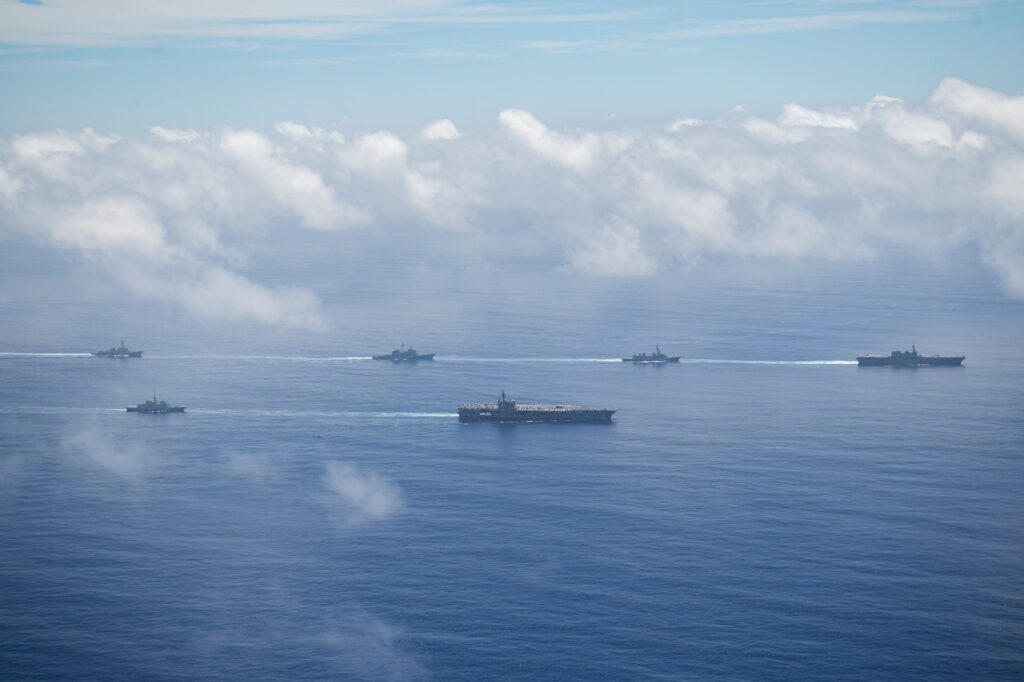
PHILIPPINE SEA – Ships from the navies of Japan, France and Canada joined two U.S. Navy carrier strike groups to operate as a unified force in the Philippine Sea, June 9.
The aircraft carriers USS Nimitz (CVN 68) and USS Ronald Reagan (CVN 76) met the Japan Maritime Self-Defense Force’s large-deck helicopter destroyer JS Izumo (DDH 183) and surface units from Canada and France.
The integrated at-sea exercise brought together more than 12,000 Sailors from across the four maritime nations and supports U.S. Indo-Pacific Command’s Large Scale Global Exercise (LSGE) 23. LSGE demonstrates the U.S. military’s interoperability with allies and partners in support of a free and open Indo-Pacific.
“The credibility of an integrated carrier strike force is the U.S. Navy’s greatest deterrent to those who threaten the international rules based order,” said Rear Adm. Jennifer Couture, commander, CSG 11, aboard USS Nimitz. “Together with our allies and partners, we’re demonstrating our capability to seamlessly integrate across all domains, our readiness to respond to any contingency, and our commitment to uphold freedom of navigation and overflight in the Indo-Pacific region.”
JMSDF Rear Adm. Takahiro Nishiyama, commander, Escort Flotilla 1, said: “The First Surface Unit of the Indo-Pacific Deployment 2023, JS Izumo and JS Samidare, departed their mother ports by June 1 to begin their three-and-a-half-month deployment operations. As the first multinational exercise, I was very excited and reassured to have the opportunity to strengthen cooperation with our important like-minded countries, the Royal Canadian Navy and the French Navy, in addition to the U.S. Navy, with which we have strong bonds of cooperation. I also believe that this exercise embodied the willingness and ability of Japan and our allies and comrades to continue our engagement in the Indo-Pacific region toward the realization of a free and open Indo-Pacific.”
The combined force conducted flight operations and air defense exercise scenarios as well as simulated strikes against maritime targets. Other ships in the partnership included USS Antietam (CG 54), FS Lorraine (D 657) from the French Navy (Marine Nationale), and frigate HMCS Montreal (FFH 336) from the Royal Canadian Navy.
The training and events provided commanders the chance to practice capabilities across the maritime domain as participating forces focused on anti-air, anti-surface, and anti-submarine warfare tactics and procedures. Moreover, cooperative maritime engagements with such enduring partnerships help strengthen existing relationships and increase collective war-fighting readiness, maritime superiority and power projection.
Nimitz from CSG 11 is operating with Ronald Reagan from CSG 5 for the first time since June 2020.
“The combined operations of CSG 5 and CSG 11 — exercising with our Canadian, French and Japanese allies — demonstrates our interoperability, combined capability and common commitment to a free and open Indo-Pacific,” said Rear Adm. Michael “Buzz” Donnelly, commander, CSG 5/Commander, Task Force 70. “As a Pacific nation, our presence allows us to coordinate across all domains and maintain a responsive maritime force that is able to support stability and security in the region by being ready across the full spectrum of naval capabilities.”
U.S. 7th Fleet is the U.S. Navy’s largest forward-deployed numbered fleet, and routinely interacts and operates with allies and partners in preserving a free and open Indo-Pacific region.
Port of Seattle Commissions Third Shore Power System at Pier 66
*****
The “world’s first” port with three ship shore power systems for cruise liners to turn off diesel engines and connect to shoreside electricity to reduce emissions
he Port of Seattle is installing a third shore power system at Pier 66, making it the world’s first port with three of the systems for cruise ships. The technology can significantly reduce emissions and improve air quality by allowing ships to connect to electricity and turn off diesel engines while at the dock.
The port operates the largest and fastest-growing cruise port on the West Coast with more than 200 vessels in a typical season between April and October. Adding a third shore power system is a major component of the port’s Waterfront Clean Energy Strategy, which will help improve air quality in historically underserved communities, modernize and optimize grid resources, support green maritime industry investments, increase resiliency of critical port infrastructure, and spur growth and employment in electrification, renewable fuels, and the clean technology sector.
The new shore power connection is expected to be fully operational by the 2024 Alaska cruise season.
The contract for the shore power system components was awarded in November 2022 to Kingston, WA-based Watts Marine, an innovator and integrator of shore power technology systems. To date, the company has installed ten shore power systems globally at ports in Seattle, San Diego, San Francisco, Halifax, Vancouver BC, Brooklyn, and Long Beach. An estimated 700 cruise ships connect to Watts Marine’s shoreside electrical power equipment each year.
The company facilitates every aspect of the shore power process, from helping the marine industry navigate the fine points of regulatory advising through design, build, heavy equipment installation, and system operation and maintenance. Each shore power system consists of proprietary equipment developed specifically to serve the cruise ship industry. This includes equipment for dual-voltage electrical service, custom-developed electrical cable handling, and electronic monitoring and control.
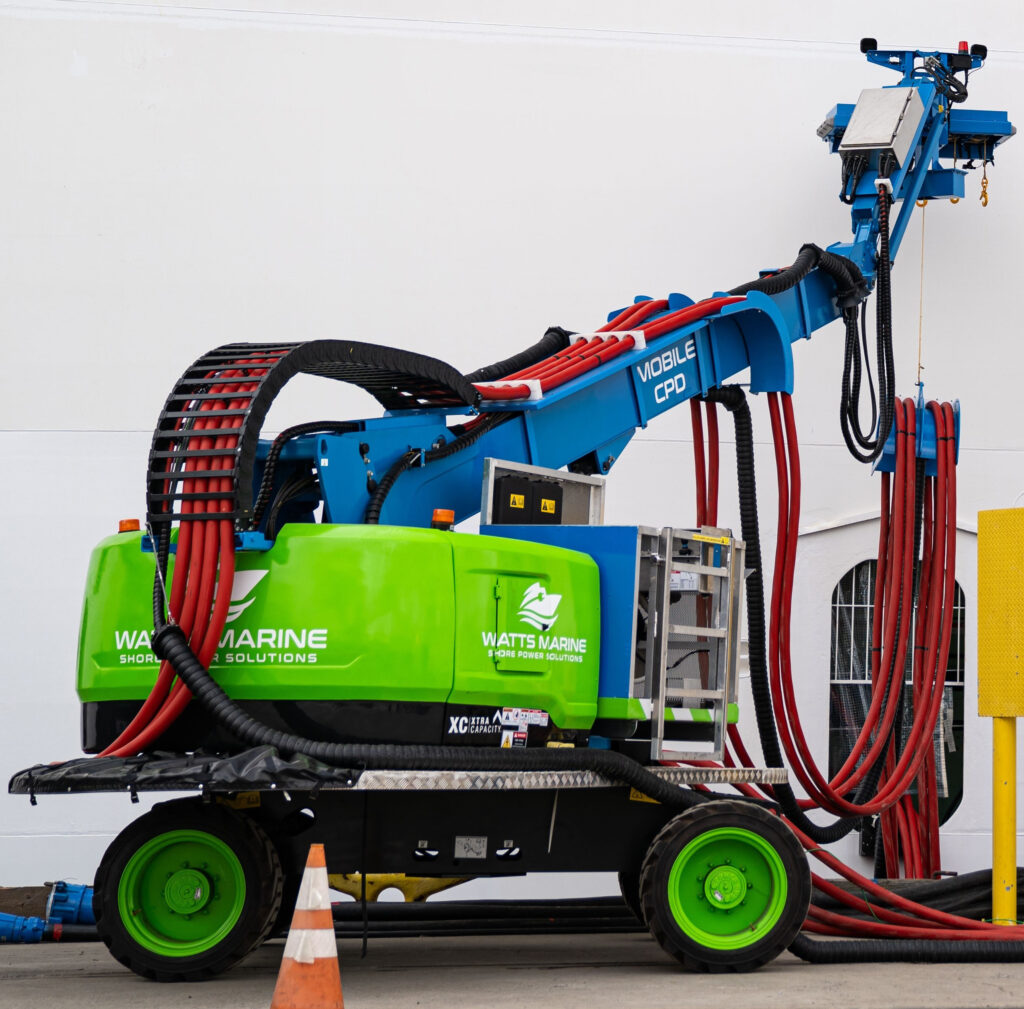
The Port of Seattle will also use Watts Marine’s innovative, cost-effective Mobile Cable Positioning Device (CPD), which facilitates shore power connections by moving the cabling strategically to the ideal location. The mobile design simplifies moving the system to accommodate docked vessels of all sizes and configurations, making shore power available almost immediately.
The mobile cable positioning device can be used with any shoreside electric power systems, not just Watts Marine installations. The unit is designed to allow the operator to strategically position the Mobile CPD, then plug into shore power cables on the back side while extending the cables from the end of a boom. The vessel’s crew can then reach out, pull the power cables in, and plug them into their connection box.
Once the connection has been made using the mobile CPD, the Watts Marine shoreside operator then selects the ship to be connected from the database in the automation system, which determines the proper operating parameters. Protection relays and redundant safety systems ensure the safety of the ship and shore electrical systems.
Watts Marine’s custom software also allows the specialists in its dedicated control center in Seattle to oversee every connection. All the ship’s systems then run on shore electricity instead of its diesel engines, virtually eliminating fuel emissions while in port.
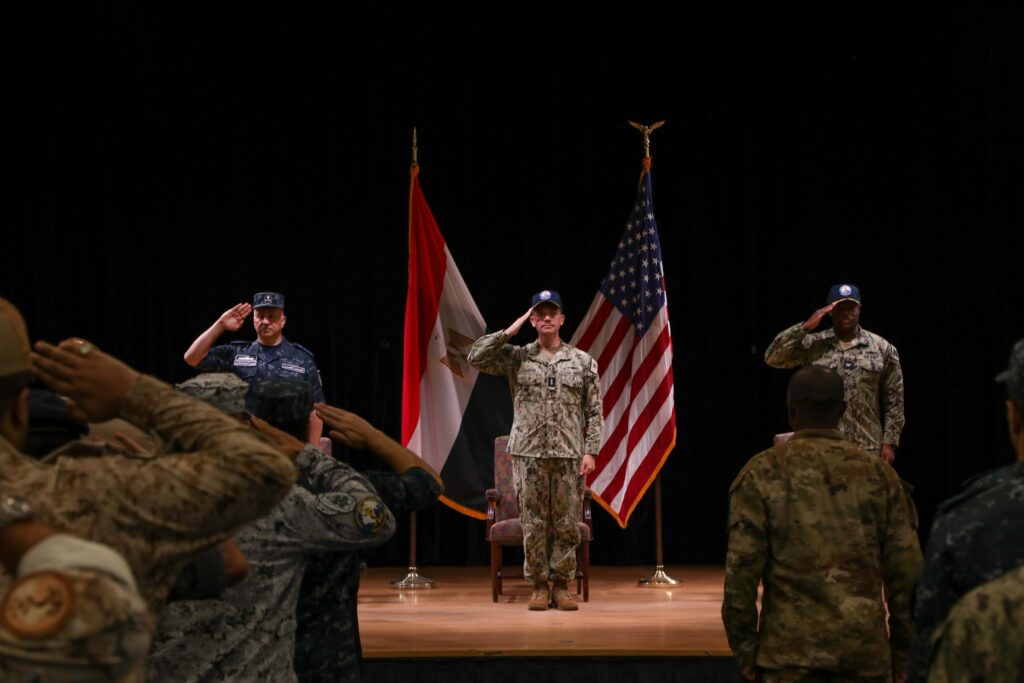
Egypt Turns Over Command of Multinational Red Sea Task Force
MANAMA, Bahrain (June 12, 2023) Egyptian Navy Rear Adm. Mahmoud Abdelsattar, left; Vice Adm. Brad Cooper, commander of U.S. Naval Forces Central Command, U.S. 5th Fleet and Combined Maritime Forces, center; and U.S. Navy Capt. Anthony Webber, new commander of Combined Task Force 153; render honors on stage during a change of command ceremony in Manama, Bahrain, June 12, 2023. (Photo by Cpl. Jensen Guillory)
By U.S. Naval Forces Central Command Public Affairs | June 12, 2023
MANAMA, Bahrain —The Egyptian Navy turned over command of a multinational Red Sea task force to the U.S. Navy, June 12, six months after Egypt began leading the Combined Maritime Forces (CMF) operational staff for the first time.
U.S. Navy Capt. Anthony Webber relieved Egyptian Navy Rear Adm. Mahmoud Abdelsattar as the commander of Combined Task Force (CTF) 153 during a ceremony in Bahrain where CMF his headquartered.
Established in April 2022, CTF 153 is one of five CMF task forces responsible for conducting maritime security and training operations across the Middle East. The multinational staff supporting CTF 153 specifically focuses on international maritime security efforts in the Red Sea, Bab al-Mandeb and Gulf of Aden.
“It was a great honor to be the commander of CTF 153,” said Mahmoud. “For the last six months, we have worked closely with partner nations, maintained stability in the Red Sea, Bab al-Mandab Strait and Gulf of Aden, and proved once again that Egypt is committed to maintaining maritime security and enhancing our capabilities through trust, training and working together.”
Webber assumes command of CTF 153 while still serving as commander for Task Force 55, U.S. 5th Fleet’s operational staff overseeing U.S. Navy surface assets employed in the Middle East.
“It takes all of us working together to make a winning team, and I have all the confidence in the world that we will do just that in carrying out our duties with honor and commitment,” Webber told the CTF 153 team. “Your achievements are vast and I am honored in having this remarkable opportunity to serve with you.”
With 38 nations, CMF is the largest naval partnership in the world. Other task forces include CTF 150, focused on maritime security in the Gulf of Oman, Indian Ocean and Gulf of Aden; CTF 151, which leads regional anti-piracy efforts; CTF 152, dedicated to maritime security in the Arabian Gulf; and CTF 154, established in May to enhance maritime security training throughout the region.