Curtiss-Wright Awarded $24 Million Contract to Provide Flight Test Instrumentation Equipment for the F-35 Technology Refresh 3 Program
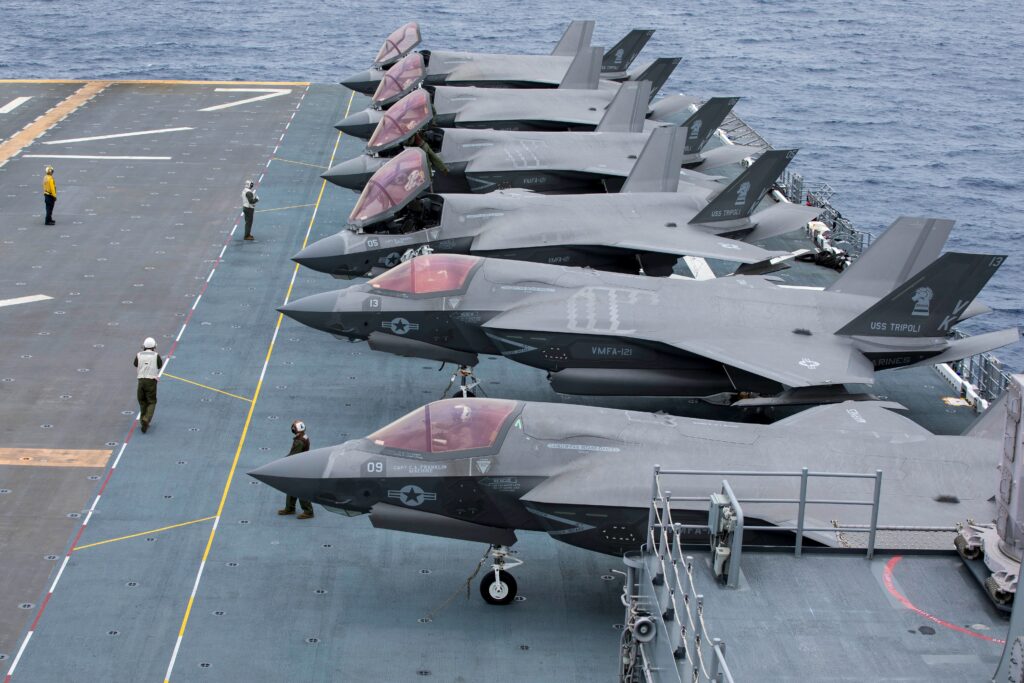
PHILIPPINE SEA (June 10, 2022) U.S. Marine Corps F-35B Lightning II aircraft with Marine Fighter Attack Squadron (VMFA) 121 stage aboard the amphibious assault ship USS Tripoli (LHA 7), while underway, June 10, 2022. Marines with VMFA-121, based out of Marine Corps Air Station Iwakuni, Japan, are conducting flight operations in support of a free and open Indo-Pacific. (U.S. Marine Corps photo by Sgt. Jackson Ricker)
DAVIDSON, N.C. – June 12, 2023 –Curtiss-Wright Corporation (NYSE: CW) today announced that it has been awarded a $24 million contract from Nellis Air Force Base to provide Flight Test Instrumentation (FTI) equipment in support of the F-35 Technology Refresh 3 (TR-3) program. Technology Refresh 3 represents a series of critical upgrades to the F-35′s hardware and software meant to improve its displays, memory and computer processing capability and support future modernization capabilities.
“We are proud to have been selected by Nellis Air Force Base to provide our aerospace instrumentation technology for use on critical flight tests of the F-35 TR-3 program,” said Lynn M. Bamford, Chair and CEO of Curtiss-Wright Corporation. “The receipt of this contract reflects our long-standing relationships and ongoing collaboration with the F-35 Joint Program Office and U.S. Flight Test Range engineers and personnel, and demonstrates the trust and confidence that customers place in Curtiss-Wright’s advanced and reliable integrated high-speed flight test instrumentation systems.”
Curtiss-Wright has worked closely over the past three years with U.S. Flight Test Ranges, including Nellis AFB and the Naval Air Warfare Center Aircraft Division, as well as the F 35 Joint Program Office, to define and architect the Distributed Flight Test Instrumentation (DFTI) system that enables the test and evaluation of F-35 TR-3 configured aircraft. Curtiss-Wright’s FTI technology forms part of the DFTI system, where products and subsystems that enable the acquisition, collation, processing, recording, and telemetry of flight test data support the seamless transport of that data. Because it is networked, DFTI enables the distribution of flight test instrumentation equipment closer to the measured parameters, resulting in increased test accuracy.
Since 1998, Curtiss-Wright has successfully supported Nellis AFB with FTI solutions that meet the highest standards. As a total systems provider for FTI, Curtiss-Wright provides products and services that collect, collate, process, record, transmit via RF links, and analyze and display flight test data.
Curtiss-Wright is performing the work at its TTC facility in Newtown, Pa., within its Defense Solutions division in the Defense Electronics segment. For more information about Curtiss-Wright’s Defense Solutions division products, please visit www.curtisswrightds.com.
FLEET BATTLE PROBLEM 2023-1 COMMENCES; FOCUSES ON INTEGRATED MARITIME CAPABILITIES WITH U.S. NAVY AND U.S. MARINE CORPS
NORFOLK, Va. – U.S. Fleet Forces Command and U.S. Marine Forces Command will conduct Fleet Battle Problem 2023 (FBP 23-1) June 9-13 on land and off the coast of Camp Lejeune, North Carolina and the Virginia Capes to further develop integrated maritime capabilities with the II Marine Expeditionary Force and U.S. 2nd Fleet.
FBPs occur multiple times a year to practice and assess new warfighting concepts that culminate in large and complex events, such as Large Scale Exercise (LSE). FBP 23-1 will focus on integrated naval capabilities, distributed logistics, and capabilities in support of Expeditionary Advanced Base Operations (EABO).
“Across the spectrum of the Navy’s operational level of war learning continuum, Fleet Battle Problems employ real-world equipment and conditions to create challenging and realistic environments designed to enable our Navy and Marine Corps team to assess innovative capabilities and explore new operational concepts,” said Adm. Daryl Caudle, commander, U.S. Fleet Forces Command. “These Battle Problem events are an investment toward developing an integrated maritime force ready to keep pace with the latest technologies, innovative tactics, and warfighting concepts needed to overmatch our adversaries.”
FBP 23-1 allows the Navy and Marine Corps to maintain and improve EABO and Littoral Operations in a Contested Environment (LOCE). Both LOCE and EABO contribute to naval operating concepts, such as Distributed Maritime Operations (DMO), that place a growing emphasis on Navy-Marine Corps integration.
“The Navy-Marine Corps team continues to innovate and adapt to current and potential threats,” said Lt. Gen. Brian Cavanaugh, the commanding general of Marine Forces Command. “Working together in events like Fleet Battle Problem strengthens our warfighting team, builds on our integration and simply makes us a better Naval force ready to answer our Nation’s call.”
Events like Fleet Battle Problem 23-1 improve how the Navy and Marine Corps work together to form a strong and cohesive Maritime Force capable of projecting American power from sea to shore at home and around the world.
Northrop Grumman to Produce New Maritime Navigation Sensor for U.S. Navy
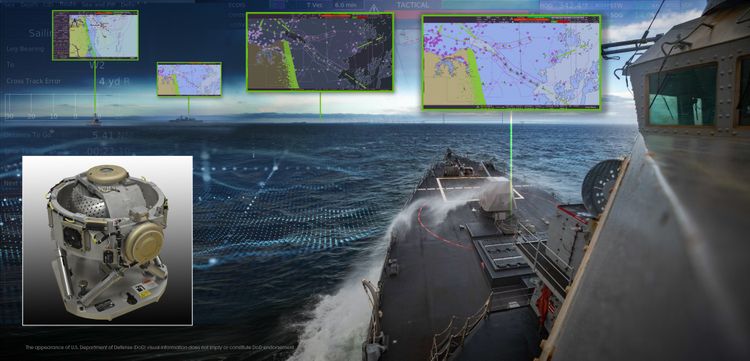
The Northrop Grumman-built AN/WSN-12 Inertial Sensor Module provides accurate positioning data with or without GPS for Navy ships and submarines. (Photo Credit: U.S. Navy)
CHARLOTTESVILLE, Va. – June 8, 2023 – The U.S. Navy awarded Northrop Grumman Corporation (NYSE: NOC) a production contract for the new AN/WSN-12 Inertial Sensor Module (ISM). Northrop Grumman’s AN/WSN-12 ISM is a next-generation sensor that significantly improves maritime navigation in Global Positioning System (GPS) denied environments for surface ships and submarines.
“The new AN/WSN-12 Inertial Navigator System will deliver more precision and performance for the warfighter while occupying the same footprint as its predecessor.” said Todd Leavitt, vice president, naval and oceanic systems, Northrop Grumman. “This allows upgrades to be made on existing systems where space is at a premium.”
The new AN/WSN-12 ISM is a key component of the U.S. Navy’s AN/WSN-12 Inertial Navigator System (INS), upgrading the Northrop Grumman built AN/WSN-7 INS. The WSN-7 is on nearly every ship in the U.S. Navy and has been the program of record for more than two decades. Surface ships and submarines rely heavily on the positioning data provided by GPS for navigation, for safety at sea and to fire weapons. The AN/WSN-12 ISM provides highly accurate positioning data with or without GPS, a key component to establishing Assured Position, Navigation, and Timing (A-PNT) maritime solutions. The first ISM will be fielded later this year.
KONGSBERG receives new Naval Strike Missile order for the U.S. Navy
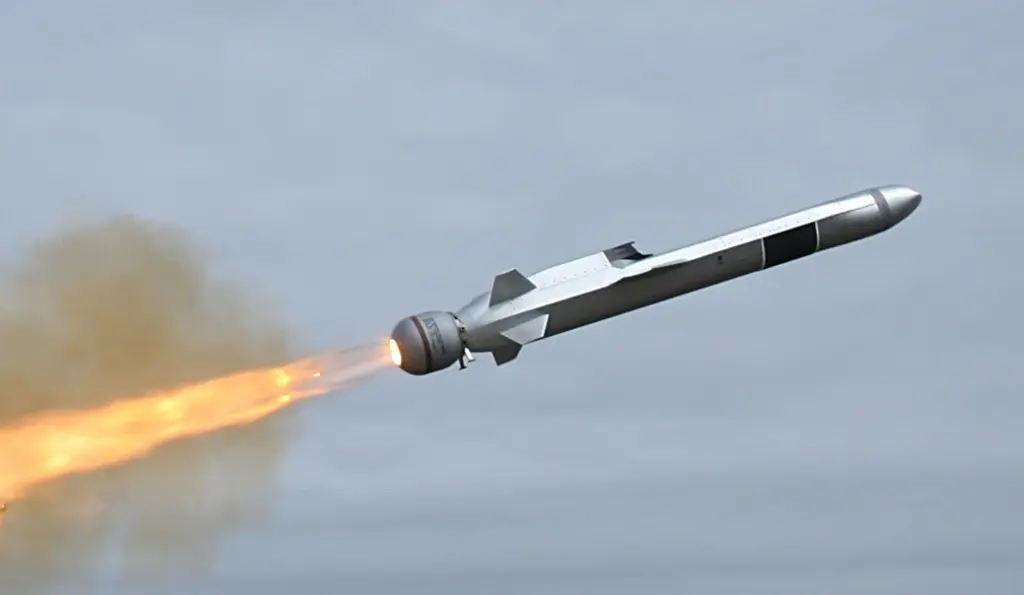
We have received an order from Raytheon Missiles & Defense for Naval Strike Missiles to the US Navy Over-The-Horizon Weapon System (OTH WS) program worth MNOK 1 345.
Raytheon is prime contractor to the US Navy.
The order is related to the OTH WS framework agreement announced 31 May 2018. We have signed orders for MNOK 3 110 under this framework agreement.
“This is the largest Naval Strike Missiles-order from US Navy so far. This generates jobs and demand for increased production capacity, both for us and our suppliers. As announced at our CMD in June 2022, we have started a significant investment in a new missile production facility that will be finished in June next year,” says Eirik Lie, President of Kongsberg Defence & Aerospace.
NSM The NSM provides superior operational performance and high survivability against all enemy defence systems.
High resolution imaging infrared seeker provides ATR and precise hitpoint for each ship class. Thrust to weight ratio above 1 and high-g programmable endgame maneuvers provide unsurpassed defence penetration capabilities.
Over-The-Horizon Weapon System The Over-The-Horizon Weapon System is a long-range, surface-to-surface missile employed by either the Littoral Combat Ship or the planned guided-missile frigate, intended to engage maritime targets both inside and beyond the firing unit’s radar horizon.
The OTH-WS is a stand-alone system consisting of an operator interface console, naval strike missile, and a missile launching system, requiring minimal integration into the host platform.
The OTH-WS receives targeting data via tactical communications from combatant platforms or airborne sensors and requires no guidance after launch.
US Navy awards launch and recovery system contract for fourth Ford-class aircraft carrier
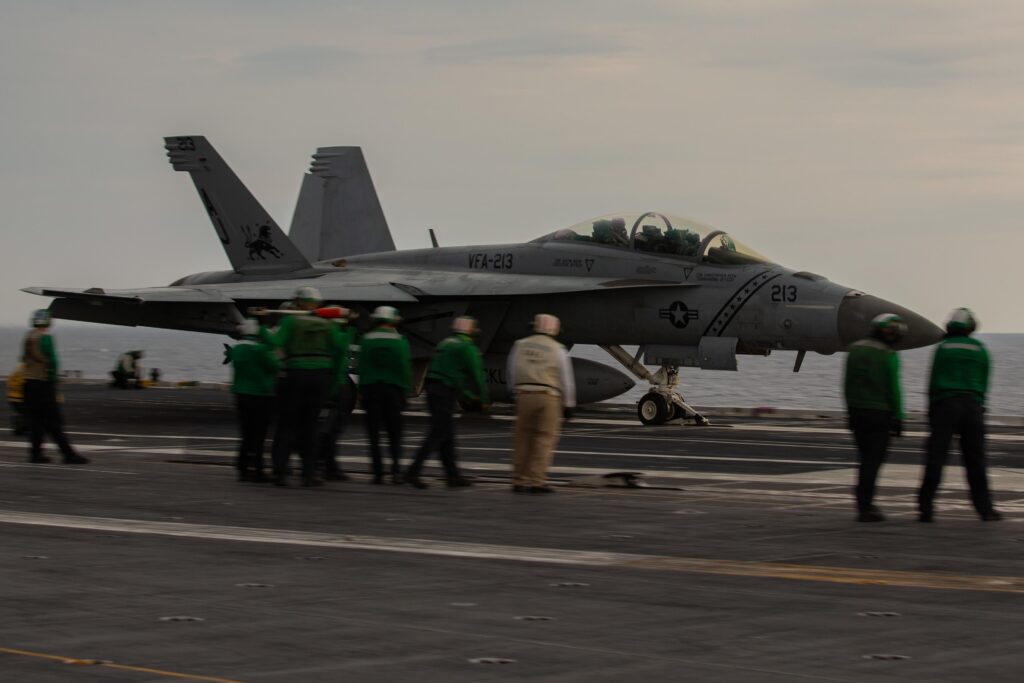
An F/A-18F Super Hornet from Strike Fighter Squadron (VFA) 213 launches off of the flight deck of the first-in-class aircraft carrier USS Gerald R. Ford (CVN 78) using the Electromagnetic Aircraft Launching System (EMALS), March 10, 2023. As the first-in-class ship of Ford-class aircraft carriers, CVN 78 represents a generational leap in the U.S. Navy’s capacity to project power on a global scale.
NAVAL AIR SYSTEMS COMMAND, PATUXENT RIVER, Md.–The U.S. Navy awarded General Atomics a $1.204-billion contract modification June 12 to build the Electromagnetic Aircraft Launch System (EMALS) and Advanced Arresting Gear (AAG) for the future USS Doris Miller (CVN 81).
The contract includes AAG and EMALS production, shipset deliveries, engineering change orders, production incorporation of obsolescence mitigations, program support, installation, and certification support for CVN 81 through 2032.
Capt. Mike Kline, program manager for the Aircraft Launch and Recovery Equipment Program Office (PMA-251) said the contract award is an important evolution in the future of launch and recovery for U.S. Naval warfare.
“As the fourth Ford-class aircraft carrier to enter the fleet, CVN 81 can lean on CVN 78’s experience, and the lessons learned while advancing EMALS and AAG for the next generation of Sailors,” he said.
EMALS and AAG certification on USS John F. Kennedy (CVN 79) is currently underway, and system production on USS Enterprise (CVN 80) is near completion. Production work for EMALS and AAG on the CVN 81 will begin immediately, with support planned through 2032.
CNO: ‘We Need to be in the Way’
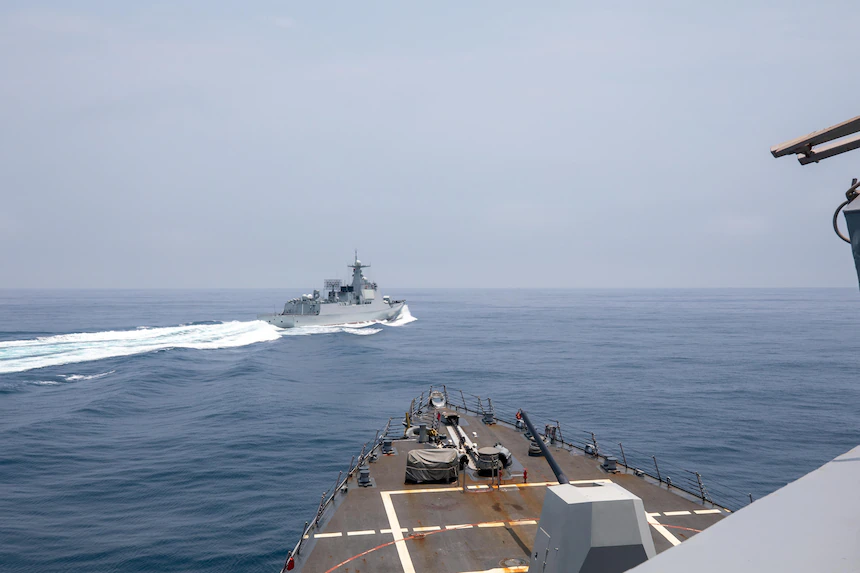
TAIWAN STRAIT (June 3, 2023) The Arleigh Burke-class guided-missile developer destroyer USS Chung-Hoon (DDG 93) observes PLA(N) LUYANG III DDG 132 (PRC LY 132) execute maneuvers in an unsafe manner while conducting a routine south to north Taiwan Straight transit alongside the Halifax-class frigate HMCS Montral (FFG 336), June 3. USS Chung-Hoon is on a routine deployment to U.S. 7th Fleet and is assigned to Commander, Task Force (CTF 71)/Destroyer Squadron (DESRON) 15. CTF 71/DESRON 15 is the largest forward-deployed DESRON and the U.S. 7th Fleet’s principal surface force. (U.S. Navy photo by Mass Communication Specialist 1st Class Andre T. Richard)
*****
ARLINGTON. Va. — The U.S. Navy needs a non-provocative but purposeful presence in the seas around China to deter challenges to international rules and the security interests of the United States, the chief of naval operations said.
CNO Admiral Michael Gilday, speaking June 7 to an audience at the Brookings Institution, a Washington think tank, remarked on the recent incidents in the South China Sea and Taiwan Strait, particularly the unsafe maneuvers of the PLAN(N) destroyer Luyang III last week in the vicinity of the U.S. Navy destroyer USS Chung-Hoon and Canadian frigate HMCS Montreal.
“We’re handling that, I think, very well, very professionally,” Gilday said.
“I am encouraged by the most recent turn in dialogue by senior leaders with the toning down of, I would say, militaristic tone,” the CNO said. “I think that’s been helpful. We need to continue to operate out there, and we need to continue to operate forward. We need to assure allies and partners. At the same time, we need to deter anybody, any nation that tends to challenge those international rules, challenge the security interests of not only the United States but our allies and partners and put our economic interests in jeopardy.
“So, I think we need to be out there, and we need to be in the way,” the admiral said. We can’t just be milling about. It has to be purposeful, and it has to be non-provocative. Let me just underscore that.”
Gilday said he was concerned about the “lack of transparency” of the Chinese military and “their intentions with respect on how they intend to use their navy to reach President Xi’s goals are concerning with respect on military expansion.”
Gilday also noted the positive contribution of the Chinese PLAN Navy in anti-piracy operations in recent years off the coast of East Africa.
“They have been good partners with combating piracy, thwarting it, and keeping those sea lanes open for all,” he said. “That should be a model for the behavior that we should expect from the PRC. I would encourage more of those types of collaborative operations at sea that benefit all of us.”
Gilday noted that “mil-to-mil [military-to-military] relationships are intended to be a shock absorber. No matter the political climate, those mil-to-mil relationships have to be steady, predictable, and they have to be very measured.”
Also speaking in the seminar was Peter Levesque, president of CMA CGN shipping company and of American President Lines, who remarked on the tensions in the South China Sea.
“The major challenge for us is, obviously, what happens in the South China Sea,” Levesque said. “Five trillion dollars of goods flow through the South China Sea every year. It’s a major shipping lane, obviously, for CMA and for the other carriers. We’re worried about what everybody’s worried about, that two planes go bump in the night, or two ships go bump in the night accidentally and spiral into something bigger, and all of a sudden, we can’t use those trade lanes or insurance companies won’t insure our ships to go through those trade lanes.
“It’s a real concern, and I don’t think we fully comprehend how big of an impact that would be not only to the global supply chain but the U.S. supply chain in particular if tensions get to the point where that’s an unusable space,” he said.
Flights Featured ESM, COMINT, Detect and Avoid, AIS, and Link 16 Capabilities
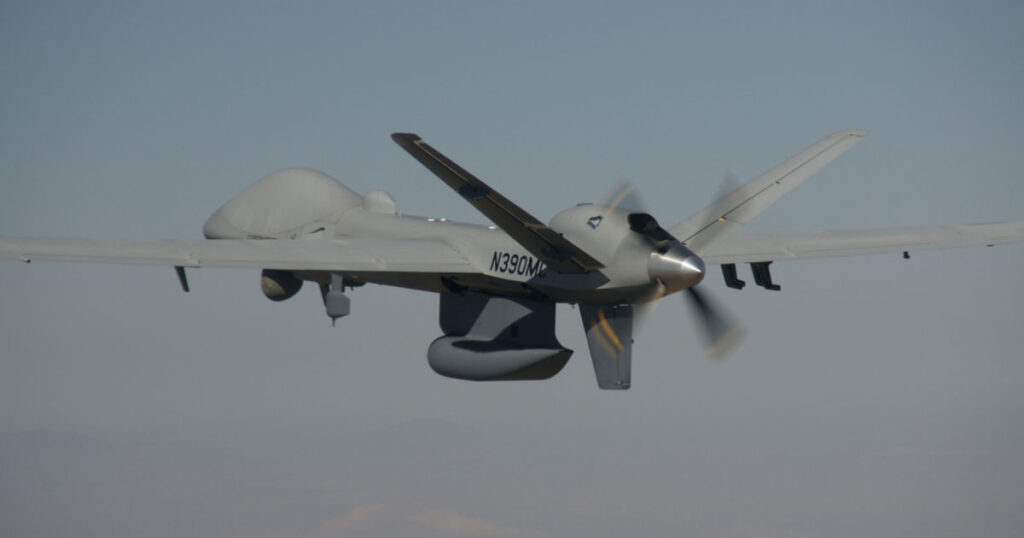
SAN DIEGO – 07 June 2023 – As part of a U.S. Navy contract, an MQ-9B SeaGuardian® Unmanned Aircraft System from General Atomics Aeronautical Systems, Inc. (GA-ASI) supported the NORTHERN EDGE 2023 (NE23) exercise May 8-19, 2023. The training exercise, which took place in the Gulf of Alaska, was one of a series of U.S. Indo-Pacific Command (IPACOM) exercises that prepares joint forces to respond to crises in the Asia Pacific region.
GA-ASI’s SeaGuardian is a maritime derivative of the MQ-9B SkyGuardian® and remains the first UAS that offers multi-domain Intelligence, Surveillance, Reconnaissance and Targeting (ISR&T) and has an internal payload suite that can prosecute surface and subsurface targets in support of Fleet Operations.
During NE23, SeaGuardian provided real-time Maritime ISR&T data feeds to the various IPACOM operations centers including Pacific Fleet, Pacific Air Forces, Joint Base Elmendorf-Richardson Joint Exercise Control Group (JECG) and various exercise and real-world watch floors. Real-time sensor data – including Signals Intelligence (SIGINT), radar, and full-motion video – was Processed, Exploited and Disseminated (PED) by operators via Minotaur Mission System. The Minotaur system was developed by the Johns Hopkins University Applied Physics Laboratory. It links sensors, SIGINT, cameras, radar and communications equipment into a single, automated system that allows operators to more efficiently identify, track and target simultaneously with other users for expedited dynamic tasking. This classified data was transmitted to the Joint Fires Network using new DoD technologies allowing for the smart routing of communications between widely distributed communications nodes.
In addition, SeaGuardian showcased an array of operational payloads, including Electronic Support Measures (ESM), Radar Moving Target Indication (MTI) and Inverse Synthetic-Aperture Radar (ISAR), Communication Intelligence (COMINT), Automatic Identification System (AIS), high-definition Electro-Optical/Infra-Red (EO/IR) imaging system and Link 16.
The ESM payload on SeaGuardian was supplied by Sierra Nevada Corporation and the COMINT payload was made by L3Harris Technologies. The aircraft featured the SeaVue Multi-role radar from Raytheon Technologies. GA-ASI’s Link 16 solution leveraged the L3Harris Small Tactical Terminal (STT) KOR-24A radio and Ultra Electronics Air Defense Systems Integrator (ADSI) host software ran on the Parry Labs Stellar Relay Common Compute Module.
The GA-ASI-developed Detect and Avoid (DAA) system was also installed in SeaGuardian and received a limited certification from NAVAIR. This enabled SeaGuardian to perform beyond visual line-of-sight (BVLOS) operations within the exercise airspace.
SeaGuardian’s multi-domain capabilities allows it to flex from mission to mission and pass real-time sensor data directly to the fleet through Link 16 and satellite feeds to the shore-based command and intelligence centers. During NE23, the MQ-9B effectively passed ISR&T information to various surface and air units, and a litany of other U.S. and foreign units taking part in the exercise.
In addition to its contributions to the exercise, the SeaGuardian self-deployed from GA-ASI’s Desert Horizons flight operations facility in El Mirage, Calif., to Joint Base Elmendorf-Richardson, Alaska, covering over 2,000 nautical miles in a single flight and demonstrated SeaGuardian’s unrivalled expeditionary attributes. The aircraft self-deployed back to El Mirage following the exercise. All flights were flown from a forward deployed Mission Command Element comprised of a Certified Ground Control Station and Mission Intelligence Station located Naval Air Station Whidbey Island, Washington, exercising UAS Expeditionary Concept of Operations (CONOPS) in support of Exercise objectives.
Makin Island ARG, 13th MEU Return to Home Port San Diego
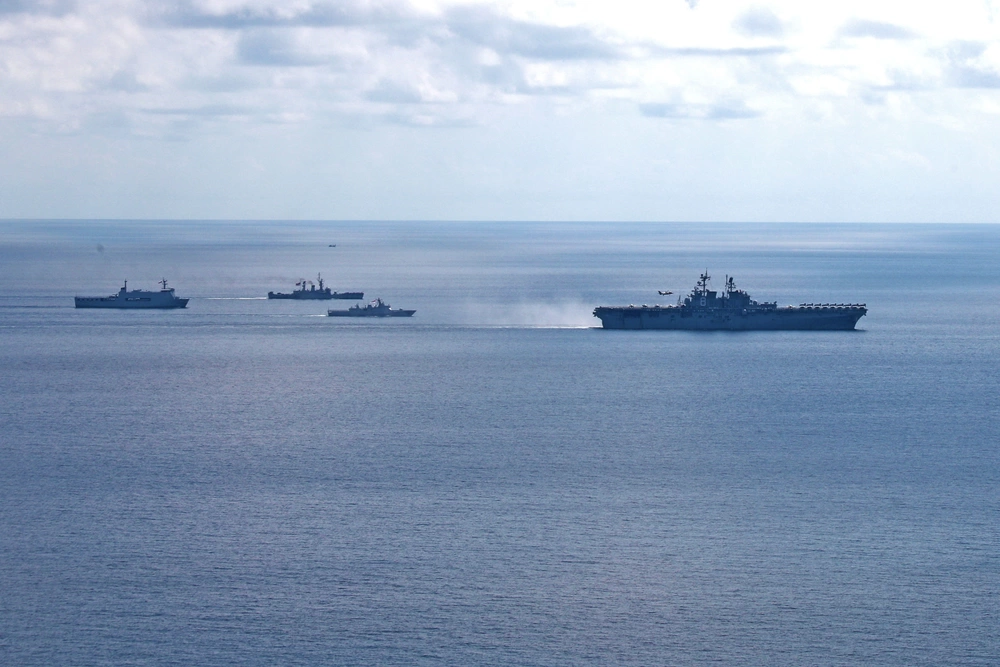
Photo By Gunnery Sgt. Chad Pulliam | PACIFIC OCEAN (Dec. 18, 2022) – A U.S. Marine Corps F-35B Lightning II pilot with Marine Fighter Attack Squadron (VMFA) 122, 13th Marine Expeditionary Unit, performs a vertical landing aboard amphibious assault ship USS Makin Island as Indonesian servicemembers view the landing from Indonesian Navy vessels during Cooperation Afloat Readiness and Training/ Marine Exercise (MAREX) Indonesia 2022, Dec. 18. CARAT/MAREX Indonesia is a bilateral exercise between Indonesia and the United States designed to promote regional security cooperation, maintain and strengthen maritime partnerships, and enhance maritime interoperability. In its 28th year, the CARAT series is comprised of multinational exercises, designed to enhance U.S. and partner navies’ and marine corps abilities to operate together in response to traditional and non-traditional maritime security challenges in the Indo-Pacific region. (U.S. Marine Corps photo by Gunnery Sgt. Chad J. Pulliam)
The Makin Island Amphibious Ready Group, led by commander, Amphibious Squadron 7 and comprised of amphibious assault ship USS Makin Island (LHD 8) and amphibious transport docks USS Anchorage (LPD 23) and USS John P. Murtha (LPD 26), with the embarked 13th Marine Expeditionary Unit, returns to San Diego this week following a seven-month deployment to the U.S. 3rd and 7th Fleet areas of operations.
“Our goal was to achieve interoperability with our allies and partners and promote a free and open Indo-Pacific. We accomplished that mission and brought every single Sailor and Marine home safely,” said U.S. Navy Capt. Andria Slough, commanding officer of Makin Island. “While the world witnessed our ARG-MEU team strengthening partnerships, I had a front-row seat to the tremendous amount of skill, dedication and hard work of 2,500 people each day of deployment. It’s awe-inspiring to watch Sailors and Marines at their very best!”
The Makin Island ARG and the 13th MEU successfully integrated capabilities of approximately 4,500 Sailors and Marines, supported allied interoperability during seven exercises, and traveled more than 47,000 nautical miles across the Indo-Pacific while deployed. Makin Island embarked all elements of the Marine Air-Ground Task Force, consisting of the 13th MEU Command Element; the Ground Combat Element, Battalion Landing Team 2/4; the Logistics Combat Element, Combat Logistics Battalion 13; the Aviation Combat Element, Marine Medium Tiltrotor Squadron (VMM) 362 (Reinforced), and Marine Fighter Attack Squadron (VMFA) 122, which included a full squadron of 10 F-35B Lightning IIs.
The ARG-MEU team began the deployment with Cooperation Afloat Readiness and Training exercises alongside regional partners and allies. The CARAT 2022 maritime exercise series promoted regional security cooperation, maintained and strengthened maritime partnerships, and enhanced interoperability among participating forces. Makin Island executed CARAT missions with Indonesia in December and Singapore in January, and Anchorage and John P. Murtha spent time training with members of the Sri Lanka and Timor-Leste militaries, respectively.
From February to March 2023, the Makin Island ARG and the 13th MEU participated in the 42nd iteration of exercise Cobra Gold with the Royal Thai Navy and Marine Corps. Cobra Gold is one of the largest multilateral theater security cooperation exercises in the Indo-Pacific and reflects the U.S. commitment to allies and partners, providing a continuous and reliable platform to train, prepare, and enhance regional stability and interoperability. Participants included Japan, Malaysia, the Republic of Indonesia, the Republic of Korea, and the Republic of Singapore, as well as participants from more than 20 other nations.
“I am so proud of all our Marines and Sailors as we return from this action-packed, seven-month deployment after exceeding all of our goals,” said U.S. Marine Corps Col. Samuel Meyer, commanding officer of the 13th MEU. “Through our Navy and Marine Corps integration, we worked with our partners and allies, creating personal bonds that will last a lifetime. From the CARAT series with Indonesia, Singapore, Timor-Leste, and Sri Lanka to our three large exercises with Thailand, Republic of Korea and the Philippines, we further strengthened these critical relationships that will continue to grow with routine ARG-MEU deployments to the region.”
The ARG-MEU participated in bilateral Exercise Ssang Yong 2023 alongside the ROK Navy and Marine Corps from March to April, reinforcing U.S. commitment. Operational exercises such as SY23 demonstrate the alliance remains ironclad, contributes to regional security, and promotes stability in northeast Asia and the Indo-Pacific region as a whole. During Ssang Yong, the 13th MEU disembarked the entirety of Battalion Landing Team 2/4 to participate in military operations in urban terrain training, close-quarters battle training, and various live-fire ranges with our ROK counterparts.
The Makin Island ARG and the 13th MEU wrapped up the deployment by participating in exercise Balikatan 2023 with the Armed Forces of the Philippines in April. The 17,600 participants made it the largest iteration of the exercise to date. Together, the two militaries trained side-by-side, developing interoperability and improved capability in the areas of maritime security, amphibious operations, live-fire training, urban and aviation operations, cyber defense, counterterrorism, and humanitarian assistance and disaster relief preparedness.
An integral part of U.S. Pacific Fleet, U.S. 3rd Fleet operates naval forces in the Indo-Pacific and provides the realistic, relevant training necessary to flawlessly execute our Navy’s role across the full spectrum of military operations that range from combat operations to humanitarian assistance and disaster relief. U.S. 3rd Fleet works together with our allies and partners to advance freedom of navigation, the rule of law, and other principles that underpin security for the Indo-Pacific region.
Marine Expeditionary Units (MEU) embarked on Amphibious Ready Groups (ARG) are characterized by their sea-based forward presence and expeditionary nature. As the Nation’s premier crisis response force, the ARG/MEUs provide a flexible and lethal force ready to perform a wide range of military, humanitarian, and diplomatic operations around the globe without the need for access, basing and overflight. Operating in international waters, this Navy-Marine Corps team also provides flexible deterrence options in key sea lines of communication and adjacent littorals near strategic chokepoints and can seize and hold maritime terrain in the defense of national interests.
Expeditionary Strike Group 3 comprises three amphibious squadrons, 15 amphibious warships, and eight naval support elements including approximately 18,000 active-duty and reserve Sailors and Marines. As the deputy commander for amphibious and littoral warfare, U.S. 3rd Fleet, the ESG 3 commander also oversees Mine Countermeasures Group 3 and the 14 littoral combat ships and two subordinate divisions under Littoral Combat Ship Squadron 1. ESG 3 is postured in support of U.S. 3rd Fleet as a globally responsive and scalable naval command element, capable of generating, deploying, and employing naval forces and formations for crisis and contingency response, forward presence, and major combat operations focusing on amphibious operations, humanitarian and disaster relief and support to defense civil authorities, and expeditionary logistics.
Navy accepts upgraded E-6B Mercury, delivering enhanced capabilities to the fleet
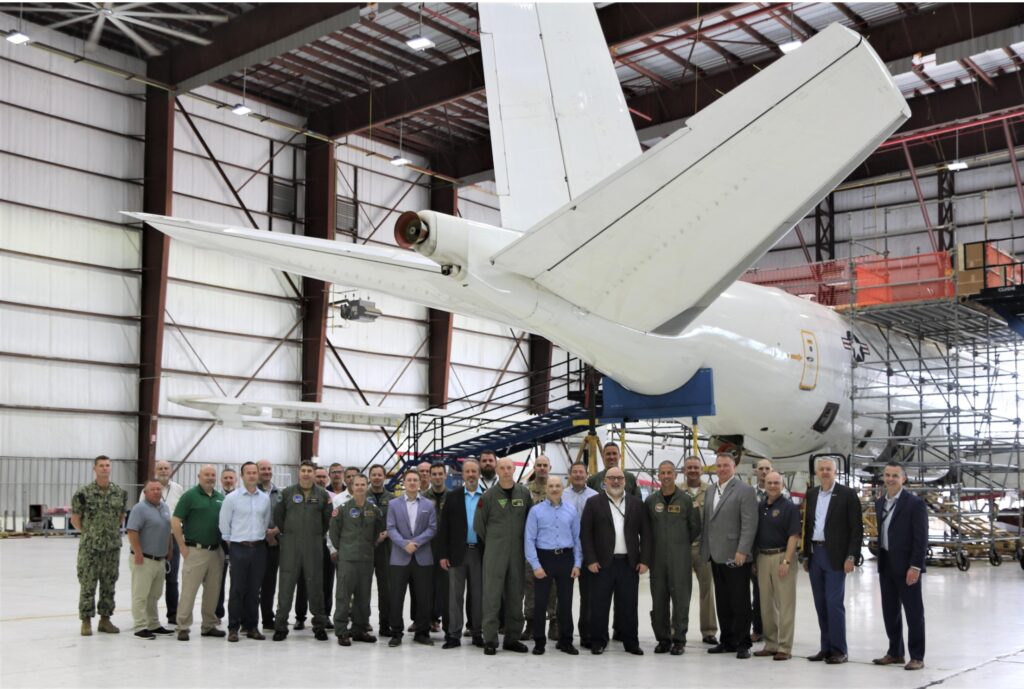
Members of the U.S. Navy and Northrop Grumman Corp. in Lake Charles, Louisiana, with the first E-6B Mercury upgraded by Northrop Grumman under the new Integrated Modification and Maintenance Contract. They include Vice Adm. Carl Chebi, commander of Naval Air Systems Command, and Capt. Adam Scott, program manager for the Airborne Strategic Command, Control and Communications Program Office. Photo courtesy of Northrop Grumman Corp.
LAKE CHARLES, La. — The U.S. Navy this month accepted the first E-6B Mercury upgraded by Northrop Grumman Corp. in Lake Charles, delivering enhanced airborne strategic communication capabilities to the warfighter.
The upgrade supports the Navy’s nuclear deterrence mission, ensuring the president, secretary of defense and U.S. Strategic Command remain connected to the U.S. nuclear arsenal in a worst-case scenario.
Northrop Grumman Corp. conducted the upgrades over the last year at its Aircraft Maintenance and Fabrication Center at Lake Charles. Under its Integrated Maintenance and Modification Contract (IMMC) with the Navy, it will overhaul multiple E-6B Mercury aircraft by 2027. The $111 million contract provides six major modifications – called Block II – to improve the aircrafts’ command, control and communications functions connecting the National Command Authority with U.S. strategic and non-strategic forces.
Block II will ensure the E-6B can successfully execute their mission for years to come.
Upgrades to the second aircraft are already underway.
“The delivery of the first IMMC aircraft is a monumental achievement,” said Bob Stailey, the E-6B deputy program manager for the Airborne Strategic Command, Control, and Communications Program Office (PMA-271), which awarded and manages the maintenance contract. “We are delivering enhanced capabilities to the fleet quicker and ensuring they have the tools to successfully execute this critical mission for years to come.”
Working with the Navy, Northrop Grumman is getting closer to the contract’s required turnaround time of six months by implementing process improvements that span engineering, scheduling, management and production. This is the first time a single company is responsible for the entire installation, reducing bureaucracy and improving speed.
“An incredible amount of work went into this aircraft, which can now perform its nuclear deterrence mission better than ever.” said Capt. Adam Scott, PMA-271 program manager. “During the past year, the team that fielded this capability worked tirelessly to implement improvements to deliver the Block II capability with urgency.”
Pilots from Strategic Communications Wing One (SCW-1) picked up the plane on June 6 and flew it home to Tinker Air Force Base, Oklahoma.
The E-6B Mercury is a communications relay and strategic airborne command post aircraft. It executes the Take Charge and Move Out (TACAMO) mission, connecting the president and secretary of defense with naval ballistic missile forces during times of crisis, and the Airborne Command Post mission, which facilitates the launch of U.S. land-based intercontinental ballistic missiles using an airborne launch control system.
It is flown by Navy Fleet Air Reconnaissance Squadrons 3 and 4 under SCW-1 out of Tinker Air Force Base.
PMA-271 is an acquisition command with the mission of delivering and supporting survivable, reliable and endurable airborne command, control and communications for the president, secretary of defense and U.S. Strategic Command. The program’s vision is to provide national security and deterrence through assured airborne strategic communications.
Marine Corps Generals to Integrate with Navy Numbered Fleet Staffs
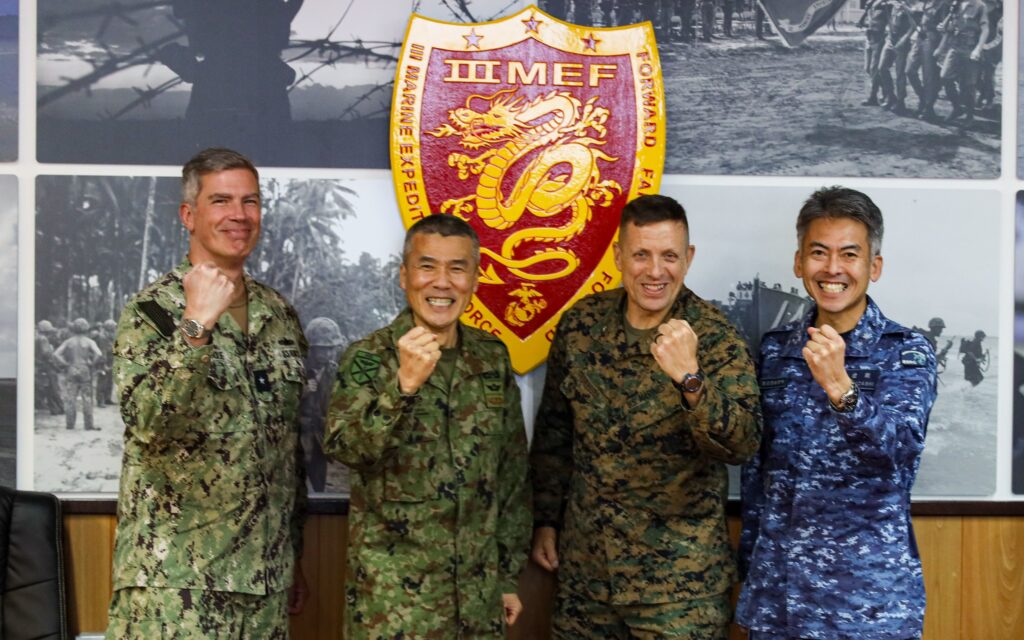
CAMP COURTNEY, Okinawa (Feb.16, 2023) U.S. Navy Rear Adm. Derek Trinque, commander Task Force 76/3, left, Japan Maritime Self-Defense Force Rear Admiral Motoyuki Kanezashi, commander, Amphibious and Mine Warfare Force, left-center, Japan Ground Self-Defense Force Maj. Gen. Shingo Nashinoki, commander, Amphibious Rapid Deployment Brigade, right-center, and U.S. Marine Brig. Gen. Fridrik Fridriksson, deputy commander TF 76/3, right, pose for a photo during Iron Fist 23 aboard Camp Courtney, Okinawa, Japan, Feb. 16, 2023. This visit took place during Exercise Iron Fist and provided an overview of TF 76/3, focusing on the command-and-control structure and command position, and how it improves the commander’s ability to control forces and command from ashore without the need to embark. Iron Fist is a U.S. Marine Corps Forces Pacific-directed, 31st Marine Expeditionary Unit-executed, bilateral training exercise between the U.S. Marine Corps and the Japan Ground Self-Defense Force and aims to improve staff planning, enhance core competencies in amphibious operations and interoperability, and maintain a positive military-to-military relationship between Japan and the United States. (U.S. Marine Corps photo by Staff Sgt. Andrew Ochoa)
*****
ARLINGTON, Va. — The U.S. Marine Corps is planning to establish integrated staffs with two U.S. Navy numbered fleets next year, according to the latest update to is Force Design 2030 concept.
The Corps plans to integrate a brigadier general in the headquarters staffs of U.S. Sixth Fleet and the U.S. Seventh Fleet.
“We need to formalize the process for establishing integrated Navy-Marine Corps staffs with numbered fleets while giving the MEF CGs [Marine Expeditionary Force commanding generals] the ability to adapt organizations to the specific needs of their partner numbered fleets,” said General David H. Berger in the latest Force Design 2030 document. “Whenever feasible, and in coordination with the efforts of the appropriate combatant commanders, these integrated staffs should also include key ally and partner representation to strengthen our integrated deterrence, offering a mature approach to campaigning.
“NLT 1 September 2024, Commander, Marine Corps Forces Pacific (COMMARFORPAC) and Commander, Marine Corps Forces Europe and Africa (COMMARFOREUR/ AF) will formalize the establishment of O-7 staffs within Sixth and Seventh Fleet headquarters.”
Lieutenant General Karsten S. Heckl, deputy commandant for Combat Development and Integration and commanding general, Marine Corps Combat Development Command, speaking June 2 to reporters in press conference, said the move would be in accordance with the commandant’s guidance to returning to a Fleet Marine Force.
“A big piece of that is getting the staffs right,” Heckl said. “We realize now more than ever that in this operating environment — now that we’re back to great power competition, without question — it is important that these staffs be properly, fully integrated, or we’re going to have problems.
“A mentor of mine told me 30 years ago that if you get the command and control of any problem figured out, you’ve got 90% of it solved, and that’s what we’re doing here” he said.
Brigadier General Kyle Ellison, commanding general of the Marine Corps Warfighting Lab, also speaking at the press conference, stressed that such a staff would be integrated to the point that it could have a Navy rear admiral in command with a Marine Corps brigadier general as deputy, or vice versa. He mentioned Task Force 79 — III Marine Expeditionary Force — and Task Force 76 — the 7th Fleet’s amphibious force — as a “completely integrated staff with an integrated maritime operations center right there on Camp Courtney [Okinawa].
“It’s critically important to recognize that it’s not just the O-7,” Ellison said. “It’s integrating the staffs so you have a truly naval staff to execute naval operations in support force. That is exciting in that typically happens only when you are task-organized and for a specific mission. Now we’re standing it up and experimenting with it as a permanent structure, and that’s happening as we speak as an 18-month experimentation that was agreed upon by two three-stars — commander of III MEF and the 7th Fleet commander.”