RIMPAC 2026 Commanders Conference Concludes in Australia
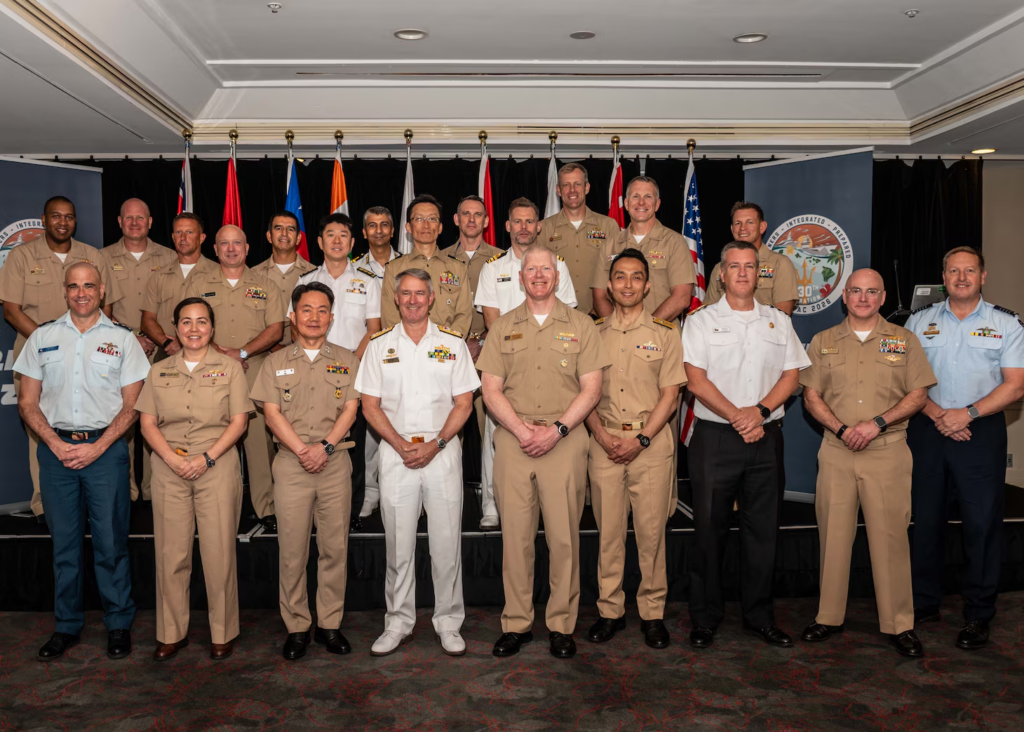
Exercise Rim of the Pacific (RIMPAC) 2026 senior leadership and staff pose for a group photo at the RIMPAC 2026 Commander’s Conference in Sydney, Mar. 17, 2026. (U.S. Navy photo by MC1 Class Sarah Eaton)
By Commander, U.S. Third Fleet, March 20, 2026
SYDNEY – Commander, U.S. 3rd Fleet concluded the Commanders Conference for Exercise Rim of the Pacific (RIMPAC) 2026, March 20, 2026, marking a key milestone in planning for the world’s largest international maritime exercise.
Senior leaders and planners, representing more than 30 allied and partner nations, gathered for the five-day conference to review major elements of the upcoming exercise and build on progress achieved during the Mid-Planning Conference held in December. The in-person engagement enabled participants to strengthen professional relationships and advance coordination ahead of integrated operations during RIMPAC 2026.
U.S. Navy Capt. Brian Jamison, RIMPAC 2026 exercise director, delivered opening remarks on the first day of the conference, formally commencing the event.
“This is a very important planning milestone for execution later this summer,” said Jamison. “This is our opportunity to come together in person, to work on some of the key deliverables, and get into the teamwork that it’s going to take to make this very successful.”
U.S. Navy Vice Adm. John Wade, commander, U.S. 3rd Fleet, welcomed attendees and emphasized the importance of multinational cooperation and shared commitment among participating nations.
“I want to make sure that everyone from the most senior to the most junior is thanked for your hard work that allowed us to come to beautiful Sydney, Australia, to align and synchronize with each other,” said Wade. “This exercise is an opportunity for the young men and women who have volunteered to serve to get better, to get stronger, to become more proficient and capable.”
Wade also underscored the conference’s role in ensuring RIMPAC builds successful international maritime partnerships built on trust and cooperation.
“This conference allows us to purposefully and methodically go through the plan and make sure that we’ve done our homework to ensure that we do this safely and professionally, obtain objectives strategically, operationally, and tactically, not only collectively as a team, but each of our nations and our services,” added Wade.
RIMPAC 2026 will mark the 30th iteration of the biennial exercise and will coincide with the United States’ 250th anniversary of the signing of the Declaration of Independence. The exercise is designed to bring allied and partner nations together to enhance interoperability, strengthen collective maritime security and reinforce enduring cooperation across the Indo-Pacific.
First conducted in 1971, RIMPAC was initially held annually before transitioning to a biennial schedule in 1974, due to its growing scale and scope. The founding participants were the United States, Australia and Canada.
U.S. Navy Opens New Expeditionary Maintenance Facility at Camp Mitchell, Rota Spain
Naval Station (NAVSTA) Rota Commanding Officer Capt. Charles Chmielak, second from left, and 22nd Naval Construction Regiment (22NCR) Commodore Capt. Allen Willey, second from right, join Sailors assigned to 22NCR and NAVSTA Rota Public Works Department to cut a ribbon during the opening of a new expeditionary maintenance facility at Camp Mitchell onboard NAVSTA Rota, Spain, March 23, 2026. (U.S. Navy photo by MCC Justin Stumberg)
From Chief Mass Communication Specialist Justin Stumberg, March 24, 2026
U.S. Navy leaders, Sailors, and civilian partners marked the completion of a new expeditionary maintenance facility (EMF) during a ribbon-cutting ceremony at Camp Mitchell aboard Naval Station (NAVSTA) Rota, Spain, March 23, 2026.
This project, led by NAVSTA Rota’s Resident Officer in Charge of Construction (ROICC) in coordination with the 22nd Naval Construction Regiment (NCR), delivers modern vehicle, boat, and equipment maintenance capabilities in direct support of Naval Mobile Construction Battalion and Underwater Construction Team assets operating across Europe and Africa.
“This facility is about readiness at the deckplate level,” said Capt. Allen Willey, 22NCR commodore. “By providing our Seabees and divers with a purpose-built maintenance space, we’re directly improving their ability to sustain equipment, respond faster, and remain mission-ready in support of fleet and combatant commander requirements.”
The $25.9 million military construction project was awarded in December 2021 and reached beneficial occupancy in December 2025. The facility replaces several aging, end-of-life buildings and consolidates maintenance and administrative functions into a single, modern structure designed specifically for expeditionary engineering forces.
“This was a complex, multi-year effort that required close coordination between installation leadership, engineers, and operational stakeholders,” said Lt. Cmdr. Joshua Owens, assigned to the NAVSTA Rota ROICC. “The end result is a facility that will support the mission and our Sailors for decades to come.”
The new EMF includes vehicle and boat maintenance bays, administrative spaces, and support areas tailored to the operational needs of forward-deployed Seabees and Navy divers. The project also involved demolition of obsolete facilities and renovations to nearby buildings to accommodate displaced operations.
“Today’s ceremony marks a direct investment in the people that comprise our fleet and win our nation’s wars,” said Naval Station Rota Commanding Officer Capt. Charles Chmielak, addressing the assembled NAVSTA Rota Public Works Seabees in attendance. “By delivering this facility, you are ensuring our expeditionary warfighters have the quality of service and operational support they need to remain the most lethal and globally dominant maritime force.”
Naval Station Rota’s strategic position at the gateway to the Mediterranean Sea makes it a critical hub for U.S. and NATO maritime operations. Infrastructure investments such as the Expeditionary Maintenance Facility enhance the installation’s ability to support maritime security, logistics, and power projection in support of U.S. Naval Forces Europe-Africa and U.S. 6th Fleet.
22NCR commands naval construction forces for Navy Expeditionary Forces Europe-Africa/Task Force 68 across the U.S. 6th Fleet area of operations to defend U.S., Allied, and partner interests.
PMA-226 Strengthens Alliance by Returning Historic Helicopter to Service
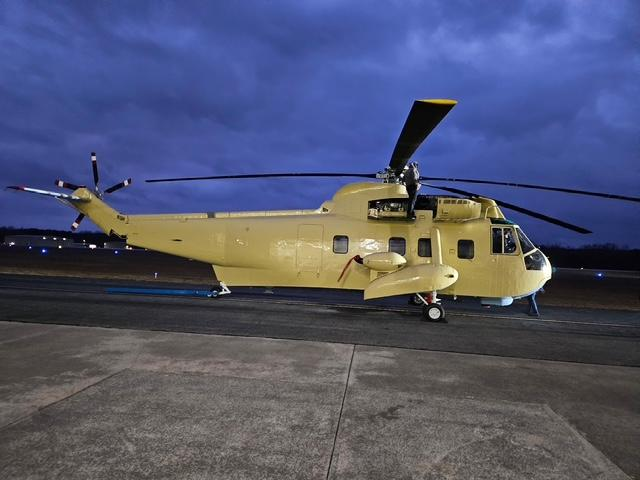
An iconic VH-3A Sea King returns to the skies after a modernization by Adversary and Specialized Aircraft Program Office (PMA-226) and industry partners. Now, this historic aircraft is ready to continue its service with the Egyptian Air Force, strengthening a decades-long alliance.
From Naval Air systems Command, March 23, 2026
NAS Patuxent River, Md. — In a powerful demonstration of its commitment to international partners, the Adversary and Specialized Aircraft Program Office (PMA-226) has successfully returned a historically significant VH-3A Sea King to the skies for the Egyptian Air Force. The project, completed in February, modernizes a key aviation asset and reinforces a strategic partnership built on decades of cooperation.
The effort, managed by the PMA-226 H-3 Integrated Product Team in partnership with NAVAIR’s Security Cooperation Office and industry partner Clayton International, successfully merged a legacy airframe with modern technology.
“This milestone is a testament to the teamwork and dedication of our program office, contracting teams, and industry partners,” said Capt. Jason Pettitt, PMA-226 program manager. “Together, we’ve delivered a modernized aircraft that strengthens our partnership with the Egyptian Air Force and highlights the value of collaboration with our allies.”
The aircraft itself, BuNo 150615, has a rich history. It was originally delivered to the U.S. Marine Corps to support presidential missions for John F. Kennedy, Lyndon B. Johnson, and Richard Nixon. Its role pivoted from executive transport to diplomatic symbol during Nixon’s 1974 visit to Egypt, when he gifted the helicopter to Egyptian President Anwar Sadat as a gesture of goodwill.
The recent refurbishment included installing a revitalized electrical backbone and a modern “glass panel” avionics suite, alongside upgraded communication and navigation systems. On Feb. 2, the Egyptian Air Force conducted an Acceptance Check Flight, validating the aircraft’s renewed performance.
“The Egyptian Air Force’s active involvement and commitment to quality were key to the success of this program,” Pettitt added.
Following the final installation of a custom VIP interior, the aircraft will be prepared for transport back to Egypt, where it will resume service as a flying symbol of an enduring partnership.
U.S. 4th Fleet Announces Southern Seas 2026 Deployment
From U.S. Naval Forces Southern Command/U.S. Fourth Fleet Public Affairs, March 23, 2026
Nimitz-class aircraft carrier USS Nimitz (CVN 68) will deploy to the U.S. Southern Command area of responsibility as part of U.S. Naval Forces Southern Command/U.S. 4th Fleet’s Southern Seas 2026 deployment.
Nimitz and Arleigh Burke-class guided-missile destroyer USS Gridley (DDG 101) are scheduled to conduct passing exercises and operations at sea with partner nation maritime forces as the ships circumnavigate the continent of South America. Southern Seas 2026 will feature subject matter expert exchanges and provide the opportunity for distinguished visitors from partner nations to see aircraft carrier operations up close. Engagements are planned with Argentina, Brazil, Chile, Colombia, Ecuador, Peru, Mexico, El Salvador, Guatemala, and Uruguay, with port visits planned for Brazil, Chile, Panama, and Jamaica.
”The Southern Seas 2026 deployment provides a unique opportunity to enhance interoperability and increase proficiency with our partner-nation forces across the maritime domain,” said Rear Adm. Carlos Sardiello, commander, U.S. Naval Forces Southern Command/U.S. 4th Fleet. “Deployments like this demonstrate our unwavering commitment to ensuring a secure and stable Western Hemisphere. This mission is a shining example of our dedication to strengthening maritime partnerships, building trust, and working together to counter shared threats.”
“We look forward to continuing the Nimitz legacy of teamwork as we engage with and train alongside our regional partners,” said Rear Adm. Cassidy Norman, commander, Carrier Strike Group 11.
Southern Seas 2026 marks the 11th iteration of the exercise to the region since 2007. Like the previous deployments, Southern Seas 2026 will foster goodwill, strengthen maritime partnerships, counter threats, and build our team.
Nimitz-class aircraft carriers are the pinnacle of mobile projection of naval air power and forward operational presence. No other weapons system has the responsiveness, endurance, multi-dimensional might, inherent battlespace awareness, or command and control capabilities of a carrier strike group and embarked air wing.
The Nimitz Carrier Strike Group consists of Nimitz, its flagship; embarked staff of Carrier Strike Group 11; DESRON 9; embarked Carrier Air Wing (CVW) 17; and Gridley. CVW 17 consists of six squadrons flying F/A-18E/F Super Hornets, EA-18G Growlers, C-2A Greyhounds, and MH-60R/S Sea Hawks.
These squadrons include Helicopter Maritime Squadron (HSM) 73, Helicopter Sea Combat Squadron (HSC) 6, Fleet Logistics Support Squadron (VRC) 40, Strike Fighter Squadron (VFA) 22, VFA-137, and Electronic Attack Squadron (VAQ) 139.
USNAVSOUTH/FOURTHFLT is the trusted maritime partner for Caribbean, Central and South America maritime forces improving regional unity and security.
USS Mustin Returns to Forward-Deployed Naval Forces in Yokosuka
From Chief Mass Communication Specialist Taylor DiMartino, Commander, Destroyer Squadron 15 Public Affairs, March 23, 2026
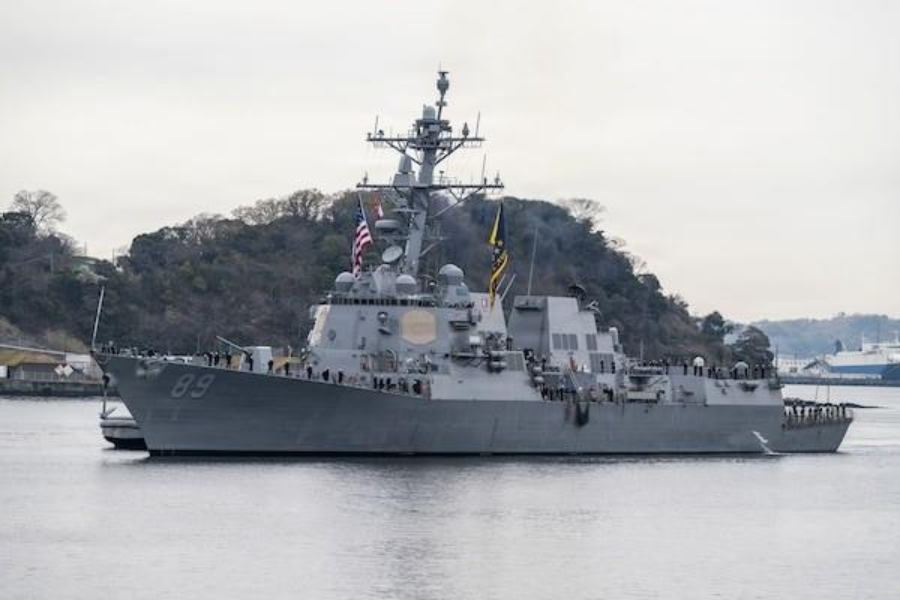
Arleigh Burke-class guided-missile destroyer USS Mustin (DDG 89) arrived at Commander, Fleet Activities Yokosuka (CFAY) March 23, 2026, marking its return to U.S. 7th Fleet after nearly five years in San Diego. The ship was previously forward-deployed to Yokosuka from 2006 to 2021.
Mustin recently completed a major modernization period while in the U.S., enhancing its combat capabilities and ensuring it, and its crew, are ready to meet the dynamic challenges of the region.
“Mustin Nation is proud to return to Japan,” said Mustin commanding officer, Cmdr. Christina Appleman. “Our arrival has a special meaning for our Sailors and their families. We are rejoining a phenomenal team here in the 7th Fleet, and are eager to work alongside our allies and partners in the region. We bring with us the spirit of our ship’s motto, ‘Always Be Bold,’ and are ready to ensure security and stability in the Indo-Pacific.”
Capt. David Huljack, commanding officer of Destroyer Squadron (DESRON) 15, welcomed Mustin’s return, highlighting its importance to the squadron’s mission.
“Welcoming USS Mustin back to the DESRON 15 family is a significant moment for us,” said Huljack. “This ship and its crew bring a renewed strength and vital capability to our surface force.Their return to the tip of the spear is a clear demonstration of our commitment to maritime security and stability in the Indo-Pacific.”
Commissioned July 26, 2003, Mustin is a multi-mission platform capable of conducting a wide range of operations, from maritime security and anti-submarine warfare to ballistic missile defense. The destroyer is named for the Mustin family, which has a long and distinguished history of service in the U.S. Navy.
The ship’s return to Yokosuka is a testament to the U.S. Navy’s enduring commitment to the security and stability of the Indo-Pacific region.
Commander, Fleet Activities Yokosuka provides critical support to U.S. 7th Fleet, the largest of the U.S. Navy’s forward-deployed fleets. CFAY’s strategic location and extensive facilities are vital for maintaining readiness and supporting maritime operations throughout the Western Pacific.
Mustin is forward-deployed and assigned to DESRON 15, the Navy’s largest DESRON and the U.S. 7th Fleet’s principal surface force.
U.S. 7th Fleet, the U.S. Navy’s largest forward-deployed numbered fleet, routinely interacts and operates with allies and partners in preserving a free and open Indo-Pacific.
Advanced Shipbuilding ‘Factory of the Future’ Opens in Alabama
Facility will help accelerate submarine production
From the Navy Office of Information, March 20, 2026
Funded in part by Navy investments provided in the One Big Beautiful Bill Act (OBBBA), the advanced manufacturing company Hadrian officially opened a new facility in Cherokee, Alabama March 20th that will boost production of U.S. Navy nuclear submarines.
The 2.2 million square foot site will host a highly-automated “factory of the future,” known as F4, which will mass produce components for Virginia-class attack submarines and Columbia-class ballistic missile submarines. The Navy’s $900 million investment of OBBBA funds combine with $1.5 billion in private capital for a total investment of more than $2.4 billion. According to Hadrian, up to 1,000 high-paying manufacturing jobs are being created in the venture.
“Both chambers of Congress delivered the generational investment required to rebuild our shipbuilding capacity, bring those jobs back to Alabama and put American skilled laborers back at the center of American strength,” said Secretary of the Navy John C. Phelan. “I look forward to building on this progress together in the months ahead, because we are just getting started. This factory is the first of three facilities designed to address the most critical bottlenecks in the maritime industrial base.”
Using advanced manufacturing techniques, workers at the new factory will be able to mass produce components that are needed to build Virginia-class and Columbia-class submarines. A dedicated production plant focused on these components frees up submarine shipyards in Rhode Island, Connecticut and Virginia to focus more resources on submarine module production, increasing capacity in the submarine industrial base.
“We call this distributed shipbuilding, and it’s a key tenet of our plan to achieve required shipbuilding production rates,” said Mr. Jason Potter, Performing the Duties of Assistant Secretary of the Navy for Research, Development & Acquisition (ASN RDA). “These factories of the future might be several states away from the yards where the ships are ultimately built, but by taking on this work they reduce bottlenecks, having a profound effect on the speed of delivery.”
The Factory 4 project is estimated to take 18-24 months from initiation to full-rate production, including stand-up of automated production facilities, qualification of components, compliance qualifications like submarine safety program (SUBSAFE), and low-rate initial production. By the third year, the facilities will operate sustainably through delivery of submarine product lines.
Congressman Aderholt Joined U.S. Navy Secretary and Alabama Delegation: Ribbon Cutting on $2.4 Billion Submarine Factory in Cherokee
From the Office of Congressman Robert Aderholt, March 23, 2026
CHEROKEE, Ala. – On Friday, Congressman Robert Aderholt (AL-04) spoke alongside local and national leaders at a landmark ribbon-cutting ceremony for a new $2.4 billion public-private defense industrial facility in Cherokee, Alabama.
The facility in Barton Riverfront Industrial Park is part of a broader public-private effort to strengthen the U.S. maritime industrial base, representing more than $2 billion in combined investment and up to 1,000 new manufacturing jobs for the area.
“It was a privilege to help open an event that has been years in the making, an effort that many worked toward and believed in. This 2.2 million square foot facility will now be a symbol of U.S. defense, anchoring shipbuilding and maritime production in Northwest Alabama. Proving that maritime dominance is not just a coastal priority.
This project didn’t happen by accident. It happened because people believed in this community, and because we made a deliberate effort to bring opportunities back to places that had been overlooked.
This facility is only part of a much larger opportunity, and I intend to keep working until that full potential is realized. Because that’s what this community has always done. America needs sea power more than ever, and Alabama is up to the challenge. We will build a 21st century collaborative campus here that no conventional shipyard or industrial park can rival.
With the leadership of President Trump and Republican majorities in Congress, we passed the One Big Beautiful Bill, legislation focused on restoring American strength. And I worked to ensure that communities like ours were part of that vision. Alongside my colleagues in the Alabama delegation, we helped turn that vision into reality right here at home.
By investing in workforce training and building the right partnerships, we made sure Alabama’s Fourth Congressional District would be ready when opportunity came and ready to compete for the kind of jobs that strengthen both our economy and our national security. And Friday, we saw that work pay off.
This facility will help bring thousands of manufacturing jobs and new opportunities to Northwest Alabama. But just as importantly, it will help restore America’s ability to produce the tools necessary to defend freedom and maintain strength at sea.
I want to thank Secretary of the NavyJohn C. Phelan, Senator Tuberville, Senator Britt, Senator Wicker, and Armed Services Chairman Mike Rogers. We all worked diligently in the crafting of the One Big Beautiful Bill to make this happen today. But government alone doesn’t build something like this. Thank you to AE Industrial Partners and AE Shoals, Hadrian, Retirement Systems of Alabama, and the Shoals Economic Development Authority for believing in this vision and making a generational investment.
This is just the beginning of a stronger region, a stronger workforce, and a stronger United States of America.”
ThayerMahan Launches SeaGuard, a UUV Defeat System to Defend Ports and Infrastructure
From ThayerMahan
GROTON, Conn., March 19, 2026 /PRNewswire/ — ThayerMahan, a leader in unmanned maritime security and acoustic intelligence solutions, today announced the official launch of SeaGuard™, the company’s operationally validated, non-kinetic defeat system built to protect high-value maritime assets and infrastructure from the rapidly growing spectrum of Uncrewed Underwater Vehicle (UUV) threats.
SeaGuard enters the market as the first fully mature, fieldtested, scalable system of its kind, engineered to disrupt and defeat underwater threats without explosives or harmful emissions, addressing urgent security requirements for defense and commercial operators worldwide.
“From my time in uniform to my role today, one truth has remained constant: the underwater domain evolves rapidly, and the threats evolve even faster,” said Vice Admiral Mike Connor, U.S. Navy (Ret.), Chairman & CEO of ThayerMahan. “SeaGuard is purpose-built to help operators stay ahead of that curve. It represents a leap forward in how we protect vital maritime assets from unmanned undersea threats – reliably, safely, and at scale.”
Recent global incidents have shown the critical asymmetric threat presented by UUVs, with lowcost, commercially accessible or locally developed systems able to penetrate defended harbors, approach highvalue assets, and target critical infrastructure, to significant demonstrated effect. As maritime security environments become increasingly congested and contested, traditional detection-only solutions are no longer sufficient to counter the expanding threat profile. SeaGuard provides a missioncritical protection layer for military facilities, deepwater ports, port complexes, LNG terminals, cable landing stations, and other vulnerable subsea locations.
“As the threat landscape shifts from theoretical to unmistakably real, SeaGuard gives government and commercial operators a proven, non-kinetic shield for the critical infrastructure our economy and national security rely on,” said Dr. Kevin Lopes, CAPT USCG (Ret.), Vice President of Marketing & Sales at ThayerMahan. “This isn’t just a solution for naval bases – it’s a mission-ready system for commercial ports and strategic assets worldwide. SeaGuard’s operationally validated performance means operators no longer need to rely on detection alone or accept unnecessary risk. They now have a field-tested, scalable capability they can deploy quickly, sustain easily, and trust completely to protect what matters most.”
SeaGuard’s operational performance has been proven across multiple evaluated exercises, where it demonstrated the ability to disrupt and defeat UUVs, deter diver and swimmer intrusion, and shield high-value assets from tampering or sabotage. These demonstrations also confirmed its endurance, maintainability, and mission-ready architecture.
“SeaGuard is the culmination of the ThayerMahan team’s incredible effort and ingenuity,” said Andy Meecham, Chief Technology Officer at ThayerMahan. “In trials, SeaGuard consistently produced repeatable, measurable defeat effects across a wide range of conditions, validated through multienvironment testing, independent technical assessment, and sustained endurance runs. It is the only system of its kind ready to deploy today, demonstrating Technology Readiness Level 8+ performance, and we built it from the start to integrate with other port monitoring and protection systems.”
SeaGuard was designed to be modular, scalable, and rapidly deployable. Depending on operational requirements, it can be installed in expeditionary or permanent configurations. The system is safe for the environment and marine life and can be tailored to any Navy, port authority, or infrastructure operator’s security needs.
“SeaGuard deploys where and how you need it, and our team ensures that happens fast,” said Christian Glander, President ThayerMahan Offshore and CAPT USCG (Ret.). “Years of large-scale operations have prepared us to rapidly install SeaGuard across a diverse range of locations. Port security and homeland defense depend on timely, effective underwater protection, and we are ready now to support both missions.”
About SeaGuard™ ThayerMahan’s SeaGuard is an operationally validated non-kinetic UUV denial and delay system. A scalable, modular security solution, SeaGuard delivers unmatched underwater threat mitigation for military and commercial port facilities, moored strategic assets, and critical infrastructure. When paired with advanced sensors such as ThayerMahan’s TransparenSea®, SeaPicket®, and Outpost® acoustic intelligence solutions, SeaGuard™ provides a detect-to-defeat chain.
About ThayerMahan’s Acoustic Intelligence Solutions ThayerMahan is the premiere provider of end-to-end unmanned acoustic intelligence solutions. TransparenSea® software, technology, and analysis drive ThayerMahan’s superior acoustic awareness, with edge processing, digital signal processing, and API integrations to watch floors and C2 systems. Outpost® and SeaPicket® deliver fixed and mobile undersea domain awareness from scalable, fully mature, productized platforms.
Maritime Theater Missile Defense Forum Advances Interoperability, Relevance at Critical Time
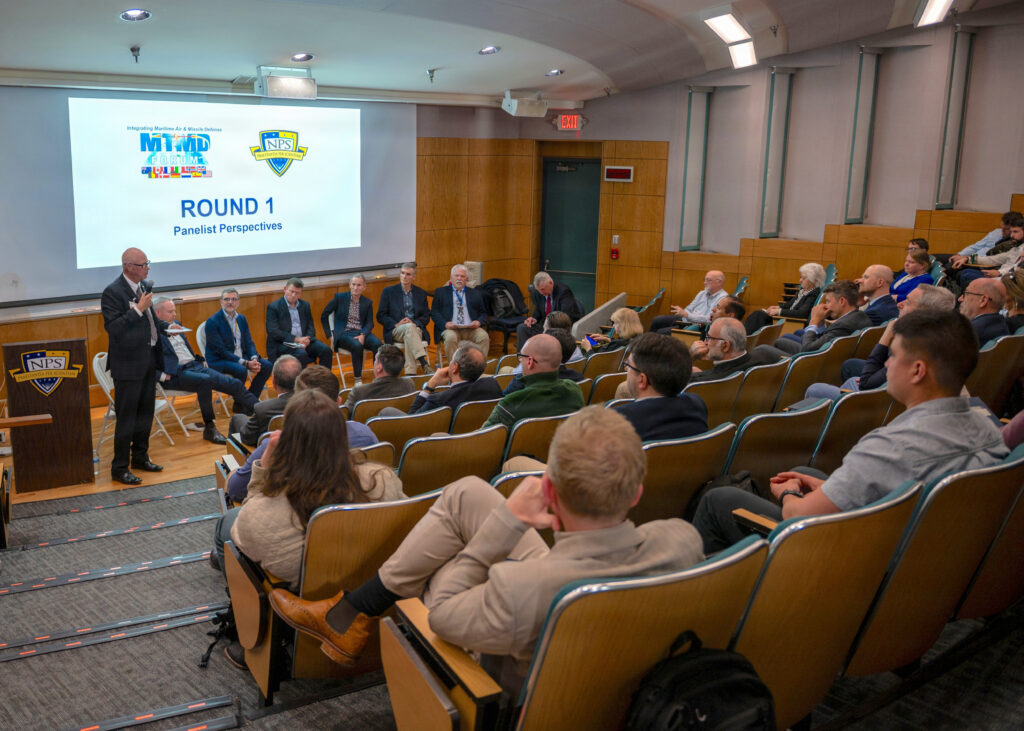
Experts across varied aspects of integrated air and missile defense engage in a panel discussion during the Maritime Theater Missile Defense Forum (MTMD-F) at the Naval Postgraduate School (NPS), March 4, 2026. The MTMD-F returned to NPS for a series of engineering and program management meetings essential to advancing their critical mission. (U.S. Navy photo by Mass Communication Specialist Seaman Apprentice Zadi Watkins)
From Naval Postgraduate School Public Affairs, March 19, 2026
Effective integrated air and missile defense (IAMD) requires an unparalleled level of international cooperation and interoperability, concepts on full display in current operations. The system of systems necessary to be effective, however, requires much more than just collaborative coalition operations.
Effective IAMD also takes a persistent collaborative effort of interdisciplinary research and development with many partners, and exhaustive analyses across a broad swath of highly technical disciplines. It also demands the agility to work through stovepipes and unforeseen challenges, in addition to anticipating strategic futures.
Meeting this challenge is the Maritime Theater Missile Defense Forum (MTMD-F), an international cooperative of 12 allied nations’ navies charged with achieving interoperability in all aspects of maritime theater air and missile defense. Building upon previous meetings in Monterey in 2006, 2013, 2017 and 2020, the forum and its team of engineers, technicians and National Points of Contact returned to Naval Postgraduate School (NPS) campus in February and March 2026 for a series of engineering and program management meetings essential to advancing their critical mission.
The importance of that mission, and its relevance to Chief of Naval Operations Adm. Daryl Caudle’s recently released Fighting Instructions, is why NPS placed a high priority on supporting the multi-week forum of both classified and unclassified program management and technical interchanges, said NPS president retired U.S. Navy Vice Adm. Ann Rondeau.
“The conversations you will have this week — about integrated air and missile defense, sensor fusion, battle management, hypersonic threats, and coalition interoperability — are no longer just about future force design concepts. They reflect present operational reality,” Rondeau said in welcoming the MTMD-F to campus.
“IAMD capability development must begin years before the commencement of operations,” added retired U.S. Navy Capt. John Hammerer, IAMD warfare chair at NPS. “Essential developmental efforts spanning the disciplines of systems engineering, modeling and simulation, acquisition, interoperability testing, and operational testing begin years before real world operations.”
NPS, and the technical leaders the institution graduates, are critical to this development, Hammerer says.
“Take U.S. Navy efforts to use directed energy for terminal defense, highlighted in the CNO’s Fighting Instructions,” he continued. “NPS graduate Cmdr. Brian Curran, a Meyer Scholar who earned his PhD in laser physics, is now using that acquired expertise to lead [Program Executive Office Integrated Warfare Systems] (PEO IWS) to accelerate fielding of shipboard lasers.”
The MTMD-F keeps essential development on track across multiple technical teams and lines of effort. Leading each navy’s efforts is the MTMD-F’s National Point of Contact (NPOC) forum. Belgian Navy Capt. Philippe De Cock, the current NPOC chair, says the forum’s focus on innovation, analysis and expertise in maritime IAMD — qualities shared at NPS — are critical enablers to its mission.
“The forum was born from a shared appreciation that only a small, agile partnership of nations with subject matter expertise could move quickly enough to anticipate trends and solve the critical problems of maritime missile defense interoperability facing allied nations,” De Cock said. “The concentration of subject matter expertise for data analysis and maritime IAMD operations makes the forum-NPS partnership mutually beneficial.”
“NPS is an ideal venue for forum collaboration,” echoed U.S. Navy Capt. John Mastriani, U.S. NPOC. “The combination of secure facilities, adaptive layout and combat systems engineering expertise make this a highly productive place for the forum’s technical projects, working groups and leadership to meet.”
Current NPS students and faculty were able to engage with MTMD-F representatives, gaining a deeper perspective on the technical, procedural and operational challenges that enable interoperability in maritime missile defense. NPS’ popular Meyer Scholar program, initiated by Hammerer, prepares officers to contribute to this essential capability by advancing their technical understanding of naval combat systems, from concept to employment.
“Meyer Scholars take on this work in addition to their normal coursework,” Rondeau said. The program combines NPS’ rigorous graduate education with a focused combat systems curriculum, operationally relevant seminars, industry visits and research tied to real-world warfare system challenges.
“Meyer Scholars are trained to lead interoperability rather than chase it, by understanding the technical, tactical, and programmatic dimensions of integrated air and missile defense, and to translate emerging technologies into fleet-ready capabilities,” she said.
Looking ahead, student and faculty participation in MTMD-F discussions identified potential pathways for further NPS contributions to IAMD interoperability and collaboration. The forum highlighted promising opportunities for IAMD-related research at NPS in areas such as:
Support for the post-mission analysis of combat systems performance following At Sea Demonstration/Formidable Shield (ASD/FS), Pacific Dragon (PD), and Hardware in the Loop (HWIL) test events.
The Ballistic Missile Defense Integration (BMDi) Project, which accelerates the development of BMD support, sensor and weapon capabilities.
The Interoperability and Common Tactical Picture (IaCTP) Project, which promotes the development of a common operating picture across an international task group by analyzing and promoting standardization in datalink systems implementation.
The Force Level Operational Architecture Technical Standard (FLOATS) Project, a platform-agnostic standard for combat-systems data exchange.
The Force Threat Evaluation and Effects Coordination (FTE2C) Project, an effort to develop and compare decision support systems and coordinate kinetic and non-kinetic effects across the Coalition Task Group.
As Rondeau stressed to the group, the importance of these developments could not be a more evident call to action.
“The missile defense mission is active, consequential, and demanding of your excellence in both technology and leadership,” she said. “That reality sharpens the purpose of this essential forum and follow-on actions for national security and homeland defense.”
Saronic Announces New Downtown New Orleans Office to Accelerate Autonomous Shipbuilding
From Saronic, March 18, 2026
Saronic today announced it is opening a nearly 15,000 square foot office in downtown New Orleans. The new space will serve as a key engineering and technical hub to support the company’s expanding shipbuilding operations in Louisiana. By establishing a strong presence in the city, Saronic is deepening its roots in one of the nation’s most historic and capable maritime regions – one with a strong, highly skilled maritime workforce.
The new office will house hardware engineers, naval architects, marine engineers, and experts in system testing to support the design and development of Marauder, Saronic’s 180-foot autonomous ship. These vessels are produced at scale at the company’s shipyard in Franklin, Louisiana, which is undergoing a substantial expansion to further strengthen the state’s role in helping drive next-generation maritime manufacturing. The office will provide vital technical connectivity across Saronic’s Louisiana operations, linking advanced engineering and design functions with production and manufacturing capabilities in Franklin.
The company expects to hire more than 350 skilled workers across its operations in Louisiana this year. To help build a strong talent pipeline, Saronic is partnering with universities and technical institutions, offering internships and early-career opportunities for students pursuing jobs in engineering, naval architecture, and other marine disciplines. The company is also working with Louisiana Economic Development to build and integrate training programs into the workforce development process across the region.
“Louisiana has been at the center of American shipbuilding for generations, and New Orleans gives us direct access to the people and technical skills that make that possible,” said Dino Mavrookas, Co-Founder and CEO of Saronic. “This facility builds on our growing investment in the state and strengthens the connection between our teams and Gulf Coast operations, allowing us to move faster as we field and deploy autonomous surface vessels and ships for both defense and commercial partners.”
“This is a strong win for New Orleans and for our growing maritime and engineering economy. Saronic’s decision to open their facilities in downtown New Orleans shows that companies see our city as a place where innovation, maritime expertise, and world-class talent come together,” said Deputy Mayor Jenny Mains. “This investment brings high-quality technical and engineering opportunities for our workforce and aligns with Mayor Helena Moreno’s 100-day plan to attract the next generation of industries and jobs to our city.”
Hiring for Key Roles in Louisiana
Across all of Saronic’s operations, the company is united by a culture of ownership, accountability, and mission-driven innovation. Full-time employees share in the company’s success through equity participation and receive a comprehensive benefits package designed to support both personal and professional growth. Team members are offered comprehensive health coverage, a 401(k) plan with company matching, generous paid time off and holidays, and fully paid parental leave. Saronic also provides supplemental benefits that support family building, overall wellness, and long-term financial security.
Master Boat Builders Signs Contract with Austal USA to Fabricate Modules for T-ATS Program
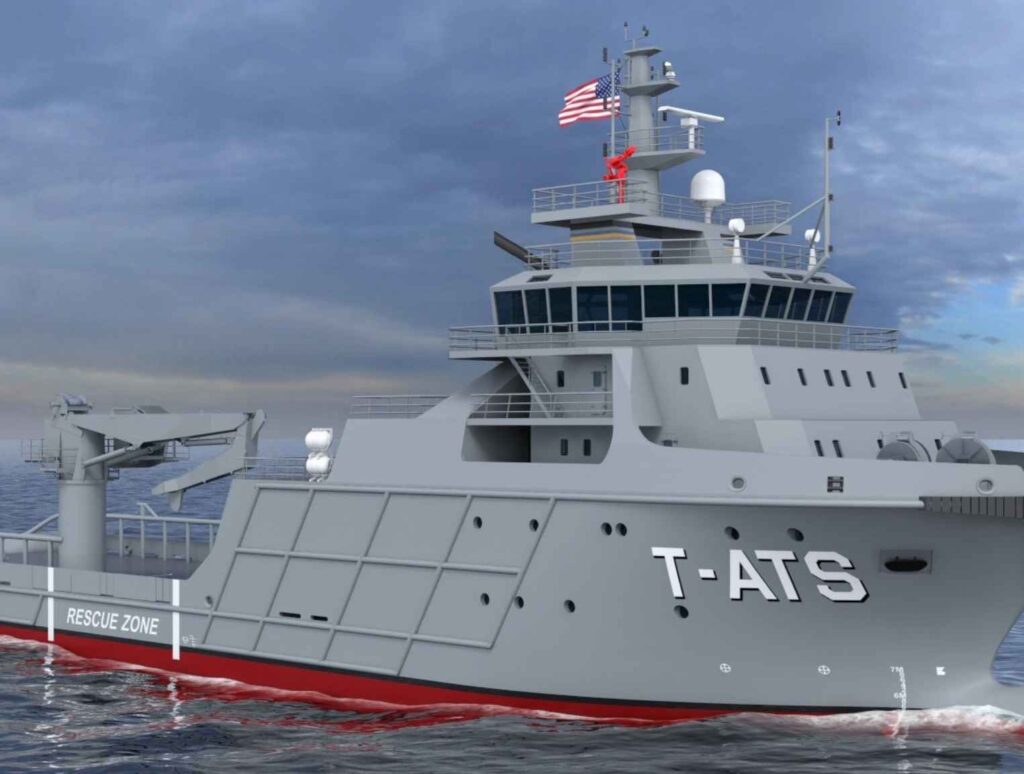
Photo from Master Boat Builders
Agreement marks the first formal production contract under the companies’ strategic outsourcing partnership
From Master Boat Builders Inc.
CODEN, Ala. - Master Boat Builders, Inc. (“Master Boat”) announced it has signed a contract with Austal USA to fabricate modules for the U.S. Navy’s Navajo-class Towing, Salvage, and Rescue Ship (T-ATS) program. The contract establishes Master Boat as a key subcontractor contributing to the construction and delivery of critical vessels that enhance the Navy’s and the Trump Administration’s push to diversify and strengthen the domestic shipbuilding industrial base through distributed production.
The partnership between the two Alabama-based shipyards reflects a significant milestone for Master Boat as it expands its participation in government defense shipbuilding programs. Under the agreement, Master Boat will provide specialized shipbuilding support and fabrication services that will contribute to the construction of advanced naval vessels designed to perform a range of missions including open-ocean towing, salvage operations, humanitarian assistance, and environmental response.
“This contract is a direct result of the partnership we built with Austal USA last year, and it validates what we’ve been saying all along – regional shipyards like ours can take on complex defense work and deliver,” said Garrett Rice, President of Master Boat Builders. “We’re not competing with the major yards. We’re adding capacity that the Navy needs right now. Our proximity to Austal USA, our experienced workforce, and our new investment in dedicated defense infrastructure all position us to support this program and others that follow.”
Under the contract, Master Boat will fabricate two T-ATS hull modules at its Coden, Alabama, shipyard, located approximately 30 minutes from Austal USA’s Mobile facility. The modules will be constructed to Austal USA’s production design and specifications, and through the collaboration, Master Boat will gain valuable experience working within U.S. Navy technical standards and production requirements of large-scale programs. The partnership also supports workforce development and strengthens regional shipbuilding capacity along the Gulf Coast. Upon completion, the modules will be transported to Austal USA’s Mobile shipyard for final erection and outfitting.
“Master Boat has proven itself as a capable and reliable partner, and this contract is a natural next step in our collaboration,” said Gene Miller, Interim President of Austal USA. “By distributing module fabrication to a qualified yard right here on the Gulf Coast, we’re expanding throughput, reducing schedule risk, and strengthening the industrial base that supports our warfighters. This is the model the Navy has asked the industry to pursue, and we’re delivering on it.”
The contract follows Master Boat’s announcement to construct a new $60 million, 150,000-square-foot manufacturing facility dedicated exclusively to government and defense shipbuilding programs. Located directly across Bayou Coden from the company’s existing yard, the 20-acre site will feature a state-of-the-art assembly building optimized for serial production of steel and aluminum ships and modules for Navy and Coast Guard programs. Prior to the new facility’s completion, T-ATS module fabrication will take place at Master Boat’s existing facility. Master Boat currently employs more than 400 people at its Coden shipyard and expects the new defense facility to support approximately 200 additional jobs upon completion. The companies also continue to co-invest in workforce development initiatives to train and equip the next generation of Gulf Coast shipbuilders.
The T-ATS program is designed to replace aging fleet ocean tugs and rescue and salvage ships with a modern, multi-mission platform capable of towing disabled vessels, conducting salvage and recovery operations, supporting diving missions, and assisting with humanitarian and disaster response. Austal USA has already launched the first two 263-foot ships in the program, demonstrating continued progress in delivering these important capabilities to the Navy. Master Boat’s role in the program contributes to the broader maritime industrial base that supports naval shipbuilding across the United States. The collaboration between regional shipyards and suppliers strengthens domestic manufacturing capacity and ensures the timely delivery of mission-critical vessels to the fleet.