Secretary of Defense Lloyd J. Austin III announced today that the president has made the following nominations:
Navy Rear Adm. Daniel L. Cheever for appointment to the grade of vice admiral, and assignment as commander, Naval Air Forces; and commander, Naval Air Force, U.S. Pacific Fleet, San Diego, California. Cheever is currently serving as chief of staff, North American Aerospace Defense Command and U.S. Northern Command, Colorado Springs, Colorado.
Navy Rear Adm. James P. Downey for appointment to the grade of vice admiral, and assignment as commander, Naval Sea Systems Command, Washington, D.C. Downey is currently serving as program executive officer for Aircraft Carriers, Washington, D.C.
Navy Vice Adm. Daniel W. Dwyer for reappointment to the grade of vice admiral, and assignment as deputy chief of naval operations for Warfighting Development, N7, Office of the Chief of Naval Operations, Washington, D.C. Dwyer is currently serving as commander, Second Fleet; and commander, Joint Forces Command Norfolk, Norfolk, Virginia.
U.S., Egypt Enhance Maritime Partnership with Patrol Craft Transfer
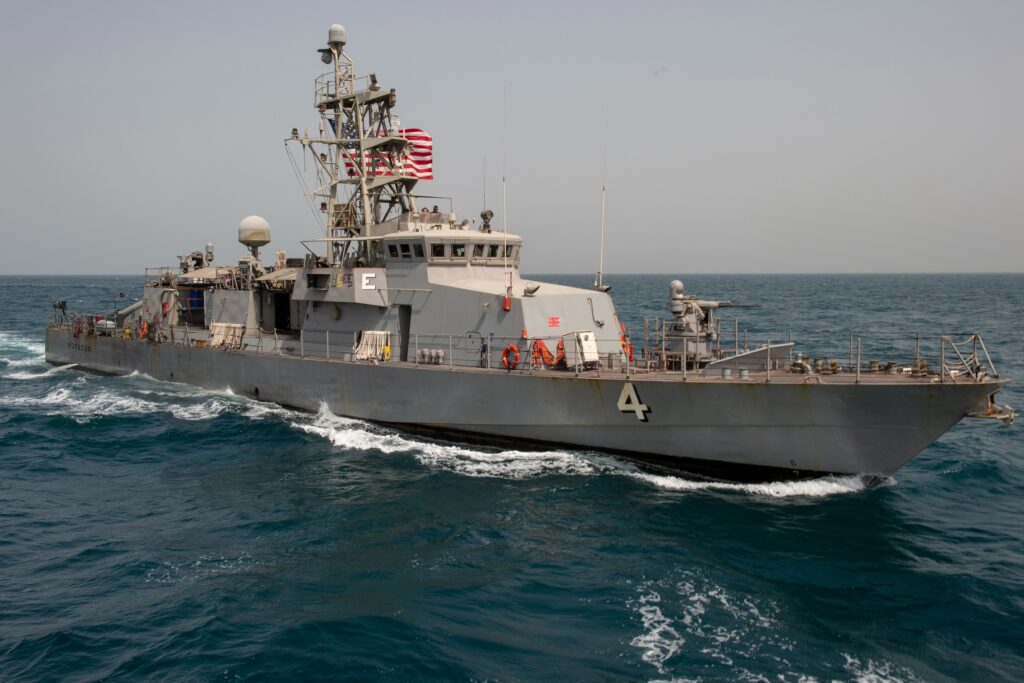
ARABIAN GULF (March 9, 2020) The coastal patrol ship USS Monsoon (PC 4) transits the Arabian Gulf after completing a joint underway with Mark VI patrol boats attached to Commander, Task Force 56 March 9. This event highlights one of many core competencies that the Coastal Riverine Force provides in support of U.S. 5th Fleet operations. CTF 56 is responsible for the planning and execution of expeditionary missions including coastal riverine operations in the U.S. 5th Fleet area of operations. (U.S. Navy photo by Mass Communication Specialist 1st Class Kory Alsberry)
From U.S. Naval Forces Central Command Public Affairs
MANAMA, Bahrain – U.S. Naval Forces Central Command (NAVCENT) transferred three patrol craft to the Egyptian Navy, March 21, during a formal ceremony in Alexandria, Egypt.
The transfer ceremony represents the culmination of weeks of preparation, training and professional exchanges between Egyptian and U.S. Navy Sailors. The U.S. Navy turned over former patrol coastal ships USS Hurricane (PC 3), USS Sirocco (PC 6), and USS Thunderbolt (PC 12) after sailing from Bahrain to Egypt during a month-long journey around the Arabian Peninsula, January through February.
“The Egypt-U.S. maritime partnership has been a fundamental pillar of our bilateral defense cooperation for decades,” said Vice Adm. Brad Cooper, commander of NAVCENT, U.S. 5th Fleet and Combined Maritime Forces. “This transfer is yet another major milestone in our strong relationship that will enhance regional maritime security for years to come.”
During the 4,000-mile transit to Alexandria, U.S. and Egyptian crewmembers worked side-by-side safely navigating the three ships on a voyage that included port visits to Jebel Ali in the United Arab Emirates; Duqm, Oman; Djibouti; and Berenice, Egypt.
U.S. and Egyptian service members continued training after the ships arrived in Alexandria, Feb. 12. Classroom lessons included discussions on engineering, search and rescue, damage control and weapons handling.
“This transfer process was an incredible opportunity for our crews. It enabled us to strengthen our bilateral ties while enhancing our interoperability with a highly capable regional maritime partner,” said Capt. Anthony Webber, commander of Task Force 55, which oversees operations for U.S. 5th Fleet’s surface forces.
The Egyptian Navy currently commands Combined Task Force 153, one of four multinational task forces organized under U.S.-led Combined Maritime Forces (CMF). The task force coordinates multinational maritime security efforts in the Red Sea, Bab al-Mandeb and Gulf of Aden.
NAVCENT and CMF are headquartered in Manama, Bahrain. They include maritime forces operating in the Arabian Gulf, Gulf of Oman, Red Sea, parts of the Indian Ocean and three critical choke points at the Strait of Hormuz, Suez Canal and Bab al-Mandeb.
Theodore Roosevelt completes maintenance, returns to San Diego
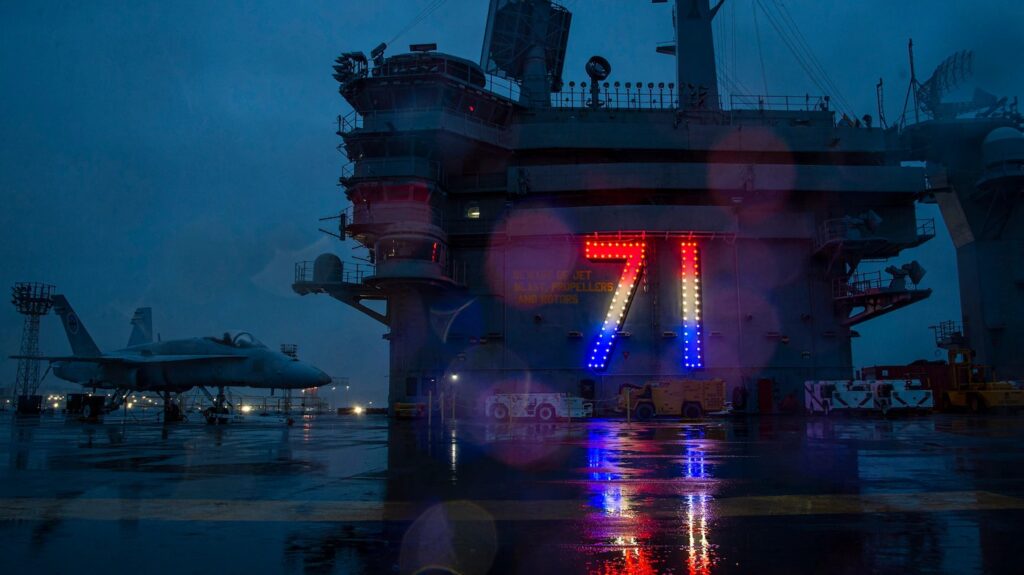
NAVAL BASE KITSAP-BREMERTON, Wash. (March 12, 2023) The hull number of the Nimitz-class aircraft carrier USS Theodore Roosevelt (CVN 71) is illuminated at sundown March 12, 2023. Theodore Roosevelt is in a docking planned incremental availability at Puget Sound Naval Shipyard and Intermediate Maintenance Facility where the ship is receiving scheduled maintenance and upgrades. (U.S. Navy photo by Mass Communication Specialist 3rd Class Andrew Benvie)
From USS Theodore Roosevelt (CVN 71) Public Affairs
BREMERTON, Wash. – The Nimitz-class nuclear-powered aircraft carrier USS Theodore Roosevelt (CVN 71) departed Bremerton, Washington, March 17, after completing an 18-month docking planned incremental availability (DPIA) at Puget Sound Naval Shipyard & Intermediate Maintenance Facility. The ship is shifting its homeport back to San Diego, California, and will return to Naval Air Station North Island next week.
The Nimitz-class nuclear-powered aircraft carrier USS Theodore Roosevelt (CVN 71) departed Bremerton, Washington, March 17, after completing an 18-month docking planned incremental availability (DPIA) at Puget Sound Naval Shipyard & Intermediate Maintenance Facility. The ship is shifting its homeport back to San Diego, California, and will return to Naval Air Station North Island next week.
Theodore Roosevelt began DPIA on Sep. 10, 2021.
The DPIA achieved significant modernization to the ship’s combat efficiency while also ensuring sustained operational readiness throughout its 50-year lifespan. Upgrades included a flight deck systems retrofit, expanding the ship’s air dominance capabilities to support the F-35C Lightning II, E-2D Advanced Hawkeye, and CMV-22B Osprey, as well as future platforms such as the MQ-25 Stingray unmanned aircraft system. Other combat systems modernization efforts included installation of the Mark 38 Mod III Machine Gun System and upgrades to the AN/SLQ-32 electronic warfare suite; Consolidated Afloat Networks and Enterprise Services (CANES); ship self-defense system (SSDS); surface search radar; and AN/SPQ-9 Fire Control System. The availability also involved a full restoration of crew habitability areas, including crew living quarters and onboard bathrooms; and preventative maintenance and restoration of the ship’s hull, rudders and rudder shafts.
“I’m so grateful for the unrelenting work our crew and our shipyard teammates put into this milestone,” said Commanding Officer Capt. Brian Schrum. “Their sacrifices have enabled us to rejoin the Fleet and to get back to being a warship for our nation. Thanks as well to our Sailors and their families for their resiliency, and to the Puget Sound communities for their unwavering support.”
Prior to DPIA, Theodore Roosevelt was homeported in San Diego and was deployed from December 2020 to May 2021 in the Indo-Pacific region in support of maritime security operations.
Navy receives final JPALS unit delivery
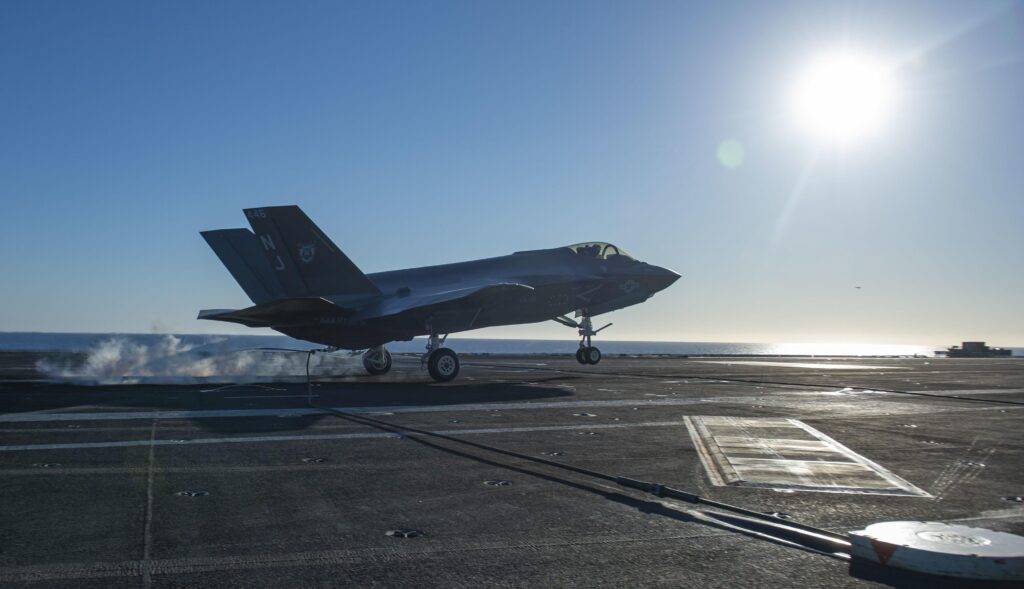
An F-35C Lightning II, from the “Rough Raiders” of Strike Fighter Squadron (VFA) 125, makes an arrseted gear landing on the flight deck of the aircraft carrier USS Nimitz. Joint Precision Approach and Landing Systems (JPALS) has been supporting F-35B deployments on U.S. Navy LH-class amphibious assault ships since 2016 and F-35C deployments on U.S. Navy aircraft carriers since 2021.
The U.S. Navy accepted delivery of the final Joint Precision Approach and Landing Systems (JPALS) unit March 16 marking another on-time or ahead of schedule delivery for increased capability at sea.
JPALS is a ship-relative GPS-based system that provides aircraft carriers and amphibious assault ships with precision approach and landing capability, surveillance, and over-the-air inertial alignment in all weather and mission environments.
“This is a significant milestone for the JPALS team and highlights the incredible efforts of hundreds of our teammates over the past decade who developed and now have fully delivered these critical systems that our Warfighters and International Partners need,” said Capt. Kevin Watkins, Naval Air Traffic Management Systems (PMA-213) program manager. “This team overcame many barriers over the past several years, successfully achieving the required outcome to deliver all of the capabilities needed, on time and affordably.”
JPALS is currently being deployed on all U.S. Navy aircraft carriers and amphibious assault ships, and is on the United Kingdom Royal Navy’s HMS Queen Elizabeth and the Italian Navy’s ITS Cavour. Japan became the third foreign military sale customer in December and is scheduled to be deployed on the Japan Maritime Self-Defense Force’s JS Izumo in 2024.
JPALS has been supporting F-35B deployments on U.S. Navy LH-class amphibious assault ships since 2016 and F-35C deployments on U.S. Navy aircraft carriers since 2021. Initial operational capability was reached in May 2021 with full operational capability scheduled for fiscal year 2026.
Navy Concludes EOC Westpac Deployment of MQ-4C Triton UAV
**************
ARLINGTON, Va.— The U.S. Navy is concluding the first deployment of a detachment of MQ-4C Triton high-altitude, long-endurance maritime intelligence, surveillance, reconnaissance and targeting (MISR&T) unmanned aerial vehicles, ending the Early Operational Capability deployment of the Triton, paving the way for the UAV’s Initial Operational Capability.
Unmanned Patrol Squadron (VUP) 19, home-based at Naval Air Station Jacksonville, Florida, deployed two MQ-4Cs to Andersen Air Force Base in Guam in 2020 to provide MISR&T for the U.S. 7th Fleet while developing the concept of operations and the tactics to refine the Triton’s operations. The detachment operated from Guam; Naval Air Facility Misawa, Japan; and Marine Corps Air Station Iwakuni, Japan, the Navy said in a March 16 release.
The two MQ-4Cs deployed from VUP-19’s maintenance base in Naval Air Station Point Mugu, California. While deployed, the maintenance detachment moved to Naval Station Mayport, Florida, which is near the squadron’s operations center in Jacksonville. One of the two deployed Tritons arrived in Mayport in December to be used for training.
The two deployed Tritons were of the baseline Integrated Functional Capability (IFC) 3 configuration. The squadron has since received newer versions in the IFC 4 configuration, which are equipped with a more capable sensor suite that will allow them to replace the Navy’s fleet of EP-3E Orion electronic reconnaissance aircraft. The MQ-4C will supplement the Navy’s P-8A Poseidon maritime patrol aircraft.
VUP-19 is scheduled to bring the Triton to Initial Operational Capability later in 2023 when it deploys a full “orbit” of Tritons to the 7th Fleet’s Task Force 72. With a full orbit, a squadron detachment will be able to maintain a Triton on patrol 24/7.
Last October, Seapower reported that Vice Adm. Karl Thomas, commander, U.S. 7th Fleet, said the fleet is working to build up an orbit “to learn our way through some of the capabilities that an EP-3 [Aries II Orion electronic reconnaissance aircraft] might bring back. It will be a different way of processing the information than we do with our EP-3s, so we’re working as a Navy to see how we seamlessly transition.”
“VUP-19 plans to introduce this capability to more fleet areas around the globe, paving the way for future Navy unmanned systems,” the Navy release said.
USS ARLEIGH BURKE (DDG 51) RECEIVES SERVICE LIFE EXTENSION
OPNAV N96 recently approved a five-year service life extension for USS Arleigh Burke (DDG 51).
First-in-class Arleigh Burke’s estimated service life was 35 years, expected to expire in FY 2026, but efforts began early last year to request additional service time for the ship. The approval extension carries the ship out through FY 2031 now, when the ship will be 40 years old.
According to Rear Adm. Brendan McLane, commander, Naval Surface Force Atlantic, the extension is a testament to the success of the DDG 51 program as a whole and is an example of the Navy’s enduring relationship with industry partners.
“DDG 51’s are the best warships in history. They demonstrate that there are no limits to what we can accomplish with a strong American Navy-industrial partnership,” McLane said. “Arleigh Burke-class destroyers are the backbone of the Navy’s surface fleet and critical to the Nation and the Navy today and long into the future.”
A DDG modernization program is underway to provide a comprehensive mid-life upgrade that will ensure the DDG 51 class possesses the latest long-range fires and terminal defense capabilities. The modernization changes are also being introduced to new construction ships to increase the baseline capabilities of the newest ships in the class, and to provide commonality between new construction ships and modernized in-service ships. The goal of the DDG modernization effort is to increase warfighting capabilities and drive commonality, which enable these ships to remain relevant, to their service life, against current and future threats.
After 30 years in Norfolk, Va., Arleigh Burke shifted homeports to Rota, Spain, on March 26, 2021, to be forward-deployed in U.S. Sixth Fleet. The ship arrived at Naval Station Rota on April 11, 2021, and is on its third patrol.
SURFLANT mans, trains and equips assigned surface forces and shore activities, ensuring a capable force for conducting prompt and sustained operations in support of United States national interests. The SURFLANT force is composed of nearly 80 ships, 17 pre-commissioning units, and more than 30 shore commands.
Release from General Dynamics Electric Boat
**************
Statement from General Dynamics Electric Boat President Kevin Graney Regarding the AUKUS Agreement
GROTON, Conn. (March 13, 2023) – Today, the United States, United Kingdom and Australia announced the trilateral AUKUS partnership, which will provide Australia with a conventionally armed, nuclear-powered submarine. General Dynamics Electric Boat has a long history of leadership in the design and construction of nuclear submarines from the beginning of naval nuclear propulsion with the USS Nautilus (SSN 571).
“We look forward to working with the Navy and our industry partners to use our knowledge and expertise to support Australia’s acquisition of nuclear submarines and the development of that country’s shipbuilding infrastructure. The AUKUS agreement underscores the critical role submarines play in the defense of our nation and our allies and calls attention to the importance of continuing to grow our submarine industrial base here in the United States,” said Kevin Graney, president, General Dynamics Electric Boat.
Northrop Grumman Offers Battle Management, Command and Control Expertise for U.S. Navy’s E-XX TACAMO Program
MELBOURNE, Fla. – Mar. 15, 2023 – Northrop Grumman Corporation (NYSE: NOC) is leveraging its weapons system integration and battle management leadership to compete for the U.S. Navy’s E-XX TACAMO fleet of aircraft systems.
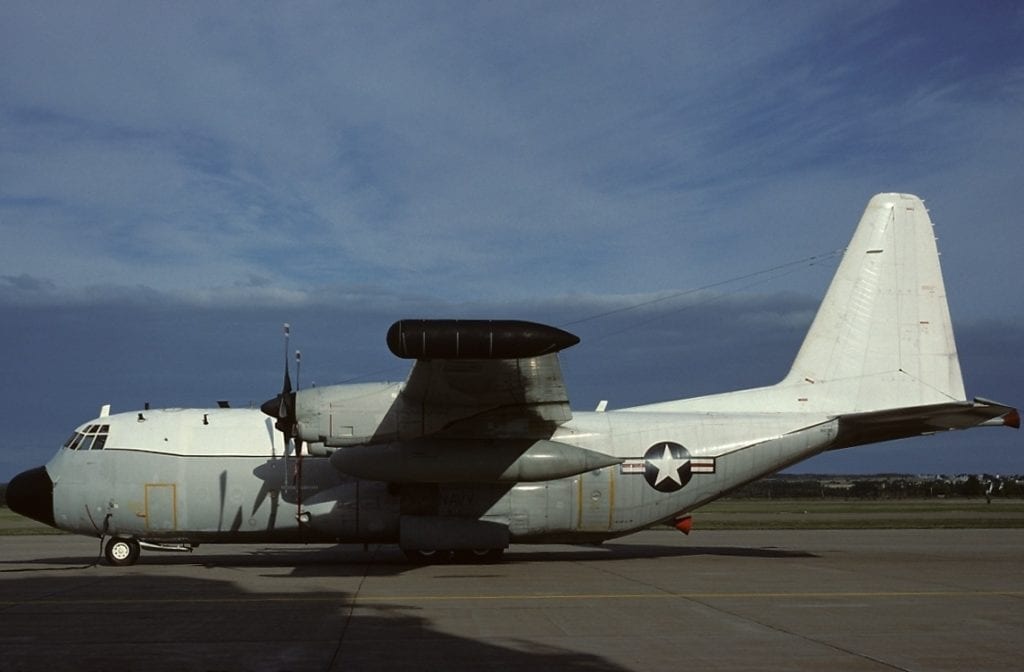
The Navy’s E-XX TACAMO aircraft will be based on the C-130J platform, and provides connectivity between the National Command Authority and ballistic submarines capable of delivering nuclear weapons. The Navy currently operates a fleet of E-6B Mercury aircraft to provide survivable, reliable and endurable airborne command, control and communications between the National Command Authority and U.S. strategic and non-strategic forces. The Navy intends to replace the E-6B fleet with the E-XX to modernize this critical strategic deterrent mission.
“Our extensive experience integrating aircraft and mission systems, combined with our expertise in creating operationally ready solutions in support of the nuclear enterprise, makes Northrop Grumman the optimal partner to deliver the Navy’s E-XX TACAMO weapon system” said Janice Zilch, vice president, multi-domain command and control programs, Northrop Grumman. “As we’ve demonstrated with the Navy’s E-2 programs, we have been a longtime partner in helping the Navy meet its operational requirements. We will bring this expertise in helping the Navy deliver the E-XX TACAMO on time and optimized for this strategically important mission.”
For more than six decades, Northrop Grumman has delivered on the development, production and modification of the Navy’s E-2 Hawkeye system as the prime contractor, and continues to provide total mission assurance with proven solutions that are secure, survivable, multi-layered systems designed for total weapon system security.
“Our team has vast knowledge and expertise in delivering critical command and control, and nuclear enterprise capabilities,” said Henry Cyr, director, multi-domain command and control capture programs, Northrop Grumman. “We perform challenging work that has a real-world impact. You can see that on our legacy platforms, the platforms currently in operation, and the platforms we will deliver tomorrow.”
Northrop Grumman is a leading global aerospace and defense technology company. Our pioneering solutions equip our customers with the capabilities they need to connect and protect the world, and push the boundaries of human exploration across the universe. Driven by a shared purpose to solve our customers’ toughest problems, our 95,000 employees define possible every day.
Amphib Suppliers to Navy Cite Need for Consistency in Ship Orders
***********
ARLINGTON, Va. — The companies supplying components and materials to the shipbuilders who produce the amphibious warfare ships for the U.S. Navy say that consistency in ship orders brings economies to the work and stability to the industrial base.
“The last few years have been fits and starts on numerous ships in the budget,” said Said David Forster, chairman of the Amphibious Warship Industrial Base Council (AWIBC) and vice president for Global Strategy for Rolls-Royce North America Inc. in an interview with Seapower. “What we have not seen is a consistent shipbuilding program has been substantiated over a FYDP [Future Years Defense Plan] that allows our suppliers the ability to actually plan the work and apply some sort of business practices.”
The AWIBC “is an organization of amphibious warship suppliers who advocate for Congress to provide funding for the sustained and stable construction of amphibious warships vital to the mission of the U.S. Navy and U.S. Marine Corps. The amphibious warship industrial base is comprised of 614 companies in 38 states and 226 Congressional Districts provide parts worth over $1.78 billion for the construction of amphibious warships,” according to an email from the company.
“The industrial base can take a lot more work than it currently has,” Forster said. “In order to do that, you do need a plan which allows the industrial base to respond.”
Forster pointed out that the shipyards need time to ramp up to meet increased production requirements, by hiring and training more skilled workers, ordering more materials, and building or installing more infrastructure and equipment.
“I think the industrial base has the capacity for more shipbuilding,” he said. “It’s not the instantaneous response that everyone would like it to be. But, given enough lead-time, as well as enough information, the industrial base can do almost anything you really want it to do.”
Asked about the 31-ship floor set for the amphibious warship fleet, Forster did not take a position.
“We’re going to let that conversation play within the requirements-setting side of the house, whether that’s the warfare modelers, the Pentagon, Congress,” he said. “We’re standing by, ready to support whatever that requirement is, whether it’s 31 as [Congress] mandated last year in the NDAA [National Defense Authorization Act or whether it’s some other number. … We’re just hoping for consistency in shipbuilding rather than a particular number.”
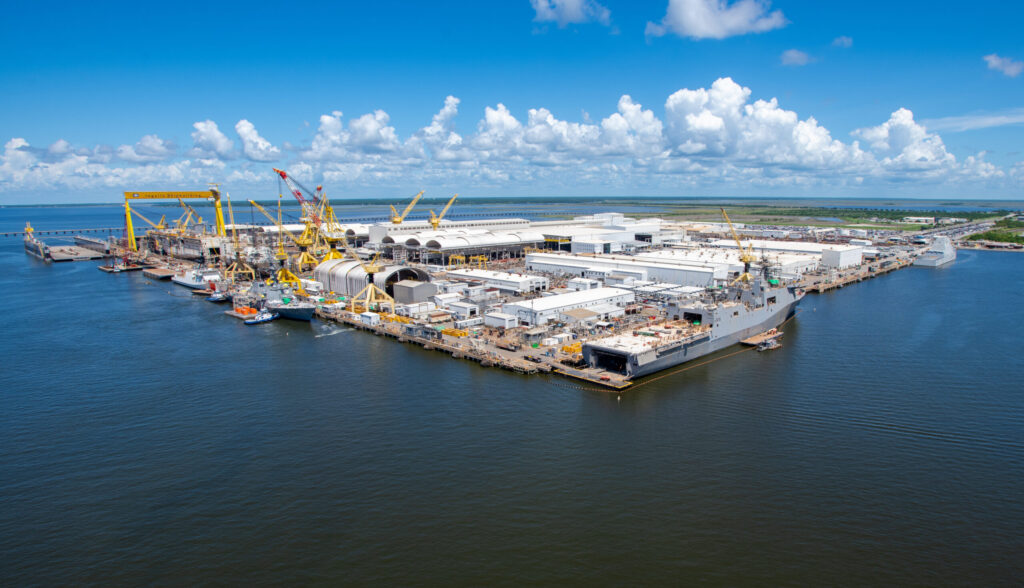
The Navy’s proposed 2024 budget would fund completion of the fourth America-class amphibious assault ship (LHA), but the associated FYDP would not fund any Flight II San Antonio-class amphibious dock ships (LPDs) for at least five years. The ships are built at HII’s Ingalls shipyard in Pascagoula, Mississippi.
“If we can get the LPDs to about every two-year centers and LHAs to about every four-year centers, what that allows the industrial base to do is apply some of that economic strategy to offset inflation, come through with some investment on whether it’s new capability, new material, new processes, or allows them to invest in workers and retain those workers,” Forster said.
The proposed medium landing ship, scheduled to be funded in 2025 and designed to support Marine littoral regiments, would be an opportunity to strengthen the industrial base.
“That ship does offer opportunity to the other yards which are not the big hull builders,” Forster said. “From an industrial base [perspective], that’s pretty good. That helps sustain the industrial base. It also provides resources into the suppliers.”
“We remain committed to landing ship medium, and for LPD, we’re taking a look at the — the acquisition strategy moving forward, again, to make sure that we would have the right capabilities at the right price, and working with industry partners to put — put together that plan moving forward,” said Undersecretary of the Navy Eric Raven, briefing reporters March 13 on the 2024 budget. … We received a direction from OSD [the Office of the Secretary of Defense] but this will be an integrated team moving forward for that assessment.”
Rear Adm. John Gumbleton, deputy secretary of the Navy for Budget, also briefing the reporters, said the “intent here is not a either/or between a LPD or a medium landing ship, it’s a both, so it’s an end game, and we have time to get this right. … I believe the services are fundamentally aligned on this requirement. Both service chiefs like 31 [large and medium amphibious warships] as a requirement, both service chiefs like multi-year procurements, both service chiefs want to buy in a predictable future. And so, if we can do a study and actually lower the cost of this, that’s all to the good of the Department of the Navy and the Marine Corps.”