Chaplain Admiral: Navy Growing Chaplain Force by 90 to Staff Destroyers

PEARL HARBOR (July 7, 2022) U.S. Navy Chief of Chaplains, Rear Adm. Gregory Todd speaks to partner-nation members during the International Chaplaincy Symposium at Joint Base Pearl Harbor as part of Rim of the Pacific (RIMPAC) 2022. Twenty-six nations, 38 ships, four submarines, more than 170 aircraft and 25,000 personnel are participating in RIMPAC from June 29 to Aug. 4 in and around the Hawaiian Islands and Southern California. The world’s largest international maritime exercise, RIMPAC provides a unique training opportunity while fostering and sustaining cooperative relationships among participants critical to ensuring the safety of sea lanes and security on the world’s oceans. RIMPAC 2022 is the 28th exercise in the series that began in 1971. (U.S. Navy photo courtesy of Royal Australian Navy LSIS Kylie Jagiello)

******* 

ARLINGTON, Va. —The U.S. Navy’s chief of chaplains said the service expects to increase the number of serving chaplains by 90 over the next five years in order to provide chaplains to the guided-missile destroyer (DDG) fleet as those ships deploy. 

Two years ago the commander, Naval Surface Forces, requested that the Navy provide chaplains to DDGs. Previously, sea-going billets for chaplains were typically limited to ships — such as aircraft carriers and amphibious warfare ships — that had large crews. 

Rear Adm. Gregory N. Todd, chief of chaplains, speaking in an online conversation with retired Rear Adm. Frank Thorp IV, President and CEO of the U.S. Navy Memorial in Washington as one of the memorial’s SITREP Speaker Series events, said the program to assign chaplains to deploying DDGs is in place and is showing good results. 

“The data that is coming as a result of that is a reduction in a lot of the bad behavior—NJP [non-judicial punishment, low morale issues, retention issues,” Todd said. “It’s apparent that the chaplains on board are change agents. Can we pinpoint exactly how that change happens? Not yet. But we do know that there is some sort of concurrent effect of attending to people’s spirituality or spiritual readiness within that [DDG’s] command, creating a venue where it’s okay and then its resultant impact on some of their negative behaviors.” 

First Increase in Chaplains Since Cold War

Todd overseas a force of about 1,100 chaplains — active and reserve — plus enlisted religion affairs specialists that provide service to 570,000 Sailors, Marines and Coast Guardsmen and their families. 

The increase in the number of chaplains is the first time the force has grown since the end of the Cold War, Todd said. 

“The Navy is hiring, and I’m trying to beat the bushes to the religious organizations of America,” the admiral said. “Send us your best. It’s a great opportunity; it’s a great place to work.  

“If I were to hold up what’s unique about this ministry, it’s the interaction with 18-to-25-year-olds,” he said. “We’re just immersed in a world of leadership. …  It’s operating in the public square, not confined to the church on the corner. Here we are, interacting with the whole Navy trying to impact the institution for the better.”  

Todd said the Coast Guard “has put us on notice that they intend to ask for more [chaplains], and the Marine Corps as well is looking at the question of adding more chaplains. So, right now, there is a realization that spiritual readiness does have an impact on the operational forces. If you attend to individual readiness in the aggregate, you’ll also build the readiness of the unit and the team.” 

Earlier in his career, Todd served as Chaplain of the Coast Guard and Chaplain of the Marine Corps. 


T-6B Training Aircraft Crashes in Alabama

******* 

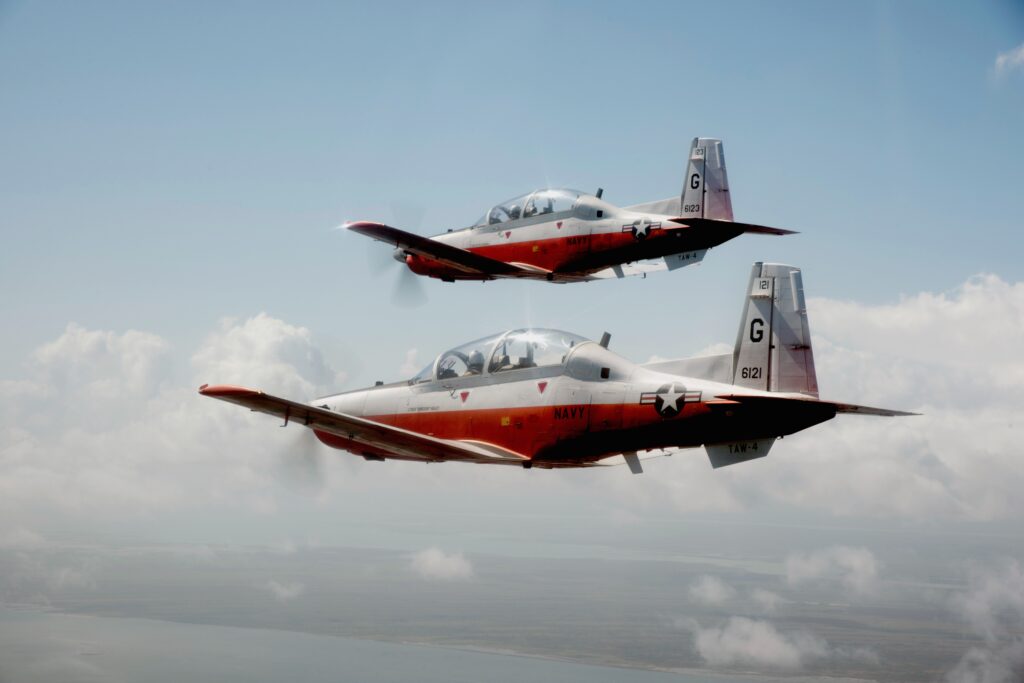
ARLINGTON, Va. — A U.S. Navy T-6B Texan II training aircraft crashed near Foley, Alabama, Jan. 17. The instructor pilot and student naval aviator ejected successfully. 

The T-6B crashed at approximately 10:50 CST in an unpopulated area near Barin Naval Outlying Field near Foley, the Chief of Naval Air Training Public Affairs Office said in a release. The two flyers were treated for minor injuries. 

The T-6B was assigned to Training Air Wing Five at Naval Air Station Whiting Field, Milton, Florida. The T-6B is flown by three training squadrons at Whiting Field, VT-2, VT-3 and VT-6, to train naval aviators for the Navy, Marine Corps, Coast Guard, and some foreign militaries. The aircraft also is flown by two training squadrons — VT-27 and VT-28 — assigned to Training Air Wing Four at NAS Corpus Christi, Texas. 

The aircraft loss was the Navy’s first in calendar 2023 and the first loss of a Navy T-6B since October 2020, when another — also assigned to Training Air Wing Five — crashed near Foley.  

The cause of the incident is under investigation. 


SECNAV Names Future Destroyer after MoH Recipient Capt. Thomas G. Kelley

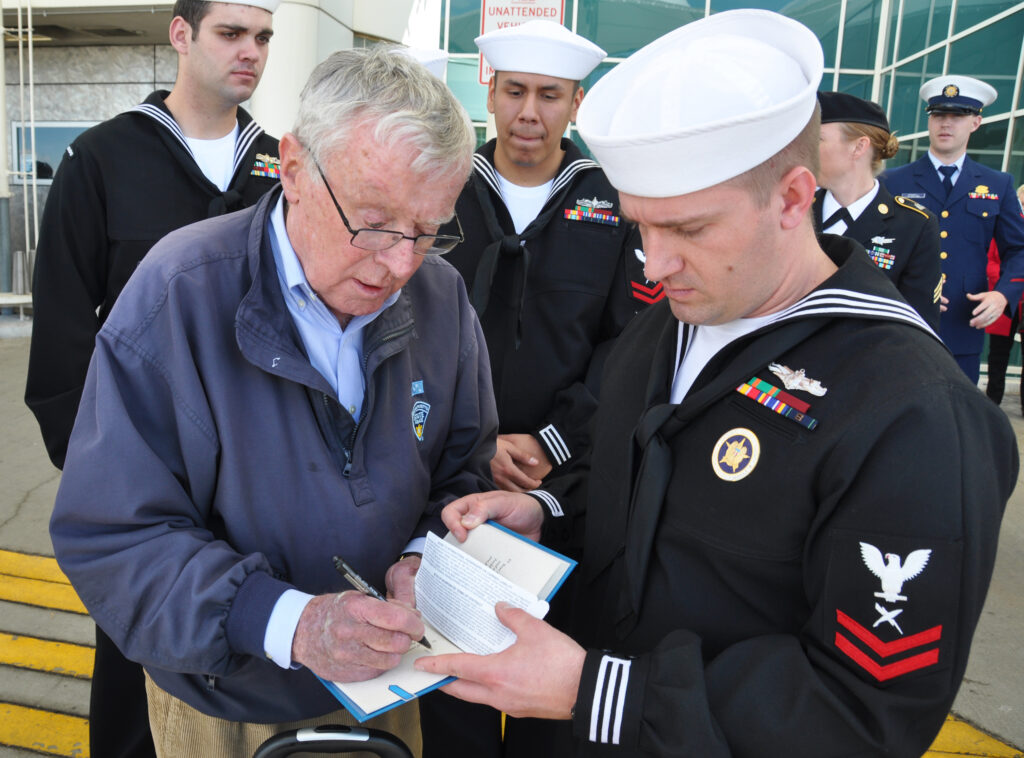
Secretary of the Navy Carlos Del Toro announced the future Arleigh Burke-class guided-missile destroyer DDG 140 will be named USS Thomas G. Kelley, named after the Medal of Honor recipient retired Capt. Thomas G. Kelley, pictured above signing a young Sailor’s book. U.S. NAVY / Petty Officer 2nd Class Robert Hartland

WASHINGTON – Secretary of the Navy (SECNAV) Carlos Del Toro announced during the Surface Navy Association Symposium that future Arleigh Burke-class guided-missile destroyer DDG 140 will be named USS Thomas G. Kelley (DDG 140), the Navy said in a Jan. 12 release.

The future USS Thomas G. Kelley will honor retired Captain Thomas G. Kelley, a Medal of Honor recipient. The name selection follows the tradition of naming destroyers after U.S. naval leaders and heroes.   

In 2020, former Secretary of the Navy Richard Spencer announced his intention to name a ship after Kelley but had yet to dedicate the name to an assigned hull number. Today, Del Toro assigns the name to DDG-140, which was appropriated in the fiscal year 2023 budget. 

“It is with great admiration and great pride that I am announcing the naming of the DDG-140 after Captain (retired) Thomas Gunning Kelley,” said Del Toro. “May we all, especially the future men and women assigned to this ship, always be inspired by Kelley’s brilliant leadership, bold initiative, and resolute determination.” 

Kelley was born in 1939 and grew up in Boston, Massachusetts. He graduated from the College of the Holy Cross in 1960 and was commissioned in the Navy. His early assignments as a Surface Warfare Officer included time aboard USS Pandemus (ARL-18), USS Davis (DD-937), and USS Stickell (DD-888). Kelley then volunteered to serve in Vietnam as a lieutenant commanding River Assault Division 152.  

Riverine Action

On June 15, 1969, Kelley led river assault craft boats when they fell under attack. Kelley, while severely wounded, continued to protect and lead his men to safety. For this gallant effort, he was awarded the Medal of Honor. Kelley, despite his injuries, continued his naval career, taking on the position of executive officer of USS Sample (DE-1048) and commanding officer of USS Lang (FF-1060). While serving, Kelley earned his master’s degree in management from the Naval Post Graduate School and completed the Armed Forces Staff College course in Norfolk, Va. Kelley retired from naval service as a Captain after thirty years, ending his tour as the director of legislation in the Bureau of Naval Personnel.  

After his military service, Kelley became the Massachusetts Department of Veterans’ Services commissioner and was named Secretary of the Department in 2003. In 2011, Kelley retired from public service and focused on charitable pursuits. He is close with the Medal of Honor Society, previously serving as president, Holy Cross’ O’Callahan Society, Arlington National Cemetery, the Homebase Program which treats veterans and active military with the hidden wounds of war, in partnership with the Boston Redsox Foundation and Massachusetts General Hospital. He also serves on the board of directors of the USS Constitution Museum. 

‘Tremendous Honor’

“It is a tremendous honor and I am truly humbled, especially as a Surface Warfare Sailor,” Kelley said. “I trust that those who sail in this ship will be reminded of service to their shipmates and that they will be carrying on a tradition greater than themselves.” 

Arleigh Burke-class destroyers, built around the Aegis Combat System, are the backbone of the U.S. Navy’s surface fleet providing protection to America around the globe. They incorporate stealth techniques, allowing these highly capable, multi-mission ships to conduct a variety of operations, from peacetime presence to national security, providing a wide range of warfighting capabilities in multi-threat air, surface and subsurface domains. These elements of sea power enable the Navy to defend American prosperity and prevent future conflict abroad. 


Coast Guard, Navy Competition for Ship Availabilities to Increase: USCG Official

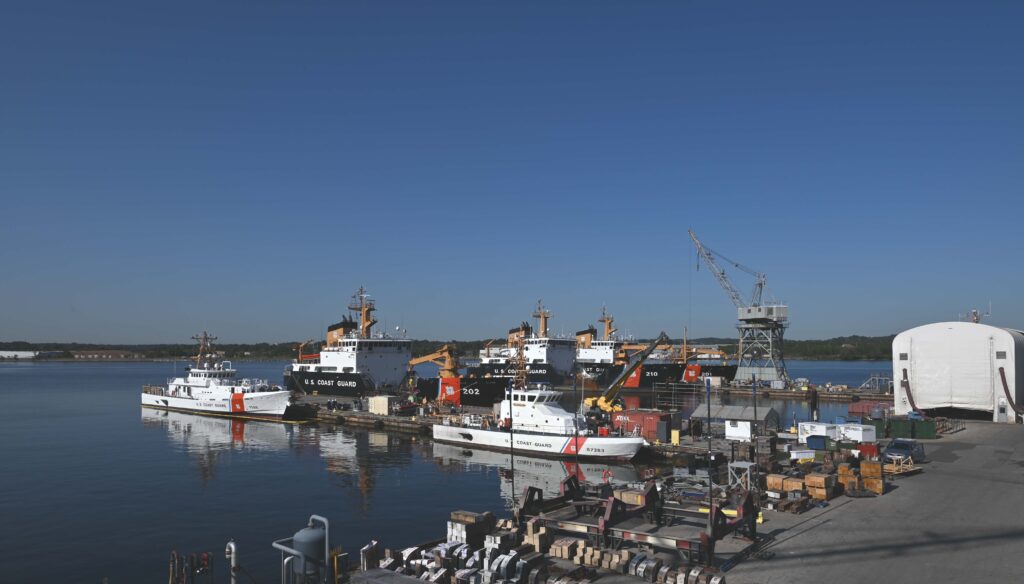
The Coast Guard Yard at Curtiss Bay, Maryland, is the service’s main cutter maintenance facility. U.S. COAST GUARD

ARLINGTON, Va. — The U.S. Coast Guard will be in “closer competition than we ever have before” with the U.S. Navy for dry dock and dockside availabilities for their ships, a Coast Guard official said during a panel on maintenance at the Surface Navy Association Annual Symposium on Jan. 12. 

Bob Thomas, U.S. Coast Guard deputy assistant commandant for engineering and logistics (CG-4D), said that the Coast Guard is competing for resources with both the industry and the Navy as retention and recruiting struggles. persist throughout the military. Along with maintenance areas that the Coast Guard hasn’t historically dealt with, such as cyber, that creates an intensely competitive environment, he said. 

The Coast Guard has seen many of the same recruiting and retention challenges as the other services, Thomas noted. 

“The workforce has almost become a migrant workforce,” he said. “They’ll shift to where the work is, [or] who’s paying the most. […] That drives the cost way up when people are competing for limited resources. You get to pay more for the same thing, or sometimes it’s not available.”

Collaborating to Retain Workforce Numbers

However, he added that the Coast Guard is working closely with the Navy to help mitigate some of these issues, mentioning a number of collaborative efforts that he thinks are “going to pay off huge for the Coast Guard.” 
 
Navy Rear Adm. Scott Brown, deputy commander for logistics, maintenance, and industrial operations, also said that 2022 was “not a great year” in terms of staffing at the public shipyards, stating that they were short by 1,200 personnel, with 37,000 total working in those shipyards. 
 
“A big focus of our efforts is to improve the recruiting and incentives for folks that come into the shipyards,” he said. 
 
Brown said he believes that, in addition to the economy, the state of the shipyards and changing demographics are the primary reasons why the Navy continues to struggle with recruiting and retention. 
 
To offset some of those challenges, the Navy is looking not only to boost pay, but to also offer career development opportunities to sailors. For example, the Navy has introduced a program to help mechanical expert tradespeople, a promotion that keeps them “turning wrenches” while still providing advancement opportunities.


Small Torpedo Being Prototyped by Raytheon to Arm the Navy’s Submarines

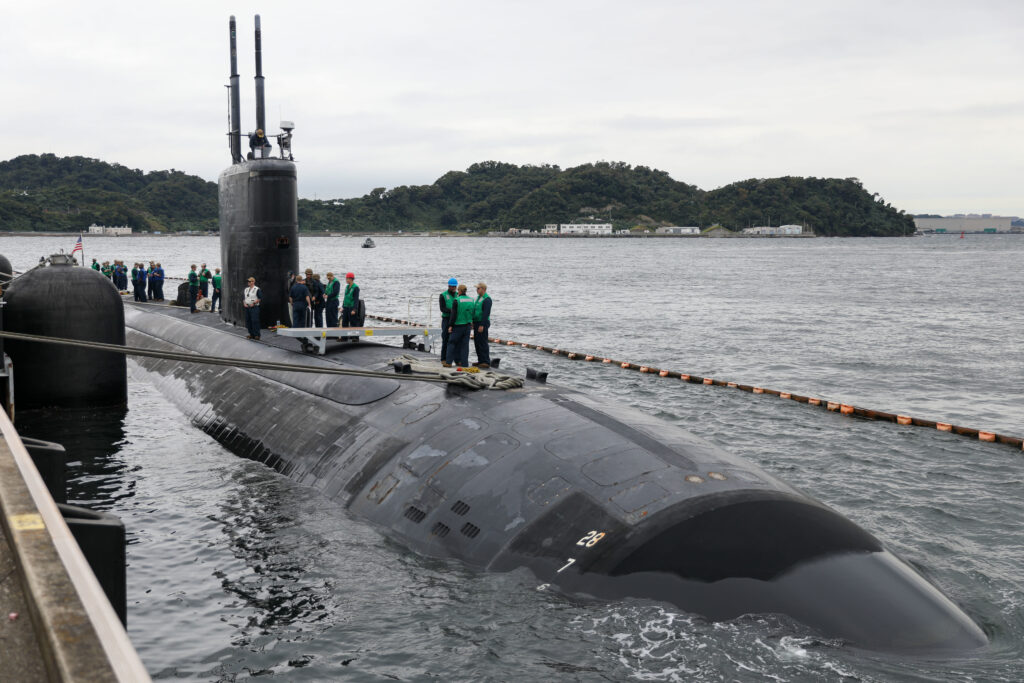
YOKOSUKA, Japan (Oct. 18, 2022) The Los Angeles-class fast-attack submarine USS Springfield (SSN 761), arrives at Fleet Activities Yokosuka for a scheduled port visit, Oct. 18, 2022. Springfield is forward-deployed to Guam and routinely operates in the U.S. 7th Fleet area of responsibility, conducting maritime security operations and supporting national security interests. U.S. NAVY / Mass Communication Specialist 2nd Class Travis Baley

ARLINGTON, Va. — Raytheon is building prototypes of a small torpedo that is designed to attack hostile submarines and defend the U.S. Navy’s submarines from incoming torpedoes. 

The Compact Rapid Attack Weapon (CRAW) is designed to be launched from a submarine’s decoy launcher rather than the submarine’s torpedo tubes, and thus will not require a separate launcher to be installed on a submarine, said Bill Guarini, Raytheon’s director of Requirements and Capabilities for Under Systems, in a Jan. 6 interview with Seapower.

Applied Physics Design in Action

Raytheon was awarded a Navy contract in September in a down-select decision to take a data package from Penn State’s Applied Physics Laboratory’s design of its nine-foot-long Very Lightweight Torpedo, updated with Technology Insertion 1 — that addresses obsolescence issues — and develop a prototype of the CRAW. Raytheon is to build 18 CRAW prototypes and 12 turn-around kits, the latter to be used to restore used CRAW prototypes to a re-usable condition. The prototypes will be delivered to the Navy with the Technology Insertion 2 data package. 

Guarini sees the CRAW as a natural fit with Raytheon’s existing torpedo business. The company builds the Mk54 lightweight torpedo deployed in surface warships and anti-submarine aircraft. 

The CRAW prototypes will be built at the company’s facility in Portsmouth, Rhode Island.


Hot Production Line for Navy’s Ship-to-Shore Connectors

Landing Craft, Air Cushion (LCAC) 104, attached to Assault Craft Unit 4, approaches the Wasp-class amphibious assault ship USS Kearsarge (LHD 3) for well deck operations Dec. 1, 2022. LCAC 100 is the Navy and Marine Corps next generation landing craft designated to replace the legacy LCAC, providing a more reliable and capable high speed amphibious connector to deliver Sailors and Marines and their equipment from ship to shore. U.S. NAVY / Mass Communication Specialist Mark O. Klimenko

ARLINGTON, Va. — Three years after the first Ship-to-Shore Connector (SSC) was delivered to the Navy, the service has accepted delivery of six SSCs, with a total of 24 under contract, with manufacturer Textron, the program manager said Jan. 11 at the Surface Navy Association’s annual symposium
 
Most recently, the Navy took delivery of LCAC 104 and LCAC 106 in June 2022 and November 2022, respectively, said Capt. Jason Grabelle, program manager for amphibious assault and connectors. 
 
Four SSCs are currently at Assault Combat Unit 4 (ACU-4) in Norfolk, Va., he said, and a number of them are going through post-delivery testing and trials. Multiple craft are currently under construction. The next milestone will be LCAC 105 going to acceptance trials.

Past Issues Resolved

In terms of differences between the aging LCAC platform and the SSC craft that will replace it, Grabelle said the two vessels basically do the same thing. The primary differences concern the four gas turbine engines on the SSC, as well as a lower life cycle cost for the SSC. 
 
“ACUs are not only the operators, they are the maintainers,” Grabelle said. “All the plus-ups we’ve made on the SSC are related to improving operational availability and maintainability.” 
 
Asked whether past issues with the gearbox and blade cracking are behind the program, Grabelle said those problems were no longer an issue. 
 
“We definitely have a steady production baseline,” he said. “We are getting more and more craft delivered to the fleet … and the production line is hot and moving along.”


Official: Navy Seeking 18 LAW Ships in POM-25

The Light Amphibious Warship will be much larger than this utility landing craft, and it will also have the ability to discharge its cargo and passengers onto unprepared shores. U.S. NAVY / Mass Communication Specialist 3rd Class Keith Nowak

ARLINGTON, Va. — The Navy will attempt to “lock in” a plan to procure 18 light amphibious warfare (LAW) ships in the Defense Department’s Program Objective Memorandum-2025 (POM-25), Marine Corps Brig. Gen. Marcus Annibale, director of expeditionary warfare (OPNAV N95), said at the Surface Navy Association’s annual symposium
on Jan. 11. 

“The light amphibious warship will birth a new class of ships,” Annibale said. “And the inventory goal is 18 [for the] initial capacity. That’s mapped to the Marine Littoral Regiment.” 

Last April, SEAPOWER reported that the Marine Corps planned to least two commercial ships over the next two years to experiment with the LAW ship concept known as landing ship medium (LSM), according to Brig. Gen. Mark Clingan, assistant deputy commandant for Combat Development and Integration and deputy commanding general of Marine Corps Combat Development Command. 

A LAW/LSM ship would be designed to carry 75 Marines in a Marine Littoral Regiment and land them ashore in an expeditionary environment. These ships would be less attractive targets for enemy missiles than a larger amphibious warfare ship, Clingan remarked. 

Annibale also said that he remained focused on a capacity goal of 31 amphibious ships for the Marines: 10 LHA/LHD large-deck amphibs, and 21 LPD/LSD amphibious transport docks. 

Mine Countermeasures

Another priority is to deliver the Mine Countermeasures Mission (MCM) package for the Independence-class Littoral Combat Ship (LCS), he said. 

“The MCM mission package is on the cusp of IOC [initial operational capability],” Annibale said. “The USS Cincinnati is doing trials on it. 

“We don’t want to put the man in the minefield, we want to put the sensor in the minefield,” he continued, noting that allies such as the Dutch and Belgians are involved from a NATO standpoint. “So very exciting times on all the capabilities that go with the MCM mission package.”


SECNAV Names Future Oceanographic Survey Ship USNS Robert Ballard

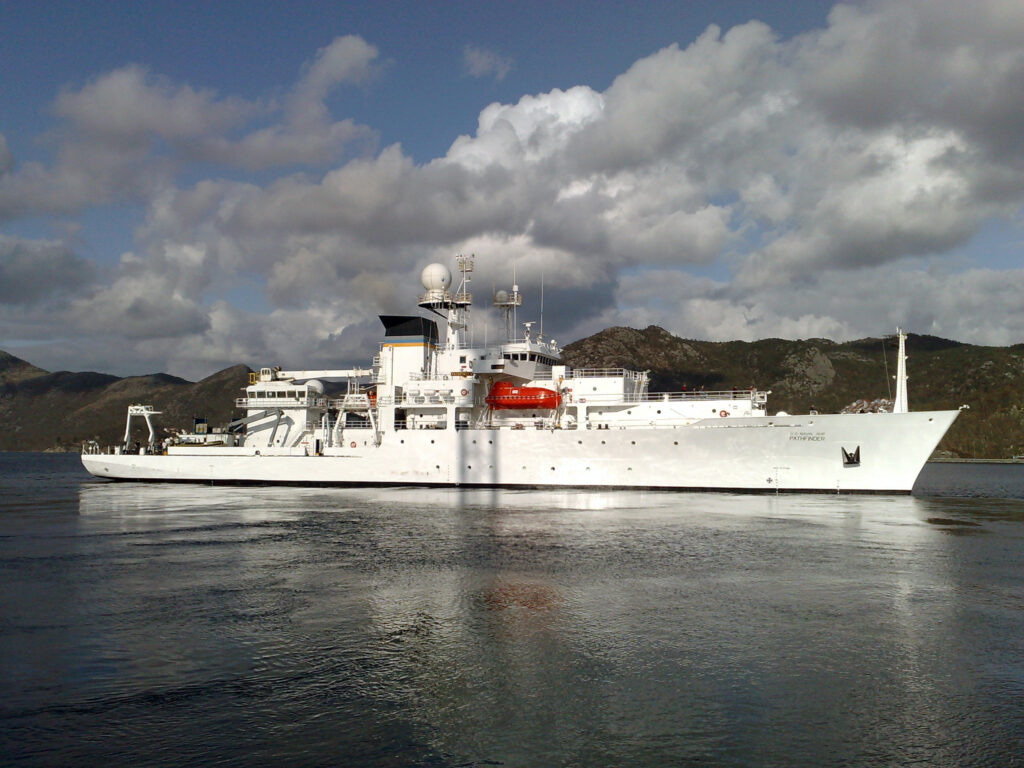
Military Sealift Command oceanographic survey ship USNS Pathfinder. U.S. NAVY

WASHINGTON — Secretary of the Navy (SECNAV) Carlos Del Toro announced Dec. 21 that a future Pathfinder-class oceanographic survey ship will be named USNS Robert Ballard (T-AGS 67). 

The future USNS Robert Ballard will honor Dr. Robert Ballard, a retired U.S. Navy commander, and former director of the Center for Ocean Exploration. A tenured professor of oceanography at the University of Rhode Island’s Graduate School of Oceanography, he is widely known as a discoverer of the final resting place of the R.M.S. Titanic. The name selection follows the tradition of naming survey ships after explorers, oceanographers and distinguished marine surveyors.  

“Dr. Ballard’s career, explorations, research and focus on teaching the next generation of oceanographers is remarkable, and I am pleased to name T-AGS 67 in his honor,” said Del Toro. “One of my enduring priorities is building a culture of warfighting excellence, and that includes lifelong learning amongst DoN personnel. The name Robert Ballard displayed across the stern of this ship will serve as an inspiration to all who see it while highlighting the results of commitment to education and exploration.” 

Ballard was born in 1942, growing up in San Diego, Calif. After he graduated from the University of California, Santa Barbara, in 1965, he earned an Army Reserve Commission, ultimately requesting and transferring to the U. S. Navy when called to active service in 1967. Assigned to the Office of Naval Research as a liaison officer at Woods Hole Oceanographic Institution in Massachusetts, Ballard worked extensively with deep-submergence vehicle Alvin (DSV-2). After transitioning to the Naval Reserve in 1970, he completed a Ph.D. in marine geology and geophysics at the University of Rhode Island. He continued to work at Woods Hole, where he was part of a team that discovered deep-sea thermal vents near the Galapagos Rift. Best known for his 1985 discovery of R.M.S. Titanic at a depth of 12,000 feet, Ballard also led other shipwreck discoveries, including USS Yorktown (CV-5), USS Quincy (CA-39) and President John F Kennedy’s PT-109. Ballard retired from U.S. Naval Service in 1995. In 1989, he founded the distance learning program the JASON Project, which reached 12 million school children; and the Institute for Exploration in Mystic, Conn, and is also the founder and president of the Ocean Exploration Trust.   

“I am humbled to have the U.S. Navy’s oceanographic ship, USNS Robert Ballard (T-AGS 67) as a namesake. As a 17-year-old, in 1959, I went on my very first oceanographic cruise, and very early in my oceanographic career, the U.S. Navy placed a central role and continues to do so to this day,” said Dr. Robert Ballard. “It is indeed an honor to know that the USNS Robert Ballard will continue to explore the oceans long after I am gone.” 

Secretary Del Toro has designated Mrs. Barbara Earle Ballard, Dr. Ballard’s spouse and president of Odyssey Enterprises, as the ship’s sponsor. 

Military Sealift Command’s Special Mission program supports worldwide oceanographic programs with ships that perform acoustical, biological, physical and geophysical surveys. These ships gather data that provides much of the military’s information on the ocean environment. The collected data helps to improve technology in undersea warfare and enemy ship detection. The oceanographic and hydrographic survey ships’ multi-beam, wide-angle precision sonar systems make it possible to continuously chart a broad strip of ocean floor. Survey ships have charted three-fourths of the world’s coastlines, making it easier for navigators to find their way along both well-traveled and not-so-familiar shipping routes. 


General Dynamics Electric Boat Awarded $5.1 Billion for Columbia-Class SSBNs

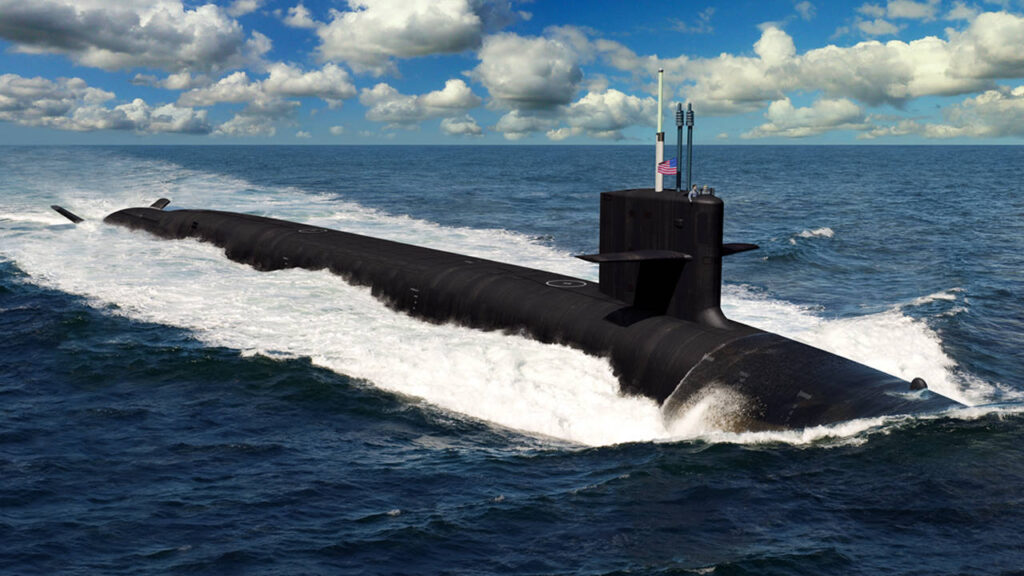
An artist’s rendering of the Columbia class of submarines, currently under construction. GENERAL DYNAMICS

GROTON, Conn. — General Dynamics Electric Boat announced Dec. 21 the U.S. Navy has awarded a $5.1-billion modification of the previously awarded Columbia Integrated Product and Process Development Contract for the Columbia class of submarines, the nation’s next-generation sea-based strategic deterrent. 

Electric Boat is the prime contractor on the Columbia program, which will replace the aging Ohio class ballistic-missile submarines (SSBNs). The District of Columbia (SSBN 826) and Wisconsin (SSBN 827) are presently under construction. 

The contract modification has a value of $5,134,324,189. Work will be performed in Groton, Connecticut; Quonset Point, Rhode Island; and Newport News, Virginia; and is expected to be completed by October 2030. The award funds advance procurement and advance construction of critical components and material to support Build II (the next five ships in the class), efforts to support continuous missile tube production, enhancements to develop the Submarine Industrial Base, and sustained class maintenance and support.  

“This award enhances Electric Boat’s efforts to maintain the Columbia-class production and delivery schedule. Advance procurement of long lead time materials and component construction is critical to the program, and the strategic investments in the development and expansion of the Submarine Industrial Base will help stabilize and grow the supply chain, which increases manufacturing capacity, reduces risk and ultimately drives timely delivery of submarines to the Navy,” said Kevin Graney, president of General Dynamics Electric Boat. 

At 560 feet long with a displacement of nearly 21,000 tons, the submarines of the Columbia class will be the largest ever built by the United States. Ships of the Columbia class will have a fuel core that will power the submarine for its entire service life, eliminating the need for a mid-service refueling. Electric Boat will deliver the lead ship to the Navy in 2027.


USNS Comfort Completes 12th Iteration of Continuing Promise 2022

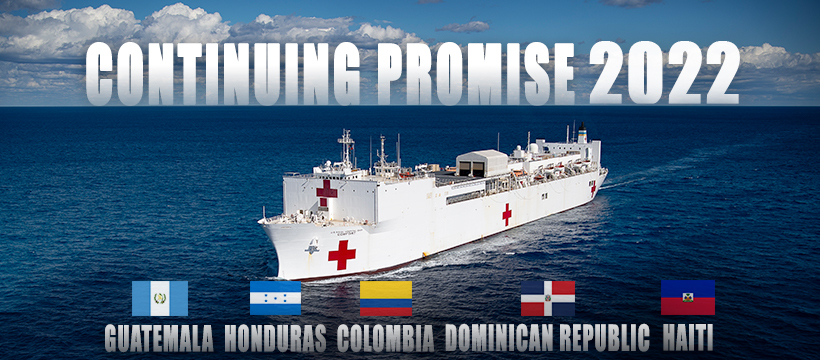
A graphic depicting hospital ship USNS Comfort (T-AH 20) and the flags and names of all the countries the ship visited during Continuing Promise 2022. U.S. NAVY / Mass Communication Specialist 2nd Class Ethan J. Soto

NORFOLK, Va. — The hospital ship USNS Comfort (T-AH 20) returned to its homeport in Norfolk, Virginia, concluding Continuing Promise, Dec. 21, 2022, said Mass Communication Specialist 3rd Class Deven Fernandez, U.S. Naval Forces Southern Command / U.S. 4th Fleet, in a release. 

The Continuing Promise 2022 team worked collectively with participating host and partner nations to enhance regional interoperability and disaster response capabilities, increase security and stability in the region, and foster new and enduring friendships in Caribbean, Central and South American region. 
 
Comfort visited Guatemala, Honduras, Colombia, Dominican Republic and Haiti throughout the mission. The crew aboard Comfort included U.S. military and civilians, more than a dozen non-governmental organizations and military members from Brazil, Canada, Chile, Colombia, Dominican Republic, Ecuador, Honduras, Netherlands and United Kingdom. 
 
Continuing Promise 2022 saw more than 13,000 patients, participated in more than 25 subject matter expert exchanges, conducted five humanitarian assistance and disaster relief workshops, shared in 18 Women, Peace and Security initiative events and partook in 11 community relations engagements. 
 
“I am so delighted to have shared this remarkable experience with the men and women of the Continuing Promise 2022 team,” said Capt. Kathryn Elliott, commanding officer of the Medical Treatment Facility aboard the hospital ship USNS Comfort (T-AH 20). “We overcame adversity to provide medical care to the community in these host nations. Along the way we learned so much from our partners. The exchange of information that took place was vital to building upon our long-lasting relationships with the countries of this region. This is Comfort’s mission and a true continuing promise.” 
 
Over the course of the 2-month mission, there were many accomplishments by the Comfort team. Here are a few of the highlights from Continuing Promise 2022. 
 
Puerto Barrios, Guatemala 
Oct. 26 – Oct. 31 
• 44 surgeries conducted 
• 2,957 prescriptions filled 
• 7 concerts performed by the U.S. Fleet Forces band 
• Pediatric cardiology care provided, which is not available in the area 
• Provided life changing surgeries, such as receiving full use of hands 
 
Puerto Cortes, Honduras 
Nov. 1 – Nov. 7 
• 23 surgeries conducted 
• 3,350 prescriptions filled 
• 7 concerts performed by the U.S. Fleet Forces band 
• Held refresher course of BLS for the volunteers at the Red Cross 
• Refurbished local school in Puerto Cortes 
 
Cartagena, Colombia 
Nov. 11 – Nov. 20 
• 143 surgeries conducted 
• 7,012 prescriptions filled 
• 6 concerts performed by the U.S. Fleet Forces band 
• Refurbished local school by adding a new coat of paint 
• Supported embassy in the handover of materials to local community 
Santo Domingo, Dominican Republic 
 
Nov. 27 – Dec. 6 
• 87 surgeries conducted 
• 7,446 prescriptions filled 
• 137 patients received physical therapy treatment 
• 209 X-Rays taken 
• 78 Ultrasounds performed 
 
Jeremie, Haiti 
Dec. 11 – Dec. 17 
• 14,012 prescriptions filled 
• 1,035 patients seen 
• 55 pallets of medical supplies and other goods donated 
 
Since its inaugural mission in 2007, Continuing Promise missions have treated more than 595,000 patients and conducted over 7,250 surgeries in the region. The successful completion of the mission marks the end of the 12th Continuing Promise. 
 
U.S. Naval Forces Southern Command/U.S. 4th Fleet supports U.S. Southern Command’s joint and combined military operations by employing maritime forces in cooperative maritime security operations to maintain access, enhance interoperability and build enduring partnerships in order to enhance regional security and promote peace, stability and prosperity in the Caribbean, Central and South American region.