From the Navy Office of Information, March 16, 2026
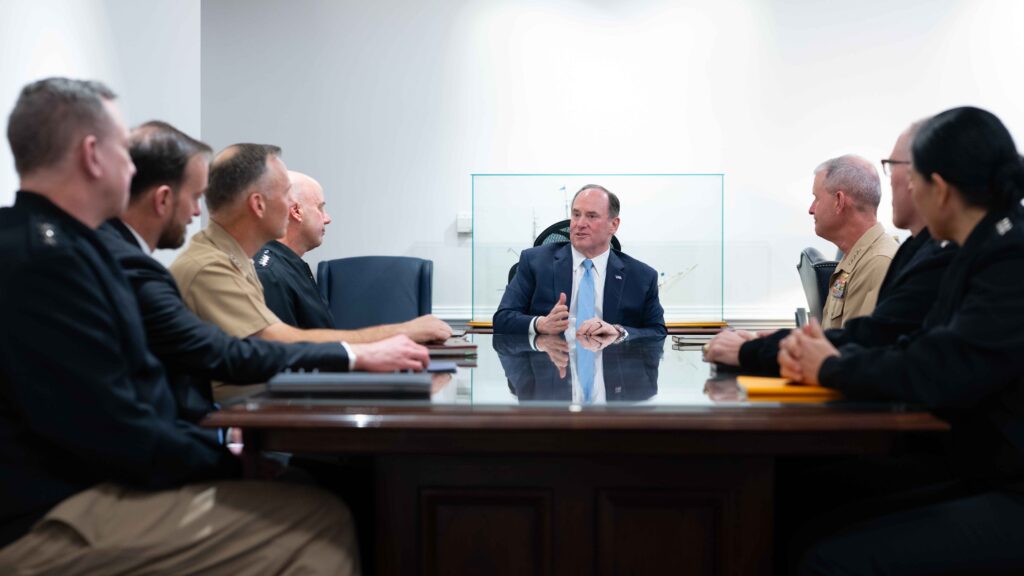
Washington, DC – The Department of the Navy (DON) today announced the establishment of five Portfolio Acquisition Executive organizations: PAE Industrial Operations, PAE Marine Corps, PAE Maritime, PAE Strategic Systems Programs and PAE Undersea. With these directives, the Navy is fully engaged in making the PAE model the new operational standard for the acquisition enterprise, injecting urgency and a ruthless focus on accelerated delivery.
The organizational changes are key initiatives of Secretary Hegseth’s directive to transform to a warfighting acquisition system and a key tenet of Secretary Phelan’s Golden Fleet initiative to change how the Navy is doing business to drive accountability and performance.
“In a time where our warfighters are on the frontline and the nature of warfare is changing at a rapid pace, the Department of the Navy needs a warfighting acquisition system that better responds to those at the tip of the spear,” said Secretary of the Navy John C. Phelan. “Every acquisition decision ties directly to deterrence, and if deterrence fails, decisive victory. With the establishment of PAEs, we are instilling a war-fighting mindset to accelerate delivery to the fight.”
Under the PAE model, leaders are empowered —and expected— to make disciplined, data-driven trade-offs across cost, schedule, and performance, with a clear priority on time to field. Additionally, each PAE is responsible for understanding and actively managing the industrial base supporting their portfolio, including production capacity, supply chain risk, and opportunities to expand or diversify suppliers.
The Department of the Navy has empowered five senior acquisition leaders as the interim Portfolio Acquisition Executives, making them the single accountable official for key portfolios:
PAE Industrial Operations: Vice Adm. James P. Downey
PAE Marine Corps: Lt. Gen. Eric Austin
PAE Maritime: Mr. Christopher Miller
PAE / DPRM Strategic Systems Programs: Vice Adm. Johnny Wolfe
PAE Undersea / DRPM Submarines: Vice Adm. Robert Gaucher
These reforms will create a warfighting acquisition system that aligns authority with responsibility, reduces unnecessary bureaucracy, empowers program managers, and delivers capability to the Navy and Marine Corps at speed and scale.
“PAEs will have direct authority not only for program offices but also over associated technical, contracting, and sustainment functions, providing true cradle-to-grave control to deliver fully integrated capability,” said Mr. Jason Potter, Performing the Duties of Assistant Secretary of the Navy for Research, Development and Acquisition (ASN RDA). “We are moving from a compliance-based bureaucracy to having outcome-focused organizations, fundamentally changing how we do business.”
Department of the Navy acquisition reform efforts have progressed aggressively since the establishment of the DON Rapid Capabilities Office (DON-RCO) and establishment of PAE Robotics and Autonomous Systems in December 2025, which Vice Adm. Seiko Okano, Principal Military Deputy to ASN(RDA), says is helping to establish a culture of speed and measured risk across the warfighting acquisition system.
“Our acquisition workforce is critical to our warfighting capability, and not being deployed does not excuse us from having a warfighting ethos,” said Vice Adm. Seiko Okano. “Each PAE will operate with a digital first mind-set – we will align on data and eliminate non-value-added layers of program reviews and bureaucracy to identify risks earlier and enable faster and more informed decision making.”
Additionally, each PAE will operate with a dedicated Rapid Capability Cell, closely linked to the Department of the Navy’s Rapid Capabilities Office. These cells will focus on rapidly identifying opportunities to adopt commercial technology, conduct rapid prototyping, and accelerate fielding when urgent operational needs arise.
Transition study efforts continue across the aviation, industrial infrastructure, mission systems, and munitions programs. These efforts are progressing and will be announced as they are formally established.
USS Gonzalez Departs Norfolk for Deployment
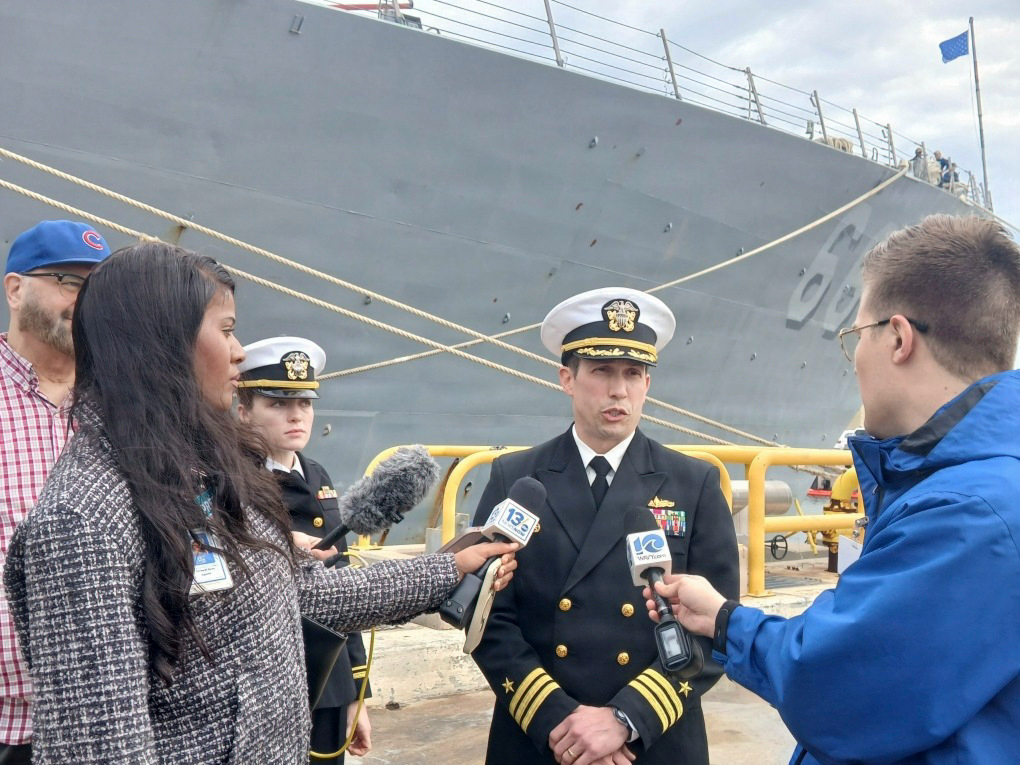
NAVAL STATION NORFOLK, Va. (March 16, 2026) – Cmdr. Michael Shenk, commanding officer of the Arleigh Burke-class guided-missile destroyer USS Gonzalez (DDG 66), speaks to local news media outlets prior to the ship’s departure from Naval Station Norfolk to begin operations in support of its scheduled deployment. The ship’s departure comes after months of training, maintenance, and certification events. (U.S. Navy photo by Chief Mass Communication Specialist Matthew Jackson)
From U.S. 2nd Fleet, 17 March 2026
NORFOLK, Va. – Arleigh Burke-class guided missile destroyer USS Gonzalez (DDG 66) got underway from Naval Station Norfolk March 16, 2026, to begin operations in support of its scheduled deployment.
The ship’s departure comes after months of training, maintenance, and certification events.
“The crew is ready and this ship brings significant combat capabilities to the fight,” emphasized Capt. John Benfield, commodore of Destroyer Squadron 22. “They are prepared to act at a moment’s notice to deter or defeat any threat as necessary.”
Gonzalez, stationed in Norfolk, Va, with a crew of approximately 300 Sailors, is a multi-mission guided-missile destroyer with air warfare, anti-submarine warfare, naval surface fire support, and surface warfare capability.
“A truly incredible amount of training and energy went into ensuring our crew was prepared for this deployment,” said Cmdr. Michael Schenk, commanding officer, USS Gonzalez. “Additionally, the guidance and assistance provided by Surface Force Atlantic, Carrier Strike Groups Four and Ten, Surface Group Mid-Atlantic, Destroyer Squadron Twenty-Two, and the Mid-Atlantic Regional Maintenance Center exemplified the full team support behind this ship being ready for any challenge we may face. Thank you to our families and the Norfolk community for your continued support as we head out to sea.”
Gonzalez is the U.S. Navy’s 16th Arleigh Burke-class destroyer. The ship was named for Marine Sgt. Alfredo Cantu Gonzalez, a Medal of Honor recipient in the Vietnam War. The keel was laid down on Feb. 3, 1994, at Bath Iron Works in Bath, Maine, and christened on Feb. 18, 1995.
U.S. 2nd Fleet, reestablished in 2018 in response to the changing global security environment, develops and employs maritime ready forces to fight across multiple domains in the Atlantic and Arctic in order to ensure access, deter aggression and defend U.S., allied, and partner interests.
For more U.S. 2nd Fleet news and photos, visit facebook.com/US2ndFleet, https://www.c2f.usff.navy.mil/, X – @US2ndFleet, and https://www.linkedin.com/company/commander-u-s-2nd-fleet.
NIWC Pacific AI Program to Guide Next-Generation Chip Development
From Darian Wilson, Naval Information Warfare Center, March 16, 2026
SAN DIEGO – A Naval Information Warfare Center (NIWC) Pacific artificial intelligence program is poised to help guide the development of a new generation of American-made microchips, following a high-level summit hosted by the University of Arizona on Feb. 18.
A new coalition of leaders from academia, venture capital, and the semiconductor industry has identified a NIWC Pacific AI program as a lead use case for developing revolutionary chips that would merge electronics and photonics. The effort aims to create processors that could dramatically reduce power consumption and heat while increasing processing power, a critical need for deploying advanced AI in resource-constrained military environments.
The “Summit on Photonics Heterogeneous Integration” brought together approximately 25 experts from top universities and tech companies to rally behind a national security imperative. A presentation on a NIWC Pacific AI initiative was given by John Wood, lead systems engineer for the NIWC Pacific Command and Control Department. “Bringing together this ecosystem of academic and industry leaders is a pivotal moment,” said Wood. “When we presented the vision for our in-house AI program, it helped crystallize the national security imperative driving this innovation. We’re not just talking about faster chips; we’re talking about securing a technological advantage for the nation.”
The NIWC Pacific program, which is developing a future AI commander-assist system, was seen as an ideal testbed. According to Wood, its near-term development goals and low initial production volume make it a perfect springboard for demonstrating the new chip technology.
The proposed hybrid chips are designed to solve two major hurdles for AI adoption on military platforms: high power draw and immense heat dissipation. By integrating light-based photonics directly with electronics, these new designs are expected to run faster and far more efficiently. This could make it feasible to run complex AI applications aboard ships and other platforms where power and cooling are inherently limited. A key goal of the coalition is to design and fabricate the new chips entirely in the United States, strengthening supply chain security for critical defense components.
“For the Navy, this is another exciting step toward making heavy AI processing a reality aboard our ships,” said Wood. “These new chips could be the key to deploying advanced AI capabilities directly to the fleet, right where they’re needed most.”
The group plans to hold semi-annual summits, alternating between the University of Arizona and Stanford, to track progress and tackle challenges, according to Wood. The long-term goal is to mature the technology through the NIWC Pacific use case before scaling it for widespread adoption in both military and mainstream AI processors.
NOTICE: AI tools were used to improve readability of this information. Factual accuracy of all content was verified by relevant DoD personnel in compliance with DoD policies.
Blue Angels Mark 80 Years, Certified for 2026 Airshow Season
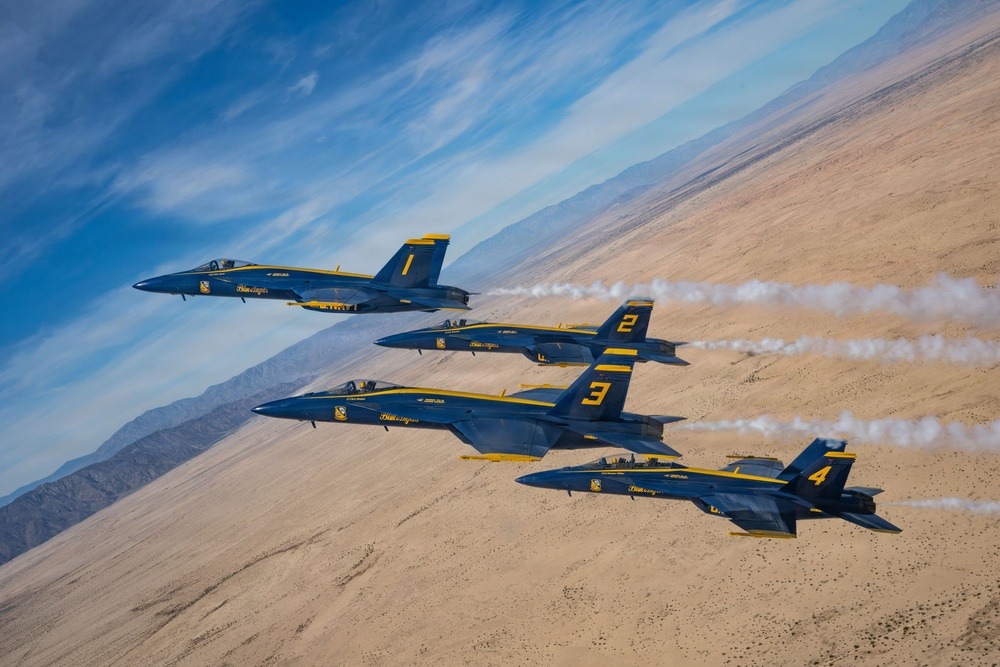
The Blue Angels fly in formation during winter training in El Centro, California, Feb. 24, 2026. After rigorous training and evaluations, Rear Adm. Max McCoy, Chief of Naval Air Training, officially certified the team “airshow ready.” (U.S. Navy photo by MC2 Maxwell Orlosky)
EL CENTRO, Calif. — The U.S. Navy Blue Angels successfully completed their annual certification for the 2026 airshow season on Feb. 23, marking the squadron’s 80th anniversary. The “airshow ready” designation was granted after the team completed its demanding winter training, ensuring they meet the highest standards of safety and performance before embarking for their 2026 season.
Since their founding in 1946, the Blue Angels have served as ambassadors of naval aviation. Rear Admiral Max McCoy, Chief of Naval Air Training (CNATRA), gave final approval for the team’s 80th season after observing their last practice demonstration in El Centro.
“Earning this certification is always an honor, but it carries special weight this year as we prepare to celebrate the squadron’s 80th anniversary,” said Capt. Adam Bryan, Blue Angels’ commanding officer. “This team has worked incredibly hard to be ready to honor that legacy and represent the men and women of the U.S. Navy and Marine Corps. We are eager to get the season started.”
This year’s certification was overseen by CNATRA with a unique understanding of the squadron’s mission, as McCoy is the first former Blue Angel to oversee the Naval Flight Demonstration Squadron as CNATRA. McCoy was assigned to Naval Flight Demonstration Squadron in 2001 and 2005.
“For 80 years, the Blue Angels have represented the absolute pinnacle of naval aviation and this anniversary is a testament to a legacy of excellence that few organizations ever achieve,” said McCoy. “Certification for this historic season was exceptionally rigorous because the standard must be met. This squadron demonstrated unwavering precision and commitment, proving they are not only ready to fly, but ready to continue the Blue Angel legacy with the honor it deserves.”
With their certification complete, the Blue Angels will now begin their season tour across the United States. The Blue Angels team consists of 158 active-duty Sailors and Marines, including pilots, aircrew, maintainers, and many other support personnel.
The Blue Angels will host the last show of the season, the Blue Angels Homecoming Air Show at Naval Air Station (NAS) Pensacola on November 6.
Pensacola, Florida is where the Blue Angels call home during the show season and conduct practices in preparation for events across the country.
Headquartered at Naval Air Station Corpus Christi, Texas, the Chief of Naval Air Training (CNATRA) oversees five training air wings and 17 training squadrons across Florida, Mississippi, and Texas. These squadrons conduct primary, intermediate, and advanced flight training for student naval aviators, naval flight officers, and air vehicle pilots. CNATRA remains steadfast in its mission to train, mentor, and deliver the highest quality naval aviators prepared to win in competition, crisis, and conflict.
Navy Accepts Delivery of Ship to Shore Connector, LCAC 115
By Team Ships Public Affairs, March 11, 2026
NEW ORLEANS – The U.S. Navy accepted delivery of Ship to Shore Connector (SSC), Landing Craft Air Cushion (LCAC) 115 from Textron Systems on March 10.
The delivery of LCAC 115 comes after completion of Acceptance Trials conducted by the Navy’s Board of Inspection and Survey, which tested the readiness and capability of the craft to effectively meet its requirements.
With delivery complete, the craft will transition for fleet integration, crew training, and certification in preparation for operational employment.
LCAC 115 increases the Navy’s capacity to move personnel, vehicles, and equipment across contested littoral environments, directly supporting distributed maritime operations and global crisis response.
“LCAC 115 represents the continuation of Amphibious capability being delivered to the Fleet,” said Capt. Chris Causee, program manager, Amphibious Assault and Connectors Programs, Program Executive Office (PEO) Ships. “Our focus is accelerating the transition from delivery to readiness for operational employment. Each additional connector strengthens the Navy-Marine Corps team’s ability to maneuver, sustain, and respond decisively in complex environments.”
The SSC program restores critical over the beach maneuver capability essential to amphibious operations. Textron Systems is in serial production for LCACs 116-129.
SSC retains the dimensions and well deck compatibility of the legacy LCAC while delivering capabilities with designs for improved reliability and maintainability. Fully compatible with well deck equipped amphibious ships, the craft carries a 60-to-75-ton payload and transports weapon systems, vehicles, cargo, and assault personnel across open ocean and over the beach.
As a Department of War acquisition program, PEO Ships is responsible for executing the development and procurement of destroyers, amphibious ships and craft, and auxiliary ships, including special mission ships, sealift ships, and support ships.
Statement of USS Gerald R. Ford on Shipboard Fire
By Commander U.S. Naval Forces Central Command Public Affairs | March 12, 2026
MANAMA, Bahrain —On March 12, USS Gerald R. Ford (CVN 78) experienced a fire that originated in the ship’s main laundry spaces. The cause of the fire was not combat-related and is contained.
There is no damage to the ship’s propulsion plant, and the aircraft carrier remains fully operational.
Two Sailors are currently receiving medical treatment for non-life-threatening injuries and are in stable condition. Additional information will be provided when available.
The Gerald R. Ford Carrier Strike Group is currently operating in the Red Sea in support of Operation Epic Fury.
‘Let Foreign Yards Build U.S. Navy Auxiliary and Service Ships Now’
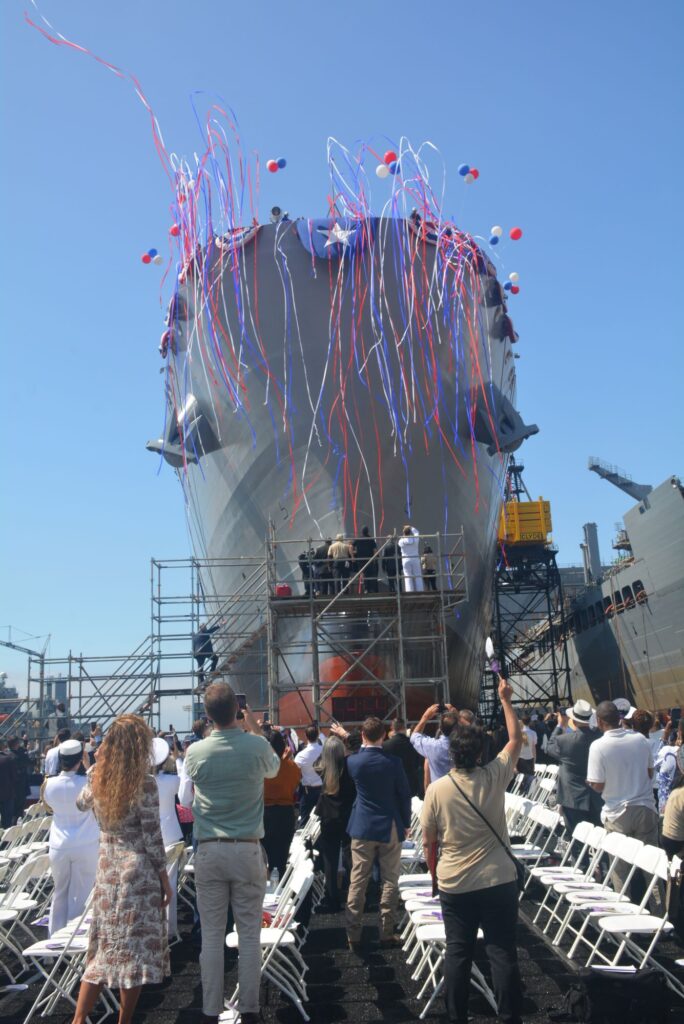
Military Sealift Command’s newest fleet replenishment oiler, USNS Lucy Stone (T-AO 209), slides down the rails, and into the San Diego Bay, following its christening at the General Dynamics NASSCO shipyard in San Diego in 2024. Photo credit: Military Sealift Command Pacific | Sarah Cannon
There is much current discussion about having foreign shipyards build U.S. Navy warships as a way to increase production and fleet numbers. That sounds good on paper, but if the target is combatant ships, then there will be significant challenges.
First, U.S. Code (10 USC 8679 of 1993 states, “no vessel to be constructed for any of the armed forces, and no major component of the hull or superstructure of any such vessel, may be constructed in a foreign shipyard,” unless a presidential waiver in the interest of national security is granted. Even with such a waiver in hand, every nation builds ships to their own standards and reaching commonality, even among close allies, has been historically difficult. The recent Constellation-class frigate debacle exemplifies some of the difficulties that foreign shipbuilders have faced in getting a ship to the U.S. Navy standard, even when such ships are being constructed in the United States. And few if any recent foreign built surface combatants have been actually tested in combat.
Fortunately, there is a U.S. market where foreign shipbuilders can immediately have impact, and that is the long list of badly needed auxiliary and service vessels that the U.S. Navy has also neglected building over the last 40 years; to include tenders, repair ships, hospital vessels, icebreakers and command ships. Building these units will allow foreign shipbuilders to develop the necessary experience to later compete for other U.S. Navy designs but the challenges with combatant warships will persist.
National standards for warship construction vary, and even relatively close allies such as those in NATO have experienced challenges in creating common warship designs. Several attempts have been made over the last 60 years to create a common frigate design which all NATO nations might embrace.
The first of these began with a 1968 working group to build a common antisubmarine warfare frigate for the alliance. There were numerous arguments, however, over what systems the NATO frigate would incorporate, and which nations would provide them. The proposed “Type 70” NATO frigate became eight different national designs, with Belgium, the United Kingdom, France, West Germany, the Netherlands, Denmark, Italy, and the United States all pursuing different specifications. The 1990s saw another attempt to create a common NATO frigate, which also foundered on differing weapons outfitting and missions. Begun in January 1988, eight nations (U.S., U.K., Spain, France, Italy, Canada, Germany, and the Netherlands,) again tried to combine their national frigate requirements. The United States dropped out early in the process, with the U.S. Surface Combatant Force Requirement Study stating there was no need for a new U.S. frigate design, leaving the FFG-7 Oliver Hazard Perry class to soldier on into the 2010s. The British, French and Italians formed the “Horizon” program that ultimately produced air defense destroyers rather than low-end frigates, with the British breaking off of the group to produce what ultimately became the Type 45 destroyer.
Learning Priorities and Concepts
Getting navies to agree on common components is hard, and even when one navy buys another navy’s ship, with a supposedly agreed design, the results can still be mixed. In the early 1990s the U.S. purchased the Italian navy’s Lerici-class coastal mine hunter design, which became the Osprey class in U.S. service. While there is anecdotal evidence the ship’s Voith Schneider propeller system, a major change from the Italian parent design, was not well received by U.S. Navy Sailors and officers, the ships were built and commission as planned and served well until retired (with less than 10 years’ service in some cases) in the mid-2000s to make way for the planned mine warfare capabilities of the littoral combat ship.
The problems of the Constellation-class frigate, and its alleged 85% deviation from its Italian/French FREMM design, are well known and need not be belabored. The FREMM has been a very successful design for the Italian, French, Tunisian and Algerian navies, but the vast number of changes imposed on the design by the U.S. Navy hints at the very different idea of what elements of ship design characterize a U.S. frigate. U.S. Naval Sea Systems Command (NAVSEA) representatives would need to monitor every step of design and construction as they do for ships built in the United States. It would take time for each side (foreign shipbuilder and NAVSEA) to learn the other’s priorities and operating concepts. The practicalities of that level of oversight are likely to make current standards impossible to guarantee.
Classification would be another issue even with a presidential waiver to build overseas in hand. Will large numbers of foreign shipbuilders need U.S. background checks and/or security classification to work with a U.S. surface combatant build? If no, would large numbers of U.S. workers need to move to foreign yards, probably with appropriate language expertise to work within an unfamiliar foreign shipyard environment? Such special considerations would need advanced coordination before any shipbuilding takes place and are likely to involve increased costs. Overlay the complexities of Union acquiescence and the difficulties fall into sharper focus.
The habitual relationships developed during associations between U.S. shipbuilders and the U.S. Navy contribute to generally a smooth building organization, notably in mature U.S.-design aircraft carrier, submarine, destroyer and amphibious vessel building programs. Regardless of other shipbuilding challenges with the littoral combat ship and the Constellation-class frigate, U.S. warships have performed to design in naval combat in the Red Sea and other parts of the globe.
While there has not been sustained, high end naval warfare since 1945, few navies other than the United States Navy have engaged in anything approaching World War II combat. U.S.-built ships such as the Perry-class frigates Stark and Samuel B. Roberts, and the Arleigh Burke-class destroyers Cole, Fitzgerald and John S. McCain, all suffered significant battle or collision damage and survived to be repaired and rejoin the active fleet. Expert U.S. Navy damage control provided by well-trained, brave, and resolute U.S. Navy Sailors contributed to the saving of all these ships, but so too did their robust construction and durability in operations. Any foreign-built, U.S. Navy combatants would need to equal these high standards. Could they?
Hybrid Methods
This is not to suggest foreign yards could not make contributions to U.S. warships. There are some hybrid methods through which vessels can be partially built in foreign shipyards and then moved incomplete to a U.S. naval or civilian shipyard for final outfitting of government-furnished equipment. Australia’s Landing Ship, Helicopter Dock (LHD) Canberra class of two ships (Canberra and Adelaide) were built as a joint project between Navantia shipbuilding (Spain) and then-Tenix Defence (now part of BAE Systems) from 2007-2015. Navantia produced the hull of the ship and associated machinery up to the flight deck, while BAE systems completed what was termed the “Australianization” of the ships and its supply chain systems after the hulls were moved from Spain to Australia via heavy-lift vessel.
Sweden similarly had its new intelligence gathering ship HSwMS Artemis partially built in the Polish Nauta shipyard, but the vessel was delivered earlier than planned due to business issues within the Polish yard and finished by Sweden’s only naval yard operated by Saab Kockums, with assistance from Polish shipworkers working at the Swedish yard. While this was not the intended plan to complete the vessel, it is an example of primary construction by a foreign yard that was finished in the vessel’s own flag state.
These examples illustrate the challenges of building combatant ships of any navy in a foreign shipyard. It’s not “mission impossible,” but there are enormous challenges to overcome before such construction can take place. In the meantime, the United States Navy has significant requirements for its long-neglected service fleet and combat logistics force that can be met by foreign shipyards. The U.S. has purchased logistics vessels from other nations in the past, and much of the construction of tenders, repair ships, hospital vessels, and command ships could, like the Australian LHD vessels, be built largely in foreign yards and then outfitted as U.S. or Military Sealift Command ships in U.S. shipyards. Those ship types are good starting points for foreign yards seeking U.S. navy — specifically Military Sealift Command — business.
USS Mustin to forward-deploy to Japan
The Arleigh Burke-class guided-missile destroyer USS Mustin (DDG 89) transits San Diego Bay past Point Loma, Feb. 23, 2026. The ship departed Naval Base San Diego and will forward deploy to Yokosuka, Japan, as part of a scheduled rotation of forces in the Pacific. (U.S. Navy photo by Mark D. Faram)
From Courtesy Story, March 11, 2026
Arleigh Burke-class guided-missile destroyer USS Mustin (DDG 89) will forward deploy to Yokosuka, Japan, as part of a scheduled rotation of forces in the Pacific. This move will be a permanent change of station for the crew and family members.
Mustin will replace Ticonderoga-class guided-missile cruiser USS Robert Smalls (CG 62), which will depart Yokosuka and shift to San Diego.
The forward presence of Mustin supports the United States’ commitment to the defense of Japan, enhances regional deterrence and ensures we maintain combat credible force ready to operate in a contested environment. Mustin will directly support the Defense Strategic Guidance to posture the most capable units forward in the Indo-Pacific Region.
The United States values Japan’s efforts to strengthen its defense capabilities and its hospitality in hosting U.S. forces forward deployed there. The U.S.-Japan alliance is important to upholding deterrence and preserving peace in the Indo-Pacific region. These forward deployed forces, along with their counterparts in the Japan Self-Defense Forces, make up the core capabilities needed to improve coordination and upgrade the alliance for effective denial defense and joint warfighting.
The Department’s peace through strength approach is rooted in credible military power, forward-postured forces, and sustainable alliances deter aggression and preserve peace. By positioning the most capable ships forward, this posture rapidly brings our most capable ships with the greatest operational capability to bear in the event of a crisis.
Maintaining a forward deployed naval force capability with the most advanced ships supports the Department’s priority of preserving combat credible forces forward to deter aggression and ensure peace through strength in the Indo-Pacific region.
Navy Announces Commissioning of the Future USS Harvey C. Barnum Jr.
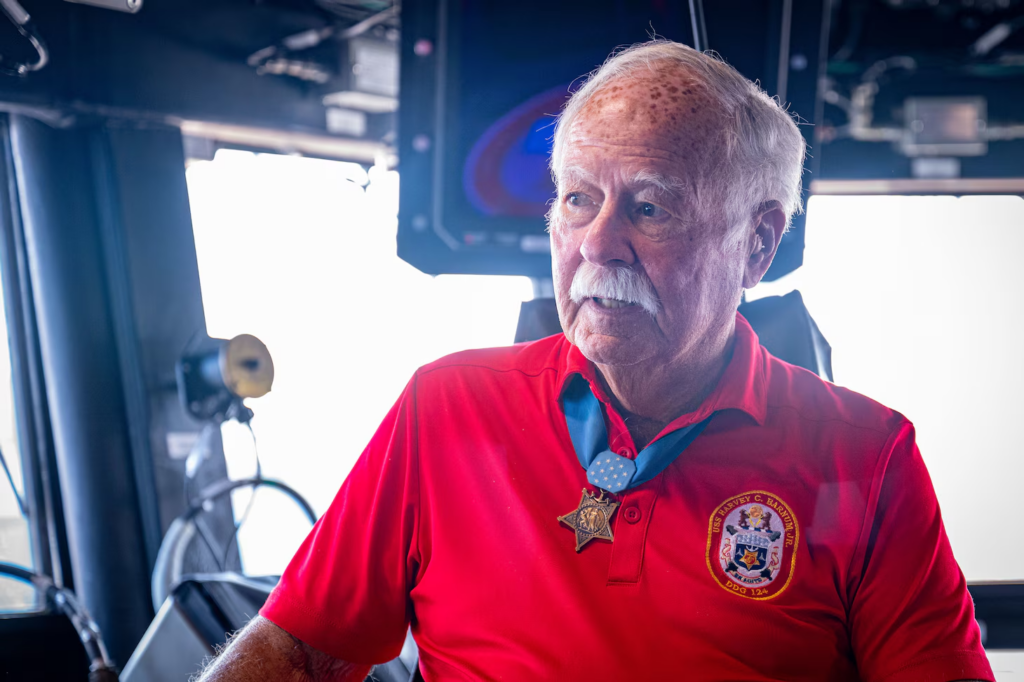
ATLANTIC OCEAN (July 15, 2025) – U.S. Marine Corps Col. (Ret) Harvey C. Barnum Jr. , a Medal of Honor recipient, poses for a photo during sea trials aboard the Arleigh Burke-class guided-missile destroyer Pre-Commissioning Unit Harvey C. Barnum Jr. (DDG 124), July 15. The ship is named in honor of Barnum, who received the Medal of Honor for valor during the Vietnam War. (U.S. Navy Photo by Neil Boorjian)
From Commander, Naval Surface Force, U.S. Pacific Fleet, 11 March 2026
The U.S. Navy will commission the future USS Harvey C. Barnum Jr. (DDG 124) on April 11, 2026, in Norfolk, Virginia.
The Arleigh Burke-class destroyer is the first ship to bear the name of Medal of Honor recipient, U.S. Marine Corps Col. Harvey Curtiss “Barney” Barnum Jr. The ship honors Barnum’s gallantry and intrepidity at the risk of his life beyond the call of duty during the Vietnam War.
On Dec. 18, 1965, then-1st Lt. Barnum assumed command of his company after the commander was mortally wounded. His actions stabilized decimated units and ultimately led to a successful counterattack against key enemy positions. With two armed helicopters under his control, he moved fearlessly through enemy fire to lead air attacks against the enemy’s well-entrenched positions while directing one platoon in a successful counterattack on the key enemy positions. Having cleared a small area, he requested and directed the landing of two transport helicopters to evacuate the deceased and wounded. He then assisted in the seizure of the battalion’s objective. He is among the few living namesakes to witness the commissioning of his ship.
The sponsor of DDG 124 is Barnum’s wife, Martha Hill. Since the ship’s keel laying ceremony in 2021, Barnum and Hill have maintained a close relationship with the crew. In keeping with Navy tradition, she will give the order during the commissioning to “man our ship and bring her to life!” At that moment, the crew will hoist the commissioning pennant, and USS Harvey C. Barnum Jr. will become a warship and enter the fleet.
Following its commissioning, DDG 124 will be homeported at Naval Station Norfolk.
Arleigh Burke-class guided-missile destroyers are the backbone of the U.S. Navy’s surface fleet. DDG 124 is a Flight IIA destroyer equipped with Aegis Baseline 9, which provides Integrated Air and Missile Defense capabilities, increased computing power, and radar upgrades that improve detection range and reaction time against modern air warfare and Ballistic Missile Defense threats. These highly capable, multi-mission ships provide a wide range of warfighting capabilities in multi-threat air, surface, and subsurface environments.
The commissioning ceremony will stream on the Defense Video Information Distribution Service (DVIDS) at www.dvidshub.net/webcast/37421. The live stream will begin at 9:50 a.m. EST, and the ceremony will begin at 10 a.m. EST on April 11.
The mission of Commander, Naval Surface Force, U.S. Pacific Fleet (CNSP) is to man, train, and equip the Surface Force to provide fleet commanders with credible naval power to control the sea and project power ashore. For more news from Commander, Naval Surface Force, U.S. Pacific Fleet, visit https://www.surfpac.navy.mil/.
Navy Kicks Off Operation Ice Camp 2026 in the Arctic Ocean
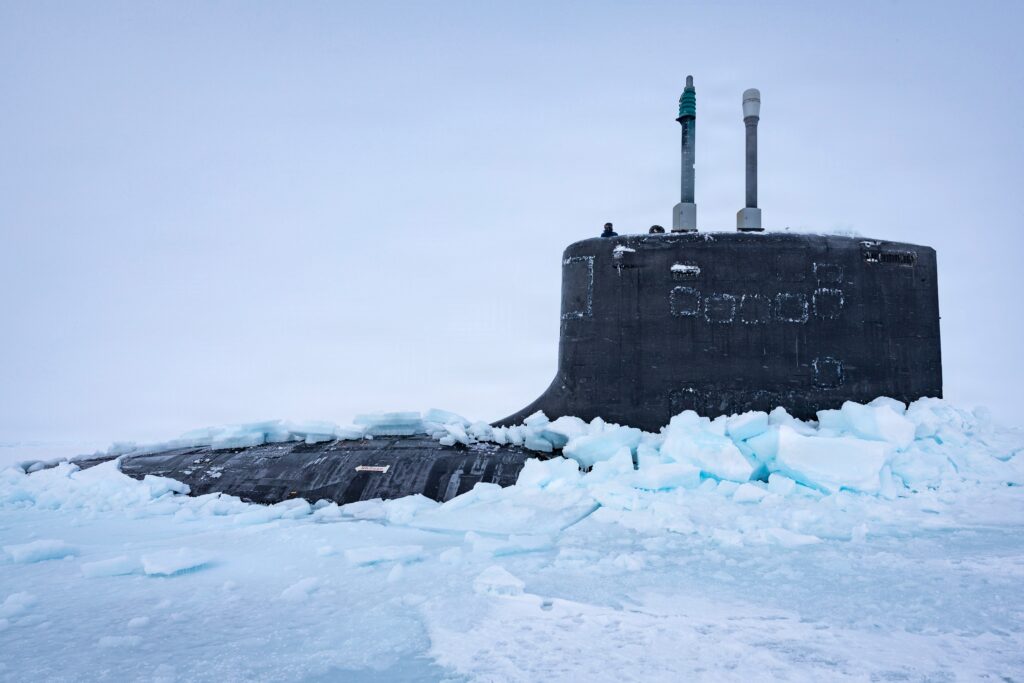
ARCTIC CIRCLE – Virginia-class fast-attack submarine USS Delaware (SSN 791) emerges from the ice after performing a vertical surfacing to kick off Operaetion ICE CAMP 2026, Mar. 7. ICE CAMP Boarfish is a three-week operation designed to research, test, and evaluate operational capabilities in the Arctic region (U.S. Navy Photo by MC1 Jacob D. Bergh)
From U.S. Fleet Forces Command, March 9, 2026
BARENTS SEA – Commander, Submarine Forces officially kicked off Operation Ice Camp (ICE CAMP) Boarfish in the Arctic Ocean on March 7, 2026, after the building of the camp and the arrival of two U.S. Navy fast attack submarines, USS Delaware (SSN 791) and USS Santa Fe (SSN 763).
ICE CAMP Boarfish is a three-week operation designed to research, test, and evaluate operational capabilities in the Arctic region. In addition to U.S. Navy, U.S. Marine Corps, and Air National Guard participation, personnel from the Royal Australian Navy, Royal Canadian Navy, Royal Canadian Air Force, French Navy, Royal United Kingdom Navy, Norwegian Defence Research Institute, and the Japan Agency for Marine-Earth Science and Technology are also taking part.
This operation, held biennially, partners with the Arctic Submarine Laboratory and was elevated from an exercise to an operation to better reflect the Navy’s strategic priorities in the Arctic. ICE CAMP provides the necessary training to maintain a working knowledge of a constantly changing region.
“The Arctic is a critical region for national security and global stability. Our commitment to a sustained presence and operational readiness here is unwavering,” said Vice Adm. Richard Seif, Commander, Submarine Forces. “ICE CAMP Boarfish allows us to test and refine our capabilities, deepen our interoperability with key allies, and ensure our Submarine Force can project power and defend our nation’s interests in any environment, at any time. Our strength in the Arctic is a testament to the skill and resilience of our sailors and partners.”
The Navy’s Arctic Submarine Laboratory, a detachment of the Undersea Warfighting Development Center, is the lead organization for planning and executing the operation. ASL serves as the “Center of Excellence” for Arctic matters for the U.S. Submarine Force. The Arctic is experiencing a trend of diminishing sea ice, which increases the likelihood of maritime activity in the region, including trans-oceanic shipping and resource extraction.
The camp, named Ice Camp Boarfish, serves as a command center for conducting operations and research. Established on a drifting ice floe, the camp consists of shelters, a command center, and the necessary infrastructure to safely house and support the multi-national contingent of personnel throughout the operation.
“Leading this multinational team in such a demanding environment is a privilege,” said Capt. David Nichols, Officer in Tactical Control of this year’s ICE CAMP. “The complexity of establishing a fully functional base on a moving sheet of ice cannot be overstated. The professionalism and dedication of every service member and civilian here is what makes this vital mission possible. We are focused on executing our objectives safely and effectively, further enhancing our collective readiness for Arctic operations.”
The camp gets its namesake from the USSBoarfish(SS 327), aBalao-class submarine commissioned on September 23, 1944.During her service in World War II,Boarfishearned a battle star for sinking two Japanese vessels in the South China Sea.
In 1947,Boarfishserved as the flagship for Operation Blue Nose, the first-ever exploration under the polar ice cap, where she tested new under-ice sonar technology. This historic mission demonstrated that extended under-ice navigation was practical and paved the way for future submarine operations in the Arctic.
Submarines have conducted under-ice operations in the Arctic for more than 60 years. USS Nautilus (SSN 571) made the first transit in 1958, and USS Skate (SSN 578) was the first U.S. submarine to surface through Arctic ice at the North Pole in March 1959. Since those initial voyages, the U.S. Submarine Force has completed 99 such evolutions, with ICE CAMP Boarfish being the 100th.
U.S. Submarine Forces execute the Department of the Navy’s mission in and from the undersea domain. In addition to lending added capacity to naval forces, Submarine Forces are expected to leverage those special advantages that come with undersea concealment to permit operational, deterrent, and combat effects that the Navy and the Nation could not otherwise achieve.
U.S. Submarine Forces and supporting organizations constitute the primary undersea arm of the Navy. Submarines and their crews remain the tip of the undersea spear.