Major Pier Project Completed at Naval Base Kitsap Bangor
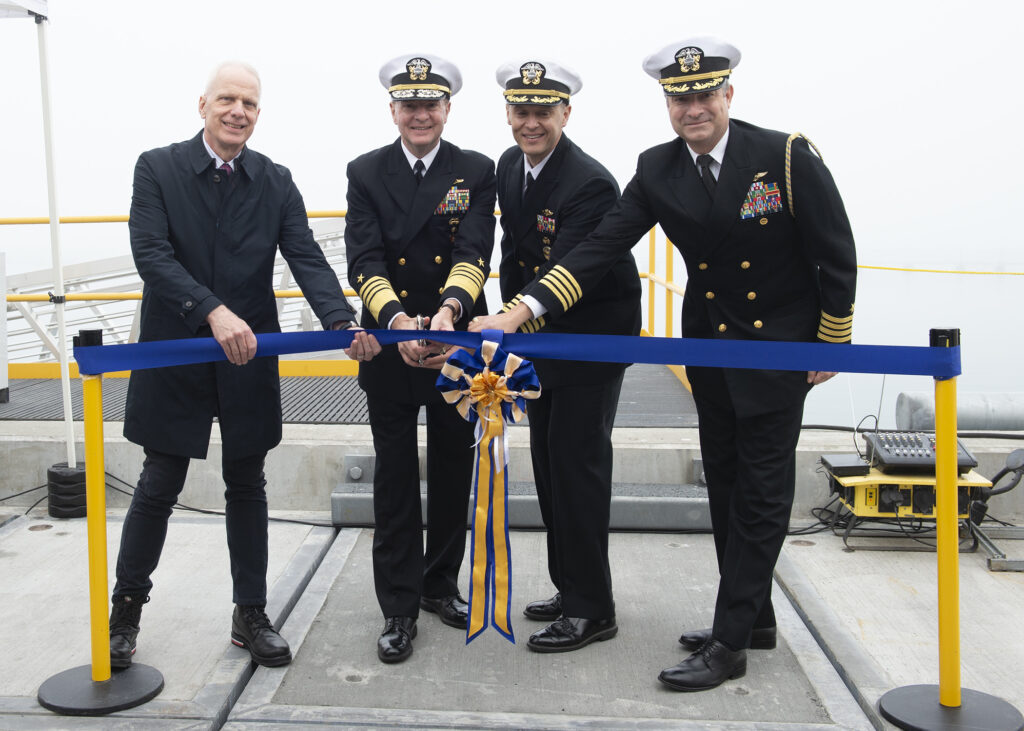
Mr. Peter Fleck, Submarine Development Group 5 facility operations manager, left, Adm. Stuart Munsch, commander, U.S. Naval Forces Europe-Africa, Capt. Gary Montalvo, commodore, Submarine Development Group 5 and Capt. Kevin Pickard, chief of staff, Navy Region Northwest, cut a ribbon during a ceremony for a newly-completed service pier located on Naval Base Kitsap – Bangor, October 19, 2022. U.S. NAVY / Mass Communication Specialist 1st Class Brian G. Reynolds

NAVAL BASE KITSAP, Wash. — Submarine Development Squadron (DEVRON) 5 held a ribbon cutting ceremony, Oct. 19, 2022, on a newly-completed service pier extension located on Naval Base Kitsap Bangor, Washington, Lt. Cmdr Christopher F. Donnelly of Commander, Submarine Force, U.S. Pacific Fleet, said in a Nov. 1 release. 

The ceremony marked the completion of a major infrastructure project, nicknamed the “Olympic pier” due to its proximity to the Olympic Mountain Range, which will support the arrival of fast attack submarines, including the planned change of homeport for USS Seawolf (SSN 21) and USS Connecticut (SSN 22) from Naval Station Bremerton to Naval Base Kitsap-Bangor. 
 
The ceremony, which was led by Capt. Gary Montalvo, commodore of DEVRON 5, hosted the event which featured Adm. Stuart Munsch, commander of U.S. Naval Forces Europe-Africa, as the keynote speaker. 

The service pier extension project was more than a decade in the making. Originally envisioned in 2008 and supported by Munsch, who was the DEVRON 5 commodore at the time and knew it was a project that was needed to service all classes of SSNs. Construction began in 2020. 
 
“Your efforts, and that of many others over the years, to build this pier and ready it to sustain our most advanced submarines, represents the best of the many organizations working together, fighting any and all obstacles to build capability to enhance our undersea dominance,” said Montalvo. 
 
The service pier extension includes state-of-the-art technologies for security and pier services for moored submarines. The shore power configuration incorporates the latest technology to provide multiple fully redundant power sources, ensuring continuous safe in-port operations and minimizing the affects due to normal wear and tear or natural disasters. The pier boasts a first-of-its-kind captured mooring system that compensates for tidal changes, which will ensure all classes of submarines remain securely moored without need to frequently adjust mooring lines. 
 
A full environmental assessment of the project was performed during the design phase in order to minimize the environmental impacts to the Hood Canal and its local fish and wildlife. Environmental considerations include a newly-designed, all-electric crane which will provide service on the pier, and the deliberate positioning of backup diesel generators located upland, away from the water. 
 
Upland support infrastructure for the service pier extension include a newly constructed parking lot to provide safe and convenient access for submarine crews and support personnel. The pier has maintenance support facilities dedicated to units moored at the service pier extension. 
 
“The completion of Olympic Pier advances a visionary shore infrastructure plan designed to improve quality of work for our Sailors, increase operational availability of fast attack submarines in the Pacific Northwest, and advance the research, development, test and evaluation needed to deliver decisive warfighting advantage,” said Munsch. “Olympic Pier enables us to bring together intellectual and industrial partners with the Submarine Force’s most experienced operators of advanced undersea systems and, now, the right current and future submarines to test and field those decisive new capabilities.” 
 
The service pier extension provides substantial immediate and long term benefits to the submarine force and the Navy. The planned change of homeport for Seawolf and Connecticut will improve the quality of service to the units while in port. Dedicated pier and maintenance facilities promote efficiency for maintenance. 
 
Support, training and oversight provided by DEVRON 5, the Immediate Superior in Command, will be improved by the close physical proximity of the boats. Longer-term benefits include the capability to maintain increased persistent presence of fast attack submarines in the northern Pacific region, and the continued development of future undersea warfare capabilities.


Navy Achieves Full Operational Capability on Critical Underwater Training Range

The Naval Aviation Training Systems and Ranges program office (PMA-205) recently achieved Full Operational Capability on their Undersea Warfare Training Ranges Increment I (USWTR INC I) program. U.S. NAVY

PATUXENT RIVER, Md. — The Naval Aviation Training Systems and Ranges program office’s (PMA-205) Ocean Systems Fixed Ranges team recently achieved full operational capability on the Undersea Warfare Training Ranges Increment I (USWTR INC I) program 13 months ahead of schedule, the Naval Air Systems Command said in a Nov. 1 release. 

The Naval Aviation Training Systems and Ranges program office’s (PMA-205) Ocean Systems Fixed Ranges team recently achieved full operational capability on the Undersea Warfare Training Ranges Increment I (USWTR INC I) program 13 months ahead of schedule. U.S. NAVY 

 The USWTR INC I training range supports fleet readiness through realistic training and the tactical development of submarine, surface ship, and aircraft undersea warfare capabilities. 
“Since completing installation, the fleet has conducted four exercises on the Increment I range, to include critical anti-submarine warfare exercises, which shape future exercises and further advance the capabilities the Navy has to offer,” said Brandi Payne-Tapponnier, the program’s team lead. USWTR INC I allows for timely and accurate feedback of training performance to exercise participants and the ability to rapidly reconstruct the training event, enhancing the quality of complex training scenarios, she said.  

The USWTR program consists of three increments. During USWTR INC I, the team managed the installation of the ocean sensor and shore electronics subsystems located off the coast of Florida. Under Increments II and III, the team is upgrading previously installed systems at the USWTR’s other range locations in areas of the Pacific Ocean and international waters of the Caribbean Sea. 

“These ranges are essential to our national security, and provide critical support to the helicopter maritime strike, maritime patrol and reconnaissance, and Navy ship communities,” said Capt. Kevin McGee, PMA-205 program manager. “They include a vast array of technology providing a realistic training environment that enables ships and aircraft to track targets for anti-submarine warfare training, which increases fleet capability and lethality.” 

The team acquired and installed an additional total of 500 nautical miles of instrumented undersea warfare training ranges in littoral waters in the Atlantic Ocean. Secondary missions of USWTR INC I include training in shallow water and conducting regional conflict operations training. 


Navy Resumes Flight Operations for Some T-45 Aircraft

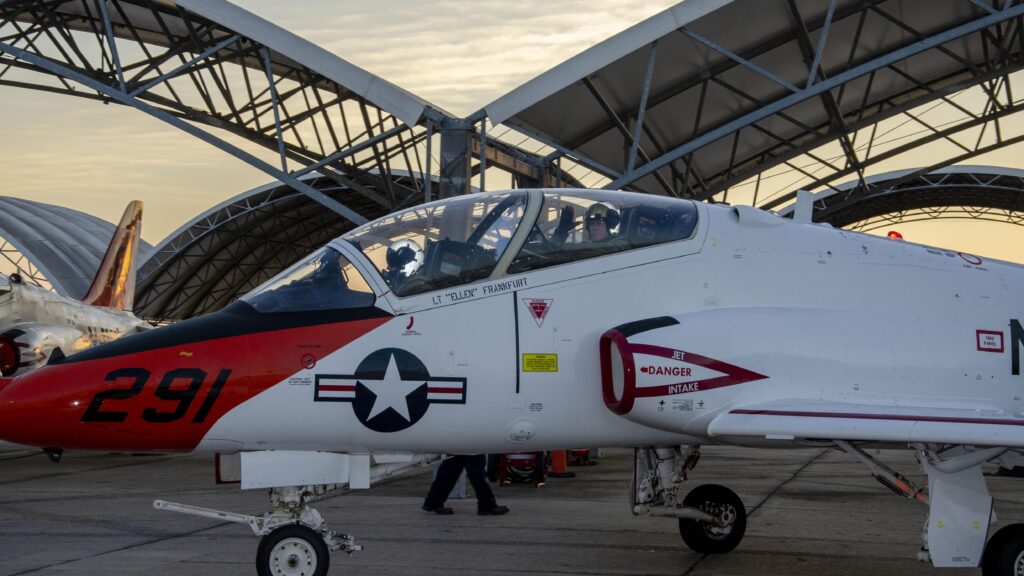
Chief of Naval Air Training Rear Adm. Richard Brophy (right) and Training Squadron 21 Commanding Officer Cmdr. Matthew Starr taxi in a T-45C Goshawk prior to a proficiency flight, Oct. 31. U.S. NAVY

PATUXENT RIVER, Md. — Chief of Naval Air Training (CNATRA) had resumed T-45C Goshawk aircraft flight operations Oct. 31, the Naval Air Systems Command said in a release.  

The Navy and Marine Corps’ fleet of T-45Cs have been on a safety pause since Oct. 14 following the discovery of an engine blade failure. Engineering analysis has revealed that a subset of T-45C engine blades do not meet the manufacturer’s engine specifications; those aircraft remain grounded. The T-45Cs that have returned to flight contain engines that are compliant with these specifications.  

“The process of returning to operations is based off engineering analysis by NAVAIR, with the most important decision being the safety of our aviators,” said CNATRA Rear Adm. Richard Brophy. “The aircraft we are flying are verified and known-good. We have the highest confidence in the compliance of these aircraft.” 

Flight operations for the rest of the T-45C fleet will remain paused as the Navy and its industry partner Rolls Royce continue to evaluate engineering data on the non-conforming parts and work to return additional T-45Cs to operational status. During this time, training air wings and squadrons are maximizing ground training, including classroom lectures, simulators and computer-based training. 

The T-45C is a tandem-seat jet trainer whose mission is to train Navy and Marine Corps pilots. 

“We sincerely thank the team at NAVAIR for their hard work and commitment to finding the best possible solution for the long-term safety of our aviators and aircraft. While the reintroduction of the T-45C fleet will be a staggered approach, it is not a process that will be rushed. It is essential that our maintenance partners analyze and diagnose this issue thoroughly so training operations can fully resume with the safety of each of our aviators as a top priority,” said Brophy. 

“Safety of our student aviators and instructors is paramount,” said Rear Adm. John Lemmon, Program Executive Officer for Tactical Aircraft Programs (PEO(T)). “Our Navy teams and industry partner are diligently and thoroughly analyzing all facets of this issue to determine a safe and expeditious way forward for the rest of the T-45 fleet to return to flight.”


NATO Concludes Successful Vigilance Activity Neptune Strike

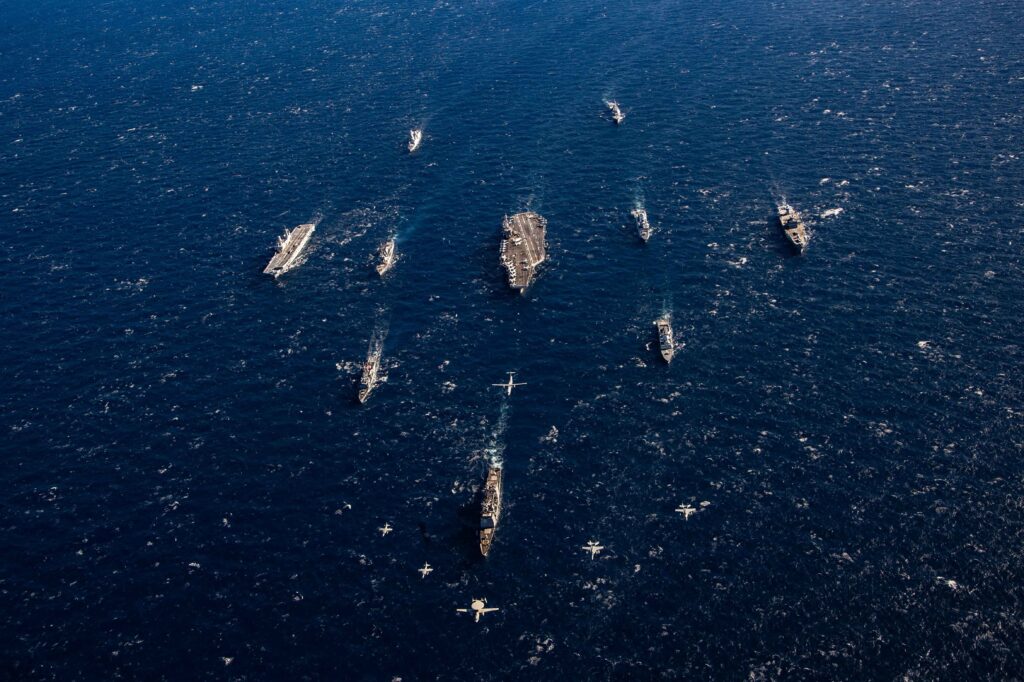
Aircraft assigned to Carrier Air Wing (CVW) 1 and the Italian Navy fly over the Mediterranean Sea as ships from Harry S. Truman Carrier Strike Group (CSG) 8, Standing NATO Maritime Group 2 (SNMG 2), the Italian Navy Cavour CSG and the Blue Ridge-class command and control ship USS Mount Whitney (LCC 20) transit the Mediterranean Sea in support of Neptune Strike 2022, Feb. 2, 2022. U.S. NAVY / Mass Communication Specialist 3rd Class Bela Chambers

OEIRAS, Portugal — Naval Striking and Support Forces NATO (STRIKFORNATO) and U.S. Sixth Fleet (SIXTHFLT) concluded Vigilance Activity Neptune Strike, the eighth phase of NATO’s long-planned Project Neptune series of activities, from STRIKFORNATO headquarters in Oeiras, Portugal, Oct. 28, Naval Striking and Support Forces NATO Public Affairs and U.S. Sixth Fleet Public Affairs said in a release. 

Neptune Strike demonstrated the combined capacity of the Alliance while underscoring allied and partner nations’ commitments to deterrence and defense of sovereign Alliance territory. This activity and NATO’s wider strategy deters adversaries and terrorist groups from spreading destabilization, widening disorder or accruing decisive military advantage that would impact allies’ security. 

“Neptune Strike sits at the leading edge of NATO’s vigilance activities, providing credible deterrence and demonstrating the inherent flexibility of the carrier strike group while building high-end interchangeability among our NATO allies and partners on a firm foundation of trust,” said Vice Adm. Thomas Ishee, commander of both SIXTHFLT and STRIKFORNATO. “The energy across the entire Naval Striking and Support Forces NATO team was palpable as we pushed the bounds of allied integration in the land, air and on the seas.” 

Throughout the two-week long vigilance activity, NATO servicemembers from several allied nations planned, briefed, and executed a variety of specific evolutions, including air-to-land integration with allies including Hungary, Lithuania, North Macedonia, Poland and Slovakia, maritime and interdiction activities, and air-to-air refueling and air-to-air rehearsal events throughout allied airspace. 

While allied and partner aircraft flew together in the skies, the ships of the George H. W. Bush carrier strike group (GHWBCSG) sailed alongside multiple allied ships in the Adriatic and Ionian Seas. These included Albanian and Croatian ships, as well as members of Allied Maritime Command’s Standing NATO Maritime Group (SNMG) 2 and Standing NATO Mine Countermeasures Group (SNMCMG) 2 and the United Kingdom’s Littoral Response Group (LRG). 

“I could not be more proud of the teamwork, expertise and professionalism displayed by everyone in making Neptune Strike 22.2 a resounding success,” said Ishee. “The evolution of Project Neptune is both a testament to the innovation of the NATO Alliance and a tangible demonstration that we truly are stronger together.” 

The diversity and complexity of evolutions conducted during Neptune Strike, through multiple domains and unique scenarios, continued to validate interoperability of a CSG within NATO command and control architectures to contend with a rapidly evolving security environment. The activity is proof of the warfighting advantage that characterizes allied interoperability and, ultimately, the strength of the most successful Alliance in history. 

“Neptune Strike has again offered a perfect opportunity to fully integrate the combat power of a U.S. aircraft carrier into enhanced Vigilance Activity in direct support of NATO’s commitment to deter conflict and defend allies. It has offered the chance to combine capabilities from a large number of nations in all warfare domains — on land, at sea and in the air — as a clear demonstration of allied unity of purpose and cohesion,” said Royal Navy Rear Adm. James Morley, deputy commander, STRIKFORNATO. “It has further rehearsed STRIKFORNATO’s role as the primary integrator for U.S. maritime combat power. The George H.W. Bush Carrier Strike Group is now even better prepared to execute complex missions in concert with wider allied efforts to defend the Euro-Atlantic area.” 

NATO Secretary General Jens Stoltenberg’s visit to the Nimitz-class aircraft carrier USS George H. W. Bush (CVN 77) on Oct. 25 served as a key highlight of the activity. While aboard the ship, Stoltenberg reflected on the carrier’s presence as a demonstration of U.S. capability and commitment to the Alliance, a general escalation of tension between European powers, and how the conclusion of Neptune Strike – and its inclusion of more than 70 aircraft, 20 ships and 5,000 personnel from 26 NATO allies and partners – demonstrates NATO’s capability on the world stage. 

“[Neptune Strike 2022] is a perfect example of the transatlantic bond — Europe and North America working together in NATO,” Stoltenberg said. “[NATO’s] strength helps to prevent any miscalculation by sending a clear message: NATO will protect and defend every inch of allied territory.” 

Participating nations in Neptune Strike included Albania, Belgium, Bulgaria, Canada, Czechia, Croatia, Denmark, France, Germany, Greece, Hungary, Italy, Latvia, Lithuania, the Netherlands, North Macedonia, Norway, Poland, Portugal, Romania, Slovakia, Spain, Sweden, Türkiye, U.K. and the U.S. 

Vigilance Activities are day-to-day activities, occurring in all domains and across SACEUR’s area of responsibility, to ensure appropriate strategic awareness and force readiness required to sustain peace. 

For over 80 years, U.S. Naval Forces Europe-U.S. Naval Forces Africa (NAVEUR-NAVAF) has forged strategic relationships with allies and partners, leveraging a foundation of shared values to preserve security and stability. 

Headquartered in Naples, Italy, NAVEUR-NAVAF operates U.S. naval forces in the U.S. European Command (USEUCOM) and U.S. Africa Command (USAFRICOM) areas of responsibility. U.S. Sixth Fleet is permanently assigned to NAVEUR-NAVAF, and employs maritime forces through the full spectrum of joint and naval operations. 

STRIKFORNATO, headquartered in Oeiras, Portugal, is Supreme Allied Commander Europe’s (SACEUR) premier, rapidly deployable and flexible, maritime power projection Headquarters, capable of planning and executing full spectrum joint maritime operations.


U.S. Navy Rescues Mariners Who Set Fire to Vessel Smuggling Drugs

Sailors aboard the coastal patrol ship USS Thunderbolt (PC 12) extinguish a fire aboard a fishing vessel in the Gulf of Oman, Oct. 29, 2022. The vessel, found to be smuggling illicit cargo, was set on fire by the fishing vessel’s crew as U.S. forces approached. U.S. NAVY

MANAMA, Bahrain — U.S. Navy personnel rescued eight civilian mariners in the Gulf of Oman, Oct. 29, after they set their fishing vessel on fire prior to being boarded, U.S. Naval Forces Central Command Public Affairs said in an Oct. 30 release.. 

U.S. Navy patrol coastal ship USS Sirocco (PC 6) was conducting a counter-smuggling patrol in international waters when the mariners set their fishing vessel ablaze. Sailors from Sirocco rescued the mariners from the water and provided medical aide as USS Chinook (PC 9) and USS Thunderbolt (PC 12) extinguished the fire on the vessel. 

“This was a superb effort by all of our crews,” said Vice Adm. Brad Cooper, commander of U.S. Naval Forces Central Command, U.S. 5th Fleet and Combined Maritime Forces. “I couldn’t be prouder of everyone involved in saving lives while carrying out our mission to disrupt destabilizing maritime activity.” 

The mariners, who identified themselves as Iranian and Pakistani, admitted to smuggling hashish and methamphetamines. U.S. naval forces recovered 560 kilograms of hashish worth an estimated $1 million, about one-third of the total shipment. The remaining drugs were destroyed in the fire. 

After the mariners received immediate medical care, all were transferred to a regional nation for additional treatment and repatriation. The fishing vessel, which sustained significant damage during the fire, sank. 

The rescue comes three days after U.S. Navy personnel rescued three civilian mariners in the Gulf of Aden, Oct. 26, after their small motorboat caught fire while transiting international waters. 

Guided-missile destroyer USS Nitze (DDG 94) and patrol coastal ship USS Monsoon (PC 4) responded after observing the mariners in distress and immediately rendered assistance. Sailors safely rescued the civilian mariners before their burning vessel sank approximately 50 miles off the coast of Yemen. 

The U.S. 5th Fleet operating area includes 21 countries, the Arabian Gulf, Gulf of Oman, Red Sea, parts of the Indian Ocean and three critical choke points at the Strait of Hormuz, Bab al-Mandeb and Suez Canal. 


EA-18G Growler Returns to the Skies Five Years After a Mid-Air Collision

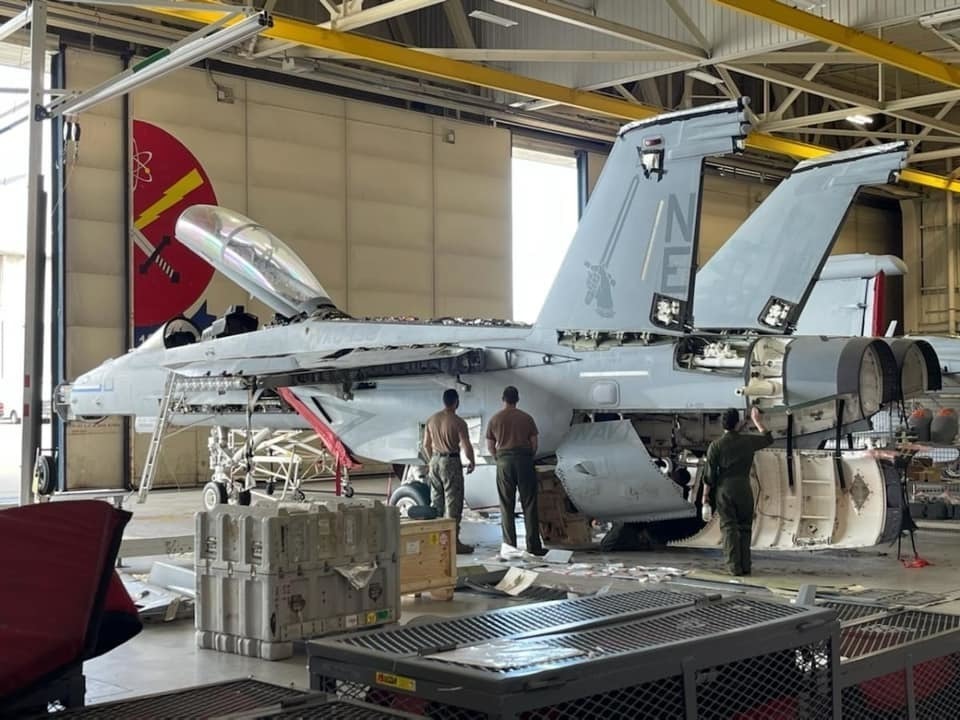
EA-18G Growler 515, assigned to Electronic Attack Squadron (VAQ) 129, is refurbished at Naval Air Station Whidbey Island (NASWI). The aircraft flew its functional check flight on Oct. 17, 2022 at NASWI and will be reentered into service with a forward-deployable squadron in the near future. U.S. NAVY

WHIDBEY ISLAND, Wash. — An EA-18G Growler attached to Electronic Attack Squadron (VAQ) 129, successfully completed a functional check flight at Naval Air Station (NAS) Whidbey Island, Oct. 17, marking the end of a complex transformation process for an aircraft thought to be beyond repair, Commander Naval Air Forces Public Affairs said in an Oct. 2 release. This five-year effort demonstrates large-scale teamwork between multiple organizations over an extended timeline. 

The aircraft, then attached to the “Wizards” of VAQ-133, was involved in a mid-air collision with another aircraft attached to Carrier Air Wing (CVW) 2 at NAS Fallon during a training event on Sept. 14, 2017. Both aircraft landed safely and the aircrew were uninjured. The Growler remained at NAS Fallon for several years, as refurbishment of this nature had never been done before and there were no processes or procedures on exactly how the repairs could be completed. 
 
Upon initial inspection, there was little hope the aircraft would be fit to fly due to the complexity of the repairs required following the mishap, as well as weather damage from years of sitting in a desert environment. However, after thorough analysis and continued coordination, the Growler’s road to recovery began when clearance for repair was granted in 2021. In February of that year, the aircraft was loaded onto a flatbed truck and transferred to the Fleet Replacement Squadron, VAQ-129, at NAS Whidbey Island. 
 
Classified as a “special rework,” funding was approved and a long-term hangar space was identified for the unprecedented project. For more than a year, engineers, maintainers and artisans from facilities across the United States collaborated to develop processes, complete repairs and thoroughly inspect the recovered aircraft — more than 2,000 man hours in total. 
 
“This was a team effort by personnel from Fleet Readiness Center (FRC) Southeast, FRC Southwest Engineering and my team from FRC Northwest,” said Tommy Moore, depot lead for FRC Northwest. “We reassembled the aircraft by replacing all major components and turned the aircraft back over to VAQ-129 as a ‘special rework’ complete on April 24, 2022.” 

The Growler will soon be transferred to an operational squadron in order to deploy around the globe and be ready to conduct flight operations for decades to come. Capt. David Harris, commodore, Electronic Attack Wing Pacific, commended the efforts of the entire Naval Aviation Enterprise in the accomplishment of this first-of-its-kind mission. 
 
“It was truly amazing to watch the entire Naval Aviation Enterprise team come together to get this much-needed asset back up to flight status,” said Harris. “From the engineers who developed the needed repair designs, to the artisans who accomplished the complex repairs, to the VAQ-129 Sailors who ultimately rebuilt the aircraft to a flight status; it was a true team effort.”


HII Awarded $2.4 Billion to Build Amphibious Assault Ship LHA 9

The amphibious assault ship USS Tripoli (LHA 7) sails with the amphibious assault ship USS America (LHA 6) during a photo exercise in the Philippine Sea, Sept. 17, 2022. U.S. MARINE CORPS / Lance Cpl. Christopher Lape

PASCAGOULA, Miss. — HII’s Ingalls Shipbuilding division has been awarded a $2.4 billion U.S. Navy fixed-price-incentive contract for the detail design and construction of amphibious assault ship LHA 9. The award includes options, that if exercised, would bring the cumulative value of the contract to $3.2 billion. Ingalls was awarded the original long-lead-time material contract for the fourth ship in the America (LHA 6) class on April 30, 2020. 

“Ingalls shipbuilders are ready to build the Navy’s newest LHA,” said Ingalls Shipbuilding President Kari Wilkinson. “We understand how important this work is, and consider it an honor to be given the opportunity to deliver this capability to the fleet. We value our partnership with the Navy and all of our critical supplier partners.” 

Construction on LHA 9 is scheduled to begin in December 2022. 

Ingalls has a long tradition of building large-deck amphibious ships that are operated by the Navy and Marine Corps. The shipyard has delivered 15 large-decks, including the Tarawa-class, LHA 1-5; the Wasp-class, LHD 1-8; and most recently the America-class, LHA 6 and LHA 7. The third of the America-class, Bougainville (LHA 8), is currently under construction. 

The America-class is a multi-functional and versatile ship that is capable of operating in a high density, multi-threat environment as an integral member of an expeditionary strike group, an amphibious task force or an amphibious ready group. LHA 9, like Bougainville, will retain the aviation capability of the America-class design while adding the surface assault capability of a well deck and a larger flight deck configured for F-35B Joint Strike Fighter and MV-22 Osprey aircraft. These large-deck amphibious assault ships also include top-of-the-line medical facilities with full operating suites and triage. 


USNS COMFORT Commences Operation Continuing Promise 2022

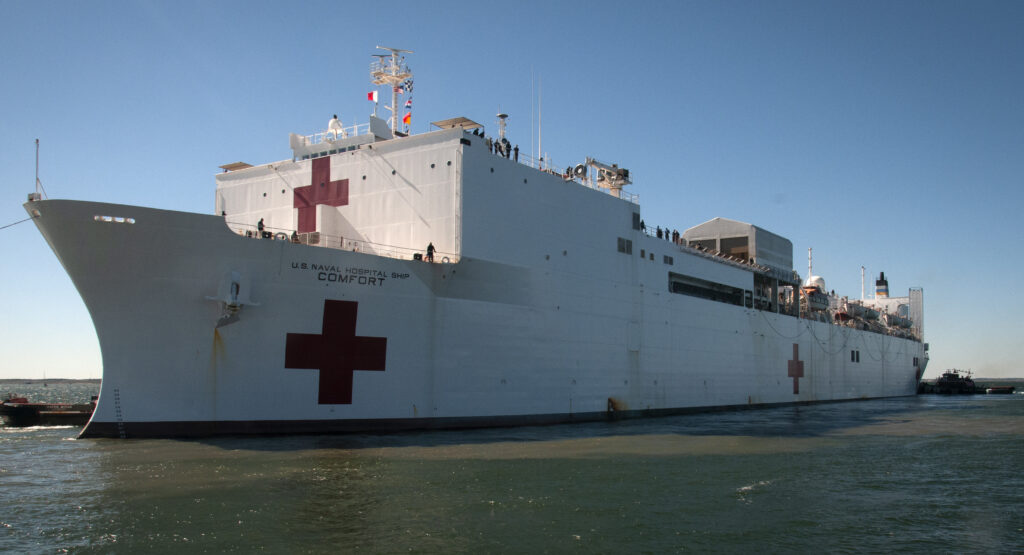
The hospital ship USNS Comfort departs Naval Station Norfolk for the 2-month Continuing Promise 2022 medical mission to Latin America and the Caribbean. U.S. NAVY

MIAMI — Hospital ship USNS Comfort (T-AH 20) departed from Miami after commencing Operation Continuing Promise 2022, Oct. 23, 2022, said Petty Officer 2nd Class Juel Foster of U.S. 4th Fleet Public Affairs said in an Oct. 22 release.  
 
During Comfort’s time in Miami, the ship hosted over 200 guests, including distinguished visitors from more than 15 countries and local and national media outlets. Sailors and crewmembers held tours of the ship and participated in press conferences and interviews. To cap it off, the U.S. Fleet Forces Band performed the “Sunday Night Football” theme song for NBC Sports, which aired Sunday afternoon. Among the distinguished visitors were General Laura J. Richardson, U.S. Southern Command combatant commander, and Rear Adm. Doug Sasse, reserve vice commander, U.S. Southern Command/U.S. 4th Fleet. 
 
“Comfort and its supporting partners demonstrate a continued commitment to the Caribbean, Central and South America,” said Richardson. “The multinational public, private and multiservice team working on this 1,000-man hospital ship really demonstrates the power of partnership. It also demonstrates a profound truth that health security is national security.” 
 
Since its inauguration in 2007, Continuing Promise’s mission has been to utilize trained medical teams to provide care aboard the ship and at land-based medical sites, while working with partner nation medical personnel to increase medical readiness, strengthen partnerships and enhance U.S. Navy and partner nation capabilities to respond to public health disasters and humanitarian crises. 
 
“Continuing Promise 2022 reflects America’s commitment to strengthening friendships, partnerships and solidarity with our Caribbean, Central and South American neighbors,” said Capt. Bryan Carmichael, commodore of Amphibious Squadron 4. “Medical services are a big part of this mission, but we are also building relationships that will have lasting impacts.” 
 
USNS Comfort’s current mission will be the 12th Continuing Promise mission conducted in U.S. Southern Command/U.S. 4th Fleet area of responsibility. 
 
U.S. Naval Forces Southern Command/U.S. 4th Fleet supports U.S. Southern Command’s joint and combined military operations by employing maritime forces in cooperative maritime security operations to maintain access, enhance interoperability, and build enduring partnerships in order to enhance regional security and promote peace, stability and prosperity in the Caribbean, Central and South American region. 


Navy to Merge Mine-Countermeasures Helicopter Squadrons

An MH-53E Sea Dragon helicopter from Helicopter Mine Countermeasures Squadron (HM) 12 participates in a nine-aircraft formation flight alongside HM-14 and HM-15. U.S. NAVY / Mass Communication Specialist 3rd Class Jesse Schwab

ARLINGTON, Va. — The Navy plans to deactivate one of its two fleet helicopter mine countermeasures squadrons next year and combine many of its personnel and helicopters with the remaining squadron. 

Helicopter Mine Countermeasures Squadron 14 (HM-14), which operates the MH-53E Sea Dragon helicopter from Naval Station Norfolk, Virginia, is scheduled for de-activation effective July 31, 2023, according to a Navy directive. 

HM-14’s sister squadron, HM-15, also based in Norfolk, will absorb 102 full-time and 48 reserve enlisted personnel and four full-time and eight reserve officers from HM-14 in order to retain “as much airborne mine countermeasure capability as possible,” the directive said.  

The directive used the term “HM-15 MAX” to describe the enlarged squadron.  

HM-14 and HM-15 are considered combined Active-Reserve squadrons, with an 80/20 mix of personnel from the two components.  

HM-14 maintains a detachment in Pohang, South Korea, in support of the U.S. 7th Fleet, while HM-15 maintains a detachment in Manama, Bahrain in support of the U.S. 5th Fleet. 

Another squadron, HM-12, serves as a fleet replacement squadron for the MH-53E fleet. 

The Sikorsky-built MH-53E Sea Dragon has two primary missions: airborne mine countermeasures and Navy heavy lift and vertical onboard delivery. The aircraft is a derivative of the CH-53E Super Stallion but is heavier and has a greater fuel capacity and range. Capable of transporting up to 55 troops, the MH-53E can carry a 16-ton payload 50 nautical miles or a 10-ton payload 300 nautical miles. In its primary mission, the MH-53E can tow a variety of mine countermeasures systems, including the Mk105 magnetic minesweeping sled, the AQS-24A side-scan sonar and the Mk103 mechanical minesweeping system. Mission duration can exceed four hours.  

The Navy plans to keep the MH-53E in service at least until 2025. 


Bahrain Leads Unmanned Exercise for Multinational Task Force

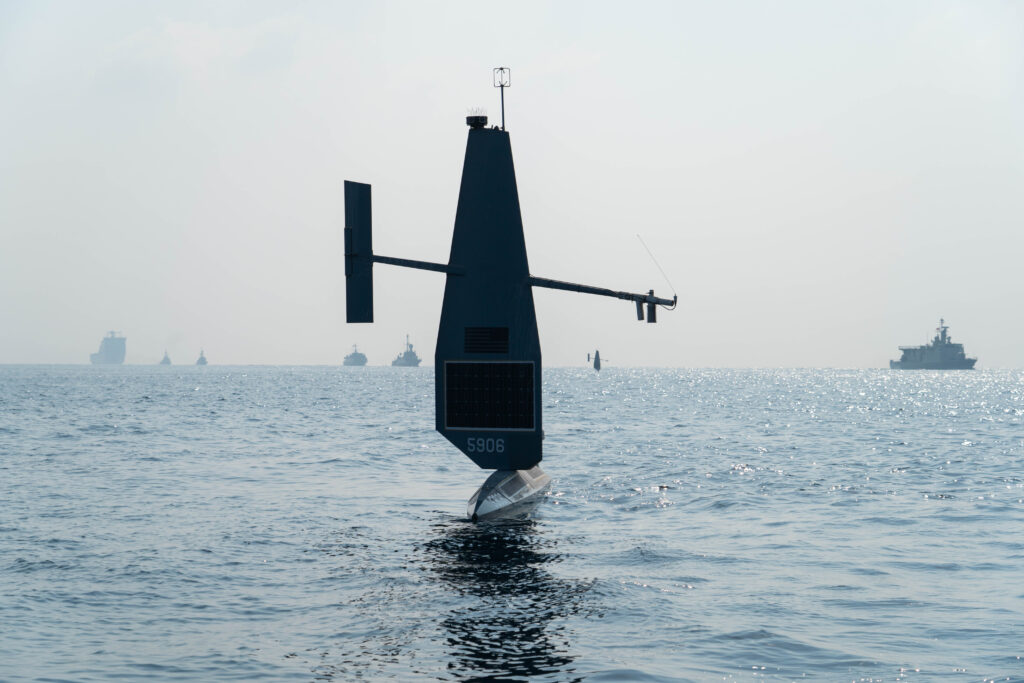
A U.S. Navy Saildrone Explorer unmanned surface vessel operates with patrol coastal ships USS Hurricane (PC 3) and USS Chinook (PC 9) from the United States, UK Royal Navy ships RFA Cardigan Bay (L3009) and HMS Bangor (M109), Royal Bahrain Naval Force ships RBNS Al-Manama and RBNS Al-Fateh, and HMS Khalid from the Royal Saudi Navy in the Arabian Gulf, Oct. 26. U.S. ARMY / Spc. Noah Martin

MANAMA, Bahrain — A multinational naval task force led by Bahrain conducted a one-day training drill in the Arabian Gulf, Oct. 26, featuring the use of unmanned systems and artificial intelligence alongside seven crewed ships, Combined Maritime Forces Public Affairs said in an Oct. 27 release. 

Naval forces from Bahrain, Saudi Arabia, the United Kingdom and the United States participated in support of Bahrain-led Combined Task Force (CTF) 152, one of four task forces organized under the Combined Maritime Forces. The naval drill enhanced interoperability in integrating new unmanned technologies to monitor regional waters. 

“It is so valuable to get these opportunities to really test how our forces from across different nations can work together with the uncrewed systems,” said Royal Bahrain Naval Force Capt. Rashed Al-Ameen, commander of CTF 152. “It helps us better understand how to work with each other to boost regional security.” 

Three U.S. Navy Saildrone Explorer unmanned surface vessels operated with USS Hurricane (PC 3) and USS Chinook (PC 9) from the United States, UK Royal Navy ships RFA Cardigan Bay (L3009) and HMS Bangor (M109), Royal Bahrain Naval Force ships RBNS Al-Manama and RBNS Al-Fateh and HMS Khalid from the Royal Saudi Navy. 

CTF 152 led the exercise while embarked aboard Cardigan Bay, as the ship sailed in international waters off the coast of Saudi Arabia. This is the latest drill involving unmanned systems in the Arabian Gulf since the United Kingdom and United States completed a similar bilateral naval exercise Oct. 7. 

During both maneuvers, unmanned and artificial intelligence systems operated in conjunction with crewed ships and naval command centers ashore in Bahrain. Sensors from the unmanned vessels were able to locate and identify training aides in the water and relay visual depictions to the command centers. 

Established in 2004, CTF 152 oversees maritime security operations in the Arabian Gulf for Combined Maritime Forces. Bahrain assumed command of CTF 152 from Kuwait in August. 

Combined Maritime Forces is the world’s largest multinational naval partnership and includes 34 member-nations whose forces operate in the Red Sea, Gulf of Aden, Northern Arabian Sea, Gulf of Oman, Arabian Gulf and Indian Ocean. CMF is headquartered in Bahrain with U.S. Naval Forces Central Command and U.S. 5th Fleet.