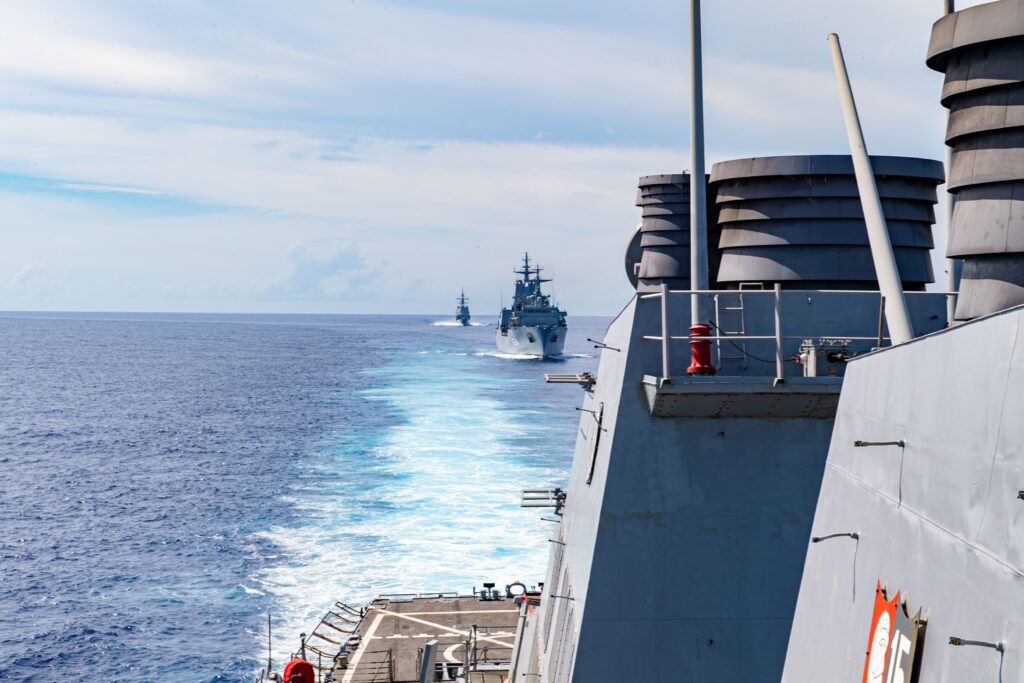
National Museum of the Surface Navy to Present 2022 “Freedom of the Seas” Awards

SAN PEDRO, Calif. — The National Museum of the Surface Navy (NMSN) is presenting its 2022 “Freedom of the Seas” awards at a gala on Saturday night, Oct. 22, aboard the historic battleship USS Iowa at San Pedro, California.

According to retired Rear Adm. Mike Shatynski, the chairman of the board of NMSN and the Battleship USS Iowa Museum, said “the Freedom of the Seas Awards honor those individuals and organizations that embody the core principles of the American Surface Navy’s mission to protect and defend our oceans for the benefit of the free world.” 

Presented annually, the awards include the Freedom of the Seas award, Vice Adm. Samuel L. Gravely, Jr. Award, Humanitarian Award and the Commerce and Communications Award. 

Secretary of Agriculture Tom Vilsack is being recognized with the 2022 Freedom of the Seas Award, which is presented to an accomplished individual who embodies the core principles of the American Surface Navy to protect and defend our oceans for the benefit of the free world.  

Shatynski said Secretary Vilsack has been spearheading a transformation of the food system to ensure that the food system of today and the future is more resilient and more competitive globally. “Under his leadership, the U.S. Department of Agriculture (USDA) and the Ministry of Agrarian Policy and Food of Ukraine are working together to enhance coordination between the U.S. and Ukrainian agriculture and food sectors to build a strategic partnership to address food insecurity.” 

The 2022 VADM Samuel L. Gravely, Jr. Award will be presented to Retired Rear Admiral Sinclair Harris, vice president, Client Relations for LMI. The award, which was named in honor of the first African American in the U.S. Navy to command a Navy ship, command a fleet and become a flag officer, recognizes leaders who exemplify the trailblazing, courageous service of the late U.S. Surface Navy vice admiral.  

“During Rear Adm. Harris’ distinguished 34-year Navy career, which culminated as vice director for operations to the chairman of the Joint Chiefs of Staff, he led joint, combined, multinational and interagency organizations across all aspects of defense; commanded the U.S. Fourth Fleet; and led U.S. naval forces assigned to the U.S. Southern Command,” Shatynski said. 

Jim Zenner, Director of Los Angeles County Military and Veteran Affairs, is being recognized with the 2022 Freedom of the Seas Humanitarian Award, which represents the Surface Navy’s response to humanitarian assistance and disaster relief. 

Zenner created the Los Angeles County Veterans Peer Access Network (VPAN), a veteran-led, community-driven support network serving veterans and their families by providing resources in the areas of mental health, substance misuse support, housing, workforce development and employment, healthcare, education, legal services, social connections and more. According to Shatynski, VPAN has become the model program for integrated and effective veteran support for the country.  “His contributions exemplifies the fearless bravery and tenacity necessary to sail through troubled waters to provide humanitarian assistance and disaster relief, which are core principles of America’s Surface Navy.” 

The 2022 Commerce and Communications Award is being presented to the California Trucking Association (CTA). This award recognizes leaders in commercial shipping and communications that embody a core principle of the American Surface Navy in utilizing the ocean for the benefit of the free world. 

Eric Sauer, Chief Executive Officer of CTA, will accept the award which recognizes the association’s instrumental role in the movement of cargo, specifically on the front line of the goods-movement industry over the past couple of years. Shatynski said CTA’s ongoing efforts to boost the economy, provide safe roads, protect the environment and lower emissions have ensured the safe and responsible movement of goods through the challenging times throughout and following the COVID-19 pandemic. 

The Freedom of the Seas Awards are held in honor of the anniversary of the October 1944 Battle of Leyte Gulf anniversary, the largest naval battle of World War II, to honor those individuals and organizations that embody the core principles of the American Surface Navy’s mission to protect and defend our oceans for the benefit of the free world. 

“As situations across the globe continue to emerge, change and get increasingly complex, the United States Surface Navy’s roles in international relations, free trade, humanitarian assistance and technological innovation becomes even more important,” Shatynski said. “The individuals and organizations that we are recognizing with this year’s Freedom of the Seas Awards, are leaders whose incredible work and accomplishments exemplify the values and mission of our organization and the Surface Navy.” 

Major sponsors for the Freedom of the Seas Awards 2022 are Lockheed Martin, Marathon Petroleum, UPS, the Port of Los Angeles, Collier Walsh Nakazawa LLP and the Surface Navy Association.  

Scheduled to open in 2025 aboard the historic Battleship USS Iowa Museum, the National Museum of the Surface Navy is the museum for America’s Surface Navy. The museum’s mission is to raise America’s awareness of the importance of the United States Surface Naval Forces’ role in international relations, free trade, humanitarian assistance and technological innovation, not just in the past but today and into the future.  


Navy Announces Two Flag Assignments

ARLINGTON, Va. — The secretary of the Navy and chief of naval operations announced Oct. 20 the following assignments: 

Rear Adm. James A. Kirk will be assigned as commander, Expeditionary Strike Group Three, San Diego, California. Kirk most recently served as commander, Carrier Strike Group Fifteen, San Diego, California.  

Rear Adm. (lower half) Michael W. Baze will be assigned as commander, Navy Personnel Command; and deputy chief of naval personnel, Millington, Tennessee. Baze is currently serving as commander, Expeditionary Strike Group Three, San Diego, California. 


USS Jackson Deployment Used Manned/Unmanned Teaming with Fire Scout, Seahawk

An MH-60S Sea Hawk and MQ-8C Fire Scout unmanned aerial vehicle, assigned to Helicopter Sea Combat Squadron (HSC) 23, conduct concurrent flight operations as a manned-unmanned team (MUM-T) while embarked on the Independence-variant littoral combat ship USS Jackson (LCS 6). U.S. NAVY / Lt. j.g. Alexandra Green

ARLINGTON, Va. — The recently concluded Western Pacific of the Independence-class littoral combat ship USS Jackson (LCS 6) saw extensive use of the newest version of the Fire Scout unmanned helicopter, with the operations including manned/unmanned teaming (MUM-T) with an MH-60S Seahawk helicopter. 

The USS Jackson, based in San Diego, deployed on July 11, 2021, to the Western Pacific for 15 months in support of the Oceania Maritime Security Initiative (OMSI). Both the ship’s Blue and Gold crews each participated in two on-hull patrols during the deployment, which took the LCS to the South China Sea and Oceania. The Jackson, with a Coast Guard law-enforcement detachment embarked, operated with the armed forces of Brunei, France, Germany, Indonesia, Thailand and Japan, and made port calls to several island nations including Palau, Tahiti and Fiji. The ship returned to its homeport on Oct. 15, 2022.  

The Jackson was armed with surface warfare mission modules, including the Naval Strike Missile, an MQ-8C Fire Scout and an MH-60S Seahawk. The aircraft were operated alternatively by detachments of Helicopter Sea Combat Squadron 23. This marked the first Pacific deployment of the MQ-8C version of the Fire Scout. 

“Jackson conducted multi-domain operations with our Fire Scout unmanned aerial vehicle and manned MH-60S Seahawk,” said Cmdr. Michael Winslow, commanding officer of the ship’s Gold Crew, during an Oct. 19 media roundtable. “We had a lot of success with the Fire Scout. We conducted about 20 hours of flight operations pushing out to distances in excess of 100 miles. Next year we have some NAVAIR operations scheduled to look at expanding the wind, pitch and roll restrictions that are currently on the Fire Scout. Absolutely a force multiplier in theater.” 

Cmdr. Nick Van Wagoner, executive officer of the Jackson’s Blue Crew, said the Jackson “set the standard in 7th Fleet and really define what persistent operations with the MQ-8C looks like. As a result of that, I think our operational commanders are seeking new ways to employ that sensor alongside other manned and unmanned aircraft and surface vehicles.” 

We did employ the manned/unmanned teaming tactic and concept with our aviation detachment from Helicopter Sea Combat Squadron 23 Detachment 6. We executed that approximately one dozen times and we saw over 100 hours of MQ-8C operations while deployed to the 7th Fleet area. While conducting those manned/unmanned teaming operations what we found was that having an unmanned aircraft that had many capable sensor payloads was really a force multiplier that we could use to develop our recognized air and maritime picture beyond the horizon while using the MH-60S to conduct positive identification of things that we detected with the MQ-8C.  

The MQ-8C is equipped with the ZPY-8 search radar, the Brite Star II electro-optical/infrared sensor and the Automatic Information System. 


CNO Holds Fast on Ship Decommissionings, Fleet Readiness 

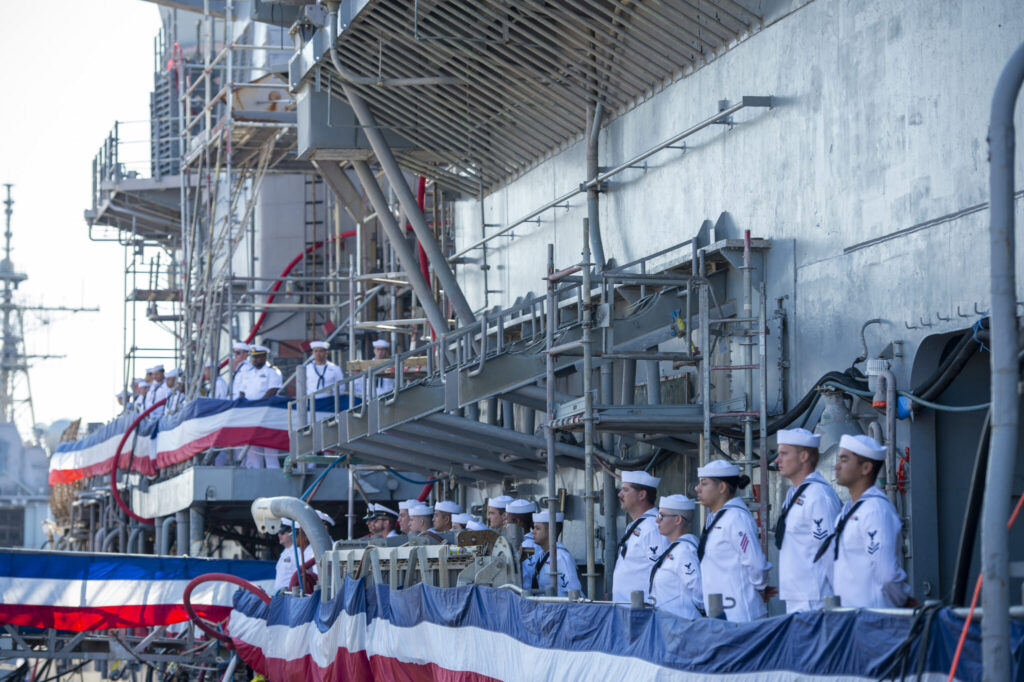
Sailors assigned to the USS Monterey (CG 61) man the rails during its decommissioning ceremony. Monterey was commissioned on June 16, 1990, and was a U.S. Navy warship for 32 years. U.S. NAVY / Mass Communication Specialist 3rd Class Rodrigo Caldas

WASHINGTON — The U.S. Navy’s top officer held fast when discussing the controversial subject of decommissioning older ships in order to sustain a ready, relevant fleet in a discussion at an event in Washington. 

“For our last four budget cycles, readiness has been our number one priority, followed by modernization of the fleet that we have today — 70% of which we’ll have a decade from now — and, finally, capacity at an affordable rate,” said Chief of Naval Operations (CNO) Adm. Michael Gilday, speaking Oct. 19 at the Atlantic Council. “My approach has been, commensurate with my responsibilities, to field the most lethal force we can now and into the future.” 

Gilday said that fielding a lethal force involves maintaining ships; “not taking maintenance holidays — as sometimes we we’ve been prone to do in the past, when we made capacity king; to ensure that our supply storerooms are filled with the proper parts so that our ships are self-sustaining at sea; to ensure that our magazines are actually filled with weapons.” 

Referring to the issue of capacity, Gilday said that “when we make decisions on which ships we’re going to decommission, the entering argument is the size of the fleet that we can afford.” 

Citing the current high monetary inflation, the CNO noted that 60% of the Navy’s budget rises at a rate above inflation and has to be taken into account. 

“Maintaining the fleet we have is extremely expensive,” he said. 

Gilday said the Navy looks at stratifying lethality across its platforms, ranking those platforms from 1 to 20, helping to inform decisions about which ships to decommission.  

“It gets back to what we can afford,” he said. 

The CNO noted that some ships “haven’t seen a dry dock since 2000” and that some ships have 125 departures from specifications. 

One example he cited was an engineering directive not to put a tugboat against one side of the ship because it could result in a hole puncture in the ship because the steel hull is too thin. 

The CNO said that some Ticonderoga-class guided-missile cruisers are three years behind in completing maintenance at costs of $80 million or more, and with a weapon system that is not going to be upgraded in time “to face the threat that the Chinese pose.” 

Gilday said that “when it comes down to making hard decisions on where to put your next dollar, those are decisions that need to be made and debated within the Pentagon.” 

The CNO pointed out that a few ships account for most of the delay days in maintenance. 

The Navy has reduced maintenance delay days from 7,700 as of January down to a little over 3,000 today. Between 40% and 50% of the delay days can be attributed to six or seven ships that the Navy would like to decommission. 

“They are old and not fit to fight against the current threat,” he said. “They were designed in the 1970s for a fight of a bygone age, but we’re still holding onto them.” 


Rear Adm. Wettlaufer: Shortage of Ships, Mariners an Ongoing Problem for Military Sealift Command

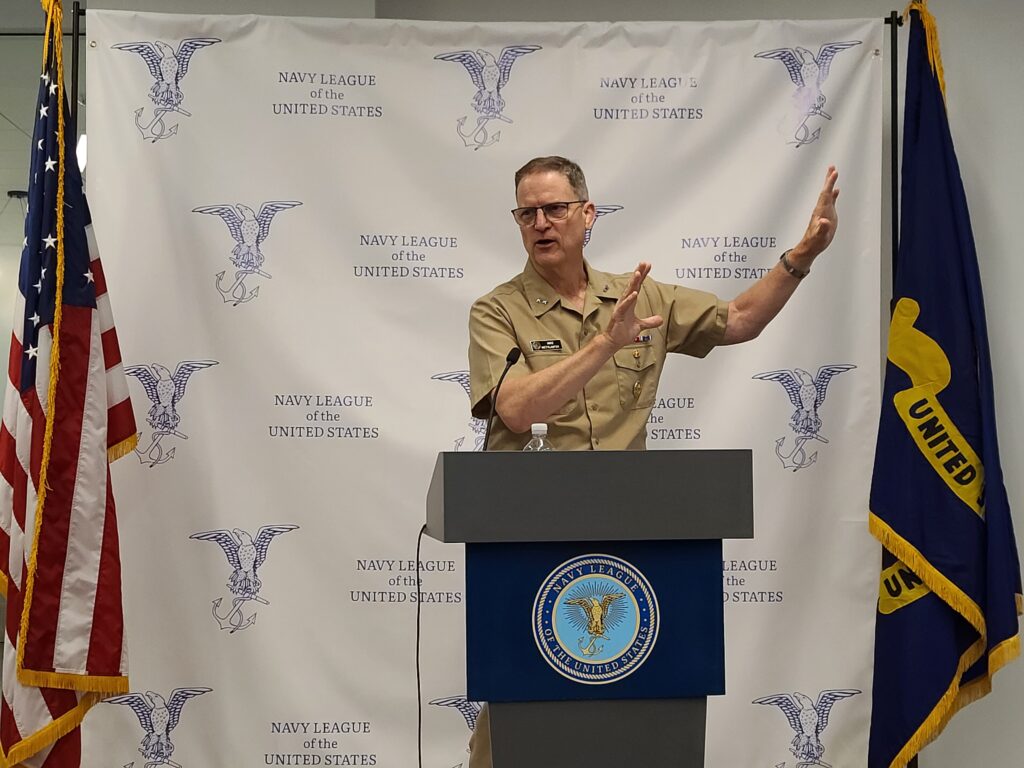
Rear Adm. Michael A. Wettlaufer, commander of Military Sealift Command, answers questions from the audience after speaking about the needs of the organization at the Navy League hosted Special Topic Breakfast, Oct. 18, sponsored by General Dynamics. NAVY LEAGUE OF THE UNITED STATES / James Peterson

ARLINGTON, VA — Military Sealift Command (MSC) continues to face a shortage of both ships and sailors, and it will take a “collective effort” from government and industry to turn the tide, Rear Adm. Michael Wettlaufer, commander of MSC, said here during an event hosted by the Navy League of the United States.

Rear Adm. Wettlaufer noted that after the number of U.S. mariners reached their peak during World War II at 262,000, their population has plummeted to a fraction of that today — about 33,000 between 2018-2021. With recruitment and retention a problem across all of the services, MSC faces no easy solutions.

Specifically, the top challenges currently facing MSC in this area are an atrophied maritime industry, a reduced U.S. flag commercial fleet and a shortage of ocean-going mariners, he said.

To help the issue of a lack of vessels, Wettlaufer said MSC will seek to incentivize commercial participation.

“We’ve got to incentivize U.S. flagged shipping,” he said, noting that the number of U.S. flagged ships at their disposal had declined from 282 at the start of this century to 178 today. “On the production side, it’s great; we’re building ships. But we certainly need more.”

On the recruitment side, it is a multi-pronged problem. A lack of U.S. flagged ships causes a decrease in the mariner population naturally, but there are other issues that the command needs to address, Wettlaufer said.

“This ecosystem is under stress [and] this needs our nation’s focus,” Wettlaufer said. “Why does [this decline in mariner population] happen? Have people changed, or are we ignoring the problem? I think we’re ignoring the problem. I think we’re ignoring the engagement opportunity.”

To help fix this issue, MSC will seek to get mariners to sea through a vigorous recruiting campaign, incentives and training. He also said MSC will be more aggressive in preventing sexual assault. Regardless, it will take a “collective effort” between government and industry to deal with this ongoing issue, the rear admiral said.


T-45 Fleet on Safety Pause 

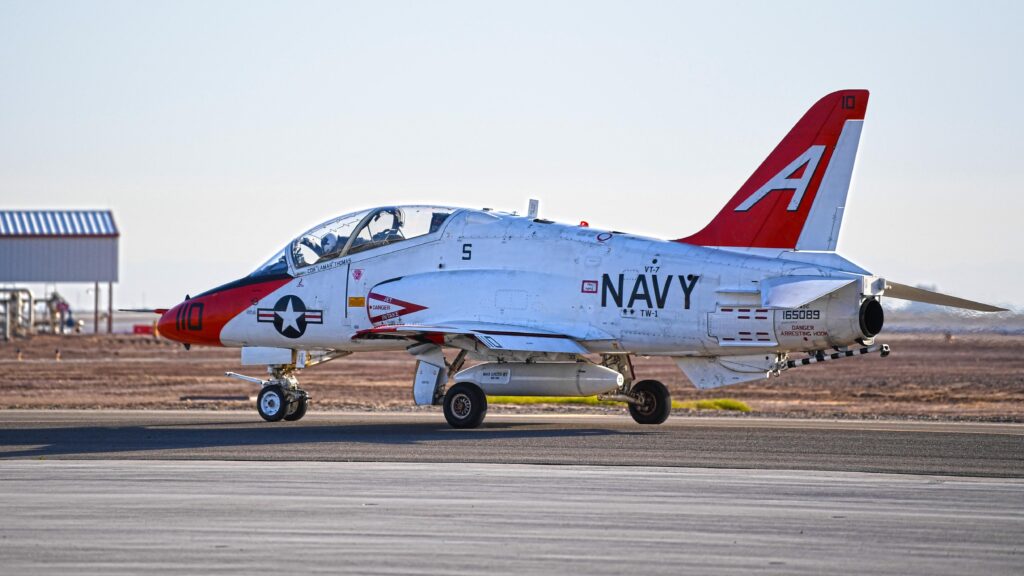
T-45C Goshawk. U.S. NAVY

PATUXENT RIVER, Md. — Chief of Naval Air Training (CNATRA) placed the Navy and Marine Corps’ fleet of T-45Cs on a safety pause Oct. 14 to review an engine blade fault, the Naval Air Systems Command said in an Oct. 18 release. 

“Out of an abundance of caution and concern for the safety of our aviators, CNATRA made the decision to halt all T-45C Goshawk operations following the discovery of an engine blade failure,” said CNATRA Rear Adm. Richard Brophy. “We are working with our partners toward a swift resolution. Safety is at the core of our operations, and we must not expose our pilots or aircraft to unnecessary risk.”   

“The Naval Undergraduate Flight Training Systems Program Office, Naval Air Warfare Center Aircraft Division, Chief of Naval Air Training and Fleet Support Team have been working around the clock with industry partner Rolls Royce to identify the root cause of the recent T-45 engine blade failure,” said Rear Adm. John Lemmon, program executive officer for Tactical Aircraft Programs. “Engineering analysis has been underway and will continue until we can safely return the T-45 fleet to a flying status to support CNATRA’s training.”  


U.S. Navy Awards BAE Systems $143 million Contract to Continue Surface Combat Systems Center Support

MCLEAN, Va. — BAE Systems will continue to support the integration of various mission equipment, combat systems, and computer programs for the U.S. Navy’s Surface Combat Systems Center (SCSC) in Wallops Island, Virginia, with a new $143 million, five-year contract. These mission-essential systems are used by sailors across the fleet for all current and future cruiser, destroyer and amphibious ship modernization initiatives.  

“Our work at Wallops Island supports SCSC’s mission to provide increased readiness and improved capability to the fleet,” said Lisa Hand, vice president and general manager of BAE Systems Integrated Defense Solutions. “This effort is vital to our nation’s sailors in an increasingly challenging maritime environment.” 

BAE Systems’ technical, engineering and overall programmatic support for SCSC includes all major activities and engineering on the systems used for Surface Navy testing, training and support of deployed surface combat systems, advanced systems under development, warfare systems integration, interoperability and at-sea testing and exercises.  


Navy Demos Wide Range of VTOL Systems for Future Operations

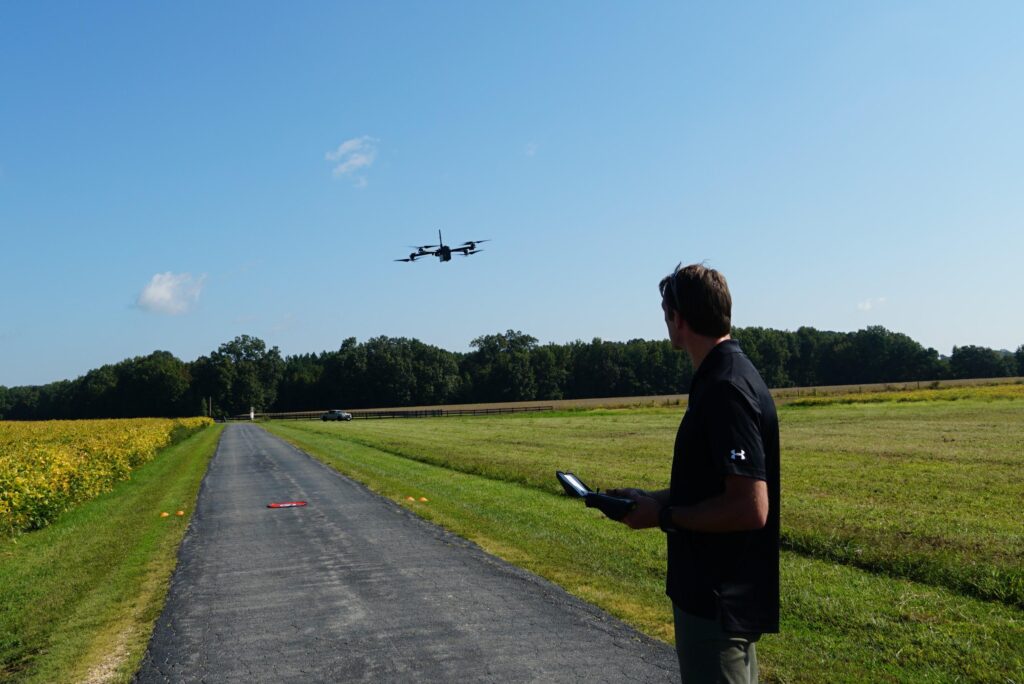
A vendor demonstrates the vertical takeoff and landing capability of a small unmanned aircraft system during a PMA-263 sponsored technical assessment Sept. 20 in California, Md. U.S. NAVY

PATUXENT RIVER, Md. — The Navy and Marine Corps Small Tactical Unmanned Aircraft Systems (PMA-263) program team put Vertical Takeoff and Landing (VTOL) systems through their paces during a two-week technical demonstration in mid-September, the Naval Air Systems Command said in an Oct. 17 release. 

More than a dozen vendors attended the event to help inform the Navy Expeditionary Warfare community of the functions and capabilities available on the commercial market. The VTOL systems represented a wide range of configurations including outdoor, indoor, hybrid VTOL/fixed wing and tethered flight capability. 

In partnership with the University of Maryland UAS Test Site, PMA-263’s Family of Small UAS (FoSUAS) team evaluated each system against a standard test card to determine its suitability for expeditionary combat support. In addition to basic measurements like length, height, weight and pack-up size, performance data was collected for ease of operation, range, endurance, audibility, electro-optical and infrared imagery quality and other unique capabilities of each system. 

“The goal was to understand what the state of the market is today,” said Col. Victor Argobright, PMA-263 program manager. “We want to show off what is available right now for future procurements to our Navy Expeditionary community.” 

Participants representing the Naval Special Warfare, Navy Explosive Ordnance Disposal, and Naval Construction Force communities and their Joint Service counterparts were given the opportunity to engage directly with the participating vendors and to observe the flight demonstrations. Each participant was also asked provide their feedback on the potential of each system to fulfill their unique mission requirements.  

“Flight demonstration events like this are a critical market research function for the PMA and help us to validate performance data reported by vendors,” said Lt. Cmdr. Ben Whatley, PMA-263 FoSUAS military lead. “We want to put these systems through their paces while also providing a venue for end-users to learn about existing and emerging SUAS technology. Moreover, events where operators from the supported Navy communities come together to collaborate and exchange information about their unique SUAS program needs provide added value to the PMA by ensuring unity of vision and a corresponding unity of acquisition effort.” 

The majority of systems demonstrated last month are currently in production and available for procurement. Vendors also had the opportunity to showcase additional developmental capabilities, though these systems were not evaluated against any of the standardized test cards. 

“Unmanned systems technology is advancing at an incredible pace,” Argobright said. “To ensure that our Navy and Marine Corps teams are able to adapt to and outmatch the capability advancements of our adversaries, it is imperative that we leverage rapid acquisition solutions in order to put relevant technology in the hands of the warfighter faster.” 

PMA-263 will use University of Maryland UAS Test Site’s assessment data and observer feedback from the event to inform the program’s priorities for follow-on engineering assessments, potential for operational testing, and inclusion of new platforms within the FoSUAS programs of record. 

The PMA-263 FoSUAS integrated product team currently supports Group 1 and 2 SUAS including the PD-100 Black Hornet 3, Skydio X2D, SkyRaider R80D and RQ-20B Puma. 


U.S. Navy Supports Australia’s Indo-Pacific Deployment Alongside Canada, Japan in the South China Sea

The Arleigh Burke-class guided-missile destroyer USS Milius (DDG 69) conducts a trilateral training exercise with the Japan Maritime Self Defense Force Murusame-class destroyer JS Kirisame (DD-104), the Royal Australian Navy Supply-class auxiliary replenishment oiler HMAS Stalwart (A304) and the Hobart-class air warfare destroyer HMAS Hobart (DDG 39) while operating in the South China Sea, Oct. 07. U.S. NAVY / Mass Communication Specialist 2nd Class Richard Cho

SOUTH CHINA SEA — Maritime forces from Canada, Japan and the United States concluded exercises in the South China Sea in support of Royal Australian Navy forces, Oct. 17, Commander, Task Force 71/Destroyer Squadron 15 Public Affairs said in a release. 

This is the first time all four nations have trained together in the South China Sea exercising complex, maritime operations in the region. 

This exercise builds on the previous bilateral and trilateral exercises from recent months conducted in the South China Sea. Throughout the naval exercises, participants trained together and conducted integrated operations designed to increase the allies’ collective ability to maintain maritime security and readiness to respond to any regional contingency. Integrated events included surface, subsurface and air defense exercises that included Maritime Patrol Reconnaissance Aircraft (MPRA) from several participating nations. 

Representing Commander, Task Force 71 are U.S. Navy Arleigh Burke-class guided-missile destroyers USS Milius (DDG 69) and USS Higgins (DDG 76). 

“Working with our Australian, Canadian and Japanese allies in the South China Sea has been an invaluable experience and opportunity,” said Cmdr. Matthew Hays, commanding officer of USS Milius. “Combined maritime exercises help us strengthen interoperability and increase collective war-fighting readiness. It was great to be able to work with these 3 fine navies and to demonstrate our unwavering strong support for their increasing role in the region and our commitment to a free and open Indo-pacific.” 

Professional engagement and cooperation with allies and partners is the foundation of regional stability, which fosters peace and prosperity for all nations. 

Australia was represented by the Royal Australian Navy, HMAS Arunta (FFH 151) and HMAS Hobart (DDG 39). 

Japan was represented by the JS Suzutsuki (DD 117) and JS Kirisame (DD 104). 

Representing Canada was the Royal Canadian Navy Halifax-class frigate HMCS Winnipeg (FFH 338). 

“HMCS Winnipeg’s deployment in the Indo-Pacific on Operation PROJECTION is aimed at conducting forward naval presence operations in the region as well as participating in cooperative deployments and naval exercises with allied and partner nations,” said Commander Annick Fortin, commanding officer of HMCS Winnipeg. “These exercises are an excellent example as they demonstrate our interoperability with other navies and provides opportunities to learn as well as prove our abilities to work seamlessly together. It is a prime example of our motto ‘one with the strength of many;’ working together, we are stronger.”


Fairbanks Morse Defense to Provide Engines Featuring Common Rail Technology for LPD 32

BELOIT, Wis. — Fairbanks Morse Defense (FMD), a portfolio company of Arcline Investment Management (Arcline), has been awarded a purchase order by Huntington Ingalls Industries to build and deliver four main propulsion diesel engines featuring common rail technology to power the U.S. Navy’s newest Landing Platform/Dock (LPD) ship, LPD 32, the company announced in an Oct. 11 release. FMD’s common rail system technology maximizes performance through enhanced fuel efficiency and reduced carbon emissions. 

“For many decades, the engineers and entrepreneurs who built Fairbanks Morse Defense have been proving the quality of our engines while improving real-world results,” said FMD CEO George Whittier. “Today, the U.S. fleet and its allies rely on our onboard solutions for global technical support to maximize mission confidence, which is why we remain as committed as ever to designing, developing and delivering the best naval power and propulsion systems on the planet.”  

Manufactured in the U.S. and serviced worldwide, FMD’s proven marine technology is engineered for excellence to ensure reliable operation, extended asset lifecycles, and minimal downtime. In addition to delivering its power and propulsion systems, the defense contractor has been selected by the Navy and Military Sealift Command time and again to provide mission-critical marine technology, turnkey services and OEM parts throughout the vessel.  

FMD previously provided engines with common rail technology for LPD 30 and LPD 31.  

This year FMD is celebrating its 150th anniversary, having served for almost 100 years the U.S. Navy, Military Sealift Command and the U.S. Coast Guard. Today, an FMD product is now on every single American naval platform as a result of their expanded portfolio of product offerings through acquisitions and organic growth.