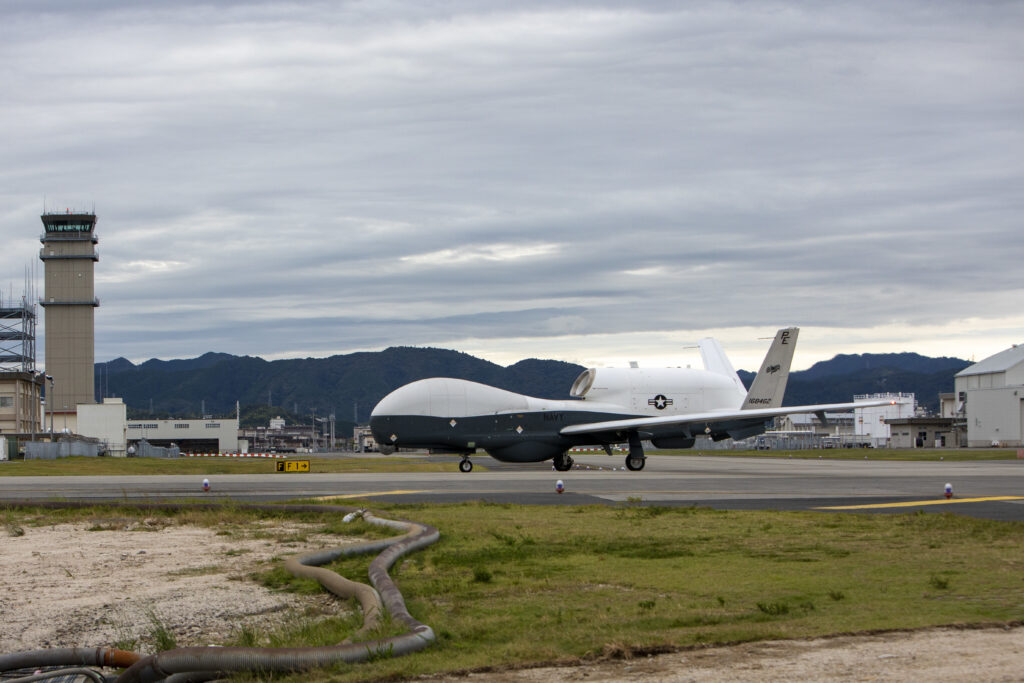
A U.S. Navy MQ-4C Triton assigned to Unmanned Patrol Squadron (VUP) 19 prepares to take off from the flightline at Marine Corps Air Station (MCAS) Iwakuni, Japan, Oct. 5, 2022. U.S. MARINE CORPS / Lance Cpl. David Getz
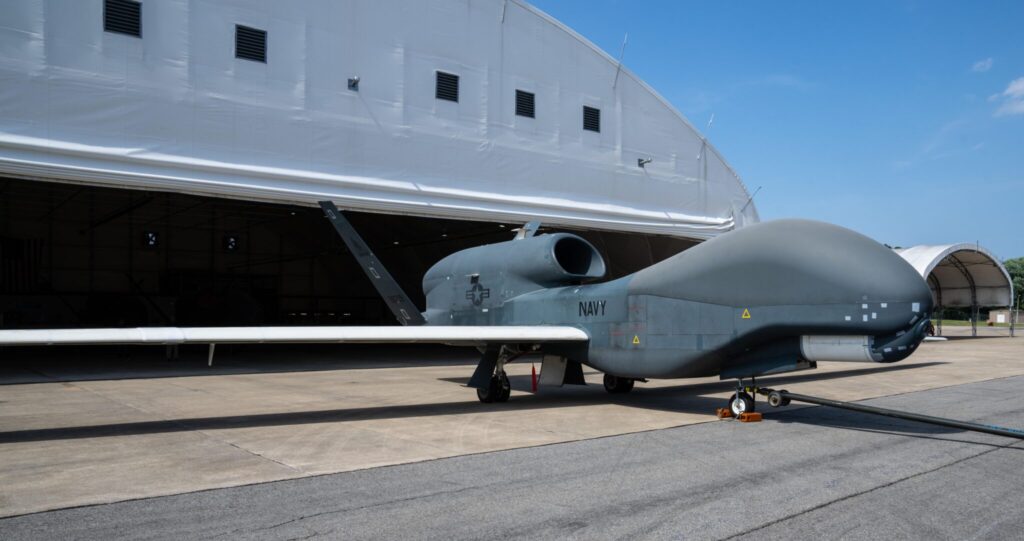
ARLINGTON, Va. — The commander of the Navy’s largest forward-deployed numbered fleet said the MQ-4C Triton high-altitude, long-endurance unmanned aerial vehicle currently deployed in the Western Pacific is proving to be a benefitting to his fleet’s operations.
“Any sensor is goodness in my fleet,” said Vice Adm. Karl Thomas, commander, U.S. 7th Fleet, speaking Oct. 14 at the U.S. Naval Institute in Annapolis, Maryland, in a Maritime Security Dialogue, a series conducted by the U.S. Naval Institute and the Center for Strategic and International Studies and sponsored by HII. “It’s a huge AOR [area of responsibility] and to have something that has that kind of legs [range] and that persistence really helps.”
“We’ve obviously been operating in theater with Triton for quite some time,” Thomas said. “We’re getting close to the IOC [Initial Operational Capability] level with Triton.
“We’re going to use Triton as a replacement for some of our surveillance aircraft,” he said. “So, the biggest benefit it brings clearly is its tremendous endurance. We’ve operated it out of Guam routinely. We’ve started to operate it out of various places in Japan, trying to not only make sure we have numerous places to take-off and land.”
The admiral said the fleet is working to build up an orbit “to learn our way through some of the capabilities that an EP-3 [Aries II Orion electronic reconnaissance aircraft] might bring back. It will be a different way of processing the information than we do with our EP-3s, so we’re working as a Navy to see how we seamlessly transition.”
Vigor Begins Work on USS Tulsa, Wins USS Michael Murphy Challenge
PORTLAND, Ore. — Vigor, a Titan company, is beginning work on two major docking selected restricted availabilities (DSRA) awarded this year, at both Swan Island in Portland, as well as Pearl Harbor Naval Shipyard (PHNSY), the company said in an Oct. 14 release. USS Tulsa recently arrived at Swan Island for its DSRA, while Vigor successfully challenged and was awarded USS Michael Murphy in Hawaii. In total, these two projects will employ more than 350 skilled workers in family wage jobs at both locations, as well as subcontractors and others providing support throughout.
“These two large awards reflect Vigor’s strong reputation for quality and on-time performance for the U.S. Navy,” said Adam Beck, Vigor executive vice president of Ship Repair. “Our skilled workers repeatedly show why Vigor is an industry leader in ship repair, and we are very proud to support our national defense and our service members.”
USS Michael Murphy will be Vigor’s third DSRA completed at PHNSY in as many years, after completing the first two ahead of schedule. Vigor’s impeccable safety record on these projects, completed at the Naval facility, included zero injuries on USS William P. Lawrence and recognition from the Shipbuilders Council of America with a Significance in Safety Achievement award.
This is the first major dry docking for USS Michael Murphy since its post-shakedown availability. It will have shafts, hubs and propeller blades removed and overhauled; a full underwater hull and freeboard preservation; overhaul and replacement of all sea valves; as well as other work completed directly by Vigor and in partnership with the Navy. Approximately 150 people will work on the project each day, through early May 2023.
In Portland, USS Tulsa will undergo a full blasting and painting of the underwater hull and flight deck, including a new type of coating for the hull, and with blasting completed using Vigor’s new more environmentally friendly and efficient system; new decking systems in the staterooms and crew spaces, among others; cleaning and painting of all fuel tanks; and other preventative maintenance. It is scheduled to be at Swan Island for approximately nine months, with more than 200 Vigor employees working on the project.
“These are large, complex projects which our skilled workers at Vigor have become highly adept at in recent years,” Beck said. “Our great ship repair teams not only complete great work on time, they have made Vigor an industry leader in safety. Our Vigor Values of Truth, Responsibility, Evolution, and Love drive us to those two goals each day, and we will continue to live by them as we work to get these two vessels back in service for the Navy.”
In addition to these two major U.S. Navy projects, work is ongoing at Vigor’s Harbor Island shipyard on USS Chosin, USS Cape St. George and USS Omaha, as well as support for Washington State Ferries. The Ketchikan Shipyard, also operated by Vigor, is continuing repair and maintenance work for the Alaska Marine Highway System, marking a busy summer across Vigor’s shipyard operations.
Navy Transferred Remaining RQ-4A BAMS-D UAVs to NASA
The RQ-4A Broad Area Maritime Surveillance Demonstrator returned from 5th Fleet to Patuxent River, Maryland, last summer after accruing more than 42,500 flight hours and over 2,000 oversea missions during a 13-year deployment. NORTHROP GRUMMAN
ARLINGTON, Va. — The Navy has transferred its three remaining RQ-4A BAMS-D high-altitude, long-endurance unmanned aerial vehicles (UAVs) to the National Aeronautics and Space Administration (NASA).
“All three currently reside at NASA’s Armstrong Flight Research Center and will be operated by NASA for the DoD Test Resource Management Center (TRMC, the new aircraft custodian),” said Jamie Cosgrove, a spokeswoman for the Navy’s Program Executive Office – Strike and Unmanned Aviation and Strike Weapons. “The remaining ground control equipment for the system, as well as all the RQ-4A non-payload spares, have likewise been transferred to TRMC.”
The last of the three RQ-4As had returned to its home base, Naval Air Station Patuxent River, Maryland, last summer from deployment to the U.S. 5th Fleet area of responsibility, culminating a 13-year span of operations that began as a six-month experiment.
The Navy had deployed the RQ-4A to Southwest Asia since 2009 as a component of the BAMS-D program. Five Block 10 RQ-4As were acquired from the U.S. Air Force and were based at Patuxent River and operated in sequence over the years by detachments of Patrol Reconnaissance Wings 5, 2 and 11. The detachment kept at least one RQ-4A in the rotation to a base in the Persian Gulf region. One was lost in a mishap in Maryland in June 2012. Another was shot down June 19, 2019, in an unprovoked attack in international airspace over the Strait of Hormuz by an Iranian surface-to-air missile.
BAMS-D provided more than 50% of maritime intelligence, surveillance and reconnaissance in theater accruing over 42,500 flight hours in 2,069 overseas missions, the Navy said.
In the Navy’s 2022 budget request, divestment of the RQ-4A Global Hawk Broad-Area Maritime Surveillance-Demonstrator UAV had been planned for acceleration from 2023 to 2022, with the savings invested in higher priorities.
The BAMS-D is being replaced by a Global Hawk derivative, the MQ-4C Triton, which has been deployed to the Western Pacific in an Early Operational Capability deployment. The Triton with an upgraded sensor capability will be deployed in 2023.
Vice Admiral: U.S. Navy Seeks 100-USV Fleet Patrolling Middle East Waterways by Next Summer
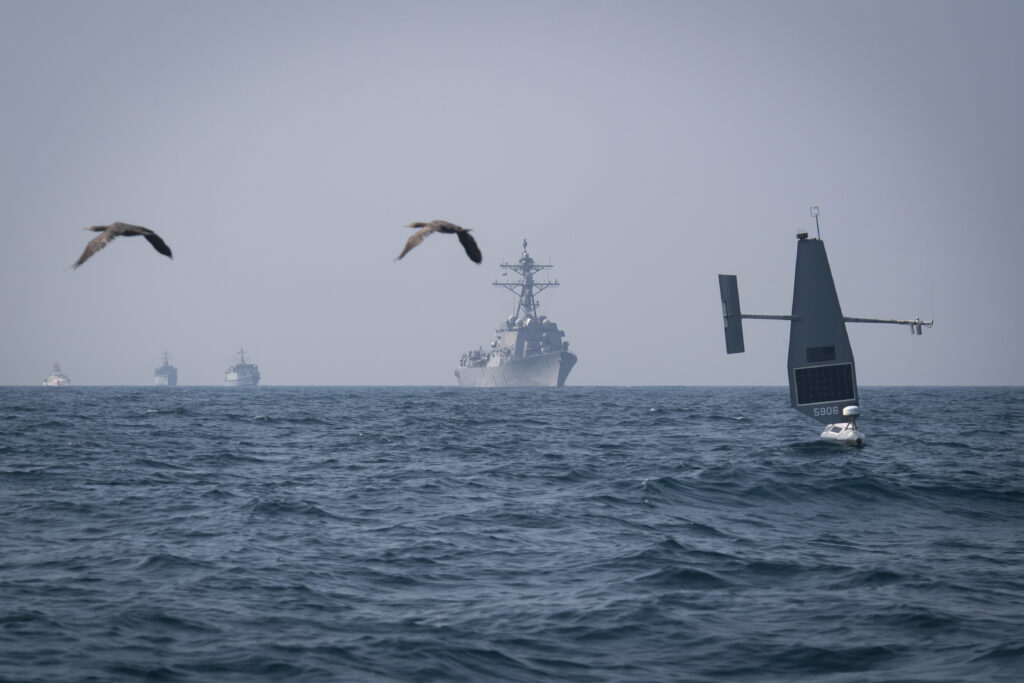
Saildrone Explorer unmanned surface vessels (USV) operate with the guided-missile cruiser USS Delbert D. Black (DDG 119), the Royal Navy Sandown-class minehunter HMS Bangor (M109), HMS Chiddingfold (M37) and the U.S. Coast Guard Sentinel-class cutter USCGC Robert Goldman (WPC 1142) in the Arabian Gulf during exercise Phantom Scope. U.S. NAVY / Chief Mass Communication Specialist Roland Franklin
ARLINGTON, Va. — The U.S. Navy hopes to have a fleet of 100 unmanned service vessels (USVs) patrolling the waterways of the Middle East region by the summer of 2023, said Vice Adm. Brad Cooper, commander of U.S. Naval Forces Central Command, during a media roundtable on Oct. 12.
Cooper said that he estimates about 20% of those USVs to be controlled by the United States, and the remaining 80% to be controlled by countries in the region.
This fleet of USVs will “map the pattern of life that’s happening around them” throughout the region,” he said. When this network spots something different in the pattern, they’ll take pictures and alert a U.S. Navy command center where a human being can make a decision about how to use that information.
This is enabled by the use of artificial intelligence (AI), which allows the Navy to monitor the thousands of ships that are underway in the region at any given time — something human beings could not do on their own, Cooper said.
“We can use manned ships much more efficiently, much more effectively,” he said.
Cooper said he has seen a growth in the practicality of USVs and AI to enhance the Navy’s control over the region.
“There’s no single navy alone that can patrol [the waters around the Arabian peninsula],” he said. “We all know the criticality of the waters to the greater flow of commerce throughout the region, and so we think the best way to cover that and expand maritime domain awareness is … [by] using unmanned sensors through the theater along with AI.”
Cooper also noted that U.S. Naval Forces Central Command has been engaged in other activities in the region, calling the two most important initiatives “accelerating innovation” — which involved the aforementioned USV efforts — but also “strengthening partnerships.”
He pointed to initiatives by the Navy such as the Combined Maritime Forces and the International Maritime Security Construct, which are consortiums that gather nations in the region to cooperate with the Navy in achieving the sea service’s objectives. He also brought up the IMX exercise, an 18-day biennial naval training event led by the command that took place earlier this year and drew participation from dozens of countries.
“We lead two of the largest coalition task forces in the world — each of them will grow in membership and partnership,” Cooper said, noting that in 2021 the command did 33 exercises with countries in the region and will double that figure by the end of this year.
USS Billings (Gold Crew) Returns Home After 4th Fleet Deployment
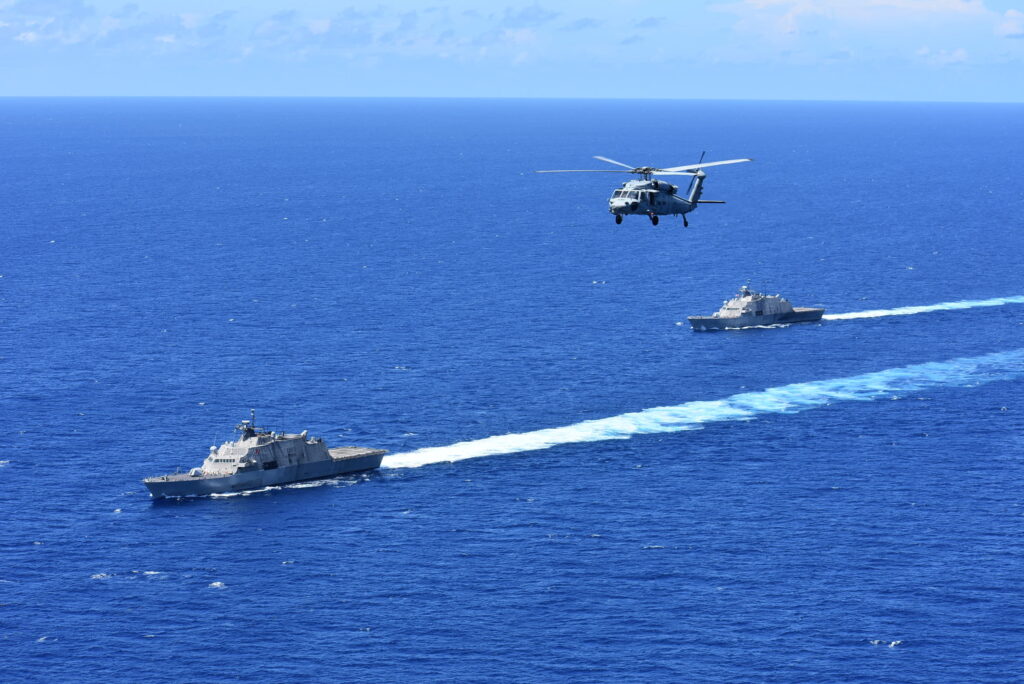
The Freedom-variant littoral combat ships USS Wichita (LCS 13), left, USS Billings (LCS 15), and an MH-60s Sea Hawk helicopter assigned to Helicopter Sea Combat Squadron (HSC) 28, Detachment 6, participate in a photo exercise in the Caribbean Sea, Sept. 10, 2022. U.S. NAVY / Mineman 2nd Class Justin Hovarter
MAYPORT, Fla. — The Freedom-variant littoral combat ship USS Billings (LCS 15) Gold Crew returned to Mayport, Fla., Oct. 7th, following its second successful deployment to the U.S. 4th Fleet area of operations, the fleet’s public affairs office said in an Oct. 8 release.
Billings, along with the “Valkyrie” of Helicopter Sea Combat Squadron (HSC) 28, Detachment 8, deployed in April 2022 to support Joint Interagency Task Force South’s counter-narcotics operations in the Caribbean Sea and Eastern Pacific Ocean. The USS Billings (LCS 15) conducted the first east coast littoral combat ship overseas (OCONUS) exchange of command and has operated forward-deployed since December 2021.
During the deployment, Billings, with her embarked U.S. Coast Guard Law Enforcement Detachment (LEDET), assisted in disrupting an estimated 3,065 kilograms of cocaine along with 1,841 pounds of marijuana worth an estimated street value of $217.7 million and removed twelve suspected drug traffickers from the narcotics trade.
“I am once again incredibly proud of the Sailors on Billings for everything they accomplished this deployment,” said Cmdr. Brett Seeley, Billings’ commanding officer. “They professionally sailed the mighty Billings from the Atlantic into the Pacific Ocean and crossed the equator for the first time in the ship’s history. The crew built upon the successes of her maiden deployment a year ago and succeeded at working with our partner nations strengthening our interoperability and taking narcotics off the streets. We look forward to watching our sister crew continue the sustained operations downrange as the mighty Billings leads the way for the littoral combat ship community.”
Billings conducted bilateral maritime exercises with Jamaica and participated in the French led multi-national maritime humanitarian assistance/disaster relief (HADR) exercise CARAIBES 2022 to strengthen partnerships and build interoperability among forces.
During a port visit to Ocho Rios, Jamaica, the ship hosted the U.S. Ambassador to Jamaica, the honorable Noah Nickolas “Nick” Perry along with senior members of the Jamaican Defence Force to showcase the capabilities of the USS Billings (LCS 15) and discuss the continued partnership and commitment shared between our two countries.
“Billings’ Gold Crew Sailors again showed superior performance in countering malign activities and conducting theater security cooperation,” said Rear Adm. Jim Aiken, U.S. Naval Forces Southern Command/U.S. 4th Fleet. “They continued to build onto the firm foundation of demonstrating forward-deployed operations and maintenance, and met U.S. Southern Command objectives for the region.”
The Billings’ Blue Crew has relieved the Gold Crew and the Billings will remain deployed to the U.S. 4th Fleet area of operations.
Navy EA-18G Squadron Home from Emergency EUCOM Deployment
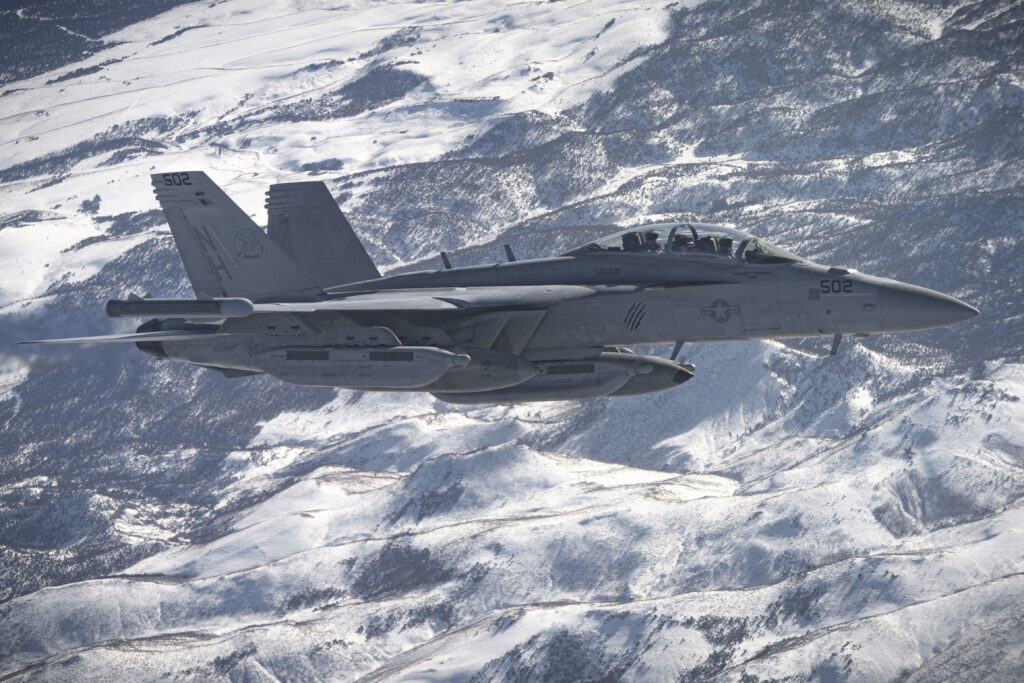
A U.S. Navy EA-18G Growlers assigned to the “Garudas” Electronic Attack Squadron (VAQ) 134, Naval Air Station Whidbey Island, Washington, waits to receive air-to-air refueling from a Royal Air Force Voyager tanker assigned to 101 Squadron, RAF Brize Norton, United Kingdom, during a Red Flag-Nellis 22-1 mission Feb. 3, 2022, at Nellis Air Force Base, Nevada. U.S. AIR FORCE / Airman 1st Class Zachary Rufus
ARLINGTON, Va. — A squadron of U.S. Navy EA-18G Growler electronic warfare aircraft has returned to its home base after more than six months deployed to the European Command as part of the build-up of forces in support NATO’s eastern flank.
Electronic Attack Squadron 134 (VAQ-134) has returned home to Naval Air Station Whidbey Island, Washington, from U.S European Command, according to a source. The squadron had deployed to Spangdahlem Air Base in Germany in late March 2022.
“The purpose of this deployment is to bolster readiness, enhance NATO’s collective defense posture and further increase air integration capabilities with our allied and partner nations,” said then- Defense Department spokesman John Kirby said in a release that month. “They are not being deployed to be used against Russian forces in Ukraine. They are being deployed completely in keeping with our efforts to bolster NATO’s deterrence and defense capabilities along that eastern flank. The deployment is not in response to a perceived threat or incident.”
The Navy has five-land-based expeditionary VAQ squadrons in addition to nine carrier-based VAQ squadrons, all equipped with EA-18Gs. For many years they deployed to bases in Southwest Asia to support combat in Afghanistan, Iraq, and Syria, and currently deploy to Misawa, Japan. The Navy’s Growlers provide electronic attack support for all of the armed services. The aircraft can jam enemy radars and communications and fire anti-radiation missiles at radar sites.
It has not been announced if VAQ-134 was replaced in Europe by another VAQ squadron. A carrier-based squadron, VAQ-140, currently is deployed to the region on board the USS George H.W. Bush.
In its 2023 budget proposal, the Navy proposed de-activating the five expeditionary VAQ squadrons. While the budget has yet to be passed, the proposal has met heavy opposition in Congress.
Ameresco, Bright Canyon Energy Host Groundbreaking Ceremony for Kūpono Solar at Joint Base Pearl Harbor-Hickam
FRAMINGHAM, Mass., PHOENIX, Ariz. and HONOLULU, Hawaii — Ameresco, Inc., a leading clean technology integrator specializing in energy efficiency and renewable energy, and Bright Canyon Energy, a leading developer of energy infrastructure, hosted a groundbreaking and blessing ceremony for the Kūpono Solar Project on Friday, October 7, 2022, Ameresco said in a release.
This combined solar and battery storage system will be built at the Joint Base Pearl Harbor-Hickam West Loch Annex in Hawai‘i. Once operational, the project is designed to deliver 42 megawatts (MW) of clean, renewable energy to Hawaiian Electric’s (HECO) grid on the island of O‘ahu. Attendees at the event heard from U.S. Senator Mazie Hirono, Lt. Governor Josh Green, and Meredith Berger, Assistant Secretary of the U.S. Navy for Energy, Installations, and Environment.
Using approximately 131 acres of Federal land, the Kūpono Solar Project will feature the installation of a 42-MW photovoltaic solar array and 42 MW/168 MWh (four-hour duration) of lithium-ion battery storage system. The batteries are designed to store solar energy beyond sunset hours, enabling the project to deliver sustainable, renewable energy to power approximately 10,000 homes on O‘ahu. Additionally, once fully operational, the project is expected to reduce more than 50,000 tons of carbon dioxide annually from Hawai‘i’s environment, which is the equivalent to offsetting emissions from 12,000 cars annually.
“Today, we are taking significant strides to strengthen our state’s energy security and resilience, and thanks to the ‘Ewa community, Navy, Hawaiian Electric, Ameresco and Bright Canyon Energy, we are now steps closer to reaching Hawai‘i’s renewable energy vision of achieving 100% clean energy by 2045,” said Lt. Governor Josh Green. “Kūpono Solar is a landmark initiative for us that will not only benefit our state’s economy but will also bolster our sustainability efforts and local communities through stable, affordable energy, innovative technology and job creation.”
Ameresco and Bright Canyon Energy established a joint venture in 2021 known as Kūpono Solar Development Company, LLC to advance the Kūpono Solar Project, which is the first project of the joint venture. In support of the Department of Defense’s long-term energy security initiative to increase clean energy reliability and military capabilities, and the state’s goals of renewable energy and decarbonization, Kūpono Solar has a 37-year land lease agreement with the Navy to provide critical energy resiliency upgrades for O’ahu.
“The Department of the Navy is proud to partner with the Kūpono Solar team and Hawaiian Electric as we enhance mission and community resilience and move purposefully towards Hawaii and Navy’s energy goals,” said Meredith Berger, Assistant Secretary of the Navy for Energy, Installations and Environment. “This is a great example of climate action, building access to clean, reliable energy sources inside and outside the fenceline.”
Kūpono Solar will own and operate this solar and battery project under a 20-year power purchase agreement with Hawaiian Electric. The project will benefit the state’s long-term clean energy transition plan while setting the foundation for Ameresco and Bright Canyon Energy to bring a diversified portfolio of clean energy solutions to Hawai‘i in the future.
“The start of this project comes at a time when the need for consistent energy security and independence is at an all-time high,” said Nicole Bulgarino, Executive Vice President and General Manager of Federal Solutions, Ameresco. “The solar and battery storage solutions that are being implemented will deliver clean, renewable energy to the grid and benefit businesses and residents across Hawai‘i.”
“Through our strategic relationships with the Navy, Hawaiian Electric and the community, we are able to leverage clean technology and infrastructure upgrades to help the state of Hawai‘i reach its renewable energy goals and the Navy achieve its climate and energy resiliency objectives,” said Jason Smith, General Manager, Bright Canyon Energy. “It’s energizing to work with a group of partners committed to bringing this key energy infrastructure to O‘ahu and its residents.”
Construction on the Kūpono Solar Project is expected to be completed in early 2024.
22nd MEU, Kearsarge ARG Return from Seven-Month Deployment
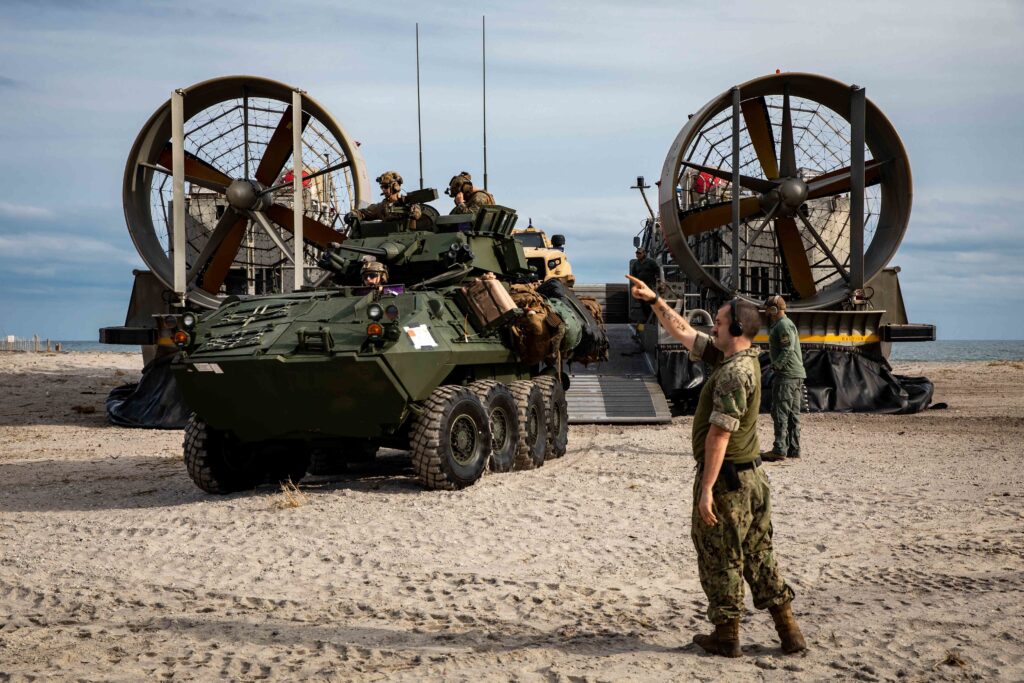
U.S. Navy Construction Mechanic 3rd Class Brandon Baker, assigned to Beach Master Unit (BMU) 2, directs a light armored vehicle, assigned to the 22nd Marine Expeditionary Unit (MEU), off Landing Craft Air Cushion 83, assigned to Assault Craft Unit (ACU) 4, in Morehead City, North Carolina, Oct. 8, 2022. U.S. NAVY / Mass Communication Specialist 1st Class John Bellino
MARINE CORPS BASE CAMP LEJEUNE, N.C. — Sailors and Marines assigned to the 22nd Marine Expeditionary Unit (MEU) returned home to Camp Lejeune, North Carolina, Oct. 9, 2022, after completing a seven-month deployment with the Kearsarge Amphibious Ready Group (ARG) in the U.S. Naval Sixth Fleet area of operations. The Kearsarge ARG is comprised of the Wasp-class amphibious assault ship USS Kearsarge (LHD 3), the San Antonio-class amphibious transport dock ship USS Arlington (LPD 24) and the Whidbey Island-class dock landing ship USS Gunston Hall (LSD 44).
The deployment marked the first time an ARG/MEU maintained a six-month presence in the Baltic region in over 20 years. More than 4,000 Marines and Sailors supported a wide range of interoperability training and exercises in 15 countries within U.S. Sixth Fleet; covering the High North/North Atlantic, Central Mediterranean, and Baltic regions promoting stability, increasing interoperability, sustaining combat readiness, and crisis response capabilities while strengthening relationships with both NATO Allies and partners.
“Our time in the Baltics and the High North was particularly valuable,” said Col. Paul C. Merida, commanding officer, 22nd Marine Expeditionary Unit. “I think all of us in the 22nd MEU came away extremely impressed with the level of military professionalism that our friends in the region possess and the level of enthusiasm for real, integrated defense cooperation was profound wherever we visited. I believe future east coast MEUs will find the High North and the Baltics not only a challenging training environment but a region full of very capable friends and allies.”
Exercises in the Arctic Region included Northern Viking 2022, a multinational amphibious and maritime exercise alongside Allied nations from France, Germany, Iceland, Norway and the United Kingdom; and a two-week bilateral exercise in northern Norway and the Norwegian Sea, exercising integrated cold weather and live- fire training with the Norwegian Armed Forces.
In the Central Mediterranean, Marines and Sailors assigned to USS Arlington participated in bilateral exercises such as Alexander the Great 22, a bilateral U.S.-Greece (Hellenic) amphibious training event; EFES 22, a biennial, multinational, combined, joint and live firing exercise with Turkish Armed Forces and U.S. Army’s Explosive Ordnance Disposal (EOD) and medical teams; as well as African Lion 22, an exercise enhancing the U.S. African Command’s partnership and security cooperation with the Tunisian Ministry of Defense.
While operating in the Baltic region, Kearsarge and Gunston Hall participated in an Estonian-led exercise, Hedgehog (Siil) 22 with Estonian Defense Forces and forces from Task Group 61/2.4 and the NATO-led exercise Neptune Shield. All of these exercises incorporated 18 NATO Allies and partners working together through multiple domains throughout the European continent and waters. In June, Kearsarge and Gunston Hall participated in the joint, annual multinational exercise, Baltic Operations (BALTOPS 22) designed to enhance interoperability, capability and demonstrate cohesion among Allied and partner forces in defending the Baltic Sea region.
Following BALTOPS22 and AL22, the Kearsarge ARG-MEU conducted scheduled maintenance availability periods in Brest, France, Rijeka, Croatia, and Copenhagen, Denmark throughout July 2022. The maintenance availability periods, which included mid-deployment voyage repair (MDVR) evolutions, allowed U.S. Navy ships to accomplish necessary and preventative repairs to continue their missions in the region while simultaneously strengthening relationships with host nations.
Once MDVRs were successfully completed, the Kearsarge ARG-MEU team returned to the Baltic region as a combined force to continue strengthening relationships and partnerships. Through rapid planning, coordination, and execution, the ARG-MEU team successfully completed bilateral training events with Finland, Sweden, and Standing NATO Maritime Group ONE (SNMG 1) during the months of August and September.
Upon conclusion of operations in the Baltic region, the ARG-MEU successfully completed a cumulative of 29 port visits across the ARG visiting 14 NATO Allied and partner countries including Reykjavik, Iceland; Narvik and Tromsø, Norway; Volos and Alexandropoulos, Greece; Tallinn, Estonia; Helsinki, Finland; Stockholm and Visby, Sweden; Gabés, Tunisia; Kiel, Germany; Brest, France; Rijeka, Croatia; Copenhagen and Kalundborg, Denmark; Riga, Latvia; Klaipeda, Lithuania; and Gdańsk and Gdynia, Poland. During each visit, the ARG-MEU engaged with representatives from embassies, ministries of defense, and local government, military and civilian officials to strengthen relationships with NATO Allies and partners through in-person key leader engagements and exchanges including media availabilities, ship tours, office calls, ceremonies and receptions, and community service projects.
“After a busy seven-month deployment it’s good to get the 22d MEU team back home to Lejeune,” Col. Paul Merida said. “We believe this was the first East Coast MEU deployment in a long while that was spent entirely in the 6th Fleet area of operations and the Marines did a tremendous job operating from above the Arctic Circle, to the Baltics, to the Mediterranean Sea. All of this was done with the backdrop of the Russia-Ukraine War, which added an additional sense of importance to our work; much of which was done alongside our NATO Allies and other key regional partners. Our families and friends should be proud of the service their Marines rendered and I believe the 22nd MEU has represented II Marine Expeditionary Force and the U.S. Marine Corps accordingly.”
The 22nd MEU’s mission is to provide the United States with a forward-deployed, amphibious force-in-readiness capable of executing missions across the full spectrum of combat and military operations and consists of four elements – a command element, a ground combat element, Battalion Landing Team (BLT) 2/6, a logistics combat element, Combat Logistics Battalion (CLB) 26, and an aviation combat element, Marine Medium Tiltrotor Squadron (VMM) 263 Reinforced.
The ARG-MEU’s presence overseas in U.S. Sixth Fleet area of operations supported strategic interests and contributed to regional security and stability and reassured the United States commitment to the High North, Mediterranean, and Baltic regions. The blue-green team provided operational flexibility to combatant commanders by providing a versatile contingency response force using sea, air, land and logistical assets. The versatility inherent to the amphibious force allowed for flexible and mission-tailored forces, while representing our nation’s strength, capability and resolve to partners and allies and deterring potential adversaries.
Navy Demonstrates VLS Reload in San Diego Harbor
Sailors aboard Arleigh Burke-class guided-missile destroyer USS Spruance (DDG 111) guide training ordnance into the ship’s forward vertical launch system (VLS) cells during a proof-of-concept evolution in San Diego, Oct. 4. U.S. NAVY / Mass Communication Specialist 3rd Class Taylor Crenshaw
SAN DIEGO — The U.S. Navy is scheduled to demonstrate re-arming the vertical launch system aboard Arleigh Burke-class destroyer USS Spruance (DDG 111) at Naval Air Station North Island and in the San Diego Harbor from Oct. 4 – 7, Commander, U.S. Third Fleet Public Affairs said in an Oct. 6 release
This will be the first time the Navy has tested VLS reloading from an offshore support vessel platform, using Military Sealift Command fleet experimentation ship MV Ocean Valor.
The demonstration is being conducted to provide proof of concept that an offshore support vessel can reload the weapons system pierside and while the ship is at sea, with a goal of expanding the capability of VLS reloading in expeditionary environments.
The launch system re-load has been tested previously, in 2016 and 2019, using other Military Sealift Command platforms.
Spruance, named for Adm. Raymond A. Spruance, who commanded U.S. forces at the Battle of Midway, is homeported in San Diego. The ship returned to the Naval Base San Diego in August following a seven-month deployment with Carrier Strike Group 3 to the U.S. 3rd and 7th Fleets. Spruance was also one of 38 ships from 26 partner nations who took part in Exercise Rim of the Pacific 2022 in the Hawaiian Islands Operating Area from June to August.
Built in 2002, MV Ocean Valor is an MSC-contracted vessel that supports logistics experimentation for fuel, stores, passengers and ordnance delivery.
The demonstration will not include live ordnance and there is no danger posed to the residents of San Diego, the harbor or sea life.
Future USS Lenah Sutcliffe Higbee Completes Acceptance Trials
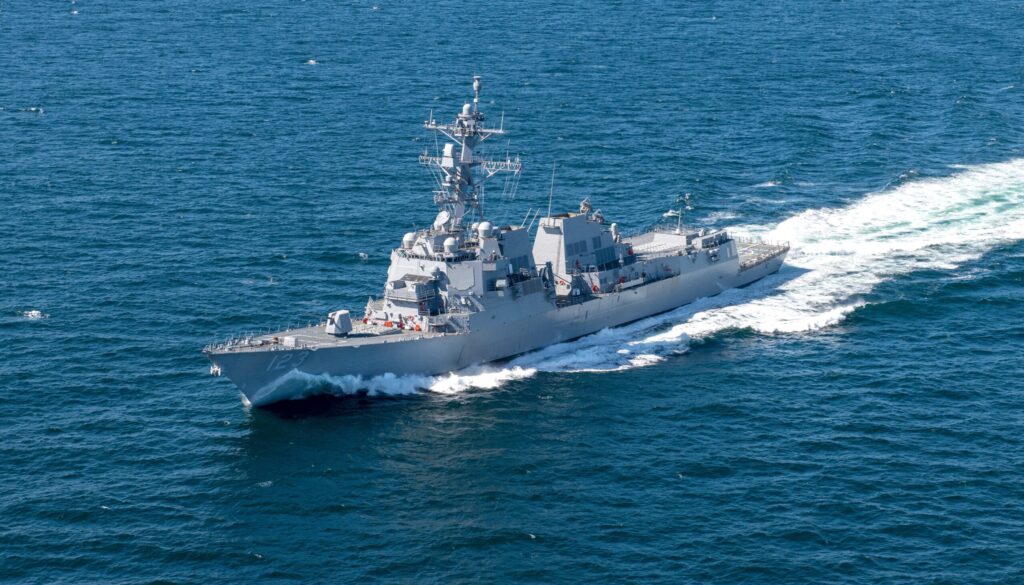
The future USS Lenah Sutcliffe Higbee (DDG 123) completed Acceptance trials, Oct. 6. HII
WASHINGTON — The future USS Lenah Sutcliffe Higbee (DDG 123) completed Acceptance trials, October 6, Team Ships Public Affairs said in a release.
During trials, the Navy’s Board of Inspection and Survey inspected the ship performing a series of demonstrations while pier side and underway to validate performance. The ship’s onboard systems, including navigation, damage control, mechanical and electrical systems, combat systems, communications and propulsion applications, met or exceeded Navy specifications.
DDG 123 is named for the first ever woman to receive the Navy Cross, Lenah Sutcliffe Higbee. Higbee served in the Navy for 14 years, including 11 as superintendent of the U.S. Navy Nurse Corps. She joined the Navy Nurse Corps in October 1908 and was promoted to chief nurse less than a year later. She was named superintendent in January 1911.
“We are proud to introduce another advanced warship to the fleet,” said Capt. Seth Miller, DDG 51 program manager, Program Executive Office (PEO) Ships. “The Navy is honored to recognized Lenah Sutcliffe Higbee with this fully capable, mission-ready ship.”
The DDG 51 Arleigh Burke-class ships are multi-mission guided missile destroyers designed to operate offensively and defensively, independently, or as units of Carrier Strike Groups, Expeditionary Strike Groups, and Surface Action Groups in multi-threat environments that include air, surface and subsurface threats. These ships will respond to Low Intensity Conflict/Coastal and Littoral Offshore Warfare scenarios, as well as open ocean conflict, providing or augmenting power projection, forward presence requirements and escort operations at sea.
DDG 123 is a Flight IIA destroyer equipped with the Aegis Combat System Baseline 9C2. This system delivers quick reaction time, high firepower and increased electronic countermeasures capability against a variety of threats.
The ship is expected to be delivered to the Navy later this year from Huntington Ingalls Industries’ Ingalls Shipbuilding division in Pascagoula, Mississippi. The shipyard is also in production on future destroyers Jack H. Lucas (DDG 125), Ted Stevens (DDG 128), Jeremiah Denton (DDG 129) and George M. McNeal (DDG 131).