U.S., U.K. Navies Conduct Unmanned Exercise in Arabian Gulf

Naval forces from the United States and United Kingdom conducted a bilateral exercise in the Arabian Gulf, Oct. 7. U.S. NAVY

MANAMA, Bahrain — Naval forces from the United States and United Kingdom conducted a bilateral exercise in the Arabian Gulf, Oct. 7, which featured the use of unmanned systems and artificial intelligence to enhance maritime monitoring by crewed ships and operators ashore, U.S. Naval Forces Central Command Public Affairs said in an Oct. 7 release. 

The one-day exercise, called Phantom Scope, occurred in international waters off the coast of Bahrain with forces from U.S. 5th Fleet and the UK Royal Navy. Three Saildrone Explorer unmanned surface vessels (USVs) participated alongside guided-missile destroyer USS Delbert D. Black (DDG 119), fast response cutter USCGC Robert Goldman (WPC 1142) and Royal Navy mine countermeasures vessels HMS Chiddingfold (M37) and HMS Bangor (M109). 

“Putting more eyes out on the water enhances our picture of the surrounding seas and enables us to position our crewed ships to react more rapidly,” said Vice Adm. Brad Cooper, commander of U.S. Naval Forces Central Command, U.S. 5th Fleet and Combined Maritime Forces. 

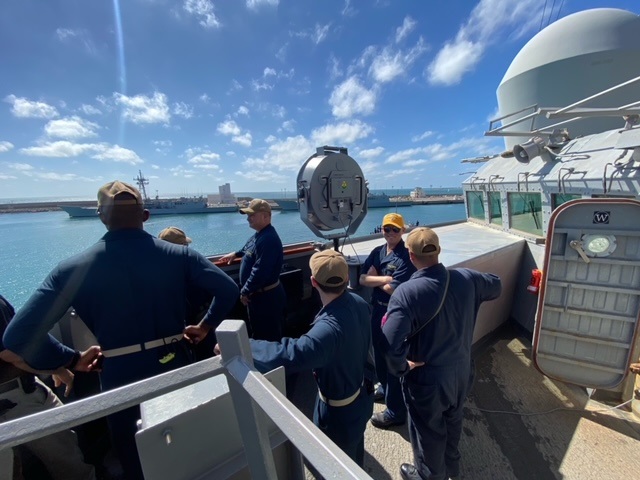
During the exercise, unmanned and artificial intelligence systems operated in conjunction with crewed ships and naval command centers ashore in Bahrain. Sensors from unmanned vessels were able to locate and identify training aides in the water and relay visual depictions to the command centers. 

“Whenever we work in the maritime environment, particularly when working alongside international partners, it is critical we have relevant maritime domain awareness,” said Royal Navy Commodore Adrian Fryer, commander of UK’s maritime component based in the Middle East.   

“Alongside the more traditional methods, uncrewed systems are an essential tool, and the future, in building this understanding, the picture they provide can enhance the security and stability of the maritime environment,” Fryer added. 

U.S. 5th Fleet established an unmanned systems and artificial intelligence task force in September 2021 to integrate new technologies into U.S. Navy operations across the Middle East. 

In the past 12 months, Task Force 59 has amassed more than 25,000 hours of experience integrating new unmanned systems and artificial intelligence. The task force has also established operating hubs in Bahrain and Aqaba, Jordan in close cooperation with regional partners. 

“We have already achieved more today than many might have imagined possible when we started,” said Cooper. “Our goal is a distributed and integrated network of systems operated with our partners to significantly expand how far we can see.”
General Dynamics Electric Boat Awarded $533 Million for Virginia-Class Submarine Support

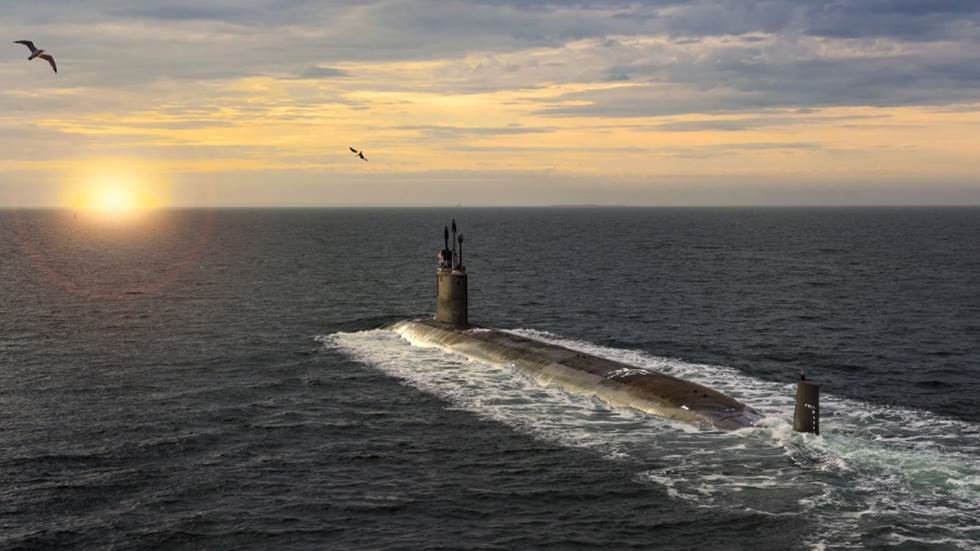
Virginia-class attack submarine. GENERAL DYNAMICS

GROTON, Conn. — General Dynamics Electric Boat, a business unit of General Dynamics, announced Oct. 6 it was awarded a U.S. Navy contract modification for lead-yard support, development studies and design efforts related to Virginia-class attack submarines. 

The contract modification has a value of $532.9 million. Work will be performed in Groton, Connecticut, and Newport News, Virginia, and is expected to be completed by October 2023.  

“We are proud to continue to support the design and engineering of Virginia-class submarines to ensure they have the superior warfighting capabilities the U.S. Navy needs to defend our Nation,” said Kevin Graney, president of Electric Boat. “The continued evolution of the Virginia class over the last two decades guarantees our sailors the asymmetric advantage they deserve.” 

General Dynamics Electric Boat designs, builds, repairs and modernizes nuclear submarines for the U.S. Navy. Headquartered in Groton, the company employs approximately 18,000 people. 


Navy Invests in Land-Based Test Site for New Frigate 

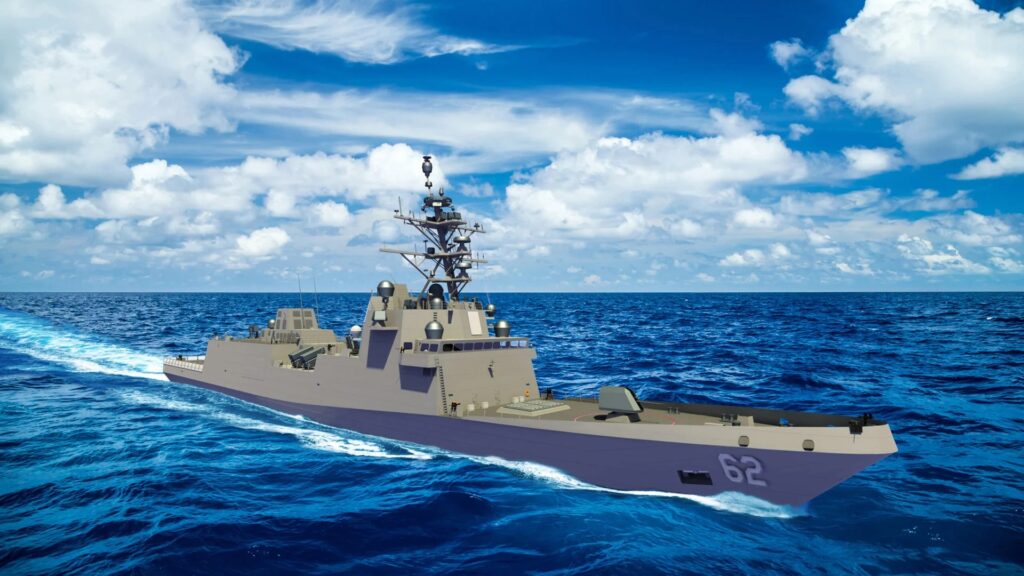
An artist’s conception of the future USS Constellation. FINCANTIERI MARINETTE MARINE

ARLINGTON, Va. — The U.S. Navy has invested funding toward building the land-based engineering test site for the Constellation-class guided-missile frigate (FFG).  

The Navy’s Supervisor of Shipbuilding, Conversion, and Repair, Bath, Maine, has awarded to Fincantieri Marinette Marine, Marinette, Wisconsin, a $76.7 million firm-fixed-fee contract modification “for procurement of long-lead time material for the land-based engineering site for the Constellation-class frigate,” the Defense Department contract announcement said. 

The land-based test site to be built in Philadelphia will be used to test the propulsion system and other machinery of the frigate design to reduce risk and identify and fix problems before they would be manifest in the lead ship of the class.  

The land-based engineering test site was mandated by the Fiscal 2021 National Defense Authorization Act as an expression on Congressional intent regarding solving engineering problems as construction proceeds.   

The construction of the U.S. Navy’s next class of guided-missile frigates officially began Aug. 31 with the first steel for the ship cut in a small ceremony at the Fincantieri Marinette Marine Shipyard in Marinette, Wisconsin.  

The future USS Constellation (FFG 62) will be the lead ship of a class of at least 20 frigates and is slated for delivery in 2026. The hull of the frigate is be based on the Italian FREMM-class frigate and will be equipped with proven weapons and combat systems.   

Work on the contract is expected to be completed by October 2025.


Navy Opens New Additive Manufacturing Center of Excellence; Announces New Regional Training Center in Danville, Va.

DANVILLE, Va. — On Oct. 5, the U.S. Navy celebrated the formal opening of its Additive Manufacturing Center of Excellence (AM CoE) within the State of Virginia’s Center for Manufacturing Advancement (CMA) on the Institute for Advanced Learning and Research (IALR) campus in Danville, Virginia, Team Submarine Public Affairs said in an Oct. 6 release.  

The AM CoE is co-located with IALR’s Accelerated Training in Defense Manufacturing (ATDM) Program, which is a joint U.S. Navy-Office of the Secretary of Defense Industrial Base Analysis and Sustainment effort that provides a fast track, intensive, and targeted curriculum across key trades, including welding, machining, metrology, and additive manufacturing. 

The new AM CoE will include three full bays dedicated to accelerating and scaling additive manufacturing, activating the supply chain through a centralized Navy demand signal, and serving as an operational hub that builds upon experience and collaboration across a consortium of industry and academic experts.  

The official ribbon-cutting ceremony took place during the Second Annual ATDM Summit, which brought together U.S. Navy, Office of the Secretary of Defense, federal, state and local government officials, as well as defense, industry and academic partners, to discuss the importance of creating a ready and capable workforce and sustaining robust trade pipelines and strong industry partnerships to close the trade and manpower gaps impacting the defense industry. 

Virginia Governor Glenn Youngkin kicked off the Summit in front of a crowd of 300 people.  

“We are honored to be partnered with the Navy. This partnership will diversify, transform and grow Southern Virginia’s production capability for the Submarine Industrial Base as well, marking another major win for Virginia’s defense economy and labor market,” Youngkin said. 

During live, virtual remarks, Secretary of the Navy Carlos Del Toro addressed the imperative for programs like ATDM.  

“To strengthen our maritime dominance, we have to field and maintain the right capabilities to deter adversaries and, when called upon, to win wars,” Del Toro said. “Graduates of the ATDM Program will enter the workforce with the specific skills and nationally recognized certifications we need now, with true, hands-on experience through facilities like the new Additive Manufacturing Center of Excellence.” 

Vice Adm. William Galinis, commander, Naval Sea Systems (NAVSEA), provided his perspective on the efforts happening in Danville and how they are poised to support the broader Navy enterprise. 

“This is an ‘All Hands on Deck’ endeavor, and ensuring we have a ready and capable workforce is at the top of the list in things we must get right,” he said. 

“The creation of the AM CoE marks the first major partnership for the CMA, and demonstrates the Navy’s commitment to investing in – and delivering – the skilled workforce necessary to strengthen and expand the Navy’s industrial base to achieve the Nation’s strategic defense objectives,” said Matthew Sermon, the executive director of Program Executive Office, Strategic Submarines (PEO SSBN). 

“Building and sustaining the Navy’s defense industrial base workforce, and smartly but aggressively pushing the bounds of advanced technology adoption, has become a national security imperative and is part of the whole-of-government/whole-of-industry approach,” Sermon continued. “This facility, and the partnerships it is built upon, will pave a path for sustainable and scalable additive manufacturing production capability in the submarine industrial base, and across the Navy-industry community.”  

PEO SSBN’s Rear Adm. Scott Pappano cut the ceremonial ribbon, and also announced plans for key investments into dedicated infrastructure, capability, and capacity designed to scale the current ATDM program through a Regional Training Center, which will sit adjacent to the AM CoE and will have the capacity to train approximately 1000 defense manufacturing workforce members each year. 

“ATDM serves as a national model for how we meet the demand for industrial base workforce over the coming years,” Pappano said. “As we look to our greatest threats and risk, we must make bold moves…that’s exactly what we are doing here in Danville. The events we celebrate today – centered on workforce, technology, and the space where those two priorities must meet – are game changing for our enterprise.”  

U.S. Sens. Mark Warner and Tim Kaine, U.S. Rep. Bob Good, and U.S. Department of Labor Assistant Secretary for Veterans’ Employment and Training Service (VETS) James D. Rodriguez were among the distinguished guests who provided their overwhelming support for both the workforce and technology efforts happening as part of the region’s partnership with the Navy. 


Navy Approves Northrop Grumman’s New Navigation Capability for Fleet Deployment 

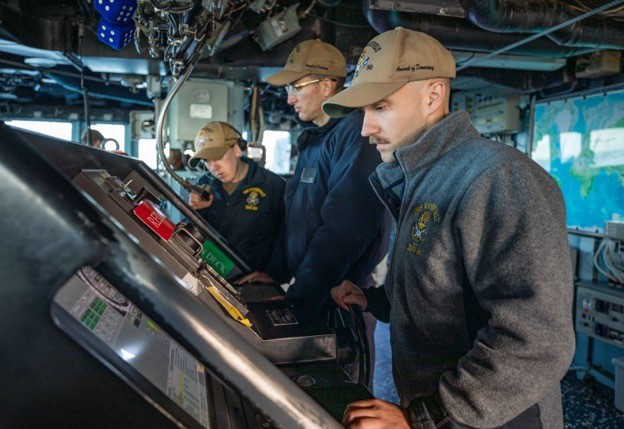
Sailors stand watch on the bridge aboard the Arleigh Burke-class guided-missile destroyer USS Roosevelt (DDG 80) as the ship conducts a replenishment-at-sea with the dry cargo and ammunition ship USNS William McLean (T-AKE 12), Oct. 1, 2022. U.S. NAVY / Mass Communication Specialist 2nd Class Danielle Baker

CHARLOTTESVILLE, Va.— The U.S. Navy has approved Northrop Grumman Corporation’s new Electronic Chart Display and Information System (Navy ECDIS) for deployment to its fleet, the company said in an Oct. 5 release. 

The Navy’s Operational Test and Evaluation Force (OPTEVFOR) issued a formal determination that Navy ECDIS is “operationally suitable, operationally effective and cyber survivable.” This new capability will be a core element to all U.S. Navy bridge and navigation systems. 

Navy ECDIS processes and displays multiple chart formats including digital nautical charts developed by the National Geospatial-Intelligence Agency. The system tracks targets from the vessel’s navigation radar, enabling creation of route plans, automation of plan execution and monitoring progress along the route. Safety checking functions analyze chart data and radar targets to warn of hazards to safe navigation while underway. 

“Our agile approach to developing Navy ECDIS enabled software to be developed in sprints, with customer input at every step of the way,” said Todd Leavitt, vice president, naval and oceanic systems, Northrop Grumman. “This workflow allowed the Navy to see and evaluate results of their input as they came up and saved them both time and money.” 

Navy ECDIS will provide the next generation of navigation capabilities to the fleet including compliance with the standard for mission interoperability with NATO allies, implementing cybersecurity requirements as well as enhancements to the human machine interface to simplify operation, improve situational awareness and increase the safety of navigation. 

OPTEVFOR’s approval of Navy ECDIS is the culmination of nearly a year of rigorous government testing. The test and approval process began with sea trials on the amphibious assault ship USS Kearsarge (LHD 3) and continued with evaluation activities at Naval Surface Warfare Center, Philadelphia Division (NSWCPD). 

The Navy has directed the Nimitz-class aircraft carrier USS Theodore Roosevelt (CVN 71) to be the first ship in the fleet to receive Navy ECDIS. NSWCPD will perform the installation this October. The Navy plans to install the system on 115 ships in the next three years, demonstrating the power of scalability of software defined systems such as Navy ECDIS. 

Northrop Grumman developed and fielded the Navy’s current ECDIS software, Voyage Management System, which has since become a core element of the bridge and navigation system on every U.S. Navy ship and submarine. Northrop Grumman’s broad range of navigation systems provides precise, survivable, secure, resilient and agile solutions for sea, land, air and space. 


Keel Authenticated for the Future USNS Saginaw Ojibwe Anishinabek 

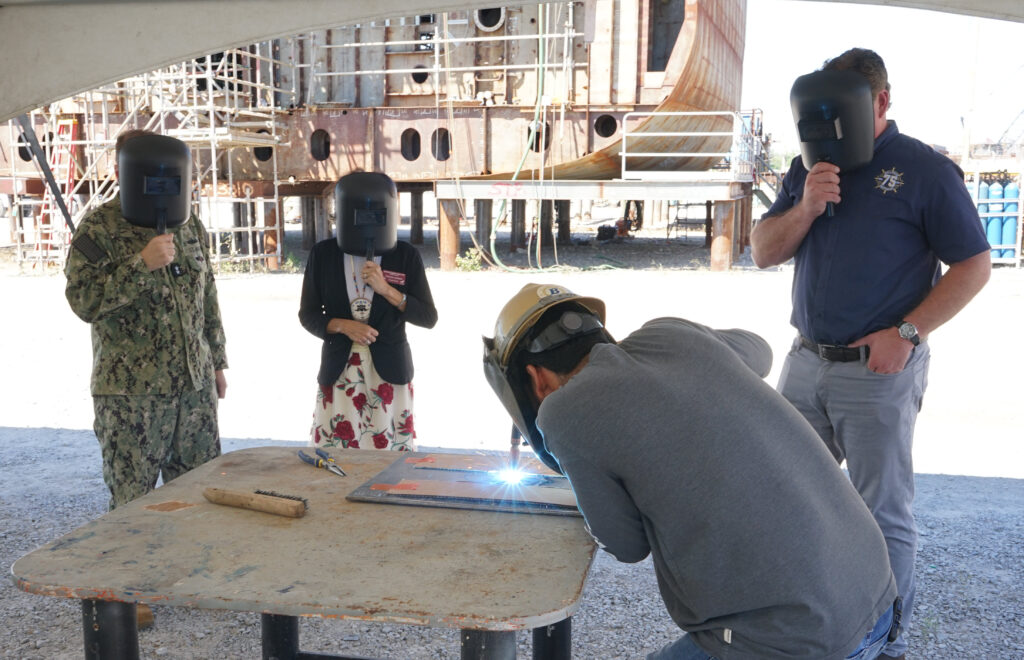
The keel for the future USNS Saginaw Ojibwe Anishinabek (T-ATS 8) was ceremonially laid at Bollinger Houma Shipyards in Houma, LA, Oct. 3. Bollinger Houma Shipyards

WASHINGTON — The keel for the future USNS Saginaw Ojibwe Anishinabek (T-ATS 8) was ceremonially laid at Bollinger Houma Shipyards, Oct. 3, Team Ships Public Affairs said in an Oct. 5 release.   

Named for the Saginaw Chippewa Tribe, the ship honors the original people of modern-day Michigan and their proud tradition of service to their country. Ojibwe is also referred to as Chippewa and Anishinabek means “original people.” The keel authenticator was the Honorable Theresa Peters Jackson, Chief of the Saginaw Chippewa Tribe. 

“This is an awesome Navy day as we gather to celebrate this multi-mission platform and the range of capabilities it will bring to the fleet, including towing, salvage, rescue, oil spill response and humanitarian assistance,” said Rear Adm. Tom Anderson, Program Executive Officer, Ships. “It is an honor to be joined by members of the Saginaw Chippewa Tribe as the keel is authenticated for their namesake ship and we are excited to honor their heritage and commitment to service of country.” 

The Navajo class (T-ATS) provides ocean-going tug, salvage, and rescue capabilities to support fleet operations. T-ATS replaces and fulfills the capabilities that were previously provided by the Fleet Ocean Tug (T-ATF 166) and Rescue and Salvage Ships (T-ARS 50) class ships. 

In addition to T-ATS 8, Bollinger is constructing USNS Navajo (T-ATS 6) and USNS Cherokee Nation (T-ATS 7) and is under contract for USNS Lenni Lenape (T-ATS 9) and USNS Muscogee Creek Nation (T-ATS 10). 


Keel Authenticated for Pathfinder-Class T-AGS 67 

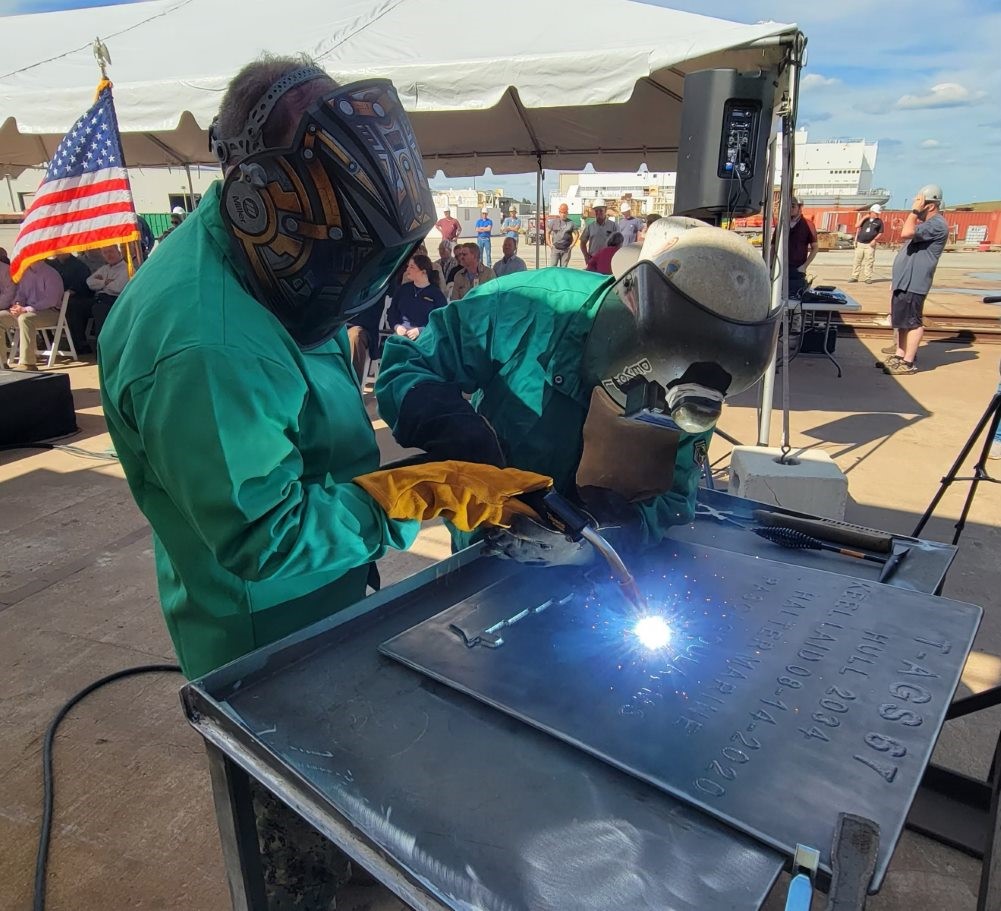
The keel of the next oceanographic survey ship (T-AGS 67) was ceremonially laid at Halter Marine in Pascagoula, MS, Oct. 4. Here, Halter Marine welders etch names and the hull number into the keel plate. Halter Marine

WASHINGTON — The keel for the Navy’s next oceanographic survey ship (T-AGS 67) was ceremonially laid at Halter Marine in Pascagoula, MS, Oct. 4, Team Ships Public Affairs said in an Oct. 5 release. The keel authenticator was Rear Adm. Tom Anderson, Program Executive Officer, Ships. 

“This is an awesome Navy day as we gather to celebrate the start of construction of the eighth ship in the Pathfinder class,” Anderson said. “We look forward to delivering another ship that provides significant capability in undersea warfare and charting the world’s coastlines.” 

Equipped with a moon pool for unmanned vehicle deployment and retrieval, T-AGS 67 will be a multi-mission ship that will perform acoustic, biological, physical and geophysical surveys, providing much of the U.S. military’s information on the ocean environment. The vessel will be more than 350 feet in length with an overall beam of 58 feet.   

T-AGS 67 will be operated by the Military Sealift Command (MSC). MSC consists of non-combatant, civilian crewed ships that replenish U.S. Navy ships, chart ocean bottoms, conduct undersea surveillance, tactically preposition combat cargo at sea and move military equipment and supplies used by deployed U.S. forces around the world. 


USS Porter Completes Service with Forward Deployed Naval Forces-Europe

The Arleigh Burke-class guided-missile destroyer USS Porter (DDG 78) departs Naval Station Rota, Spain, to begin its homeport shift to Norfolk, Virginia, Sept. 28, 2022. U.S NAVY

NAVAL STATION ROTA, Spain — The Arleigh Burke-class guided-missile destroyer USS Porter (DDG 78) departed Naval Station Rota, Spain, on Sept. 28, 2022, marking the end of its time as a Forward Deployed Naval Forces-Europe (FDNF-E) destroyer, said Lt. j.g. Anna M. Kukelhan of Commander, Naval Forces Europe/Africa, in an Oct. 5 release. 

Porter has been stationed in Rota, Spain for seven years, initially joining USS Donald Cook (DDG 75) and USS Ross (DDG 71) on April 30, 2015 as the third FDNF-E destroyer assigned to Destroyer Squadron 60 and Commander, Task Force (CTF) 65, which operates under command and control of U.S. Sixth Fleet in the U.S. Naval Forces Europe-Africa area of operations. 

“Porter’s time in Sixth Fleet was an invaluable experience for all. The crew and I depart Rota, Spain at the highest state of readiness thanks to the many operations and exercises conducted with our NATO allies and partners,” said Cmdr. Christopher Petro, Porter’s commanding officer. “We are extremely grateful for personal and professional development provided by the opportunities and challenges encountered as a member of Forward Deployed Naval Forces Europe.” 

Porter conducted 11 patrols in the U.S. Sixth Fleet area of operations, finishing her most recent patrol in July 2022. Throughout these patrols, Porter sailed through the Mediterranean Sea, Baltic Sea, Black Sea and High North. The ship has also crossed the Atlantic three times, building interoperability with NATO allies and partners throughout the region. 

Porter worked with the USS Dwight D. Eisenhower (CVN 69), USS Harry S. Truman (CVN 75) and the French Charles de Gaulle Carrier Strike Groups, although most of its time underway was independently deployed. Porter’s patrols focused on a wide variety of mission areas, including surface warfare, anti-submarine warfare, anti-air warfare and strike warfare, dedicated to ensuring interoperability with U.S. allies and offering a stable presence in the region. 

During its seven years with the FDNF-E force, Porter participated in many joint operations with allies and other branches of service. Some of the notable exercises the ship participated in include FOST, BALTOPS, Atlas Handshake, Joint Warrior, Sea Breeze, Polaris and Atlantic Resolve. 

In April 2017, Porter launched 59 Tomahawk missiles into Al-Shayrat Air Base, Syria, in coordination with USS Ross (DDG 71), in response to the Syrian government’s chemical attacks on civilians during the Syrian civil war. 

Porter will be replaced on the FDNF-E force by USS Bulkeley (DDG 84), the latest destroyer to arrive to Rota, Spain. USS Bulkeley was commissioned in December of 2001, and is named for Vice Admiral John D. Bulkeley. 

With Porter’s departure, all four ships originally assigned to CTF 65 have been replaced. With all homeport shifts now completed, the new FDNF-E ships are the USS Arleigh Burke (DDG 51), USS Roosevelt (DDG 80), USS Paul Ignatius (DDG 117) and the USS Bulkeley (DDG 84). The new members of the FDNF-E force will continue the exemplary work accomplished by the first assigned destroyers, including Porter. 

“Throughout her seven years patrolling Sixth Fleet, Porter Sailors consistently demonstrated our capabilities and integration with joint and combined forces. I am extremely proud of the work USS Porter accomplished here and how we have furthered our alliances and partnerships,” said Cmdr. Joseph Hamilton, Porter’s executive officer, “It has been a privilege to serve at the forefront of critical operations in the FDNF-E environment, and I am humbled to have served with the best crew in the Navy.” 

Porter is named for Commodore David Porter, and his son, Adm. David Dixon Porter, and is the fifth ship to bear his name. Commodore David Porter served in the Quasi War, First Barbary War, War of 1812 and in the West Indies. He took command of numerous ships, including the USS Constitution. He is known for first originating the saying, “Free Trade and Sailors Rights.” 

Adm. David Dixon Porter was the second U.S. Navy Officer to achieve the rank of Admiral, largely due to his service during the Civil War, where he played a vital role in the Battle of New Orleans and the Battle of Vicksburg. He also led the assault on Fort Fischer, the final significant naval contribution of the war. His service began with his time in the Mexican-American War and ended with his tenure as Superintendent of the Naval Academy, where he enacted a significant series of reforms, laying the groundwork for their current mission. 

USS Porter is scheduled to return to its former homeport of Norfolk, Virginia, and will now continue to serve through an assignment to Destroyer Squadron 22. 

Four U.S. Navy destroyers are based in Rota, Spain and are assigned to Commander, Task Force 65 in support of NATO’s Integrated Air Missile Defense architecture. These FDNF-E ships have the flexibility to operate throughout the waters of Europe and Africa, from the Cape of Good Hope to the Arctic Circle, demonstrating their mastery of the maritime domain. 


Gerald R. Ford Deploys After One-Day Weather Delay 

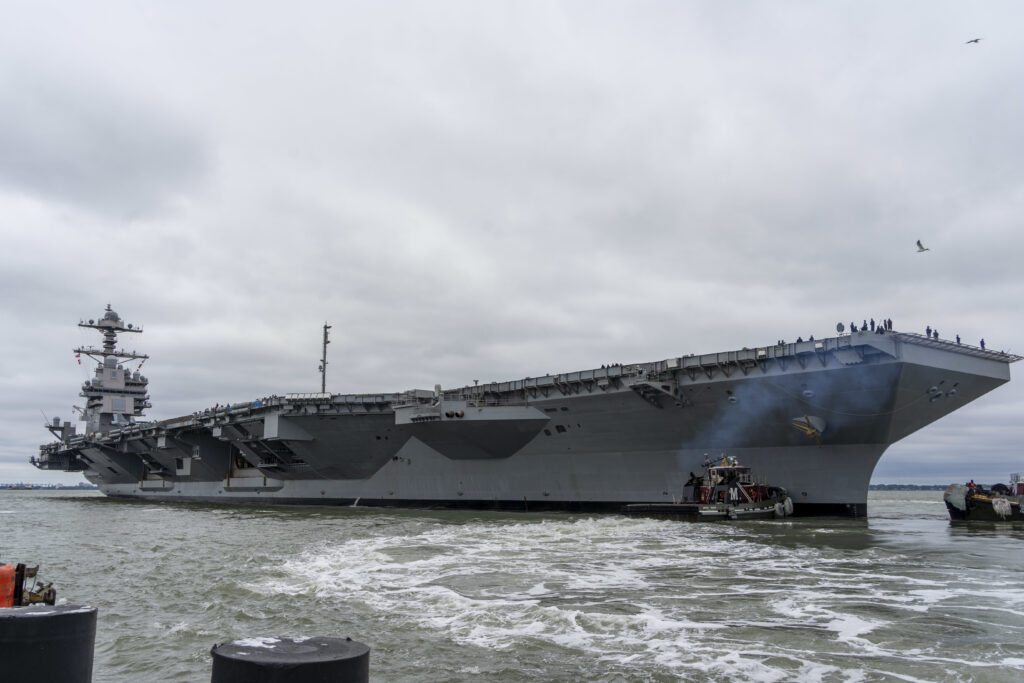
The Gerald R. Ford-class aircraft carrier USS Gerald R. Ford (CVN 78) departs Naval Station Norfolk, Oct. 4. U.S. NAVY / Mass Communication Specialist 1st Class Anderson W. Branch

ARLINGTON, Va. — The lead ship U.S. Navy’s newest class of nuclear-powered aircraft carrier, USS Gerald Ford (CVN 78), delayed a day for weather, departed Naval Station Norfolk, Virginia, Oct. 4 on its first major deployment.  

“This afternoon the Navy’s newest and most advanced aircraft carrier USS Gerald R. Ford (CVN 78) set out on deployment,” said Lt. Danielle Moser, deputy public affairs officer for Commander, U.S. 2nd Fleet, in an Oct. 4 release. 

The Ford is making what the Navy calls a “service-retained” deployment, meaning it is operating by the authority of the chief of naval operations under command and control of the U.S. 2nd Fleet, rather than under the command and control of a regional combatant commander under the Global Force Management Concept.   

Vice Adm. Daniel Dwyer, commander of the U.S. 2nd Fleet, said Carrier Strike Group 12 (CSG 12), of which the Ford is a part, will range throughout the Atlantic Ocean operating with navies of allied and partner nations.  

Dwyer, speaking to reporters Sept. 26, said the deployment would provide the Ford CSG commander “a chance to test the carrier’s air operability prior to embarking on its first Global Force Management deployment next year. This historic service-retained deployment is an opportunity for the U.S. Navy to come together with other members of the NATO Alliance to exercise and train together within the Atlantic and its littorals while testing out advanced technologies on the first new class of U.S. aircraft carrier in more than 40 years.”  

CSG-12 and Destroyer Squadron Two staffs will be embarked in the Ford, as will Carrier Air Wing Eight. Deploying with the group will be Ticonderoga-class guided-missile cruiser USS Normandy (CG 60); the Arleigh Burke-class guided-missile destroyers USS Ramage (DDG 61), USS McFaul (DDG 74), and USS Thomas Hudner (DDG 116); the Legend-class national security cutter USCGC Hamilton (WMSL 753); the Henry J. Kaiser-class fleet replenishment oiler USNS Joshua Humphpries (T-AO 188), and the Lewis and Clark-class dry cargo and ammunition ship USNS Robert E. Peary (T-AKE 5).  

Units from eight allied and partner nations will operate with the CSG and include ships from Canada, Denmark, Finland, France, Germany, The Netherlands, Spain and Sweden. The CSG includes 17 ships and one submarine.  

While deployed, the Ford CSG will conduct group steaming, air-defense exercises, maritime domain awareness, long-range maritime strike, distributed maritime operations, antisubmarine warfare exercises and naval integration, Dwyer said.  

All eight squadrons of Carrier Air Wing Eight will be onboard for the deployment but some will not be at full strength in terms of numbers of aircraft.   

“It won’t be the full complement, but it will be nearly the entire air wing,” Dwyer said. “And that is not because of any lack of capacity aboard Ford, but only where the air wing is in the Global Force Management process. We’re still sizing the numbers, but it will be a fairly full air wing, but not the complete air wing.”  

New Technology 

The Ford, commissioned in 2017, is deploying with 43 new technologies, including the Electro-Magnetic Aircraft Launch System, and the Advanced Arresting Gear.  

The Ford’s commanding officer, Capt. Paul Lanzilotta, said in a Sept. 29 interview that all systems have been tested and are ready to go, and some will go through further operational testing.  

Lanzilotta, a native of Long Island, New York, is an E-2 Hawkeye naval flight officer. He said the Ford has “incredible network connectivity.”  


Navy’s VP-9 Conducts Harpoon Shot in Atlantic Thunder 2022 

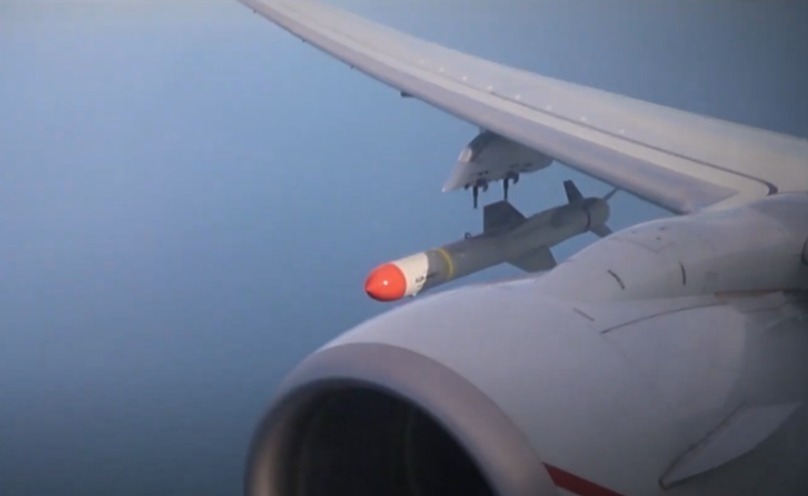
An AGM-84D Harpoon missile is deployed off the wing of the P-8A by VP-9 during Atlantic Thunder 2022. U.S. NAVY / Lt. Joseph Reed

SIGONELLA, Sicily — Patrol Squadron Nine (VP-9) recently had the unique opportunity to participate in Atlantic Thunder 2022, a joint, multi-phase, multinational exercise designed to increase NATO interoperability and strengthen the United States-United Kingdom strategic partnership, the squadron said in a release.

The highlight of the exercise for VP-9 occurred with a coordinated time-on-target strike of the decommissioned Oliver Hazard Perry Class frigate USS Boone. 

Various joint and multinational assets collaborated on the Hebrides Deep Sea Range off Scotland’s northwest coast in order to achieve the exercise’s main tactical objective, sinking the decommissioned USS Boone. Combat Air Crew Six (CAC-6) was selected to carry out the coordinated time on target strike portion of the exercise with the AGM-84D Harpoon, an anti-ship missile developed by Boeing. Among the other assets that joined CAC-6 and VP-9 in other phases of the exercise were the Royal Navy’s HMS Westminster and its Agusta-Westland AW159 Wildcat Helicopter, three Royal Air Force Typhoons of the 41st Squadron, one U.S. Air Force McDonnell-Douglas F-15E Strike Eagle, and a U.S. Navy submarine. Additionally, range clearance safety was provided by other U.S. P-8As from VP-9’s sister squadron, VP-46. 

Atlantic Thunder 2022 proved to be a rousing success for all participants, as it not only accomplished all of its primary objectives and sunk the decommissioned USS Boone, but according to the U.K.’s after action report, the process “achieved several firsts for the U.K. and U.S. in terms of advanced warfighting techniques and delivering complex weapon effects against a realistic target.”

Ultimately, the ship formerly known as the USS Boone stood no chance against the “remarkable amount of combined firepower within a short period.”

First to hit the ex-Boone were two SM-6 missiles, courtesy of the HMS Westminster. This was followed in short order by the coordinated Harpoon shot conducted by CAC-6 and the HMS Westminster. At precisely 1521Z, the AGM-84D Harpoon launched from the P-8A had a rendezvous with two surface launched AGM-84D Harpoons via the HMS Westminster into the hull of the ex-Boone. The HMS Westminster’s portion of coordinated time on target strike included passive over-the-horizon-targeting generated by U.S. Naval Integrated Fires, marking the first time this type of targeting has ever been accomplished against a real life target with multinational collaboration.

Raymond O’Toole, Principle Deputy Director, Operational Test and Evaluation from the Office of the Secretary of Defense remarked on this coordinated targeting, saying, “What we’ve demonstrated through this exercise is a new capability — to gain and exchange information for targeting purposes.” 

Coordinated time on target shots such as the one conducted by CAC-6 and the HMS Westminster require precise multinational cooperation via detailed planning, communications, and tactical data link employment from multiple nations and services. Successful coordinated shots are remarkably effective in overwhelming a potential combatant’s defenses by delivering rapid amounts of ordnance on target simultaneously and from multiple trajectories and domains.

“What we’ve seen in Atlantic Thunder today, is that with Royal Air Force, U.S. Air Force, U.S. Navy, and Royal Navy all operating together [with] helicopters, fixed-wing aircraft, ships, and a submarine, every one of which is capable of going to war tomorrow, we’ve proven it today for the first time in decades in the Atlantic,” summed up Royal Navy Rear Adm. James Parkin. 

Following VP-9’s successful coordinated Harpoon shot with the HMS Westminster, the ex-Boone endured several more rounds of punishment from exercise participants. The three RAF Typhoons arrived in short order to deploy four Paveway IV precision guided missiles onto ex-Boone. This was quickly followed by the Wildcat Helicopter’s two Martlet missiles and shortly thereafter two Joint Direct Attack Munitions dropped by the F-15E Strike Eagle. The sub-launched munition and explosive ordnance disposal live charges delivered the final blow against the ex-Boone, sending her to the depths of the North Atlantic in over 6,500 feet of water. 

Notably, the decommissioned USS Boone was prepared and configured specifically to meet stringent Environmental Protection Agency standards. This was done to mitigate potential adverse effects and keep risk to the environment as low as practicable. In addition to the ex-Boone’s configuration, strict acoustic and visual monitoring from multiple sources on the range ensured that the risk posed by the exercise to marine mammals was extremely low. 

VP-9’s contribution to Atlantic Thunder 2022 was critical to the exercise’s overall success and demonstrated the P-8A’s and MPRF’s ability to provide long range, coordinated strike capability in the maritime domain, with the added challenge of multi-national and multi-service planning and coordination. 

Commanded by Cmdr. James J. Donchez, and based out of NAS Whidbey Island, Washington, the 279 Sailors assigned to VP-9 are currently deployed to the 6th Fleet area of responsibility and operate the P-8A Poseidon Maritime Patrol Aircraft.