Navy Recruiting Announces Results for Fiscal 2022 and Goals for 2023 
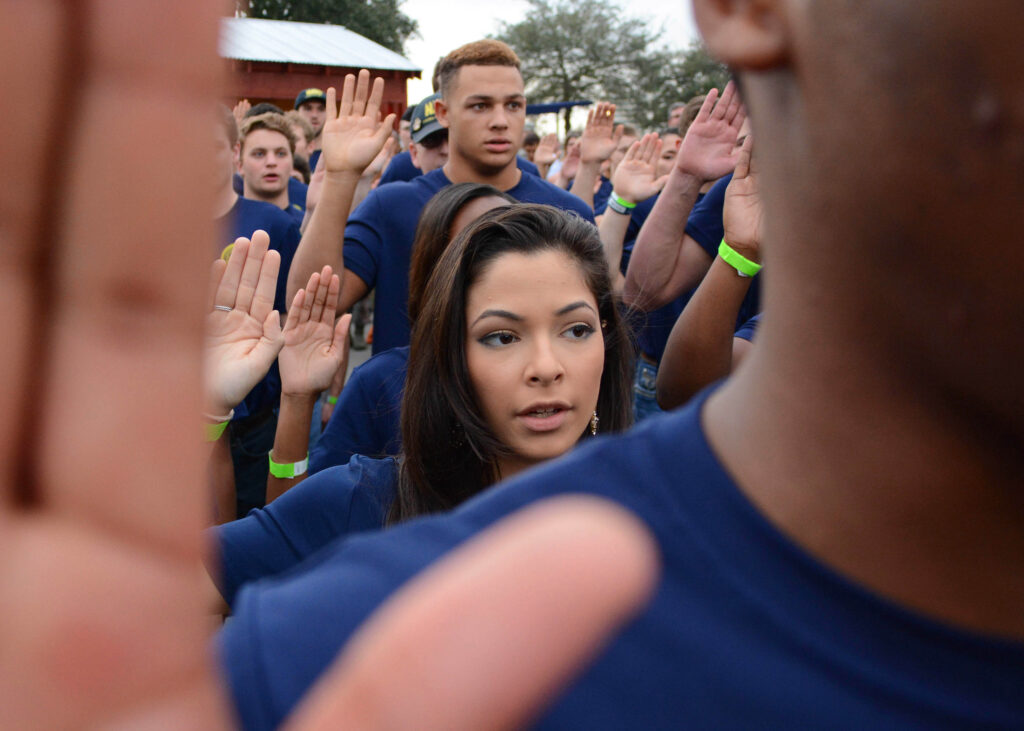
Approximately 100 future Sailors from across Navy Recruiting District Houston took the Oath of Enlistment Wednesday, March 4, during a joint swear in ceremony at the Houston Rodeo. U.S. NAVY / Mass Communication Specialist 1st Class Chris Fahey

MILLINGTON, Tenn. — Fiscal year 2022 Navy recruiting completed Sept. 30, with the Navy reaching its goal in enlisted active duty recruiting, while falling short of its goals in reserve enlisted and both active and reserve officer recruiting, said Petty Officer 2nd Class Cody Anderson of Navy Recruiting Command in a release.

FY22 has been a highly challenging recruiting environment, with competition for top talent fierce within the branches of the Department of Defense and the private sector, where major corporations have begun offering incentive packages to compete with the military. As all branches of the military have struggled to make mission, the Navy implemented multiple initiatives in order to accomplish their accession goal.

The Navy finished FY22 with the following numbers.
FY22 Goal Actual 
Enlisted (Active) 33,400 33,442 
Officer (Active) 2,507 2,298* 
Enlisted (Reserve) 7,400 5,442* 
Officer (Reserve) 1,360 982* 
*Preliminary numbers, which may change slightly based on Sept. 30 activity.

“We’ve completed a very challenging year, and I am very proud of the tremendous efforts our Recruiters gave to bring in the nation’s top talent and build the future of the fleet,” Rear Adm. Alexis “Lex” Walker, commander, Navy Recruiting Command said. “The coming year promises to be even more challenging, as we are not starting the year in as strong a position as FY22. In order to achieve our mission goals this year, we will need an all-hands-on-deck effort, not only from our recruiters, but from throughout the active and reserve fleet, our retired Navy veterans, and our community leaders around the country who are centers of influence in the lives of the young people we are trying to recruit. We are going to do everything within our power to ensure that our recruiters are empowered and have the assets they need in order to accomplish the mission.” 
 
While the enlisted active accessions reached their mission goal, this came at a heavy price. The Navy entered FY22 with a relatively healthy Delayed Entry Program (DEP) pool and finished the year with the lowest DEP pool in 40 years. DEP allows future Sailors to be contracted to join but remain on hold before shipping off to Recruit Training Command (boot camp). The goal of the program is to acclimate future service members to the military environment, military rank structure, history, customs and courtesies and to improve their physical fitness prior to shipping out. It also allows the military flexibility in when they ship future service members to regulate the flow of future Sailors to boot camp and follow on training schools. 
 
Draining the DEP pool to critically low levels brings many new challenges for the upcoming year. Around a third of those remaining in DEP are future Sailors who are seniors in high school, who cannot ship until after graduation in May/June 2023. So the Navy is expected to be in a contract-and-ship posture, where future Sailors are shipped to boot camp within weeks or even days of contracting to serve. This posture is expected to persist through FY23. 

For fiscal 2023, the goals are 37,700 enlisted (active); 8,100 enlisted (reserve); and 1,732 officer (reserve). The goals for active-duty officers are usually released in the first quarter of the fiscal year.

To bring more future Sailors into the DEP pool, the Navy has been offering multiple incentives to generate a greater interest in naval service among qualifying applicants. In August, Navy Recruiting Command announced enlistment bonuses up to $50,000 and student loan repayment up to $65,000. This offers the opportunity for future Sailors to earn a substantial sum as they begin their careers. The loan repayment program remains in place for FY23, and the bonus structure for the start of FY23 is posted at this link, with a maximum bonus remaining $50,000.

“The maximum current enlistment bonus is $50,000, and the maximum loan repayment is $65,000,” said Walker. “They are not mutually exclusive, so if a future Sailor maximizes both, that adds up to a life-altering $115,000, and the opportunity to serve in the world’s finest Navy.”

In addition to bonuses and loan repayment, leadership throughout the Navy is engaged in helping to improve Navy recruiting numbers. Secretary of the Navy Carlos Del Toro has begun sending letters to high school principals to promote military service and to foster school access for recruiters. These initial letters will be followed up with a letter from Commander, Navy Recruiting Command to further foster a relationship with these centers of influence.

CNRC also began the Every Sailor is a Recruiter program in July. The goal of the program is for U.S. Navy Sailors all over the world to share their positive experiences of naval service with qualifying applicants and provide referrals based upon these interactions.

“Every Sailor has a voice, and it’s not just up to recruiters to represent the Navy back at home, but it is their duty to share their experiences and inspire people to serve their country,” Master Chief Navy Counselor Gerald Allchin, NRC national chief recruiter said. “Growing up in Cleveland, Ohio, I know first-hand how rare it can be in non-fleet concentration areas to hear anything about the Navy. So, I tell my shipmates to share your stories!”

This program will be a force multiplier and will make the Navy more competitive in today’s challenging labor market. Navy leadership is currently determining the best way to recognize and award Sailors that provide referrals who ultimately join.

To address Reserve recruiting shortfalls, the Navy altered its recruiting command structure this summer, standing up Navy Recruiting Reserve Command to specifically tackle these challenges. Part of this restructure’s focus is on Canvasser Recruiter professionals. They make up 65% of NRRC and carry a critical portion of the NRRC enlisted goal and 100% of the officer mission goal.

“Our success depends upon CANREC professionals, and I am continually amazed at their commitment,” said Capt. Karen Muntean, commander of NRRC. “These individuals are Selected Reservists and civilian professionals who have committed themselves to joining our challenging recruiting charge. Their role is to recruit for the reserve mission, educate active duty, civilians and veterans on the benefits of serving in the Navy Reserve, and partner with military and industry organizations.”

CNRC consists of a command headquarters, two Navy Recruiting Regions, NRRC, and 26 NTAGs that serve more than 1,000 recruiting stations around the world. Their mission is to attract the highest quality candidates to assure the ongoing success of America’s Navy. 
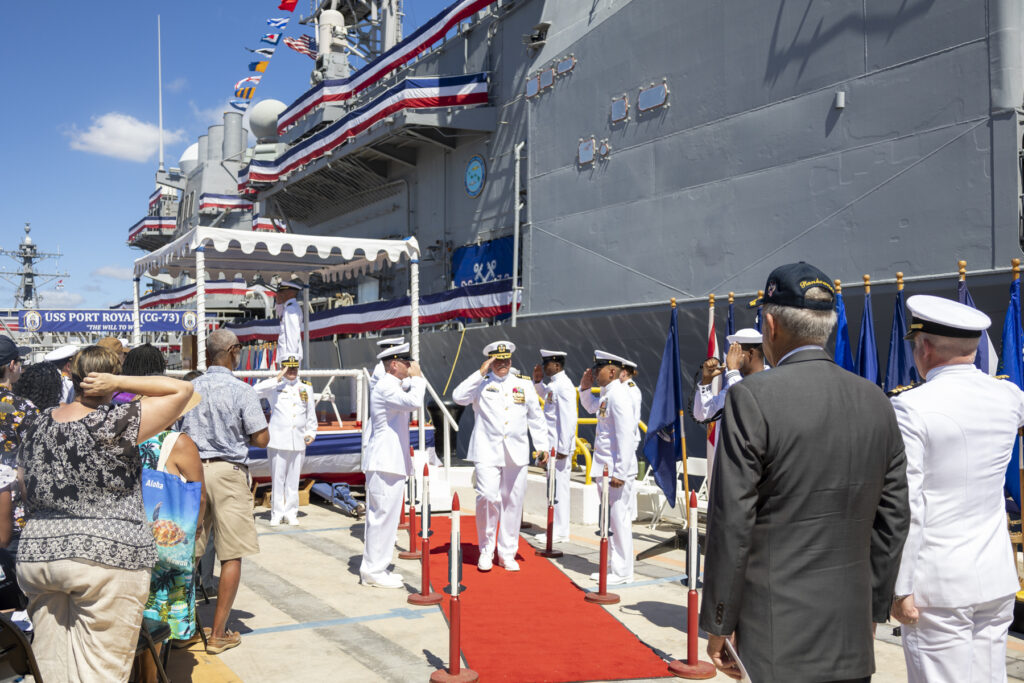


Cruiser USS Port Royal Decommissioned at Pearl Harbor  

USS Port Royal Decomissioning at Joint Base Pearl Harbor-Hickam, Hawaii, Sept. 29. U.S. NAVY / Ens. Brianna McLaughlin

PEARL HARBOR, Hawaii – USS Port Royal (CG 73), the 27th ship of the Ticonderoga class guided-missile cruiser, recognized more than 28 years of naval service during a decommissioning ceremony Sept. 29 at Joint Base Pearl Harbor-Hickam, Commander, Naval Surface Force, U.S. Pacific Fleet Public Affairs said in a release. 

During the ceremony, guest speaker Capt. Joe Ring, commander, Naval Surface Group Middle Pacific (COMNAVSURFGRU MIDPAC) wished current and former crew members and their families fair winds and following seas as they bid farewell to their ship. 
 
“The operations Port Royal Sailors supported when the nation called provided tremendous significance to their lives as well as the legacy of the United States Navy,” said Ring. “They left an indelible legacy for the future. To remain ahead of our competitors, we must now invest and provide our Sailors with the most advanced systems and warfighting capabilities that will enable us to maintain our competitive edge.” 
 
Port Royal’s commanding officer, Capt. Michael “Mike” Wagner, reflected on the service of his crew and those who came before. 
 
“USS Port Royal and generations of Sailors served our nation with honor and distinction for more than 28 years,” said Wagner. “Port Royal deployed all over the globe and earned numerous awards and accolades during her time of service. We are proud of what this ship and her crews accomplished.” 
 
Port Royal maintained a crew of 40 officers, 31 chiefs and 300 enlisted Sailors. The ship was built in Pascagoula, Mississippi, by Ingalls Shipyard Company and commissioned July 9, 1994, in Savannah, Georgia. 
 
CG 73 is the second ship in the U.S. Navy to be commissioned as Port Royal. The first ship of the fleet to bear the name “USS Port Royal” was a wooden 1163-ton “double-ender” side wheel steam gunboat, built in New York City. Commissioned in April 1862, Port Royal was soon sent to the Hampton Roads and James River areas, taking part in the battle at Sewell’s Point on May 8-9, 1862, and at Fort Darling on May 15, 1862. The first USS Port Royal was decommissioned in May 1866 and sold in October of that year. 
 
The current Port Royal’s rich deployment history spans two decades, starting in December 1995 as part of the Nimitz battle group Carrier Group Seven. Following her first deployment, Port Royal became the first Navy cruiser to integrate women into the crew. The ship returned from her final deployment in July 2022. During the ship’s 28 plus years of commissioned service, Port Royal made numerous deployments to the Arabian Gulf, Mediterranean Sea, and operated prominently throughout the Indo-Pacific region supporting peace and stability and working alongside allied and partner navies. 


Cold War Era Emissions Control Could Protect Navy Assets from Cyber Attacks, Expert Says

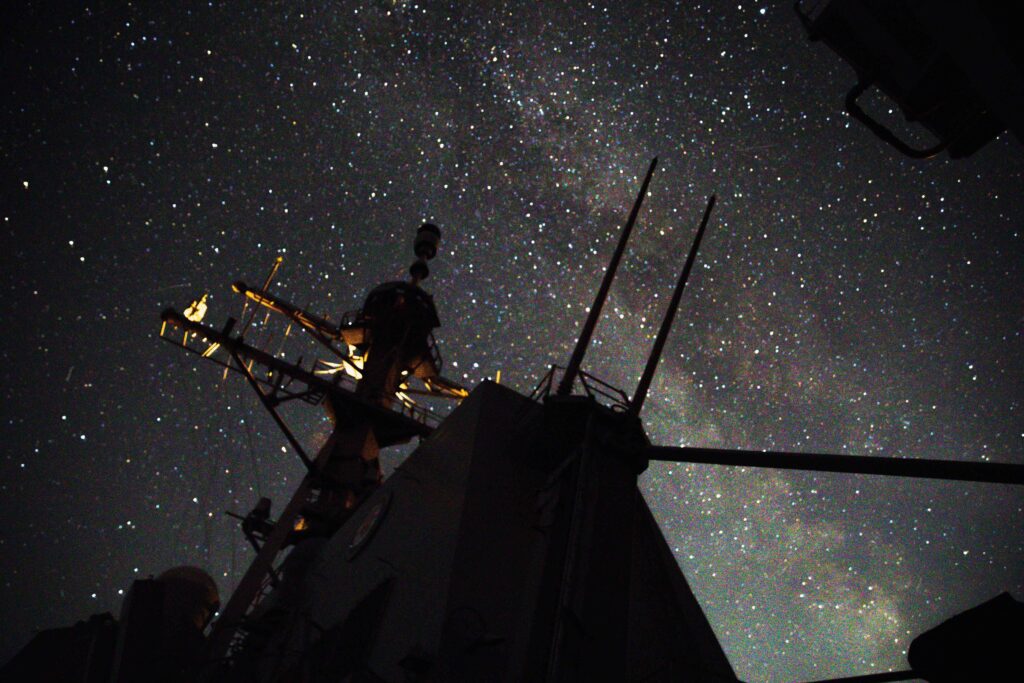
The Arleigh Burke-class guided-missile destroyer USS Paul Ignatius (DDG 117) sails through the Baltic Sea, Sept. 4. U.S. NAVY / Mass Communication Specialist 2nd Class Aaron Lau

ARLINGTON, Va. — A rediscovered Cold War practice and the U.S. Navy’s unique command and control culture could protect the service’s assets from cyberattack, according to a U.S. Naval Academy cybersecurity expert.

While most information systems across the Defense Department tend to be similar, “the Navy has a different command and control culture,” Martin Libicki, holder of the academy’s Keyser Chair of Cybersecurity Studies, told a live-streamed panel discussion at Annapolis on Cyber Disruption and Disinformation Sept. 29.

Historically, the Navy has put a premium on independent action, “and one of the things navies do to protect themselves against sophisticated adversaries is not communicate. It’s called emissions control. We used to do it a lot in the Cold War, then we forgot it,” he said.

“Now we’re relearning it and that tends to isolate certain Navy assets from the rest of the world. The more you isolate them, the harder it is to carry out cyber operations against them,” noted Libicki, who researches cyberwar and the general impact of information technology on domestic and national security.

The discussion, presented by the U.S. Naval Institute, focused largely on Russia’s use of cyberattacks and disinformation before, as well as since it began its illegal invasion of Ukraine in February.

Bilyana Lilly, geopolitical risk lead at the Krebs Stamos Group and previously a cyber expert at Deloitte and the RAND Corp., noted that Russians hacked the Facebook accounts of Ukrainian military leaders to send messages urging their troops to surrender. “The Russians are trying to erode the Ukrainians’ will to fight,” she said.

Lilly also stressed the importance for the United States as well as Ukraine to practice cyber civil defense: Training the population to recognize disinformation and be aware that they could be a target. The Russian government has a military doctrine that stipulates “every single one of us is a target. I think that message has to be made very clear,” she said.


Navy Awards Advance Acquisition for Low-Rate Initial Production of MQ-25 

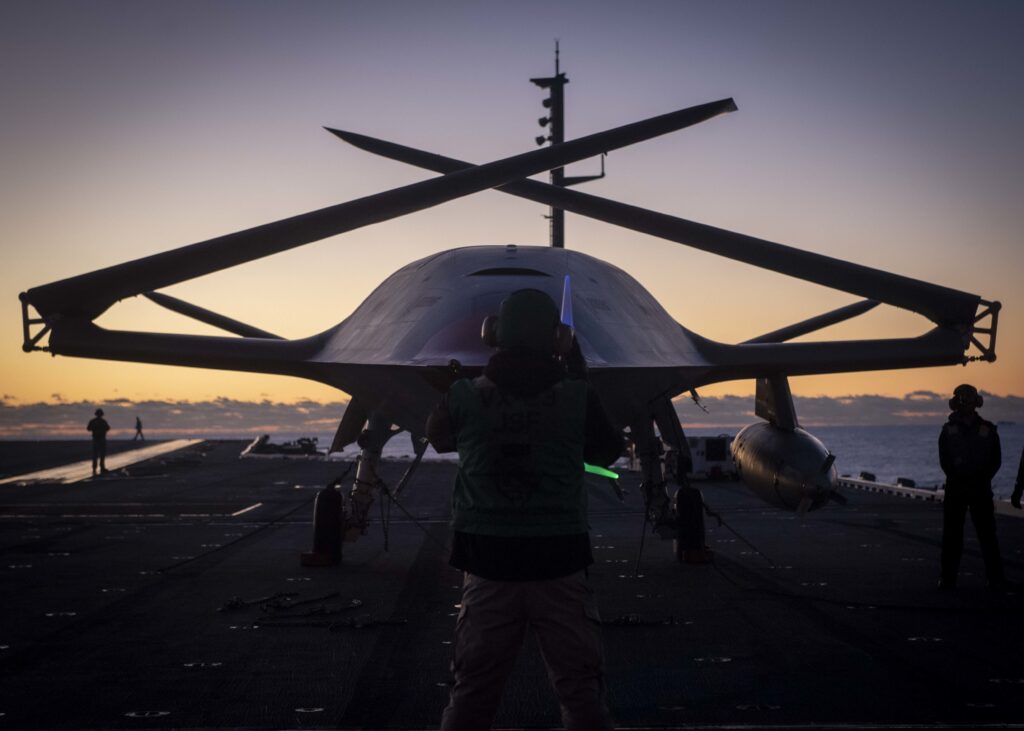
A Boeing unmanned MQ-25 aircraft is given operating directions on the flight deck aboard the aircraft carrier USS George H.W. Bush (CVN 77). U.S. NAVY / Mass Communication Specialist 3rd Class Hillary Becke

ARLINGTON, Va. — The U.S. Navy has awarded Boeing a contract for advanced acquisition of the MQ-25A Stingray aerial refueling unmanned aerial vehicle.  

The Naval Air Systems Command awarded Boeing a $47.5 million “firm-fixed-price advance acquisition contract for the production and delivery of MQ-25 Stingray low-rate initial production lot 1 for the U.S. Navy,” a Sept. 28 Defense Department contract announcement said. 

Boeing was selected Aug. 30, 2018, for the design, development, fabrication, testing, delivery and support of four MQ-25As, followed in April 2020 with an order for three more, according to the Navy’s program office. The MQ-25 test asset, known as T1, made its first flight Sept. 19, 2019. In summer 2021, the MQ-25 T1 test asset successfully refueled three different carrier-based aircraft: F/A-18F, F-35C and E-2D aircraft in 2021. The Unmanned Carrier Aviation Demonstration was conducted in December 2021 on board the USS George H.W. Bush (CVN 77). This event marked the first time the MQ-25 T1 test asset was tested aboard an aircraft carrier. 

The MQ-25 will leverage existing line-of-sight and beyond-line-of-sight communications links and interface with existing ship- and land-based command and control systems.MQ-25 will be an integral part of the future carrier air wing, increasing the mission effectiveness range with its enhanced refueling capabilities and increasing the number of F/A-18E/Fs available for the strike fighter mission by relieving them of the tanking role. The MQ-25 will also pioneer manned-unmanned teaming and pave the way for future unmanned systems to pace emerging threats. 

The MQ-25 Stingray is designed to deliver a robust aerial refueling capability and secondary intelligence, surveillance and reconnaissance capability that extend the range and operational capability of the carrier air wing and carrier strike group, according to the Navy’s program office. The MQ-25 will leverage existing line-of-sight and beyond-line-of-sight communications links and interface with existing ship- and land-based command and control systems.  

The MQ-25A is scheduled to achieve initial operational capability in 2025. It is anticipated that 72 air vehicles will be procured. 

Work under this contract is expected to be completed in September 2026. 


Gerald R. Ford to Deploy at Last, With Slightly Reduced Air Wing

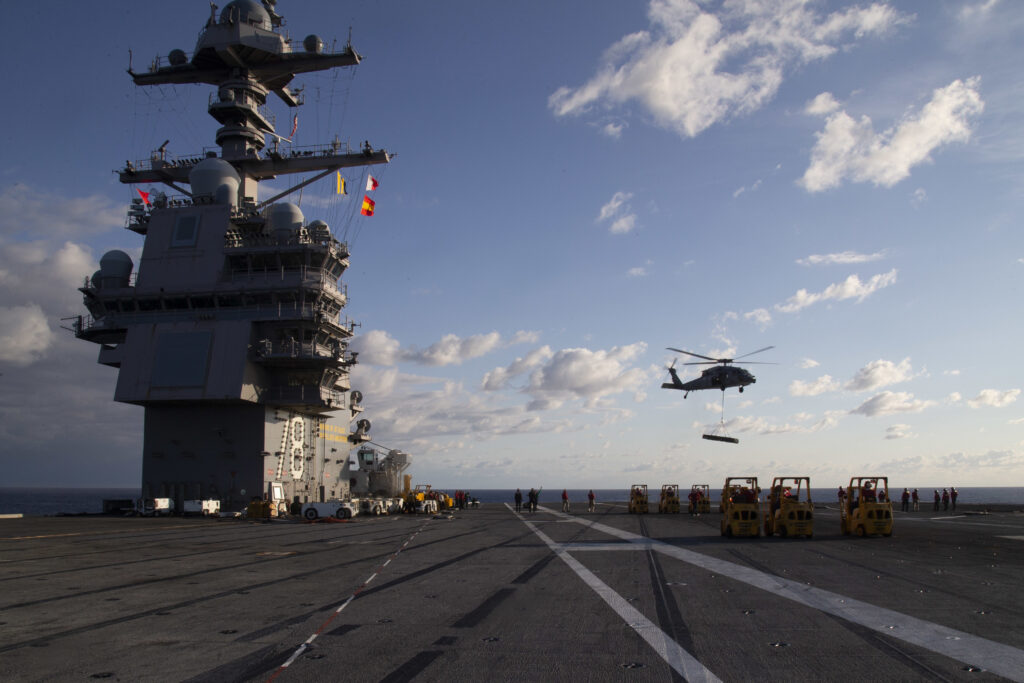
Sailors assigned to the first-in-class aircraft carrier USS Gerald R. Ford (CVN 78) and the “Tridents” of Helicopter Sea Combat Squadron (HSC) 9 conduct an ammunition onload, Sept. 25, 2022. U.S. NAVY / Mass Communication Specialist 1st Class William Spears

ARLINGTON, Va. — The lead ship U.S. Navy’s newest class of nuclear-powered aircraft carrier, USS Gerald Ford (CVN 78), will depart Norfolk, Virginia, next week on its first major deployment. The carrier is scheduled to deploy next year in support of regional combatant commanders. 

The Ford is making what the Navy calls a “service-retained” deployment, meaning it is operating by the authority of the chief of naval operations under command and control of the U.S. 2nd Fleet, rather than under the command and control control of a regional combatant commander under the Global Force Management Concept.  

Vice Adm. Daniel Dwyer, commander of the U.S. 2nd Fleet, said Carrier Strike Group 12 (CSG 12), of which the Ford is a part, will range throughout the Atlantic Ocean operating with navies of allied and partner nations. 

Dwyer, speaking to reporters Sept. 26, said the deployment would provide the Ford CSG commander “a chance to test the carrier’s air operability prior to embarking on its first Global Force Management deployment next year. This historic service-retained deployment is an opportunity for the U.S. Navy to come together with other members of the NATO Alliance to exercise and train together within the Atlantic and its littorals while testing out advanced technologies on the first new class of U.S. aircraft carrier in more than 40 years.” 

CSG-12 and Destroyer Squadron Two staffs will be embarked in the Ford, as will Carrier Air Wing Eight. Deploying with the group will be Ticonderoga-class guided-missile cruiser USS Normandy (CG 60); the Arleigh Burke-class guided-missile destroyers USS Ramage (DDG 61), USS McFaul (DDG 74), and USS Thomas Hudner (DDG 116); the Legend-class national security cutter USCGC Hamilton (WMSL 753); the Henry J. Kaiser-class fleet replenishment oiler USNS Joshua Humphpries (T-AO 188), and the Lewis and Clark-class dry cargo and ammunition ship USNS Robert E. Peary (T-AKE 5). 

Units from eight allied and partner nations that will operate with the CSG and include ships from Canada, Denmark, Finland, France, Germany, The Netherlands, Spain and Sweden. The CSG includes 17 ships and one submarine. 

While deployed, the Ford CSG will conduct group steaming, air-defense exercises, maritime domain awareness, long-range maritime strike, distributed maritime operations, antisubmarine warfare exercises and naval integration, Dwyer said. 

“Innovation and interoperability are the key focal points of this deployment,” Dwyer said. “And we will work together with allies and partner nations to strengthen our collective defense of the Atlantic by maturing our integration for future maritime operations.”  

All eight squadrons of Carrier Air Wing Eight will be onboard for the deployment but some will not be at full strength in terms of numbers of aircraft.  

“It won’t be the full complement, but it will be nearly the entire air wing,” Dwyer said. “And that is not because of any lack of capacity aboard Ford, but only where the air wing is in the Global Force Management process. We’re still sizing the numbers, but it will be a fairly full air wing, but not the complete air wing.” 

New Technology

The Ford, commissioned in 2017, is deploying with 43 new technologies, including the Electro-Magnetic Aircraft Launch System, and the Advanced Arresting Gear. 

The Ford’s commanding officer, Capt. Paul Lanzilotta, said in a Sept. 29 interview that all systems have been tested and are ready to go, and some will go through further operational testing. 

Lanzilotta, a native on Long Island, New York, is an E-2 Hawkeye naval flight officer. He said the Ford has “incredible network connectivity.” 

Several Ford crew members were made available for interviews on Sept. 29 pierside in Norfolk. 

Chief Machinist’s Mate (select) Kera Archambeault, who accrued two previous deployments on the Nimitz-class aircraft carrier USS Carl Vinson (CVN 70), said the Ford has better amenities for the crew, “like all spaces having better air conditioning, the food is really good, the gallies are really open to bring everyone together.” 

“We’re very by the book here,” said Boatswain’s Mate Second Class Patrick Schlosser, for whom this will be his first deployment, asked about the ease of maintenance on a new ship. “There are a lot of new systems — this is the biggest, the baddest, the newest ship in the fleet — there are a lot of learning curves that we have to get across. We are able to conduct and do what we need to do regularly with a relative amount of ease and we’re pretty efficient at it. … This crew is ready for anything that comes at us. Everybody would overcome any obstacle that they deal with as far as maintenance goes and any equipment that we deal with.” 


U.S. Navy Warship Seizes $10 Million in Drugs in Gulf of Oman 

An interdiction team from guided-missile destroyer USS Delbert D. Black (DDG 119) approaches a fishing vessel in the Gulf of Oman, Sept. 28, as an MH-60R Sea Hawk attached to Helicopter Maritime Strike Squadron 48 provides aerial support. U.S. NAVY / MC3 Jeremy R. Boan

MANAMA, Bahrain — A U.S. Navy guided-missile destroyer seized 7,200 kilograms of hashish worth an estimated $10 million from a fishing vessel transiting international waters in the Gulf of Oman, Sept. 28, NAVCENT Public Affairs said Sept. 29. 

USS Delbert D. Black (DDG 119) was operating in support of U.S. 5th Fleet, headquartered in Manama, Bahrain. The ship began patrolling waters across the Middle East in August. 

“This seizure is a testament to the professionalism and determination of the ‘Trailblazer’ team,” said Cmdr. Mark Gallagher, commanding officer of Delbert D. Black. “I’m proud of our commitment to regional security and countering illicit activity on the high seas across the Middle East region.” 

Delbert D. Black’s seizure occurred one day after USCGC Charles Moulthrope (WPC 1141) seized 2,410 kilograms of heroin worth $85 million from another fishing vessel transiting the Gulf of Oman Sept. 27. The U.S. Coast Guard ship was operating under Combined Maritime Forces, the world’s largest multinational naval partnership. 

Forces from CMF’s 34 member-nations have conducted 13 successful drug interdictions in 2022, resulting in seizures of heroin, methamphetamine, amphetamine pills and hashish worth a combined value of nearly $300 million. 

Delbert D. Black is an Arleigh Burke-class destroyer named for the first Master Chief Petty Officer of the Navy. The ship is deployed as part of the USS George H. W. Bush Carrier Strike Group and has a crew of more than 300 Sailors in addition to an embarked aviation detachment from Helicopter Maritime Strike Squadron 48.   


CNO, Commander of the Romanian Naval Forces Discuss Maritime, Regional Security 

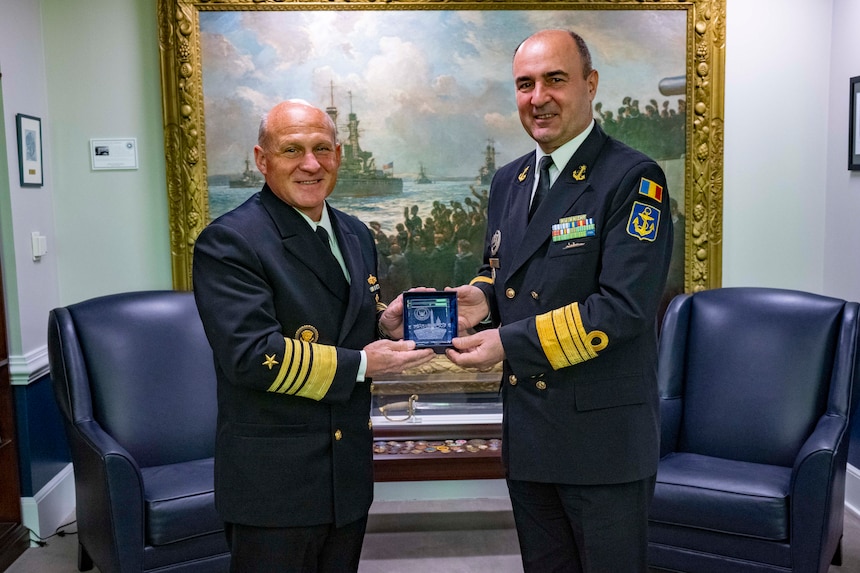
Chief of Naval Operations Adm. Mike Gilday meets with Commander of the Romanian Naval Forces Rear Adm. Mihai Panait at the Pentagon for an office call Sept. 29. U.S. NAVY / Chief Mass Communication Specialist Amanda Gray

WASHINGTON — Chief of Naval Operations Adm. Mike Gilday met with Commander of the Romanian Naval Forces Rear Adm. Mihai Panait at the Pentagon for an office call on Sept. 29, the CNO’s public affairs office said in a release. 

The leaders discussed regional stability and maritime security, allied cooperation efforts, as well as modernization and deterrence. 

“My discussions with Rear Adm. Panait were very productive and focused on future operations,” said Gilday. “The U.S. and Romania have a shared commitment to promoting safety and stability in the Black Sea, and the Romanian Naval Forces are an active contributor to maritime security operations there, as well as an important partner throughout the region. The U.S. Navy will continue to operate alongside our Romanian allies.” 

The U.S. Navy and Romanian Naval Forces regularly operate together. Most recently, both navies participated in the Bulgarian exercise Breeze alongside Allies and partners Albania, Belgium, Georgia, Greece, Italy, Latvia, Turkey and the United Kingdom.  

Romania hosts U.S. Aegis Ashore Missile Defense System Romania, located aboard Naval Support Facility Deveselu in Deveselu, Romania. USAAMDSRO is under the operational control of the U.S. Navy’s 6th Fleet based in Naples, Italy, and is part of the European Phased Adapted Approach, which protects European NATO Allies and U.S. deployed forces in the region. This land-based missile defense facility is designed to detect, track, engage, and destroy ballistic missiles in flight outside the atmosphere. Its technology is nearly identical to and works in coordination with the systems used on the four forward-deployed Aegis destroyers stationed in Rota, Spain. 

Panait attended the U.S.-led 2021 International Seapower Symposium in Newport, Rhode Island, and will see Gilday again in Venice, Italy, next month for the Trans-Regional Seapower Symposium. This was their first official meeting. 


Littoral Combat Ship Training Facility Atlantic Established

NAVAL STATION MAYPORT, Fla. — Marking a significant milestone event for the waterfront community, the Littoral Combat Ship Training Facility Atlantic was established during a ceremony onboard Naval Station Mayport, Sept. 23.

The training facility, formerly managed and operated by Surface Combat Systems Training Command Detachment Southeast, became a separate command under the SCSTC domain.

Before Littoral Combat Ship Training Facility Atlantic was officially established, Cmdr. Carl Brobst was relieved by Lt. Cmdr. Aloysius Elzie as SCSTC Det Southeast’s officer in charge during a change of charge. From July 2019, when Brobst assumed duties as OIC, to September 2022, Brobst and his team helped shape the next generation of surface warfighters. The det’s annual throughput more than quadrupled and they delivered over 18,840 combat-ready Sailors to the Fleet. Brobst will retire later this year after 30 years of naval service.

Immediately following the change of charge, Cmdr. Dan Reiher assumed command of Littoral Combat Ship Training Facility Atlantic. Reiher is already well-known in the LCS community. He served aboard USS Sioux City (LCS 11) as executive officer and commanding officer Gold Crew. Most recently, he was the commanding officer of USS Wichita (LCS 13).

“I am truly humbled to become the first commanding officer of LTF LANT and honored to join and lead an outstanding team of professionals in training future LCS warfighters,” he said.

The establishment of Littoral Combat Ship Training Facility Atlantic is part of Surface Combat Systems Training Command’s large internal realignment effort that begun in 2021 with the changing of its name, formerly the Center for Surface Combat Systems. The name change and realignment define the command’s critical mission of training surface warfighters. SCSTC, with its surface community partners and force development counterparts, provides system and platform specific combat systems training to a growing surface Navy. Littoral Combat Ship Training Facility Atlantic, with the responsibility of training all LCS Freedom-class ships and their crews, supports the increased demand for LCS training at the waterfront.

Capt. George A. Kessler, Jr., commodore of SCSTC, presided over the ceremony and delivered remarks as the keynote speaker.

“Being here in Mayport, you can see and feel the impact of today’s event for not only SCSTC, but also the waterfront,” Kessler said. “LTF LANT is part of the domain’s overall realignment effort but the significance of LTF LANT is about the mission. A mission that is growing in importance each day. Strategic competition at sea is not an amorphous concept but an everyday reality and it demands that our Sailors have the tactical competence and proficiency needed to execute the mission across the spectrum of operations in today’s challenging environment. Our warfighters must be ready to fight and LTF LANT provides the high-end tactical training needed to ensure warfighting readiness, which leads to security for our country and our allies and maintains the freedom of the seas we so richly enjoy.”

The LTF LANT is located onboard Naval Station Mayport, Fla. The first Freedom variant LCS arrived at Naval Station Mayport in 2016 and the number of LCSs have grown.

LTF LANT facilitates the training concepts of Train-to-Qualify and Train-to-Certify for the LCS 1 USS Freedom ship variant. It provides an integrated command and control environment to support training in both navigation and combat systems mission areas. LTF LANT is comprised of three components which can be used independently or in concert with the others to provide more complex training scenarios. Each section of the trainer replicates the basic layout and design of the LCS command and control, bridge, and propulsion control systems. Using mockups of these areas, which includes video screens reproducing scenes from a ship’s bridge windows, the SCSTC team produces realistic training scenarios.


Gonzalez Returns To Norfolk from 9-Month Deployment

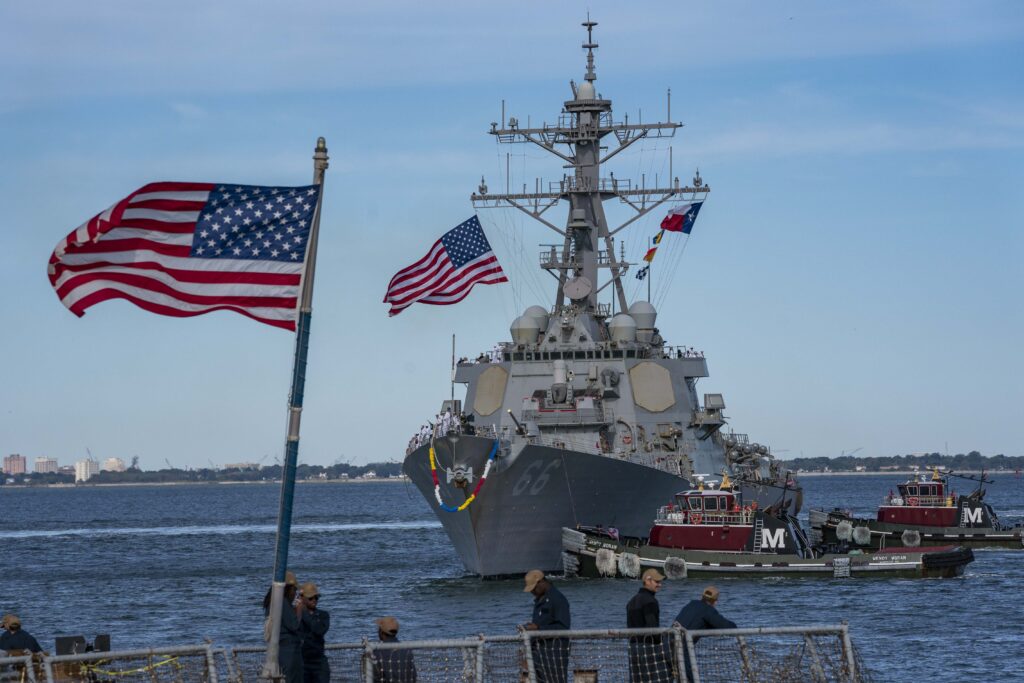
The Arleigh Burke-class destroyer USS Gonzalez (DDG 66) returns to Naval Station Norfolk after a regularly scheduled deployment in the U.S. 5th Fleet and U.S. 6th Fleet areas of operations, Sept. 28. U.S. NAVY / Mass Communication 2nd Class Nathan T. Beard

NORFOLK, Va. — The Arleigh Burke-class guided-missile destroyer USS Gonzalez (DDG 66) returned to its homeport of Naval Station Norfolk, Sept. 28, 2022, USS Harry S. Truman Public Affairs said in a release. 

Gonzalez deployed Jan. 23 as part of a surge deployment of five destroyers under commander, U.S. 2nd Fleet, that included the Arleigh Burke-class guided-missile destroyers USS Donald Cook (DDG 75), USS Mitscher (DDG 57), USS The Sullivans (DDG 68) and USS Forrest Sherman (DDG 98) before Gonzalez joined the Harry S. Truman Carrier Strike Group (HSTCSG) in the Mediterranean Sea as a part of Destroyer Squadron (DESRON) 28. 

The ship was dynamically employed by U.S. 5th and 6th Fleets, traveling throughout the regions participating in a multitude of bi-lateral and multi-lateral training opportunities ensuring maritime security and stability. 

“We left on this deployment to bolster relationships with key allies and partners as well as defend international interests in the U.S. 5th and 6th Fleets,” said Cmdr. Timothy Battles, Gonzalez’s commanding officer. “I am proud of the men and women of this ship and all that they have accomplished since we left home and know they can feel a strong sense of pride for a job well done.” 

The crew’s outstanding efforts complemented the ship’s diversity of mission sets and substantial capabilities. “The Sailors aboard USS Gonzalez lead the way in demonstrating resolve and dedication to support the mission and each other,” said Cmdr. Kate Stegner, Gonzalez’s executive officer. “As an independent deployer, our team met each mission with continued success. I am humbled to be a part of this great crew.” 

While operating in the U.S. 5th Fleet area of operations, Gonzalez conducted multiple escort transits through the Bab-el-Mandeb Strait and conducted counter smuggling operations in support of Combined Task Force (CTF) 150 in the Gulf of Oman. Gonzalez also conducted security patrols in support of the recently established CTF 153 to ensure international maritime security and capacity building efforts in the Red Sea, Bab al-Mandeb Strait and Gulf of Aden. 

During their operations in U.S. 6th Fleet, Gonzalez demonstrated cohesion and capability by sailing and operating with Forward Deployed Naval Forces-Europe ships, as well as those of Standing NATO Maritime Group (SNMG) 2 and the HSTCSG. 

In the Mediterranean, Gonzalez helped pave the way for the NATO-led exercise Neptune Shield 22, conducting dual and tri-carrier operations with the Italian and French navies. The multinational exercise demonstrated NATO’s ability to integrate the high-end maritime warfare capabilities of allied aircraft carrier strike groups, amphibious ready groups and marine expeditionary units to support the defense of the alliance. Training exercises and vigilance activities throughout the deployment provided the opportunity to enhance relationships with European Allies and partners. 

As the ship finally pulled into homeport, Command Master Chief Lance Connolly, Gonzalez’s senior enlisted leader, reflected on the sacrifices made by those onboard and those waiting at the pier. 

“They conducted themselves admirably the past months despite the many challenges presented throughout our deployment,” said Command Master Chief Connolly. “I could not have been more pleased with the resiliency and warrior spirit of our crew.” 

The Nimitz-class aircraft carrier USS Harry S. Truman (CVN 75), commanded by Capt. Gavin Duff, serves as the flagship of the HSTCSG; additional elements include the nine squadrons of Carrier Air Wing (CVW) 1, commanded by Capt. Patrick Hourigan; the staff and guided-missile destroyers of Destroyer Squadron 28, commanded by Capt. Blair Guy, which have included: USS Bainbridge (DDG 96), USS Cole (DDG 67), USS Gravely (DDG 107), USS Forrest Sherman (DDG 98) and USS Jason Dunham (DDG 109). 


U.S. Navy Expands Maintenance Provider Base in Africa 

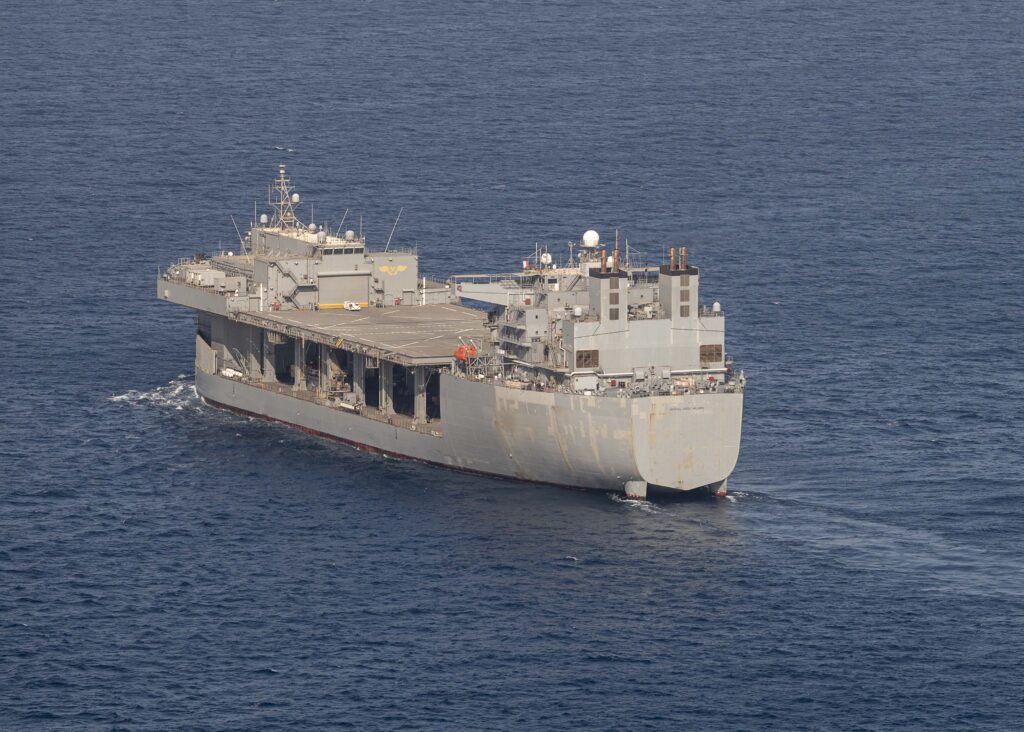
The Lewis B. Puller-class expeditionary sea base USS Hershel “Woody” Williams (ESB 4) sails in the Gulf of Aden, July 26. Hershel “Woody” Williams is rotationally deployed to the U.S. Naval Forces Africa area of operations, employed by U.S. 6th Fleet, to defend U.S., allied and partner interests. U.S. AIR FORCE / Staff Sgt. Dylan Murakami

WALVIS BAY, Namibia — Lewis B. Puller-class expeditionary sea base ship USS Hershel “Woody” Williams (ESB 4) and Forward Deployed Regional Maintenance Center (FDRMC) ship repair experts hosted a ship check event attended by commercial maintenance providers during a recent port visit to Walvis Bay, Namibia, Sept. 5, U.S. Naval Forces Europe-Africa Public Affairs said Sept. 27.

Ship checks provide opportunities to meet regional maintenance providers in person and allow representatives to visit the ship ahead of potentially bidding on a maintenance contract. During the first-ever ship check for Hershel “Woody” Williams in Namibia, FDRMC representatives led the attendees around the vessel to identify areas and equipment in need of maintenance ahead of an upcoming voyage repair availability.

Following the ship check event, Naval Supply Systems Command Fleet Logistics Center Sigonella (NAVSUP FLCSI) contracting officers and FDRMC ship repair experts and U.S. Transportation Command’s Military Sealift Command hosted a virtual industry engagement. This event educated maintenance provider representatives about the U.S. government contract solicitation process, contracting regulations and how to submit competitive solicitations to the government to perform any of the ship’s needed maintenance.

“The U.S. Navy cannot operate effectively and execute its mission overseas without the labor and expertise of commercial ship repair vendors,” said Capt. Paul Haslam, NAVSUP FLCSI chief of contracts. “Ship checks and virtual industry engagement events like those we conducted aboard HWW serve to strengthen relations with key partners like Namibia and, in general, help pave the way for future maintenance and logistics capability overseas. These events also broaden mutual understanding and improve cooperation between NAVSUP and our mission partners.”

Having the maintenance provider tour the ship at the same time as the ship check exposed them to needed work aboard Hershel “Woody” Williams. Similarly, during the virtual industry engagement, they had the opportunity to learn about the U.S. government contract solicitation process, contracting regulations and how to submit competitive solicitations to the government to perform any of the ship’s needed maintenance.

“Building relationships with regional maintenance providers is critical to ensure U.S. Navy ships receive quality and on-time maintenance during future availabilities,” said Marie Hahn, NAVSUP FLCSI Ship Repair Division director. “We haven’t done work in Namibia yet; so it was expected that commercial vendors in attendance benefited from the virtual industry engagement.”

Hershel “Woody” Williams is the first U.S. Navy vessel to be assigned to the U.S. Africa Command area of responsibility whose presence is to promote maritime security through a persistent presence in African waters in close cooperation with African partners.