Cruiser USS Monterey Decommissioned 
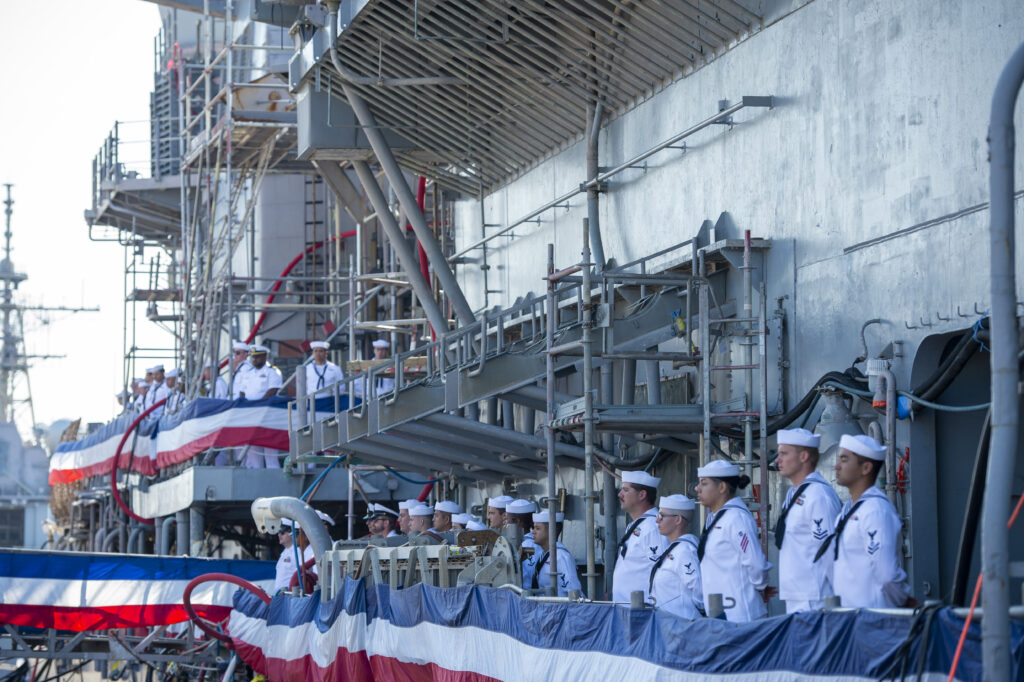
Sailors assigned to the USS Monterey (CG 61) man the rails during its decommissioning ceremony. Monterey was commissioned on June 16, 1990, and was a U.S. Navy warship for 32 years. U.S. NAVY / Mass Communication Specialist 3rd Class Rodrigo Caldas

NORFOLK, Va. — The crew of the guided-missile cruiser USS Monterey (CG 61) held a decommissioning ceremony onboard Naval Station Norfolk, Virginia, Sept. 16, USS Dwight D. Eisenhower (CVN 69) public affairs said in a release. 

Plankowners, including the ship’s commissioning commanding officer Capt. Joel Heaton, as well as former crew members, joined hundreds of attendees to celebrate the ship’s distinguished 32-year history of naval service. 
 
“Unique to the Navy, when we serve on a ship, it becomes part of us — I mean who we are, how we act, think and live. Similarly, we all in turn become part of that ship — it is a tremendously powerful legacy. This is most definitely the case with USS Monterey, she is certainly a testament to her excellent crews and she has been ‘rough in battle and ready in peace,'” said Vice Adm. Jim Kilby, deputy commander, U.S. Fleet Forces Command. 
 
“Monterey executed 14 deployments, many availabilities, and as many training cycles. She was modified over her life to continue to be a relevant and a key ship in our fleet. She will leave a great legacy for many years in the future as those who proudly call themselves Monterey Sailors continue to serve our Nation.” 
 
Monterey’s current Commanding Officer, Cmdr. David M. Schaller, spoke of the powerful bond between Sailors and their ships and the lives shaped aboard.

“Nobody joins the Navy to decommission a ship,” said Schaller. “The Monterey crew performed their duties of putting her to rest in the most professional and exemplary manner, honoring her storied history and service to our nation.” 
 
Monterey was built at Bath Iron Works in Bath, Maine, and commissioned in Mayport, Florida, June 16, 1990. Monterey’s namesake commemorates the battle fought Sept. 20, 1846, in the war with Mexico. 
 
“She has served her crews and her nation well and rightfully takes her place among the ships that, for well over 200 years, have played an indispensable role in protecting the United States of America and serving her strategic interests across the world,” said Schaller. “This ship and her crews will forever share a legacy that will be felt across the fleet for years to come.” 


7th Fleet Destroyer Transits Taiwan Strait with Canadian Frigate 

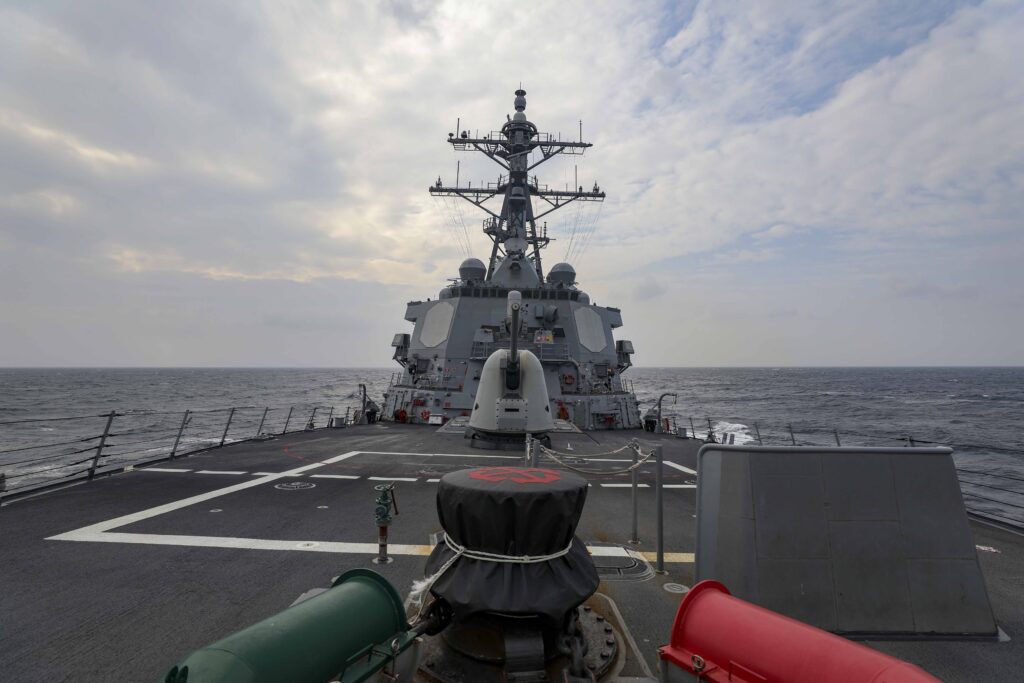
The guided-missile destroyer USS Higgins (DDG 76) conducts a routine Taiwan Strait transit Sept. 20. Higgins is forward-deployed to the U.S. 7th Fleet area of operations in support of a free and open Indo-Pacific. U.S. NAVY / Mass Communication Specialist 1st Class Donavan K. Patubo

TAIWAN STRAIT — The Arleigh Burke-class guided-missile destroyer USS Higgins (DDG 76), in cooperation with Royal Canadian Navy Halifax-class frigate HMCS Vancouver (FFH 331), conducted a routine Taiwan Strait transit Sept. 20 (local time) through waters where high seas freedoms of navigation and overflight apply in accordance with international law, U.S. 7th Fleet Public Affairs said Sept. 20. 

The ships transited through a corridor in the Strait beyond the territorial sea of any coastal state. Higgins’ and Vancouver’s transit through the Taiwan Strait demonstrates the commitment of the United States and its allies and partners to a free and open Indo-Pacific.


Navy Evaluates New Crash Crane for Carrier Decks 

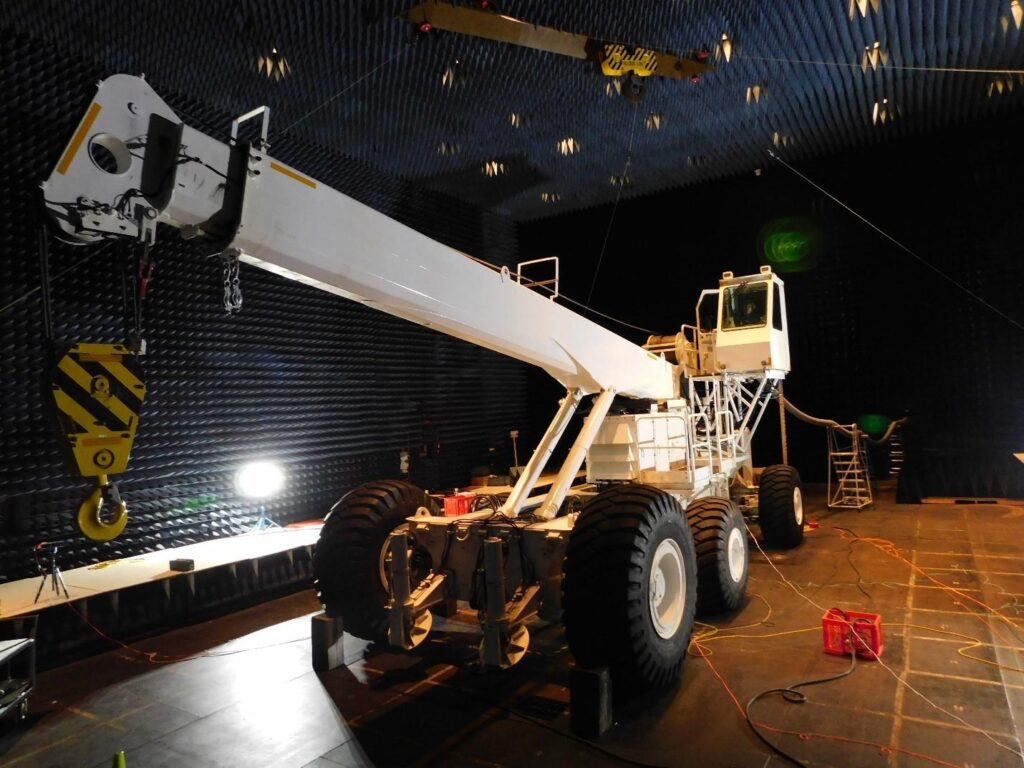
The Navy’s Common Aviation Support Equipment program office (PMA-260) is currently evaluating electromagnetic environmental effects on a crash and salvage crane at the Aircraft Anechoic Test Facility in Patuxent River. U.S. NAVY

PATUXENT RIVER, Md.—The Navy’s Common Aviation Support Equipment program office (PMA-260) is currently evaluating electromagnetic environmental effects on a crash and salvage crane at the Aircraft Anechoic Test Facility in Patuxent River, the Naval Air Systems Command said Sept. 20. 

Electromagnetic waves within the radio frequency spectrum are used for communication, radar and information networks aboard ships. The E3 evaluation currently underway in the Aircraft Anechoic Test Facility will determine the crane’s compatibility with the RF environment. 

RF cannot be seen or felt, but it can negatively affect other electrical systems if those systems are not properly protected. Testing will determine if the crane has an appropriate level of emissions, can withstand a general level of radiation across the whole RF spectrum, and can withstand high levels of radiation tailored to frequencies in its operational environment. 

“The new amphibious and carrier CSC designs will ensure the warfighter has the safest, most modern and reliable equipment possible for years to come,” said Jim Choflet, PMA-260 crash crane team lead. 

Crash and salvage cranes are critical pieces of equipment because no flight operations are allowed on ships without an operational CSC running on standby. They are used for lifting and moving disabled aircraft on carriers and landing helicopter dock flight decks. The new version, designed by industry partner Allied Systems Co., replaces the legacy carrier and amphibious assault crash cranes. 


ONR SCOUT Tests Tech for Monitoring Illicit Maritime Cargo 

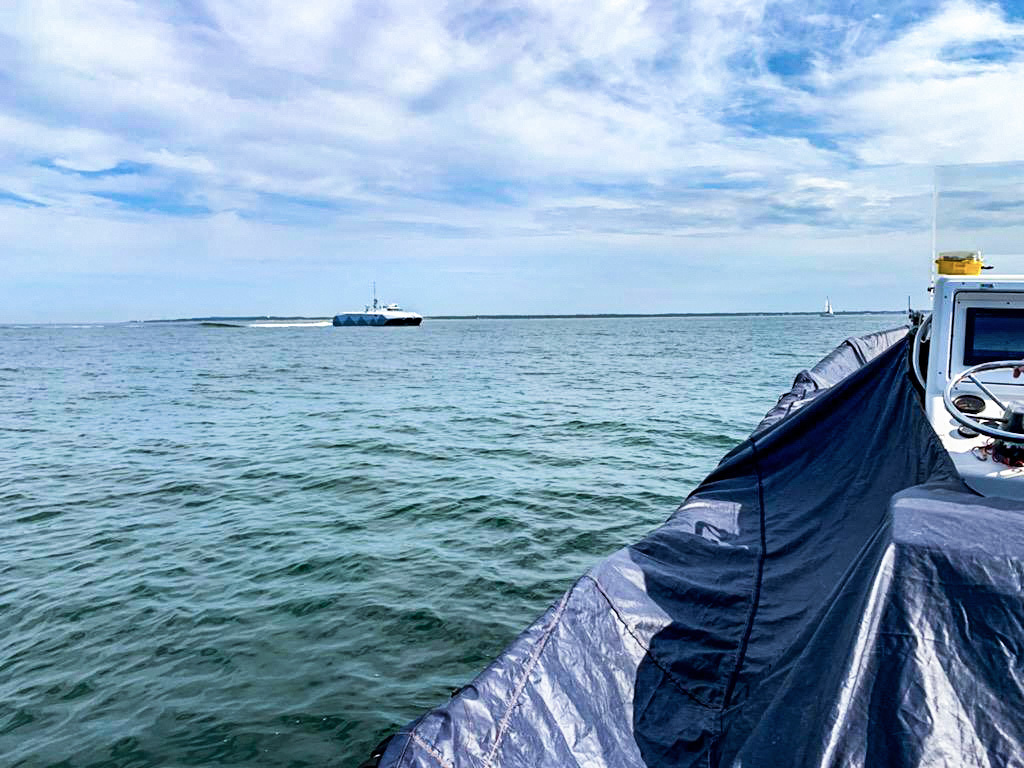
Vessels participate in an ONR SCOUT-sponsored experimentation event at Joint Expeditionary Base Little Creek-Fort Story, Virginia, at the entrance of the Chesapeake Bay. U.S. NAVY / Max Hopkins, Demonstration Assessment Team, Naval Surface Warfare Center Indian Head Division

ARLINGTON, Va. — To improve capabilities for monitoring aircraft and vessels carrying illicit maritime cargo such as drugs, for longer periods of time and over greater distances, the Office of Naval Research-sponsored SCOUT initiative recently conducted a dynamic experimentation event at Joint Expeditionary Base Little Creek-Fort Story, Virginia, at the entrance of the Chesapeake Bay. 

The goal of the event was to find creative solutions to pinpoint “dark targets” — aircraft or watercraft operating with little to no radio-frequency signatures — found in maritime operating areas covered by the Joint Interagency Task Force South, ONR said in a Sept. 19 release. It sought ways to use unmanned technologies to expand intelligence, surveillance and reconnaissance capabilities beyond those of traditional maritime patrol aircraft such as the P-3 Orion and P-8 Poseidon.  
 
JIATF-S currently works with U.S. Southern Command and partner naval forces to leverage all-domain technologies and unmanned capabilities to target, detect and monitor illicit drug trafficking in the air and maritime domains. This facilitates interdiction and apprehension to reduce the flow of drugs, as well as degrade and dismantle transnational criminal organizations. 
 
ONR SCOUT is an ongoing, multiagency experimentation campaign for identifying alternative ways to bring unmanned technologies to warfighter problems, operationalize them and bring them to scale. SCOUT is committed to getting nontraditional, commercial-off-the-shelf, government-developed and/or government-sponsored technologies to the fleet rapidly. 
 
“SCOUT is an innovation vehicle and investment strategy for the rapid development of autonomous platforms that address today’s warfighter challenges,” said Chief of Naval Research Rear Adm. Lorin Selby. “Through experimentation with partners like JIATF-S, we can connect innovators, industry, acquisition professionals and fleet stakeholders to attack and solve key operational problems.” 
 
“This is a pressing issue for JIATF-S because every day multiple suspect vessels are near and in the area of operations conducting illicit trafficking,” said U.S. Coast Guard Lt. Cmdr. Duane Zitta, JIATF-S chief of operational demonstration and experimentation. “Because of this vast area, JIATF-S is looking for alternative capabilities and technologies to provide unmanned counter-operations that can detect and monitor suspect activity, ultimately helping prevent illegal movement to the United States.” 
 
The JEB Little Creek-Fort Story experimentation event was a partnership involving ONR SCOUT, JIATF-S, the Naval Research and Development Establishment, and industry partners in the Chesapeake Bay area. It was one of multiple sprint events (scenario-based demonstrations of technology capabilities and characteristics) held this year that will lead to a large-scale main experimentation event in March 2023. 
 
During the Chesapeake Bay event, participants engaged in simulated drug-running and -hunting scenarios during “cat-and-mouse” games involving a specialized vessel owned by SOUTHCOM and JIATF-S, a “Gotcha” boat formerly used by drug traffickers and seized by JIATF-S, and various targets of interest. 
 
Participants employed sophisticated sensor systems and technologies, ranging from coordinated unmanned aircraft systems to wide-area motion imagery. Data collected during the exercises was fed into an onsite maritime operations center and synthesized, providing operators with real-time information about targets and each technology’s performance. 
 
The technology tested at JEB Little Creek-Fort Story will undergo further refinement and improvement before the March 2023 main experimentation event. 


Ishee Assumes Command of U.S. 6th Fleet and Naval Striking and Support Forces NATO 

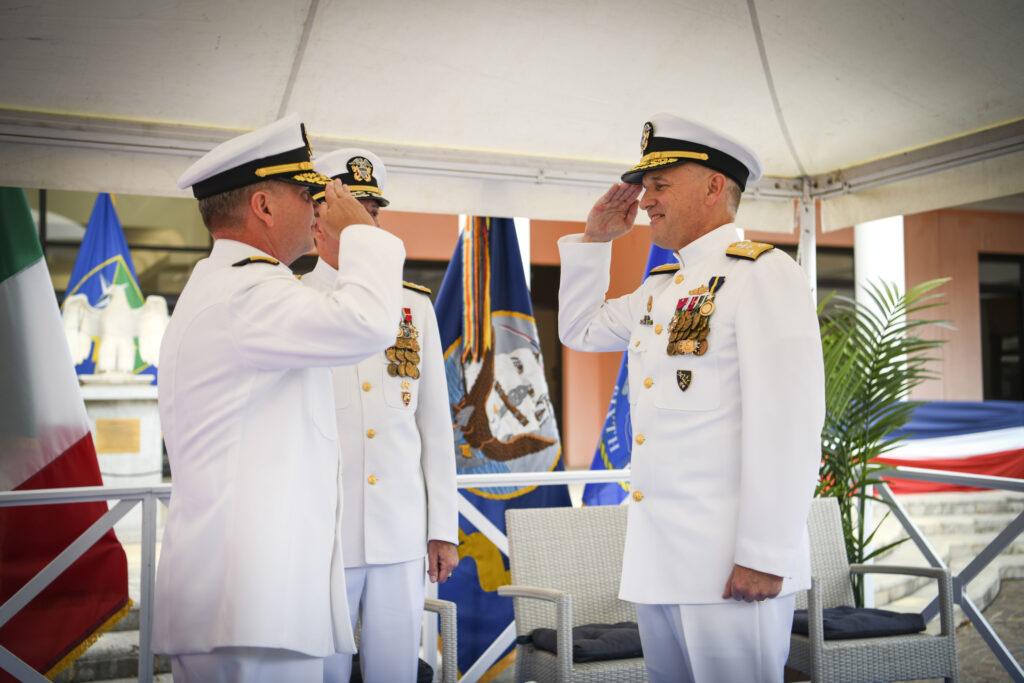
Vice Adm. Thomas E. Ishee relieved Vice Adm. Gene Black III as commander, U.S. 6th Fleet and commander, Naval Striking and Support Forces NATO in a change of command ceremony held onboard U.S. Naval Support Activity Naples, Italy, Sept. 15. U.S. NAVY

U.S. NAVAL SUPPORT ACTIVITY NAPLES, Italy — Vice Adm. Thomas E. Ishee relieved Vice Adm. Gene Black III as commander, U.S. 6th Fleet and commander, Naval Striking and Support Forces NATO (STRIKFORNATO) in a change of command ceremony held onboard U.S. Naval Support Activity Naples, Italy, Sept. 15. 

Adm. Stuart Munsch, commander, U.S. Naval Forces Europe-Africa (NAVEUR-NAVAF) and commander, Allied Joint Forces Command Naples, presided over the ceremony. Munsch outlined Black’s extensive accomplishments as 6th Fleet commander and presented Black with the Distinguished Service Medal. 

“Gene has sustained an unprecedented level of activity as the fleet commander for the Euro-Atlantic area, recalibrating our combined forces for dynamic operations, as the tenets of strategic competition dictate, to deter Russian aggression and stand ready to defend NATO,” said Munsch. “No one can look at the tenor you’ve set and argue that our adversaries haven’t factored your warfighting command of 6th Fleet and STRIKFORNATO into their calculus.” 

As 6th Fleet commander and deputy commander of NAVEUR-NAVAF, Black provided regional, national and international leadership with credible Navy and NATO combat capabilities across the European and African areas of operations. He also spearheaded the establishment of a European Navy-Marine Corps task force (Task Force 61 Naval Amphibious Forces Europe/ 2d Marine Division (TF-61/2)). TF 61/2 is charged with command and control of high-end U.S. forces, including Amphibious Ready Groups and Marine Expeditionary Units; Reconnaissance and Counter-Reconnaissance Marines; and intelligence and collection units able to integrate with theater allies and partners. 

“The establishment of Task Force 61/2 has brought an enhanced rapid response capability to the 6th Fleet area of operations and has displayed the strength and flexibility of the Navy-Marine Corps team,” said Brig. Gen. Andrew Priddy, commanding general of TF 61/2. 

Additionally, Black’s leadership of STRIKFORNATO yielded the first transfer of authority of a U.S. Carrier Strike Group to NATO since the Cold War, setting a new standard in NATO cohesion and cooperation. 6th Fleet and STRIKFORNATO executed multiple phases of the Project Neptune series in 2021 and 2022, expanding transfer of authority of allied carrier strike groups and of the USS Kearsarge (LHD 3) ARG and 22nd MEU, substantially increasing flexibility and cohesion throughout the alliance. 

“Demonstrating and enhancing NATO’s high-end maritime warfare capabilities shows the world the true strength and teamwork of our alliance,” Black said of Neptune Shield, held in May 2022. “NATO’s capacity to conduct integrated operations in the maritime domain … validates more than seven decades of Alliance interoperability.” 

Ishee, previously the Director of Global Operations for U.S. Strategic Command, spoke of his appreciation for the team he will lead, while outlining his vision and goals for the command. 

“History is unfolding before our eyes, and our nation, the alliance, other allies and our partners around the world are relying on 6th Fleet and STRIKFORNATO to maintain freedom of navigation, defend our nations and the alliance, and support our partners,” said Ishee. “We will continue to build these enduring relationships through training and exercises, common values, and shared experiences and vision.” 

Black has been selected for reappointment to the grade of vice admiral and assignment as deputy chief of naval operations for operations, plans, and strategy, N3/N5, Office of the Chief of Naval Operations, Washington, D.C. 

U.S. 6th Fleet is permanently assigned to NAVEUR-NAVAF, and employs maritime forces through the full spectrum of joint and naval operations. 


Littoral Combat Ship USS Coronado Decommissioned 

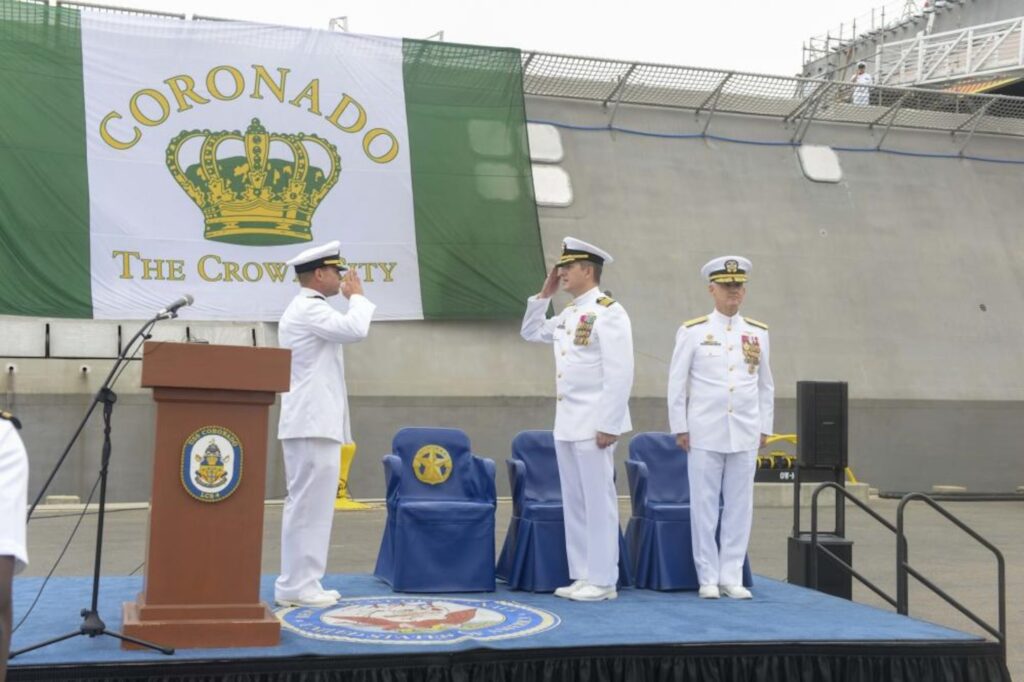
Capt. Marc Crawford, center, commodore of Littoral Combat Ship Squadron ONE, gives the order to decommission Independence-variant littoral combat ship USS Coronado (LCS 4) during a decommissioning ceremony Sept. 14. U.S. NAVY / Mass Communication Specialist 2nd Class Vance Hand

SAN DIEGO — Independence-variant littoral combat ship USS Coronado (LCS 4) was decommissioned in San Diego, Sept. 14, the Navy said in a release.

As on operational unit, Coronado and its crew played an important role in the defense of the nation and maritime freedom. As a test and training ship, Coronado and its Sailors were key to determine the operational configuration and deployment capabilities of today’s LCS platform.

“Today we recognize the great contribution Coronado and its crew made in developing the operational concepts foundational to the current configuration and deployment of littoral combat ships,” said Rear Adm. Wayne Baze, the ceremony’s guest speaker and commander of Expeditionary Strike Group 3. “Thanks to Coronado, the future of LCS looks bright.”

Coronado and its Sailors contributed a tremendous amount of work and time to ensure the future success of the LCS program during the ship’s time in naval service. The ship worked alongside allied and partner nations while on a 14-month rotational deployment to the Indo-Pacific in 2017, including inaugural port visits to Cam Ranh, Vietnam and Lamut, Malaysia. While deployed, Coronado supported presence operations and maritime security operations to include the advancement of the LCS manned-unmanned teaming concepts through successful targeting exercises with an embarked MQ-8B Fire Scout. The ship’s successful operations demonstrated the relevance of LCS as a platform that provides flexible options and tactical advantages.

“Since April 5th, 2014, Coronado has been the vanguard for proving the capabilities of the LCS platform and establishing the mission sets,” said Cmdr. Spike Lamson, Coronado’s commanding officer. “The dedication of her crews and supporting teams have guaranteed the future success of this class of ship and the crews that will operate them over-the horizon. I am proud to have served alongside her Sailors, and I am grateful for the opportunity to give Coronado the farewell she deserves.”

Built by Austal USA in Mobile, Alabama, Coronado was commissioned April 5, 2014, at Naval Air Station North Island. The ship deployed to U.S. 7th Fleet, integrated with a carrier strike group, performed exercises with partner navies and conducted joint maneuvers with other U.S. Navy warships. Upon decommissioning, Coronado will be designated as Out of Commission, In Reserve asset, and its Sailors will receive follow-on orders to new assignments.

The first USS Coronado (PF 38) served in World War II and was decommissioned in 1945. The second USS Coronado (AGF 11) served in U.S. 2nd, 5th and 6th Fleets and as the flagship for Commander, U.S. 3rd Fleet. The second Coronado was decommissioned in 2006 and sunk during Exercise Valiant Shield in 2012.


CNO: Navy Needs to Maintain the Lead on Ship Design  

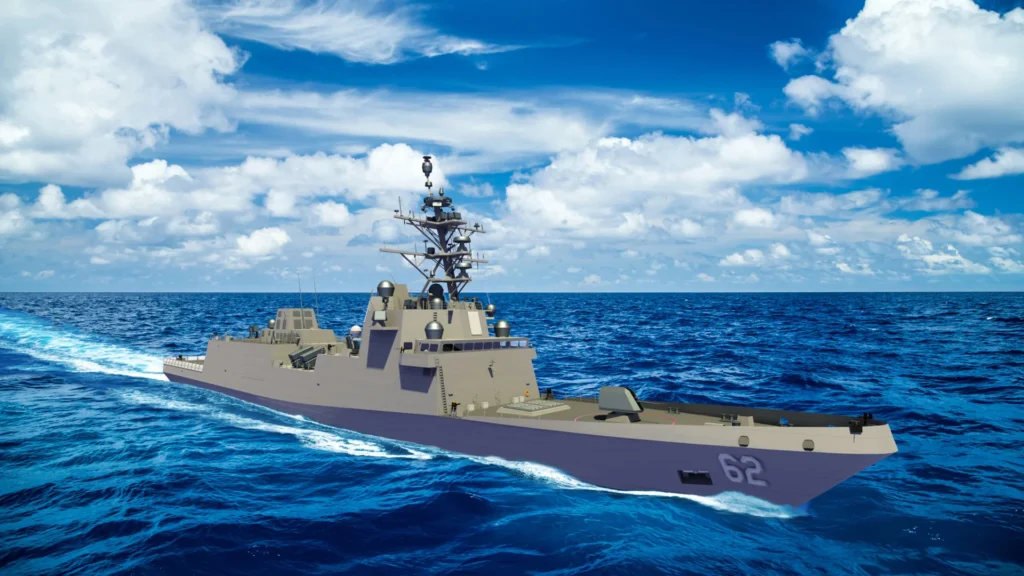
An artist’s conception of the future USS Constellation (FFG 62). FINCANTIERI MARINETTE MARINE

ARLINGTON, Va. — The chief of naval operations praised the trend of the Navy leading the teams developing its ship designs in a recent interview, citing a recent success, and looking forward to more with the next-generation frigate and destroyer designs. 

“We’re learning a lot, as we can see with FFG [the FFG 62 Constellation-class frigate program],” said Adm. Michael Gilday, speaking in a Sept. 14 interview with Deputy Editor Bradley Peniston during Defense One’s State of Defense webinar, commenting on the subject of the Navy’s DDG(X) next-generation destroyer program.  

 “We’re beginning to make progress on that first ship [FFG 62],” Gilday said.  

“I think it’s important that the Navy maintain the lead on design,” he said. “So, what we’ve done with DDG(X) is we’ve brought in the private shipbuilders so that they can help inform the effort. So, it’s a team, but it’s Navy-led. So, both of the companies that produce DDGs are involved in that initial design. Our intent is to go into build with a mature design. So, that would mean at more than the 80% complete point when we actually start bending metal. 

“We have seen great success of that, with Columbia [-class ballistic-missile submarine] as an example, where we were at more than 80% design that we began that first hull,” Gilday said. 

“So that’s going to be something that we’re going to play close attention to, because it actually drives down technical risk,” he said. “Technical risk has been a challenge for us, whether it has been Zumwalt [DDG 1000], LCS [littoral combat ship] or Ford [aircraft carrier] in particular. [With] those three builds, we have accepted technical risk, and it has cost us in terms of keeping those ships not only on budget but also on schedule.”  

The CNO said the design plan for DDG(X) will be to migrate the Arleigh Burke-class DDG combat systems to the larger-hull DDG(X), much as with the successful migration of the combat systems of the Ticonderoga-class guided-missile cruiser to the Arleigh Burke in the late 1980s. He said the DDG(X) also will have increased space, weight, and power to handle future capability growth over time, possibly to include hypersonic missiles, which require larger launchers than the current Mk41 and MK75 vertical launching systems. 


CNO Visits Aviation Commands, Tailhook Convention 

Chief of Naval Operations Adm. Mike Gilday meets with Sailors during lunch at Naval Air Station Lemoore. Gilday traveled to Nevada and California, Sept. 8-13, to meet and speak with Sailors and Navy leaders. U.S. NAVY / Mass Communication 1st Class Michael B. Zingaro

LAS VEGAS — Chief of Naval Operations Adm. Mike Gilday traveled to Nevada and California, Sept. 8-13, to visit local commands, meet with Sailors and attend conferences, the CNO’s public affairs office said in a release.  

Gilday visited Naval Air Station Fallon, Naval Air Station Lemoore, and Reno, Nevada.  

He first visited Naval Aviation Warfighting Development Center in Fallon, Nevada, for the Aviation and Surface Warfare Commander’s Symposium, where he spoke.  

“We need to continue to ensure tactical aviation readiness and improved ground forces training can meet the demands of today and the threats of tomorrow,” said Gilday. “NAS Fallon and the Fallon Range Training Complex is the nation’s premier training environment comprised of airspace and challenging ranges … it’s a true center of warfighting excellence where our air wings are preparing to win high-end conflict.”    

He then traveled to Reno, Nevada, for Tailhook Association’s Hook ’22, a three-day event that featured presentations and panels with leaders from across naval aviation. At the symposium, he met with Sailors, attended a winging ceremony for three new aviators and was the guest of honor at the Tailhook Banquet, where he provided remarks. 

“The aircraft carrier and its unmatched weapons system, the embarked air wing, represents what is and what will remain the centerpiece of naval combat power,” said Gilday. “The carrier has been a versatile platform for more than a century and will continue to be so because we have adapted the air wing to a changing world and its capabilities to a changing threat spectrum.”    

“The carrier is the world’s most lethal and flexible military machine and the most effective tool for sea control and power projection ever created,” he added. “The aircraft carrier, naval aviation and our Navy have a great legacy and an even greater future thanks to our people.”  

The symposium was a chance for junior officers, senior leaders, aircrew, Navy civilians, retirees and industry partners to gather and talk about items of interest to naval aviation, such as the Air Wing of the Future, unmanned capabilities, readiness, maintenance, training and manning. 

Following Hook ’22, Gilday travelled to NAS Lemoore, California, for F/A-18 and F-35 program updates and to meet with Sailors.   

“The men and women here are shaping the future of our force,” said Gilday. “Advanced capabilities help to ensure our Navy will maintain warfighting advantages against increasingly competitive adversaries,” said Gilday.   

“Going forward, we will continue investing in the next generation air dominance family of systems, manned and unmanned aircraft, netted sensors and weapons, and in our aircraft carriers,” the CNO said.  “The last 100 years of carrier aviation has been impressive and we will continue to adapt and carry on that adaptation and warfighting ethos … the carrier is here to stay.” 

The Navy recently deployed its first Navy F-35C and CMV-22B as part of the USS Carl Vinson Carrier Strike Group. Additionally, the first Marine Corps F-35Cs deployed with the USS Abraham Lincoln Carrier Strike Group. The USS Gerald R. Ford (CVN 78) will deploy for the first time later this year. 


USS Ronald Reagan Departs Yokosuka to Resume Patrol 

Sailors man the rails aboard the U.S. Navy’s only forward-deployed aircraft carrier, USS Ronald Reagan (CVN 76), as the ship departs Commander, Fleet Activities Yokosuka, Sept. 12. U.S. NAVY / Mass Communication Specialist Seaman Natasha ChevalierLosada

YOKOSUKA, Japan — The U.S. Navy’s only forward-deployed aircraft carrier, USS Ronald Reagan (CVN 76), and its strike group departed Commander, Fleet Activities Yokosuka Sept. 12 to continue promoting peace and stability in the Indo-Pacific region, according to the ship’s public affairs. 
 
Ronald Reagan’s departure marks the end of a scheduled maintenance availability period. 
 
“We’re excited to be back at sea, and are grateful for the excellent support from our maintenance teams ashore,” said Capt. Fred Goldhammer, Ronald Reagan’s commanding officer. “Not only was our completion of scheduled maintenance and in port training beneficial in ensuring the combat readiness of ‘Warship 76,’ but this brief period allowed our crew an opportunity to recharge and reconnect with our families and friends.” 
 
While departing, hundreds of Reagan Sailors manned the rails in service dress white uniforms as the ship made its way to sea for the second time this year. 
 
During this routine deployment, Ronald Reagan, its strike group ships, the embarked Carrier Air Wing 5, Carrier Strike Group 5 and Destroyer Squadron 15 staffs, will continue working with allies and partners, promote adherence to a rules-based international order, as well as maintain presence and flexibility. 
 
Prior to Reagan’s return to Yokosuka, the ship conducted operations in the Philippine Sea. 
 
The Ronald Reagan Carrier Strike Group includes the Ticonderoga-class guided-missile cruiser USS Chancellorsville (CG 62), as well as Arleigh Burke-class destroyers USS Barry (DDG 52) and USS Benfold (DDG 65), assigned to DESRON 15. 
 
The Ronald Reagan Carrier Strike Group is forward-deployed to the U.S. 7th Fleet area of operations in support of a free and open Indo-Pacific region. Under Commander, U.S. Pacific Fleet, 7th Fleet is the U.S. Navy’s largest forward-deployed numbered fleet, and routinely interacts and operates with 35 maritime nations. 


James Honea Takes the Helm as the Next MCPON 

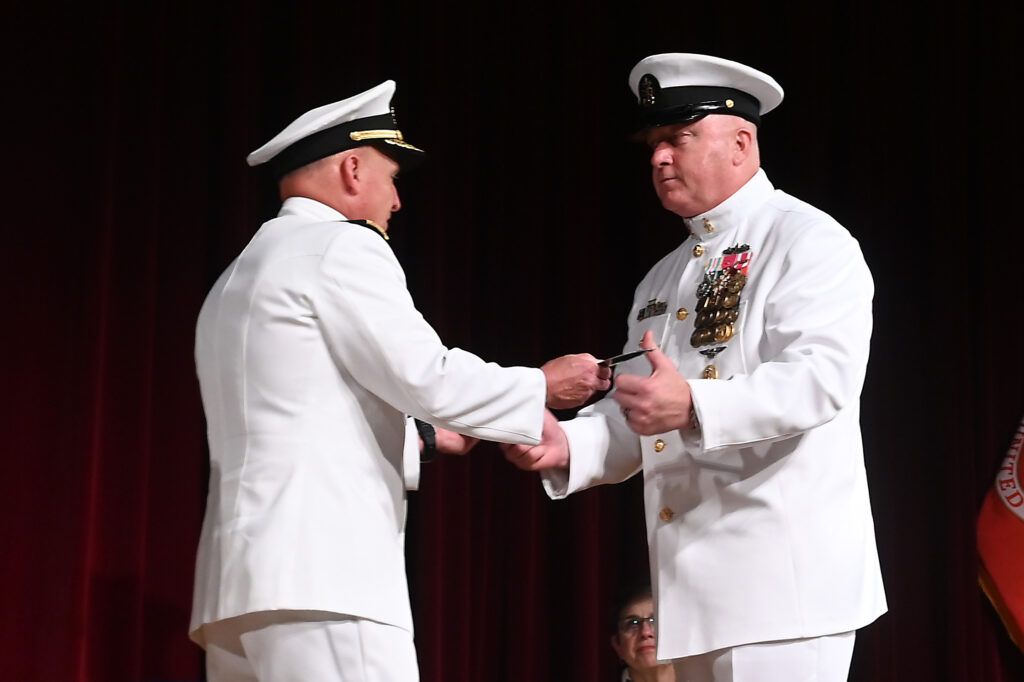
Chief of Naval Operations Adm. Mike Gilday hands the Master Chief Petty Officer of the Navy cutlass to MCPON James Honea during the Change of Office ceremony held at Mahan Hall, United States Naval Academy, Sept. 8. U.S. NAVY / Senior Chief Mass Communication Specialist Anastasia McCarroll

ANNAPOLIS, Md. — Master Chief Petty Officer of the Navy Russell Smith passed the ceremonial cutlass, via the Chief of Naval Operations Adm. Michael Gilday, to James Honea during a change of office and retirement ceremony Sept. 8, the Office of the Master Chief Petty Officer of the Navy said Sept. 10. 

The ceremony held at the U.S. Naval Academy’s Mahan Hall marked the end of more than three decades of Naval service for MCPON Smith. 
 
Smith has served as the 15th MCPON since Aug. 29, 2018. During his term, he instituted Laying the Keel, an updated leadership development career path, revised the command master chief instruction, and the Sailor of the Year program. More importantly, he tirelessly advocated policy and program improvements for the Navy’s Sexual Assault Prevention and Response program as well as increased Sailor access for mental health care to congressional members during his annual testimonies before the House Armed Services Committee. 
 
Gilday presided over the ceremony and highlighted Smith’s accomplishments during his naval career while thanking him for his leadership. 
 
“Your tireless efforts to provide Sailors with mental, morale, and spiritual support has helped make our fleet more resilient and much more effective,” said Gilday. “Your leadership ensured that our most important resource, our people, are ready to serve and defend the nation we love. Having conducted more than 200 fleet visits all over the world, your outreach and willingness to be there for Sailors and their families is what truly made your service so remarkable. Thank you for everything you have done over these past four years. Our Navy and our Navy family are much stronger than it was four years ago.” 
 
After the ceremonial passing of the MCPON cutlass, Honea took the helm of the enlisted force as the Navy’s 16th MCPON. During the ceremony, he spoke about his top priorities: warfighting competency, professional and character development, and quality of life. 
 
“When I was selected for MCPON, I thought heavily on what my tenure means and what I could bring to you all,” said Honea. “I’m glad I chose to be challenged by this adventure and I’m proud of what it has brought me. I thank you all for accepting the same challenge and being on this journey with me. I have always been proud to be your Shipmate, and I’m privileged to be your MCPON.” 
 
The MCPON serves as an adviser to the CNO and to the chief of naval personnel in matters dealing with enlisted personnel and their families. The MCPON is also an adviser to boards dealing with enlisted personnel issues; is the enlisted representative of the Department of the Navy at special events; may be called upon to testify on enlisted personnel issues before Congress; and maintains a liaison with enlisted spouse organizations.