Ohio-Class Submarines Work with USAF and USMC During VERTREP 

An MH-60R Seahawk helicopter, assigned to the “Wildcats” of Helicopter Sea Combat Squadron 23, delivers supplies to the ballistic missile submarine USS Nevada (SSBN 733) during a vertical replenishment at sea. U.S. NAVY

NAVAL BASE KITSAP, BANGOR, Wash. — Two Ohio-class ballistic missile submarines demonstrated their ability to replenish while operating at sea during a series of vertical replenishment exercises off the coast of California July through August 2022, said Submarine Group 9 public affairs.
 
During the exercise, the Ohio-class ballistic missile submarines USS Nevada (SSBN 733) and USS Henry M. Jackson (SSBN 730) operated jointly with U.S. Navy MH-60R Seahawk helicopters, U.S. Marine Corps MV-22 Ospreys, and U.S. Air Force C-17 Globemaster IIIs. 
 
“Recently the Pacific SSBN submarine force exercised a vertical replenishment capability for at-sea SSBNs to prove our resiliency for worldwide operations and to replenish our ships with materials, food and operational gear,” said Capt. Kelly L. Laing, director of maritime operations for Commander, Task Group 114.3. “This allows us to maintain an unpredictable forward presence and continued demonstration of the unmatched strength of our strategic forces.” 
 
The event showcased the submarines’ ability to remain on mission and at sea while performing essential replenishment operations. 
 
“Our fundamental mission is to deter a strategic attack, which is an existential threat to the United States and our allies.” said Rear Adm. Mark Behning, commander of both Submarine Group 9 and Task Group 114.3. “Testing our readiness ensures we maintain a safe, secure and reliable strategic deterrent force.” 
 
The event was part of a U.S. Strategic Command exercise which highlights the interoperability of multiple U.S. military platforms in order to implement the strategic deterrence mission. 
 
“Exercising these VERTREPs was a joint operation involving Marine and Air Force assets,” Laing said. “This shows our commitment to joint operations worldwide and between combatant commanders. This is important so that we don’t stovepipe ourselves under one community or brand. We are committed to operating together as a global force.” 
 
This event is the latest in a series of efforts by the United States submarine force to look at alternative operations that previously required a submarine to be pierside to accomplish. For example, in May, the Ohio-class ballistic-missile submarine USS Alabama (SSBN 731) conducted an at-sea crew exchange, swapping out the blue and gold crews. This demonstrated the submarine’s ability to continuously operate and stay on mission for longer periods of time while sustaining quality of life for the crews and their families. 
 
“What this shows to our allies and adversaries is that we have the ability to keep our boats at sea,” Laing said. “This shows them that we are ready.” 


Navy Ready to Christen New Overlord USV ‘Mariner’ 

The Navy’s newest medium unmanned surface vessel, soon to be christened Mariner, on display at the U.S. Naval Academy in Annapolis. RICHARD R. BURGESS

ANNAPOLIS, Md. — The U.S. Navy’s newest Overlord medium unmanned surface vessel (MUSV) is moored at the U.S. Naval Academy in Annapolis, Maryland, for its Aug. 23 christening ceremony after a period of tours by dignitaries, Navy officials, academy midshipmen and media reporters. 

The MUSV, produced by prime contractor Leidos, with Gulf Craft of Franklin, Louisiana, as the builder, is to be christened “Mariner” by Stacy Small, wife of Capt. Pete Small, program manager for Unmanned Maritime Systems in the Program Executive Office, Unmanned and Small Combatants (PEO-USC). 

The Mariner is the fourth Overlord MUSV to be acquired by the Navy, although the third vessel, Vanguard, is still under construction. The first two Overlord MUSVs, Ranger and Nomad, were built under the Strategic Capabilities Office’s Ghost Fleet Overlord Program and transferred to the Navy early in 2022. They are assigned to Unmanned Surface Vessel Division One in San Diego, California and participated in the Rim-of-the-Pacific Exercise off Hawaii this summer.  

The Mariner, delivered to the Navy in March, recently completed a period at Little Creek, Virginia, for installation of some government-furnished equipment, said Brian Fitzpatrick, principal assistant program manager. Eventually it will be transferred to USV Division One via a transit of the Panama Canal.  

Rear Adm. Casey Moton, program executive officer, PEO-USC, said the Overlord program is leveraging both at-sea and land-based testing. The at-sea testing is used to evaluate the performance of the MUSV in a corrosive salt-water environment. 

Casey pointed out that each of the four Overlord vessels is different, with a variety of different hull, mechanical, and engineering systems and mission systems. Each MUSV also is evaluated with different mission systems that are changed out.  

The Mariner, halfway built when the Navy bought it, is based on a fast supply vessel designed to service offshore oil rigs. The vessels are already significantly automated. 

The MUSV is equipped with satellite communications; three radars of different bands; a mast-mounted electro-optical sensor, an electro-optical/infrared system camera system on six sides of the ship; Link 16; and several radios.     

The Mariner, for example, can carry two 20-foot containers and four 40-foot containers on its aft section. The containers can contain mission systems, spare parts, weapons and other systems. 

The Mariner can accommodate a small crew — including two merchant marine captains — as needed while the technology and concepts of operation for the MUSVs are evaluated. Fitzpatrick showed reporters the “red button” at the bridge control panel that allows a captain to take control of the ship if needed.  

The Mariner is powered by five 2,000-horsepower diesel engines that drive five water jets. The ship also is equipped with bow thrusters. The ship was built with two generators but a third was installed by the Navy to provide power for the expected needs of the payloads, some of which may be deployed on the ship with their own power and cooling systems. 

Redundancy is necessary on an unmanned ship more than a manned ship, and for each of its diesel engines the Mariner is equipped with three oil filters instead of one.  

‘Pushing Boundaries’

The admiral said the Overlord vessels are designed to deploy in open oceans but declined to say they would be deployed to the Western Pacific, noting that the Ranger and Nomad deployed to Hawaii for RIMPAC. 

Fitzpatrick said the Overlord MUSVs will need to be able to be refueled at sea, currently conducted by an onboard crew. 

“We have to work through that,” he said. 

Fitzpatrick said the program is collecting massive amounts of data — 400 terabytes so far — and has started to process it. 

Moton said the Overlord program will influence the discussion in Congress and the Navy on the value and operation of MUSVs and that the program will have an impact beyond the U.S. Navy into the international maritime market, including commercial operations.  

The Vanguard will be longer than the Mariner — 205 feet vice 19 feet — with a wider beam and greater capacity for payloads. Fitzpatrick said the program is “purposely pushing boundaries” with the Vanguard. 


Navy Taps BIW, Raytheon for Conventional Prompt Strike Work on Zumwalt DDGs  

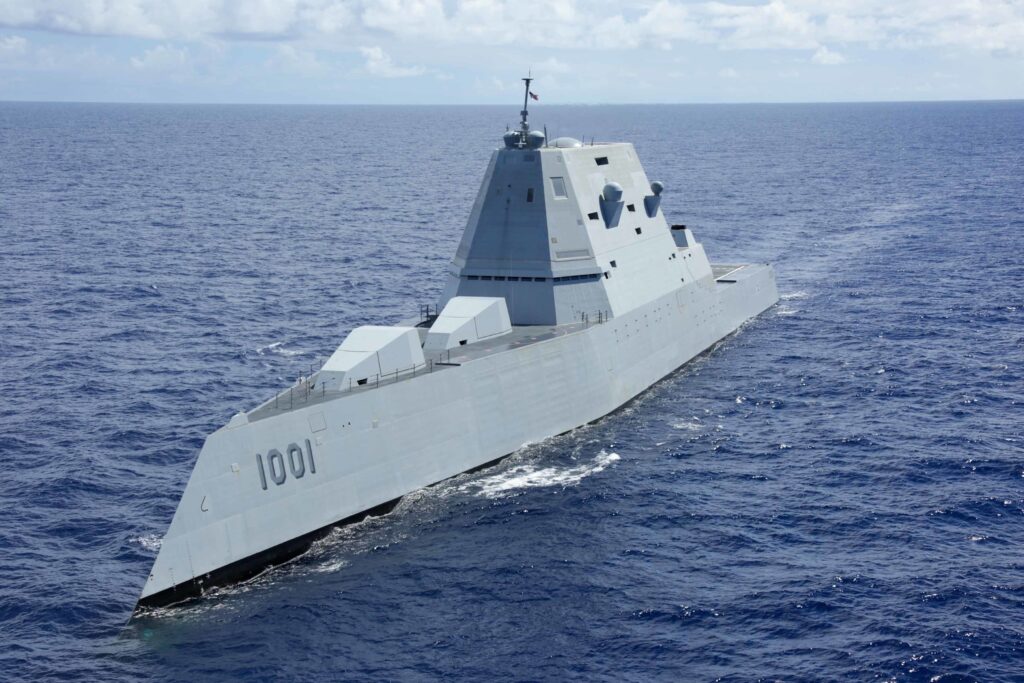
The Zumwalt-class guided-missile destroyer USS Michael Monsoor (DDG 1001) sails in formation during Rim of the Pacific (RIMPAC) 2022. U.S. NAVY / Mass Communication Specialist 3rd Class Aleksandr Freutel

ARLINGTON, Va. — As the U.S. Navy moves to deploy Conventional Prompt Strike missile systems on its three Zumwalt-class (DDG 1000) guided-missile destroyers, the service recently awarded two contracts to further that goal. 

The Navy’s Supervisor of Shipbuilding, Conversion, and Repair, Bath, Maine, has awarded General Dynamics Bath Iron Works a $20 million cost-plus-fixed-fee contract modification “for procurement of long-lead time material for the Large Missile Vertical Launch System [LMVLS] launch module fabrication on DDG 1000,” an Aug. 18 Defense Department contract announcement said. Work is expected to be completed by June 2024.  

Bath Iron Works is the prime contractor for the Zumwalt-class DDG. Raytheon is the contractor for the ship’s Total Ship Computing Environment. 

The Naval Sea Systems Command has awarded Raytheon an $11.2 million firm-fixed-price contract modification for “Total Ship Computing Environment Lab hardware for modernization/technical refresh and Conventional Prompt Strike to support DDG 1000-class combat system activation, sustainment and modernization,” according to an Aug. 19 Defense Department contract announcement. Work is expected to be completed by November 2023. 

The Navy plans to field the Conventional Prompt Strike capability on the USS Zumwalt in 2025 as the first platform for the new weapon. The LMVLS is needed because the ship’s existing Mk57 launchers for its Standard and Tomahawk missiles are too small to accommodate the CPS missile.  

The Conventional Prompt Strike capability will be fielded later in the decade on the Block V version of the Virginia-class attack submarine. 


Lockheed Martin Delivers Integrated Multi-Mission Laser Weapon System to The Navy 

HELIOS provides directed energy capability to the Navy fleet. LOCKHEED MARTIN

SAN DIEGO — Lockheed Martin has delivered to the U.S. Navy a 60+ kW-class high energy laser with integrated optical-dazzler and surveillance (HELIOS), the first tactical laser weapon system to be integrated into existing ships and provide directed energy capability to the fleet, the company said Aug. 18.

Integrated and scalable by design, the multi-mission HELIOS system will provide tactically relevant laser weapon system warfighting capability as a key element of a layered defense architecture. 

“Lockheed Martin and the U.S. Navy share a common vision and enthusiasm for developing and providing disruptive laser weapon systems,” said Rick Cordaro, vice president of Lockheed Martin Advanced Product Solutions. “HELIOS enhances the overall combat system effectiveness of the ship to deter future threats and provide additional protection for Sailors, and we understand we must provide scalable solutions customized to the Navy’s priorities. HELIOS represents a solid foundation for incremental delivery of robust and powerful laser weapon system capabilities.” 

HELIOS provides an additional layer of protection for the fleet with its deep magazine, low-cost per kill, speed of light delivery and precision response, the company said.


CNO Visits Spain, UK, Meets with Sailors, Focuses on Partnerships   

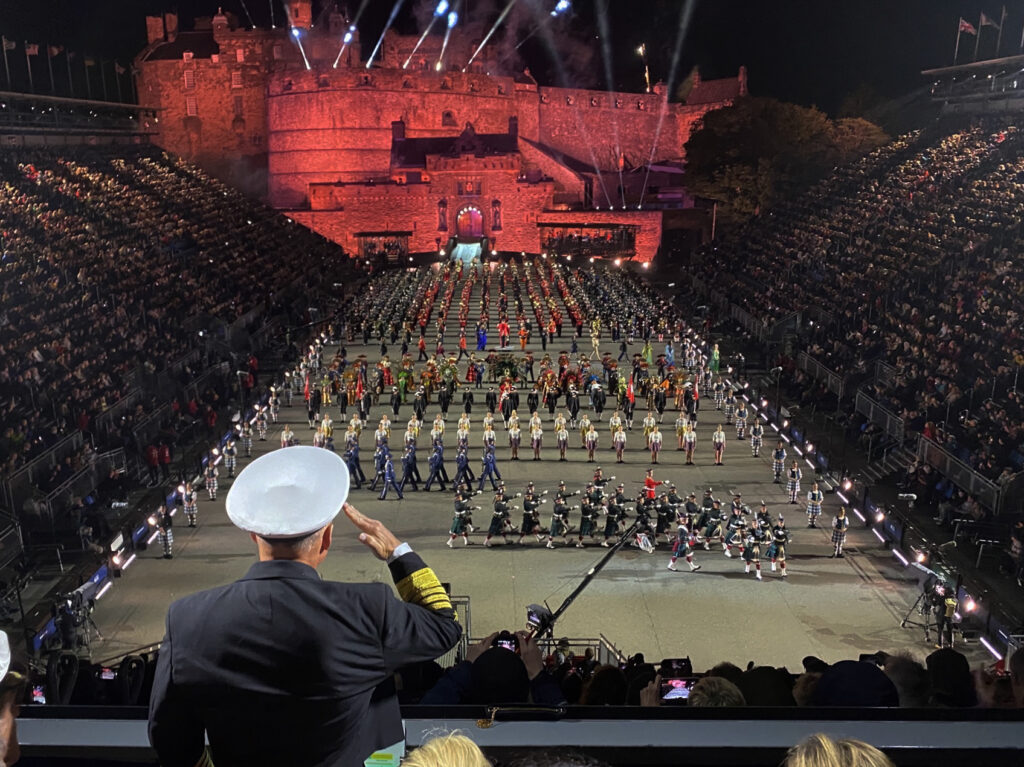
Chief of Naval Operations Adm. Mike Gilday renders a salute as the Royal Navy’s guest of honor at the Royal Edinburgh Military Tattoo in Edinburgh, Scotland, Aug. 20. U.S. NAVY / Capt. Gregory Leland

EDINBURGH — Chief of Naval Operations Adm. Mike Gilday and his wife, Linda, visited Spain and the United Kingdom, Aug. 16-21 to meet with Sailors, government and military leaders, the CNO’s public affairs office said Aug. 19.   

The CNO spoke with U.S. Sailors, as well as service members assigned to allied and partner militaries in Rota, Spain, London and Faslane and Edinburgh, Scotland.    

Gilday’s visit to Rota coincided with the arrival of the guided-missile destroyer USS Bulkeley (DDG 84) to its new homeport, Naval Station Rota, Aug. 17. Bulkeley joins three other U.S. Navy destroyers that are part of Forward Deployed Naval Forces-Europe: USS Arleigh Burke (DDG 51), USS Paul Ignatius (DDG 117) and USS Roosevelt (DDG 80).      

Gilday participated in a flag-raising ceremony alongside Admiral of the Spanish Fleet, Adm. Eugenio Díaz del Río Jaudenes, where together they hoisted the Spanish flag aboard Bulkeley.    

Speaking afterward to media, Gilday explained the significance of presence and the strength of the partnership between the U.S. and Spanish navies.   

“Spain remains one of our closest partners particularly in the maritime,” said Gilday. “The global economy floats on seawater … the U.S. Navy’s ability to have our destroyers forward-deployed in Spain is an exceptional opportunity for us to help keep sea lanes open, to work with closely with our allies and partners.”   

He later explained, “Our ships here in Rota are equipped with the most advanced capabilities and together with the Spanish navy we will continue to operate and sail strongly side by side to assure our NATO allies.”   

The Gildays also toured and spoke with Sailors assigned to Arleigh Burke.   

“What you do every day is not insignificant. I am extremely proud of this ship and everything you are doing, the ship means nothing without the crew and this is an exceptionally talented and dedicated team of warfighters,” Gilday said while speaking to the Sailors.   

Gilday began his U.K. engagements in London, where he was the keynote speaker at the dedication ceremony of the USS Osprey (AM 56) bell at the United States Embassy. USS Osprey was a Raven-class minesweeper that supported the invasion of Normandy, Operation Overlord. The ship struck an enemy mine the night before the invasion of Normandy while clearing the channel for the invasion. Six members of the crew died, becoming among the first of D-Day casualties. 

Gilday also visited the London Tech Bridge, where he exchanged views on the importance of this innovation hub and the partnership and collaboration with the U.S.-U.K. military, industry, academia and small businesses. 

“Collaborating, sharing information, being interoperable and truly interchangeable strengthens our ability to prevail in conflict and bolsters integrated deterrence against potential adversaries,” said Gilday. “We must continue to pursue innovative solutions, experiment and put capabilities in the hands of warfighters quickly if we want to maintain warfighting advantages.”   

During a visit to HM Naval Base Clyde at Faslane, Scotland, a logistical base for warships and submarines operating in European waters, he observed Valiant Jetty which was built to support operations by the latest Astute-class Royal Navy attack submarines. Gilday spoke with U.S. Navy Sailors who are training with Royal Navy sailors, toured cutting-edge boats, and also congratulated newly qualified Royal Navy British submariners who received their qualifications and pins.   

Gilday, the Royal Navy’s guest of honor, attended the Royal Edinburgh Military Tattoo, an annual series of artistic performances by 900 performers, including British armed forces, commonwealth and international military bands from across the globe.  

The focus of Gilday’s visit to the U.K. was to advance and further strengthen the maritime partnership and work toward becoming truly interchangeable. Throughout his visit, Gilday met with Royal Navy Adm. Sir Ben Key, First Sea Lord and chief of the Naval Staff of the United Kingdom. 


Navy Orders Full Production for Boeing’s HAAWC Air-Launched Torpedo Kits

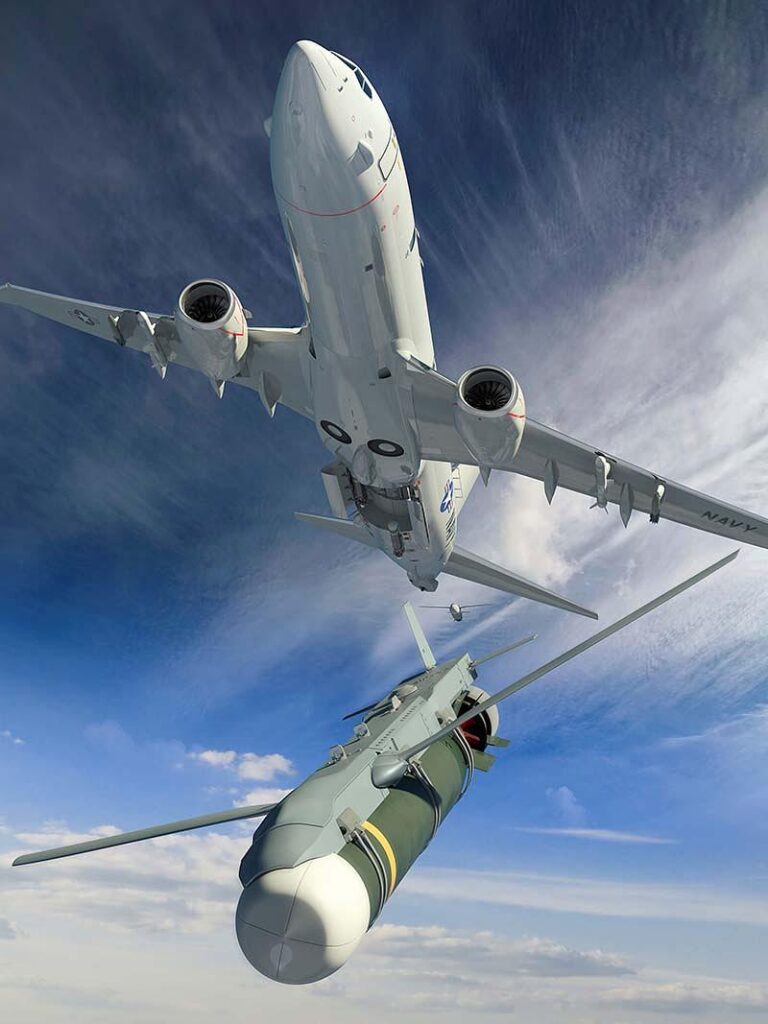
In an artist’s rendering, a High Altitude Anti-Submarine Warfare Weapon Capability, or HAAWC, deploys from a Boeing P-8A Poseidon multi-mission maritime patrol aircraft. Boeing illustration

ARLINGTON, Va. — The Navy has awarded Boeing a full-rate production contract for the High-Altitude Anti-Submarine Warfare Weapon Capability (HAAWC), a weapon which will allow the P-8A maritime patrol aircraft the ability to launch anti-submarine torpedoes from high altitudes. 

The Naval Sea Systems Command awarded Boeing a 25.6 million “fixed-firm-price, cost-plus-fixed-fee and cost-only, full-rate production contract for the production of High-Altitude Anti-Submarine Warfare Weapon Capability Air Launch Accessory (ALA) equipment, related engineering and hardware repair services, and other direct cost support,” the Defense Department said in an Aug. 19 contract announcement. 

HAAWC is an all-weather add-on glide kit that enables the Mk54 torpedo to be launched near or below the cruising altitude of the P-8A Poseidon. The kit consists of a modular ALA that strapped to a Mk54 torpedo, enabling it with precision navigation to glide to a target area, where the ALA separates and drops the torpedo into the water.  

“This is an important milestone because it brings HAAWC one step closer to becoming fully operational and deployed by the Navy,” said Dewayne Donley, Boeing’s HAAWC program manager, in a release. “Our solution transforms the Mk54 into a precision glide weapon in GPS-aided and GPS-denied environments. The HAAWC system provides flexibility by allowing the Navy to carry out anti-submarine operations throughout the full flight envelope of the P-8A.” 

“There are also provisions for Boeing to provide engineering such as design studies, testing, prototyping and/or analyses of production related issues,” the Boeing release said. “Repair service provisions include hardware repair and maintenance services for government-owned HAAWC ALAs and associated hardware and equipment. A provision item order option also allows the Navy to procure spare hardware in support of the program.” 

This contract includes options, which, if exercised, would bring the cumulative value of this contract to $121,4 million. Work is expected to be completed by September 2024. If all options are exercised, work will continue through September 2030.


Navy’s Light Amphibious Warship Will Be A ‘Great Enabler’ for Marine Littoral Regiments, General Says

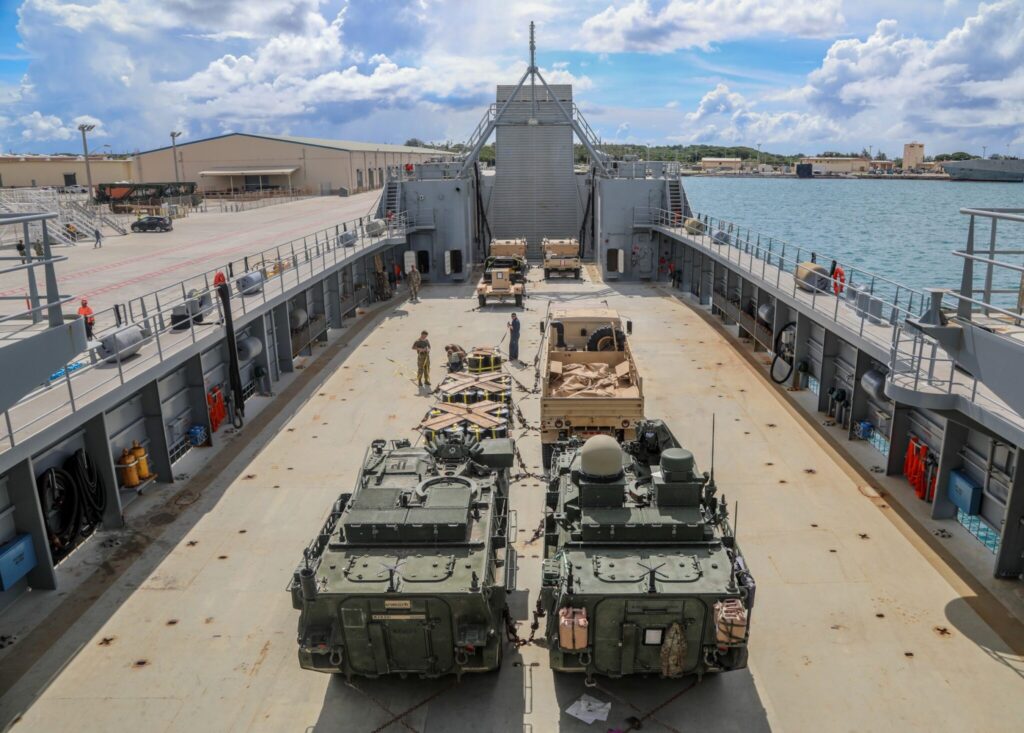
The crew of U.S. Army logistics support vessel Lt. General William B. Bunker (LSV-4), loaded equipment and supplies on LSV-4 in Guam in July 2021 for theater distribution operations in support of Defender Pacific 2021. Some call for the LSV to be used as a bridge to the Navy’s planned light amphibious warship. U.S. ARMY / Staff Sgt. Kevin Martin

ARLINTON, Va. — The U.S. Navy’s concept of the Light Amphibious Warship (LAW), more formally designated as a medium landing ship (LSM), is advancing within the Pentagon as the Navy and Marine Corps define some goals and the concept gels as a part of the Marine Corps’ Force Design 2030 concept.  

“The [LAW] AoA [Analysis of Alternatives] has been signed,” said Marine Maj. Gen. Marcus Annibale, director of Expeditionary Warfare in the Office of the Chief of Naval Operations, speaking Aug. 18 at the Surface Navy Association’ Waterfront 2022 West Coast symposium in San Diego. “We’re working through some details on that. OSD CAPE [Office of the Secretary of Defense Cost Assessment and Program Evaluation] has given us some comebacks on it. We need to get it as close to right as we can.”   

The LAW, as a warship, is designed to help the Marine Corps operate within the engagement zone of China, deploying Marine littoral regiments (MLRs) as stand-in forces. The MLR, armed with anti-ship cruise missiles and an air-defense capability, among others, will be able to complicate China’s ability to operate within the first island chain. 

“We put our own A2AD [anti-access/area denial] capability in their back yard as the stand-in force,” Annibale said. 

“One important thing to maneuver the MLR and sustain the MR is a warship that can move over distance with speed and capacity to support the MLR,” he said. “That is the LAW. We’re working through the baseline for that.”  

The general said that Chief of Naval Operations Adm. Michael Gilday has signed off on an initial capacity of 18 LAWs. 

“What that maps out to, we’re looking at about nine LAWs for each MLR,” he said. “We’re working the technical aspects of the ship. We’ve looked at different commercial capabilities. We’re experimenting in the Pacific with some contract surrogate shipping. … It’s going to be a great enabler for those MLRs.” 

Annibale said the Navy conducted a classified survivability study on the LAW as part of the AoA. 

“It’s a warship,” he said, “It’s not a commercial ship, even though we’re going to experiment with some commercial ships.” 

Annibale said that the rank for a LAW commanding officer is under discussion, floating the option of an O-4 lieutenant commander as a skipper and the nine-LAW squadron under an O-5 commander. 


U.S. Naval Special Warfare Establishes Assessment Command

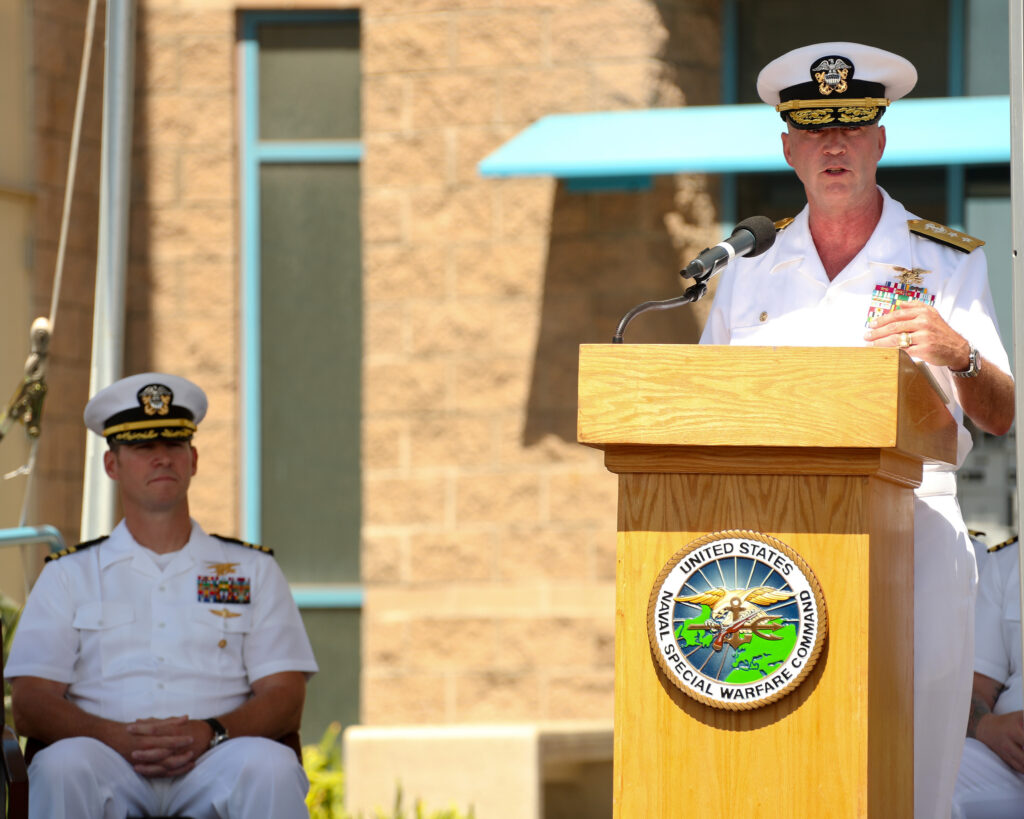
Rear Adm. Hugh Howard III, commander, Naval Special Warfare Command, addresses the crowd at the establishment ceremony for Naval Special Warfare Assessment Command (NSWAC). NSWAC conducts outreach, assessment, selection, and development of future and current Naval Special Warfare operators. U.S. NAVY / Mass Communication Specialist 1st Class Benjamin K. Kittleson

SAN DIEGO — U.S. Naval Special Warfare Command established Naval Special Warfare Assessment Command (NSWAC) under the Naval Special Warfare Center during an Aug. 18 ceremony onboard Naval Amphibious Base Coronado, said Petty Officer 2nd Class Alex Perlman in an Aug. 19 release. 

NSWAC substantively transforms the Navy’s commando force in its ability to compete for talent capable of solving the hardest problems from the maritime domain. It proactively engages diversity in all forms and enrolls future candidates who possess the Force’s standards and ethos. This new command accelerates the ways the Force continuously assesses and selects for the character, cognitive and leadership attributes necessary for the highest complexity and risk maritime operations mission to expand national leverage and deterrence options- and win if deterrence fails. 

During the ceremony, Cmdr. Aaron Brown, a Navy Special Warfare Officer, assumed command. Rear Adm. H.W. Howard, III, commander, U.S. Naval Special Warfare Command, was the presiding officer of the establishment ceremony. 
 
“Across the spectrum of warfare, the United States and its allies face new challenges and threats. The complexity of the strategic and operating environments demand we evolve quickly and creatively,” said Howard. “We’re aggressively seeking an edge in human capital and technology to expand the margins between mission success and failure. The Assessment Command is at the forefront of our urgent initiatives to deliver the step changes in capability and professionalism across the Force. Modernizing approaches to recruitment, assessment, selection and training underpin our transformations to be ready for the uncertainties ahead.” 
 
Attendees for the event included commander, Special Operations Command, Gen. Richard Clarke; Vice Chief of Naval Operations, Adm. Bill Lescher; Chief of Naval Personnel, Vice Adm. Richard Cheeseman; Deputy Commander, Navy Education and Training Command, Rear Adm. Scott Ruston; Commander, Navy Recruiting Command, Rear Adm. Alexis Walker; and the incoming commander of U. S. Naval Special Warfare Command, Rear Adm. Keith Davids. 
 
According to Howard, Naval Special Warfare initiated this effort in the Fall of 2020 to build the sustainable architecture for diversified outreach, more rigorous pre-assessments for character, cognitive and leadership attributes across the Assessment and Selection pathway and implement the innovative initiatives that strengthen continuous assessment across the continuum of a Naval Special Warfare. 
 
Howard also noted how the Assessment Command conducts outreach and enrollment opportunities across the United States to proactively engage under-represented demographics and geographic areas in the Force. 
 
“The Assessment Command will identify, engage and enroll the next generation of candidates we need to solve the hardest problems from – on – and under the sea,” said Howard. In partnership with CNRC, the Assessment Command will lead candidate assessment programs that deepen our Force’s diversity and capabilities.” 
 
According to Capt. Brian Dreschler, commanding officer, NSWCEN, over the past year as the team deliberately iterated to build this new command, the team conducted 60 outreach events partnered with local Navy Talent and Acquisition Groups (NTAGs). More than half of the outreach events were specifically focused on increasing Force diversity and inclusivity, with under-represented demographics. 
 
“The Assessment Command is a mission imperative for the Force’s relevance, survivability and lethality to contribute in irregular ways to Integrated Deterrence options,” said Capt. Brian Dreschler, the commanding officer of NSWCEN. “Not only are we adapting the way we assess and select our potential candidates, but we are also evolving the assessment and selection of our leadership, officer and enlisted, at all levels of command. The Assessment Command is also charged with learning from the Joint Force, allies and partners, and from private sector innovations to reinforce our culture of continuous assessment – the candid assessments for feedback, self-improvement and optimal leadership and team formation decisions.” 
 
One of NSWAC’s assessment programs is Naval Special Warfare Leader Assessment Program (NLAP). Enhancing NSW’s culture of continuous assessment, NLAP evaluates and selects NSW operators at every level. During NLAP, operators participate in purpose-filled events to select for officer and enlisted career milestones. Through feedback from peers, leaders, and subordinates, NLAP assesses an operator’s leadership, character, physical and mental attributes. According to Brown, this program ensures NSW places the right leaders in the right assignments, while offering critical professional development to guide the force into the future. 
 
“I’m humbled to assume command of this mission imperative,” said Brown. “With this high-performing team of professionals, we will strengthen the precision of candidate identification, assessment, selection, enrollment, training and development.” 
 
NSWAC is headquartered at Naval Amphibious Base Coronado in Coronado, California with a detachment in Virginia Beach, Virginia. Alongside Basic Training Command and Advanced Training Command, NSWAC will be a subordinate command to NSWCEN. 
 
“With the establishment of the Assessment Command, Howard said, we are in position to compete for talent and more rigorously assess, select, train and retain men and women who embody the courage, integrity, humility, creativity, team-ability, creativity and grit that expand competitive edge to remain the Nation’s preeminent maritime special operations force.” 
 
NSWCEN provides initial assessment and selection and subsequent advanced training to the Sailors who make up the Navy’s SEAL and Special Boat operational formations. The Naval Special Warfare mission is to provide maritime special operations forces to conduct full-spectrum operations, unilaterally or with partners, to support national objectives. For more information on the NSW assessment, selection and training pathways, visit https://www.sealswcc.com/


Construction of Navy’s New Frigate to Begin This Month, Admiral Says

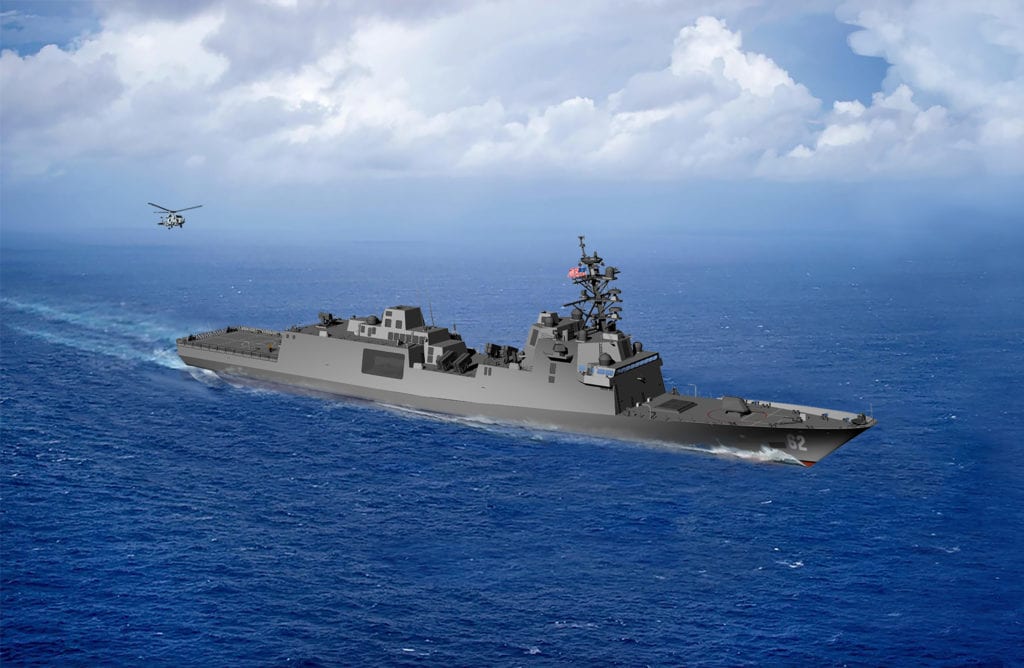
An artist’s rendering of the Constellation-class guided missile frigate. U.S. NAVY

ARLINGTON, Va. — Construction of the U.S. Navy’s next-generation guided-missile frigate (FFG) is to take begin later this month, a Navy admiral said. 

“[Regarding] the FFG 62 Constellation class, we’re going to start bending metal later this month,” said Rear Adm. Fred Pyle, director, Surface Warfare Division in the Office of the Chief of Naval Operations, speaking Aug. 18 at the Surface Navy Association’s Waterfront 2022 West Coast symposium. “That’s a success story. This frigate is going to bring DDG-like capability. We need to build small surface combatants in numbers [and] get this fighting frigate to sea. So, we’re excited about the Constellation-class frigate.” 

Three Constellation-class FFGs—Constellation (FFG 62), Congress (FFG 63), and Chesapeake (FFG 64) currently are on order. In June, the Navy exercised a contract option to order to build FFG 64 from Wisconsin-based Fincantieri Marinette Marine, the ship’s builder.  

The Marinette Marine shipyard is currently working on the detailed design for the future USS Constellation.  

The Navy has a requirement for 20 frigates. Marinette Marine is now under contract for the first three FFGs with options for seven more.  

The Constellation class FFG is based largely on the Italian FREMM frigate, but with a longer hull and features modified to meet U.S. Navy standards on reliability, survivability, maintainability, habitability and lethality. The 496-foot-long steel ship will displace 7,300 tons and have a beam of 64.6 feet and a draft of 18 feet. It will be powered by a combination diesel electric and gas turbine propulsion system. 

The FFG will feature a Mk41 Vertical Launching System, canister-launched Naval Strike Missiles, Mk110 57 mm gun, RAM Mk49 launcher, CAPTAS-4 variable-depth sonar, TB-37 Multi-Function Towed Array, SQQ-89(V)16 undersea combat system, SLQ-25E Nixie, SLQ-32(V)6 SEWIP Block 2, SPY-6(V)3 FFG Radar, Aegis Baseline 10 combat system, one MH-60R helicopter, one MQ-8C, and two 7-meter rigid-hull inflatable boats. Delivery of Constellation is anticipated for 2026.


U.S. Navy’s Military Sealift Command Conducts Maintenance in India 

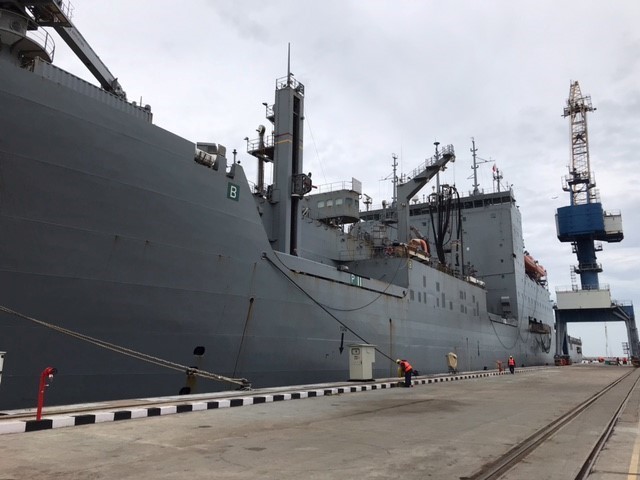
The Lewis and Clark-class dry cargo ship USNS Charles Drew (T-AKE 10) moors pier side in L&T Shipyard in Kattupalli, near Chennai, India, Aug. 7, 2022 for scheduled maintenance. As part of Military Sealift Command’s Combat Logistics Force (CLF), Charles Drew enables U.S. Navy ships to remain at sea and combat ready for extended periods of time. Joel Garcia

CHENNAI, INDIA — Military Sealift Command’s (MSC’s) Lewis and Clark-class dry cargo ship USNS Charles Drew (T-AKE 10) conducted maintenance at Larsen & Toubro Ltd, commonly known as L&T shipyard, in Kattupalli near Chennai, India, Aug. 7-17, MSC Far East Public Affairs Spokeswoman said in a release. 
 
“India’s initiative to offer logistics, repairs, and refits to the U.S. ships assumes special significance in furthering the strategic partnership between India and the United States, thereby promoting harmony in South Asia under the Indo-Pacific initiative,” said Dr. Ajay Kumar, defense secretary of India. 
 
Both Secretary of Defense Lloyd Austin and U.S. Secretary of State Antony Blinken expressed their intent to conduct maintenance in India during the U.S.-India 2+2 Ministerial Dialogue in April. 
 
“This inaugural repair of a United States naval ship, the Charles Drew, conducted by the L&T Kattupalli shipyard, is a landmark development to be celebrated as a symbol of our strengthened U.S.-India partnership,” said Judith Ravin, U.S. Consul General in Chennai. 
 
“Today marks another step forward in Indian and American maritime cooperation. Our shipping industries positively contribute to a free and open Indo-Pacific by partnering to deliver effective, efficient, and economical repair of military vessels We look forward to seeing the outcomes of this endeavor and where our partnership may go in the future,” said Defense Attaché at the U.S. Embassy at New Delhi Rear Adm. Michael Baker, when the ship first arrived in India. 
 
Routine maintenance conducted aboard Charles Drew in India included repairs to safety and crew habitability systems and equipment. 
 
“We appreciated the opportunity to complete this maintenance in India which will ensure we are ready for any tasking,” said Charles Drew’s Third Officer Anna Lewis, who serves as the ship’s navigator and operations officer. 
 
Charles Drew is one of the many ships that are part of the U.S. Navy’s MSC’s Combat Logistics Force (CLF). CLF are the supply lines to U.S. Navy ships while at sea. These ships provide virtually everything Navy ships need including fuel, food, fleet ordnance, dry cargo, spare parts, mail, and other supplies. 
 
CLF ships enable the Navy fleet to remain at sea and combat ready for extended periods of time. In addition to U.S. Navy ships, CLF ships also resupply international partners and allies operating in the Indo-Pacific Region. 
 
MSC Far East ensures approximately 50 ships in the Indo-Pacific Region are manned, trained, and equipped to deliver essential supplies, fuel, cargo, and equipment to warfighters, both at sea and on shore. Under Commander, U.S. Pacific Fleet, 7th Fleet is the U.S. Navy’s largest forward-deployed numbered fleet and routinely interacts and operates with 35 maritime nations in preserving a free and open Indo-Pacific Region.