MQ-8 Fire Scout Demonstrates Expeditionary Capability during Navy Exercise
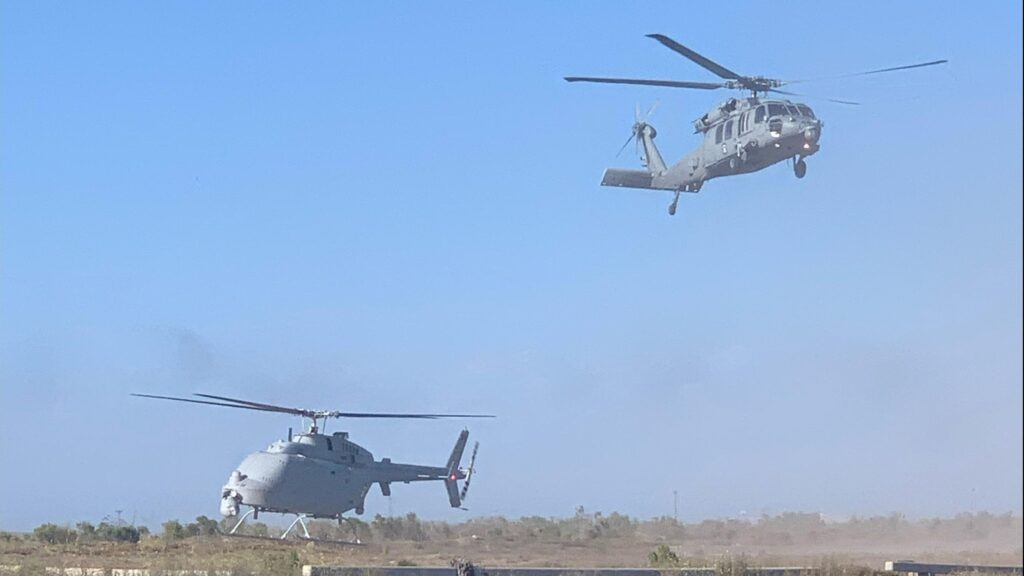
The Navy’s MQ-8C Fire Scout demonstrated Expeditionary Advanced Base Operations concept during Exercise Resolute Hunter in from Naval Base Ventura County Point Mugu in California. U.S. NAVY
PATUXENT RIVER, Md. — The Navy’s MQ-8C Fire Scout recently supported an Expeditionary Advanced Base Operations (EABO) exercise off the coast of California, demonstrating its capability to transition from ship-to-shore in a maritime environment, the Naval Air Systems Command said Aug. 8.
The MQ-8C Fire Scout participated in the Resolute Hunter exercise June 21-July 1, flying a total of 23 hours and proving the unmanned helicopter’s expeditionary use from land and across multiple ship classes.
Resolute Hunter is a joint and coalition large force exercise focused on training personnel on battle management, command and control and intelligence, surveillance and reconnaissance.
“Fire Scout is the Navy’s only unmanned helicopter with the ability to deploy from a ship or land with ISR&T at the extended range required for future warfighting,” said Capt. Dennis Monagle, Fire Scout program manager. “The system is vital in expeditionary use for situational awareness and critical decision-making.”
During the exercise, Helicopter Sea Combat Squadron (HSC) 23 successfully launched MQ-8C Fire Scout from Point Mugu and completed a hand-off to the detachment’s Portable Mission Control Station (MCS-P) at San Clemente Island. The portable MCS-P ground control station helps Fire Scout basing in austere locations on land, helipad operations in an advanced forward location, and logistics support from ship flight decks.
With the flexible MCS-P, Fire Scout has the ability to land on another ship or an expeditionary shore site where a runway is not feasible.
Fire Scout is currently deployed aboard USS Jackson (LCS 6) in the Indo-Pacific region. The Navy plans to continue deployments aboard LCS with future deployments planned on Constellation-class guided-missile frigates and potential operations from shore sites under the EABO concept.
Navy Receives First Fleet-Representative Next-Generation Jammer Mid-Band Pods
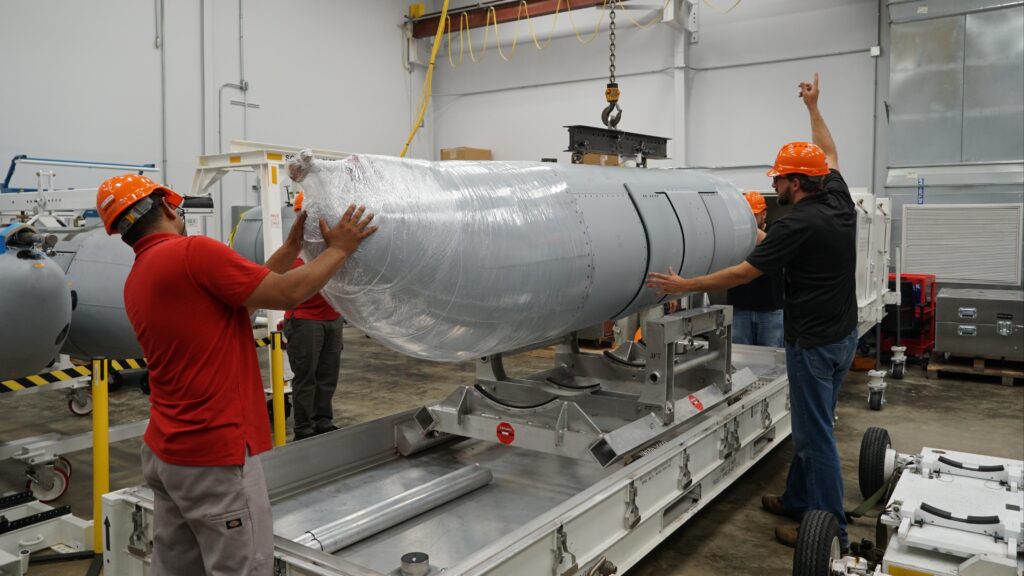
Kennie Martinez and Marc Dannemiller, Raytheon Intelligence & Space employees, unbox the first of two Next Generation Jammer Mid-Band fleet representative pods that were delivered to the Airborne Electronic Attack Systems pod shop at Naval Air Warfare Center Aircraft Division, Patuxent River, Maryland, July 7. U.S. NAVY
PATUXENT RIVER, Md. — The U.S. Navy’s first AN/ALQ-249 Next Generation Jammer Mid-Band (NGJ-MB) production representative pods arrived at the Naval Air Warfare Center Aircraft Division Patuxent River, Maryland, July 7, the Naval Air Systems Command said Aug. 8.
The two fleet representative test articles, which make up an NGJ-MB shipset, were delivered to the Airborne Electronic Attack Systems Program Office (PMA-234) pod shop where they will be used to complete the developmental test program and commence operational test that requires the use of operationally representative hardware and software.
Lt. Alexander Belbin, AEA project officer with NAWCAD’s Air Test and Evaluation Squadron (VX) 23, said he’s most looking forward to being able to test what the fleet is getting.
“We will test the pods for everything we expect to encounter in the fleet,” said Belbin. “For example, the power they generate, the frequency range they operate in, and the effects we can achieve against expected targets across the spectrum.”
The remainder of developmental test will be conducted by VX-23 and VX-31, located at the Naval Air Warfare Center Weapons Division, China Lake, California, and operational testing will be conducted by VX-9 at Naval Air Weapons Station China Lake. To date, NGJ-MB has successfully completed more than 300 hours of developmental flight testing and has more than 5,000 hours of chamber and lab testing using the engineering development models that were designed specifically for developmental testing.
NGJ-MB is part of a larger system that will augment and ultimately replace the legacy ALQ-99 Tactical Jamming System currently used on the EA-18G Growler.
Belbin said NGJ-MB’s increased power and capacity to target multiple systems will be significant enhancements over the ALQ-99.
“I have flown the Growler in the fleet and will eventually be going back. I may one day fly missions with the very pods that we will be testing for the first time,” Belbin said.
The U.S. Navy will receive six shipsets from Raytheon Intelligence & Space, the original equipment manufacturer. Once the flight test program is complete, the pods will be sent to the fleet in conjunction with the first low rate initial production shipsets for initial operational capability, which is scheduled for fall 2023.
“It is imperative we deliver this game-changing electronic warfare capability to the warfighter as quickly as possible,” said Capt. Dave Rueter, PMA-234 program manager. “Receiving the production representative pods allows us to finish the flight test program and ensure we have a reliable product for the U.S. Navy and our Royal Australian Air Force cooperative partners.”
U.S. Navy Recovers F/A-18E from Mediterranean Sea
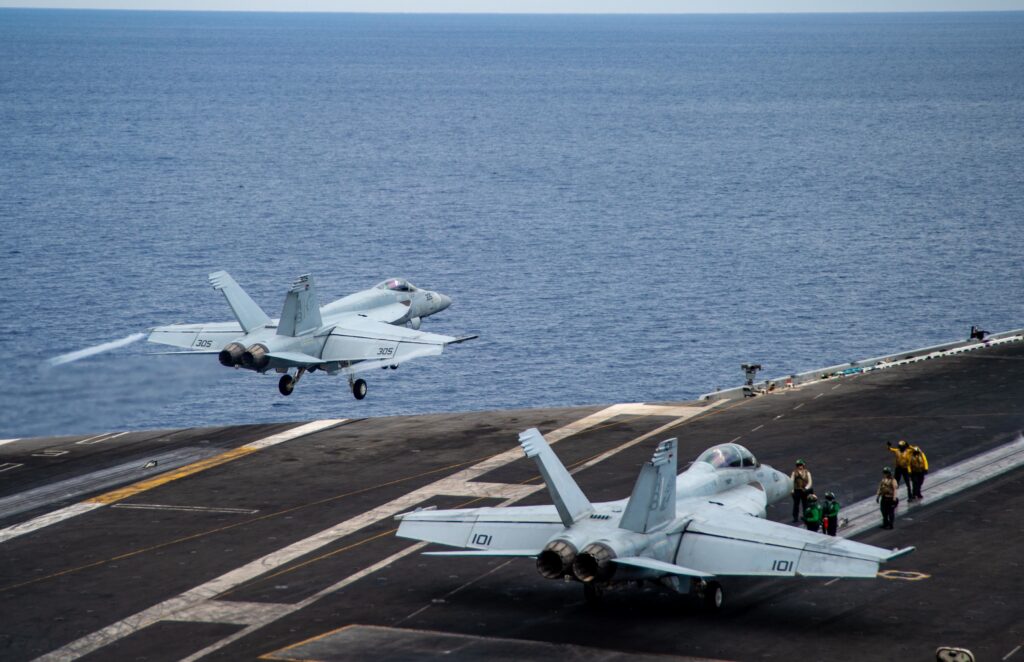
An F/A-18E Super Hornet, attached to the “Blue Blasters” of Strike Fighter Squadron (VFA) 34, launches off the flight deck of the Nimitz-class aircraft carrier USS Harry S. Truman (CVN 75), July 30. A Super Hornet that blew overboard earlier that month has been recovered. U.S. NAVY / Mass Communication Specialist 2nd Class Crayton Agnew
NAPLES, Italy — On Aug. 3, the U.S. Navy successfully recovered the F/A-18E Super Hornet aircraft assigned to Carrier Air Wing 1, embarked aboard USS Harry S. Truman (CVN 75), that blew overboard due to unexpected heavy weather in the Mediterranean Sea July 8.
The aircraft was recovered from a depth of approximately 9,500 feet by a team from Task Force (CTF) 68, Naval Sea Systems Command’s Supervisor of Salvage and Diving, USS Harry S. Truman, Naval Strike Fighter Wing Atlantic, and U.S. 6th Fleet embarked on the multi-purpose construction vessel Everest.
“Inherent to Task Force 68 is our ability to adapt to any mission set — we can rapidly mobilize and deploy scalable command, control, and communications, in order to seamlessly integrate and provide forward command and control when and where needed,” said CTF 68 Commodore, Capt. Geoffrey Townsend.
The aircraft was recovered using a CURV-21 remotely operated vehicle to attach specialized rigging and lift lines to the aircraft. A lifting hook was attached to the rigging to raise the aircraft to the surface and hoist it aboard Everest.
“The rapid response of the combined team, including SUPSALV and Phoenix International personnel, allowed us to conduct safe recovery operations within 27 days of the incident,” said Lt. Cmdr. Miguel Lewis, U.S. 6th Fleet salvage officer. “Our task tailored team operated safely and efficiently to meet the timeline. The search and recovery took less than 24 hours, a true testament to the team’s dedication and capability.”
The recovery efforts demonstrate the U.S. Navy’s capabilities to conduct deep-water search and recovery operations world-wide. The aircraft was delivered to a nearby military installation where it will be transported to the United States.
Largest International Maritime Exercise, RIMPAC 2022, Concludes
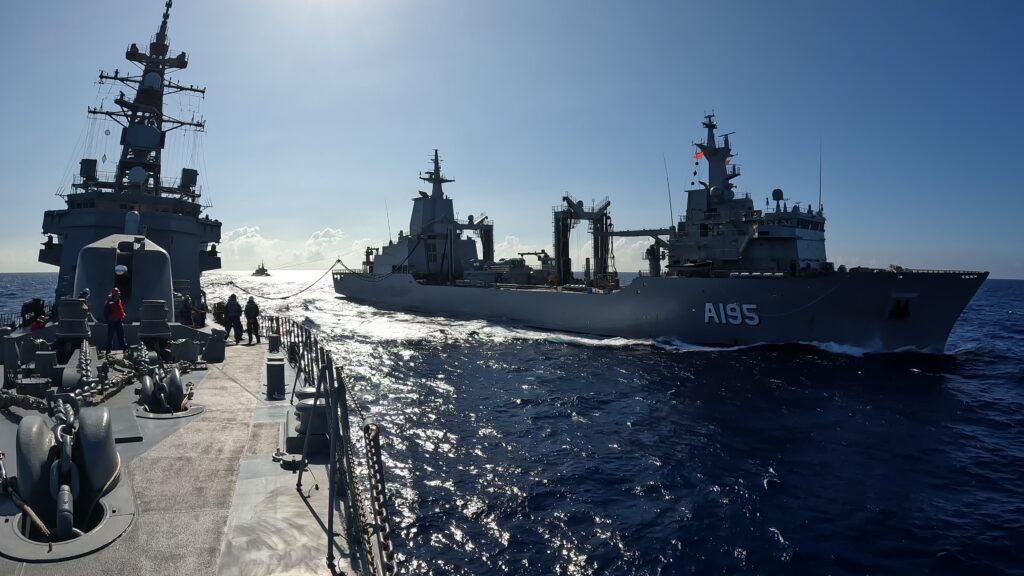
Japan Maritime Self-Defense Force Takanami-class destroyer JS Takanami (DD 110) conducts a replenishment at sea with Royal Australian Navy auxiliary oiler replenishment ship HMAS Supply (A 195) during Rim of the Pacific 2022. JAPAN MARITIME SELF-DEFENSE FORCE / Petty Officer 1st Class Miura Naoto
JOINT BASE PEARL HARBOR-HICKAM — The world’s largest international maritime exercise concluded Aug. 4 following more than a month of realistic, relevant combined operations training conducted in and around the Hawaiian Islands and Southern California, Commander, U.S. Third 3rd Public Affairs said in an Aug. 5 release.
Twenty-six nations, 38 surface ships, three submarines, nine national land forces, more than 30 unmanned systems, approximately 170 aircraft and over 25,000 personnel participated in the 28th edition of the biennial Rim of the Pacific, or RIMPAC.
RIMPAC 2022 Combined Task Force Commander, U.S. Navy Vice Adm. Michael Boyle expressed that returning to a full-scale exercise, with multiple exercise firsts, has been a success across all domains.
“By coming together as capable, adaptive partners, and in the scale that we are, we are making a statement about our commitment to work together, to foster and sustain those relationships that are critical to ensuring the safety of the sea lanes and the security of the world’s interconnected oceans,” Boyle said.
Japan Maritime Self-Defense Force Rear Adm. Toshiyuki Hirata filled the role of vice commander, and commanded the Humanitarian Assistance and Disaster Relief portion of the exercise that operated with local hospital personnel. This year’s RIMPAC included two Maritime Self-Defense Force escort ships and the Ground Self-Defense Force’s Western Army.
Hirata said in the current security environment, it is important for the international community to work together. “It is of great significance to deepen and strengthen the relationship of trust.”
For the first time, Republic of Korea Rear Adm. Sangmin An served as the commander of the exercise’s combined amphibious task force, with the Republic of Singapore Navy Col. Kwan Hon Chuong serving as the amphibious force’s Sea Combat Commander, and Royal Australian Navy Capt. Michael Osborn serving as the sea logistics commander.
RIMPAC’s Deputy Commander, Royal Canadian Navy Rear Adm. Christopher Robinson, said the collaboration and cohesiveness between partner nations enhanced their operations.
“This exercise provides tremendous training value, enabling partners to build skills and refine procedures through working together. Part of this comes from seeing how other partners approach similar scenarios, offering new perspectives,” Robinson said. “The value of this collaboration goes further, in that it also enables us to build and foster those relationships and networks that are so incredibly valuable as we operate together in future operations throughout the region.”
A few of the first-time achievements included:
Two U.S. Marine Corps MV-22 Osprey aircraft embarked in Australian amphibious ship HMAS Canberra for the whole duration of the exercise.
While participating in RIMPAC for the first time, HMNZS Aotearoa conducted numerous replenishment at sea operations with partner nations including France, Australia, Canada, Malaysia and the U.S.
Royal Malaysian Ship KD Leskir (F26) conducted its first live missile firing outside Malaysian waters.
First embedded use of the MQ-9A and MQ-9B unmanned aerial vehicles, and the unmanned surface vessels Nomad, Ranger, Sea Hawk and Sea Hunter; with data and knowledge sharing among 13 countries, including Australia, Canada, Japan, Korea, Malaysia, Philippines, Peru, India, France, Chile, Mexico, Singapore and Indonesia.
Nine nations participated in the RIMPAC Amphibious Assault (Australia, Chile, Indonesia, Malaysia, Mexico, Republic of Korea, Sri Lanka, Tonga and the U.S.
This year’s exercise included units and personnel from Australia, Brunei, Canada, Chile, Colombia, Denmark, Ecuador, France, Germany, India, Indonesia, Israel, Japan, Malaysia, Mexico, Netherlands, New Zealand, Peru, the Republic of Korea, the Republic of the Philippines, Singapore, Sri Lanka, Thailand, Tonga, the United Kingdom and the United States.
Ticonderoga-Class Cruiser USS Vella Gulf Decommissioned
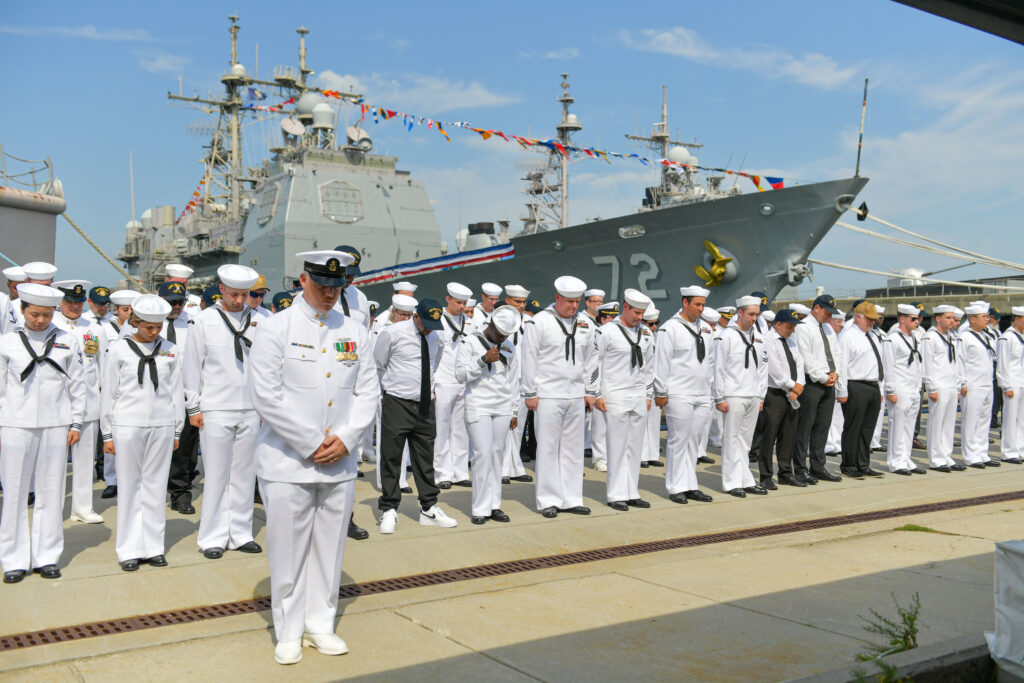
Sailors and former shipmates stand in formation during the guided-missile cruiser USS Vella Gulf (CG 72) decommissioning ceremony, Aug. 4. Vella Gulf was commissioned on Sept. 18, 1993, at Naval Station Norfolk. Vella Gulf is the first of five cruisers set to be decommissioned this year. U.S. NAVY / Mass Communication Specialist 1st Class Jacob Milham
NORFOLK, Va. — With plank owners and former crew members looking on, the crew of USS Vella Gulf (CG 72) decommissioned their ship at a Naval Station Norfolk, ceremony Aug. 4, Commander, Naval Surface Force Atlantic said in a release.
The event comes just months before the ship’s 29th commissioning anniversary. Hundreds gathered in the August heat to celebrate the ship’s distinguished history and military service. Capt. Constantine Xefteris, Vella Gulf’s first commanding officer, went back to the beginning, addressing the many plankowners on hand.
“In 1993, every officer, every chief, every Sailor wanted to be on an Aegis cruiser,” said Xefteris. “It was the finest, most lethal ship in the world. Aegis cruisers set the standard for performance and everyone knew it.”
Following several Xefteris sea stories illuminating the ship’s early days, Rear Adm. Brendan McLane, commander, Naval Surface Forces Atlantic, lauded the crews, both current and former, for their hard work, dedication and setting the standard over the years.
“In 2020 the Vella Gulf crew completed perhaps the most challenging deployment of the ship’s career, deploying to the Middle East and Europe with the USS Eisenhower Strike Group during Covid,” said McLane.
“The crew spent 205 days underway,” he continued. “Vella Gulf’s crew proved their mettle on that deployment, embodying self-sufficiency, grit and warrior toughness by staying on station, despite the immense challenges. Nobody came out. Nobody left.
“As we enter an era of strategic competition, the example and lessons of Vella Gulf will guide us in meeting the challenges.”
Vella Gulf’s current Commanding Officer, Capt. Mike P. Desmond, spoke of the powerful bond between Sailors and their ships and the lives forged aboard. His words resonated with the audience as they bade farewell to the cruiser.
“Decommissioning conjures up a broad spectrum of emotions, as different as the backgrounds of the Sailors who have called Vella Gulf home away from home,” said Desmond. “Vella Gulf was as temperamental as can be, but when all systems were operating as designed, she was perhaps the most reliable, capable and lethal warship on the planet.”
Vella Gulf was built at Ingalls Shipbuilding in Pascagoula, Mississippi, and commissioned in Norfolk, Virginia, Sept. 18, 1993.
The ship was named in commemoration of the World War II Battle of Vella Gulf, which was fought in the area surrounding the Solomon Islands in the Pacific Ocean from Aug. 6-7, 1943. The battle saw six American destroyers successfully disrupt the Imperial Japanese Navy’s supply lines without taking a single casualty or damage from enemy fire. It was a decisive victory for the United States.
Over its 29 years of service, the cruiser has been an important part of America’s national defense strategy.
In 1999, the crew participated in NATO strikes against Serbia in an effort to stop government-sanctioned human rights abuses against ethnic Albanians in the Kosovo region.
In 2001, Vella Gulf answered the call, taking part in the national effort to provide homeland defense for the country’s northeastern region immediately following the terrorist attacks of Sept. 11. The crew supported air traffic control efforts as the air defense commander, controlling protocols for an area spanning from Boston to Washington D.C.
In 2009, the ship led a task force responsible for curbing anti-piracy efforts off the Horn of Africa. During its mission, CG 72 responded to a distress call from the merchant vessel Polaris, a 420-foot tanker that was under attack. Vella Gulf’s intervention led to the pirates arrest and made the region safer for shipping.
In 2017, the Vella Gulf joined Carrier Strike Group 11. During its assignment, it supported strikes against ISIS in Iraq and Syria.
The ceremony marks the first of five cruisers set to be decommissioned this year. Inactivation is a normal part of a warship’s lifecycle. After decommissioning, the ship is slated to be towed on Oct. 11 to the Navy’s Inactive Ship’s facility in Philadelphia, where it will be in a Logistical Support Asset status.
“She has served her crews and her nation well, and rightfully takes her place among the ships that, for well over 200 years, have played an indispensable role in protecting the United States of America and serving her strategic interests across the world.” concluded Desmond.
“This ship and her crews will forever share a proud and lasting legacy.”
Navy Orders Construction of Two Fleet Oilers, One Expeditionary Sea Base
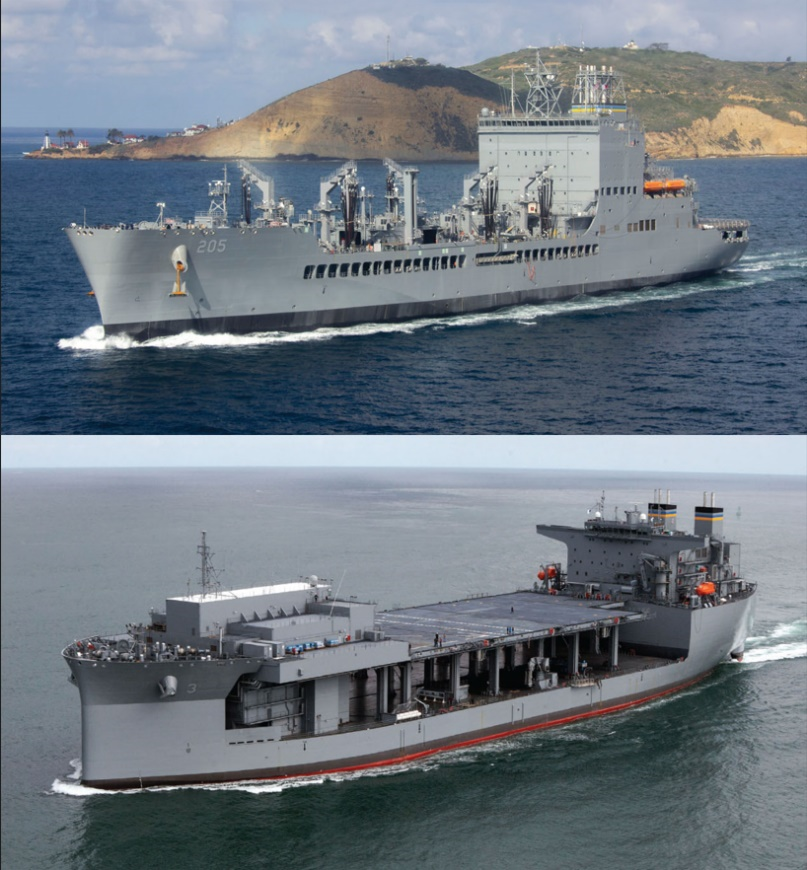
General Dynamics NASSCO has been awarded two contracts for detailed design and construction for two fleet replenishment oilers and one expeditionary sea base ship. GENERAL DYNAMICS NASSCO
ARLINGTON, Va. — The U.S. Navy has awarded two contracts totaling $1.4 billion for the detailed design and construction of three ships to be built by General Dynamics NASSCO in San Diego: two fleet replenishment oilers and one expeditionary sea base ship.
The Naval Sea Systems Command awarded General Dynamics National Steel and Shipbuilding Co. (NASSCO) an $890 million contract modification for detailed design and construction of the seventh and eighth John Lewis-class fleet replenishment oilers T-AO 211 and 212, according to an Aug. 4 Defense Department contract announcement. The company also was awarded a $535 million contract modification for detailed design and construction of Lewis B. Buller-class expeditionary sea base (ESB) 8, the sixth ship of the class.
The T-AO contract modification also includes an option for the detail design and construction of T-AO 213 which, if exercised would bring the cumulative value of that contract modification to $1.63 billion.
In June, the Naval Sea Systems Command awarded NASSCO a $500 million contract modification for long-lead-time material in support of the T-AO 211 and 212, according to a June 28 Defense Department contract announcement. The company also was awarded a $100 million contract modification for long-lead-time material in support of ESB 8.
On July 27, NASSCO delivered to the Navy the lead ship of the new 742-foot-long, 49,850-ton fleet oiler class, the John Lewis (T-AO 205). Three more T-AOs are under construction — the future USNS Harvey Milk (T-AO 206), the future USNS Earl Warren (T-AO 207), and the future USNS Robert F. Kennedy (T-AO 208) — and four, T-AO 209 through 212, are under contract. The oilers each will have a fuel capacity of 157,000 barrels of oil as well as other dry stores to replenish ships at sea.
The Lewis B. Puller-class ESB is a development of the Montford Point-class mobile landing platform ship. The 784-foot-long ESB is equipped with a 52,000 square-foot flight deck that can handle H-1, H-53 and H-53 helicopters and V-22 tilt-rotor aircraft. The ship is a capable platform to support mine-countermeasures missions, special operations forces, patrol boat support and unmanned systems.
Three ESBs are serving in the fleet — USS Lewis B. Puller (ESB 3), USS Hershel “Woody” Williams (ESB 4) and the USS Miguel Keith (ESB 5) — and two more, the future USNS John L. Canley and USNS Robert E. Simanek (ESB 7), are under construction.
NASSCO said the construction of the three newly contracted ships is planned for third quarter of 2023 and continue into 2027. The company sees the contracts as helpful in sustaining and growing its workforce.
USS Delbert D. Black Under Way for First Deployment
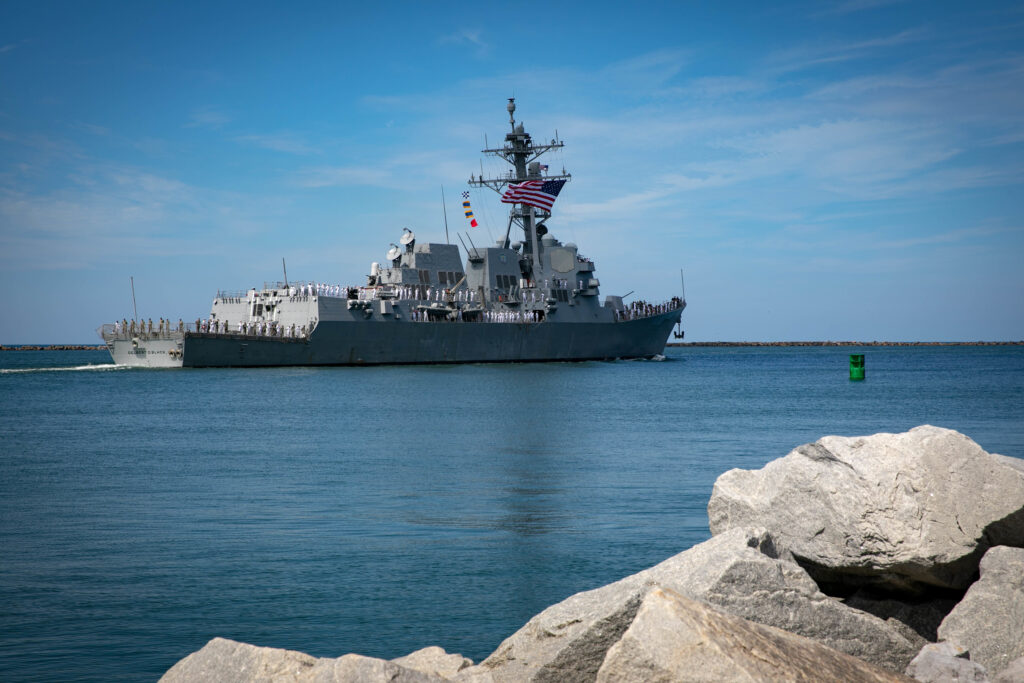
The Arleigh Burke-class guided missile destroyer USS Delbert D. Black (DDG 119) departs Naval Station Mayport for deployment, Aug 2. USS Delbert D. Black is homeported at Naval Station Mayport. U.S. NAVY / Mass Communication Specialist 2nd Class Juel Foster
JACKSONVILLE, Fla. — The Arleigh Burke-class guided-missile destroyer USS Delbert D. Black (DDG 119) departed Naval Station Mayport Aug. 2 on the ship’s inaugural deployment, U.S. 2nd Fleet said Aug. 4.
The ship completed all training phases of the Optimized Fleet Response Plan with Destroyer Squadron 26 and Carrier Strike Group 10.
“Our ship and crew have trained for this moment for more than four years,” said Cmdr. Mark Gallagher, commanding officer, Delbert D. Black. “We are prepared for any mission directed to us. The crew and ship are the finest the Navy has to offer, and I am proud to sail with each one of these fine men and women.”
Commissioned in September 2020, the ship’s crew is comprised of more than 50 officers and nearly 300 enlisted Sailors.
Delbert D. Black is the 68th Arleigh Burke-Class guided-missile destroyer delivered to the Navy and the first to bear its name. The ship honors the first master chief petty officer of the Navy. Black is known for initiating the master chief program, ensuring enlisted leadership was represented Navy-wide.
“It is an honor and a privilege to take this ship and crew on its maiden deployment,” said Delbert D. Black Command Master Chief Christopher Bartley. “We are following in the footsteps of our trailblazing namesake, making Del and Ima Black proud.”
Ima Black, Black’s widow and a former Sailor, serves as the ship’s sponsor. She served during World War II in the Navy WAVES (Women Accepted for Volunteer Emergency Service).
A detachment from Helicopter Maritime Strike Squadron 48 will remain embarked aboard Delbert D. Black.
Delbert D. Black provides the nation multiple warfighting capabilities as one of the Navy’s newest destroyers that maintains maritime stability and security to ensure access, deter aggression, and defend U.S., allied and partner interests as part of the George H.W. Bush Carrier Strike Group.
U.S. Navy Delivers First Upgraded CN-235 Aircraft to RMAF
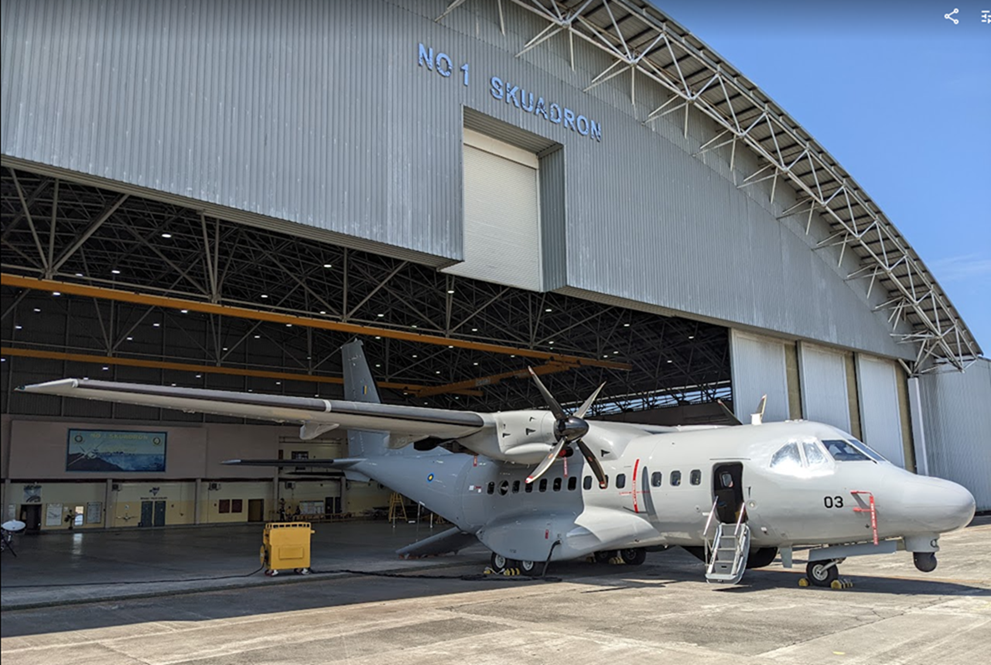
The U.S. Navy has delivered the first of three Royal Malaysian Air Force CN-235 military transport aircraft converted to a maritime patrol platform. U.S. NAVY
PATUXENT RIVER, Md. — The U.S. Navy has delivered the first of three Royal Malaysian Air Force CN-235 military transport aircraft converted to a maritime patrol platform, the Naval Air Systems Command said Aug. 3. This comes just three and a half years after the U.S. signed a letter of offer and acceptance to begin increasing the capability and interoperability of U.S. and Malaysian forces.
The effort was facilitated by the U.S. Navy’s Building Partner Capacity program, aligned with the U.S. government’s Maritime Security Initiative, which is intended to assist the Malaysian government in increasing maritime security and maritime domain awareness within the Malaysian Exclusive Economic Zone.
The project to integrate an intelligence, surveillance and reconnaissance upgrade into the aircraft was undertaken by the Malaysian air force in cooperation with the Naval Air Systems Command’s Security Cooperation Office and Naval Air Warfare Center Aircraft Division’s AIRWorks.
“Our collective international team has overcome tremendous challenges during the recent worldwide pandemic to deliver this capability. We are excited to deliver this first aircraft,” said Gerald Swift, who leads AIRWorks, NAWCAD’s office focused on rapidly and effectively delivering warfighter capability to meet immediate and emergent warfighter needs.
The upgrade includes a maritime surveillance mission suite, maritime surveillance radar, an electro-optical infrared turret, line-of-sight datalink and a roll-on/roll-off mission system operator station. Compatible mobile and fixed ground stations are also being delivered to increase the Malaysian air force’s ISR capability.
The project’s CN-235s were flown to Indonesia for completion and testing in Sept. 2020 amid COVID-19 restrictions and first flight took place in October 2021. Work on the two remaining CN-235 aircraft and multiple ground stations continues and is expected to be completed in 2022.
USS Bulkeley Departs Norfolk for Homeport Shift to Rota
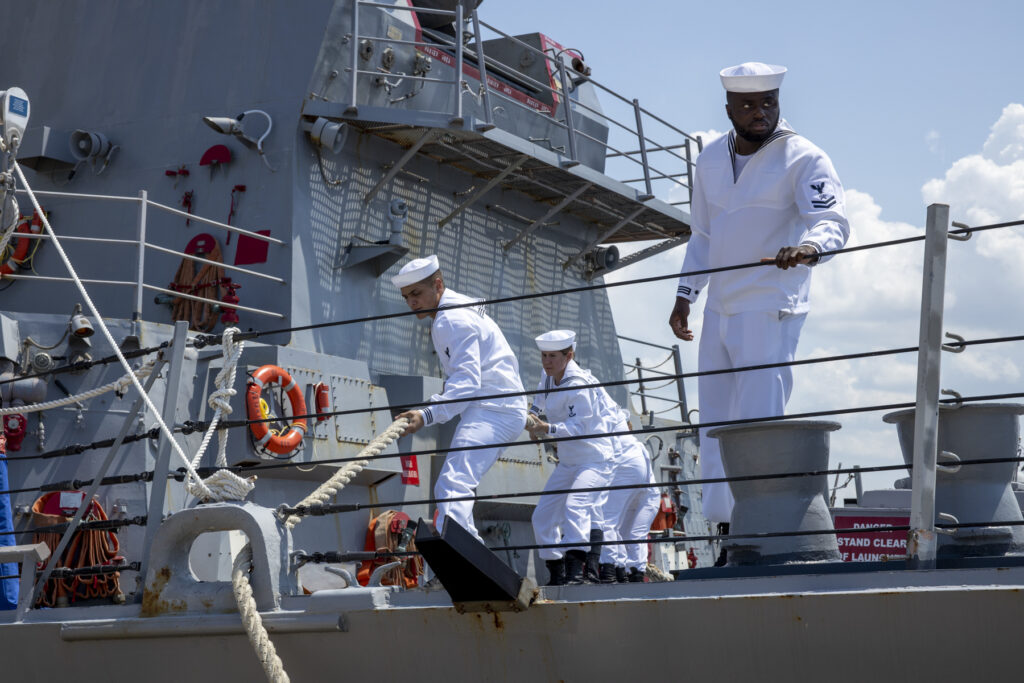
Sailors aboard the USS Bulkeley (DDG 84) cast off lines as they depart Naval Station Norfolk Aug. 4 for the ship’s scheduled homeport shift to Rota, Spain, as part of the U.S. Navy’s long-range plan to gradually rotate the Rota-based destroyers. U.S. NAVY / Mass Communication Specialist 1st Class Theodore Green
NAVAL STATION NORFOLK — The Arleigh Burke-class guided-missile destroyer USS Bulkeley (DDG 84) departed Naval Station Norfolk Aug. 4, commencing the ship’s scheduled homeport shift to Rota, Spain, as part of the U.S. Navy’s long-range plan to gradually rotate the Rota-based destroyers, U.S. Fleet Forces Command said Aug. 4.
Bulkeley will join destroyers USS Arleigh Burke (DDG 51), USS Roosevelt (DDG 80), USS Paul Ignatius (DDG 117) and Helicopter Maritime Strike Squadron (HSM) 79 as Forward Deployed Naval Force-Europe (FDNF-E) assets stationed in Rota.
“The Bulkeley crew has been working extremely hard the past year to prepare to join our forward deployed forces in Rota and work with our partners and allies in the region,” said Capt. Mac Harkin, commanding officer, USS Bulkeley. “We are excited to join our sister ship and aviation units already at the tip of the spear, to assure our allies, respond to threats as required and ensure support to global operations.”
U.S. Navy ships assigned to FDNF-E demonstrate national resolve, strengthen alliances, dissuade potential adversaries and enhance the ability to respond quickly to contingencies. Rota offers a world-class port facility that provides an excellent location for multi-mission Aegis ships to support NATO and U.S. missions, exercises and engagements.
“Bulkeley is a highly capable, multi-warfare platform that is joining a substantial force of FDNF-E assets already in place,” said Harkin. “When combined with our partners and allies, we are collectively ready to perform a myriad of tasks, including NATO ballistic missile defense, the full spectrum of maritime security operations, bi-lateral and multi-lateral training exercises, and NATO operations and deployments.”
The rotation of the FDNF-E ships serves to keep these multi-mission capable ships forward deployed to better support maritime security operations in the region as well as Ballistic Missile Defense (BMD) of U.S. and allied units and personnel.
With Bulkeley’s arrival, along with Paul Ignatius’ arrival earlier this year, USS Ross (DDG 71) and USS Porter (DDG 78) will shift homeports from Rota to Norfolk in the coming months, marking the final scheduled homeport shifts in the long-planned FDNF-E rotation.
Ready-to-Fight Force Conducts Amphibious Assault During RIMPAC 2022
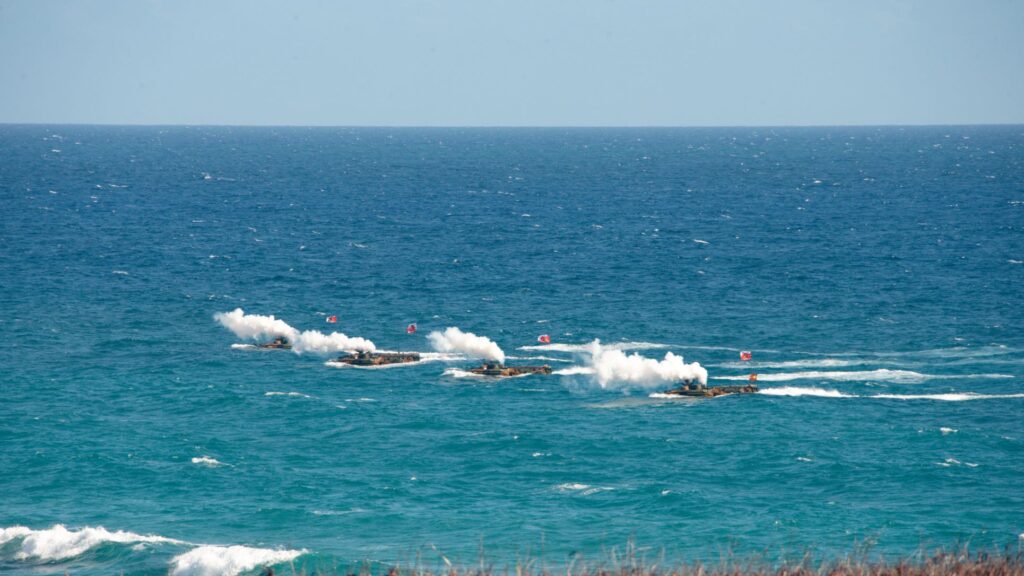
Republic of Korea Marine Corps Amphibious Assault Vehicles cover and conceal during an amphibious raid for a multinational littoral operations exercise as part of Rim of the Pacific 2022, Aug. 1. U.S. MARINE CORPS / Sgt. Melanye Martinez
MARINE CORPS BASE HAWAII — With the theme of “Capable Adaptive Partners,” the 2022 Rim of the Pacific exercise has featured a wide range of capabilities, projecting the inherent flexibility of maritime forces and helping to promote a free and open Indo-Pacific, culminating with an amphibious assault in Hawaii.
During the exercise, 26 nations, 38 surface ships, four submarines, nine national land forces, more than 30 unmanned systems, approximately 170 aircraft and more than 25,000 personnel trained together while operating in and around the Hawaiian Islands and Southern California, June 29 to Aug. 4.
Following weeks of workups, and then intensive training together when the exercise began, RIMPAC amphibious forces conducted a simulated assault on a beach and airfield at Marine Corps Base Hawaii at Kaneohe Bay on the island of Oahu in Hawaii.
RIMPAC has been led by the commander of U.S. 3rd Fleet, Vice Adm. Michael Boyle. Republic of Korea navy Rear Adm. Sangmin An served as the commander of Combined Task Force 176, RIMPAC’s amphibious task force, aboard his flagship, amphibious assault ship USS Essex (LHD 2). His deputy was U.S. Navy Rear Adm. Michael Baze, commander of Expeditionary Strike Group (ESG) 3.
In the scenario, a fictional armed radical organization known as Draco has captured a beach and airfield and adjacent areas from a fictional friendly nation called Orion. The amphibious task force employed a multi-domain assault to capture it back.
By definition, an amphibious assault involves the establishment of a landing force on a hostile or potentially hostile shore. An amphibious force consists of an amphibious task force and a landing force. Both partner and partner nations and allies provide the forces that are organized equipped and trained for these specialty mission sets.
According to Col. Ricardo Miagany, assistant chief of staff for operations with Marine Forces Pacific, the ship-to-shore phase showcases multilateral interoperability approach.
“A flotilla of coalition naval vessels is supporting this amphibious assault. Each ship possesses unique capabilities that will be harnessed to dislodge the occupying forces,” he said.
In addition to Essex, the assault force included the ROKN landing helicopter platform ROKS Marado (LPH-6112); the Royal Australian Navy landing helicopter dock HMAS Canberra (L02); and the Mexican navy landing ship tank ARM Usumacinta (A412), the ex-USS Frederick (LST-1184).
“Each ship possesses unique capabilities that will be harnessed to dislodge the occupying forces. Today’s training highlights some of the capabilities of the forces of the amphibious partners in the region as we operate together for a collection of naval platforms and functioning as one joint naval task force,” said Miagany.
USMC F/A-18 Hornets and AH-1Z and UH-1 aircraft provided fire support, and USMC CH-53E Super Stallions and MV-22 Ospreys delivered troops to the landing zone, USAF A-10 Thunderbolt IIs, a USAF MQ-9 Reaper and a USAF C-17 airlifter.
The ground assault included forces from Australia, the Republic of Korea, Mexico, Sri Lanka, Chile, Indonesia, Malaysia, the Kingdom of Tonga and the U.S.
Miagany said the “ready-to-fight force embarked on amphibious assault vehicles, small boats and aircraft, and attacked from the sea to the shore in one of the most complex and difficult form of maneuver and amphibious operations.”
Force Modernization
“For years we have practiced amphibious operations together, and many of the participants in sporting experience have experience working with Marine Expeditionary Unites. These will remain key facets of our crisis response roles in support of our alliances and security partnerships in the years ahead,” Miagany said. “These challenges in the constant evolution of military technology are focusing the Marine Corps and many of our partners on force modernization efforts. Marine Corps investment and experimentation efforts will enhance our collective security and improve U.S. crisis response capabilities.”
Miagany said “the amphibious assault today demonstrates the flexibility and strength of integrated and interoperable amphibious forces, the synergy of network allies and partners, the enduring value of amphibious crisis response capabilities, and provides a glimpse of the U.S. Marine Corps’ emerging core mission of providing stand-in forces which defend our allies and partners.”
According to Miagany, amphibious assaults are one of the most complex of all military operations.
“Only a small collection of militaries around the world are capable of planning and executing them. This form of a maneuver warfare projects naval forces from ship to shore into contested spaces. Accomplishing this requires a tremendous amount of professionalism, partnership, compatible operating concepts and interoperable technology. When training and practicing these maneuvers throughout Hawaii in preparation for this mission, our nations are building relationships with each other and strengthening our interoperability. For years we have practiced amphibious operations together, and many of the participants this morning have experience working with Marine Expeditionary Units. These will remain key facets of our crisis response roles in support of our alliances and security partnerships in the years ahead.”
In addition to the operational demonstration, Marines from the 3d Littoral Combat Regiment displayed their tactical systems, including sensors such as the AN/TPS-80 Ground/Air Task Oriented Radar and weapons such as the High Mobility Artillery Rocket System.
At the conclusion of the demonstration, Lt. Gen. Steven R. Rudder, commander, U.S. Marine Corps Forces, Pacific and commanding general of Fleet Marine Force, Pacific, congratulated the forces that had been training on the ground for the past month and a half, and referred to the assault as the “RIMPAC graduation exercise.”
“The blue water ops that have been that have been transpiring has been shaping this environment so that we can conduct this amphibious assault today,” Rudder said. “It’s the first time we’ve done an amphibious assault with nine countries during the RIMPAC exercise. Although bilateral is such a key part of all of our nation’s military exercising in the Indo-Pacific, the biggest operations are by nature joint, and are by nature multilateral.”