Pacific Partnership Concludes Palau Phase 
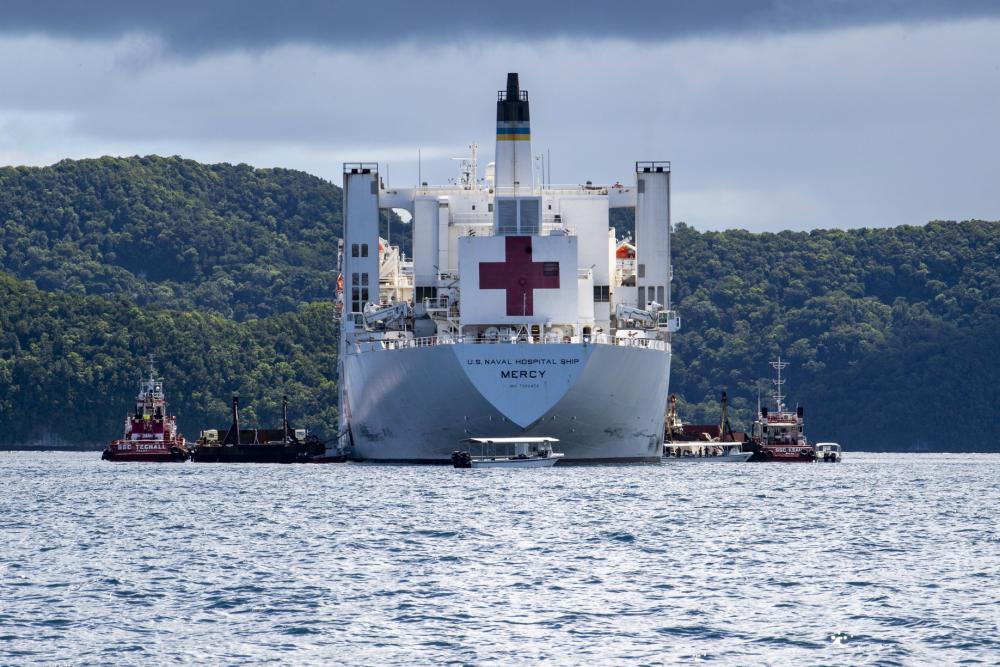
Military Sealift Command hospital ship USNS Mercy (T-AH 19) sits at anchor upon its arrival off the coast of Koror, Palau during Pacific Partnership 2022. U.S. NAVY / Mass Communication Specialist 2nd Class Brandie Nuzzi

KOROR, PALAU — The Palau phase of Pacific Partnership concluded in Koror, Palau, on July 23, Lt.j.g. Molly Sanders wrote in a July 27 U.S 7th Fleet release. 

In Palau, the Pacific Partnership 2022 team included representatives from the host nation, Australia, Japan, the United Kingdom and the United States. 

During the mission stop, the Pacific Partnership 2022 team conducted more than 100 total medical engagements including more than 50 dental events and five patient surgeries, 71 animals seen for surgical and medical care, two humanitarian assistance and disaster relief workshops with 120 personnel trained, three band concerts with more than 600 attendees, and a search and rescue exercise conducted between four participating nations. 
 
“The USNS Mercy is strengthening relationship between our countries. We greatly appreciate their presence here in Palau to further the capabilities of our local medical practitioners,” said Palau President Surangel S. Whipps Jr. 
 
Participants said the coordination between partner nations during Pacific Partnership 2022 enhanced understanding and cooperation, as well as prepared those involved to respond in case of a natural disaster or humanitarian assistance and disaster relief. Pacific Partnership contributes to regional stability and security through exchanges that foster enduring partnerships, trust, and interoperability between nations. 
 
“It has been our honor to bring Pacific Partnership to Palau,” said Capt. Hank Kim, Pacific Partnership 2022 mission commander. “We worked together to share knowledge and provide care that will instill bonds lasting long after PP22 departs Koror.” 
 
This year’s mission has included stops in Vietnam and Palau and an engineering engagement in Fiji. The hospital ship USNS Mercy (T-AH 19) serves as the Pacific Partnership 2022 mission platform. 
 
Now in its 17th year, Pacific Partnership is the largest annual multinational humanitarian assistance and disaster relief preparedness mission conducted in the Indo-Pacific. 
 
For more information about Pacific Partnership and USNS Mercy, visit www.facebook.com/USNSMERCY, www.facebook.com/pacificpartnership, or https://www.msc.usff.navy.mil/ships/mercy/


US Navy Exercises Option for L3Harris Submarine Imaging Masts  

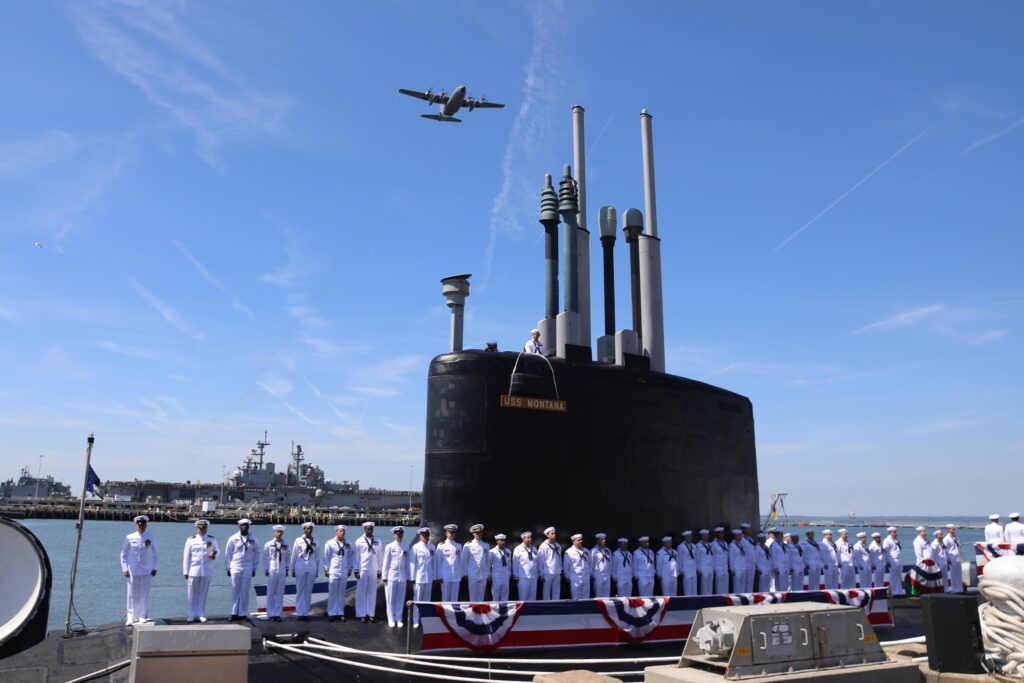
Sailors attached to the Virginia-class fast attack submarine USS Montana (SSN 794) man the boat during a commissioning ceremony in Norfolk, Va., June 25. L3Harris will provide imaging masts for Virginia- and Columbia-class submarines. U.S. NAVY / Senior Chief Mass Communication Specialist John Smolinski

NORTHAMPTON, Mass. — The U.S. Navy exercised an option on a previously awarded L3Harris Technologies’ contract to produce enhanced submarine imaging masts and spares, the company said July 27.  

L3Harris will provide two configurations of its Type 20 low-profile mast to meet the Navy’s operational requirements. Production will be performed at L3Harris’ Northampton, Massachusetts, facility, with initial deliveries scheduled to begin in 2024.  

As the world’s largest submarine imaging system provider, L3Harris delivers precise, high-resolution optics and integrated sensor packages.  

The Type 20 mast is a modular non-hull-penetrating imaging sensor that uses a telescoping universal modular mast to deliver improved high-definition visual imaging capabilities. 

“The Type 20 low-profile mast is the next-generation imaging mast that will provide enhanced capabilities to the Virginia- and Columbia-class submarines,” said Rosemary Chapdelaine, president, Maritime, L3Harris. “Under this contract, we will deliver technology advancements to support the U.S. Navy’s mission and operational requirements, which will enable the users to see and control the submarine integrated imaging systems.” 


Austal USA Awarded Contract Option for 2 U.S. NAVY T-ATS Ships 

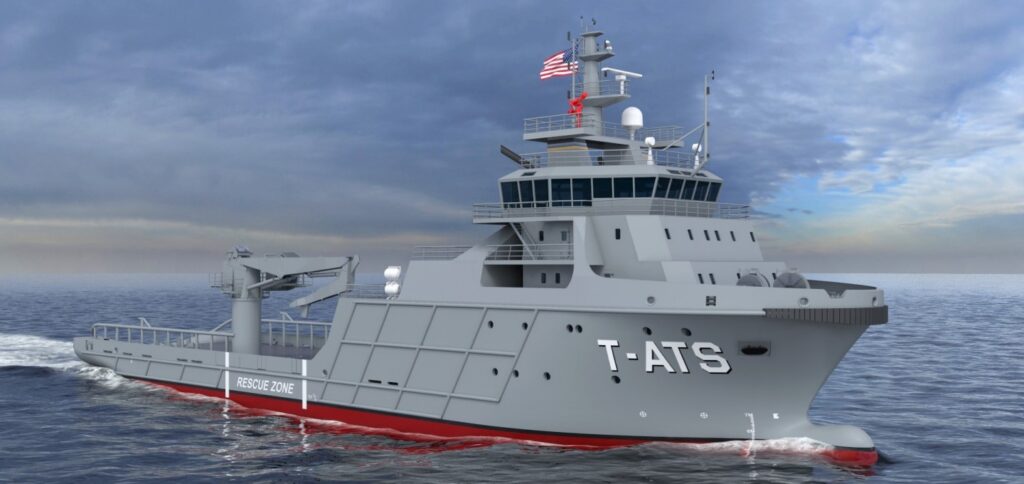
An artist’s conception of a T-ATS craft. AUSTAL USA

MOBILE, Ala. – Austal USA was awarded a $156 million U.S. Navy contract option for the construction of two Navajo-class Towing, Salvage, and Rescue Ships (T-ATS), the company said in a release. With the award, the company is now under contract for four T-ATS, having received awards for T-ATS 11 and 12 in October 2021. 

T-ATS will provide ocean-going tug, salvage, and rescue capabilities to support U.S. Navy fleet operations and will be a multi mission common hull platform capable of towing heavy ships. These ships will also be able to support current missions, including oil spill response, humanitarian assistance, and wide area search and surveillance. 

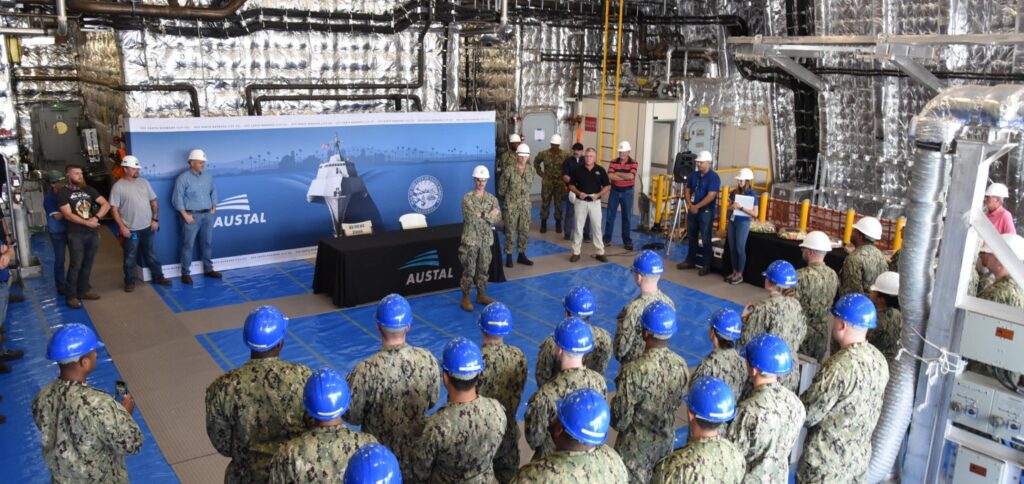
The contract award follows Austal USA’s start of construction on its first T-ATS ship earlier this month that was celebrated at a ceremony attended by governmental officials and local community leaders. The highlight of the ceremony had U.S. Rep. Jerry Carl (R-Alabama) pushing the plasma cutter button making the first cut of steel for the ship. 

“The T-ATS program is special to our team as it represents the start of construction of a new class of ship for our shipbuilding team. This contract is important because it provides us the backlog to really optimize production over the course of these four ships,” Austal USA President Rusty Murdaugh said. “We’re honored to have this contract and it illustrates the Navy’s continued confidence in our team’s demonstrated ability to deliver capability on-time and on-schedule.” 


General Atomics SeaGuardian UAS Supporting RIMPAC 2022 

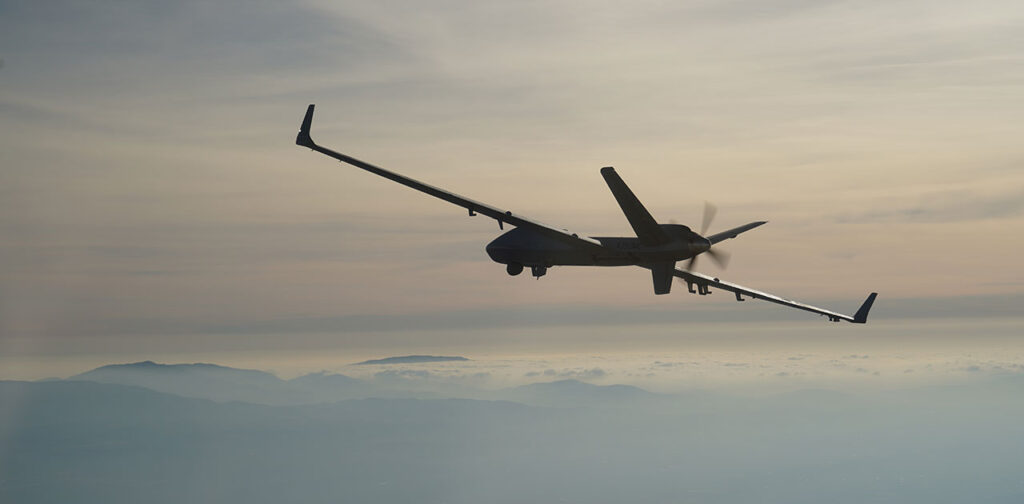
An MQ-9B SeaGuardian UAS is supporting RIMPAC 2022 under a contract with the U.S. Navy. GENERAL ATOMICS AERONAUTICAL SYSTEMS

SAN DIEGO — An MQ-9B SeaGuardian unmanned aircraft system from General Atomics Aeronautical Systems Inc. is under contract with the U.S. Navy to support the Rim of the Pacific (RIMPAC) 2022 exercise, the company said July 27.

RIMPAC, the world’s largest international maritime exercise, started in late June and continues until early August in Hawaii and Southern California operations areas. 

GA-ASI’s SeaGuardian is a maritime derivative of the MQ-9B SkyGuardian and remains the first UAS that offers multi-domain intelligence, surveillance, reconnaissance and targeting as an internal payload that can search the ocean surface and the depths in support of Fleet operations. The UAS is also providing real-time ISR data feeds to the U.S. Pacific Fleet Command Center using signals intelligence parametrics and full-motion video to the watch floor and intelligence centers for real-time, dynamic tasking. 

As of July 25, 11 flights totaling over 80 hours have been flown by SeaGuardian showcasing all operational payloads, which includes electronic intelligence, communication intelligence, Automatic Identification System, antisubmarine warfare monitor and control of sonobuoys, GA-ASI developed Lynx Multi-mode Maritime Radar, high-definition electro-optical/infra-red imaging system and Link 16.  

SeaGuardian’s multi-domain capabilities allows it to flex from mission to mission and pass real-time sensor data directly to the Fleet through Link 16 and satellite feeds to the shore-based command and intelligence centers, the company said.

During RIMPAC, the MQ-9B has effectively passed ISR&T information to various surface and air units, such as the aircraft carrier USS Abraham Lincoln, guided-missile destroyers, littoral combat ships, frigates, patrol boats, P-8 and P-3 maritime patrol aircraft and a litany of other U.S. and foreign units taking part in the exercise. 


CNO’s NAVPLAN Addresses Hybrid Fleet Force Structure Goals for 2045 

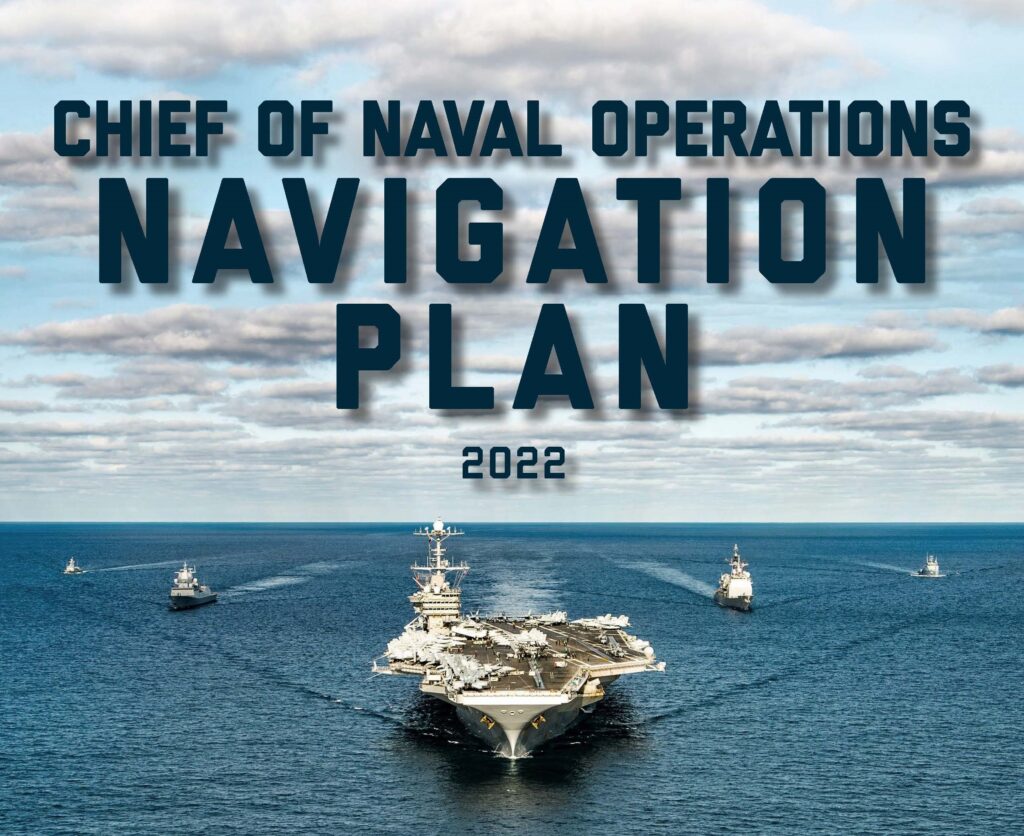
ARLINGTON, Va. — The update to the chief of naval operation’s Navigation Plan incorporates the Navy’s Force Design 2045 ship and aircraft force level goals for 2045, a hybrid fleet in which manned ships will remain dominant but supplemented by significant numbers of unmanned systems. 

The NAVPLAN, released July 26, has been informed by recent fleet exercises, including IMX-22 held by Task Force 59 earlier this year and the Rim of the Pacific exercises, CNO Adm. Michael Gilday, now in his third year in office, said during a July 26 roundtable with reporters.  

The plan complies with the National Defense Strategy and the CNO’s priorities on Sailors, readiness, capability and capacity.  

“The Navy must be capable of controlling the seas to deter aggression against our allies and partners, and project power ashore as an integral part of the Joint Force,” the CNO says in the NAVPLAN. “The Navy will incorporate our force design imperatives — distance, deception, defense, distribution, delivery, and decision advantage — to effectively integrate with the joint force, deliver effects across all domains and defeat adversary forces in conflict.

“To accomplish this, the Navy must become a hybrid fleet. Manned, multi-mission platforms will remain at the core of our future fleet but augmented with new platforms and new capabilities. We will add to our current fleet a host of manned, unmanned and optionally manned platforms operating under, on, and above the seas. This future fleet will deliver an assured strategic deterrent; greater numbers of undersea capabilities; a mix of large and small modern surface combatants; and a resilient logistics enterprise that can sustain our distributed naval force.” 

Gilday said the future fleet would require a 3% to 5% annual increase in the Navy’s budget, noting that the shipbuilding request of $27 billion is the highest ever but also affirming that a long time will be required to build up the size of the fleet to meet the goals in 2045. 

“I think it’s going to take a couple of decades to yield that hybrid fleet that we think that we ultimately need in order to fight the way we think we want to fight in a distributed manner, leveraging networking like JADC2 and the effort that we have ongoing with Overmatch,” Gilday said. “All that is going to take time. I’m being realistic. We don’t have the capacity in the industrial base to pump out that number of ships in a short period of time.”

Force Design 2045 envisions a hybrid fleet of “more than 350 manned ships, 150 large, unmanned surface and subsurface platforms, and approximately 3,000 aircraft,” the plan says, noting the numbers will be refined as the security environment changes. 

The capacity goals of Force Design 2045 include: 

  • 12 Columbia-class nuclear-powered ballistic-missile submarines 
  • 12 nuclear-powered aircraft carriers 
  • 66 nuclear-powered fast-attack and large-payload submarines, continuing with the Virginia class and developing the SSN(X)  
  • 96 large surface combatants, including the Flight III Arleigh Burke-class DDG and the DDG(X) 
  • 56 small surface combatants, including the Constellation-class FFG 
  • 31 large amphibious warships 
  • 18 light amphibious warships 
  • Approximately 150 unmanned surface and subsurface vessels 
  • 82 combat logistic and auxiliary ships  
  • Increased expeditionary logistics capacity 
  • Approximately 1,300 carrier-based fifth-generation strike fighters and Next-Generation Air Dominance Family of Systems 
  • Approximately 900 maritime patrol, reconnaissance, anti-submarine and anti-surface fixed-wing and rotary-wing aircraft, augmented by unmanned aircraft 
  • Approximately 750 intra-theater lift, training, and research and development aircraft. 

“We will augment the force with an evolving complement of thousands of small, rapidly adaptable, and attritable unmanned platforms,” the NAVPLAN says. “These enablers will increase our sensing resilience, persistence, and coverage, provide cross-domain kinetic and non-kinetic effects, and enhance the survivability and sustainability of the future fleet. We will build future platforms with modernization in mind — hardware upgradeable and software updateable at the speed of innovation. We must build adequate space, weight, and power into our large long-life capital investments to support evolving sensors and weapons systems.” 

The NAVPLAN is available here.


USS Whidbey Island Decommissioned after Nearly 38 Years of Service 

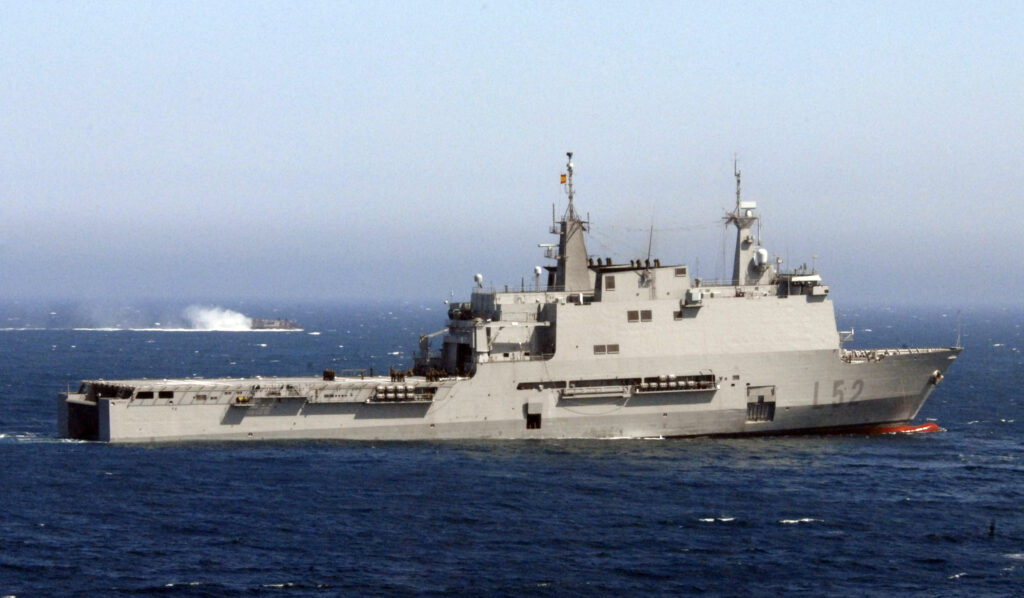
A landing craft air cushion from Assault Craft Unit 2, currently embarked aboard the amphibious assault ship USS Bataan (LHD 5), passes the Spanish landing platform dock Castilla (L-52), during a bilateral Spanish Amphibious Landing Exercise, June 21. U.S. NAVY / Petty Officer 1st Class Rachael L. Leslie

NORFOLK — Whidbey Island-class dock landing ship namesake, USS Whidbey Island (LSD 41) held a decommissioning ceremony at Joint Expeditionary Base Little Creek-Fort Story, Virginia, on July 22 before its inactivation next month, the Navy said in July 25 release. 

The ship’s decommissioning ceremony was held on the quay wall, alongside the moored USS Whidbey Island. The ceremony was attended by nine of her previous commanding officers and over 50 plankowners. “The last crew of Whidbey Island performed with great dignity and resiliency,” said Cmdr. Matt Phillips, the ship’s final commanding officer. “It’s been a privilege and an honor to lead this crew in executing her final mission.” 

Whidbey Island was commissioned Feb. 9, 1985, at Lockheed Shipyard in Seattle. The first ship in a class designed specifically to interface with the landing craft, air cushion, assisted in the operational and developmental testing of the amphibious assault craft from July to September 1985 and again in May and July 1986. 

Whidbey Island was the first amphibious ship from the East Coast to deploy to the European Theater with LCACs. In September and October 1989, it participated in Hurricane Hugo disaster relief operations in the Caribbean Sea. 

In August 1994, Whidbey Island rescued and transported over 8,100 Cuban migrants from the Straits of Florida during Operation Able Vigil and participated in the restoration of the legitimate government to Haiti during Operation Uphold Democracy. 

In June 2006, Whidbey Island deployed in support of Operation Enduring Freedom. While in-port Aqaba, Jordan in July of 2006, the ship was recalled through the Suez Canal to support contingency operations due to the crisis in Lebanon. Whidbey Island subsequently participated in the largest non-combatant evacuation conducted by the U.S. Navy since Vietnam. During July and August, the ship evacuated 817 American citizens via LCAC with personnel transport module. 

On Feb. 16, 2007, Whidbey Island was awarded the 2006 Battle “E” award. 

On June 24, 2016, USS Whidbey Island deployed from Joint Expeditionary Base Little Creek-Fort Story, for what would be its final deployment. It conducted eight Theater Security Port Visits, country visits vital to reassuring host nations of the commitment of the United States to their partnership. On July 21, 2016, USS Whidbey Island transited the Bosphorus Strait during a time of tension following the failed 2016 Turkish coup d’état attempt. 

Rear Adm. Tom Williams, commander, Expeditionary Strike Group (ESG) 2 presided over the ceremony, which included the remaining ship’s crew, several of its previous commanding officers, including the ship’s first commanding officer, Captain Pat Muldoon and many other special guests in attendance. 

“I am humbled to be with you on this bittersweet day as we gather here at Joint Expeditionary Base Little Creek – Fort Story to commemorate this ship’s near 38 years of commissioned service,” said Williams. 


HII’s Ingalls Shipbuilding Awarded DDG(X) Design Engineering Contract 

An aerial image of HII’s Ingalls Shipbuilding. Ingalls was awarded a design engineering contract from the Navy for the Next-Generation Guided-Missile Destroyer program. HII

PASCAGOULA, Miss. — HII’s Ingalls Shipbuilding division has been awarded a cost-plus-incentive-fee contract for engineering and design from the U.S. Navy for the next-generation guided-missile destroyer (DDG(X)) program, the company said July 22. 

“We are excited to continue on this path with our Navy and industry partners,” Ingalls Shipbuilding President Kari Wilkinson said. “It provides us a tremendous opportunity to bring best practices and innovation from our experienced engineering team to the design of this important future surface combatant.” 

Ingalls Shipbuilding is a major contractor and shipbuilding partner in the Arleigh Burke-class (DDG 51) program that has been in production for three decades. Arleigh Burke-class destroyers are multi-mission ships that can provide offensive and defensive capabilities, and can conduct a variety of operations, from peacetime presence and crisis management to sea control and power projection, all in support of the United States military strategy. 

DDG(X) will be the next generation large surface combatant for the U.S. Navy, and is being designed by a Navy-industry collaborative team consisting of the Navy and both large surface combatant shipbuilders. 


CNO Travels to RIMPAC, Meets with Exercise Participants  

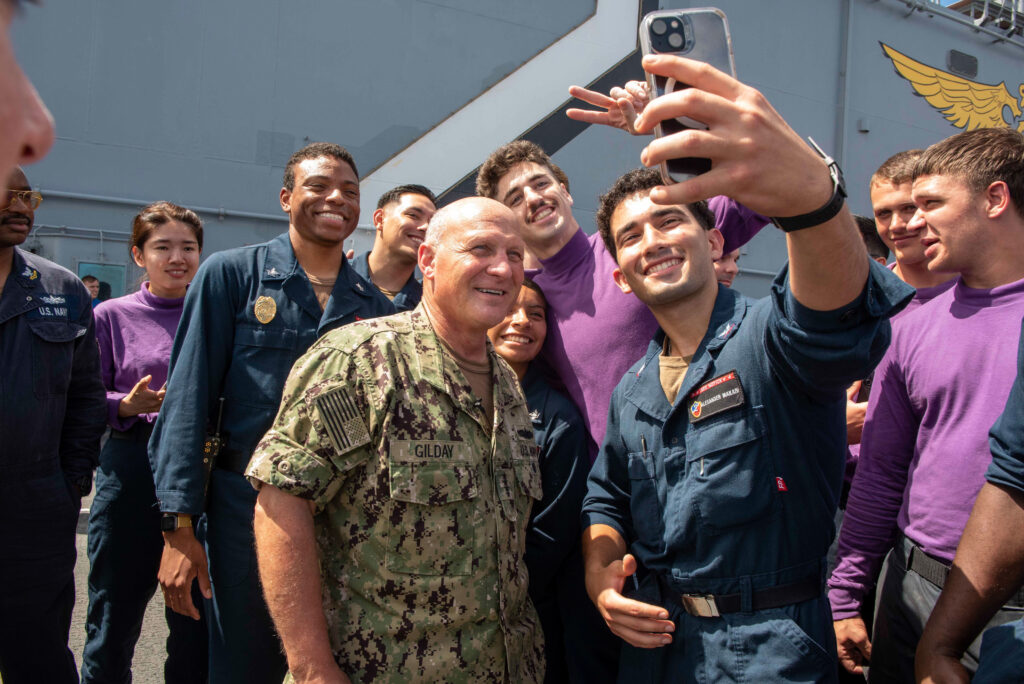
Chief of Naval Operations Adm. Mike Gilday meets with Sailors aboard the Wasp-class amphibious assault ship USS Essex (LHD 2) during Rim of the Pacific 2022, July 21. U.S. NAVY / Chief Mass Communication Specialist Amanda R. Gray

HONOLULU — Chief of Naval Operations Adm. Mike Gilday traveled to Hawaii June 20-23 to visit participants of the Rim of the Pacific Exercise, the CNO’s public affairs office said July 23.  

Gilday visited several U.S. and partner nation ships, where he spoke with Sailors and observed the ongoing exercise.    

“RIMPAC is the premier international maritime exercise and the largest multinational exercise,” Gilday said. “The complex warfighting exercise in this unique training environment across all combat domains strengthens our ability to work together, hone our skills and foster trust among nations.”   

“Building interchangeability among like-minded allies and partners demonstrates our solidarity, RIMPAC truly demonstrates the value of maritime partnership,” he said.   

While on Oahu, Gilday met with U.S. Indo-Pacific Commander Adm. John Aquilino and U.S. 3rd Fleet and RIMPAC 2022 Commander Vice Adm. Michael Boyle.  

Gilday also spent multiple days underway aboard ships participating in the exercise. He visited USS Essex (LHD 2), USS Abraham Lincoln (CVN 72), Japan Maritime Self-Defense Force helicopter destroyer JS Izumo (DDH-183) and the Republic of Korea navy amphibious assault ship ROKS Marado (LPH 6112), to thank Sailors, meet with leadership and observe the exercise first-hand.   

Gilday met with Commander of Combined Task Force (CTF) 176, Republic of Korea Rear Adm. Sangmin An, when he was aboard Essex. Additionally, he met with vice commander of Combined Task Force for RIMPAC, Japan Maritime Self-Defense Force Rear Adm. Toshiyuki Hirata, while aboard the Izumo.  

“Complex combined operations drive readiness, build confidence, and enhance interoperability among a diverse and highly capable international team,” Gilday said. “We are joined in our commitment to maintaining a free and open Indo-Pacific.”    

Unmanned systems are being used in different ways from humanitarian assistance to high-end warfighting. This year, more than 30 experiments were planned using multiple unmanned platforms from U.S. and partner nations.    

“We need to continue to put ourselves in a position where we can scale and really make unmanned assets on, below and above the sea an important part of the fleet,” said Gilday. “Unmanned systems provide Sailors with cutting edge capability now and into the future. It’s no longer a luxury. It’s a necessity if we want to operate in a distributed manner.”   

In its 28th iteration, the biennial event is the world’s largest international maritime exercise, providing a unique training opportunity to foster and sustain cooperative relationships critical to ensuring security on the world’s oceans. Capabilities exercised during RIMPAC range from disaster relief and maritime security operations to sea control and complex warfighting.       

This was Gilday’s first time attending RIMPAC as CNO. 


Austal USA Delivers the Future USS Santa Barbara to the U.S. Navy 

Austal USA delivered the future USS Santa Barbara (LCS 32) to the U.S. Navy on July 21. AUSTAL USA

MOBILE, Ala. — Austal USA delivered the future USS Santa Barbara (LCS 32) to the U.S. Navy on July 21, the company said July 22. LCS 32 is the 16th Independencevariant littoral combat ship delivered by the company. 

Delivery documents were signed on board the ship and followed the successful completion of acceptance trials during which the ship’s major systems and equipment were tested to demonstrate mission readiness. The ship’s pre-commissioning unit will now prepare the ship for fleet introduction. 

“Delivering the future USS Santa Barbara is a proud moment for Austal USA shipbuilders who worked extensively with Navy teammates and suppliers from across the nation to produce a capability that will serve our country for years to come,” said Rusty Murdaugh, president of Austal USA. “The fact that we’re delivering that capability on time and on schedule demonstrates our commitment to the warfighter and our nation’s defense.” 

LCS are built to operate in near-shore environments and support forward presence, maritime security, sea control and deterrence missions. Several Austal USA built Independence-variant LCS have deployed to the western Pacific within the last year including USS Jackson (LCS 6), USS Tulsa (LCS 16) and USS Charleston (LCS 18). 

Austal USA is currently constructing three LCS including the recently launched future USS Augusta (LCS 34). Final assembly is underway on the future USS Kingsville (LCS 36) and modules are under construction for the future USS Pierre (LCS 38). 


GD Mission Systems Awarded $272.9M Contract for US, UK Sub Fire Control Systems 

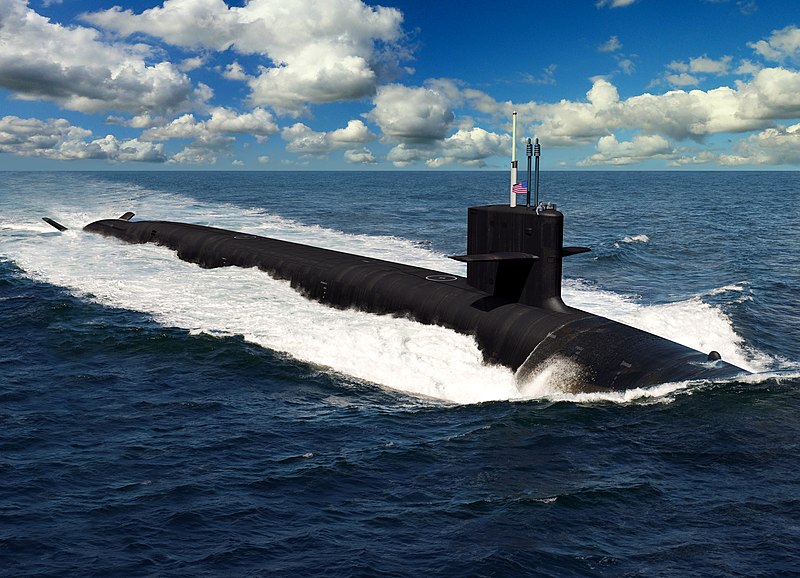
An artist’s conception of the Columbia-class submarine. U.S. NAVY

PITTSFIELD, Mass. — General Dynamics Mission Systems was awarded a U.S. Navy contract to support development, production and installation of fire control systems for the Columbia- and Dreadnought-classes of ballistic missile submarines, the company announced July 20. 

The contract as awarded has a value of $272.9 million over the next six years. This contract is the second for General Dynamics Mission Systems and is comprised of development, production and installation support for U.S. and U.K. submarine strategic weapons systems and subsystems. It will also support strategic weapons systems upgrades on currently fielded U.S. and U.K. strategic ballistic missile submarines. Work will primarily be performed in Pittsfield, Massachusetts, and is expected to be complete by July 2028. 

General Dynamics Mission Systems’ Maritime and Strategic Systems line of business will deliver the fire control system for the U.S. Navy’s second and third Columbia-class submarine and the third U.K. Dreadnought class submarine as well as installation support and pre-deployment planning for both U.S. and U.K. sites. This contract also includes Columbia and Dreadnought design completion scope and continuation of design activities for the first planned refresh of the Columbia and Dreadnought fire control system.  

“The U.S Columbia and U.K. Dreadnought class submarines are of strategic importance to our nation and our allies. General Dynamics has been supporting previous submarine programs for more than 65 years and we are extending our support through the development, production and installation of mission critical systems for this new fleet of submarines,” said Carlo Zaffanella, vice president and general manager at General Dynamics Mission Systems.