Navy Awards L3Harris $380 Million Contract for Cooperative Engagement Capability
L3Harris Technologies will produce and support the Cooperative Engagement Capability for the U.S. Navy under a contract worth up to $380 million. U.S. NAVY
MELBOURNE, Fla. — The U.S. Navy awarded L3Harris Technologies a contract worth up to $380 million for the production, repair, and sustainment of the Cooperative Engagement Capability (CEC) system with an initial award of $15 million, the company said in a July 19 release.
The CEC system enables high-quality situational awareness and integrated fire control capability for the battle force. It is designed to enhance the anti-air warfare capability of U.S. Navy ships, U.S. Navy aircraft, U.S. Marine Corps Composite Tracking Network and allied nation units and is a key element of the U.S. Navy’s integrated sensors and networked communications solution set.
“L3Harris is the trusted global provider of resilient, all-domain communications networks, and with this CEC agreement, the Navy has affirmed we deliver best-in-class capabilities to employ mission critical data for their most important missions,” said Brendan O’Connell, president of Broadband Communication Systems at L3Harris.
“The CEC enables the Navy, Marine Corps and coalition forces to sense, defend and strike earlier than the threat, increasing the survivability of the battle force and the overall speed of communication as they maneuver in a complex, multi-domain battlespace.”
Ship to Shore Connector LCACs Get Lift of Opportunity Aboard Future USS Fort Lauderdale
The Navy’s newest amphibious transport dock ship is transporting the Navy’s newest connectors to their new homeport, highlighting the significant capabilities being delivered to the Navy from the Gulf Coast. U.S. NAVY / Ronnie Newsome
WASHINGTON — The Navy’s newest amphibious transport dock ship is transporting the Navy’s newest connectors to their new homeport, highlighting the significant capabilities being delivered to the Navy from the Gulf Coast.
Ship to Shore Connector, Landing Craft, Air Cushion (LCAC) 103 and 104, received a lift of opportunity aboard future USS Fort Lauderdale (LPD 28), July 16, Team Ships Public Affairs said July 19.
During LPD 28’s transit from Huntington Ingalls Industries’ Ingalls Shipbuilding Division in Pascagoula, Mississippi, to Fort Lauderdale, Florida, where the ship will soon be commissioned, the newest LPD worked with Assault Craft Unit 4 (ACU 4) as LCAC 103 and 104 entered the well deck. The craft will remain aboard the ship as it transits to its homeport in Norfolk after commissioning.
“As the future USS Fort Lauderdale readies for commissioning, the LOO [lift of opportunity] provides the opportunity to further demonstrate a capability that will be essential to the future amphibious fleet for years to come,” said Capt. Cedric McNeal, program manager, Amphibious Warfare Program Office, Program Executive Office Ships. “We welcome the opportunity to bring together key Navy and Marine Corps next generation capabilities as we look to strengthen and advance the amphibious maritime mission.”
LCAC 103 and 104, delivered to the Navy by Textron Systems in December 2021 and June 2022 respectively, have been at Naval Surface Warfare Center Panama City Division receiving post-delivery upgrades and participating in test and trials events. Once the craft are in Norfolk, they will proceed to ACU 4 in Little Creek, Virginia, where they will join LCAC 101 and 102 to continue post-delivery test and trials and fleet introduction.
LCACs/SSCs are used primarily to transport vehicles, heavy equipment, and supplies through varied environmental conditions, from amphibious ships to over the beach. Delivery of this craft will significantly enhance the Navy’s and Marine Corps’ capability to execute a broad spectrum of missions well into the 21st century, from humanitarian assistance and disaster response to multidimensional amphibious assault.
CNO, Commander-in-Chief of the Chilean Navy Discuss Partnership
Chief of Naval Operations Adm. Mike Gilday meets with Commander-in-Chief of the Chilean Navy Adm. Juan Andrés de la Maza Larrain at the Pentagon for an office call on July 18. U.S. NAVY / Mass Communication Specialist 1st Class Michael B. Zingaro
WASHINGTON — Chief of Naval Operations Adm. Mike Gilday welcomed Commander-in-Chief of the Chilean Navy Adm. Juan Andrés de la Maza Larrain at the Pentagon for an office call, July 18, the CNO’s public affairs office said in a release.
The two leaders discussed maritime security, cyber defense, unmanned technology and their shared commitment to deepening partnership through future exercises and combined naval presence.
“As we face shared global maritime security challenges, we must partner with like-minded nations and create opportunities to increase collaboration, enhance interoperability, and build our collective capacity,” said Gilday. “Chile is a longstanding and trusted partner, and the U.S. Navy will continue to work with Chile and other regional maritime forces to deepen our security cooperation and pursue opportunities to promote peace and stability throughout the Americas.”
“I am very pleased to greet today Admiral Gilday, whom I had not had the opportunity to meet in person, due to the pandemic that forced to suspend this important meeting,” said de la Maza.
“Taking advantage of the visit we will make to the frigate Lynch deployed at RIMPAC [Rim of the Pacific Exercise], we have arranged this meeting where I can mention that the various cooperation and exchange activities with the United States Navy, as Admiral Gilday mentions, have been carried out for many years. We have common challenges and we must face them in a combined manner, because they are global problems that require solutions in which all countries participate.”
Gilday added, “My meeting today with Admiral de la Maza was very productive and I look forward to seeing him in Hawaii as we observe the RIMPAC exercise.”
The U.S. Navy and Chilean Navy operate regularly together around the globe. Chile regularly participates in RIMPAC and is represented in this year’s iteration by the Chilean Navy frigate Almirante Lynch (FF 07).
The Chilean Navy also participates annually in the UNITAS multinational maritime exercise in the waters of the Eastern Pacific and South Atlantic, and leads the biennial Teamwork South maritime exercise.
This was the first in-person meeting between the two heads of navy since de la Maza assumed command in 2021.
Navy’s F-5 Modernization Completes Engineering Phase; Moves into Production, Deployment
The ARTEMIS program will blend commercial-off-the-shelf solutions and industry partner investments to reduce potential safety risks by adding necessary upgrades to instrumentation increasing safety and capability. U.S. NAVY
PATUXENT RIVER, Md. — The Navy’s Specialized and Proven Aircraft program office (PMA-226) F-5N+/F+ Avionics Reconfiguration and Tactical Enhancement/Modernization for Inventory Standardization (ARTEMIS) program successfully reached Milestone C decision June 28, effectively moving into production and deployment, the Naval Air systems Command said July 14.
To meet the Navy and Marine Corps requirement to increase fleet adversary training capacity with high-altitude tactical fighters, the PMA-226 Adversary Team is inducting 22 repatriated, former Swiss Air Force F-5E/F aircraft into the ARTEMIS modification program. This program will reconfigure the airframe and incorporate a block upgrade consisting of emerging and existing commercial technology while capitalizing on industry’s private investment and lessons learned to upgrade necessary safety and capability features on the aircraft. The program office will reconfigure the airframes and convert the F-5E/F engines to the Navy and Marine Corps standard F-5N/F. Once that is complete, the program will integrate the block upgrade, which consists of a new glass cockpit and avionics suite that uses technology found in more modern aircraft to improve safety and capability.
Subsequent to this upgrade, the 22 aircraft will be in the F-5N+/F+ baseline configuration. The Adversary Team and industry partner Tactical Air Support Inc. (Tactical Air Support) will execute the F-5N+/F+ ARTEMIS program. Tactical Air Support owns and operates F-5AT aircraft currently supporting PMA-226 tactical fighter training and has performed similar modernization and safety upgrades on its own fleet of aircraft. Tactical Air Support assisted in the validation of the block upgrade F-5N+/F+ configuration on two of the prototype Navy F-5Ns completed earlier this year.
Capt. Gregory Sutton, PMA-226 program manager said, “This program will provide a fleet of upgraded, safe and modernized adversary aircraft, providing the realistic and relevant tactical training that our aviators need to win in the fight.”
To improve and enhance aircraft safety and mission effectiveness and to meet existing and emerging requirements and obsolescence issues, the ARTEMIS program integrates fully digitized avionics instrumentation and provides increased safety and capability upgrades. These upgrades will also add tactical capabilities designed to improve air-to-air training.
“PMA-226’s Adversary Team drove to a successful milestone decision by challenging norms to tailor the program requirements using a blend of commercial solutions and the lessons learned by our industry partners with a focus on desired outcomes and risk mitigation,” said Boyd Forsythe, PMA-226 F-5 Adversary Team lead.
Given the significant use of commercial-off-the-shelf components with well-defined maintenance and support equipment requirements that are used for the F-5N+/F+ configured aircraft, the product support strategy will be to execute Navy and Marine Corps maintenance procedures at the original equipment manufacturer (OEM) maintenance facility, with fleet support teams within close proximity to the OEM facility to assist. The program’s preventive maintenance will consist of inspections, cleaning and scheduled maintenance tasks.
Xerox Elem Additive and U.S Navy Deploy First Metal 3D Printer at Sea
The amphibious assault ship USS Essex (LHD 2), shown here in 2018, now has an ElemX liquid metal printer onboard. U.S. MARINE CORPS / Cpl. A. J. Van Fredenberg
NORWALK, Conn. — Xerox Elem Additive Solutions announced July 18 that an ElemX liquid metal printer was recently installed onboard USS Essex (LHD 2), making it the first metal additive manufacturing machine deployed on a U.S. naval vessel.
The ElemX was placed on the ship earlier this month in Pearl Harbor, with at-sea trials beginning immediately. The installation is the latest step in the U.S. Navy’s strategy of using additive manufacturing to increase operational readiness for the fleet. It also builds on the relationship between the U.S. Navy and Xerox Elem Additive that began with the Naval Postgraduate School in Monterey, California, receiving the first installation of the ElemX in 2020.
“The military supply chain is among the most complex in the world, and putting the ElemX on USS Essex means Sailors can now bypass that complexity and print parts when and where they need them,” said Tali Rosman, GM of Elem Additive. “We are proud to continue our partnership with the Navy to help them advance their additive manufacturing capabilities and execute their long-term vision.”
The ElemX leverages Xerox’s liquid metal additive manufacturing technology that uses standard aluminum wire. Unlike other metal 3D printing technologies, there are no hazardous metal powders with ElemX and no need for special facility modifications or personal protective equipment to operate the machine. The printer also requires minimal post-processing and therefore provides a faster time-to-part. This ability to produce reliable replacement parts on-demand reduces the dependency on complex global supply chains for deployed forces.
To withstand various sea states and environmental challenges that U.S. naval warships encounter, the ElemX was installed in an industrial shipping container to ruggedize it. Trials have already begun to establish operational guidelines and technical feasibility studies to determine applications and use cases. A team on USS Essex will design and print shipboard items and provide feedback to NPS and Commander, Naval Surface Force Pacific.
The ElemX 3D printer was commercially introduced in February 2021, and since then Elem Additive Solutions has expanded operations, including opening an Additive Manufacturing Center of Excellence in Cary, North Carolina. The ElemX is a safer and simpler metal 3D printer, addressing supply chain resiliency for transportation, aerospace, defense and industrial manufacturing.
Boeing, U.S. Navy Demonstrate Manned-Unmanned Teaming with Super Hornet
A Block III F/A-18 Super Hornet takes off from Lambert International Airport in St. Louis. As the most advanced Super Hornet ever built, the Block III is equipped to run the app-based solutions of the future. BOEING
ST. LOUIS — Boeing and the U.S. Navy have completed a series of manned-unmanned teaming (MUM-T) flight tests in which a Block III F/A-18 Super Hornet successfully demonstrated command and control of three unmanned aerial vehicles, the company said July 15.
Boeing system engineers connected Block III’s adjunct processor, known as the Distributed Targeting Processor – Networked (DTP-N), with a third-party tablet to team with the UAVs. Boeing developed new software loads for the DTP-N specific to running the third-party tablet and transmitting commands. The software development, tablet connection to the fighter and all flight tests were completed in less than six months.
“Block III Super Hornet is executing on its guarantee of hardware — installed today — that is ready to receive the software of the future,” said Ben LeGrand, Boeing director of Mission Systems. “Block III Super Hornet will integrate third-party systems and software with minimal modifications.”
Boeing partnered with the F/A-18 & EA-18G Program Office (PMA-265), Air Test and Evaluation Squadrons 23 and 31, Naval Air Warfare Center-Weapons Division at China Lake, California, and a third-party vendor on the demonstration. During the test flights, F/A-18 pilots entered commands into the tablet, which were processed and transmitted through Block III’s hardware. The UAVs executed all commands given by F/A-18 pilots during tests over a two-week period.
“This successful MUM-T demonstration represents a significant step toward the Navy’s vision for distributed maritime operations. It highlights the potential of unmanned concepts to expand and extend the Navy’s reach,” said Scott Dickson, Boeing’s director for Multi-Domain Integration. “As part of a Joint All-Domain Command and Control network, teams of UAV conducting ISR missions led by the latest Super Hornets equipped with network-enabled data fusion and advanced capabilities would provide warfighters across the Joint Force with significant information advantage.”
“Future fighter pilots will be the quarterback of the skies, orchestrating commands and controlling UAVs from the integrated Block III touch-screen cockpit,” said Mark Sears, Boeing vice president and program manager of F/A-18, EA-18G programs. “Block III Super Hornet is the bridge to the future and is a risk reducer for the Navy that is delivering on teaming, networking and interoperability now.”
Navy Rethinking ‘Full-Mission Capability’ Definition with F-35s in Distributed Ops, Whitesell Says
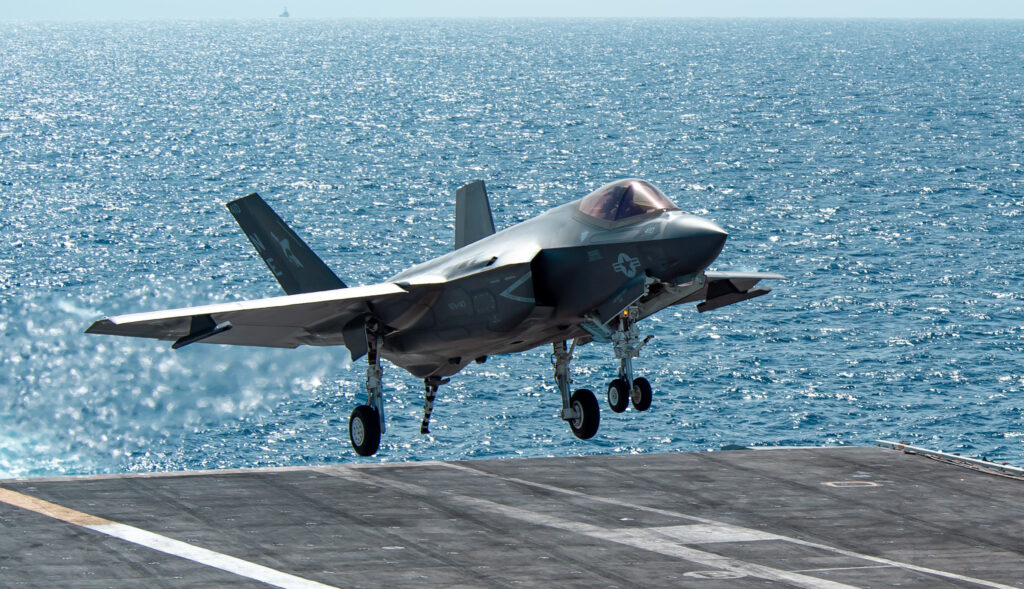
An F-35C Lightning II, assigned to the “Argonauts” of Strike Fighter Squadron 147 prepares to land on the flight deck of Nimitz-class aircraft carrier USS Carl Vinson (CVN 70) on June 17, 2021. U.S. NAVY / Mass Communication Specialist Seaman Caden Richmond
ARLINGTON Va. — The Navy’s “Air Boss” said fifth-generation strike fighters are redefining the concept of full mission capability and changing the way a four-plane division operates in distributed maritime operations.
Vice Adm. Kenneth Whitesell, commander, Naval Air Forces and commander, Naval Air Force, U.S. Pacific Fleet (the Air Boss), addressed the concept while speaking July 13 at a naval aviation seminar hosted by the Center for Strategic and International Studies and the U.S. Naval Institute and sponsored by HII.
Responding to a question from moderator Ward Carroll about the full-mission-capable rates of Navy F-35Cs during the 2021 deployment on board USS Carl Vinson, Whitesell said taking a “30,000-foot view of the way the [carrier] air wing is going to be employed is going to be completely different.”
“The air wing’s not going to be employed the same way [as before],” Whitesell said. “The F-35 is the perfect exemplar of that. The way we employ that platform. … There is no defensive and offensive combat spread [where] you break out into some of the traditional missions that we would have done five or 10 years ago. Employing the Joint Strike Fighter as they employed it as a [four-plane] division [was] definitely more spread out. The way information is shared amongst the platforms makes up for any deficits that an individual aircraft may have.
“The way we think of mission capability and full mission capability — we have to think about it in a distributed and in this case in a full division or greater employment mode through Distributed Maritime Ops,” the admiral said. “Fitting into the bigger vision of Distributed Maritime Ops, a single platform can have degradations, but because of the information sharing between the platforms, we have to think about how we’re going to define full mission capability, not platform-specific, but truly mission specific. It’s a different way of looking at things.”
Sev1Tech Proposes Solutions for Moving Navy Shipyards into the Digital Age
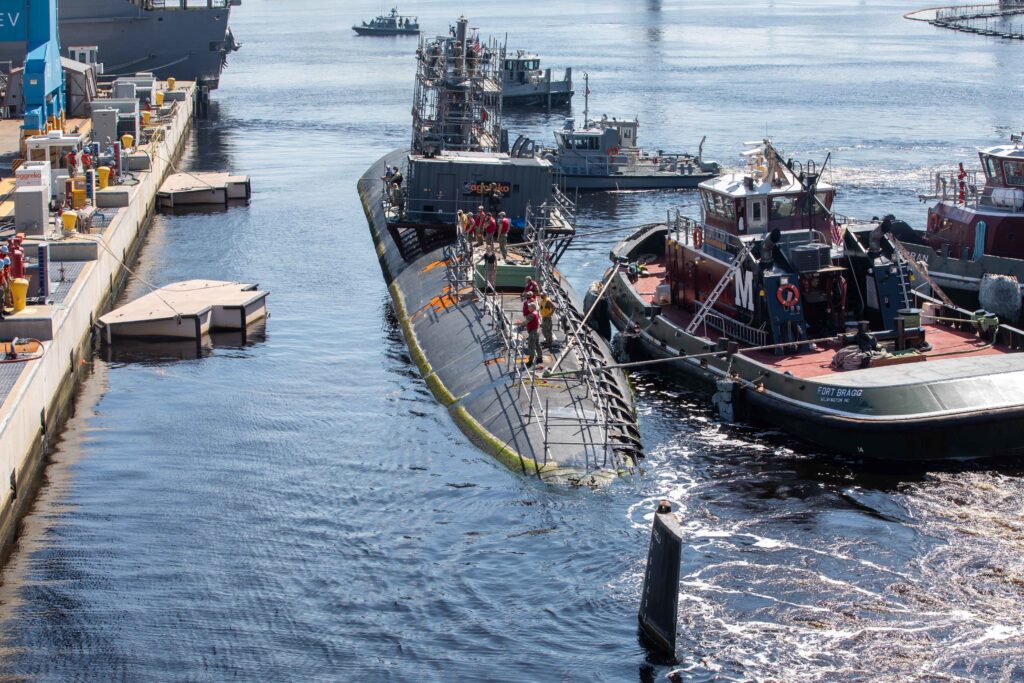
USS Pasadena (SSN 752) arriving at Norfolk Naval Shipyard in 2020 for a Drydocking Selected Restricted Availability. NORFOLK NAVAL SHIPYARD / Daniel DeAngelis
ARLINGTON, Va. — As the U.S. Navy makes a huge investment in upgrading and modernizing its four public shipyards, one company is proposing ideas to move shipyard processes from the Industrial Age to the Digital Age using digital information technology.
The Navy is investing more than $20 billion over 20 years to modernize its shipyards under the Shipyard Infrastructure Optimization Plan, or SIOP. Much of the effort involves modernizing century-old dry docks and other heavy infrastructure.
Patrick Fitzgerald, senior vice president for Navy Missions of Sev1Tech, is a former Naval Information Warfare Center Atlantic Enterprise Systems Department Head and a manager with a long background in information technology. He told Seapower his company is well positioned to contribute to the SIOP the digital transformation of the Industrial-Age processes of Navy shipyards and to “generate a really significant return on investment” and enable the shipyards to “get the ships out to the fleet when needed and fully ready to perform their mission.”
Fitzgerald said the SIOP is a “once-in-a-century thing that our country needs to safeguard itself. “Unfortunately, a lot of the federal government has not moved to the information age; it’s still very Industrial Age processing.”
Among the ideas Sev1Tech is floating is the use of augmented reality or virtual reality in training the shipyard workers. Fitzgerald said that technology makes for “much more effective training programs that improve knowledge retention.”
The workers “make fewer errors when they actually perform the maintenance. They can verify that a part is being installed in the correct space, [which] will help eliminate re-work for a variety of tasks.”
He also said applying data analytics would result in better parts-demand forecasting and help minimize issues with the global supply chain. Data analytics also would improve auditability, lower the warehousing complexity and costs and reduce or eliminate the time a ship waits for a part to arrive.
Digital twin modeling of the actual layout of the shipyard facilities as they evolve over time can improve shipyard processes.
“One we get that initial model set, you can start doing simulations on that for the evolving needs and the evolving capabilities,” Fitzgerald said. “It really optimized the layout for the workflow.”
Use of drones is one way to save time and improve productivity, he said.
“The walking that the folks at the four public shipyards do every day is absolutely insane,” Fitzgerald said. “At the end of the day you have to leave the security to get a part and then come back. That’s a lot of lost labor time not directly serving the mission and helping us get that ship out on time. Having the networks in place where a person working on a ship realizes they needed a part that they didn’t expect they needed — if it’s a lightweight part — a drone could potentially fly out a five-pound package to the edge of the ship so they don’t have to walk all the way across the base to get it from a warehouse.”
Fitzgerald pointed out that the Navy owns the airspace over its shipyards and therefore could set the policy of drome operations within the yard.
“We could save hours of an employee’s time every day walking back and forth to get parts or checklists,” he said. “That’s massive for what it could mean to getting a ship out of the shipyard on time and back to the fleet where it needs to be.”
He also advocates leveraging 5G and other wireless communications and use of tablets and other support devices.
With a tablet that can go classified when [a worker goes] into a classified space — and given access to the data and drawings they need dynamically, and as soon as they walk out of that space, no longer have access to that information. That would reduce the complexity of managing them, reduce the risk of that information getting compromised, and give them what the need at the right time when they need it,” he said.
“The investment in IT relative to the investment in the capital infrastructure is pretty small to get a really big yield,” Fitzgerald said.
Reservist’s Innovative Idea is a Winner in Navy Waypoints Contest
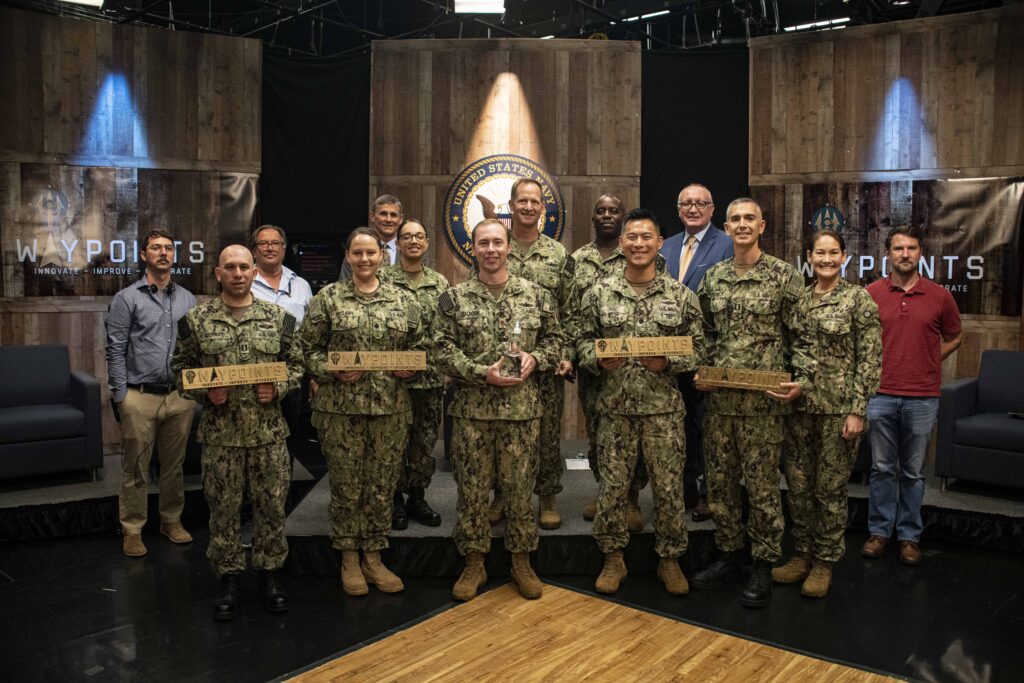
Lt. Cdr. Jonathan Calhoun (center) holds the i3 Waypoints trophy after Vice Adm. John Mustin (back row, middle) announced Calhoun’s “Leveraging Mobile Technology to Streamline Mobilization” as the winning entry of the inaugural i3 Waypoints. Calhoun is surrounded by the other final presenters (front row), the finalist panel and production staff (back row). U.S. NAVY / Chief Mass Communication Specialist Elisandro T. Diaz
FORT MEADE, Md. — A Navy Reservist’s innovative concept for adapting a mobile application to better enable mobilization is a winning idea.
Lt. Cdr. Jonathan Calhoun, a Selected Reserve member attached to U.S. Fleet Forces Command Maritime Operations Center (N3 FCC) in Norfolk, Virginia, submitted his entry, “Leveraging Mobile Technology to Streamline Mobilization,” as part of the “i3 Waypoints” effort to find new or better ways for the Navy Reserve to operate.
Vice Adm. John B. Mustin, chief of Navy Reserve and commander, Navy Reserve Force, announced the winning entry of the inaugural i3 Waypoints in a streaming broadcast on July 14.
Calhoun’s entry was one of 107 received and evaluated by a panel of judges.
Calhoun initially thought of his idea during a mobilization exercise where he realized shifting many of the mobilization requirements to a secure mobile platform would make the process faster and more efficient for both Sailors and Navy Reserve Center staff.
“Empowering Sailors to use their mobile device to complete a significant portion of pre-mobilization requirements will improve the overall experience for the modern-day Sailor and save critical time during mass mobilizations to get warfighting-ready Sailors on station faster,” said Calhoun.
Calhoun’s entry envisions a mobile application to reduce duplicative administrative requirements for both members and mobilization staff, save critical time by auto-populating data fields across multiple documents, provide real-time transparency and progress status for members and leadership throughout the process, and enable clear and customizable views and reports.
Additionally, the app could remove the difficulties some Reserve members have accessing Common Access Card-enabled sites outside an Navy/Marine Corps Internet environment and would “ensure our ability to mass mobilize, predictably, at scale, and with seamless administration activation workflows” as outlined in the Navy Reserve Fighting Instructions 2022.
“We are already moving out on the design for Lt. Cdr. Calhoun’s mobile application,” said Mustin. “His idea to add mobile technology to our distributed activation process helps us achieve our goal of mobilizing the entire Selected Reserve force of 50,000 in 30 days, if required.”
Mustin conceived of the i3 Waypoints program as an approach to “innovate something entirely new; improve on something already established; or integrate several ideas, products or processes rendering the former completely obsolete.”
The annual competition is designed to fast-track transformative ideas from across the Navy directly to the highest levels of the Navy Reserve, without filters or bureaucratic barriers.
The competition is open to anyone in the U.S. Navy–Selected Reserve, Training and Administration of the Reserve, Individual Ready Reserve, Active Duty and civilians, in all ranks, rates and grades.
Of the 107 entries received, five entries were subsequently chosen and presented to a panel hosted by Mustin, retired Vice Adm. Andrew “Woody” Lewis, Bruce E. Mosler, chairman, global brokerage of Cushman & Wakefield Inc., Navy Reserve Force Master Chief Tracy L. Hunt and 2021 Reserve Sailor of the Year Chief Yeoman (Select) Jasmyn Phinizy.
“The large number of creative, thoughtful strategic ideas submitted in a relatively short timeframe far exceeded our original expectations,” said Mustin. “It demonstrates our Reserve Force’s commitment to innovate, improve efficiencies, and reduce administrative burdens, allowing us to focus on warfighting readiness — our one and only priority. With such an enthusiastic response from the force, and so many great ideas to modernize the way we do business, we saw enough in this inaugural event to commit to making i3 Waypoints an annual program. Very little is more important to us than keeping the direct pipeline open for creative ideas to flow to top leadership without filter or disruption.”
The other i3 Waypoints finalists, and their winning ideas, are:
Lt. Brian Adornato, Naval Sea Systems Command, Surge Maintenance Sacramento: “Create a New Category of Personnel: Civilian Technicians”
Cdr. Bobby Hsu, Director of Navy Staff, Office of the Chief of Naval Operations: “Official Navy Reserve YouTube Channel”
Cdr. Sarah McGann, Navy Personnel Command (PERS-9), and Lt. Josh Didawick, Office of the Chief of Naval Operations for Manpower, Personnel, Training and Education: “New Policy for Reserve Retirement Education Across the Career Continuum”
Cdr. Scott Mericle, Navy Reserve Operations, Plans and Policy (N5), Commander, Second Fleet: “Improve Active to Reserve Transition.”
Analysts: Carrier Air Wings Need Sustained Extended Range to Counter China
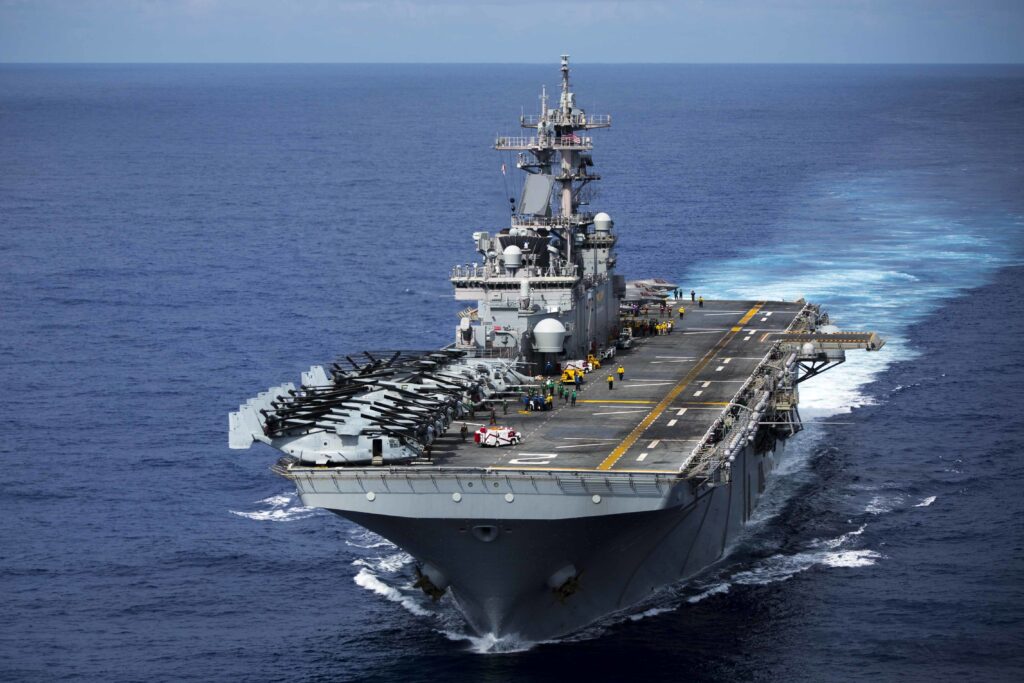
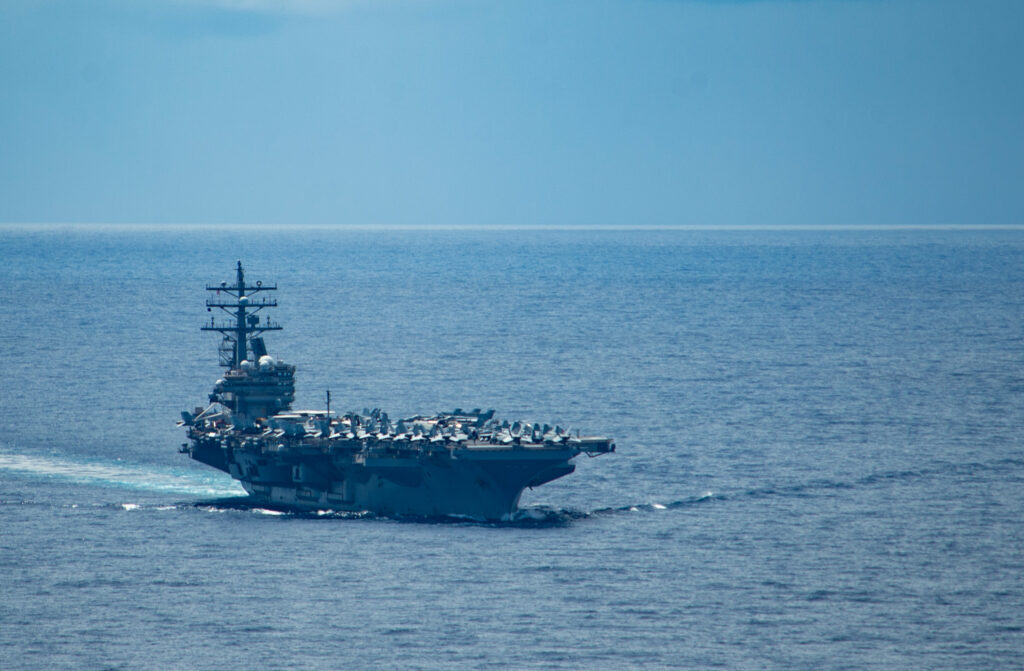
The U.S. Navy’s only forward-deployed aircraft carrier USS Ronald Reagan (CVN 76) steams through the Balabec Strait on July 12. Ronald Reagan, the flagship of Carrier Strike Group 5, provides a combat-ready force that protects and defends the United States, and supports alliances, partnerships and collective maritime interests in the Indo-Pacific region. U.S. NAVY / Mass Communication Specialist 2nd Class Askia Collins
WASHINGTON — The U.S. Navy’s carrier air wings lack some of the characteristics needed to counter China in the event of a conflict, two naval analysts said in a webinar.
Bryan Clark, senior fellow and director of the Center for Defense Concepts and Technology at the Hudson Institute, and Timothy Walton, a senior fellow at the center, discussed in a July 12 webinar their report “Regaining the High Ground Against China,” which presents their case that carrier strike groups are challenged by Chinese long-range missile threat and will need a longer-range carrier air wing to affect the battlespace.
The Chinese missile threat could force carrier strike groups to operate at ranges of 1,000 to 1,500 nautical miles away from China, reducing or negating the range with which carrier-based strike fighters could strike hostile forces, Clark said.
Clark noted that the carrier air wing is not set up for combat at sustained ranges and the U.S. Navy is “going to need some way to extend the range of the carrier air wing.”
The carrier air wing’s strike fighters, the F-35C Lightning II and the F/A-18E/F Super Hornet, need aerial refueling to operate at extended ranges. The forthcoming MQ-25A Stingray aerial refueling UAV will enhance the ranges of the strike fighters, relieve some Super Hornets from aerial refueling duties and provide a platform for sensors.
Fleet air defense also has become a capability demanding more attention in view of the Chinese missile threat. The F-14 Tomcat fighter and its Phoenix air-intercept missiles, designed during the Cold War to counter Soviet bombers carrying cruise missiles at long ranges, were retired from the fleet in 2006 and the F/A-18 and F-35 do not have a similar long reach. Clark said the CSG needs a layered defense.
“We need to regain the ability to attack bombers before they can launch their missiles,” Clark said.
He advocated the use of electronic warfare in a more offensive way, including the use of UAVs to confuse enemy defenses. This would involve shifting away from the EA-18G Growler electronic attack aircraft to long-range UAVs, even expendable ones.
The analyst said the Navy needs to change the way it conducts airborne early warning and intelligence, surveillance and reconnaissance. Possible platforms include the MQ-9 Reaper UAV, stratospheric balloons and satellites.
Clark said the P-8A Poseidon maritime patrol aircraft would need to keep away from enemy air defenses and shift from an anti-submarine search and attack role to one of command and control of unmanned platforms and distributed ASW sensors.
A pdf of “Regaining the High Ground Against China” can be found here.