Navy Deploys More EA-18G Electronic Attack Jets to EUCOM 
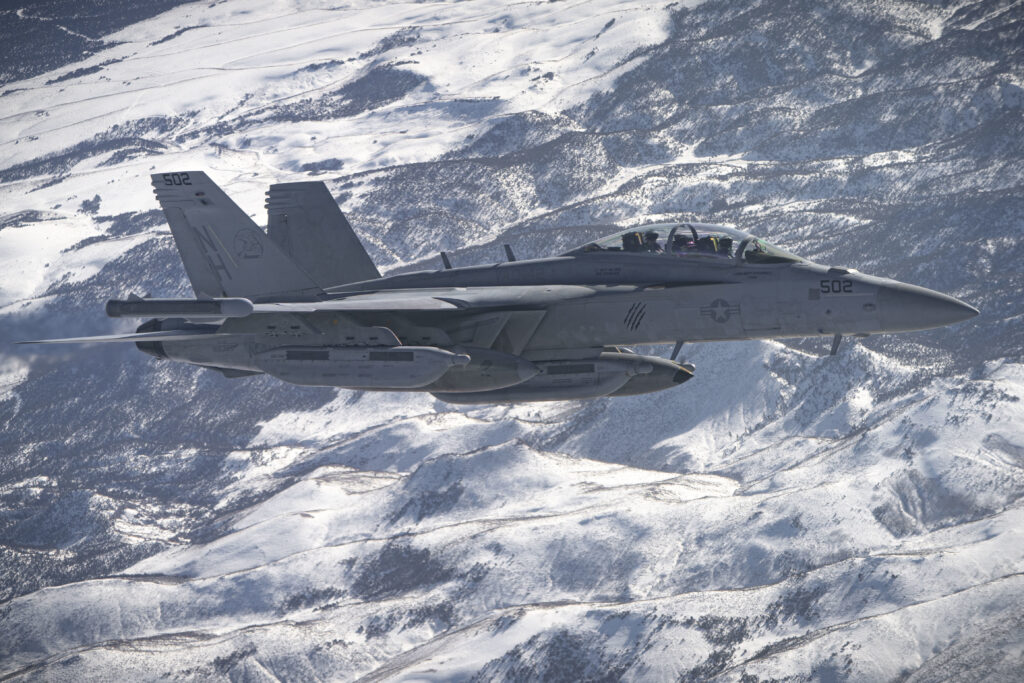
A U.S. Navy EA-18G Growlers assigned to the “Garudas” Electronic Attack Squadron (VAQ) 134, Naval Air Station Whidbey Island, Washington, waits to receive air-to-air refueling from a Royal Air Force Voyager tanker assigned to 101 Squadron, RAF Brize Norton, United Kingdom, during a Red Flag-Nellis 22-1 mission Feb. 3, 2022, at Nellis Air Force Base, Nevada. U.S. AIR FORCE / Airman 1st Class Zachary Rufus

ARLINGTON, Va. — A squadron of U.S. Navy EA-18G Growler electronic warfare aircraft has been deployed to the European Command as part of the build-up of forces in support NATO’s eastern flank. 

According to Defense Department spokesman John Kirby, the six EA-18Gs of Electronic Attack Squadron 134 (VAQ-134) — the Garudas — and their support personnel were to be staged by March 28 at Spangdahlem Air Base in Germany, home of the U.S. Air Force’s 52nd Fighter Wing, which fields one squadron of F-16CJ fighters. The EA-18Gs are home-based at Naval Air Station Whidbey Island, Washington. Spangdahlem is approximately 650 miles from the borders of NATO countries in Eastern Europe with Ukraine. 

“The purpose of this deployment is to bolster readiness, enhance NATO’s collective defense posture and further increase air integration capabilities with our allied and partner nations,” Kirby said in a release. “They are not being deployed to be used against Russian forces in Ukraine. They are being deployed completely in keeping with our efforts to bolster NATO’s deterrence and defense capabilities along that eastern flank. The deployment is not in response to a perceived threat or incident.” 

The Navy has five-land-based expeditionary VAQ squadrons in addition to nine carrier-based VAQ squadrons, all equipped with EA-18Gs. For many years they deployed to bases in Southwest Asia to support combat in Afghanistan, Iraq, and Syria, and currently deploy to Misawa, Japan. The Navy’s Growlers provide electronic attack support for all of the armed services. The aircraft can jam enemy radars and communications and fire anti-radiation missiles at radar sites. 

“I am extremely proud of the men and women in VAQ-134,” said Navy Capt. Christopher M. Bahner, commander, Electronic Combat Wing, U.S. Pacific Fleet, in a Defense Department release. “The Garudas have performed exceptionally well during their planned work-up cycle and stand ready to support U.S. expeditionary and allied task forces in Europe. Expeditionary EA-18G squadrons integrate with joint and coalition forces to provide our commanders capabilities to defend our forces in all potential phases of operation, while allowing our Carrier Air Wing EA-18G squadrons to remain at sea, defending freedom of navigation with our carrier strike group teams.” 

Another EA-18G squadron, VAQ-137, currently is deployed with Carrier Air Wing One on board USS Harry S. Truman in the Mediterranean Sea. VAQ-137 has been flying patrols over Romania and Poland in support of NATO operations since the Russian invasion of Ukraine. 


Navy to Christen Guided-Missile Destroyer Jack H. Lucas 

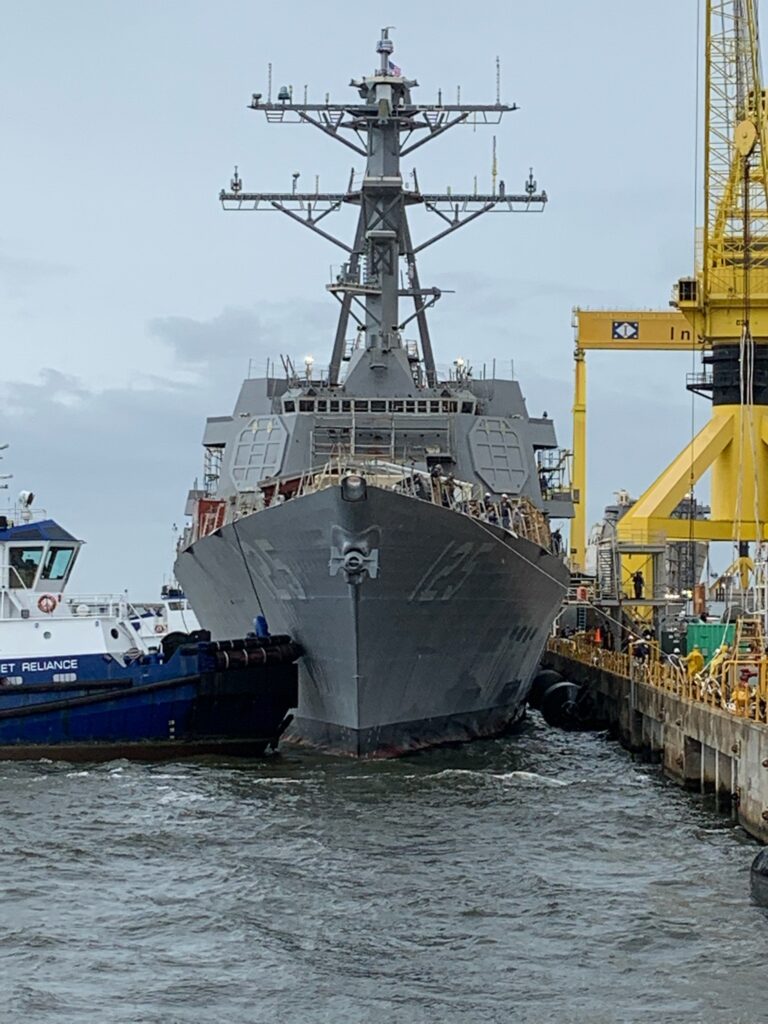
The future Jack H. Lucas (DDG 125), an Arleigh Burke-class guided missile destroyer (Flight III configuration) successfully launched at Huntington Ingalls Industries, Ingalls Shipbuilding division, June 4, 2021. HUNTINGTON INGALLS INDUSTRIES

ARLINGTON, Va. — The U.S. Navy will christen the future USS Jack H. Lucas (DDG 125), the first Flight III Arleigh Burke-class guided-missile destroyer, during a 10 a.m. CDT ceremony on Saturday, March 26, in Pascagoula, Mississippi, the Defense Department announced. 

Jacklyn Harold “Jack” Lucas, the ship’s namesake, served as a U.S. Marine during World War II and was awarded the Medal of Honor at the age of 17, making him the youngest recipient. Private First Class Lucas received the award during the Iwo Jima campaign when he hurled himself on two grenades to absorb the explosion with his own body and protect his fellow Marines. Surviving the blast, Lucas lived until June 5, 2008, when he died from cancer. The future USS Jack H. Lucas (DDG 125) is the first combat warship to bear his name. 

Chief of Naval Operations Adm. Michael Gilday will deliver the christening ceremony’s principal address. Mississippi’s Sen. Roger Wicker and Rep. Steven Palazzo will attend, along with Meredith Berger, performing the duties of the undersecretary of the Navy; Maj. Gen. Jason Bohm, commanding general, Marine Corps Recruiting Command; and Kari Wilkinson, president of Ingalls Shipbuilding will also provide remarks. In Navy tradition, the ship’s sponsors, Ruby Lucas and Catherine B. Reynolds, will christen the ship by breaking a bottle of sparkling wine across the bow. 

“The future USS Jack H. Lucas will serve as a constant reminder of the immense impact actions taken by any one Sailor or Marine can truly have,” said Navy Secretary Carlos Del Toro. “Private First Class Lucas is a national hero and this ship and crew will honor his legacy for decades to come.” 

The ship will be the 73rd Arleigh Burke-class destroyer and is one of 20 ships currently under contract for the DDG 51 program. The Flight III upgrade is centered on the AN/SPY-6(V)1 Air and Missile Defense Radar, which enables Flight III ships to perform anti-air warfare and ballistic missile defense simultaneously. The Flight III baseline begins with DDGs 125-126 and continues with DDG 128 and follow-on ships. The future USS Jack H. Lucas will be 509.5 feet long and 59 feet wide, with a displacement of 9,496 tons. The ship will homeport in San Diego. 


Navy’s New Hovercraft Delivers Helicopter for Air Force 

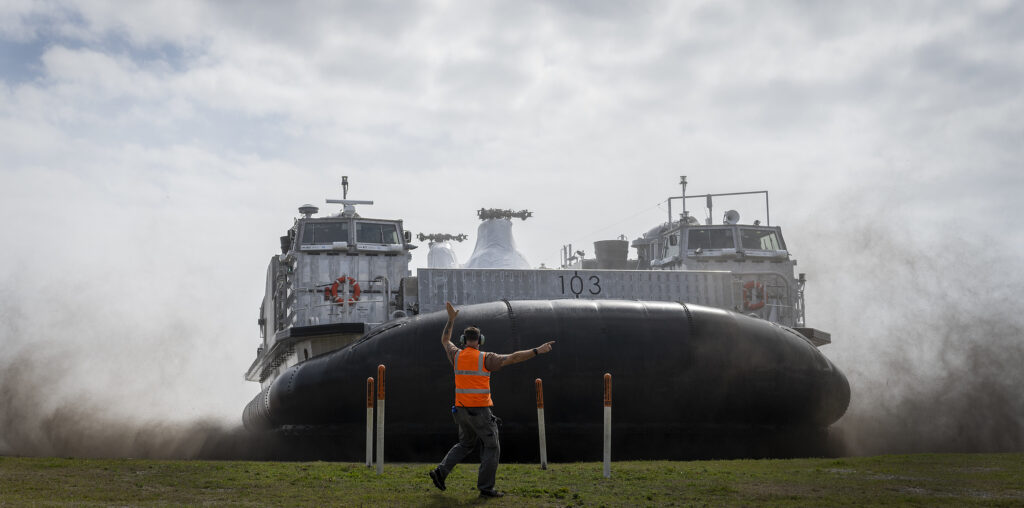
Skip Whitmore, Naval Surface Warfare Center Panama City, marshals a Landing Craft Air Cushion vehicle onto shore south of Hurlburt Field, Florida, Feb. 24. The amphibious landing craft carried a CH-46 Sea Knight helicopter from Pensacola to be used for training purposes within Eglin Air Force Base range. U.S. AIR FORCE / Samuel King Jr.

ARLINGTON, Va. — An unusual transport mission last month demonstrated the capabilities and versatility of the Navy’s new LCAC 100-class ship-to-shore connector. 

The Air Force 96th Test Wing at Eglin Air Force Base, Florida, requested the assistance of the Naval Surface Warfare Center – Panama City Division to solve a problem in transporting a CH-46 helicopter from Naval Air Station Pensacola, Florida, to Eglin. The retired helicopter was to be used to “support future training operations for the Air Force Special Operations Command Special Tactics Training Squadron,” Jeremy Roman of the NSWC PCD public affairs office said in a March 23 release. 

“With a height of nearly 17 feet, transporting the helicopter by land would have required extensive preparation work in order to lower the height to safely maneuver on public highways,” Roman said.   

The 96th Test Wing and the NSWC PCD determined the best solution was using one of the LCAC 100-class ship-to-shore connectors, which recently entered fleet service, to transport the helicopter over the water to Eglin.

LCAC 103, the third production LCC 100-class SSC, was selected for the mission, conducted on Feb. 24. 

“LCAC 103 transited from Panama City, Florida, to NAS Pensacola where the CH-46 was loaded and then transported to Eglin AFB,” Roman said. “The LCAC 103 then displayed its amphibious capability by transiting from water to shore at Eglin AFB where the CH-46 was rolled off the deck onto dry land. LCAC 103 further demonstrated the SSC amphibious capabilities by transiting across Santa Rosa Island at the Eglin AFB Test Range to navigate back to base via the most efficient route to NSWC PCD. This long-distance, land-hopping mission, supported post-delivery test and trials objectives by successfully gaining reliability growth hours while demonstrating required capabilities for Navy and Marine Corps expeditionary forces.” 

“NSWC PCD is a Navy research, development, test and evaluation laboratory, and this mission displayed the fruit of the RDT&E and acquisition teamwork which is providing this critical expeditionary capability to the fleet. It is always a bonus when that capability supports our sister military branches and partners,” said Randy Whitehead, NSWC PCD Air Cushion Vehicle and Seabasing technical program manager, in the release.

“This was an excellent demonstration of key capabilities such as the LCAC’s unique combination of range, speed, amphibious versatility and lift capacity. It not only allowed us to successfully execute this mission but also showed how SSC can bring more to the table for future Distributed Maritime Operations.” 

The LCAC 100-class SSC is built by Textron Systems and is replacing the older LCAC 01 class hovercraft in the fleet. Testing of the LCAC 100 craft is conducted at NSWC PCD. Recently, two LCAC 100s were delivered to the fleet’s Assault Craft Unit 4 at Little Creek, Virginia. 


Navy’s E-2D Distributed Readiness Trainers Improving Readiness, Capability 

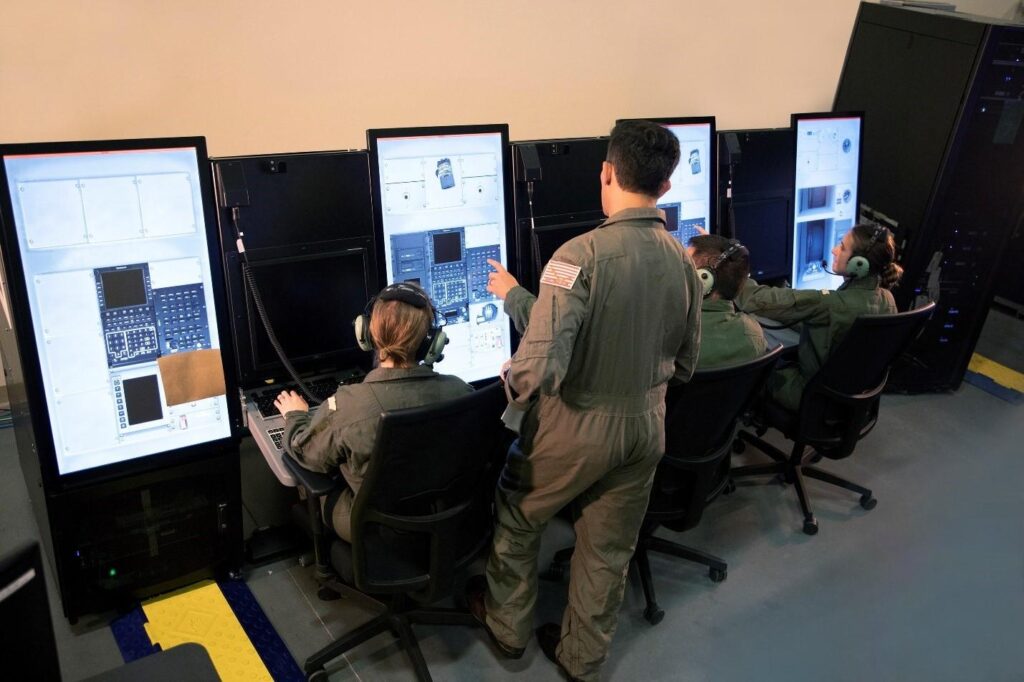
Naval aviators train on E-2D distributed readiness trainers, which are training devices capable of elements of two, five crewmember aircraft to conduct a single training scenario simultaneously and execute the full list of tactics, techniques, and procedures. U.S. NAVY

PATUXENT RIVER, Md. — The aircrew from Carrier Airborne Command & Control Squadron 125 (VAW-125), an E-2D Advanced Hawkeye squadron, recently completed two weeks of on-site readiness training following the installation of two E-2D Distributed Readiness Trainers by the Naval Aviation Training Systems and Ranges program office, Naval Air Systems Command said March 23.   

These medium-fidelity trainers contain a complete mock-up of the E-2D weapons system and are available via commercial off-the-shelf components, allowing them to be operational faster than higher fidelity trainers. The D-DRT uses touch screen technology and are less expensive to maintain than the legacy trainers, which improves reliability and reduces lifecycle costs.   

“Our ability to cycle through reps and sets of advanced tactics, techniques and procedures in a short amount of time will make the warfighter more lethal at a much lower cost to the taxpayer,” said David Adams, PMA-205 Training Systems integrated product team lead.   

The devices were installed to coincide with the squadron’s return from deployment, for use immediately upon return. PMA-205 team members were on hand to provide instruction on their operation.

“The event provided VAW-125 an increased level of combat readiness and the ability to maintain combat effectiveness without costly travel to traditional training locations,” said PMA-205 program manager, Capt. Lisa Sullivan.   

A multidisciplinary PMA-205 team conducted the training and provided aircrew with “hands-on” instruction to learn how to operate the devices and get the most out of their training. The trainers can accommodate an E-2D element of two five-crewmember aircraft to conduct a single training scenario simultaneously and execute the full list of tactics, techniques, and procedures.    

Cmdr. Ryan Mann, executive officer of the E-2 Weapons School, said, “These devices have received a significant amount of positive feedback from the E-2D community, and it is very excited about its capabilities.” Future developments and iterations of the D-DRT will add additional capability to improve readiness.   


Navy’s Two-Carrier Block Buy Stabilized Supplier Base During COVID Pandemic, Industry Exec Says

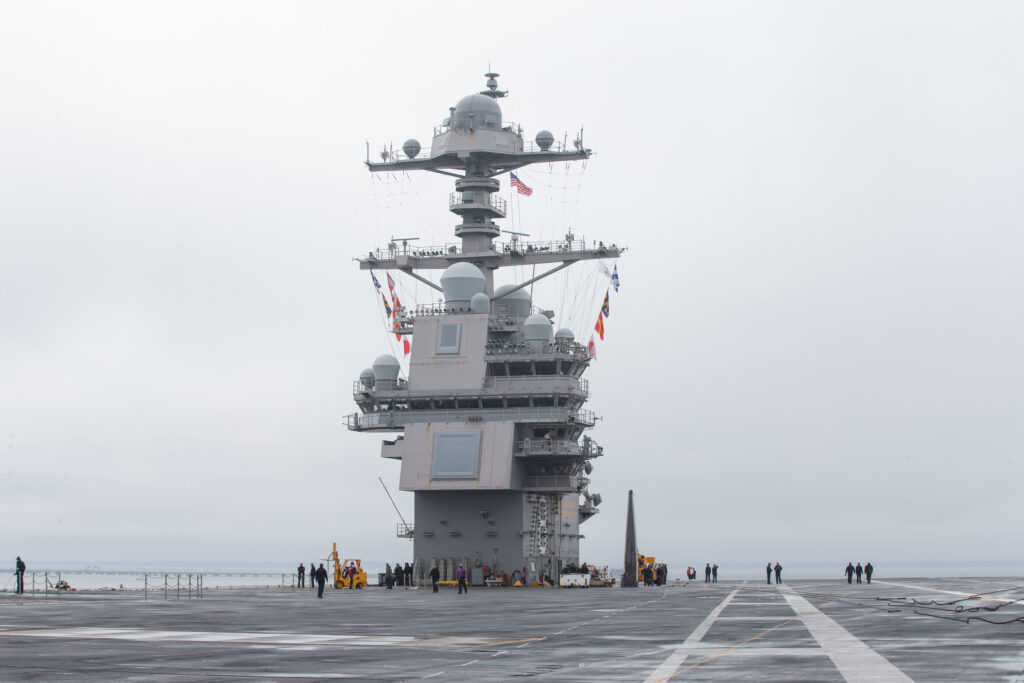
USS Gerald R. Ford (CVN 78) transits the James River after leaving Newport News Shipyard during sea and anchor, Feb. 25, 2022. Ford is underway in the Atlantic Ocean after completing the industrial portion of a six-month planned incremental availability. U.S. NAVY / Mass Communication Specialist 3rd Class Jacob Mattingly

ARLINGTON, Va. — The Navy’s procurement and congressional funding of two Ford-class aircraft carriers in a single block buy enabled numerous small suppliers to weather or even survive the COVID pandemic, an industry official said. The stability of the program also enabled the aircraft carrier industrial base to control costs and enact savings.  

Stable and predictable funding provided by the block procurement of CVN 80 and CVN 81, in place before the pandemic, gave the aircraft carrier industrial base the ability to absorb the shock of the pandemic, especially for the small lower-tier suppliers, said Rick Giannini, chairman of the Aircraft Carrier Industrial Base Coalition and CEO of Milwaukee Valve, speaking March 22 in a phone conference with Seapower

“The two-carrier buy was really very helpful to the supply base [during the pandemic], because those orders in the hands of the suppliers before COVID gave them the work to get through things,” Giannini said.    

Giannini said the ACIBC’s top priority is “stable and predictable funding,” which he defined as “a two-carrier block buy over eight years, with carriers purchased on four-year centers. 

“And with that comes advance planning funding early in the cycle,” which he said “really is the catalyst. It’s great to have the bulk buy, but if we don’t have the funds to go and buy those raw materials as a supply base, it makes it very difficult to enact the savings that come out of it. We got good funding for [CVNs] 80 and 81, and one of the lessons is we need more early on so we can get more of the supply base involved.” 

Giannini cited the experience of his own company, Milwaukee Valve.

“We were able to buy all of the materials for two full shipsets up front. Now we have that material in our facility so that the lead times not be impacted by material problems. Nor will the cost change. And it saves significant dollars and will improve the lead times overall.”      

He said a two-carrier block buy is “very doable. We’re hoping we can get it moved up into 2024 — eight years after the AP [advance procurement] money came in for 80/81. We’re really trying to match the procurement of the Nimitz class. They were built on 3.5-year centers. So, four [-year centers] is good enough.” 

The carrier industrial base coalition includes 2,000 companies from 46 states that employ approximately 121,000 workers. Its member companies provide $9.6 billion worth of materials and services for one aircraft carrier.  

Workforce issues became prominent during the pandemic because many “baby boomer” workers retired earlier than planned. A shortage of skilled workers is focusing companies on recruiting and developing shipyard and manufacturing workers. Many companies are forming partnerships with local community and technical colleges and trade schools. 

Giannini’s Milwaukee Valve company’s workforce is down about 8% in personnel, he said. Also, he noted that when a worker contracted COVID-19, about 10 other workers around that worker had to be quarantined, greatly affecting workflow for a week or two at a time. Absenteeism had risen to about 8 to 10 points on a fairly consistent basis, he said.   

Giannini attended the dinner March 21 — sponsored by the Navy League —with Chief of Naval Operations Adm. Michael Gilday in Norfolk, Virginia, to celebrate the centennial of the U.S. Navy’s first aircraft carrier, where, he noted, the CNO said the Navy needed a force level of 12 aircraft carriers. 


DoD Inspector General to Audit Navy’s MQ-25 UAV Program 

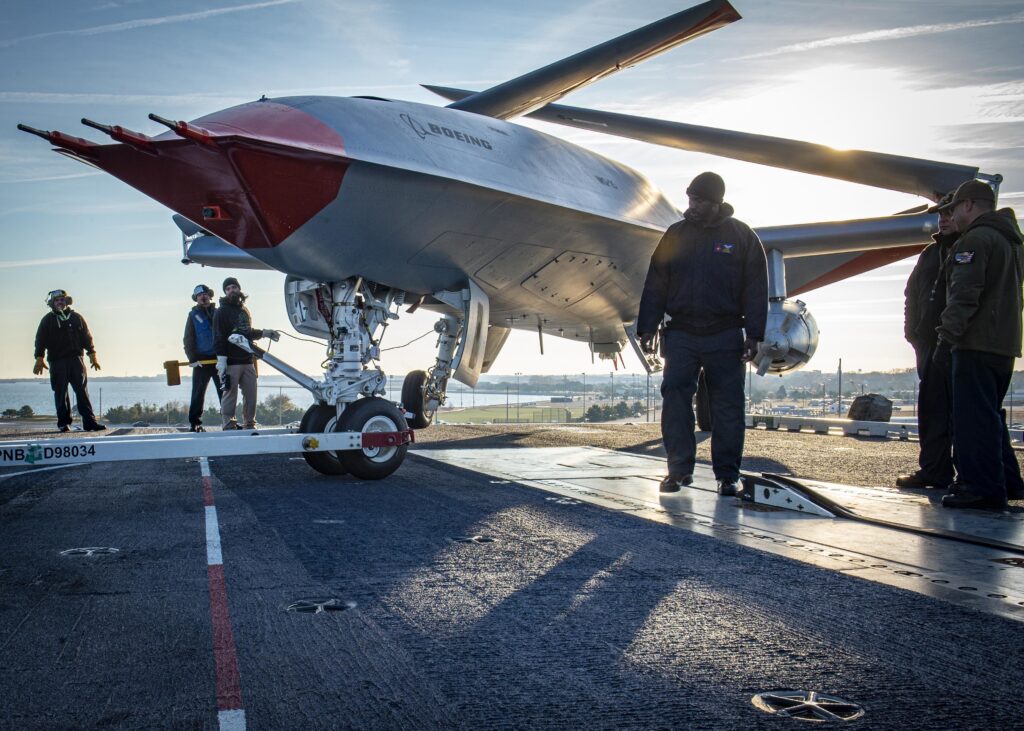
The Boeing unmanned MQ-25 aircraft on the flight deck aboard the aircraft carrier USS George H.W. Bush (CVN 77) in 2021. U.S. NAVY / Mass Communication Specialist 3rd Class Brandon Roberson

ARLINGTON, Va. — The inspector general of the Department of Defense is planning to conduct an audit of the U.S. Navy’s MQ-25 Stingray aerial refueling unmanned aerial vehicle program. 

In a March 21 memorandum addressed to the undersecretary of Defense for Acquisition and Sustainment, the director for Operational Test and Evaluation, and the auditor general of the Department of the Navy, the inspector general said, “The objective of this audit is to determine whether Navy officials are effectively managing the MQ-25 Stingray program to meet operational capability requirements and user needs. We may revise the objective as the audit proceeds, and we will also consider suggestions from management for additional or revised objectives.” 

The MQ-25 program is designed to provide a UAV capable of refueling carrier-based aircraft, thus freeing more F/A-18E/F Super Hornet strike fighters for their primary missions.  

A prototype of the MQ-25A, built by Boeing, has flown and has demonstrated the ability to refuel F/A-18s, F-35 Lightning II strike fighters and E-2D Advanced Hawkeye early warning aircraft. The prototype, known as T1, also was put through flight deck handling trials at sea on board the aircraft carrier USS George H.W. Bush (CVN 77) in December 2021.  

Boeing is under contract to build seven MQ-25As. The Navy anticipates it will procure a total of 72 Stingrays under current planning. Initial operational capability is planned for fiscal 2025. 


Navy Orders YRBM Barges from Conrad Shipyard  

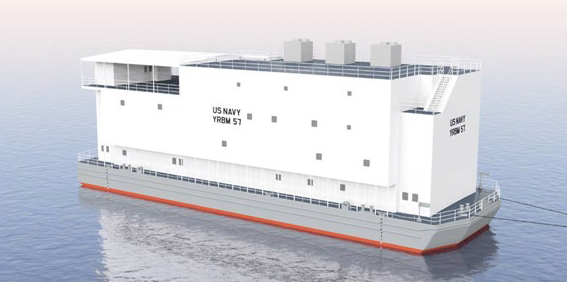
A Yard, Repair, Berthing and Messing barge. CONRAD SHIPYARD LLC

MORGAN CITY, La. — Conrad Shipyard LLC has been awarded a contract by the U.S. Navy for the design and construction of up to eight Yard, Repair, Berthing and Messing (YRBM) barges, the company said in a release.  

YRBM barges provide a temporary home away from home and workplace for service men and women whose vessels are in port for repairs or maintenance. Conrad’s design incorporates functional spaces which allow the Sailors to work, sleep, and eat comfortably.  

The fixed-price contract, a small business set-aside, has a potential value of more than $140 million. Conrad expects to deliver the first YRBM barge to the Navy in late 2023. If the Navy exercises options for the additional barges, peak production is expected to occur from 2023 through 2025.  

“We are excited to enter into this partnership with the Navy to help modernize its fleet,” said Conrad Shipyard CEO Johnny Conrad. “Not only will this contract provide an abundance of jobs for our workforce in the Morgan City area, but it will also help to support a multitude of small businesses. I know our dedicated and hardworking men and women at Conrad are proud to work on this project which will ultimately benefit the brave service men and women of the U.S. Navy.” 

The YRBM barge is an ABS A1 Accommodation Barge with a footprint of roughly 151 feet by 49 feet by 14 feet. The vessel provides pier-side living accommodations capable of berthing 199 mixed gender personnel, messing for 300 personnel, and includes spaces for medical offices, classrooms, workspaces, laundry rooms, storerooms and lounge areas. 


Navy Decommissions Two More Patrol Ships 

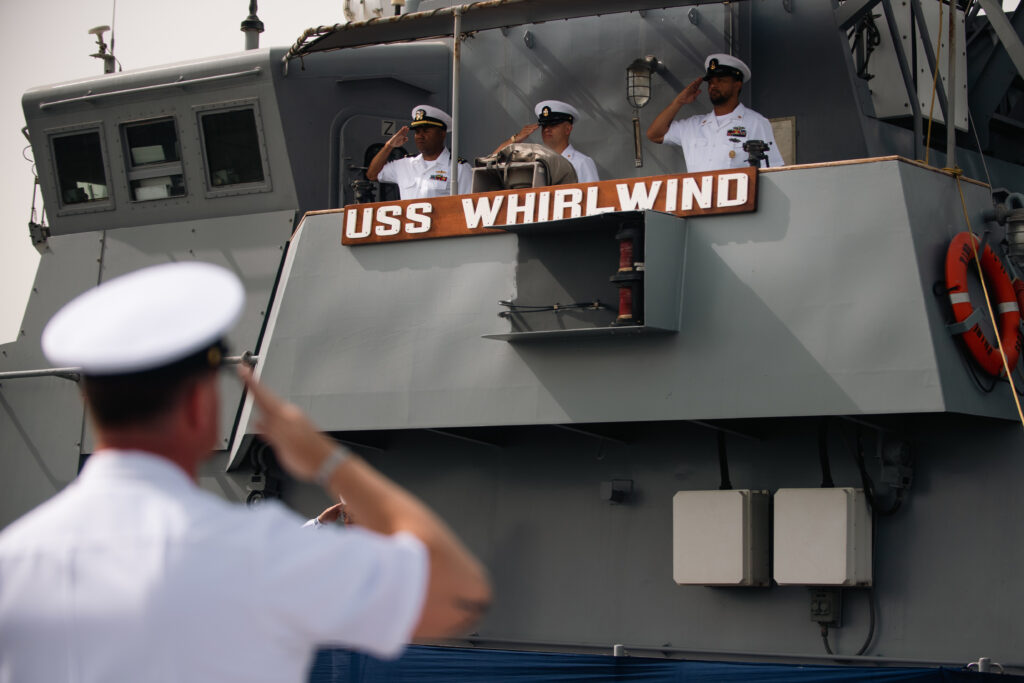
Sailors assigned to the coastal patrol ship USS Whirlwind (PC 11) salute during the ship’s decommissioning ceremony on March 21 at Naval Support Activity Bahrain. U.S. NAVY / Mass Communication Specialist 2nd Class Dawson Roth

ARLINGTON, Va. — The U.S. Navy decommissioned two more Cyclone-class coastal patrol ships in March, bring to five the number of PCs retired from the U.S. 5th Fleet this year, all within a one-month period, according to the fleet’s public affairs office. 

USS Whirlwind (PC 11) was decommissioned in ceremonies held in Bahrain on March 21. A week earlier, USS Squall (PC 7) was decommissioned on March 14. The recent PC force reductions began on Feb. 23 with the decommissioning of USS Firebolt (PC 10), followed by Typhoon (PC 2) on Feb. 28 and Tempest (PC 2) on March 7.  

All of the above decommissioned PCs will be made available for foreign military sales. 

The reductions leave the Navy’s last five PCs on strength still in service with the 5th Fleet: USS Hurricane (PC 3), USS Monsoon (PC 4), USS Sirocco (PC 6); USS Chinook (PC 9) and USS Thunderbolt (PC 12).  

USS Squall — like its sister ships, it was built by Bollinger Shipyards — was commissioned on July 4, 1994. It was based at Naval Amphibious Base Coronado, California until late 2005, when it was moved to Naval Amphibious Base Little Creek, Virginia. In 2013. Squall was assigned to the 5th Fleet. 

USS Whirlwind was commissioned on July 1, 1995. It was stationed at Little Creek from which it supported operations in the U.S 4th and 6th Fleet areas of responsibility. The Whirlwind also provided homeland security near New York City’s harbor following the 9/11 terrorist attacks on the city. The ship was transferred to the 5th Fleet in 2013. 

“Our patrol coastal ships have made a lasting impact here in the region supporting naval operations and safeguarding maritime security,” said Capt. Robert Francis, commander of Task Force 55 at U.S. 5th Fleet, in the March 21 5th Fleet release. “This was only made possible by the dedicated Sailors who served aboard these ships for nearly three decades.” 


ONR-Sponsored RE2 Robotics, VideoRay ROV Achieve New Depth Milestone 

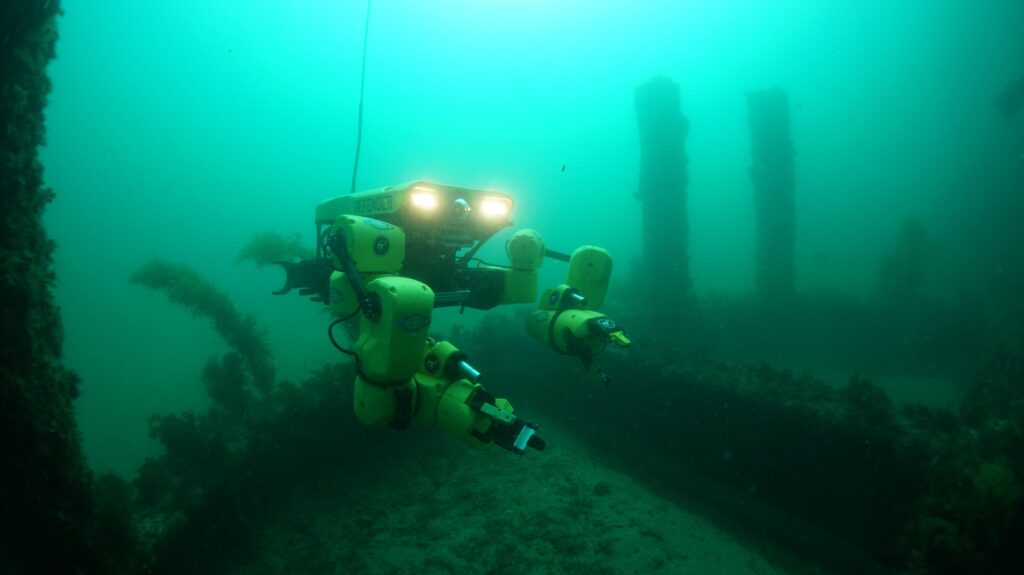
RE2 Robotics’ Sapien Sea Class underwater robotic arms, coupled with VideoRay’s Defender remotely operated vehicle, make up the Maritime Mine Neutralization System. RE2 ROBOTICS

PITTSBURGH and POTTSTOWN, Pa. — RE2 Robotics, a leading developer of intelligent mobile manipulation systems, announced March 22 that its Maritime Mine Neutralization System reached an unprecedented depth milestone of more than 1 kilometer during a recent open-water demonstration for the U.S. Navy’s project sponsor, the Office of Naval Research.   

M2NS is an underwater autonomous mine neutralization system composed of RE2 Sapien Sea-class underwater robotic arms mounted onto VideoRay’s inspection-class Defender remotely operated vehicle. M2NS also uses RE2’s advanced computer vision and autonomy software, RE2 Detect and RE2 Intellect, to enable the precise, autonomous, and clandestine neutralization of a target. 

During the test event, which took place in the Pacific Ocean with support from the Naval Information Warfare Center Pacific in Point Loma, California, four successful dives exceeding 1,000 meters of depth were completed. The dives were conducted using supervised autonomy, which allows human operators to monitor the robotic system’s autonomous movements and make corrections if necessary. 

“These tests allowed us to demonstrate the continuing success of the M2NS project for the U.S. Navy,” said Jack Reinhart, vice president of project management, RE2 Robotics. “The progress we made during these deep dives shows that we could successfully complete an underwater supervised autonomous mission at depths of more than 1,000 meters without any damage to the system. The M2NS system succeeded where no other system of this class has before.” 

All onboard electronics remained operational during the deep dives, including the ROV’s camera feed and data to the support vessel, proving the survivability of the complete system to a depth of more than 1,000 meters.  

“We have proven the ability to deploy the Defender with a large payload to depths of 3,500 feet [1,000-plus meters] from a small deck footprint,” said Marcus Kolb, chief technology officer, VideoRay. “We performed complex, autonomous manipulation tasks with the RE2 system while station-keeping a few feet off the bottom. We are excited about the direction of this program and how it will help accelerate commercial solutions.” 

Following the success of these dives, RE2 Robotics and VideoRay are planning future demonstrations for ONR to test the system’s autonomy capabilities using a tetherless ROV at extended depths. OceanComm Inc., a provider of high-speed wireless underwater communication technology, will provide wireless acoustic modems for future dives. 


CNO Visits Norfolk for Carrier Aviation Centennial Celebration   

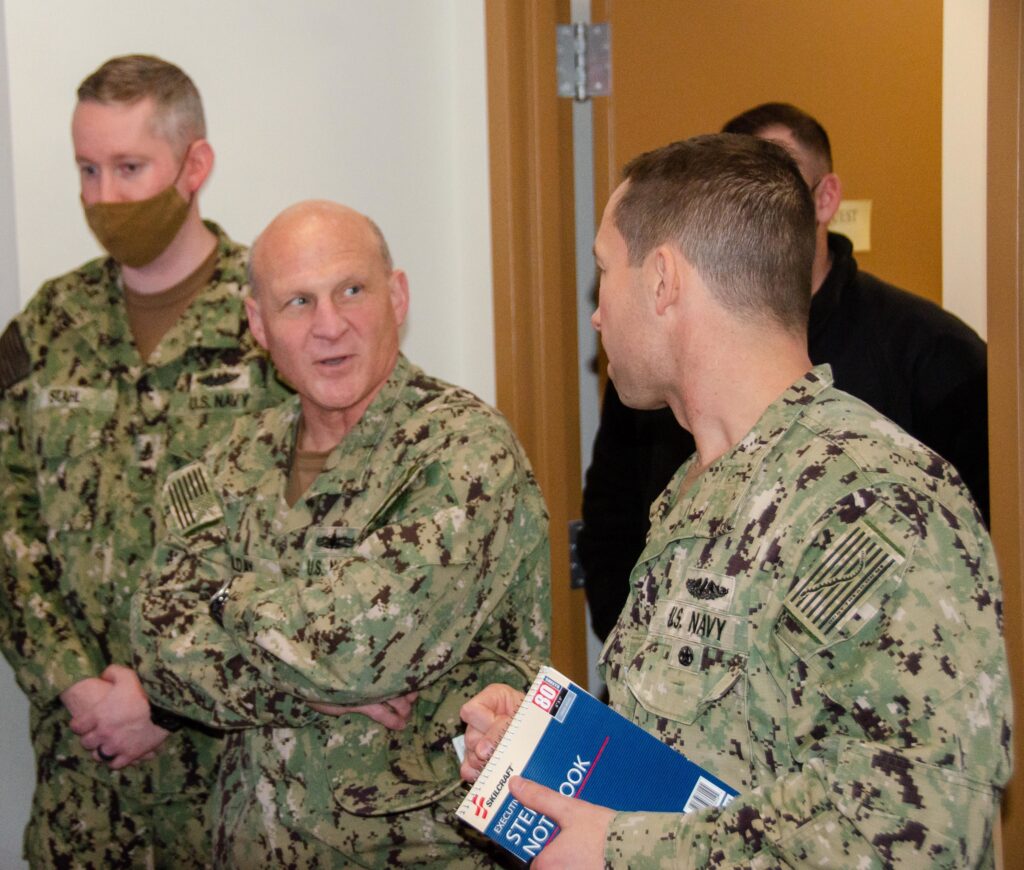
Chief of Naval Operations Adm. Mike Gilday during a visit to Naval Submarine School in February. On March 20-21, he visit Hampton Roads, Virginia, to celebrate a century of U.S. aircraft carrier aviation. U.S. NAVY / Charles E. Spirtos

NORFOLK, Virginia — U.S. Chief of Naval Operations Adm. Mike Gilday traveled to Hampton Roads, Virginia, for the 100 Years of Carrier Aviation Celebration, to visit local commands and to meet with Sailors and industry partners, March 20-21, the CNO’s public Affairs office said in a release. 

Gilday delivered remarks during the centennial celebration ceremony, hosted by the Navy League, held to honor the legacy of U.S. Navy aircraft carriers and aviation. 

“For 100 years aircraft carriers have been the most survivable and versatile airfields in the world,” said Gilday. “Perhaps no single military platform distinguishes what our nation is … and what it stands for … more than the aircraft carrier.”  

While in Hampton Roads, Master Chief Petty Officer of the Navy Russell Smith joined Gilday to meet with Sailors and leadership at Airborne Command and Control Squadron (VAW) 121 and Board of Inspection and Survey, where they spoke to the “get real, get better” call to action. 

The get real, get better mindset seeks to reduce the gap between the Navy’s least and most capable performer, cement dynamic learning and innovation into Navy culture, and build better leaders and teams ready to solve problems more effectively.  

“Our Sailors need to be self-assessing, finding and fixing problems, and embracing the red,” said Gilday. “We need to expand and empower this across the fleet, we have no room for complacency — each ship, squadron and command must hold themselves accountable. We need to continue to get real and get better.” 

Gilday also met with Virginia congressional Democratic Reps. Bobby Scott and Elaine Luria for a working lunch and discussion at Mid-Atlantic Regional Maintenance Center. During lunch, they received updates about ship maintenance.  

Finally, Gilday visited BAE Systems Norfolk Ship Repair for a tour and discussion about shipbuilding and maintenance progress and initiatives. 

“The work being done here in Norfolk, in partnership with BAE Systems, is helping to ensure our Navy is ready and has cutting edge capabilities,” said Gilday. “Working together with industry partners, we will drive down maintenance delays that reduce our readiness, while we continue to make sure our Sailors have what they need to fight and win.”    

The Hampton Roads area has the largest concentration of fleet headquarters administrative and communication facilities outside of Washington, D.C. It is home to more than 82,000 personnel and several major tenant commands: U.S. Fleet Forces Command, Joint Staff Hampton Roads, U.S. Marine Corps Forces Command, Naval Submarine Forces, Atlantic, and Naval Reserve Forces Command.