An F-35C Lightning II that crashed in the South China Sea earlier this year has been recovered. U.S. NAVY
YOKOSUKA, Japan — U.S. 7th Fleet’s Task Force 75 and Naval Sea Systems Command on March 2 successfully retrieved the F-35C Lightning II aircraft which crashed earlier this year in the South China Sea, 7th Fleet Public Affairs said March 3.
The F-35C Lightning II, assigned to Carrier Air Wing 2, crashed while USS Carl Vinson (CVN 70) was conducting routine flight operations in the South China Sea on Jan. 24.
The wreckage was recovered from a depth of approximately 12,400 feet by a team from CTF 75 and the NAVSEA’s Supervisor of Salvage and Diving embarked on the diving support construction vessel Picasso.
“The task force’s expertise in rapid, scalable command, control, and communications, agile logistics, organic security, and explosive ordnance disposal was the most flexible choice for the fleet commander to respond in a timely manner,” said CTF 75 Commodore Capt. Gareth Healy.
“Ultimately, this deliberate approach resulted in the correct capabilities conducting recovery operations within 37 days of the incident. Given the unique challenges of this problem and the unique technical capabilities that NAVSEA delivered, this was an aggressive and achievable timeline.”
The aircraft was recovered using a CURV-21 remotely operated vehicle, which attached specialized rigging and lift lines to the aircraft. The ship’s crane lifting hook was then lowered to the seafloor and connected to the rigging, and then lifted the aircraft to the surface and hoisted it onboard Picasso.
The aircraft will be delivered to a nearby military installation to aid in the ongoing investigation and evaluated for potential transport to the United States.
Navy Patrol Ship USS Typhoon Decommissioned
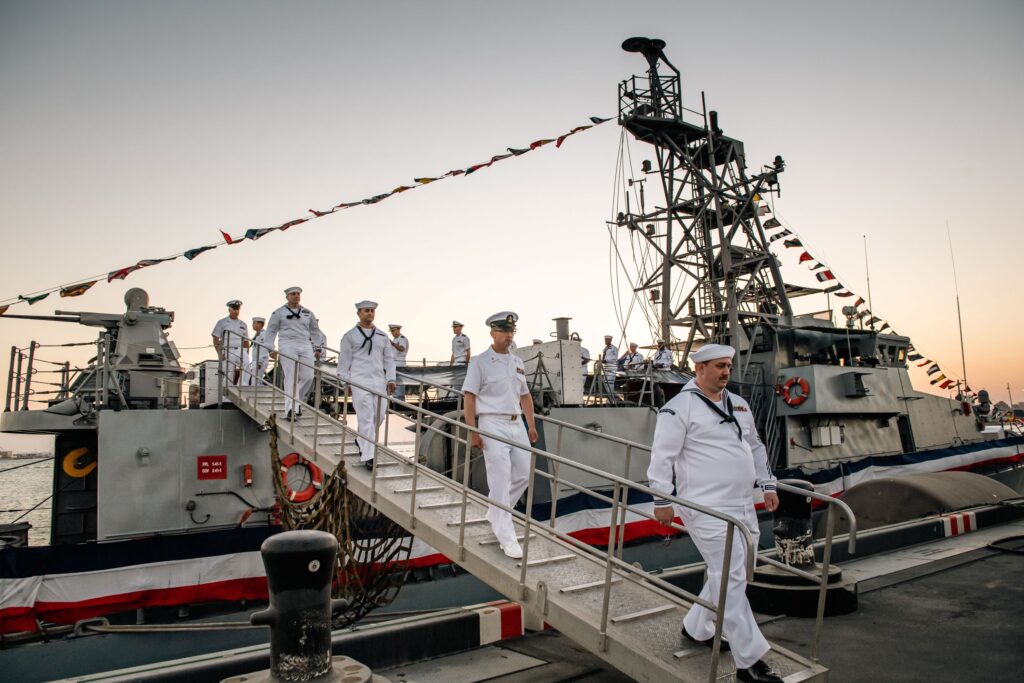
Sailors disembark patrol coastal ship USS Typhoon (PC 5) during the ship’s decommissioning ceremony at Naval Support Activity Bahrain. Typhoon commissioned in 1994 and began conducting routine coastal patrol operations under U.S. 5th Fleet in 2004. U.S. NAVY / Mass Communication Specialist 2nd Class Dawson Roth
ARLINGTON, Va. — A second Cyclone-class coastal patrol ship has been retired from the fleet in the Persian Gulf. USS Typhoon (PC 5) was decommissioned in Manama, Bahrain, on Feb. 28 after 28 years of service, a few days after its sister ship, USS Firebolt (PC 10), was decommissioned on Feb. 23.
The event drops to eight the number of Cyclone-class PCs forward deployed to the U.S. 5th Fleet. Three PCs based in the United States were decommissioned last year, leaving the rest of the class in the Persian Gulf.
The 174-foot-long, 375-ton Typhoon was built by Bollinger Shipyards in Lockport, Louisiana, and commissioned in Tampa, Florida, Feb. 12, 1994.
During the late 1990s and early 2000s, the Typhoon deployed to the Mediterranean and Baltic seas. It was forward to the 5th Fleet in 2004. In the Persian Gulf and Arabian Sea, the Typhoon conducted maritime security patrols, including anti-piracy and anti-smuggling operations, security patrols for offshore oil rigs and terminals, and shipping escort.
The Typhoon and its sister ships will be replaced in the Persian Gulf by forward-deployed littoral combat ships beginning in 2022.
Future Attack Submarine USS Oregon Delivered to U.S. Navy
The Virginia-class submarine USS Indiana (SSN 789), a sister ship to the future USS Oregon, departs Submarine Base New London in Connecticut on Jan. 7. The future USS Oregon was delivered to the Navy on Feb. 26. U.S. NAVY / John Narewski
GROTON, Conn. — The submarine force’s newest attack submarine, the future USS Oregon (SSN 793), was delivered to the U.S. Navy on Feb. 26, Team Ships Public Affairs said Feb. 28.
PCU Oregon is the 20th Virginia-class submarine that are co-produced at General Dynamics Electric Boat and Huntington Ingalls Industries – Newport News Shipbuilding through a long-standing teaming agreement. Oregon is the 11th Virginia Class delivered by GDEB and the second Block IV configured submarine.
“Oregon is in excellent condition and the captain and crew have expertly taken the ship through her paces,” said Capt. Todd Weeks, the Virginia-class program manager who rode the boat during its sea trials. Delivery of a Virginia-class submarine is the culmination of almost 10 million work hours by the shipbuilders under the exacting standards imposed by Naval Sea Systems Command and Naval Reactors under the direct oversight of the Supervisors of Shipbuilding at both company locations. “Each organization works tirelessly with the others focused on getting ships to sea as the first step in ultimately arriving at its squadron and homeport where it becomes a vital asset to the Nation.”
Virginia-class submarines are built to operate in the world’s littoral and deep waters while conducting antisubmarine warfare, anti-surface ship warfare, strike warfare, special operations forces support, intelligence, surveillance and reconnaissance, irregular warfare and mine warfare missions. Their inherent stealth, endurance, mobility and firepower directly enable them to support five of the six maritime strategy core capabilities — sea control, power projection, forward presence, maritime security and deterrence.
The submarine’s sponsor is Dana Richardson, wife of former Chief of Naval Operations Adm. John Richardson.
Oregon is the third U.S. Navy ship to honor the state. The first USS Oregon was a brigantine ship purchased in 1841 and used for exploration until 1845. The second Oregon (BB 3) was commissioned on July 15, 1896. While decommissioned in 1906, she was later recommissioned in 1911 and remained in the reserve until stricken from the Navy list in 1942.
Navy to Demo New Mine Countermeasure System on MQ-8 Fire Scout
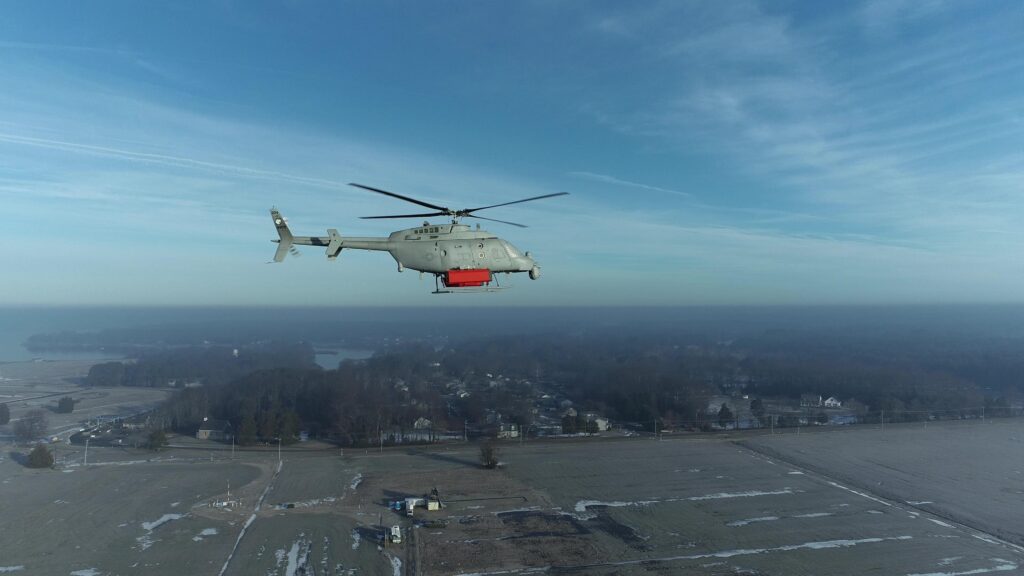
The MQ-8 Fire Scout, with mass shapes attached, conducts low airspeed flying qualities testing in February at Webster Field, Maryland, to prepare for upcoming the Single System Multi-Mission Airborne Mine Detection demonstration. U.S. NAVY
PATUXENT RIVER, Md. — The Navy is working to develop a new mine countermeasure sensor suite for the MQ-8C Fire Scout that that will enable the unmanned helicopter to detect and localize mines and obstacles on land and at-sea, Naval Air Systems Command said March 2.
The Fire Scout program office, in conjunction with the Office of Naval Research and Program Executive Office Unmanned and Small Combatants, have partnered with the Naval Air Warfare Center Aircraft Division’s AIRWorks, Aircraft Prototype Systems Division, Webster Outlying Field and Air Test and Evaluation Squadron Two Four (UX-24) to execute the final phase of the Single System Multi-Mission Airborne Mine Detection Future Naval Capability Program, or SMAMD.
SMAMD will be the first mine countermeasure system flown onboard the MQ-8C Fire Scout as well as the airframe’s heaviest payload carried to date. The SMAMD system, developed by BAE Systems, uses an airborne optical sensor suite that will have the ability to have real-time onboard processing coupled with low false alarm rates, enabling the warfighter to respond swiftly to detected threats. Current mine countermeasure technologies require post-mission analysis that lengthens the threat detection and mitigation timeline.
“This capability is extremely important as we see future fights occurring in the littoral waters where mine warfare is prevalent,” said Capt. Thomas Lansley, Fire Scout program director. “A mine warfare capability will greatly reduce risk for LCS and other vessels in the littoral.”
In February, UX-24 conducted flying qualities and performance testing with the MQ-8C using mass equivalency models in place of the prototype system pods, which mimic the size and weight of the SMAMD System. The testing is performed to collect data to allow for the evaluation of air vehicle performance and handling to assess safety of flight assessment and airworthiness.
This spring, the joint team will hold a land-based demonstration of the mine countermeasure prototype at the Naval Surface Warfare Center in Panama City, Florida. The demo will stretch from the beach zone, drifting mines and moored mines both in shallow water and deep water up to 10 kilometers offshore. The objective of the demonstration is to gather performance data for both the MQ-8C Fire Scout and SMAMD to inform future integration efforts.
The SMAMD will prove that a podded MCM system can operate as intended on the MQ-8C without causing adverse effects to the vehicle or significantly diminish its time on station.
“The program office will continue to gather information to inform future integration efforts of the COBRA Block II System onto the MQ-8C,” said Lansley.
The MQ-8C Fire Scout is currently deployed aboard USS Milwaukee (LCS-5) to support operations in the U.S. 4th Fleet area of responsibility.
Rep. Wittman Responds to CNO’s 500-Ship Fleet Aspirations
U.S. Rep. Rob Wittman (R-Virginia) has lunch with Sailors aboard the Wasp-class amphibious assault ship USS Kearsarge (LHD 3) on Aug. 10, 2021. U.S. NAVY / Mass Communication Specialist 3rd Class Nick Boris
WASHINGTON, D.C. – Rep. Rob Wittman (R-Virginia), ranking member of the House Armed Services Committee’s Seapower and Projection Forces subcommittee, released the following statement in response to Chief of Naval Operations Adm. Michael Gilday’s recent assertion the Navy needs a 500-ship Navy to meet the Biden Administration’s forthcoming National Defense Strategy:
“We are at a critical junction in our nation’s history: We must decide if the United States will retain its global primacy or concede to the Chinese. Presently, China has the largest navy in the world and if we do nothing to change our fleet trajectory, China will fully modernize its military and outpace the United States militarily.
“I am supportive of Chief of Naval Operations Gilday’s affirmation of the previous administration’s force structure objectives, and I am incredibly supportive of a larger, more robust naval fleet that will position the United States to maintain presence necessary to dissuade conflict and if necessary, win in war. However, we have heard these calls for a larger fleet before without any substantive follow through. CNO Gilday’s call for a 500-fleet navy is a welcomed aspiration, but it must be backed by President Biden’s budget request to ensure our Navy and entire military has what it needs to maintain readiness, improve our systems, and outpace our competitors. In my estimation, real world dynamics require at least 5% real growth in our national security in fiscal year 2023.
“I continue to be concerned as to how CNO Gilday’s plan aligns with the Biden Administration’s forthcoming National Defense Strategy. Last year, this administration did not even provide Congress with a five-year investment vision. Without a credible 30-year shipbuilding plan, the industrial base has no real map to invest for the future. Additionally, the ‘divest to invest’ approach of this administration presumes a benign China response in the short term. We need to be ready for conflict in five years, not in some fairy tale Battle Force 2045. The administration needs to be forthright with Congress in the fiscal year 2023 budget request and their intent to dissuade future conflict now.”
Navy’s Second F-35C Fleet Squadron Declared Safe for Flight
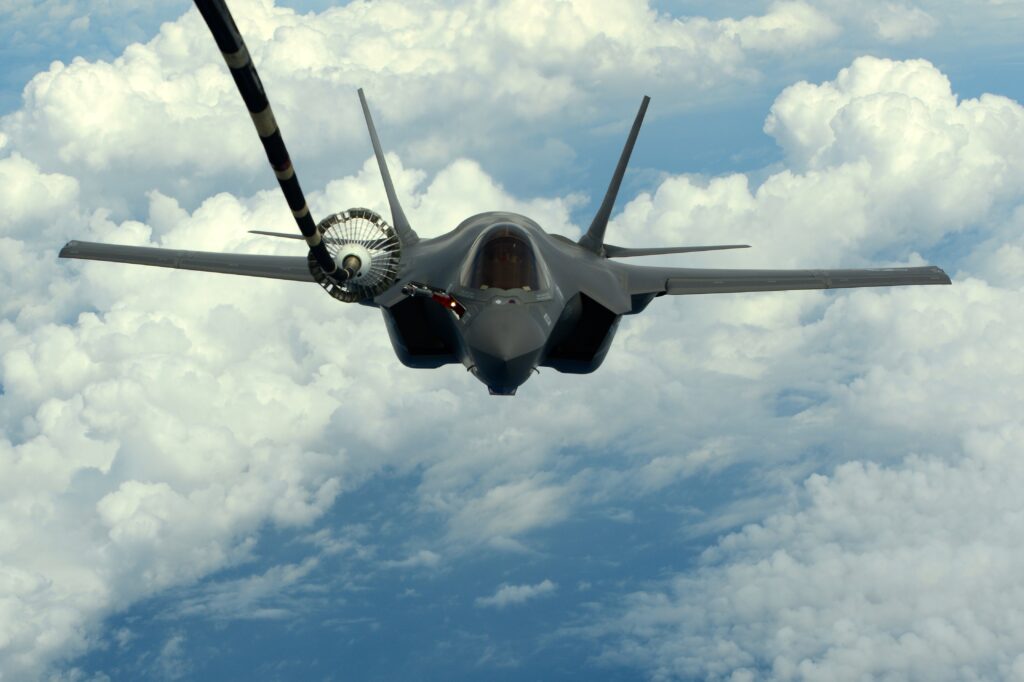
A Navy F-35C Lightning II is drogue refueled by a KC-10A during a training mission near Eglin Air Force Base, Florida, in 2015. U.S. AIR FORCE /Staff Sgt. Brian Kelly
ARLINGTON, Va. — The Navy’s second fleet squadron to operate the F-35C Lightning II strike fighter has been declared safe for flight in that aircraft.
Strike Fighter Squadron 97 (VFA-97) — the Warhawks — reached that status Feb. 18, a few days after VFA-147, the first fleet F-35C squadron, returned on board USS Carl Vinson (CVN 70) from the first F-35C deployment.
The first Marine Corps F-35C squadron, Marine Fighter Attack Squadron 314, currently is deployed to the Indo-Pacific region on board USS Abraham Lincoln (CVN 72).
VFA-97, which began transition to the F-35C in February 2021, had operated the F/A-18E Super Hornet strike fighter since 2013, when it had upgraded from the F/A-18C version.
The Warhawks were established on June 1, 1967, as an A-7 Corsair II squadron and were deployed the next year to the Vietnam War.
HII Completes Inaugural Maintenance, Modernization Period for USS Gerald R. Ford
The aircraft carrier USS Gerald R. Ford (CVN 78) departs HII’s Newport News Shipbuilding division on Friday, Feb. 25 after its planned incremental availability. HII / Ashley Cowan
NEWPORT NEWS, Va. — The first planned incremental availability for the aircraft carrier USS Gerald R. Ford (CVN 78) has been completed, Huntington Ingalls Industries’ Newport News Shipbuilding division announced March 1.
Gerald R. Ford is the first ship in a new class of aircraft carriers that incorporates 23 new technologies, designed to support the Navy’s air wing of the future.
“It is truly an honor and a privilege for our shipbuilding team to ready this most technologically advanced aircraft carrier for the Navy fleet,” said Lucas Hicks, vice president of the Gerald R. Ford and John F. Kennedy (CVN 79) aircraft carrier programs. “We look forward to folding what we learned into the entire Gerald R. Ford class, extending the Navy’s power projection advantage around the globe.”
Gerald R. Ford-class aircraft carriers incorporate new technologies such as electromagnetic catapults and weapons elevators, a redesigned flight deck and island, and more than twice the electrical capacity of Nimitz-class carriers. These aircraft carriers are designed to be the centerpiece of the Navy’s deployed battle force and alongside allies and partners, they defend freedom, preserve economic prosperity and keep the seas open and free.
The planned incremental availability involved six months of modernization and maintenance work to ensure Gerald R. Ford has the most current upgrades prior to the carrier’s first deployment. The ship entered the PIA in September 2021 after completing full ship shock trials and a successful post-delivery test and trials period.
Three other Gerald R. Ford-class aircraft carriers are currently under construction at Newport News Shipbuilding. They include John F. Kennedy, Enterprise (CVN 80) and Doris Miller (CVN 81). In addition, Newport News Shipbuilding is conducting mid-life refueling complex overhauls on two Nimitz-class aircraft carriers — USS George Washington (CVN 73) and USS John C. Stennis (CVN 74). These overhauls will extend the service life for each platform by another 25 years, ensuring the Navy is positioned to deploy a fleet of aircraft carriers ready to support national security requirements.
CNO and Connecticut Congressman Visit Commands and Industry Partners
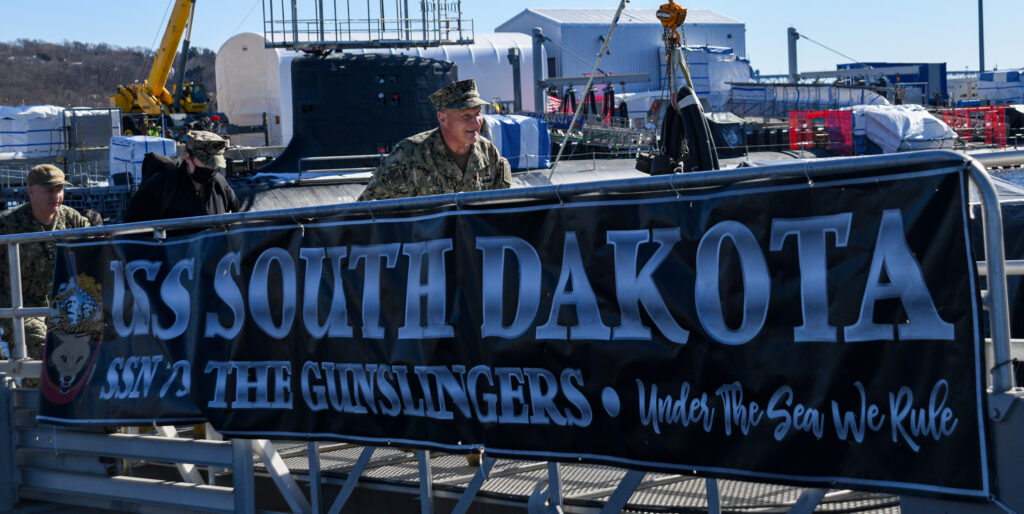
Chief of Naval Operations Adm. Mike Gilday departs from the Virginia Class submarine USS South Dakota (SSN 790) after a tour of the submarine. Gilday and Connecticut Rep. Joe Courtney visited the Naval Submarine Base New London waterfront and Naval Submarine School after touring nearby General Dynamics Electric Boat Shipyard submarine construction facilities. U.S NAVY / Mass Communication Specialist 3rd Class Maxwell Higgins
GROTON, Conn. — Chief of Naval Operations Adm. Mike Gilday and Connecticut Rep. Joe Courtney traveled to Rhode Island and Connecticut to visit with Sailors, tour Navy commands and meet with industry partners on Feb. 28, the CNO’s Public Affairs office said in a release.
Together, they visited General Dynamics Electric Boat shipyards at Quonset Point, Rhode Island, and Groton, Connecticut, where they received updates about Virginia-class and Columbia-class submarine construction.
“These submarines need to be delivered on time, on budget, and ready for the fight — we have no margin to fall behind,” Gilday said. “Columbia-class is our number one acquisition priority, and Virginia-class submarines are our advantage at sea. Working together with our industry partners, we will get them into the fleet where they belong.”
“Activity around the globe and calls for support from our allies has really put eastern Connecticut in the spotlight in terms of delivering on the most important needs of the U.S. Navy,” said Courtney. “Our region’s shipbuilders and manufacturing industries keep our Navy unrivaled on and beneath the waves. Today CNO Gilday saw the high-tempo production in southern New England that is meeting the Navy’s demand signal. Our region’s manufacturing and building trades workforce continues to illustrate that the Navy’s targeted investments are paying off, and preparing us for tomorrow’s challenges.”
Columbia-class ballistic missile submarines (SSBN) are the nation’s future Sea-Based Strategic Deterrent and will provide the most survivable leg of the Nation’s strategic triad. As set forth in the 2018 Nuclear Posture Review, the program will consist of a minimum of 12 submarines to meet U.S. strategic deterrent force structure requirements.
Columbia SSBNs are replacing Ohio-class SSBNs and will be a vital part of the fleet, remaining in service until 2080. The Ohio-class SSBNs will begin to reach their end of service life in 2027.
During the visit, Gilday visited Quonset Point and Groton facilities and interacted with employees.
“The work being done here in partnership with General Dynamics Electric Boat is shaping the future of the Navy and will deliver cutting edge capabilities and strategic deterrence,” said Gilday.
During the visit he spoke with employees and told them, “You are like world-class Olympic athletes, with your unrelenting dedication and expertise to build the world’s best submarines. Thank you for your efforts to make sure tomorrow’s Sailors have what they need to deter aggression and win the fight.”
Gilday and Courtney also visited the Virginia-class fast-attack submarine USS South Dakota (SSN 790) at Naval Submarine Base New London, where they ate lunch with the crew, talked with Sailors and toured the submarine.
Next, Gilday and Courtney visited the Undersea Warfighting Development Center to hear a tactics brief and the Naval Submarine School Submarine attack center where they met with Sailors.
Atlantic Fleet Name a No-Go, for Now
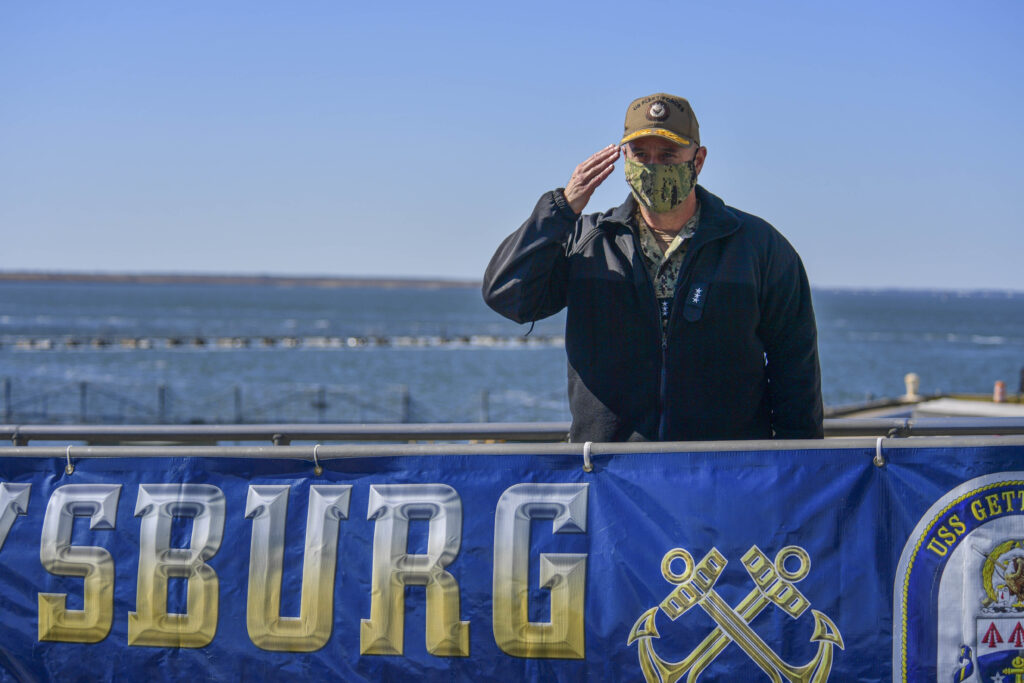
Vice Adm. James Kilby, deputy commander, U.S. Fleet Forces Command, departs the Ticonderoga-class guided-missile cruiser USS Gettysburg (CG-64), following a visit to the ship, Feb. 10. Plans to redesignate Fleet Forces Command as the U.S. Atlantic Fleet appear to have been abandoned. U.S. NAVY / Mass Communication Specialist 1st Class Jacob Milham
ARLINGTON, Va. — Just over a year ago, the president approved the proposal to re-designate the U.S. Fleet Forces Command as the U.S. Atlantic Fleet. The proposal — for now, at least — is in the dustbin of history.
In January 2021, shortly before leaving office, the re-designation was approved by then-President Donald Trump. Now, more than a year later, the proposal has not been enacted.
“From my understanding, that proposal was not forwarded following the Global Posture Review,” said Capt. Jereal Dorsey, special assistant for public affairs for the secretary of the Navy, in response to a query from Seapower.
The Defense Department’s Global Posture Review was ordered by President Joe Biden on Feb. 4, 2021, and its recommendations were approved by him in November 2021. The Navy said in the interim that the renaming proposal for U.S. Fleet Forces Command would depend on the results of that review.
The original commander, U.S. Atlantic Fleet staff, had a long pedigree that began in 1906, when the North Atlantic Squadron and South Atlantic Squadron were combined. The fleet existed in various forms until 2006, when the chief of naval operations renamed Commander, U.S. Atlantic Fleet, to Commander, U.S. Fleet Forces Command, which assumed the duties of the former fleet plus the mission of the former Commander, Fleet Forces Command, which was “to serve as the primary advocate for fleet personnel, training, requirements, maintenance and operations issues,” according to the U.S. Fleet Forces Command website.
The re-designation plan originally was announced by then-Navy Secretary Kenneth J. Braithwaite, testifying Dec. 2, 2020, before the Readiness and Management Support subcommittee of the Senate Armed Services Committee, noting the changing world requires that the Navy must evolve to meet the threat.
Atlantic Theater Challenges
“Our existing structure operates on the premise that we still live in a post-9/11 state, where NATO’s flanks are secure, the Russian Fleet is tied to the pier, and terrorism is our biggest problem,” Braithwaite said. “That is not the world of today. As the world changes, we must be bold, evolved, and change with it. Instead of perpetuating a structure designed to support Joint Forces Command, we are aligning to today’s threat.
“To meet the maritime challenges of the Atlantic Theater, we will rename Fleet Forces Command as the U.S. Atlantic Fleet and will refocus our naval forces in this important region on their original mission, to controlling the maritime approaches to the United States and those of our allies,” he said. “The Atlantic Fleet will confront the reassertive Russian navy, which has been deploying closer and closer to our East Coast with a tailored maritime presence, capability and lethality.”
Speaking Jan. 11, 2021, in a webinar of the Surface Navy Association convention, CNO Adm. Michael Gilday discussed the pros of the redesignation.
“It underscores the importance of the Atlantic in a way that the title ‘Fleet Forces’ doesn’t,” Gilday said. “It actually is a testament to recent tangible decisions that we made to increase our power in that body of water, to include bringing 2nd Fleet back, standing up SubGru 2 [Submarine Group 2]. It will also include standing up [NATO’s] Joint Force Command Norfolk, which is focused on the Atlantic.”
Gilday said, “in a day and age when the homeland is no longer a sanctuary, and homeland defense is at the fore of every plan the combatant commanders have put together, the name ‘Atlantic Fleet’ always carries some gravitas with respect to defense of the nation.”
He noted the complexity of the re-designation, saying the command “also has responsibilities as a component [command] for [U.S.] Northern Command and the Eastern Pacific that extend up to the Arctic as well as their role as component of the [U.S] Strategic Command. They really have a global responsibility with respect to the command and control of our SSBNs [ballistic-missile submarines].”
Adm. Christopher W. Grady, then-commander, U.S. Fleet Forces Command, seconded the complexity in a Jan. 13, 2021, webinar at the convention, noting the downside “might be that we would lose emphasis on what we do for the homeland. Indeed, I control forces in both the Pacific and down south [in U.S. Southern Command area of responsibility].
“So, we will balance all that, and in the end the name change is an important branding opportunity, and we will move out on that,” Grady said.
Grady is now vice chairman of the Joint Chiefs of Staff.
SECNAV Names Future T-AO USNS Thurgood Marshall, Sponsors for USS Doris Miller
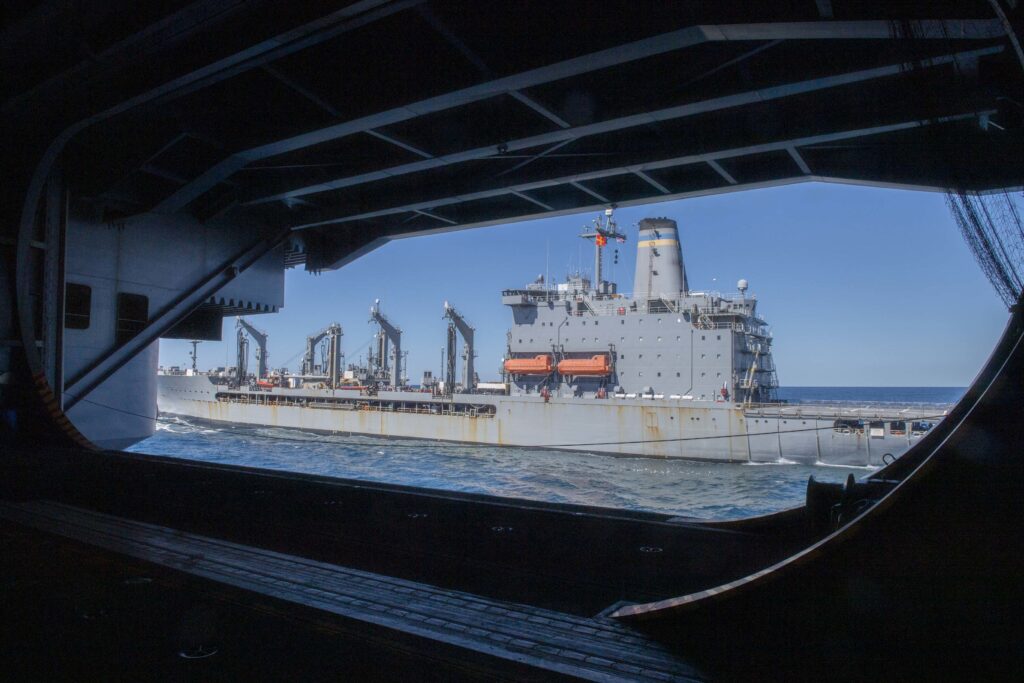
Aircraft carrier USS Nimitz (CVN 68) performs a replenishment-at-sea with the fleet replenishment oiler USNS Pecos (T-AO 197). A future John Lewis-class replenishment oiler will be named USNS Thurgood Marshall, Secretary of the Navy Carlos Del Toro announced Feb. 25. U.S. NAVY / Mass Communication Specialist 3rd Class David Negron
WASHINGTON — During Black History Month, Secretary of the Navy Carlos Del Toro announced on Feb. 25 the sponsors for the USS Doris Miller and that a future John Lewis-class replenishment oiler (T-AO) ship will be named USNS Thurgood Marshall to honor the former Supreme Court justice and civil rights activist.
The future USNS Thurgood Marshall (T-AO 211) will be the first naval vessel to bear this name. However, it is not the first U.S. Navy ship to be named after a Supreme Court justice.
“It is my pleasure to recognize the tremendous lifelong contributions of the Honorable Thurgood Marshall by naming T-AO 211 after him. This naming selection enables a legacy of continued conversations and visibility, essentially a living memorial to be seen around the world, of a historic figure in the continued fight for civil and human rights, and I am pleased to share this decision during Black History Month,” said Del Toro. “Continued diversity and inclusion efforts are critical to the mission success of the Navy and Marine Corps team. Selecting Thurgood Marshall as the namesake aligns with the diversity, equity and inclusion efforts that I have implemented in my strategic guidance since serving as secretary.”
The name selection follows the naval tradition of honoring people who have fought for civil and human rights. Born in 1908, Thurgood Marshall was a civil rights leader turned Supreme Court justice. Marshall made history as the first Black justice to serve on the U.S. Supreme Court when he was confirmed by the U.S. Senate in 1967. Of his 25-year tenure on the Supreme Court, he is most noted for his work toward affirmative action, stopping Jim Crow segregation and the landmark case Brown v. Board of Education.
The future T-AO 211 is the seventh of the TAOs awarded to the Navy, with the first delivered in 2021. The class and lead ship is named in honor of Rep. John Lewis (D-Georgia).
T-AOs are fleet oilers designed to transfer fuel to the Navy’s operating carrier strike groups. The oilers have the ability to carry a load of 162,000 barrels of oil, maintain significant dry cargo capacity, aviation capability and a speed of 20 knots. NASSCO designed the vessels with double hulls that protect against oil spills and strengthened cargo and ballast tanks. The John Lewis-class T-AO measures 742-feet in length with a full load displacement of 49,850 tons.
Ship Sponsors
Along with announcing the ship’s name, Del Toro also announced the sponsors for the future USS Doris Miller (CVN 81) as Charlene Austin and Taya Miller, who in their role as the ship’s sponsors will represent a lifelong relationship with the ship and crew.
Charlene Austin is not only the spouse of Secretary of Defense Lloyd Austin, but possesses an extensive history of professional and volunteer work supporting initiatives for military families. Taya Miller is the great-niece of Doris “Dorie” Miller, and was selected by the Doris Miller family to represent the family on behalf of the late Doris Miller and her late mother, Vickie Miller. Matrons of Honor for the USS Doris Miller are represented by members of the Dorie Miller family: Lakisha Bledsoe-Stansberry, Carra Miller Boykins, Tina Shedd and Selena James.