CNO Emphasizes Joint All-Domain Operations in Texas Visit
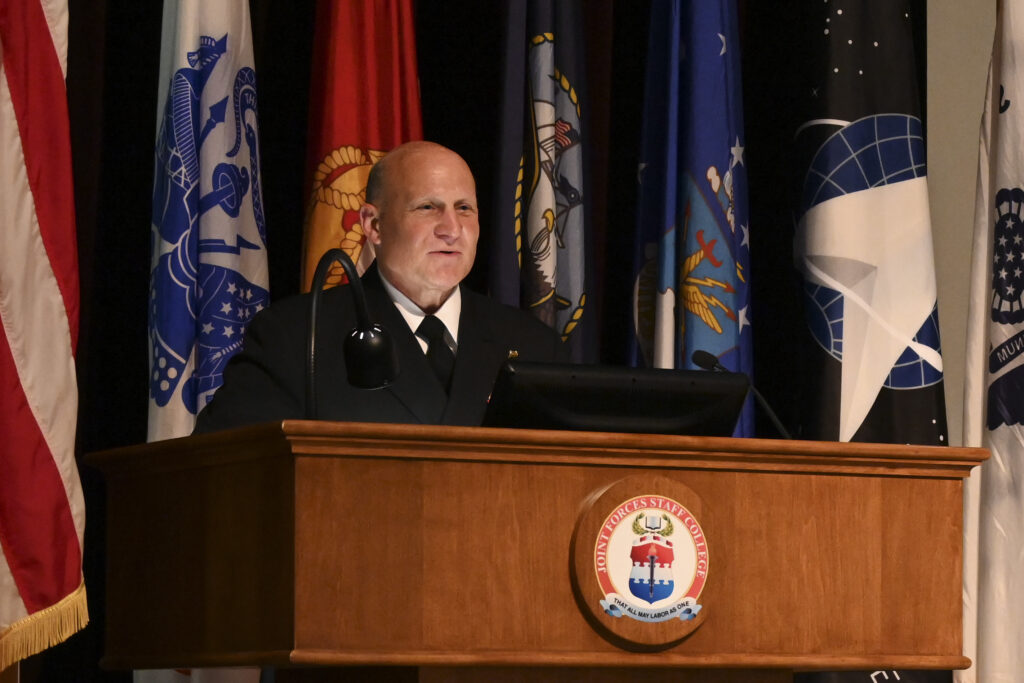
Chief of Naval Operations, Adm. Michael Gilday speaks Feb. 4 during an establishment ceremony for the Naval Safety Command. U.S. NAVY / Mass Communication Specialist 2nd Class (SW/AW) Weston A. Mohr

FORT WORTH, Texas — Chief of Naval Operations Adm. Mike Gilday traveled to Fort Worth, Texas, and visited Lockheed Martin on Feb. 10, with Rep. Kay Granger (R-Texas), the CNO’s Public Affairs Office said in a release.   

Gilday and Granger toured facilities and received updates about F-35C Lightning II advancements and capabilities, joint all-domain operations, anti-surface warfare and weapon technology. 

“The work that we’re doing here in Fort Worth in partnership with Lockheed Martin is delivering cutting edge capabilities for the Navy now and into the future,” said Gilday. “These advanced capabilities will ensure the U.S. Navy will maintain our warfighting advantage against increasingly competitive adversaries and ensure tomorrow’s Sailors will have what they need to win the fight.” 

The F-35C is an aircraft that redefines the multirole fighter. It is a fifth-generation aircraft that integrates advanced stealth technology that provides unprecedented situational awareness to the pilot, as well as lethality and survivability. Major advances in network enabled mission systems, reliability and interoperability make this platform powerful and effective.   

“Today’s visit from Admiral Gilday highlights the role played by Texas, and North Texas in particular, at the forefront of our nation’s strong national defense,” Granger said. Our visit gave us greater insight on the incredible capabilities of the F-35 and the advancements being made to ensure we have the best fighter fleet in the world. I will always remain the F-35 program’s staunchest advocate.” 

The aircraft, satellites, ships and ground vehicles Navy forces operate have the ability to collect information from air, sea, space, land and cyber, but processing and analyzing that amount of data can be a difficult task, Gilday added.   

Gilday explained the industrial base plays a key role in maintaining the current fleet as well as developing and building platforms and capabilities for the future fight. “We will seek opportunities to accelerate the development and fielding of needed capabilities ahead of our rivals,” he said.  

Playing a large role in joint all-domain operations, the F-35C fighter brings increased situational awareness, information sharing and connectivity to the naval force, as well as our allies and partners.  

This visit marked CNO’s second trip to Fort Worth. 


COVID Challenges Toughened 7th Fleet Sailors, Vice Adm. Merz Says

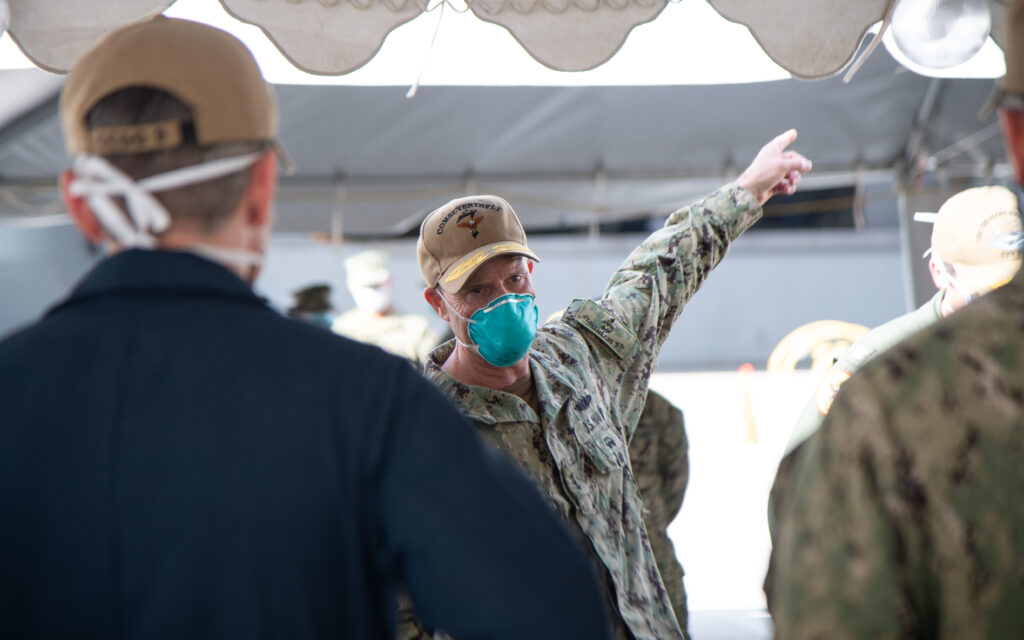
U.S. Navy Vice Adm. Bill Merz, then commander of U.S. 7th fleet, addressed Carrier Strike Group Nine warfare commanders on the pier in Naval Base Guam April 5, 2020. Merz arrived in Guam to assess and support the ongoing COVID-19 recovery efforts for the crew of USS Theodore Roosevelt (CVN 71). U.S. NAVY / Mass Communication Specialist Seaman Kaylianna Genier

ARLINGTON, Va. — The coronavirus pandemic may have disrupted normal operations and planned training exercises over the last two years, but it drove U.S. Navy and Marine Corps units in the Indo-Pacific to work together and solve problems under trying conditions, a former 7th Fleet commander says.

Outbreaks of the COVID-19 virus sidelined some warships, like the aircraft carrier USS Theodore Roosevelt, and extended at-sea deployments for all the rest, “but a lot of good came out of it if you put it in context,“ Vice Admiral William Merz, the deputy chief of naval operations for Operations, Plans and Strategy (N3/N5), told the National Defense Industrial Association’s virtual Expeditionary Warfare Conference Feb. 9.

Merz, who commanded the 7th Fleet before assuming his N3/N5 role, told online viewers they should be “celebrating the Sailors, how they just came alive under those oppressive conditions, coming together against this common enemy. I’ll tell you, COVID’s probably the best thing that’s happened to 7th Fleet, at least in recent memory. It allowed us to stay together as a fleet, we pretty much stayed at sea the entire time, undistracted.”

Because of COVID restrictions on travel, Merz said he cut his routine trips  to Washington way back, “so it allowed me to engage very heavily” with all parts of the fleet. He kept the amphibious command ship USS Blue Ridge (LCC-19), usually based at Japan’s Yokosuka Naval Base, at sea for a total of 200 days during his last 15 months at 7th Fleet, using its flight deck to helicopter around his command.

Once counter-virus practices were in place aboard ships, Merz said he was able to move his expeditionary force around the 7th Fleet area of responsibility at sea undistracted. Other U.S. and allied naval vessels kept China’s People’s Liberation Army Navy from taking advantage of the Roosevelt’s absence from the sea, he noted.

Construction projects and test concepts like unmanned undersea vehicles kept on track even more efficiently because exercises and other distractions were canceled during the height of the pandemic, Merz said.

“Probably most revealing was the time period that I had the Theodore Roosevelt in Guam coordinating her recovery,” he said. “The whole world is benefiting from the lessons we learned from that large scale but very focused recovery, and we had doctors from all over the globe coming to study how we moved through that.”

Commander, Task Force 75, based in Guam, built two expeditionary hospitals on the island and reopened the hotels closed by the pandemic, to treat, quarantine and house the 5,000 crew members disembarked from the Roosevelt while it was sanitized. CTF 75 also provided security and logistics for those facilities, Merz said.

CTF 75 also constructed two bubble liberty ports on Guam and Okinawa, as well as a backup one in Diego Garcia in the Indian Ocean. “This just proved to be a life saver” and not just for the 7th Fleet, Merz said. Naval vessels from South Korea, Japan, France, Britain and Malaysia also made stops at the COVID-free bubbles to enjoy beer, pizza and the beach facilities.

“It just became this wonderful resetting for the crews, who were heavily stressed, not just by the virus or what was going on at home, but the much longer at-sea periods that we levied on them to make sure that once they were cleaned, they stayed clean,” Merz said.


Admiral: ‘Urgency’ Needed in Fielding of New Systems 

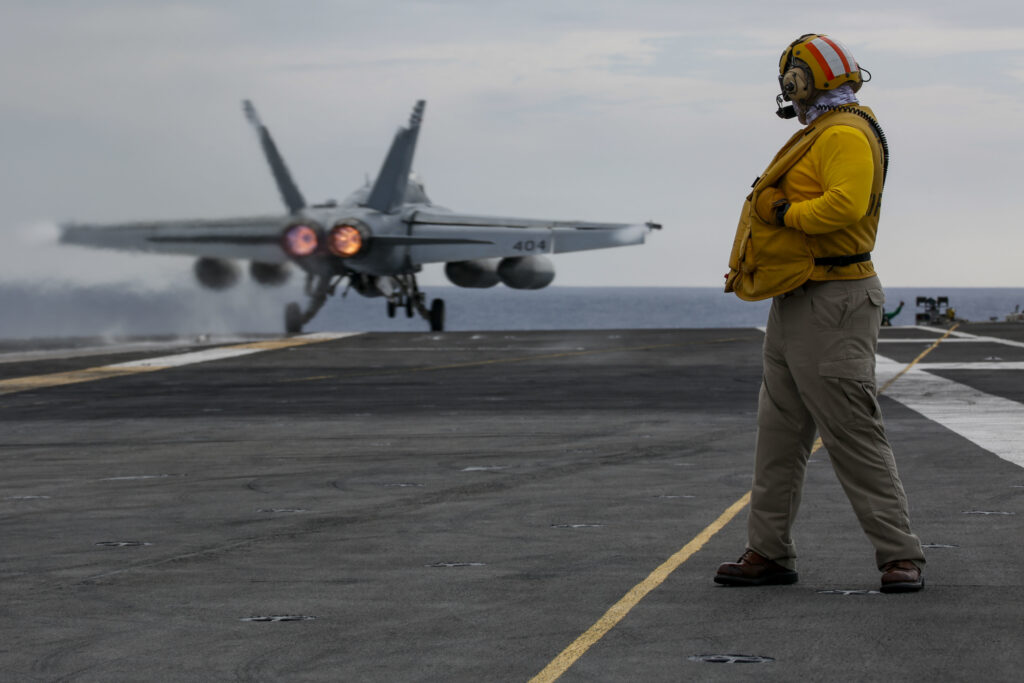
Lt. Stephen Yaccarino observes an F/A-18E Super Hornet, assigned to the “Vigilantes” of Strike Fighter Squadron (VFA) 151, launch from the flight deck of the Nimitz-class aircraft carrier USS Abraham Lincoln (CVN 72) on Feb. 8. U.S. NAVY / Mass Communication Specialist 3rd Class Michael Singley

ARLINGTON, Va. — The current world geo-political climate is evidence of the need for urgency in the fielding of new systems, a Navy program executive officer said. 

“It shouldn’t take 18 months to get [a new system] on contract; it should take 90 days,” said Rear Adm. Shane Gahagan, the Navy’s program executive officer for Tactical Aircraft Programs, speaking Feb. 9 at the National Defense Industrial Association’s Expeditionary Warfare Conference. 

Gahagan discussed several ongoing and future programs such as a replacement for the MH-60 helicopters; the Next-Generation Air Dominance program to replace the FA-18E/F Super Hornet strike fighter; the fielding of the Block III of the F/A-8E/F, and the life-extension program for the F/A-18E/F.  

“The pressure is the idea to pull all that to the left,” he said, stressing the need to accelerate development and field systems sooner in order to counter the rapid development weapons and other systems by potential adversaries such as China and Russia. 


AARGM-ER Completes 2nd Successful Missile Live Fire Test 

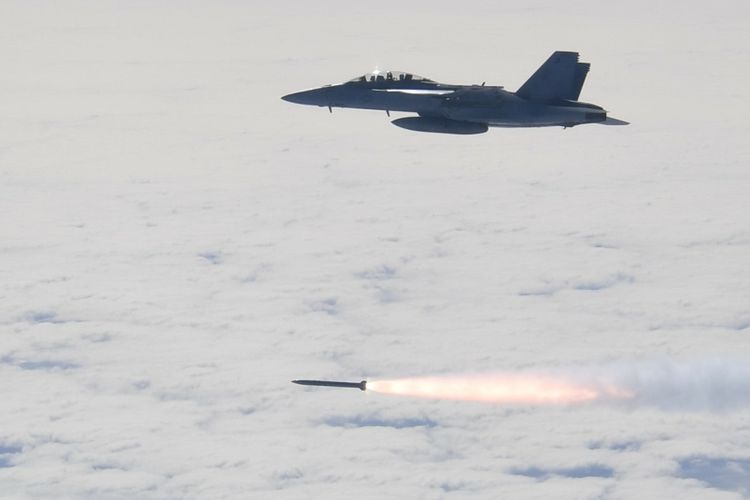
An AARGM-ER is successfully launched from a U.S. Navy F/A-18 Super Hornet during a recent test at the Point Mugu Sea Range, California. U.S. NAVY

LOS ANGELES — Northrop Grumman Corp. announced Feb. 7 the successful completion of the second flight test of its AGM-88G Advanced Anti-Radiation Guided Missile Extended Range.

The U.S. Navy launched the missile from an F/A-18 Super Hornet aircraft Jan. 21 at the Point Mugu Sea Range off the coast of southern California. The missile performed an extended range profile, engaging a land-based, emitter target staged at the range on San Nicholas Island. 

“This second flight test verified AARGM-ER’s ability to detect, identify, locate and engage a land-based air defense radar system from an extended range,” said Captain A.C. Dutko, Navy Program Manager for Direct and Time Sensitive Strike (PMA-242). “Through the exceptional efforts of our government-industry team, we are another step closer to delivering capability to suppress the most advanced adversary air-defense systems without putting our warfighters in danger.” 

Since achieving a milestone C decision (authorization for low-rate initial production) in September 2021, AARGM-ER prime contractor Northrop Grumman has continued to lead its industry team in developing the system. Northrop Grumman is currently under contract to deliver production units of AARGM-ER to support a 2023 initial operational capability fielding.  In December 2021, Northrop Grumman received a $45.6 million contract for the second lot of AARGM-ER LRIP. 

AARGM-ER leverages existing state-of-the-art AARGM sensors, electronics and digital models with the addition of a new high-performance air vehicle, solid rocket motor propulsion system and advanced warhead. 

“AARGM-ER provides the U.S. Navy with the capability to stay ahead of evolving threats,” said Mary Petryszyn, corporate vice president and president of Northrop Grumman Defense Systems. “This flight test further demonstrated the critical capability of AARGM-ER to precisely engage long-range threats, while enabling launching aircrew to remain at a safe distance.” 

AARGM-ER is being integrated on the Navy F/A-18E/F Super Hornet and EA-18G Growler aircraft as well as F-35A/B/C aircraft. 


Analysts: Navy’s LAW Shipbuilding Program Must Resist Requirements Creep 

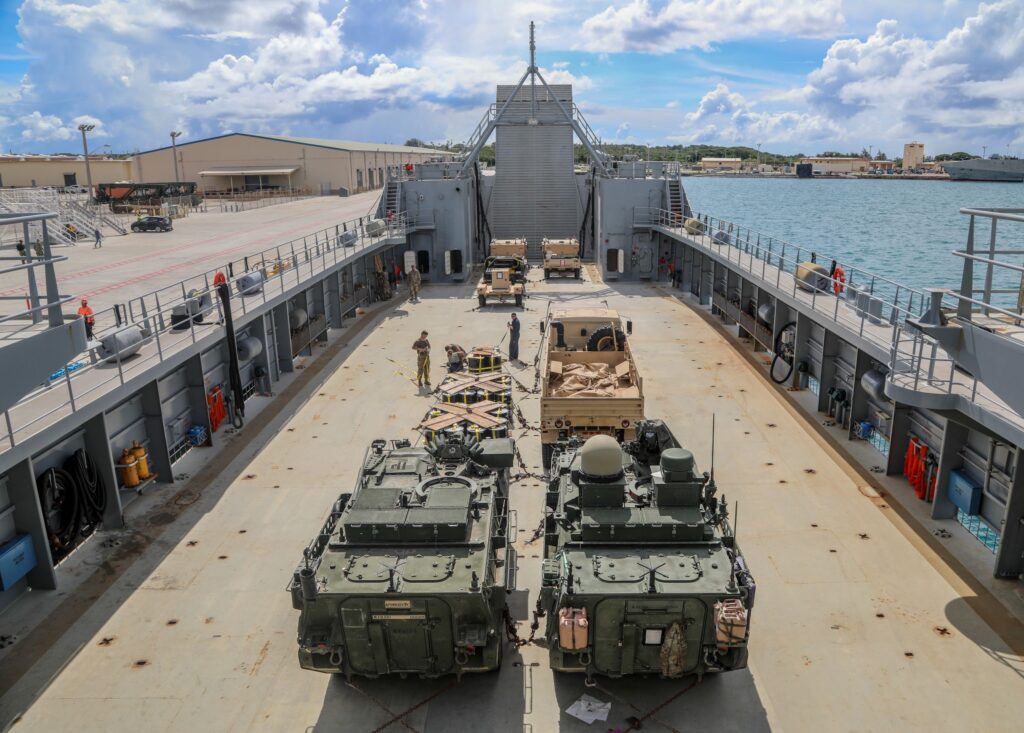
The crew of U.S. Army logistics support vessel Lt. General William B. Bunker (LSV-4), loaded equipment and supplies on LSV-4 in Guam in July 2021 for theater distribution operations in support of Defender Pacific 2021. Some call for the LSV to be used as a bridge to the Navy’s planned light amphibious warship. U.S. ARMY / Staff Sgt. Kevin Martin

ARLINGTON, Va. — The U.S. Navy’s program to build a force of light amphibious warships faces challenges, including an uncertain amphibious warfare fleet force structure requirement and a risk of requirements creep, according to analysts.

Eric Labs, senior analyst for Naval Forces and Weapons, Congressional Budget Office, and Ron O’Rourke, naval affairs analyst for the Congressional Research Service, spoke Feb. 8 at the National Defense Industrial Association’s Expeditionary Warfare Conference, addressing Navy shipbuilding plans with a focus on amphibious warfare ships.

The Navy, in response to the need of the Marine Corps for a large number of smaller amphibious warfare ships for distributed maritime operations and expeditionary advance base operations, is planning to design and build the light amphibious warship to augment the amphibious lift fleet. The LAW would be able to beach and discharge Marines and their vehicles on a shore. 

Labs pointed out that the future of amphibious forces is “facing challenging times for the next five years,” and finds that there is “no natural constituency” for the LAW. 

Labs said the number of LAWs needed by the fleet has not been refined. Recent shipbuilding plans, he pointed out, have variously assumed a build range of 24-35 LAWs. The requirement for large and medium-sized amphibious warfare ships — amphibious assault ships (LHA/LHDs) and amphibious transport dock ships (LPDs) — is no longer 38 ships, but over the last year variously is said to be 24 to 32 ships. The Navy has not provided to Congress a 30-year shipbuilding plan for two years. 

O’Rourke warned against requirements creep that could increase the cost of the LAW program and threaten the Navy’s estimate of a LAW’s cost of $130 million to $150 million. 

“The LAW represents an effort to break that price trend,” O’Rourke said. 

He noted the success of the Arleigh Burke-class guided-missile destroyer (DDG) in its beginnings, when the Navy determined to build five DDGs in one fiscal year, designing ships not just with capabilities in mind but also with numbers of ships in mind, and was able to meet its goal of five in one year.  

O’Rourke noted there is some pushback in Congress about the LAW concept because of concerns about the survivability of the ship and of the ability to resupply Marines inside an island chain where the Marines would be delivered. 

O’Rourke also noted a suggestion as an option that a small number U.S. Army’s logistic support vessels — similar in size to that envisioned for the LAW — be used as surrogates for the LAW, as a bridge to the LAW. The Army LSVs are equipped with a bow ramp to discharge vehicles on shore.  


USS O’Kane Returns Home from Deployment 

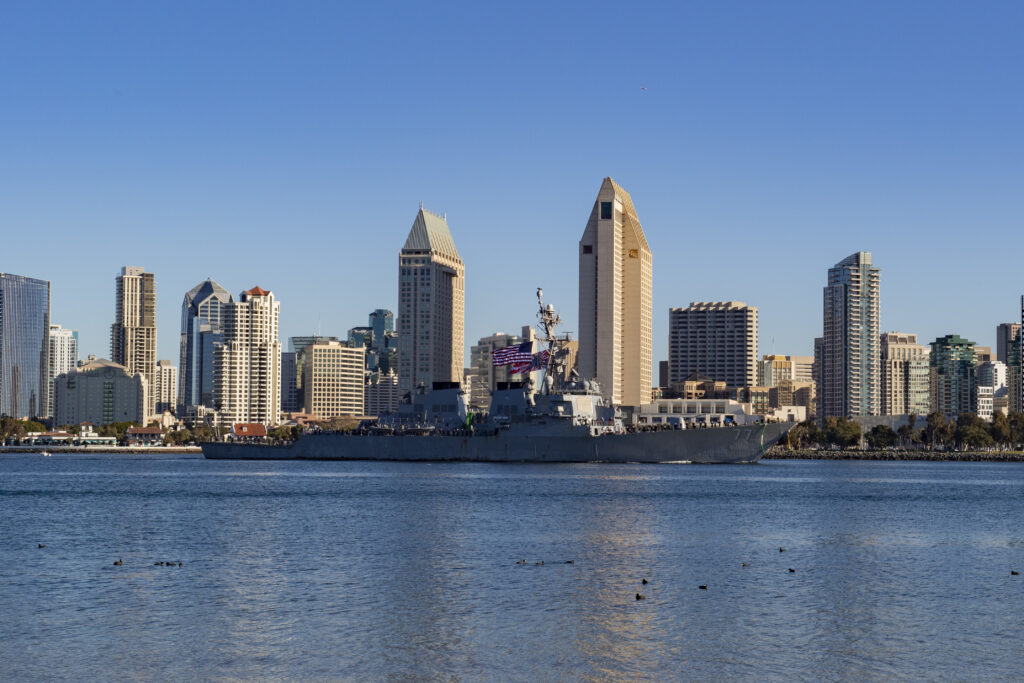
The guided-missile destroyer USS O’Kane (DDG 77) arrives returns to its homeport in San Diego. O’Kane, a part of the Carl Vinson Carrier Strike Group, returned to Naval Base San Diego Feb. 6, following an independent deployment to the U.S. 5th and 7th Fleets in support of national tasking and to ensure a free and open Indo-Pacific. U.S. NAVY / Mass Communication Specialist 2nd Class Kevin C. Leitner

SAN DIEGO — The Arleigh Burke-class guided-missile destroyer USS O’Kane (DDG 77) returned home to Naval Base San Diego on Feb. 6, completing an eight-month independent deployment to the U.S. 5th and 7th Fleet areas of operation, said U.S. 3rd Fleet public affairs. 

O’Kane deployed in June 2021 in support of national tasking, serving as the ballistic missile defense commander for Carrier Strike Group 1 while operating in the U.S. 7th Fleet and the primary ballistic missile defense asset while in the U.S. 5th Fleet. 

The Sailors aboard USS O’Kane lead the way in demonstrating resiliency and dedication to support the mission and each other,” said Cmdr. Michelle R. Fontenot, O’Kane’s commanding officer. “As an independent deployer serving in both the U.S. 5th and 7th Fleets, O’Kane met each mission with success.” 

While operating in U.S. 5th Fleet, O’Kane escorted multiple high-value units through 30 strait transits, including the Strait of Hormuz, Bab el-Mandeb and the Suez Canal. O’Kane participated in several high-end exercises such as maritime security operations in support of the International Maritime Security Coalition, collaborating with seven partner nations for security and the free flow of commerce.

O’Kane also participated in Indigo Defender, a bilateral maritime exercise between Saudi naval forces and U.S. Naval Forces Central Command. In addition, O’Kane conducted maritime interdiction operations; board, search, and seizure operations; and operated alongside international navies, including the Egyptian naval force, Royal Saudi navy and the Indian navy.

Following Israel’s transition from the U.S. European Command theater to U.S. Central Command area of responsibility in September, O’Kane Sailors were able to enjoy a visit to Haifa, further strengthening the U.S.partnership with Israel.

O’Kane served as a key facilitator in a highly successful seizure of illicit cargo from a stateless fishing vessel during a flag verification boarding in accordance with customary international law in the North Arabian Sea on Dec. 20. O’Kane worked alongside the Cyclone-class coastal patrol ships USS Tempest (PC 2), USS Typhoon (PC 5), and the U.S. Coast Guard Advanced Interdiction Team to seize 1,400 AK-47s and 226,000 rounds of ammunition. 

Upon completion of the missions in U.S. 5th Fleet, O’Kane entered U.S. 7th Fleet and took part in expeditionary strike force operations with the Wasp-class amphibious assault ship USS Essex (LHD 2) and the Nimitz-class aircraft carrier USS Carl Vinson (CVN 70). The U.S. force of more than nine ships conducted underway replenishments, including vertical and connected replenishments. O’Kane executed anti-submarine warfare operations while escorting high-value assets through the South China Sea.

“O’Kane’s tireless commitment and unparalleled performance are above reproach. I am very proud of every O’Kane Sailor and what we have accomplished as a team,” said Fontenot. “O’Kane Sailors represent the Navy’s fighting spirit and it is an honor to serve them as their commanding officer.” 


Rep. Luria: Congress Needs Frank Budget Requirements from Navy — and Consequences of Not Funding Them  

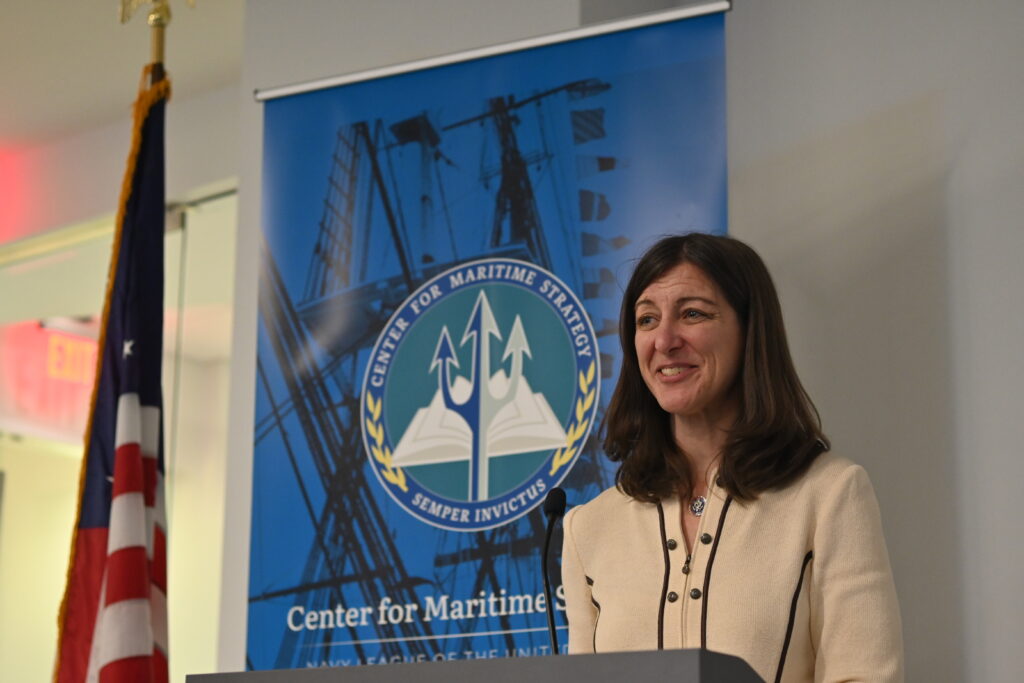
Rep. Elaine Luria (D-Virginia), speaking at the Jan. 31 ribbon cutting for the Center for Maritime Security. NAVY LEAGUE / Brett Davis

ARLINGTON, Va. — The Navy needs to be frank in telling Congress what it needs to meet its warfighting requirements in the National Defense Strategy and the consequences if requirements are not funded, the vice chair of the House Armed Services Committee said Feb. 7.  

“As a member of Congress, what do we want to hear? We want the services to come to us and essentially say, ‘This is what we need, this is why, and — most of all — this is the risk of not doing it,’” said Rep. Elaine Luria, (D- Virginia), deputy chair of the HASC, in a conversation with the Hudson Institute’s Bryan Clark. “And that is a portion of what is not being communicated.  

“It’s like a shell game,” Luria said. “The Navy comes to us and says, ‘We only want to build one DDG this year,’ but the other DDG is on your unfunded list?”  

She said Congress needs to know the risks of not funding budget requirements. 

“Then it is on Congress to make a decision about the risk of not doing those things,” she said. “It is never articulated. It shouldn’t be up to Congress to say to the Navy, ‘Hey, we really want to give you more,’” she said. 

“It’s all backwards,” Luria said. “There should be a strategy, the strategy drives the requirements, the requirements drive the POM [Program Objective Memorandum], the POM [becomes] the budget.” 

Luria, a retired Navy nuclear-trained surface warfare officer, said she watched recordings of the testimony before Congress during the 1980s of then-Navy Secretary John Lehman advocating his Maritime Strategy and a 600-ship Navy. 

“Essentially, where the discussion led [was], ‘This is what we need — that equals 600 ships — and here’s the risk of not doing that,’” she paraphrased Lehman as saying.  

“That’s not being communicated in that way [today],” noting that things like 30-year shipbuilding plans are not “put into context, what that means, what presence delivers, and what deterrence that equates to with regard to China potentially trying to take Taiwan by force. It’s not being communicated in a way that’s compelling.  

“There is a lack of a maritime strategy, and it is important to understand what the strategy is,” Luria said. “I think the previous administration had a good focus on what needed to be done. … We’re kind of starting over again without really understanding what the future of the fleet looks like.”  

Luria questioned the integrated deterrence concept of the current administration as not something new, but a “just the newest buzzword. Has anyone clearly defined what it is?” 

The lawmaker said for deterrence, “you actually have to have deterrence — you have to have the forces.” 

She has been critical of Navy plans to “divest to invest,” noting the investments are frequently short-changed, resulting, for example, in “two decades of lost shipbuilding opportunities.” 

Luria affirmed that more budget resources “need go to the Navy and the Air Force because that’s the nature of the [Pacific] theater.”   


HII Completes Initial Sea Trials of Virginia-class Submarine Montana  

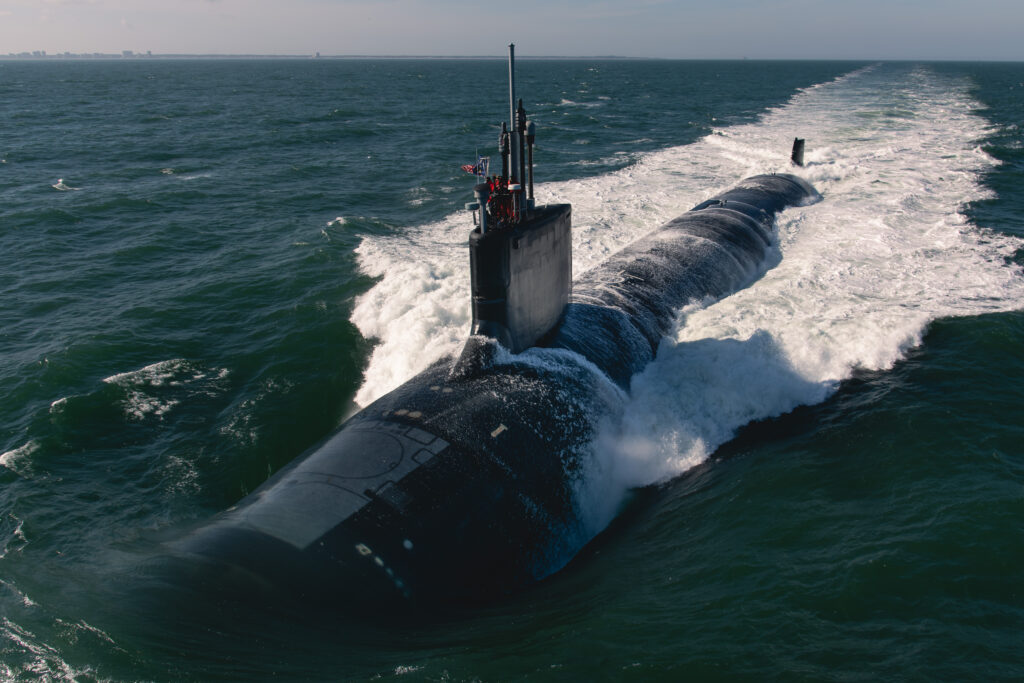
USS Montana has successfully completed sea trials, Huntington Ingalls Industries announced Feb. 7. HUNTINGTON INGALLS INDUSTRIES / Ashley Cowan

NEWPORT NEWS, Va. — Huntington Ingalls Industries announced Feb. 7 the successful completion of the initial sea trials last week of fast attack submarine USS Montana (SSN 794). The Virginia-class submarine, built at HII’s Newport News Shipbuilding division, spent several days at sea last week to test the ship’s systems and components. 

Testing included submerging the submarine for the first time and high-speed maneuvers while on the surface and submerged. HII teams will continue the testing program and will deliver the boat to the U.S. Navy later this year. 

“We are very proud to say the Montana and her crew performed exceptional,” said Jason Ward, Newport News Shipbuilding vice president of Virginia-class submarine construction. “Taking the ship to sea for the first time is a huge milestone for everyone involved. The crew, thousands of suppliers from around the country and shipbuilders from HII and Electric Boat can be proud the ship was successfully brought to life and will soon be part of the world’s greatest Navy.” 

Construction of Montana began in 2015. The boat — the 21st Virginia-class submarine built as part of the teaming partnership with General Dynamic’s Electric Boat — was christened in September 2020. 


Littoral Combat Ship USS Savannah Commissioned 

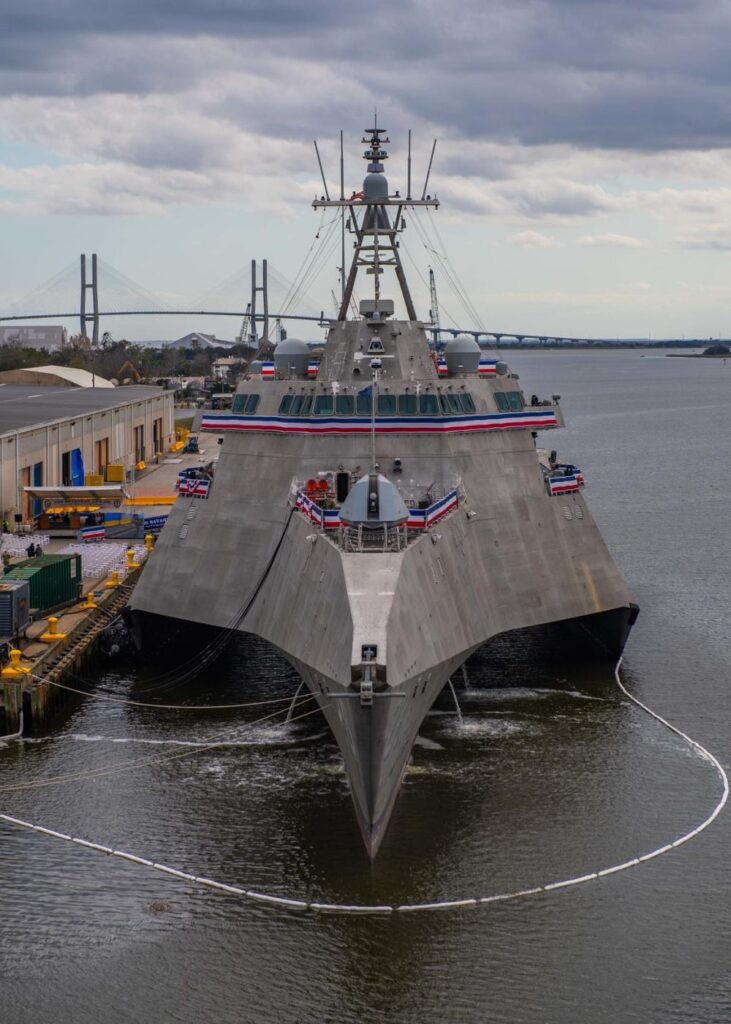
The U.S. Navy commissioned its newest Independence-variant littoral combat ship, USS Savannah (LCS 28), on Feb. 5 in Brunswick, Georgia. U.S. NAVY / Mass Communication Specialist 2nd Class James S. Hong

BRUNSWICK — The U.S. Navy commissioned its newest Independence-variant littoral combat ship, USS Savannah (LCS 28), Feb. 5 in Brunswick, Georgia, the commander, Naval Surface Forces, said in a release. 
 
“It’s fitting that it would find its home in Savannah — a city whose agility has allowed her to be a defining force in the entire scope of American history,” said principal speaker U.S. Rep. Earl L. “Buddy” Carter (R-Georgia). 
 
Diane Davison Isakson is the ship’s sponsor and wife of the late Johnny Isakson, former senator from Georgia. Their daughter, Julie Isakson Mitchell, served as the matron of honor. Meredith Berger, performing the duties of the undersecretary of the Navy, recognized Isakson. 
 
“It is said that the character and spirit of the ship’s sponsor serves to enrich, guide, and protect the ship and her crew,” said Berger. “You come from a family steeped in service. You’ve got Navy in your blood.” 
 
Guest speakers for the event also included Mayor of Savannah Cosby Johnson, Mayor of Brunswick Van Johnson, and Vice Adm. Carl Chebi, commander of Naval Air Systems Command. 
 
“The USS Savannah is poised to represent its motto across the globe, not for self but for others,” said Chebi. “Today as we commission her as an operating force of the U.S. Navy. The ship and her crew will carry on the legacy of the five other ships that had the honor to bear the name Savannah since 1798. They participated in the Mexican War, the Civil War, World War I, World War II and the Vietnam War. The sixth USS Savannah’s history has yet to be written but will be enriched in stories of honor, courage, and commitment.” 
 
During the ceremony, Savannah’s commanding officer, Cmdr. Kevin M. Ray, reported the ship ready, and Isakson gave the traditional order to “man our ship and bring her to life.” 
 
“To the city of Savannah, I assure you, the fine men and women of our crew, who I am humbled to lead, represent everything that is great about your city. Pride, patriotism, resiliency, diversity, and hospitality,” said Ray. “We will carry your name forward, wherever our Nation asks us to go, and we will represent you well.” 
 
Following commissioning, Savannah will sail to California to be home ported in San Diego, joining sister ships USS Coronado (LCS 4), USS Jackson (LCS 6), USS Montgomery (LCS 8), USS Gabrielle Giffords (LCS 10), USS Omaha (LCS 12), USS Manchester (LCS 14), USS Tulsa (LCS 16), USS Charleston (LCS 18), USS Cincinnati (LCS 20), USS Kansas City (LCS 22), USS Oakland (LCS 24) and USS Mobile (LCS 26). 


CNO and MCPON Visit Norfolk for Naval Safety Command Establishment, Fleet Engagement  

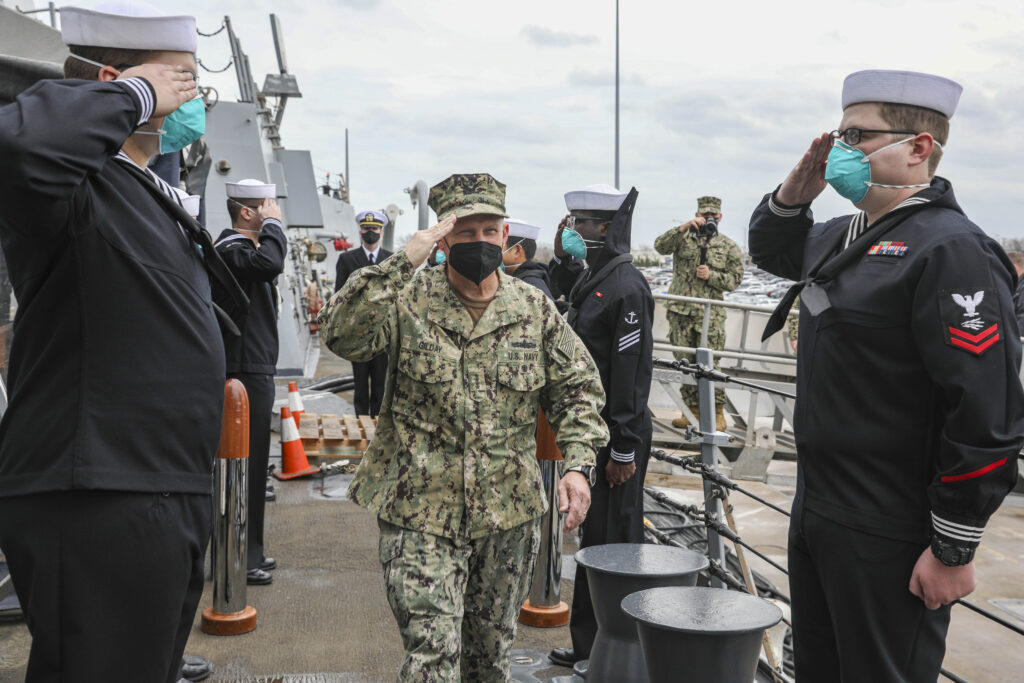
Chief of Naval Operations Adm. Mike Gilday salutes Sailors assigned to USS Mason (DDG 87) during a visit to the ship on Feb. 4. CNO Gilday and Master Chief Petty Officer of the Navy Russell Smith were in Norfolk for an establishment ceremony for the Naval Safety Command, previously known as the Naval Safety Center, and to visit various local commands. U.S. NAVY / Mass Communication Specialist 3rd Class Jeremy R. Boan

NORFOLK, Va. — U.S. Chief of Naval Operations Adm. Mike Gilday and Master Chief Petty Officer of the Navy Russell Smith visited Norfolk Naval Station to attend the establishment ceremony of the Naval Safety Command and visit local Norfolk-based commands on Feb. 4. 

Gilday was the guest speaker for the establishment ceremony, during which the Naval Safety Center was elevated to the Naval Safety Command.  

This elevation, highlighted during his remarks at the Surface Navy Association symposium in January, was a key component of Gilday’s call to action for the U.S. Navy to “get real, get better.” 

“The establishment of the Naval Safety Command expands our focus on safety and leverages ‘get real get better’ principles, while we evaluate safety management and performance of the Navy and Marine Corps,” said Gilday.  

The get real, get better program seeks to reduce the gap between the Navy’s least and most capable performer, cement dynamic learning and innovation into Navy culture, and build better leaders and teams who are ready to solve problems more effectively.  

“The significance of today’s establishment can be summarized simply: It’s a vital change that will increase warfighting readiness,” said Gilday. “Almost no aspect of naval operations can be separated from risk, but risk can be reduced.”  

The Navy elevated the Naval Safety Center to the Naval Safety Command following the USS Bonhomme Richard fire and the Major Fires Review.  

“We will empower our Sailors, Marines and civilians by collecting their insights to bolster our safety culture,” said Commander, Naval Safety Command Rear Adm. Frederick Luchtman. “Ultimately, the command will serve as a force multiplier of a culture that incorporates risk management and accountability by all individuals, regardless of rank and position.” 

Gilday, Luchtman and Hailey unveiled the command’s new seal during the ceremony. Key elements of the seal include a blue and red shield representing protection across the naval enterprise, blue for the Navy’s dominance on, under and over the maritime domain, and red for the courage and tenacity of the Marine Corps, said the command’s press office. The globe behind the shield symbolizes naval warriors, wherever they serve worldwide, under the protection of safety principles. 

The new command motto featured on the seal, “Enabling Warfighting Readiness,” is a testament to the command’s mission to preserve warfighting capability, combat lethality and enable readiness by working with its stakeholders to identify and mitigate or eliminate hazards to reduce unnecessary risk to people and resources. 

“The Naval Safety Command will provide transparency into emerging risk trends and the current safety status of all commands through enhanced risk identification, communication, and accountability, as well as data collection, management, and product dissemination, which will protect our most important resource, our Sailors, Marines, and civilians whose lives we value above all else.” Luchtman said. 

For more information or resources from the Naval Safety Command, visit the command website at https://navalsafetycommand.navy.mil

Other Visits

While in Hampton Roads, Gilday and Smith also visited the Arleigh Burke-class guided-missile destroyer USS Mason (DDG 87) and the Ticonderoga-class guided-missile cruiser USS Gettysburg (CG 64) where they met with Sailors and leadership. 

“Having the opportunity to travel with CNO while having unfiltered, candid conversations with Sailors provides essential feedback that improves our fleet and increases combat readiness. Our people are truly paramount to readiness; without them, Gettysburg and Mason could not perform the multitude of missions they were designed for. It is our Sailors who will ensure we prevail in combat,” said Smith.