CNO to Elevate Navy Safety Center to a Two-Star Command
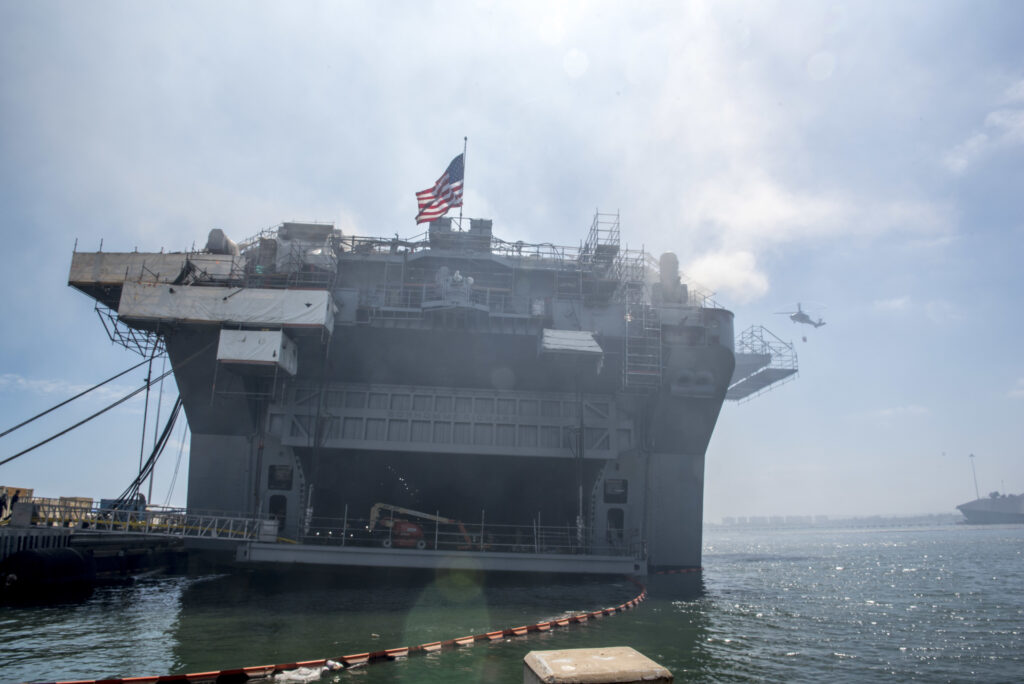
A helicopter from Helicopter Sea Combat Squadron 3 combats a fire aboard the amphibious assault ship USS Bonhomme Richard (LHD 6). U.S. NAVY / Mass Communication Specialist 1st Class David Mora Jr.
ARLINGTON, Va. — The chief of naval operations is increasing the focus of the Navy on safety in its operations by elevating the Naval Safety Center to a full command.
CNO Adm. Michael Gilday, speaking Jan. 11 to an audience at the Surface Navy Association’s annual symposium in Arlington, said the Naval Safety Center in Norfolk, Virginia, would be redesignated the Navy Safety Command and its commander would be a two-star admiral with experience as a carrier strike group commander.
“That command will evaluate how the entire Navy — from the fleet commander down — manage safety and risk, and it will grade how effectively commands are self-assessing performance,” the CNO said.
The commander of the Navy Safety Command would report directly to the CNO.
Gilday said he considered the Navy’s Board of Inspection and Survey as a model for the Naval Safety Command and how it will perform.
The Navy has suffered a number of high-profile collisions at sea in recent years, most notably the 2017 collisions of the Arleigh Burke-class guided-missile destroyers USS Fitzgerald and USS John McCain with merchant ships, resulting in the deaths of 17 Sailors. The amphibious assault ship US Bonhomme Richard was damaged beyond economical repair in 2020 by a fire while pierside.
Gilday noted in his speech that the fleet had suffered “14 other major fire events in the past 12 years.”
Kitchener: SWO Retention on An Upward Trend
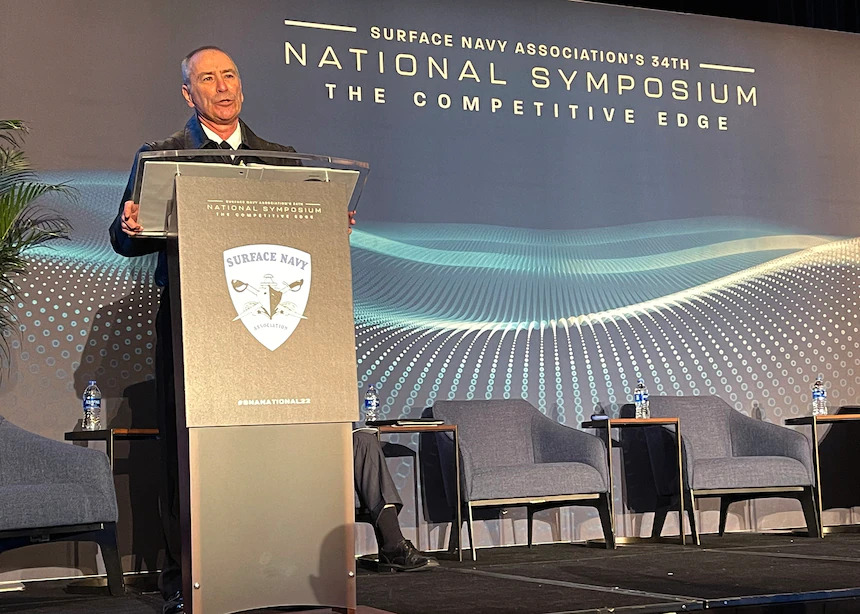
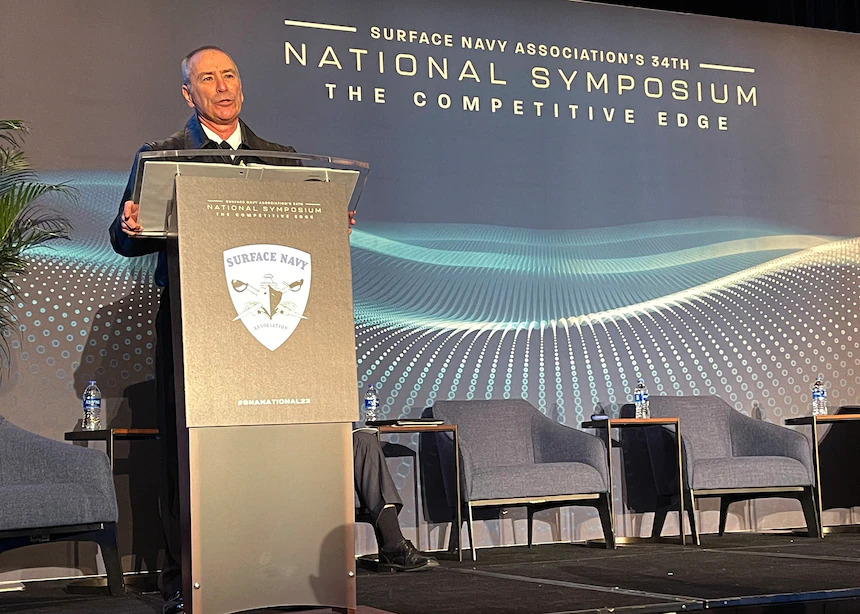
Vice Adm. Roy Kitchener, speaking at the Surface Navy Association’s annual symposium. U.S. NAVY
ARLINGTON, Va. — The retention of surface warfare officers is improving, the U.S. Navy’s “surface boss” said, one metric that affirms the Navy’s efforts to assess its readiness and to take action to address the challenges.
“Within the wardroom, SWO retention continues on an upward trend, a 5% increase over the past five years, exceeding or remaining on par with the aviation and submarine communities,” said Vice Adm. Roy Kitchener, speaking Jan. 11 to an audience at the Surface Navy Association’s annual symposium in Arlington, Virginia.
“While a positive indication, there’s still a lot of work to do, and we’re really not satisfied where we are,” Kitchener said.
“We’ll be looking at the entire career spectrum through an analytical lens to determine what our officer retention goal should be,” he said. “We need to think differently about how we manage retention. I would submit that past retention policies may not help us retain the best talent as we move into the future.”
Kitchener said the Navy is looking at how other services and other high-performing organizations “manage their talent pool.”
He also said the Navy will look at important factors such as childcare and family planning.
“We’re also devoting resources to retention in a number of ways throughout the SWO career path with increased compensation, diverse education opportunities, tours within industry, and additional flexibility in their career path,” he said. “We have a lot of work to do in this area, but we are committed to the task.”
CNO Gilday Issues New ‘Charge of Command’ to Commanders
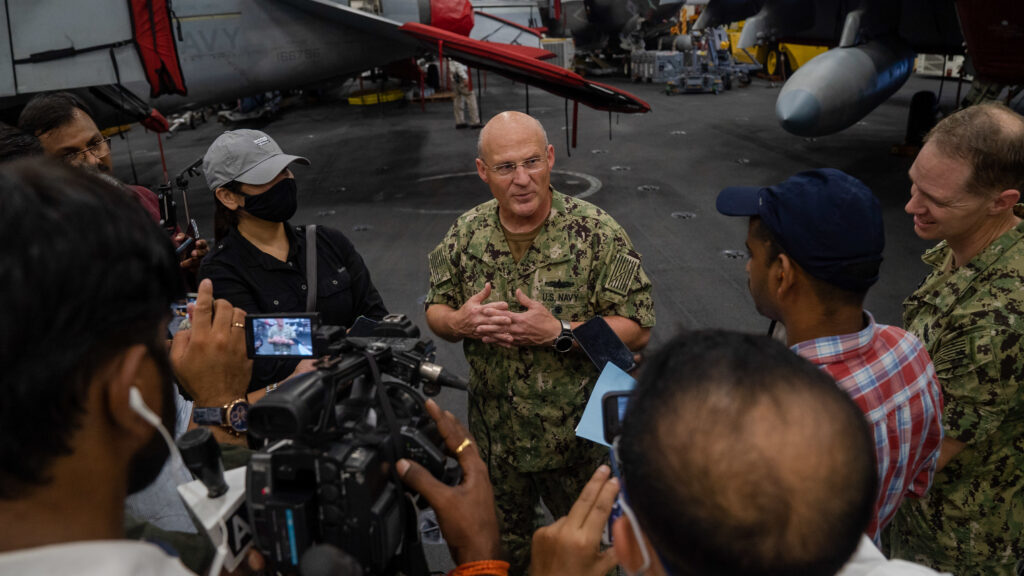
Adm. Mike Gilday, Chief of Naval Operations, addresses media in the hangar bay of Nimitz-class aircraft carrier USS Carl Vinson (CVN 70) as part of maritime exercise Malabar 2021, Oct. 14, 2021. U.S. NAVY / Mass Communication Specialist Seaman Emily Claire Bennett
WASHINGTON — Chief of Naval Operations Adm. Mike Gilday issued a new “charge of command” to commanders Jan. 10, the CNO’s public affairs said in a release.
The document highlights and lays out CNO’s expectations for commanders at every level and focuses on several key topics, including professional competency, integrity, character and preparing for and leading in combat.
“The responsibility of command is absolute, and we take our commanding officers’ performance very seriously,” said Gilday. “We place a great amount of trust and confidence in our commanding officers, rely on them to manage risk, make decisions, and communicate openly and honestly, especially in crisis.”
Gilday said his expectation is that leaders use the charge as a foundational point for conversations about standards of performance.
“Above all, command, whether at sea or ashore, is fundamentally about preparing for and leading in combat,” the charge reads. “Never lose sight of this — seize absolute ownership of your assigned mission, and all that goes into its accomplishment. When called upon to sail into harm’s way, you and your team must be ready. Your command’s mission is absolutely essential to the Navy’s ability to fight and win. Imbue this belief in your team.”
Gilday also stressed the need for commanders to set the example for their Sailors.
“As the commander, you are the example your team reflects,” the charge reads. “Embody humility, selflessness, and complete transparency. Acknowledge the value of every Sailor and civilian. Take care of them and their families. Embrace diversity of thought and background. Foster inclusion and connectedness. Always do the right thing, especially when it is hard. In doing these things, keep close watch on your own mental, physical, and emotional health, and the health of those you lead.”
The last charge of command was issued by former CNO Adm. John Richardson in 2018.
Commander, Naval Surface Force Releases Force Alignment Document
Vice Adm. Roy Kitchener released a new surface force alignment document, “Surface Warfare: The Competitive Edge,” on Jan. 11. U.S. NAVY
ARLINGTON, Va. — Vice Adm. Roy Kitchener, commander of Naval Surface Forces released “Surface Warfare: The Competitive Edge,” at the Surface Navy Association National Conference, Jan 11, the Navy said in a release.
The document was designed to better align the surface force in the face of increasing technological complexity and rising strategic challenges.
In the paper, Kitchener cites the strategic importance of the surface force to America’s forward-deployed conventional deterrence posture, a posture that depends on surface ships creating “…numerous operational dilemmas arising from present, powerful, networked, interoperable forces.”
“The surface force and the surface warfare enterprise must better align in order to get in front of the challenges we face — challenges stemming from serious strategic competition and the complexity of the force we are becoming,” said Kitchener.
Citing five main lines of operation along which the surface force must plan, Kitchener pointed to the coming decade as one of unprecedented complexity, in which 10 new or modified platforms will either join the fleet or begin production. Adding to this complexity will be the fielding of a new fleet radar, (the SPY-6 family), a new electronic warfare system (SEWIP Block III) and a new computer program that integrates them, Aegis Baseline 10.
“This document directs action to lead the target, thereby providing our ships and crews with the tools they need,” said Kitchener. “Together, we will remove obstacles and break through barriers that impede our success.”
The five lines of effort in the document (develop the leader, warrior, mariner, and manager; deliver more, ready ships; achieve excellence in fleet introduction; create clear and innovative operational concepts; and establish infrastructure for the future force) are each assigned to responsible flag officers, called LOE owners, for action, and include specific tasks with deadlines for completion.
Kitchener will lead these efforts and require periodic updates, as well as provide the surface warfare community with regular updates.
The Five Lines of Effort
· Develop the leader, warrior, mariner, and manager: LOE owner is commander, Naval Surface Forces. “The surface force builds leaders, warriors, mariners, and managers, and each of these roles requires training, education and mentoring. While we continue to field increasingly sophisticated technology, the human element remains central.”
· Produce more ready ships: LOE owner is commander, Naval Surface Forces. “The essence of this LOE is to force new thinking about the force we have and consider ways of getting more out of it by planning, maintaining, and operating it more wisely.”
· Achieve excellence in fleet introduction: LOE owner is commander, Naval Surface Forces Atlantic. This LOE focuses on improving surface force performance in platform and capability introduction by applying lessons learned from both the successes and the challenges of the past 50 years.
· Create clear and innovative operational concepts: LOE owner: Commander, Surface and Mine Warfare Development Command. This LOE tasks SMWDC with developing the people, the concepts and the facilities necessary to derive and provide innovative warfighting concepts to accompany new platforms and capabilities.
· Establish infrastructure for the future force: LOE owners are OPNAV N95/96. This LOE focuses on the command and control infrastructure of surface forces, the physical infrastructure of surface forces, and the land-based, developmental infrastructure necessary to support Surface Force development.
Highlights of ‘The Competitive Edge’
· Recognizes both the complexity of platforms and capabilities entering the force in the next decade and the strategic challenges those platforms and capabilities are addressing.
· Assigns responsible parties with required dates of accomplishment.
· Strengthens force emphasis on data analytics.
· Considers the introduction of warfare tactics instructors to program offices to ensure tight coupling of concepts with acquisition.
· Requires OPNAV N96 to produce an integrated combat system campaign plan and PEO IWS to produce an integrated combat system roadmap. The roadmap will have at least a 10-year horizon.
· Considers the return of fleet introduction teams to enhance transition of new platforms to the force.
· Assigns SMWDC to develop a capability introduction road map for Maritime Strike Tomahawk, as part of a larger emphasis on SMWDC growing into the center of warfighting innovation, experimentation and virtual warfighting.
· Requires a 10-year roadmap for class-specific land-based facilities and infrastructure requirements to reduce technical risk in capability introduction.
Lockheed Martin Upgrading SPY-1 Radars on 21 DDGs to Counter Evolving Threats
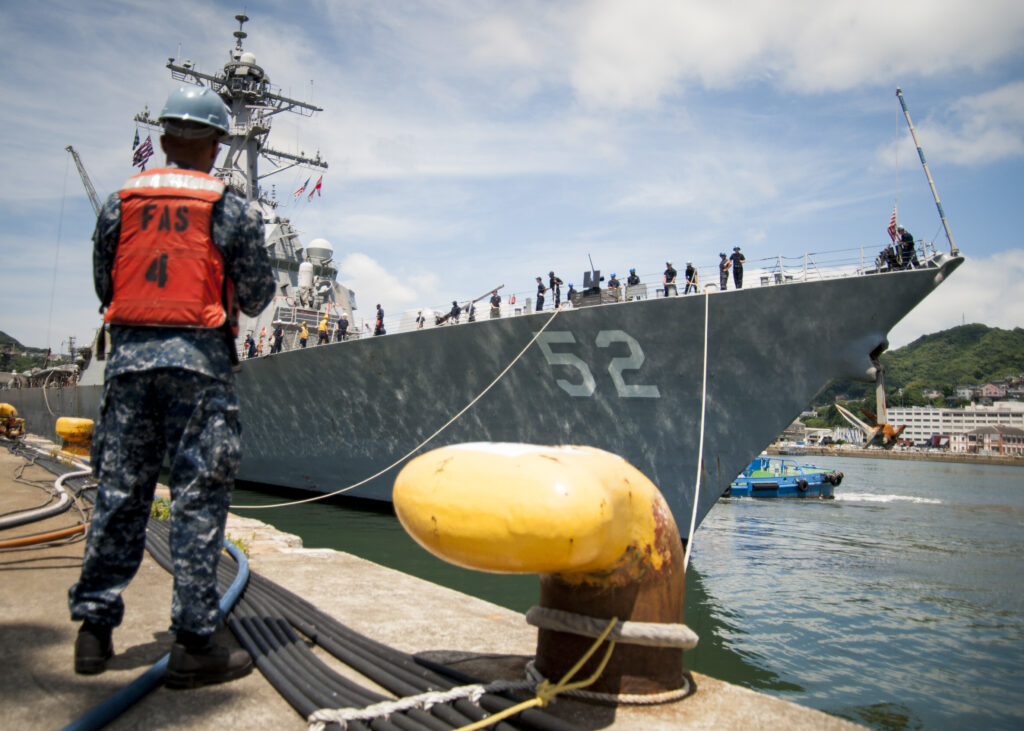
Arleigh Burke-class guided-missile destroyer USS Barry (DDG 52) pulls into Commander, U.S. Fleet Activities Sasebo, Japan, in 2016. U.S. NAVY / Mass Communication Specialist 3rd Class Kristopher S. Haley
ARLINGTON, Va. — Lockheed Martin is continuing to upgrade primary radars on a number of the U.S. Navy’s guided-missile destroyers (DDGs), a company official said. Older SPY-1 versions are being modified with digital Low Noise Amplifiers, or LNAs, which can improve their sensitivity and thereby improve the accuracy, range and discrimination of the radar.
“How do you develop a low-cost, high-payoff solution to keep SPY-1 relevant as the threat evolves?” Jon Rambeau, Lockheed Martin’s vice president and general manager for Integrated Warfare Systems and Sensors, asked rhetorically in an interview with Seapower, pointing to the LNA as a step in that direction.
The SPY-1 radar is the primary sensor of the Aegis Combat System on the U.S. Navy’s Ticonderoga-class cruisers and Flight I, II and IIA Arleigh Burke DDGs and is used to detect and track aircraft, cruise missiles and ballistic missiles.
The LNA is part of the upgrade of the 21 Flight I and II DDGs to enable a “full BMD [ballistic missile-defense] capability in accordance with the 2030 Missile Defense Review,” Rambeau said.
He said Lockheed Martin is under contract for upgrading nine SPY-1 arrays under funding provided by the Navy and the Missile Defense Agency. The arrays are being tested and made ready for installation of the DDGs.
Rambeau there was “some discussion around the Navy’s future plans for those 21 ships and that’s something we’re watching very carefully.”
He said the LNA upgrade may be something the company thinks can be relevant for international customers as well.
CNO Emphasizes Hypersonics During Alabama Visit
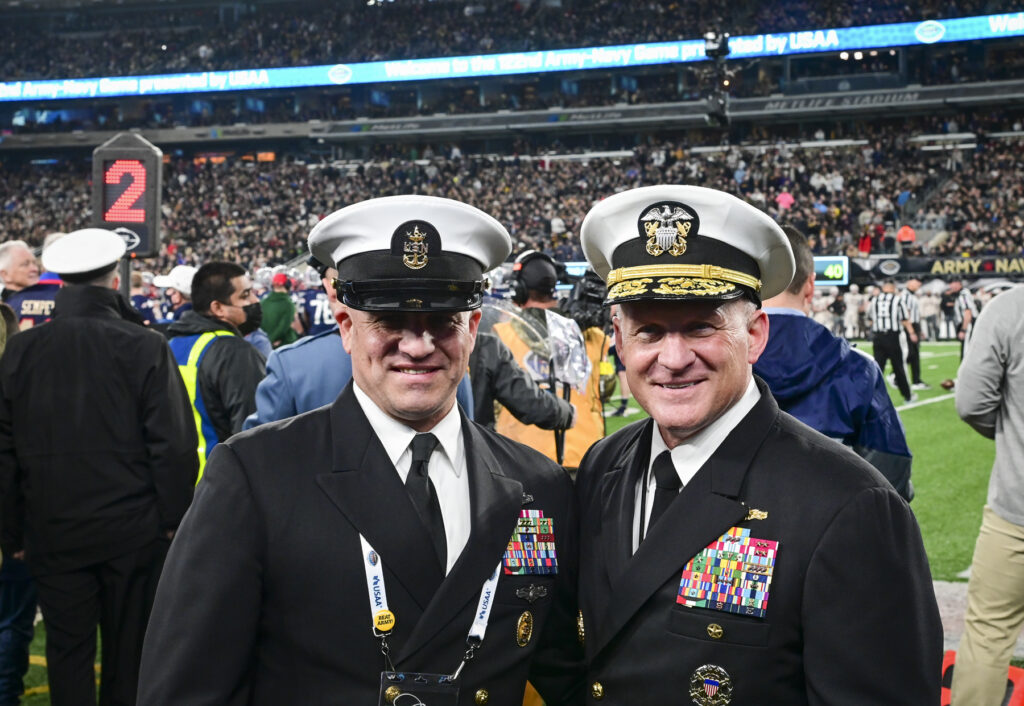
Chief of Naval Operations (CNO) Adm. Mike Gilday, right, and Master Chief Petty Officer of the Navy Russell Smith, shown here during the 122nd Army-Navy football game. U.S. NAVY / Mass Communication Specialist 1st Class Sean Castellano
HUNTSVILLE, Ala. — Chief of Naval Operations Adm. Mike Gilday traveled to Courtland and Huntsville, Alabama, Jan. 6, to visit Dynetics and Lockheed Martin facilities with Alabama Rep. Mo Brooks, the CNO’s public affairs officer said in a release.
Gilday toured facilities and received updates about hypersonic weapon technology development, advancements, and capabilities.
“In order to maintain a warfighting advantage against the increasingly aggressive modernization efforts of our primary challengers, it is imperative to accelerate the development and fielding of hypersonic capabilities,” Gilday said. “Our partnerships with the Army and industry are paramount as we transition hypersonics from developmental to operational systems at speed and scale that will meet the needs of our Sailors, Soldiers and the nation.”
Hypersonic weapons, capable of flying at speeds greater than five times the speed of sound, or Mach 5, are highly maneuverable and operate at varying altitudes. The U.S. Navy and Army are working together to expand hypersonic capabilities through the use of a common glide body, common missile design and joint test opportunities to field hypersonic weapon systems in the mid- to late-2020s.
“Hypersonic systems provide a combination of speed, maneuverability and altitude that enables highly survivable, long-range, rapid defeat of time-critical, heavily-defended and high value targets,” Gilday said. “Delivering hypersonic weapons continues to be one of the Navy’s highest priorities, which the Navigation Plan makes clear.”
“I appreciate Adm. Mike Gilday for taking the time to visit Courtland and Huntsville as part of the Navy and Army’s collaboration with industry, government national laboratories, and academia to field hypersonic warfighting capability,” said Brooks.
“As the co-chair of the newly formed House Hypersonics Caucus, I’m doing all I can to help my congressional colleagues understand that hypersonic systems are absolutely vital to America’s missile defenses and should be an urgent priority.” Brooks said. “China and Russia are diligently strengthening their hypersonics capabilities and America must keep pace.”
The Navy and Army have been working in collaboration with industry, government national laboratories, and academia to field hypersonic warfighting capability.
This visit marked CNO’s first trip to Huntsville and Courtland.
BAE Systems to Modernize USS Mitscher
The Arleigh Burke-class guided-missile destroyer USS Mitscher (DDG-57) prepares to conduct a fueling-at-sea with the Nimitz-class aircraft carrier USS Dwight D. Eisenhower (CVN 69) in February 2021. U.S. NAVY / Mass Communication Specialist 3rd Class Cameron Pinske
NORFOLK, Va. — BAE Systems has received a $1.9 million contract from the U.S. Navy for the maintenance and modernization of the Arleigh Burke-class guided-missile destroyer USS Mitscher (DDG 57). The value of the competitively awarded contract could reach $101.2 million if all options are exercised.
Under the docking selected restricted availability contract awarded, BAE Systems will dry-dock the ship, perform underwater hull preservation work, support the Navy’s efforts to upgrade the ship’s Aegis combat system and its command-and-control equipment and refurbish the living spaces for the ship’s 285 crewmembers. The work is expected to begin in March 2022 and to be completed in April 2023.
“Our team looks forward to the preservation and upgrade work aboard USS Mitscher,” said Mike Bruneau, vice president and general manager of BAE Systems Norfolk Ship Repair. “With our subcontractor teammates and Navy personnel alongside, we will apply our experience with the DDG class to ensure this ship returns to the fleet mission-ready and fully capable to support our national security.”
BAE Systems’ Norfolk shipyard is performing similar work aboard the guided-missile destroyer USS Stout (DDG 55).
USS Mitscher is the second U.S. Navy ship named in honor of Adm. Marc Mitscher (1887-1947), who served as commander of the Fast Carrier Task Force 58 in the Pacific, the Navy’s main striking force during the latter half of World War II. The current ship was commissioned in December 1994.
Navy Stands Up High-Powered Microwave Division to Refocus Directed Energy Efforts
Nhan Bhui, a statistician at Naval Surface Warfare Center Dahlgren Division, works on a boat motor. Using high powered microwaves, Bhui and scientist Thomas Salvato are testing vessel stopping efforts. NAVAL SEA SYSTEMS COMMAND
DAHLGREN, Va. — Under the directed energy umbrella, there are two significant areas of interest: high-energy laser and high-power microwave weapon systems, or HPM. At Naval Surface Warfare Center Dahlgren Division, the growing demand from the operational community for novel directed energy weapon systems resulted in a corresponding growth in NSWCDD’s technical capability in this area, the center said Jan. 5.
During a recent reorganization of the Integrated Engagement Systems Department, leadership looked at the two directed energy areas historically maintained in a single division and made the strategic decision to split them into respective divisions, recognizing the need for continued growth and development in both areas that have similar technical roots.
“HPM and lasers work in parallel in a lot of areas,” said NSWCDD HPM Weapon Systems Division Head Kevin Cogley, who spent several years working with high energy lasers before making the move to lead the new division.
“One thing that is unique in the HPM arena is that we can have graduated effects. In HPM, we can have a range of effects on target — from basically jamming a device to physically destroying electrical systems,” he explained. “HPM is very different than many other weapon systems because in many cases you may not see any outward physical effects during an engagement but will see nearly-instant results on the target’s operational performance. Using HPM, we can give our Sailors a capability that could be a desirable alternative to firing a kinetic weapon.”
Both high energy lasers and HPM projects require significant development costs, but “the cost per shot is pennies” instead of million-dollar weapons, according to Cogley. “When you look at a historically kinetic weapon system, DE brings a wealth of benefits in terms of magazine depth. We can keep shooting as long as there is power.”
The added “magazine depth” that directed energy can provide creates a strong argument for its use, compared to kinetic technologies.
“The Navy has strategic objectives to provide effective and affordable ship defense solutions that address growing threats to our ability to project power and protect freedom of the seas,” explained Navy Senior Technologist for DE Dr. Frank Peterkin. “The Dahlgren mission to deliver warfare systems to the fleet includes bringing forward new technical solutions like DE in general and HPM specifically, offering great promise to meet these goals.”
Over the last five or six years, DE has been a high-level thrust for the Office of the Secretary of Defense, with funding approximately doubling for research and development efforts.
The technical split of directed energy within the department, separating high-energy laser systems and HPMs, sets NSWCDD ahead of the curve for HPM testing. According to NSWCDD Deputy Director of the Research Institute for DE Matt McQuage, Dahlgren is one of two places in the country with a specific HPM division, acting alongside the Air Force Research Lab in New Mexico.
The two centers collaborate on the largest HPM projects in the country, offense applications, counter unmanned aerial systems and integrated air defense topics. The talents and expertise of the members of the Dahlgren HPM Weapon Systems Division results in the development of game-changing weapon system technologies that provides the warfighter with a unique capability to execute their mission.
Navy’s Newest Fire Scout UAV Version Prepares for Westpac Deployment
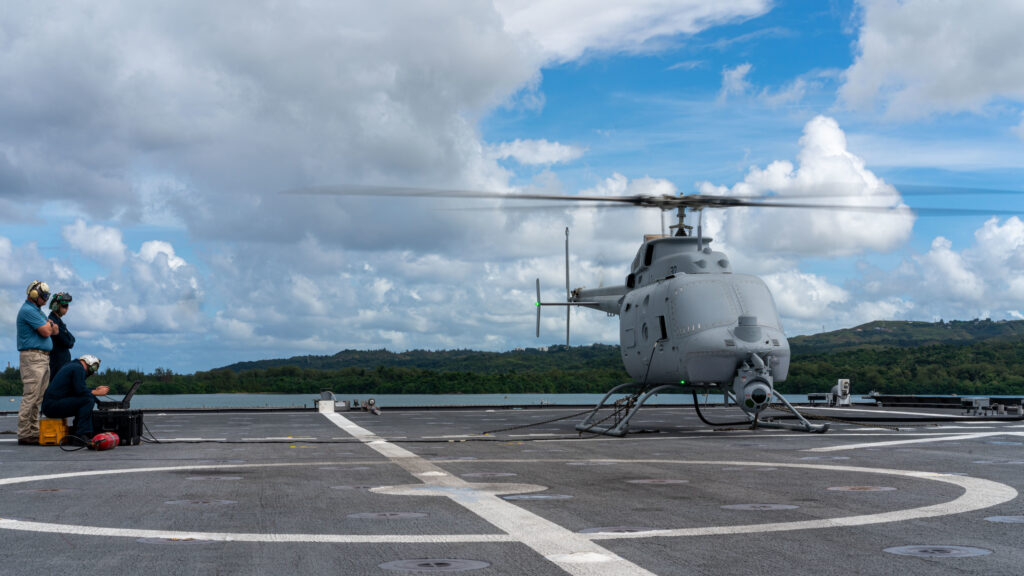
Sailors attached to Helicopter Sea Combat Squadron (HSC) 23, assigned to the Independence-variant littoral combat ship USS Jackson (LCS 6) and Naval Engineering Technology (NET) technicians perform ground turns on an MQ-8C Fire Scout on the flight deck of Jackson. U.S. NAVY / Mass Communication Specialist 3rd Class Andrew Langholf
ARLINGTON, Va. — The newest version of the Navy’s Fire Scout UAV is being prepared for deployment to the Western Pacific, according to an official photograph.
An MQ-8C Fire Scout was depicted in a Dec. 22 official Navy photograph taken on the deck of Independence-class littoral combat ship USS Jackson (LCS 6) while in port in Apra Harbor, Guam. The caption stated the Jackson was part of Destroyer Squadron Seven “on a rotational deployment in the U.S. 7th Fleet area of operation to enhance interoperability with partners and serve as a ready-response force in support of a free and open Indo-Pacific region.”
The MQ-8C in the photograph was going through predeployment functional ground checks for a detachment of Helicopter Sea Combat Squadron 23 — based at Naval Air Station North Island, California — that will operate the MQ-8C from the USS Jackson.
The MQ-8C, which achieved initial operational capability in June 2019, is an upgrade to the Fire Scout System mainly in that it uses a Bell 407 airframe, which is larger than the earlier-design MQ-8B’s airframe and equipped with more powerful engines, thus having a greater payload and endurance, up to 12 hours on station.
The MQ-8C can carry the ZPY-8 search radar or an electro-optical/infrared sensor and uses the same ground control station and the MQ-8B. The Navy plans to add more capability in the form of Link 16 data link, passive targeting, and a mine-countermeasures payload.
Northrop Grumman was under contract to deliver 38 MQ-8Cs, all of which have been delivered. The company has delivered 30 of the earlier MQ-8B version.
Editor’s note: This article has been updated and corrected from a previous version.
USS Milwaukee Returns to Sea After COVID Confinement
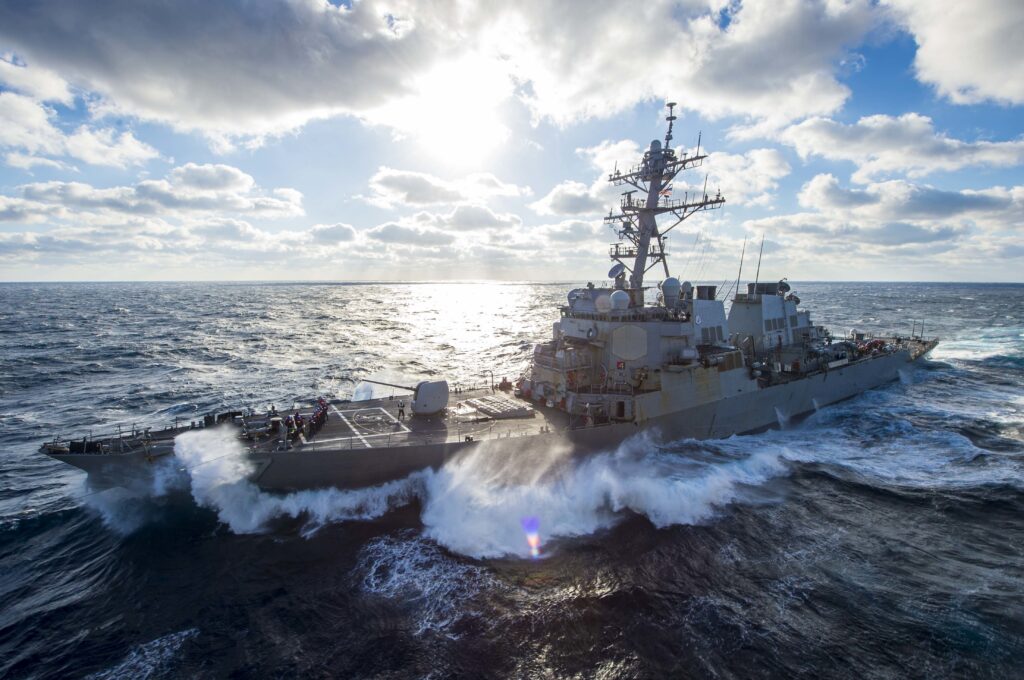
The Freedom-variant littoral combat ship USS Milwaukee (LCS 5) steams through the ocean, Dec 16, 2021. U.S. NAVY / Mass Communication Specialist 3rd Class Aaron Lau
NAVAL STATION GUANTANAMO BAY — USS Milwaukee (LCS 5) a Freedom variant littoral combat ship, returned to sea Jan. 3 after being in port as a result of a portion of the crew testing positive for COVID-19, Cmdr. Katherine L Meadows, U.S. Naval Forces Southern Command and U.S. 4th Fleet Public Affairs, said in a statement.
The ship departed with all crew members, which includes the “Sea Knights” of Helicopter Sea Combat Squadron (HSC) 22 Detachment 5 and embarked U.S. Coast Guard Law Enforcement Detachment.
“It is great to be heading back out to sea.” said Cmdr. Brian Forster, USS Milwaukee commanding officer. “The crew worked together as a team to ensure we are ready to conduct the mission. My entire crew is feeling great, healthy and excited for the next portion of our deployment.”
Milwaukee has been in port since Dec. 20, when it arrived for a regularly scheduled port visit.
While all Sailors onboard were 100% immunized, a portion of the crew tested positive for COVID-19. All affected Sailors exhibited mild or no symptoms.
Since being in port, Sailors were also afforded the opportunity to receive the COVID-19 booster shot. While not mandatory, the booster is recommended for Sailors.
The ship’s crew will continue to follow aggressive cleaning protocols, wear masks and social distance while at sea to ensure they remain mission ready.
Milwaukee departed its homeport of Naval Station Mayport, Florida, Dec. 14 for its regularly scheduled deployment to the U.S. 4th Fleet area of operations. Milwaukee will support the Joint Interagency Task Force South’s mission, which includes counter-illicit drug trafficking missions in the Caribbean and Eastern Pacific.