UISS Conducts Successful Underwater Explosion Shock Test
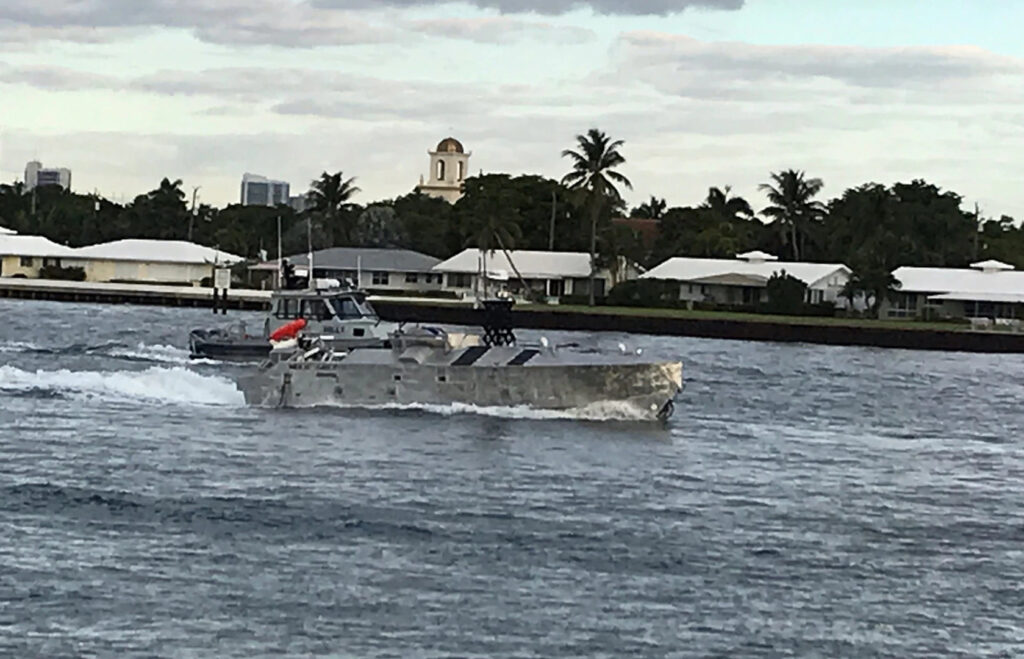
The Unmanned Influence Sweep System heads out for an operational assessment in this November 2019 photo. U.S. NAVY

ABERDEEN, Md. — The Program Executive Office for Unmanned and Small Combatants announced on Jan. 4 the successful completion of underwater explosion shock testing on the Unmanned Influence Sweep System, a component of the Navy’s suite of mine countermeasure technologies. 

The test was conducted by the Aberdeen Test Center and Naval Surface Warfare Center Carderock with assistance from Textron and NSWC Panama City. 

The series of shock trials is key for testing the survivability of UISS and its ability to execute its mission in hazardous environments.  

Capable of being hosted from littoral combat ships, operated from shore, or vessels of opportunity, Unmanned Influence Sweep System provides acoustic and magnetic minesweeping coupled with the unmanned, semi-autonomous, diesel-powered, aluminum-hulled mine countermeasures unmanned surface vehicle, or MCM USV. 

“The UISS UNDEX test demonstrates the survivability of the MCM USV,” said LCS Mission Modules Program Manager Capt. Godfrey “Gus” Weekes. “This brings us one step closer to delivering the MCM mission package to the fleet.”  

The series of successful tests demonstrate the growing maturity of the UISS program. The program completed shipboard initial operational test and evaluation onboard USS Cincinnati (LCS 20) in June 2021 and Cyber initial operational test and evaluation in September 2021, ensuring the program is on schedule to achieve initial operating capability in 2022.  

“Completion of these tests showcased the capability and resiliency of the MCM USV, and is a critical milestone for the program,” Weekes said. “The MCM USV is the centerpiece of the MCM mission package, and this test demonstrates the final steps we’re taking for MCM mission package IOT and E and fielding.” 

In addition to minesweeping capability, the MCM USV will employ modular payloads to bring additional MCM capabilities to the fleet. The MCM USV is currently undergoing integration testing of the AQS-20C towed mine hunting sonar, which provides detection, identification, classification and localization of volume and bottom mine-like objects. The MCM USV is an integral part of the MCM mission package, which will replace the Navy’s aging Avenger-class minesweeping ships and MH-53Es Sea Dragon helicopters. 


NAVSEA Orders Two More Mark VI Patrol Boats for Ukraine

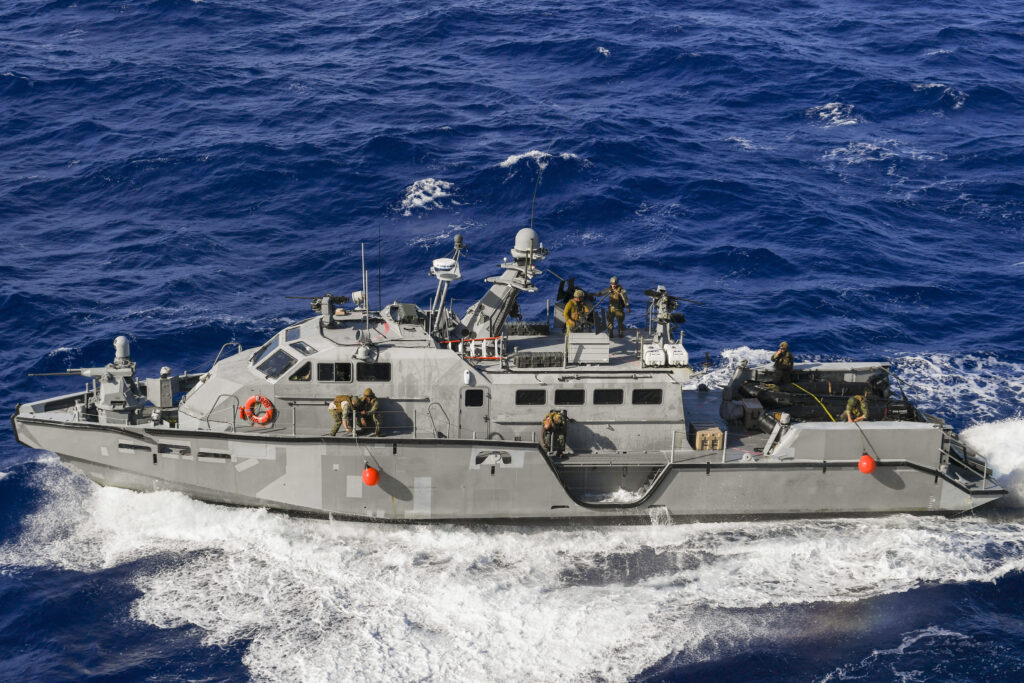
A Mark VI is launched from the amphibious dock landing ship USS Ashland (LSD 48) in the Philippine Sea in February 2021. U.S. NAVY / Mass Communication Specialist 3rd Class Madysson Anne Ritter

ARLINGTON, Va. — The U.S. Navy has ordered two more Mark VI patrol boats for the government of Ukraine, the Defense Department said. 

The Naval Sea Systems Command awarded SAFE Boats International of Bremerton, Washington, a $25.6 million firm-fixed-price modification “for the exercise of options for construction, outfitting, reactivation, and training of two Mark VI patrol boats,” the Dec. 30 announcement said. 

The order is funded with some of the $125 million Ukraine Security Assistance Initiative funds through the fiscal year 2021 Building Partner Capacity initiative. 

In June 2020, the U.S. State Department has approved the possible foreign military sale of up to 16 Mark VI patrol boats and related equipment to Ukraine for an estimated cost of $600 million, the Defense Security Cooperation Agency said. The December order brings the total ordered to date to 12 boats. 

“This action reaffirms the U.S. commitment to providing defensive lethal weapons to enable Ukraine to more effectively defend itself against Russian aggression,” the Defense Department said of an earlier sale of Mark VI boats to Ukraine.   

The patrol boats will be operated by the Ukrainian navy to defend territorial waters and other maritime interests. They each will be armed with two MSI Seahawk A2 gun systems and two Mk44 cannons and equipped with electro-optical/infrared sensors and loud-speaker systems.   

Mark VI patrol boats are used by the Navy Expeditionary Combat Command for escort of high-value ships, coastal patrol, and other maritime security missions.   

The boats will be built in Tacoma, Washington, and deliveries are expected to be completed by March 2026. 


Navy Orders Additional TH-73A Helicopters to Train Naval Aviators

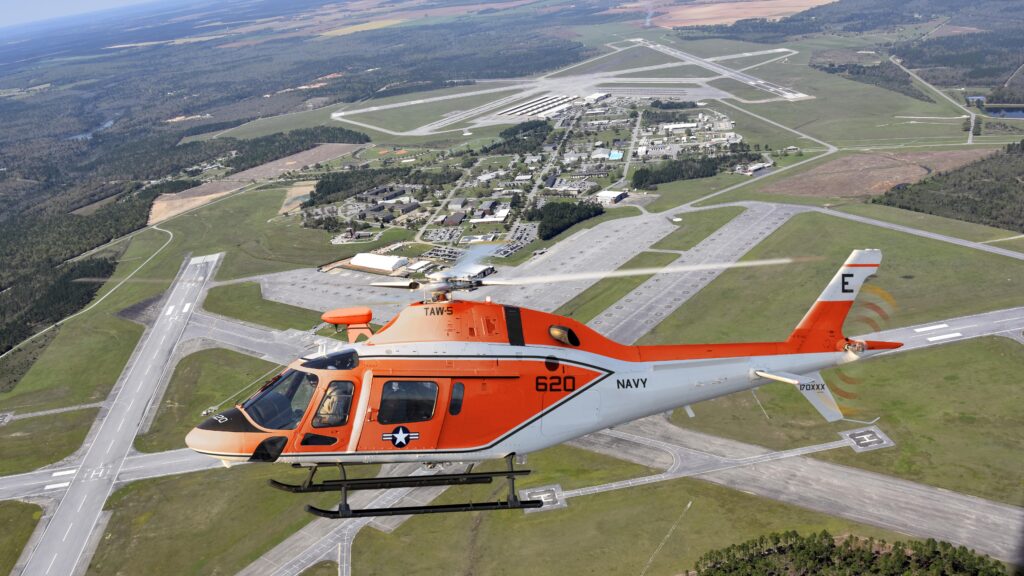
A Leonardo TH-73A helicopter. LEONARDO

PHILADELPHIA — The newly established partnership between Leonardo and the U.S. Navy on the advanced training of next-generation helicopter pilots grew in December with the U.S. Department of Defense buying an additional 36 TH-73A rotorcraft, with initial spares, for $159.4 million, the company announced Dec. 22. 

This third lot brings the total number of aircraft on order to 104 of the total requirement for 130, with delivery continuing into 2024. The fleet will be used to collectively train student pilots from the U.S. Navy, Marine Corps and Coast Guard, along several NATO allies. 

In January 2020, Leonardo, through AgustaWestland Philadelphia Corp., was awarded a firm-fixed-price contract valued at $176 million for the production and delivery of an initial 32 TH-73A helicopters. The agreement — which included an initial package of spares, support, dedicated equipment, and specific pilot and maintenance training services — was confirmed that following November through the order of a second lot of aircraft through a $171 million contract modification for an additional 36 helicopters. 

All TH-73As will be fully produced at the Leonardo’s plant in Philadelphia where the AW119 is exclusively built on an FAA Certified Part 21 production line. The site operates today as a supplier and partner to the U.S. DoD through the TH-73A program for the U.S. Navy, of which Leonardo is prime contractor, in addition to the Boeing MH-139A program for the U.S. Air Force.  

Located in Philadelphia since the early 1980s, the plant today employs 700 of Leonardo’s 7,000 employees active in the U.S. and has become a Divisional Center of Excellence for production, support, engineering and training activities. The Philadelphia site includes production of the AW119, AW139 and the AW609 tilt-rotor, as well as support, maintenance and repair services. Pilot and maintenance technician training is performed at the training academy, co-located at the same campus as all other U.S. functions, which was inaugurated earlier this year as part of an $80 million dollar expansion. 

A delivery ceremony for the first TH-73A to the U.S. Navy took place in June 2021 in Philadelphia. Based on the IFR instrument flight rules variant of the commercial model AW119Kx, the TH-73A, which will replace the TH-57B/C Sea Ranger first introduced in 1968, is perfectly suited for both initial and advanced training.  

Equipped with a powerful and reliable Pratt & Whitney PT-6 engine and characterized by dual safety and hydraulic systems and advanced digital avionics by Genesys Aerosystems, the TH-73 can perform every phase of the U.S. Navy’s training program without compromise. The new system will allow the U.S. Navy to upgrade its technologies from analogue to digital and is expected to be in service until after 2050. 

The fleet will be based at Naval Air Station Whiting Field in Milton, Florida. After being awarded the initial contract and in order to support the fleet once operational, Leonardo announced plans to build a 100,000 square foot support center immediately adjacent to NAS Whiting Field in partnership with the City of Milton, Santa Rosa County and Space Florida. Site work has already begun and the facility’s completion is expected by the end of 2023.      


U.S. Navy Ships Interdict Heroin Worth $4 Million in Arabian Sea

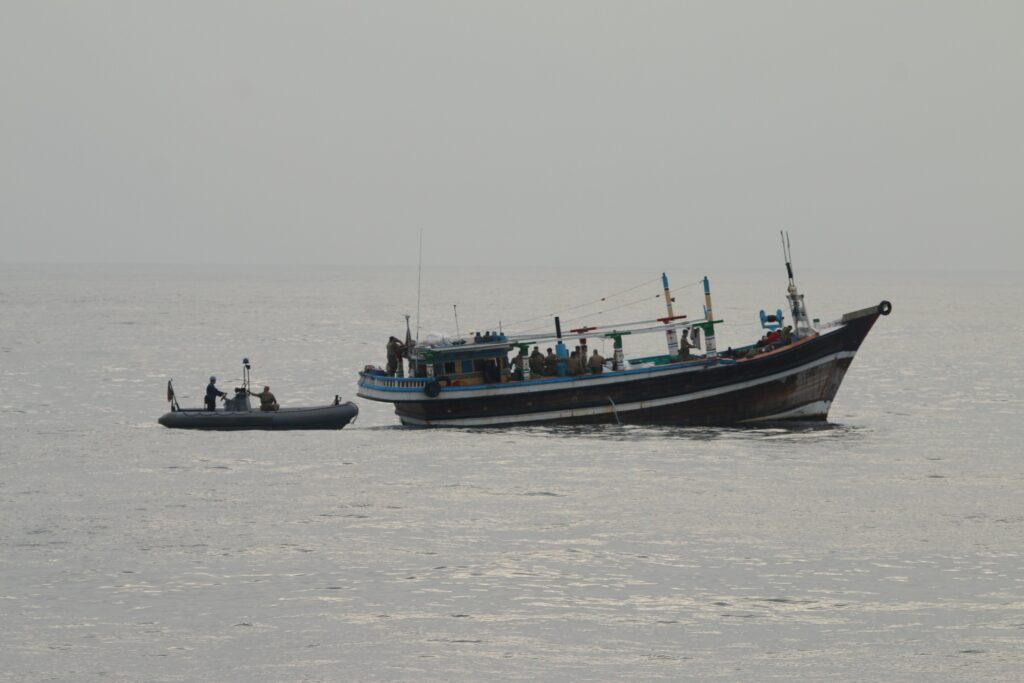
Two U.S. Navy ships seized 385 kilograms of heroin worth approximately $4 million from a stateless fishing vessel transiting the Arabian Sea, Dec. 27. U.S. NAVY

MANAMA, Bahrain — Two U.S. Navy ships seized 385 kilograms of heroin worth approximately $4 million from a stateless fishing vessel transiting the Arabian Sea, Dec. 27, Naval Forces Central Command said Dec. 30. 

U.S. Coast Guard personnel embarked aboard USS Tempest (PC 2) and USS Typhoon (PC 5) discovered the illegal shipment while conducting a flag verification boarding in accordance with customary international law. The confiscated drugs were destroyed at sea by U.S. forces. 

The coastal patrol ships were operating as part of an international task force called Combined Task Force 150, which has increased regional patrols to locate and disrupt unlawful maritime activity. CTF 150 is one of three task forces under Combined Maritime Forces. 

“This latest seizure is a demonstration that CTF 150 and assigned surface and air assets are ready to conduct interdiction operations 365 days a year,” said Royal New Zealand Navy Capt. Brendon Clark, commander of CTF 150. 

In 2021, CTF 150 has seized illegal drugs worth more than $193 million (at regional wholesale prices) during counter-narcotics operations at sea. This is a higher total value than the amount of drugs the task force interdicted in the previous four years combined. 

“This interdiction highlights the incredible work of our ships and Sailors and serves as a reminder of the value in having forward-deployed naval forces on scene and ready,” said Lt. Cmdr. Jordan Bradford, Typhoon’s commanding officer, who is  from Ocean Springs, Mississippi. 

International naval forces operating in support CTF 150 regularly conduct maritime security and counter-terrorism operations at sea outside the Arabian Gulf to disrupt criminal and terrorist organizations and their related illicit activities, including the movement of personnel, weapons, narcotics and charcoal. These efforts help ensure legitimate commercial shipping transits the region free from non-state threats. 

“We were able to execute this interdiction safely and with precision due to the tireless efforts of all involved,” said Lt. Cmdr. Matt Intoccia, a native of Collegeville, Pennsylvania, and the commanding officer of Tempest. “I am proud of our collective contribution to regional stability and look forward to more opportunities for operational success.” 

The U.S. Navy released the stateless fishing vessel and its nine crew members, who identified themselves as Iranian nationals, after seizing the drugs. 

Combined Maritime Forces is the largest multinational naval partnership in the world. The organization includes 34 nations and is headquartered in Bahrain with U.S. Naval Forces Central Command and U.S. 5th Fleet. 


U.S. Navy Seizes 1,400 Assault Rifles During Illicit Weapons Interdiction

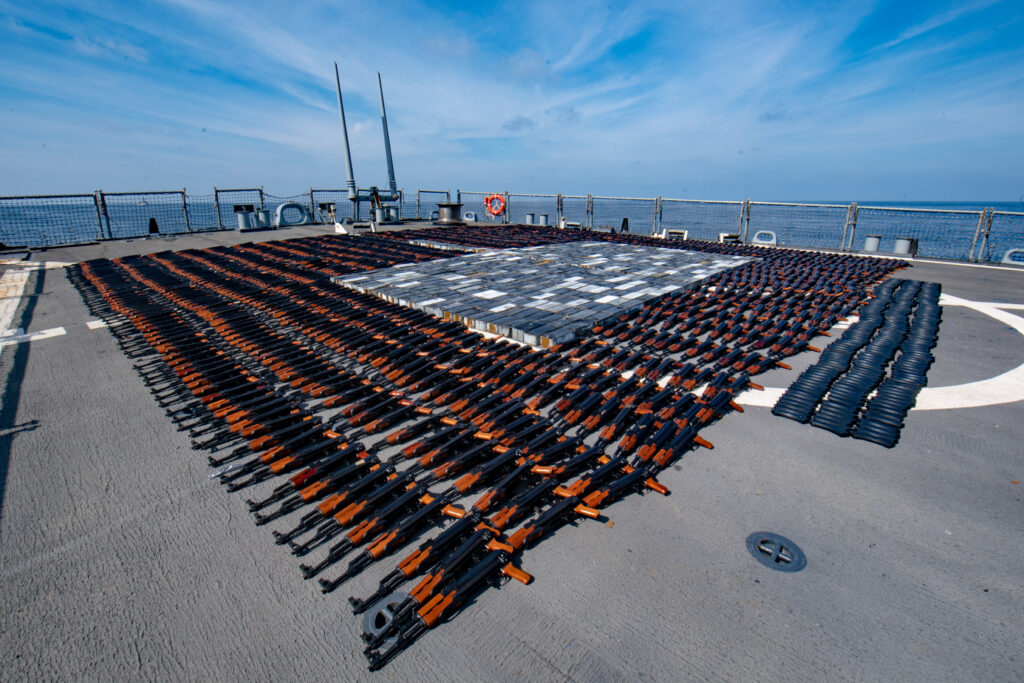
Illicit weapons seized from a stateless fishing vessel in the North Arabian Sea are arranged for inventory aboard guided-missile destroyer USS O’Kane’s (DDG 77) flight deck, Dec. 21. U.S. NAVY / Mass Communication Specialist Seaman Elisha Smith

MANAMA, Bahrain – U.S. 5th Fleet ships seized approximately 1,400 AK-47 assault rifles and 226,600 rounds of ammunition from a stateless fishing vessel during a flag verification boarding in accordance with customary international law in the North Arabian Sea, Dec. 20, NAVCENT public affairs said Dec. 22.

U.S. Navy patrol coastal ships USS Tempest (PC 2) and USS Typhoon (PC 5) found the weapons during a search conducted by embarked U.S. Coast Guard personnel. The illicit weapons and ammunition were later transported to guided-missile destroyer USS O’Kane (DDG 77) where they await final disposition.

The stateless vessel was assessed to have originated in Iran and transited international waters along a route historically used to traffic weapons unlawfully to the Houthis in Yemen. The direct or indirect supply, sale or transfer of weapons to the Houthis violates U.N. Security Council Resolutions and U.S. sanctions.

The vessel’s five crew members identified themselves as Yemeni nationals and will be returned to Yemen.

After removing the crew and illicit cargo, U.S. naval forces determined the stateless vessel was a hazard to navigation for commercial shipping and sank it.

U.S. naval forces regularly perform maritime security operations in the Middle East to ensure the free flow of legitimate trade and to disrupt the transport of illicit cargo that often funds terrorism and other unlawful activity. U.S. Navy warships operating in the U.S. 5th Fleet region have seized approximately 8,700 illicit weapons in 2021.

Guided-missile cruiser USS Monterey (CG 61) seized dozens of advanced Russian-made anti-tank guided missiles, thousands of Chinese Type 56 assault rifles, and hundreds of PKM machine guns, sniper rifles and rocket-propelled grenade launchers from a stateless vessel transiting the North Arabian Sea in May.

In February, guided-missile destroyer USS Winston S. Churchill (DDG 81) seized a cache of weapons off the coast of Somalia, including thousands of AK-47 assault rifles, light machine guns, heavy sniper rifles, rocket-propelled grenade launchers and crew served weapons. The inventory also included barrels, stocks, optical scopes and weapon systems.

The U.S. 5th Fleet area of operations encompasses approximately 2.5 million square miles of water area and includes the Arabian Gulf, Gulf of Oman, Red Sea, parts of the Indian Ocean and three critical choke points at the Strait of Hormuz, Suez Canal and Strait of Bab al Mandeb.


Advanced Weapons Elevators Completed Aboard USS Gerald R. Ford

The aircraft carrier USS Gerald R. Ford (CVN 78) departed Naval Station Norfolk to make the transit to Newport News Shipyard in support of its planned incremental availability, a six-month period of modernization, maintenance, and repairs, Aug. 20. U.S. NAVY / Mass Communication Specialist 1st Class Ryan Seelbach

WASHINGTON — On Dec. 22, the 11th and final advanced weapons elevator aboard USS Gerald R. Ford (CVN 78) was turned over to the ship’s crew, according to Program Executive Office Aircraft Carriers public affairs.

AWEs on this first-of-class aircraft carrier operate using several advanced technologies, including electromagnetic motors instead of more labor intensive, hydraulic systems. The advanced technology enables fewer sailors to safely move ordnance from weapons magazines to the flight deck with unparalleled speed and agility.

“This is a significant milestone for the Navy, ship, and her crew,” said Rear Adm. James P. Downey, Program Executive Officer for Aircraft Carriers. “With completion of this final AWE, we now have the entire system to operate and train with.”

Downey added the Navy-industry AWE team worked tirelessly in port and at sea to complete the elevators to ensure the availability of needed materials and engineering expertise. Multiple vendors have collaborated along the way to ensure seamless support to multi-shift, shipboard production efforts.

“The Navy-industry teaming provided the opportunities for hundreds of craftsmen, technicians and engineers, working around the clock — through multiple underway and holiday periods — to get these advanced systems on line and operational,” said Downey.

The team logged the milestone in the midst of the ship’s six-month planned incremental availability at Huntington Ingalls Industries-Newport News Shipbuilding facility in Hampton Roads, Virginia. Gerald R. Ford is scheduled to complete the PIA this spring, followed by training and deployment.

“The end game is always operational readiness,” added Downey, “and Ford is on track to complete this PIA on schedule, conduct sea trials, and to move on to follow-on tasking.”


Austal Delivers Future USS Canberra to U.S. Navy

The future USS Canberra (LCS 3). AUSTAL USA

MOBILE, Ala. — The U.S. Navy took delivery of the future USS Canberra (LCS 30) at Austal USA on Dec. 21, the company announced, the second Independence-variant littoral combat ship Austal delivered to the Navy in 2021.

“With two ship launches, two christenings, and now the successful completion of sea trials and delivery for LCS 30, it has been a busy last couple of months at Austal USA,” said Austal USA President Rusty Murdaugh. “All of these milestones require extensive coordination between Austal, our vendors and our Navy teammates and I’m proud to say that these partnerships grow stronger with each milestone achievement.”

Acceptance Trials for LCS 30 were completed in early November, demonstrating to the Navy the successful operation of the ship’s major systems and equipment. Delivery documents were signed onboard the future USS Canberra and the crew will now begin preparing the ship for her commissioning into the fleet.

Four LCSs are currently under construction by the company, including the future USS Santa Barbara (LCS 32). Final assembly is underway on the future USS Augusta (LCS 34) and modules are under construction on the future USS Kingsville (LCS 36) and the future USS Pierre (LCS 38).

Two Expeditionary Fast Transports are also under construction at the shipyard, with a third under contract. In October, Austal USA was awarded a contract for the detailed design and construction of two U.S. Navy Towing, Salvage, and Rescue Ships (T-ATS), the first contract for Austal’s new steel construction facility.

Austal has recently been awarded several post-delivery service-related contracts for the LCS program including sustainment execution contracts for both variants of LCS on the East and West coasts and an indefinite delivery indefinite quantity contract to support LCS deployed to the western Pacific and Indian Ocean.


Biden Permits Defense Production Act to be Used to Strengthen Submarine Industrial Base

Tugboats guide the USS Minnesota (SSN 783) to the pier as the Virginia-class nuclear-powered fast-attack submarine returns to Naval Submarine Base New London following a regularly-scheduled deployment in 2021. The Defense Production Act can now be used to scale production of Virginia-class subs. U.S. NAVY / Mass Communication Specialist 2nd Class Tristan B. Lotz

On Dec. 21, President Biden signed three determinations permitting the use of the Defense Production Act to strengthen the U.S. submarine industrial base, the Department of Defense announced Dec. 22.

The expansion of the authority will allow the U.S. Navy to maintain its maritime superiority, the DoD said.

Scaling the production of Virginia-class attack submarines will ensure the U.S. Navy can meet its missions to maintain open sea lanes for global communication and commerce, enhance diplomatic partnerships and grow a robust underwater warfare capability, the DoD said. Through the DPA, the U.S. Navy can make key investments with the manufacturers and suppliers executing the submarine shipbuilding plan.

These activities will strengthen the shipbuilding industrial base and allow its heavy manufacturing and large scale fabrication suppliers to meet growing demand and expand the maritime workforce training pipeline.

“Ensuring a robust, resilient and competitive domestic defense industrial base that has the capability, capacity and workforce to meet the Virginia-class submarine undersea warfighting mission is essential to our national security,” said a memo attributed to Biden.

The DoD said it continues to work with key stakeholders to use Defense Production Act authorities to address risks and challenges across the submarine enterprise supply chain. These authorities expand options and opportunities to accelerate and scale critical investments across key markets.

More information about the DPA is available here, and the presidential determination can be found here.


Austal USA Awarded Contract for Next Generation Logistics Ship Design Studies

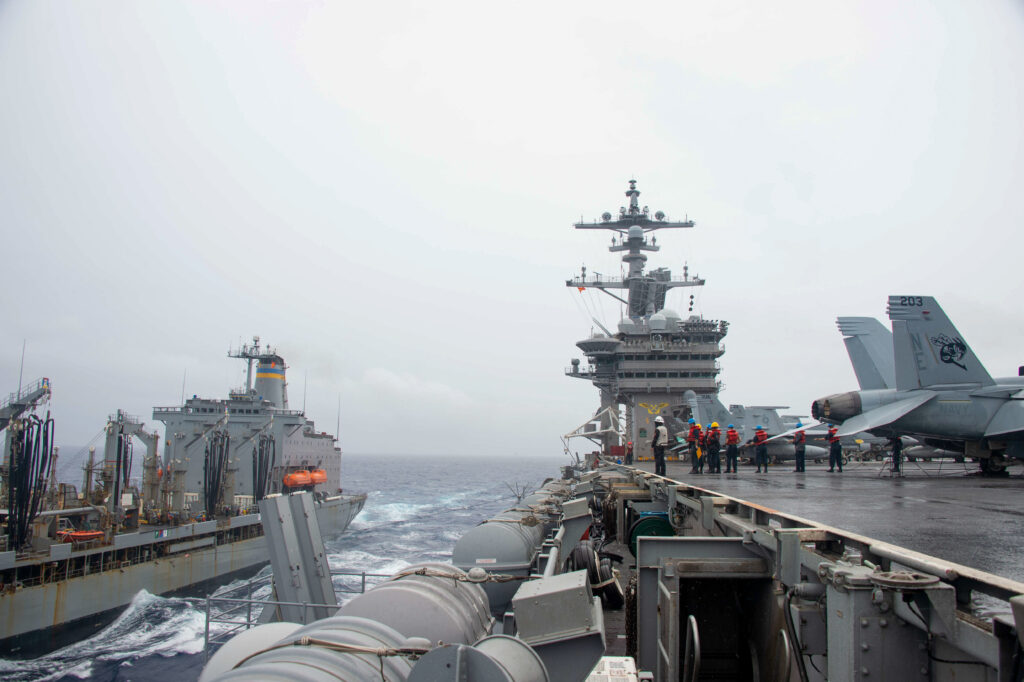
Nimitz-class aircraft carrier USS Carl Vinson (CVN 70) conducts a replenishment-at-sea with Henry J. Kaiser-class fleet replenishment oiler USNS Rappahannock (T-AO 204), The next-generation logistics ship is intended to be a smaller than current combat logistics force ships such as the Rappahannock. U.S. NAVY / Mass Communication Specialist Seaman Elizabeth Grubbs

MOBILE, Ala. — Austal USA was awarded a contract to perform design studies for the U.S. Navy’s next generation logistics ship program Dec. 20, the company announced.

This contract requires Austal to develop a new baseline design and perform specific trade studies for the Navy’s newest logistics ship. Austal, as the shipbuilder and design agent, will be the prime contractor.

“Austal is excited to begin work on another U.S. Navy steel shipbuilding program,” Austal USA President Rusty Murdaugh said. “This contract, combined with our recent T-ATS ship construction contract award and the concept studies we are performing on the LAW p[light amphibious warships] rogram, demonstrate our commitment to bring the same industry leading quality to steel ships as we have been delivering for aluminum ships.”

The next generation logistics ship program represents a new class of medium-sized at-sea supply ships intended to support small surface combatants such as littoral combat ships and frigates as well as the Navy’s planned LAW. The mission of the NGLS fleet will include refueling, rearming, and resupply of naval assets.

Austal USA’s reputation of completing major military vessel contracts on schedule and on budget gives the company a strong foundation to provide a highly capable and cost effective NGLS design to the Navy.


U.S. Navy, Boeing Complete First Carrier Tests for MQ-25

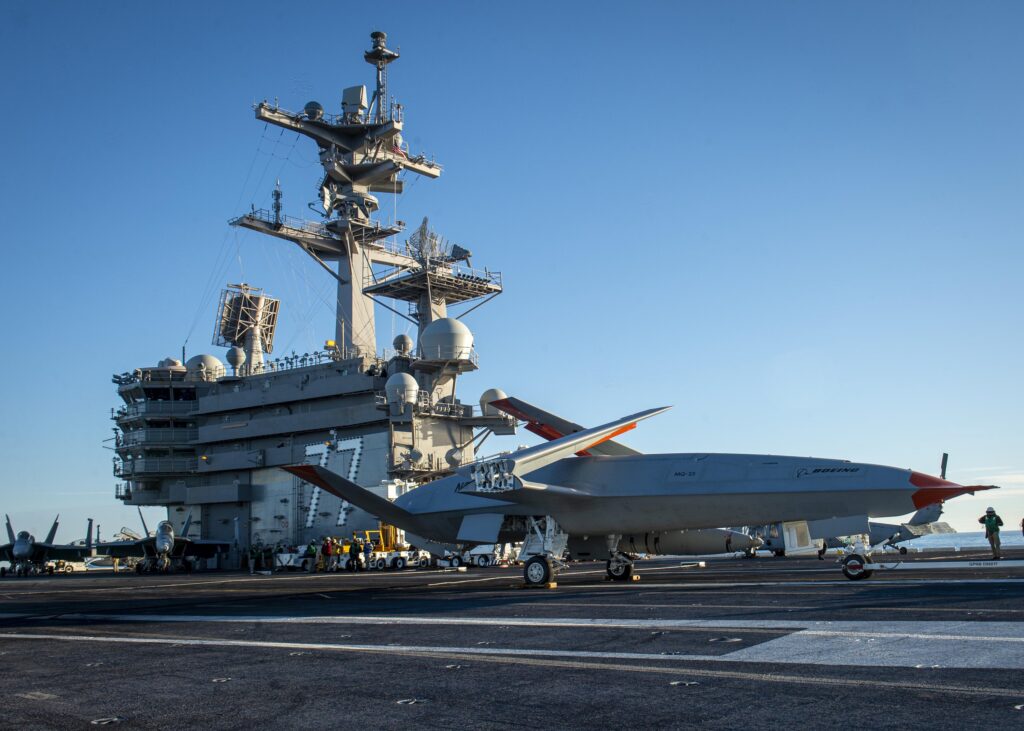
An MQ-25 Stingray test asset conducts deck handling maneuvers Dec. 12 while underway aboard USS George H.W. Bush (CVN -77). This unmanned carrier aviation demonstration marked the first time the Navy conducted testing with the MQ-25 at sea. U.S. NAVY

NORFOLK, Va. — The U.S. Navy and Boeing have successfully maneuvered the Boeing-owned T1 test asset on a U.S. Navy aircraft carrier for the first time, an early step forward in ensuring the MQ-25 unmanned aerial refueler will seamlessly integrate into carrier operations.

During an underway demonstration aboard the USS George H.W. Bush (CVN 77), Navy flight deck directors — known as “yellow shirts” — used standard hand signals to direct T1 just like any other carrier-based aircraft. Instead of a pilot receiving the commands, however, it was a Boeing MQ-25 Deck Handling Operator (DHO) right beside the yellow shirt who commanded the aircraft using a new handheld deck control device.

“This is another significant step forward in demonstrating MQ-25’s integration into the Carrier Air Wing on the flight deck of our fleet’s aircraft carriers,” said Capt. Chad Reed, Unmanned Carrier Aviation program manager. “The success of this event is a testament to the hard work of our engineers, testers, operators and the close collaboration and teaming from Naval Air Force Atlantic and the crew aboard CVN 77.”

The demonstration was intended to ensure the design of the MQ-25 will successfully integrate into the carrier environment and to evaluate the functionality, capability and handling qualities of the deck handling system both in day and night conditions. Maneuvers included taxiing on the deck, connecting to the catapult, clearing the landing area and parking on the deck.

“The Navy has a rigorous, well-established process for moving aircraft on the carrier. Our goal was to ensure the MQ-25 fits into the process without changing it,” said Jim Young, MQ-25 chief engineer. “From the design of the aircraft to the design of the system moving it, our team has worked hard to make the MQ-25 carrier suitable in every way.”

DHO’s trained in Boeing’s deck handling simulation lab in St. Louis, where they practiced entering commands from simulated yellow shirts into the real handheld device. A simulated MQ-25, running the aircraft’s real operational flight code and interfaces, would move accordingly. The handheld controller is a simple, easy-to-use device designed specifically for a generation of sailors who natively understand such handheld technology and have experience with controllers used in the gaming industry today.

The deck handling demonstration followed a two-year flight test campaign for the Boeing-owned T1 test asset, during which the Boeing and Navy team refueled three different carrier-based aircraft — an F/A-18 Super Hornet, an E-2D Hawkeye and an F-35C Lightning II.

“The Navy gave us two key performance parameters for the program — aerial refueling and integration onto the carrier deck,” said Dave Bujold, Boeing MQ-25 program director. “We’ve shown that the MQ-25 can meet both requirements, and we’ve done it years earlier than traditional acquisition programs.”