USS The Sullivans Completes Historic Deployment
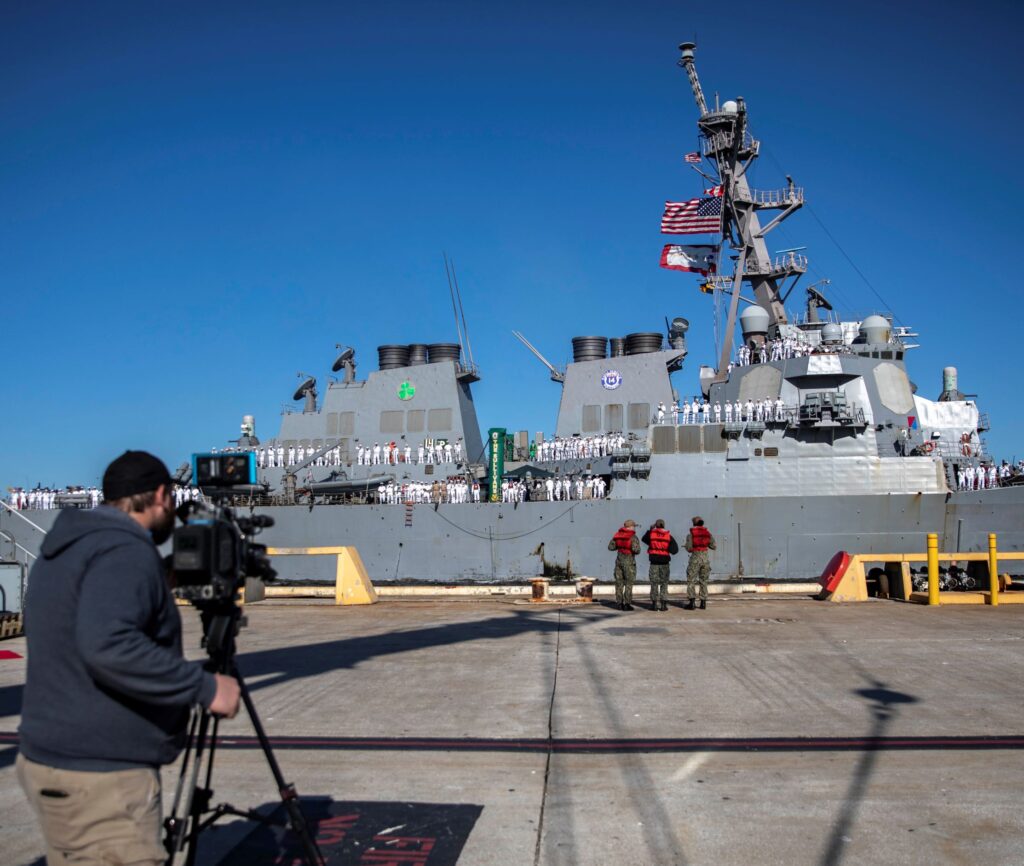
The Arleigh Burke-class guided missile destroyer USS The Sullivans (DDG 68) returns from a seven-month world deployment with the HMS Queen Elizabeth Carrier Strike Group, Nov. 24. U.S. NAVY / Mass Communication Specialist 2nd Class Austin G. Collins

MAYPORT, Fla. — The Arleigh Burke-class guided-missile destroyer USS The Sullivans (DDG 68) returned to Naval Station Mayport, Nov. 24, marking the end of a seven-month world tour deployment to the U.S. 2nd, 5th, 6th and 7th Fleet areas of operations as part of the U.K. Carrier Strike Group 2021 (CSG 21) and Operation Fortis, the U.S. 2nd Fleet said Nov. 24. 

CSG 21 was led by aircraft carrier HMS Queen Elizabeth (R08) on her first deployment and was comprised of multi-national forces, including The Sullivans, U.S. Marine Corps Fighter Attack Squadron (VMFA) 211 and The Netherlands frigate HNLMS Evertsen (F805). 
 
U.S. Navy Cmdr. James Diefenderfer Jr., commanding officer of The Sullivans, regards the integrated deployment as a step forward for the long-standing maritime alliance between the United States and the United Kingdom. 

“The Sullivans was fortunate to complete a seven-month deployment with a United Kingdom carrier, marking the culmination of a decade-long bilateral carrier coordination effort,” Diefenderfer said. “The Sullivans’ crew proved again and again they have the grit and professionalism it takes to represent the U.S. Navy and the memory of the Sullivan brothers while deployed.”  

The crew navigated over 50,000 nautical miles through four U.S. fleets, transiting the Strait of Gibraltar, Suez Canal, Bab-el Mandeb, Strait of Malacca and across the equator. The Sullivans also conducted 29 underway replenishments and 18 sea and anchor details during port visits to Portsmouth, England; Gaeta, Italy; Limassol, Cyprus; Guam; Yokosuka, Japan; Souda Bay, Greece; Toulon, France; and Rota, Spain. 
 
The Sullivans, the only U.S. surface ship in CSG 21, supported U.S. 2nd, 5th, 6th and 7th Fleet commanders across 20 warfare areas ranging from surface to ballistic missile and air defense. 
 
While operating with CSG 21 in Operation Fortis, The Sullivans was tasked to escort HMS Queen Elizabeth around the world, providing multi-threat defense. Operation Fortis was executed in six phases across four different areas of operations, demonstrating interoperability with more than 15 different allied and partner nations. The Sullivans also provided layered defense and command and control for the entire carrier strike group in support of air defense missions to ensure stability and security across the globe. 

“USS The Sullivans has been an integral part of the U.K. CSG for over a year,” said Royal Navy Cmdr. Steven Moorhouse, commander, CSG 21. “It was a pleasure working with The Sullivans, and I thank each and every member of the ship’s company for their loyalty, professionalism and great humour along our journey. The ship’s motto says it all: ‘We stick together.’” 
 
CSG 21 spent nearly half of the seven-month deployment in the U.S 6th Fleet area of operations, participating in four major multinational exercises, including Steadfast Defender and Strike Warrior 2021. 

After departing U.S. 6th Fleet, CSG 21 transited to the Indian Ocean where they participated in the Indian Navy Exercise Konkan. The crew trained to aggressively advance surface, anti-submarine and anti-air warfare tactics while strengthening interoperability with their foreign partners. 
 
The strike group then entered U.S. 7th Fleet and began a string of exercises in the Indo-Pacific, demonstrating seamless interoperability with allies and partners. Exercise Noble Union, conducted in the Pacific Ocean, fully integrated CSG 21 and Expeditionary Strike Group (ESG) 7 and marked the beginning of a three-month tactical training with the Japanese Maritime Self-Defense Force (JMSDF). The strike group also trained with Republic of Korea’s Surface Forces on communication, search and rescue, replenishment capabilities, and cross-deck aviation evolutions. 
 
CSG 21 met the Ronald Reagan Carrier Strike Group (CSG 5), the Carl Vinson Carrier Strike Group (CSG 1) and the JMSDF Carrier Strike Group to conduct quad carrier operations. Squadrons from different air wings operated in concert with the 17-ship force, representing six participating nations and demonstrating a commitment to a free and open Indo-Pacific. 
 
After concluding operations in U.S. 7th Fleet, The Sullivans and CSG 21 re-entered the Indian Ocean to participate in the Maritime Partnership Exercise in the Bay of Bengal with Australia, India, Japan and CSG 1. 
 
The Sullivans detached from CSG 21 in the Indian Ocean and sailed independently through U.S. 5th Fleet, after a farewell visit from Cdre. Moorhouse and U.S. Marine Corps Brig. Gen. Simon Doran, U.S. Senior National Representative to the United Kingdom’s CSG. 
 
The Sullivans participated in one final exercise with the Tunisian Navy in the Mediterranean Sea, the first time conducting high-level integrated operations together. 
 
“The crew worked extremely hard over the last year and a half preparing for and executing a deployment as dynamic as this one,” Diefenderfer said. “I am grateful for the love and sacrifice that the Sailors and their families displayed through a global pandemic leading into a deployment. The crew came together to accomplish every operational tasking as a team.” 


Austal Contracts with SSAB for Steel for Navy T-ATS Construction

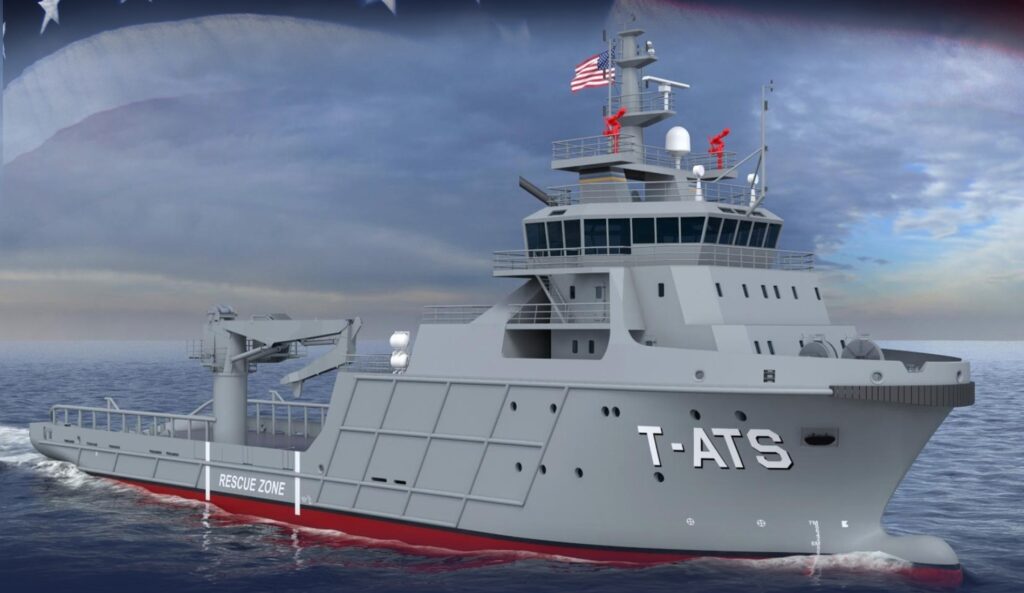
An artist’s conception of a Towing, Salvage and Rescue ship. AUSTAL USA

Mobile, Ala. — Following Austal USA’s award from the U.S. Navy to build steel-hulled Towing, Salvage and Rescue ships (T-ATS), Austal USA has contracted with local Alabama steel provider SSAB to provide steel for the new Navy ships, Austal said Nov. 29. The supplier partnership directly supports hundreds of jobs in the greater Mobile area from both Austal and SSAB. 

Austal will source various strength and sized steel plating from SSAB capable of being cut, shaped, welded and fitted, resulting in the construction of valuable support ships and potential combat ships for our U.S. military. 

“SSAB not only provides us with quality steel, but also great flexibility due to its location adjacent to us here in Mobile, Alabama,” Austal USA President Rusty Murdaugh said. “The ability to work quickly and in-person with them on current and future steel requirements by the U.S. Navy and Coast Guard is an asset to Austal that will support our business and economic growth in our community.” 

“Austal USA is a respected and valued partner to SSAB Americas,” SSAB Americas Senior Vice President and Chief Commercial Officer Jeff Moskaluk said.  “Our participation in such an important and vital project, that will strengthen both the economic and national security of our country, makes this partnership even more meaningful. We are proud to work closely with Austal USA and demonstrate the service, quality and value that is delivered from an interconnected and local supply chain here in Alabama.” 

Austal USA broke ground on a new steel manufacturing line in March 2020 to meet the steel-ship demand signal of the U.S. government. The new line will be operational in April with Austal poised to start construction on the recently award U.S. Navy T-ATS program. Austal’s state-of-the-art steel production line will support future steel programs for the U.S. Navy and U.S. Coast Guard.  


MQ-25 Conducts Ground Testing at Chambers Field

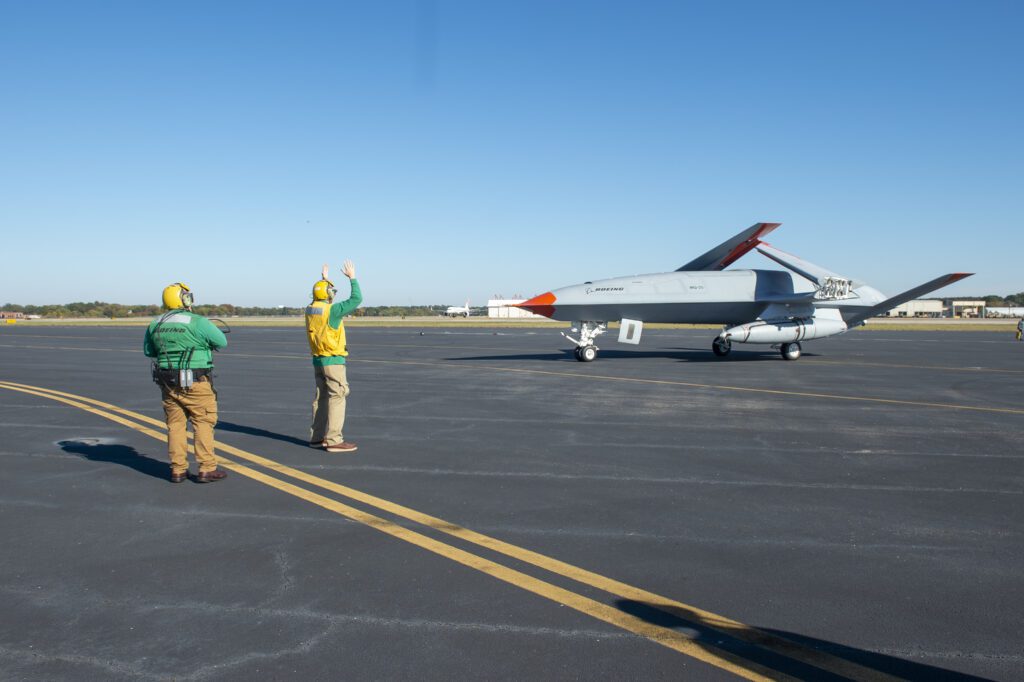
The U.S. Navy and Boeing conducted ground testing of the MQ-25 Stingray at Chambers Field onboard Naval Station Norfolk, Virginia. The MQ-25 Stingray is an unmanned aerial refueling aircraft. U.S. NAVY / Mass Communication Specialist 2nd Class Sam Jenkins

NORFOLK, Va. — The U.S. Navy and Boeing are completing ground tests of the MQ-25 Stingray test asset at Chambers Field onboard Naval Station Norfolk, Virginia, the Navy said Nov. 22. 

“The Stingray is the future of naval aviation. It is the first aircraft carrier-based unmanned air vehicle,” said Rear Adm. John Meier, Commander, Naval Air Force Atlantic. “The ground testing is another step toward the teaming of manned and unmanned aircraft platforms. Integrating platforms like the MQ-25 into the air wing will increase their lethality and reach.” 

The MQ-25 Stingray introduces unmanned aerial refueling and intelligence, surveillance and reconnaissance capabilities to the air wing that will extend the range, operational capacity and lethality of the Carrier Air Wing and Carrier Strike Group. 

“What we are doing today is deck handling,” said Rick Schramm, the technical lead engineer material review board. “We have a system installed on the airplane that allows the aircraft to be engines up, power running and taxing by controllers on the deck.”  

Schramm described that they are using painted lines to section areas of the flight deck to test how the MQ-25 would be able to maneuver on board an aircraft carrier.  

The MQ-25 is the first move toward the Navy’s strategic vision of unified, interoperable networks and systems architecture. It is paving the way for future unmanned systems to be introduced to the air wing and aircraft carrier environment.  

Chief Aviation Machinist Mate Michael Solle said the capabilities of the MQ-25 will allow the F/A-18 to return to its primary mission set as well as extend its strike range and enhance maneuverability. 

The Boeing-owned MQ-25 recently completed its first aerial refueling of an F-35C Lightning II aircraft, marking the third refueling flight evolution for the test aircraft as a whole. Once operational, MQ-25 will refuel every receiver-capable carrier-based aircraft. 

The MQ-25 is intended to be one of the Navy’s fastest major defense acquisition programs to reach initial operational capability. 


ONR Chief Unveils New Vision to Reimagine Naval Power

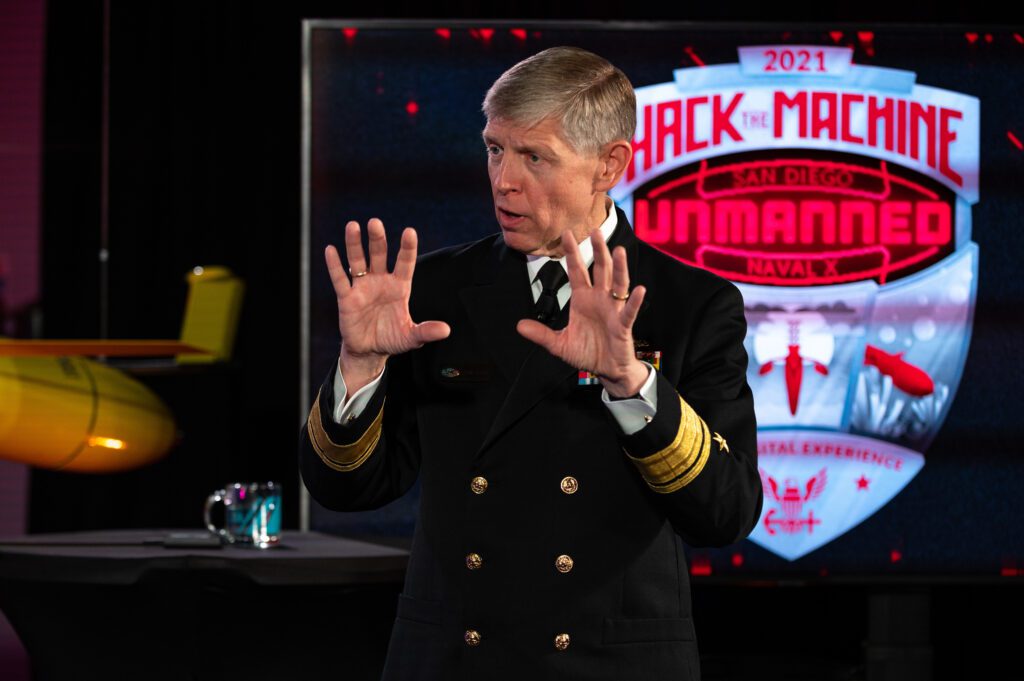
Rear Adm. Lorin Selby, chief of naval research, delivers remarks at the HACKtheMACHINE Unmanned competition in Alexandria, Virginia, Nov. 17. HACKtheMACHINE Unmanned is the first in a series of public-facing technology challenges aimed at accelerating discovery and teambuilding between the DoN, industry and academia for the creation of groundbreaking unmanned and autonomous systems. U.S. NAVY / Michael Walls

ARLINGTON, Va. — Declaring “Our time to innovate is now,” Chief of Naval Research (CNR) Rear Adm. Lorin C. Selby last week introduced a new vision for future naval power, one based on faster development of unmanned, autonomous systems, vibrant partnerships with industry and academia and reimagined naval formations. 

“I think this decade, the 2020s, will have special significance for our nation and our role in leading the world,” Selby told a nationwide audience during the HACKtheMACHINE Unmanned event. “What can we do today that can deliver measurable results in two years, that leads to deployed capabilities at scale in five years, to fully realize that reimagined future?”   

Small, Agile, Many 

A critical important component of future naval success, he said, is incorporating advanced cyberphysical technologies found in the “small, the agile, and the many” — small unmanned, autonomous platforms that have the agility to be built and adapted quickly, in large numbers, and at far lower costs compared to larger platforms. These unmanned air, surface and subsurface vehicles will carry an array of sensors and modern payloads, and perform multiple missions. 

“The small, the agile and the many have the strong potential to define the future in a world where the large and the complex are either too expensive to generate in mass, or potentially too vulnerable to put at risk,” he said. 

“We are talking about how to iterate at scale and at speed. How to take things that meet operational needs and making them part of the force structure, deploying them in novel naval formations” that will “confuse and confound the tasks our adversaries must consider.” 

One of the advantages of the small, agile and many platforms in this new formation is that Selby believes they can be built relatively inexpensively compared to existing force structure. This makes them more attritable in high-end conflict — in other words, if they are shot down or otherwise put out of action, American forces will have dozens, even thousands, of backups in place. Having large numbers of advanced but inexpensive platforms in the fleet to counter an adversary’s expensive platforms could play an important role in deterring aggressive actions. 

Selby gave his remarks during a keynote address at the HACKtheMACHINE Unmanned competition, held virtually Nov. 16-19. This event, which is expanding to multiple cities across the country, is a public-facing technology challenge aimed at accelerating discovery and team building between the Department of the Navy, industry and academia. 

The ultimate goal of such events, Selby said, is to create new ways of doing business for autonomous and software-based systems. Comparing this moment in history to the dawn of the industrial revolution, when technological advances drove massive change, he noted that today, “data is the new oil, and software is the new steel.” 

Sponsored by ONR, in conjunction with Program Executive Office (PEO) C41, PEO Integrated Warfare Systems, PEO Unmanned and Small Combatants, the Navy’s Cybersecurity Office (PMW-130) and industry partners like Fathom5 and Booz Allen Hamilton, HACKtheMACHINE Unmanned is one of the ways ONR is working to support the Navy’s 2021 Unmanned Task Force and integrate unmanned and autonomous technology at scale.  

A Strategic Hedge 

Selby emphasized the importance of America’s current naval force structure needing a “strategic hedge.” He noted that in World War II, the Navy was primarily invested in battleships as the nucleus of combat power for any future conflict. However, the Navy and the nation had a “hedge” investment in aircraft carrier and submarine force structure. Ultimately the hedge proved crucial to victory — far different from the beginning of the war, when battleships were seen by many as the key. 
   
The small, the agile and the many represent a viable hedge to support the large and the complex platforms that comprise the backbone of today’s force structure. Rapid development of unmanned, autonomous systems provides the technological drive to create a hedge option for the 21st century Navy and Marine Corps. Developing this strategic hedge at ONR is one of many ways the organization helps the Navy and Marine Corps adapt to potential futures. 

Finally, the CNR stressed the importance of moving from the current requirements-driven acquisition process — a successful process for large platforms, but one not rooted in speed — to a “problem-driven” process, where the Naval Research Enterprise asks operators and commanders what problems they are facing, and rapidly creates solutions to solve their problems.  

That approach has already begun. ONR provided dozens of unmanned platforms and sensors used in last April’s Integrated Battle Problem 2021, which focused on a PACFLEET battle problem. In 2022, those efforts will continue, including partnering with SOUTHCOM to deliver new tools for drug interdiction efforts. 


Navy and Port of Hueneme Help Relieve U.S. Supply-Chain Congestion

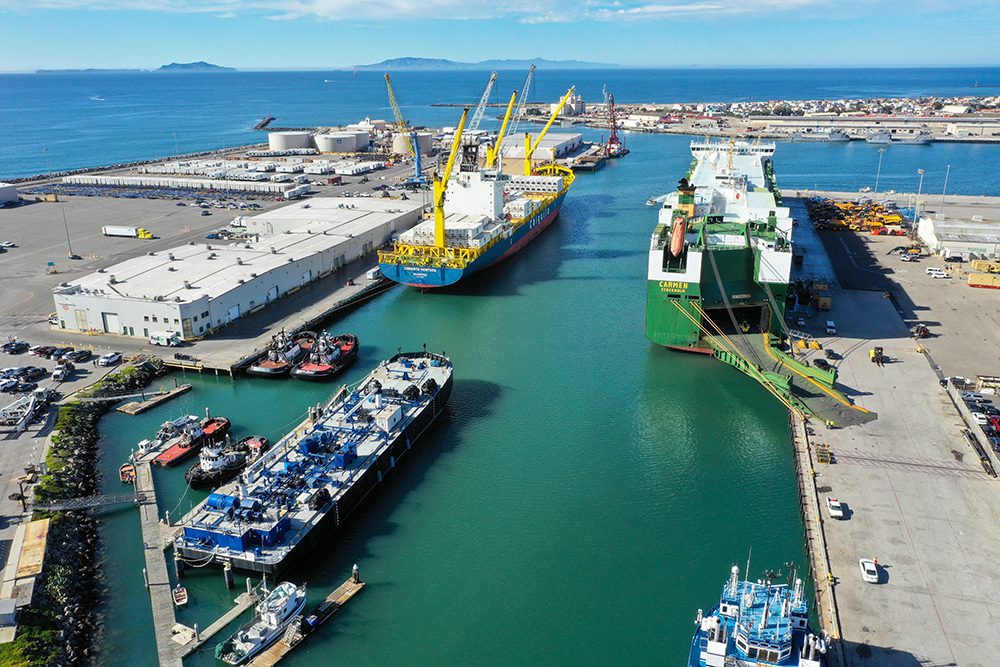
The U.S. Navy in partnership with the Oxnard Harbor District is providing resources onboard Port Hueneme in direct support of decreasing port congestion in Los Angeles County and reducing the national supply-chain shortage, Nov. 22, 2021. U.S. NAVY

PORT HUENEME, Calif. — The U.S. Navy in partnership with the Oxnard Harbor District (OHD) is providing resources onboard Port Hueneme in direct support of decreasing port congestion in Los Angeles County and reducing the national supply-chain shortage, Nov. 22, 2021. 

A standing Joint Use Agreement (JUA) with Naval Base Ventura County and OHD, allows the Navy to support commercial supply chain logistics when activated. 

“Naval Base Ventura County recently welcomed a large cargo vessel,” said Daniel J. Herrera, assistant program director for port operations, NBVC. “Ports of America already off-loaded a large number of 40-foot containers into lot 22 onboard Port Hueneme, which is merchandise expected to have direct impact with helping to support holiday supply demands.” 

The Department of the Navy entered into a JUA in 2002 with the OHD, replacing the 1994 memorandum of understanding, authorizing commercial use of Wharf 3 onboard NBVC, including approximately 21 acres of contiguous land, buildings 546 and 548, and if available, up to an additional 10 acres of industrial land located outside of the Wharf 3 area. 

Jason Hodge, President of the OHD which owns the Port of Hueneme, said commercial business at the port has increased significantly over the past year and when it comes to moving cargo, the Port’s flexible “can do” attitude is similar to the Navy Seabees’ “Can Do” motto of completing a task no matter the condition or situation. 

“The port appreciates the partnership with NBVC and locating additional space to accommodate excess holiday shipments coming through the port,” Hodge said. “We are delighted to come together to meet the challenge of providing a solution to help keep essential goods moving. Our long-standing history of partnership continues with this call-to-action to address the national supply chain challenge.” 

The JUA was activated in November as a resource to help reduce the shipping congestion affecting Los Angeles County’s major ports and contributing to the national supply crisis. Vessels would arrive into the port to unload a portion of their containers before continuing on to Los Angeles County or chose to unload all their containers at the Port of Hueneme to avoid the backlog of ships farther south. 


HII Awarded Additional $113.6 Million for Advance Procurement for LHA 9

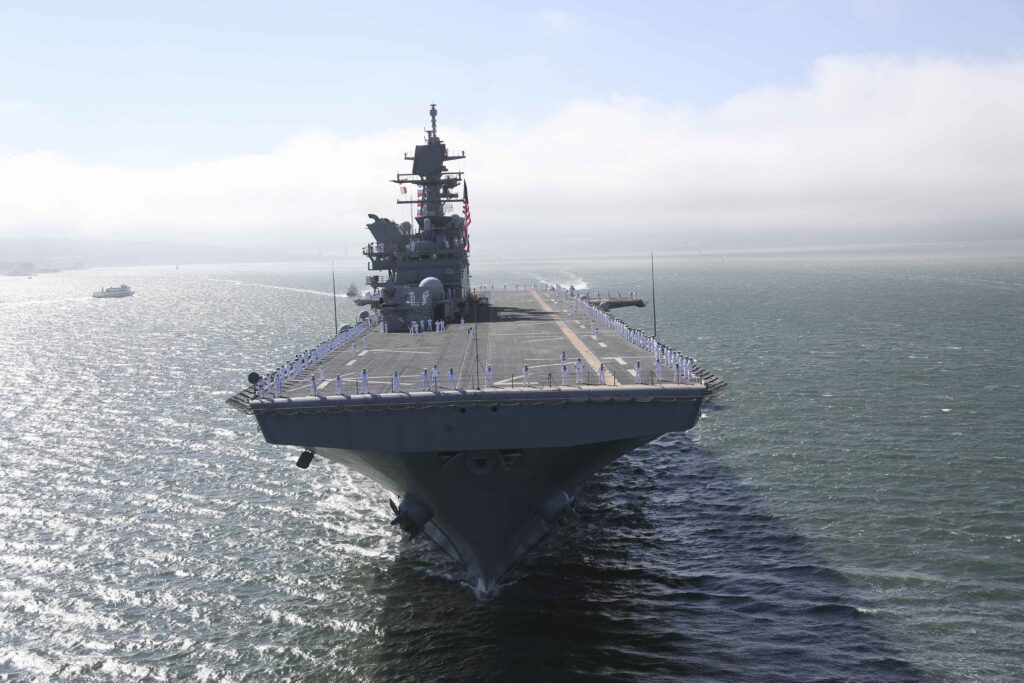
Sailors aboard amphibious assault ship USS Tripoli (LHA 7) man the rails on the ship’s flight deck as the ship prepares to pull into San Francisco in support of San Francisco Fleet Week, Sept. 11. Huntington Ingalls Industries has received a contract modification to enable long-lead material and advanced procurement activities for amphibious assualt ship LHA 9. U.S. NAVY / Mass Communication Specialist 3rd Class Erica Higa

PASCAGOULA, Miss. — Huntington Ingalls Industries’ Ingalls Shipbuilding division has received a contract modification from the U.S. Navy for $113.6 million to enable long-lead-time material and advance procurement activities for amphibious assault ship LHA 9, the company said Nov. 19. This modification brings the total advance funding for LHA 9 to $651 million. 

“We appreciate the partnership we have with the Navy and their continued commitment to this important ship,” Ingalls Shipbuilding President Kari Wilkinson said. “Not only will it provide capability to our Navy fleet, but it also sustains hundreds of jobs across the country within our vast network of suppliers in support of construction.” 

LHAs are the centerpiece of the Navy amphibious ready groups and Marine Corps air ground task forces. In addition to being lethal, mobile and agile maintenance and logistics facilities, LHAs are top-of-the-line medical facilities with full operating suites and triage capabilities. 

Ingalls is the sole builder of large-deck amphibious ships for the Navy. The shipyard delivered its first amphibious assault ship, the Iwo Jima-class USS Tripoli (LPH 10), in 1966. Ingalls has since built five Tarawa-class (LHA 1) ships, eight Wasp-class (LHD 1) ships and the first in the new America class of amphibious assault ships (LHA 6) in 2014. The second ship in the America class, USS Tripoli (LHA 7), was delivered to the Navy in early 2020. Bougainville (LHA 8) is under construction. 


Navy to Christen Future Littoral Combat Ship Marinette

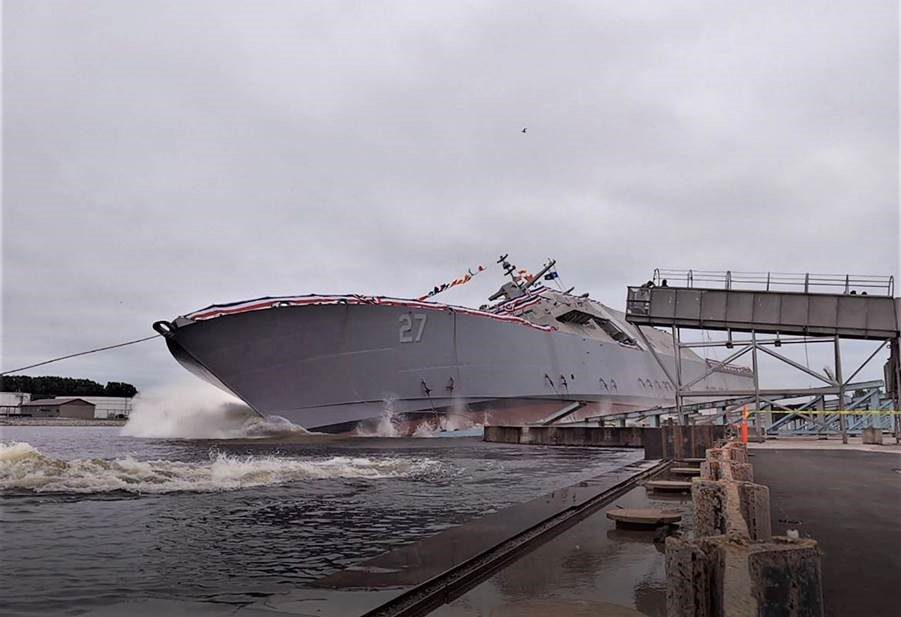
The Navy will christen the future USS Marinette (LCS 25) on Nov. 20. Shown here is the future USS Nantucket, christened Aug. 7. LOCKHEED MARTIN

ARLINGTON, Va.—The Navy will christen the future USS Marinette (LCS 25) as the newest Freedom-variant littoral combat ship (LCS) during a 10:00 a.m. CST ceremony Saturday, Nov. 20, in Marinette, Wisconsin, the Defense Department said Nov. 19. 

The principal speaker is Meredith Berger, performing the duties of the under secretary of the Navy. Additional speakers include Vice Adm. William Galinis, commander, Naval Sea Systems Command; Rear Adm. Casey Moton, program executive officer for Unmanned and Small Combatants; Steve Genisot, mayor of Marinette, Wisconsin; and shipbuilders Steve Allen, Lockheed Martin vice president of Small Combatants and Ship Systems, and Dario Deste, president and CEO of Fincantieri Marine Group. The ship’s sponsor, former Michigan governor Jennifer M. Granholm, will break a bottle of sparkling wine across the bow in a time-honored Navy tradition. 

“The future USS Marinette will be the second U.S. Navy ship honoring the important naval heritage and shipbuilding history the city of Marinette is known for,” said Secretary of the Navy Carlos Del Toro. “I have no doubt the Sailors of USS Marinette [LCS 25] will carry on the proud legacy from generations past and will stand ready to respond to any mission, wherever, and whenever, there is a need.” 

LCS is a fast, agile, mission-focused platform designed to operate in near-shore environments, winning against 21st-century coastal threats. The platform is capable of supporting forward presence, maritime security, sea control and deterrence. 

The LCS class consists of two variants, the Freedom and the Independence, designed and built by two industry teams. Lockheed Martin leads the Freedom variant team, or odd-numbered hulls, in Marinette, Wisconsin. Austal USA leads the Independence variant team in Mobile, Alabama for LCS 6 and the subsequent even-numbered hulls. 

LCS 25 is the 13th Freedom-variant LCS and 25th in the LCS class. It is the second ship named in honor of the city of Marinette, Wisconsin. The first Marinette (YTB-791), a Natick-class large fleet tugboat, was launched in 1967 and performed miscellaneous tugging services in the 5th Naval District, headquartered at Norfolk, Virginia. 


Navy Accepts Delivery of Future LCS USS Minneapolis-Saint Paul

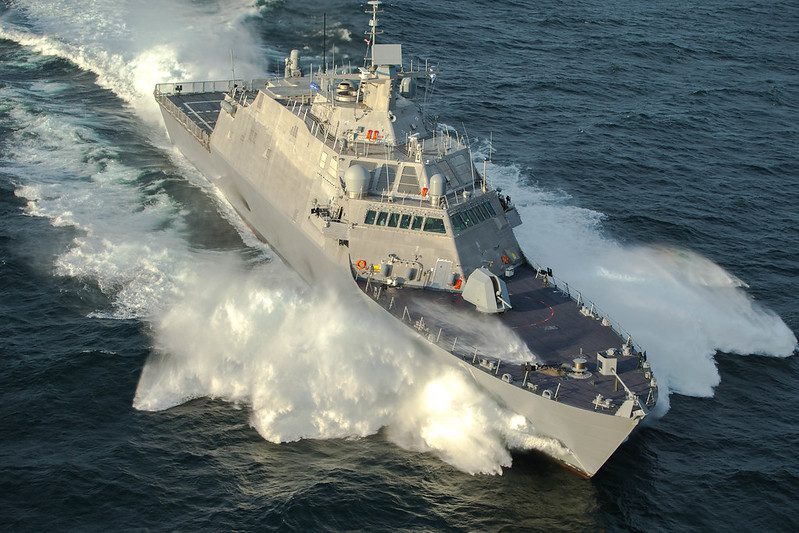
The U.S. Navy accepted delivery of the future USS Minneapolis-Saint Paul (LCS 21) Nov. 18. LOCKHEED MARTIN

MARINETTE, WIS. – The Navy accepted delivery of the future USS Minneapolis-Saint Paul (LCS 21) at the Fincantieri Marinette Marine (FMM) shipyard Nov. 18, Program Executive Office – Unmanned and Small Combatants (PEO USC) Public Affairs said in a release. 

The future USS Minneapolis-Saint Paul is the 11th Freedom-variant LCS designed by the Lockheed Martin-led industry team at Fincantieri Marinette Marine, Marinette, Wisconsin. Delivery marks the official transfer of the ship from the shipbuilder, part of a Lockheed-Martin-led team to the Navy.  

“Today marks a significant shipbuilding milestone in the life of the future USS Minneapolis-Saint Paul, an exceptional ship which will conduct operations around the globe,” said LCS program manager Capt. Mike Taylor. “I look forward to seeing Minneapolis-Saint Paul join her sister ships with 100 percent of propulsion power available for unrestricted use.” 

LCS 21 was accepted after rigorous testing of a combining gear modification that will allow for unrestricted operations, addressing a class-wide flaw that was discovered as the Fleet deployed these ships in greater numbers. LCS 21 is the first Freedom-variant ship to receive the fix.    

The future USS Minneapolis-Saint Paul is the second naval ship to honor Minnesota’s Twin Cities although each city has been honored twice before. The first US Navy warship named Minneapolis-Saint Paul was a Los Angeles-class submarine launched in 1983 who took part in Operation Desert Shield/Desert Storm. USS Minneapolis-Saint Paul (SSN 708) was the first submarine to carry Tomahawk missiles specifically designed for use in strikes against Iraq during the Gulf War. Having served for over two decades with distinction, the submarine Minneapolis-Saint Paul was decommissioned in 2007. 

Several more Freedom variant ships are under construction at Fincantieri Marinette Marine Corp. in Marinette, Wisconsin. Pending successful at-sea testing of its combining gear modification, Cooperstown (LCS 23) is planned to deliver in January 2022. Additional ships in various stages of construction include Marinette (LCS 25), Nantucket (LCS 27), Beloit (LCS 29) and Cleveland (LCS 31).  

The Littoral Combat Ship (LCS) is a fast, agile, mission-focused platform designed to operate in near-shore environments, winning against 21st-century coastal threats. The LCS is capable of supporting forward presence, maritime security, sea control, and deterrence. 


Rear Adm. Pappano: Supply Chain Fragility is No. 1 Risk to Columbia SSBN Program

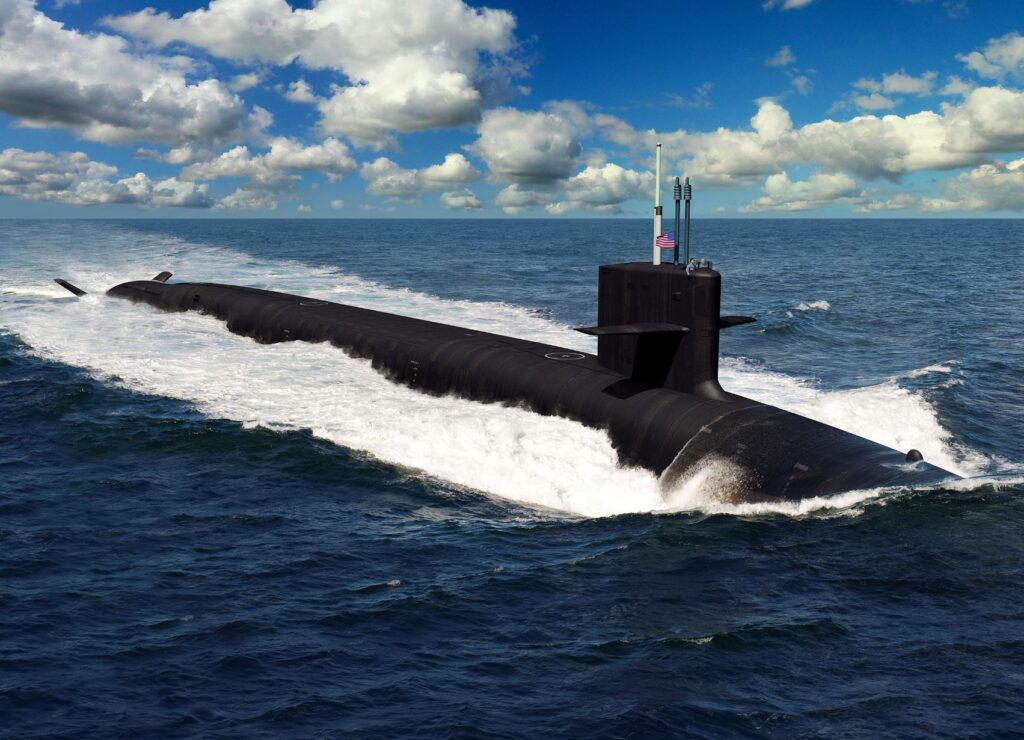
An artist’s rendering of the future U.S. Navy Columbia-class ballistic missile submarines. U.S. NAVY

ARLINGTON, Va. — The admiral in charge of building the Navy’s next-generation ballistic-missile submarine (SSBN) said the fragility of the submarine industrial base supply chain is the main risk to the Columbia SSBN going on patrol on time in October 2030. 

“The supply chain is the No. 1 risk to Columbia and 1 + 2,” said Rear Adm. Scott Pappano, program executive officer for Strategic Submarines, speaking Nov. 18 at the Naval Submarine League’s annual symposium in Arlington.  

The “1+2” refers to the current submarine building load of one Columbia-class SSBN and two Virginia-class attack submarines (SSNs) per year. 

Pappano also said because the Columbia-class SSBN is the Navy’s No.1 procurement priority, any schedule adjustment to the submarine programs would be borne by the Virginia-class SSNs before it would affect Columbia. 

The admiral noted that in the post-Cold War period the submarine industrial base had 17,000 suppliers, a number that has declined to 5,000 today. He said the fragility is greatest with components such as castings, fittings, valves and electrical equipment. 

Pappano said the Navy needs some sort of tripwire to warn the service when a supplier is faltering. 

PEO Submarines soon is standing up a new directorate, PMS-396, to manage sustainment of in-service SSBNs. 

He said there is no margin in the build schedule, so the Navy is not going to sponsor competitions for many components and systems already proven but will leave some room for competition.  

The admiral also said that the Ohio-class SSBNs — designed for 30-year careers and extended to 42 years — may be extended even longer on an individual basis.  

“Individual extensions are being looked at for targeted work,” he said. 

The admiral also said that the patrol and refit cycles of the Ohio class may be adjusted “to better maximize” their service until the boats are retired in the late 2030s. 

Pappano also stressed that the shore infrastructure that supports the SSBN force — such as the Trident Refit Facilities — needs attention if it is to last through the 2080s to service the Columbia SSBN force for its entire life. 


Rear Adm. Perry: First New-Production Mark 48 Torpedoes Set for 2022 Delivery

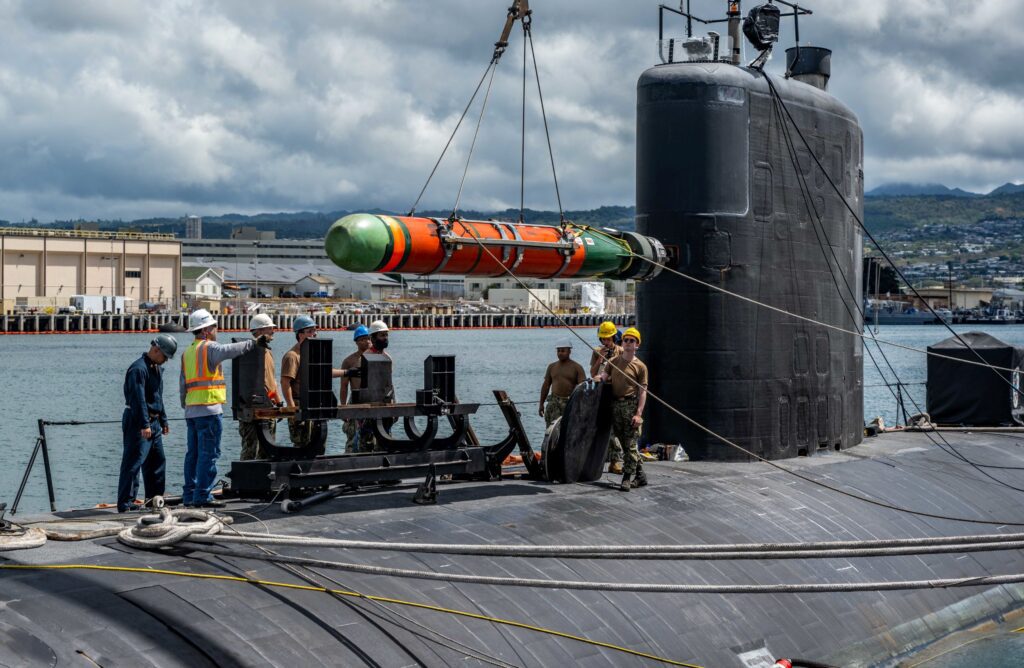
Sailors assigned to the Los Angeles-class fast-attack submarine USS Columbia (SSN 771) load a Mark 48 advanced capability torpedo for Exercise Agile Dagger 2021. U.S. NAVY / Mass Communication Specialist 1st Class Michael B. Zingaro

ARLINGTON, Va. — The first of a new-production batch of heavy-weight torpedoes (HWTs) is slated for delivery to the U.S. Navy fleet beginning in fiscal 2022, the Navy’s submarine resource sponsor said.  

Rear Adm. Doug Perry, director of Undersea Warfare Programs speaking Nov. 18 at the Naval Submarine League’s annual symposium in Arlington, said the Mark 48 HWT was last delivered in 1996, but that it has been incrementally upgraded ever since to the Advanced Capability (ADCAP) standard. However, new production was needed to build up the Navy’s inventory to meet potential warfighting needs. 

“The heavy-weight torpedo will remain the weapon of choice for the submarine for the foreseeable future, primarily due to its intended stealth, its destructive effectiveness in the battlespace, and [is] pretty difficult to defend against.” 

Perry also noted that the HWT sustains the stealth of the launch platform, the submarine. 

The Navy restarted the ADCAP production in 2016, with the program bearing fruit this year. 

Perry said the Navy is focusing on capacity in parallel with improvements for the torpedoes, including in sensor capability and in defeating countermeasures. 

The modernization upgrades over the last two decades primarily have been focused on software algorithms and processing, he said. 

“We’re past time about introducing some game-changing capability into this mainstay weapon,” Perry said. “We’re introducing significant range increase through the re-introduction of a proven engine that can give us longer legs, much longer than the average ADCAP. 

With the combination of some longer legs, some better sonar and processing and a digital backbone vice analog, it will enable us to have a one-shot, one-kill ADCAP into the next decade against those key platforms that the submarine force will be responsible to ‘service’.”