Vice Adm. Wolfe: Hypersonic Weapon Load for Zumwalt DDGs Under Study
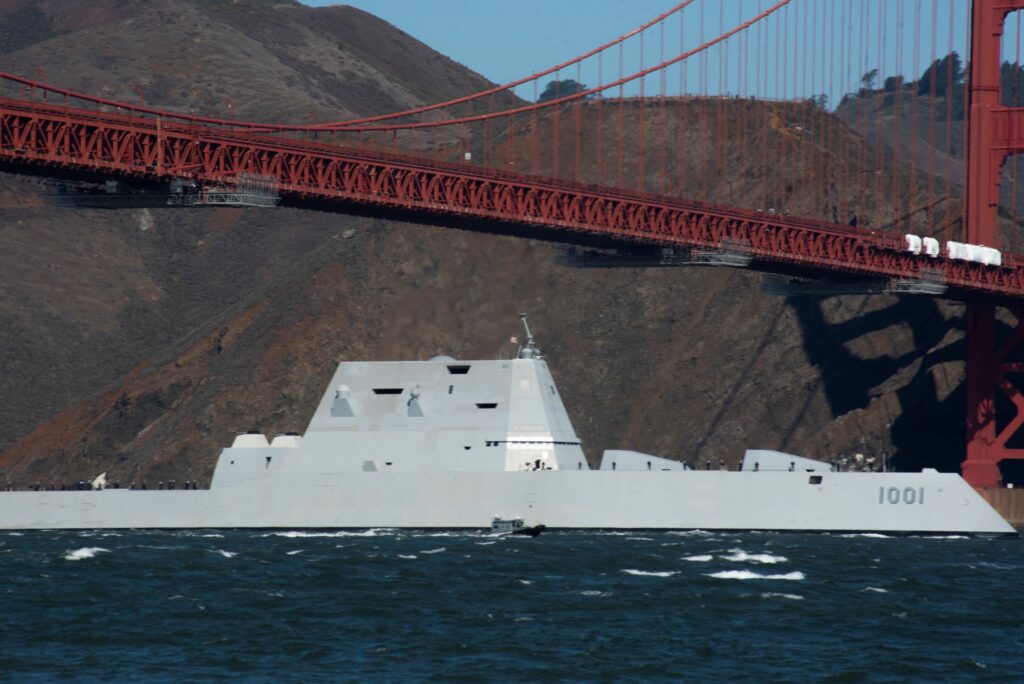
The Zumwalt-class guided-missile destroyer USS Michael Monsoor (DDG 1001) transits under the Golden Gate Bridge during San Francisco Fleet Week 2021. U.S. NAVY / Mass Communication Specialist 2nd Class Hector Carrera
ARLINGTON, Va. — With the Zumwalt-class destroyer set to be the first ship to be armed with the Conventional Prompt Strike (CPS) hypersonic missiles, the Navy is studying the parameters for the weapon load-out for the ships, a senior Navy admiral said.
Vice Adm. Johnny Wolfe, director, Strategic Systems Program, speaking Nov. 18 at the Naval Submarine League’s annual symposium in Arlington, said the CPS “will be the primary weapon system” on the Zumwalt DDGs.
The Zumwalt is equipped with 20 four-call Mk57 peripheral vertical launch systems which can launch Tomahawk, Standard, Evolved SeaSparrow and Vertical-Launch Anti-Submarine Rockets. The ship is expected to be fitted with separate launchers for the CPS. The two Advanced Gun Systems on the ship — which are inactive because of lack of an affordable munition — may be removed to make room for CPS launchers.
The Navy originally had planned to deploy the CPS on the Ohio-class guided-missile submarines (SSGNs), but the delay in funding for an underwater launch test facility for the missiles pushed development into the future such that, with the Navy’s plan to decommission the SSGNs in the mid-2020s, Wolfe said it made more sense to skip the SSGNs as a platform. The underwater launch test facility development will be restarted in 2022.
The Block V Virginia-class attack submarine (SSN) equipped with the Virginia Payload Module will be the second platform to be armed with hypersonic missiles.
“What we’re doing is trying to leverage Zumwalt — even though it is a surface platform,” Wolfe said. “A lot of things that we’re going to test on Zumwalt are still going to be applicable on Virginia [SSN] and we’re looking at how we can get that learning to get to that platform sooner.”
Wolfe said, “We’ve been hitting our milestones” toward fielding all-up rounds for the Army in 2023 and the Navy in its Zumwalt DDGs in 2025.
Two tests of all-up rounds for the Army will be tested in fiscal 2022 and he said the Navy will start ramping up to five Advanced Payload Modules which will go into the Zumwalts and then go into the Virginia SSN.
Wolfe said the Navy has been including CPS equipment in sounding rocket sorties from NASA’s facility in Wallops Island, Virginia, along with payloads from other users to advance technology maturation.
The hypersonics program so far has had three successful rocket motor tests and the first slug test, the latter demonstrating the ability to eject-test in a cold launch.
Vice Adm. Houston: Sub Force Approaching Inflection Point of 50 SSNs
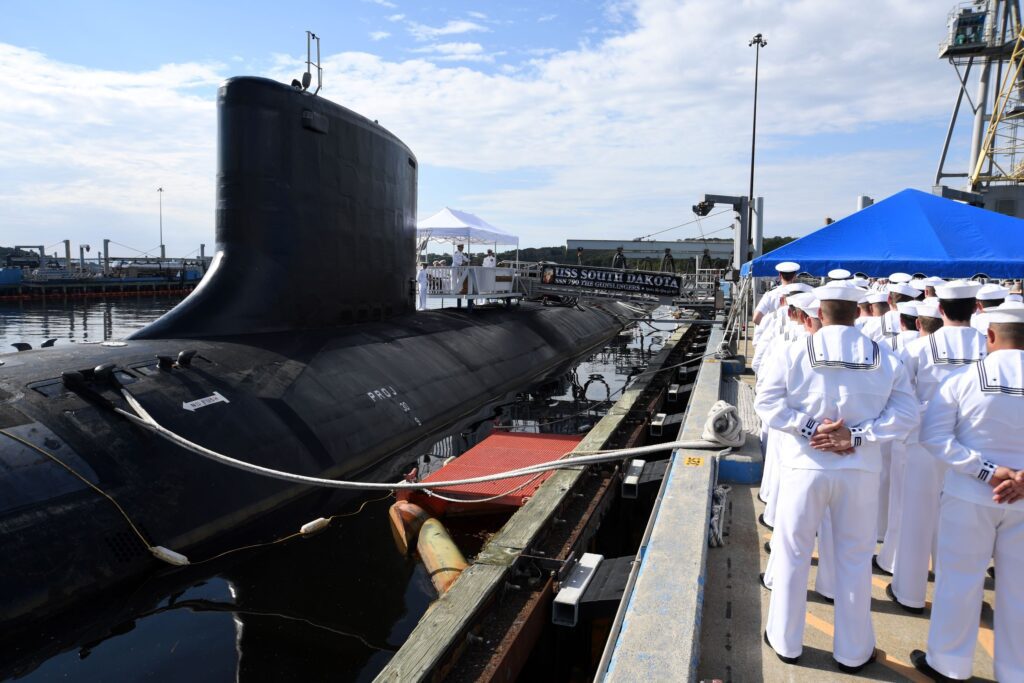
The crew of the Virginia-class submarine USS South Dakota (SSN 790) stand at parade rest during a change-of-command ceremony onboard Naval Submarine Base New London in Groton, Connecticut, Sept. 27. U.S. NAVY / Chief Petty Officer Joshua Karsten
ARLINGTON, Va. — The decline in the number of the Navy’s attack submarines (SSNs) is leveling out sooner than was feared just a few years ago, made possible by the decision to extend the service lives of some older SSNs.
Previously, the force level of SSNs was predicted to decline to a “trough” of 41 SSNs in the mid-2020s before the number would start to increase as the building of two Virginia-class SSNs per year hit its stride.
With 50 submarines “we are at that inflection point right now,” said Vice Adm. Bill Houston, commander, Naval Submarine Forces, speaking Nov. 17 at the Naval Submarine League’s annual symposium in Arlington. “We are actually very stable right now [at 50] and we’re starting to increase our numbers.
“How are we doing that? Through an awful lot of hard work by those people who came before me and whose shoulders we’re standing on right now; tremendous hard work from the shipbuilders and tremendous from the Navy, from the Department of Defense and from our overall government,” Houston said.
An important initiative is the service life extension of several Los Angeles-class SSNs.
“There is additional margin in the Los Angeles class,” he said. “We actually have reactor cores available which will refuel and extend a significant number of Los Angeles-class submarines.”
Houston was not specific in the number of Los Angles-class SSNs submarines that will go through life extensions. The Navy previously has mentioned consideration of extending the service lives of five to seven boats.
“We found that on most of our Los Angeles [SSNs] had significant hull margins, so we were able to extend them, and they had the fuel to go longer,” he said. “There are several Los Angeles’s that we will physically refuel and add years on them. Just due to the absolutely incredible job we did when we built the Los Angeles and the Ohio [SSBN and SSGN] that we could extend those ships as long as we can.”
Adm. Caldwell: ‘It’s a Great Time to Be a Submariner’
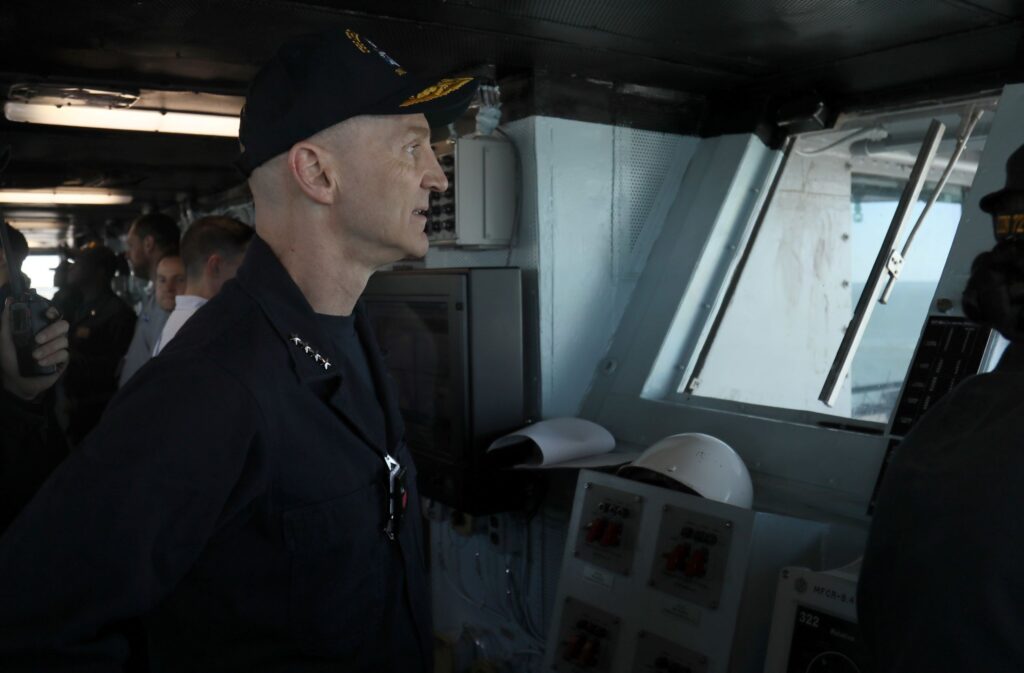
Adm. Frank Caldwell observes Nimitz-class aircraft carrier USS Abraham Lincoln (CVN 72) getting underway on the bridge in this 2017 photo. U.S. NAVY / Mass Communication Specialist 1st Class Josue L. Escobosa
ARLINGTON, Va. — The director of the U.S. Navy’s Nuclear Propulsion Program told an audience of active-duty and retired submariners that the current era of great power competition is highly demanding of the submarine force but is an exciting time as the challenges are met.
“Our submarines are consistently in high demand,” said Adm. Frank Caldwell, director, Navy Nuclear Propulsion Program, speaking Nov. 17 at the Naval Submarine League’s annual symposium in Arlington. “We are always improving our game, our team, our platforms. … It’s a great time to be a submariner.”
Caldwell noted that while the United States faced a formidable adversary during the Cold War — the Soviet Union — it now faces two nuclear-capable competitors: Russia and China. He said that the U.S. Navy’s attack submarines and guided missiles are deployed forward daily.
He especially praised the wisdom of the conversion of four Ohio-class ballistic-missile submarines (SSBNs) into guided-missile submarines (SSGNs), each able to deploy with up to 154 Tomahawk cruise missiles and with special operations forces.
“We can’t keep these platforms at sea enough,” he said of the Ohio-class SSGNs, calling their development in the 2000s a “monumental decision.”
The SSGNs are slated for retirement in the mid-2020s, and their missile capacity will be replaced by Block V Virginia-class submarines equipped with the Virginia Payload Module.
Caldwell noted the new strike weapons entering the submarine force’s arsenal in the next few years, including the Maritime Strike Tomahawk, the Conventional Prompt Strike hypersonic weapon, and the return of the submarine-launched Harpoon cruise missile.
Seabed warfare also is a capability being sought by the submarine force, he said, with an emphasis on unmanned vehicles.
Caldwell said the submarine force is focusing on all methods of transferring data on and off the ship to be networked with the fleet, including incorporating machine learning and artificial intelligence, to enable faster decision-making.
“Just as we pursue acoustic superiority, we are pursuing decision superiority,” he said.
He also noted that the United States currently is building submarines at the highest rate since the 1990s.
Electric drive will be returning to the submarine force with the Columbia-class SSBN. Caldwell said that every electric drive train bound for a Columbia-class SSBN will be thoroughly tested at a land-based test site in Philadelphia and then shipped to Electric Boat in Groton, Connecticut for installation in their respective hulls.
Caldwell briefly addressed the recent AUKUS agreement between Australia, the United States and the United Kingdom, which plans to build a nuclear-powered submarine force for Australia.
The U.S. Navy stands ready to support the historic announcement, but Caldwell stressed the importance of wise stewardship, looking at various options, and the importance of trust in the endeavor. He also said the Navy must be sure not to let AUKUS slow its own efforts.
“We have an already busy enterprise,” he said, noting that it is important for the Navy to remain focused.
Moran: China Way Ahead of US on AI Data
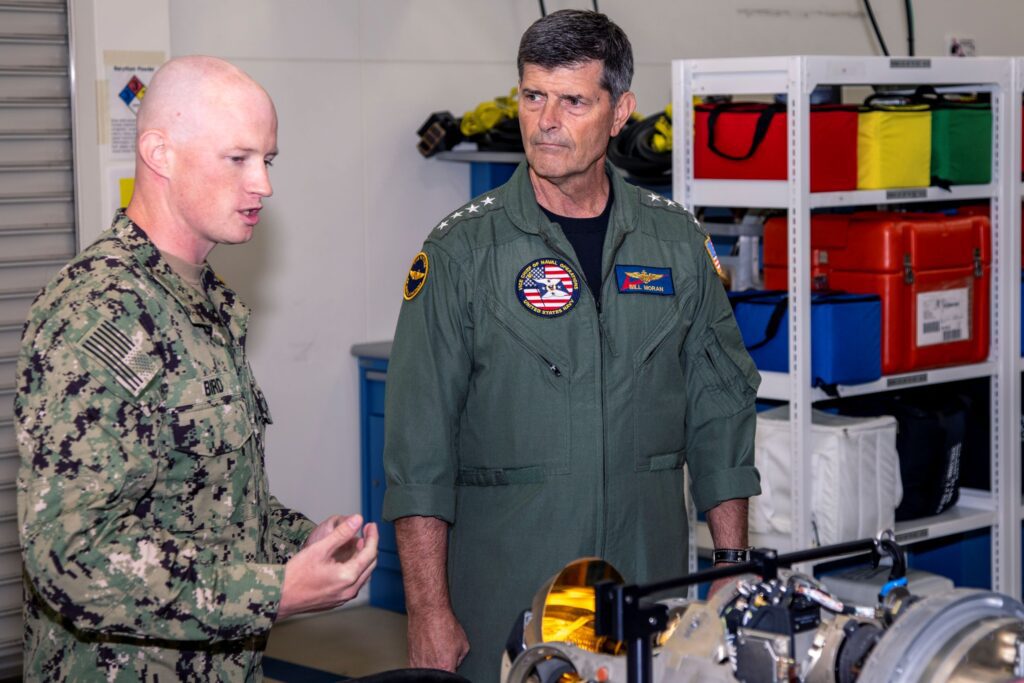
Retired U.S. Navy Adm. William Moran, then vice chief of naval operations, visits Aircraft Intermediate Maintenance Detachment Iwakuni at Marine Corps Air Station Iwakuni, Japan, Sept. 12, 2018. U.S. MARINE CORPS / Lance Cpl. Stephen Campbell
ARLINGTON, Va. — The United States still has an edge in two aspects of artificial intelligence (AI), but the People’s Republic of China is ahead on a third aspect and rapidly closing on the other two, a retired Navy admiral said.
Speaking on AI in a Nov. 16 webinar — hosted by the Navy League of the United States and sponsored by Deloitte — was retired Adm. William Moran, former vice chief of naval operations and currently a strategic advisor for several companies, a board member at the US Naval Institute and as the founder and president of WFM Advisors LLC.
Moran considered three legs of AI in his assessment: quality of data; AI expertise; and domain expertise.
“You add those things together and that’s where the magic happens,” he said.
The admiral said that much available data has to be refined, a time-consuming task that requires a large investment in personnel to convert stove-piped data in stove-piped systems to be useful across networks.
The United States — inside the U.S. Navy and outside — is flush with AI expertise, Moran said.
“We ae the best in the world in developing algorithms and developing AI capability,” he said.
But even more so, the Navy is vastly endowed with domain expertise.
“From a DoD [Department of Defense] perspective, we are so far ahead of the Chinese, in my opinion,” he said. “ASW [anti-submarine warfare], ASUW [anti-surface warfare], even — to some extent — cyber, we’re way ahead on domain expertise.
Moran said that on the aspect of data, “China is way ahead of us, because they can put raw manpower and unlimited resources towards data and they’ve done that for quite some time … and they don’t have a lot of the roadblocks to obtaining that data, not worried about the security pieces that we rightfully have in front of mind, whether it’s on the operational or tactical edge or the operational management structure.”
He said that China is going to close gaps quickly in AI and domain expertise.
“They’re in a race to get there sooner than we do,” he said.
“You’ve got to get the domain folks in with the software engineers that are writing the code, with the data that’s high quality, and it can happen pretty quickly. … You just have to commit and get after it.”
Naval Surface Warfare Center Implements Navy Continuous Training Environment Tool for Live Virtual Constructive Training
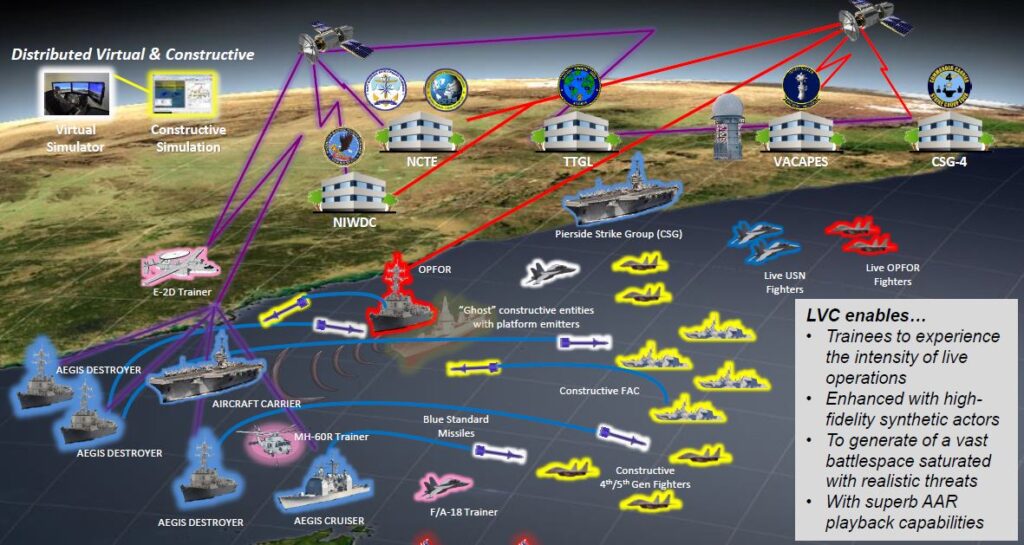
The Navy Continuous Training Environment (NCTE) enables live virtual constructive (LVC) training with live and synthetic systems around the globe. The Navy recently utilized NCTE during the Large-Scale Exercise 2021 to execute LVC events with forces from across the United States Fleet Forces Command, U.S. Pacific Fleet and U.S. Naval Forces Europe-Africa. The above graph show how the program communicates using networks, simulations, simulation routing equipment, data translation devices and live training range systems used to create a realistic LVC training environment. RON KETER
To meet the goal of digital transformation that seeks to eliminate onboard technical assists to ships by 2030 and advance the Navy’s training capabilities, Naval Surface Warfare Center, Port Hueneme Division has connected to the Navy Continuous Training Environment (NCTE).
Connectivity with NCTE enables warfighters to conduct live virtual constructive (LVC) training with live and synthetic systems around the globe. NSWC Corona Division in Corona, California, develops, manages, operates and maintains the NCTE on behalf of Commander, U.S. Fleet Forces Command and Commander, Pacific Fleet.
The NCTE consists of networks, simulations, simulation routing equipment, data translation devices and live training range systems used together to create a realistic LVC training environment.
“The ability to properly train or conduct training on a simulated threat that has the actual capability of the real threat, provides us with some knowledge of what our weapons can and cannot do,” said William Gieri, NSWC PHD Surface Warfare Engineering Facility (SWEF) manager. “It also provides training to fleet operations on what its people can expect in terms of how our systems would react to various threats.”
NCTE enables sailors to experience an integrated and secure training environment that can generate a variety of situations that might not be available in a live exercise but should be expected at sea, including scenarios with multiple ships and aircraft, according to Gieri.
“Instead of having real-life aircraft like commercial airlines, we can put simulated aircraft up there flying commercial routes and also aircraft from hostile countries that gives operators on the ship a much more realistic threat environment they’re more likely to encounter in various areas of the world they couldn’t otherwise experience in a sterile fleet environment or in an ocean where they don’t have aircraft routes,” Gieri said.
Gieri said he saw the tremendous potential to improve the command’s capabilities by connecting to NCTE. While NCTE was developed specifically for conducting fleet training, the command is exploring options to support events such as Combat Systems Ship Qualification Trials (CSSQT) and Combat System Assessment Team (CSAT) events using the NCTE capability.
“With the CSSQT events that we conduct, we can’t always provide real-world threats to the ships conducting them, so we are exploring using the NCTE and its capabilities to augment physical targets that we throw at the ships,” Gieri said.
Recently, USS Fitzgerald (DDG 62) was the first ship to visit NSWC PHD that participated in the Single Ship Synthetic Training, using NCTE to develop and deliver a complex scenario of multiple anti-ship cruise missile vignettes to help DDG 62’s training requirements.
And, the Navy recently used NCTE during the Large-Scale Exercise (LSE) 2021 to execute LVC events with forces from across the United States Fleet Forces Command, U.S. Pacific Fleet, and U.S. Naval Forces Europe-Africa. LSE 2021 was a globally integrated exercise that spanned multiple fleets across 17 different time zones connected using NCTE — executing new warfighting concepts and technology.
NSWC PHD’s use of NCTE is in the early stages, according to Gieri, and the team is learning what its full potential is and the different ways it can be used in training the warfighter and supporting the fleet.
“If you do the crawl, walk and run phase, you can throw simple threats at somebody, and once they become proficient at simple threats, you can throw more complex scenarios at them — much like you’d expect in the real world,” Gieri said. “So, it gives them the ability to learn from past experiences and become more proficient than if they were in an actual hostile engagement.”
In addition to providing enhanced training, NCTE is a cost-effective way to conduct complex training scenarios.
Sailors can also learn, while in a LVC training environment, how to tell the difference between a threat and a non-threat, as well as see how current weapons and combat systems may react to a potential threat.
“You can also recreate past scenarios, with different combat system baselines, which NSWC PHD is working toward right now with virtual test beds in the SWEF, so you can have a crew sitting at a combat information center with a combat system it has on its ship and see what real ships are doing on the range and see how that crew would react,” Gieri said.
Kanoko Esheim, NSWC PHD LVC lead, worked alongside Gieri to connect SWEF to NCTE.
“By coupling NCTE integrating architecture with the other digital transformation initiatives that are underway, the command is determined to activate a modernized capability to enhance the toolkit and workforce development activities,” Esheim said.
Gieri added that his team is exploring different ways the Navy can use the NCTE.
“We are working toward that end right now,” Gieri said. “We haven’t gotten there yet, but that’s the next generation, which is how to bring a land-based test site and marry it with a ship at sea to look at different combat systems and evaluate older or future combat systems with the combat systems on a ship on a training range.”
While NCTE was developed primarily for fleet training purposes, NSWC PHD is also exploring options for using it to support CSATs and CSSQTs.
“We’re working on use cases [that outline the purpose and likely uses] and presenting them to Pacific Surface Fleet leadership to see if there’s any buy-in or if the leaders can support that,” Gieri said. “This first test with NCTE during a CSAT at the end of September will be a proof-of-concept to evaluate if NCTE can be used in a CSAT environment.”
Virginia-Class SSN New Jersey Christened at Newport News Shipbuilding
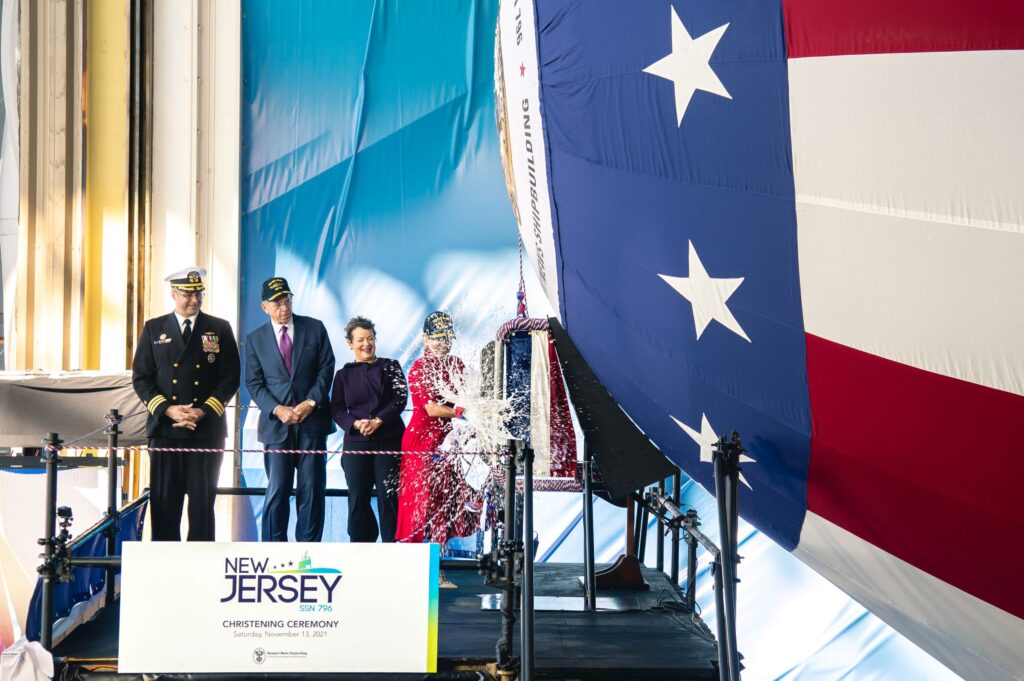
Ship’s sponsor Susan DiMarco christens pre-commissioning unit New Jersey (SSN 796) during ceremony on Saturday, Nov. 13, at Newport News Shipbuilding. Also pictured (left to right) are Cmdr. Carlos Otero, the ship’s prospective commanding officer; retired Navy Adm. Michael Mullen, former chairman of the Joint Chiefs of Staff and former chief of naval operations; and Jennifer Boykin, president of Newport News Shipbuilding division. HUNTINGTON INGALLS INDUSTRIES
NEWPORT NEWS, Va. — Huntington Ingalls Industries christened pre-commissioning unit New Jersey (SSN 796) Nov. 13 at the company’s Newport News Shipbuilding division, the company said in a release.
“The christening is a Navy and shipbuilder tradition that celebrates the hard work and dedication of the women and men who are building this magnificent submarine, readying her for the next phase of construction, which includes launch, testing, sea trials and delivery to the Navy,” said Jennifer Boykin, president of Newport News Shipbuilding. “We commemorate these American builders during a challenging time in our nation’s history.
“When New Jersey joins the Navy’s fleet, she will deliver firepower for freedom, taking with her the skill of her shipbuilders, the spirit of her sponsor, the courage of her commander and crew and the pride of her fellow New Jerseyans,” Boykin added. “These characteristics, united, forge a strong national defense that defines America.”
Susan DiMarco, a New Jersey resident, retired dentist and wife of former Secretary of Homeland Security Jeh Johnson, serves as the ship’s sponsor and performed the traditional honor of breaking a bottle of American sparkling wine across the submarine’s bow during the ceremony.
“As citizens today, we are more divided and disconnected from one another than at any time in our last 50 years, but the efforts that went into building New Jersey say otherwise,” DiMarco said. “In order to complete this great ship there must have been vital partnership and purpose. As a country, we are cooperative, generous and tenacious, and we can work together on exceptional ideas.”
The ceremony took place outside of Newport News Shipbuilding’s Module Outfitting Facility and was attended by more than 1,800 guests, including Newport News Shipbuilding employees who are building New Jersey, members of the submarine’s crew, Navy personnel and other government officials, including Jeh Johnson.
U.S. Rep. Bobby Scott, of Virginia, and U.S. Rep. Donald Norcross, of New Jersey, both delivered remarks. Other speakers included New Jersey Gov. Phil Murphy; Jay Stefany, acting assistant secretary of the Navy for research, development and acquisition; Vice Adm. Johnny Wolfe Jr., director of the Navy’s strategic systems programs; and Kevin Graney, president of General Dynamics Electric Boat.
Ceremony participants included U.S. Rep. Elaine Luria, of Virginia; Capt. Andrew P. Johnson, commanding officer of Supervisor of Shipbuilding, Conversion and Repair, Newport News; and Cmdr. Carlos Otero, the ship’s prospective commanding officer.
Retired U.S. Navy Adm. Michael Mullen, former chairman of the Joint Chiefs of Staff and former chief of naval operations, provided the keynote address.
“Today is a day of gratitude, especially to the 4,000 men and women whose hard work put New Jersey together,” said Mullen, adding that the nation must prevail in an ideological battle against an adversary it has not seen before.
“The future USS New Jersey will be a critical — some say the most critical — arrow in our quiver,” he said.
The company reached the pressure hull complete milestone in February, meaning all of the ship’s hull sections were joined to form a single, watertight unit. This was one of the last major milestones before the submarine was christened and floated off to a pier-side berth for additional outfitting and testing.
New Jersey is the 23rd Virginia-class submarine and the 11th to be delivered by Newport News Shipbuilding. It is first submarine designed with a modification for gender integration. Construction began in March 2016 and is 82% complete. The submarine is scheduled to be delivered to the U.S. Navy in late 2022.
A video of the ceremony, along with additional information on New Jersey, DiMarco and the Virginia-class submarine program, can be found at: https://nns.huntingtoningalls.com/SSN796
Navy to Christen Submarine New Jersey
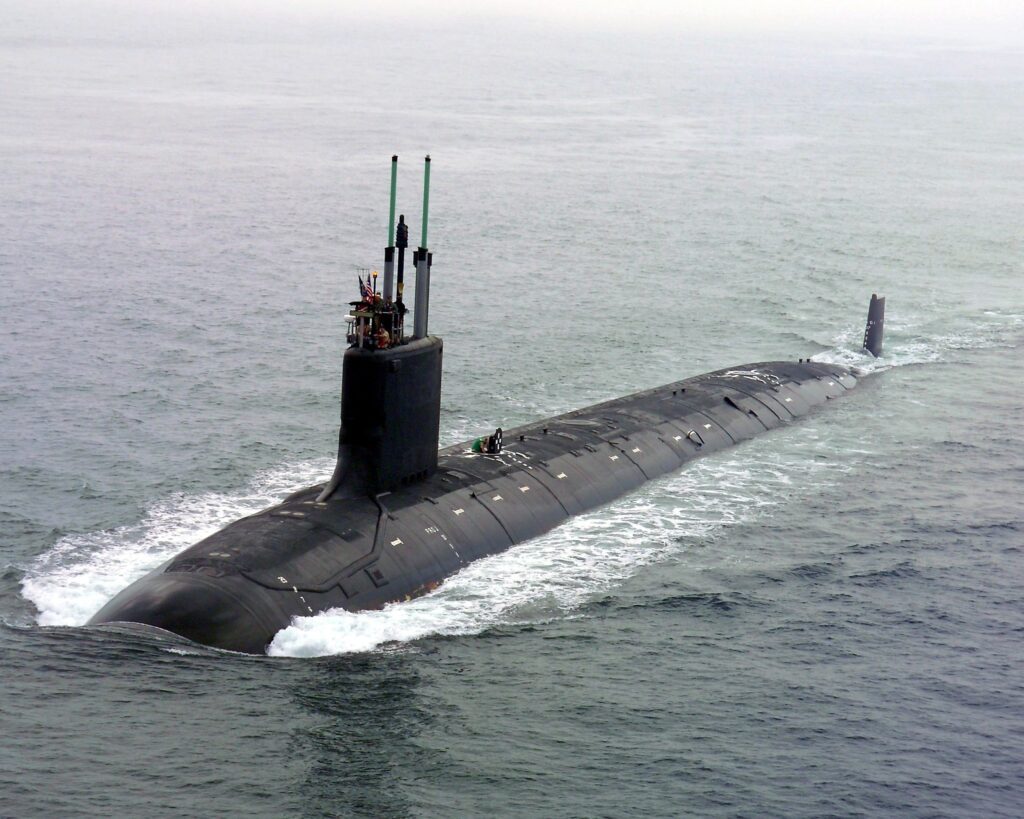
USS Virginia, the first of the Virginia-class of fast-attack submarines, in 2004. The Navy will christen the newest Virginia-class submarine, the future USS New Jersey (SSN 796) on Saturday, Nov. 13. GENERAL DYNAMICS ELECTRIC BOAT / Wikipedia
ARLINGTON, Va. — The Navy will christen one of its newest Virginia-class fast-attack submarines, the future USS New Jersey (SSN 796), during an 11 a.m. EST ceremony Saturday, Nov. 13, 2021, at Huntington Ingalls Industries in Newport News, Virginia, the Defense Department said Nov. 12.
The principal speaker will be retired Adm. Michael Mullen, the 17th chairman of the Joint Chiefs of Staff and the 28th chief of naval operations. Frederick “Jay” Stefany, acting assistant secretary of the Navy for research, development and acquisition and Vice Adm. Johnny Wolfe Jr., director, Strategic Systems Programs, will also deliver remarks. The submarine’s sponsor, Susan DiMarco Johnson, will christen the ship by breaking a bottle of sparkling wine across the bow in a time-honored Navy tradition.
“Shipbuilding has always played a key role in shaping the future of our national security,” said Mullen. “The impressive community of men and women involved in the construction of the future USS New Jersey should be extremely proud as they continue a legacy of extraordinary USS New Jersey ships and the future of our maritime security.”
The future USS New Jersey (SSN 796) is the third Navy vessel named in recognition of the state and is the 5th Block IV Virginia-class submarine to be built. The first USS New Jersey (Battleship No. 16) commissioned in 1906 and then sailed as part of the around-the-world cruise of the Great White Fleet. It spent most of its career in the Atlantic and West Indies, decommissioning in 1920.
The second USS New Jersey (BB 62) was commissioned in early 1943 before sailing for the Pacific. It served as a fast carrier escort and shore bombardment platform in the war against Japan, earning nine battle stars through the end of World War II. Although decommissioned in the post-war drawdown, it returned to service three more times over the next 45 years: once for the Korean War, once for Vietnam and again for service in the 1980s at the end of the Cold War. New Jersey now serves as a museum ship in Camden, New Jersey.
Virginia-class submarines are built to operate in the world’s littoral and deep waters while conducting antisubmarine warfare, anti surface ship warfare, strike warfare, special operations forces support, intelligence, surveillance, and reconnaissance, irregular warfare and mine warfare missions. Their inherent stealth, endurance, mobility and firepower directly enable these submarines to support five of the six maritime strategy core capabilities: sea control, power projection, forward presence, maritime security and deterrence. Virginia-class submarines are replacing Los Angeles-class fast-attack submarines as they retire.
Navy to Christen Future USNS Apalachicola
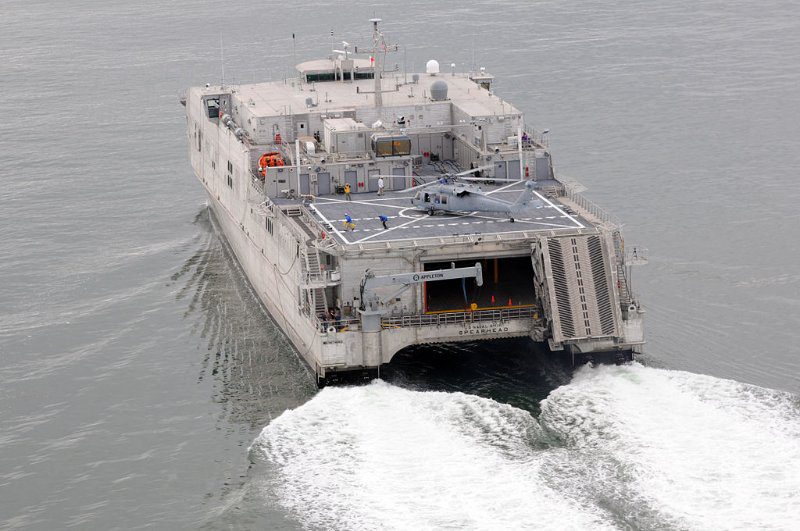
USNS Spearhead, the lead ship in the Spearhead class of expeditionary fast transport ships. AUSTAL / Phil Beaufort
ARLINGTON, Va. — The Navy will christen its 13th Spearhead-class expeditionary fast transport, the future USNS Apalachicola (T-EPF 13), during a 10:00 a.m. CT ceremony Saturday, Nov. 13 in Mobile, Alabama, the Defense Department said Nov. 12.
Brenda Ash, mayor of Apalachicola, Florida, will deliver the principal ceremonial address. Remarks will also be provided by Vice Adm. Darse Crandall, judge advocate general of the Navy; Bilyana Anderson, deputy assistant secretary of the Navy for Ships; Steven Cade, executive director, Military Sealift Command; Rusty Murdaugh, president of Austal USA; and Stan Kordana, vice president of Surface Systems, General Dynamics Mission Systems. Former Georgia Sen. Kelly Loeffler, the ship’s sponsor, will christen the ship by breaking a bottle of sparkling wine across the bow in a time-honored Navy tradition.
“This ship honors the city of Apalachicola, Florida, a city that represents America’s fighting spirit and dedication to duty,” said Secretary of the Navy Carlos Del Toro. “Apalachicola, like the other ships in the EPF class, will provide our warfighters the necessary high-speed sealift mobility and agility to accomplish any mission. I am thankful for this ship and its crew who will serve our nation for decades to come.”
The future USNS Apalachicola is the 13th ship in its class and will be operated by the Navy’s Military Sealift Command. The ship is named in honor of the city of Apalachicola and will be the second U.S. Navy ship to bear that name. The first Apalachicola (YTB 767) was a Natick-class large harbor tug launched in 1963. The tugboat spent the majority of its service in the Puget Sound-area providing harbor services to various ships. Apalachicola was stricken from the Navy List in 2002.
EPF class ships are designed to transport 600 short tons of military cargo 1,200 nautical miles at an average speed of 35 knots. The ship can operate in shallow-draft ports and waterways, interfacing with roll-on/roll-off discharge facilities and on/off-loading the Abrams main battle tank (M1A2).
The EPF includes a flight deck for helicopter operations and an off-load ramp that will allow vehicles to drive off the ship quickly. EPF’s shallow draft (less than 15 feet) further enhances littoral operations and port access. This makes the EPF an extremely flexible asset for support of a wide range of operations, including maneuver and sustainment, relief operations in small or damaged ports, flexible logistics support, or as the key enabler for rapid transport.
Navy Contracts 5 Companies to Compete for Future Possible Shipyard Modernization Projects
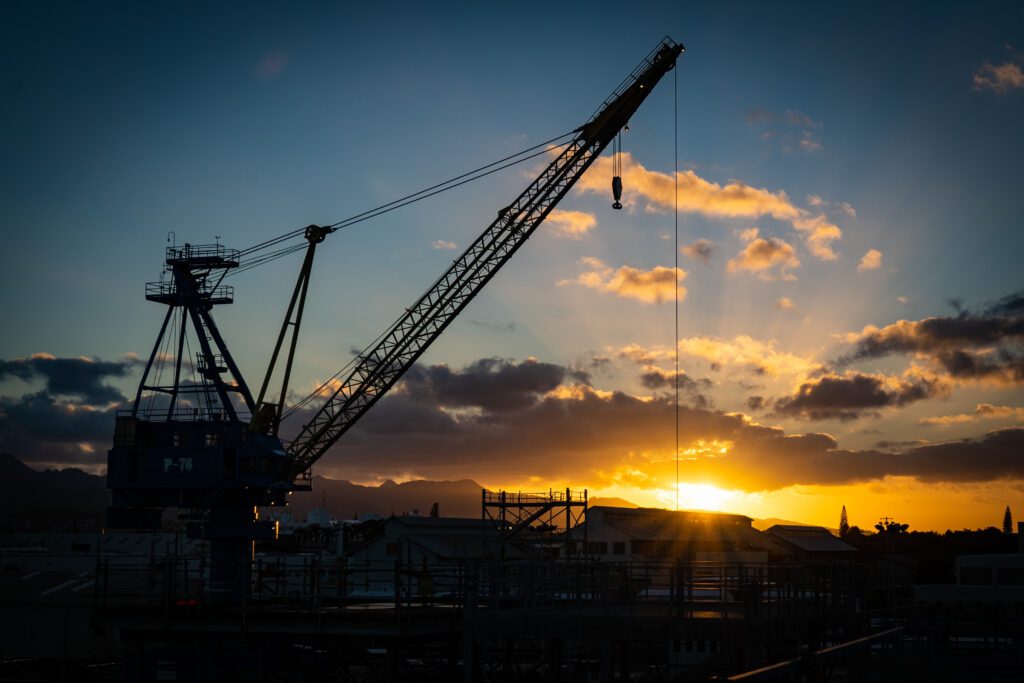
Pearl Harbor Naval Shipyard & IMF, (February 11, 2021) Sunrise over the Ko`olau Mountains with a portal crane P-76 in the foreground at Pearl Harbor Naval Shipyard and Intermediate Maintenance Facility. U.S. NAVY / Public Affairs Specialist Dave Amodo
WASHINGTON — Naval Facilities Engineering Systems Command awarded contracts to five companies to facilitate the award of future task orders for potential military construction projects at Pearl Harbor Naval Shipyard and Intermediate Maintenance Facility (PHNSY & IMF) in Hawaii and Puget Sound Naval Shipyard (PSNS) & IMF in Washington, the command said in a release.
The five companies may compete for future task orders for pre-construction planning, preparation, and constructability reviews associated with construction of waterfront facilities such as warehouses, dry docks, piers, and other site improvements, as well as dredging and incidental design, environmental, and other services related to the Navy’s Shipyard Infrastructure Optimization Program (SIOP).
“These contracts will help the Navy begin design and renovation work at Pearl Harbor Naval Shipyard and Puget Sound Naval Shipyard once we’ve completed all the regulatory processes, including agency and government-to-government consultations and public engagement,” said Rear Adm. John Korka, NAVFAC’s commander, and the Navy’s chief of civil engineers. “It involves industry partners in our planning efforts, a lesson we learned from our SIOP efforts to date. This will facilitate healthy competition and, ultimately, help us deliver the best solution we can for our Navy and our Nation.”
The contracts are for up to eight years or a combined cumulative value of $8 billion, whichever comes first. While the contracts are primarily for SIOP-related work at PHNSY and PSNS, task orders may also be issued for work at other sites in NAVFAC’s areas of responsibility.
“The Navy depends on our shipyards returning combat-ready ships and submarines to the fleet,” said Korka. “SIOP guides the Navy’s investment plan to achieve that. It’s a once-in-a-century effort that the NAVFAC team is proud to be part of.”
SIOP is a joint effort between NAVFAC, Naval Sea Systems Command and Commander, Navy Installations Command to recapitalize and modernize the infrastructure at the Navy’s four public shipyards, including repairing and modernizing dry docks, recapitalizing and reconfiguring shipyard facilities, and modernizing the shipyards’ industrial plant equipment.
The awardees for this contract are Reston, Virginia-based Bechtel National; Honolulu, Hawaii-based Dragados/Hawaiian Dredging/Orion JV; Burlingame, California-based ECC Infrastructure; Vancouver, Washington-based SIOP MACC, AJV; and Sylmar, California-based TPC-NAN joint venture.
Navy-Owned Deep-Diving Alvin Being Certified for Operations to 6,500 Meters
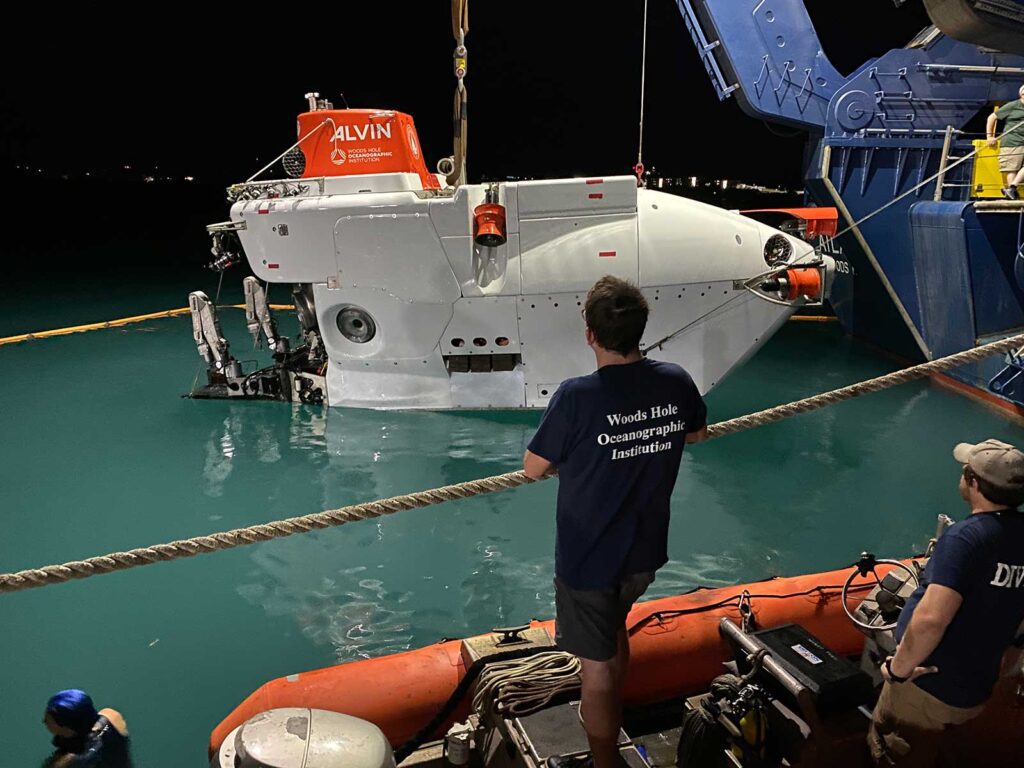
Alvin undergoing certification in Bermuda on Nov. 2. WHOI / Ken Kostel
The deep-diving Human Occupied Vehicle Alvin is being certified for return to service following completion of a series of modernization and improvements. Alvin is currently undergoing certification dives near Bermuda.
Thanks to Alvin’s three-inch-thick titanium sphere, researchers can study the deep ocean while safe from the crushing pressure and deadly cold.
Alvin is owned by the U. S. Navy Office of Naval Research and operated by the National Deep Submergence Facility (NDSF) at Woods Hole Oceanographic Institution (WHOI) and was last certified in 2013 to dive to 4,500 meters. Although a $50 million overhaul was conducted between 2011 and 2013, some of the necessary improvements to certify the vehicle to conduct deeper dives were not yet available. An $8 million upgrade was commenced last year. Alvin’s upgrade and operations are largely funded by the National Science Foundation.
According to Andy Bowen, a principal engineer of applied ocean physics and engineering at WHOI and director of the NDSF, the most recent overhaul will extend Alvin’s depth certification from 4,500 to 6,500 meters.
“This increase in depth capability involves a wide range of improvements from a new titanium personnel sphere, variable ballast system, hydraulic power plant and upgraded floatation,” he said. “There has also been a myriad of improvements to the vehicle’s propulsion system, imaging capabilities and overall electronic upgrades.
“We are engaged in the early stages of sea trials to verify performance of all the vehicle systems, including life support, stability, variable ballast, manipulation and hydraulic components,” Bowen said. “Progress in verifying perforce has been steady with initial dives tethered to the support vessel RV Atlantis accomplished with satisfactory results. We expect to complete the first untethered dives this week in the harbor here in St. Georges, Bermuda. Once this has been accomplished, Atlantis and Alvin will move into open ocean and continue with a series of deeper dives until we have achieved our full depth of 6,500 meters.”
Alvin will make its first 6,500-meter dive, or 21,325 feet — nearly four miles below the ocean’s surface — in mid-November. It takes about three and a half hours to reach that depth. Missions can last as long as 10 hours, although most missions do not travel to the vehicle’s maximum depth.
Atlantis completed its own one-year, $50 million overhaul in July.
“We planned to do the one-year refit of Atlantis to coincide with the work on Alvin, so the mothership and sub would be done in parallel,” said Tim Schnoor, a contractor supporting ONR’s research ship programs. “The work on Atlantis included improvements to and recertification of Alvin’s launch and recovery system, and the upgrades to the storage hangar where Alvin is kept between missions.”
Brian Pelletier, assistant program manager for advanced undersea systems at Naval Sea Systems Command (NAVSEA), said the certification process will ensure Alvin can be operated safely with people on board. “We ensure the system is safe for manned operations per the manual for deep submergence systems. Our NAVSEA team has been observing the November test dives in the Bahamas, and engineers from Team SUB will provide independent representatives to make sure the tests are being performed in accordance with the requirements of NAVSEA P9290, which is the Navy’s system certification procedures and criteria manual for deep submergence systems.”
After the certification dives, Bowen said Alvin will move into a brief series of test dives to prove its scientific capabilities in the waters around Puerto Rico. “With these accomplished, Alvin’s first scientific dives will be in support for Dr. Craig Young from the University of Oregon,” he said.
Alvin usually operates with a pilot and carries two scientists, and can be fitted with the appropriate instruments and science payload for the mission being conducted.
ONR is responsible for acquisition and life cycle support, with funding also provided by the National Science Foundation and the National Oceanic and Atmospheric Administration. Alvin’s operations are managed by the NDSF and scheduling is coordinated by the University-National Oceanographic Laboratory System.
In addition to Alvin, the NDSF also operates the Navy-owned remotely operated vehicle Jason and autonomous underwater vehicle Sentry for the ocean science community.
While researchers can learn a lot from unmanned systems, Bowen said there is no substitute for the human. “Humans are still the most effective means for exploring the unknown,” he said.