Sea-Air-Space 2021 Prequel: Lawmakers, Analyst Say Navy Needs a Battle Force Ready for 2025, Not 2045
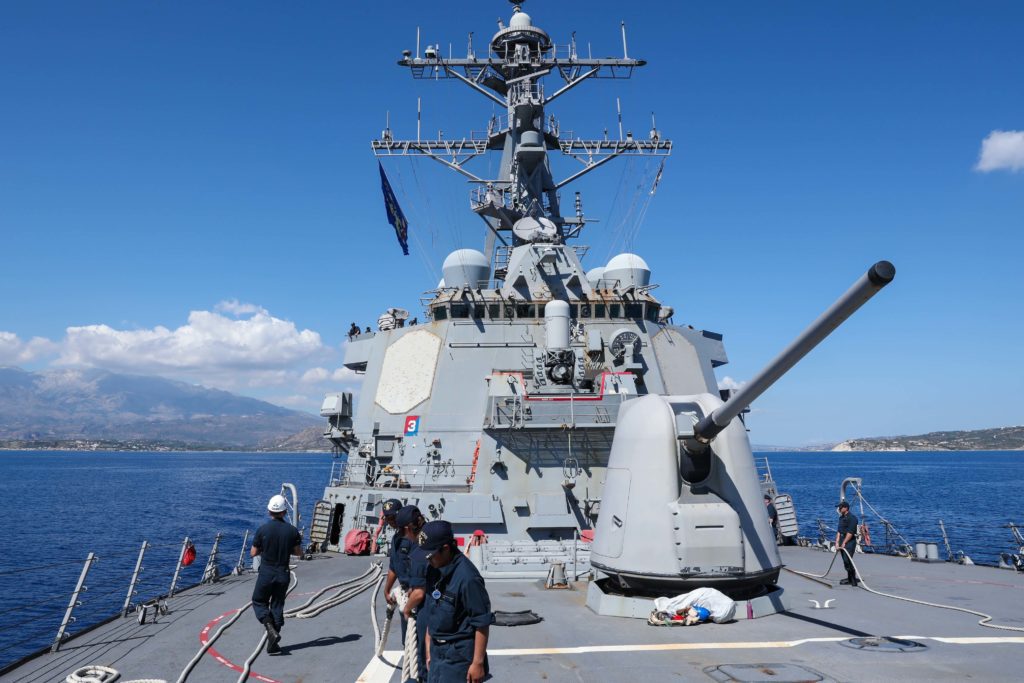
Sailors assigned to the Arleigh Burke-class guided-missile destroyer USS Ross (DDG 71) stow lines as the ship leaves port in Souda Bay, Greece, July 19, 2021. U.S. NAVY / Mass Communication Specialist 2nd Class Claire DuBois

ARLINGTON, Va. — The U.S. Navy urgently needs to modernize its battle force in order to meet the near-term challenges of China and Russia if it is to continue to dominate the maritime domain and protect the freedom of the seas, two Congress members and a naval analyst said.

“We as a nation must become a sea power again,” said Dr. Jerry Hendrix, a retired Navy captain, former director of Navy History and Heritage Command, and now vice president of the Telamus Group, speaking in a pre-recorded webinar of the Navy League’s Sea-Air Space Prequel event. “We’re facing a rising global competition right now. This [2022] budget quite frankly in reading of it, is just unserious. It’s unserious in that amount that was funded there and it’s as unserious in the terms of cutting back forces just as we should be adding forces, trying to keep the defense industrial base primed and, in fact, expanding. So, when we actually cut back on the number of surface combatants we’re building, we’re sending a mixed signal to the industrial base when we ought to be singing as a chorus right now about what is needed.”

Hendrix said the U.S. government “seems to be leaning toward a budget that is purely focused on 10 to 15 years out when, in fact, we’ve just had a significant warning from an outgoing retiring four-star [Adm. Phil Davidson, former commander, Indo-Pacific Command] that really the threat can exist six years from now. So, how are we going to meet that near-term threat? That calls for us to be looking at how we modernize and extend the lives of the platforms we have now, which is what we are not doing as a Navy or Department of Defense.”

Rep. Mike Gallagher (R-Wisconsin), a member of the House Armed Services Committee, also speaking in the webinar, said the Navy needs to “build a battle force for 2025, not 2045. As Adm. Davidson has warned, we may have six years or less before the PRC [Peoples Republic of China] takes action against Taiwan. We could have just years to prepare for a war that could decide the course of the 21st century, and that war would be waged, first and foremost, by the sea services. So, we can’t pay lip service to the idea of naval supremacy anymore, we have to earn it. We have to do better if we want to avert disaster and — make no mistake — that is where our present course leads us. We have to act with sense of urgency to advocate for, to build, and resource American seapower before it’s too late.”

Gallagher said Congress needs “to be honest with the American people about the stakes, what it’s going to cost, and the hard choices we have to make. If we fail to reverse the current trends, we’re going to wake up one day and we will either have lost a war or thrown Taiwan under the bus and, in so doing, destroyed American military deterrence in the process.”

“We need to take swift action to improve our fleet architecture to respond to the threats that China poses today,” said Rep. Elaine Luria (D-Virginia), vice chair of the House Armed Services Committee, also speaking at the webinar, noting the need to ready the battle force for 2025, not just 2045.

“The position we find ourselves in is no fault of today’s naval leadership. We’ve really lost a generation of shipbuilding — ship classes that haven’t been built to the same quantity or capability that was initially intended. There is a bigger debate going on in Congress about what the future Navy, the future force structure looks like, and I, myself, was quite disappointed with this [2022] budget from the Navy that in fact did not grow the fleet … and proposed to decommission more ships than it was going to build” in 2022.
Sea-Air-Space 2021 Prequel: CNO Describes the Fleet of 2025

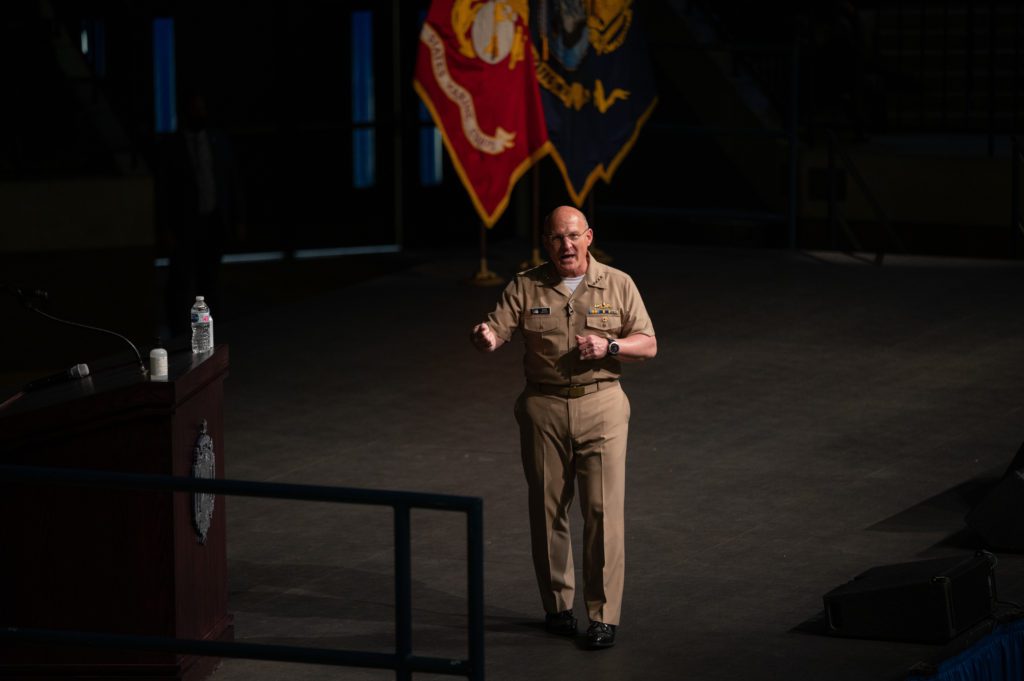
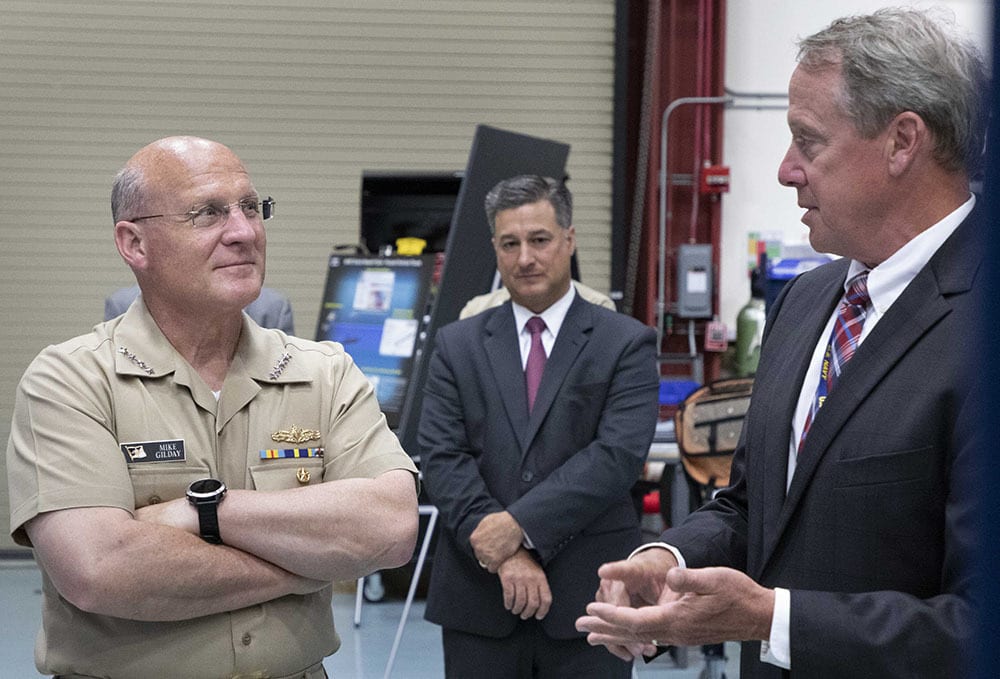
Chief of Naval Operations (CNO) Adm. Mike Gilday speaks to 1st Class midshipmen during his visit to the U.S. Naval Academy in April. U.S. NAVY / Midshipman 1st Class Tommy Brophy

ARLINGTON, Va. — The Navy’s top officer has described what he sees the U.S. Fleet will look like in 2025, a benchmark which he says the Navy will have made investments so that the fleet will have made notable strides with fielding increased combat capability.

CNO Adm. Michael Gilday, speaking in a prerecorded webinar of the Navy League’s Sea-Air-Space Prequel, listed some of the major platforms and weapons that will make the fleet more capable by 2025:

Under the sea:

  • “All of our Block III and IV [Virginia-class attack submarines] should be delivered by 2025 with an undersea weapon that is more lethal and has greater range.”

On the sea:

  • “We [will be] just on the cusp of delivering our first Constellation-class frigate.”
  • “We will be delivering the [Arleigh Burke-class] Flight III DDGs in earnest.”
  • “We are investing in a longer-range weapon, the Maritime Strike Tomahawk that gives us range and speed to reach out and touch an adversary.”
  • “We believe that we will be delivering the Zumwalt-class destroyers with a hypersonic missile capability.”

In the air:

  • “We’ll have half of our [carrier] air wings [with] a fourth- and fifth-generation mix [of strike fighters], which analysis has shown to be quite effective against our adversaries. Tied in with that is a longer-range air-to-surface missile that gives us greater reach and greater punch.”
  • “Our P-8s [maritime patrol reconnaissance aircraft] we are investing in with an upgrade.”

“All of that is coming into play by 2025,” the admiral noted. “So, we do have an investment strategy that incrementally gets us to a more capable, lethal fleet — not necessarily a bigger fleet — unless we saw a rise in the [budget] topline.”


NSWC Taps VTG to Equip More Ships with Counter-UAS Laser

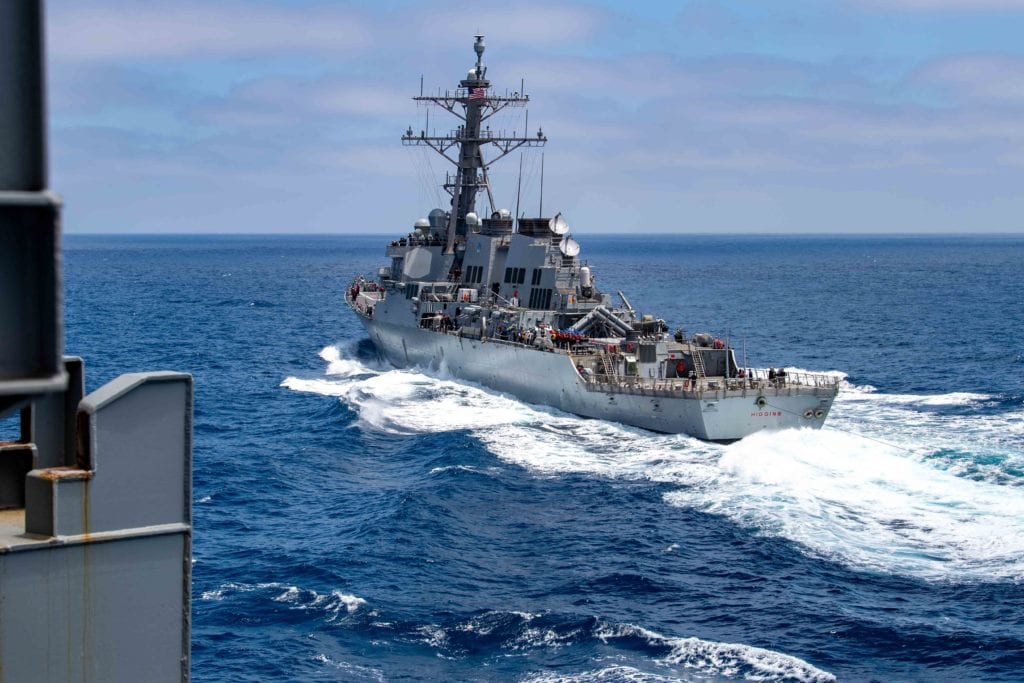
The Arleigh Burke-class guided-missile destroyer USS Higgins (DDG 76) steers away from Nimitz-class aircraft carrier USS Carl Vinson (CVN 70) following a replenishment-at-sea, July 20, 2021. VTG will equip more such ships with anti-unmanned aircraft laser systems. U.S. NAVY / Mass Communication Specialist Seaman Sophia Simons

CHANTILLY, Va., July 21, 2021 VTG has been selected by the Naval Surface Warfare Center, Port Hueneme Division, to equip more ships in the U.S. fleet with an innovative laser designed to counter threats from unmanned aerial systems.

Under the prime, single-award contract, VTG will install and integrate the AN/SEQ-4 Optical Dazzler Interdictor, Navy (ODIN), a directed energy weapon, aboard five U.S. Navy Arleigh Burke-class destroyers.

“Our team is honored to support NSWC-PHD in integrating this innovative defensive technology into the fleet. The ODIN laser represents a significant advancement for the Navy in addressing asymmetric threats and protecting our sailors,” said John Hassoun, VTG president and CEO. “Delivering next-generation capabilities to our warfighters is something we’re passionate about. VTG’s depth of expertise with ODIN, together with our skilled fleet modernization team, cutting-edge manufacturing and prototyping capabilities, and long-term legacy of support to the Navy, makes us uniquely qualified to perform this mission critical work.”

In 2020, VTG successfully integrated the ODIN laser aboard the USS Stockdale (DDG 106) and USS Spruance (DDG 111) through a separate sole-source contract, completing both projects on time and on budget, and setting the standard for future directed energy weapon installations aboard U.S. Navy ships.

ODIN is used to counter adversary UAS-mounted intelligence, surveillance and reconnaissance capabilities. This laser for the optical dazzling of adversaries’ long-range and very long-range surveillance systems is being developed and built by the government at NSWC Dahlgren Division, and rapidly fielded to meet an urgent fleet need. The ODIN laser will be employed on surface combatants to counter asymmetric threats and to provide a scalable response for escalation of force.

Over the past decade, VTG has modernized 240 different surface ships, aircraft carriers and submarines. With a record of exceptional quality, uncompromising safety, and on-time and on-budget delivery, VTG ensures that our sailors have a competitive advantage over near-peer adversaries now and in the future. 


DCNO Crites: Inflation in Shipbuilding Costs a Challenge for Navy Fleet Expansion

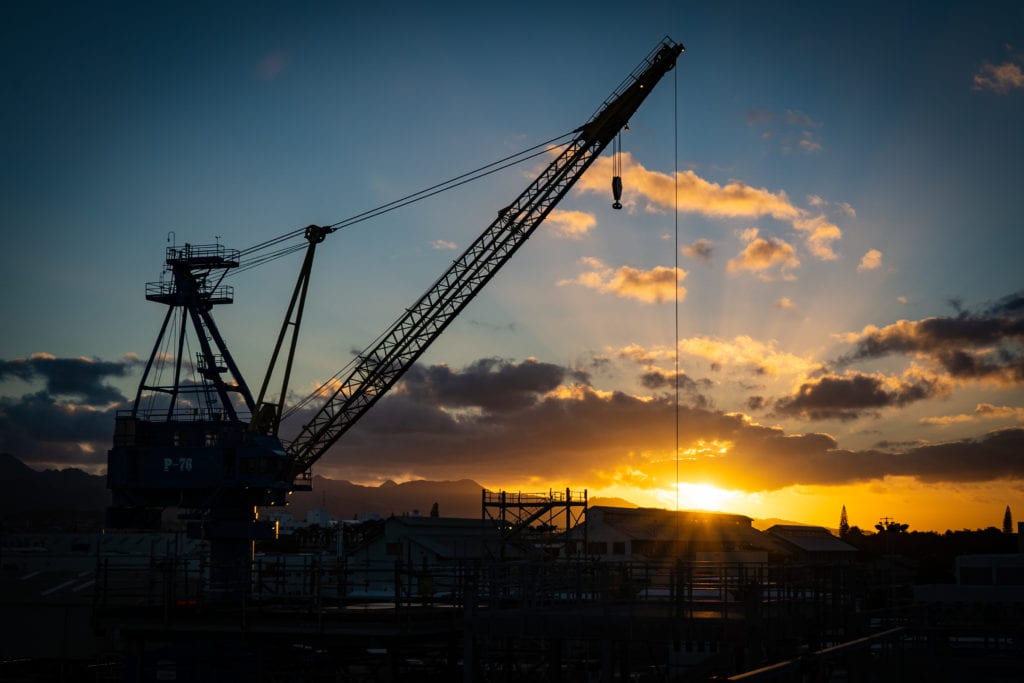
Sunrise over the Pearl Harbor Naval Shipyard and Intermediate Maintenance Facility, Feb. 11, 2021. U.S. NAVY / Public Affairs Specialist Dave Amodo

WASHINGTON — The Navy’s expansion to a larger fleet is hampered not only by the flat topline of the fiscal 2022 budget but also inflation in the costs and complexity of shipbuilding, a senior Navy admiral said.  

As the Navy works to tailor its battle fleet to meet the challenges of the era of great power competition and divest some platforms that are aging out or needed less in terms of priorities, it also faces costs exceeding inflation that put pressure on the shipbuilding budget.    

While the U.S. Navy proposes retirement of 15 battle force ships in fiscal 2022, it proposes to fund only eight battle force ships in that year, a setback in terms of growing the fleet to a congressionally mandated level of 355 ships.  

“What we’ve seen over the last 10 or 11 years is essentially a flat budget, said Vice Adm. Randy Crites, deputy chief of naval operations for Integration of Capabilities and Resources, testifying July 21 during a hearing of the defense subcommittee of the Senate Appropriations Committee. “We have not kept pace with inflation. Back in 2010 we had about 280 battle force ships. We declined as we went through sequestration down to 271 and we built our way out of that up to about 297 today. That occurred as a result of a number of reform efforts and divestitures that we did inside the service.  

“That challenge that we’re facing now is that the good ideas, the [divestiture of] things that we don’t need to bring to the future fight, we’re starting to run out of that,” Crites said. “So, we’re challenged as we see labor costs far exceeding inflation; the cost and complexity of the work we’re trying to do; and materials we’re trying to buy all outpacing inflation. Yet we need to balance within the program that we have.” 

Crites said the Navy’s current priorities have not changed.  

“The No.1 priority is to bring in Columbia [ballistic-missile submarine. No. 2 is to ensure that we have a ready force; No. 3 is to make sure that we’re bringing the capabilities that we need; and No. 4 has been capacity that we can afford,” he said. 


Navy Awards Teledyne Contract for Autonomous Underwater Vehicles

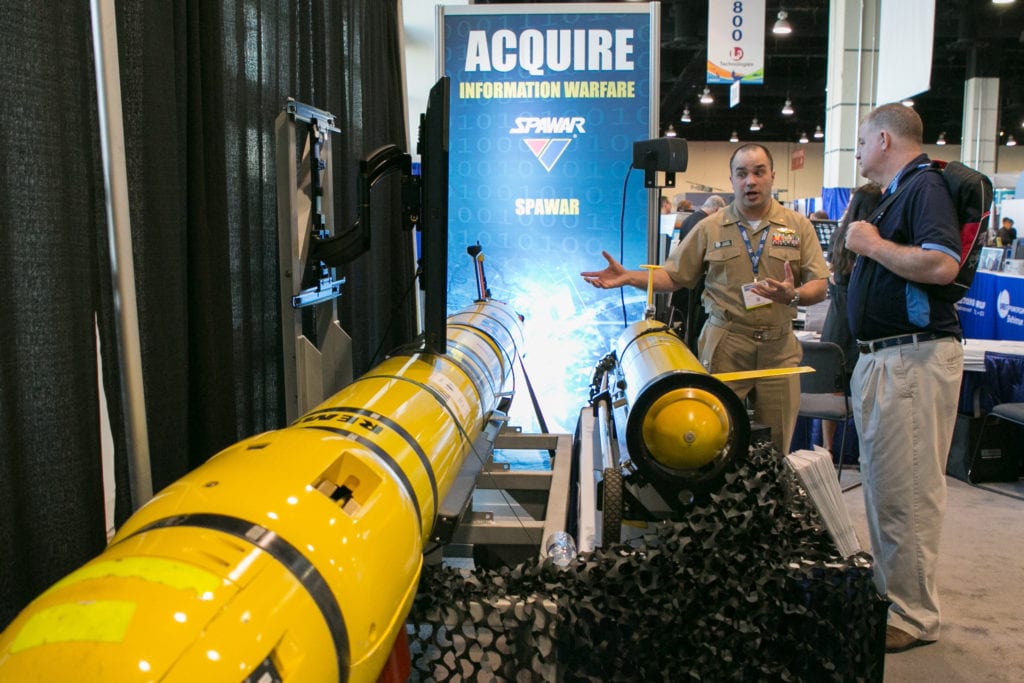
Littoral Battlespace Sensing Unmanned Underwater Vehicles (LBS-UUV) on display at the Navy League’s Sea-Air-Space conference and exhibition in 2017. The LBS-UUV is made up of two vehicle types, a glider and an autonomous undersea vehicle. U.S. NAVY / Krishna M. Jackson

THOUSAND OAKS, Calif. — Teledyne Technologies Inc.’s subsidiary, Teledyne Brown Engineering Inc., has been awarded an indefinite-quantity/indefinite-delivery contract with a maximum base value of $27.4 million from the U.S. Navy for the Littoral Battlespace Sensing-Glider (LBS-G) program, the company said in a July 19 release. 

The contract, awarded under full and open competition, includes a single five-year ordering period and five one-year option periods. The option periods, if exercised, have a ceiling value of $39.2 million. 

Teledyne Slocum gliders are long-endurance, buoyancy-driven autonomous underwater vehicles (AUVs) that provide a highly persistent means to sample and characterize the ocean water column properties. They can do this at spatial and temporal resolutions not possible using other vessels or tactical units alone. The AUVs host a range of oceanographic sensors to support antisubmarine warfare, mine countermeasures and Naval Special Warfare mission areas. 

Teledyne Brown Engineering and sister company, Teledyne Webb Research, will perform the design, development, fabrication, production, test, and support of the LBS-G systems. Under a previous contract awarded in 2009, Teledyne delivered 203 gliders to the U.S. Navy. 

“We are pleased to announce the continuation of Teledyne’s successful partnership with the Naval Information Warfare Systems Command to deliver this capability,” stated Jan Hess, president of Teledyne’s Engineered System Segment and Teledyne Brown Engineering. “We look forward to supporting the Navy and assisting with its awareness and understanding of the ocean’s conditions.” 

Teledyne Slocum gliders provide the U.S. Navy the capability to conduct persistent sampling of large ocean areas for long periods of time. They also allow focused sampling to obtain extremely high-resolution data within a smaller, tactically significant operating area. The LBS-G System, part of the LBS Unmanned Undersea Vehicles program, is part of a solution to close critical capability gaps allowing the U.S. Navy to characterize adequately and persistently the physical ocean environment on tactical and strategic scales in a battlespace. 


Sea-Air-Space 2021 Prequel: Cruisers’ Combat Systems Lagging Behind Threat, CNO Says

Chief of Naval Operations Adm. Mike Gilday (from left) speaks with Naval Undersea Warfare Center Headquarters Director of Undersea Warfare Eugene Hackney Jr. as Christopher DelMastro, head, Division Newport’s Platform and Payload Integration Department, listens, during a visit to the Division on June 28, 2021. U.S. NAVY

ARLINGTON, Va.—The U.S. Navy’s 2022 budget proposal to decommission seven guided-missile cruisers is not just based on the age and material condition of the ships. According to the chief of naval operations (CNO), the lethality of the cruisers’ combat system is lagging behind the developing threat capabilities.

CNO Adm. Michael Gilday, speaking in a prerecorded webinar of the Navy League’s Sea-Air-Space Prequel, noted that the seven Ticonderoga-class cruisers are equipped with the SPY-1A or early SPY-1B radars, which are the oldest radars that are the main sensor of the Aegis Combat System. The SPY-1A is an analog system, increasingly anachronistic in the Digital Age.

The radars “are approaching obsolescence … and they have difficulty actually seeing the threat, based on the speed and the profiles that we see threat missiles flying at these days.”

Gilday said the cost to own and operate the seven CGs over the five-year Future Years Defense Plan would come to $5 billion.

“These ships on average right now are 32 years old,” he said. “We are seeing cracks. We are seeing challenges in the material condition of these ships that are, to a certain degree, unpredictable. So, they’re ‘unknown unknown.’ When we tried to deploy a ship most recently [USS Vella Gulf] and had to bring it back twice because of fuel tank cracks, is an example of something we just couldn’t predict that we have to react to, and it does have an impact on reliability. We need to be able to provide the secretary of defense reliable assets that they can count on to do the nation’s business.”

The CNO said the above factors “really came into play from a realistic standpoint in terms of making the argument for the best of those cruisers. The cost alone with respect to cruiser modernization is running tens of millions of dollars above what we had originally estimated, largely due to the unknowns that come into play with hulls that are over three decades old.”

The seven cruisers marked for decommissioning are USS San Jacinto (CG 56), USS Lake Champlain (CG 57), USS Monterey (CG 61), USS Hue City (CG 66), USS Anzio (CG 68), USS Vella Gulf (CG 72), and USS Port Royal (CG 73).


Navy Helicopter Crew Rescued After Crash Near Mt. Hogue, California

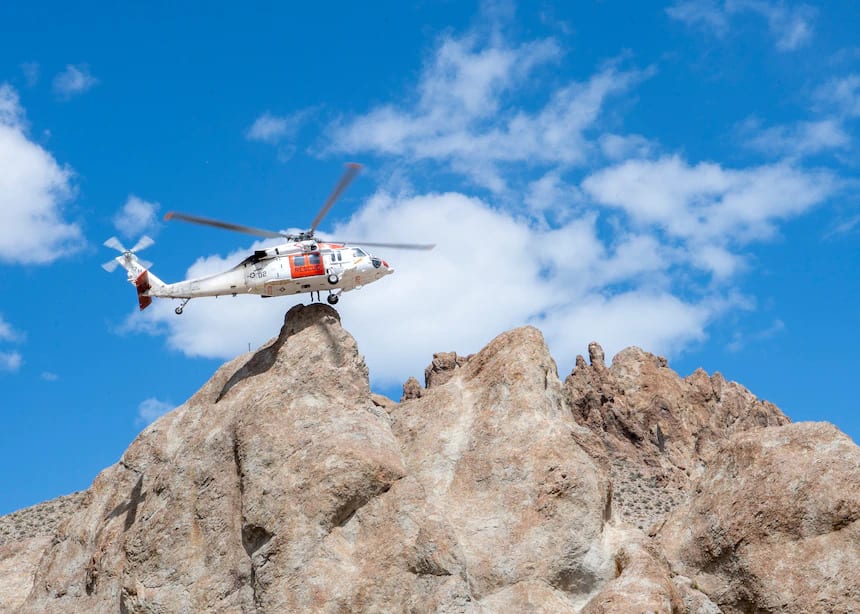
The MH-60S Knighthawk helicopter that crashed, assigned to the “Longhorns” of Helicopter Search and Rescue (SAR) Squadron, conducts a one wheel during a simulated SAR training exercise in February. U.S. NAVY / Mass Communication Specialist 2nd Class Ryan M. Breeden

NAVAL AIR STATION FALLON, Nev. — A Navy MH-60S Knighthawk helicopter crashed near Mt. Hogue, California, at approximately 5 p.m. on July 16, while conducting search and rescue (SAR) operations, the Navy said in a July 17 release. All four crewmembers survived the crash without injury and have been safely recovered. 

The aircraft, call sign Longhorn 02, was supporting Mono County search and rescue efforts to locate a lost hiker in the rugged high-altitude terrain in the National Forest south of Boundary Peak, 120 miles south of NAS Fallon. The aircrew consists of four personnel — a pilot, co-pilot, and two crewmen. 

The crash site is at 11,700 feet above sea level, in very rugged terrain. The crew were able to communicate following the impact, but a follow-on helicopter mission launched on the evening on July 16 from NAS Fallon was unable to retrieve them. An overnight kit was dropped to the survivors, who spent the night on mountain. 

On the morning of July 17, an additional MH-60S, Longhorn 01, launched from NAS Fallon, and provided on-scene coordination, but could not affect a rescue. A CH-47 Chinook from Mather Air Force Base was called in for its superior high-altitude performance characteristics. It dropped off a ground SAR team that met up with the survivors while the CH-47 returned to Mammoth Lakes for fuel. The Chinook returned to the scene, and at approximately 2 p.m., the crew of Longhorn 02 was safely recovered aboard the CH-47. 

All military support for civil mutual aid SAR missions are coordinated by the Air Force Rescue Coordination Center at Tyndall Air Force Base, Florida. Pursuant to the National SAR Plan of the United States, military aircraft may also be used for civil SAR/medevac needs to the fullest extent practicable on a non-interference basis with primary military duties according to applicable national directives, plans, guidelines and agreements. 

The cause of the crash is unknown. The Navy will conduct a mishap investigation, with support from the Naval Safety Center. Following the on-site investigation, the aircraft will be removed from its current position on U.S. Forest Service land. 


USS Dwight D. Eisenhower Returns from Deployment, IKE CSG Earns Navy Unit Commendation

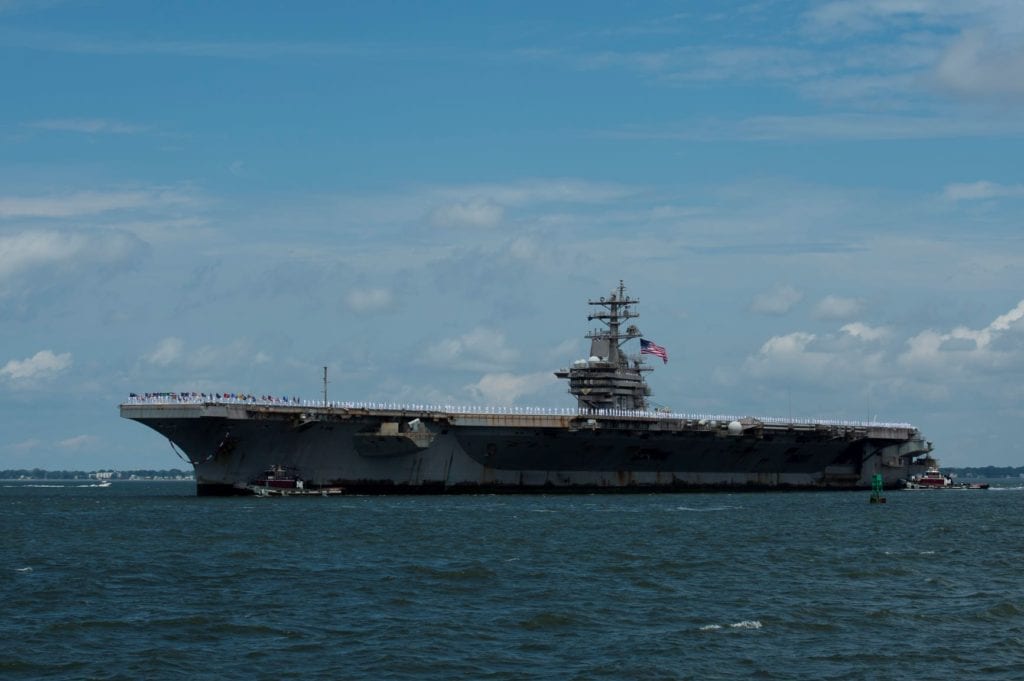
The aircraft carrier USS Dwight D. Eisenhower (CVN 6) returned to Naval Station Norfolk on July 18 following a six-month deployment. U.S. NAVY

NORFOLK, Va. – The Nimitz-class aircraft carrier USS Dwight D. Eisenhower (CVN 69) (IKE) returned home to Naval Station Norfolk July 18 following a six-month deployment to the U.S. 5th and 6th Fleet areas of operation, the U.S. 2nd Fleet said in a release. 

It was the third homecoming in as many days for the Dwight D. Eisenhower Carrier Strike Group (IKE CSG). The Arleigh Burke-class guided-missile destroyer USS Laboon (DDG 58) returned to Nofolk July 16 and the Arleigh Burke-class guided-missile destroyer USS Thomas Hudner (DDG 116) returned to its homeport in Naval Station Mayport, Florida, July 17. 

Additionally, more than 1,800 Navy aviators from the nine squadrons of Carrier Air Wing Three (CVW-3) returned to their home bases at Naval Air Station Oceana, Naval Station Norfolk, Naval Air Station Whidbey Island, and Naval Air Station Jacksonville July 13. 

The Ticonderoga-class guided-missile cruiser USS Vella Gulf (CG 72) will return to Norfolk July 23. Meanwhile, the Ticonderoga-class guided-missile cruiser USS Monterey (CG 61) and Arleigh Burke-class guided-missile destroyers USS Mitscher (DDG 57) and USS Mahan (DDG 72) remain on deployment and will return to Norfolk at a future date. 

In addition to homecoming news, it was announced that the courageous efforts of the IKE CSG’s Sailors were recognized by Acting Secretary of the Navy Thomas Harker with the Navy Unit Commendation for operational excellence. 

“The Sailors of the Eisenhower Carrier Strike Group and their families have served and sacrificed a tremendous amount by answering the nation’s call to duty, spanning two deployments with only a short reset in between,” said Rear Adm. Scott F. Robertson, commander, Carrier Strike Group 2. “Nevertheless, our well-trained, exceptional Sailors rose to each challenge, enabling our strike group to be a dynamic force across great distances conducting simultaneous missions between both 5th and 6th Fleet.” 

The Eisenhower Carrier Strike Group departed Norfolk for deployment Feb. 18 after successfully completing a six-week, historic composite training unit exercise (COMPTUEX). This year’s COMPTUEX included a NATO vignette and incorporated integrated training with SEALs from Naval Special Warfare Group 2 for the first time in recent history. 

While in 6th Fleet, the IKE CSG supported national security interests in Europe through increased theater cooperation and maintaining a forward naval presence. While in the Atlantic Ocean and transiting through the Mediterranean Sea, the IKE CSG conducted Exercise Lightning Handshake 21, a U.S.-led, bi-lateral maritime exercise with the Royal Moroccan Navy and Royal Moroccan Air Force. The strike group also participated in Exercise Sea Shield 21, a multinational naval exercise hosted by Romania, alongside ships from nine different nations to conduct operations across the entire spectrum of naval warfare. The IKE CSG also worked alongside the Israeli navy and conducted passing exercises with the Hellenic, Italian, Albanian and Turkish navies. 

In 5th Fleet, the Eisenhower Carrier Strike Group and French Navy (Marine Nationale) Charles de Gaulle Carrier Strike Group (CDGSG) conducted dual carrier operations in the Arabian Sea. Shortly after the dual carrier operations, the IKE CSG ships participated in submarine familiarization exercises and conducted passing exercises with the Canadian navy in the Arabian Sea and later with the Egyptian navy in the Red Sea. The strike group’s ships also participated in joint air operations in support of maritime surface warfare exercises with the United Arab Emirates, U.S. Coast Guard, Joint Aviation Command, Royal Saudi Naval Forces and U.S. Air Forces Central. 

Embarked to Eisenhower, CVW-3 supported both missions Operation Inherent Resolve (OIR) and Operation Freedom’s Sentinel (OFS), in the Arabian Sea as a continuation of the United States’ commitment to maritime security, stability, as well as to ensure safe passage and deescalate tensions throughout international waters in 5th Fleet. 

During its final month in 5th Fleet, the IKE CSG provided naval aviation support for the responsible, deliberate and safe drawdown of U.S. and coalition forces from Afghanistan April 28 to June 23 in support of OFS. CVW-3 conducted a total of 6,100 sorties and 12,401 flight hours throughout the strike group’s deployment. 

“The courage and effort put forth by the Sailors of CVW-3 over these many months speaks great volumes to their unwavering commitment to success, no matter what kind of adversity emerges over the horizon,” said Capt. Marcos A. Jasso, commander, Carrier Air Wing Three. “Our Sailors gave it their all each and every day during this deployment and I am honored to have served with our great air wing and flight deck crew. I wish them all a relaxed and enjoyable time off after deployment. The whole strike group deserves it. They’ve all earned it.” 

The Eisenhower Carrier Strike Group sailed more than 190,000 nautical miles, operating dynamically across multiple fleets with our NATO allies, partners and friends. The strike group’s ships completed multiple strait and choke point transits, including the Strait of Gibraltar, the Suez Canal, Strait of Hormuz and Strait of Bab el Mandeb. 

“As the flagship of the strike group, we maneuvered IKE into the right battlespace for launching and recovering air wing missions ashore and over the horizon,” Campagna said. “IKE Sailors operated decisively and safely with a clear sense of purpose.” 

“It took diligence, hard work, and grit from everyone to ensure our strike group remained safe and combat-ready throughout this deployment. What we do while deployed is no small feat considering we are the only Navy that can operate in a sustained manner with the kind of combat power we provide,” said Rear Adm. Robertson. “I am exceedingly proud of each and every one of our Sailors for their exceptional performance and it has been an honor to serve alongside this team of warfighters for the Eisenhower Strike Group’s 2021 mission. However, we still have a few of our strike group’s ships that remain on station and we should keep them and their families in our thoughts until they return to Norfolk.” 

Dwight D. Eisenhower Carrier Strike Group is a multiplatform team of ships, aircraft and more than 5,000 Sailors, capable of carrying out a wide variety of missions around the globe. The Navy provides a ready, flexible force capable of responding to a broad range of contingencies. 


Navy Christens the First Ship in the T-AO Fleet Oiler Program

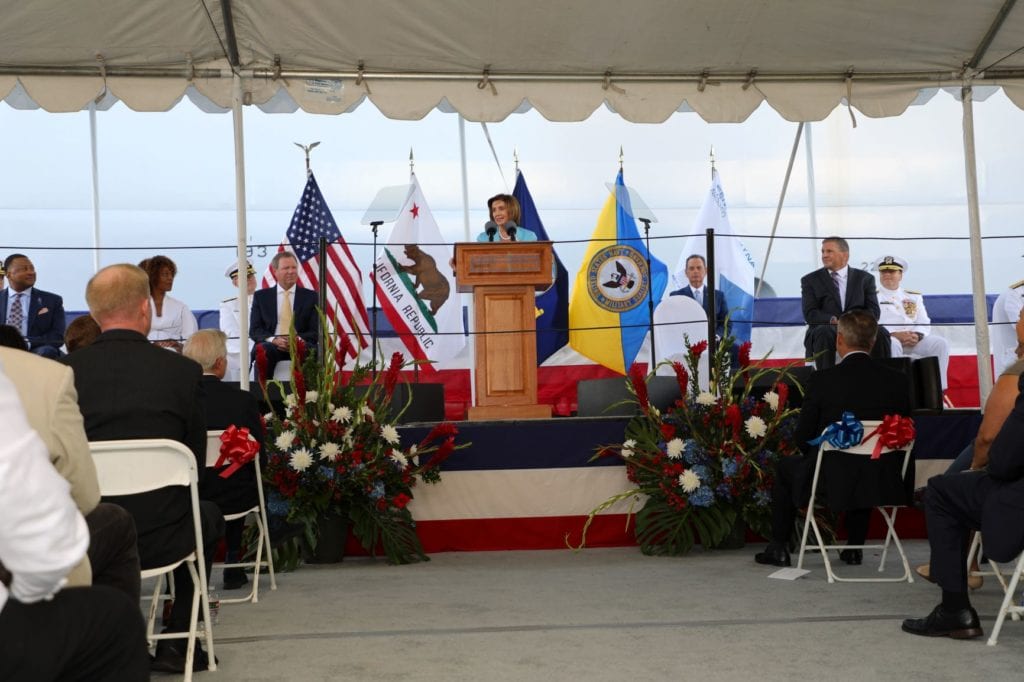
Speaker of the House Nancy Pelosi speaks at the christening of the future USNS John Lewis, the first ship in the U.S. Navy’s new John Lewis-class fleet oiler program. U.S. NAVY

SAN DIEGO – The future USNS John Lewis (T-AO 205), the first ship in the U.S. Navy’s John Lewis-class fleet oiler program, was christened July 17 during a ceremony in San Diego, the Navy said in a release. 

House Speaker Nancy Pelosi, D-California, served as the principal speaker at the ceremony. 

“As House Speaker, I am deeply honored to lead this congressional delegation of many friends of our beloved late Congressman John Lewis to honor his beautiful and saintly life,” said Speaker Nancy Pelosi. “John Lewis was a warrior for freedom and, as a titan of the civil rights movement, his courage and goodness helped transformed our nation. In the halls of the Capitol, he was fearless in his pursuit of a more perfect union, whether fighting to defend voting rights, end anti-LGBTQ discrimination or respect the dignity and worth of every person.” 

Following Pelosi, the ship’s sponsor, Alfre Woodard Spencer, spoke briefly about the ship’s namesake. 

John Lewis “lives in the unalterable truths he spoke to power,” said Spencer. “John Lewis lives in all those spaces where people reach out their hands to pull others up to the lives that they deserve. And now he lives in the name and the embodiment of this mighty sailing vessel and its mission of fortifying and sustaining those who have committed themselves to the service of our nation.” 

Following her remarks, Spencer christened the ship with the traditional champagne bottle break alongside the hull. 

Additional remarks were provided by U.S. Navy representatives, Marcus Tyner, nephew of the ship’s namesake, and Dave Carver, president of General Dynamics NASSCO. 

“The christening ceremony today takes on a very special meaning, for it marks the one-year anniversary, to the day, of John Lewis’ passing.” Carver said. “Just as its namesake, this majestic vessel will be instrumental in shaping the future of our Nation. The shipbuilders of NASSCO are proud to ensure Congressman John Lewis’ legacy will live on in this ship.” 

Former Navy Secretary Ray Mabus declared the John Lewis-class of oilers be named after leaders who fought for civil and human rights. The class and the first ship honors Congressman and American civil rights leader John Lewis. 

In 2016, General Dynamics NASSCO was awarded the contract by the U.S. Navy for the detailed design and construction of the next generation of fleet oilers, the John Lewis-class (T-AO 205), previously known as the TAO(X). The contract calls for the design and construction of six 742-foot-long oilers with a full load displacement of 49,850 tons. Designed to transfer fuel to U.S. Navy carrier strike group ships operating at sea, the oilers have the capacity to carry 157,000 barrels of oil, a significant dry cargo capacity, aviation capability and up to a speed of 20 knots. 

In addition to the christening of this ship, three ships in the T-AO class fleet oiler program for the U.S. Navy — the future USNS Harvey Milk (T-AO 206), the future USNS Earl Warren (T-AO 207), and the future USNS Robert F. Kennedy (T-AO 208) — are currently under construction. The second ship, the future USNS Harvey Milk (T-AO 206) is scheduled to launch later this year. 


Navy to Christen First John Lewis-Class Oiler

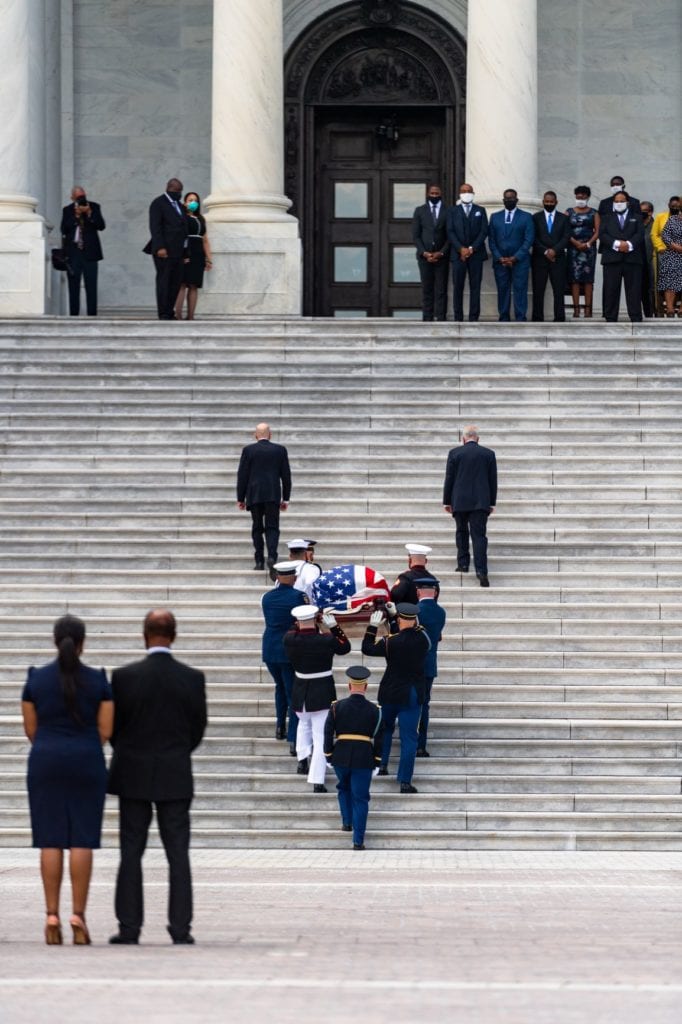
An Armed Forces Body Bearer Team carries the flag-draped casket of Rep. John Lewis at the U.S. Capitol, Washington, D.C., July 27, 2020. DoD personnel are honoring the congressman by providing military funeral honors during his congressional funeral events. U.S. ARMY / Spc. Zachery Perkins

ARLINGTON, Va. — The Navy will christen its first-in-class John Lewis-class replenishment oiler, the future USNS John Lewis (T-AO 205), during a 9 a.m. PDT ceremony Saturday, July 17, in San Diego, California, the Defense Department announced in a July 16 release. 

Speaker of the House of Representatives, Rep. Nancy Pelosi, D-California, will deliver the ceremonial principal address. Remarks will also be provided by James Geurts, performing the duties of Under Secretary of the Navy; Vice Adm. Ross Myers, commander, Fleet Cyber Command and commander, U.S. 10th Fleet; Rear Adm. Michael Wettlaufer, commander, Military Sealift Command; and Marcus Tyner, nephew of the ship’s namesake. In a time-honored Navy tradition, the ship’s sponsor, Alfre Woodard Spencer, will christen the ship by breaking a bottle of sparkling wine across the bow. 

“Tomorrow we christen the first John Lewis-class replenishment oiler,” said acting Secretary of the Navy Thomas Harker. “Leaders like Representative Lewis taught us that diversity of backgrounds and experiences help contribute to the strength of our nation. There is no doubt that the future Sailors aboard this ship will be galvanized by Lewis’ legacy.” 

The future USNS John Lewis is the first ship in its class and will be operated by the Navy’s Military Sealift Command. The ship is named in honor of the late politician and civil rights leader. John Lewis-class oilers will be named for other prominent civil rights leaders and activists. 

The John Lewis-class ships are based on commercial design standards and will recapitalize the current T-AO 187-class fleet replenishment oilers to provide underway replenishment of fuel to U.S. Navy ships at sea. These ships are part of the Navy’s Combat Logistics Force. 

In June 2016, the Navy awarded a $3.2 billion contract to General Dynamics NASSCO in San Diego for the design and construction of the first six ships of the Future Fleet Replenishment Ship, the John Lewis-class (T-AO 205), with construction commencing in September 2018. The Navy plans to procure 20 ships of the new class. 

Lewis passed July 17, 2020; the christening marks the one-year anniversary of his death.