‘Old Salt’ Designation Passes to Adm. Christopher Grady
Adm. Christopher Grady, commander, Fleet Forces Command. U.S. NAVY
The Surface Navy Association’s (SNA) “Old Salt” designation, honoring the active duty U. S. Navy officer with the earliest date of qualification as a Surface Warfare Officer, has passed to Adm. Christopher Grady. Grady is currently assigned as the Commander, U.S. Fleet Forces Command.
Grady relieved Adm. Philip Davidson, who has retired, and is now the 21st individual to receive this honor.
Initiated in 1988, the Old Salt award is accompanied by a bronze statue depicting a naval officer on the pitching deck of a ship. The statue is cast from metal salvaged from historic U.S. naval ships, most notably the battleship USS Maine, which exploded and sank in Havana Harbor in 1898, precipitating the Spanish-American War.
Old Salts have their names engraved on brass plates attached to the base of the Old Salt statue. The statue is then held in the custody of the current Old Salt during the recipient’s active-duty tenure. The Old Salt trophy may be kept in possession of the recipient or displayed by the command to which the Old Salt is assigned.
The issuance of the Old Salt Award is a tribute to the Navy’s customs and traditions which call the respected, experienced, knowledgeable, and senior surface warfare officer with the designation as Old Salt.
SNA also recognizes the “Old Tar” award to honor the Surface Warfare Enlisted Specialist with the earliest date of receiving the coveted warfare qualification. That designation recently went to Fleet Master Chief Bill Smalts.
General Atomics Opens Office in Patuxent River, Maryland
An F/A-18E Super Hornet landed aboard USS Gerald R. Ford’s (CVN 78) flight deck marking the 1,000th recovery of a fixed-wing aircraft using Ford’s Advanced Arresting Gear (AAG) in March 2020. GA-EMS’ new office in Patuxent River, Maryland, will serve as a customer engagement center for the AAG and other programs. U.S. NAVY / Mass Communication Specialist 1st Class Gary Prill
SAN DIEGO — General Atomics Electromagnetic Systems (GA-EMS) has opened an office in Patuxent River, Maryland, to serve as a customer engagement center supporting maritime and naval aviation programs and business growth initiatives in the region, the company announced May 3.
James Donnelly, GA-EMS’ director of Maritime Program Operations, will be responsible for leading office operations and providing program support for GA-EMS’ Aircraft Launch and Recovery Systems delivered to the Naval Air Systems Command (NAVAIR) for Ford-class aircraft carriers. Donnelly will also serve as a point of interface for other maritime programs in GA-EMS’ growing portfolio of business activities on the Eastern Seaboard, including nuclear submarine construction support and unmanned undersea vehicle programs.
“We are excited to join the Pax River community, and have the convenience of proximity to our NAVAIR customer and an industry base that provides world-class technologies in support of the Navy,” said Scott Forney, president of GA-EMS. “For nearly two decades, we’ve worked from our San Diego headquarters, Tupelo, Mississippi, center of excellence for manufacturing, and our Lakehurst, New Jersey, operations site to support NAVAIR’s procurement and delivery of our Electromagnetic Aircraft Launch System and Advanced Arresting Gear system for all Ford–class carriers. Now, our Pax River office literally opens the door to our customers to help improve communication and collaboration at the local level. We look forward to strengthening existing partnerships and forging new relationships within the community to continue delivering technology innovations supporting the warfighter.”
Naval Air Station Patuxent River is the home of several tenant commands, including the Fleet Readiness Center Mid-Atlantic, the U.S. Naval Test Pilot School, Naval Test Wing Atlantic, Naval Air Warfare Center Aircraft Division and NAVAIR headquarters. NAVAIR is the primary acquisition command for naval aviation.
BAE Systems Awarded $76 Million Contract for Vertical Launch System Canisters
An SM-2 telemetry surface to air missile is launched from the forward vertical launch system of the Ticonderoga-class guided-missile cruiser USS Shiloh (CG 67) while conducting a live-fire exercise. U.S. NAVY / Mass Communication Specialist 2nd Class Ryre Arciaga
MINNEAPOLIS, Minn. — BAE Systems has been awarded a $76 million contract modification to produce additional Vertical Launch System (VLS) canisters for the U.S. Navy, the company said in a May 4 release. The canisters play a critical role for storing, transporting, and firing a range of offensive and defensive missiles from the deck of the Navy’s guided-missile cruisers and destroyers.
“The VLS is a highly survivable and versatile system and our canisters play a key role in equipping the Navy with this world-class capability,” said Brent Butcher, vice president of the Weapon Systems product line at BAE Systems. “BAE Systems has partnered with the Navy and its allies for more than 30 years to provide them with the most flexible and reliable weapon systems to execute a variety of missions effectively, and we look forward to continuing that commitment with this VLS technology.”
Under the contract now totaling $306 million, BAE Systems will produce canisters for the Mk 13, Mk 14, Mk 25, Mk 29 and other hardware for the Navy. The contract will also support purchases from the governments of Australia, Japan, the Netherlands, Norway, South Korea, Spain, and Turkey under a Foreign Military Sales program.
VLS canisters serve in a multifaceted role as containers for missile shipping and storage, as well as launch tubes when loaded into the VLS. They also provide identification and firing support to multiple missile types, including the Tomahawk Land Attack Missile, Standard Missile-2, Standard Missile-3, Standard Missile-6, the Evolved Sea Sparrow Missile and the vertical launch anti-submarine rocket known as ASROC.
Work on the contract modification will be performed at the BAE Systems production facility in Aberdeen, South Dakota, through 2023, with engineering and program support in Minneapolis. The new modification will allow BAE Systems to add 25 jobs to its Aberdeen facility.
Navy Receives Production Approval for Next-Generation Air Combat Training System
The Tactical Combat Training System Increment II (TCTS II) achieved Milestone C on April 27 and has been approved for limited production. U.S. NAVY
PATUXENT RIVER, Md. — The Naval Aviation Training Systems and Ranges program office (PMA-205) received Milestone C approval for its next-generation air combat training system, the Tactical Combat Training System Increment II (TCTS II) on April 27, the Naval Air Systems Command said in a May 3 release.
Approved by Program Executive Officer for Aviation Common Systems and Commercial Services (PEO(CS)), Gary Kurtz, Milestone C clears the way for the TCTS II program to transition into limited production with the support of industry partner, Collins Aerospace Systems (Collins), Cedar Rapids, Iowa.
Going into production of this capability comes after many years of work and planning done by the PMA-205 and Collins team. “I could not be more proud of this team’s achievement revolutionizing the way we train,” said Kurtz.
“This is an exciting time for the program and the fleet as we start production on the next Tactical Combat Training System,” said Capt. Lisa Sullivan, PMA-205 program manager. “The Navy, Marine Corps and Air Force all identified a critical need for a common, encrypted and multiple-level security range training system, and PMA-205 will be delivering TCTS Inc II to meet those requirements on schedule.“
The TCTS II system is an open architecture system enabling highly secure air combat training across fourth- and fifth-generation aviation and maritime platforms, replacing and advancing the existing range training infrastructure. The Collins-developed training pod is the first to meet the services’ requirements and communicates with both airborne and ground equipment.
“The TCTS II system is also built with future growth in mind and includes key components to achieve Live, Virtual, and Constructive (LVC) capabilities,” said Sullivan.
LVC blended training is a cost-effective solution for developing and testing emerging technologies and is critical for providing aviators and weapon system operators with realistic mission rehearsal training for the complex challenges they might face during actual combat scenarios.
“The fleet has been asking for this type of capability for some time and we, along with Collins, have worked diligently to develop, test and mature this training capability, while maintaining schedule,” said Chuck Kaylor, PMA-205 TCTS II team lead. “Obtaining Milestone C approval is a culmination of our efforts.”
Performance and flight testing will be conducted by Air Test and Evaluation Squadron 23 (VX-23) at Naval Air Station Patuxent River, in Maryland, on the F/A-18E Super Hornet.
The Air Force teamed up with the PMA-205’s TCTS II program, leveraging investments made by the Navy to enable delivery of these training capabilities sooner and at a lower cost, helping our warfighter best prepare for real-world threats.
PMA-205 provides full life-cycle acquisition of naval aviation platforms, general training systems, training range instrumentation systems, and distributed mission training centers to provide USN and USMC pilots, naval flight officers, aircrew, and maintainers with the training equipment required to provide lethal capability and operational readiness. The program office manages flight simulators, part-task trainers, maintenance trainers, airborne and underwater training range instrumentation, threat systems, and associated curricula to ensure optimum performance for naval aviation.
Responsibilities include execution of naval aviation’s Live, Virtual Constructive training strategy, execution of the Naval Aviation Simulator Master Plan, commonality and interoperability across training systems, procurement and sustainment of training products and services to include equipment overhaul and/or replacement, engineering changes, modernization and technology refreshes, and future technology advancements for training systems and training ranges.
Navy Announces New Assignments for Flags
Adm. William D. Byrne Jr., assigned as director, warfare development, N72, Office of the Chief of Naval Operations, one of several assignments announced April 30. U.S. NAVY
ARLINGTON, Va. — The acting secretary of the Navy and chief of naval operations announced on April 30 the following assignments:
Rear Adm. William D. Byrne Jr. will be assigned as director, warfare development, N72, Office of the Chief of Naval Operations, Washington, D.C. Byrne is currently serving as vice director, Joint Staff, Washington, D.C.
Rear Adm. Ronald C. Copley will be assigned as director, National Maritime Intelligence Integration Office; and commander, Office of Naval Intelligence, Washington, D.C. Copley is currently serving as deputy director of operations, National Security Agency, Fort Meade, Maryland.
Rear Adm. Douglas G. Perry will be assigned as director, Undersea Warfare Division, N97, Office of the Chief of Naval Operations, Washington, D.C. Perry is currently serving as commander, Submarine Group Nine, Silverdale, Washington.
Rear Adm. (lower half) Christopher C. French, selected for promotion to rear admiral, will be assigned as deputy judge advocate general of the Navy, Washington, D.C. French is currently serving as legal counsel to the Chairman of the Joint Chiefs of Staff, Washington, D.C.
Rear Adm. (lower half) George M. Wikoff, selected for promotion to rear admiral, will be assigned as vice director, Joint Staff, Washington, D.C. Wikoff is currently serving as special assistant to the deputy chief of naval operations for operations, plans and strategy, N3/N5, Office of the Chief of Naval Operations, Washington, D.C.
Rear Adm. (lower half) Craig C. Clapperton will be assigned as commander, Combined Joint Task Force, Cyber, U.S. Tenth Fleet, Fort Meade, Maryland. Clapperton is currently serving as commander, Carrier Strike Group Twelve, Norfolk, Virginia.
Rear Adm. (lower half) Douglas C. Verissimo will be assigned as director, Assessment Division, N81, Office of the Chief of Naval Operations, Washington, D.C. Verissimo is currently serving as commander, Carrier Strike Group Nine, San Diego, California.
Capt. Maria L. Aguayo, selected for promotion to rear admiral (lower half), will be assigned as commander, Naval Facilities Engineering Systems Command Atlantic, with additional duties as fleet civil engineer (N01CE), U.S. Fleet Forces Command, Norfolk, Virginia. Aguayo is currently serving as chief of staff, Naval Facilities Engineering Systems Command, Washington, D.C.
Capt. Erik J. Eslich, selected for promotion to rear admiral (lower half), will be assigned as deputy commander, Seventh Fleet, Yokosuka, Japan. Eslich is currently serving as executive assistant, U.S. Fleet Forces Command, Norfolk, Virginia.
Capt. Joseph B. Hornbuckle, selected for promotion to rear admiral (lower half), will be assigned as commander, Fleet Readiness Centers, Naval Air Systems Command, Patuxent River, Maryland. Hornbuckle is currently serving as chief of staff, Naval Air Warfare Center Aircraft Division, Patuxent River, Maryland.
Capt. Christopher A. Kijek, selected for promotion to rear admiral (lower half), will be assigned as director, operations and plans, N3, Office of the Chief of Naval Operations, Washington, D.C. Kijek is currently serving as executive assistant, U.S. Indo-Pacific Command, Camp H. M. Smith, Hawaii.
Capt. Stuart C. Satterwhite, selected for promotion to rear admiral (lower half), will be assigned as director, My Navy Career Center, Millington, Tennessee. Satterwhite is currently serving as deputy director, enterprise support, Office of the Chief of Naval Personnel, Arlington, Virginia.
Capt. Ralph R. Smith III, selected for promotion to rear admiral (lower half), will be assigned as vice director for intelligence, J-2, Joint Staff, Washington, D.C. Smith is currently serving as director, Maritime Operations Center, U.S. Tenth Fleet/U.S. Fleet Cyber Command, Fort Meade, Maryland.
Martin UAV Selected to Prototype U.S. Navy Unmanned Aerial System
Martin UAV’s V-BAT unmanned aircraft, selected by the U.S. Navy to meet threats in austere operating environments. MARTIN UAV
PLANO, Texas — The Navy selected Martin UAV’s V-BAT for a VTOL UAS prototyping and development effort in order to fulfill new technological requirements driven by the changing nature of threats in austere operating environments, Martin UAV said in an April 28 release.
Martin UAV was one of 13 respondents to the Navy’s Mi2 Challenge and was later down selected with L3Harris Technologies to compete in a technology demonstration at the Yuma Proving Grounds in Yuma, Arizona.
The merit-based competition that included technology questionnaires, performance summaries, and in-depth supporting artifacts in accordance with established criteria, sought maximum portability, self-sufficiency and modularity in UAS hardware and payload capabilities without the need for ancillary support equipment.
The V-BAT was selected to meet these requirements as a result of its minimal logistic support requirements and maximum versatility. The system offers vertical takeoff with a single-engine ducted fan, automatic transition to straight and level flight, easily commanded hovers and stares, interchangeable payloads, and an open architecture.
Since its founding in 2015, Martin UAV has always maintained a focus on the true needs of the warfighter and worked to develop the V-BAT to meet those exact needs. Now, as a result of winning the Mi2 Challenge, Martin UAV has a clear path to continuing those development efforts and deliver a leading edge ISR technology with operator input included.
“Martin UAV’s V-BAT was designed to address the needs of the warfighter in an ever-changing landscape and is now an integral part of reshaping mission requirements and capability offerings to better equip the Navy in future operations,” said Heath Niemi, Martin UAV’s chief development officer and retired U.S. Army colonel.
“Without Martin UAV CEO Ruben Martin’s commitment to innovation, the team’s relentless dedication to superior product development, and the support and expertise of our partner Broadhead Consulting throughout the entire process; offering this unique UAS solution would not have been possible.” Niemi added.
“The awarding of this opportunity does not just benefit Martin and its partners, it truly benefits the warfighter and everyone involved in support of defense mission sets, and we couldn’t be more appreciative of the opportunity,” said Niemi.
U.S. Indo-Pacific Command Holds Change of Command Ceremony
Adm. John Aquilino, left, relieves Adm. Philip Davidson, right, as commander of U.S. Indo-Pacific Command (USINDOPACOM). Aquilino becomes the 26th Commander of USINDOPACOM, the nation’s oldest and largest combatant command. U.S. NAVY / Mass Communication Specialist 2nd Class Anthony J. Rivera
PEARL HARBOR, Hawaii – U.S. Indo-Pacific Command (USINDOPACOM) held a change of command ceremony April 30 at Pearl Harbor, Hawaii, where Adm. Philip Davidson relinquished command to Adm. John Aquilino, the Defense Department said in a May 1 release.
Aquilino becomes the 26th Commander of USINDOPACOM, the nation’s oldest and largest combatant command. As the USINDOPACOM commander, he is charged with leading more than 380,000 Soldiers, Sailors, Marines, Airmen, Guardians, Coast Guardsmen, and Department of Defense civilians and is responsible for all U.S. military activities in the Indo-Pacific, covering 36 nations, 14 time zones, and more than 50 percent of the world’s population.
The Indo-Pacific region is the U.S. Department of Defense’s priority theater for U.S. national security. In his remarks, Davidson noted the continued challenges in the region.
“The strategic competition in the Indo-Pacific is not between two nations, it is a contest between liberty — the fundamental idea behind a Free and Open Indo-Pacific — and authoritarianism, and the absence of liberty,” said Davidson. “The United States has always demonstrated a willingness to stand up for, to defend, and to put our lives on the line in the name of liberty.”
Davidson thanked the service members who have been at the forefront of defending liberty throughout the region, while also recognizing the crucial role our allies and partners have played in maintaining a free and open Indo-Pacific.
“We have spent much of our time at INDOPACOM focused on strengthening our alliances and enhancing our emerging partnerships across the Indo-Pacific region,” noted Davidson. “The United States is deeply committed to advancing and expanding these vital relationships further to help promote our collective peace and prosperity while enhancing security and stability in the Indo-Pacific.”
Secretary of Defense Lloyd J. Austin III, who presided over the ceremony, praised Davidson’s tenure as the USINDOPACOM commander and his more than 38 years of service.
“Admiral Davidson has done the nation a great service with his focus on deterrence in the region and the investments he’s made in our network of allies and partners,” said Austin. “The Indo-Pacific Command is better prepared, better trained, and better equipped today than it ever was.
“You’ve always believed in something bigger than yourself, and you’ve put your life on the line to protect the country you love. It is my honor to thank you for your lifetime of distinguished service,” stated Austin.
Austin said today’s rapidly changing environment is going to demand new thinking and action from the Defense Department to create an integrated deterrent across all realms of potential conflict.
“Throughout American history, deterrence has meant fixing a basic truth within the minds of our potential foes, and that truth is the costs and risks of aggression are out of line with any conceivable benefit,” said Austin. “To make that clear today, we’ll use existing capabilities, and build new ones, and use all of them in networked ways — hand in hand with our allies and partners.”
Austin also addressed the many challenges facing the region and his confidence in Aquilino’s leadership to address those challenges.
“Your new commander knows the stakes, he knows the people, and he knows the challenges,” said Austin. “Admiral Aquilino, you are the right leader at the right time.”
Aquilino, who was previously the U.S. Pacific Fleet commander, acknowledged USINDOPACOM’s critical role in providing regional peace and security.
“The Indo-Pacific is the most consequential region for America’s future, hosts our greatest security challenge, and remains the priority theater for the United States,” said Aquilino. “We will compete to achieve our national interests, cooperate where we can, and confront where we must to ensure we maintain a Free and Open Indo-Pacific.”
Aquilino emphasized he will continue to focus on working alongside allies and partners to address collective security issues.
“For more than over 75 years, the U.S. in partnerships with like-minded allies and partners have created an environment where all nations could thrive and prosper,” said Aquilino. “I am honored and humbled to take on this important position during a most consequential time.”
General Mark A. Milley, the Chairman of the Joint Chiefs of Staff, reflected on the significance of Davidson’s service of leading the joint force in the region and passing the title of commander to Aquilino.
“The Indo-Pacific is the globe’s crossroads. We the United States of America, and your Joint Force, safeguards the transit of the goods and information that keep the world running,” said Milley. “We are a team of teams and this country, as well as the many nations who are represented here today, are thankful for Phil’s leadership and look forward to the guiding hand of Adm. Aquilino to bridge the Indo-Pacific into the future.”
During the ceremony, Davidson was presented with the Defense Distinguished Service Medal, and Aquilino was presented the Distinguished Service Medal. Their spouses, Tracy Davidson and Laura Aquilino, were both presented the Distinguished Public Service Award.
CNO: Hypersonic Missiles First on Zumwalt DDGs Before Block 5 Virginia SSNs
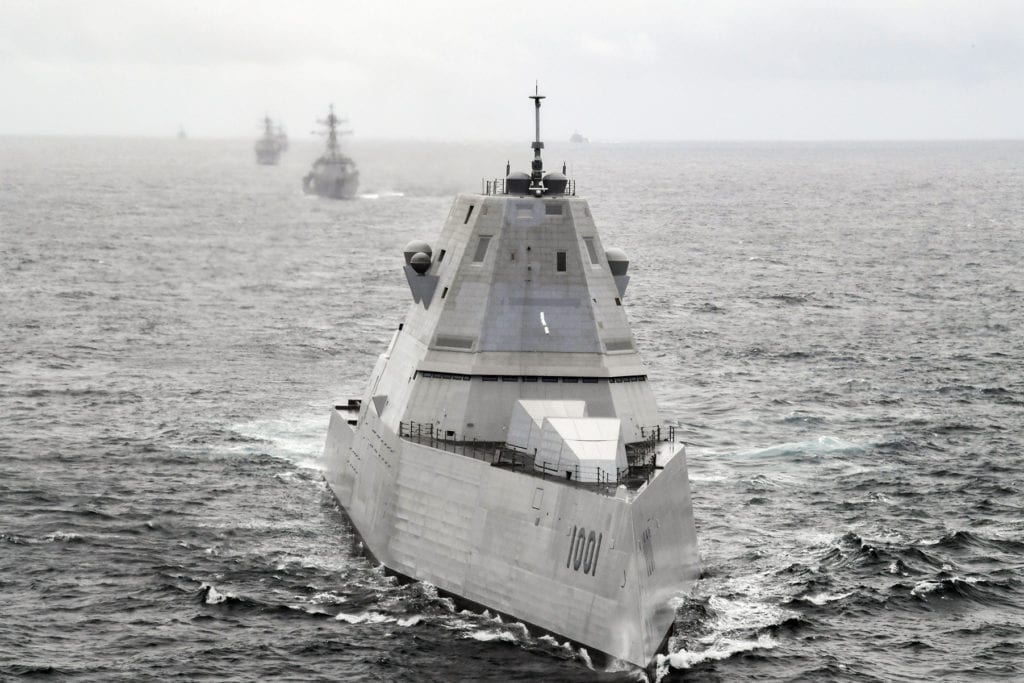
The Zumwalt-class guided-missile destroyer USS Michael Monsoor (DDG 1001) leads a formation including the Arleigh Burke-class guided missile destroyers USS Fitzgerald (DDG 62), USS Spruance (DDG 111), USS Pinckney (91), and USS Kidd (DDG 100), and the Independence-variant littoral combat ship USS Coronado (LCS 4) during U.S. Pacific Fleet’s Unmanned Systems Integrated Battle Problem (UxS IBP) 21, April 21. U.S. NAVY / Chief Mass Communication Specialist Shannon Renfroe
ARLINGTON, Va. — The Navy’s top officer said Zumwalt-class guided-missile destroyers will be the first U.S. Navy ships to be armed with hypersonic missiles.
“With respect to our research and development budget, hypersonics is our top priority, so we are working closely with the Marine Corps, with the Army, and with the Air Force to reach a capability that we can deliver to the fleet in 2025,” said Adm. Michael Gilday, chief of naval operations, testifying April 29 before the defense subcommittee of the House Appropriations Committee.
“We intend to do that on the latest and greatest destroyers we have, the Zumwalt-class destroyer,” Gilday said. “Our intent is to first put the weapon on those destroyers and then on our Virginia-class Block 5 submarines. Right now, our projection is that capability will be on our submarines by 2028.”
As recently as November, Vice Adm. Johnny Wolfe, director of Strategic Systems Programs, said the plan was to deploy the Conventional Prompt Strike (CSP) capability hypersonic missiles first on the four Ohio-class guided-missile submarines (SSGNs)
The CSP will be deployed by the U.S. Army first in 2023. Wolfe said the Initial Unit Training of Army units without the All-Up Round will begin in 2021. A canister hot-launch operational demonstration is planned for 2022. Delivery of the Army’s prototype truck-hauled delivery system is scheduled for 2023. The delivery of the All-Up Round — including the hypersonic glide body — is planned for 2024.
Gilday said a hypersonic weapon was successfully tested last year with the Army, being fired thousands of miles at very high speed and with very high precision.
“We’re very excited about the path we are on right now in hypersonics,” he said. “We’re very confident of the delivery timeline.”
Curtiss-Wright Selected by SRC to Provide Flight Recorders for T-6 Aircraft
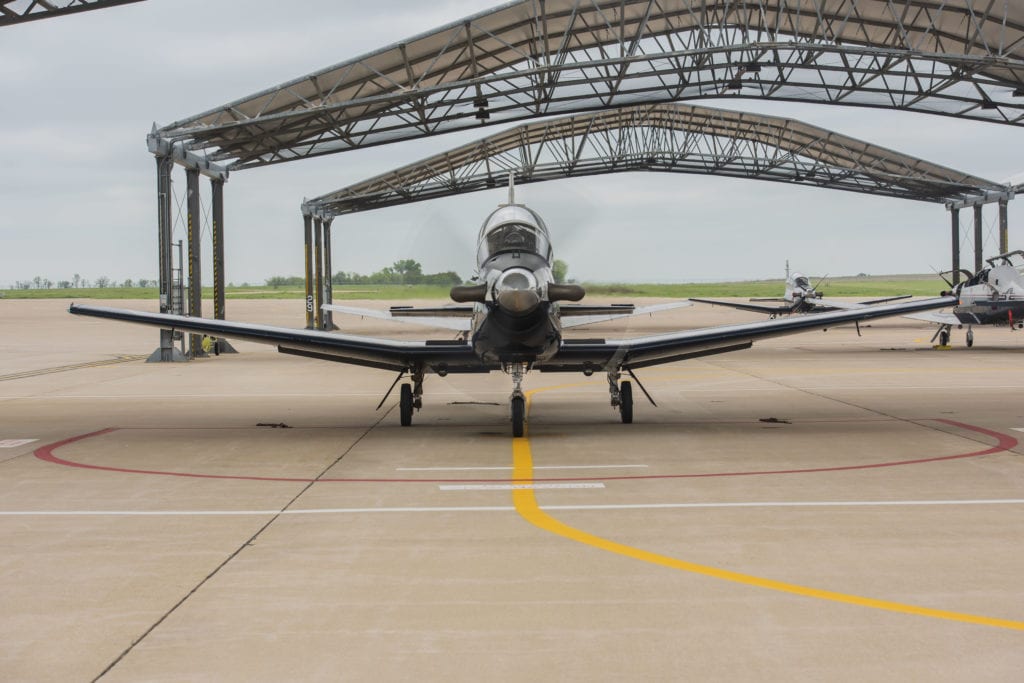
Curtiss-Wright’s Defense Solutions division will provide a version of its Fortress flight recorder system to upgrade T-6 Texan II trainer aircraft used by the U.S. Navy and Air Force. U.S. AIR FORCE / Airman Zoe T. Perkins
ASHBURN, Va. – April 28, 2021 – Curtiss-Wright’s Defense Solutions division, a supplier of rugged avionics solutions, today announced that it was selected by Scientific Research Corp. (SRC) to provide a version of its Fortress flight recorder system to upgrade the T-6 Texan II trainer aircraft used by the U.S. Air Force and Navy, Curtiss-Wright said in an April 28 release.
Under the agreement, Curtiss-Wright is providing SRC with a new variant of the Fortress CVR25, developed for use on military fixed wing and rotorcraft airborne platforms. The Fortress CVR25 combines a CVR, FDR, integrated data acquisition, and an independent power supply in a single lightweight, compact unit. The Fortress recorder’s ability to acquire additional data as customer needs evolve has helped further establish Curtiss-Wright as one of the leading suppliers of modern flight data recorders. Under the contract, shipments began in the first quarter of 2021 and are scheduled to continue through the first half of 2023.
“We are very proud to have been selected by Scientific Research Corporation to provide our innovative Fortress cockpit voice recorder and flight data recorder to upgrade the important T-6 Texan II trainer used by the U.S. Air Force and Navy,” said Chris Wiltsey, senior vice president and general manager, Defense Solutions. “SRC and Curtiss Wright intend to further explore other flight recorder applications within the DoD where our unique experience can assist in liberating the benefits of modern-day flight recorder technology for the military aircraft market.”
Lawmakers Introduce SHIPYARD Act to Support National Defense Infrastructure
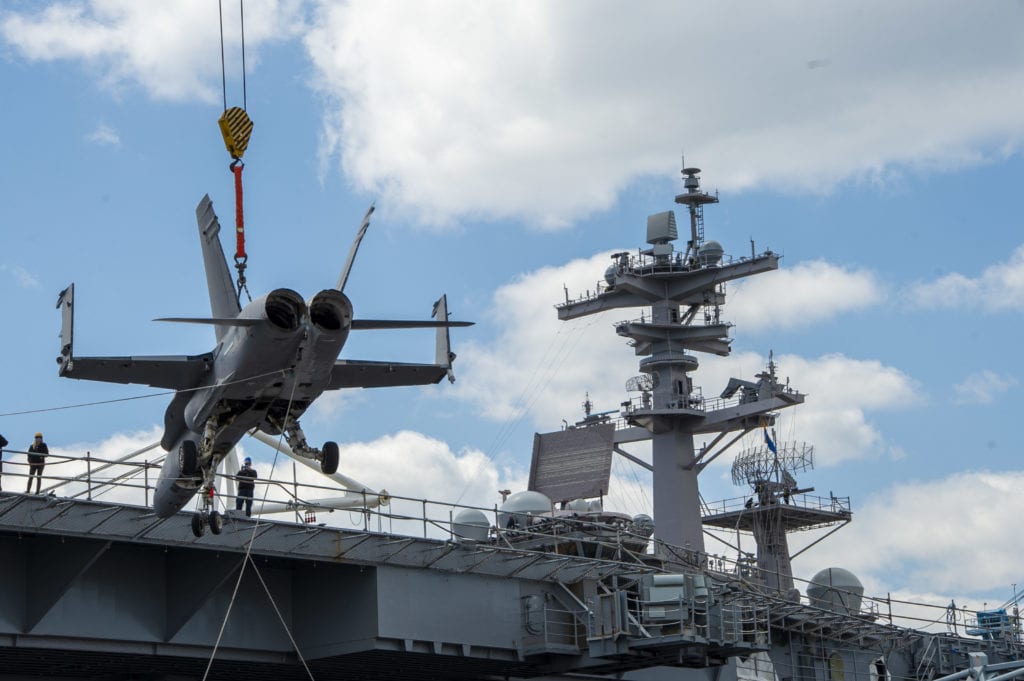
A dud aircraft is loaded by a crane to the aircraft carrier USS George H. W. Bush’s (CVN 77). GHWB is at Norfolk Naval Shipyard undergoing its Docking Planned Incremental Availability. U.S. NAVY / Mass Communication Specialist Seaman Bayley McMichael
WASHINGTON – Several U.S. Senators and Representatives introduced the Supplying Help to Infrastructure in Ports, Yards, and America’s Repair Docks (SHIPYARD) Act of 2021, which would provide $25 billion to make investments needed to optimize, improve, and rebuild shipyard facilities, electrical infrastructure, environmental systems, and the equipment of public and private shipyards in the U.S. that support the U.S. Navy fleet.
Introducing the bill were Sens. Roger Wicker, R-Mississippi; Tim Kaine, D-Virginia; Susan Collins, R-Maine; Angus King, I-Maine; and Jeanne Shaheen, D-New Hampshire, along with Reps. Rob Wittman, R-Virginia, and Mike Gallagher, R-Wisconsin.
The act would designate $21 billion for the Navy’s four public shipyards in Virginia, Maine, Hawaii, and Washington, $2 billion for major Navy private new construction shipyards, and $2 billion for Navy private repair shipyards.
“As lawmakers consider ways to improve our nation’s infrastructure, the facilities that support our Navy fleet should be a part of the conversation,” Wicker said. “Congress has already taken the important step of committing to a larger Navy, but our shipyards are having trouble servicing today’s 296-ship fleet and are clearly insufficient to maintain the 355-ship or larger fleet we need to counter China, Russia, and other adversaries. Now is the time to provide our Navy leaders the support they need to grow and preserve our fleet for generations to come.”
“Virginia’s public and private shipyards are crucial to strengthening our national security,” said Kaine. “This legislation would ensure that our sailors, shipbuilders, and ship repairers have the most up-to-date tools, equipment, and facilities to ensure our Navy remains ready to protect our nation.”
“The importance of our naval assets to our national security and global stability has never been greater, which is why it is so critical that our defense industrial base has the capacity to build and maintain a larger fleet,” said Collins. “If we are serious about the United States competing against and deterring China, we have to consider our vital defense infrastructure. For example, the Navy has specifically identified a critical lack of dry dock capacity at our nation’s four public shipyards. I have long advocated for modernization of Portsmouth Naval Shipyard and Bath Iron Works in Maine to help the highly skilled employees continue to successfully carry out their essential missions in modern, streamlined facilities. Our bipartisan legislation would support infrastructure improvements at shipyards across the country to help reduce maintenance backlogs, increase safety and efficiency, and accommodate growth to counter China’s growing naval ambitions. As a member of the Military Construction Appropriations Subcommittee, I will continue to advocate for infrastructure projects at shipyards to keep our Navy strong.”
“Portsmouth Naval Shipyard and Bath Iron Works play critical roles in both our nation’s national defense and Maine’s economy,” said King. “The contributions of these yards are absolutely essential to the Navy’s ability to operate and create thousands of good-paying jobs across Maine, both on-site and with contractors who provide additional support. As the Navy seeks to grow its fleet to address an array of challenges across the globe, and the associated maintenance requirements continue to expand, it is absolutely essential that we provide these shipyards with the modern tools and technologies they need to meet growing demand. This bipartisan legislation will make much-needed investments in a critical part of our national security infrastructure — including adaptations to prepare for the potential impacts of climate change — ensuring that these storied yards will be able to continue to fulfill their important duties for decades to come.”
“The Portsmouth Naval Shipyard is an economic engine of New Hampshire’s Seacoast region and brings immense pride to our state by bolstering its role in support of our national defense. The oldest, continually operating shipyard in the nation, the stability and security of PNSY and its workers are of critical importance,” said Shaheen. “That’s why I’m glad to partner with Senator Wicker and this bipartisan group of lawmakers on this legislation to make robust federal investments in the facilities, infrastructure and equipment at shipyards across the country, including New Hampshire. Modernizing the structures and capabilities of our shipyards is crucial for both our military readiness and our local economies, which is why I urge members on both sides of the aisle to join us in this effort.”
“At a time when China is commissioning three ships in a single day, we desperately need to strengthen the American shipbuilding industrial base to expand, support, and service the fleet,” said Rep. Gallagher. “The bipartisan, bicameral SHIPYARD Act makes critical investments to better ensure shipyards across the country, such as Marinette Marine, can build the Navy the nation needs.”
The legislation would help to address a backlog of modernization, maintenance, and expansion projects the U.S. Navy has identified at public shipyards and provide the Navy flexibility to support capital improvement projects and other investments at yards that are critical to maintaining and growing the fleet. Projects identified by the Secretary of the Navy would include improvements to shipyard infrastructure, construction of new dry docks, and other items to enable these shipyards to keep pace with Navy needs for decades to come.
Among other provisions, the legislation would:
Fully fund the Navy’s $21 billion Shipyard Infrastructure Optimization Program (SIOP) at the nation’s four public shipyards in Portsmouth, Virginia, Kittery, Maine, Pearl Harbor, Hawaii, and Bremerton, Washington.
Invest $2 billion in commercial repair shipyards, subcontractors and suppliersthat maintain the U.S. Navy fleet, allowing the Secretary of the Navy to fund key upgrades and infrastructure modernization projects to address current and future maintenance needs.
Invest $2 billion in commercial new construction shipyards, subcontractors and suppliers that build the U.S. Navy fleet, allowing the Secretary of the Navy to fund key upgrades and infrastructure modernization projects to meet current and future Navy capability and capacity needs.
Provide all funds via the Defense Production Act,removing typical fiscal year constraints on appropriations and increasing flexibility to enable the Secretary of the Navy to accelerate contract awards.
Click here to read a white paper on the legislation and here to read the full legislative text.