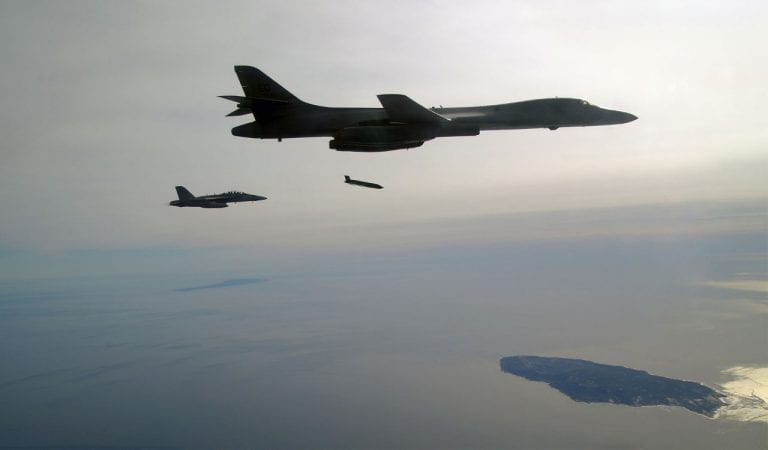
An LRASM being dropped from a B-1B Lancer bomber. LOCKHEED MARTIN
ARLINGGTON, Va. — The Navy has awarded a contract to Boeing to integrate the AGM-158C Long-Range Anti-Ship Missile (LRASM) into the P-8A Poseidon maritime patrol reconnaissance aircraft.
The Naval Air Systems Command awarded Boeing a $74 million cost-plus-fixed-fee order for “the design, development, and test of software and ancillary hardware necessary for the integration of the Long-Range Anti-Ship Missile onto the P-8A aircraft for the Navy,” an April 21 Defense Department contract announcement said.
The LRASM, a derivative of the Air Force’s AGM-158B Joint Air-to-Surface Strike Missile-Extended Range cruise missile, fills an air-launch capability gap and provides flexible, long-range, advanced anti-surface capability against high-threat maritime targets. The weapon reduces dependency on intelligence, surveillance and reconnaissance platforms, network links and GPS navigation in electronic warfare environments. Semi-autonomous guidance algorithms will allow it to use less-precise target cueing data to pinpoint specific targets in the contested domain.
The P-8A currently can be armed with AGM-84 Harpoon cruise missiles and Mk54 antisubmarine torpedoes. The addition of the LRASM will expand its anti-surface capability in terms of range and ability to operate in a GPS-denied environment.
Work on the order is expected to be completed in October 2024.
Houston Nominated for Vice Adm., commander, Naval Submarine Forces
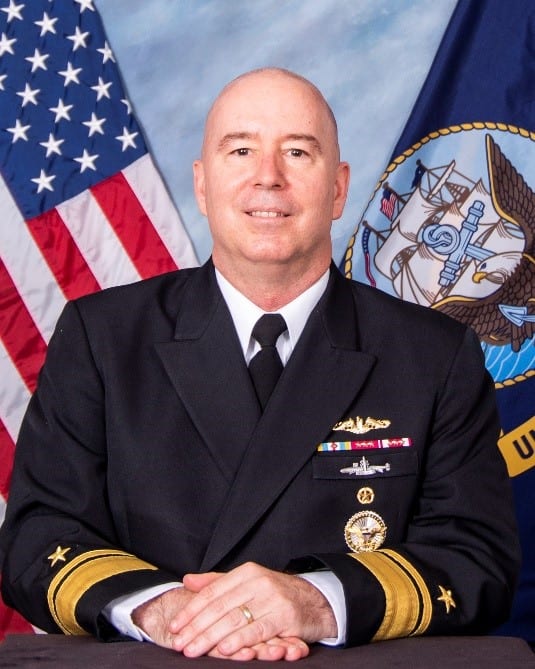
Rear Adm. William J. Houston, nominated for appointment to vice admiral and assigned as commander, Naval Submarine Forces, commander, Submarine Force, U.S. Atlantic Fleet, and commander, Allied Submarine Command, Norfolk, Virginia. U.S. NAVY
ARLINGTON, Va. — Secretary of Defense Lloyd J. Austin III announced April 21 that the president has nominated Navy Rear Adm. William J. Houston for appointment to the grade of vice admiral, and assignment as commander, Naval Submarine Forces; commander, Submarine Force, U.S. Atlantic Fleet; and commander, Allied Submarine Command, Norfolk, Virginia.
Houston is currently serving as director, Undersea Warfare Division, N97, Office of the Chief of Naval Operations, Washington, D.C.
Rear Adm. Houston is a native of Buffalo, New York, and graduated from the University of Notre Dame in May 1990 with a bachelor of science in electrical engineering and was commissioned via the Navy Reserve Officer Training Corps (NROTC) program. He holds a master’s of business administration from the College of William and Mary.
His sea tours include division officer assignments on USS Phoenix (SSN 702), engineer officer onboard USS Hampton (SSN 767), and executive officer onboard USS Tennessee (SSBN 734) Blue. He commanded USS Hampton (SSN 767) in San Diego and was commodore of Submarine Squadron 20 in Kings Bay, Georgia.
His staff assignments include flag lieutenant for Commander Submarine Force, U.S. Atlantic Fleet; the Atlantic Fleet Nuclear Propulsion Examining Board; special assistant to the Director of Naval Reactors for Personnel and Policy; deputy commander for Submarine Squadron 20; the principal director for Nuclear Matters within the Office of the Secretary of Defense; the submarine and nuclear community manager, Military Personnel Plans and Policy (N133) and division director of Submarine and Nuclear Propulsion Distribution, Navy Personnel Command (PERS-42).
His first flag assignment was deputy director for Strategic Targeting and Nuclear Mission Planning (J5N) United States Strategic Command. Following this, he served as director of operations, Naval Forces Europe-Africa; deputy commander, U.S. 6th Fleet, and commander, Submarine Group Eight.
Future USS Mobile Set for Namesake City Commissioning
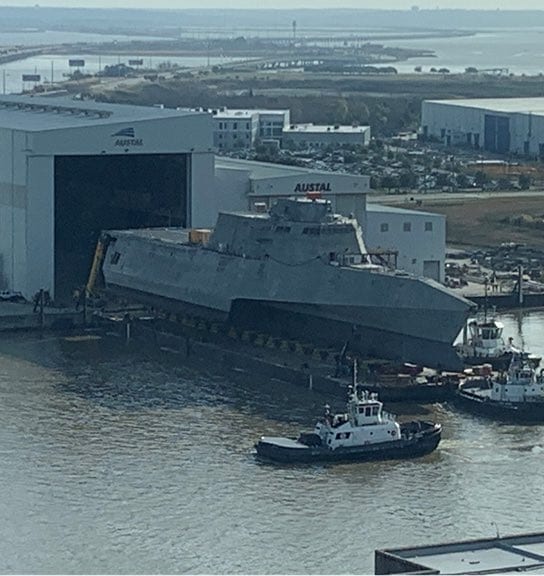
The future USS Mobile (LCS 26) moves from its construction bay to the Mobile River in this 2020 photograph. OFFICE OF BRADLEY BYRNE / Wikipedia
MOBILE, Alabama – The future USS Mobile (LCS 26), the U.S. Navy’s newest Independence-variant littoral combat ship (LCS), will be commissioned May 22, 2021 at 10:00 a.m. (CT) in Mobile, Alabama, the U.S. Naval Surface Force, U.S. Pacific Fleet said in an Apr. 21 release.
Due to ongoing public health and safety concerns related to the COVID-19 pandemic, the ceremony will take place in compliance with Department of Defense, Centers for Disease Control, state public health, state, and local government guidelines and restrictions. The event will be livestreamed to offer maximum viewing by the general public.
“The Mobile crew worked hard to prepare their ship for this moment, and they will continue to see the fruits of their labor as they train and operate at sea,” said Vice Adm. Roy Kitchener, commander, Naval Surface Force, U.S. Pacific Fleet. “We are refining the LCS class lethality and global sustainment infrastructure to better harness the versatility these ships bring to the surface force. Mobile is entering the fleet at a prime time in the LCS progression, as we implement lessons learned from other LCS deployers.”
Rebecca Byrne, president and CEO of The Community Foundation of South Alabama and wife of former U.S. Rep. Bradley Byrne, R-Alabama, is the ship’s sponsor. As a former chairman of the Downtown Mobile Alliance and former executive director of United Way of Baldwin County, Rebecca has long served her community through civic, cultural, and church leadership roles.
Highlighting the commissioning is a time-honored Navy tradition where Rebecca will give the first order to, “man our ship and bring her to life.”
Mobile’s commanding officer, Cmdr. Christopher W. Wolff, a graduate of Carnegie Mellon University, the University of Oklahoma, and the U.S. Naval War College, has deployed five times on five different ships. The third-generation naval officer leads a crew of 70 officers and enlisted Sailors.
USS Mobile was built in Mobile, Alabama, by Austal USA and was launched on January 11, 2020. The future USS Mobile is the fifth Navy ship to honor the city of Mobile, which has a rich historical relationship with the Navy.
The first Mobile was a Confederate, government-operated, side-wheel steamer operating as a blockade runner and captured in New Orleans in April 1862 by U.S. forces. Commissioned as USS Tennessee, the ship was later renamed Mobile. Commissioned in March 1919, the second Mobile, a Hamburg Amerika Lines passenger liner operating between Germany and the U.S. until the outbreak of World War I, was taken over by the Allied Maritime Council and assigned to the United States after the Armistice. USS Mobile (CL 63) participated in numerous Pacific Theater campaigns during World War II. Commissioned on March 24, 1943, the cruiser received 11 battle stars for the ship’s time in service and was decommissioned in May 1947. The fourth Mobile (LKA 115) was an amphibious cargo ship serving from September 1969 until decommissioning in February 1994.
LCS is a highly maneuverable, lethal and adaptable ship designed to support focused mine countermeasures, anti-submarine, and surface warfare missions. The Independence-variant LCS integrates new technology and capability to affordably support current and future missions, from deep water to the littorals.
LCS is now the second-largest surface ship class in production, behind the Navy’s DDG 51 Arleigh Burke-class destroyer program. USS Mobile will be homeported at Naval Base San Diego, California.
HII Awarded $107M Advance Procurement Contract for LHA 9
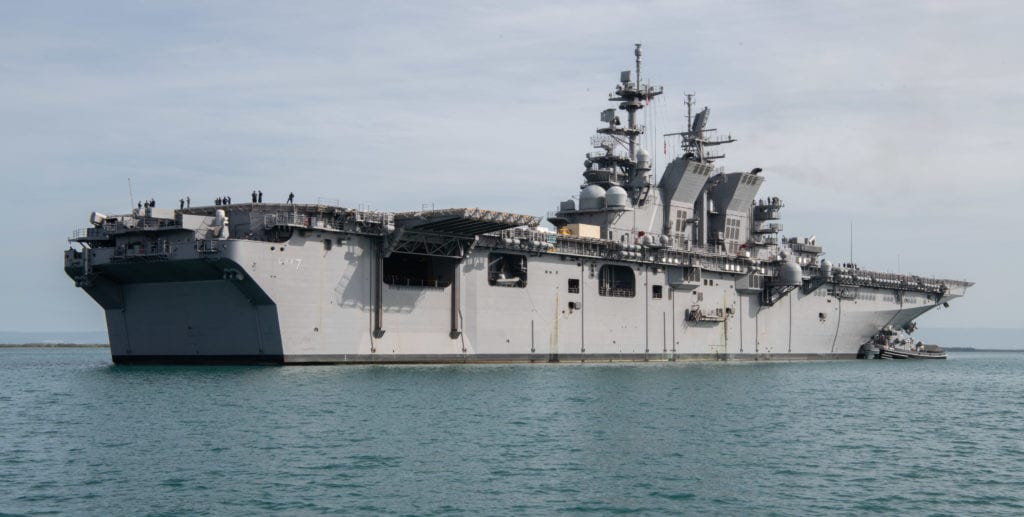
USS Tripoli (LHA 7), the second America-class amphibious assault ship, transits toward Naval Station Guantanamo Bay, Aug. 3, 2020. Huntington Ingalls Industries’ Ingalls Shipbuilding division has been awarded a $107 million contract modification for the LHA 9. U.S. NAVY / Mass Communication Specialist 3rd Class Annaliss Candelaria
PASCAGOULA, Miss. — Huntington Ingalls Industries’ Ingalls Shipbuilding division has received a contract modification from the U.S. Navy for $107 million to provide long-lead-time material and advance procurement activities for amphibious assault ship LHA 9, the company said in an April 19 release.
“The amphibious warship production line is a critical component of our nation’s defense industrial base,” Ingalls Shipbuilding President Kari Wilkinson said. “This funding will strengthen our suppliers and sustain jobs across the country in support of LHA 9 construction.”
Ingalls is the sole builder of large-deck amphibious ships for the Navy. The shipyard delivered its first amphibious assault ship, the Iwo Jima-class USS Tripoli (LPH 10), in 1966. Ingalls has since built five Tarawa-class (LHA 1) ships, eight Wasp-class (LHD 1) ships and the first in the new America class of amphibious assault ships (LHA 6) in 2014. The second ship in the America class, USS Tripoli (LHA 7), was delivered to the Navy in early 2020. Bougainville (LHA 8) is under construction.
Navy’s Unmanned Integrated Battle Problem 21 to Culminate in Missile Shoot
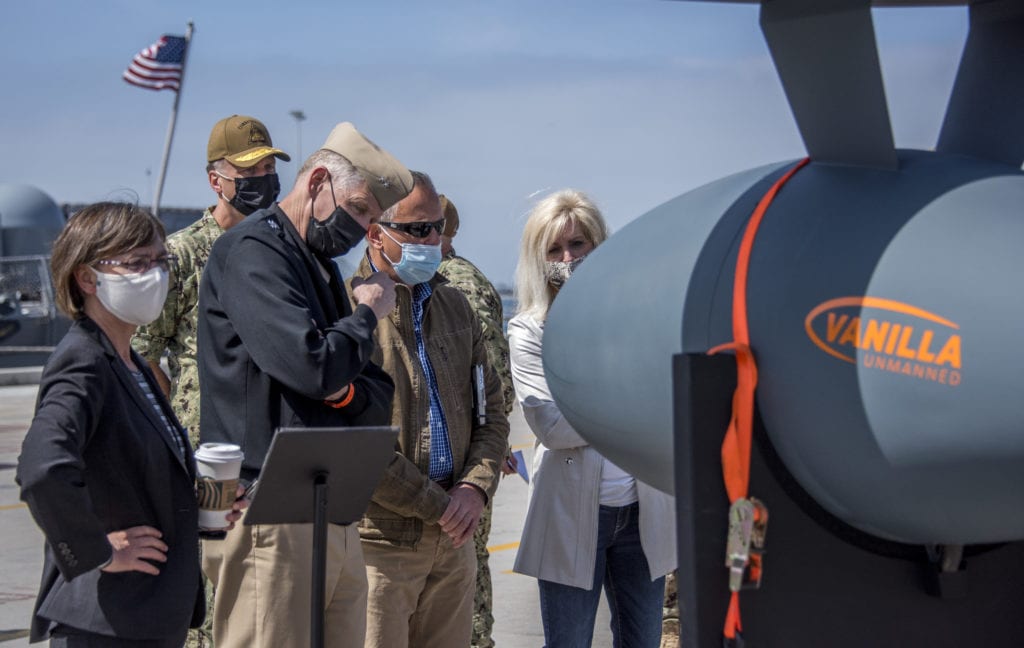
Chief of Naval Research, Rear Adm. Lorin Selby, observes a Vanilla Ultra Endurance unmanned aerial vehicle on Pier 12 during Integrated Battle Problem 21 (UxS IBP 21) Distinguished Visitors Day at Naval Base San Diego, April 16. U.S. Pacific Fleet’s UxS IBP 21, April 19-26, integrates manned and unmanned capabilities into the most challenging operational scenarios to generate war fighting advantages. U.S. NAVY / Mass Communication Specialist 2nd Class Natalie M. Byers
ARLINGTON, VA. — The U.S. Navy’s first large-scale unmanned systems (UxS) integrated battle problem (IBP) will involve manned/unmanned teaming and has a goal of developing a targeting solution for a planned missile shoot, the IBP executive agent said.
The battle problem, led by the U.S. Pacific Fleet and executed by U.S. 3rd Fleet, began April 19 and is being conducted under the command of Rear Adm. James Aiken, commander, Carrier Strike Group Three.
“This integrated battle problem provides an operational approach to integrating and adapting unmanned technology with our manned fleet,” Aiken said, speaking April 20 in a teleconference with reporters. “Various manned systems, including littoral combat ships, two classes of destroyers, an amphibious transport dock ship, and fixed and rotary-wing aircraft will test their enhanced capabilities alongside unmanned systems through operationally challenging scenarios and vignettes during this exercise.
“This exercise generates warfighting advantages for our fleet by providing the operational environment to work through tactics, techniques, procedures, command and control, to integrate the fleet and we are ready to execute,” he said. “Our operational integration of these unmanned systems is here in our fleet today above the sea, on the sea and below the sea.
“We want to move to a capability, to start applying operational concepts,” he said. “Foundationally, when actually planning this exercise, Sailors were part of the planning.
“Our goal for this exercise is to evaluate these unmanned systems and how they can actually team with manned systems,” he said. “As we team all those together, we will be able to evaluate what we can do and what we can’t do in trying to create a warfighting advantage … then we’re going to make sure we get it into the hands of the Sailors. We need to move things from the technical community to the tactical community.”
Aiken said one of the vignettes of most interest is the most challenging: using “a combination of manned and unmanned assets in order to get after a target and provide a targeting solution. At range we’re going to put a missile on the target.”
The admiral was not at liberty to name the type of missile to be used.
Unmanned systems participating in the IBP include two medium-displacement unmanned surface vessels, Sea Hunter and its new sister ship, Seahawk; MQ-8B Fire Scout UAV; MQ-9 Sea Guardian UAV; Vanilla ultra-long-endurance UAV; Office of Naval Research’s Super Swarm Project; and the Ocean Aero Triton-Class Dual-Modality Underwater and Surface Autonomous Vehicle.
Manned ships participating in the IBP include the Zumwalt-class guided-missile destroyer (DDG) USS Michael Monsoor; the Arleigh Burke-class DDGs USS Spruance, USS John Finn, USS Stockdale and USS Fitzgerald; Ticonderoga-class guided-missile cruiser USS Princeton; Freedom-class littoral combat ship (LCS) USS Fort Worth; Independence-class LCS USS Coronado; San Antonio-class amphibious transport dock ship USS Anchorage; and Los Angeles-class attack submarine USS Hampton.
Manned aircraft participating include the P-8A Poseidon, E-2C Hawkeye, EA-18G Growler, MH-60R Seahawk and MH-60S Seahawk.
Inaugural Unmanned Battle Problem 21 to begin April 19
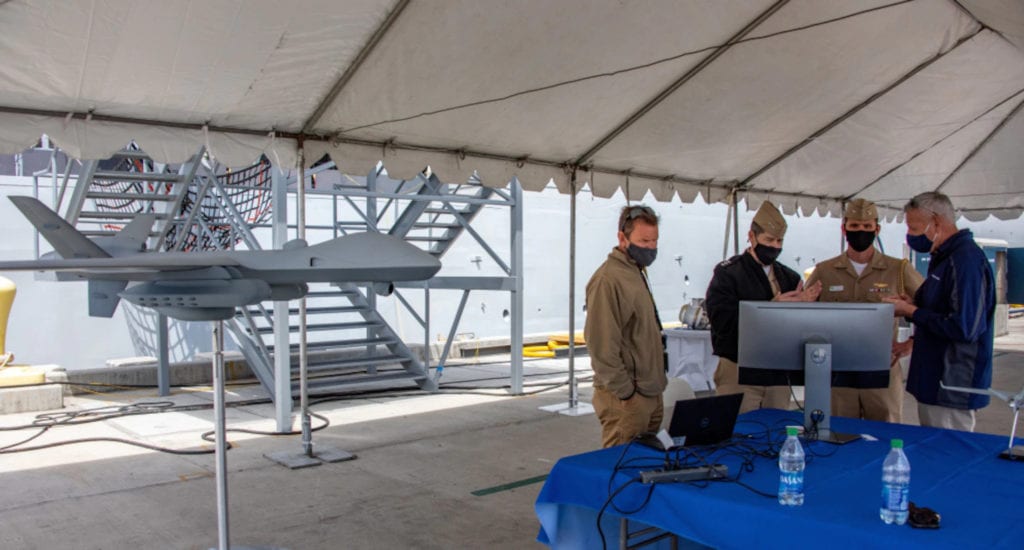
Vice Adm. Michael Moran, principal military deputy assistant Secretary of the Navy (Research, Development and Acquisition), speaks with representatives from General Atomics Aeronautical about the MQ-9 Sea Guardian unmanned aircraft at Pier 12 on Naval Base San Diego. U.S. Pacific Fleet’s UxS IBP 21, April 19-26, integrates manned and unmanned capabilities into the most challenging operational scenarios to generate war fighting advantages. U.S. NAVY
SAN DIEGO – The Navy begins its inaugural multi-domain manned and unmanned capabilities exercise April 19, the U.S. 3rd Fleet said in an April 16 release. The exercise will feature unmanned capabilities “Above the Sea, On the Sea and Below the Sea.”
Led by U.S. Pacific Fleet and executed by U.S. 3rd Fleet, Unmanned Integrated Battle Problem 21 will generate warfighting advantages by integrating multi-domain manned and unmanned capabilities into the most challenging operational scenarios.
The exercise will feature operational, unmanned systems such as the MQ-9 Sea Guardian Unmanned Aerial Vehicle, the Medium Displacement Unmanned Surface Vessels Sea Hunter and Sea Hawk, and small and medium Unmanned Undersea Vehicles with modular payloads.
“Building off advances achieved over the past decade in unmanned aviation, Pacific Fleet is answering the Chief of Naval Operations’ drive to put the Navy’s Unmanned Campaign Plan into action,” says Rear Adm. Robert M. Gaucher, director of maritime headquarters at U.S. Pacific Fleet. “Furthermore, by exercising our full range of unmanned capabilities in a Pacific warfighting scenario, UxS IBP21 directly supports U.S. Indo-Pacific Command’s warfighting imperative of driving lethality through experimentation.”
Unmanned systems alongside the traditional, manned naval force will give the U.S. Navy the advantage needed to fight, win and deter potential aggressors. This exercise will directly inform warfighters, warfare centers and developers to further incorporate unmanned capabilities in day-to-day Fleet operations and battle plans.
“The overall goal is to integrate our unmanned capabilities across all domains to demonstrate how they solve CNO and Fleet Commander Key Operational Problems,” says Gaucher. “To get after these problems, UxS IBP21 will include maneuvering in contested space across all domains; targeting and fires; and intelligence, reconnaissance and surveillance.”
USS The Sullivans Deploys in Support of British Carrier Task Group 21
The Arleigh Burke-class guided-missile destroyer USS The Sullivans (DDG 68), departed Mayport, Florida, April 19, for deployment to participate in HMS Queen Elizabeth (R08) Strike Group. U.S. NAVY
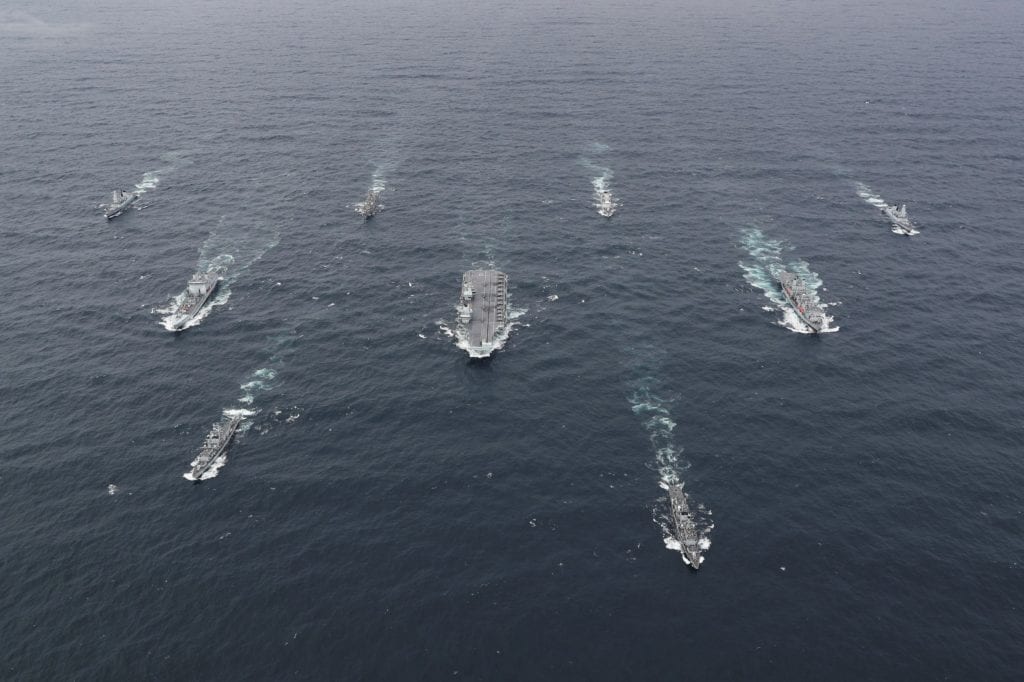
MAYPORT, Fla. — The Arleigh Burke-class guided-missile destroyer USS The Sullivans (DDG 68), departed Mayport, Florida, April 19, for deployment to participate in HMS Queen Elizabeth (R08) Strike Group, the U.S. 2nd Fleet said in a release.
The inclusion of U.S. forces in the strike group will improve expeditionary capabilities and interoperability between NATO allies, demonstrating the United States’ commitment to the NATO alliance.
“It is an honor to sail in this elite multi-national strike group on the frontline demonstrating a fully integrated force that showcases the special relationship that our countries have,” said Cmdr. David Burkett, commanding officer of The Sullivans. “USS The Sullivans’ namesakes would be extremely proud of us as we boldly show that, we stick together!”
The ship is named after the five Sullivan brothers who died when their ship, the USS Juneau, was sunk by a Japanese submarine during the battle of Guadalcanal in World War II. It is the second Navy ship to be named after the brothers.
The Sullivans recently participated in a successful Composite Unit Training Exercise alongside the Iwo Jima Amphibious Ready Group and the 24th Marine Expeditionary Unit that included a NATO vignette and training with SEALS from an East Coast-based Naval Special Warfare Group.
The vignette, developed by Carrier Strike Group Four and Combined Joint Operations from the Sea Centre of Excellence (CJOS COE), consisted of familiarity training designed to facilitate allied maritime interoperability and integration, in practical terms using NATO procedures, messaging formats and chat capabilities.
The vignette developed and refined a clear list of interoperability requirements for future Navy force generation, and improved allied maritime command-and-control linkages.
“To ensure truly effective deterrence and defense in the North Atlantic, we need to make sure that the navies of NATO can work as one team, and that means interoperability is vital,” said Commodore Tom Guy, Royal Navy, deputy director CJOS COE. “This NATO vignette has been a great step forward in pursuing allied interoperability. CJOS COE looks forward to continuing to develop this for future deploying strike groups.”
In Oct. 2020, USS The Sullivans participated in U.K.-led exercise Joint Warrior 20-2 as part of HMS Queen Elizabeth Strike Group. The exercise provided pre-deployment opportunities for the international strike group.
HII Achieves Milestone in RCOH of USS George Washington
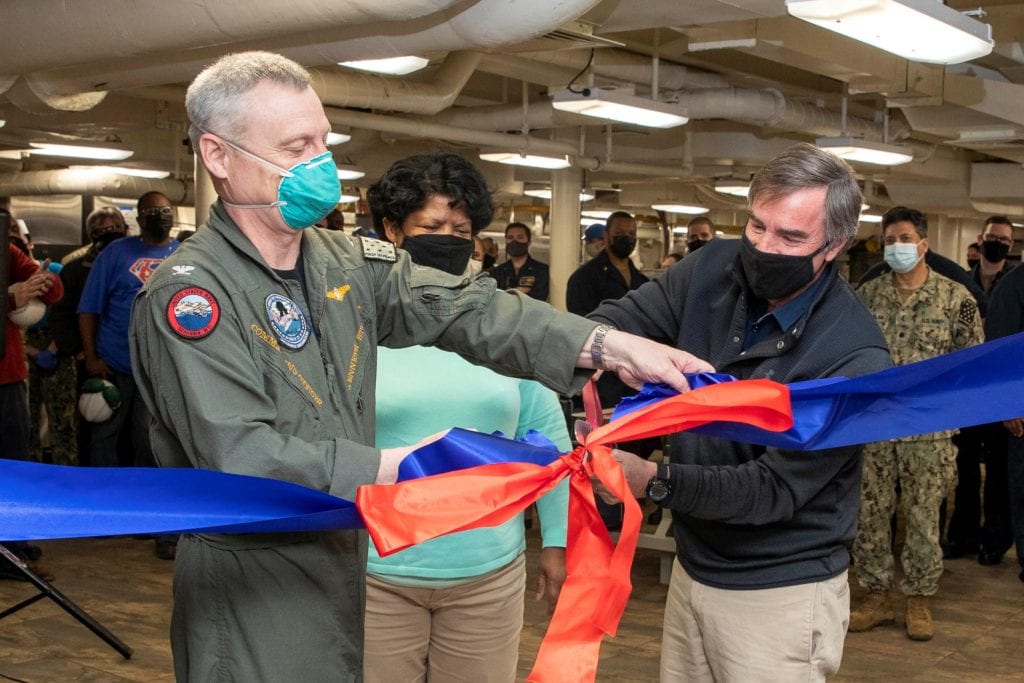
The aircraft carrier USS George Washington (CVN 73) celebrated the reopening of the aft crew mess with a ribbon-cutting ceremony on April 16, 2021. Pictured (Left to right): Capt. Kenneth Strong, the ship’s commanding officer; CVN 73 program director Thomasina Wright; and Scott Menkes, deputy project supervisor for Supervisor of Shipbuilding, Newport News. U.S. NAVY / MCSN Dakota Nack
NEWPORT NEWS, Va. — Huntington Ingalls Industries’ Newport News Shipbuilding division reached a major milestone on the refueling and complex overhaul (RCOH) of USS George Washington(CVN 73), the company said in an April 16 release.
Following a ribbon-cutting ceremony, Sailors ate the first meal prepared in the galley in the nearly three years since the ship arrived at Newport News. The opening of the crew galley is one of the last significant steps before the first 1,100 Sailors are expected to move aboard in June.
“George Washington has gone through a transformation since it arrived at Newport News for the mid-life refueling overhaul and maintenance availability,” said Todd West, Newport News’ vice president, in-service aircraft carrier programs. “The crew beginning their move aboard and the reopening of berthing spaces and galleys, all supporting our nearing completion of the RCOH, is a sign that the ship is being brought back to life. We look forward to continuing our work with our Navy partners to redeliver the ship to the fleet.”
The Nimitz-class aircraft carrier is in the final stages of testing, which is designed to exercise all aspects of the propulsion plant systems and will certify the systems and components for future operations over the next 25 years of service. The RCOH is more than 85% complete, and the ship is on track to be re-delivered to the Navy in 2022.
Aircraft Carrier Industrial Base Coalition Confident of Another Dual-CV Buy
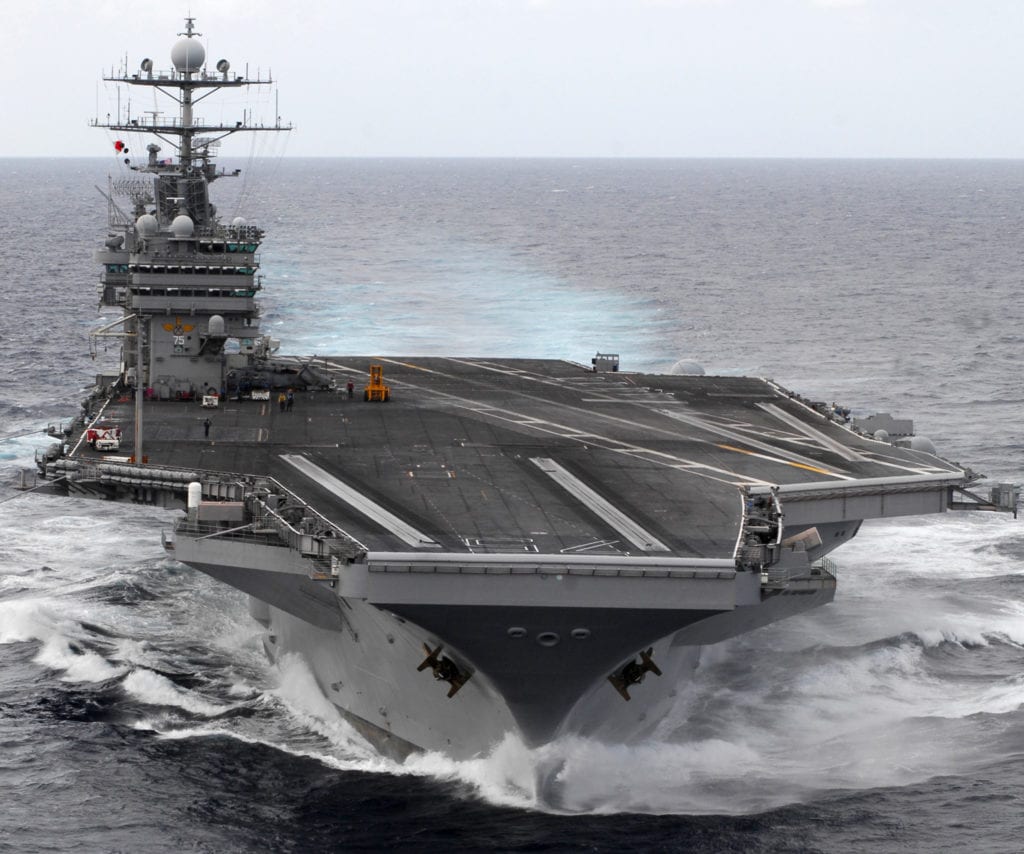
The Nimitz-class aircraft carrier USS Harry S. Truman (CVN 75), due to be retired, a move opposed by the Aircraft Carrier Industrial Base Coalition. U.S. NAVY
ARLINGTON, Va. — The chairman of the industrial coalition of suppliers for the Navy’s aircraft carriers said the coalition supports continuing to build large aircraft carriers instead of light ones and predicts there will be another dual-carrier procurement in the future.
“We’re strong supporters of the large platform,” said Rick Giannini, chairman of the Aircraft Carrier Industrial Base Coalition (ACIBC), who also is president and chief executive officer of Milwaukee Valve Co. in New Berlin, Wisconsin, in an interview with Seapower.
Giannini said the size of the Navy’s carrier aircraft demand a large flight deck to sustain a high sortie rate and that a large aircraft carrier is the most survivable airfield.
The Navy will be conducting an analysis of the concept of light aircraft carriers.
“I believe the L-class ships [amphibious assault ships] operating with the F-35B would fit that bill,” said Rear Adm. Gregory Harris, the Navy’s director for Air Warfare, speaking last month at a Navy League Special Topic Breakfast webinar, sponsored by General Dynamics. “Others would disagree.”
Harris said he is “confident that over the long run we’ll find that there’s not a compelling return on investment to make a smaller carrier just [because of] speed, station-keeping, the air wing that you would put on top of that carrier, and the ability to have the fuel for the air wing and for the carrier to have for the surface combatants.”
The ACIBC members meet on Capitol Hill every year to lobby Congress. This year’s virtual session included more than 260 companies holding more than 123 scheduled meetings with members of Congress to impress upon them the importance of aircraft carriers to the national defense.
“We’re doing everything we can to get that message out,” Gianni said.
The ACIBC represents the more than 2,000 supplier companies in 46 states, supporting 92,000-plus jobs. These companies inject over $8.8 billion into our nation’s economy.
He was critical of proposed initiatives to retire the USS Harry S. Truman instead of refueling it for another quarter century of service, noting the Navy risks falling below the legally mandated number of 11 aircraft carriers.
That leads right back to the industrial base, because for us it’s all about stability and predictability of where those funds ae coming from,” Giannini said, noting that the Navy’s two-ship buy of CVN 80 and 81 brought a lot of stability to the suppliers.
“We’re always concerned when a new administration comes in every time these things are starting over for the next ship in the class,” he said. “We’re fortunate right now; we have two [CVNs] in the pipeline — orders in [fiscal 2019] for eight years of work. We’re still confident that the reasons carriers have been required for the last 50 years aren’t going to be any different than the requirements for the next 50 to 100 years.
“We remain confident there will be another block buy for [CVNs] 82 and 83, because it is the best way to spend the nation’s money, which is to ensure that the supply base has this steady and predictable stream of work, so we can lower the cost,” he said.
Giannini pointed to the example of a class of valves supplied by his company that, because of the last dual-carrier buy, were produced at 20-25% lower cost. Not only is the cost being reduced because the orders for both ships come at once, but additional cost savings come by being able to order materials at today’s prices rather than at future prices.
USS Oakland Commissioning Ceremony Set for April 17
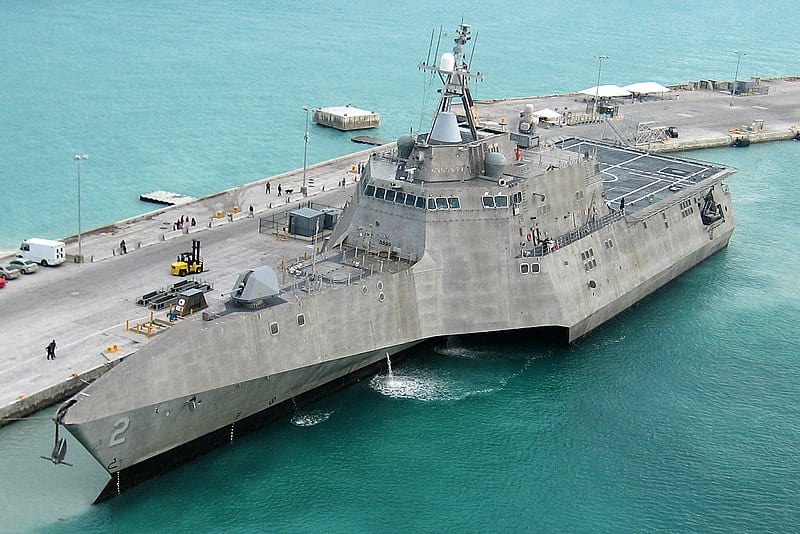
The USS Independence, a sister ship to the future USS Oakland, which will be commissioned on Saturday, April 17. U.S. NAVY
ARLINGTON — The Navy’s newest Freedom-variant littoral combat ship, the future USS Oakland (LCS 24), will be commissioned at 10:00 a.m. PST on Saturday, April 17, 2021 in Oakland, California, the Defense Department said in an April 16 release.
Due to public health and safety concerns related to the novel coronavirus (COVID-19) pandemic, the commissioning will be a private event. The ceremony will be live-streamed for those unable to attend. The following link will become active approximately five minutes prior to the event (9:55 a.m. PST): https://allhands.navy.mil/Live-Stream.
Acting Secretary of the Navy Thomas W. Harker, will deliver the commissioning ceremony’s principal address. Ms. Kate Brandt, Google sustainability officer, is the ship’s sponsor. The ceremony will be highlighted by a time-honored Navy tradition when Ms. Brandt gives the order to “man our ship and bring her to life!”
Cmdr. Francisco X. Garza, a native of Phoenix, Arizona, is the ship’s commanding officer and leads a crew of 70 officers and enlisted personnel. The 3,200-ton Oakland was built by General Dynamics/Austal USA in Mobile, Alabama. The ship is 421 feet in length, has a beam of 103 feet, and a navigational draft of 15 feet. The ship is powered by two gas turbine engines, two main propulsion diesel engines, and four waterjets to reach speeds up to 40-plus knots.
“The USS Oakland crew is excited and ready to bring our ship to life and join the fleet,” said Garza. “We are privileged to be a part of this ship and embody the spirit of the people of Oakland. As plank owners and future crew members build a positive legacy for this ship, the city of Oakland will experience those successes with us.”
Oakland is the third ship to bear the name. She is the 12th Independence-variant LCS and the 297th ship to join our battle force. The littoral combat ship is a fast, agile, focused-mission platform designed to operate in near-shore environments, while capable of open-ocean tasking and winning against 21st-century coastal threats such as submarines, mines, and swarming small craft. The LCS is capable of supporting forward presence, maritime security, sea control, and deterrence.
USS Oakland will be homeported at Naval Base San Diego, California.