Flag Officers Newly Nominated as Vice Admirals and Commanders for Three Fleets
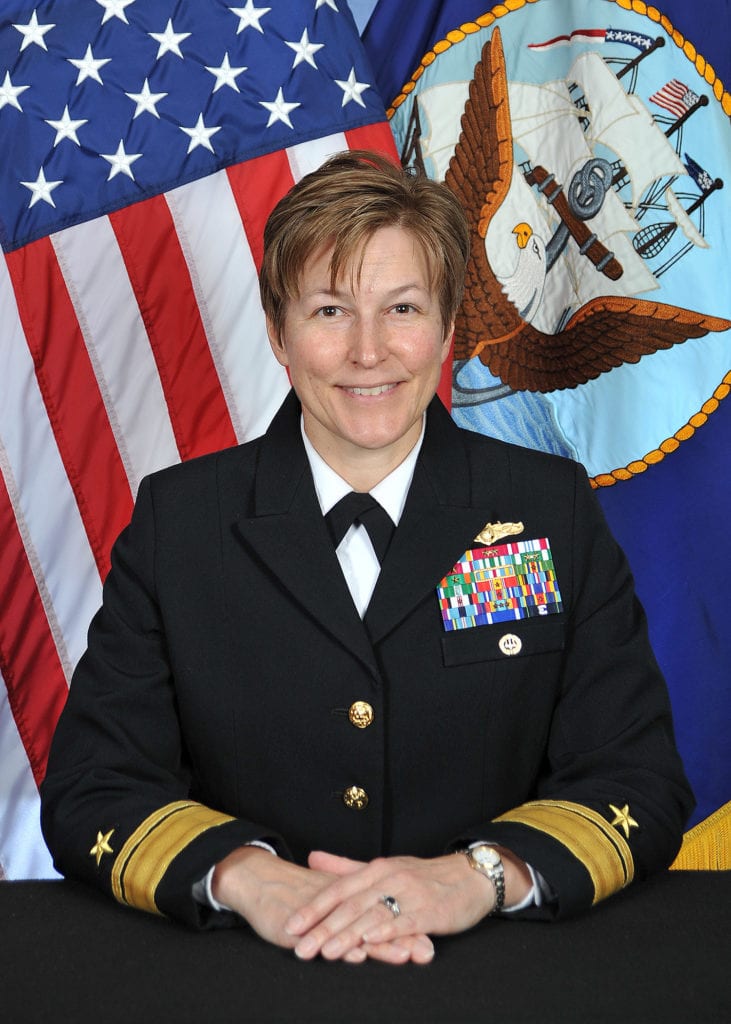
Rear. Adm. Kelly A. Aeschbach, one of six nominations for vice admiral announced on April 15. U.S. NAVY

ARLINGTON, Va. — Defense Secretary Lloyd J. Austin III announced a number of Navy flag officer nominations by the president on April 15, including six for vice admiral, three of which would assume command of the U.S. 3rd, 5th and 7th Fleets.   

Austin said the president has made the following nominations: 

Navy Rear Adm. Kelly A. Aeschbach for appointment to the grade of vice admiral, and assignment as commander, Naval Information Forces, Suffolk, Virginia. Aeschbach is currently serving as director, National Maritime Intelligence Integration Office; and commander, Office of Naval Intelligence, Washington, D.C. 

Navy Vice Adm. Scott D. Conn for reappointment to the grade of vice admiral, and assignment as deputy chief of naval operations for warfighting requirements and capabilities, N-9, Office of the Chief of Naval Operations, Washington, D.C. Conn is currently serving as commander, Third Fleet, San Diego, California. 

Navy Rear Adm. Charles B. Cooper II for appointment to the grade of vice admiral, and assignment as commander, U.S. Naval Forces, Central Command; commander, Fifth Fleet; and commander, Combined Maritime Forces, Manama, Bahrain. Cooper most recently served as commander, Naval Surface Force, Atlantic, Norfolk, Virginia. 

Navy Rear Adm. John V. Fuller for appointment to the grade of vice admiral, and assignment as inspector general, Department of the Navy, Washington, D.C. Fuller is currently serving as deputy director for force protection, J-8, Joint Staff, Washington, D.C. 

Navy Rear Adm. Stephen T. Koehler for appointment to the grade of vice admiral, and assignment as commander, Third Fleet, San Diego, California. Koehler is currently serving as deputy commander, U.S. Pacific Fleet, Pearl Harbor, Hawaii. 

Navy Rear Adm. Karl O. Thomas for appointment to the grade of vice admiral, and assignment as commander, Seventh Fleet, Yokosuka, Japan. Thomas is currently serving as assistant deputy chief of naval operations, plans and strategy, N3/N5B, Office of the Chief of Naval Operations, Washington, D.C. 

Navy Rear Adm. (lower half) Robert T. Clark has been nominated for appointment to the grade of rear admiral. Clark is currently serving as deputy commander, Seventh Fleet, Yokosuka, Japan. 

Navy Rear Adm. (lower half) Nancy S. Lacore has been nominated for appointment to the grade of rear admiral. Lacore is currently serving as chief of staff, U.S. Naval Forces Europe/U.S. Naval Forces Africa/Sixth Fleet, Naples, Italy. 

Navy Rear Adm. (lower half) Eileen H. Laubacher has been nominated for appointment to the grade of rear admiral. Laubacher is currently serving as senior defense official/defense attaché – India, New Delhi, India.  

Navy Rear Adm. (lower half) Theodore P. LeClair has been nominated for appointment to the grade of rear admiral. LeClair is currently serving as mobilization assistant to the director for operations, J3, U.S. Indo-Pacific Command, Camp H. M. Smith, Hawaii. 


EUCOM Commander Seeks More Destroyers, F-35s to Deter Russian Belligerence

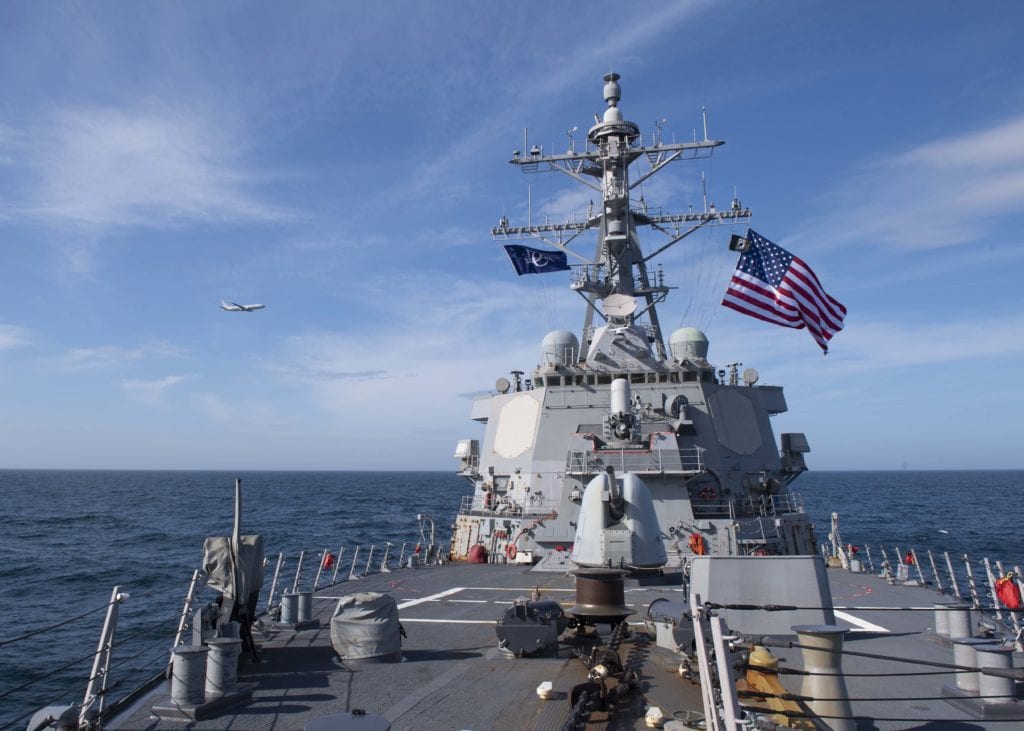
A Boeing P-8 Poseidon flies over the Arleigh Burke-class guided-missile destroyer USS Donald Cook (DDG 75) during a photo exercise in the Black Sea, Feb. 9, 2021. Donald Cook, forward-deployed to Rota, Spain, is on patrol in the U.S. Sixth Fleet area of operations in support of regional allies and partners and U.S. national security in Europe and Africa. U.S. NAVY / Mass Communication Specialist 3rd Class Will Hardy

ARLINGTON, Va. — The Air Force general heading U.S. European Command says more Navy destroyers and Air Force strike fighters are what he needs to both deter and monitor Russia’s aggressive behavior from Arctic waters to the Black Sea.

 “I see a concerted effort on behalf of Russia’s maritime forces in the Baltic, in the Barents and Black seas,” Gen. Tod Walters told a House Armed Services Committee April 15 during a hearing on national security challenges and U.S. military activities in Europe. Improving overall strategic indications and warnings (I&W), as well as command and control (C2), “starts with two destroyers to improve our ability to see undersea and it also culminates with F-35s.”

Wolters said he anticipated receiving the first set of U.S. F-35 Lightning II joint strike fighters in Britain this Fall. There are already 30 non-U.S. F-35s in Europe and the total number is expected to reach 450 jets by 2030. “And we’re programmed now with the United States Navy in the 2025 and 2026 timeframe to hopefully receive two additional destroyers,” he said.

There are four destroyers already based in Rota, Spain, which Wolters described as “the workhorses of deterrence,” projecting U.S. presence into the Mediterranean and Black seas and then back out again and up to the Arctic. Two more, also to be based in Rota, are required because of a consistent increase in Russian undersea activity in the Greenland-Iceland-United Kingdom gap. The historic maritime chokepoint in the 20th century is an access lane to the Atlantic Ocean for Arctic-based Russian subs. “The destroyers’ participation in undersea warfare, C2 and I&W is absolutely, positively critical,” Wolters said.

While the U.S. submarine fleet is “performing admirably,” Wolters said, command and control involves other assets like the Boeing P-8 Poseidon maritime patrol aircraft and destroyers.

“To comprehensively defend in this area, from undersea to all the way to 25,000 feet with a P-8, we need to make sure we have the right hardware and software, and we’re traversing in that direction,” Wolters said, adding. “It’s very challenging with respect to numbers.”

 Asked by Virginia Republican Rep. Robert Wittman if he believed Russia’s seizure of Crimea in 2014 “gives them a strategic foothold in that area” and helps efforts to modernize the Black Sea fleet?” Wolders said “our vigilance is sky high” in the Barents and Baltic seas, as well as the Black Sea. “And every point that you alluded to with respect to potential intentions, we are preparing for, and planning for and expecting it occur.”

Laura Cooper, the deputy assistant secretary of defense for Russia, Ukraine, and Eurasia, who also testified at the hearing, said the Pentagon had increased its focus on the Black Sea. “And we’re taking an approach that looks holistically at all of our allies and partners in the region,” she said, adding, “We’ve started with efforts to build maritime domain awareness capacity” in Ukraine, Georgia, Bulgaria and Romania.


Navy Holds Decommissioning Ceremony for Fire-Damaged USS Bonhomme Richard

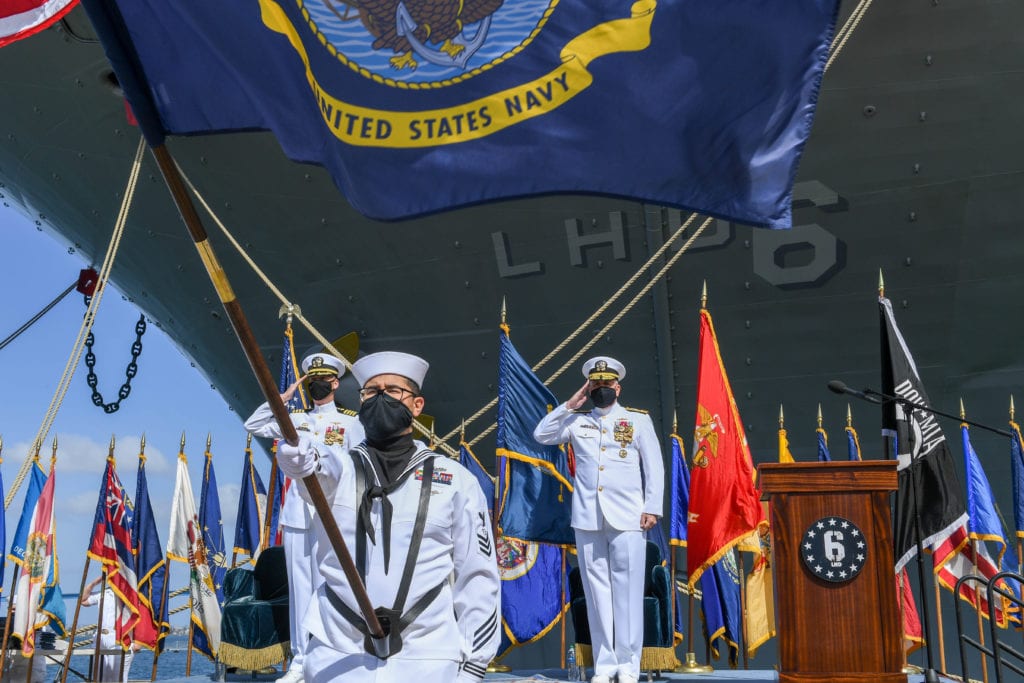
Rear Adm. Philip Sobeck, Commander, Expeditionary Strike Group Three, and Capt. G. S. Thoroman, commanding officer, amphibious assault ship USS Bonhomme Richard (LHD 6), salute the ensign for colors during a decommissioning ceremony for Bonhomme Richard at Naval Base San Diego April 14. The ceremony highlighted the history of the ship, its crew, and their legacy. Due to health and safety concerns related to COVID-19, the event was closed to the public. U.S. NAVY / Mass Communication Specialist 2nd Class Alex Millar

SAN DIEGO — The U.S. Navy held a decommissioning ceremony for amphibious assault ship USS Bonhomme Richard (LHD 6) at Naval Base San Diego April 14, the Naval Surface Force Public Affairs said in a release. 

The Bonhomme Richard had been severely damaged in a fire that began on July 12 while in port going through an extensive maintenance availability. The Navy determined the funds required to repair the 22-year-old ship or convert it to an alternate use would be better spent on other priorities.  
 
The ceremony highlighted the history of the ship, its crew, and their legacy. Bonhomme Richard was the third ship to bear the name. It was named in honor of John Paul Jones’ famous frigate, named the French equivalent for “Good man Richard.” This was in honor of Benjamin Franklin, the U.S. Ambassador to France at the time. The name Bonhomme Richard is derived from Franklin’s pen name. 
 
“[The original Bonhomme Richard] Sailors gave their all to prevail against seemingly impossible odds, and they won.” said Rear Adm. Philip Sobeck, commander, Expeditionary Strike Group 3. “They taught us that you don’t always save the ship, but you never stop fighting. The reputation of that fighting spirit began to proceed our Navy wherever we sailed and that same spirit persists today.” 
 
Like the previous five Wasp-class ships, Bonhomme Richard was designed to embark, deploy, and land elements of a Marine landing force in amphibious assault operations by helicopter, landing craft, or amphibious vehicles. 
 
Throughout its history, Bonhomme Richard projected power and maintained presence by serving as the cornerstone of Amphibious Ready Groups (ARG) or Expeditionary Strike Groups (ESG). It transported and landed elements of the Marine Expeditionary Unit (MEU) or Marine Expeditionary Brigade (MEB) with a combination of aircraft and landing craft. 
 
Not long after commissioning, the ship was called to action for Operation Stabilize in February 2000, providing peacekeeping and humanitarian operations of the coast of East Timor. This made Bonhomme Richard the first U.S. Navy ship to make a Western Pacific deployment in the 2000s. 
 
Bonhomme Richard’s following deployment put it in the spotlight of Operation Iraqi Freedom. The ship offloaded
more than a thousand Marines and their equipment from the 3rd Battalion, 1st Marines into Kuwait. After delivering attack and transport helicopters, as well as troops and vehicles, Bonhomme Richard took position just miles off the coast of Kuwait to launch AV-8B Harrier aircraft into Iraq. From the deck of Bonhomme Richard, Marine Attack Squadrons (VMA) 211 and 311 flew missions into Iraq and expended more than 175,000 pounds of ordnance and provided close air support to Marines on the ground. In total, the ship launched more than 800 sorties in support of Operation Iraqi Freedom. More than 500 of those were combat launches. 


Navy’s Triton UAV Performing Better than Expected, Admiral Says

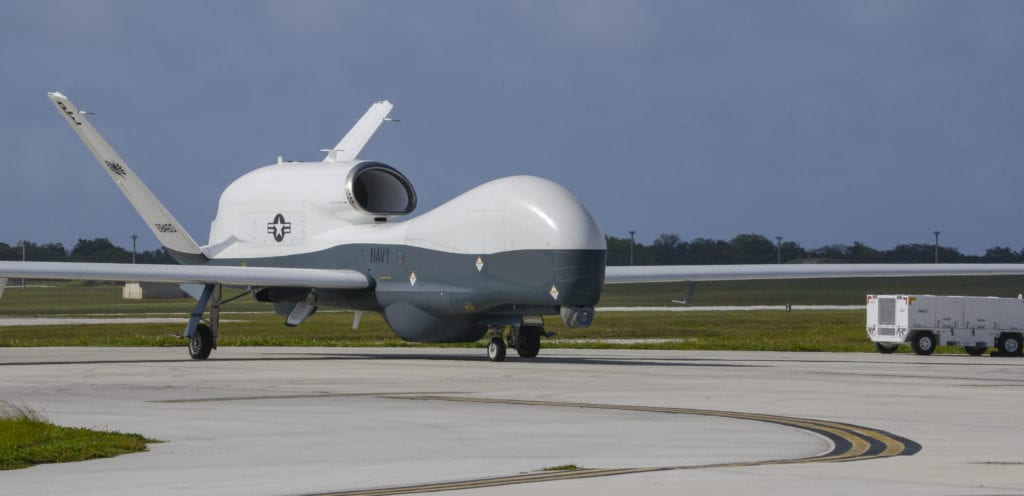
An MQ-4C Triton taxis at Andersen Air Force Base. U.S. AIR FORCE / Senior Airman Michael S. Murphy

ARLINGTON, Va. — The admiral in charge of developing the Navy’s unmanned aerial vehicles said the MQ-4C Triton UAV is doing well a more than a year into its first operational deployment to Guam, as the Navy looks to prove operations at other locations. 

Unmanned Patrol Squadron 19, the Navy’s first Triton squadron, deployed two MQ-4Cs to Guam in January 2020 to establish Early Operational Capability, providing surveillance for the U.S. 7th Fleet and also exercising the logistics train that will support future deployments. 

“Triton is doing very, very well,” said Rear Adm. Brian Corey, program executive officer for Unmanned and Strike Weapons, speaking April 14 at the Unmanned Systems-Defense webinar of the Association for Unmanned Vehicle Systems International. “In fact, it’s doing better than we expected in Guam.  

“We just finished a two-hour review with the Navy’s Air Boss, Vice Adm. [Kenneth] Whitesell, on how Triton is doing,” Corey said. “First off, anyone that has operated an air force knows that airplanes work and then they break. We have an air force of two [Tritons] and we put Triton out there [Guam] with Early Operational Capability, knowing that we didn’t have a fully fleshed-out set of depot-level maintenance and that sort of thing.   

“So, we have had some amazing success here over these last several months,” he said. “We got over there, we were able to fly, we were able to interact in the airspace until we could fly in the entire Pacific region, until we got cooperation from our partners.  

“We are delivering the products that Triton is intended to deliver to the 7th Fleet and to the [Pacific] Fleet commander, he said. “We’re able to do that in the number of missions a month that they are looking for.” 

Corey said the next operational step for the Triton is “to prove that we can operate somewhere other than Guam and we’ll be working on that through the fall while we finish up IFC 4 [Integrated Functional Capability 4], the follow-on capability for Triton.”


Former SECNAV Braithwaite Continues to Advocate for U.S. 1st Fleet for Indo-Pac

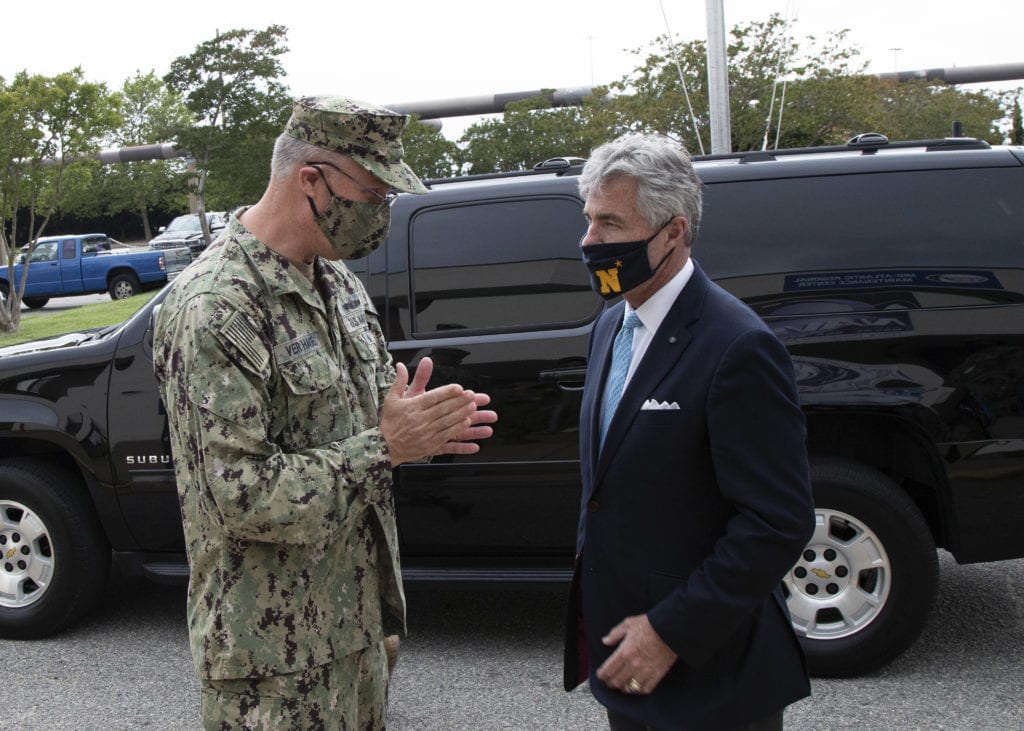
Commander, Navy Regional Maintenance Center Rear Adm. Eric Ver Hage greets then-Secretary of the Navy Kenneth Braithwaite as he arrives to tour the Mid-Atlantic Regional Maintenance Center Production Facility in 2020. U.S. NAVY / Hendrick L. Dickson

ARLINGTON, Va. — Three months after leaving office, the former secretary of the Navy is continuing to advocate for the re-establishment of a U.S 1st Fleet in the Southwestern Pacific and Indian Ocean and recommends the new fleet be expeditionary and sea-based. 

Kenneth J. Braithwaite, the 77th secretary of the Navy and a retired admiral in the Navy Reserve, discussed the concept with Brent Sadler of the Heritage Foundation in an April 14 webinar, hoping the idea “will continue to extraction.” 

While Navy Secretary, Braithwaite said he concluded that the expanse of the Western Pacific and Indian Oceans was too great for a single numbered fleet, the Japan-based U.S. 7th Fleet.  

“One numbered fleet can’t double down on all of the emerging challenges in that part of the world,” he said, noting a “real void” in the South China Sea and the Indian Ocean. 

He took note of the increased tensions with China in the South China Sea and the increased U.S. cooperation with India as demanding a more focused attention. 

“We needed more emphasis in places where we are being challenged the most,” Braithwaite said. “I thought about the structure of the Navy and what had worked historically for the Navy may not work in the future.”  

The actual intersections of the areas of responsibility (AORs) of the U.S. 3rd and 7th Fleets and the proposed U.S. 1st Fleet would be determined in the process, but Braithwaite said that “in the past most of our numbered fleets were at sea [and] operated aboard a flagship. I think that’s a concept we need to embrace again, especially as we enter this new period of great power competition. I think it need to be expeditionary and I think it needs to be sea-based.” 

Braithwaite pointed out that his announcement of the concept of the 1st Fleet came on the eve of a trip to the Western Pacific. 

“The idea seems to be one that many others, if they hadn’t been thinking specifically about the structure and the resurrection of the 1st Fleet, it was one that did meet with positive perspective once I had the opportunity to have those conversations with the [defense ministers] of those nations that would be impacted by it. That would include India, Singapore and Japan. All embraced the idea.” 

Braithwaite said the 1st Fleet could be equipped with guided-missile destroyers, guided-missile frigates, littoral combat ships and expeditionary fast transports, operating as a squadron based in Singapore. He also said Coast Guard cutters could add capability to the proposed fleet. 

“We do need a bigger Navy,” he said. “Ninety percent of trade moves across the sea lanes of the world, and as such, we need to make sure, as the predominant naval force, that they remain free.” 

The status of the 1st Fleet concept within the new presidential is not yet known. President Joseph Biden has yet to nominate a new secretary of the Navy. 

“One thing the Navy doesn’t do well is embrace change,” he said. I had to build up support from within, get people to think again about what might be possible. … It is a concept that has found some support.” 

“I hope that my successor embraces [the 1st Fleet concept] as well once he is announced and confirmed,” he said.    


US, Japan Navy Chiefs Discuss Maritime Security, Continued Cooperation

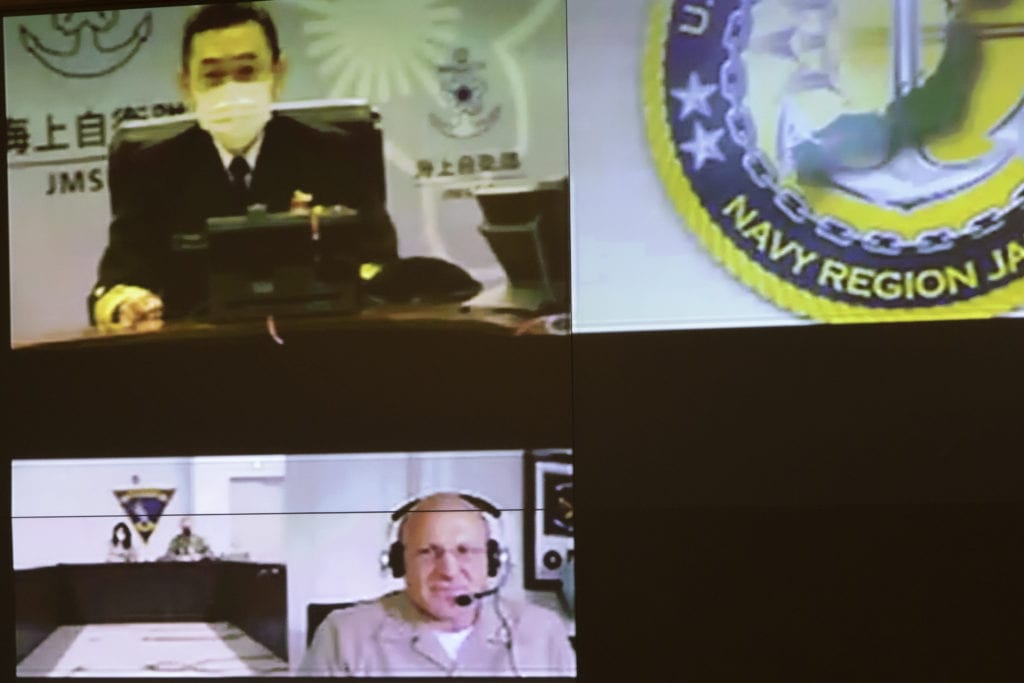
Chief of Naval Operations (CNO) Adm. Mike Gilday speaks with Japan Chief of Staff Adm. Hiroshi Yamamura during a video teleconference. The two leaders discussed recent operations across the globe and ways to strengthen the two navies’ interoperability. U.S. NAVY / Chief Mass Communication Specialist Nick Brown

WASHINGTON – U.S. Navy Chief of Naval Operations (CNO) Adm. Mike Gilday conducted a video teleconference with Japan Chief of Staff Adm. Hiroshi Yamamura April 13, Chief of Naval Operations Public Affairs said in a release. 

The two leaders discussed recent operations across the globe and ways to strengthen the two navies’ interoperability.  

“The alliance between the U.S. and Japan is a cornerstone of security and stability in a free and open Indo-Pacific,” said Gilday. “Adm. Yamamura and I remain committed to strengthening the bonds of our navies’ cooperation and friendship, and we stand ready, together.” 

Gilday also thanked Yamamura for the Japan Maritime Self-Defense Force’s (JMSDF) continued support of U.S. Navy forces in the region. 

“The discussion today with Adm. Gilday to promote naval cooperation and enhance alliance capabilities for deterrence and effective response is of great significance,” said Yamamura. “The JMSDF and the U.S. Navy will continue to closely work together for a free and open Indo-Pacific.” 

Japanese and U.S. Navy forces frequently operate together. The most recent was a joint participation in French-led exercise La Perouse in the Bay of Bengal. Other recent events include operations between JMSDF JS Kongo (DDG 173) and USS Blue Ridge (LCC 19), and the addition of a Japanese liaison officer at Logistics Group Western Pacific/Task Force 73, working directly with the staff’s replenishment officer to help enhance interchangeability and combined logistics operations.  


Rigorous Systems Engineering Vital for Ensuring USV Reliability, Admiral Says

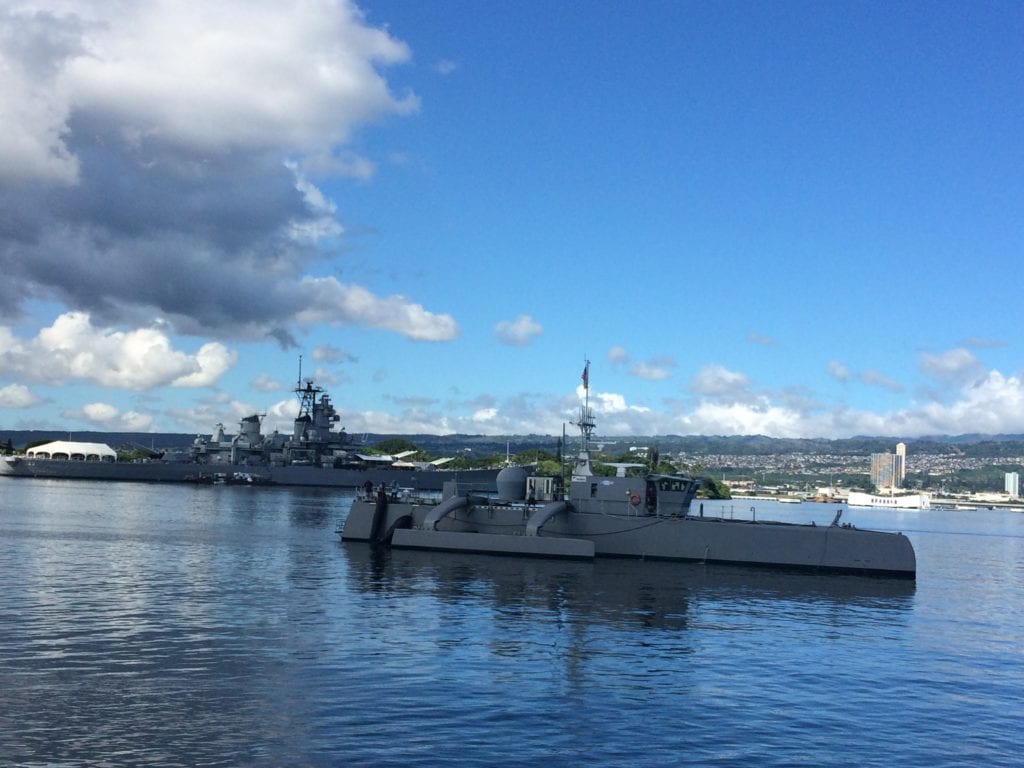
Sea Hunter, an entirely new class of unmanned sea surface vehicle developed in partnership between the Office of Naval Research (ONR) and the Defense Advanced Research Projects Agency (DARPA), recently completed an autonomous sail from San Diego to Hawaii and back — the first ship ever to do so autonomously. Sea Hunter is part of ONR’s Medium Displacement Unmanned Surface Vehicle (MDUSV) project, a forerunner of the Medium Unmanned Surface Vessel program. U.S. NAVY

ARLINGTON, VA. — The Navy plans to use extensive land-site testing for components and systems of the Medium Unmanned Surface Vessel (MUSV) in order to wring out risk in developing and integrating systems, the admiral in charge of developing unmanned vessels said. 

The Navy is committed to addressing the congressional concerns about, for example, the reliability of machinery of USVs, “to make sure that we go in this measured way of rigorous systems engineering approach,” said Rear Adm. Casey Moton, program executive officer, Unmanned and Small Combatants, speaking April 13 in an Unmanned Systems Defense webinar of the Association of Unmanned Vehicle Systems International.  

“Along with our prototypes that are out testing now, we’ve been maturing our execution plans,” Moton said, noting that the program engineers are “working on hybrid reliability and hull, mechanical and electrical [HM&E] equipment. 

“We are now going to do our testing at sea, but we are going to do land-based testing of our HM&E equipment for a Medium USV and we’re getting plans ready for Large USV and all of those aspects,” he said. 

Moton said a second pillar of the programs is for C4I [command, control, communications, computers and intelligence], “making sure that we carefully test the C4I system that is going to allow our unmanned vessels to be a part of this hybrid fleet. A lot of that is about [Project] Overmatch, but also be a principal component of Overmatch.” 

A third pillar of the unmanned systems focus is combat systems, adapting them for use on autonomous vessels. Weapons firing will always be performed by a human in the loop, he said. 

A fourth pillar, a common control system, is maturing and is to be something that can be designed once and then scaled up for fleet use. 

“Our initial prototypes were systems that we bought from industry,” Moton said. “We are all the time maturing that into a common system that is going to go in our program of record.” 

The fifth pillar is perception. “We have a very rigorous plan we’re already executing with our prototypes, testing out the perception systems … and the autonomy we need to do.” he said.    

The sixth pillar is prototyping.  

“We’re getting after the sea-based testing and land-based testing, that particularly has been a concern of Congress, and as we go forward, we’re going to articulate that more clearly, but, in each one of these, we’re going very carefully, doing the building blocks, in a good systems engineering manner,” he said.  

“We’re solving it [any given technological challenge] once. We’re going to scale it up like the framework [Unmanned Campaign Plan] talks about, [so that] we’re not having to learn the same lessons over and over again. Even though we have a set number of prototypes, we are developing systems that are going to apply across the fleet.”      


NAWCAD Team Brings First-of-its-Kind P-8A Decoy Prototype to Test

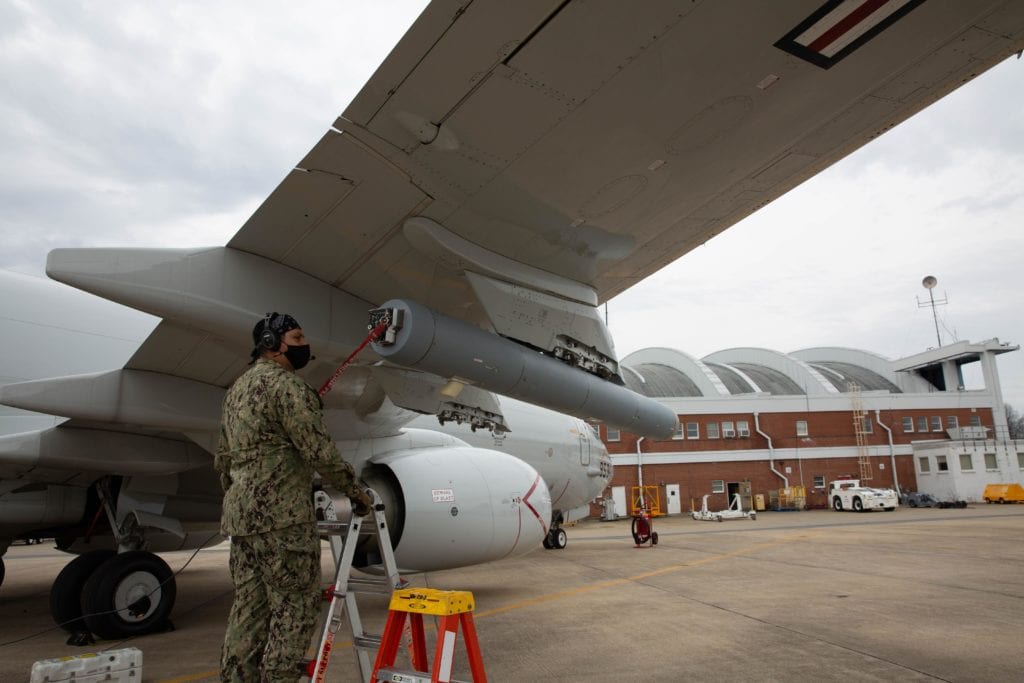
A member of Air Test and Evaluation Squadron (VX) 20 puts a pod-mounted radio frequency countermeasure system on a P-8A Poseidon, March 12. The pod successfully competed an air worthiness test at the Naval Air Warfare Center Aircraft Division (NAWCAD) Atlantic Test Ranges. U.S. NAVY

PATUXENT RIVER, Md. — An Air Test and Evaluation Squadron (VX) 20 P-8A Poseidon successfully completed an airworthiness test of a pod-mounted radio frequency countermeasure (RFCM) prototype at the Naval Air Warfare Center Aircraft Division (NAWCAD) Atlantic Test Ranges, March 12, the Naval Air Systems Command said in an April 9 release. 

The first-of-its-kind radio frequency defense decoy could allow the P-8A to thwart enemy radio frequency missile attacks. 

 “This has the potential to be a game-changer for protecting the warfighter,” said Capt. Eric Gardner, program manager for the Maritime Patrol and Reconnaissance Aircraft Program Office (PMA-290). “We continue to look for ways to enhance capabilities that allow the fleet to be successful.”  

Getting the pod into testing, in just over a year, took a complete team effort. 

Constantly looking for upgrades to the P-8A, PMA-290 set out to find a solution to a potential threat from surface-to-air radio frequency missiles. 

Outlining their needs and running lead on the project, PMA-290 brought in the Advanced Tactical Aircraft Protection Systems Program Office (PMA-272), the Rapid Prototyping, Experimentation & Demonstration (RPED) team, and the NAWCAD Aircraft Prototype Systems Division (APSD) to get the ball rolling. 

The RPED team supported APSD in designing the RFCM pod, which integrated the proven AN/ALE-55 Fiber Optic Towed Decoy from PMA-272 into a shell. The team developed the shell design based on the certified AGM-84 Harpoon missile, and then incorporated unique tracks and housing to fit and deploy the decoy. 

By employing the assistant secretary of the Navy for research, development and acquisition’s delegation of other transactions authority (OTA) for prototype projects, PMA-290 and NAWCAD were able to complete a one-of-a-kind contract with BAE Systems to develop the RFCM pod’s additional internal equipment suite. The OTA, a non-Federal Acquisition Regulation contracting approach, could potentially allow this critical self-protection technology to transition from prototype to fleet capability in much less time than a traditional effort. 

APSD and BAE leveraged the established AN/ALE-55 electrical design to accommodate the suite’s installation. 

“A lot of the challenge and effort went into designing, to our best estimates, for what BAE was expected to put in the pod,” said Michael Hansell, the leading APSD engineer for the project. “We had to adapt and redesign rapidly. We worked as fast as possible to support PMA-290 and RPED to make sure we could pivot and adjust to meet established timelines.” 

Constant tweaks were needed as the teams continued to hone in on a capable design. 

“Michael Hansell and his team’s flexibility and willingness to go above and beyond, to work through issues and prepare for BAE, was key in getting [the pod design and build] done in a timely manner,” said James Sherman, the APSD project lead. 

The Naval Innovative Science & Engineering (NISE) program funded the project, which provided the means to conceptualize, prototype, build, and test this new capability for the Navy. 

This funding accelerated the design and manufacturing cycle for the prototype to just under six months. The expedited developmental process supports the rapid prototyping of new and developing technologies and provides the resources to find solutions and incorporate improvements to fill capability gaps in the fleet faster. 

The teams were also able to use PMA-272’s F/A-18 lab equipment to speed up the timeline. 

All this teamwork culminated in the successful airworthiness test with VX-20. 

 “This shows that when we identify a need and work rapidly as a team we can bring a viable solution to test that has the ability to greatly impact the warfighter,” said Lt. Cmdr. Mike Marschall, PMA-290 weapons and rapid capabilities co-team lead. 

Following the test, the pod went to Naval Air Weapons Station China Lake, California, where it successfully completed effectiveness testing, March 21-26. It will now continue to be tested at a system level leading to platform integration through planned capability fielding phases. 


Admiral: Artificial Intelligence Will Be A Wingman, Not a Lead

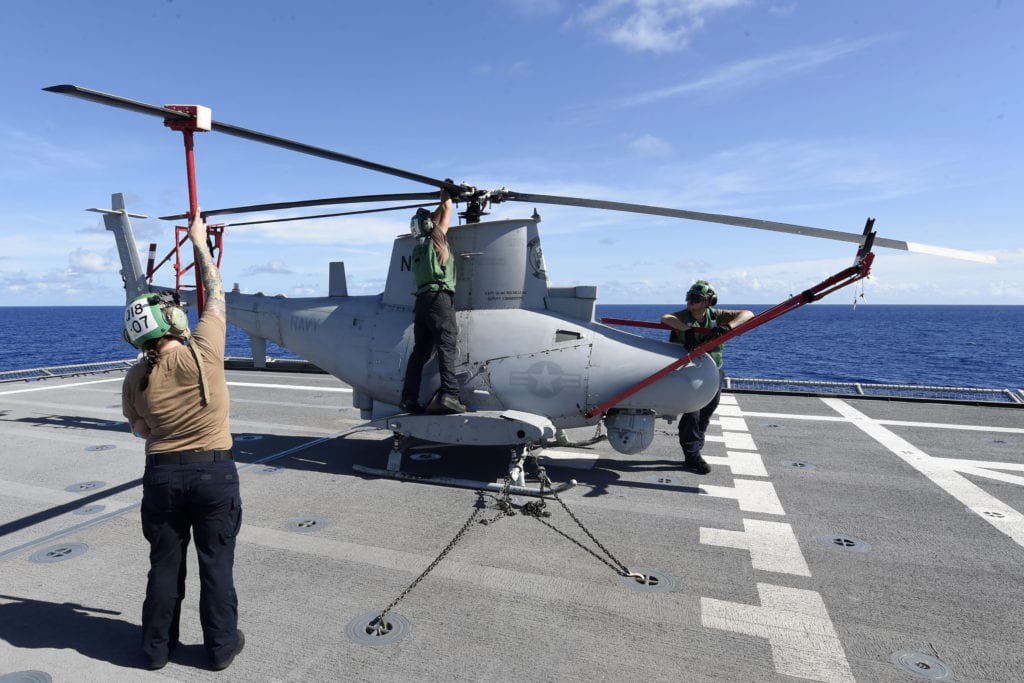
Sailors assigned to the “Wildcards” of Helicopter Sea Combat Squadron (HSC) 23 prepare an MQ-8B unmanned helicopter for routine flight operations on the flight deck of the Independence-variant littoral combat ship USS Gabrielle Giffords (LCS 10), July 7, 2020. U.S. NAVY / Mass Communication Specialist 2nd Class Brenton Poyser

ARLINGTON, Va. — The Navy is very much on board for integrating artificial intelligence (AI) and machine learning into its networks, but human decision makers must always be part of the decision process in warfighting, an admiral said. 

“From a warfighting perspective, artificial intelligence subsets would be enablers or augments to the human in the loop,” said Rear Adm. Paul Spedero Jr., director, Fleet Integrated Readiness and Analysis, U.S. Fleet Forces Command, speaking April 8 during a Navy League webinar sponsored by Deloitte. “That has always been our approach. I don’t see that changing. There are some things that can’t be replaced; the experience of a seasoned warfighter in the field being able to assess things that a machine — no matter how much we teach it — may never be able to pick up on. There’s always going to be a necessity for [experience-based decision making]. That necessity for war fighting will never go away — to have a human in the loop. 

“AI will be our wingmen,” he said. “It will not be the lead in a fight.”  

Spedero said in the world of data analysis, his current focus, there “certainly is a place for AI, particularly machine learning, as we try to get to that predictive and prescriptive level of data analytics. We’re entering into mathematical equations and regressions that just can’t be done manually and algorithms you want [machines] to learn with demonstrated performance and adjust the coefficients within that [so] you can tighten your tolerance and lower your upper and lower limits of variance get closer to each other.”   

The admiral, who is on the staff of Adm. Chris Grady, said his office is using data analytics “to identify barriers to force readiness,” to make sure the Optimized Fleet Readiness Plan is working correctly, continually assessing it “to get it right.” He is working to determine the metrics down to the unit level that will define what the readiness of the force is.   

Also speaking in the webinar was Dr. Patrick O’Connell, chief digital transformation officer for the Navy, who said as the Navy confronts the challenge of processing massive amounts of data to make decisions, transformation works best when it it is both pushed down from the top of the organization and pushed up from the bottom. Institutional culture is one of the hardest things to change when trying to implement a revolutionary transformation, he said.   


VTG Awarded Navy Contract to Modernize Combat Systems Across the Fleet

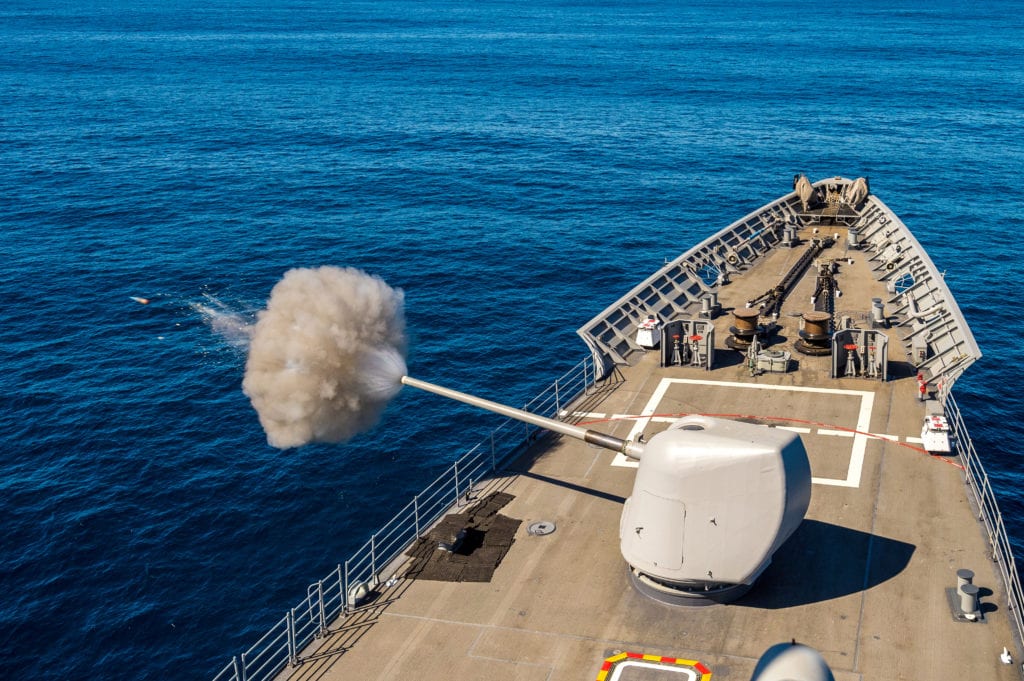
VTG has been awarded a $188 million Navy contract to help modernize combat systems across the fleet, including the Aegis Combat System, shown here in 2017 undergoing a test on the guided-missile cruiser USS Mobile Bay (CG 53). U.S NAVY Mass Communication Specialist 1st Class Chad M. Butler

CHANTILLY, Va. — VTG has been awarded the Technical Insertion 16 Sustainment, Installation, Procurement and Engineering Services contract by the Naval Surface Warfare Center Port Hueneme Division, a field activity of the Naval Sea Systems Command (NAVSEA), the company said in an April 7 release. The indefinite delivery, indefinite quantity contract has a potential value of $188 million and a five-year period of performance. 

“VTG has a proud legacy of closely collaborating with the Navy to engineer the next generation of sea power,” said John Hassoun, VTG president and chief executive officer. “The TI16 program enables VTG to build upon that legacy, expanding our technical expertise, strengthening our partnership with NSWC Port Hueneme and NAVSEA, and — most importantly — modernizing the fleet.” 

The TI16 program is the U.S. Navy’s enterprise approach to modernizing combat systems across the surface fleet, most notably the Aegis Combat System, and includes all cruisers and destroyers, aircraft carriers, and amphibious ships. TI16 also enables the Navy to introduce the latest commercial off-the-shelf technologies and open architecture designs into its combat systems. 

VTG will leverage its robust, full-lifecycle combat-systems engineering capabilities to fulfill TI16 program requirements. The company currently provides prime contract warfare, control, and C5I engineering services to the NAVSEA Naval Sea Systems Engineering Directorate and has over 50 years of experience installing and integrating advanced C5ISR systems aboard every existing U.S. Navy surface ship and submarine class. 

Most recently, VTG completed the successful installation and integration of the ODIN directed-energy laser weapon system aboard two Arleigh Burke-class destroyers. The company will also leverage its growing digital and software engineering capabilities. Earlier this month, VTG announced that it had begun work on a prime contract to develop the future state of the Navy Operational Architecture and to optimize fleet interoperability. The company also introduced the VTG Battle Lab, an industry-integrated model-based systems engineering environment for next-generation warfare systems.