USS Arleigh Burke Prepares for Homeport Shift to Rota
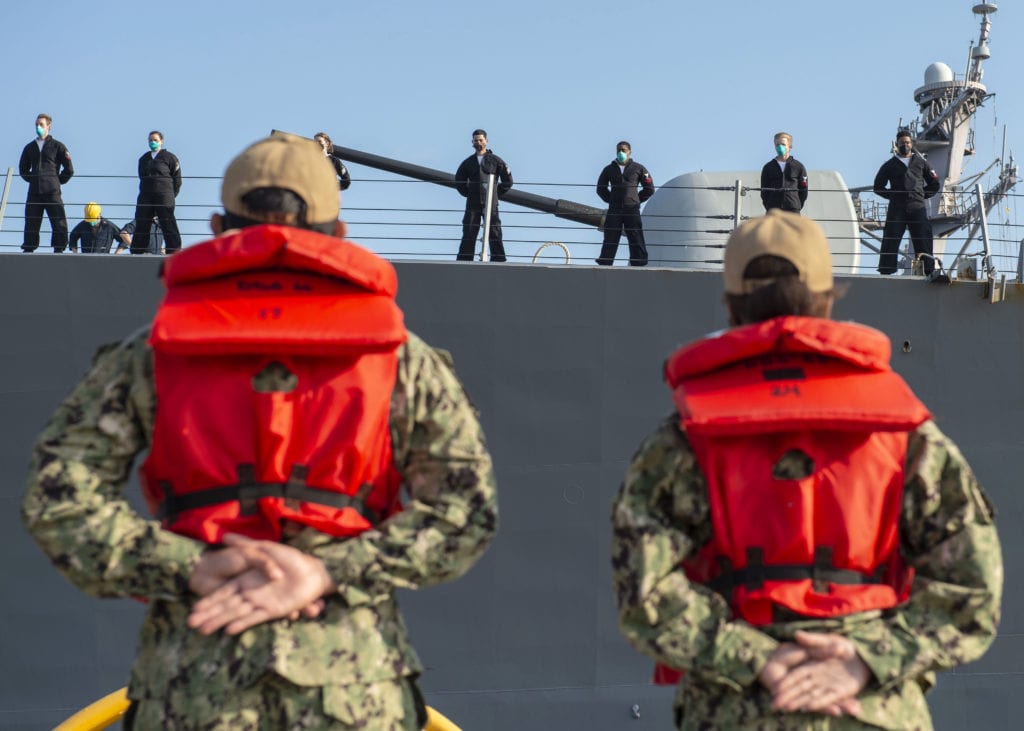
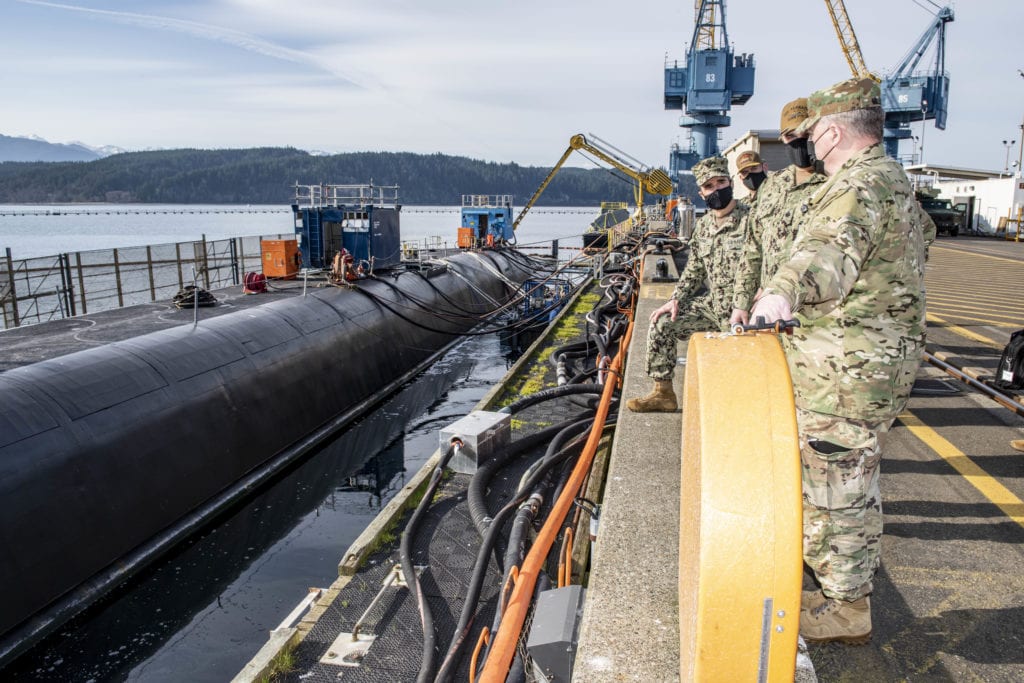
Sailors aboard the guided-missile destroyer USS Arleigh Burke (DDG 51) man the rails as they get underway from Naval Station Norfolk Mar. 26. Arleigh Burke will replace USS Donald Cook (DDG 75) as one of four forward deployed naval forces (FDNF) located in Spain. Arleigh Burke will join USS Ross (DDG 71), USS Roosevelt (DDG 80), and USS Porter (DDG 78) as the newest member of FDNF Rota. U.S. NAVY / Mass Communication Specialist 2nd Class Kris R. Lindstrom
NORFOLK, Va. – The guided-missile destroyer USS Arleigh Burke (DDG 51) departed from Naval Station Norfolk, Mar. 26, commencing the ship’s homeport shift to Rota, Spain, the U.S. 2nd Fleet Public Affairs said in a March 27 release.
Arleigh Burke will replace USS Donald Cook (DDG 75) as one of four forward-deployed naval forces (FDNF) located in Spain. The ship is named after U.S. Navy Admiral Arleigh Burke (1901-1996) who distinguished himself during World War II and the Korean War, and served as chief of naval operations during the Eisenhower and Kennedy administrations. Arleigh Burke, the lead ship of its class of Aegis-equipped guided-missile destroyers, was commissioned in Burke’s honor in 1991. The honor of naming a vessel after a living figure had only been bestowed four times since 1861.
“As one of the most technologically advanced destroyers in the entire United States Navy, we are excited to provide additional capability to 6th Fleet operations,” said Cmdr. Patrick Chapman, commanding officer, USS Arleigh Burke. “However, even stronger than the technology we have been outfitted with is the strength of our crew. Every day we train to be the most effective crew possible, one that is ready for sustained forward presence in the 6th Fleet Area of Operations.”
Arleigh Burke was the first U.S. Navy destroyer in the world equipped with the Aegis Weapons Systems and departs for 6th Fleet with the latest Aegis baseline nine upgrades. This higher capability ship is effective in high-threat areas conducting anti-air, antisubmarine, anti-surface, and strike operations.
To prepare for the homeport shift, Arleigh Burke took part in the Iwo Jima Amphibious Ready Group’s Composite Training Unit Exercise (COMPTUEX). COMPTUEX is designed to fully integrate a strike group as a cohesive, multi-mission fighting force, and test the group’s ability to carry out sustained combat operations from the sea. Upon completion of COMPTUEX, Arleigh Burke is certified and ready to execute the full spectrum of maritime operations in any theater.
“I am immensely proud of the perseverance of our crew, and of our families who have supported us through our arduous training cycle,” said Hospital Corpsman 1st Class Jason Waters. “Despite the COVID-19 pandemic, the crew was able to remain healthy and continue with one of the most rigorous schedules I have experienced in my career. Arleigh Burke’s crew and families have performed beyond all expectations. There is no doubt in my mind that we are ready for 6th Fleet.”
In addition to certifying in support of naval operations worldwide, Arleigh Burke Sailors and their families have been focused on preparing for the move to Spain. Arleigh Burke’s leadership team traveled from Norfolk to Naval Station Rota to participate in educational briefings and question-and-answer sessions concerning the homeport shift process and life in Spain. Naval Station Rota also supported virtual meetings for Norfolk crewmembers and their families to learn about the complicated homeport shift process.
The U.S. Navy will continue to meet combatant commander requirements around the world, but in order to do so, protective steps must be taken to ensure the health and safety of Sailors and their families from exposure to COVID-19.
Arleigh Burke will join USS Ross (DDG 71), USS Roosevelt (DDG 80), and USS Porter (DDG 78) as the newest member of FDNF Rota, replacing USS Donald Cook (DDG 75). Donald Cook will return to her new home at Naval Station Mayport, whereas she was previously homeported at Naval Station Norfolk.
USS Fort McHenry Decommissioning Ceremony Marks 33 Years of Service
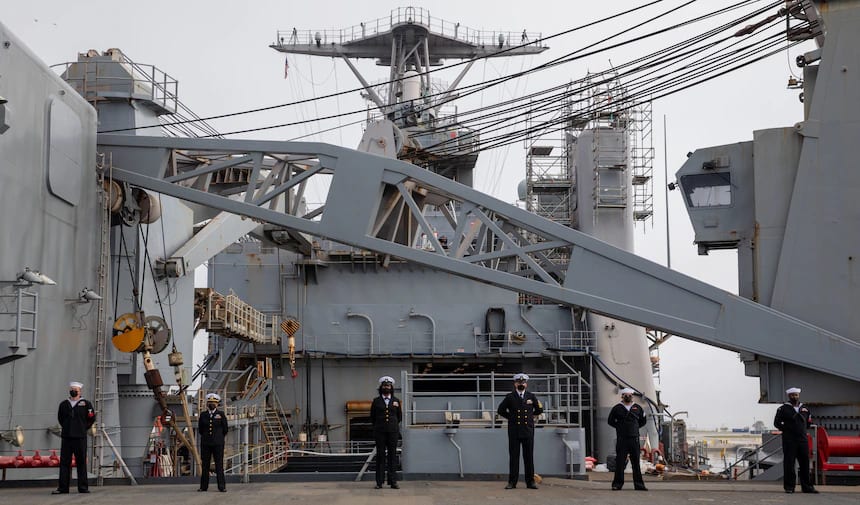
Sailors aboard the Whidbey Island-class dock landing ship USS Fort McHenry (LSD 43) main the rails during the decommissioning ceremony at Naval Station Mayport, March 27, 2021. U.S. NAVY / Mass Communication Specialist Seaman Aaron Lau
NORFOLK, Va. — The Whidbey Island-class dock landing ship USS Fort McHenry (LSD 43) held a small, COVID-conscious decommissioning ceremony at Naval Station Mayport, Florida, on March 27 before its inactivation, which will occur in April, the U.S. Fleet Forces Command said in a release.
Rear Adm. Robert Katz, commander, Expeditionary Strike Group (ESG) 2 presided over the ceremony, which included the remaining ship’s crew and several of its previous commanding officer, including the ship’s commissioning commanding officer, Capt. George “Dusty” Rhodes, who retired in 1999 and featured prominently in the ceremony.
“I am humbled to be with you on this bittersweet day as we gather here at Naval Station Mayport to commemorate this ship’s 33 years of commissioned service,” said Katz. “The history of Fort McHenry lies within each of the ship’s Sailors, and it is my hope this pride in their namesake guided all who crossed its quarterdeck and reported for duty.”
Fort McHenry was commissioned on Aug. 8, 1987, at Lockheed Shipyard in Seattle.
“During my 17 years of sea duty and four commands at sea, I have no doubt that the Fort McHenry crew was the best with whom I ever served,” said Rhodes. “They were always more than willing to do whatever it took to fulfill the mission. It is remarkable how closely they have stuck together over the past 34 years. I am proud to be among them.”
After arriving in San Diego on Sept. 30, 1987 the ship remained homeported there until 1995 when it replaced the USS San Bernardino (LST 1189) as a forward-deployed ship based in Sasebo, Japan.
Fort McHenry’s first deployment to the Western Pacific took place between June 16 and Dec. 16, 1988, as part of an Amphibious Ready Group (ARG) along with embarked Marines from the 15th Marine Expeditionary Unit. The other ships of the ARG were USS New Orleans (LPH 11), USS Mobile (LKA 115), USS Ogden (LPD 5) and USS Fresno (LST 1182). During the deployment Fort McHenry participated in exercises Cobra Gold-88, Valiant Usher 88-6 and Valiant Blitz 89-1 and the Sailors and Marines got some well-earned liberty during port visits to Okinawa, the Philippines, Thailand, Australia, South Korea and Pearl Harbor, Hawaii.
Over the next few decades, Fort McHenry would shift homeport, and deploy several more times, supporting Operations Desert Shield, Desert Storm, Vigilant Warrior and Enduring Freedom. Its crews would assist with humanitarian assistance efforts domestically, such as oil spill cleanup in the Prince William Sound and internationally, supporting disaster relief efforts in East Timor in 2001, the Philippines and Indonesia in 2004,
In November 1994, the ship received the first women to be permanently assigned to the crew — two lieutenants who reported aboard as the Supply Officer and Electrical Officer.
The ship’s final deployment was as part of the USS Kearsarge (LHD 3) Amphibious Ready Group and concluded in July 2019. While deployed to the Europe, Africa and the Middle East area of operations, Fort McHenry, along with embarked Marines from the 22nd Marine Expeditionary Unit, conducted maritime security operations and provided a forward naval presence in these critical regions.
During the deployment, Fort McHenry Sailors conducted a burial at sea for the remains of 34 veterans and two military spouses, a passing exercise with Egyptian navy ships in the Northern Arabian Sea and conducted more than 15 strait transits and port visits to Romania, the United Arab Emirates, Germany and Latvia. The ship capped off their deployment by participating in exercise Baltic Operations 2019.
“The last crew of Fort McHenry has performed with toughness and resiliency,” said Fabrizio, the ship’s final commanding officer. “Like their predecessors onboard, their efforts during the last phase of the ship’s active service and the inactivation process have been nothing short of amazing.”
The ship will be inactivated on April 16, 2021, and will be designated as Out of Commission in Reserve. That same day, it is scheduled to be towed by a seagoing tug to the Naval Inactive Ship Maintenance Facility in Philadelphia.
Navy Announces New Assignments for Flag Officers
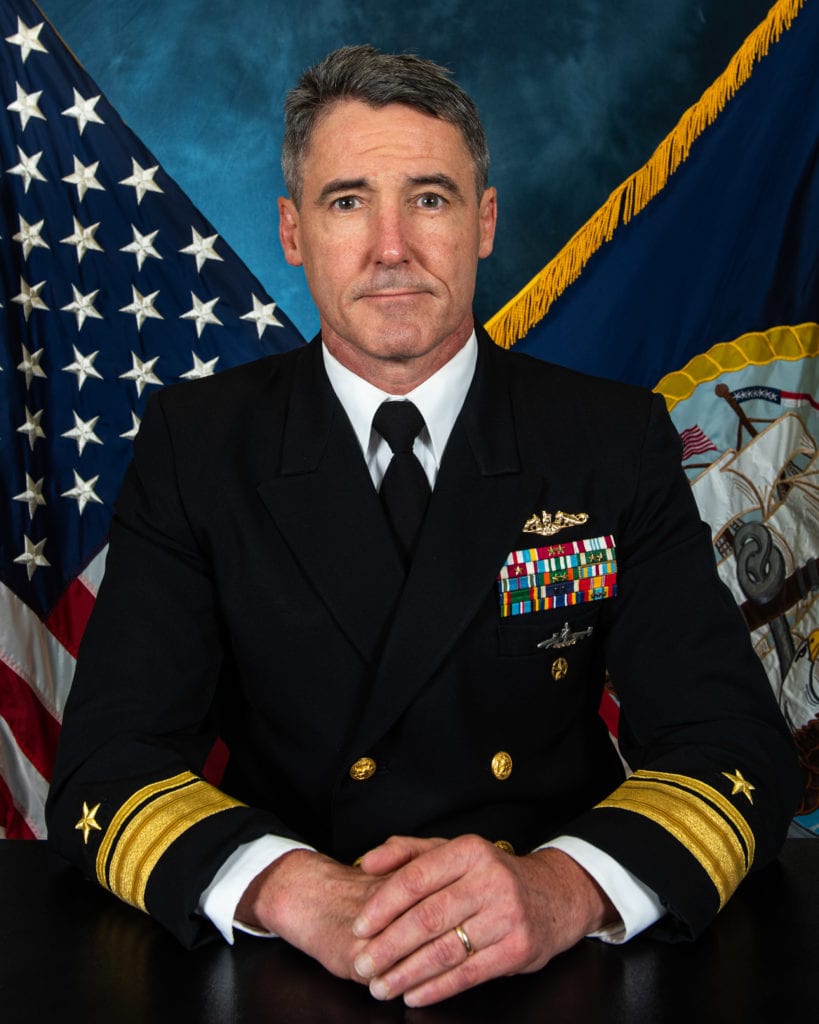
Rear Adm. Blake L. Converse, assigned as deputy commander, U.S. Pacific Fleet, one of a number of new assignments announced March 29. U.S. NAVY
ARLINGTON, Va. — The acting secretary of the Navy and chief of naval operations announced on March 29 the following assignments:
Rear Adm. Blake L. Converse will be assigned as deputy commander, U.S. Pacific Fleet, Pearl Harbor, Hawaii. Converse is currently serving as commander, Submarine Force, U.S. Pacific Fleet, Pearl Harbor, Hawaii.
Rear Adm. Frederick W. Kacher will be assigned as assistant deputy chief of naval operations for operations, plans and strategy, N3/N5B, Office of the Chief of Naval Operations, Washington, D.C. Kacher is currently serving as commander, Expeditionary Strike Group Seven; and commander, Amphibious Force, Seventh Fleet, Okinawa, Japan.
Rear Adm. (lower half) James A. Aiken, selected for promotion to rear admiral, will be assigned as commander, U.S. Naval Forces, Southern Command; and commander, U.S. Fourth Fleet, Jacksonville, Florida. Aiken is currently serving as commander, Carrier Strike Group Three, Bremerton, Washington.
Rear Adm. (lower half) Joseph D. Noble Jr., selected for promotion to rear admiral, will be assigned as director, logistics operations, Defense Logistics Agency; and commander, Joint Regional Combat Support, Fort Belvoir, Virginia. Noble is currently serving as commander, Naval Supply Systems Command Weapons Systems Support, Philadelphia, Pennsylvania.
Rear Adm. (lower half) Dean A. VanderLey, selected for promotion to rear admiral, will be assigned as commander, Naval Facilities Engineering Systems Command Pacific; and director, Fleet Civil Engineer, U.S. Pacific Fleet, with additional duties as fleet civil engineer, N46, U.S. Pacific Fleet, Pearl Harbor, Hawaii. VanderLey is currently serving as commander, Naval Facilities Engineering Systems Command Atlantic with additional duties as fleet civil engineer (N01CE), U.S. Fleet Forces Command, Norfolk, Virginia.
Rear Adm. (lower half) Peter G. Vasely, selected for promotion to rear admiral, will be assigned as commander, special operations, Special Operations Joint Task Force – Afghanistan, U.S. Special Operations Command, Kabul, Afghanistan. Vasely is currently serving as director for operations, Defense Intelligence Agency, Washington, D.C.
Rear Adm. (lower half) Stephen D. Barnett will be assigned as commander, Navy Region Southwest, San Diego, California. Barnett is currently serving as commander, Navy Region Northwest, Silverdale, Washington.
Rear Adm. (lower half) Michael A. Brookes will be assigned as director, J2, U.S. Southern Command, Doral, Florida. Brookes is currently serving as director of intelligence, J2, U.S. Strategic Command, Offutt Air Force Base, Nebraska.
Rear Adm. (lower half) Timothy J. Kott will be assigned as commander, Navy Region Hawaii; and commander, Naval Surface Group Middle Pacific, Pearl Harbor, Hawaii. Kott is currently serving as commander, Carrier Strike Group One, San Diego, California.
Rear Adm. (lower half) Carl A. Lahti will be assigned as commander, U.S. Naval Forces, Japan; and commander, Navy Region Japan, Yokosuka, Japan. Lahti is currently serving as commandant, Naval District Washington, Washington, D.C.
Rear Adm. (lower half) Matthew N. Ott III will be assigned deputy chief of staff for Fleet Ordnance and Supply; and fleet supply officer, N41, U.S. Fleet Forces Command, Norfolk, Virginia. Ott is currently serving as executive director, operational contract support, Office of the Under Secretary of Defense for Acquisition and Sustainment, Washington, D.C.
Rear Adm. (lower half) Milton J. Sands will be assigned as commander, Special Operations Command Africa, U.S. Special Operations Command, Stuttgart, Germany. Sands is currently serving as commander, Naval Service Training Command, Great Lakes, Illinois.
Capt. Christopher D. Alexander, selected for promotion to rear admiral (lower half), will be assigned as commander, Naval Surface and Mine Warfighting Development Center, San Diego, California. Alexander is currently serving as commanding officer, Surface Warfare Officer School Command, Newport, Rhode Island.
Capt. Sean R. Bailey, selected for promotion to rear admiral (lower half), will be assigned as deputy commander, U.S. Naval Forces, U.S. Central Command; and deputy commander, U.S. Fifth Fleet, Manama, Bahrain. Bailey is currently serving as chief of staff, Naval Air Force Atlantic, Norfolk, Virginia.
Capt. Thomas R. Buchanan, selected for promotion to rear admiral (lower half), will be assigned as deputy director for plans and policy, DJ5, U.S. Central Command, Tampa, Florida. Buchanan is currently serving as commandant of midshipman, U.S. Naval Academy, Annapolis, Maryland.
Capt. Christopher J. Cavanaugh, selected for promotion to rear admiral (lower half), will be assigned as director, Maritime Headquarters (N03), U.S. Pacific Fleet, Pearl Harbor, Hawaii. Cavanaugh is currently serving as director, submarine/nuclear power distribution (PERS-42), Navy Personnel Command, Millington, Tennessee.
Capt. Brad J. Collins, selected for promotion to rear admiral (lower half), will be assigned as commander, Navy Region Northwest, Silverdale, Washington. Collins is currently serving as chief of staff, Navy Installations Command, Washington, D.C.
Capt. Jennifer S. Couture, selected for promotion to rear admiral (lower half), will be assigned as commander, Naval Service Training Command, Great Lakes, Illinois. Couture is currently serving as assistant chief of staff, Naval Surface Force, Atlantic, Norfolk, Virginia.
Capt. William R. Daly, selected for promotion to rear admiral (lower half), will be assigned as deputy director for policy, plans, strategy, capabilities and resources, J-5/8, U.S. European Command, Stuttgart, Germany. Daly is currently serving as chief of staff, Naval Surface Forces, U.S. Pacific Fleet, San Diego, California.
Capt. Ronald A. Foy, selected for promotion to rear admiral (lower half), will be assigned as deputy director for global operations, J-3, Joint Staff, Washington, D.C. Foy is currently serving as deputy commander, Naval Special Warfare Command, Virginia Beach, Virginia.
Capt. Patrick J. Hannifin, selected for promotion to rear admiral (lower half), will be assigned as deputy director for political-military affairs (Asia), J5, Joint Staff, Washington, D.C. Hannifin is currently serving as director, aircraft carrier requirements, N98, Office of the Chief of Naval Operations, Washington, D.C.
Capt. Oliver T. Lewis, selected for promotion to rear admiral (lower half), will be assigned as deputy director for political-military affairs (Europe, NATO, Russia), J-5, Joint Staff, Washington, D.C. Lewis is currently serving as executive assistant to the chief of naval operations, Office of the Chief of Naval Operations, Washington, D.C.
Capt. Benjamin R. Nicholson, selected for promotion to rear admiral (lower half), will be assigned as U.S. Indo-Pacific Command representative, Guam, Commonwealth of the Northern Mariana Islands, Federated States of Micronesia, Republic of Palau; commander, U.S. Naval Forces, Marianas; and commander, Joint Region Marianas, Guam. Nicholson is currently serving as executive assistant to the vice chairman of the Joint Chiefs of Staff, Joint Staff, Washington, D.C.
Capt. Randall W. Peck, selected for promotion to rear admiral (lower half), will be assigned as president, Board of Inspection and Survey, Virginia Beach, Virginia. Peck is currently serving as commanding officer, USS John C. Stennis (CVN 74), Norfolk, Virginia.
Capt. Ronald J. Piret, selected for promotion to rear admiral (lower half), will be assigned as commander, Naval Meteorology and Oceanography Command, Stennis Space Center, Mississippi. Piret is currently serving as chief of staff, Naval Meteorology and Oceanography Command, Stennis Space Center, Mississippi.
Capt. Benjamin G. Reynolds, selected for promotion to rear admiral (lower half), will be assigned as director of Maritime Headquarters, U.S. Naval Forces Europe/Africa/Sixth Fleet, Naples, Italy. Reynolds is currently serving as director, Operations Division, Office of the Assistant Secretary of the Navy for Financial Management and Comptroller; and director, Operations Division, Fiscal Management Division, N821, Office of the Chief of Naval Operations, Washington, D.C.
Capt. Mark A. Schafer, selected for promotion to rear admiral (lower half), will be assigned as commander, Navy Region Korea; commander, U.S. Naval Forces Korea; and commander, Naval Component, U.S. Forces Korea, United Nations Command, Korea, Busan, Korea. Schafer is currently serving as deputy, staff operations and plans, Joint Special Operations Command, Tampa, Florida.
Navy Orders One Additional MQ-4C Triton UAV
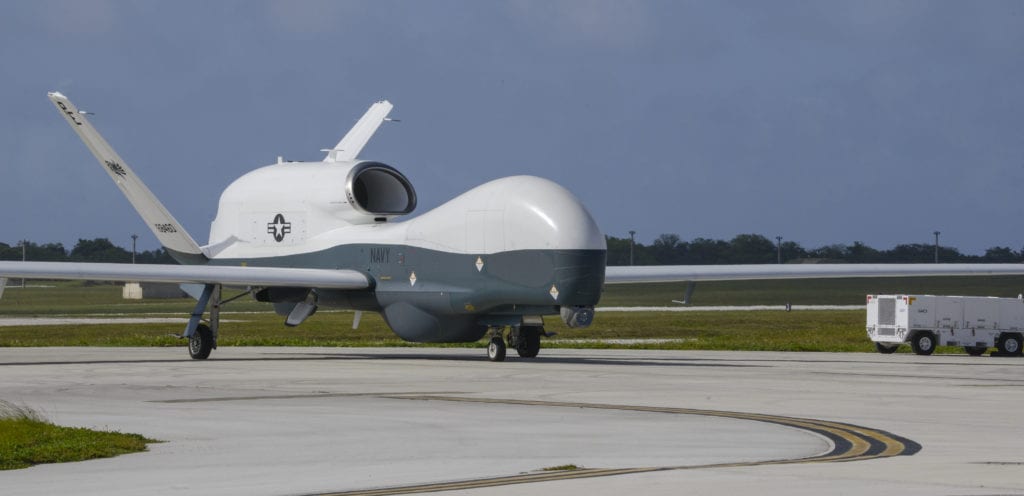
An MQ-4C Triton taxis at Andersen Air Force Base. U.S. AIR FORCE / Senior Airman Michael S. Murphy
ARLINGTON, Va. — The U.S. Navy has ordered an additional MQ-4C Triton high-altitude, long-endurance unmanned aerial vehicle.
The Naval Air Systems Command has awarded Northrop Grumman Systems Corp. a $98.9 million contract modification to a previously awarded, fixed-priced incentive contract “for one additional low-rate initial production Lot Five MQ-4C Triton unmanned aircraft system,” the Defense Department said in a March 26 contract announcement.
The order brings LRIP Lot 5 to three Tritons and, counting orders of the four previous LRIP lots, the Navy has ordered a total of 15. The service plans to procure a total of 68 production Tritons.
The Navy has taken delivery of three LRIP 1 Tritons so far, in addition to its two prototypes used for development and testing.
Last year, the Navy began an Early Operational Capability deployment of the Triton to Guam with a detachment of unmanned Patrol Squadron 19. The Navy plans to deploy three orbits overseas by 2025, and later establish two orbits from bases in the continental United States.
Work on the new order is expected to be completed in January 2025.
Navy Accepts Delivery of First Tomahawk Block 5 Missile
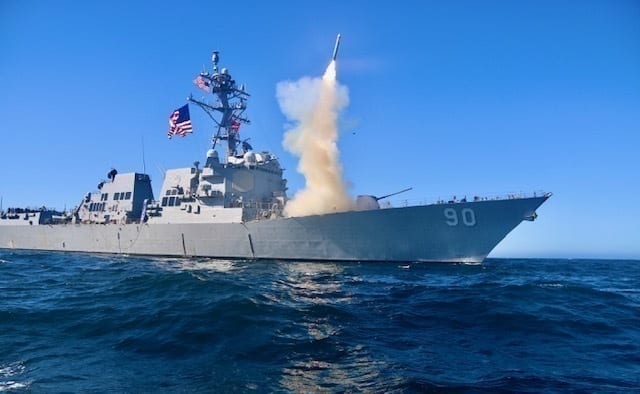
The guided-missile destroyer USS Chafee (DDG 90) launches a Block 5 Tomahawk, the weapon’s newest variant, during a three day missile exercise in November 2020. This event marked the first time a Block 5 Tomahawk missile was operationally tested, marking the Navy’s transition to a more advanced capability for the fleet. U.S. NAVY / Ens. Sean Ianno/Released
ARLINGTON, Va.—The U.S. Navy accepted its first Block 5 Tomahawk cruise missile from Raytheon Missiles & Defense in March 25 ceremonies at the company’s facility in Tucson, Arizona.
The missile is one of the first five Block 4 Tactical Tomahawk missiles that have been inducted into the recertification process, which takes missiles at the midlife 15-year mark for overhaul, modernization, and re-certification as Block 5 versions.
All Block 5s will feature a new data-link radio and antennas and navigation system. The Block 5a version also will feature a new seeker kit to hit moving targets and will be called the Maritime Strike Tomahawk (MST). The Block 5b version will feature the Joint Multi-Effects Warhead System.
Deliveries of all-new Block 5 missiles will begin in late 2021, said Kim Ernzen, vice president of Naval Power at Raytheon Missiles & Defense, speaking during the ceremonies on Zoom.
Chris Daily, program area director, Naval Air Missiles, for Raytheon Missiles & Defense, said the Tomahawk “remains our “nation’s weapon of choice” and that “delivery of the Block 5 is the next evolutionary step for the Tomahawk.”
Ernzen noted that the Tomahawk entered service in 1983 and first was used in combat in 1991 during the Persian Gulf War. More that 2,300 Tomahawks have been fired in combat and 500 have been used in test firings. More than 4,000 had been delivered by 2017.
She said the highly survivable Tomahawk is “counted on for its precision” and that Raytheon is “taking existing capability and making it even better.”
Capt. John Red, the Navy’s Tomahawk Weapon System program manager, also speaking in the event, noted that each Tomahawk now only needs to return to Raytheon’s factory only once in the lifecycle of the missile, 15 years after production, for another 15-year life extension.
During the ceremonies, Ernzen and Red signed symbolically the DD250 form signifying the official transfer of the first Block 5 missile.
The Navy ultimately will field only the Block 5 version once the remaining Block 4 Tactical Tomahawks have been converted to Block 5s. The earlier Block 3 versions, which first entered service in 1994, are being withdrawn from use and are being demilitarized.
Navy T-4C Jet Trainer Crashes in Texas; 2 Ejections
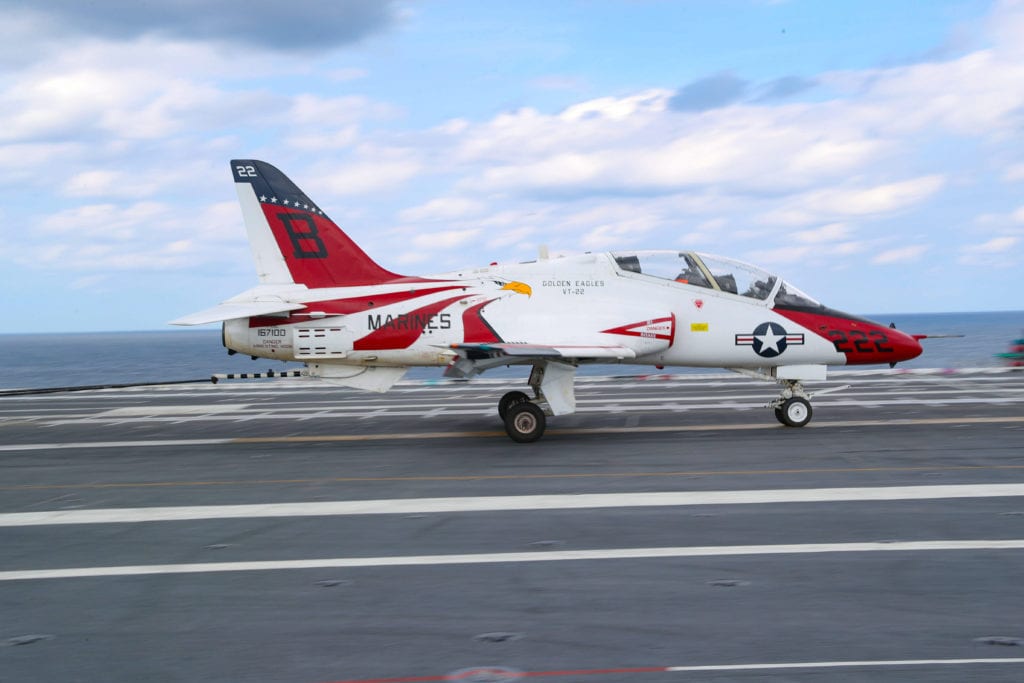
A T-45C Goshawk, reported to be the same one that crashed, lands on the flight deck of the aircraft carrier USS Gerald R. Ford (CVN 78), March 15, 2021. U.S. NAVY / Chief Mass Communication Specialist RJ Stratchko
ARLINGTON, Va. — A U.S. Navy training jet crashed March 24 in Texas, but both crew members ejected safely.
The T-45C Goshawk crashed at approximately 2 p.m. Central time three miles northeast of Nava/ Outlying Field Orange Cove, Texas, the Navy said in a release.
“The two occupants, an instructor, and a student, safely ejected from the aircraft and reported minor injuries,” the release said. “They were transported to a local medical treatment facility for evaluation. Navy and local emergency services responded to the scene and extinguished a small brush fire. Navy personnel are on scene and are cooperating with local authorities.
The aircraft was assigned to Training Air Wing Two at Naval Air Station Kingsville, Texas, was being flown by the Golden Eagles of Training Squadron 22.
The incident is under investigation.
China is the Biggest Challenge and Taiwan the Biggest Risk: INDO-PACOM Nominee Says
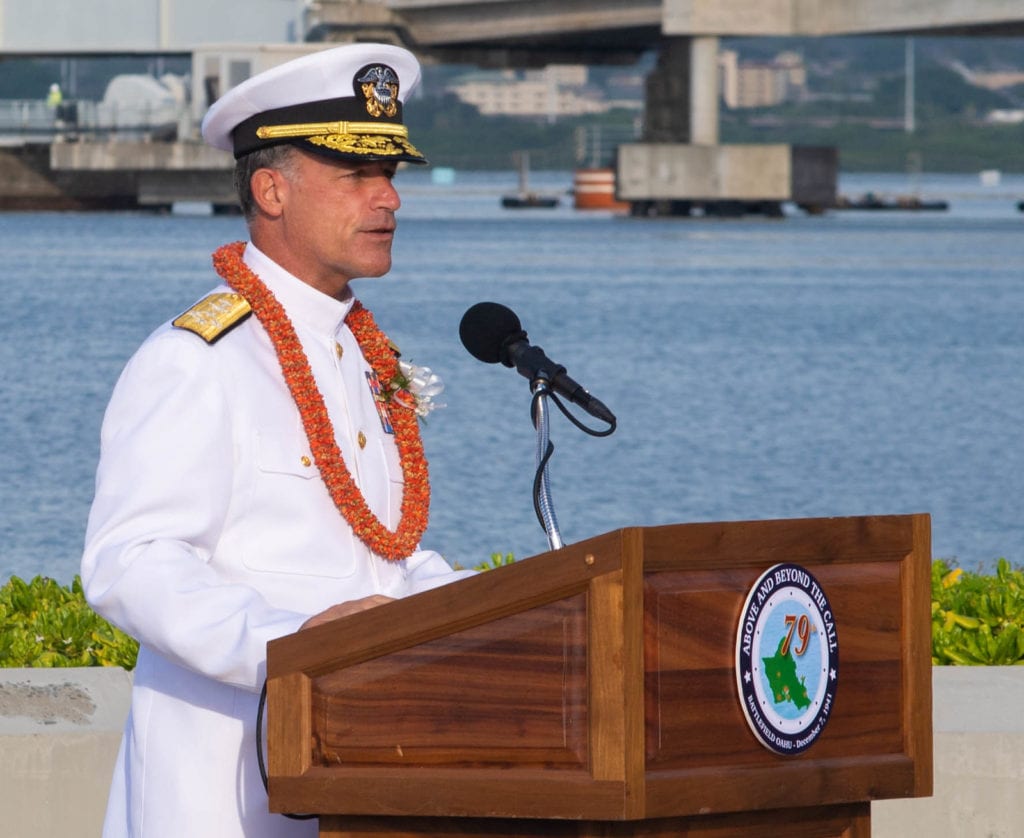
Adm. John Aquilino, Commander, U.S. Pacific Fleet, speaks during the 79th Pearl Harbor Remembrance Day ceremony at the Pearl Harbor National Memorial in Honolulu, Hawaii, in 2020.Aquilino, nominated to be the next commander of Indo-Pacific Command, testified before the Senate Armed Services Committee March 23, 2021. U.S. NAVY / Mass Communication Specialist 2nd Class Jessica O. Blackwell
ARLINGTON, Va. — The Navy admiral nominated to lead U.S. Indo-Pacific Command says his immediate challenge is to deter China from seizing Taiwan, while assuring regional allies and partners that the United States is serious about opposing Beijing’s belligerence.
“This problem is much closer to us than most think,” Adm. John C. Aquilino, currently commander of the U.S. Pacific Fleet, told the Senate Armed Services Committee at his confirmation hearing March 23.
“The Indo-Pacific is the most consequential reason for America’s future and remains the priority theater for the United States,” he said, adding that the region includes four of the five security challenges for the U.S. military: China, Russia, North Korea and violent extremist organizations.
But “of all the threats we face, [Defense Secretary Lloyd J.] Austin was very clear when he stated, ‘China is our pacing threat,’” Aquilino added. The admiral said he agreed with the assessment of the departing INDO-PACOM commander, Adm. Philip S. Davidson, that the most dangerous concern with China was if it used “military force against Taiwan.” To deter that, forward deployed U.S. forces rely on the support of “our allies and partners –those nations with common values,” he said.
While the threat of a Chinese attack is not immediate, Aquilino said it was likely sooner than the six years Davidson projected in testimony before the committee March 9. If China seized Taiwan and subsequently based ships and aircraft there, “it would certainly extend their reach. It would extend the contested environment. It would threaten our allies and partners, think [of] the Philippines,” he said.
Aquilino said conducting exercises with allies and partner nations, like Japan, Korea and India would complement the administration’s focus on deterrence through diplomatic, development and economic means. He also said the Pacific Deterrence Initiative (PDI) a multibillion dollar fund created by Congress last year, “is the foundational approach” to advancing capabilities and capacity in lethality, force design and logistics to help strengthen partnerships for an integrated joint force.
Reclaiming Taiwan, which broke away from the People’s Republic of China in 1949, is important “because the rejuvenation of the Chinese Communist Party is at stake,” the admiral said, adding “They view it as their No. 1 priority.” The fate of the island nation of 23 million, located about 100 miles from China, puts U.S. credibility on the line with regional partners. “The status of the United States as a partner with our allies and partners also is at stake should we have a conflict in Taiwan,” Aquilino said.
“The United States maintains its longstanding commitments as outlined in the Three Communiqués, the Taiwan Relations Act, and the Six Assurances. We will continue to assist Taiwan in maintaining a sufficient self-defense capability,” Aquino said in written answers to questions previously submitted by the committee.
A 1984 U.S. Naval Academy graduate and naval aviator since 1986, Aquilino was nominated in December 2020 by then-President Trump for the INDO-PACOM post but was not confirmed by the Senate before the change in administrations. He was nominated again by President Joe Biden, Austin announced March 5.
A graduate of the Navy Fighter Weapons School (TOPGUN), Aquilino made several extended deployments in support of operations Deny Flight, Deliberate Force, Southern Watch, Noble Eagle, Enduring Freedom and Iraqi Freedom. His flag assignments have included deputy director, Joint Force Coordinator on the Joint Staff; commander, CSG-2, director of Maritime Operations, U.S. Pacific Fleet and commander, U.S. Naval Forces Central Command, U.S. 5th Fleet, Combined Maritime Forces.
Navy Orders 10th Block V Virginia-Class Attack Submarine
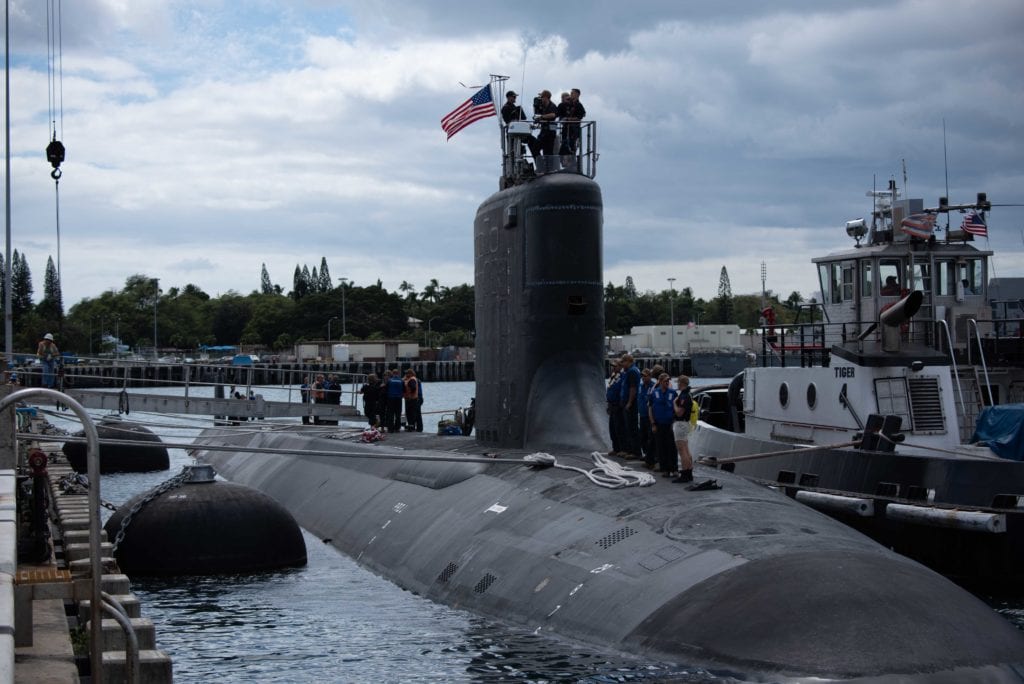
The U.S. Navy has exercised a contract option for a tenth Block V version of the Virginia-class submarine to join its other Virginia-class subs, including the USS Illinois, shown here preparing to leave Pearl Harbor in 2019. U.S. NAVY / Mass Communication Specialist 1st Class Daniel Hinton
ARLINGTON, Va. — The Navy has exercised a contract option and ordered a tenth Block V version of the Virginia-class nuclear-powered attack submarine (SSN).
The Naval Sea Systems Command awarded General Dynamics Electric Boat a $2.4 billion fixed-price incentive modification to a contract for the SSN, according to a March 19 Defense Department contract announcement. Electric Boat subcontracts Huntington Ingalls Newport News Shipbuilding for part of the work on the program.
This 460-foot, 10,200-ton Block V SSN, like seven of its nine sister Block Vs, will include a Virginia Payload Module, an 84-foot-long section of launch tubes which can fire 28 Tomahawk cruise missiles, in addition to the 12 launch tubes in the submarine’s bow, giving the submarine a payload of 40 Tomahawks.
Work on this contract option is expected to be completed by 2030. This SSN will bring to 38 the number of Virginia-class SSNs in the fleet.
CNO Visits Fincantieri Marinette Marine Shipyard
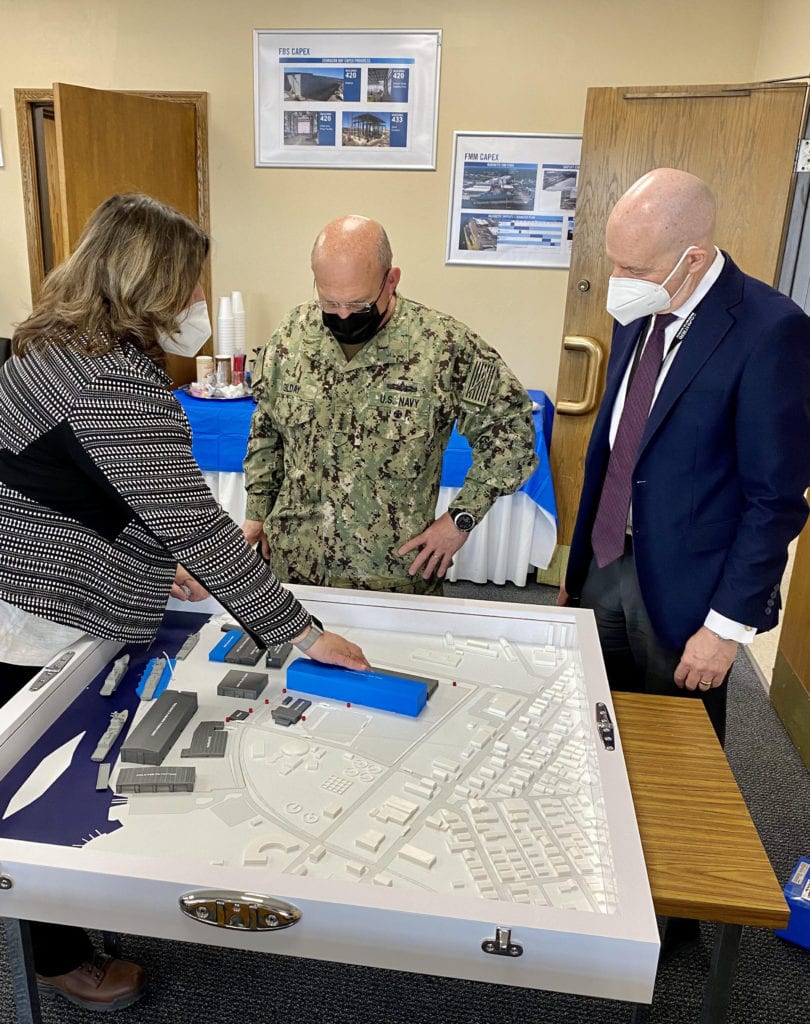
Chief of Naval Operations (CNO) Adm. Mike Gilday tours Fincantieri Marinettte Marine Shipyard with leadership from the shipyard. During the visit, CNO also received briefs on a range of topics, including the Navy’s new Constellation-class Guided-Missile Frigate and Large Unmanned Surface Vehicle development. U.S. NAVY / Cmdr. Nate Christensen
WASHINGTON — Chief of Naval Operations (CNO) Adm. Mike Gilday traveled to Marinette, Wisconsin on March 23, to visit Fincantieri Marinette Marine shipyard, the Navy said in a release.
During the visit, CNO toured the facility and received briefs on a range of topics, including the Navy’s new Constellation-class Guided-Missile Frigate and Large Unmanned Surface Vehicle development.
“One of the most important reasons I am here in Wisconsin is to remind the thousands of men and women working in and around the shipyard that their work is important to our Navy and to our nation” said Gilday. “While Wisconsin seems far from our oceans, its connection to the U.S. Navy remains strong.”
The CNO said an important reason for his visit was to better understand design efforts of the Constellation-class frigates.
“This class of ships is going to be a workhorse in the fleet, and I don’t want anyone to forget the fact that our Sailors are depending on the quality of work done here,” said Gilday. “The ships need to leave Marinette ready for the fight, and that’s what we intend to do. I’m excited to see the FFG ships come to life over the months and years come.”
Dario Deste, president and CEO of Fincantieri Marine Group, echoed similar sentiments.
“We know that the Constellation-class frigates are going to be important for tomorrow’s Navy,” said Deste. “It’s great to have the CNO here in Wisconsin, walking the shipyard, meeting our team and seeing the pride and commitment we have in our work.”
During the visit, the CNO had the chance to meet with shipyard workers and said he was impressed by the innovation and dedication shipyard workers have shown to keeping production lines on track, especially amidst the pandemic.
“To the entire workforce here in Marinette who are responsible for helping us generate warfighting readiness, you have my profound thanks,” said Gilday. “Your innovation and dedication to keeping production lines on track is greatly appreciated, as is your commitment to readiness, which is critical for us to be able to protect our nation.”
Low-Yield Warhead, Nuclear Sea-Based Cruise Missile Will Survive, HASC Ranking Member Says
Chairman of the Joint Chiefs of Staff Gen. Mark A. Milley speaks to Cmdr. Brian Murphy, commanding officer of the Ohio-class ballistic-missile submarine USS Alabama (SSBN 731) Blue crew, March 3. Milley toured Alabama, visited with Sailors, and toured Trident Training Facility Bangor and Strategic Weapons Facility Pacific while visiting strategic-deterrent units in the Pacific Northwest. U.S. Navy/ Mass Communication Specialist 1st Class Andrea Perez
ARLINGTON, Va. — Two naval nuclear weapons deployed or planned are likely to survive cancellation efforts from Democratic members Congress, said the new ranking member of the House Armed Services Committee (HASC).
Mike Rogers, R-Alabama, speaking March 22 during a webinar of the Defense Writers Group, was asked by Seapower about the future of the W76-4 low-yield warhead deployed in 2019 on some Trident submarine-launched ballistic missiles — carried on Ohio-class ballistic-missile submarines — and the planned nuclear-armed sea-launched cruise missile (SLCM) called for in the Defense Department’s 2018 Nuclear Posture Review.
The NPR said that “a low-yield SLBM warhead and SLCM will not require or rely on host nation support to provide deterrent effect. They will provide additional diversity in platforms, range, and survivability, and a valuable hedge against future nuclear ‘break out’ scenarios.”
The review said the “SLCM will provide a needed non-strategic regional presence, an assured response capability. It also will provide an arms-control-compliant response to Russia’s noncompliance with the Intermediate-range Nuclear Forces Treaty, its nonstrategic nuclear arsenal, and its other destabilizing behaviors.”
The new HASC chairman, Rep. Adam Smith, D-Washington, has stated his opposition to the low-yield warhead and SLCM as being destabilizing to the nuclear balance.
“We’ll hold the line,” Rogers said, speaking of the congressional Republicans. “I’m sure there will be a big debate. We’ve got some people [opponents of weapons], as long as there are TV cameras in the room, they’re going to run their mouth, but I think we’ll have the votes.”