U.S. Navy Recovers MH-60S Helicopter From Record Depth
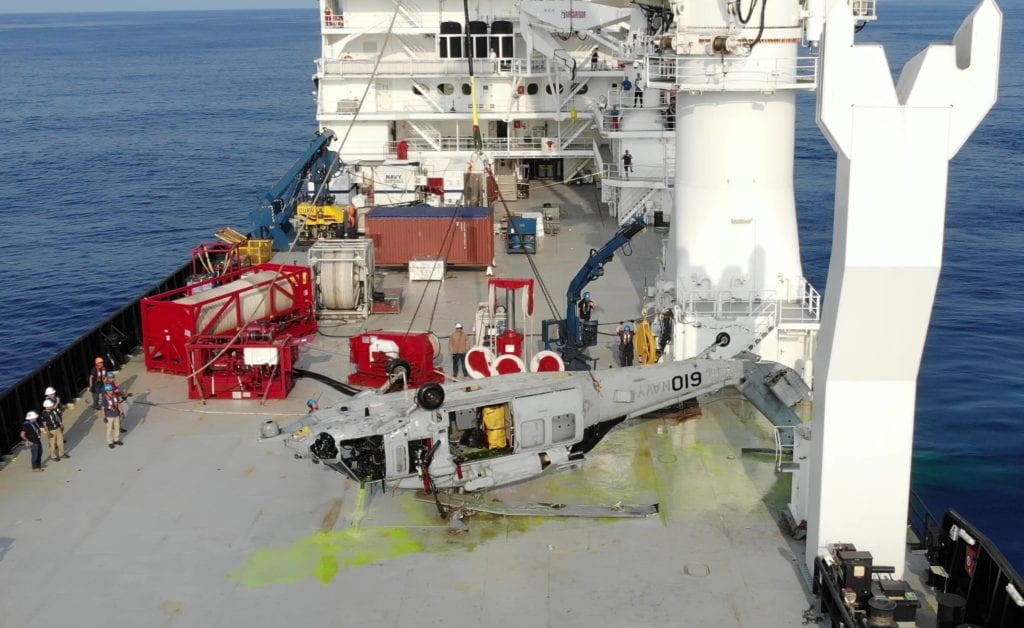
An MH-60S on deck of contracted salvage vessel off the coast of Yokosuka, Japan on March 18, 2021, having just been pulled from the depth of 19,075 feet by NAVSEA Supervisor of Salvage and Diving, (SUPSALV) at the request of the Navy Safety Center to facilitate accident investigation. NAVAL SEA SYSTEMS COMMAND

NORTH PACIFIC — The Naval Sea Systems Command’s (NAVSEA’s) Supervisor of Salvage and Diving (SUPSALV) recovered a downed Navy MH-60S helicopter from a depth of 19,075 feet off the coast of Okinawa, Japan, March 18, the Naval Sea Systems Command Office of Corporate Communication said in a March 22 release. 

The helicopter, a twin-engine Sikorsky Seahawk, crashed into the Pacific Ocean last year while operating from the amphibious command ship USS Blue Ridge (LCC-19). The air crew was able to escape the MH-60S before it sank, and no lives were lost in the accident. 

Responding to a U.S. Pacific Command Fleet request, SUPSALV located and documented the wreckage using side-scan sonar and photographs of the helicopter as it lay on the ocean floor during North Pacific operations last spring.  

SUPSALV returned to the site this month at the request of the Navy Safety Center with CURV 21, a deepwater remotely operated vehicle with the ability to meet deep ocean salvage requirements to a maximum depth of 20,000 feet. 

The SUPSALV team met the contracted salvage vessel in Guam, completed mobilization of CURV and its deep-lift take-up reel, and departed for the five-day transit. Arriving on the crash site March17, the team began recovery operations. Pulled from its depth of 19,075 feet below sea level, the MH-60S’s recovery broke SUPSALV’s own world depth record for an aircraft recovery.  

The salvage vessel will proceed to Fleet Activities Yokosuka where the MH-60S will be offloaded for transport back to the United States. 

“As a whole, this operation was fast-paced and entirely successful,” said Bryan Blake, SUPSALV’s Deep Ocean program manager. “Our efforts validated the Navy’s deep ocean search-and-recovery requirements. The capability to recover the airframe and make it available to determine the cause of the accident is a huge plus helping to ensure Naval Aviation safety.” 

The Navy’s Supervisor of Salvage and Diving provides technical, operational and emergency support to the Navy, Department of Defense and other federal agencies in the ocean engineering disciplines of marine salvage, towing, pollution control and abatement, diving and diving system safety and certification, diving and salvage equipment procurement, and underwater ship husbandry. 



Congressman Supports Defense Digital Service Academy for Cyber, AI

Rep. Mike Rogers foresees a military academy that focuses on cybersecurity, artificial intelligence and other high-tech skills. NAVAL INFORMATION WARFARE CENTER PACIFIC

ARLINGTON, Va. — The ranking member of the House Armed Services Committee supports establishment of a new training institution for cyberwarfare and artificial intelligence (AI) to help the nation to meet cyber threats. 

Rep. Mike Rogers, R-Alabama, speaking March 22 in a webinar of the Defense Writers Group, said one of his top priorities is developing the nation’s defense work force in cyber and artificial intelligence capabilities. 

“We just had a cool subcommittee hearing a little over a week ago that recommended a digital service academy, much like the military academies now, but we’d train cyber and AI and other IT [information technology] skills,” Rogers said, noting that the academy could offer qualification “anywhere from a certificate level to an associate degree, bachelor’s degree, to a doctoral degree.” 

Rogers said the concept would recruit students that would attend at no charge and would have an obligation to work five years for the government.  

“That’s something I’m really focused on, because cyber is an emerging threat that we’ve go to recognize we’re not prepared to meet,” he said. 


Boeing Inducts First EA-18G Growler for U.S. Navy Modification Program

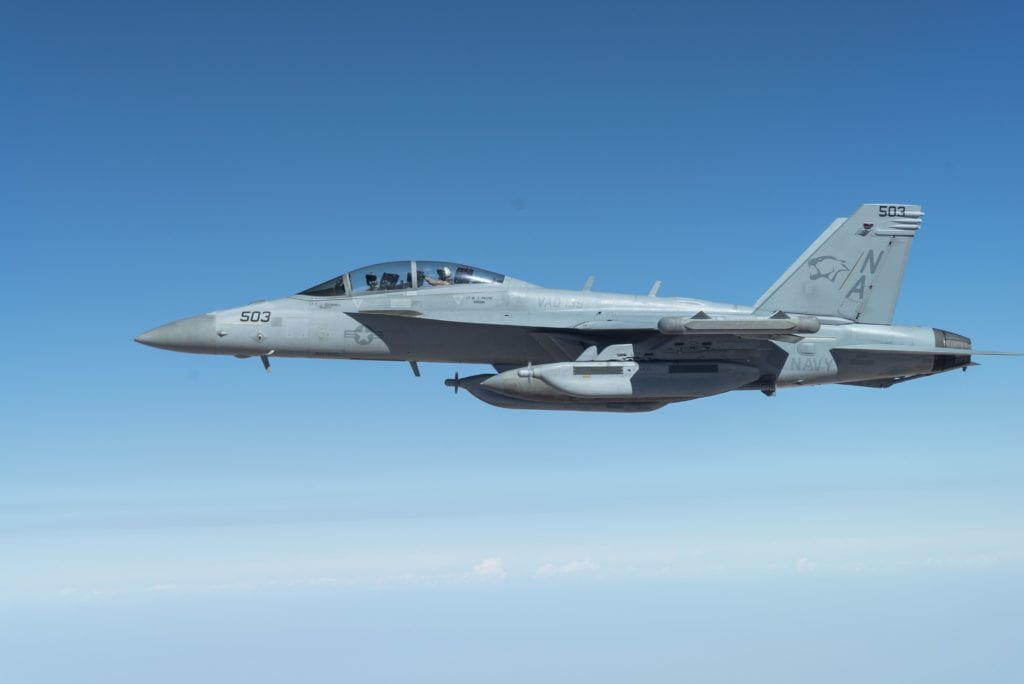
A U.S. Navy EA-18G Growler assigned to Electronic Attack Squadron (VAQ) 139, deployed aboard the aircraft carrier USS Nimitz (CVN 68), flies over the U.S. Central Command area of responsibility, Sept. 30, 2020. VAQ-139 is assigned to Carrier Air Wing 17, deployed aboard the aircraft carrier USS Nimitz (CVN 68), flagship of Nimitz Carrier Strike Group. The EA-18G has an array of sensors and weapons that provide the warfighter with the ability to counter current and emerging threats. (U.S. Air Force photo by Staff Sgt. James Merriman)
A U.S. Navy EA-18G Growler assigned to Electronic Attack Squadron (VAQ) 139, deployed aboard the aircraft carrier USS Nimitz (CVN 68), flies over the U.S. Central Command area of responsibility, Sept. 30, 2020. U.S. AIR FORCE / Staff Sgt. James Merriman

WHIDBEY ISLAND, Wash. — Boeing has started a five-year modification program for the U.S. Navy’s EA-18G Growler fleet with the induction of the first jet at Naval Air Station Whidbey Island, the company said in a March 19 release. 

The modifications are focused on updating the jets’ structural and mission systems architecture, enabling future capability growth for the Navy’s 160 Growler aircraft. Growlers serve a critical role in jamming radar and communications signals of threat forces, disabling their ability to detect and track U.S. and allied military forces. 

“We’re excited to have the Growler industry team here working on capabilities that will bring the fleet enhanced electronic surveillance, enhanced data link and the ability to carry the Next-Generation Jammer pod,” said Capt. Chris “Needles” Bahner, commander, Electronic Attack Wing, U.S. Pacific Fleet. “We look forward to being a cooperative partner with PMA-265 and PMA-234 at Naval Air Systems Command and the Growler industry team on this exciting work.” 

Following contract awards in October 2020 and February 2021 for materials and labor, the modification work includes various upgrades for Growler mission systems. The aircraft’s ALQ-218 receiver system will receive the Airborne Electronic Attack System Enhancements modification, enabling the Growler to operate in increasingly complex electromagnetic environments. 

Additional modifications will expand the Growler’s information pipeline for more rapid and secure data transfer to other aircraft and platforms as well as substantially improve the speed of data processing. Boeing also will prepare the Growler for the Next Generation Jammer, which greatly improves the Growler’s electronic attack capability. 

“As the world’s premier electronic attack platform, we’re starting this program for the EA-18G Growler in solid partnership with the Navy,” said Mark Sears, Boeing vice president of Fighters and Strike Product Support. “These modifications will position it to meet the threats of today and those in the future.” 

The program schedule forecasts that all Navy Growlers will be modified in five years. Full rate modification is expected to start in June 2021. Boeing has positioned people onsite at Whidbey, following state, local, customer and corporate COVID-19 protocols, to ensure the program is fully staffed to support the workflow. 


Winston S. Churchill Returns to Homeport after 9-Month Deployment

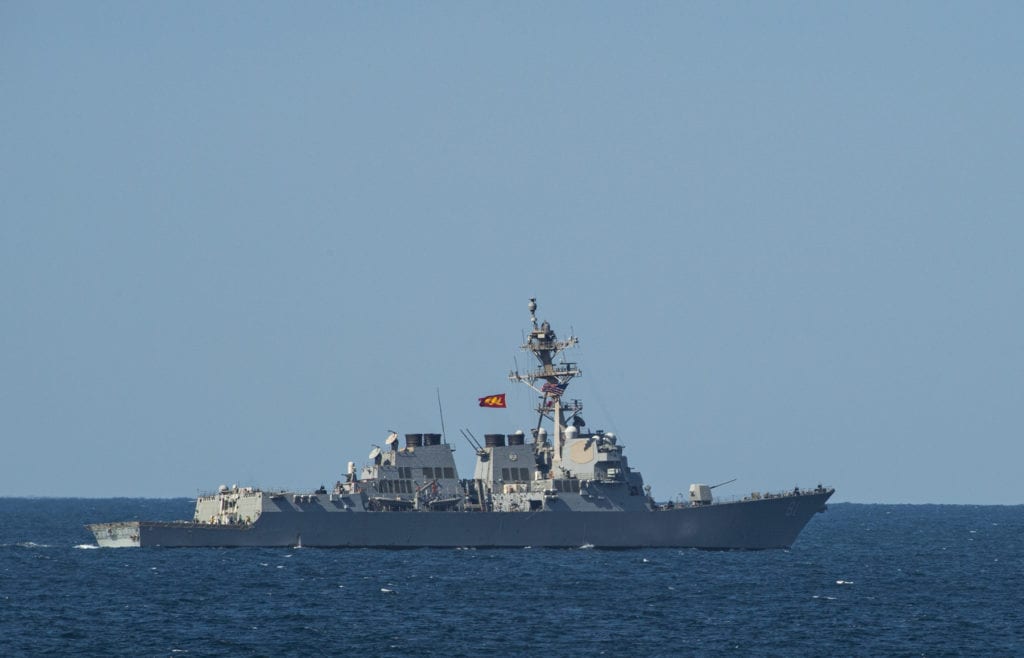
The guided-missile destroyer USS Winston S. Churchill (DDG 81) steams in the Arabian Sea. Winston S. Churchill is deployed to the U.S. 5th Fleet area of operations in support of naval operations to ensure maritime stability and security in the Central Region, connecting the Mediterranean Sea and Pacific Ocean through the western Indian Ocean and three critical chokepoints to the free flow of global commerce. U.S. Navy / Mass Communication Specialist 1st Class John Philip Wagner, Jr

NORFOLK, Va. – The guided-missile destroyer USS Winston S. Churchill (DDG 81) returned to homeport in Naval Station Norfolk March 19, after nearly nine months deployed in the U.S. 5th and 6th Fleet areas of operation, U.S. 2nd Fleet Public Affairs said in a March 19 release. 

Winston S. Churchill participated in important training exercises with international partners to foster positive relationships while encouraging freedom of navigation and maritime security. 

“I’m so proud of the Churchill Team, the crew and their families are the most resilient people I have ever come across,” said Capt. Timothy F. Stanley, commanding officer of Winston S. Churchill. “Returning today is almost nine months since the crew was last with their friends and family.” 

Winston S. Churchill, along with the embarked Helicopter Maritime Strike Squadron (HSM) detachment, traveled nearly 60,000 miles during the deployment and completed 26 strategic choke point transits, escorting a total of 23 vessels over 14 of those transits. She transited the Strait of Gibraltar twice, the Suez Canal twice, the Straits of Bab-el-Mandeb 14 times (nine transits with escort duties), and the Strait of Hormuz eight times (five transits with escort duties). 

“Churchill has nearly completed the equivalent of three laps around the Earth meeting important fleet tasking, all the while consistently meeting mission requirements, and keeping sea lines of communication open through the majority of the world’s key straits,” Stanley said. 

Winston S. Churchill participated in a 14-Day Restriction of Movement on June 22, 2020, prior to getting underway for pre-deployment exercises and training in order to combat the effect of COVID-19 on ship’s readiness. It officially deployed on Aug. 10, 2020. 

Winston S. Churchill conducted a landmark port visit in Port Sudan, Sudan, the first U.S. Navy warship to do so in over 30 years. The visit served to build a foundation of military cooperation between the U.S. and Sudan. Additionally, Winston S. Churchill visited Souda Bay, Djibouti, and Bahrain, where the crew was restricted to the pier. 

“Amongst a global pandemic, these sailors have met their personal and professional goals, making themselves and the Navy better,” Stanley said. “This team onboard has been galvanized through this deployment, and I’d argue is the best, most synergized, and resilient tactical-level force in the Navy.” 

Churchill conducted counter-smuggling operations with embarked Advanced Interdiction Team, comprised of U.S. Coast Guardsmen, U.S. Army Soldiers and U.S. Navy Sailors. AIT boarded two stateless dhows flying no flags in international waters off the coast of Somalia in accordance with international law. A large cache of weapons was discovered while conducting maritime security operations in the U.S. Central Command area of operations. The weapons disposed of included thousands of AK-47 assault rifles, light machine guns, heavy sniper rifles, rocket-propelled grenade launchers and crew served weapons. Other weapon components disposed of include barrels, stocks, optical scopes and weapon systems. 

The only U.S. warship named after a Briton, Winston S. Churchill worked with the Royal Navy HMS Trent in the Eastern Mediterranean. The cooperation demonstrates the long-standing high-end warfare capabilities of the Alliance, which will culminate in the deployment of the international Queen Elizabeth Strike Group this summer. 

While in the Mediterranean, Winston S. Churchill also sailed with the Tunisian navy, reinforcing the commitment to African Maritime security. 

After disembarking the HSM-70 detachment to its homeport at Naval Air Station, Jacksonville, Florida, Churchill will return to homeport in Naval Station Norfolk. 


General Dynamics Delivers First Knifefish Surface MCM UUV to U.S. Navy

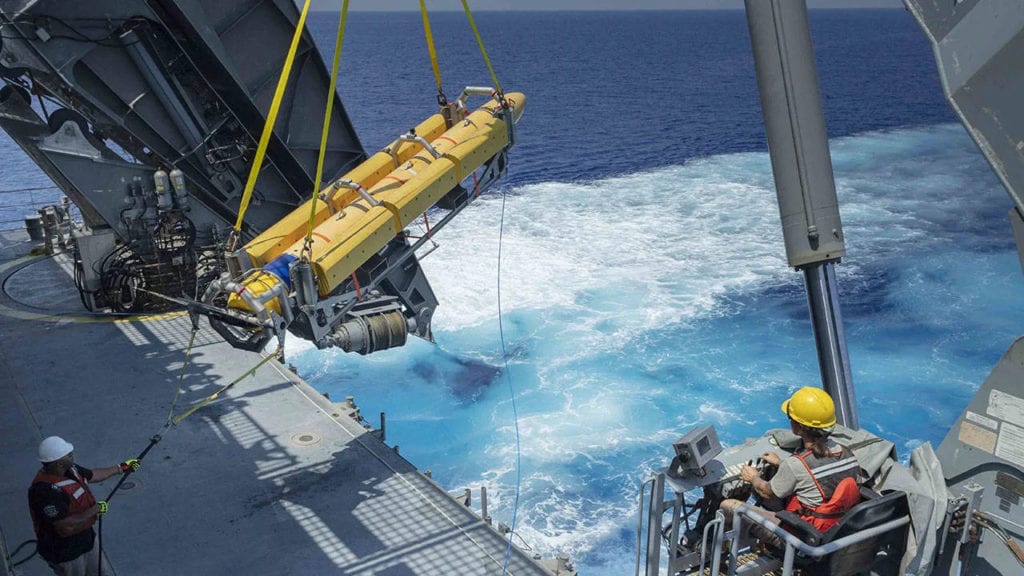
The first Knifefish surface mine countermeasure UUV system has been delivered to U.S. Navy six months after final acceptance tests were completed. General Dynamics Mission Systems

QUINCY, Mass. – General Dynamics Mission Systems recently delivered the first Knifefish surface mine countermeasure unmanned underwater vehicle (UUV) system under a contract awarded by the U.S. Navy on Aug. 26, 2019, the company said in a March 18 release. 

The contract, awarded immediately after a successful Milestone C decision and approval to enter low-rate initial production, calls for the procurement of five Knifefish systems (10 total UUVs) and support equipment. 

Knifefish is a medium class mine countermeasure UUV intended for deployment from the Navy’s littoral combat ship and other Navy vessels of opportunity. Knifefish will reduce risk to personnel by operating within minefields as an off-board sensor while the host ship stays outside the minefield boundaries. 

“Together with the U.S. Navy’s Program Executive Office for Unmanned and Small Combatants, our Knifefish team has worked to deliver critical mine countermeasure mission capabilities to protect our Sailors,” said Carlo Zaffanella, vice president and general manager at General Dynamics Mission Systems. “We designed Knifefish using an open architecture concept that can be quickly and efficiently modified to accommodate a wide range of missions.” 

General Dynamics Mission Systems is the prime contractor for the Knifefish program. The company designed the tactical UUV using an open architecture concept that can be quickly and efficiently modified to accommodate a wide range of missions. The Knifefish SMCM UUV is based on the General Dynamics Bluefin Robotics Bluefin-21 deep-water autonomous undersea vehicle.  


Navy’s Future Carrier Air Wing Could Reach 40% Unmanned Aircraft, Use Manned/Unmanned Teaming, Admiral Says

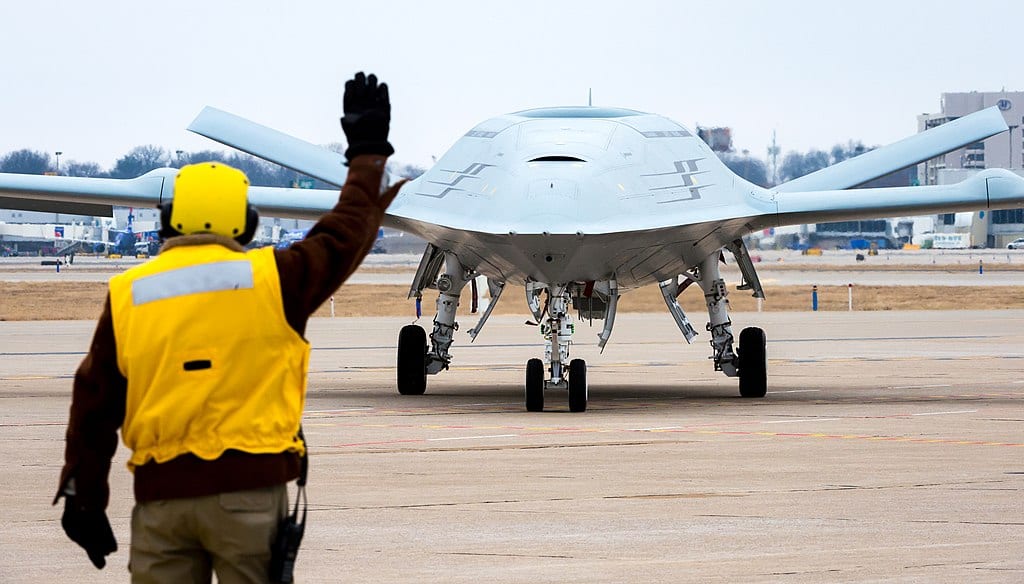
Boeing conducts MQ-25 deck handling demonstration at its facility in St. Louis, Missouri, in 2018. U.S. Navy / Boeing

ARLINGTON, Va. — The Navy’s forthcoming fielding of its first carrier-based unmanned aircraft could presage a much larger UAS presence in the future carrier air wing, a senior admiral said, and may include manned/unmanned teaming. 

The MQ-25A Stingray UAS now being tested by Boeing and the Navy is designed to be a tanker for aerial refueling of other carrier-based aircraft such as the F-35C Lightning II and F/A-18E/F Super Hornet strike fighters; EA-18G Growler electronic attach aircraft; E-2D Advanced Hawkeye battle management aircraft; and CMV-22B Osprey carrier on-board delivery aircraft.     

“The MQ-25 has great promise for us,” said Vice Adm. James Kilby, deputy chief of naval operations for Warfighting Requirements and Capabilities, testifying March 18 before the Seapower and Projection Forces Subcommittee of the House Armed Services Committee. “Our initial focus is to introduce this platform and get it introduced into the air wing where it can serve its role initially in tanking and limited ISR [intelligence, surveillance and reconnaissance]. But what we are focusing on is launching, landing, moving it around on the deck, bringing it up, taking it down to the hangar bay, how do we position those assets, how can we support the air wing. 

“So, step one: get the fighters out of the business of refueling fighters and use the MQ-25 to do that, initially close aboard the carrier but eventually at range,” Kilby said. “But there is some payload capacity in that vehicle that we think has great promise for us. So, I think initially we would transition to ISR but in an air wing of the future view … we think we could get upwards of 40% of the aircraft in an air wing that are unmanned and then transition beyond that.” 

Kilby said the logical step would be, “crawl, walk run, figure how to handle it within the air wing, let’s move to ISR, maybe electronic attack, strike, and then other things as complexity grows across that mission set. The MQ-25 most certainly will provide promise to us because perhaps it would exceed the endurance of a maned aircraft.” 

The admiral pointed out that while there will be a control center on each aircraft carrier for unmanned aircraft, the Navy’s aspiration is for manned unmanned teaming in the future so that manned aircraft could control unmanned aircraft. 


Navy’s Orca XLUUV to Have Mine-Laying Mission, Adm. Kilby says

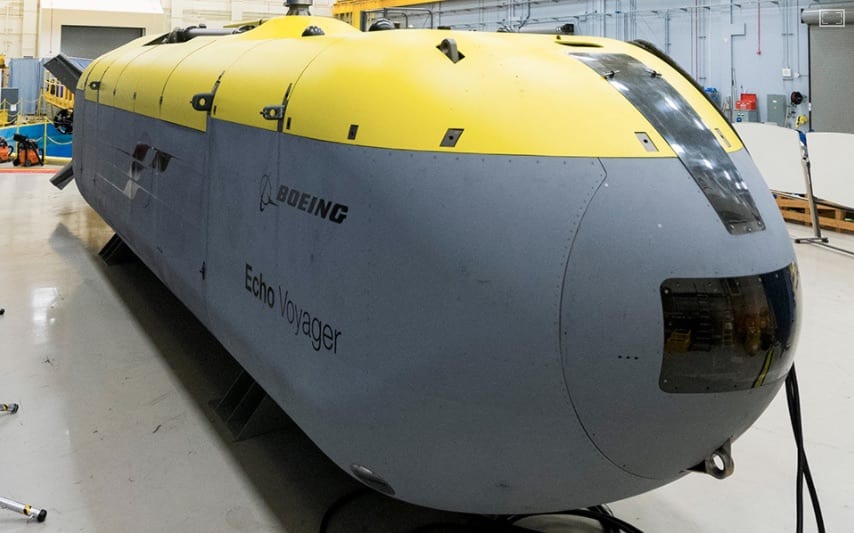
Boeing’s Echo Voyager, forerunner of the Orca extra-large unmanned underwater vehicle, or XLUUV. Boeing

ARLINGTON, Va. — The Navy is planning on mine laying as the initial mission for the Orca extra-large unmanned underwater vehicle (XLUUV), a Navy official said. 

“The XLUUV is a migration from the Echo Voyager from Boeing, with a mission module placed in the middle of it, to initially carry mines,” said Vice Adm. James Kilby, deputy chief of naval operations for Warfighting Requirements and Capabilities, testifying March 18 before the Seapower and Projection Forces Subcommittee of the House Armed Services Committee. “We are pursuing that vehicle because we have operational needs from a combatant commander to go solve this specific problem.” 

The Orca, five of which are being built by Boeing, will be an open-architecture, reconfigurable UUV that will be modular in construction and have a modular payload bay. The XLUUV core vehicle will provide guidance and control, navigation, autonomy, situational awareness, core communications, power distribution, energy and power, propulsion and maneuvering, and mission sensors. The length will be greater than 80 feet. The Orca, too large to be carried by a submarine, will be pier-launched.  

“We need to get that initial prototype built and start employing it to see if we can achieve the requirements to do that mission set,” Kilby said. “If we can’t meet our milestones, we need to critically look at that and decide if we have to pursue another model or methodology to get after that combatant need. In the case of the XLUUV, we haven’t even had enough run time of that vessel to make that determination yet. Certainly, there [are] challenges with that vehicle.” 

The Navy is developing new types of mines: the cylindrical-shaped Clandestine Delivered Mine and the Hammerhead, an encapsulated torpedo designed to lie in wait for submarines. The capsule for the torpedo would be anchored to the ocean floor, much like the Mk60 CAPTOR mine of Cold War vintage that housed a Mk46 antisubmarine torpedo. (The CAPTOR was withdrawn from the Navy’s inventory in 2001.) The Hammerhead is designed to have modular architecture to allow for technology insertion. 


Panel Examines Strategic Balance: Is the Navy You Have the Navy You Need?

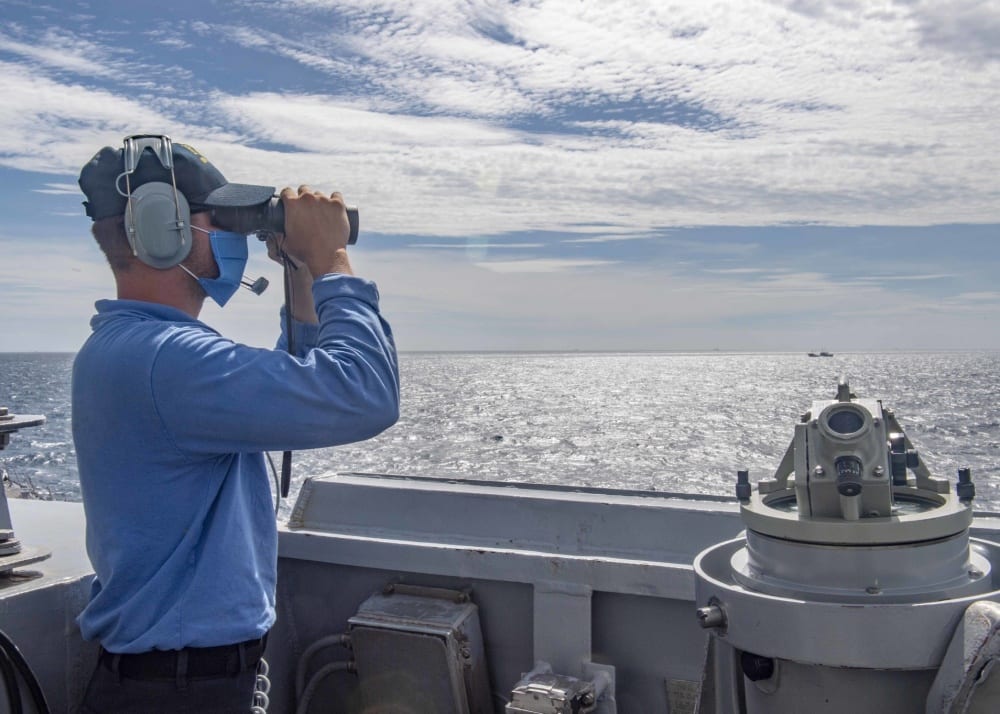
Seaman Zachery Douglas, from Dansville, New York, looks through binoculars on the bridge as the Arleigh Burke-class guided-missile destroyer USS Mustin (DDG 89) conducts routine operations in the Taiwan Strait. Mustin is forward-deployed to the U.S. 7th Fleet area of operations in support of security and stability in the Indo-Pacific region. U.S. Navy / Mass Communication Specialist 3rd Class Cody Beam

A March 16 webinar on “Maritime Competition and the Maritime Strategy,” hosted by the Center for Strategic and Budgetary Assessments examined several recently published papers dealing with maritime strategy, the role of the U.S. Navy and the composition of peacetime and wartime fleets in the current era of great power competition.

The virtual forum featured leading international security scholars, each of whom has contributed to a recent special issue of the journal Security Studies (Volume 29, Issue 4), as well as several companion pieces from a recent series published by War On The Rocksentitled Maritime Strategy on the Rocks.

The discussion was moderated by Evan Braden Montgomery, CSBA’s director of research and studies, who was also one of the authors in the collection. He was joined by panel of experts, including Jonathan Caverley, professor of strategy at the U.S. Naval War College; Fiona Cunningham, assistant professor of political science and international affairs at George Washington University; Peter Dombrowski, professor of strategy at the U.S. Naval War College; Erik Gartzke, professor of political science at the University of California at San Diego; Jon Lindsay, assistant professor at the University of Toronto; Paul van Hooft, senior strategic analyst at the Hague Center for Strategic Studies; and Sara McLaughlin Mitchell, professor of political science at the University of Iowa. 

Also participating was Dr. Doyle Hodges, executive editor of Texas National Security Review, who served as curator and editor of the series.

The papers focused on the Indo-Asia-Pacific region, which is primarily a maritime theater. The authors looked at how naval officers and scholars think about the INDO-PACOM maritime domain, and noted that they often viewed things quite differently.

The authors commented on the new tri-service strategy, and the distinct strength that of each of the three sea services bring to the security calculus. They also noted the U.S. is basically providing presence far from home, while China is essentially defending what it perceive as its home waters.  As such, the U.S. cannot face China alone and requires commitments from allies and partners in the region. In the Taiwan scenarios, however, the authors debated whether other countries would join the U.S. in coming to the aid of Taiwan if China were to invade.

Beyond simple territorial disputes, the authors examined various triggers and thresholds that have led to armed conflict in the past, including resources like fisheries and oil and gas.

The panelists debated the right mix of ships in the Navy fleet, and the relative merits of highly visible platforms as a form of deterrence, like carrier strike groups, and those less visibly but perhaps more potent, like ballistic missile submarines.

There may be reluctance to take the risk of fully committing very expensive platforms. Less expensive platforms are more affordable and can be built in larger quantities, but the ships need to be credible.  Furthermore, ships that are good at fighting might not be so good at preventing combat, or performing missions short of combat.

The panelists talked about how China’s strength exactly targets U.S. weaknesses, and that the U.S. today must go to greater lengths to be reassuring to allies and a deterrence to adversaries.


Navy MQ-25A Basing Assessment Finds No Significant Environmental Impact

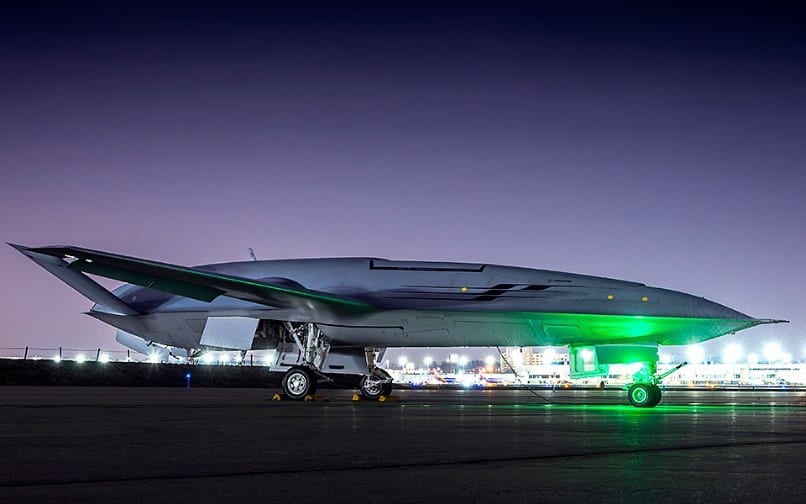
The MQ-25A Stingray carrier-based unmanned aircraft system, which will be home based at Naval Base Ventura County, Point Mugu, California. Boeing

ARLINGTON, Va. — The Navy has released a final environmental assessment (EA) and Finding of No Significant Impact for home-basing the MQ-25A Stingray carrier-based unmanned aircraft system at Naval Base Ventura County, Point Mugu, California, the Navy said in a March 17 release. 

The proposed action is to establish facilities and functions at NBVC Point Mugu to support home basing and operations of the MQ-25A Stingray. Under the proposed action, the Navy would home base 20 Stingray systems, construct a hangar, training facilities, and supporting infrastructure, perform air vehicle maintenance, provide training for operators and maintainers, conduct approximately 960 Stingray annual flight operations and station about 730 personnel, plus their family members. 

The Stingray will enhance aircraft carrier capability and versatility through the integration of a persistent, sea-based, multi-mission aerial refueling and intelligence, surveillance, and reconnaissance UAS into the carrier air wing, the Navy said. The Stingray will extend the range and reach of carrier air wings on the West Coast to meet current and future threats and enhance refueling and intelligence, surveillance, and reconnaissance capabilities in support of national defense objectives and policies. 

Based on analysis presented in the environmental assessment, which has been prepared in accordance with the requirements of the National Environmental Policy Act, and in consultation with the U.S. Fish and Wildlife Service and California Coastal Commission, the Navy finds implementation of the proposed action will not significantly impact the quality of the human environment. Therefore, an environmental impact statement is not required. 

The assessment prepared by the Navy is on file and interested parties may obtain a copy by downloading it from the project website: https://www.nepa.navy.mil/stingray


With Scant ISR Resources, SOUTHCOM Turns to ISR, Machine Learning

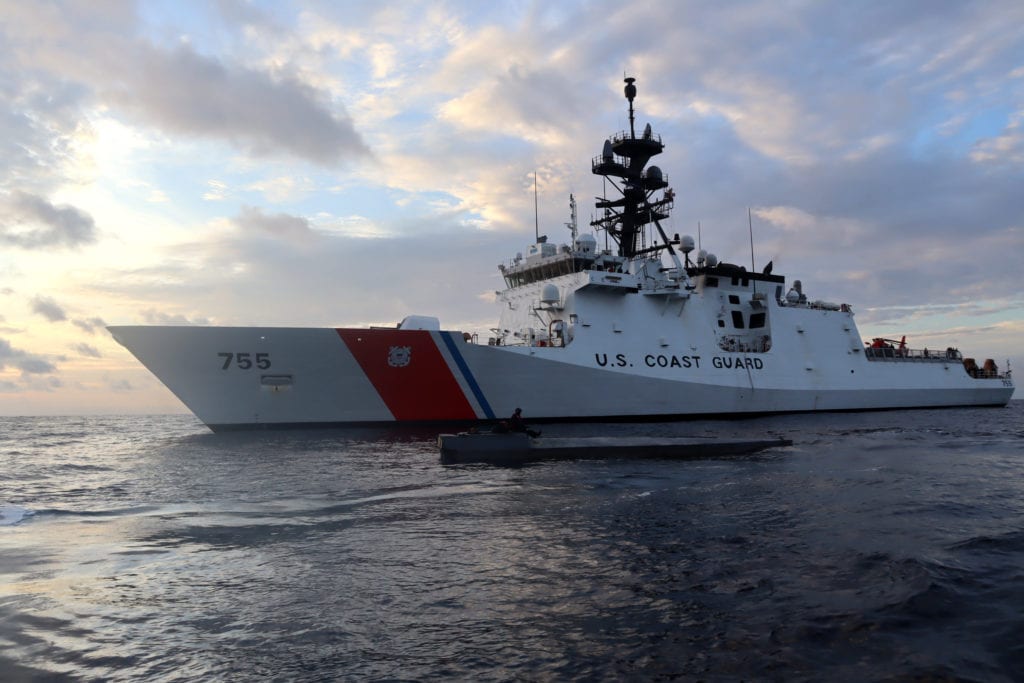
A Coast Guard Cutter Munro (WMSL 755) boarding team member sits atop an interdicted low-profile vessel in the Eastern Pacific Ocean after crews seized 3,439 pounds of cocaine from the LPV, Jan. 27, 2021. Munro is one of two California-based cutters whose crews interdicted a combined three suspected drug smuggling vessels in the Eastern Pacific Ocean between Jan. 26 and Feb. 1 resulting in the seizure of more than 9,000 pounds of cocaine worth an estimated $156 million. U.S. Southern Command is looking to combine analytics, AI and machine learning to close the ISR gap in the battle against transnational criminal organizations. U.S. Coast Guard

ARLINGTON, Va. — U.S. Southern Command is turning to artificial intelligence and machine learning to compensate for underfunded intelligence, surveillance and reconnaissance (ISR) capabilities to monitor  international criminals and great power competitors in Latin America.

SOUTHCOM accounts for less than 1% of Defense Department ISR resources to counter external state actors, like Russia and China, and transnational criminal organizations in the region, the combatant command’s chief, Navy Adm Craig S. Faller, told a Senate Armed Services Committee hearing March 16.

“Intelligence drives everything. That allows us to have the domain awareness,” Faller said, “so we can then inform our other interagency partners of what the threats are up to.” He and another witness at the hearing, Air Force Gen. Glen Van Herk, commander of U.S. Northern Command, identified China and Russia as the two biggest threats to stability in the Hemisphere.

Faller singled out China as the main threat to U.S. interest in Latin America. “The intervention goes well beyond economic influence, [China’s] outlook with over 40 ports in progress, significant loans that are used as political leverage and predatory practices demonstrated in illegal, unreported, and unregulated  fishing are weakening democratic institutions and leveraging the future of this Hemisphere. We have seen many of these same tactics in Asia and Africa over the last few decades,” he said.

The admiral went into greater detail at a Pentagon press briefing later in the day, calling those tactics “a very insidious move for global economic dominance.”

Regarding ISR limitations in the face of growing threats, from regional and international extremist groups and drug cartels, Faller said intel wasn’t limited to “big wing stuff” like P-8 maritime patrol aircraft and MQ-9 drones. SOUTHCOM has turned to what he called “21st century tradecraft,” non-traditional ISR that leverages analytics with “AI and machine learning for all the data out there that’s available in open source.”

He said two pilot programs, if converted to programs of record or based more broadly, “show great promise.” The Technical Network Analysis Cell provides actionable intelligence, in cooperation with law enforcement partners, that is shared with partner nations and interagency partners leading to disruption of criminal activities. The Asymmetric Target Acquisition Center, run by Special Operations Command South, supports law enforcement efforts to counter transnational crime organizations.