Nimitz Returns Home from Deployment
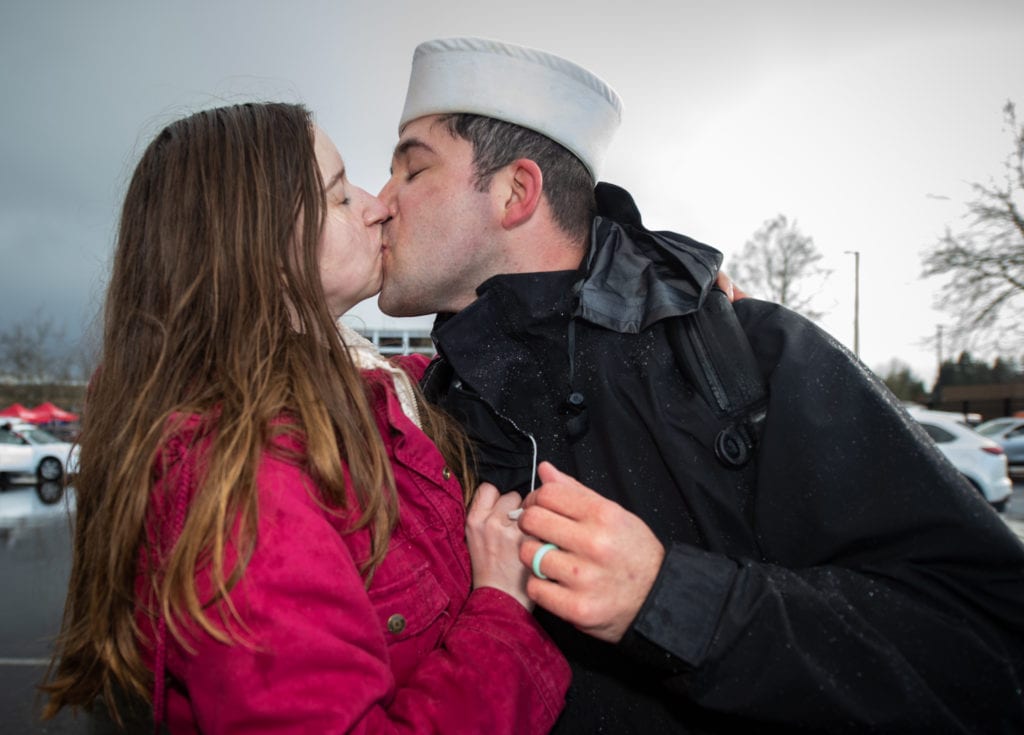
Information Systems Technician 1st Class Jorge Franco, from Lacey, Washington, greets his wife after returning from deployment. Nimitz, part of Nimitz Carrier Strike Group, returned to its homeport Naval Base Kitsap, Bremerton, Wash., after more than 11 months following a deployment to U.S. 5th Fleet and U.S. 7th Fleet, which included freedom of navigation operations and participation in Operations Freedom’s Sentinel, Inherent Resolve, and Octave Quartz. U.S. Navy / Mass Communication Specialist 2nd Class Sarah Christoph

BREMERTON, Wash. — Sailors assigned to aircraft carrier USS Nimitz (CVN 68) returned to the Pacific Northwest area, Mar. 4, after nearly 11-months deployed in U.S. 3rd, 5th, and 7th Fleets, USS Nimitz Public Affairs said. 

Nimitz was the first carrier to embark on a deployment for the U.S. Navy after the onset of the COVID-19 pandemic. The crew walked aboard Nimitz April 1, 2020, at their homeport aboard Naval Base Kitsap, Bremerton, Washington, for what would be a 27-day restriction of movement (ROM) period. Nimitz deployed from San Diego June 8 after completing integrated training with other assets from the Nimitz Carrier Strike Group.  

“It has been a long 11 months since we bid farewell to our homeport in the beautiful Pacific Northwest, and it feels great to be back,” said Capt. Max Clark, Nimitz commanding officer, and Philadelphia native. “I am so proud of the Sailors on board Nimitz. The hard work, dedication, and teamwork they demonstrated day in and day out to accomplish all missions assigned is commendable.” 

“They and their families have my deepest respect and gratitude,” added Clark. “We all look forward to returning now to our families and friends here in Bremerton and the surrounding areas. It’s wonderful to be home.” 

While deployed, Nimitz completed five dual carrier operations in U.S. 7th Fleet with the Ronald Reagan and Theodore Roosevelt Carrier Strike Groups and participated in the India hosted multinational Exercise Malabar 2020 with the Japan Maritime Self-Defense Force and Australian Navy in the Bay of Bengal. 

“The pandemic changed a lot of things that the Navy normally does,” said Senior Chief Operations Specialist Torrence Mabry, from Youngstown, Ohio. “Fortunately, we were the ship that was able to do it. At the end of the day we did what we had to do while we were in 5th Fleet. We did what we had to do while we were in 7th Fleet. We did what we had to do around the world. Now is the time to enjoy the benefits and do the things you enjoy doing. Because you sacrificed and put your life on the line.” 

In the U.S. 5th Fleet area of operation, Nimitz supported Operation Freedom’s Sentinel as part of the NATO-led Resolute Support mission in Afghanistan, and Operation Inherent Resolve with close air support and defensive counter-air missions against the Islamic State in Iraq and Syria. The strike group provided associated and direct support to the 33-nation coalition Combined Maritime Forces (CMF) and the eight-nation coalition International Maritime Security Construct (IMSC) to ensure the free flow of commerce and maritime security in three critical waterways. Nimitz also operated off the coast of Somalia in December to support Joint Task Force –Quartz and Operation Octave Quartz during a repositioning of U.S. forces within East Africa. 

“We all banded together and got through it,” said Culinary Specialist 2nd Class Tradondra King, a native of Miami. “That shows a lot. During this extremely tough time everyone found that strength and resiliency in them. We had to get this done, we had a job to do and a mission to complete. That was the way and what we had to do.” 

U.S. 3rd Fleet leads naval forces in the Indo-Pacific and provides the realistic, relevant training necessary to flawlessly execute our Navy’s timeless roles of sea control and power projection. U.S. 3rd Fleet works in close coordination with other numbered Fleets to provide commanders with capable, ready assets to deploy forward and win in day-to-day competition, in crisis, and in conflict. 

“We did a great thing,” said Mabry. “Nimitz pulled it off, better than any other carrier so far. We wrote the book. We set the standard high and now it’s time for everybody else to follow.” 
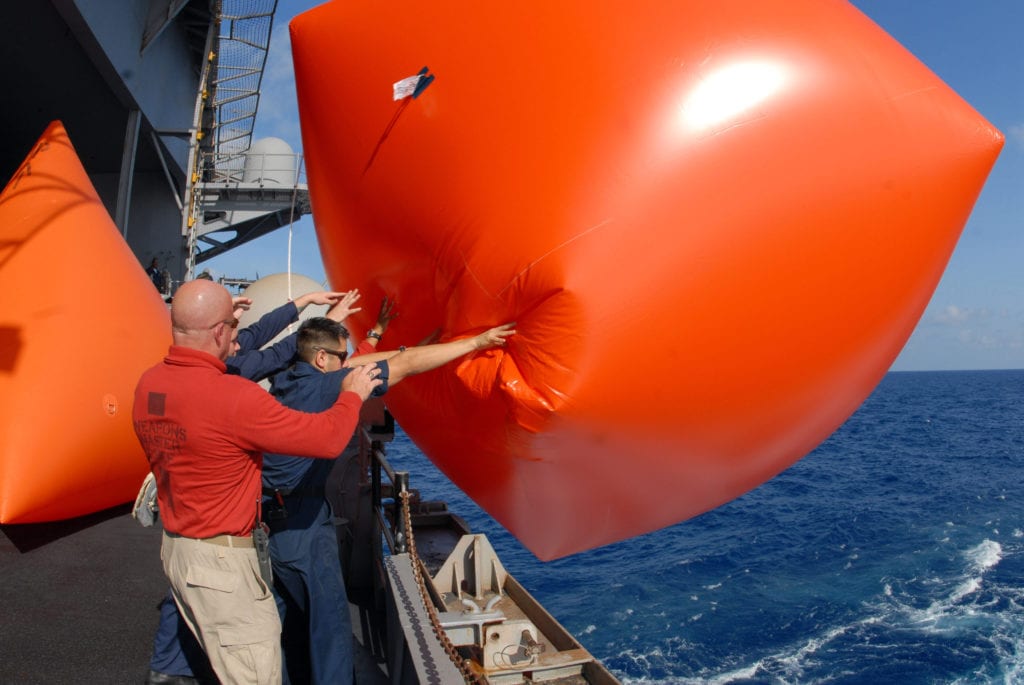


Seaborne Targets Depot Team Demonstrates Contribution to Readiness

Weapons Department Sailors aboard the Nimitz-class aircraft carrier USS Ronald Reagan launches an inflated target, Killer Tomato, to allow the ship’s full-bore team a chance to fire on a active target. U.S. Navy / Petty Officer 2nd Class Gary Prill

PORT HUENEME, Calif. – The U.S. Navy’s Seaborne Targets team from Program Executive Office (PEO) Ships and NAVAIR’s Naval Air Warfare Center Weapons Division (NAWCWD) demonstrated its essential capabilities to Chief of Naval Operations (CNO) Adm. Michael Gilday, during his visit to Naval Base Ventura County, Port Hueneme, Feb. 26, Team Ships Public Affairs said in a March 5 release.  

Seaborne targets are used during the required testing and training of missile systems, guns, and other weapons designed to destroy an approaching “threat” to ships and aircraft. Adm. Gilday viewed unique capabilities of the Government-developed remote-control system used to control the target boats. The remote-control system allows range operations personnel to control target boats in groups or formations, realistically simulating the threat of multiple boats simultaneously attacking a ship. Various types and configurations of seaborne targets were also on display. 

“The CNO has tasked us with maintaining our advantage at sea and we know that threats to ships and aircraft are constantly emerging and evolving,” said Mike Kosar, program manager, Auxiliary Ships, Small Boats and Craft, Program Executive Office (PEO) Ships. “The Navy must constantly adapt by developing new weapons systems to counter those threats and therefore, must develop new seaborne targets to test the systems and train operators to respond to the approaching threat.”  

Seaborne targets are known for their orange color which allows them to be easily identified. The Navy’s inventory of seaborne targets is comprised primarily of self-propelled boats and barges or floating pontoons designed to be towed behind the boats. 

To produce target boats, the PEO Ships Support Ships, Boats and Craft program office works to procure and deliver them and installs remote control systems on the boats following delivery. NAWCWD personnel perform final assembly of all tow targets in Port Hueneme. Seaborne Targets Depot personnel test the targets before shipping them to the sea ranges where they are ultimately used. 

“The in-house capabilities of the Seaborne Targets team enable us to retain the technical knowledge and expertise required to provide support wherever our targets are used,” Kosar said. “Our surface force must have confidence in the reliability of the systems and weapons they are given. The vital work of the Seaborne Targets team helps ensure the readiness of our warfighters.” 


U.S. Will Fight from Guam and for Guam, U.S. Indo-Pacific Commander Says

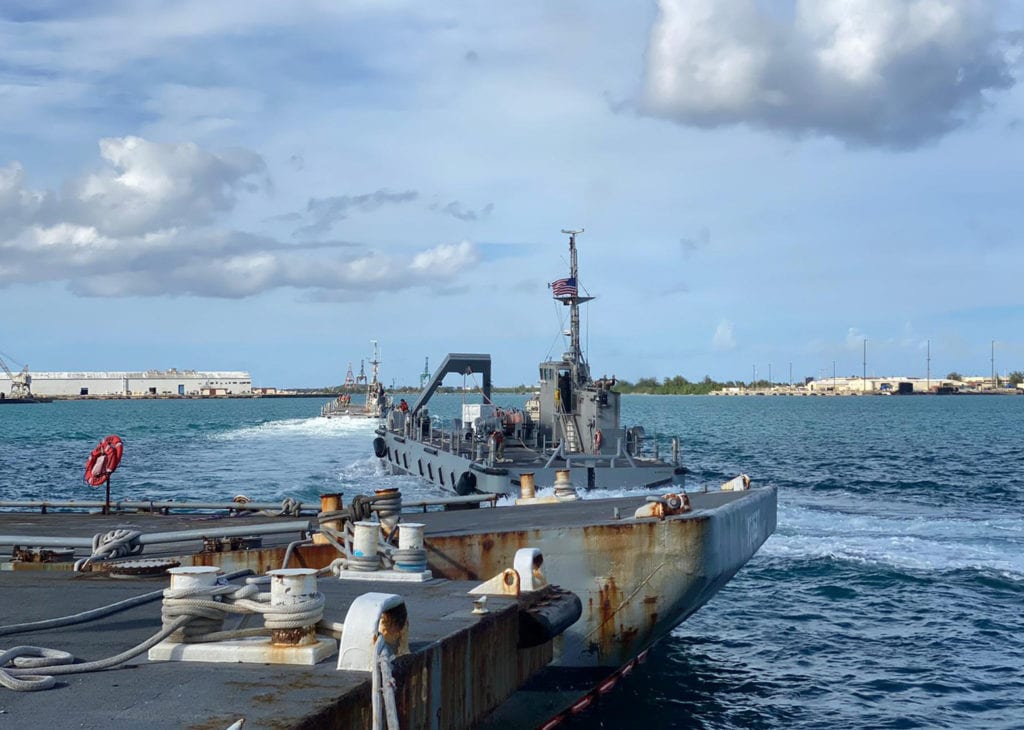
Sailors deployed from Naval Beach Group 1 navigate Improved Navy Lighterage Systems in Apra Harbor, Guam. U.S. Navy / Chief Boatswain’s Mate Daniel Nguyen

ARLINGTON, Va. — The Navy admiral in charge U.S. Indo-Pacific Command said building up the defenses of Guam is his highest budget priority and reminded observers Guam is not just a base for military operations but a part of the American homeland, and should be defended as such. 

Guam, a large island southernmost of the Marianas island chain, is a U.S. territory and has been a U.S. base since before World War II — except for the Japanese occupation during 1941-1944.  

“Guam is absolutely critical in maintaining deterrence and stability in the region,” said Adm. Philip Davidson, commander, U.S. Indo-Pacific Command, speaking March 4 during a webinar of the American Enterprise Institute, a Washington think tank. “It is our most critical operating location west of the International Dateline. Funding for the air and missile defense of Guam is my Number 1 priority — most importantly because Guam is U.S. homeland.  

“There are 170,000 Americans living in Guam, and their defense is homeland defense,” Davidson said. “Defense Department personnel comprise some 13% of the total population on Guam, a total of nearly 22,000 service members, civilians, contractors and family members that are supporting America’s of Guam. That doesn’t even include rotational forces [that deploy to Guam].” 

Davidson said Guam is a “critical nexus for command and control, for logistics and sustainment, and for power. It has strategic deep-water ports and airfields. We have billions of dollars in military capability in Guam today and there are billions of dollars programmed by the United States to advance those capabilities tomorrow.”

He pointed to an example, Marine Corps Base Camp Blaine, established in November 2020 and built to garrison 5,000 Marines as the first new Marine Corps base established in the Pacific since 1952. 

The admiral wants to establish Aegis Ashore missile-defense facilities in Guam to augment the Terminal High-Altitude Area Defense radar system already in Guam and provide 360-degree missile defense of the island and “the full spectrum of detect-to-engage sequence, the sensing, the network and the delivery of fires to support our maneuver.” 

He pointed out that an Aegis Ashore facility would accomplish what otherwise would require three Arleigh Burke-class guided-missile destroyers to defend Guam, ships that could be freed to employ their multi-mission capabilities elsewhere. 

Davidson responded to critics who say that bolstering missile defenses of Guam would make the island a target, noting that “it already is one. China is making no secret of this fact, as evidenced in last fall’s widely circulated PLA Air Force propaganda video which specifically depicted an attack on a mock-up of Andersen Air Force Base in Guam. 

“In all, the Guam defense system will allow us to regain the advantage, help us to deter China, and will demonstrate our steadfast commitment to our allies and partners in the region that we are here to stay and to defend what is ours,” he said. “… It is not a de facto status that we only need to be able to fight from [Guam] — we’re going to have to be able to fight for it, and missile defense in the region is critical.” 


Navy Orders 20,000 SSQ-125 Sonobuoys

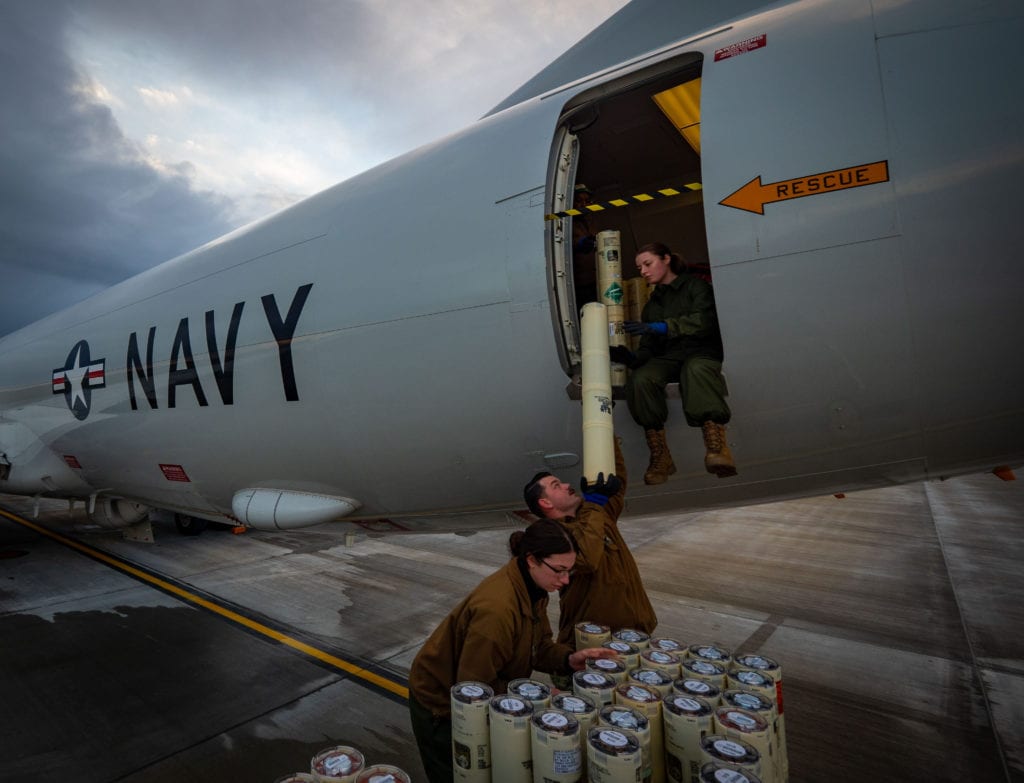
Aircrew Survival Equipmentman 3rd Class Alyssa Kozak, left, Hospital Corpsman 2nd Class Austin Phillips, center, and Aviation Ordnanceman Airman Siane Nash load sonobuoys onto a P-8A Poseidon anti-submarine warfare patrol aircraft, Dec. 14, 2020. U.S. Navy/ Mass Communication Specialist 2nd Class Austin Ingram

ARLINTON, Va. — The U.S. Navy has ordered 20,000 SSQ-125 sonobuoys for anti-submarine warfare (ASW) training and operations.  

The Navy has in recent years placed renewed emphasis in ASW and has increased its capabilities and capacity in view of the increased Russian and Chinese submarine activity and capabilities. 

The Naval Air Systems Command awarded ERAPSCO — a joint venture of Sparton Corp. and Ultra Electronics — a $71.3 million firm-fixed-price contract modification for a maximum quantity of 20,000 SSQ-125s, according to a March 3 Defense Department contract announcement.  

The sonobuoys will be used “in support of annual training, peacetime operations and testing expenditures and maintaining sufficient inventory to support the execution of major combat operations determined by the Naval Munitions Requirements Process for the Navy and Foreign Military Sales customers,” the announcement said.  

The SSQ-125 is used by U.S. Navy P-8A and P-3C aircraft and produces electronic (coherent) pulses of various types and lengths that enable Doppler processing to distinguish moving targets (such as submarines) from stationary features of the environment (such as shipwrecks).  

The work on the order is expected to be completed in March 2023.   


Naval Academy Increasingly Affected by Rising Tides, Superintendent Says

The U.S. Navy Flight Demonstration Squadron, the Blue Angels, fly over the U.S. Naval Academy commissioning ceremony May 20, 2020. The academy’s waterfront is being affected by rising sea levels. Video still by U.S. Navy / Petty Officer 1st Class Jess Gray.

WASHINGTON — The waterfront of the U.S. Naval Academy is more frequently being affected by rising sea levels, the academy’s superintendent said. 

Vice Adm. Sean Buck, testifying March 2 before the House Appropriations Committee’s Defense subcommittee, said that rising sea level is causing more high-tide flooding of the academy’s campus. 

The Naval Academy, in Annapolis, Maryland, is located at the estuary of the Severn River at the Chesapeake Bay. 

“We’re built on a lot of reclaimed land, Buck said. “We’re at the confluence of one of Maryland’s major rivers and the Chesapeake Bay, and we’re also affected throughout the entire day, 365 days of the year, by the prevailing winds that have existed for centuries, easterly and southeasterly winds which, when you combine that weather with sea-level rise, with subsidence, which is pretty significant in the Chesapeake Bay area … we are continuously experiencing negative effects of high tide almost on a regular basis.”

Buck said in the entire decade of the 1990s the academy experienced 41 events of high-tide flooding.  

“Now, we’re experiencing 41 instances of high-tide flooding per year,” he said. “As we look at all of the projections from all of the science, and those who are looking at this, especially on the East Coast looking at it for naval infrastructure, it is projected by 2050 that we will see this high-tide flooding negative effect every single day of the year.” 

Buck said some of the effects of the flooding are flooded-out roads — including commuting routes — parking lots, and entrances and exits to some of the campus buildings.  

Buck said his predecessor formed the U.S. Naval Academy Sea-Level Rise Advisory Council in 2015, comprised of Naval Academy scientists and engineers and stakeholders in the Naval academy team, the city of Annapolis, and the state of Maryland. He said the council is informed by the Army Corps of Engineers and other experts who are working on a study expected to be completed by the end of 2021 “to help us create a military installation resiliency plan. 

“They are going to present to us different courses of action — engineering solutions — that we can take around the yard,” he said, noting the solutions might include building up sea walls, creating earthen berms, raising the level of roads and upgrading storm water drainage. 


MARMC, Blue Water, USS Gerald R. Ford Partner for UAS Exercise

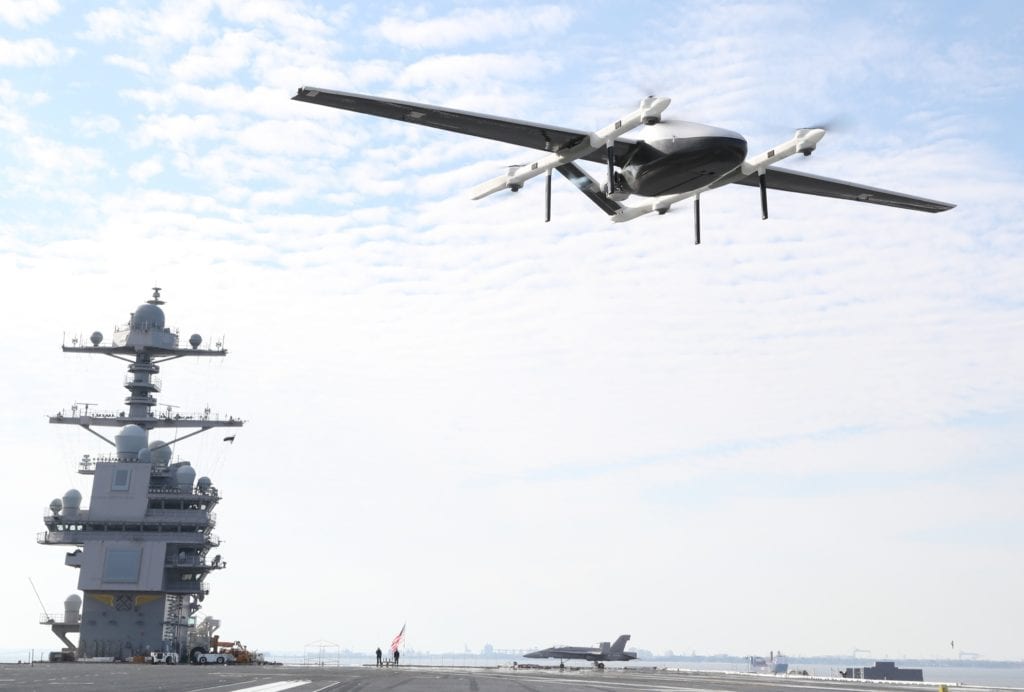
A logistics Unmanned Air System (UAS) prototype, called Blue Water UAS, approaches to deliver cargo on USS Gerald R. Ford’s (CVN 78) flight deck during supply demonstration Feb. 21, 2021. The test was successfully conducted by transporting light-weight logistical equipment from one part of Naval Station Norfolk aboard Ford while the aircraft carrier was in port. U.S. Navy / Chief Mass Communication Specialist RJ Stratchko

NORFOLK, Va. — Mid-Atlantic Regional Maintenance Center (MARMC) hosted the Blue Water Unmanned Aerial System (UAS) Skyways team for an exercise that could impact the way the Navy handles transporting parts for repairs needed aboard forward deployed ships, Chris Wyatt, MARMC public affairs specialist, said in a March 2 release. 

MARMC, in collaboration with the USS Gerald R. Ford (CVN 78) Beach Detachment and the Blue Water team, tested the abilities of a Maritime Logistics UAS to deliver a part to the ship from MARMC Headquarters. 

“The UAS departed the MARMC parking lot with a simulated package pickup and took the part needed for repair over to the Ford,” said MARMC Logistics Department Head, Cmdr. Kevin Borkert. “For this evolution MARMC handed the part to the UAS crew and they placed it in the cargo bay along the underside of the UAS.” 

In October 2020, the US Navy acquired a commercial unmanned vehicle developed by Skyways of Austin, Texas, to further develop and demonstrate long-range naval ship-to-ship and ship-to-shore cargo transport. Navy engineers and test pilots continue to organically enhance the system with developments like folding wings for better handling and ship storage and consider alternative air vehicle designs with advanced propulsion systems to provide greater range and payload performance, optical and infrared collision avoidance and landing systems, and navigation systems not only dependent on GPS. 

“Our motto is ‘We Fix Ships’ and we feel like they chose the right place to show this innovation in action,” said MARMC Commanding Officer Capt. Tim Barney. “I want MARMC to be a part of any program that uses advancements in technology, which could potentially save time, money and reduce the Navy’s carbon footprint, while helping to keep the fleet mission ready.” 

Moving forward, if MARMC is chosen as a pivot point in the procurement process for parts needed for repairs, it could potentially have a large and lasting impact on how business is done. 

MARMC provides surface ship maintenance, management and oversight of private sector maintenance and fleet technical assistance to ships in the Mid-Atlantic region of the United States and provides support to the fifth and sixth Fleet Area of Responsibilities. They are also responsible for the floating dry-dock Dynamic (AFDL-6). 


Second Navy Squadron Ready for F-35C Transition

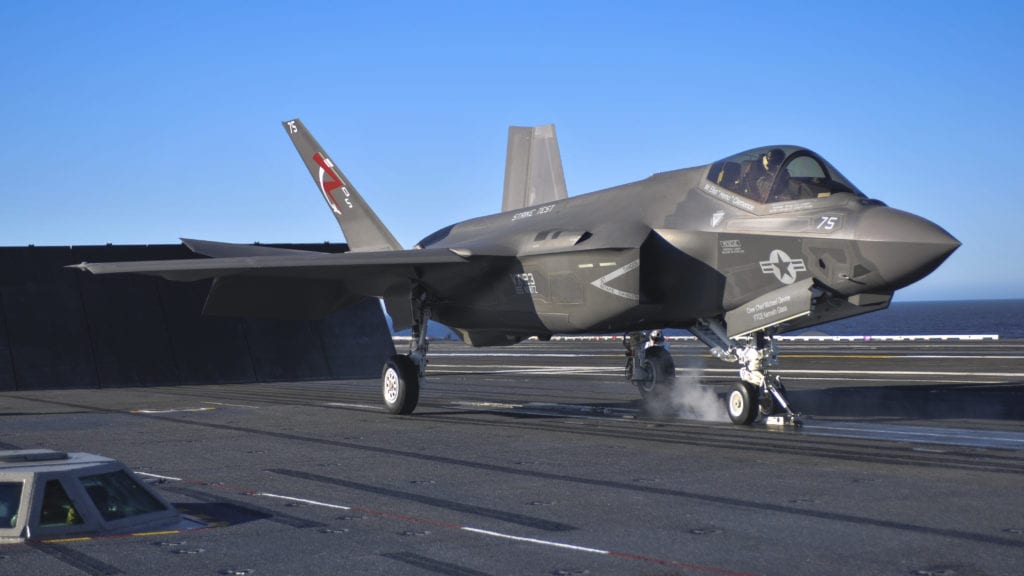
An F-35C Lightning II carrier variant joint strike fighter launches from the flight deck of the aircraft carrier USS Nimitz (CVN 68). U.S. Navy / Mass Communication Specialist Seaman Shauna C. Sowersby

ARLINGTON, Va. — The second Navy strike fighter squadron (VFA) slated for transition to the F-35C Lightning II strike fighter has made its last flight in the F/A-18E Super Hornet. 

The Warhawks of VFA-97, based at Naval Air Station Lemoore, California, flew the Super Hornet for the last time on Feb. 26. For more than a year, the squadron has operated older F/A-18Es in an adversary role to help train sister VFA squadrons in aerial combat.  

The Warhawks will receive transition training at Lemoore from VFA-125, the fleet replacement squadron for the F-35C. 

VFA-97 will become the Navy’s second fleet F-35C squadron. The first, VFA-147, is scheduled to deploy later this year with Carrier Air Wing Two on USS Carl Vinson (CVN 70). 

VFA-97 had operated the F/A-18 Hornet since 1991, and the F/A-18E Super Hornet since 2013. 

Marine Fighter Attack Squadron 314 (VMFA-314) also has completed transition to the F-35C and is scheduled to deploy on a carrier in fiscal 2022.  


Navy Orders Four Additional CMV-22B Osprey COD Aircraft

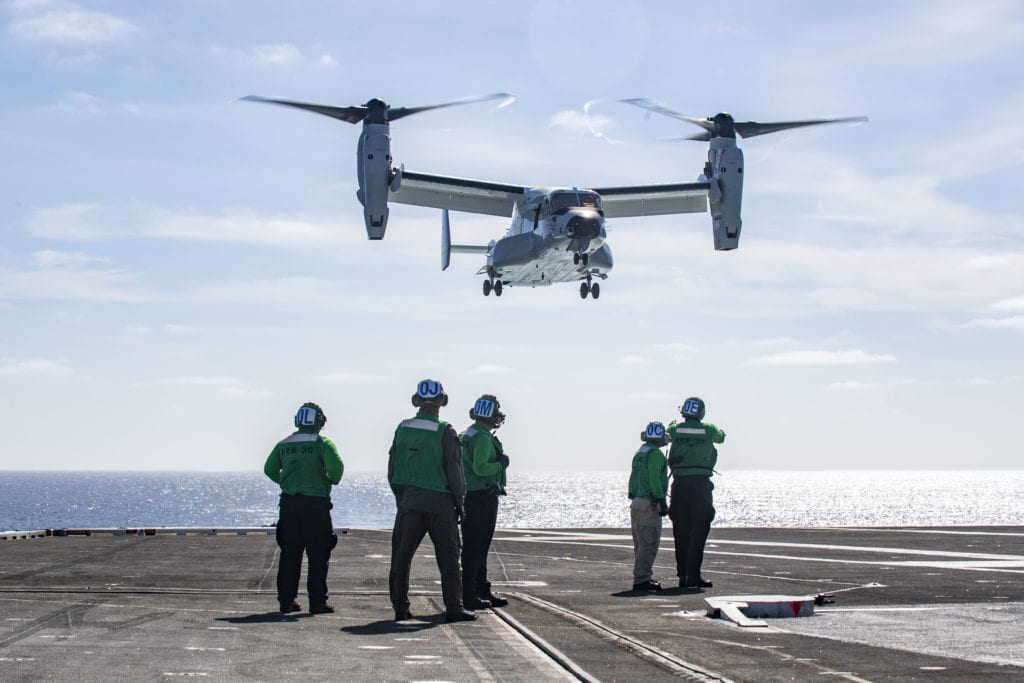
A CMV-22B Osprey from the “Titans” of Fleet Logistics Multi-Mission Squadron (VRM) 30 approaches the flight deck of Nimitz-class nuclear aircraft carrier USS Carl Vinson (CVN 70). U.S. Navy / Mass Communication Specialist 3rd Class Aaron T. Smith

ARLINGTON, Va. — The U.S. Navy has ordered four additional CMV-22B Osprey carrier-onboard delivery aircraft, according to a Feb. 26 Defense Department contract announcement.  

The Bell Boeing Joint Project Office, Amarillo, Texas, was awarded a $309.6 contract modification by the Naval Air Systems Command for the four CMV-22Bs,” the announcement said.  

The Navy’s CMV-22B replaces the C-2A Greyhound for the Carrier On-Board Delivery (COD) mission. Its mission is to transport personnel, mail, supplies and cargo from shore bases to aircraft carriers at sea. Forty-four of the 48 Navy program of record aircraft will be delivered under the June 2018 multiyear procurement contract.     

The CMV-22B differs from the MV-22B by having a high-frequency radio, extra fuel capacity, improved fuel dump capability, improved lighting for cargo handling and a public address system. The aircraft can carry up to 6,000 pounds up to a range of 1,150 nautical miles. It is capable of internally carrying the F-135 engine power module for the F-35 Lightning II.    

The CMV-22B made its first flight on Dec. 19, 2019 at Bell Flight’s Amarillo, Texas assembly facility and later flew to Naval Air Station Patuxent River to continue flight testing in February 2020. The first CMV-22B squadron, VRM-30, is working up a detachment to deploy on board USS Carl Vinson (CVN 70).    

Operational Test and initial operation capability are scheduled for 2021; full operational capability is scheduled for 2024.    


Navy Orders 15th Expeditionary Fast Transport from Austal

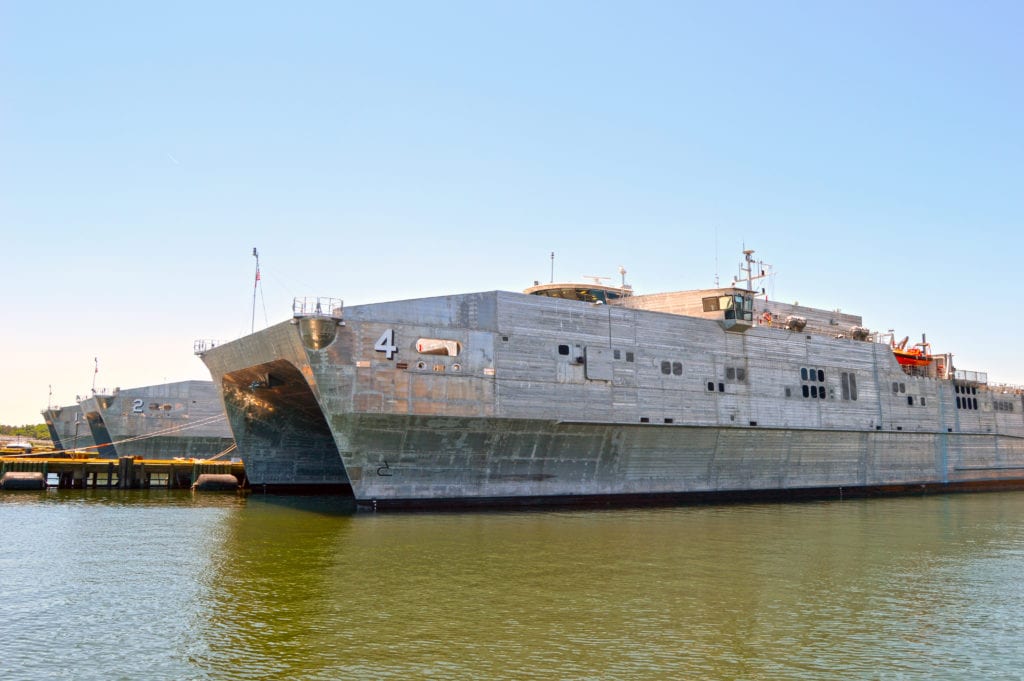
Expeditionary Fast Transport vessels, USNS Spearhead (T-EPF 1), USNS Choctaw County (T-EPF 2) and USNS Fall River (T-EPF 4) shown at Joint Expeditionary Base Little Creek-Fort Story in this 2015 photo. U.S. Navy / Brian Suriani

ARLINGTON, Va. — The U.S. Navy has awarded Austal USA a contract to build the 15th Spear-head-class expeditionary fast transport (EPF).  

The Naval Sea Systems Command awarded Austal a $235 million “undefinitized” contract action modification on Feb. 26, 2021, for the detailed design and construction of EPF 15, the company said in a release. 

The EPF, designated T-EPF in service to the Military Sealift Command, originally was designated a joint high-speed vessel, but has proven versatile in performing a number of roles in support of regional combatant commanders. Those roles have included humanitarian assistance, disaster relief, maritime security, surveillance, command and control, and counter narcotics, among others.  

“With a draft of only 13 feet and waterjet propulsion, the EPF is able to access austere and degraded ports with minimal external assistance providing flexibility to fleet and combatant commanders,” the Austal release said. “With its maneuverability, large open mission bay and ability to achieve speeds greater-than 35-knots, the EPFs have the capability to support additional missions such as special operations and medical support.” 

The Spearhead class originally was intended to be 10 ships: five for the U.S. Army and five for the Navy. The five Army ships later were reallocated to the Navy. The lead ship was delivered in December 2012. As the utility and success of the ships was demonstrated in operations, Congress has approved an increase in the number of hulls authorized, now at 15 ships. Austal has delivered 12 to the Military Sealift Command to date.  

EPF 15, like EPFs 13 and 14, will include an expeditionary medical capability. The EPFs are operated by civilian mariners of the Military Sealift Command.  

“At its core, the EPF is designed to be highly capable, flexible and affordable,” said Rusty Murdaugh, Austal USA’s chief financial officer and interim president. “With this baseline, we’ve been able to deliver multiple ships that are performing different missions for the U.S. military. The award of EPF 15 allows the Navy to leverage a hot production line and highly trained workforce to continue producing ships that are meeting the needs of warfighters today and into the future.” 


Ingalls Shipbuilding Awarded Life-Cycle Engineering Contract on Navy’s LPD 17 Program

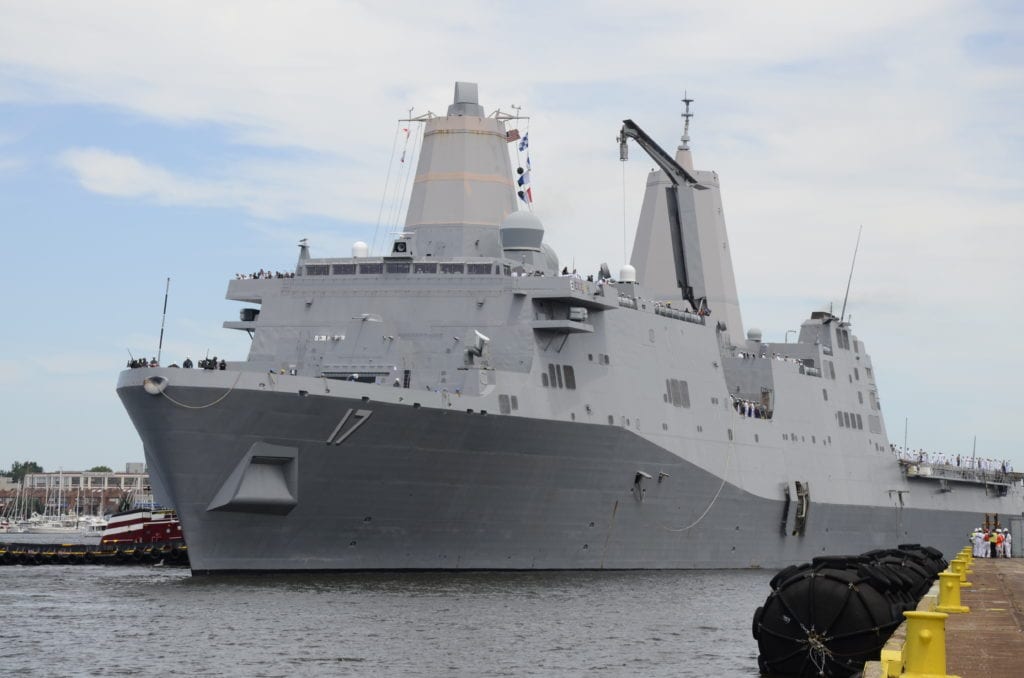
USS San Antonio (LPD 17) approaches its assigned berthing space in Baltimore, Maryland, in this 2012 photo. Ingalls Shipbuilding has been awarded a contract for life-cycle engineering and support services for the San Antonio class of amphibious transport docks. U.S. Navy / Joseph P. Cirone

PASCAGOULA, Miss. — Huntington Ingalls Industries’ Ingalls Shipbuilding division has been awarded a cost-plus-fixed-fee contract for life-cycle engineering and support services on the U.S. Navy’s San Antonio (LPD 17) class of amphibious transport docks, the company said in a Feb. 26 release. This follow-on contract consists of a base contract valued at $36.9 million with a cumulative value of $213.9 million if all options are exercised. 

“This contract enables Ingalls to continue providing LPD support and services that are critical to the sustainment of the Navy’s amphibious fleet,” said Ingalls Shipbuilding President Brian Cuccias. “Our talented workforce has the knowledge and experience required to perform this important work, and we are committed to ensuring these state-of-the-art warships serve our nation well into the future.” 

Services provided in this contract include engineering change management; systems engineering and integration; supply chain management; training for new LPD 17-class shipboard systems; and the execution of industrial post-delivery availabilities. 

“We appreciate the Navy’s continued investment in our experienced team and their reliance on the support we provide,” said David King, Ingalls’ LPD 17 life-cycle program manager. “This contract builds on our strong partnership with the Navy in the construction and post-delivery management of Navy ships. We look forward to supporting these ships as they evolve to meet the changing threat environment.” 

San Antonio-class ships are 684 feet long and 105 feet wide and displace approximately 25,000 tons. Their principal mission is to deploy the combat and support elements of Marine expeditionary units and brigades. The ships can carry up to 800 troops and have the capability of transporting and debarking landing craft air cushion or conventional landing craft, augmented by helicopters or vertical take-off and landing aircraft such as the MV-22. These ships will support amphibious assault, special operations or expeditionary warfare missions through the first half of the 21st century.