Looser Intel-Sharing Restraints May Be Worth a Look to Facilitate Joint Ops, Navy Data Chief Says
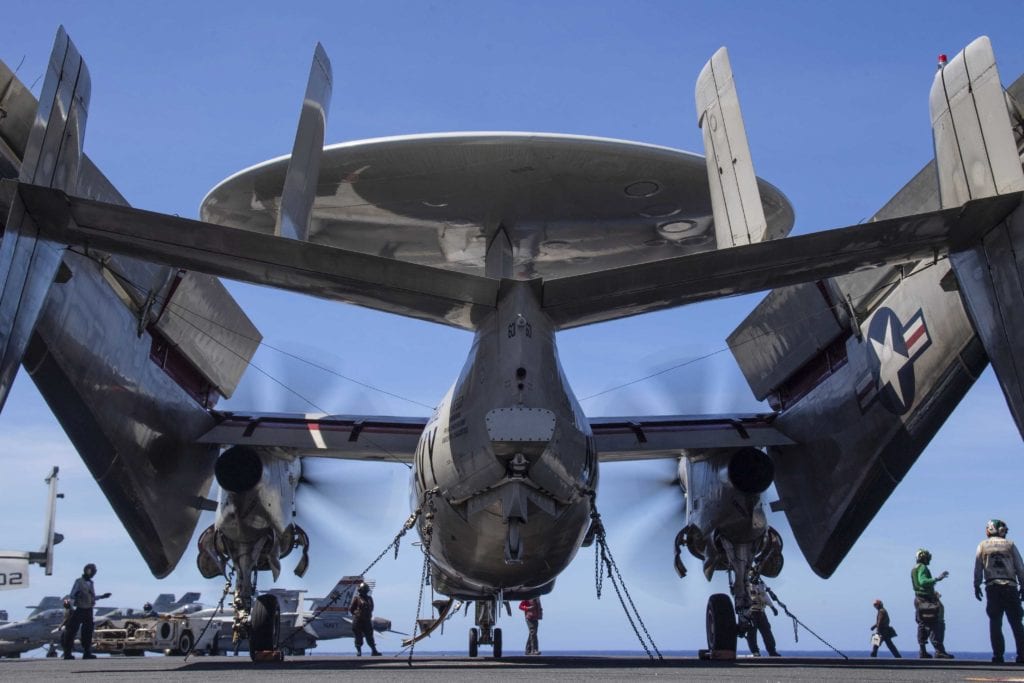
U.S. Sailors conduct pre-flight checks on an E-2C Hawkeye, assigned to the “Liberty Bells” of Airborne Command and Control Squadron (VAW) 115, as it starts up on the flight deck of the aircraft carrier USS Theodore Roosevelt (CVN 71) Jan. 30, 2021. U.S. Navy / Mass Communication Specialist 2nd Class Zachary Wheeler

ARLINGTON, Va. — Getting actionable, timely data to deployed expeditionary forces is tougher than keeping that data secure from prying adversaries, according to the U.S. Navy’s top data official.

“We’re pretty good at securing information and keeping it from people, which is the exact opposite of making it available for decision making,” concedes Thomas Sasala, chief data officer, Department of the Navy.

Enhancing data sharing is a key element in the Navy’s Project Overmatch, as part of the Defense Department’s Joint All-Domain Command and Control (JADC2) concept to connect sensors from all of the military services into a single network.

For years the Army, Navy, Marine Corps and Air Force have been developing tactical communications networks that can’t interface with other services’ networks, hampering joint operations, a pillar of the National Defense Strategy. And that’s keeping crucial data from getting to front-line commanders in an actionable timeframe. It may be worth taking a look at whether security culture is getting in the way, Sasala told the Feb. 17 webinar of the C4ISRNET website’s “Removing Stovepipes” series.

“You have to understand the concept of perishability,” Sasala said. The information given warfighters “is generally highly perishable. And so, if that information is hacked or compromised for one reason or another, it is not useful outside its lifecycle.”

Big strategic decisions are not being sent downrange for kicking-down-the door activity, Sasala said.

“Literally, it’s ‘This guy is on the roof right now.’ And five minutes from now that information is not useful to anyone because he’s no longer on the roof. And so, we have to take that risk calculus into the equation — which we don’t do today.”

All data is treated with the same sensitivity level, the same protection level, Sasala said, adding, it might be time to take a step back.

“The information might be classified. It might come from a highly classified intelligence source, but if it’s only good for five minutes, and only these three people need to see it, maybe we can just lighten up a little bit on how we get it to them.”

However, he added, issues like keeping sources and methods secret or maintaining plausible deniability on sensitive operations have to be considered when passing data.

“It’s a balancing act,” he said, “more cultural than anything. There are some bandwidth restraints. There are data operability and exchange restraints, but our general risk aversion to kind of opening up the aperture  a little bit on what data we send is probably the biggest barrier more than anything.”

The goal of Project Overmatch is to develop networks, infrastructure, data architecture, tools and analytics that enable Navy and Marine Corps operations that swarm the sea, delivering synchronized lethal and non-lethal effects from near-and-far in every domain.

Sasala called Overmatch the maritime contribution to the broader multi-domain battle space.

“From a data perspective, data simply doesn’t care whether you’re Army, Navy, Air Force. Position data is position data whether it’s a plane  or a boat — whatever,” he said. But breaking down military department silos or stovepipes “is really the key to getting at something like JADC2.”
USS Dwight D. Eisenhower Deploys Upon Completion of Historic COMPTUEX

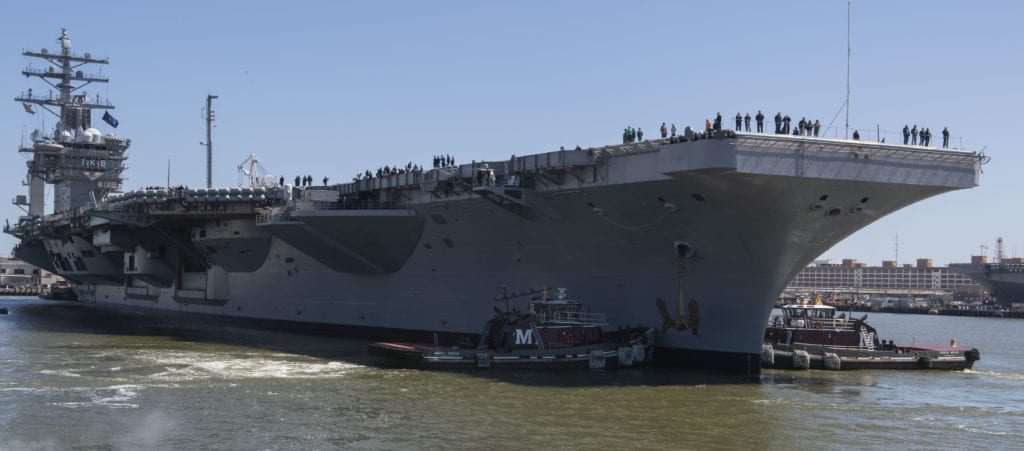
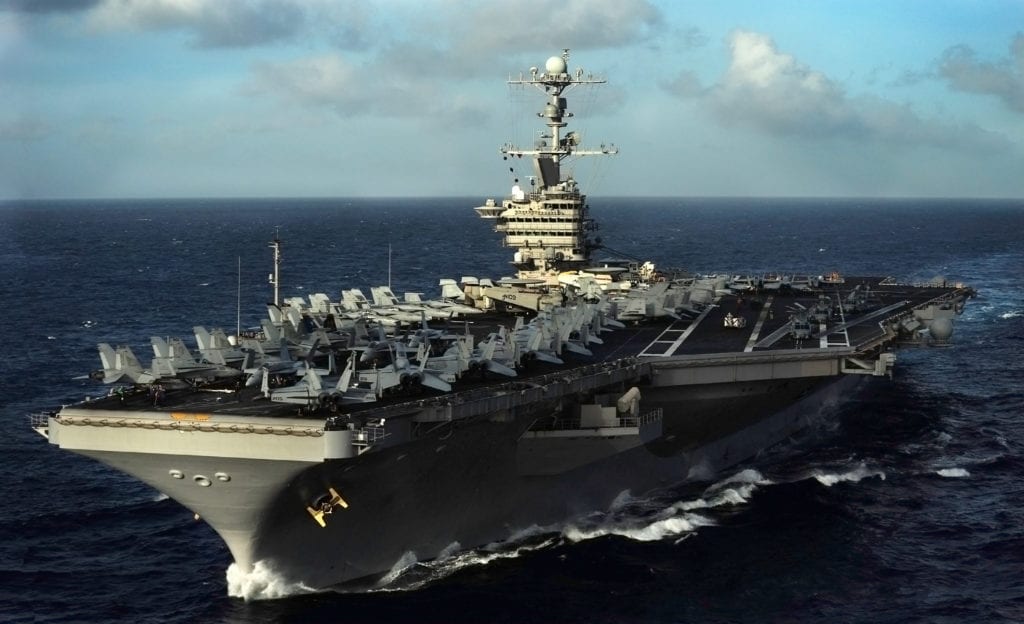
The Nimitz-class aircraft carrier USS Dwight D. Eisenhower (CVN 69) departs for a scheduled underway in this 2019 photo. As part of the Eisenhower Carrier Strike Group, it has now departed for deployment. U.S. Navy / Mass Communication Specialist 3rd Class Daniel E. Gheesling

NORFOLK, Va. — The Nimitz-class aircraft carrier USS Dwight D. Eisenhower (CVN 69) and the ships and aircraft of Carrier Strike Group (CSG) 2, the Eisenhower Carrier Strike Group (IKE CSG), departed for deployment Feb. 18 after successfully completing a historic Composite Unit Training Exercise (COMPTUEX).

That COMPTUEX included a NATO vignette and training with SEALS from an East Coast-based Naval Special Warfare (NSW) Group for the first time in recent history, the U.S. 2nd Fleet said in a Feb. 18 release. 

 “COMPTUEX provided graduate-level training that simulates the full spectrum of operations, low intensity to high-end combat that IKE CSG must be ready for,” said Rear Adm. Scott Robertson, commander, CSG-2. “The live, virtual and constructive training with a NATO backdrop enabled the team to hone its application of integrated, multiple domain warfare. We are ready to deploy!” 
 
The inaugural NATO vignette, developed by CSG 4 and Combined Joint Operations from the Sea Centre of Excellence (CJOS COE), consisted of familiarity training designed to facilitate Allied maritime interoperability and integration, in practical terms using NATO procedures, messaging formats and chat capabilities. The vignette developed and refined a clear list of interoperability requirements for future Navy force generation, and improved allied maritime command and control linkages. 
 
“To ensure truly effective deterrence and defense in the North Atlantic, we need to make sure that the navies of NATO can work as one team, and that means interoperability is vital,” said Commodore Tom Guy, Royal Navy, deputy director CJOS COE. “This NATO vignette has been a great step forward in pursuing allied interoperability. CJOS COE looks forward to continuing to develop this for future deploying strike groups.” 
 
Additionally, NSW SEAL, Boat and Reconnaissance units integrated with the IKE CSG team to enhance warfighting lethality in the maritime domain and to educate Fleet leadership on unique NSW capabilities. The SEAL Team focused on supporting COMPTUEX in maritime strike warfare. During the training, personnel helped with over-the-horizon targeting, directed combat aircraft’s action in close-air support, and other offensive air operations. NSW forces controlled operations from a Task Group headquarters. To extend the IKE CSG reach, NSW forces employed multi-mission combatant craft, which allowed operators to get closer to simulated enemies and send the real-time operational picture back to decision-makers on the ship and beyond. The SEAL Team also sent an advisor to the training cell to provide expertise on NSW capabilities. 
 
The opportunity to support IKE CSG objectives by showcasing NSW’s unique contributions to distributed maritime operations improved integration and interoperability with the fleet. NSW was able to validate near-peer maritime and land-based tactics, techniques and procedures to demonstrate NSW’s critical role in global power competition. 
 
COMPTUEX is a live, virtual, and constructive (LVC) training that provides Sailors from the IKE CSG with an opportunity to operate real equipment with real risk. LVC training increases interoperability and provides the fleet with unprecedented flexibility in conducting training across the spectrum of operations and threat scenarios. CSG 4 was involved in building the scenarios and assessing performance to ensure that when IKE CSG shows up to the fleet they are ready to operate. 
 
The IKE CSG is a multiplatform team of ships, aircraft and more than 6,000 Sailors, capable of carrying out a wide variety of missions around the globe. 
 
Deploying ships and aircraft of the strike group, commanded by Rear Adm. Scott Robertson, include flagship USS Dwight D. Eisenhower (CVN 69), commanded by Capt. Paul F. Campagna; eight squadrons from Carrier Air Wing Three; Ticonderoga-class guided-missile cruisers USS Monterey (CG 61) and USS Vella Gulf (CG 72); Arleigh Burke-class guided-missile destroyers USS Mitscher (DDG 57), USS Laboon (DDG 58), USS Mahan (DDG 72) and USS Thomas Hudner (DDG 116) from Destroyer Squadron 22 stationed at Naval Station Norfolk, Virginia. 
 
Squadrons of Carrier Air Wing (CVW) 3, commanded by Capt. Marcos Jasso, embarked on Eisenhower include the “Fighting Swordsmen” of Strike Fighter Squadron (VFA) 32, “Gunslingers” of Strike Fighter Squadron (VFA) 105, “Wildcats” of Strike Fighter Squadron (VFA) 131, “Rampagers” of Strike Fighter Squadron (VFA) 83; “Dusty Dogs” of Helicopter Sea Combat Squadron (HSC) 7; “Swamp Foxes” of Helicopter Maritime Strike Squadron (HSM) 74; “Screwtops” of Airborne Command and Control Squadron (VAW) 123; “Zappers” of Electronic Attack Squadron (VAQ) 130, and a detachment from Fleet Logistics Support Squadron (VRC) 40 “Rawhides.” 
 
C2F exercises operational authorities over assigned ships, aircraft, and landing forces on the East Coast and the Atlantic. When directed, C2F conducts exercises and operations within the U.S. European Command area of operations as an expeditionary fleet, providing Naval Forces Europe an additional maneuver arm to operate forces dynamically in theater. 


HII Awarded $2.9 Billion Contract to Execute USS John C. Stennis RCOH

The Nimitz-class aircraft carrier USS John C. Stennis (CVN 74) transits the Pacific Ocean during a replenishment at sea. Huntington Ingalls Industries’ Newport News Shipbuilding will carry out its refueling and complex overhaul under a $2.9 billion contract. U.S. Navy / Mass Communication Specialist 2nd Class Walter M. Wayman

NEWPORT NEWS, Va. — Huntington Ingalls Industries’ Newport News Shipbuilding division has been awarded a $2.9 billion contract for the refueling and complex overhaul (RCOH) of the nuclear-powered aircraft carrier USS John C. Stennis (CVN 74), the company said in a Feb. 19 release. 

“We are pleased to be awarded the contract to execute this extensive construction and engineering project,” said Todd West, Newport News’ vice president, in-service aircraft carrier programs. “Our teams have spent three years preparing and planning for each step of the process along the way, and we look forward to continuing our work with our suppliers and Navy partners in anticipation of the ship’s arrival at Newport News.” 

The RCOH represents 35% of all maintenance and modernization in an aircraft carrier’s 50-year service life. Stennis’ RCOH will include the refueling of the ship’s reactors, as well as extensive modernization work to more than 2,300 compartments, hundreds of tanks and systems. In addition, major upgrades will be made in the propulsion plant, to the flight deck, catapults, combat systems and the island. 

Built at Newport News, Stennis was christened in 1993 and delivered to the Navy in 1995. The ship is the seventh Nimitz-class carrier to undergo this major life-cycle milestone. More than 4,000 Newport News employees will support the execution effort, which will continue through late 2025. 


With Crew Vaccinations Increasing, Newest Navy COVID-19 Guidance Looks to Ease Liberty Restraints

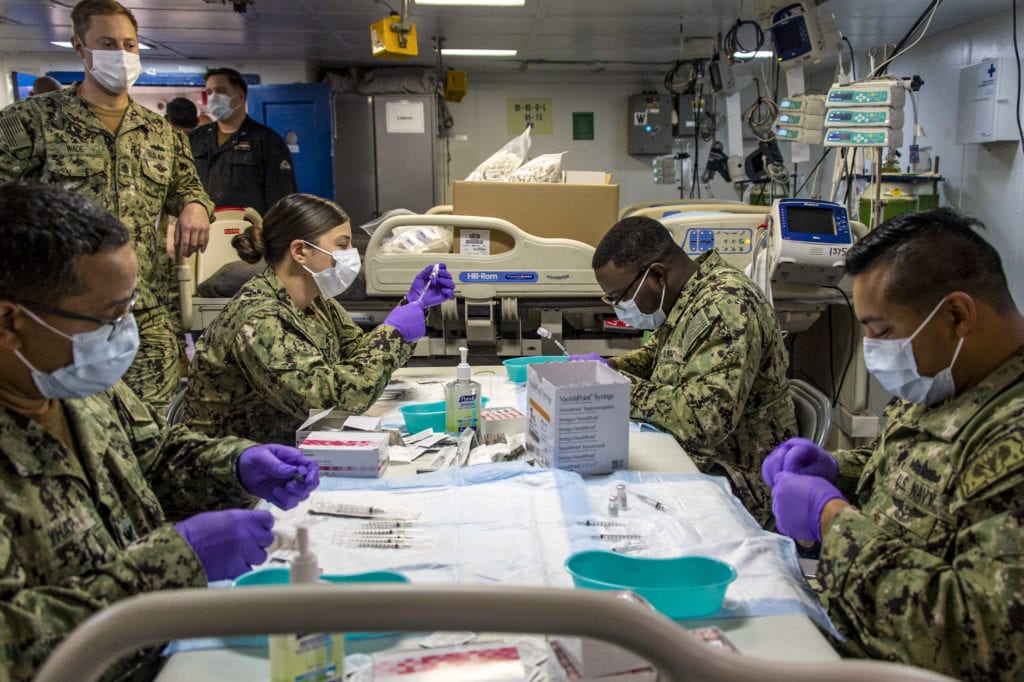
Sailors prepare syringes of the Pfizer COVID-19 vaccine aboard Wasp-class amphibious assault ship USS Essex (LHD 2). This marked the first time personnel received vaccines aboard a Pacific Fleet warship. Essex is homeported in San Diego. U.S. Navy / Mass Communication Specialist 3rd Class Brett McMinoway

ARLINGTON, Va. — The U.S. Navy’s newest operational guidance for dealing with the coronavirus pandemic includes provisions for more Safe Haven ports like Guam and Rota, Spain to provide secure  liberty opportunities for crews on increasingly lengthy deployments, according to senior officers.

COVID-19 Standardized Operational Guidance (SOG) 4.0 is the first directive for commanders since vaccines against the novel coronavirus became available in January. Although predominantly focused on shipboard environment, SOG 4.0 applies to all uniformed Navy personnel at home and deployed.

Fully immunized Sailors enable the Navy “to begin to unwind the limits” placed on Sailors at sea, where the consequence of a wide-spread outbreak is greatest, the Guidance issued Feb. 16, noted.

“Where a ship at sea can be a challenge to contain the spread, having a high immunization rate [among crew] could cause the disease to have nowhere to go and burn itself out,” Rear Adm. Karl Thomas, Assistant Deputy Chief of Naval Operations for Operations, Plans, and Strategy, (N3/N5B), said Feb. 19.

In a roundtable with reporters, Thomas said 35,000 Sailors have received at one vaccine injection and  45,000 are totally immunized. Rear Adm. Bruce Gillingham, the Surgeon General of the Navy, said those numbers amounted to about 23% of the Fleet having at least one dose of the vaccine. Whether immunized Sailors can still transmit the virus remains “the $64,000 question,” Gillingham said.

Since a COVID outbreak in early 2020 infected more than 1,000 crew members of the USS Theodore Roosevelt and sidelined the aircraft carrier at Guam for months, deployed ships have spent nearly all their time at sea. Additionally, increased operational tempo has led to longer deployments and quick turn arounds, or double pumps, for carrier strike groups, causing stress for crews and their families. The carrier USS Dwight Eisenhower, at sea for seven months in 2020, was deployed again in February.

“Up until this point, we’ve really had to restrict the Sailors to liberty on the pier,” Thomas said, adding. “In Guam there’s a beach right next to the pier and we’re able to keep it segregated from the population so they can get some liberty on the pier as well as get down to the beach.”

But in SOG 4.0, he said “we actually put a paragraph in there about Safe Haven ports in places like Guam, Yokosuka, Bahrain.” Officials hope that crews with higher immunization rates will be able to have more quality liberty opportunities at ports with more services like Exchanges and Morale, Welfare and Recreation facilities.

The final decision on safe haven ports will be up the geographically dispersed Navy component commanders “but we wanted to put [the opportunity] into the guidance for them to be able to do that type of thing,” Thomas said.


Navy Begins Retirement of Cyclone-Class Patrol Ships Without Replacement

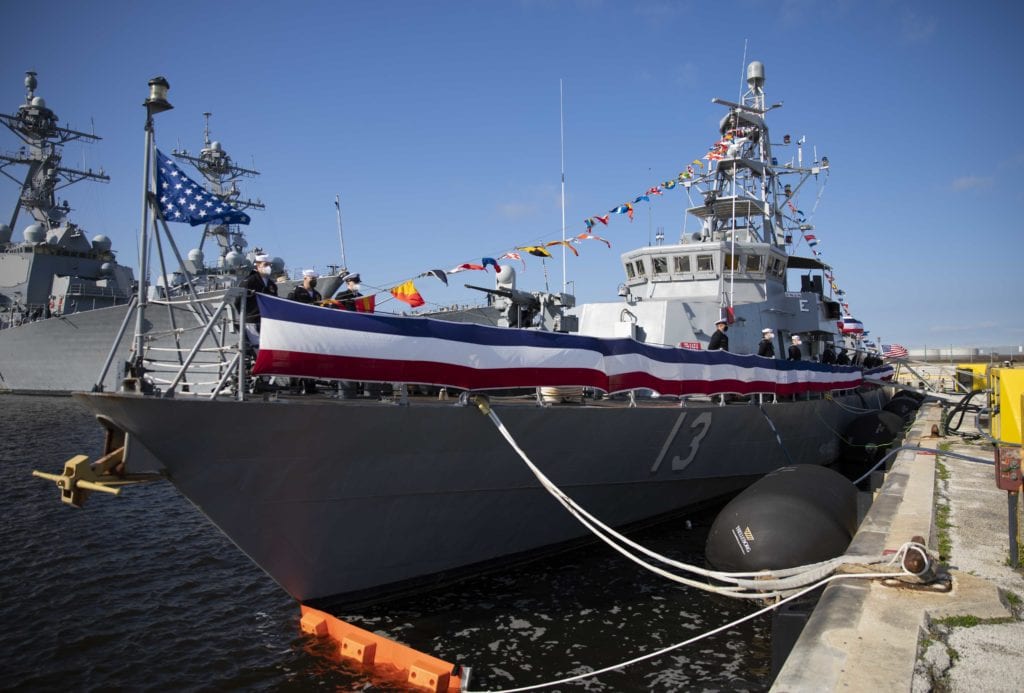
Sailors conduct a decommissioning ceremony aboard the Cyclone-class patrol ship USS Shamal (PC 13) at Naval Station Mayport, Florida. Shamal is one of three Cyclone-class patrol ships being decommissioned at Naval Station Mayport. U.S. Navy / Mass Communication Specialist 3rd Class Austin G. Collins

ARLINGTON, Va. — The Navy held ceremonies this week to mark the decommissioning of three Cyclone-class coastal patrol ships this week, beginning the retirement of the class which has no direct replacement. 

The three decommissioning ceremonies held over three days — Feb. 16, 17, and 18 — marked the imminent retirement of the Cyclone-class coastal patrol ships USS Shamal (PC 13), USS Zephyr (PC 8) and USS Tornado (PC 14), respectively, at Naval Station Mayport, Florida. 

In recent years, the three PCs were used to train crews for the 10 PCs forward deployed to the Persian Gulf. They also participated in homeland security missions such as drug interdiction countering illegal immigration. 

The Navy commissioned 14 Cyclone-class PCs between 1993 and 2000. They were built by Bollinger Shipyards and designed for coastal interdiction and support of special operations forces such as SEALs. They were built with a 15-year service life and even the newest already has operated for six years beyond that. 

The lead ship, USS Cyclone, was transferred to the Philippine Navy after being briefly transferred to the U.S. Coast Guard, which did not operate the ship.  

Several PCs operated in support of Operation Iraqi Freedom and ultimately 10 were forward deployed to the U.S. Fifth Fleet in the Persian Gulf. 

During 2004, five PCs were transferred to the U.S. Coast Guard to perform homeland security missions. All five were returned to the Navy by August 2008.  

“The decision to decommission these three ships [Shamal, Zephyr and Tornado] stems from the fact that they have all exceeded their designed service life,” the Navy said in a Feb. 17 web article. “Based on the rising cost of modernization efforts, the Navy will receive a better return by decommissioning and freeing up funds to invest in other platforms.” 

The PCs offer rare command-at-sea opportunity for lieutenants, one reason the ships will be missed. The ships will have no direct replacements, but their presence in the Persian Gulf eventually will be assumed by littoral combat ships. 

“These three warships have served our Navy and our country well,” said Capt. Mike Meyer, commander, Naval Surface Squadron Fourteen, in the Navy release.  “Each of them has operated well past their designed service life, with their crews contributing demonstrably to meeting our national objectives.” 

The three PCs being retired are being transferred to the Navy’s inactive ship facility in Philadelphia, where they will be decommissioned officially. The official decommissioning dates are Feb. 25, March 2 and March 4 for Shamal, Zephyr and Tornado, respectively. Tornado will be held for Foreign Military Sales; the other two will be scrapped. 


MDSU 2 Hosts Ice Dive Training for Arctic Training

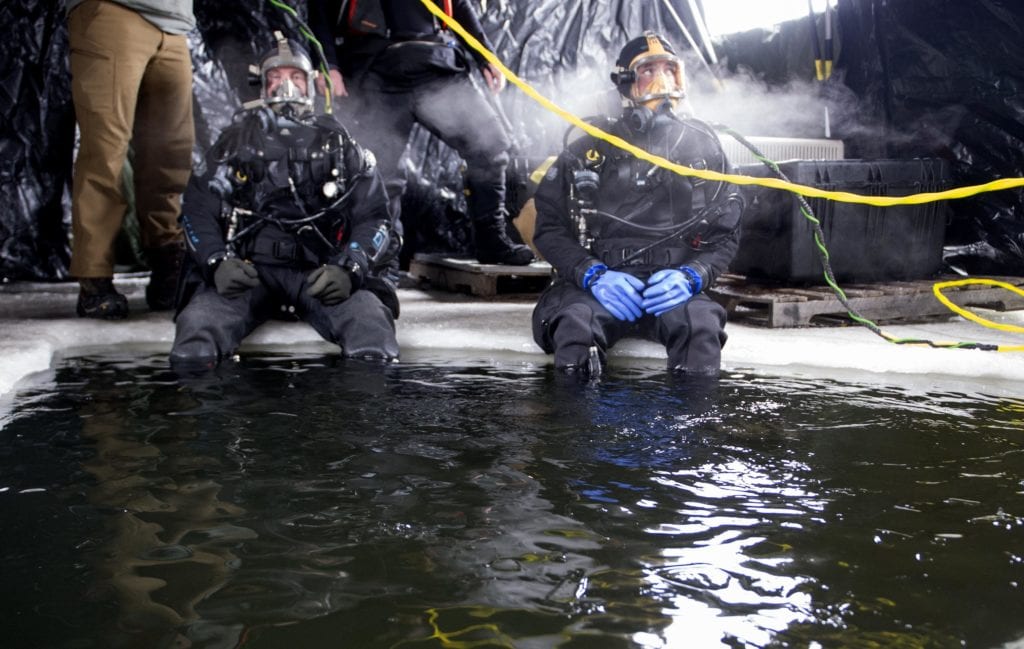
Navy divers assigned to Mobile Diving and Salvage Unit (MDSU) 2 prepare to enter the water during ice dive training at Camp Ripley in Little Falls, Minnesota. The training hosted by MDSU 2, is in its third iteration and has become more relevant, showcasing how Navy divers are assisting in building a more capable arctic naval force. U.S. Navy / Chief Mass Communication Specialist Jeff Atherton

VIRGINIA BEACH, Va. – Mobile Diving and Salvage Unit (MDSU) 2, headquartered at Joint Expeditionary Base Little Creek-Fort Story, hosted the third iteration of ice dive training for Navy divers and explosive ordnance disposal (EOD) technicians at Camp Ripley in Little Falls, Minnesota, in February, the group said in a Feb. 16 release. 
 
The course, run by qualified Navy divers and civilian instructors, teaches the fundamentals of operating on and diving under the ice. 

Ice diving is unique and it can be hazardous without the proper training. Dry suit familiarization dives must be completed prior to diving under the ice, and scuba cold-water set-up training and familiarization must also take place prior to the operation.

Familiarization and training on all aspects must be conducted prior to operating in an Arctic environment, which is why civilian instructors are used who have a wealth of experience operating in these cold environments. The courses hosted by Dive Rescue International are introductory and provides the tools necessary for Navy divers to execute ice diving operations in an Arctic environment. The extensive logistical considerations, medical considerations, emergency evacuation procedures, and topside personnel considerations are also taken into account prior to execution. 

Camp Ripley is an outstanding site to conduct ice and cold weather dive training. The site allows Navy divers to train in a subzero temperature and arduous conditions at training ranges that provide bodies of water similar to operating in the Arctic environment. The Army National Guard has been a tremendous help in supporting with base facilities and logistical support making it an ideal location to train in the Arctic environment now and in the future. 

In the course, the divers are responsible for dive setup, which includes building tents, heating the tents and cutting holes in the ice before diving. 

While the Arctic environment is not outside of the skill set of Navy divers, it is a significant difference from the comparatively warmer waters of Virginia Beach and the significantly warmer waters of Key West, Florida, where many divers are accustomed to training. 

With the recent release of the Department of the Navy’s strategic blueprint for the Arctic, this annual training event has become even more relevant, showcasing how Navy divers are assisting in building a more capable arctic naval force. 

MDSU 2 is part of Explosive Ordnance Disposal Group (EODGRU) 2, which oversees all East Coast explosive ordnance disposal and a mobile diving and salvage unit which are capable of providing skilled, capable, and combat-ready deployable forces around the globe to support a range of operations.

Article by Chief Petty Officer Jeff Atherton, Explosive Ordnance Disposal Group Two


Lawmakers Renew Push for Navy to Procure 3 Virginia Submarines Per Year

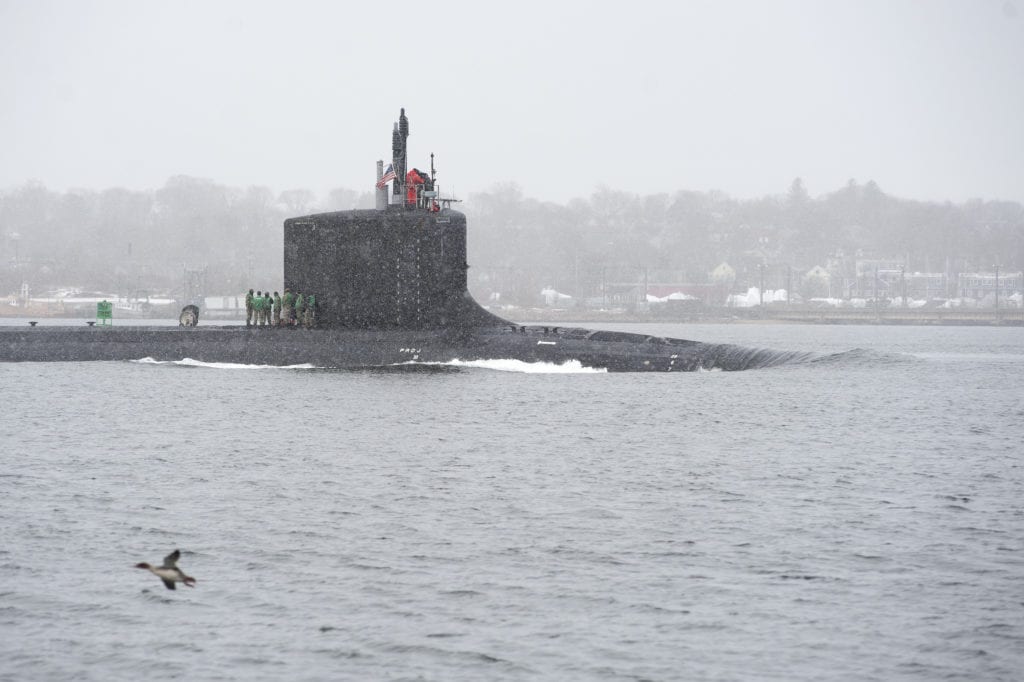
The Virginia-class attack submarine USS Vermont (SSN 792) makes its way up the Thames River and past New London, Connecticut on Feb. 3. Leaders of the House Armed Services Committee’s Seapower subcommittee want the Navy to increase its procurement of Virginia-class boats to three per year. U.S. Navy / John Narewski

ARLINGTON, Va. — The Navy needs to increase procurement of its Virginia-class attack submarines (SSNs) to three per year in order to pace the potential threat of China and Russia, said the congressmen who lead the Seapower subcommittee in the House Armed Services Committee. The U.S. Navy also needs to push ahead with development of the follow-on to the Virginia class, they said.  

Speaking Feb. 19 in a webinar sponsored by the Hudson Institute, Rep. Joe Courtney, D-Connecticut, chairman of the Seapower subcommittee, and Rep. Rob Wittman, R-Virginia, ranking member, were united in their reiteration of the need for more attack submarines and have renewed the push to include three in the 2022 defense budget, a level that nearly was achieved in the 2021 final budget.  

Wittman noted a recent study that reinforced how “incredibly important getting to building three attack submarines per year will be for this nation going forward.” 

Wittman said it was critical the Navy request a third SSN in the president’s 2022 budget proposal because “it is extraordinarily difficult to add things to the president’s budget.” 

He recounted the effort to increase the procurement of a third SSN in the 2021 budget, which was ultimately unsuccessful when the proposed amendment was defeated in the House in a floor vote for the appropriations bill.  

Wittman is optimistic the third submarine will be included in the 2022 budget, saying, “I think the glass is half full.” 

Courtney also is optimistic, noting the recent statements by Defense Secretary Austin — a retired Army general — and Gen. Mark Milley, chairman of the Joint Chiefs of Staff — an Army general — that the budget “pie” may need to be sliced more in favor of naval, aerial, and cyber capabilities. 

The construction of the Columbia ballistic-missile submarine that began recently is pressuring the budget of the Navy and capacity of the submarine industrial base.  

“Frankly, we’re going to need more facilities if we’re really going to get serious about going for three [SSNs] per year on a regular basis,” Courtney said.

The nation’s two submarine builders are General Dynamics Electric Boat in Courtney’s district and Huntington Ingalls Newport News Shipbuilding in Virginia, Wittman’s home state.  

Courtney said he also has concerns about the work force but is “bullish” on solving that challenge. He stressed the need to “keep performance of the shipyards at uppermost.” 

Wittman supports the Navy’s plan to extend the service lives of some Los Angeles-class SSNs as part of the formula to a submarine force large enough to meet the potential threat from near-peer competitors like China and Russia.  

He also stressed the need for the Navy to focus on development of the next-generation of attack submarines to assure no gaps as the production of the Virginia-class SSNs ends.  


KBR to Reinforce the US Navy’s Counter-Unmanned Air Systems

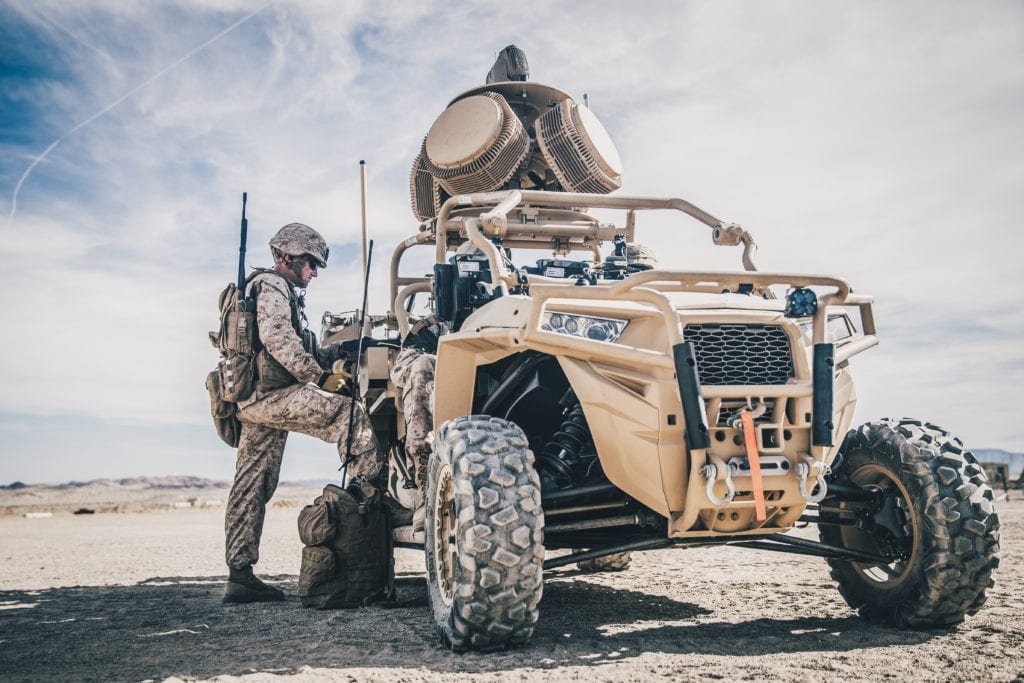
1st Lt. Taylor Barefoot, a low altitude air defense officer with Marine Medium Tiltrotor Squadron 163 (Reinforced), 11th Marine Expeditionary Unit, programs a counter-unmanned aircraft system on a Light Marine Air Defense Integrated System (LMADIS) during a predeployment training exercise at Marine Corps Air Ground Combat Center Twentynine Palms, Calif., Nov. 13, 2018. U.S. Marine Corps / Lance Cpl. Dalton S. Swanbeck

HOUSTON — KBR has been awarded a $92.6 million contract to perform engineering, integration and sustainment services on counter unmanned air systems (C-UAS) for the Combat Integration & Identification Systems unit within the U.S. Naval Air Warfare Center Aircraft Division (NAWCAD), the company said in a Feb. 16 release. 

This cost-plus-fixed-fee, indefinite-delivery/indefinite-quantity contract is a new opportunity for KBR to help the U.S. military with ground-based air defense. 

KBR will provide its expertise to various Navy identification and data link systems, which include the Negation of Improvised Non-State Joint Aerial-Threats (NINJA) system; Counter-Remote Control Model Aircraft Integrated Air Defense Network (CORIAN) system; SkyTracker UAS detection and tracking suite; Light Marine Air Defense Integrated System (LMADIS); Marine Air Defense Integrated System (MADIS); and ANDURIL artificial intelligence platforms. 

The Department of Defense uses these C-UAS systems to strengthen homeland security and address potential threats in the U.S. and abroad. The systems can scan the skies for enemy aircraft and take appropriate action to deny airspace access. 

KBR’s specific tasks will include the integration and installation of systems; the characterization of system and subsystem components; development of training curriculum and materials, as well as delivery of formal training programs; supply system management and material control; testing and repair of C-UAS; and laboratory maintenance and quality assurance. The company will perform the five-year contract primarily at Webster Outlying Field in St. Inigoes, Maryland.  

KBR’s services supporting NAWCAD will also benefit programs sponsored by the Naval Air Systems Command; Naval Sea Systems Command; Naval Inventory Control Point – Mechanicsburg; U.S. Coast Guard; commercial and Foreign Military Sales customers; and other DoD and government entities. 

 “Our work through this new win will have wide-reaching impacts within the DoD and international allied community,” said Byron Bright, KBR Government Solutions president. “We are excited to join NAWCAD as it advances C-UAS technology and, ultimately, strengthens national security and protects our armed forces around the globe.” 


Navy Awards Collins Aerospace $64 Million Contract for Warship Sonar Domes

The Naval Programs group within Aerostructures at Collins Aerospace has supplied more than 25 composite keel domes and 360 rubber bow windows for U.S. Navy surface ships. Collins Aerospace

JACKSONVILLE, Fla. — The Naval Surface Warfare Center in Crane, Indiana, has awarded Collins Aerospace Systems, a unit of Raytheon Technologies, a seven-year, $64 million indefinite delivery, indefinite quantity contract to provide sonar domes for surface combat ships for the U.S. Navy and allied forces, the company said in a Feb. 16 release. 
 
The agreement, which builds upon a previous five-year production contract, includes shipping, installation, engineering support, field services, inspection and repairs. Work will be produced by the Naval Programs (Engineered Polymer Products) group of the Aerostructures business unit at Collins Aerospace. 
 
Sonar domes, located on the hulls of warships, protect critical electronic equipment used for detection, navigation and ranging. The domes permit acoustic energy to pass through with minimal sound transmission interference. 
 
The contract includes domes made of a proprietary advanced composite material developed by Collins Aerospace that provides optimal structural and acoustic performance to the ship’s sonar system. This allows for enhanced detection and classification of underwater targets. These composite keel domes replaced traditional rubber domes on U.S. and Allied Navy frigates in 1997 because they require less maintenance and are expected to last more than 30 years even under the most extreme operating conditions. 
 
“Our sailors are putting their lives on the line, and they need the most advanced solutions available to keep them safe. We’ve spent more than 25 years refining our sonar systems technologies and materials to do just that,” said Marc Duvall, president of Aerostructures at Collins Aerospace. “We’re honored to serve the men and women of the Navy and provide the technology they need to see deep into the seas they protect.” 
 
To date, Naval Programs has supplied over 25 composite bow domes for U.S. Navy Virginia-class submarines, as well as more than 25 composite keel domes and 360 rubber bow windows for U.S. Navy surface ships. 


Navy Details Revised 2021 Ship Decommissioning Schedule

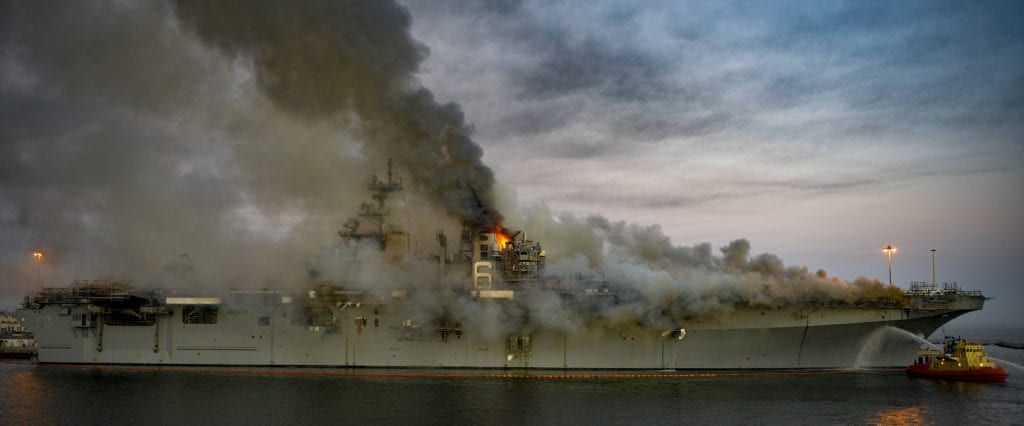
USS Bonhomme Richard (LHD 6), due to be dismantled after its devastating fire in 2020. U.S. Navy / Mass Communication Specialist 2nd Class Austin Haist

ARLINGTON, Va. — The U.S. Navy has revised its ship decommissioning schedule for fiscal 2021, including the date for the Wasp-class amphibious assault ship USS Bonhomme Richard, severely damaged by fire in 2020. The list also included the first two littoral combat ships. 

In an Feb. 12 administrative message, the Office of the Chief of Naval Operations announced the plans to decommission seven ships from the fleet and remove from service one ship from the Military Sealift Command. 

The ships to be retired and their 2021 retirement dates are listed below: 

Ship Name           Projected Inactivation Date        Post Inactive Status 

USS Zephyr (PC 8)           March 2            Dismantle 

USS Shamal (PC 13)      Feb. 25            Dismantle 

USS Tornado (PC 14)    March 4           Foreign Military Sales 

USS Fort McHenry (LSD 43)   Apr. 16          Reserve 

USS Freedom (LCS 1)          Sept. 30                 Reserve 

USS Independence (LCS 2)      July 31             Reserve 

USS Bonhomme Richard (LHD 6) April 15     Dismantle  

USNS Sioux (T-ATF 171)    Sept. 30         Foreign Military Sale 

The first two littoral combat ships are considered experimental and are of an earlier configuration than later production ships. They will be placed in a preserved status for re-activation if needed, as will the USS Fort McHenry. 

The three Cyclone-class coastal patrol ships are the only ones of the class not based in the Persian Gulf.  

The Navy also plans to retire 48 more ships during fiscal 2022-2026.