Winston S. Churchill Seizes Illicit Weapons from Two Dhows off Somalia
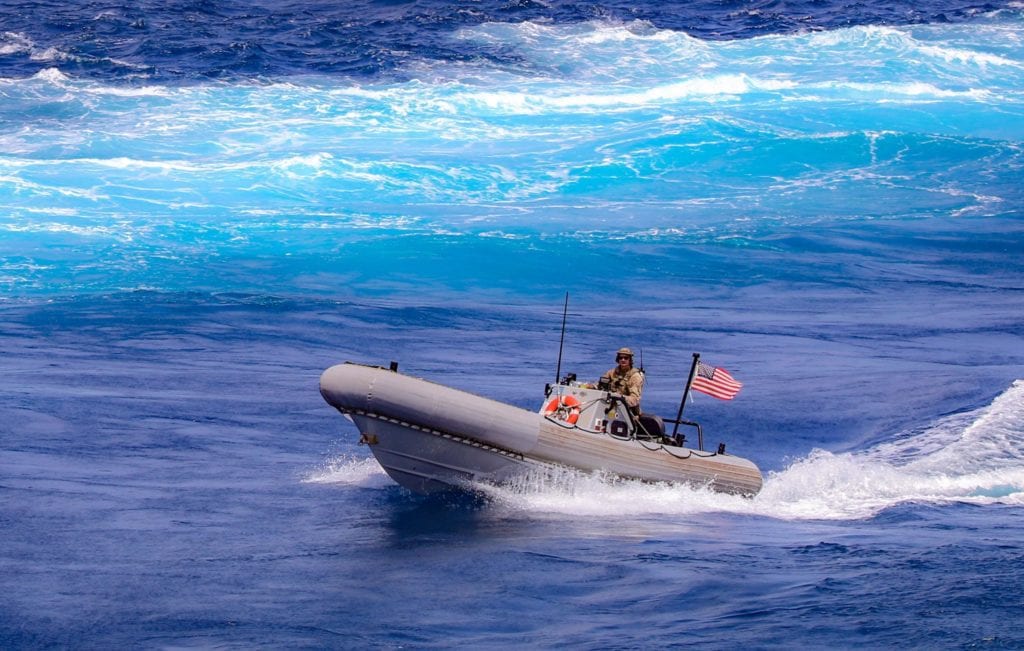
A Sailor assigned to the guided-missile destroyer USS Winston S. Churchill (DDG 81), in accordance with international law, boarded a stateless dhow off the coast of Somalia and interdicted an illicit shipment of weapons and weapon components, Feb. 12. U.S. Navy / Mass Communication Specialist 3rd Class Louis Thompson Staats IV
INDIAN OCEAN – The guided-missile destroyer USS Winston S. Churchill (DDG 81) seized illicit shipments of weapons and weapons components from two stateless dhows during a maritime security operation in international waters off the coast of Somalia, Feb. 11-12, U.S. Naval Forces Central Command / U.S. 5th Fleet Public Affairs said in a Feb. 16 release.
Churchill’s Visit, Board, Search, and Seizure (VBSS) team and embarked joint service Advanced Interdiction Team (AIT) discovered the illicit cargo during a flag verification boarding conducted in accordance with international law and in international waters.
The cache of weapons consisted of thousands of AK-47 assault rifles, light machine guns, heavy sniper rifles, rocket-propelled grenade launchers, and crew served weapons. Other weapon components included barrels, stocks, optical scopes and weapon systems.
The original source of the weapons has not yet been identified. Churchill located the dhows and provided more than 40 hours of over watch and security for the ship and its boarding teams throughout the two-day operation.
The dhow crews were provided food and water before being released.
“We are proud of the combined efforts of the AIT and Churchill crew members for executing dynamic and demanding boardings,” said Lt. Travis Dopp, assistant AIT leader aboard Churchill. “We are proud to have a positive impact on the safety and security of coalition forces by interdicting shipments of lethal aid.”
The seizure of the illicit weapons by Churchill was conducted as part of the U.S. Navy’s regular maritime security operations in the region. These routine patrols are performed to ensure the free flow of commerce for legitimate traffic and to disrupt the transport of illicit cargo that often funds terrorism and unlawful activity.
“This joint team [Army, Navy and Coast Guard] on board Churchill came together to successfully execute this operation over the course of two days in the Indian Ocean. These operations prevent nefarious actors from illegally spreading their lethal aid,” said Cdr. Timothy Shanley, commanding officer of Churchill.
Winston S. Churchill departed Norfolk, Virginia, Aug. 10 for a regularly-scheduled deployment to maintain maritime security and ensure the freedom of navigation in critical waterways.
U.S. 5th Fleet, headquartered in Manama, Bahrain, conducts joint and naval operations in order to support regional allies and partners and U.S. national security interests in the Middle East.
Italian Navy Aircraft Carrier Arrives at Norfolk for F-35B Certification
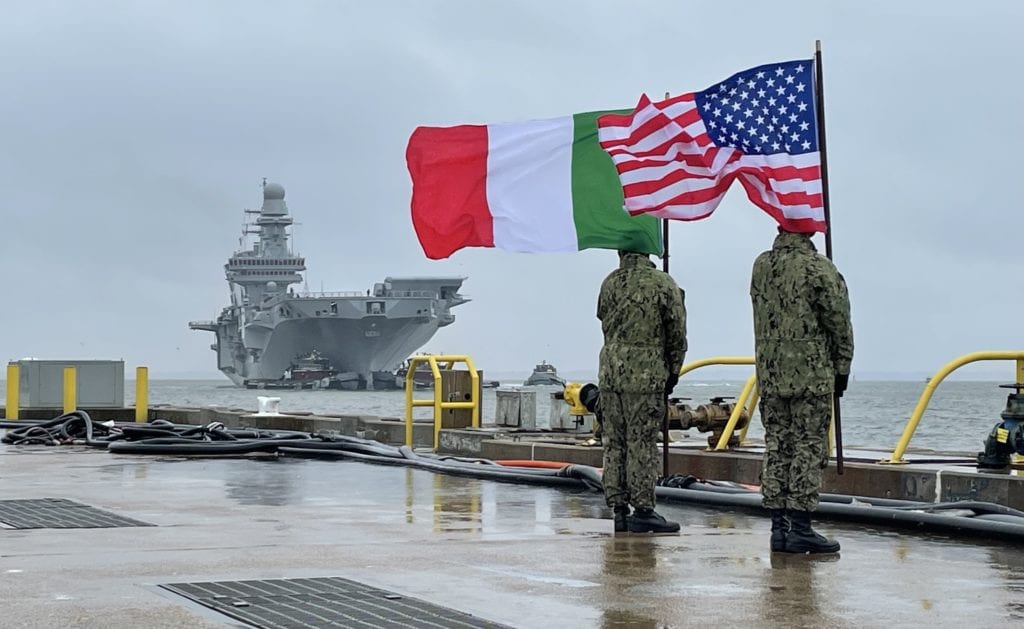
Italian navy flagship, the aircraft carrier ITS Cavour (CVH 550), arrives at Naval Station Norfolk, Virginia, Feb 13. The Cavour’s visit is part of a series of operations alongside U.S. military assets to attain the Italian navy’s “ready for operations” certification to safely land and launch F-35B aircraft. U.S. Navy / Capt. Cassidy Norman
NORFOLK, Va. — The Italian navy flagship, the aircraft carrier ITS Cavour (CVH 550), arrived at Naval Station Norfolk, Virginia, Feb. 13 for a series of operations alongside U.S. military assets to attain the Italian navy’s “ready for operations” certification to safely land and launch F-35B aircraft, the U.S. 2nd Fleet said in a release.
While in the Western Atlantic, Cavour will be embarked by an F-35 Joint Program Office test team to conduct sea trials, a series of tests and functional activities to create a safe flight operating envelope for the short takeoff and vertical landing (STOVL) variant of the fifth-generation aircraft aboard the recently upgraded ship.
This carrier-based flight test and other actions with U.S. 2nd Fleet ships and aircraft improve interoperability and strengthen the relationship between two NATO Allies.
“Operating in the Western Atlantic with our NATO allies presents a mutually beneficial opportunity to enhance both of our navies’ capabilities,” said Vice Adm. Andrew Lewis, commander of U.S. 2nd Fleet. “Supporting our Italian allies in certification of their aircraft carrier increases our collective experience in safety and combat abilities. We are stronger together.”
While crossing the Atlantic from Italy, ITS Cavour was met by the Arleigh-Burke class guided-missile destroyer USS Stout (DDG 55) and conducted a three-day interoperability exercise with support from Carrier Air Wing (CVW) 7 and Patrol and Reconnaissance Wing (CPRW) 11. Specific events included integrated ship maneuvering, low-slow-flyer detect-to-engage, anti-surface warfare serials with P-8 participation, air defense/air intercept control event with F/A-18 participation, and C5I interoperability events in the Western Atlantic 10-12 Feb.
“We are deeply grateful for the warm welcome received by the U.S. Navy 2nd Fleet upon our arrival in the Western Atlantic waters,” said Capt. Giancarlo Ciappina, commanding officer of ITS Cavour. “My officers and the whole crew were impressed for the professionalism and seamanship shown during these three days of training by the crews of USS Stout, CVW-7 and CPRW-11. We consider a real privilege having the opportunity to sail and exercise alongside our closest allies and friends and we are very proud to share with the USN Community such important certification deployment, which will provide ITS Cavour and the Italian naval aviation with the fifth-generation air combat capability of the Joint Strike Fighter.”
Upon arriving in Norfolk, ITS Cavour was hosted by USS John. C. Stennis (CVN 74). Stennis is coordinating and providing all pier services required by Cavour, to include refueling, diving operations, equipment and personnel on load, security, and contingency medical functions.
“We couldn’t be more excited to host our Italian ally,” said Capt. Cassidy Norman, Stennis’ commanding officer. “The Stennis team fully understands the importance of building trust and cooperation by supporting Cavour’s certification with the newest multi-role combat aircraft, the F-35. We are happy to see our Italian naval aviation counterparts dramatically increase their operational capability, strengthening our collective capability.”
The F-35 Pax River Integrated Test Force (ITF) team from Naval Air Station Patuxent River, Maryland. NAS PAX River comprises almost 200 people with the engineering and test pilot expertise and experience to conduct F-35B envelope expansion flight test, two specially instrumented developmental flight test aircraft, and support equipment.
“Italy is a critically important Cooperative Program Partner in the F-35 enterprise,” said Andrew Maack, F-35 Pax River ITF chief test engineer and site director.
“We are excited to get underway with the sailors of Cavour and honored to contribute to the aircraft carrier achieving the Italian navy’s strategic goal of it being ready for operations,” Maack said. “We look forward to a phenomenally successful shipboard detachment.”
For decades, the bond between Europe and North America has made NATO the strongest alliance in history. Conducting training and exercises alongside allies and partners increases our collective capacity and capabilities as well as increased interoperability with the U.S. Forces.
U.S. 2nd Fleet exercises operational authority over assigned ships, aircraft, and landing forces on the East Coast and the Atlantic.
CAE and Pinnacle Solutions Prepare to Deliver LCS Simulators to U.S. Navy
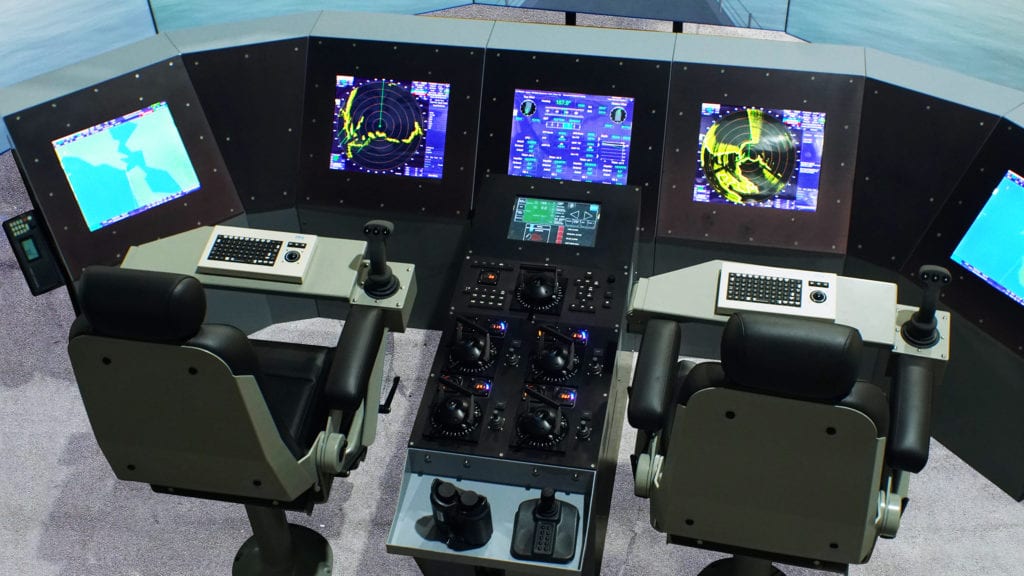
Two Littoral Combat Ship Bridge Part-Task Trainers representing the General Dynamics Independence variant will be delivered to the Navy’s Surface Warfare Schools Command in Newport, Rhode Island. CAE
TAMPA, Fla.—The joint venture CAE USA and Pinnacle Solutions, Xebec, will be delivering the first three Littoral Combat Ship (LCS) Bridge Part-Task Trainers (BPTTs) to the U.S. Navy, CAE said in a Feb. 9 release.
The new LCS BPTTs recently completed factory acceptance testing at CAE’s facility in Tampa, Florida and will now be packed and shipped to the Navy’s Surface Warfare Schools Command (SWSC) in Newport, Rhode Island. The SWSC is the Navy’s center of excellence for surface warfare where training for officers and Sailors who will serve on the Navy’s surface combatants is delivered.
“The Navy is focused on navigation and seamanship training and these littoral combat ship simulators will greatly assist in this endeavor,” said Michael Beard, program manager, U.S. Navy LCS Training Systems for CAE. “The more training our officers and Sailors receive ashore, the better prepared they will be at sea in real life situations.”
CAE is featured a video demonstration of the LCS bridge simulators in the Innovation Hub as part of the CAE OneWorld virtual conference and tradeshow. CAE OneWorld 2021 will be available online for the next month.
Included in the initial delivery to the SWSC in Newport will be two LCS BPTTs for the LCS 2 Independence variant manufactured by General Dynamics and Austal USA, and one LCS BPTT for the LCS 1 Freedom variant manufactured by Lockheed Martin. The three LCS BPTTs will undergo site acceptance testing once installed in Newport and are expected to be ready for training by the end of April. Xebec is under contract to deliver four additional LCS BPTTs which will be delivered to the LCS training facilities located in San Diego, California and Mayport, Florida.
“The fidelity and flexibility of the littoral combat ship simulators we have developed will allow the Navy to deliver most of the personnel qualification standards training in a simulation-based environment,” said Ray Duquette, president and general manager, CAE USA. “This means when sailors get to their assigned ship they will be better prepared for the navigation and operational assignments required.”
The LCS BPTTs are being developed by Xebec, a joint venture of CAE USA and Pinnacle Solutions established under the U.S. Small Business Administration’s Mentor-Protégé program.
“We were pleased to establish the Xebec joint venture with CAE and the collaboration has resulted in a very successful littoral combat ship simulator program for the Navy,” said Mike Durant, Pinnacle’s president and CEO. “We look forward to continuing deliveries of the LCS simulators to the Navy and to future pursuits with CAE through the Xebec joint venture.”
L3Harris Awarded Systems Integration Contract for Navy Frigate Program
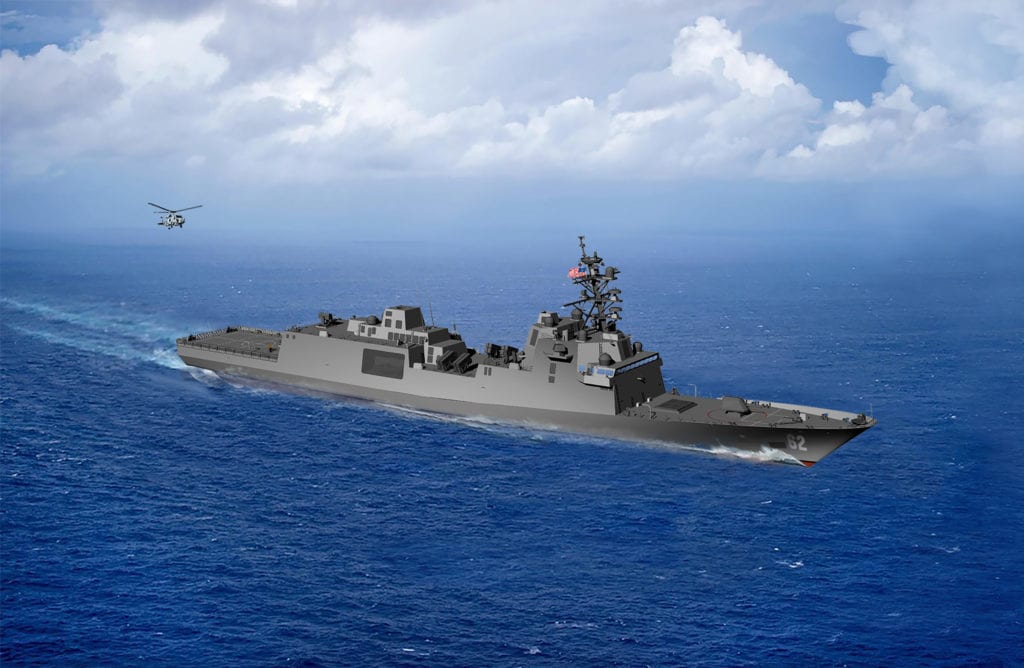
An artist’s rendering of the guided-missile frigate (FFG). The new small surface combatant will have multi-mission capability to conduct air warfare, anti-submarine warfare, surface warfare, electronic warfare, and information operations. U.S. Navy
CAMDEN, N.J. — L3Harris Technologies has been awarded a contract by Fincantieri Marinette Marine for the shipboard integration and production of major subsystems onboard the U.S. Navy’s guided-missile frigate, FFG 62, the company said in a Feb. 10 release. L3Harris is prepared to support the Navy’s plans to build at least 10 ships. The value of the L3Harris program could exceed $300 million if all design, development, and production options are awarded.
L3Harris is the largest member of the Fincantieri FFG team and will provide integrated systems that include the electric and propulsion systems, bridge and navigation systems, and aviation integration services. The diversified capabilities that L3Harris delivers on the Constellation-class frigate program will distribute the power and propulsion needed to meet the U.S. Navy’s mission requirements throughout the world.
“We’re excited by the opportunity to join the Fincantieri Marinette Marine team on the Frigate program and we look forward to bringing to bear industry-best speed, innovation and affordability as we deliver the advanced integrated capabilities that will ensure the Navy’s ability to operate this ship with impunity upon any sea,” said Sean Stackley, president, Integrated Mission Systems, L3Harris.
The Navy recently awarded a contract to Fincantieri to design and build the FFG, the Navy’s first new build in more than a decade. L3Harris will support Fincantieri at its Marinette, Wisconsin, shipyard, where it will build the frigate based on the company’s Italian FREMM multi-mission frigate.
Boeing Is Refurbishing Harpoon Missiles for U.S. Navy Submarines
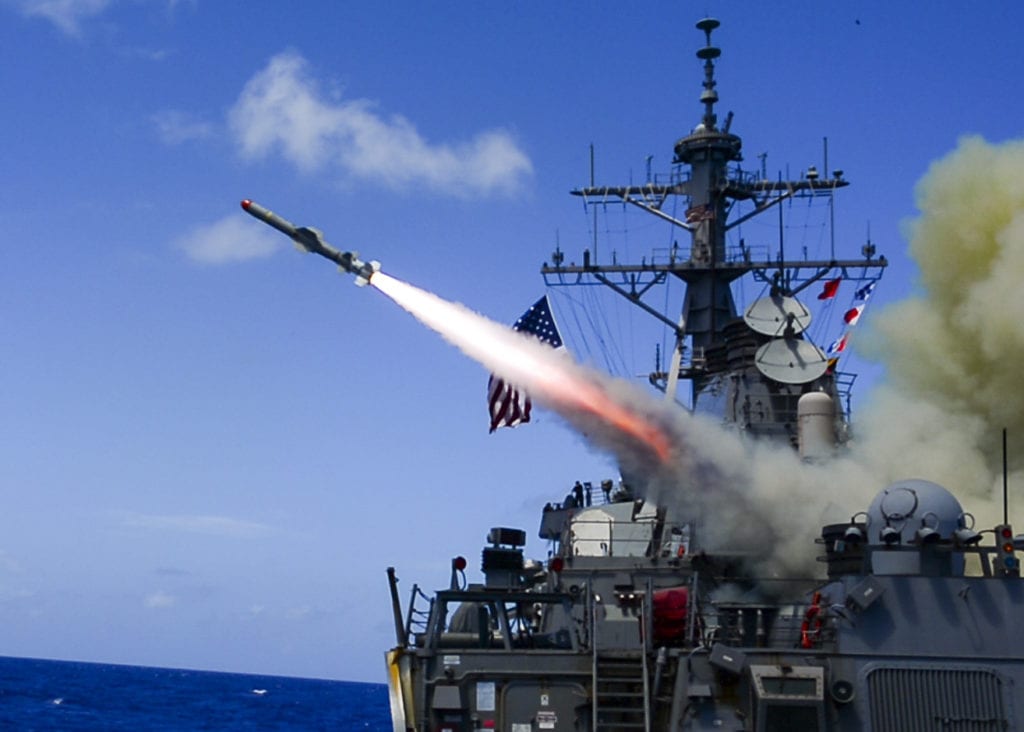
The Arleigh Burke-class guided missile destroyer USS Fitzgerald (DDG 62) conducts a live fire of a ship-launched variant Harpoon missile during Multi-Sail 2016. Boeing has now begun work to return Harpoon cruise missiles to operational status with the Navy’s submarine force. U.S. Navy / Mass Communication Specialist 3rd Class Eric Coffer
ARLINGTON, Va. — Boeing has begun work to return the Harpoon cruise missile to operational status in the U.S. Navy’s submarine force after a more than 20-year absence.
Boeing received an $10.9 million Naval Sea Systems Command contract late last month to refurbish 16 Harpoon missile capsules and four all-up rounds of encapsulated Block 1C Harpoon missiles for the Navy’s submarines. Work is scheduled for completion by December 2022.
The UGM-84A Harpoon Block 1C missiles will be integrated on the Navy’s Los Angeles-class submarines. The UGM-84A is encapsulated to be fired from a torpedo tube and has a rocket booster to propel it above the surface of the water and into flight.
“I am happy to report that we will have the first refurbished [Harpoon] missiles delivered to the fleet in [fiscal] ‘21,” said Rear Adm. Thomas Ishee, director of undersea warfare in the Office of the Chief of Naval Operations, speaking Nov. 7 at the Naval Submarine League’s annual symposium in Arlington.
In a demonstration in the 2018 Rim of the Pacific exercise, a Harpoon was fired from the Los Angeles-class attack submarine USS Olympia at a target ship, the first time one was fired from a U.S. Navy submarine since the UGM-84A Harpoons were withdrawn from the force in 1997.
The UGM-84A is encapsulated to be fired from a torpedo tube and has a rocket booster to propel it above the surface of the water and into flight.
“The Navy has a deep inventory of Harpoon Block IC missiles,” said Sally Seibert, director, Cruise Missile Systems at Boeing, in a statement. “These missiles can be refurbished and reintegrated into the fleet in a shorter timeframe, and at a fraction of the cost, compared to purchasing new missiles — and that is exactly what our team is doing.”
The Harpoon cruise missile is a combat-proven, all-domain anti-ship missile used by the Navy and more than 30 international customers, a statement from Boeing said. “Evolving over the years to keep pace with emerging threats, the Harpoon Block II includes a GPS-aided guidance system that allows for autonomous, all-weather capability — and can execute both anti-ship and land-strike missions. The more advanced Harpoon Block II+ adds a data link that allows for in-flight targeting updates.”
“The shelf life of the Harpoon missile allows us to maximize existing capability by bringing this weapon back to the submarine fleet,” Seibert said. “Customers who currently have Harpoon missiles in their inventory are prime candidates for refurbishments, or even upgrades, to add this extremely viable and cost-effective weapon to their arsenal.”
Currently, more than 600 ships, 180 submarines, 12 different types of aircraft and several land-based launch vehicles across the world are integrated with Harpoon missiles, Boeing said.
Future USS Daniel Inouye Completes Acceptance Trials
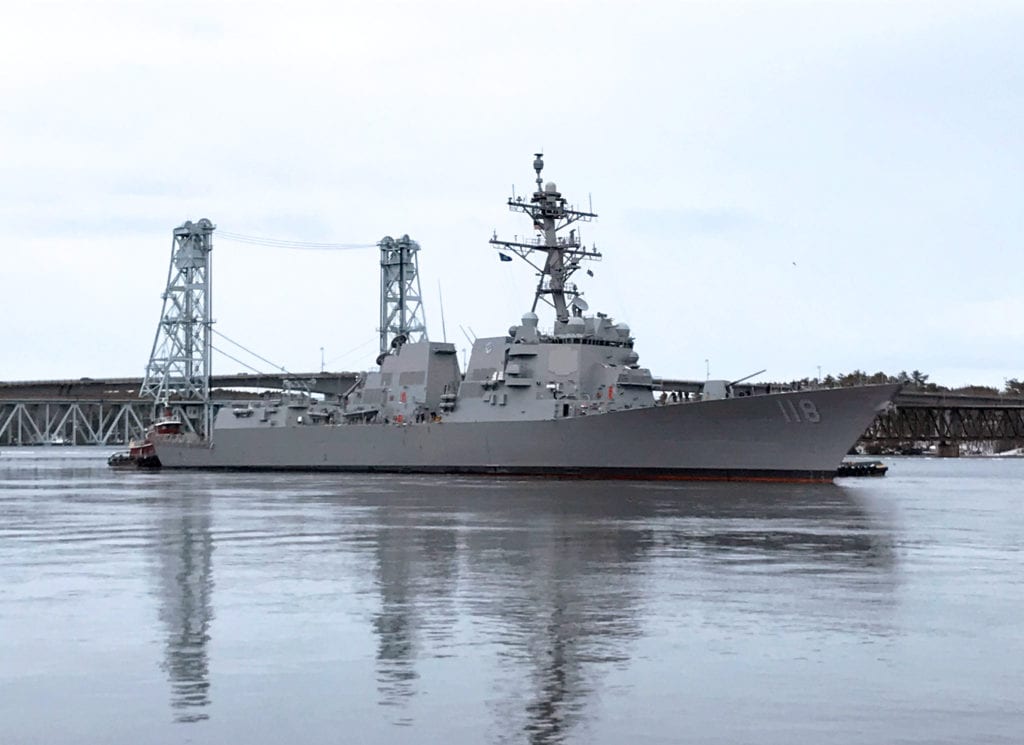
The future USS Daniel Inouye (DDG 118) departs General Dynamics Bath Iron Works shipyard on Feb. 3 for acceptance trials. SUPSHIP Bath
BATH, Maine — The future USS Daniel Inouye (DDG 118) successfully completed acceptance trials Feb. 4 after spending a day underway off the coast of Maine, the Program Executive Office (PEO) – Ships announced in a Feb. 5 release.
The Bureau of Inspection and Survey inspected the ship during a series of demonstrations while pier side and underway. Many of the ship’s onboard systems, including navigation, damage control, mechanical and electrical systems, combat systems, communications, and propulsion applications, were tested to validate performance and met or exceeded Navy specifications.
“Following an outstanding Combined Alpha and Bravo trials this past December, DDG 118 performed superbly during the ship’s Acceptance Trial earlier this week,” said Capt. Seth Miller, DDG 51 class program manager, PEO-Ships. “The Navy and industry team are ready to deliver a highly capable multi-mission warship to the fleet within the next few weeks.”
Daniel Inouye is a Flight IIA destroyer, equipped with the Aegis Baseline 9 Combat System, which includes Integrated Air and Missile Defense capability and enhanced Ballistic Missile Defense capabilities. This system delivers quick reaction time, high firepower, and increased electronic countermeasures capability against a variety of threats.
Following delivery, Daniel Inouye will be the 37th Arleigh Burke (DDG 51)-class destroyer to be delivered by BIW. The shipyard is also in production on the future Arleigh Burke-class destroyers Carl M. Levin (DDG 120), John Basilone (DDG 122), Harvey C. Barnum (DDG 124), Patrick Gallagher (DDG 127), and Flight III ships, Louis H. Wilson, Jr. (DDG 126), and William Charette (DDG 130), as well as the future Zumwalt-class destroyer, Lyndon B. Johnson (DDG 1002).
Lockheed Martin’s SPY-7 Radar Is Going to Sea
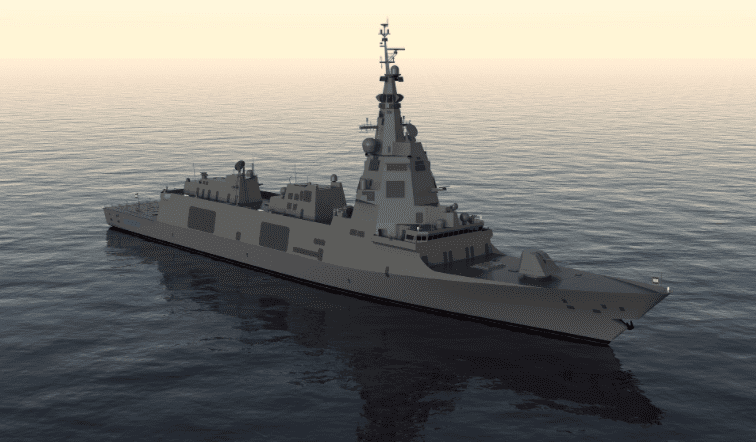
An artist’s rendering of a Spanishfuture F-110 frigate equipped with AN/SPY-7(V)2. Navantia
ARLINGTON, Va. — Lockheed Martin’s new SPY-7 radar will be sailing to sea on the ships of three navies as the company highlights the radar’s capabilities for application to other navies, including the U.S. Navy.
The SPY-7, which uses gallium nitride modules, initially was developed for the Navy’s Air and Missile Defense Radar competition. It was adapted into the Long-Range Discrimination Radar (LRDR) procured by the U.S. Missile Defense Agency (MDA) as a sensor of the Ground-Based Midcourse Defense system. Being installed at Clear Air Force Station in Alaska, the LRDR is designed to discriminate between incoming warheads and decoys.
The core building blocks [of the LRDR] are the same core building blocks in SPY-7,” said Jon P. Rambeau, vice president and general manager, Integrated Systems & Sensors, Lockheed Rotary and Mission Systems, during a Feb. 2 interview with Seapower. “[SPY-7] is a modular radar that allows us to build different configurations for both land-based and sea-based applications.”
The SPY-7 has been selected by the Spanish navy to integrate it with the Aegis Combat System on its F110 frigates. The Canadian navy is procuring the radar to install it on its new Halifax-class surface combatant.
Japan had selected the SPY-7 for its two planned Aegis Ashore ballistic-missile defense sites, but when the plans were cancelled in part out of concern for missile debris falling on populated areas, Japan shifted to a plan to deploy the SPY-7 on some future, unspecified sea-based BMD platform. Japan already has BMD capabilities in its Kongo-class guided-missile destroyers with Aegis systems using the SPY-1 radar.
Japan, which already has placed an order for the SPY-7, “is going through a process now to determine exactly what that platform is going to look like,” Rambeau said. “We are pleased with the progress that the technology has made, and we’re starting to see some uptake both here in the U.S. as well as abroad.”
“SPY-7 is part of the Aegis common source library (CSL) and the interfaces are understood,” said Patrick W. McNally, director of communications for Integrated Warfare Systems & Sensors, in a statement to Seapower. “For Japan, we have completed the first of three releases which were recently demonstrated to MDA. Starting from the CSL, with over one million lines of code, Japan will be receiving the best of both Baseline 9 and 10 [Aegis software].”
The U.S. Navy is considering backfitting some Flight IIA Arleigh Burke-class guided-missile destroyers with a radar more modern than the SPY-1, and Lockheed is keeping a watch on developments in the event the SPY-7 could complete in the program if it comes to pass.
Rambeau said his company also “has some more affordable options available to upgrade some of the SPY-1 arrays to provide improved sensitivity and improved resistance to electronic attack and we think we can do that at a fraction of the cost of a wholesale replacement, so we’ve put forth a couple of options for upgrades to SPY-1 to both MDA and the Navy.”
New PTDO Under Secretary of the Navy Designated
James F. “Hondo” Geurts. U.S. Navy
ARLINGTON, Va. — Acting Secretary of the Navy Thomas Harker has designated James F. “Hondo” Geurts as PTDO (performing the duties of) under secretary of the Navy, the Navy announced in a Feb. 4 release.
Prior to this selection, Geurts served as the eighth assistant secretary of the Navy for Research, Development and Acquisition (ASN RD&A), from December 2017 to January 2021. As ASN RD&A, he served as the Navy’s acquisition executive, with oversight of an annual budget in excess of $100 billion and responsible for equipping Sailors and Marines with platforms, systems and technologies around the globe in defense of the nation.
“I’ve worked with Hondo for a number of years and know he will bring a wealth of insight and leadership derived from 34 years of DoD experience to this position,” said Harker. “His stellar knowledge of acquisition efforts, experience driving positive change, and commitment to naval innovation will be a strong asset in this position, where he will continue to reinforce a clear understanding of the needs, requirements and capabilities of our Navy and Marine Corps.”
In performing the duties of the under secretary of the Navy, in addition to serving as the deputy and principal assistant to the SECNAV, Geurts will serve as the chief operating officer and chief management officer for the Department of the Navy. Additionally, he will oversee intelligence activities, intelligence-related activities, special access programs, critical infrastructure, and sensitive activities within the department.
“Having supported the military, both in and out of uniform, for the majority of my life, I know that when we are empowered and focused on the mission we can accomplish amazing things,” said Geurts. “I look forward to continuing to work with a great team of professionals as we spearhead efforts in support of the finest Navy and Marine Corps in the world.”
Geurts previously served as the acquisition executive, U.S. Special Operations Command, at MacDill Air Force Base, Florida, where he was responsible for all special operations forces acquisition, technology and logistics. Prior to being selected for Senior Executive Service, Geurts began his career as an Air Force officer. He served as an acquisition program manager with engineering and program management leadership positions in numerous weapon systems, including intercontinental ballistic missiles, surveillance platforms, tactical fighter aircraft, advanced avionics systems, stealth cruise missiles, training systems and manned and unmanned special operations aircraft.
He has over 30 years of joint acquisition experience and served in all levels of acquisition leadership positions including acquisition executive, program executive officer and program manager of major defense acquisition programs.
Geurts is a distinguished 1987 Reserve Officers’ Training Corps graduate from Lehigh University where he received a Bachelor of Science in Electrical Engineering. He holds a Master of Science in Electrical Engineering from Air Force Institute of Technology, Wright-Patterson AFB and in National Security Resourcing from Industrial College of the Armed Forces, National Defense University, Washington, D.C. Geurts also attended executive leadership and international studies programs at Harvard Kennedy School and George Washington Elliot School.
Nimitz Carrier Group Sails into Indo-Pacific Command
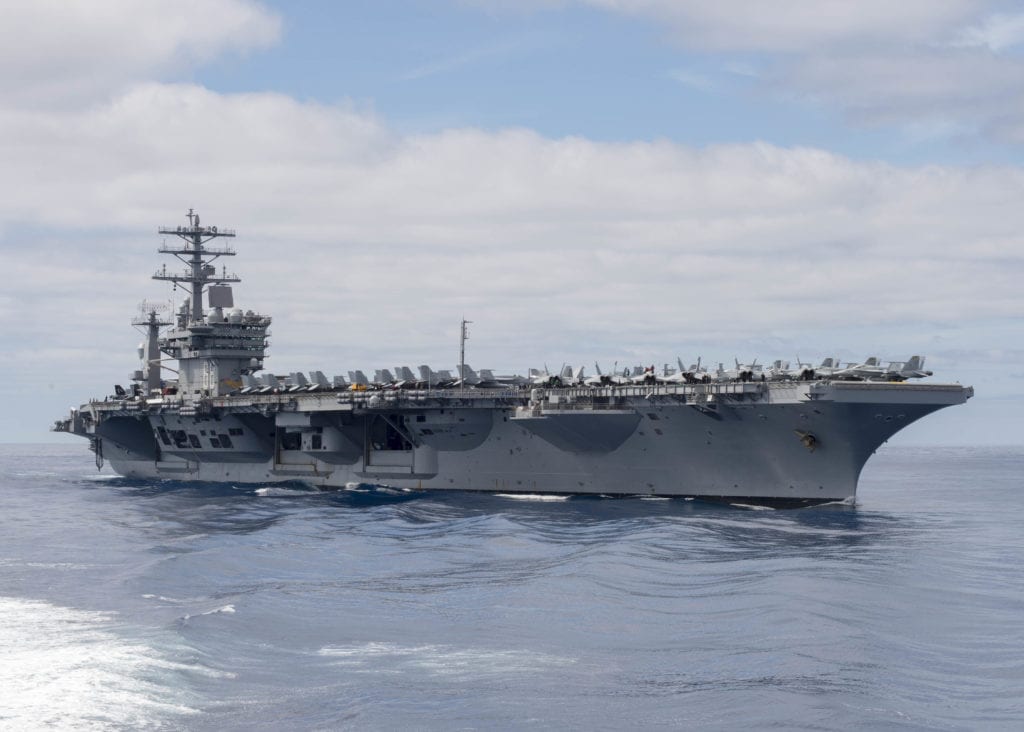
The aircraft carrier USS Nimitz (CVN 68) transits alongside the Arleigh Burke-class guided-missile destroyer USS Pinckney (DDG 91) after a replenishment-at-sea in this 2017 photo. U.S. Navy / Mass Communication Specialist 2nd Class Craig Z. Rodarte
ARLINGTON, Va. — The USS Nimitz Carrier Strike Group is departing the Central Command area of responsibility and moving into the U.S. Indo-Pacific region, Pentagon Press Secretary John F. Kirby announced Feb. 4.
“We want to thank all the men and women aboard the ships in that strike crew and the squadrons who supported Central Command now for more than 270 days, ensuring our national security and deterring conflict in a very critical region of the world,” Kirby said.
The carrier is homeported in Bremerton, Washington. It is now in the 7th Fleet area of responsibility and can be called upon for operations, training or humanitarian exercises there.
The Nimitz’s departure means there is no U.S. carrier operating in the Central Command area of operations. Kirby said Secretary of Defense Lloyd J. Austin III believes America has “a robust presence in the Middle East.” U.S. service members are based in many nations in the Persian Gulf and there is more than enough airpower to counter any adversary.
Kirby said Austin has constant discussions with U.S. Central Command commander Marine Corps Gen. Frank McKenzie, as well as other combatant commanders. Austin must balance requirements from various parts of the world, and the United States doesn’t have an unlimited number of aircraft carriers.
These decisions are carefully weighed, the press secretary said. “Every decision that we make with military forces — air, ground or naval — and certainly, decisions that you make with respect to a capital asset, like an aircraft carrier and its associated, supporting Strike Group is a decision driven by a frank assessment of the threats in the area, and also a frank consideration of the capabilities themselves,” Kirby said. “So, absolutely, the secretary was mindful of the larger geostrategic picture when he approved the movement of the Carrier Strike Group from the Central Command area responsibility.”
Also playing into the decision is the length of the deployment for the Nimitz sailors and their families. The Nimitz and supporting ships have been deployed longer than is typically required. Austin and CentCom and Navy officials must consider the wear and tear on the sailors, the ships and the aircraft.
Navy Seeking Innovation in New Places Despite Challenges, ONR Director Says
Anne Sandel, executive director, Office of Naval Research. U.S. Navy / John F. Williams
While there is a new administration and leadership, the Office of Naval Research’s executive director said she does not expect any major changes in the Department of the Navy’s priorities, and the acquisition team will continue to be focused on delivering and sustaining lethal capability, increasing agility, driving affordability and developing a work force to compete and win.
Anne Sandel, also the acting principal civilian deputy to the assistant secretary of the Navy for research, development and acquisition, spoke at the National Defense Industrial Association’ s Expeditionary Warfare Conference, which took place virtually Feb. 2 and 3.
Sandel said the Navy acquisition and research and development enterprise, like everyone else, was challenged by the global pandemic during 2020. COVID 19 had a big impact on the work environment. But, she said, through adaptation and process, the Navy has continued to execute.
“We’ve leapfrogged ahead to embrace that virtual and electronic environment,” Sandel said. “Our outreach, communication and our collaboration has actually increased. Although people like to be in room with one another, I have seen much more collaboration across the board, whether it’s Navy, Marine Corps, or any of our industry partners or allies. We are able to reach out on a moment’s notice and do what we’re doing today with one another. Many times, it’s a force multiplier, because we can include people who personally would not have been available because of travel, cost or schedule demands. Today, they can log on, be part of a phone call, and be there instantaneously. It’s multiplied our ability to communicate and move forward in a format that is unusual for those of us who grew up in an industrial infrastructure. We’ve had to transcend that with the acquisition, design, engineering and construction efforts. It’s improved our processes.”
Sandel has a long career in shipbuilding, maintenance and repair, but in her current role, she has a view of the many evolving technologies and concepts to address current and future warfighting requirements across all of the warfare domains.
In her job at ONR, Sandel said she came to better appreciate just how much of ONR’s portfolio is focused on the expeditionary mission and in support of Marines. In fact, the vice chief of naval research is a Marine who also commands the Marine Corps Warfighting Laboratory.
“We are very closely aligned with the Marine Corp and the expeditionary portfolio,” she said.
Leveraging innovation
Sandel talked about finding and leveraging innovation. The NavalX organization, established by then-Assistant Secretary of the Navy for Research, Development and Acquisition James Guerts, focuses on embracing non-traditional agility methods across the DON workforce, and linking up isolated or disparate pockets of excellence and subject matter experts. As a part of NavalX, the Navy established storefront “TechBridge” offices — “agility cells” to broaden the network to help the Navy and Marine Corps learn and act faster in key locations.
The TechBridge storefront concept applies both internally within the Department of the Navy, but also externally, with other federal, state, regional and local government organizations, academia, nonprofits, trade and professional organizations and industry.
“Think of NavalX as the ‘network,’ and the TechBridges as the nodes on the network,” Sandel said.
While she said the Navy is committed to developing and supporting America’s industrial base, she also is looking at capabilities that are available on the global market, including government-to-government and international commercial collaboration.
Sandel said Rear Adm. Lorin Selby, the Chief of Naval Research, has an international component to his job, and ONR Global has offices around the world to connect with academia, industry and governments to share developing technologies. The first TechBridge outside the U.S. has been established in the U.K., collocated with ONR Global at Northwood, to help make connections and find innovative technologies.
Another way to accelerate getting technology into the hands of warfighters is through experimentation. The Navy and Marine Corps are planning an ambitious array of exercises in the months and years ahead, including Trident Warrior, RIMPAC, Sea Dragon, Bold Alligator, Valiant Shield, Valiant Blitz, Large Scale Exercise 2020, to name a few, along with Advanced Naval Technology Exercises (ANTX) and Joint Interagency Field Exercises.
Originally planned for 2020, the Navy is looking to leverage Large Scale Exercise 2021 to operationalize concepts like Distributed Maritime Operations (DMO), Expeditionary Advanced Base Operations (EABO), and Littoral Operations in a Contested Environment (LOCE), naval operational architecture, and command and control in a contested environment to develop and test alternative warfare concepts.
“We’re putting tools and kit in the hands of the actual operators, experiment with it, and give us feedback directly,” she said.
Sandel discussed some of the ways the Navy in general, and ONR specifically, can move quickly to find, develop and field new technology. She pointed to ONR’s TechSolutions program as an example of how ONR can act promptly on ideas from deckplate Sailors or Marines to improve mission effectiveness. TechSolutions has resources to rapidly address suggestions and ideas from the fleet, investigate available technologies, and deliver prototype solutions.
She also recognized the importance of small business, such as those participating in the Small Business Innovation Research (SBIR) program. “During my tenure at ONR, and now at the enterprise level, I have seen how we have been able to leap forward greater agility using the SBIR funding than I was aware of in all my years in the engineering and acquisition organizations. I knew they were there, and how to get innovation from small companies that couldn’t compete as primes, but I’ve learned that they’re more agile than I recognized, The SBIR program, the way its architected and funded, has the agility to take innovative technologies and leapfrog forward,” she said.