Northrop Grumman to Manufacture US Navy’s Advanced Lightweight Torpedo
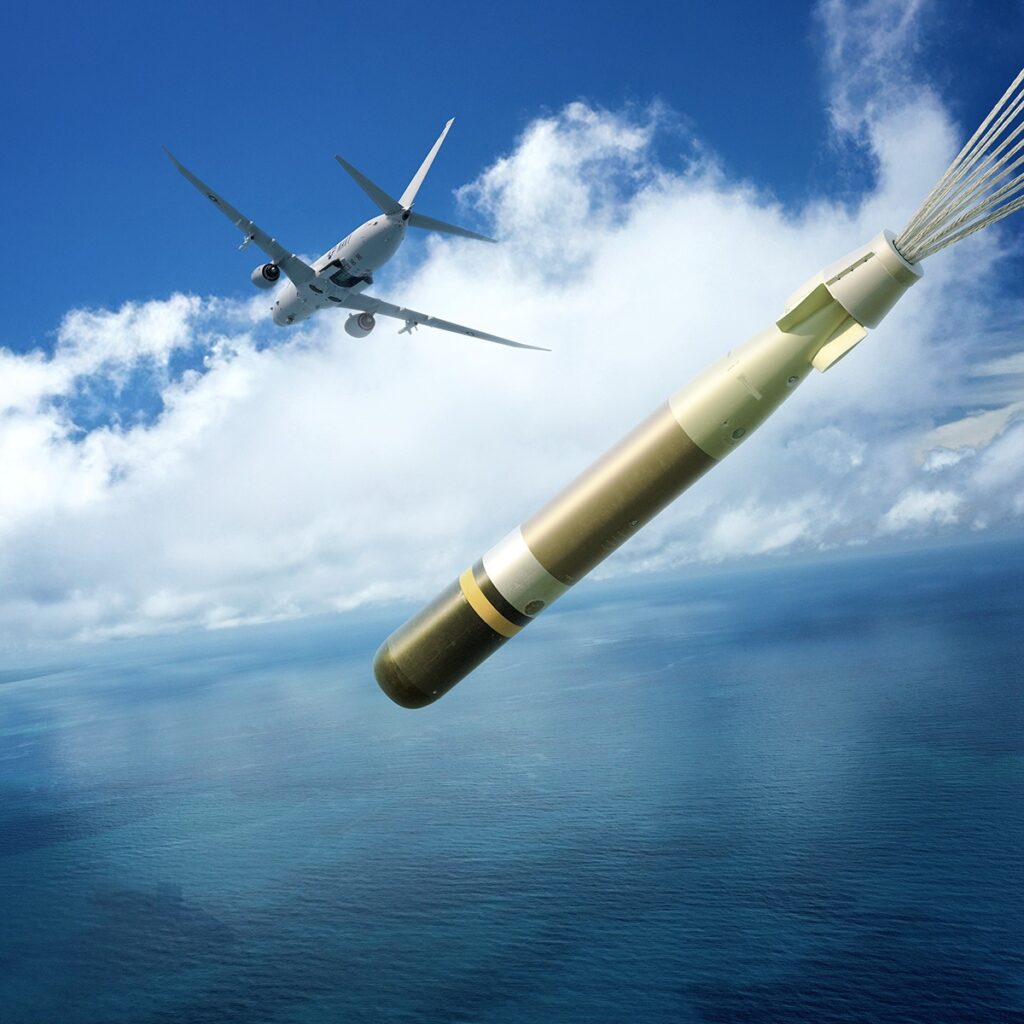
Launched from surface ships, fixed-wing aircraft, and helicopters, the MK54 MOD 2 Advanced Lightweight Torpedo is key to the U.S. Navy’s strategy to address modern and future submarine threats. (Photo Credit: Northrop Grumman)
Features a newly developed, Northrop Grumman-designed warhead that delivers increased weapon lethality
PLYMOUTH, Minn. – Jan. 12, 2026 – Northrop Grumman (NYSE: NOC) will manufacture and deliver to the U.S. Navy a new advanced lightweight torpedo with a custom-designed warhead to increase its lethality. Northrop Grumman will draw upon decades of production expertise to deliver a weapon that fires from multiple naval platforms.
Northrop Grumman will perform the integration and initial proof of manufacturing at the company’s facility in Plymouth, Minnesota, and Allegany Ballistics Laboratory (ABL) in Rocket Center, West Virginia.
The contract, worth $233 million, covers the proof of manufacturing and qualification phases, as well as delivery of multiple torpedoes for qualification testing.
Northrop Grumman’s state-of-the-art facilities and technologies allow for rapid delivery of this urgent U.S. Navy requirement.
Expert:
Dave Fine, vice president, armament systems, Northrop Grumman: “Northrop Grumman is leveraging over 80 years of innovative torpedo technology, combined with our capacity and speed in delivery, to accelerate the design qualification and manufacturing for the advanced lightweight torpedo. This new weapon will provide U.S. and allied sailors with a next-generation response to counter the most advanced undersea threats.”
Details on the Advanced Lightweight Torpedo Program:
The MK54 MOD 2 was designed under a cooperative development agreement with the Australian Defence Force, led by the U.S. Navy. This upgraded torpedo will enhance the existing inventory of MK54 MOD 0 and MOD 1 variants with Northrop Grumman’s advanced warhead and processing capabilities, resulting in increased performance and lethality. Capable of tracking, classifying, and attacking underwater targets, MK54 MOD 2 will operate in all ocean environments.
HII Successfully Demonstrates Sea Launcher, Ship-Based Automated Launch and Recovery of REMUS Autonomous Underwater Vehicle
POCASSET, Mass., Jan. 13, 2026 (GLOBE NEWSWIRE) — HII (NYSE: HII), the world’s leading manufacturer of autonomous underwater unmanned vehicles, announced today the successful shipboard deployment and recovery of a REMUS autonomous underwater vehicle (UUV) using the company’s automated launch and recovery system, Sea Launcher.
The demonstration represents a key milestone in advancing operationally proven manned-unmanned teaming for maritime missions and highlights HII’s ability to integrate mature automation and autonomy into ship-ready systems, including the HII ROMULUS family of unmanned surface vessels (USVs) currently in production.
During recent testing, HII validated key aspects of system performance to support a fully autonomous, end-to-end launch and recovery sequence. The test used a representative vehicle configured for real-world mission conditions and mirrored a recovery procedure that has been proven in deployments repeatedly across U.S. Navy and allied operations.
Automated launch and recovery significantly reduces risk to sailors, expands mission range and flexibility, and shortens mission timelines. These advantages are particularly important in contested or high-sea-state environments, where minimizing hands-on deck operations improves safety and operational availability.
“This is proven technology applied in a highly relevant shipboard configuration,” said Duane Fotheringham, president of Mission Technologies’ Unmanned Systems business group. “REMUS has successfully performed autonomous line capture and recovery for years. What this demonstration shows is how seamlessly that capability integrates with automated launch and recovery systems onboard manned or unmanned vessels to support modern maritime operations.”
REMUS is one of the most widely deployed autonomous underwater vehicle families in the world, trusted by more than 30 navies for missions including mine countermeasures, undersea survey, intelligence collection, and environmental sensing. Its modular design and open architecture allow it to operate independently or as part of a distributed maritime force, teaming with crewed ships, unmanned surface vessels, and other undersea platforms.
“This demonstration reinforces the value of REMUS within a distributed maritime operating model,” Fotheringham added. “Whether operating alongside manned platforms or coordinating with other unmanned systems, REMUS provides commanders with a reliable and flexible capability they already know and trust.”
Looking ahead, HII plans to continue integrating REMUS with its new ROMULUS unmanned surface vessel (USV) family, as well as a range of manned and unmanned ships, to support evolving customer requirements across U.S. and allied navies.
Fairbanks Morse Defense Expands Robotic Welding Capabilities to Strengthen Fleet Readiness and Reduce Maintenance Downtime
FMD’s advanced robotic welding technology cuts repair times, enhances safety and boosts fleet readiness for naval operations
Release From Fairbanks Morse Defense
BELOIT, Wis. –January, 12, 2025 – Fairbanks Morse Defense (FMD) has announced the expansion of its robotic welding program aimed at boosting ship repair and maintenance efficiency for the U.S. Navy and allied fleets. The company’s robotic welding technology combines automation, precision and data-driven performance to reduce operational downtime, improve safety and extend the service life of naval assets.
FMD’s robotics integrate advanced machine learning technology that enables automated weld control, consistent quality and real-time weld fault detection. By merging robotics with human expertise, FMD can accelerate repairs while ensuring each weld meets stringent naval standards. This innovation is part of the company’s broader strategy to modernize maintenance operations and strengthen mission readiness across the maritime defense sector.
“Robotic welding represents a fundamental shift in how we approach fleet sustainment. It allows us to complete repairs faster, more accurately and more safely than ever before. This technology does not replace skilled technicians, but it enhances their capabilities, ensuring ships are returned to service in record time without compromising quality or safety,” said Keith Haasl, President, Service and Technology at Fairbanks Morse Defense.
FMD’s robotic welding technology is engineered to perform critical repairs in confined or challenging environments, such as engine rooms and below-deck components. Robotic welders work up to three times faster than manual welding and can reduce crank bore repair time by as much as 75% (even in large-scale jobs).
FMD robotics are programmed to maintain heat distribution and weld spacing consistently from the first bead to the 1,000th. This ensures each weld is executed with consistent accuracy and durability, reducing the likelihood of rework or failure. The technology also captures detailed data from every weld performed, creating a traceable record that supports quality assurance and predictive maintenance programs.
FMD’s welding robots have been deployed successfully in high-pressure naval repair operations, including emergent crank line repairs on U.S. submarines, where the system demonstrated three times faster weld repair under demanding conditions. The project validated the effectiveness of robotic welding in critical mission support and confirmed its role as an enabler of faster fleet readiness.
By automating repetitive or high-risk welding tasks, the system minimizes exposure to heat and hazardous materials for human operators, improving overall workplace safety. Skilled technicians remain integral to the process, overseeing operations, conducting inspections and managing complex or customized welds that require human oversight. This human-machine collaboration supports FMD’s long-term workforce development strategy by allowing technicians to focus on high-value work while leveraging robotics for precision and endurance.
FMD’s robotics program is aligned with its broader focus on digital transformation across its service and technology divisions. The company remains focused on advancing automation, extended reality training and predictive analytics as part of its long-term strategy to deliver innovative solutions that enhance operational performance and mission success.
GDIT Awarded $988 Million Contract to Modernize Navy C5ISR Systems
Company will integrate advanced systems across all surface combatant ships to stay ahead of emerging threats
FALLS CHURCH, Va. – General Dynamics Information Technology (GDIT), a business unit of General Dynamics (NYSE:GD), announced today that it was awarded the Ship and Air Command, Control, Communications, Computers, Combat, Intelligence, Surveillance, and Reconnaissance (C5ISR) Systems Support (SACSS) contract to continue modernizing the U.S. Navy fleet. The $988 million contract, awarded in December, has a one-year base period, four one-year options and a six-month option.
Under the contract, GDIT will modernize and integrate C5ISR systems to enhance the operational effectiveness and readiness of naval forces. The company will provide integration, engineering, procurement, logistics and installation services onboard all classes of surface combatant ships, including guided missile ships, aircraft carriers, Coast Guard vessels, manned and unmanned aircraft and shore stations. GDIT will upgrade these systems efficiently to enable the Navy to keep its current vessels operational and ensure mission continuity.
“C5ISR systems are foundational to how our Navy senses, communicates and fights in the modern battlespace,” said Brian Sheridan, GDIT senior vice president for Defense. “We look forward to continuing to deliver innovative solutions to ensure these vital systems operate at peak performance and enable our warfighters to stay ahead of emerging threats.”
GDIT has decades of experience delivering mission-critical services to the Navy. The company supports the development of advanced electronic warfare technologies for airborne platforms, provides training support services for more than 100,000 U.S. and allied sailors around the globe, and delivers advanced artificial intelligence/machine learning solutions to modernize the Navy Enterprise Service Desk program.
Austal USA Christens Final EPF: Future USNS Lansing
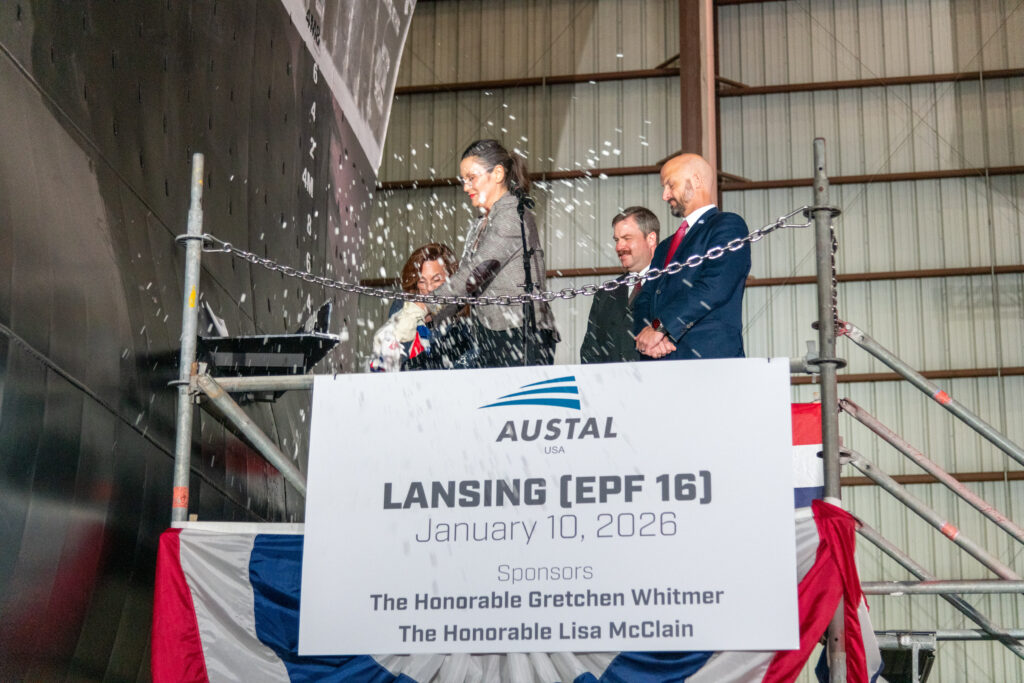
Credit: Austal USA
Release From Austal USA
MOBILE, Ala. – The final U.S. Navy Expeditionary Fast Transport Ship – future USNS Lansing (EPF 16) – was christened at a ceremony today at Austal USA’s Mobile, Ala. ship manufacturing facility. The christening marks a major milestone in the Spearhead-class EPF program, which has delivered vital high-speed, shallow-draft transport capability to the U.S. Navy and Military Sealift Command. Since the inception of the EPF program, Austal USA has built and delivered a fleet of fast transport vessels that provide agile intra-theater personnel and cargo movement, rapid response support, and enhanced operational flexibility around the globe.
This christening event was unique in that two sponsors christened the ship; The Honorable Gretchen Whitmer, Governor of Michigan, and The Honorable Lisa McClain, U.S. Representative serving Michigan’s 9th District broke bottles of champagne simultaneously on the bow of the ship after which they jointly exclaimed, “For the United States of America, I christen thee Lansing. May God bless this ship and all who sail in her!”.
“I was especially honored to witness this tradition that means so much to our Navy and our Nation with the christening of the last ship of this great fleet. The Flight II Expeditionary Fast Transport ships represent a significant increase in naval auxiliary capability, designed to support a wide range of missions including medical operations, logistics, and troop transport.” commented Austal USA President Michelle Kruger. “These ships are built by an exceptional team of dedicated men and women who consistently strive to be the best in the industry, delivering the most capable and cost-effective vessels to our superior Navy.”
The Honorable Gretchen Whitmer has been Michigan’s Governor since 2019. As a lifelong Michigander, earning both her bachelor’s degree and law degree from Michigan State University, Whitmer is a lawyer, an educator, former prosecutor, State Representative and Senator. Since taking her oath of office, she has signed executive directives to clean up Michigan’s drinking water, secure equal pay for equal work, and expand opportunities for small and disadvantaged businesses.
Born and raised in Stockbridge, Michigan, The Honorable Lisa McClain is serving her second term as U.S. Representative for Michigan’s 9th District. She currently serves as a member of the House Committee on Financial Services and the Committee on Education and Workforce and Chairwoman of the House Republican Conference for the 119th Congress.
Speakers at today’s event included: Principal speaker, The Honorable Hung Cao, Under Secretary, U.S. Navy; Rear Admiral Benjamin Nicholson, Commander, Military Sealift Command, U.S. Navy; Vice Admiral Seiko Okano, Principal Military Deputy to the Assistant Secretary of the Navy for Research, Development and Acquisition; Michelle Kruger, Austal USA President; and Scott Bonk, Director, Future Combatants & Mission Systems, General Dynamics Mission Systems.
The future USNS Lansing is the first Navy ship named after the capital of Michigan. There have been 32 naval ships named after some aspect of Michigan. This includes the first iron-hulled ship in the Navy, named after the state and commissioned in 1844.
EPF Flight II provides a Role 2E (enhanced) medical capability which includes, among other capabilities, basic secondary health care built around primary surgery; intensive care unit; ward beds; and limited x-ray, laboratory and dental support. The EPF’s catamaran design provides inherent stability to allow surgeons to perform underway medical procedures in the ship’s operating suite. Enhanced capabilities to support V-22 flight operations and launch and recover 11-meter Rigid Hull Inflatable Boats complement the ship’s medical facilities. These Flight II upgrades along with EPF’s speed, maneuverability and shallow water access are key enablers for mission support of future Distributed Maritime Operations and Expeditionary Advanced Base Operations around the world. Flight II retains the capability of the Flight I to support other missions including core logistics. EPF is one of four shipbuilding programs under serial production at Austal USA.
The EPF program has been a cornerstone of Austal USA’s contribution to U.S. maritime logistics and expeditionary operations, providing fast, flexible support for a wide range of fleet missions. With the christening of the final EPF vessel, Austal USA continues its legacy of supporting the U.S. Navy with innovative ship design and construction excellence.
HII Expands European Unmanned Operations with New Facility in Portchester, UK
PORTCHESTER, United Kingdom, Jan. 12, 2026 (GLOBE NEWSWIRE) — HII (NYSE: HII), the world’s leading manufacturer of autonomous surface and underwater unmanned vehicles, has doubled the size of its unmanned facility in Portchester, U.K.
The enlarged facility significantly enhances and strengthens the company’s presence in the United Kingdom and increases capacity and support for the U.K. Royal Navy and European partners that operate the REMUS line of unmanned underwater vehicles (UUVs).
In addition to supporting regional unmanned customers, the Portchester facility will serve as a European hub for HII’s Mission Technologies division, enabling collaborative customer support for U.S. combatant commands and allied missions. The site will provide operational, technical, and logistics support to deploy, sustain, and integrate electronic warfare and C5ISR systems, fleet modernization efforts, artificial intelligence capabilities, and live, virtual, and constructive training.
The facility also prepares the region for the deployment and sustainment of HII’s ROMULUS family of unmanned surface vessels (USVs), a modular AI-enabled line powered by HII’s Odyssey Autonomous Control System and scheduled for availability in 2026.
HII’s unmanned platforms are known for modular design, long endurance and reliable field performance. They support defense, commercial and research missions that include mine countermeasures, hydrographic survey, intelligence collection and environmental monitoring.
The expanded Portchester facility will operate as a strengthened regional hub for HII’s unmanned systems. Staffed by U.K. employees, it will drive new jobs and support supplier engagement, maintenance, training and long-term sustainment for operators across the U.K. and Europe. The site will also work in close coordination with HII’s global engineering, production, training and mission support teams to keep programs aligned and effective.
Duane Fotheringham, president of Mission Technologies’ Unmanned Systems business group, said, “This new HII Portchester facility reinforces HII’s long term presence in the United Kingdom and provides a strong foundation for future cooperation. It ensures that U.K. and European operators, suppliers, and partners of ROMULUS USVs and REMUS UUVs receive regional access to world class support, training and sustainment.”
REMUS UUV Family of Systems
REMUS unmanned underwater vehicles are the world’s leading UUV. They use an open-architecture design that supports the rapid integration of new payloads, mission-specific configurations, and future upgrades that ensure operators keep pace with evolving challenges and requirements while managing costs. REMUS systems are in service with more than 30 countries, including 14 NATO members, and are known for dependable operation, advanced sensor performance, and a strong record in mine hunting, reconnaissance and underwater survey missions.
In September, Babcock International Group and HII signed a memorandum of understanding to integrate HII’s REMUS vehicles with Babcock’s submarine Weapon Handling and Launch Systems. The goal is autonomous launch and recovery of UUVs through submarine torpedo tubes, strengthening undersea advantage for allied navies. The partnership builds on the U.S. Navy’s first successful forward-deployed torpedo-tube launch and recovery of a UUV using a REMUS. Babcock’s Weapon Handling and Launch Systems are in service with submarine fleets in the U.K., Canada, Australia, Spain and South Korea.
The Royal Navy has a long partnership with REMUS. Since 2001, the Ministry of Defence has acquired REMUS 100, REMUS 300 and REMUS 600 vehicles for mine countermeasure operations. In 2024, HII announced the sale of three REMUS 100s and five REMUS 300s to the Royal Navy. This order reflects confidence in the upgrade potential and build quality of HII systems and builds on more than two decades of cooperation. The first two REMUS 100s delivered in 2001 remain in active service today.
The REMUS Mine Hunting Capability (MHC) provides high resolution seabed imaging and precise navigation, giving naval teams a fast and reliable tool to counter underwater threats.
The REMUS line includes several variants, each designed for specific mission sets and operating depths. The numbering reflects operational depth and generation.
REMUS 130: Compact and optimized for shallow-water operations and rapid deployment.
REMUS 300: Offers increased range and payload capacity in a lightweight form. Serves as the baseline for the U.S. Navy’s Lionfish program.
REMUS 620: Features modular upgrades, modernized electronics, battery life up to 110 hours, and a range of 275 nautical miles. Recently supported submarine launch and recovery operations for the U.S. Navy Submarine Force.
REMUS 6000: Operates at depths up to 6,000 meters and is used for deep-sea recovery and complex scientific work.
All REMUS models share a common architecture, allowing operators to scale capability while maintaining system familiarity. More than 90% of REMUS units delivered over the past 23 years remain in service. This highlights the platform’s durability and lifecycle value, two critical factors in defense acquisition.
REMUS Track Record
Defense: Used by 14 NATO navies for mine warfare, ISR, and seabed mapping.
Search and Recovery: Played key roles in the search for Air France Flight 447, post-tsunami response in Japan, and the discovery of USS Indianapolis (CA 35).
Science and Environment: Supports environmental monitoring, marine archaeology, and oceanographic research. The National Oceanic and Atmospheric Administration is deploying REMUS 620 systems to map seafloor habitats affected by the Deepwater Horizon spill.
HII ROMULUS USV Family of Systems
HII’s ROMULUS family is a modular, AI-enabled line of USVs powered by the Odyssey Autonomous Control System. The flagship, ROMULUS 190, is currently under construction with sea trials planned for 2026.
ROMULUS is built on a commercial-standard hull for rapid, repeatable production. It delivers speeds over 25 knots and a range of 2,500 nautical miles. Large versions of the ROMULUS are capable of carrying four 40-foot ISO containers. ROMULUS is purpose built for global mission deployment and extended autonomous operations.
Powered by the Odyssey ACS, ROMULUS delivers open-ocean autonomy, multi-agent swarming, and modular adaptability. It supports missions that include ISR, counter-unmanned air systems, mine countermeasures, strike, and launch and recovery of UUVs and UAVs.
US Navy Selects Northrop Grumman for Second Stage Solid Rocket Motor Program
The second stage solid rocket motor completes a static fire test on November 21, 2025 in Elkton, Maryland. (Photo Credit: Northrop Grumman)
From Northrop Gruman, Jan. 7, 2026
ELKTON, Md. – Jan. 7, 2026 – Northrop Grumman Corporation (NYSE: NOC) was awarded a $94.3 million contract by the U.S. Navy to develop and qualify a new 21-inch diameter second-stage solid rocket motor (SSRM) for the Navy’s extended-range missile programs to deter and defeat fast-moving air, surface and hypersonic threats.
The SSRM is a low-risk, rapidly developed design that enables the Navy to quickly and cost-effectively field an extended-range hypersonic defense capability.
The high-performance 21” diameter rocket motor is engineered to significantly extend range and speed across various missions, including air warfare, surface warfare, land strike, and ballistic missile defense.
The Navy has expressed interest for potential deployment of Northrop Grumman’s extended range propulsion technology across various platforms.
Continued design and low-rate initial production of 60 units for testing and delivery will take place at Northrop Grumman’s Propulsion Innovation Center in Elkton, Md.
Expert:
Gordon LoPresti, senior director, propulsion systems and control, Northrop Grumman: “Being chosen by the U.S. Navy is an honor and a testament to our rapid development capabilities, production capacity and leadership in advanced propulsion solutions. The successful development and demonstration of our SSRM in just 10 months showcases our unique, affordable, and versatile extended-range capabilities that will equip the U.S. Navy to excel in its defense and deterrence missions. We are eager and prepared to rapidly qualify and produce these motors in quantities to meet the needs of the US.”
Details:
As the nation’s preeminent propulsion provider, Northrop Grumman continues to invest in facilities, capacity, and technologies, to ensure the ability to produce advanced weapons and solid rocket motors affordably at scale. To meet the growing customer demand, Northrop Grumman has invested more than $1 billion since 2018 to enhance capacity and capabilities for weapons and missile components, including solid rocket motors. With decades of proven success and over one million solid rocket motors delivered, Northrop Grumman is a trusted provider of SRMs and advanced propulsion systems essential for defense, payload delivery and space exploration.
Northrop Grumman is delivering advanced propulsion and solid rocket motors at scale today and is investing in further expanding capacity to meet growing customer demand and support a resilient defense industrial base. Propulsion work takes place across six strategic sites in West Virginia, Utah and Maryland, totaling 10 million square feet of manufacturing space. We’re tripling capacity for small tactical SRMs at our West Virginia production facility, doubling production capacity for large SRMs in Utah, and increasing by 25% manufacturing capacity in Maryland to accommodate future high-demand programs, including air-breathing hypersonic propulsion solutions.
SECNAV, CNO, MCPON, Senior Navy Leaders Visit Bollinger Mississippi Shipbuilding
From Bollinger Shipyards
PASCAGOULA, Miss. — (January 9, 2026) – Bollinger Shipyards yesterday hosted The Honorable John C. Phelan, Secretary of The Navy (SECNAV) at its Bollinger Mississippi Shipbuilding facility in Pascagoula for his first official visit in the role. Joining Secretary Phelan was Adm. Daryl Caudle, Chief of Naval Operations (CNO), John J. Perryman, Master Chief Petty Officer of The Navy (MCPON) and Jason L. Potter, Assistant Secretary of The Navy for Research, Development, and Acquisition (ASN RDA). Their collective presence underscored the Navy’s commitment to advancing workforce development, platform innovation, and procurement reform across the shipbuilding sector.
The visiting leaders toured the yard, engaging with Bollinger’s workforce and leadership to discuss current transformation initiatives. Bollinger highlighted the success of its innovative workforce development initiatives, such as its Shipbuilder Bootcamp, its significant 61% increase in the Mississippi workforce, as well as ongoing projects at Bollinger Mississippi Shipbuilding and beyond. The delegation’s interactions with employees and management reinforced the importance of industry-government collaboration in meeting the evolving needs of the US Navy and its partners. Bollinger’s unique experience as a leader in both commercial and government shipbuilding has made the company a leading advocate for procurement reforms that bring government acquisition closer to the streamlined commercial model, accelerating delivery and putting vessels in the water faster to meet the Administration’s priorities.
“We’re honored to welcome Secretary Phelan and his leadership team to Pascagoula,” said Ben Bordelon, President and CEO of Bollinger Shipyards. “Secretary Phelan’s visit emphasizes what we all recognize. The Navy under President Trump has set ambitious goals that demand speed, scale, and sustained execution in order to restore America’s maritime dominance. The fastest path to results is to empower the industrial base to do what it does best. That means setting clear requirements, providing stable demand, and streamlining the processes that slow awards and production, so shipbuilders and our supplier partners can lead on delivery. When industry is trusted and empowered to execute, the Navy gets more capability, more predictably, and our warfighters and sailors get these critical assets sooner. We greatly appreciate the continued trust and partnership of the Trump Administration and Secretary Phelan as we work to grow and modernize the fleet in support the brave men and women of the US Navy.”
Through these high-level discussions, Bollinger and its Navy partners reaffirmed their shared vision for modernizing and streamlining acquisition processes. These efforts aim to accelerate production timelines, improve cost-effectiveness, and deliver enhanced naval capabilities more efficiently, strengthening America’s shipbuilding leadership.
U.S. Navy to Christen Future USNS Lansing
From the U.S. Department of War, Jan. 9, 2026
The U.S. Navy will christen the future USNS Lansing (EPF 16) during a ceremony at Austal USA in Mobile, Alabama, Jan. 10 at 10:30 a.m. (CDT).
The principal address will be delivered by The Honorable Hung Cao, Under Secretary of the Navy. Additional speakers will include Vice Adm. Seiko Okano, principal military deputy to the Assistant Secretary of the Navy for Research, Development, and Acquisition; Rear Adm. Benjamin Nicholson, commander, Military Sealift Command; Ms. Michelle Kruger, president of Austal USA; and Mr. Scott Bonk, director of Future Combatants and Mission Systems, General Dynamics Mission Systems.
“As we christen the future USNS Lansing, we celebrate another symbol of the unbreakable linkage that ties the workmanship of our shipyard workers to those of our American mariners who will man these ships. This also marks the pivotal transition from construction to the rigorous test and trials phase to ensure these platforms are ready to answer the call,” said Under Secretary of the Navy Hung Cao.
In a time-honored tradition, the ship’s sponsors, the Honorable Gretchen Whitmer, Governor of Michigan, and the Honorable Lisa McClain, U.S. Representative, Michigan’s 9th District, will christen the ship by breaking a bottle of sparkling wine across the bow.
“The future USNS Lansing is one step closer to joining the U.S. fleet and Military Sealift Command to answer the call to action, any ocean, any time,” said Cao.
The ship is named in honor of Michigan’s capital city Lansing. USNS Lansing is the first ship to be named after the city, a manufacturing hub that has produced supplies for our nation’s military since the Civil War.
The christening of the future USNS Lansing symbolizes the Navy’s 250-year commitment to innovation and maritime dominance. From seabed to space, the Navy delivers power for peace – always ready to fight and win. This milestone marks the Navy’s enduring legacy and commitment to shaping the future of maritime power.
EPF 16, as the final “Flight II” ship of the Spearhead class, will be able to deploy as an expeditionary fast transport, as a Role 2 medical-capable platform, or as a combination of both. The ship is currently designated to be crewed by 31 civilian mariners and is capable of embarking up to 155 embarked forces, or an Expeditionary Medical Unit as required.
HII Works to Boost Capacity as New Ship Designs Loom
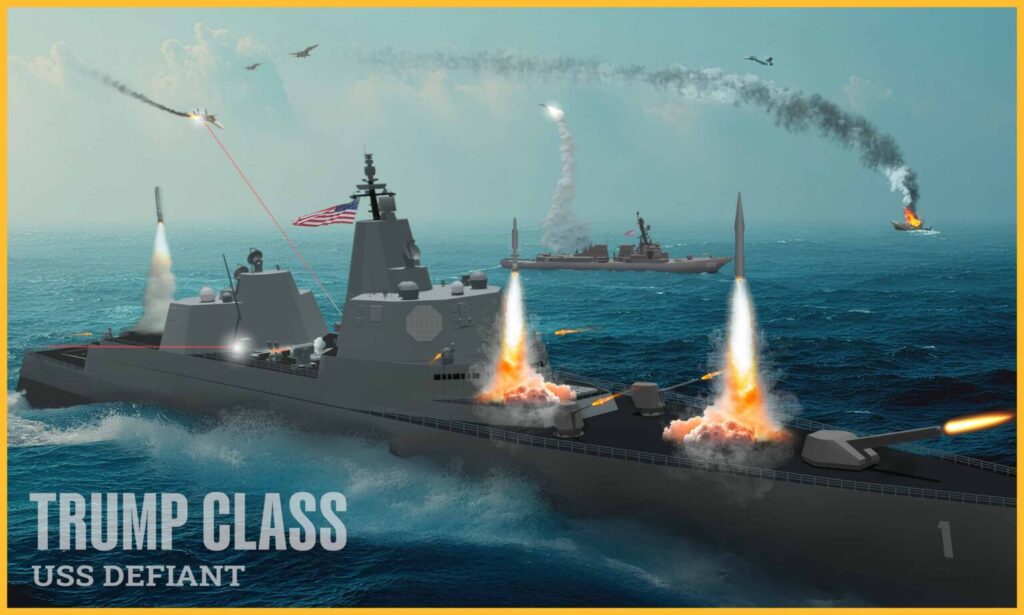
An artist’s conception of a new Navy battleship, as released by the U.S. Navy in December. Image credit: U.S. Navy
ARLINGTON, VA — Shipbuilder HII is concentrating on improving its shipbuilding capacity and efficiency to meet the demands of the military and the Trump Administration, efforts that now are expected to include building a new class of battleships.
Chris Kastner, president and CEO of HII, sat down with reporters in the company’s Arlington, Virginia office ahead of next week’s Surface Navy Association meeting and said the company is in tune with the administration and is focused on increasing its capacity and bolstering its workforce to speed ship production.
“It’s a good and challenging time to be in shipbuilding,” Kastner said.
Some of those challenges have arisen very recently. Just before Christmas, Trump announced a new class of battleship as part of the “Golden Fleet” concept to revitalize American shipbuilding, which would mark the first battleship construction since World War II.
This week, Trump said he wants defense spending to climb to $1.5 trillion, a 50% increase over the current budget, including spending from last year’s budget reconciliation bill. He also said defense companies should focus on performance instead of conducting stock buybacks or paying large salaries to executives.
Kastner said while much is yet unknown about the battleship — “we learned of the battleship announcement when you did” — he expects more information in the next month or two and said it won’t interfere with plans for a Navy package buy of two aircraft carriers as “it’s clear the Navy wants both, they’re both part of the Golden Fleet.”
The Navy has so far projected the battleship will be up to 800 feet long, have a crew of up to 850 and consist of 20 to 25 ships, each equipped with vertical launch missile cells, two Mk45 five-inch guns, one 32-megajoule railguns, Spy-6 radars and more.
Kastner said the speed of design and construction depends on whether it’s a clean-sheet system or one based on a parent ship, such as Arleigh Burke-class DDG-51 destroyers or the follow-on DDG(X) concept.
“If it’s fundamentally based on a derivative of a DDG expanded and they can use the DDG(X) concept studies as a baseline, you can accelerate things,” he said. “It’s all going to be based on the requirements, and how many of those requirements are consistent with a previous ship’s requirements, and whether you can use similar design parameters.”
Navy shipbuilding plans also include a yet-undefined new type of aircraft carrier as well as a new frigate based on HII’s Legend-class national security cutter, which Secretary of the Navy John Phelan described as “a proven, American-built ship that has been protecting U.S. interest at home and abroad … our goal is clear — launch the first hull in the water in 2028.”
Kastner said the carrier design is likely a “potential redesign of the Ford class” and said the goal date of 2028 for the new frigate is achievable because it’s based on the existing design. The Navy’s previous frigate program, based on an Italian ship design, was truncated to just two vessels after the program experienced schedule delays, cost overruns and design changes.
I have high confidence we can get that in the water in 2028,” he said. “When I say in the water, that means launched by 2028.” As for performing to meet White House and Department of Defense standards, Kastner said, “the theme is invest more, invest more for capacity and capability and technology, and if you do that and execute, you have opportunity for growth.”