Large, Medium USVs to Enhance Distributed Maritime Operations

The medium-displacement unmanned surface vehicle prototype Sea Hunter pulls into Joint Base Pearl Harbor-Hickam, Hawaii, Oct. 31, 2018. There is currently one Sea Hunter operating with Surface Development Squadron One and a second is planned. U.S. NAVY / Mass Communication Specialist 1st Class Corwin M. Colbert

ARLINGTON, Va. — The U.S. Navy is working hard and making progress in developing concepts and making technological advances in developing its planned large and medium unmanned surface vessels (USVs), said the admiral in charge of their development.  

“USVs are one of the centerpieces of distributed maritime operations,” said Rear Adm. Casey Moton, program executive officer, Unmanned and Small Combatants (PEO-USC), speaking June 23 at an event sponsored by the U.S. Naval Institute, Huntington Ingalls Industries and the Center for Strategic and International Studies — a Washington think tank.  

Moton said the Navy views the future Large USV (LUSV) and Medium USV (MUSV) as platforms that will enable the fleet to operate in a more distributed manner either as part of a carrier strike group or as vessels pressed forward with an acceptable risk of attrition. 

The LUSV and MUSV are envisioned as distributed platforms with lower cost than manned warships that will have sensors and/or missiles and that normally will operate under the protection of a carrier strike group. Both types of USVs will need to be capable of open-ocean transits, Moton said.   

The LUSV, for example, is envisioned to be a node in the Aegis protective network and could function as an “add-on magazine” of missiles, Moton said.  

Moton’s office is “laying a lot of the foundational work” for USV operations by developing mission autonomy; navigation and control systems; hull, mechanical and electrical reliability; cyber and anti-tamper protection; and integration of the USV into the Aegis Combat System, with a focus on retiring risk in the prototype phase of development. Moton said the LUSV to be equipped with vertical-launch systems.    

The Navy’s Surface Development Squadron One in San Diego now operates the single Sea Hunter USV, which he said has been exercising with guided-missile destroyers. A second Sea Hunter is under construction. 

The Navy’s two Overlord commercial-standard vessels with unmanned systems also have been busy with concept and systems development. One of the Overlord vessels made two long transits of 1,400 nautical miles from the Gulf of Mexico to Norfolk, Virginia, and back, in an autonomous mode, Moton said.  

One of the concepts being worked on is the degree to which people will be involved in servicing the LUSV, for example. Personnel will need to be involved in maintenance, resupply, protection, and moving the vessel in and out of port. The need for personnel to temporarily board and stay onboard these vessels for a period is one of the areas being studied. Redundancy of some systems may reduce the need for unscheduled maintenance. A goal is to have a 30-day threshold of operation between preventative maintenance periods. 

“Our starting point for those two vessels [LUSV and MUSV] is we are driving from a technology standpoint to try and automate everything that we can,” Moton said. 

He said the Navy has two more Overlord vessels under construction that will be delivered in fiscal 2021. 

“The plan is to push our prototypes out to the West Coast [for the Surface Development Squadron One] but we’re looking for opportunities for the East Coast as well,” Moton said. 

The first program-of-record LUSV is planned for procurement in fiscal 2023. 


Navy Positions Contract Option for 2 Columbia SSBNs

An artist rendering of the future Columbia-class ballistic missile submarines. U.S. NAVY

ARLINGTON, Va. — The Navy has awarded an $869 million contract modification for continued work on the Columbia-class ballistic-missile submarine (SSBN) design and support, but which also includes an option to build the first two Columbia SSBNs when funds are authorized and appropriated by Congress, the Navy announced on June 22. The work to ready the contract option will enable the Navy, if authorized, to begin construction of the first Columbia in October 2020. 

Naval Sea Systems Command awarded General Dynamics Electric Boat the $869 million contract modification to pursue “continued design completion, engineering work, affordability studies and design support efforts for the Columbia class,” the 22 June Defense Department contract announcement said. “This modification also includes submarine industrial base development and expansion efforts as part of the integrated enterprise plan and multi-program material procurement supporting Columbia SSBNs and the nuclear shipbuilding enterprise (Virginia-class [submarine] and Ford-class [aircraft carrier]). The contract modification also provides additional United Kingdom Strategic Weapon Support System kit manufacturing and effort to support expansion of the domestic missile tube industrial base.” 

The contract modification also features an option — that already has been fully priced by the Navy — that would start construction of the first Columbia, SSBN 826, in October 2020, and fund advance procurement, advance construction and 2024 construction start of the second Columbia, SSBN 827. If exercised, the option would increase the value of the contract to $9.5 billion. 

In a June 22 teleconference with reporters, James F. Geurts, assistant secretary of the Navy for research, defense and acquisition, said the Navy is focused on its supplier industrial base and improving the capacity of its sub-tier vendors, which would reduce risk in its nuclear ship programs and thereby reduce risk and delay in the Columbia program. He expressed appreciation of Congress for its support of the Navy’s efforts to shore up the industrial base. 

Geurts said the work of the Navy to price out the two SSBN contract option will help the service keep on schedule and achieve economies on materials and advance procurement for the class.  

Rep. Joe Courtney, D-Conn., chairman of the House Seapower and Projection Forces Subcommittee, in whose district Electric Boat’s main facility is located, praised the Navy’s initiative in a June 22 statement.  

“Today’s announcement means ‘game on’ for this exciting and transformational project that will shape our region’s economy for the next two decades — and I know that our talented shipbuilders of Electric Boat are up to the challenge,” Courtney said. “This award is the culmination of nearly a decade’s worth of preparation for this milestone moment for our region and our nation,” Courtney said. “The replacement of our sea-based strategic deterrent comes only once every other generation, and this work is already fueling unprecedented growth in the workforce in Groton and transformation of the shipyard. This isn’t just good news for Groton — the work that will be done on this program will fuel activity at suppliers across our state and our nation for years to come. This exciting news is a testament to the hard work of countless designers, engineers and waterfront tradesmen and women who have worked so hard each and every day for more than a decade to see this day come.” 

Geurts said the strategic imperative of fielding the USS Columbia on its first deterrent patrol in 2031 requires a delivery of the submarine in 2028. 

The Navy plans to build 12 Columbia-class SSBNS to replace 14 Ohio-class SSBNs. The Trident D5LE nuclear-armed ballistic missile will arm both classes. 


Navy Awards Austal USA $43 Million Contract for LCS Post-Delivery Services

MOBILE, Ala. — Austal USA has been awarded a modification to previously awarded contract with a total potential value of $43,362,000 by Naval Sea Systems Command to exercise the options for littoral combat ship (LCS) class design services, material to support LCS class design services and the integrated data product model environment (IDPME), the company said in a June 23 release.  

“The continued award of LCS post-delivery services contracts reflects the Navy’s ongoing confidence in Austal to perform quality work throughout the life cycle of the ship,” Austal USA President Craig Perciavalle said. “Austal’s post-delivery service and supply team’s performance will help continue Austal’s outstanding support to the fleet well into the future.” 

Austal will provide LCS class design services to all LCS ships and services may include program management, fitting out services, change processing, software maintenance, engineering and lifecycle efforts. Austal will also maintain an IDPME that shall enable Navy access to enterprise LCS data management. 


House Seapower Subcommittee Announces Proposals for 2021

The release by Reps. Courtney and Wittman details the need for four more V-22 Ospreys. U.S. NAVY / Mass Communication Specialist 3rd Class Vance Hand

ARLINGTON, Va. — The House Committee on Armed Services Subcommittee on Seapower and Projection Forces has announced its proposals for the mark-up of the National Defense Authorization Act for Fiscal Year 2021. 

In a June 22 release, chairman Rep. Joe Courtney, D-Conn., and ranking member Rep. Rob Wittman, R-Va., released the proposals the day before the scheduled June 23 mark-up session.  

Of major naval-related items, the proposal: 

  • Recommends the restoration of a second Virginia-class submarine and the required advanced procurement to maintain the two-per-year build rate. 
  • Recommends to the full committee that the Navy procure eight battle force ships, including one Columbia class fleet ballistic missile submarine; two Virginia-class submarines; two Arleigh Burke destroyers; one guided-missile frigate (FFG); and two T-ATS towing, salvage, and rescue ships. 
  • Prohibits the retirement of littoral combat ships LCS 3 and LCS 4 until all operational tests have been completed.  
  • Prohibits the retirement of any aircraft carrier before its first refueling.  
  • Recommends six P-8 Poseidon aircraft. 
  • Recommends four additional V-22 Osprey aircraft. 
  • Authorizes efficient construction of the first two Columbia-class ballistic-missile submarines. 
  • Restricts funds associated with the secretary of defense until the 30-year shipbuilding plan is delivered. 
  • In fiscal 2021, prohibits the retirement of any Navy vessel until the secretary of defense provides a Navy force structure assessment. 
  • Authorizes the procurement of up to four used sealift vessels.   
  • Requires the secretary of defense to provide ship requirements to implement the Commandant’s Planning Guidance. 
  • Establishes a Tanker Security Fleet to help fill the gap in at sea logistics. 
  • Recommends funding of the fourth National Security Multi-Mission Vessel for the state maritime academies and recommends additional funds for previously authorized ships. 
  • Continues to provide strict oversight of the Large Unmanned Surface Vessel. 


Littoral Combat Ship USS Kansas City Joins the Fleet

Cmdr. William Dvorak, executive officer of the Navy’s newest littoral combat ship USS Kansas City (LCS 22) salutes Cmdr. R.J. Zamberlan, the ship’s commanding officer, during a reading of his orders during the ship’s commissioning ceremony. The Navy commissioned LCS 22, the second ship in naval history to be named Kansas City, via naval message due to public health safety and restrictions of large public events related to the novel coronavirus (COVID-19) pandemic. U.S. NAVY / Mass Communication Specialist 2nd Class Alex Corona

SAN DIEGO — The U.S. Navy commissioned Independence-variant littoral combat ship USS Kansas City (LCS 22) June 20, Littoral Combat Ship Squadron One Public Affairs said in a release. 

The Navy commissioned Kansas City administratively via naval message, due to public health safety and restrictions of large public gatherings related to the COVID-19 pandemic and transitioned the ship to normal operations. The Navy is looking at a future opportunity to commemorate the special event with the ship’s sponsor, crew and commissioning committee. 

“This Independence-variant littoral combat ship will continue our proud naval legacy and embody the spirit of the people of Kansas City,” said Navy Secretary Kenneth J. Braithwaite. “I am confident the crew of the USS Kansas City will extend the reach and capability of our force and confront the challenges of today’s complex world with our core values of honor, courage and commitment.” 

Vice Adm. Richard A. Brown, commander, Naval Surface Force, U.S. Pacific Fleet, welcomed the ship that brings capabilities to counter diesel submarine, mines and fast surface craft threats to the premier surface force in the world. 

“Like other littoral combat ships, Kansas City brings speed and agility to the fleet,” said Brown via naval message. “Congratulations to Kansas City’s captain and crew for all of your hard work to reach this milestone. You join a proud surface force that controls the seas and provides the nation with combat naval power when and where needed.” 

Tracy Davidson, the ship’s sponsor, offered congratulations to everyone who played a role in delivering USS Kansas City to service. 

“I am so proud of USS Kansas City and her crew, and everyone involved, for all the tremendous work they’ve done to bring this ship to life. Their dedication to our nation and the Navy is very much appreciated,” Davidson said. “I am privileged to be a part of this ship honoring Kansas City and look forward to remaining connected to USS Kansas City as her legacy grows, wherever she may sail.” 

Kansas City’s commanding officer, Cmdr. R.J. Zamberlan, reported the ship ready. 

“The caliber of crew required to prepare a warship entering the fleet is second to none,” Zamberlan said. “This is even more impressive aboard an LCS, where every member of the minimally manned team is required to fulfill multiple roles and excel at all of them to get the job done. 

“This crew has exceeded expectations in unprecedented times and I could not be prouder to be their captain.” 

Kansas City is the 11th of the Independence-variant to join the fleet and second ship to be named for Kansas City. The name Kansas City was assigned to a heavy cruiser during World War II. However, construction was canceled after one month due to the end of the war. 

The name Kansas City was also assigned to the Wichita-class replenishment oiler AOR-3 in 1967. This ship saw service in the Vietnam War and Operation Desert Storm and was decommissioned in 1994. 

The littoral combat ship is a fast, agile and networked surface combatant, and the primary mission for the LCS includes countering diesel submarine threats, littoral mine threats and surface threats to assure maritime access for joint forces. The underlying strength of the LCS lies in its innovative design approach, applying modularity for operational flexibility. 

Fundamental to this approach is the capability to rapidly install interchangeable mission packages onto the seaframe to fulfill a specific mission and then be uninstalled, maintained and upgraded at the Mission Package Support Facility for future use aboard any LCS seaframe. 


AARGM-ER Components Pass Critical Design Review

Advanced Anti-Radiation Guided Missile image. NORTHROP GRUMMAN

LOS ANGELES — Northrop Grumman Corp. recently completed its critical design review (CDR) following successful design verification tests of key components for the U.S. Navy’s Advanced Anti-Radiation Guided Missile-Extended Range (AARGM-ER) program, the company said in a June 18 release. The AARGM-ER program is leveraging the AARGM program currently in full-rate production. Design verification tests of the AARGM-ER rocket motor and warhead along with the CDR verified subsystem- and system-level performance. 

“Rocket motor design verification tests represented a significant knowledge point and milestone for engineering and manufacturing development,” said Gordon Turner, vice president, advanced weapons, Northrop Grumman. “These tests were important to informing the critical design review and verifying performance of the missile.  With our government partners, we are aggressively focused on achieving ‘speed to fleet’ while holding to program cost objectives.” 

Design verification tests of the rocket motor were conducted at extreme cold and hot temperature conditions and successfully demonstrated required propulsion performance. Testing of the warhead successfully demonstrated lethality performance. AARGM-ER is being integrated on the F/A-18E/F and EA-18G and will be compatible for integration of the F-35A/B/C. By leveraging the AARGM program, the AARGM-ER program with the new rocket motor and warhead will provide advanced capability to detect and engage long-range adversary air defense systems. 


DoD Acts to Shore Up Shipbuilding Industrial Base Amid Pandemic

Austal USA’s shipyard in Mobile, Alabama. AUSTAL

ARLINGTON, Va. — The Defense Department is taking more actions to shore up the shipbuilding industrial base, among other industrial sectors, the department said in a June 18 release.  

The actions, made under the Defense Production Act Title III, are designed to “help sustain and strengthen essential domestic industrial base capabilities and defense-critical workforce in shipbuilding, aircraft manufacturing, and clothing and textiles,” said Lt. Col. Mike Andrews, Defense Department spokesman, in the release. “These actions will help to retain critical workforce capabilities throughout the disruption caused by COVID-19 and to restore some jobs lost because of the pandemic.” 

DoD made a $50 million agreement with Austal USA, a shipbuilder in Mobile, Alabama, “to maintain, protect, and expand critical domestic shipbuilding and maintenance capacity. These investments will have long-term benefits for U.S. Navy shipbuilding while accelerating pandemic recovery efforts in the Gulf Coast region,” the release said. 

Austal is the builder of the Navy’s Independence-class littoral combat ships and Spearheard-class expeditionary fast transport ships. 

In addition, DoD entered into a $55 million agreement with W International, based in Goose Creek, South Carolina, “to maintain, protect and expand critical domestic industrial base capability for the U.S. Navy nuclear shipbuilding industry. These investments will have long-term benefits for Navy shipbuilding while accelerating pandemic recovery efforts in the South East region of the United States,” the release said. 

W international is a fabrication corporation “that provides manufacturing, custom fabrication, project management, tooling and engineering services to clients in the aerospace, defense, automotive, energy and commercial industries,” according to the company’s website. 

In both cases, the DoD actions are being taken to “ensure critical capabilities are retained in support of U.S. Navy operational readiness,” Andrews said. 


F/A-18F Crash Only Second Navy Aircraft Lost So Far in 2020

An F/A-18F Super Hornet, shown here in January 2020 as it lands on the flight deck of the aircraft carrier USS Gerald R. Ford (CVN 78), was the second Navy aircraft lost so far in 2020 during a sortie from the USS Theodore Roosevelt. U.S. Navy / Mass Communication Specialist Seaman Jesus O. Aguiar

ARLINGTON, Va. — The crash of a Navy F/A-18F Super Hornet strike fighter on June 18 was only the second loss of a Navy aircraft so far in 2020 — or in fiscal 2020 as well — according to an unofficial count.  

The F/A-18F lost on June 18 crashed into the Philippine Sea during a sortie from the USS Theodore Roosevelt. The aircraft’s pilot and weapon system operator were rescued by an MH-60S helicopter from Helicopter Sea Combat Squadron Eight (HSC-8), according to a release from the aircraft carrier. 

The F/A-18F was assigned to Fighter Squadron 154 (VF-154), according to a source.  

“The incident occurred as the F/A-18F Super Hornet assigned to Carrier Air Wing 11 was conducting routine pilot proficiency training. The incident is currently under investigation,” the carrier said in its release. “Both aviators were assessed by the medical team on board Theodore Roosevelt and are in good condition.” 

The other loss in 2020 so far was an MH-60S operating from the 7th Fleet command ship USS Blue Ridge on Jan. 25. The helicopter crashed into the Philippine Sea and all five personnel on board were rescued. 


Navy Won’t Restore Relieved Captain to Command of COVID-19-Stricken Carrier

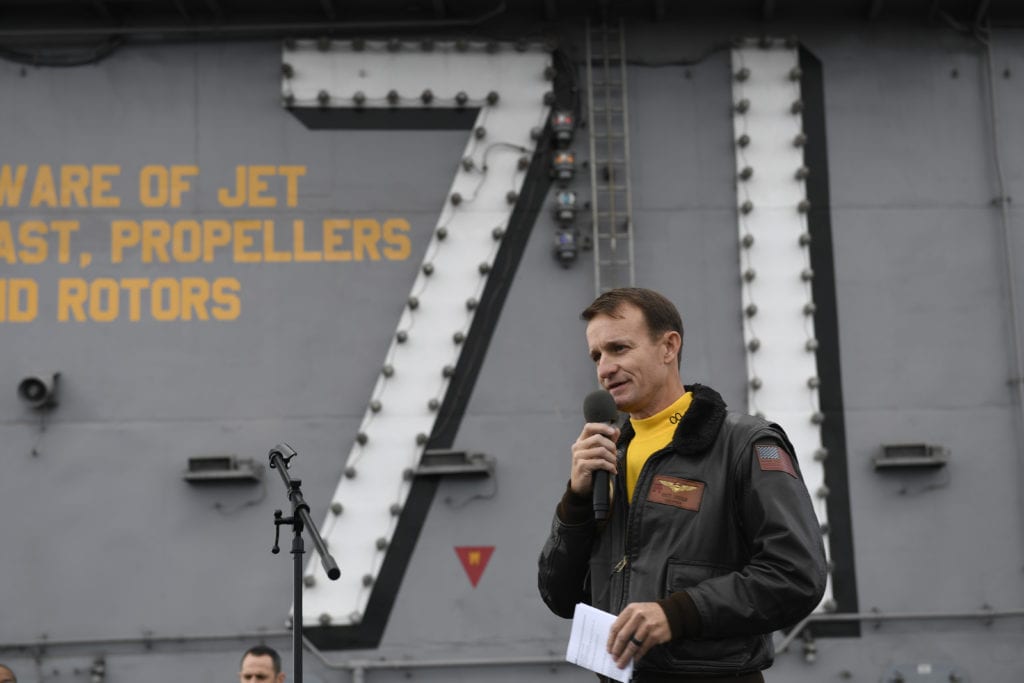
Capt. Brett Crozier, commanding officer of the aircraft carrier USS Theodore Roosevelt (CVN 71), addresses the crew during an all-hands call on the ship’s flight deck. Theodore Roosevelt is conducting routine operations in the Eastern Pacific Ocean. U.S. NAVY / Mass Communication Specialist 3rd Class Nicholas Huynh

ARLINGTON, Va. — Capt. Brett Crozier, the embattled former skipper of the first U.S. Navy warship to suffer a novel coronavirus outbreak at sea, will not be restored to command of the aircraft carrier USS Theodore Roosevelt, top Navy leaders announced June 19.

Chief of Naval Operations Adm. Mike Gilday and Navy Secretary Kenneth J. Braithwaite announced the decision at a Pentagon press briefing on the results of the USS Theodore Roosevelt Command Investigation, begun April 2, the day Crozier was fired. The investigation was conducted by Vice Chief of Naval Operations Adm. Robert Burke.

Gilday said he would not reassign Crozier as the commanding officer of the ship known as the TR, “nor will he be eligible for future command. Capt. Crozier will be reassigned.” Gilday also said the promotion of Crozier’s immediate superior, Rear Adm. Stuart Baker, the Theodore Roosevelt Carrier Strike Group commander, to a second star was being put on hold “pending further review.”

Braithwaite, who was sworn into office just three weeks ago, said he fully supported the report’s findings and recommendations and “I am satisfied that it was conducted in an extremely thorough and fair.”

Gilday conceded that he previously believed that Crozier should be reinstated after conducting an initial investigation following Crozier’s removal, but a wider investigation had a much deeper scope.

“It is my belief that both Admiral Baker and Capt. Crozier fell well short of what we expect of those  in command,” he said. “Had I known then what I know today, I would not have made that recommendation to reinstate Capt. Crozier. Moreover, if Capt. Crozier were still in command today, I would be relieving him,” Gilday added.

Crozier was relieved of command April 2 by then acting Navy Secretary Thomas B. Modly after a March 30 letter that Crozier wrote to top Navy officers and fellow naval aviators, pleading for faster intervention from his superiors to assist his crew, was leaked to a San Francisco newspaper.

In the letter, which was sent, unencrypted, via email, Crozier expressed alarm over the slow pace of disembarking his crew at Naval Base Guam while the coronavirus spread rapidly on the ship, also known as the TR. Publication of the letter in the San Francisco Chronicle sparked an outcry and worldwide media attention over Crozier’s actions and the fate of the carrier’s crew.

Eventually, 1,100 of the TR’s nearly 5,000 crewmembers, including Crozier himself, tested positive for COVID-19. Only a fraction required hospitalization, but one Sailor, Aviation Ordnanceman CPO Charles Thacker Jr., succumbed to the virus.

Crozier was hailed as a hero by his crew — who were seen on video cheering for him as he departed the ship in Guam — while others criticized him for circumventing the Navy’s chain of command. Modly said Crozier was not fired in retaliation for his letter but because the secretary had lost confidence in the captain’s leadership. Crozier, he said, had allowed the complexity of the COVID-19 challenge “to overwhelm his ability to act professionally, when acting professionally was what was needed.”

However, Modly complicated matters by flying to Guam, to defend his actions in an April 6 profanity laced address to the TR’s crew. Modly called Crozier “too naive or too stupid to be the commanding officer of a ship like this,” according transcripts of recordings of Modly’s remarks made by several of the carrier’s crew.

Less than 24 hours after the speech, Modly issued an apology to Crozier, the Roosevelt’s crew and the Navy, and offered his resignation to Defense Secretary Mark Esper, who accepted it.

Gilday directed Burke, the vice CNO, to investigate the circumstances and climate of the entire Pacific Fleet affecting the chain of command. Previously, Gilday spoke of “a potential comms breakdown, wherever it occurred,” adding “we’re not looking to shoot the messenger here, we want to get this right.”

The completed report was delivered April 24 to Modly’s replacement, acting Navy Secretary James McPherson, who directed Gilday to conduct a second investigation, saying he had “unanswered questions that the preliminary inquiry has identified and that can only be answered by a deeper review.”  

COVID-19 was detected on board the aircraft carrier in late March, 15 days after the TR made a port call to Da Nang, Vietnam, the Navy announced March 24. Stopping at Guam for a scheduled visit on March 27, Crozier began disembarking crewmembers as the number of Sailors testing positive continued to rise. Finding suitable accommodations for thousands of personnel on the island was a slow process.

In his letter, Crozier said the carrier had inadequate space to isolate or quarantine Sailors. “We are not at war. Sailors do not need to die,” Crozier wrote. “If we do not act now, we are failing to properly take care of our most trusted asset — our Sailors.”

Testing the entire crew for COVID-19 was completed in mid-May and they began returning to the carrier in waves after 14-days’ isolation and twice testing negative for the virus. Despite those efforts, at least 14 returning Sailors tested positive again for COVID-19. Following a bow-to-stern deep-cleaning process by about 700 crew members, and recertifying aviation activities for its Carrier Air Wing 11, the TR left Guam and resumed it mission on June 4.


Block III Super Hornets Headed for Navy Flight Tests

F/A-18 Block III flight test aircraft F287 makes its first flight in May. Boeing has delivered the first two Block IIIs to the U.S. Navy. Boeing

ARLINGTON, Va. — Boeing has delivered the first two Block III Super Hornet strike fighters to the U.S. Navy. The aircraft, an F/A-18E and two-seat F/A-18F, will go through comprehensive testing by Navy air test and evaluation (VX) squadrons over the next year.  

VX-23 at Naval Air Station Patuxent River, Maryland, will receive the F/A-18F (the 287th built) aircraft for “shore-based carrier testing” and will be used for testing of hardware and aeromechanical aspects, the Program Executive Office-Tactical Aircraft (PEO(T)) said in a June 17 release. 

Once that testing is completed, the F/A-18F will go to VX-31 at Naval Air Weapons Station China Lake, California, to complete Bock III testing. The F/A-18E (the 323rd built) will go to VX-31 for software functionality and network architecture testing. 

The Block III Super Hornet features several major structural and mission system improvements over the Block II, Jennifer Tebo, Boeing’s director of development for F/A-18E/F & EA-18G Programs, said in a June 17 teleconference with media.  

The Advanced Cockpit System includes replacement of a set of displays with a single large touch-screen display for improved user interface and display of the Common Tactical Picture, the PEO said. 

The Advanced Network Infrastructure will have 17 times the computing power of the mission computer of the Block II through the Distributed Targeting Processor Network and Tactical Targeting Network Technology (TTNT). 

Tebo described the TTNT as a “big data pipe — low latency, high-data” for better situational awareness. The infrastructure will be open to accept third-party applications for “speed to the fleet with urgent needs,” she said. 

The Block III Super Hornets will feature an improved radar cross section for better survivability. 

The most distinguishable characteristic of the Block III is the addition of streamlined, low-drag conformal fuel tanks to the upper wing and fuselage junctions. These will be optional for use and will enable the Super Hornet to carry 3,500 pounds more fuel, reducing the need for underwing external fuel tanks and freeing up the pylons to carry more weapons. 

When delivered, each Block III will have a service life of 10,000 flight hours, far more than the 6,000 hours of a Block II strike fighter. 

“In addition to the Block III delivery, Boeing will also perform service life modification (SLM) to hundreds of Block II Super Hornets, to extend their service life and integrate Block III capabilities,” the PEO said. “SLM is key to building the capacity and capability to ensure the Navy has jets ready to fight into the mid-2040s.” 

Tebo said the SLM will extend the life of Block IIs to 10,000 hours and that deliveries of Block IIIs converted from Block IIs will begin in 2023 and continue into the mid-2030s. 

Tebo said the Block III Super Hornet made its first flight on May 14. Delivery of 78 full-up production Block IIIs is planned to begin in mid-2021 at a rate of two per month through early 2024. 

“The first squadron deployment of Block III Super Hornet is anticipated in mid-2023, with a plan in place to have two Block III squadrons, composed of new production and Block IIs that have undergone SLM, accompanying each carrier air wing by 2027,” the PEO said in the release. 

“Now it’s up to our test squadrons and our integration team to verify requirements are met and ensure the engineering behind the Block III is validated prior to full-scale production and delivery of the Block III to the fleet,” Capt. Mike Burks, F/A-18 E/F deputy program manager, said in the release. 

“These new capabilities are essential for ensuring we maintain the tactical advantage in the Great Power Competition,” Capt. Jason Denney, the Navy’s F/A-18 & EA-1G Program Manager, said in the release. “Block III production and SLM for our Block IIs also demonstrate contracting efficiency and solid partnerships with industry — an all-around win for the Navy, for Boeing, and for the warfighter.”