Marine pilot Lt. Col. Lucas “Amber” Frank takes the CH-53K simulator, the Containerized Flight Training Device (CFTD), for a test drive. The Marine Corps took delivery of the CFTD in April. Naval Air Systems Command
PATUXENT RIVER, Md. — The H-53 heavy-lift helicopter program office has taken delivery of the first training device for the CH-53K King Stallion helicopter, according to a Naval Air Systems Command release.
Delivered April 14, the Containerized Flight Training Device (CFTD) is housed at Marine Corps Air Station (MCAS) New River in Jacksonville, North Carolina.
The CFTD, built by Lockheed Martin in partnership with Veraxx, provides realistic in-cockpit system displays (visual resolution, tactile, spatial, audio and functionality) and can simulate weather and tactical environments. The CFTD also can connect with other simulators for enhanced attitude control and other aircraft training scenarios.
“The CFTD is an amazingly capable training device,” said Col. Jack Perrin, CH-53 program manager. “It is a much less expensive practice than using operational equipment and provides near-aircraft fidelity into a state-of-the-art training simulator for the fleet.”
The CFTD is the first in a series of new training devices being developed for the CH-53K. All trainers will eventually be located at the Center for Naval Aviation Technology Training at MCAS New River, where all the aircraft’s aircrew and maintenance maintainers will be trained. Delivery of two other CH-53K training devices — the Helicopter Emulation Maintenance Trainer and the Composite Maintenance Trainer — also are expected this year.
The CH-53K is completing development tests, leading to initial operational test and evaluation in 2021. First fleet deployment will be in 2023 or 2024. The simulation software continuously updates. As the program team makes necessary modifications to the CH-53K into the future, the CFTD also will change.
Esper: ‘The Safest Place Is on a Deployed Navy Ship’
Hospital Corpsman 2nd Class Shane Miller (left) and Hospital Corpsman 2nd Class Austin Kelly draw blood from a Sailor assigned to the guided-missile destroyer USS Kidd after its arrival in San Diego as part of the Navy’s response to the COVID-19 outbreak on board the ship. U.S. Navy/Mass Communication Specialist 2nd Class Alex Corona
ARLINGTON, Va. — The secretary of defense noted May 4 that — with a couple of notable exceptions — the U.S. Navy’s ships at sea remain unaffected by the spread of the COVID-19 pandemic.
“The statistics show that the safest place to be is on a deployed Navy ship compared to one that’s in port,” Defense Secretary Mark Esper said, speaking during a webcast sponsored by the Brookings Institution, a Washington think tank. “Of the 90-plus ships at sea, we only have two that have been affected.”
The Navy has suffered significant outbreaks of the novel coronavirus on the Nimitz-class aircraft carrier USS Theodore Roosevelt and the Arleigh Burke-class guided-missile destroyer USS Kidd. A Sailor off the Roosevelt died from COVID-19 complications in mid-April.
The cause of the transmission of the virus to the crews of both ships is unknown. The Theodore Roosevelt made a port call to Vietnam soon before Sailors began showing signs of illness. Another possibility: the virus was brought aboard by aircrews and passengers returning to the carrier.
“We’re not sure where [the USS Kidd] picked [the virus] up,” Esper said. “It may have been through a counter-drug operation.”
Esper said that “two ships out of 94 is a pretty good record. The Navy has taken a lot of good practices. They’ve learned from the Teddy Roosevelt. Before a ship is deployed it goes through multiple tests of its Sailors. They are quarantined for a couple of weeks. And, of course, we don’t bring a ship back in if it’s being replaced by one that’s going out. So, we’re being very careful of that.”
“The statistics show that the safest place to be is on a deployed Navy ship compared to one that’s in port.”
Defense Secretary Mark Esper, during a May 4 webinar
The service is keeping the aircraft carrier USS Harry S. Truman away from port following a major deployment to avoid the pandemic.
“We have had ships that have been portside that have had Sailors infected but that’s not unlike what you might see at an Army base or an Air Force base where you have Sailors out in the community who may get infected by the virus,” Esper said. “Before they go to sea, we bring them in, we test, we quarantine, and we make adjustments to make sure our ships get out on time.”
U.S., British Ships Conduct Anti-Submarine Exercise Above Arctic Circle
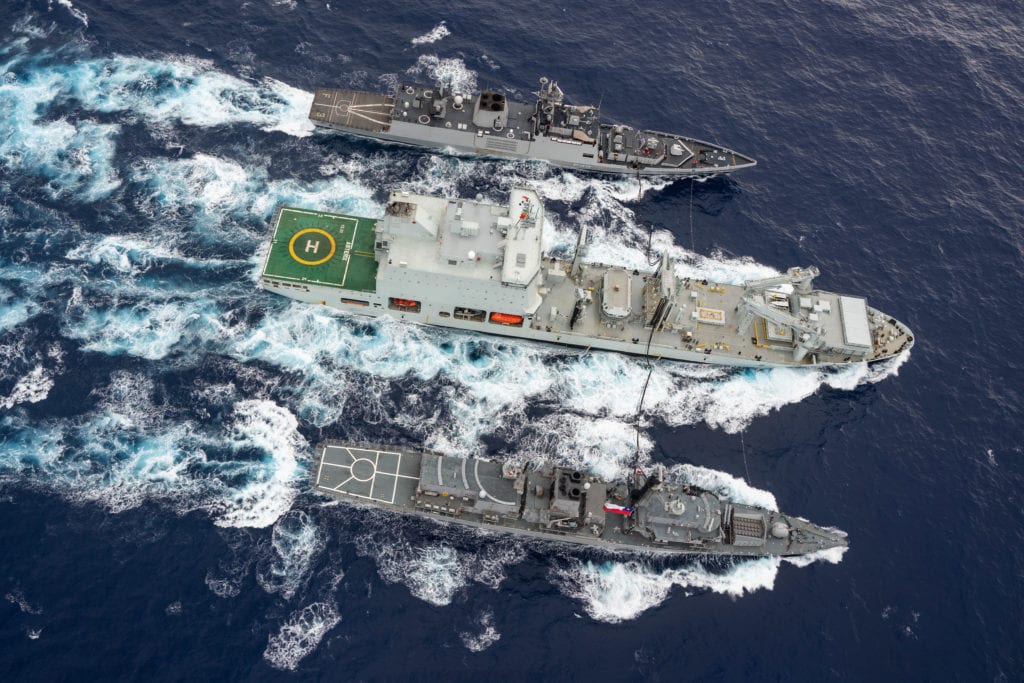
The Arleigh Burke-class guided-missile destroyer USS Donald Cook, USNS Supply, the USS Porter and the Royal Navy’s HMS Kent conduct a connected replenishment in the North Atlantic on April 28 ahead of a bilateral anti-submarine warfare exercise. U.S. Navy/Yeoman 3rd Class Anthony Nichols
NORWEGIAN SEA — The U.S. 6th Fleet conducted a bilateral anti-submarine warfare exercise with the U.K. above the Arctic Circle on May 1, U.S. Naval Forces Europe-Africa and the 6th Fleet said.
Four ships from two nations, a U.S. submarine, and a U.S. P-8A maritime patrol and reconnaissance aircraft worked together in the Norwegian Sea to conduct training in the challenging Arctic conditions.
For the exercise, Arleigh Burke-class Aegis destroyers USS Donald Cook and the USS Porter and fast combat support ship USNS Supply were joined by the Royal Navy’s HMS Kent. The U.S. sub and the P-8A Poseidon from Patrol Squadron (VP) 4 supported the training. This drill reinforced the combined training that the nations received last month while participating in the U.K.’s Submarine Command Course.
“For more than 70 years, 6th Fleet has operated forces across the region in support of maritime security and stability. Our regional alliances remain strong because of our regular operations and exercises with partner navies, and we welcome this opportunity to work collaboratively at sea, while enhancing our understanding of Arctic operations,” said Vice Adm. Lisa Franchetti, the 6th Fleet’s commander.
The multinational anti-submarine exercise in the High North, made up of about 1,200 Sailors from the U.S. Navy and Royal Navy, is the latest in a series of U.S. ships operating above the Arctic Circle.
In 2018, elements of the USS Harry S. Truman Carrier Strike Group and the USS Iwo Jima Expeditionary Strike Group operated above the Arctic Circle to support a NATO exercise, Trident Juncture. In 2019, the forward deployed destroyer USS Donald Cook and a SAG from U.S 2nd Fleet led by the USS Normandy and the USS Farragut also operated separately above the Arctic Circle.
“We are working with our partners to enhance our combined capabilities as we conduct maritime security operations and training in the Arctic region,” Franchetti said. “Our ships must be prepared to operate across all mission sets, even in the most unforgiving environments. This is especially critical in the Arctic, where the austere weather environment demands constant vigilance and practice.”
Geurts: Urgency, Discipline Hallmarks of Frigate Selection Process
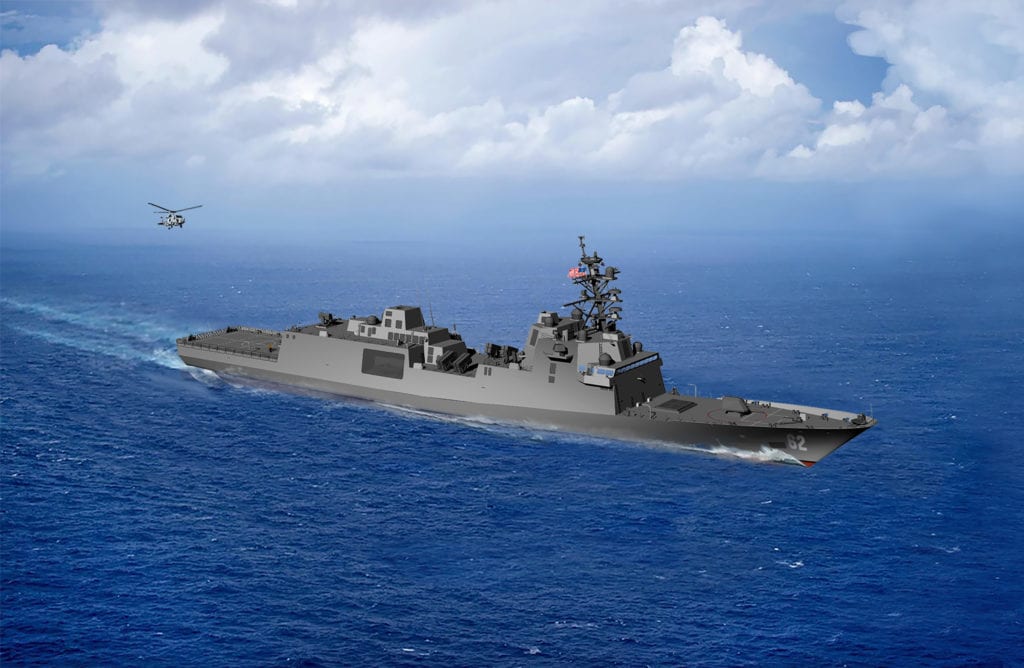
Marinette Marine will base the FFG(X) guided-missile frigate on Fincantieri’s FREMM frigate, which is in service with the Italian and French navies.
ARLINGTON, Va. — The U.S. Navy’s top acquisition official praised the government team that selected and the industry teams that submitted proposals for the design of the Navy’s next-generation small combatant, the FFG(X) guided-missile frigate, the first of which is scheduled to be delivered in 2026. Design of the frigate has begun three months ahead of schedule.
The Navy announced on April 30 that it had awarded a detailed design and construction contract to Marinette Marine, a Fincantieri company based in Marinette, Wisconsin.
Marinette is building the Freedom-class littoral combat ships for Lockheed Martin and will turn to building the new frigate that will be based on the Fincantieri FREMM frigate, which is in service with the Italian and French navies.
“I am very proud of the hard work from the requirements, acquisition and shipbuilder teams that participated in the full and open competition, enabling the Navy to make this important decision today,” said James F. Geurts, assistant secretary of the Navy for research, development and acquisition, in the Navy’s April 30 announcement.
“Throughout this process, the government team and our industry partners have all executed with a sense of urgency and discipline, delivering this contract award three months ahead of schedule. The team’s intense focus on cost, acquisition and technical rigor enabled the government to deliver the best value for our taxpayers as we deliver a highly capable next-generation frigate to our warfighters.”
“The parent design really set us up well here.”
Rear Adm. Casey Moton, program executive officer for unmanned and small combatants
Geurts noted in a May 1 teleconference with reporters that the selection of the frigate design three months ahead of schedule was accomplished despite the impact of the COVID-19 pandemic on the Navy and stressed again that the decision was made with “a sense of urgency but also a sense of discipline.”
He said that by “integrating the requirements, acquisition planning and conceptual design we were able to reduce the span time by six years as compared to traditional shipbuilding programs. … It’s the best I’ve seen in the Navy thus far at integrating all of our teams together and it’s a model we are building on for future programs.”
The detail design and construction (DD&C) contract awards $795.1 million for the design and construction of the lead ship plus nine separately priced options for up to nine more ships. The contract also provides for “post-delivery availability support, engineering and class services, crew familiarization, training equipment, and provisioned item orders,” the April 30 Defense Department contract announcement said.
The price of the lead ship, including the design cost, is marked as $1.281 billion, which includes the $795 million for the shipbuilder’s design and construction, with the remainder for government-furnished equipment (GFE) and other items and services.
The Navy has a cost objective for the follow-on ships of $800 million each and a threshold of $950 million. According to a Navy independent cost estimate, the follow-on ships will cost $781 million (in constant 2018 dollars) on average. If all options are exercised, the contract’s cumulative value for the 10 frigates would be $5.58 billion. The Navy has a requirement for 10 more small surface combatants but has not yet settled on an acquisition strategy for the second set of 10, Geurts said.
He said that by selecting a proven hull and adding a proven combat system, weapons and sensors, the Navy was able to keep the cost under the objective cost per platform cap of $950 million (in fiscal 2018 dollars).
“The Navy conducted this competition using a tradeoff process to determine the proposal representing the best value, based on the evaluation of non-price factors in conjunction with price,” the contract announcement said.
“The Navy made the best value determination by considering the relative importance of evaluation factors as set forth in the solicitation, where the non-price factors of design and design maturity and objective performance (to achieve warfighting capability) were approximately equal and each more important than remaining factors.”
Construction of the first frigate is scheduled for no later than April 2022, with delivery set for 2026. Initial operational capability is slated for 2029 or 2030 and full operational capability scheduled for 2031 or 2032. The contract calls for final work to be complete by 2035.
Rear Adm. Casey Moton, program executive officer for unmanned and small combatants, who also spoke at the teleconference, said the maturity of the selected design “was one of the non-price factors” that influenced the decision.
“The parent design really set us up well here,” Moton said of the nondevelopmental FREMM design that was selected.
He also cited the work that Fincantieri put into and will put into the Marinette shipyard as another non-price factor that was weighed in the selection decision.
Moton also said he was very comfortable with how the plan for acquisition and integration of government-furnished equipment was proceeding and that the GFE “will be ready on time.”
An artist’s conception of the next-generation small surface combatant, the guided-missile frigate (FFG(X). U.S. Navy
WASHINGTON — Marinette Marine has won a coveted contract from the U.S. Navy to design and produce the next-generation small surface combatant, the guided-missile frigate (FFG(X), the public affairs office of the Navy’s Program Executive Office-Unmanned and Small Combatants said in an April 30 release.
The Marinette Marine deal is good for detail design and construction (DD&C) of up to 10 guided-missile frigates, consisting of one base ship and nine option ships.
The FFG(X) will have multimission capability to conduct air warfare, anti-submarine warfare, surface warfare, electronic warfare and information operations.
“The Navy’s Guided-Missile Frigate (FFG(X)) will be an important part of our future fleet,” said Chief of Naval Operations, Adm. Mike Gilday. “FFG(X) is the evolution of the Navy’s small surface combatant with increased lethality, survivability and improved capability to support the National Defense Strategy across the full range of military operations. It will no doubt help us conduct distributed maritime operations more effectively, and improve our ability to fight both in contested blue-water and littoral environments.”
The new ship will include an Enterprise Air Surveillance Radar (EASR) radar, Baseline Ten (BL10) AEGIS Combat System, a Mk41 Vertical Launch System (VLS), communications systems, Mk57 Gun Weapon System (GWS) countermeasures and added capability in the EW/IO area with design flexibility for future growth.
“I am very proud of the hard work from the requirements, acquisition and shipbuilder teams that participated in the full and open competition, enabling the Navy to make this important decision today,” said James Geurts, assistant secretary of the Navy for research, development and acquisition.
“Throughout this process, the government team and our industry partners have all executed with a sense of urgency and discipline, delivering this contract award three months ahead of schedule. The team’s intense focus on cost, acquisition and technical rigor enabled the government to deliver the best value for our taxpayers as we deliver a highly capable next-generation frigate to our warfighters.”
The acquisition process for FFG(X) began in 2017. Since then, the Navy has worked with industry to balance cost and capability. The Navy released the FFG(X) DD&C request for proposals to industry last June. Technical proposals were received in August and cost proposals were received the following month. A full and open competition took place with multiple offers received.
Pacific Fleet to Host At-Sea-Only RIMPAC Exercise in August
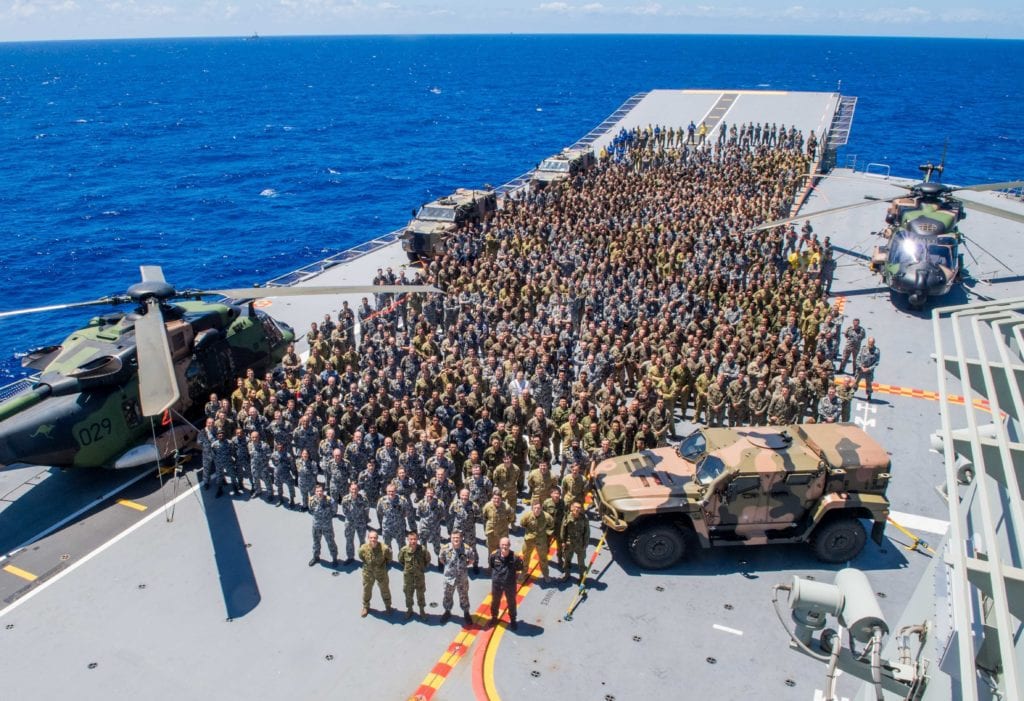
Military members from the Royal Australian Navy, Australian army, U.S. Marines, Sri Lankan navy and marines, Royal Malaysian Army, His Majesty’s Armed Forces of Brunei, the Japan Ground Self-Defense Force and the New Zealand army gather for a group photo on the flight deck of the landing helicopter dock ship HMAS Adelaide during the last RIMPAC two years ago. U.S. Navy/Mass Communication Specialist 2nd Class Kelsey J. Hockenberger
PEARL HARBOR, Hawaii — The U.S. Navy will sponsor the 27th Rim of the Pacific exercise, from Aug. 17 to Aug. 31, the U.S. Pacific Fleet said in a release.
Hosted by the commander, U.S. Pacific Fleet, this biennial maritime exercise will be an at-sea-only event in light of COVID-19 concerns. The theme of RIMPAC 2020 is “Capable, Adaptive, Partners.”
The at-sea-only construct for RIMPAC 2020 was developed to ensure the safety of all forces participating by minimizing shore-based contingents. Commander, U.S. Pacific Fleet crafted the modified RIMPAC plan as a way to conduct a meaningful exercise with maximum training value and minimum risk to the force, allies and partners, and the people of Hawaii.
The world’s largest international maritime exercise, RIMPAC is designed to foster and sustain cooperative relationships, critical to ensuring the safety of sea lanes and security in support of a free and open Indo-Pacific region.
The exercise, which takes place in the waters surrounding the Hawaiian Islands, is a training platform designed to enhance interoperability and strategic maritime partnerships. In 2018, during the last RIMPAC, 26 nations participated in and around Hawaii.
“In these challenging times, it is more important than ever that our maritime forces work together to protect vital shipping lanes and ensure freedom of navigation through international waters,” said Adm. John Aquilino, commander, U.S. Pacific Fleet. “And we will operate safely, using prudent mitigation measures.”
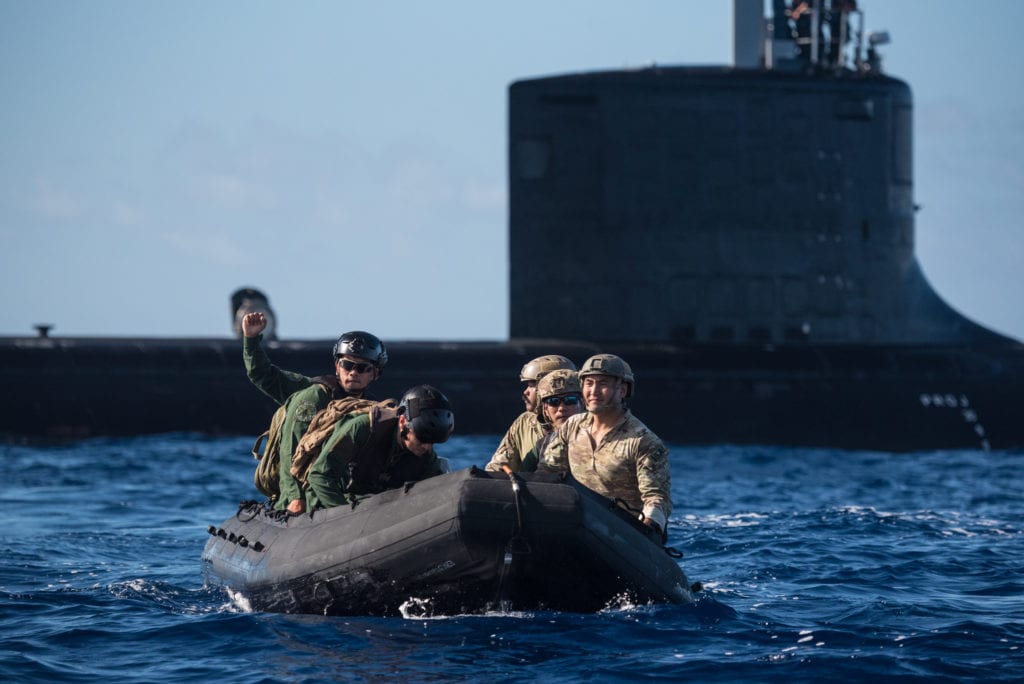
Multinational special operations forces participate in a submarine insertion exercise with the Virginia-class fast-attack submarine USS Hawaii and combat rubber raiding craft off the coast of Oahu, Hawaii, during RIMPAC 2018. U.S. Navy/Mass Communication Specialist 1st Class Daniel Hinton
As the U.S. Navy continues to limit the spread of COVID-19, RIMPAC 2020 is not scheduled to include social events ashore. Joint Base Pearl Harbor-Hickam will be accessible for logistics support, with a minimal footprint of staff ashore for command and control, logistics and other support functions.
This year’s exercise will include multinational anti-submarine warfare, maritime intercept operations and live-fire training events, among other cooperative training opportunities. Continued planning will remain flexible as Navy leaders monitor and assess evolving circumstances.
“We remain committed to and capable of safeguarding allies and partners throughout the Indo-Pacific region,” Aquilino said. “The flexible approach to RIMPAC 2020 strikes the right balance between combatting future adversaries and the COVID-19 threat.”
RIMPAC 2020 will be led by the commander of the U.S. 3rd Fleet, Vice Adm. Scott D. Conn.
The Chilean navy frigate CNS Almirante Lynch and the Indian navy stealth multi-role frigate INS Sahyadri perform a replenishment-at-sea with the Royal Canadian Navy supply ship MV Asterix off the coast of Hawaii during RIMPAC 2018. Twenty-five nations, 46 ships, five submarines and about 200 aircraft and 25,000 personnel participated. U.S. Navy/Mass Communication Specialist 1st Class Arthurgwain L. Marquez
Geurts: Third Zumwalt DDG Will Be Commissioned After Combat Systems Activation
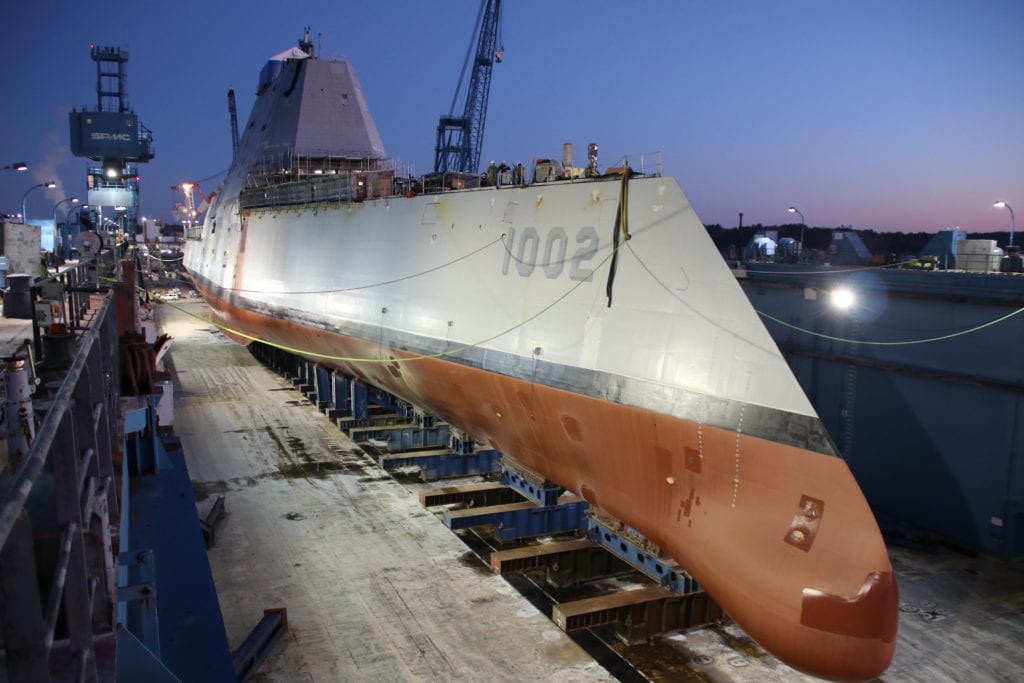
The USS Lyndon B. Johnson is made ready before flooding of the dry dock at General Dynamic-Bath Iron Works shipyard and subsequent launching of the third Zumwalt-class destroyer in 2018. U.S. Navy via General Dynamics-Bath Iron Works
ARLINGTON, Va. — The U.S. Navy’s third Zumwalt-class guided-missile destroyer will be commissioned after its combat systems are fully installed and activated, rather than going through a two-part delivery, the Navy’s top acquisition official said.
The future USS Lyndon B. Johnson (DDG 1002), under construction at the Bath Iron Works shipyard in Bath, Maine, will not be commissioned until after its combat systems are installed, unlike the process used for its two predecessors, USS Zumwalt (DDG 1000) and Michael Monsoor (DDG 1001), said James F. Geurts, assistant secretary of the Navy for research, development and acquisition, speaking to reporters in an April 28 teleconference.
In the case of the first two of the class, the ships’ hulls were completed and put through trials and then delivered to the Navy before their combat systems were installed. The Zumwalt was commissioned — in a status the Navy calls In Commission, Special — in Baltimore and then proceeded to San Diego for installation and activation of its combat systems. It was delivered to the Navy on April 24 and will begin at-sea testing of its systems preparing for its initial operational test and evaluation and its 2021 initial operational capability milestone.
The USS Michael Monsoor similarly was commissioned on Jan. 26, 2019, and proceeded to San Diego for its combat systems installation, which was completed in March.
The Lyndon B. Johnson is 93% complete, Geurts said, but will not be delivered and commissioned until its combat systems are installed. Since the combat systems activation will be conducted in San Diego, it will need to proceed there in a status other than as a commissioned ship.
“We did change to a single-phased delivery for that ship, and so we are adjusting that ship’s future plans based on all the learning we’ve had on DDG 1000 and DDG 1001,” Geurts said.
“I’m personally not a fan of two-phased delivery,” he said. “I can understand why we do them. In certain cases, I think they’re also problematic because you end up delivering the ship more than once and you can get into a delayed test-maintain-fix cycle.”
Navy Accepts Delivery of Destroyer USS Delbert D. Black
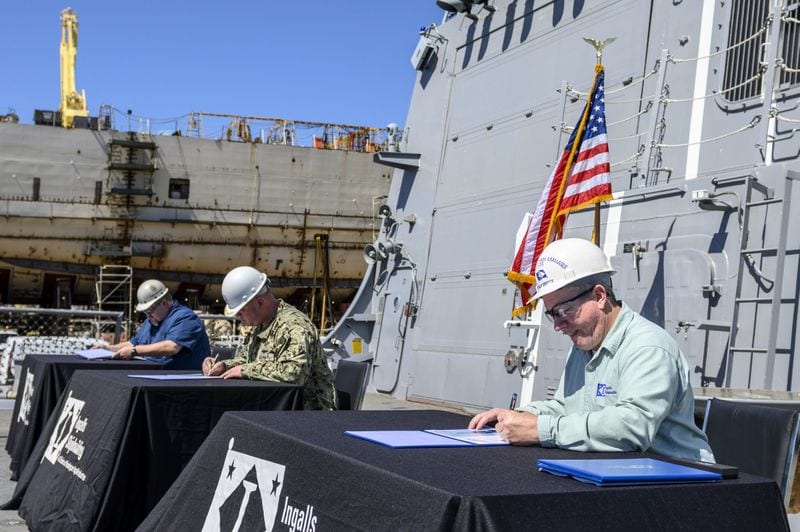
Donny Dorsey (right), Ingalls’ DDG 119 ship program manager, Cmdr. Matthew McKenna (center), the Delbert D. Black’s prospective commanding officer, and Peter T. Christman III, DDG 51 Project Office, SUPSHIP Gulf Coast, practice social distancing while signing the transfer of custody of the ship to the Navy on April 24 at Ingalls Shipbuilding in Pascagoula, Mississippi. Huntington Ingalls Industries
PASCAGOULA, Miss. — The U.S. Navy accepted delivery of the guided missile destroyer Delbert D. Black from Huntington Ingalls Industries’ Ingalls shipbuilding division on April 24, the Navy’s Program Executive Office (PEO)–Ships said in a release.
Accepting delivery of the Delbert D. Black represents the official transfer of the ship from the shipbuilder to the Navy. Prior to delivery, the ship successfully conducted a series of at-sea and pier-side trials to demonstrate its material and operational readiness.
The 68th Arleigh Burke-class destroyer honors Delbert D. Black, the first master chief petty officer of the Navy, and will be the first naval ship to bear his name. Black is known for guiding the Navy through the Vietnam War and ensuring enlisted leadership was properly represented Navy-wide by initiating the master chief program.
“The DDG 51 shipbuilding program and Supervisor of Shipbuilding, Gulf Coast are proud to accept delivery of Delbert D. Black on behalf of the Navy and look forward to her commissioning later this year,” said Capt. Seth Miller, DDG 51 class program manager for PEO-Ships. “Ingalls has delivered another highly capable platform that will sail from our shores and help protect the nation for decades to come.”
The DDG 51 class ships currently being constructed are Aegis Baseline 9 Integrated Air and Missile Defense destroyers with increased computing power and radar upgrades that improve detection and reaction capabilities against modern air warfare and ballistic missile defense threats.
In addition to Delbert D. Black, HII’s Pascagoula shipyard also is in production on the future destroyers Frank E. Peterson Jr. and Lenah H. Sutcliffe Higbee as well as the Flight III ships, Jack H. Lucas and Ted Stevens.
Navy Takes Delivery of Final Block II Super Hornet, Looks Ahead to Block III
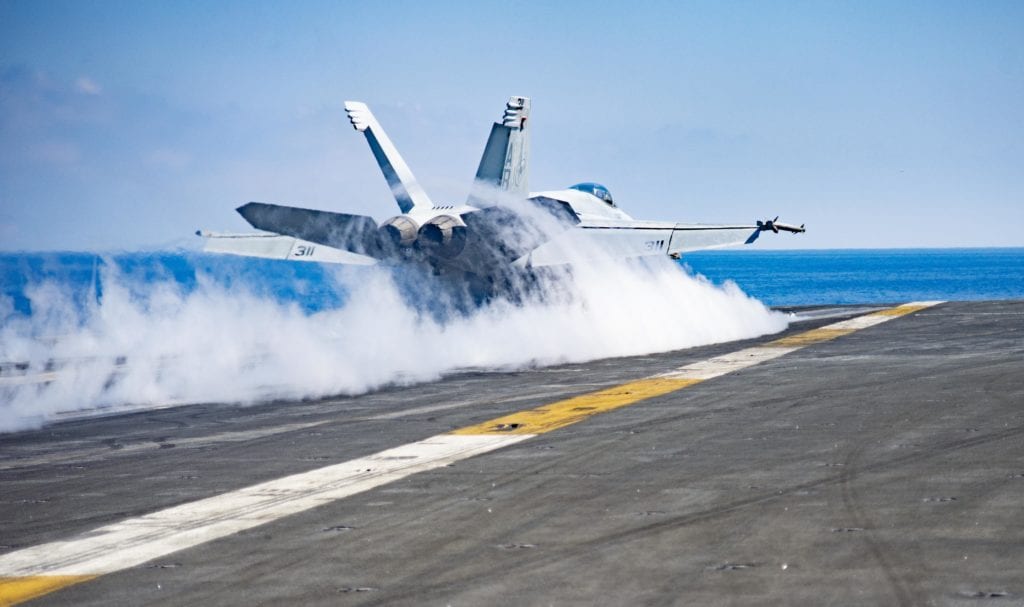
A Block II F/A-18E Super Hornet launches from the flight deck of the aircraft carrier USS Harry S. Truman in the Mediterranean Sea on April 5. U.S. Navy/Mass Communication Specialist 3rd Class Rebekah Watkins
PATUXENT RIVER, Md. — The U.S. Navy took delivery of the final Block II Super Hornet, closing out a run of 322 one-seater F/A-18Es and 286 two-seated F/A-18Fs, on April 17, the Navy’s Program Executive Office-Tactical Aircraft said in a release.
Since 2005, F/A-18 Super Hornet Block II aircraft have been rolling off Boeing’s production line and serving as the Navy’s multimission capable workhorse.
“Aircraft E322 will leave Boeing’s production line and head straight to Strike Fighter Squadron (VFA) 34 based in [Naval Air Station] Oceana,” said Cmdr. Tyler Tennille, of the Defense Contract Management Agency (DCMA), who oversees acceptance testing.
“When the Super Hornets first came online, they were a game-changer,” he said, pointing to the Block II’s Active Electronically Scanned Array radar as well as larger displays, upgraded sensors and avionics and increased range and capability to employ an arsenal of precision weapons that delivered advanced lethality and mission flexibility for the service.
The airframe was built with an open mission systems architecture, which has enabled easy integration of new weapons and technologies. The Block II Super Hornet serves as the Navy’s responsive aircraft, capable across the full mission spectrum, including air superiority, fighter escort, reconnaissance, aerial refueling, close air support, air defense suppression and day/night precision strike.
This aircraft been the backbone of the Navy’s carrier air wing and has proven itself repeatedly during numerous operations where it has been the pre-eminent platform performing multiple missions, sometimes rapidly reconfiguring on the fly.
Even though it is substantially larger — about 7,000 pounds heavier and a 50% higher range, the Super Hornet delivered with fewer parts and lower maintenance demands than its predecessor, the Hornet.
“Delivery of this last production Block II Super Hornet is hardly the end of an era, but rather a stepping stone along the path to continuously evolving our platforms to meet the Navy’s ever-evolving needs,” said Capt. Jason Denney, program manager of the F/A-18 and EA-18 Program Office.
Following the delivery of these aircraft, Tennille said he expects the transition from Block IIs to Block IIIs to be seamless.
The capabilities and successes of the Block II program were leveraged by the Navy in awarding a multiyear procurement contract for Block III Super Hornets to Boeing in March 2019, totaling about $4 billion. The Navy will procure 72 Block III Super Hornets between fiscal years 2019 and 2021.
Boeing is expected to deliver the Block III test jets to the Navy as early as late spring, where subsequent testing will commence at both Naval Air Station Patuxent River and Naval Air Weapons System China Lake. This latest version of the Super Hornet includes an advanced cockpit system, advanced network infrastructure, reduced radar cross-section and a 10,000-flight hour lifespan.
Navy Accepts Delivery of Next-Gen Destroyer
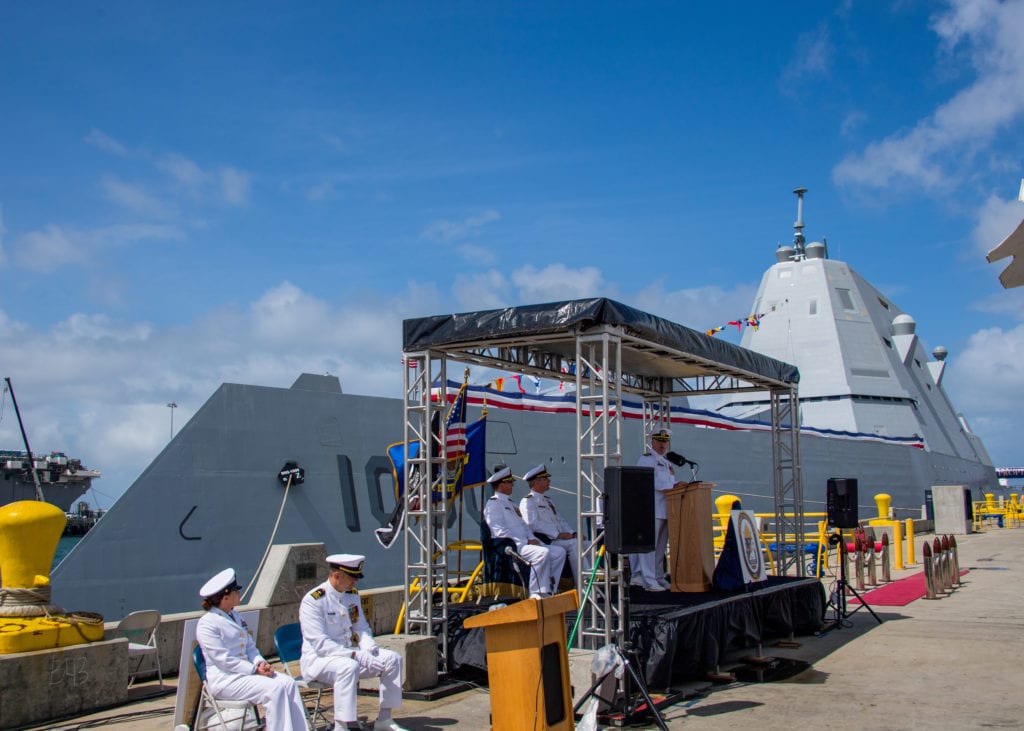
Capt. Scott Carroll, commander of Zumwalt Squadron One, delivers remarks during the establishment ceremony of Surface Development Squadron ONE last May. U.S. Navy/Mass Communication Specialist 1st Class Woody S. Paschall
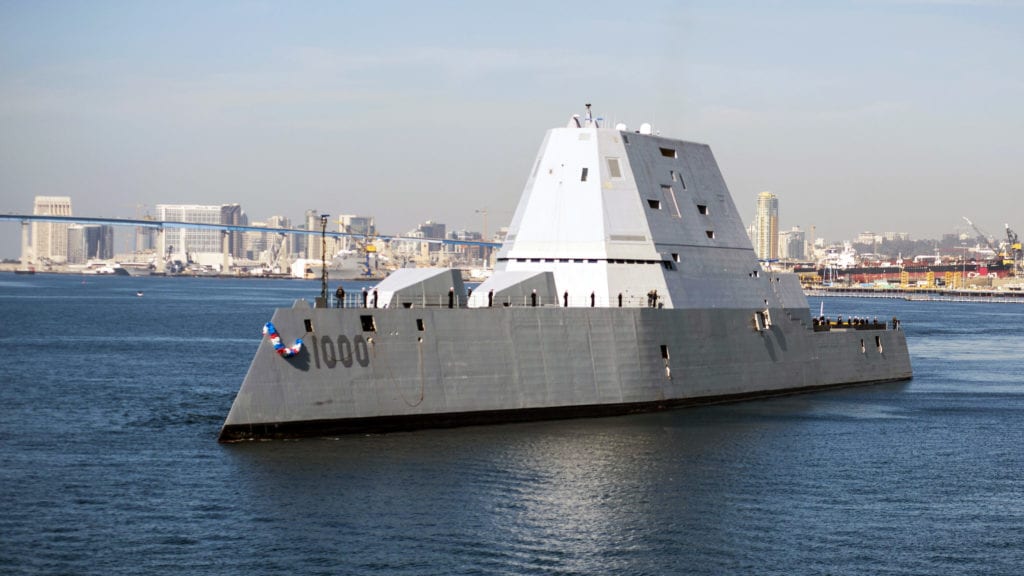
SAN DIEGO — The U.S. Navy accepted delivery of the USS Zumwalt, the lead ship of the Navy’s next generation of multimission surface combatants, on April 24, Program Executive Office (PEO)-Ships said in a release.
Following this delivery, the ship will transition from combat systems activation to the next phase of developmental and integrated at-sea testing.
This event also marks a milestone of the dual delivery approach for the Zumwalt (DDG 1000), which achieved hull, mechanical and electrical delivery from shipbuilder General Dynamics’ Bath Iron Works (BIW) in May 2016.
Raytheon Integrated Defense Systems was the prime contractor for the Zumwalt combat system and has lead activation and integration for Zumwalt-class ships both in Bath, Maine, and San Diego.
“Delivery is an important milestone for the Navy, as DDG 1000 continues more advanced at-sea testing of the Zumwalt combat system,” said Capt. Kevin Smith, DDG 1000 program manager for PEO-Ships.
“The combat test team, consisting of the DDG 1000 sailors, Raytheon engineers and Navy field-activity teams, have worked diligently to get USS Zumwalt ready for more complex, multimission at-sea testing. I am excited to begin demonstrating the performance of this incredible ship.”
“Delivery is an important milestone for the Navy, as DDG 1000 continues more advanced at-sea testing of the Zumwalt combat system.”
Capt. Kevin Smith, DDG 1000 program manager, PEO-Ships
With delivery, USS Zumwalt joins the U.S. Pacific Fleet battle force and remains assigned to Surface Development Squadron One. In addition to at-sea testing of the Zumwalt combat system, DDG 1000 also will operate as an enabler in the acceleration of new warfighting capabilities and rapid development and validation of operational tactics, techniques and procedures.
The 610-foot, wave-piercing tumblehome ship design provides a wide array of advancements. Employing the Integrated Power System (IPS), DDG 1000 has the capacity to distribute 1000 volts of direct current across the ships’ entirety, allowing for enhanced power capability for various operational requirements. Additionally, the shape of the superstructure and the arrangement of its antennas significantly reduce radar cross section, making the ship less visible to enemy radars.
“Every day the ship is at sea, the officers and crew learn more about her capability, and can immediately inform the continued development of tactics, techniques, and procedures to not only integrate Zumwalt into the fleet, but to advance the Navy’s understanding of operations with a stealth destroyer,” said Capt. Andrew Carlson, the ship’s commanding officer.
“After sailing over 9,000 miles and 100 days at sea in 2019, we are absolutely looking forward to more aggressive at-sea testing and validation of the combat systems leading to achievement of initial operational capability.”
The USS Zumwalt is the first ship of the Zumwalt-class destroyers. The USS Michael Monsoor (DDG 1001) is homeported in San Diego and is undergoing combat systems activation. The third and final ship of the class, the future USS Lyndon B. Johnson (DDG 1002), is under construction at BIW’s shipyard in Bath.
The USS Zumwalt arrives at its new homeport in San Diego in December 2016. U.S. Navy/Petty Officer 3rd Class Emiline L. M. Senn