Elbit Integrates Active Towed Array Sonar Onboard Seagull USV
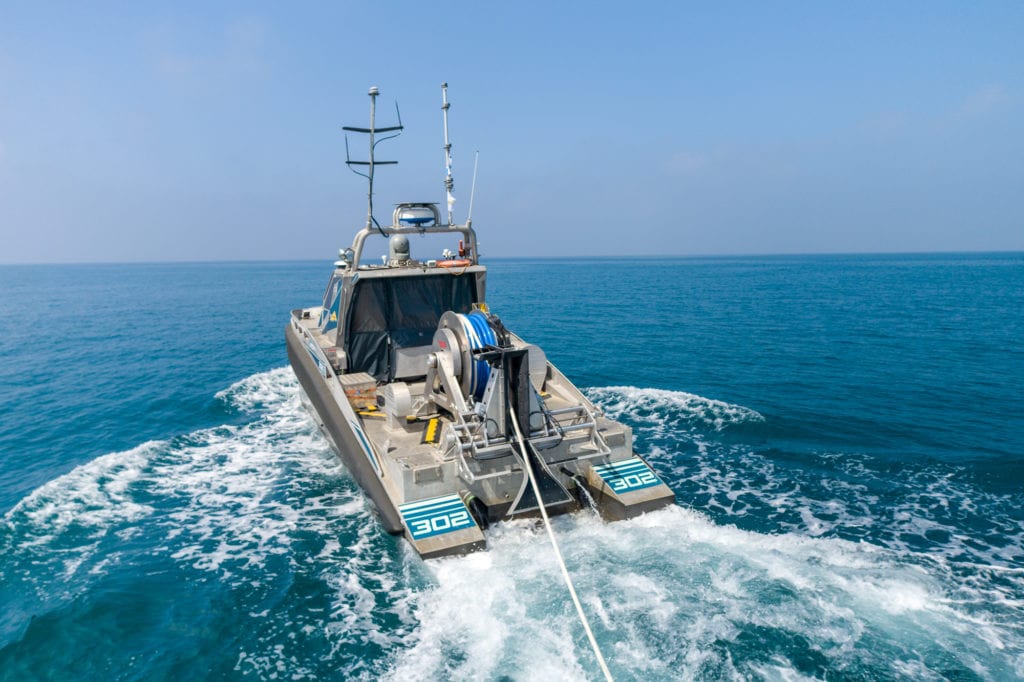
Elbit Systems has integrated the TRAPS-USV with its Seagull unmanned surface vehicle. Elbit Systems
HAIFA, Israel — Elbit Systems has integrated the Towed Reelable Active Passive Sonar for Unmanned Surface Vessels (TRAPS-USV) with its Seagull USV, according to an April 14 company release. The sea trials included several deployment and recovery cycles, towing at different speeds and transmission at various power levels.
The TRAPS-USV version is a compact variant of the TRAPS, a technology that is intended for detection, classification, localization and tracking of submarines in anti-submarine warfare (ASW) operations. TRAPS versions are containerized or permanent-fit for any size, diverse-purpose vessel.
The TRAPS-USV variant is lighter weight but maintains all acoustic active sonar capabilities of TRAPS. TRAPS-USV is the compact and powerful low frequency towed sonar that was recently introduced by Geospectrum, Elbit’s wholly owned Canadian subsidiary.
The Seagull autonomous multimission USV features plug and play, modular mission payload suites and can perform — in addition to ASW — mine countermeasure missions, electronic warfare, maritime security, underwater surveys and other missions using the same vessel, mission control system and data links.
Integration of the TRAPS-USV enables the Seagull to perform ASW operations on the move, substantially extending its operative range and further enhancing its flexibility. The integration of the TRAPS-USV follows the recent conversion for operation, by Israel’s navy, of helicopter long-range active sonar dipping sonar onboard the Seagull USV.
HII Begins Fabrication of Destroyer Ted Stevens
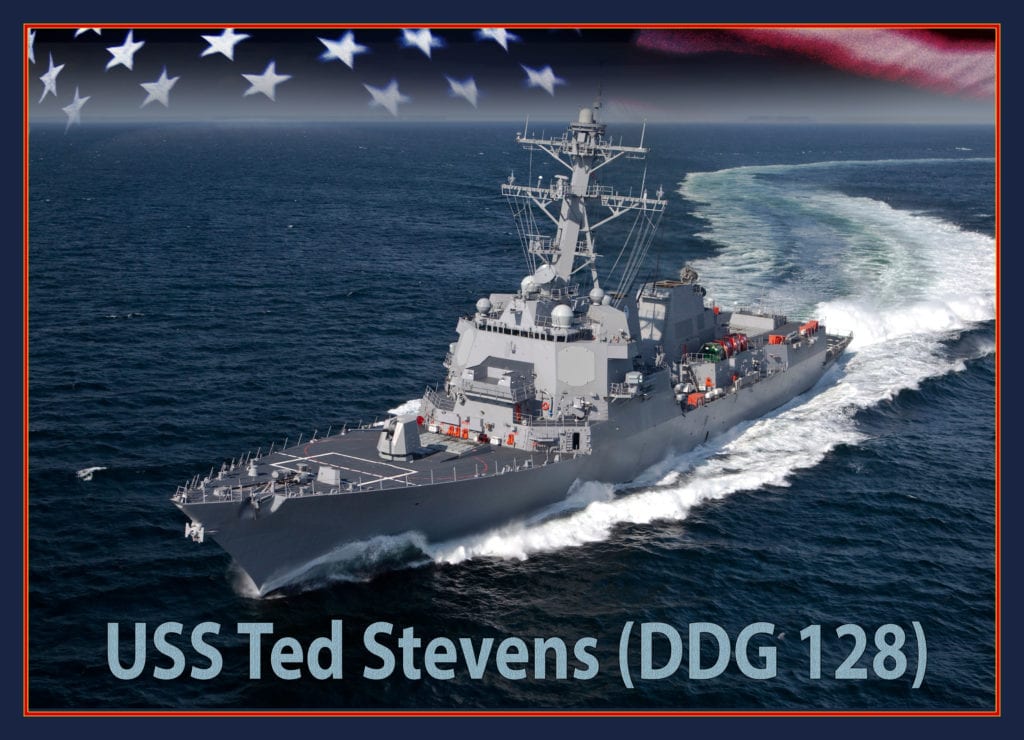
An artist rendering of the future Arleigh Burke-class guided-missile destroyer USS Ted Stevens. U.S. Navy
PASCAGOULA, Miss. — Huntington Ingalls Industries’ Ingalls Shipbuilding division started fabrication of the Arleigh Burke-class destroyer Ted Stevens on April 6, the company said in a release. The start of fabrication signifies that the first 100 tons of steel have been cut.
“As we begin this important milestone in the construction of another great warship, we look forward to continuing production and carrying on the extraordinary legacy of the Navy destroyer fleet,” said George Nungesser, Ingalls’ DDG 51 program manager.
The ship honors former U.S. Sen. Ted Stevens, who served as a pilot in World War II and later represented Alaska. At the time he left office in 2009, he was the longest-serving Republican senator in history.
Ingalls has delivered 31 Arleigh Burke-class destroyers to the Navy. Other destroyers under construction include Delbert D. Black, Frank E. Peterson Jr., Lenah H. Sutcliffe Higbee and Jack H. Lucas.
Arleigh Burke-class destroyers are highly capable, multimission ships and can conduct a variety of operations, from peacetime presence and crisis management to sea control and power projection, all in support of the U.S. military strategy. The guided missile destroyers are capable of simultaneously fighting air, surface and subsurface battles. The ship contains myriad offensive and defensive weapons designed to support maritime defense needs well into the 21st century.
NAVSEA Bids Farewell to Longest-Serving Civil Servant in Defense Department
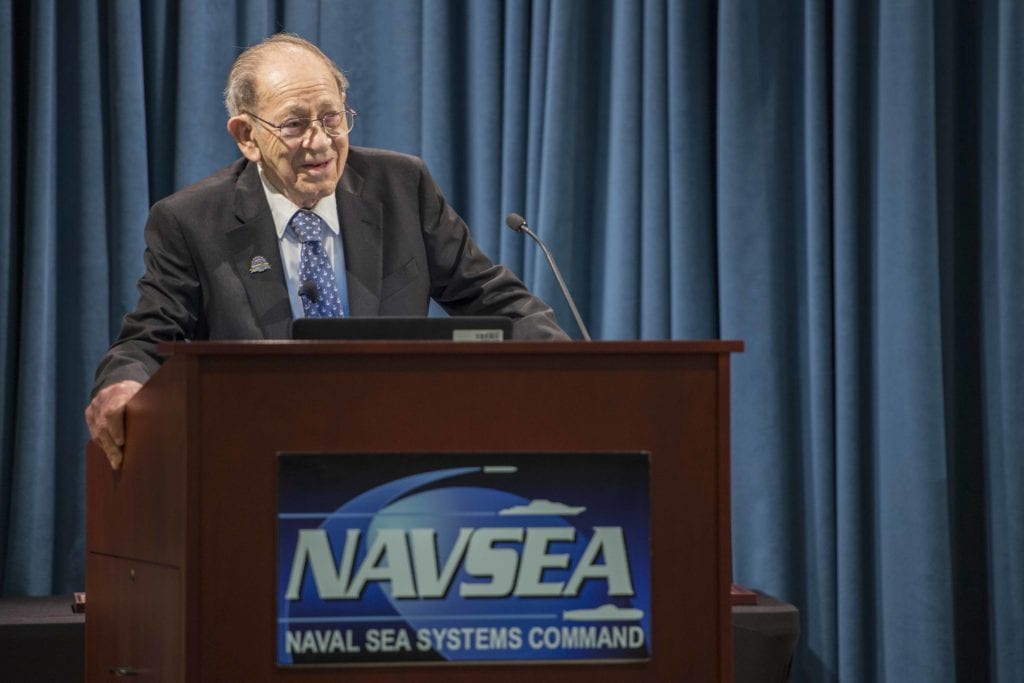
Sarkis Tatigian delivers remarks in 2017 during a celebration of his 75 years of federal service at the Washington Navy Yard. U.S. Navy/Mass Communication Specialist 2nd Class Jackie Hart
WASHINGTON — Sarkis Tatigian, who began his U.S. Navy career at the age of 19 during World War II, passed away earlier this week, leaving behind a nearly 78-year legacy of service to the Department of Defense, Naval Sea Systems Command said in an April 7 release.
At the time of his death, Tatigian, the longest serving civil servant in the history of the DoD, was serving as NAVSEA’s small business advocate.
“Mr. Tatigian truly lived a life dedicated to advocacy and the service of others,” said NAVSEA’s executive director, James Smerchansky.
“His decades of work oversaw the expansion of the small business industrial base and more than $100 billion in contracts awarded to diverse, small businesses. As we bid fair winds and following seas to Mr. Tatigian, NAVSEA will greatly miss his presence, but we will never forget the positive impact he made on this command and the entire U.S. Navy.”
“Mr. Tatigian truly lived a life dedicated to advocacy and the service of others.”
NAVSEA Executive Director James Smerchansky
Tatigian’s civilian career with the Navy began in July 1942 as a junior radio inspector at the naval aircraft factory in the Philadelphia Navy Yard and the Navy Office of Inspector of Naval Aircraft in Linden, New Jersey.
He left his position as an inspector in March 1943 and entered the uniformed Navy as an active-duty Sailor. In June 1944, he started working as an aviation electronics technician’s mate in the development of the Navy’s first guided anti-ship munition, the ASM-N-2 “BAT” glide bomb, which later became an operational weapon used by the fleet at the end of World War II.
In 1946, he left active duty and returned to the Navy department and civil service with the Bureau of Ordnance in Washington, working on the Navy’s first generation of guided-missile systems. From there, he moved on to his life’s passion, helping small businesses, as a small business analyst for the bureau. While in the position, Tatigian developed a small business mobile exhibit that traveled coast-to-coast, visiting all state capitals and cities with populations exceeding 400,000. For his organizational efforts on the exhibit, Tatigian received congressional recognition.
“I was retirement eligible in October 1973. But when you don’t have something to wake up for, that’s when you start to decline. And, if you love what you do and derive a sense of personal worthiness, it’s not really work.”
Sarkis Tatigian
In June 1979, Tatigian was appointed NAVSEA’s associate director of the Small and Disadvantaged Business Utilization Office. The office was eventually renamed the Small Business Program Office, where he continued to serve as an advocate for small business.
In 2012, it was announced during a ceremony honoring Tatigian’s 70 years of service that the Navy’s Office of Business Opportunities Director’s Award would be renamed the Sarkis Tatigian Small Business Award.
The award recognizes outstanding performance by a field activity in creating an organizational climate resulting in the advancement of small business opportunity through exceptionally-managed small business programs and challenging initiatives and who has made significant contributions to the command and the DON small business program. Because of his contributions, Tatigian even won the award that bears his name.
In 2017, NAVSEA celebrated Tatigian’s 75th anniversary of civil service. A unique service pin was specially made to mark the occasion as one celebrating that many years of service had never been given before to an employee.
Tatigian, explained upon his 75th anniversary, why he was driven to continue to come to work each day at NAVSEA.
“I was retirement eligible in October 1973,” Tatigian said. “But when you don’t have something to wake up for, that’s when you start to decline. And, if you love what you do and derive a sense of personal worthiness, it’s not really work.”
Navy Awards $200 Million Contract to Upgrade USS Boxer
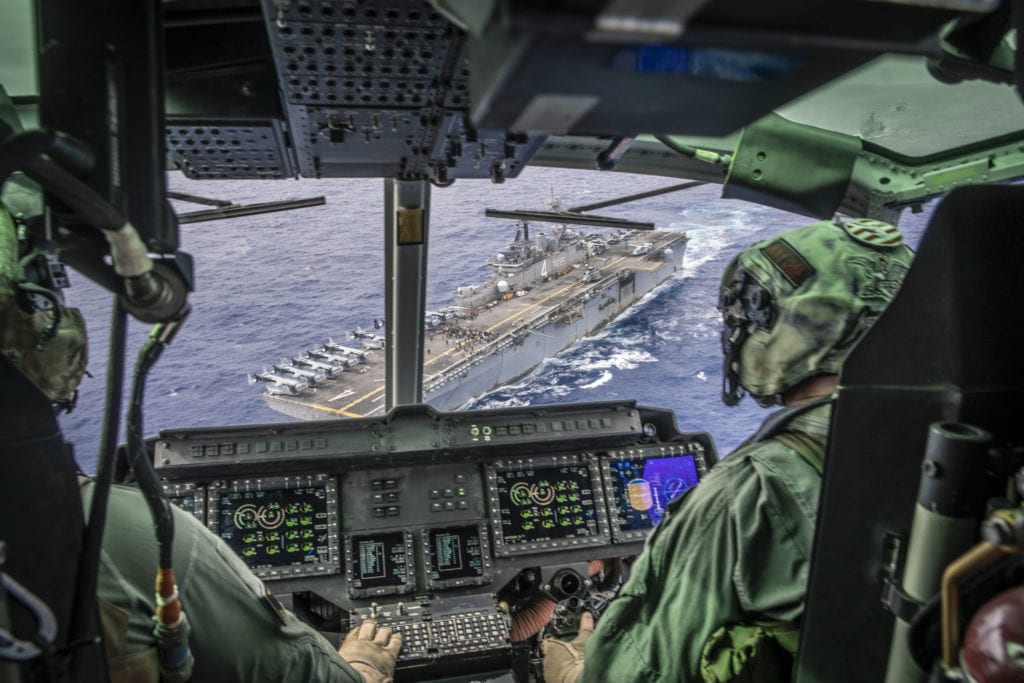
U.S. Marine Corps UH-1Y Venom pilots with Marine Medium Tiltrotor Squadron 163 (Reinforced), 11th Marine Expeditionary Unit, demonstrate an unguided missile attack run at the amphibious assault ship USS Boxer during an air power demonstration. U.S. Marine Corps/Sgt. Adam Dublinske
SAN DIEGO — BAE Systems has received a $200 million contract from the U.S. Navy to drydock and perform nearly 18 months of maintenance and modernization work aboard the amphibious assault ship USS Boxer, according to a company release.
The drydocking of the USS Boxer will be the first time the company’s San Diego shipyard will use its 950-foot-long Pride of California drydock to service a large-deck warship. The shipyard is nearing completion of another major milestone for the drydock: the first simultaneous docking of two guided-missile destroyers on the West Coast.
BAE’s San Diego shipyard will begin working aboard the 843-foot-long USS Boxer in June. Under the awarded contract, BAE will upgrade the ship to support and operate joint strike fighters on-board; perform hull, tank and mechanical work; and make other shipboard improvements. The shipyard is expected to complete its work aboard the 25-year-old ship in December 2021. The contract includes options that, if exercised, would bring the cumulative value to $207.5 million.
Last October, BAE Systems simultaneously docked the USS Stethem and USS Decatur. The guided-missile destroyers are scheduled to be refloated together from the Pride of California drydock later this spring. The Pride of California, the largest drydock in California, can lift more than 55,000 tons.
Attack Submarine USS Delaware Joins Fleet
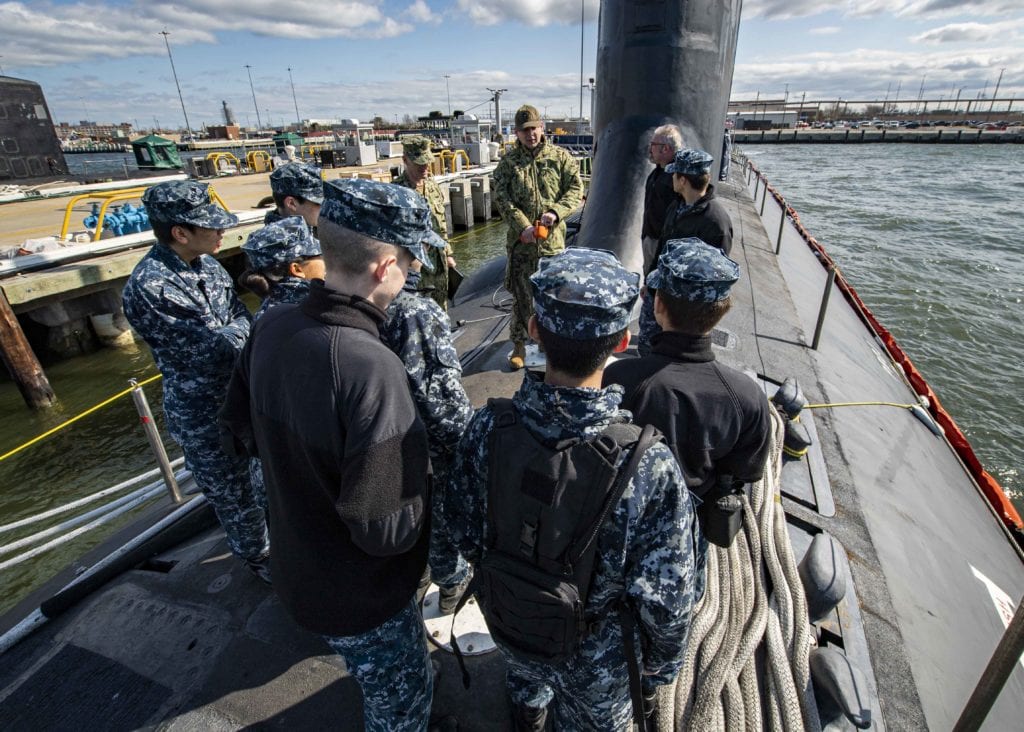
Sonar Technician (Submarine) 1st Class Ryun Lewis (center) gives a tour of the Delaware last month to U.S. Naval Sea Cadets with the sub moored pier side at Naval Station Norfolk as the Virginia-class boat prepared for its April 4 commissioning. U.S. Navy/Mass Communication Specialist 2nd Class Cameron Stoner
WASHINGTON — The U.S. Navy commissioned USS Delaware, the 18th Virginia-class attack submarine, on April 4, according to a Navy release.
Although the traditional commissioning ceremony was canceled due to restrictions on large gatherings brought on by the COVID-19 pandemic, the Navy commissioned USS Delaware administratively and transitioned the ship to normal operations. Meanwhile, the Navy is looking at an opportunity to commemorate the special event with the ship’s sponsor, crew and commissioning committee.
“This Virginia-class fast-attack submarine will continue the proud naval legacy of the state of Delaware and the ships that have borne her name,” acting Navy Secretary Thomas B. Modly said in the release.
Vice Adm. Daryl Caudle, commander of Navy Submarine Forces, said he is pleased to welcome the ship to the sub fleet and contribute to Navy undersea warfighting capability.
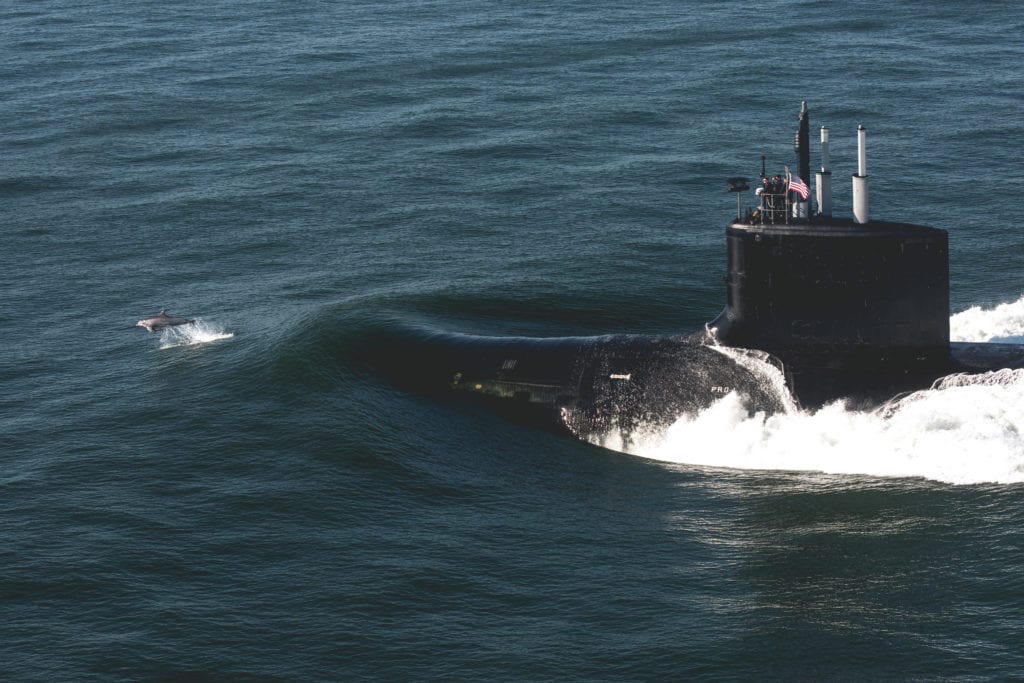
The Virginia-class attack submarine USS Delaware transits the Atlantic Ocean after departing Huntington Ingalls Industries Newport News Shipbuilding division during sea trials last August. U.S. Navy via Ashley Cowan of HII
“The U.S. Navy values the support of all those who contributed to today’s momentous milestone and will look for a future opportunity to commemorate this special event,” Caudle said. “The sailors of USS Delaware hail from every corner of the nation and from every walk of life. This crew, and the crews who follow, will rise to every challenge with unmatched bravery and perseverance to ensure the U.S. Submarine Force remains the best in the world.”
The ship’s sponsor, Jill Biden, spouse of former Vice President Joe Biden, a Democratic candidate for president, offered congratulations to everyone who played a role in delivering USS Delaware to service.
“I know this submarine and her crew of courageous sailors will carry the steadfast strength of my home state wherever they go,” she said. “The sailors who fill this ship are the very best of the Navy, and as you embark on your many journeys, please know that you and those whom you love are in my thoughts.”
Delaware’s commanding officer, Cmdr. Matthew Horton, said the commissioning marks the culmination of six years of hard work by the men and women who constructed the submarine and are preparing it to become a warship. He thanked the crew and their families, Jill Biden, the USS Delaware Commissioning Committee and the Navy League of Hampton Roads for their work and support.
“As we do our part to maintain the nation’s undersea supremacy well into the future, today marks a milestone for the Sailors who serve aboard USS Delaware. Whether they have been here for her initial manning three years ago, or have just reported, they all are strong, capable submariners ready to sail the nation’s newest warship into harm’s way,” Horton said.
This is the first time in nearly 100 years the name “Delaware” has been used for a U.S. Navy vessel. It is the seventh Navy ship, and first sub, to bear the name of the state. The boat is 377 feet long, has a 34-foot beam and will be able to dive to depths greater than 800 feet and operate at speeds in excess of 25 knots submerged. It will operate for more than 30 years without ever refueling. Its keel was laid on April 30, 2016, and was christened during a ceremony on Oct. 20, 2018. It is the final Block III Virginia-class sub before Block IV deliveries begin.
Navy Orders Materials for Harpoon Missiles for Six Allies and Partners
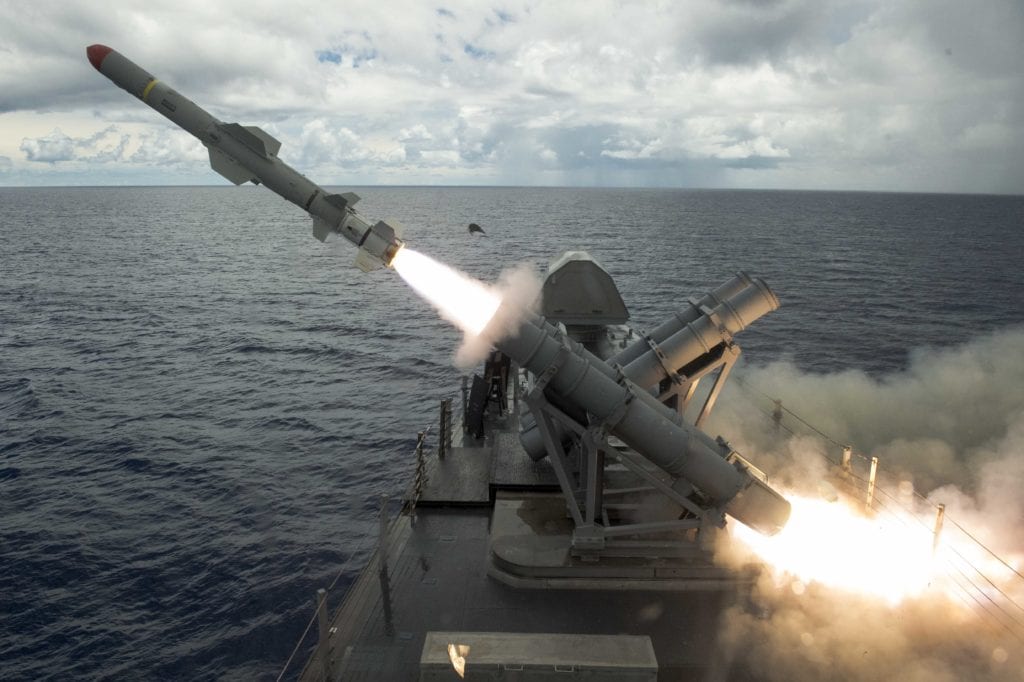
A Harpoon missile launches from the missile deck of the littoral combat ship USS Coronado off the coast of Guam. U.S. Navy/Mass Communication Specialist 2nd Class Kaleb R. Staples
ARLINGTON, Va. — The U.S. Navy has ordered materials for AGM/RGM-84 Harpoon anti-ship cruise missiles for six allied and partner nations, the Defense Department said in an April 2 release.
Naval Air Systems Command awarded Boeing a $73.2 million contract modification to provide additional long-lead material funding for full-rate production Lot 91 of the Harpoon missile under the foreign military sales program. Work is expected to be complete by December 2023.
When produced, the missiles will be delivered to the governments of Saudi Arabia, Qatar, Thailand, South Korea, Brazil and Japan.
The Harpoon missile family is deployed by the armed forces of 31 nations.
Navy Orders Four New LCU 1700 Utility Landing Craft from Swiftships
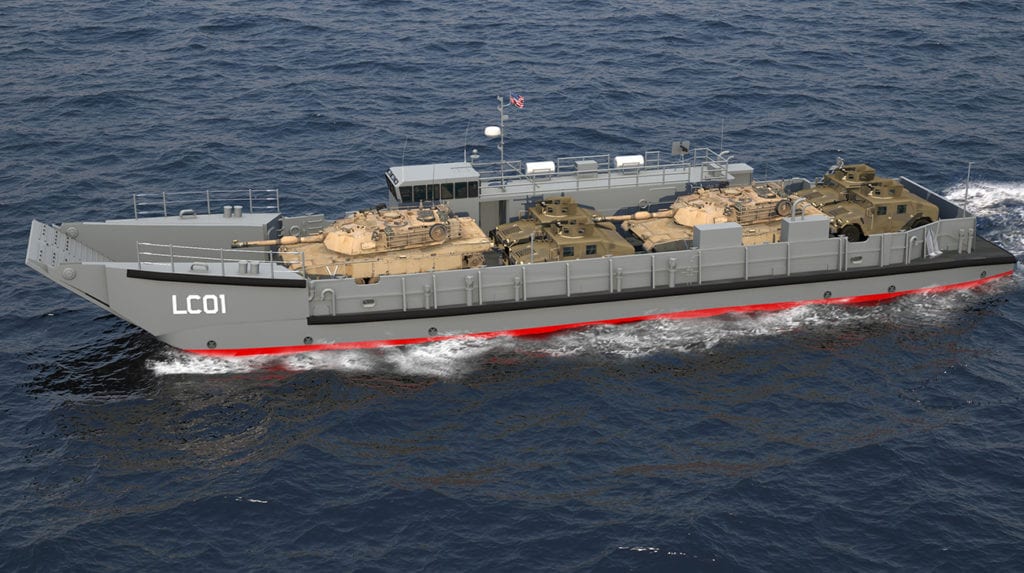
A Swiftships Landing Craft Utility 1700. Swiftships
ARLINGTON, Va. — The U.S. Navy has ordered four more of its new utility landing craft (LCU) for its amphibious warfare forces.
Naval Sea Systems Command awarded Swiftships of Morgan City, Louisiana, a $50.1 million modification to a previously-awarded contract “to exercise an option for the construction of four Landing Craft Utility (LCU) transportation boats (1703 through 1706),” the Defense Department said in an April 2 announcement. Delivery is expected by October 2022. The funds will come from the fiscal 2020 budget.
In February 2019, the Navy ordered LCU 1701 and 1702 under a $26.7 million contract modification. The craft will follow the prototype of the LCU 1700 class. Delivery is expected by May 2021.
“The LCU 1700 class will recapitalize the LCU 1610 capabilities and have a design life of 30 years,” the contract announcement said. “LCU 1700 craft will be a highly reliable and fuel-efficient heavy-lift platform whose capability will be complementary to the faster air cushion landing craft, which have a significantly shorter range, smaller payload capacity, no habitability and operating hour limitations.”
The Navy’s amphibious warfare ships equipped with well decks routinely deploy with LCUs embarked. The Navy plans to procure a total of 32 LCU 1700 craft.
Navy Orders Two E-2D Advanced Hawkeye Aircraft
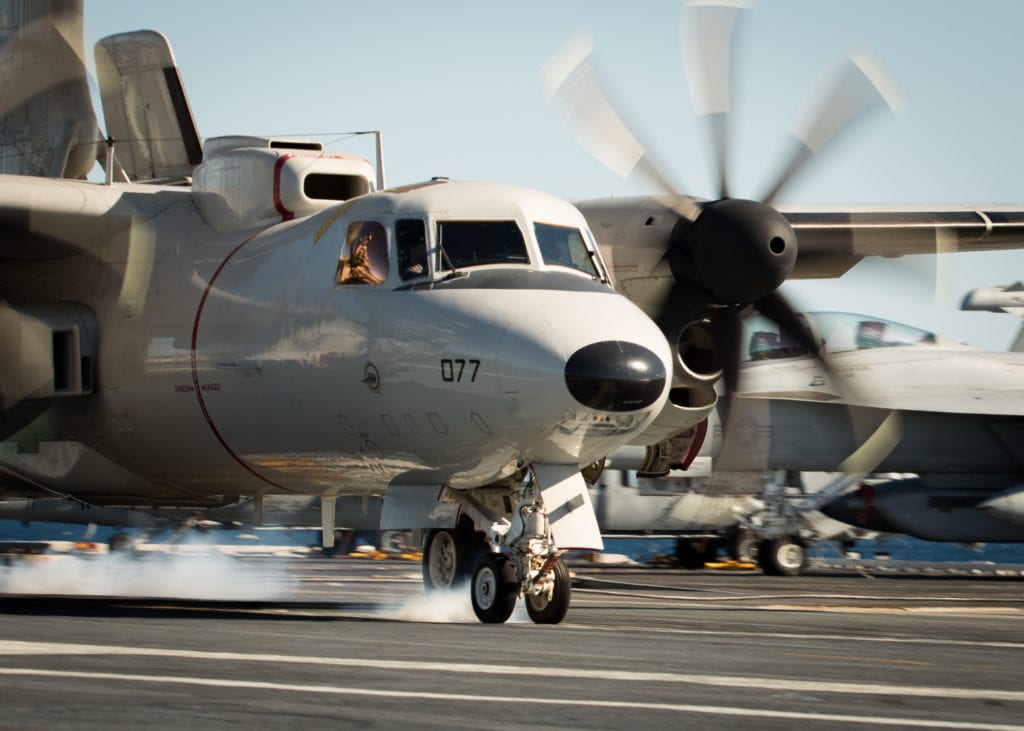
A E-2D Hawkeye lands on the flight deck of the aircraft carrier USS Gerald R. Ford. U.S. Navy/Mass Communication Specialist 3rd Class Ryan Carter
ARLINGTON, Va. — The U.S. Navy has ordered two more E-2D Advanced Hawkeye battle management aircraft, the Defense Department said in a contract announcement.
Naval Air Systems Command awarded Northrop Grumman Aeronautics Systems of Melbourne, Florida, a $404 million contract modification to the previously awarded, fixed-price-incentive-firm-target contract, the department said in an April 1 release.
One of the E-2Ds is being procured as part of fiscal 2019’s full-rate production (FRP) Lot 8 while the second as part of fiscal 2020’s FRP Lot 9.
This modification exercises contract options for nonrecurring engineering and software support activities. Work is expected to be complete by March 2025, the release said.
The Navy expects to procure a total of 86 E-2Ds. Japan has received four E-2Ds of and has ordered an additional nine. The E-2Ds are replacing E-2C Hawkeye aircraft in both the U.S. Navy and the Japanese Air Self-Defense Force.
Boeing Awarded Navy Contract Modification for Additional MQ-25 UAVs
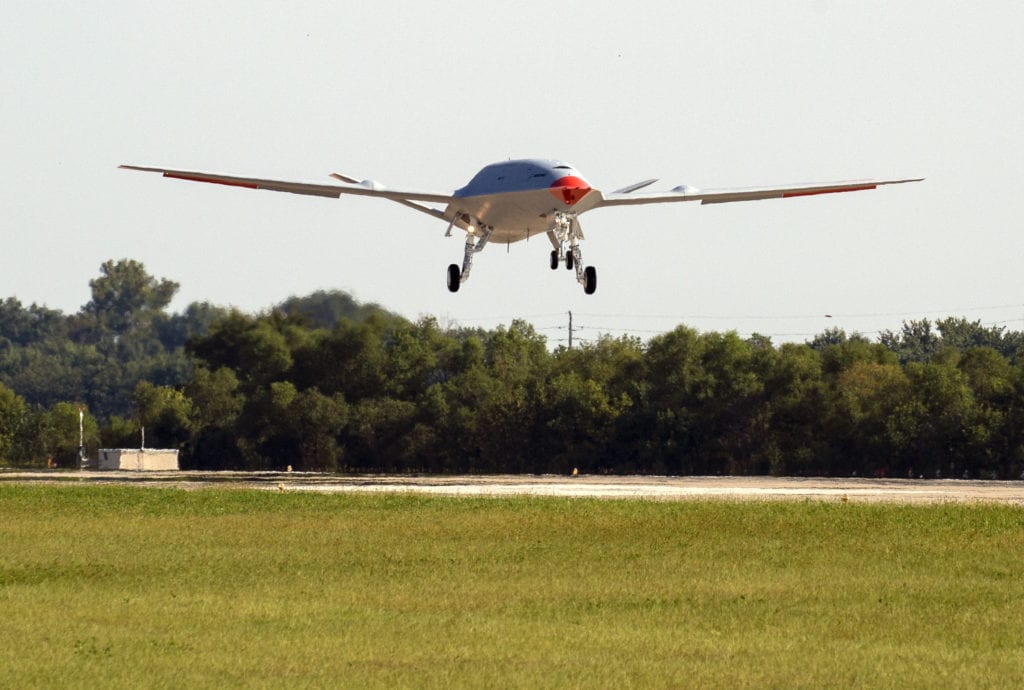
The MQ-25 unmanned carrier-based test aircraft comes in for landing after its first flight in September at MidAmerica Airport in Mascoutah, Illinois. The Boeing-owned test asset, known as T1, flew two hours to validate the aircraft’s basic flight functions and operations. U.S. Navy via Boeing
ST. LOUIS — The U.S. Navy has awarded Boeing a contract modification for three additional MQ-25 unmanned aerial refueling aircraft, bringing the total number of aircraft Boeing is manufacturing to seven, the company said in a release.
“We’re honored to have the Navy’s confidence in our system design and performance that is evident from this additional order,” said Dave Bujold, Boeing’s MQ-25 program director.
“This order establishes uninterrupted production of the first MQ-25 aircraft and lines up with the Navy’s MQ-25 test and training plans for fleet introduction. The MQ-25 program is vital in ensuring the Navy can deliver a critical unmanned aerial refueling capability to the carrier air wing.”
This $84.7 million modification exercises options for three MQ-25 system demonstration test articles and was an option identified in the original $805 million contract for four aircraft awarded in August 2018.
Early flight testing of Boeing’s MQ-25 test asset, T1, is contributing to program progress. The company recently concluded the first round of flight testing for T1, resulting in nearly 30 hours in the air at various speeds and altitudes.
The aircraft is undergoing a planned modification that includes installation of an aerial refueling store (ARS) under the left wing. Flight testing with the ARS will resume later this year.
Navy Surface Forces, Army Attack Helicopters Conduct Ops in Arabian Gulf
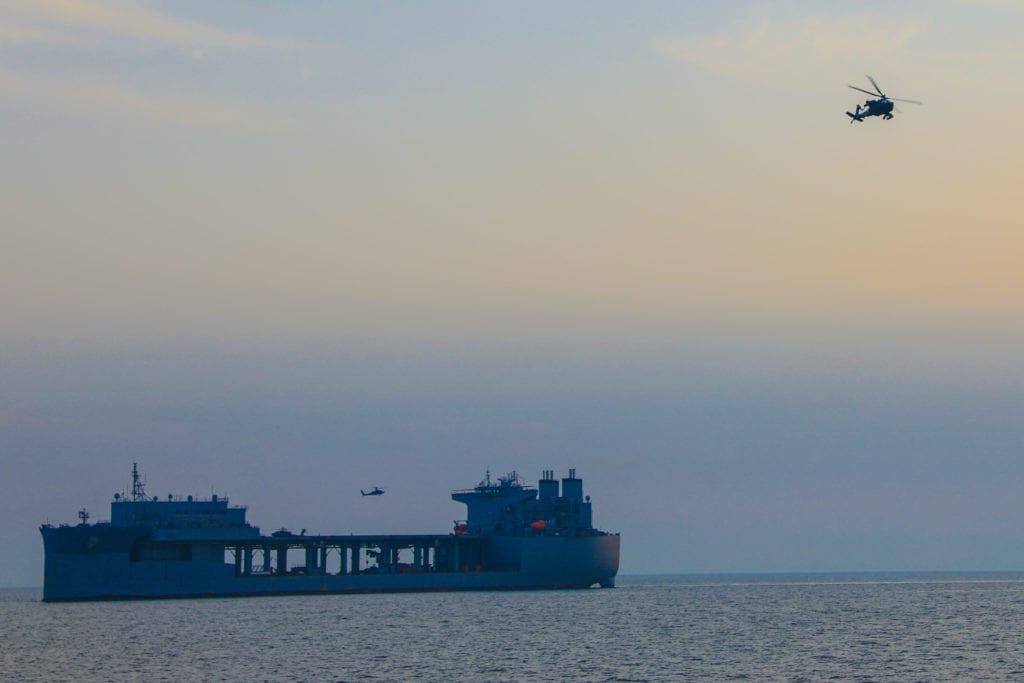
AH-64 Apache helicopters operate with the expeditionary sea base USS Lewis B. Puller during a joint naval and air integration operation on March 27. U.S. Army/Spc. Cody Rich
PERSIAN GULF — U.S. Navy expeditionary landing base ship USS Lewis B. Puller has been conducting joint naval and air integration operations with U.S. Army AH-64E Apache attack helicopters assigned to Army Central Command’s Task Force Saber throughout March, according to U.S. Naval Forces Central Command (USNAVCENT) public affairs.
The operations, which are designed to enhance the capabilities of U.S. forces to respond to surface threats, have involved Puller performing as a landing base platform for the Apaches, while Cyclone class Patrol Coastal ships select simulated targets for them to engage. The guided-missile destroyer USS Paul Hamilton also participated in the joint operations.
“The integration of U.S. Army air weapons teams with other joint fires into the maritime environment greatly enhances our ability to expand reconnaissance and attack capability,” said Capt. Peter Mirisola, commander of Destroyer Squadron (DESRON) 50/Commander, Combined Task Force (CTF) 55. “The Apaches, in coordination with our surface ships, allow us to hold an adversary at high risk at extended ranges. Combined with other joint fires, these aircraft significantly increase the precision lethality of our joint maritime forces.”
Similar integration operations with Special Operations assets were conducted in the Arabian Gulf between U.S. naval forces and MH-6M Little Bird helicopters during Operation Earnest Will from 1987 to 1988.
More recently, USNAVCENT surface forces also conducted joint naval and air integration operations with AC-130W Stinger II gunships, assigned to U.S. Special Operations Command Central, on March 8 and March 9.
“Working with USARCENT forces represents another key capability in our ongoing integration of naval and air assets across our joint and coalition force to ensure maritime superiority,” said Vice Adm. Jim Malloy, commander of USNAVCENT/U.S. 5th Fleet. “This kind of cross-domain integration allows us to maintain highly lethal and effective defensive capabilities, regardless of what platforms are operating in theater.”
DESRON 50/CTF 55 conducts maritime security operations in support of regional security and stability. Its responsibilities include planning and executing a robust regional engagement program with coalition forces from regional partners and allied navies who operate and deploy to the Arabian Gulf.
The U.S. 5th Fleet area of operations encompasses about 2.5 million square miles of water area and includes the Arabian Gulf, Arabian Sea, Gulf of Oman, Red Sea and parts of the Indian Ocean. The expanse is comprised of 20 countries and includes three critical choke points at the Strait of Hormuz, the Suez Canal and the Bab el-Mandeb Strait at the southern tip of Yemen.