Pentagon Report Cites Rapidly Modernizing Chinese Navy
A Chinese Type 052C destroyer, the Changchun, in Malaysia in 2017.
ARLINGTON, Virginia
— China’s first home-built aircraft carrier is likely to join the People’s
Liberation Army Navy (PLAN) fleet this year, a highlight of China’s effort to
modernize its fleet with modern, farther-ranging platforms and weapons.
Construction
began on a second aircraft carrier in 2018, said a new report to Congress from
the Defense Department, “Military and Security Developments Involving the
People’s Republic of China 2019.” This carrier, which should reach the PLAN fleet
in 2022, is likely to be fitted with a catapult aircraft launch system,
according to the report.
A coastal
defense navy during the Cold War, the PLAN is continuing a two-decade build-up
with numerous blue-water platforms
“The PLAN is
rapidly replacing obsolescent, generally single-purpose platforms in favor of
larger, multirole combatants featuring advanced anti-ship, anti-air and
anti-submarine weapons and sensors,” the report said. “This modernization
aligns with China’s growing emphasis on the maritime domain and increasing
demands on the PLAN to conduct operational tasks at expanding distances from
the Chinese mainland using multimission, long-range, sustainable naval
platforms possessing robust self-defense capabilities.”
“Modernization
of China’s submarine force remains a high priority for the PLAN,” the report
said. “The PLAN currently operates four nuclear-powered ballistic missile
submarines (SSBN), six nuclear-powered attack submarines (SSN) and 50
conventionally powered attack submarines (SS). The speed of growth of the
submarine force has slowed and will likely grow to between 65 and 70 submarines
by 2020.”
The PLAN also
continues to modernize its surface warship fleet.
“The PLAN is rapidly replacing obsolescent, generally single-purpose platforms in favor of larger, multirole combatants featuring advanced anti-ship, anti-air and anti-submarine weapons and sensors.”
A new Pentagon report to Congress on China’s naval modernization
China has
built new guided-missile cruisers (CGs), guided-missile destroyers (DDGs) and
guided-missile frigates (FFGs) that “will significantly upgrade the PLAN’s air
defense, anti-ship, and anti-submarine capabilities. These assets will be
critical as the PLAN expands operations into distant seas beyond the range of
shore-based air defense systems” the report said.
China has
built four Renhai-class CGs over the last two years and has several more under
construction. The lead CG is scheduled to join the fleet in 2019. At least
three Luyang-class DDGs joined the PLAN fleet in 2018, bringing the total to
nine with at least four more under construction. A larger variant forthcoming,
Luyang III, will be equipped with a vertical launcher system.
China also
emphasizes small surface combatants, with 27 or more Jiangkai II FFGs and more
than 40 Jiangdao-class corvettes, with more of both types under construction.
All new
attack submarines and surface combatants are being armed with modern anti-ship missiles.
“The PLAN
recognizes that long-range ASCMs require a robust, over-the-horizon targeting
capability to realize their full potential,” the new Pentagon report said. “China
is investing in reconnaissance, surveillance, command, control and
communications systems at the strategic, operational and tactical levels to
provide high-fidelity targeting information to surface and subsurface launch
platforms.”
China also is
building a fleet of amphibious warfare ships, adding three to the current five
Yuzhao-class amphibious transport dock ships.
China also is expanding the
PLAN marine corps from two brigades and 10,000 marines to seven brigades and
30,000 marines by 2020. The Chinese marine corps also now has its own commander
and a new central headquarters.
Sealift Command to Welcome New Navajo Class of Tugboats to Fleet
An artist rendering of the future USNS Navajo (T-TATS 6). U.S. Navy photo illustration.
NORFOLK, Virginia
— A new class of towing and salvage vessels will join the U.S. Navy’s Military
Sealift Command (MSC) in fiscal year 2021.
“The new
Navajo class replaces the Powhatan class T-ATF fleet tugs, which provide
towing, diving and standby submarine rescue services for the U.S. Navy, and the
Safeguard class T-ARS rescue and salvage vessels, whose mission includes,
salvage, diving, towing and heavy-lift operations,” said Tim Schauwecker, MSC towing
and salvage project officer.
“MSC and
the fleet commanders will benefit by having new, state-of-the-art and highly
capable platforms that can perform a wide range of missions ranging from towing
and salvage, diving operations and submarine rescue,” he said.
The
primary mission of the fleet tug is towing and submarine rescue with the
secondary mission of salvage. Rescue and salvage ships conduct salvage with a
secondary mission of towing. The Navajo class will combine the capabilities of
both classes into a single class for greater efficiency, Schauwecker said.
“This new ship class will … eventually restore the towing and salvage fleet to an end strength of eight hulls.”
Tim Schauwecker, Sealift command’s towing and salvage project officer
“The major
improvements include a significant bollard pull increase that will enable the
ship to tow virtually any ship currently in the [Navy] inventory. The new ships
include additional deck space to account for the requirements of the submarine
rescue diving and recompression system, including transfer under pressure, a
40-ton heave compensating crane to assist with underwater salvage operations
such as lifting aircraft wreckage out of the water, dynamic positioning, which
provides the ability to automatically maintain position and heading in the
water by using its propellers and thrusters despite the environmental
conditions, and berthing for an additional 42 personnel [other than crew] in two-
to six-person staterooms. The ship will also have modern automation and
engineering systems that include environmentally friendly main propulsion
diesel engines,” he said.
MSC search-and-rescue
vessels have contributed to a variety of missions around the world, including
recovery efforts for John F. Kennedy Jr.’s plane crash, the USS Guardian
grounding, TWA flight 800, Hurricane Katrina and the SS El Faro sinking.
MSC took
delivery of the Powhatan class of fleet ocean tugs between 1978 and 1981. These
ships were designed and built based on commercial offshore towing vessels and were
manned by civilian mariners. Salvor and Grasp were commissioned in 1985 and
1986 and were sailed as USS ships by U.S. Navy Sailors. The Navy decommissioned
the Safeguard class of salvage ships in 2006 and 2007 and transferred them to
MSC, where they were redesignated as T-ARS and manned by civilian mariners.
According
to the Congressional Budget Office’s 2019 shipbuilding analysis, the
procurement of the new Navajo class aligns with the Navy’s plan to expand the
fleet to 355 ships.
“This new
ship class will bring a significant capability increase to the U.S. Navy and
Military Sealift Command and eventually restore the towing and salvage fleet to
an end strength of eight hulls,” Schauwecker said.
Secretary
of the Navy Richard V. Spencer announced in March the new class of ships will
be named Navajo, in honor of the major contributions the Navajo people have
made to the armed forces.
The lead ship will start
construction in May, with delivery of the first five ships in fiscal 2021 and
2022, followed by one ship per year through 2025.
Navy’s Heliborne EW Pods Set for Delivery at Year’s End
ARLINGTON, Va. — Lockheed Martin is set to deliver to the Navy the first Advanced Off-Board Electronic Warfare AOEW pods at the end of 2019, the company’s program manager said.
The first set of pods is on track for delivery in December 2019 or January 2020, said Joe Ottovanio, director of electonic warfare solutions for Lockheed Martin, speaking to reporters May 1 in Arlington.
Ottoviano also said the program expects a Milestone C decision for Low-Rate Initial Production of the AOEW pod in December.
The AOEW is a pod designed to be carried aloft by and MH-60R or MH-60S helicopter and function as an extension of a warship’s SLQ-32(V)6 electronic warfare system.
HII’s Digital Shipbuilding Transformation Earns 2019 CIO 100 Award
NEWPORT
NEWS, Va. — Huntington Ingalls Industries’ Newport News Shipbuilding division
has been named a recipient of a 2019 CIO 100 Award for adopting
business-aligned IT strategies during its integration of modern technologies
into shipbuilding. The ongoing initiative, known as Integrated Digital
Shipbuilding (iDS), is transforming the way ships are being designed and built.
The annual
awards program, sponsored by IDG’s CIO magazine and the CIO Executive Council,
celebrates organizations that are using IT in innovative ways to deliver
business value, optimize business processes, enable growth or improve
relationships with customers.
Newport
News is being recognized for its use of technology business management
strategies to bolster IT cost transparency and build trust, which helped the
company to embrace a digital-first mindset in adopting leading-edge
technologies.
Since the
company’s digital transformation began two years ago, Newport News has
introduced laser scanning, augmented reality, modeling and simulation, and
additive manufacturing into processes to increase efficiency, safety and
affordability. The digital shipbuilding efforts also include transitioning from
traditional two-dimensional paper-based instructions — the company’s primary
method for conveying design data for more than a century — to digital formats.
The company currently is developing digital work packages for the aircraft
carrier Enterprise (CVN 80), which will be the first ship built completely
paperless, and preparing to go digital with the new class of ballistic
submarines, the Columbia class.
“Digital
shipbuilding is the largest transformative initiative, digital or otherwise,
that Newport News has embarked upon since switching from diesel to
nuclear-powered aircraft carriers in the 1960s,” said Bharat Amin, Newport
News’ vice president and chief information officer. “I feel proud of my team
for helping to drive change and empowering shipbuilders with the tools to build
today’s warships with tomorrow’s technology. It’s an exciting time to work in
IT and at HII.”
The
company will be recognized at the CIO 100 Symposium and Awards Ceremony on Aug.
21 in Colorado.
O-Level Reform: Lemoore Strike Fighter Squadrons Returning More Jets to Flight Line
F/A-18E Super Hornets from Strike Fighter Squadron 136 “Knighthawks” fly in formation during a photo exercise over the California coast. The Knighthawks are an operational U.S. Navy strike fighter squadron based at Naval Air Station Lemoore, California, and are attached to Carrier Air Wing One. U.S. Navy / Chief Mass Communication Specialist Shannon Renfroe
LEMOORE,
Calif. — Two Navy Super Hornet squadrons at Naval Air Station (NAS) Lemoore,
California, have reduced maintenance turnaround times and are boosting aircraft
readiness as part of naval aviation’s maintenance reform initiatives under the
Naval Sustainment System (NSS).
The NSS
initiative leverages best practices from commercial industry to help reform
aspects of naval aviation’s fleet readiness centers, organizational-level
(O-level) maintenance, supply chain, engineering, and maintenance organizations
and governance processes. Initially, the NSS is concentrating on getting the
Navy F/A-18 Super Hornet fleet healthy before rolling out the approach to every
Navy and Marine Corps aircraft.
Strike
Fighter Squadrons (VFA) 22 and 122 were the first to implement O-level
maintenance reforms following visits from commercial aviation consultants in
December and January.
Reforms
include assigning crew leads to manage the maintenance on each aircraft and
reorganizing hangar spaces, parts cages and tools.
Squadrons Empower Petty Officers
The most
significant change has been the delegation of ownership over each aircraft in
for repairs from the squadrons’ maintenance material control officers, or
MMCOs, to individual crew leads comprised mostly of first-class petty officers.
Traditionally,
MMCOs must keep track of the status of each aircraft in for maintenance as well
as the Sailors working on them, and that’s in addition to deciding what
maintenance actions are required for each jet and which aircraft are safe to
release for flight. Assigning junior-level crew leads to each jet removes some
of that burden from the MMCOs and has led to improved communication and
increased accountability.
“The crew
leads are not making the maintenance decisions; that’s still done by the
maintenance controllers, but what it allows for is it sheds those maintenance
control chiefs of having to know every status of every jet, of every person,
all day long,” said Lt. Cmdr. Brandon Michaelis, O-level reform champion for
Commander, Naval Air Forces (CNAF). “So they can focus on releasing safe
aircraft by empowering those first-class petty officers, who can now own that
process and know where the people are, know the status of the parts, and brief
that up the line.”
For the
petty officers accustomed to doing their job a certain way, reform did not come
easy. But the benefits have been evident, said Aviation Electronics Technician
1st class Victor Perez, the leading petty officer for VFA-122’s avionics shop
and one of the squadron’s selected crew leads.
“At first
the changes didn’t feel productive, because we didn’t really understand it, but
now that we’ve had some time with it, it’s definitely helped improve our
processes and communication,” Perez said.
Used to
focusing exclusively on avionics, Perez said serving as a crew lead has forced
him to approach the maintenance of his assigned aircraft more holistically. The
increased responsibility of bringing an entire jet back online ultimately leads
to a greater sense of accomplishment, he said.
“You get
kind of personal with an aircraft,” he added. “Some aircraft are easy, and some
are a struggle to get through. Rather than working on a jet for a couple hours
to complete the one thing assigned to your shop and then moving on to the next
jet, this way you take more ownership toward completing the whole thing.”
In some
cases, exceptional second-class petty officers have also been considered for
crew lead, including Aviation Electrician’s Mate 2nd Class Michaela Zadra, a
member of VFA-22’s quality assurance division. Having crew leads that can focus
on individual jets — and communicate with the various maintenance shops —
relieves maintenance control from having to keep near-constant track of as many
as a dozen aircraft at a time, Zadra said.
“Crew
leads have cut down on empty communication, so now I, as a maintainer who is
not stuck behind a maintenance control desk, can walk around to each shop and
talk to them personally,” she said. “There’s a lot more communication
one-on-one, instead of one-to-one-to-one and then to maintenance control. It’s
definitely helped with communication and productivity with the jets.”
In tandem
with the crew lead concept has been the utilization of a whiteboard alongside
each aircraft that informs anyone passing by as to the jet’s status.
Information on the boards includes the names of the crew chief and additional
personnel assigned to the aircraft, what maintenance is needed, and the
expected completion date.
“If you
physically walk through one of our hangars today, you can tell which ones have
been reformed and which ones haven’t,” said Vice Adm. DeWolfe H. Miller III,
CNAF. “You know the exact status of that airplane, you know who’s working on
that airplane and when they expect that airplane to be up. There’s going to be
a crew lead who has that ownership.”
In
addition, the two squadrons have begun treating the spaces around each Super
Hornet in their hangars as dedicated workspaces, with all necessary tools and
parts kept beside the aircraft rather than back in one of the various
maintenance shops.
“We’re now
treating the airplane a little more, as an analogy, like a patient getting
surgery,” Miller said. “I am the doctor as the maintainer, and I said,
‘scalpel,’ and my tool is right there. What we’re seeing with that sort of
approach, having our tools next to the airplane, having our status board next
to the airplane, everything is going to the point of action being around that
airframe, and we’re seeing a really significant improvement in our mission
capable rates.”
Both
squadrons have also begun keeping larger parts in a centralized “parts cage” in
the hangar, dramatically reducing the amount of time Sailors spend traversing
the hangar in search of equipment rather than with their hands on an aircraft.
“It may be
five minutes here or five minutes there, but over the course of a day across
all those technicians, that’s a lot of time saved by having those parts close
to where the job is being done,” Michaelis said.
The 84-Day Corrosion Inspection
Together,
the changes have helped the squadrons achieve one of the first goals of O-level
reform — reducing the turnaround time for routine 84-day corrosion inspections
down from 10-14 days to three days.
The 84-day
inspection, so called because Super Hornets receive one every 84 days, is one
of the most common checks conducted on the jet and is officially supposed to
take three days.
“Our
average is about 10 to 14 days,” Miller said. “It’s really important for us to
put some discipline into achieving these checks on a predictable three-day
pattern.”
After
meeting with consultants, VFA-22 was the first squadron to pilot reforms aimed
at reducing the 84-day inspection time.
“They were
able to do it in two-and-a-half shifts, and as we’ve been going through the
process with other squadrons, we realize that yes, three days in itself is
sufficient, once we weed out the inefficiencies,” said Lt. Hasely Clarke,
assistant maintenance officer for Strike Fighter Wing Pacific.
Clarke
said many of those inefficiencies arose from work centers waiting on one
another to be finished with an aircraft before beginning their own tasks.
“There was a lot of waiting time in between,” he said.
Time
management, communication and multitasking between shops have all improved
following the O-level reform, Zadra said, noting shops were encouraged to
identify which of their tasks could be performed alongside another’s
simultaneously. For instance, Zadra said she can check the lights in the
cockpit from the side of the jet while someone from the avionics shop inspects
instrumentation inside the cockpit.
“It cuts
down a lot on worker hours, so we can minimize the time on the inspection,” she
said.
Initial Skepticism
A former
MMCO, Michaelis said he was skeptical of the O-level reforms when they were
initially proposed, but has come around after seeing how VFA-22 and VFA-122
have put the reforms into practice.
“It’s been
a tough pill to swallow, to see how inefficient even when I was in that
position, even though I thought we were on point every single time,” he said.
“To now look back and go, ‘Wow, there were a lot of places where I could have
improved.’ So, that’s what’s made me a believer, is being able to look in
hindsight and realize there’s tons of this stuff that I wish I had when I was
an MMCO.”
Michaelis
said the plan is to take the reforms to VFA squadrons at NAS Oceana, Virginia,
before rolling them out across the Super Hornet community and, ultimately, to
other platforms.
“As we
migrate this and expand it across all type-model-series, I’m excited about what
this is going to do for our future,” Miller said.
Further
evidence of the reform’s efficacy will come when squadrons can keep their
Sailors on normal work schedules while preparing for deployments, Michaelis
said.
“Before we go on detachments or on deployment, we often work Sailors 12 [hours] on, 12 off, sometimes seven days a week,” he said. “The proof is when, on a Thursday, we can let our people out for a three-day weekend because our jets are up and ready to go, and we saw that recently in one of our transformed squadrons.”
HII Wins LCS Planning Yard Contract Worth a Possible $931.7 Million
HII’s Ingalls Shipbuilding division in Pascagoula, Mississippi. Lance Davis/Huntington Ingalls
PASCAGOULA, Mississippi — Huntington Ingalls Industries’ Ingalls
Shipbuilding division has been awarded a cost-plus-award-fee contract with a
potential total value of $931.7 million for planning yard services in support
of in-service littoral combat ships (LCS), the company said in a May 1 release.
The contract, which includes options over a six-year period, also provides work
packages for HII’s Technical Solutions division.
“Ingalls Shipbuilding will build on 35 years of planning
yard experience to join our Technical Solutions division in fully supporting
this life-cycle work on the LCS program,” Ingalls Shipbuilding President Brian
Cuccias said. “Our talented shipbuilding team has the resources and program
management experience necessary to ensure the post-delivery work on the LCS
program meets the requirements and missions of our U.S. Navy customers.”
“Our talented shipbuilding team has the resources and program management experience necessary to ensure the post-delivery work on the LCS program meets the requirements and missions of our U.S. Navy customers.”
Ingalls Shipbuilding President Brian Cuccias
The planning yard design services contract will provide
the LCS program with post-delivery life-cycle support, which includes fleet
modernization program planning, design engineering and modeling, logistics
support, long-lead-time material support, and preventative and planned
maintenance system item development and scheduling. Unique to this planning
yard effort is the requirement to manage the scheduling of all planned,
continuous and emergent maintenance and associated availabilities.
Most
of the work will be accomplished in Pascagoula and Hampton, Virginia, by
designers, engineers, logisticians, planners, program managers and a variety of
additional subject matter experts. Ingalls and Technical Solutions will also
provide waterfront support in the LCS homeports.
ATAC Selected as Provider of Training for Navy’s TACT Program
WASHINGTON — Textron Airborne
Solutions, a business unit of Textron Inc., announced on May 1 that its
Airborne Tactical Advantage Company subsidiary (ATAC) has been selected as a
provider of contracted air services under the U.S. Navy’s Terminal Attack
Controller Trainer (TACT) program.
Training provided under the IDIQ contract
will be led by ATAC and includes a team made up of Textron Aviation Defense and
the Valkyrie Defense family of companies. They will deliver contracted live-air
training to forward air controllers, joint terminal attack controllers (JTACs)
and forward air controllers (Airborne) on ATAC’s L-39 Albatros, Textron
Aviation Defense’s Beechcraft AT-6 Wolverine light attack and armed
reconnaissance aircraft and Valkyrie’s A-27 Tucanos.
“TACT is a marked increase in both the
quality and quantity of JTAC training services demanded by the U.S. Navy and
Marine Corps. ATAC’s world-class team is pleased to provide the most
mission-representative JTAC training solutions available,” said Russ Bartlett,
CEO of Textron Airborne Solutions.
“Textron Aviation Defense is proud to be on
this air services contract to equip the TACT community with the Beechcraft AT-6
Wolverine’s cost-effective, high-performance close air support capability,”
said Brett Pierson, vice president of Light Attack Aircraft and Scorpion. “The
Navy and Marine Corps flew the AT-6 during the U.S. Air Force Light Attack
experiments and are well-acquainted with its unparalleled mission capability
and optimized battlespace networking capability.”
“Everyone at Valkyrie Defense’s family of
companies is excited to be working with ATAC in providing the best contracted
close air support and JTAC training available. We look forward to fulfilling
the needs of the U.S. warfighter for years to come with our fleet of aircraft,”
said Charlie Keebaugh, CEO of Valkyrie Aero.
ATAC has a fleet of more than 90 aircraft,
having pioneered much of what are now contracted air services industry
standards with 20 years of operating experience and 57,000 flight hours. For
the past 15 years, ATAC has provided a wide range of contracted close air
support capabilities to U.S. Department of Defense JTAC communities across
Europe, continental U.S., Hawaii and the western Pacific region. The only
contractor that has operated supersonic fighter aircraft for the DoD, ATAC has
helped train crews from the Navy, Air Force and Marine Corps and regularly
operates out of as many as 25 different bases per year.
Textron Airborne Solutions
focuses on live military air-to-air, air-to-ship and air-to-ground training and
support services. Within Textron Airborne Solutions is Airborne Tactical
Advantage Company (ATAC), a business that provides tactical flight training and
adversary aggressor services for Navy, Marine and Air Force pilots.
DARPA Director Praises Navy’s Aggressive Use of Autonomous Sea Hunter
Sea Hunter is moored at Joint Base Pearl Harbor-Hickam, Hawaii. The director of DARPA on May 1 praised the Navy’s aggressive use of the unmanned surface vessel. Mass Communication Specialist 1st Class Nathan Laird
The director of the nation’s premier government innovation
organization is excited about the U.S. Navy’s aggressive use of an unmanned
surface vessel to experiment with the military applications of advanced
automation and artificial intelligence.
“The most exciting thing I’m really happy with the Navy right now
is what they’re doing with the Sea Hunter, which is an autonomous 132-foot
surface ship that DARPA demonstrated a couple years ago,” Steven H. Walker,
director of the Defense Advanced Research Projects Agency, told a Defense
Writers breakfast on May 1. “The Navy
has really taken that and is using it and experimenting with it.”
Walker cited Sea Hunter’s voyage last fall from San Diego to
Hawaii and back with no humans on board to control it, “which I think
demonstrates the autonomous capability we put into that program.”
“They’re really interested in how that helps them with their
distributed lethality program,” and using Sea Hunter as “the basis for their
medium-size and large-size unmanned surface vessels. I’m really excited about
where they’re taking that system.”
The Navy is projecting unmanned vessels as a key element of its
future combat fleet and has proposed buying 10 “large” unmanned ships over the
next five years. It has not defined the size and capabilities of those vessels.
Although the Navy has not indicated whether it plans to test
weapons on Sea Hunter, the likelihood that some of its future unmanned vessels
will be armed raises the controversial issue of what control humans will have
over weapon employment by autonomous platforms.
Sea Hunter completes an autonomous sail from San Diego to Hawaii and back — the first ship ever to do so autonomously. U.S. Navy photo
DARPA, which is pursuing advances in artificial intelligence (AI),
studies the ethical issue of weaponized unmanned systems.
“I think it’s still important to have that lethal decision rest
with the human,” Walker said. But, he noted, “Sea Hunter has a lot of potential
uses that don’t involve weaponizing it,” such as mine countermeasures and as a
sensor.
“The key to autonomy, particularly in the ocean, is getting out
and experimenting, testing how these things work,” which was why he was so
pleased with the Navy’s use of Sea Hunter.
Much of Walker’s discussion with defense reporters focused on
DARPA’s work on AI, which it has been doing for 50 years.
“Sea Hunter has a lot of potential uses that don’t involve weaponizing it.”
DARPA director Steven H. Walker
“We’re pretty excited, not only by the latest advances in machine
learning, but moving into what we call the third wave [of AI] — how humans and
machines become partners. Not just using machines as tools but as partners,” he
said. “If we actually can build this team, you can think about all sorts of
things that warfighters could do more effectively in a time of war.”
Walker also discussed DARPA’s work developing more powerful lasers
in smaller packages and in moving hypersonic technology into useable weapon
systems.
Having demonstrated solid state lasers, which while fairly
powerful were “still pretty big,” DARPA is focusing now on fiber lasers, which
have the promise of even greater power in much smaller packages. Walker said he
expected to fully demonstrate a high-powered fiber laser by the end of the
year.
He said the first military application for those more powerful
lasers “comes in ships and ground vehicles, where weight and size are not as
big an issue. I think we’re still a ways away from putting these things on
airplanes.”
One of DARPA’s highest priorities is advancing hypersonic
technology, which Walker said the United States led the world, but which “some
of our adversaries” have turned into capabilities. Hypersonic generally is described
as Mach 5 or faster. China and Russia have demonstrated different forms of
hypersonic aircraft.
DARPA is working on two applications of hypersonic — a boost-glide
missile, which is rocket-propelled to a high altitude then glides at hypersonic
speeds to a target, and a propelled system that may use a rocket to get to
hypersonic velocity then maintains that speed with some form of air-breathing
engine, such as a scramjet.
He expected to fly each of those systems late this year or early
in 2020.
“The advantage of
hypersonics is not only the speed but the range and maneuverability,” Walker
said.
Lockheed Develops Rack to Make F-35A/C a Six-Shooter
Marines prepare F-35B Lightning II aircraft on the flight deck of the amphibious assault ship USS Wasp. The F-35B can’t accommodate the new Sidekick weapons rack, as its weapons bay is too small, but the F-35C, the Navy’s variant of the joint strike fighter, can. Mass Communication Specialist 3rd Class Benjamin F. Davella III
ARLINGTON,
Va. — The builder of the F-35 Lightning II joint strike fighter has designed a
new weapons rack to enable the aircraft to carry two more missiles internally.
The new rack,
called Sidekick, enables each of the two weapons bays of the Air Force F-35A
and Navy carrier-capable F-35C to carry three AIM-120 Advanced Medium-Range
Air-to-Air Missile (AMRAAM) instead of the current two, for a total of six internally
carried AMRAAMs.
Speaking May
1 to reporters at a Lockheed Martin media briefing, a company F-35 test pilot,
Tony ‘Brick’ Wilson, said the rack was developed entirely with company internal
research and development funds.
“The extra missiles add a little weight but are not adding extra drag.”
Tony ‘Brick’ Wilson, F-35 TEST PILOT
The rack is
not compatible with the vertical lift Marine Corps F-35B version, which has
smaller weapons bay.
The F-35 can
carry more AMRAAMs on external pylons, but Wilson pointed out that carrying two
more internally preserves the stealth characteristics of the F-35.
“The extra
missiles add a little weight but are not adding extra drag,” Wilson said.
Wilson also said the F-35 has the external structural capacity for hypersonic weapons should that be required in the future.
He also said
the company, working with the Air Force Research Lab, has developed and installed
on the F-35A — six years ahead of schedule — the Auto Ground Collision
Avoidance System (AGCAS).
The AGCAS has
“saved eight pilots’ lives,” Wilson said.
He
said the AGCAS will be installed later on the F-35B and on the F-35C in 2021.
Navy Leaders to Meet May 16 to Assess Sub Construction Delays, Columbia Class Schedule, Secretary Tells House Panel
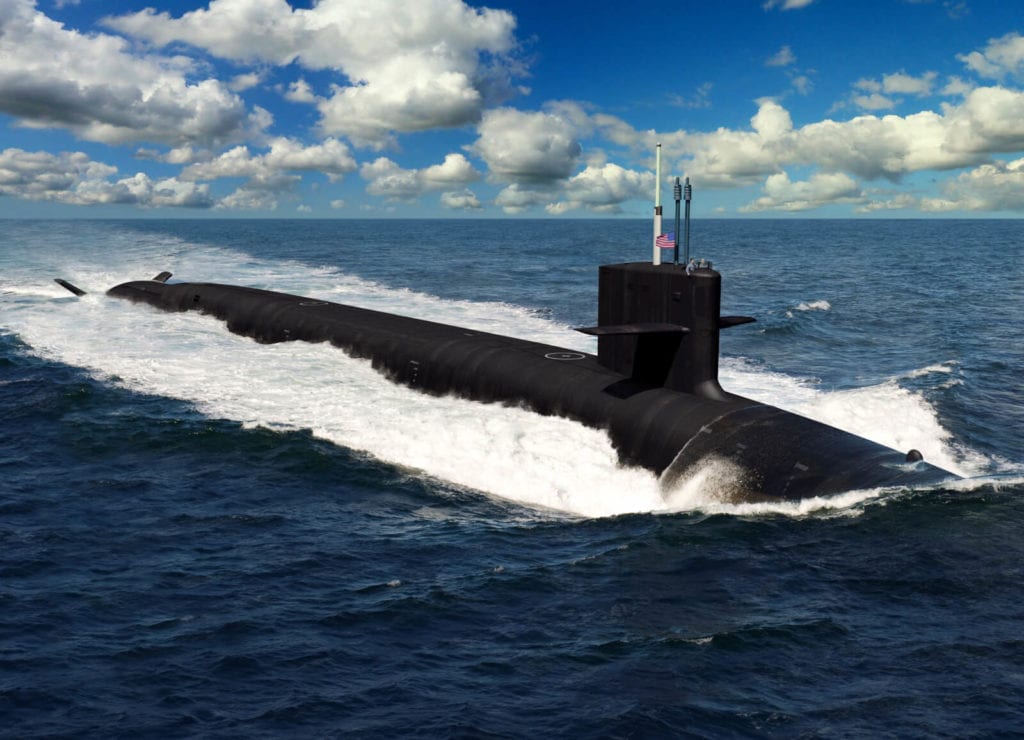
An artist rendering of the future Columbia-class ballistic missile submarine. U.S. Navy leaders will meet with industry officials in May to examine how they can add more space in the tight schedule to build the first of the Columbia-class ballistic missile submarines, Navy Secretary Richard V. Spencer said. U.S. Navy illustration.
U.S. Navy leaders will meet with industry officials in May
to examine how they can improve the increasingly challenged submarine
production program and try adding more space in the tight schedule to build the
first of the Columbia-class ballistic missile submarines, Navy Secretary
Richard V. Spencer said April 30.
The Navy would like to increase the production of its
Virginia-class attack submarines from two a year to three to stop the decline
in the already inadequate number of attack boats. But that pace is hampered by
the fact that the two shipyards building those boats also are responsible for
getting the Columbia class into service by 2031, when the Navy’s Ohio-class
boomers will be unable to continue their crucial strategic deterrence patrols,
Spencer said.
“We do have concerns,” Spencer told the House Appropriations
Defense Subcommittee. To address those issues, the Navy will sit down with
industry leaders May 16 to assess the sub construction yards and the supply
chain and seek to “build in margin where we can” for the Columbia-class
schedule.
“If we do not, it will run off the rails,” Spencer said in
response to questions from the panel responsible for providing the money the
Navy Department will need for all its programs.
In addition to the questions the appropriators had about the
Columbia class, the Navy’s self-declared No. 1 procurement priority, the
subcommittee’s chairman, Rep. Pete Visclosky (D-Indiana), hounded the Navy
leaders on the chronic problems in submarine maintenance and acceptance of new
warships with multiple material problems.
Visclosky pointed out that three of the older Los Angeles
class attack submarines — Boise, Columbus and Hartford — are no longer
certified to submerge because they have not received maintenance that is
overdue. He emphasized that Boise was scheduled to go into the repair yard in
2013 but still is waiting for an opening.
And Visclosky was particularly troubled by the Navy failing
to request funds to repair the three inoperable submarines in its regular
fiscal 2020 budget request but added them to the unfunded requirements list.
Spencer and Chief of Naval Operations Adm. John M.
Richardson conceded they were having trouble getting submarines into required
maintenance, which was aggravating the inability to meet combatant commanders’
requests for the attack boats, with some reports putting the shortfall as high
as 50 percent.
The two Navy leaders argued that the submarine maintenance
problem stemmed from the sharp reduction in funding during the years when the
Budget Control Act forced sequestration.
But Visclosky replied that “sequestration happened some time
ago” and Congress “provided a lot of money” the last two years.
Spencer said the shipyards cut their skilled work force
during the lean years and are now working to replace those workers and improve
their aged facilities. He and Richardson emphasized the Navy’s program to
modernize the government-owned shipyards and to incentivize the private yards
to also update and expand.
Visclosky also demanded the Navy provide details on the
problem highlighted in a recent Government Accountability Office report showing
a long list of new ships the Navy has accepted from the builders with a range
of deficiencies. He stressed the aircraft carrier Gerald R. Ford (CVN-78), the
first in its class of aircraft carriers, is not expected to be operational
until 2023, nearly five years later than expected because of numerous
construction deficiencies.
The chairman wanted to know how the cost of correcting those
flaws was divided between the Navy and its contractors, noting that GAO
indicated the government has been paying 96 percent. Spencer promised to
provide the data.