U.S. Coast Guard, Navy Seize Nearly 1,300 Pounds of Cocaine in Eastern Pacific
U.S. Coast Guard Law Enforcement Detachment (LEDET) 105 embarked aboard the Arleigh Burke-class guided-missile destroyer USS Sampson (DDG 102), prepare to offload interdicted contraband from a rigid-hull inflatable boat while conducting maritime interdiction operations in the Eastern Pacific, Aug. 11, 2025. (U.S. Navy photo by MC2 Sheryssa Dodard)
From MC1 Brandon Roberson, Aug. 18, 2025
U.S. Coast Guard Law Enforcement Detachment (LEDET) 105 embarked aboard the Arleigh Burke-class guided-missile destroyer USS Sampson (DDG 102), prepare to offload interdicted contraband from a rigid-hull inflatable boat while conducting maritime interdiction operations in the Eastern Pacific, Aug. 11, 2025. (U.S. Navy photo by MC2 Sheryssa Dodard)
PACIFIC OCEAN – A U.S. Coast Guard Law Enforcement Detachment (LEDET), embarked aboard the Arleigh Burke-class guided-missile destroyer USS Sampson (DDG 102), interdicted a suspected drug smuggling vessel and seized approximately 1,296 pounds of cocaine in international waters Aug. 11.
The Sampson, operating in a known drug trafficking corridor, identified a suspicious vessel exhibiting telltale indicators of smuggling, including excessive fuel barrels and packaged cargo visible on deck. Upon receiving authorization, the ship launched a U.S. Navy MH-60R Sea Hawk helicopter from Helicopter Maritime Strike Squadron (HSM) 49, as well as a rigid-hull inflatable boat (RHIB) to intercept.
The suspect vessel attempted to flee and began jettisoning packages overboard. After warning shots failed to compel compliance, the helicopter crew, under Coast Guard direction, employed disabling fire, successfully halting the vessel without injury. Two boarding teams, including members from LEDET 105, conducted a non-compliant boarding and recovered 12 bales of suspected narcotics. Field tests confirmed the presence of cocaine, and two individuals were taken into custody.
Due to deteriorating seaworthiness and heavy seas, the vessel began taking on water and was deemed unsafe to tow. The suspects were transferred to Sampson, and the vessel was left to sink to mitigate navigational hazards.
The interdiction was conducted under international law and a bilateral agreement with Ecuador. Upon mission completion, tactical control of the Sampson returned to U.S. 3rd Fleet.
This operation reflects ongoing cooperation between the U.S. Navy, U.S. Coast Guard, and interagency partners to disrupt transnational criminal networks operating in the maritime domain.
The Sampson is employed under U.S. Northern Command’s maritime homeland defense authorities with a Coast Guard Law Enforcement Detachment embarked to enable maritime interdiction missions to prevent the flow of illegal drugs and other illegal activity. U.S. Northern Command is working together with the Department of Homeland Security to provide additional military forces and capabilities at the southern border.
Australia’s MQ-4C Triton Fleet Grows to Three
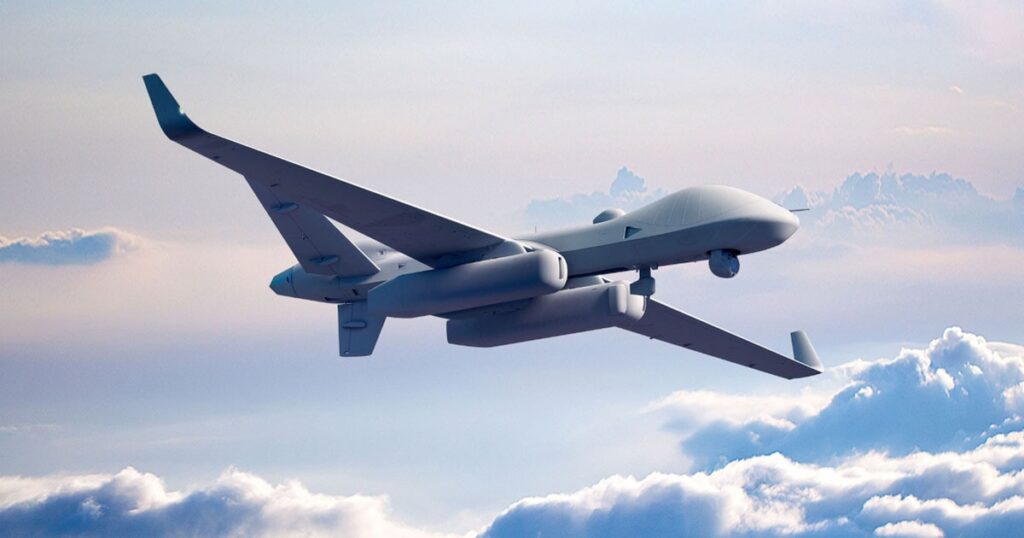
Three Royal Australian Air Force MQ-4C Triton aircraft on the taxiway at RAAF Base Tindal. (Australian Department of Defence)
From Australian Ministry of Defence, June 27, 2025
Australia’s second and third MQ-4C Triton remotely piloted aircraft systems arrived at RAAF Base Tindal, Northern Territory, in May.
The two aircraft were remotely piloted from United States Naval Air Station Patuxent River in Maryland, safely arriving on Australian soil after completing a multi-day, multi-leg journey across the Pacific Ocean. The aircraft join Australia’s first MQ-4C Triton, which was delivered in July 2024 and successfully completed its first test flights under Australian control.
Chief of Air Force Air Marshal Stephen Chappell said the arrival of the MQ-4C Triton two and three represents a significant milestone for Air Force.
“It delivers unprecedented persistence and awareness over Australia’s extensive maritime domain in support of the integrated focused force,” Air Marshal Chappell said.
“This acquisition clearly demonstrates the ongoing success of the cooperative program with the United States Navy, and strengthens our integrated focused force.”
Australia will acquire a total of four MQ-4C Triton aircraft and associated ground support systems through a Cooperative Program with the United States Navy and in collaboration with the manufacturer of the MQ-4C Triton, Northrop Grumman.
All four aircraft will be based at RAAF Base Tindal, and operated by Air Force’s 9 Squadron, located at RAAF Base Edinburgh, South Australia.
‘It’s going to be an exciting and challenging period, with significant learning opportunities as we continue to unlock and exploit the capabilities of the MQ-4C Triton.’
Commanding Officer 9 Squadron Wing Commander Lawry Benier said the safe arrival of Australia’s second and third MQ-4C Triton was the culmination of a large integrated effort across Defence, United States Navy and Northrop Grumman.
“It will continue to be a team game across Defence and defence industry, as we take the MQ-4C Triton further afield and put it through the paces of its mission roles,” he said.
“It’s going to be an exciting and challenging period, with significant learning opportunities as we continue to unlock and exploit the capabilities of the MQ-4C Triton.”
The MQ-4C Triton will provide the ADF with a persistent, high altitude, long endurance, maritime intelligence, surveillance, reconnaissance and electronic warfare capability that can contribute to a range of tasks including intelligence surveillance and reconnaissance, anti-surface warfare and electronic warfare.
“Additional MQ-4C aircraft further realises the Triton’s ability to enable the delivery of long-range, persistent and networked surveillance and reconnaissance for the integrated force,” Wing Commander Benier said.
“It creates necessary fleet depth to afford 9 Squadron with resilience and flexibility to enable introduction into service and operational test activities.”
The MQ-4C Triton will operate alongside Air Force’s crewed P-8A Poseidon aircraft as a “family of systems” that will provide support to national security response activities, both domestically and abroad.
Australia’s fourth and final MQ-4C Triton is in production, and is scheduled to be delivered in 2028.
Task Force Forge Marines and Sailors Assume Southern Border Mission in Arizona
Aug. 18, 2025 | By Marine Corps 1st Lt. John Carter
Service members assigned to Combat Logistics Battalion 15, 1st Marine Logistics Group, I Marine Expeditionary Force, known as Task Force Forge, assumed operational responsibilities last month from 1st Combat Engineer Battalion, 1st Marine Division, known as Task Force Sapper, to support U.S. Northern Command’s ongoing assistance to the Department of Homeland Security under Joint Task Force Southern Border.
Comprised of 500 Marines and sailors, Task Force Forge is conducting vital ground engineering and logistical operations within the U.S. Border Patrol’s Yuma Sector located in Arizona. These missions include reinforcing the existing southern border barrier, emplacing national defense area signage and performing roadway surveys and maintenance — all part of the Defense Department’s continued support to U.S. Customs and Border Protection.
Before starting barrier reinforcement tasks, the unit completed a series of barrier surveys along key segments to evaluate conditions, identify reinforcement needs and guide mission planning. These assessments form the foundation for ongoing operations.
The barrier reinforcement mission, previously conducted by Task Force Sapper in the San Diego Sector, was an anticipated requirement that Task Force Forge had prepared for in advance. Marines and sailors are now welding prefabricated steel brackets onto the existing barrier infrastructure. Once installed in sufficient numbers, these brackets will support the placement of barbed and concertina wire, enhancing the overall security of the barrier.
“The Marines and sailors of Task Force Forge bring precision, professionalism and purpose to every mission,” said Marine Lt. Col. Colin Graham, CLB 15 battalion commander and Task Force Forge commanding officer. “Reinforcing the border barrier is a tangible way we assist our interagency partners to strengthen security and protect the territorial integrity of the United States.”
In parallel, following the recent establishment of the Yuma National Defense Area — located adjacent to the Barry M. Goldwater Range and now part of Marine Corps Air Station Yuma — Task Force Forge has been tasked with emplacing NDA signage throughout the NDA 4 East region. This land, previously owned by the Interior Department, was transferred to the Navy, with Marine Corps Air Station Yuma delegating operational authority to Northcom.
Additionally, the task force is conducting detailed surveys of unimproved roads essential for maintaining mobility for CBP and DOD personnel operating in rugged desert terrain. These surveys evaluate road geometry, surface conditions and drainage patterns.
Task Force Forge engineering experts are using these findings to plan targeted maintenance activities such as blading, reshaping and dust abatement. These efforts aim to preserve the environmental integrity of each route while ensuring safe and reliable travel for mission-critical operations.
Gerald R. Ford Carrier Strike Group Transits Strait of Dover
The world’s largest aircraft carrier, USS Gerald R. Ford (CVN 78), passes the Cliffs of Dover in the English Channel, Aug. 17, 2025. Gerald R. Ford, a first-in-class aircraft carrier and deployed flagship of Carrier Strike Group Twelve, is on a scheduled deployment in the U.S. 6th Fleet area of operations to support the warfighting effectiveness, lethality and readiness of U.S. Naval Forces Europe-Africa, and defend U.S., Allied and partner interests in the region. (U.S. Navy photo by Mass Communication Specialist 3rd Class Gladjimi Balisage)
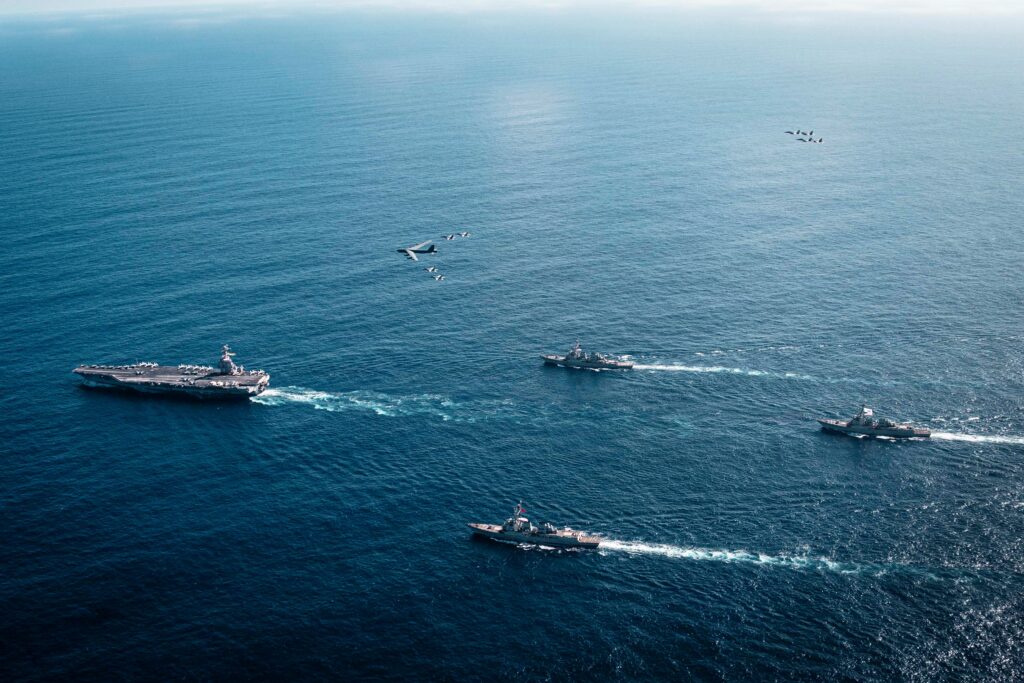
NORTH SEA – The world’s largest aircraft carrier, USS Gerald R. Ford (CVN 78), and Arleigh Burke-class guided-missile destroyers USS Mahan (DDG 72), USS Winston S. Churchill (DDG 81), and USS Bainbridge (DDG 96), all assigned to Gerald R. Ford Carrier Strike Group (GRFCSG), transited the Strait of Dover into the North Sea, Aug. 17.
The Harry S. Truman Carrier Strike Group was the last U.S. carrier strike group to transit through the Strait of Dover, on Oct. 14, 2024.
“Gerald R. Ford’s agile transit through the Strait of Dover between England and France is a testament to our power projection capability that supports peace through strength,” said Capt. Dave Skarosi, commanding officer of Gerald R. Ford. “Our skilled navigation team ensures that the world’s largest aircraft carrier brings our capability as a forward-positioned force anytime, anyplace, to defend the Euro-Atlantic region from hostile action.”
The inherent flexibility and scalable maritime force that GRFCSG provides to the NATO Alliance is unrivaled, and their continued operations in the U.S. European Command area of operation reinforces the U.S. Navy’s ironclad commitment to the stability and security of the European theater.
“A free and open maritime domain benefits all nations,” said Capt. Mark Lawrence, commodore of Destroyer Squadron Two, embarked aboard Gerald R. Force as the Sea Combat Commander. “Our collective surface force’s transit into the North Sea demonstrates our resolve to strengthen peace, stability, and deterrence across the European continent.”
Historically known as the Dover Narrows, the Strait of Dover is the slimmest part of the English Channel and separates Great Britain from mainland Europe. It also delineates the border between the Atlantic Ocean and the North Sea.
Carrier Strike Group Twelve is on a scheduled deployment to the U.S. 6th Fleet area of operations to support the warfighting effectiveness, lethality, and readiness of U.S. Naval Forces Europe-Africa, and defend U.S., Allied and partner interests in the region. For more than 80 years, U.S. Naval Forces Europe-U.S. Naval Forces Africa has forged strategic relationships with our Allies and partners, leveraging a foundation of shared values to preserve security and stability.
Sailors assigned to the Arleigh Burke-class guided-missile destroyer USS Sterett (DDG 104) man the rails as the ship returns to its homeport of San Diego following a nine-month deployment to the U.S. 5th and 7th Fleet areas of operations, Aug. 13, 2025. An integral part of the U.S. Pacific Fleet, U.S. 3rd Fleet leads naval forces in the Indo-Pacific and provides the realistic, relevant training necessary to execute the U.S. Navy’s role across the full spectrum of military operations. U.S. 3rd Fleet works together with allies and partners to advance freedom of navigation and overflight, the rule of law and other principles that underpin security for the Indo-Pacific region. (U.S. Navy photo by Mass Communication Specialist 2nd Class Lordin Kelly)
Carl Vinson Carrier Strike Group Returns from 9-month Deployment
The USS Carl Vinson returns to San Diego Aug. 14, 2025, from a nine-month combat deployment to the Indo-Pacific region. (U.S. Navy photo by MC2Lordin Kelly)
From Lt.j.g. Jack Scypinski, Carrier Strike Group One, Aug. 15, 2025
The Nimitz-class aircraft carrier USS Carl Vinson (CVN 70), the flagship of Carrier Strike Group (CSG) 1, returned to its homeport of San Diego on Aug. 14, following a nine-month deployment to the U.S. 3rd, 5th and 7th Fleet areas of operations.
CSG-1 conducted a wide range of missions while operating in the Western Pacific and the Middle East, to include freedom of navigation operations, multinational exercises with U.S. allies and partners, and combat operations in the U.S. Central Command area of responsibility.
“Our Sailors’ dedication and hard work over nearly nine months was vital to sustained operations, including combat, protecting our American values of freedom, prosperity and security on the high seas,” said Rear Adm. Amy Bauernschmidt, commander of CSG-1. “I am immensely proud of every member of our team who professionally executed the mission and will now be able to reunite and spend well-earned time with family and friends.”
In February, the Carl Vinson Carrier Strike Group (VINCSG) operated in the Philippine Sea with the French Navy and Japan Maritime Self-Defense Force during Exercise Pacific Steller 2025, maintaining and improving integrated operational capabilities across three large-deck ships and strengthening maritime security in the Indo-Pacific region.
While participating in Exercise Freedom Shield 25, the Carl Vinson and its embarked Carrier Air Wing (CVW) 2 conducted air integration training with the U.S. Air Force and Republic of Korea (ROK) Air Force, which included variations of the F-35 fifth generation strike fighter aircraft from both nations. This exercise enhanced joint and combined interoperability and underscored the enduring military alliance between the U.S. and ROK.
“Throughout this deployment, the Sailors of CVW-2 operated with precision and professionalism, safely executing demanding missions across multiple domains,” said Capt. Eric Bell, commander of CVW-2. “Their skill and teamwork brought adaptability, survivability and lethality to the air wing of the future, demonstrating that warfighting readiness is not just about the advanced platforms, but the people who make them operationally effective.”
Upon entering the USCENTCOM AOR, VINCSG conducted strikes against Iran-backed Houthi targets in Yemen during Operation Rough Rider. These continuous operations degraded Houthi capabilities and disrupted threats to commercial shipping in the Red Sea, Gulf of Aden and the Bab al-Mandeb Strait.
“Throughout this deployment, the Sailors of America’s Favorite aircraft carrier have continually demonstrated remarkable professionalism, grit and teamwork,” said Capt. Joshua Wenker, commanding officer of the Carl Vinson. “From high-profile evolutions to routine operations, their unwavering dedication and commitment to excellence ensured the ship remained ready and effective. It’s an honor to return home with such an exceptional crew.”
VINCSG Sailors completed more than 10,000 sorties and 23,000 flight hours, carried out 45 replenishments-at-sea aboard the carrier and sailed over 275,000 nautical miles combined. The ships of VINCSG conducted port visits to Malaysia, Thailand, Republic of Korea and Guam while deployed to the U.S. 7th Fleet area of operations, participating in key leader engagements, community relations projects, sporting events and cultural exchanges.
Notable key leader engagements and visits aboard the Carl Vinson included Gen. Michael Kurilla, commander, U.S. Central Command; Gen. Xavier T. Brunson, commander, United Nations Command, Combined Forces Command, United States Forces Korea; Vice Adm. George Wikoff, commander, U.S. 5th Fleet; Vice Adm. Fred Kacher, commander, U.S. 7th Fleet; and key leaders from the Philippine Navy, Thai Navy, Republic of Korea Navy, Japan Maritime Self-Defense Force, Royal Malaysian Navy and U.S. Forces Korea.
VINCSG is a multiplatform team of ships and aircraft, capable of carrying out a wide variety of missions around the globe from combat missions to humanitarian assistance and disaster relief response.
CSG-1 consists of the Carl Vinson, embarked staffs of CSG-1 and Destroyer Squadron (DESRON) 1, CVW- 2, the Ticonderoga-class guided-missile cruiser USS Princeton (CG 59), and the Arleigh Burke-class guided-missile destroyers USS Sterett (DDG 104) and USS William P. Lawrence (DDG 110). The William P. Lawrence returned to its homeport of Pearl Harbor, Hawaii, on July 9 after a seven-month deployment to the U.S. 7th Fleet area of operations.
CVW-2 is composed of nine squadrons flying the F-35C Lightning II, F/A-18E/F Super Hornets, EA-18G Growler, E-2D Advanced Hawkeye, CMV-22 Osprey and MH-60R/S Sea Hawks.
An integral part of the U.S. Pacific Fleet, U.S. 3rd Fleet leads naval forces in the Indo-Pacific and provides the realistic, relevant training necessary to execute the U.S. Navy’s role across the full spectrum of military operations. U.S. 3rd Fleet works together with allies and partners to advance freedom of navigation, the rule of law and other principles that underpin security for the Indo-Pacific region.
Fleet Master Chief John Perryman Selected as 17th Master Chief Petty Officer of the Navy
From the U.S. Navy Office of Information, Aug. 15, 2025
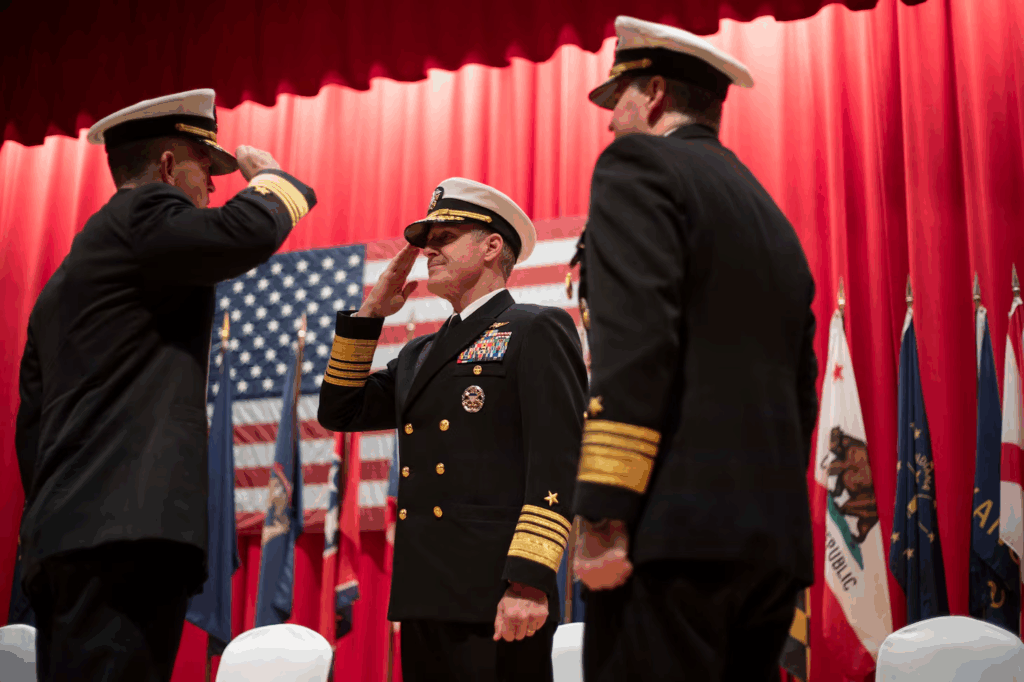
WASHINGTON — The Navy has announced the selection of Fleet Master Chief John Perryman as the 17th Master Chief Petty Officer of the Navy (MCPON).
Perryman, who currently serves as the senior enlisted leader for U.S. Fleet Forces Command, will relieve MCPON James Honea during a change of office ceremony scheduled for September at the Navy Memorial.
With decades of operational experience across the fleet, Perryman will play a vital role in advising Navy leadership, shaping enlisted policy, and maintaining warfighting readiness in an era of strategic competition.
Perryman enlisted in 1994 and rose through the ranks as an electronics technician submariner. His sea tours include USS Bremerton (SSN 698), USS Dolphin (AGSS 555), and USS Cheyenne (SSN 773). He served as command master chief aboard USS Hawaii (SSN 776) and at multiple flag-level commands, including Commander, Submarine Force U.S. Pacific Fleet; Commander, Submarine Group Seven; Commander, Submarine Force Atlantic; and U.S. Strategic Command.
UNITAS 2025 To Be Held Across Multiple Locations Along the East Coast of United States
MAYPORT, Fl. (Dec 18, 2024) – Depicted is the U.S. Navy’s UNITAS 2025 logo. (U.S. Navy graphic by Ens. Paul Archer)
From USNAVSOUTH/4TH Fleet Public Affairs, Aug. 14, 2025
MAYPORT, Fla. – U.S. Navy and Marine Corps, and participating nation forces are set to arrive at Naval Station Mayport, Fla., in support of UNITAS 2025 (66) the world’s longest-running multinational maritime exercise, scheduled to start September 15, 2025.
The U.S. Navy will host this year’s UNITAS featuring approximately 8,000 personnel from 25 allied and partner nations, including multiple ships, submarines, and aircraft (fixed wing and rotary). Forces will conduct operations off the East Coast of the United States and ashore in the vicinity of Naval Station Mayport, Fla., Marine Corps Base Camp Lejeune, N.C., and Naval Station Norfolk, Va. through October 6.
UNITAS, which is Latin for unity, united, or oneness, was conceived in 1959 when representatives at the first Inter-American Naval Conference in Panama agreed to conduct an annual maritime exercise with one another. The first UNITAS took place in 1960 with forces from Argentina, Brazil, Chile, Colombia, Ecuador, Peru, Uruguay, the United States, and Venezuela. This year marks the 66th iteration of the world’s longest-running annual multinational maritime exercise.
Including the United States, UNITAS 2025 will bring together 26 nations from all over the world to train forces in joint maritime operations that enhance tactical proficiency and increase interoperability. Participating nations include Argentina, Belize, Brazil, Canada, Chile, Colombia, Dominican Republic, Ecuador, El Salvador, France, Germany, Greece, Guatemala, Honduras, Italy, Mexico, Morocco, Netherlands, Jamaica, Japan, Panama, Paraguay, Peru, Singapore, Spain, and the United States
“In line with the Secretary’s guidance, and to bolster defense of the homeland and build on over six decades of success, UNITAS 2025 is a vital opportunity to demonstrate how our partners in the region work together to defend against hemispheric threats,” said Rear Adm. Carlos Sardiello, commander of U.S. Naval Forces Southern Command/U.S. 4th Fleet and commander, Task Force 138. “By bringing together 25 nations, we’re not just enhancing tactical proficiency and interoperability, we are demonstrating a prime example of regional burden-sharing; we’re reinforcing trust and unity crucial for ensuring we stand side by side against hemispheric threats.”
Following the UNITAS 2025 Opening Ceremony on September 15, the in-port phase of the exercise will feature subject matter expert exchanges, professional symposiums, ship rider exchanges, and operations meetings. During this time, Marines and Sailors will conduct training events in Mayport to include medical, cyber defense, and diving and salvage operations.
During the UNITAS 2025 Underway Phase, forces will participate in events testing all warfare operations, to include live-fire exercises such as a SINKEX, an amphibious ship-to-shore landing and force withdrawal in Camp Lejeune, North Carolina.
Additionally, unmanned and hybrid fleet systems will return to UNITAS for a second year as part of the testing and development of the U.S. Navy’s future hybrid fleet.
U.S. forces participating in UNITAS 2025 include the U.S. Navy’s Carrier Strike Group 2, Carrier Strike Group 4, Commander, Patrol and Reconnaissance Wing 11, Destroyer Squadron 40, Explosive Ordnance Disposal Mobile Unit 6, Expeditionary Strike Group 2, Helicopter Maritime Strike Squadron 48, SEAL Team 8, Special Boat Team 20, Theater Support Vessel 1 Prevail, Theater Support Vessel 4 Narragansett, Theater Support Vessel 5 Vindicator, USNS Leroy Grumman (T-AO-195), USS Arlington (LPD 24), USS Cooperstown (LCS 23), USS Harry S Truman (CVN 75), USS Oregon (SSN 793), USS Thomas Hudner (DDG 116), and Air Test and Evaluation Squadron 20. Marine Corps forces include the 2nd Marine Aircraft Wing; 2nd Marine Division; 2nd Marine Logistics Group, including Combat Logistics Battalion 22; the 26th Marine Expeditionary Unit Command Element; 4th Marine Division; B Company, 4th Light Armored Reconnaissance Battalion; Force Headquarters Group Augments; Marine Light Attack Helicopter Squadron 269; II Marine Expeditionary Force; II Marine Expeditionary Force Information Group; K Company (-), 3rd Battalion 23rd Marine Regiment; Littoral Craft Company D, 4th Amphibian Assault Battalion; Marine Air Control Group 28; Marine Forces Reserve; Marine Fighter Attack Squadron 251; Marine Fighter Attack Squadron 542; and Marine Wing Communications Squadron 48. The U.S. Coast Guard is represented by the Tactical Law Enforcement Team and a U.S. Coast Guard Maritime Security Response Team. U.S. Air Force units involved include Air Force Special Operations Command and the 107th Fighter Squadron. Exercises like UNITAS play a critical role in enhancing the combat readiness of U.S. service members, as well as those of our Allies and partners, by providing a platform for joint training and cooperation in complex maritime environments.
Following the successful completion of UNITAS 2025, senior leaders from participating countries will join in a series of high-profile events along the East Coast, celebrating a historic milestone: the United States Navy 250th birthday. This commemoration honors a legacy of protecting American interests, deterring aggression, and promoting prosperity and security, while also showcasing the Navy’s enduring commitment to defending the American way of life.
U.S. Naval Forces Southern Command/U.S. 4th Fleet is the trusted maritime partner for Caribbean, Central and South America maritime forces leading to improved unity, security and stability.
For more USNAVSOUTH/4th Fleet news and photos, visit facebook.com/NAVSOUS4THFLT, https://www.fourthfleet.navy.mil/, X – @ NAVSOUS4THFLT, and https://www.linkedin.com/company/u-s-naval-forces-southern-command-u-s-4th-fleet
Assistant Secretary of the Navy Visits MSC Ship
From Military Sealift Command, Aug. 13, 2025
Assistant Secretary of the Navy (Manpower and Reserve Affairs), Mr. C Scott Duncan (second from left) addresses the crew of USNS Patuxent (T-AO 201) during a ship tour, aboard the ship Aug. 13, 2025. (U.S. Navy photo by Brian Suriani)
DARPA Christens Unmanned Ship Aimed at Revolutionizing Naval Capability
Ship sponsor Mattie Hanley follows naval tradition by breaking a bottle of spirits on the side of the USX-1 Defiant during the official christening ceremony in Everett, Wash., on Aug. 11, 2025. (DARPA photo by Spencer Bruttig)
Defiant demonstrates path to accelerate US shipbuilding and strengthen naval fleet
From Defense Advanced Research Projects Agency, Aug 11, 2025
DARPA has marked a traditional naval milestone with the christening of USX-1 Defiant, a first-of-its-kind autonomous, unmanned surface vessel designed from the ground up to never accommodate a human aboard. The ceremony took place Monday, Aug. 11, at Everett Ship Repair in Everett, Washington.
The demonstrator for the No Manning Required Ship (NOMARS) program, the Defiant, has a simplified hull design to allow rapid production and maintenance in nearly any port facility or Tier III shipyard that traditionally supports yacht, tug, and workboat customers.
The 180 foot-long, 240-metric-ton lightship is completing final systems testing in preparation for an extended at-sea demonstration of reliability and endurance.
“Defiant is a tough little ship and defies the idea that we cannot make a ship that can operate in the challenging environment of the open ocean without people to operate her,” said NOMARS Program Manager Greg Avicola, during the ceremony. “While relatively small, Defiant is designed for extended voyages in the open ocean, can handle operations in sea state 5 with no degradation and survive much higher seas, continuing operations once the storm passes. She’s no wider than she must be to fit the largest piece of hardware and we have no human passageways to worry about.”
The NOMARS program leapfrogs conventional thinking about unmanned ships, with a goal to minimize the need for “optionally manned” vessels and safely demonstrate the reliability and capability of fully unmanned systems to strengthen the nation’s defense industrial base.
“Defiant class vessels provide cost-effective, survivable, manufacturable, maintainable, long-range, autonomous, and distributed platforms, which will create future naval lethality, sensing, and logistics,” said DARPA Director Stephen Winchell. “Defiant will protect and expand the capabilities of manned ships, multiply combat power at low cost, and unlock new American maritime industrial capacity.”
After completing the at-sea demonstration, Defiant will be turned over to the U.S. Navy’s Unmanned Maritime Systems Program Office (PMS 406). DARPA is working closely with the Navy to identify a pathway to ensure capabilities and technologies demonstrated throughout the NOMARS program are accessible for rapid transition and integration, are scalable, and support international defense partnerships.
In the reconciliation bill, which passed in July of this year, Congress appropriated $2.1 billion “for development, procurement, and integration of purpose-built medium unmanned surface vessels.” Upon transition to PMS 406, Defiant will be the Navy’s first solely autonomous (vs. hybrid manned-unmanned) MUSV.