E-130J Popular Name Announced for TACAMO Mission Aircraft 

The E-130J received its popular name designation, Phoenix II, in August 2025. The Phoenix II will be the Navy’s new Take Charge and Move Out (TACAMO) mission aircraft for decades to come. (Artist Rendering) 

Release From Naval Air Systems Command

NAS Patuxent River, Md. — The U.S. Navy’s Airborne Strategic Command, Control and Communications Program Office (PMA-271) and Strategic Communications Wing 1 (SCW-1) announced the official popular name for the Navy’s new Take Charge and Move Out (TACAMO) mission aircraft: E-130J Phoenix II. 

In October 2024, the placeholder name E-XX was officially designated as E-130J. As of today, the E-130J’s popular name has been designated as Phoenix II, representing the mythical bird whose ability is to be reborn and represents a symbol of immortality, resurrection, and renewal. 

This meaning of rebirth is a nod to the proven C-130 platform fulfilling the TACAMO mission since 1963-1993 via the EC-130Q.The E-130J Phoenix II will relieve the Navy’s E-6B Mercury fleet of the TACAMO mission. TACAMO is the vital connection for the president, secretary of defense and U.S. Strategic Command with naval ballistic missile forces. 

“Phoenix II is the ideal popular name as we take the E-130J TACAMO mission into its next phase,” said Capt. Roger Davis, PMA-271 program manager. “A phoenix is known for its resilience, exceptionally long lifespan, and its ability to transform and continue its purpose. The dedicated team at PMA-271 have committed to the ideals of TACAMO’s critical deterrence mission when executing this new platform; transforming the legacy mission aircraft into a new weapon system with unmatched survivability and longevity for this country.” 

SCW-1 squadrons home based out of Tinker Air Force Base, Oklahoma. They include the “Ironmen” of Fleet Air Reconnaissance Squadron (VQ) 3, “Shadows” of VQ-4 and “Roughnecks” of VQ-7. 

“I’m pleased that this very important program remains on track, and that we were able to leverage our community sailors and veterans through the process,” said Capt. Britt Windeler, commander of SCW-1. “I feel like Phoenix II is especially apt, as we are returning to our roots of executing the TACAMO mission on a C-130 variant.” 

The current platform, E-6B Mercury, is a communications relay and strategic airborne command post aircraft. It provides survivable, reliable, and endurable airborne Nuclear Command, Control, and Communications (NC3) for the president, secretary of defense and U.S. Strategic Command. The E-130J Phoenix II will recapitalize the aging E-6B Mercury fleet that has been in service for more than three decades. 

PMA-271 is part of Naval Air Systems Command (NAVAIR) with its headquarters at Naval Air Station Patuxent River, Maryland. Its mission is to deliver and support survivable, reliable and endurable airborne command, control and communications for the president, secretary of defense and U.S. Strategic Command. 

The mission of SCW-1 is to receive, verify and retransmit Emergency Action Messages (EAMs) to U.S. strategic forces. 


DoN Seeks Energy Resilience Solutions to Power Navy and Marine Corps Installations 

Release From SECNAV Public Affairs Office

WASHINGTON, D.C. – Today, the Department of the Navy, under the leadership of Secretary of the Navy John C. Phelan, announced a bold solicitation to industry for innovative, deployable energy solutions capable of powering Navy and Marine Corps installations with unmatched resilience, security and reliability. 

The solicitation, issued through the Center for Energy, Environment, and Demilitarization (CEED) Consortium under an Other Transaction Authority (OTA) agreement—seeks execution-ready prototypes that will modernize energy infrastructure, safeguard mission-critical operations and ensure uninterrupted power in any operating environment. 

“President Trump’s commitment to unleashing American energy innovation is powering the Navy into a new era,” said Secretary Phelan. “We are calling on America’s most capable innovators to deliver advanced, installation-scale energy solutions, ranging from small modular nuclear reactors to cutting-edge storage and generation technologies that can deliver power with 99.9% availability, even if the public grid goes dark. This is about warfighting readiness, mission assurance, and making sure our bases remain operational under any circumstances.” 

Prototype concepts should focus on: 

  • Modernizing Energy Infrastructure: Deploy advanced, resilient energy systems at Navy, Marine Corps, and other DoD installations. 

  • 99.9% Mission Availability: Deliver power systems capable of sustaining operations without interruption during public grid failures. 

  • Powering High-Demand Data Centers: Ensure generation systems, particularly SMRs are capable of supporting data centers that power advanced AI systems, which require substantially higher and continuous energy output than traditional facilities. 

  • Advanced On-Site Generation: Integrate next-generation small modular nuclear reactors, geothermal, battery storage, and other dispatchable energy technologies. 

  • Resilience Against All Threats: Build systems hardened against natural disasters, cyberattacks, and grid instability. 

  • Innovative Financing: Employ alternative capital structures to accelerate deployment and reduce reliance on traditional appropriated funding. 

The OTA pathway gives the Navy the speed and flexibility needed to work directly with industry leaders, moving from concept to deployment faster than traditional acquisition methods allow. The Department is seeking solutions from both traditional defense contractors and non-traditional energy innovators that can be rapidly mobilized, require minimal permitting, and are ready for immediate execution. 

“Energy resilience is warfighting resilience,” said Secretary Phelan. “If a hurricane knocks out the local grid, our ships still sail. If a cyberattack takes down civilian power, our bases stay online. That’s the standard and we’re setting it now.” 

This opportunity is available exclusively to CEED Consortium members.  

Full details of the solicitation are available at https://cmgcorp.org/cmg-opportunities/


Exail Partners With U.S. Key Player to Supply 100 Navigation Systems for Naval UUVs 

LINCOLN, R. I.) July 30, 2025 — Exail, a leading provider of navigation solutions, has secured a new contract with a U.S.-based global defense player. The agreement involves the delivery of 100 Phins Compact Inertial Navigation Systems (INS) to equip Unmanned Underwater Vehicles (UUVs). 

Offering highly precise navigation capabilities, the Phins Compact INS ensures reliable performance in demanding environments and remains resilient to external signal disruptions. Its compact design enables rapid integration, allowing UUVs to carry out missions with flexibility and efficiency, even in dynamic and unpredictable maritime defense scenarios. 

“We are grateful for our client’s trust in Exail technology. We are confident that our INS will deliver the precision and robustness required for UUVs to operate effectively across varied environments,” said Carlos Lopes, Sales Director at Exail. “Over the years, we’ve worked closely with our customers to develop a navigation suite that truly meets defense challenges. Today, our INS is a global benchmark in subsea navigation.” 

This contract strengthens Exail’s global leadership in subsea navigation, with its INS technology trusted by over 50 navies and widely deployed on a broad range of subsea autonomous vehicles worldwide. It also represents a key milestone in the company’s expanding presence in the United States, supporting defense programs with proven, high-performance solutions. 


Senators Introduce Bill to Exempt Shipbuilding Workforce from Cuts

USS Greeneville (SSN 772) departs Portsmouth Naval Shipyard in Kittery, Maine, in April 2024. Greeneville had been at the shipyard for a scheduled maintenance period since June 2021. Photo credit: U.S. Navy | Mass Communication Specialist 1st Class Charlotte Oliver

WASHINGTON — A bipartisan group of New England lawmakers has introduced a bill in Congress to protect the shipbuilding workforce.

U.S. Senators Jeanne Shaheen (D-N.H.), a senior member of the U.S. Senate Armed Services Committee and co-chair of the U.S. Senate Navy Caucus, Maggie Hassan (D-N.H.), Susan Collins (R-Maine) and Angus King (I-Maine) introduced the Protecting Public Naval Shipyards (PNSY) Act to exempt the workforces of America’s four public shipyards, like the Portsmouth Naval Shipyard, from recent hiring freezes and mass layoffs.

The bill aims to ensure the maintenance and overhaul of America’s nuclear-powered submarine fleet continues uninterrupted by requiring the U.S. Department of Defense to exempt certain positions at public shipyards from workforce reductions. 

“Our shipyard workforce represents an essential component of our national defense and preparedness – they should have never been subjected to this administration’s ill-considered hiring freezes,” Shaheen said. “The Portsmouth Naval Shipyard workforce is supposed to be exempt from the hiring freeze, but there continues to be issues with implementation. Our bipartisan bill enshrines that exemption in federal law and ensures that no public shipyard is subjected to such chaos and uncertainty in the future, allowing them to focus instead on the vital role they play in our national security.” 

“Our nation’s public shipyards depend on a highly skilled and experienced workforce,” Collins said. “At Portsmouth Naval Shipyard, workers set the gold standard for repairing, retrofitting, and refueling our nation’s nuclear submarines. This bipartisan bill would protect the men and women at PNSY, and at all four of our nation’s public shipyards, helping sustain the critical contributions these shipyards make to our national defense, the readiness of our Navy, and the economies of their surrounding regions.” 

Protecting PNSY Act would require DoD to exempt positions at the public shipyards from workforce reductions that are critical to maintenance of our submarine fleet and that support the Shipyard Infrastructure Optimization Program (SIOP). The bipartisan bill also removes hiring limits for these positions. 

Click HERE to read the bill text. 


L3Harris Successfully Tests New Power Plant System for Advanced Lightweight Torpedo

Release From Aerojet Rocketdyne

L3Harris Technologies has successfully completed testing of the first power plant system for the Stored Chemical Energy Propulsion System (SCEPS) that will power the U.S. Navy’s MK 54 MOD 2 Increment 2 Advanced Lightweight Torpedo. The power plant system testing validated the functionality and performance of this key component and positions L3Harris to begin SCEPS design verification testing of the fully integrated system later this year. 

L3Harris is on contract with the Navy to deliver proof of design for SCEPS propulsion for the MK 54 MOD 2 torpedo, which includes the power plant system and an integrated tail and torpedo afterbody assembly. 

“The power plant system is at the very heart of the propulsion system that will power the Navy’s MK 54 MOD 2 torpedo,” said Scott Alexander, President, Missile Solutions, Aerojet Rocketdyne, L3Harris. “We are pleased with the performance of the system during these tests and look forward to completing design verification testing of the entire afterbody later this year.” 

L3Harris’ Center of Excellence for Undersea Propulsion Manufacturing, based in Orlando, Florida, includes the only SCEPS manufacturing capability within the U.S. industrial base, and plays a key role supporting the Navy’s next generation torpedoes. In parallel with ongoing U.S. Navy contracts, the company has been independently funding fabrication and testing of prototype SCEPS components to further the innovative technology. 

SCEPS uses a lithium boiler to generate heat used to create steam that drives a turbine to propel the torpedo to intercept its intended target. The innovative propulsion system will significantly improve U.S. Navy torpedo capabilities. 


QinetiQ US Secures $26M in Naval Defense Contracts with General Dynamics Electric Boat

Release From QintetiQ

Multi-year agreement strengthens QinetiQ’s position in naval defense systems with critical components for Virginia and Columbia class submarines 

MCLEAN, Va., July 29, 2025 — QinetiQ US secures approximately $26 million in subcontracts from General Dynamics Electric Boat to deliver key electrical and electromechanical systems for the U.S. Navy’s Virginia and Columbia class submarine programs. 

Under these contracts, QinetiQ US will build, test and deliver complex electrical and electromechanical systems that enable critical onboard operations. These specialized components play vital roles in performance and mission effectiveness. 

“These awards highlight Electric Boat’s confidence in QinetiQ’s engineering expertise, manufacturing capability and our role within the Navy submarine industrial base to deliver mission-critical systems for the nation’s fleet,” said Tom Vecchiolla, President and Chief Executive of QinetiQ US. “Our technical solutions support enhanced operational capabilities for these advanced submarines, enabling the U.S. Navy’s undersea dominance.” 

The Virginia and Columbia class submarines represent the current and future of the U.S. Navy’s undersea warfare capabilities. The Virginia class is a nuclear-powered fast-attack submarine designed to excel in littoral and deep-water missions, while the Columbia class will replace the Ohio-class ballistic missile submarines as a critical component of the nation’s nuclear deterrent. 

Production of all electrical and electromechanical systems will take place at QinetiQ’s US-based manufacturing facilities with deliveries scheduled throughout the period of performance. 


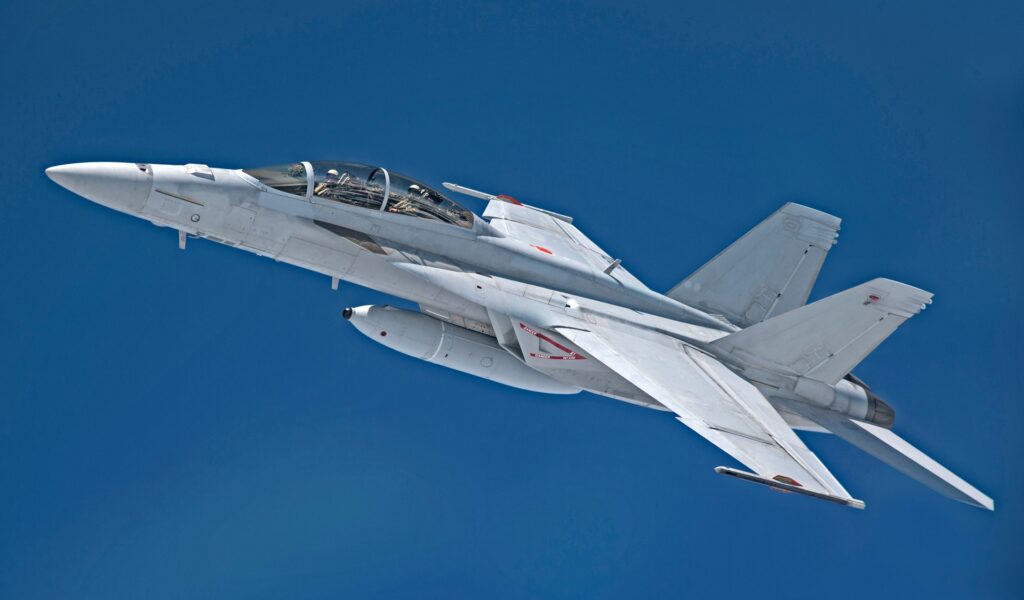
F/A-18 and EA-18G Surpass 12 Million Flight Hours 

A formation of Air Test and Evaluation Squadron (VX) 31 “Dust Devils” aircraft, including an EA-18G Growler, AV-8B Harrier II+, an F/A-18E Super Hornet, and an F/A-18D Hornet, flies over Point Mugu’s Sea Range in Californation during a photo exercise. These aircraft demonstrate the Naval Air Warfare Center Weapons Division’s commitment to advancing fleet capabilities through rigorous testing and operational support.  

RELEASE FROM NAVAL AIR SYSTEMS COMMAND

NAS PATUXENT RIVER, Md. — The U.S. Navy’s F/A-18 and EA-18G aircraft fleet has surpassed 12 million flight hours, marking an important milestone for one of the most enduring families of aircraft in modern naval aviation. This achievement underscores the capability, reliability and availability of these aircraft, which have served as the backbone of the U.S. Navy and Marine Corps air power for decades.   

Put into perspective, the aircraft have completed the equivalent of 500,000 days, or nearly 1,370 years, of nonstop flight defending national interests and ensuring global security.   

“When you call the roar of these aircraft ‘the sound of freedom,’ it holds real weight,” said Capt. Michael Burks, program manager for the F/A-18 and EA-18G program office (PMA-265). “Throughout their service, the F/A-18 and EA-18G family has supported nearly every major U.S. military conflict of the past 40 years and continues to adapt to rapidly changing threat environments. From the initial deployment of the Hornet to the advanced capabilities of the Super Hornet and Growler, these aircraft have delivered forward presence, tactical airpower and critical electronic warfare capabilities around the globe.” 

Since the F/A-18 Hornet was first introduced in the 1980s, it has quickly become a versatile and capable fighter and attack aircraft. Its successor, the F/A-18E/F Super Hornet, and its electronic warfare counterpart, the EA-18G Growler, introduced significant advancements in radar, avionics, payload capacity and electronic attack.  

Key modernization efforts include Super Hornet Service Life Modification (SLM), which extends Super Hornet service life from 6,000 to 10,000 flight hours, and the delivery of Block III Super Hornets, which are equipped with advanced sensors, enhanced survivability and a redesigned cockpit for improved pilot performance. Growler Block II modifications will enhance mission systems, enable future capability growth and strengthen the Navy’s electronic warfare superiority.  

“This milestone is a significant achievement and a reflection of the generations of Sailors, Marines and civilians who sustain, fly and innovate these platforms every day,” said Burks. “Twelve million flight hours demonstrates our commitment to delivering world-class capability, enabling our warfighters to execute their missions with an asymmetric advantage and return home safely.” 

The flight hour milestone comes at a notable time for naval aviation, coinciding with the 30th anniversary of the Super Hornet’s first flight in November, and as the U.S. Navy and Marine Corps prepare to celebrate 250 years of service to the nation this year.   

As part of Program Executive Office for Tactical Aircraft Programs (PEO(T)), PMA-265 supports, sustains and advances the F/A-18A-D Hornet, F/A-18E/F Super Hornet and EA-18G Growler, delivering critical capabilities to ensure naval aviators succeed in dynamic and contested operational environments.    


USNS Comfort Departs Costa Rica After Fifth CP25 Mission Stop

LIMÓN, Costa Rica (July 28, 2025) Sailors assigned to the Mercy-class hospital ship USNS Comfort (T-AH 20) assist a patient departing Comfort in Limón, Costa Rica during Continuing Promise 2025, July 28, 2025. (U.S. Navy photo by MC2 Thomas Boatright)

By USNAVSOUTH/4TH FLEET PUBLIC AFFAIRS

LIMÓN, Costa Rica  –  The Mercy-class hospital ship USNS Comfort (T-AH 20) departed from Limón, Costa Rica, August 1, 2025, after spending eight days providing medical care, dental care, veterinary care, and multiple subject matter exchanges for Continuing Promise 2025 (CP25). 
 
“As the Continuing Promise mission continues, we leave Costa Rica not only with a sense of accomplishment in the work we’ve done, but with a profound appreciation for the enduring partnership we’ve forged,” said Capt. Ryan Kendall, commodore, Destroyer Squadron 40 and CP25 mission commander. “We thank our Costa Rican counterparts for their warm welcome and dedication to this mission, as we eagerly anticipate the opportunity to build upon these strong ties in the years to come.” 
 
U.S. and Costa Rican medical providers encountered 2,200 patients at the Limón mobile medical site set up at Hernán Garrón Salazar Terminal. Additionally, team Comfort filled 3,323 pharmaceutical prescriptions, conducted 371 dental procedures, distributed 856 pairs of glasses and 706 sunglasses, and performed 65 surgeries aboard Comfort, including 12 pediatric surgeries. 
 
“We were able to provide the best care to Costa Rica with the resources that we had, within the time that we had,” said Capt. Todd Mondzelewski, an ophthalmologist assigned to Comfort. “We have been able to do a lot of surgeries and provide exceptional medical care for every country that we’ve been to, and I hope to be able to continue doing just that.” 
 
The team conducted subject matter expert exchanges (SMEE) including a trauma symposium, preventive medicine classes, basic life-saving techniques, and a tactical combat casualty care course. Over three days, 13 SMEE events occurred with 228 participants from the Costa Rican Red Cross, first responders, and Servicio Nacional de Guardacostas, Costa Rica’s Coast Guard. 
 
Besides patient and medical services, U.S. Army veterinarians from the 248th Medical Detachment Veterinary Service Support encountered 1,741 small animals, including 1,188 routine checkups, and performed 553 neuter and spay procedures in Limón. 
 
“It was a great experience overall,” said Spc. Ali Peer, a veterinary technician assigned to the 248th Medical Detachment Veterinary Support Services. “We did more than 1,000 vaccinations and consultations on the animals and made a long-lasting impact in Costa Rica.” 
 
Comfort’s time in Limón was more than just a chance to offer medical and veterinary services to Costa Rican citizens; it also allowed service members to reunite with their loved ones. 
 
“I haven’t seen my dad in three years,” said Hospital Corpsman 2nd Class Veronica Hernandez Araya, assigned to Comfort. “I was nervous to see my dad in a military setting, but he was super happy to see me, hugged me, and told me he was proud of me, which made it all worth it.” 
 
Throughout the Comfort’s time in Limón, the U.S. Navy Fleet Forces Band “Uncharted Waters” performed for 6 days at a variety of events for more than 3,560 Costa Ricans. U.S. service members also had the opportunity to participate in community relations events, including a park cleaning and restoration, a basketball game, a cricket game, and a kickball game against students from Colegio Tecnico Professional De Limón. 
 
Lastly, Seabees from Naval Mobile Construction Battalion (NMCB) 11 dedicated 615 man-hours in repairing two school sites: Colegio de Limón and Colegio Tecnico Professional. The repairs included replacing a rotting wooden stage, installing roofing over walkways, and painting a 10,000 square foot roof to prevent roof corrosion. 
 
Following Costa Rica, the Comfort will head to its sixth and final mission stop of CP25 in the capital of Trinidad and Tobago, Port of Spain. 
 
CP25 marks the 16th mission to the region since 2007 and the eighth aboard Comfort. The mission will foster goodwill, strengthen existing partnerships with partner nations, and encourage the establishment of new partnerships among countries, non-federal entities, and international organizations. 
 
U.S. Naval Forces Southern Command/U.S. 4th Fleet supports U.S. Southern Command’s joint and combined military operations by employing maritime forces in cooperative maritime security operations to maintain access, enhance interoperability, and build enduring partnerships in order to enhance regional security and promote peace, stability and prosperity in the Caribbean, Central and South American region. 


General Dynamics Bath Iron Works Awarded Contract for Additional DDG 51 Destroyer 

Release From General Dynamics Bath Iron Works

BATH, Maine – General Dynamics Bath Iron Works, a business unit of General Dynamics (NYSE:GD), announced today that the U.S. Navy has exercised an option to add an additional DDG 51 destroyer to the multi-year contract awarded in 2023.  

“We are proud to be selected to build this ship for the U.S. Navy and to continue our legacy of contributing to the nation’s defense,” said Charles F. Krugh, president of Bath Iron Works. “I appreciate the efforts of our team to improve the construction process and build to the plan. We are clawing back schedule so we can deliver more Bath-built ships to our Navy. I would also like to acknowledge and thank our Congressional delegation who added this ship to the Fiscal Year 2025 Defense Appropriations Bill.” 

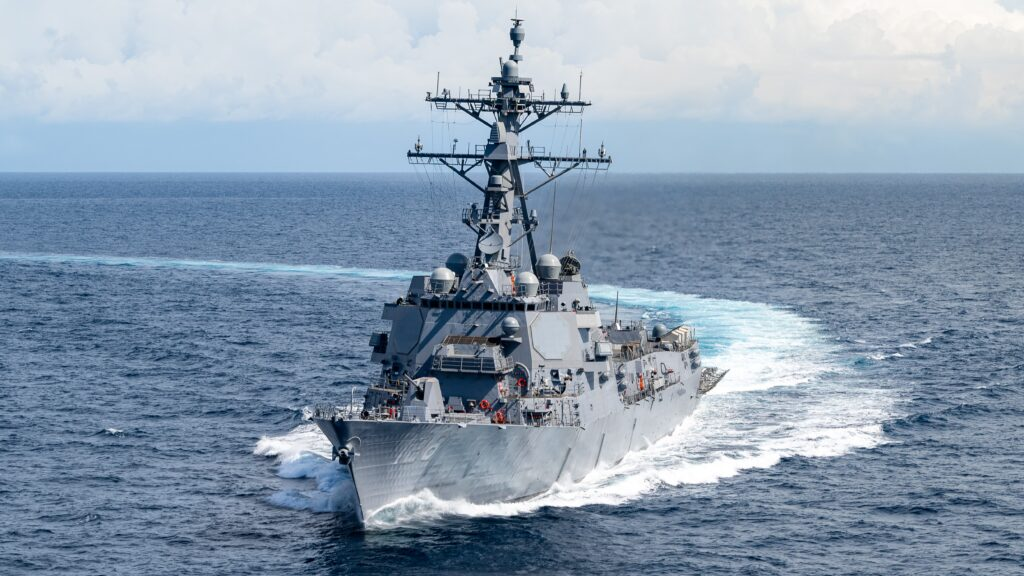
Bath Iron Works currently has under construction the Flight IIA Arleigh Burke-class destroyers Harvey C. Barnum Jr. (DDG 124) and Patrick Gallagher (DDG 127) as well as the Flight III configuration destroyers Louis H. Wilson Jr. (DDG 126), William Charette (DDG 130), Quentin Walsh (DDG 132), John E. Kilmer (DDG 134) and Richard G. Lugar (DDG 136). 


Navy F-35C Jet Crashes Near NAS Lemoore 

By Richard R. Burgess, Senior Editor 

ARLINGTON, Va. — A U.S. Navy F-35C Lightning II strike fighter crashed on July 30 near Naval Air Station Lemoore, California, the air station said in a Facebook post.  

“NAS Lemoore can confirm an aviation incident on the Operations side of the installation,” the announcement said. “At 1830, an F-35C attached to the VFA-125 Rough Raiders went down not far from NAS Lemoore. We can confirm the pilot successfully ejected and is safe. There are no additional affected personnel.” 

VFA-125 is the fleet replacement squadron for the F-35C, training aviators and maintenance personnel for Navy and Marine Corps squadrons that operate the F-35C. 

The jet is the fourth tactical jet that the Navy has lost this calendar year.