LSE 2025 Concludes: A New Benchmark in Global Naval Integration 
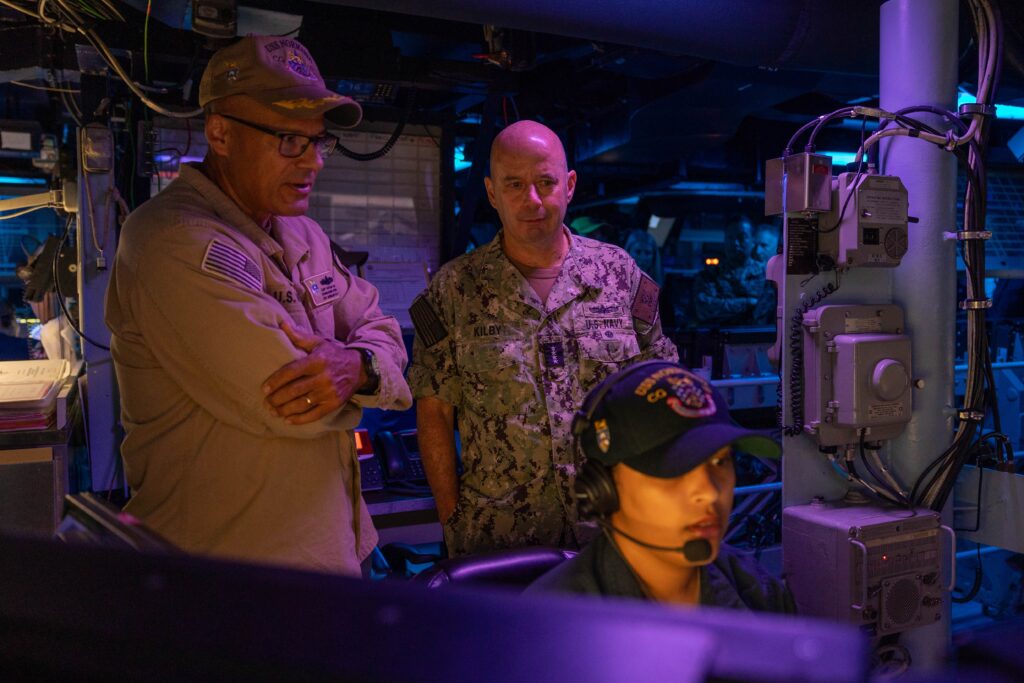
U.S. Navy Adm. James W. Kilby, Chief of Naval Operations (Acting) (center), speaks with Capt. Nathan Diaz, commanding officer of the Ticonderoga-class guided-missile cruiser USS Normandy (CG 60) aboard the USS Normandy during Large Scale Exercise (LSE) on August 5, 2025 (U.S. Navy photo by Mass Communication Specialist 1st Class Nathan T. Beard) 

From U.S. Fleet Forces Command

NORFOLK, Va. – Sailors and Marines from across the globe participated in the U.S. Navy- and U.S. Marine Corps-led Large Scale Exercise (LSE) 2025, July 30-Aug. 8. 

LSE 2025 marks the most comprehensive demonstration of global maritime coordination to date, testing the services’ ability to command and control forces across the full spectrum of conflict in a contested, high-end fight. Using a globally integrated live, virtual and constructive maritime exercise model, the 10-day event addressed complex simulated scenarios while enhancing interoperability, refining tactics, and strengthening collaboration for thousands of Sailors and Marines operating around the world. 
 
For the first time, all 10 Fleet Maritime Operations Centers (MOCs) operated together, synchronizing real-time effects and exercising command and control across 22 time zones and six combatant commands. The exercise replicated the complexity, friction, and operational tempo of global conflict. 
 
“At its core, LSE 2025 is about readiness. It allows us to refine how we command and control forces on a global scale, how we align efforts with interagency teammates, allies and partners, and how we generate and sustain combat power under pressure,” said Vice Adm. John Gumbleton, acting commander, U.S. Fleet Forces Command. “One of our top priorities is validating the Global Maritime Response Plan, proving we can shift from steady-state operations to a full warfighting posture at speed, whenever and wherever we’re needed.” 
 
For the first time, LSE 2025 incorporated operational-level participation from key allies and partners, including Canada, Japan, and NATO forces, strengthening coalition integration and interoperability in contested environments. The exercise also included interagency and joint elements, reinforcing the principle of integrated deterrence across domains. 
 
A cornerstone of LSE 2025 was the validation of the Global Maritime Response Plan (GMRP)—demonstrating the Navy’s ability to rapidly shift from day-to-day operations to full-scale warfighting. This required a coordinated effort across the entire enterprise, from OPNAV, Type Commands (TYCOMs), and Systems Commands (SYSCOMs) to the Navy Reserve Force. 
 
“This was more than a Navy and Marine Corps event. It was a unified effort across allies, joint forces, and interagency partners,” said Gumbleton. “Exercises like LSE 2025 showcase the strength of integrated deterrence and the value of building warfighting trust across every level of command.” 
 
LSE 2025 moved beyond coordination to full integration, embedding joint capabilities from the outset and enabling commanders to deliver decisive effects at the operational level. 
 
“Integrating with our naval counterparts, especially at the MOC, enables the Navy and Marine Corps team to exercise command and control of the most lethal fighting force in the world, said Brig. Gen. Thomas M. Armas, deputy commander, Fleet Marine Force, Atlantic, Marine Forces Command, Marine Forces Northern Command. “The Marine Air-Ground Task Force (MAGTF), known as a Marine Expeditionary Unit (MEU), embarked on a three ship Amphibious Ready Group (ARG), provides numerous options when campaigning or responding to crisis. LSE 25 provides a venue to practice synchronized and innovative command and control in order to ensure guaranteed max effective results when our nation needs it most.” 
 
Large Scale Exercise 2025 provided a pivotal opportunity to test and refine the Navy and Marine Corps’ ability to operate in a globally contested environment. By integrating advanced warfighting concepts, allied capabilities, and real-time operational coordination, the exercise reinforced the maritime services’ commitment to maintaining strategic advantage, deterring aggression, and ensuring security and stability across the world’s oceans. 
 
U.S. Fleet Forces Command is responsible for manning, training, equipping and employing more than 125 ships, 1,000 aircraft, and 103,000 active-duty service members and government employees, and providing combat-ready forces forward to numbered fleets and combatant commanders around the globe in support of U.S. national interests. 


Adm. Caudle Relinquishes Command of U.S. Fleet Forces Command

U.S. Navy Adm. Daryl Caudle, speaks during the relinquishment of command ceremony for U.S. Fleet Forces Command (USFFC) aboard Naval Station Norfolk on August 6, 2025. USFFC is responsible for manning, training, equipping and providing combat-ready forces forward to numbered fleets and combatant commanders around the globe. (U.S. Navy photo by Mass Communication Specialist 1st Class Nathan T. Beard/Released) 

Release From U.S. Fleet Forces Command

NORFOLK, Va. – Admiral Daryl L. Caudle relinquished command of U.S. Fleet Forces Command (USFFC) during a ceremony held aboard Naval Station Norfolk, Aug. 6, 2025. 
 
Presiding over the ceremony was U.S. Air Force Gen. Gregory Guillot, commander, North American Aerospace Defense Command and U.S. Northern Command, who praised Caudle’s visionary leadership, operational focus, and relentless dedication to enhancing Fleet readiness during a period of rising strategic competition. 
 
“For the last three and a half years, [Adm. Caudle] has served simultaneously in four critical positions – Joint Force Maritime Component Commander, Strategic; Commander, United States Naval Forces – Strategic Command; Commander, United States Naval Forces – Northern Command; and Commander, United States Fleet Forces Command,” said Guillot. “In each role, Admiral Caudle served with distinction – persistently advocating for modernization while emphasizing fleet readiness and wartime preparedness.” 
 
During his tenure, Caudle led a force of more than 138,000 Sailors, over 120 ships and submarines, 1,500 aircraft, seven task forces, and five carrier strike groups. His leadership was instrumental in key initiatives that reshaped the Navy’s approach to training, readiness, and force integration. 
 
Among his many accomplishments, he reshaped Atlantic Fleet operations through the One Atlantic initiative, breaking down legacy command-and-control silos and improving homeland defense while enhancing the Navy’s ability to respond to high-velocity threats in the Atlantic, Arctic, and high north. 
 
Caudle championed the development of Live, Virtual Environments, and Constructive Scenarios (LVC), culminating in the establishment of the Hefti Global LVC Operations Center in 2024. The state-of-the-art facility integrates live and simulated training environments, greatly enhancing warfighter preparedness in high-end conflict scenarios. 
 
Also, Caudle led the Navy’s participation in the Chief of Naval Operations-directed Large Scale Exercises 2023 and 2025, which spanned 22 time zones, component commands, U.S. numbered Fleets, and this year, for the first time, including allies and partners – marking the most extensive naval exercise in more than a generation. 
 
Caudle’s focus on homeland defense led to the creation of Maritime Command Elements East and West, streamlining command-and-control for maritime homeland defense and disaster response operations. 
 
Caudle drove combat-proven readiness across the Fleet, ensuring all deploying units met the highest standards of lethality and performance, demonstrated during major naval engagements in the Red Sea as part of Operations Prosperity Guardian and Poseidon Archer. 
 
In his remarks, Caudle expressed that his proudest accomplishment was the three-year effort that culminated in the Global Maritime Response Plan, a process that leverages combat surge ready units and response conditions to control our escalation of readiness and forces across the spectrum of conflict. 
 
“Leading this extraordinary team has been an honor,” Caudle said. “Your dedication, resilience, and pursuit of excellence have been the driving force behind everything Fleet Forces Command achieved in propelling our Navy forward. You are executing a vital role in force development, force generation and force employment, and that is no doubt a relentless effort.” 
 
As Caudle concludes a tour marked by historic achievements, he leaves behind a legacy of innovation, integration, and strategic foresight that will guide U.S. naval operations for years to come. 


Naval Research Hydrogen Tech Goes Tactical 

August 6, 2025 

Release From Nicholas E. M. Pasquini, U.S. Naval Research Laboratory Corporate Communications 

U.S. Naval Research Laboratory (NRL) has prototyped a Hydrogen Small Unit Power (H-SUP) system to reduce detectability and improve readiness of Marine Corps in expeditionary warfare operations. 

NRL’s H-SUP is a portable fuel cell electric generator with greater energy per weight than batteries and lower audible and thermal signatures than combustion generators. 
  
“This is more than a power system. It’s a capability that supports distributed operations and extends mission range. That’s strategic value,” said NRL Principal Investigator Kevin Cronin. “At NRL, we champion long-term modernization while working hand in glove with end-users across the services. Our investment today with the Marines in low-signature power intends to shape the future of how Marines fight – more independently, more efficiently, and with less logistical burden.” 
  
The use of hydrogen in key applications can lead to increased electrical efficiency and energy density, increased operational range, reduced thermal and audible signature, and reduced maintenance requirements; ultimately increasing lethality of the force and decreasing logistical sustainment requirements. 
  
“Warfighter feedback is a critical component of the technology development process and will be used to inform requirement definition and future research and development activities,” said Capt. Joshua Ashley, U.S. Marine Corps, Expeditionary Energy Office (E2O) Science and Technology Analyst. “The E2O serves as the link between the warfighter and the lab, providing feedback to refine the system and accelerate acquisition.” 
  
The Marine Corps established the E2O to conduct research and development in technologies, which can be the difference between mission success and failure, while reducing energy consumption with the goal of increasing reach, persistence, and lethality. E2O works closely with the combat and technology development communities and serves as the proponent for Expeditionary Energy in the force development process. 
  
“H-SUP isn’t just innovative – it increases lethality by keeping us powered and hard to find,” Ashley said. “We ensure this technology meets the needs of Marines on the ground – quiet, efficient, and reliable power that supports expeditionary operations.” 
 
By evaluating H-SUP in operational scenarios, the team is reducing risk and accelerating requirements development of technology that increases endurance and improves the autonomy of small units. 
  
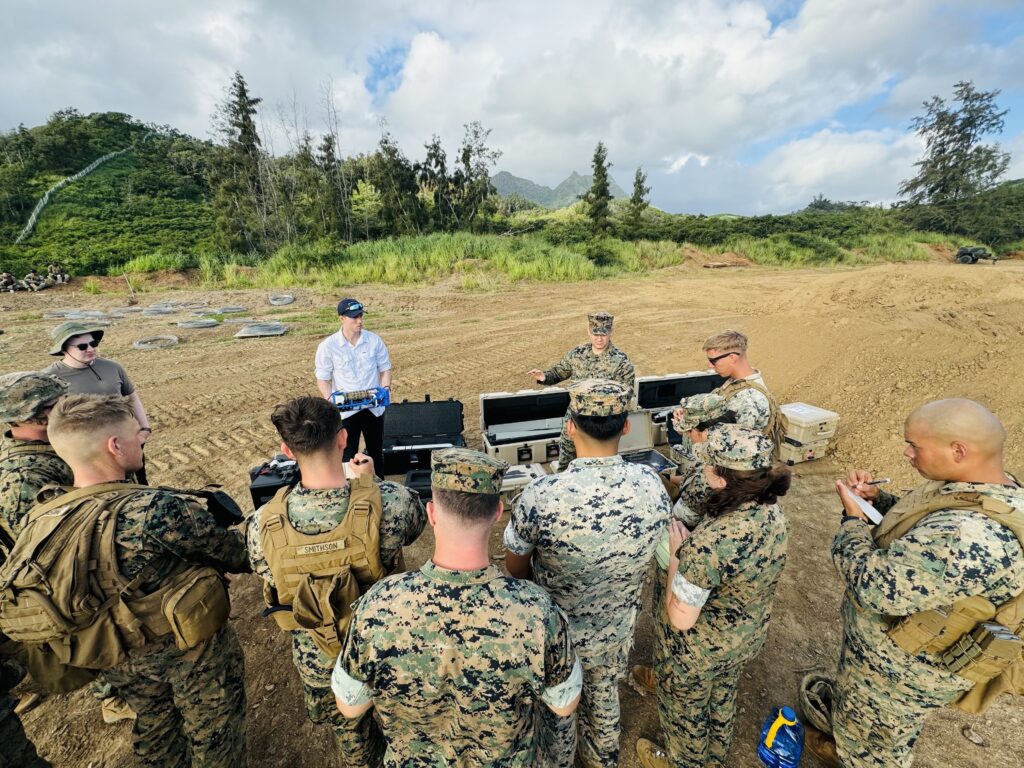
H-SUP was field tested at Marine Corps Base Camp Lejeune in July 2022, Marine Corps Air Station Yuma in February 2025, Marine Corps Training Area Bellows in March 2025, an Army event at Fort Polk with the 101st Airborne in May 2025, and most recently at Marine Corps Air Ground Combat Center Twentynine Palms in May 2025. 
  
“Our mission at NRL is to advance science that solves today’s problems while anticipating tomorrow’s threats,” Cronin said. “Hydrogen fuel cells fit both categories.” 
  
NRL and E2O are translating feedback from Marines to refine the system for usability, survivability, and integration. This leads to adoption, not just prototypes. 
  
“My role at NRL is to turn advanced science into operational capability,” Cronin said. “We built H-SUP not just to work in the lab, but to serve Marines in the field. Through collaboration with partners and direct feedback from users, we’re pushing this from prototype to practical.” 
  
The fuel cell system in H-SUP was originally developed for use in unmanned vehicles. The high specific energy content of hydrogen enables increased range and endurance for those systems. This has been demonstrated in the Naval Air Warfare Center Aircraft Division’s H2 Stalker program, where this same fuel cell was integrated into the Stalker VXE30. 
 
H2 Stalker provides greater combined power and energy to weight than alternate Stalker VXE30 configurations, enabling improved range, endurance, and dash metrics compared to the baseline VXE30. H2 Stalker successfully completed multiple flight tests and demonstrations in various environmental conditions. 
 
“We’re pushing technology into the hands of warfighters through real partnerships with industry and acquisition commands,” Cronin said. “In addition, the fuel cell in the H-SUP can also be used to power unmanned aerial vehicles to extend mission endurance. Lastly, fuel cells can support multiple aspects of the U.S. Marine Corps concept of Expeditionary Advanced Base Operations.” 
 
NRL has developed fuel cell technology and the H-SUP system with sponsorship from the Office of Naval Research, Office of the Secretary of Defense Manufacturing Science and Technology Program, Naval Air Systems Command, and the USMC E2O; in addition to collaboration with industry partners, Northwest UAV and Noble Gas Systems. 
 
About the U.S. Naval Research Laboratory 
NRL is a scientific and engineering command dedicated to research that drives innovative advances for the U.S. Navy and Marine Corps from the seafloor to space and in the information domain. NRL is located in Washington, D.C. with major field sites in Stennis Space Center, Mississippi; Key West, Florida; Monterey, California, and employs approximately 3,000 civilian scientists, engineers and support personnel. 


E-130J Popular Name Announced for TACAMO Mission Aircraft 

The E-130J received its popular name designation, Phoenix II, in August 2025. The Phoenix II will be the Navy’s new Take Charge and Move Out (TACAMO) mission aircraft for decades to come. (Artist Rendering) 

Release From Naval Air Systems Command

NAS Patuxent River, Md. — The U.S. Navy’s Airborne Strategic Command, Control and Communications Program Office (PMA-271) and Strategic Communications Wing 1 (SCW-1) announced the official popular name for the Navy’s new Take Charge and Move Out (TACAMO) mission aircraft: E-130J Phoenix II. 

In October 2024, the placeholder name E-XX was officially designated as E-130J. As of today, the E-130J’s popular name has been designated as Phoenix II, representing the mythical bird whose ability is to be reborn and represents a symbol of immortality, resurrection, and renewal. 

This meaning of rebirth is a nod to the proven C-130 platform fulfilling the TACAMO mission since 1963-1993 via the EC-130Q.The E-130J Phoenix II will relieve the Navy’s E-6B Mercury fleet of the TACAMO mission. TACAMO is the vital connection for the president, secretary of defense and U.S. Strategic Command with naval ballistic missile forces. 

“Phoenix II is the ideal popular name as we take the E-130J TACAMO mission into its next phase,” said Capt. Roger Davis, PMA-271 program manager. “A phoenix is known for its resilience, exceptionally long lifespan, and its ability to transform and continue its purpose. The dedicated team at PMA-271 have committed to the ideals of TACAMO’s critical deterrence mission when executing this new platform; transforming the legacy mission aircraft into a new weapon system with unmatched survivability and longevity for this country.” 

SCW-1 squadrons home based out of Tinker Air Force Base, Oklahoma. They include the “Ironmen” of Fleet Air Reconnaissance Squadron (VQ) 3, “Shadows” of VQ-4 and “Roughnecks” of VQ-7. 

“I’m pleased that this very important program remains on track, and that we were able to leverage our community sailors and veterans through the process,” said Capt. Britt Windeler, commander of SCW-1. “I feel like Phoenix II is especially apt, as we are returning to our roots of executing the TACAMO mission on a C-130 variant.” 

The current platform, E-6B Mercury, is a communications relay and strategic airborne command post aircraft. It provides survivable, reliable, and endurable airborne Nuclear Command, Control, and Communications (NC3) for the president, secretary of defense and U.S. Strategic Command. The E-130J Phoenix II will recapitalize the aging E-6B Mercury fleet that has been in service for more than three decades. 

PMA-271 is part of Naval Air Systems Command (NAVAIR) with its headquarters at Naval Air Station Patuxent River, Maryland. Its mission is to deliver and support survivable, reliable and endurable airborne command, control and communications for the president, secretary of defense and U.S. Strategic Command. 

The mission of SCW-1 is to receive, verify and retransmit Emergency Action Messages (EAMs) to U.S. strategic forces. 


DoN Seeks Energy Resilience Solutions to Power Navy and Marine Corps Installations 

Release From SECNAV Public Affairs Office

WASHINGTON, D.C. – Today, the Department of the Navy, under the leadership of Secretary of the Navy John C. Phelan, announced a bold solicitation to industry for innovative, deployable energy solutions capable of powering Navy and Marine Corps installations with unmatched resilience, security and reliability. 

The solicitation, issued through the Center for Energy, Environment, and Demilitarization (CEED) Consortium under an Other Transaction Authority (OTA) agreement—seeks execution-ready prototypes that will modernize energy infrastructure, safeguard mission-critical operations and ensure uninterrupted power in any operating environment. 

“President Trump’s commitment to unleashing American energy innovation is powering the Navy into a new era,” said Secretary Phelan. “We are calling on America’s most capable innovators to deliver advanced, installation-scale energy solutions, ranging from small modular nuclear reactors to cutting-edge storage and generation technologies that can deliver power with 99.9% availability, even if the public grid goes dark. This is about warfighting readiness, mission assurance, and making sure our bases remain operational under any circumstances.” 

Prototype concepts should focus on: 

  • Modernizing Energy Infrastructure: Deploy advanced, resilient energy systems at Navy, Marine Corps, and other DoD installations. 

  • 99.9% Mission Availability: Deliver power systems capable of sustaining operations without interruption during public grid failures. 

  • Powering High-Demand Data Centers: Ensure generation systems, particularly SMRs are capable of supporting data centers that power advanced AI systems, which require substantially higher and continuous energy output than traditional facilities. 

  • Advanced On-Site Generation: Integrate next-generation small modular nuclear reactors, geothermal, battery storage, and other dispatchable energy technologies. 

  • Resilience Against All Threats: Build systems hardened against natural disasters, cyberattacks, and grid instability. 

  • Innovative Financing: Employ alternative capital structures to accelerate deployment and reduce reliance on traditional appropriated funding. 

The OTA pathway gives the Navy the speed and flexibility needed to work directly with industry leaders, moving from concept to deployment faster than traditional acquisition methods allow. The Department is seeking solutions from both traditional defense contractors and non-traditional energy innovators that can be rapidly mobilized, require minimal permitting, and are ready for immediate execution. 

“Energy resilience is warfighting resilience,” said Secretary Phelan. “If a hurricane knocks out the local grid, our ships still sail. If a cyberattack takes down civilian power, our bases stay online. That’s the standard and we’re setting it now.” 

This opportunity is available exclusively to CEED Consortium members.  

Full details of the solicitation are available at https://cmgcorp.org/cmg-opportunities/


Exail Partners With U.S. Key Player to Supply 100 Navigation Systems for Naval UUVs 

LINCOLN, R. I.) July 30, 2025 — Exail, a leading provider of navigation solutions, has secured a new contract with a U.S.-based global defense player. The agreement involves the delivery of 100 Phins Compact Inertial Navigation Systems (INS) to equip Unmanned Underwater Vehicles (UUVs). 

Offering highly precise navigation capabilities, the Phins Compact INS ensures reliable performance in demanding environments and remains resilient to external signal disruptions. Its compact design enables rapid integration, allowing UUVs to carry out missions with flexibility and efficiency, even in dynamic and unpredictable maritime defense scenarios. 

“We are grateful for our client’s trust in Exail technology. We are confident that our INS will deliver the precision and robustness required for UUVs to operate effectively across varied environments,” said Carlos Lopes, Sales Director at Exail. “Over the years, we’ve worked closely with our customers to develop a navigation suite that truly meets defense challenges. Today, our INS is a global benchmark in subsea navigation.” 

This contract strengthens Exail’s global leadership in subsea navigation, with its INS technology trusted by over 50 navies and widely deployed on a broad range of subsea autonomous vehicles worldwide. It also represents a key milestone in the company’s expanding presence in the United States, supporting defense programs with proven, high-performance solutions. 


Senators Introduce Bill to Exempt Shipbuilding Workforce from Cuts

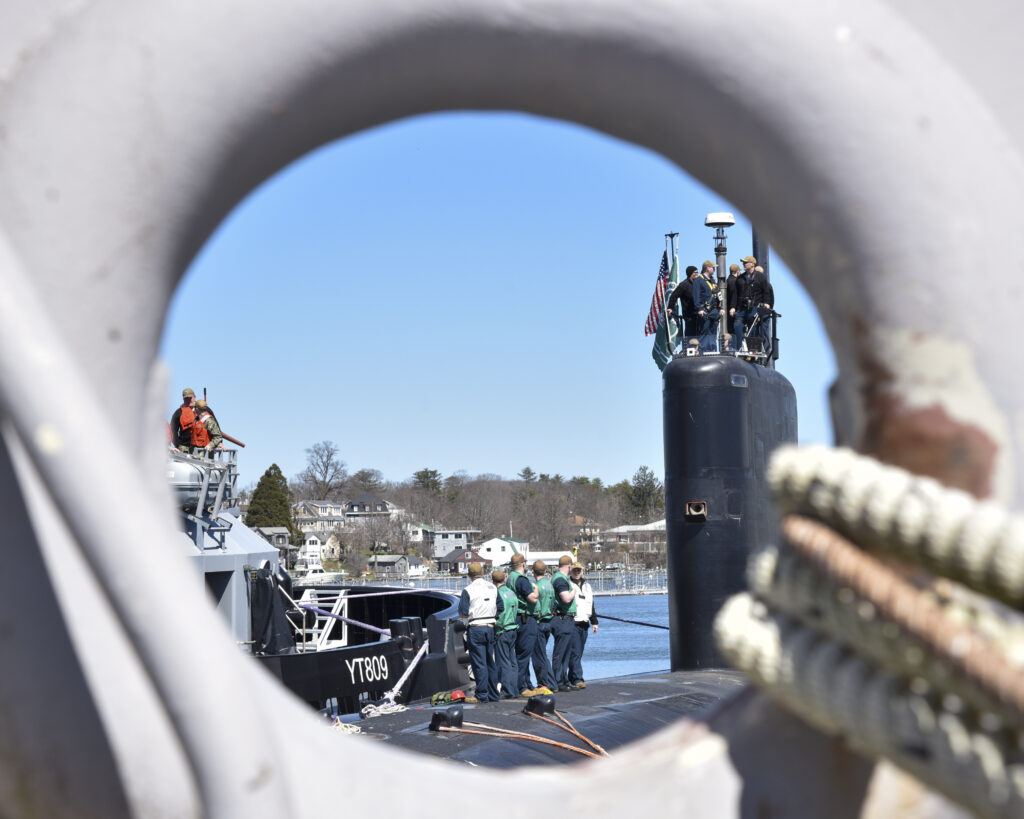
USS Greeneville (SSN 772) departs Portsmouth Naval Shipyard in Kittery, Maine, in April 2024. Greeneville had been at the shipyard for a scheduled maintenance period since June 2021. Photo credit: U.S. Navy | Mass Communication Specialist 1st Class Charlotte Oliver

WASHINGTON — A bipartisan group of New England lawmakers has introduced a bill in Congress to protect the shipbuilding workforce.

U.S. Senators Jeanne Shaheen (D-N.H.), a senior member of the U.S. Senate Armed Services Committee and co-chair of the U.S. Senate Navy Caucus, Maggie Hassan (D-N.H.), Susan Collins (R-Maine) and Angus King (I-Maine) introduced the Protecting Public Naval Shipyards (PNSY) Act to exempt the workforces of America’s four public shipyards, like the Portsmouth Naval Shipyard, from recent hiring freezes and mass layoffs.

The bill aims to ensure the maintenance and overhaul of America’s nuclear-powered submarine fleet continues uninterrupted by requiring the U.S. Department of Defense to exempt certain positions at public shipyards from workforce reductions. 

“Our shipyard workforce represents an essential component of our national defense and preparedness – they should have never been subjected to this administration’s ill-considered hiring freezes,” Shaheen said. “The Portsmouth Naval Shipyard workforce is supposed to be exempt from the hiring freeze, but there continues to be issues with implementation. Our bipartisan bill enshrines that exemption in federal law and ensures that no public shipyard is subjected to such chaos and uncertainty in the future, allowing them to focus instead on the vital role they play in our national security.” 

“Our nation’s public shipyards depend on a highly skilled and experienced workforce,” Collins said. “At Portsmouth Naval Shipyard, workers set the gold standard for repairing, retrofitting, and refueling our nation’s nuclear submarines. This bipartisan bill would protect the men and women at PNSY, and at all four of our nation’s public shipyards, helping sustain the critical contributions these shipyards make to our national defense, the readiness of our Navy, and the economies of their surrounding regions.” 

Protecting PNSY Act would require DoD to exempt positions at the public shipyards from workforce reductions that are critical to maintenance of our submarine fleet and that support the Shipyard Infrastructure Optimization Program (SIOP). The bipartisan bill also removes hiring limits for these positions. 

Click HERE to read the bill text. 


L3Harris Successfully Tests New Power Plant System for Advanced Lightweight Torpedo

Release From Aerojet Rocketdyne

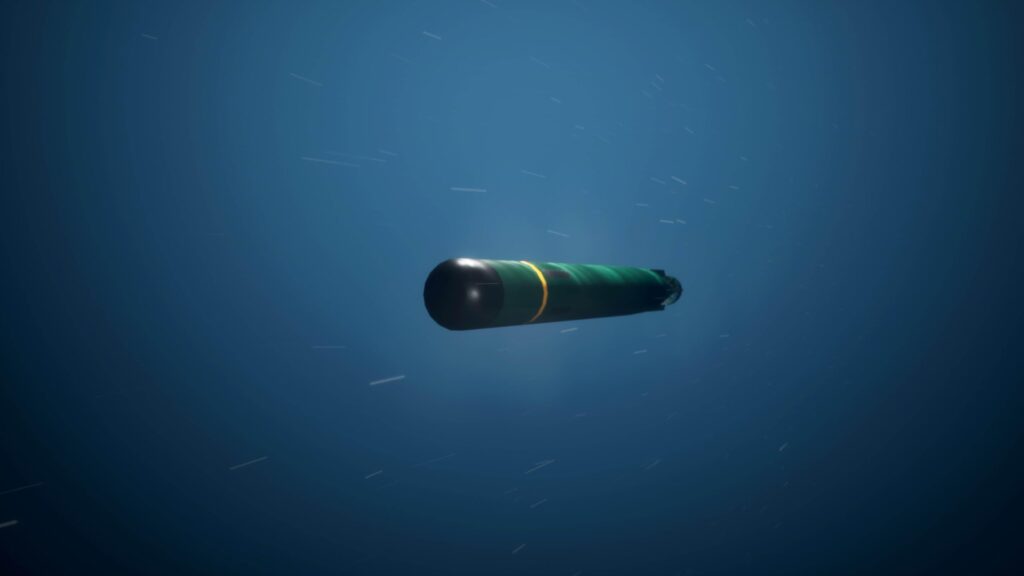
L3Harris Technologies has successfully completed testing of the first power plant system for the Stored Chemical Energy Propulsion System (SCEPS) that will power the U.S. Navy’s MK 54 MOD 2 Increment 2 Advanced Lightweight Torpedo. The power plant system testing validated the functionality and performance of this key component and positions L3Harris to begin SCEPS design verification testing of the fully integrated system later this year. 

L3Harris is on contract with the Navy to deliver proof of design for SCEPS propulsion for the MK 54 MOD 2 torpedo, which includes the power plant system and an integrated tail and torpedo afterbody assembly. 

“The power plant system is at the very heart of the propulsion system that will power the Navy’s MK 54 MOD 2 torpedo,” said Scott Alexander, President, Missile Solutions, Aerojet Rocketdyne, L3Harris. “We are pleased with the performance of the system during these tests and look forward to completing design verification testing of the entire afterbody later this year.” 

L3Harris’ Center of Excellence for Undersea Propulsion Manufacturing, based in Orlando, Florida, includes the only SCEPS manufacturing capability within the U.S. industrial base, and plays a key role supporting the Navy’s next generation torpedoes. In parallel with ongoing U.S. Navy contracts, the company has been independently funding fabrication and testing of prototype SCEPS components to further the innovative technology. 

SCEPS uses a lithium boiler to generate heat used to create steam that drives a turbine to propel the torpedo to intercept its intended target. The innovative propulsion system will significantly improve U.S. Navy torpedo capabilities. 


QinetiQ US Secures $26M in Naval Defense Contracts with General Dynamics Electric Boat

Release From QintetiQ

Multi-year agreement strengthens QinetiQ’s position in naval defense systems with critical components for Virginia and Columbia class submarines 

MCLEAN, Va., July 29, 2025 — QinetiQ US secures approximately $26 million in subcontracts from General Dynamics Electric Boat to deliver key electrical and electromechanical systems for the U.S. Navy’s Virginia and Columbia class submarine programs. 

Under these contracts, QinetiQ US will build, test and deliver complex electrical and electromechanical systems that enable critical onboard operations. These specialized components play vital roles in performance and mission effectiveness. 

“These awards highlight Electric Boat’s confidence in QinetiQ’s engineering expertise, manufacturing capability and our role within the Navy submarine industrial base to deliver mission-critical systems for the nation’s fleet,” said Tom Vecchiolla, President and Chief Executive of QinetiQ US. “Our technical solutions support enhanced operational capabilities for these advanced submarines, enabling the U.S. Navy’s undersea dominance.” 

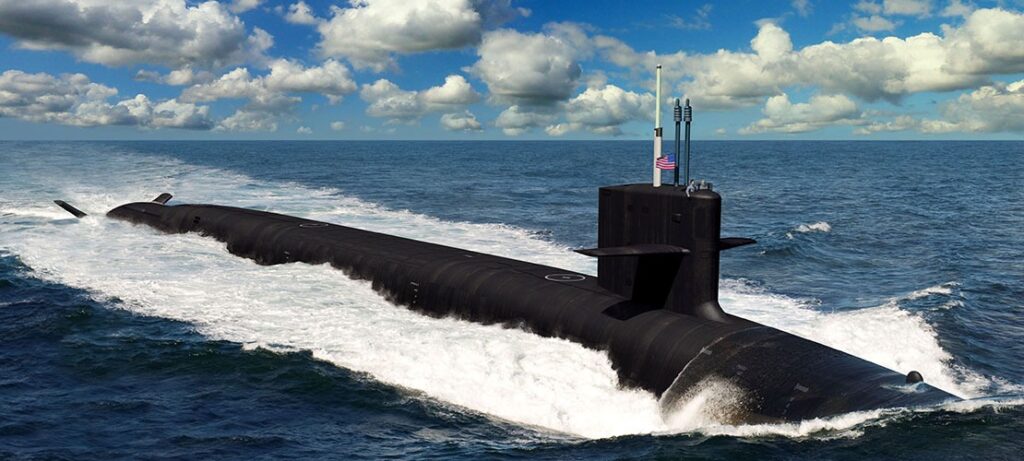
The Virginia and Columbia class submarines represent the current and future of the U.S. Navy’s undersea warfare capabilities. The Virginia class is a nuclear-powered fast-attack submarine designed to excel in littoral and deep-water missions, while the Columbia class will replace the Ohio-class ballistic missile submarines as a critical component of the nation’s nuclear deterrent. 

Production of all electrical and electromechanical systems will take place at QinetiQ’s US-based manufacturing facilities with deliveries scheduled throughout the period of performance. 


F/A-18 and EA-18G Surpass 12 Million Flight Hours 

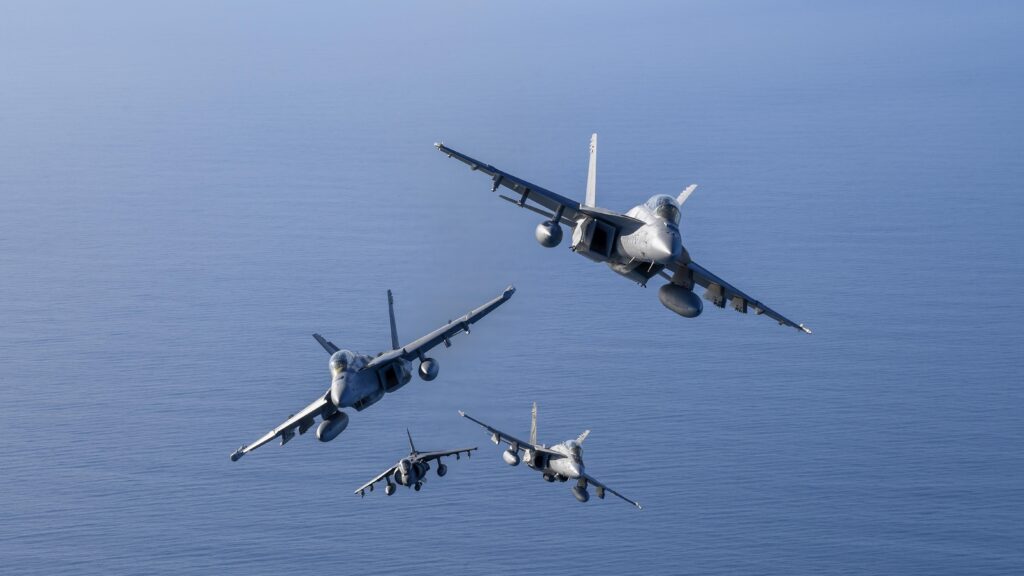
A formation of Air Test and Evaluation Squadron (VX) 31 “Dust Devils” aircraft, including an EA-18G Growler, AV-8B Harrier II+, an F/A-18E Super Hornet, and an F/A-18D Hornet, flies over Point Mugu’s Sea Range in Californation during a photo exercise. These aircraft demonstrate the Naval Air Warfare Center Weapons Division’s commitment to advancing fleet capabilities through rigorous testing and operational support.  

RELEASE FROM NAVAL AIR SYSTEMS COMMAND

NAS PATUXENT RIVER, Md. — The U.S. Navy’s F/A-18 and EA-18G aircraft fleet has surpassed 12 million flight hours, marking an important milestone for one of the most enduring families of aircraft in modern naval aviation. This achievement underscores the capability, reliability and availability of these aircraft, which have served as the backbone of the U.S. Navy and Marine Corps air power for decades.   

Put into perspective, the aircraft have completed the equivalent of 500,000 days, or nearly 1,370 years, of nonstop flight defending national interests and ensuring global security.   

“When you call the roar of these aircraft ‘the sound of freedom,’ it holds real weight,” said Capt. Michael Burks, program manager for the F/A-18 and EA-18G program office (PMA-265). “Throughout their service, the F/A-18 and EA-18G family has supported nearly every major U.S. military conflict of the past 40 years and continues to adapt to rapidly changing threat environments. From the initial deployment of the Hornet to the advanced capabilities of the Super Hornet and Growler, these aircraft have delivered forward presence, tactical airpower and critical electronic warfare capabilities around the globe.” 

Since the F/A-18 Hornet was first introduced in the 1980s, it has quickly become a versatile and capable fighter and attack aircraft. Its successor, the F/A-18E/F Super Hornet, and its electronic warfare counterpart, the EA-18G Growler, introduced significant advancements in radar, avionics, payload capacity and electronic attack.  

Key modernization efforts include Super Hornet Service Life Modification (SLM), which extends Super Hornet service life from 6,000 to 10,000 flight hours, and the delivery of Block III Super Hornets, which are equipped with advanced sensors, enhanced survivability and a redesigned cockpit for improved pilot performance. Growler Block II modifications will enhance mission systems, enable future capability growth and strengthen the Navy’s electronic warfare superiority.  

“This milestone is a significant achievement and a reflection of the generations of Sailors, Marines and civilians who sustain, fly and innovate these platforms every day,” said Burks. “Twelve million flight hours demonstrates our commitment to delivering world-class capability, enabling our warfighters to execute their missions with an asymmetric advantage and return home safely.” 

The flight hour milestone comes at a notable time for naval aviation, coinciding with the 30th anniversary of the Super Hornet’s first flight in November, and as the U.S. Navy and Marine Corps prepare to celebrate 250 years of service to the nation this year.   

As part of Program Executive Office for Tactical Aircraft Programs (PEO(T)), PMA-265 supports, sustains and advances the F/A-18A-D Hornet, F/A-18E/F Super Hornet and EA-18G Growler, delivering critical capabilities to ensure naval aviators succeed in dynamic and contested operational environments.