First Increment 3 Block 2 modifications complete for P-8A Poseidon aircraft
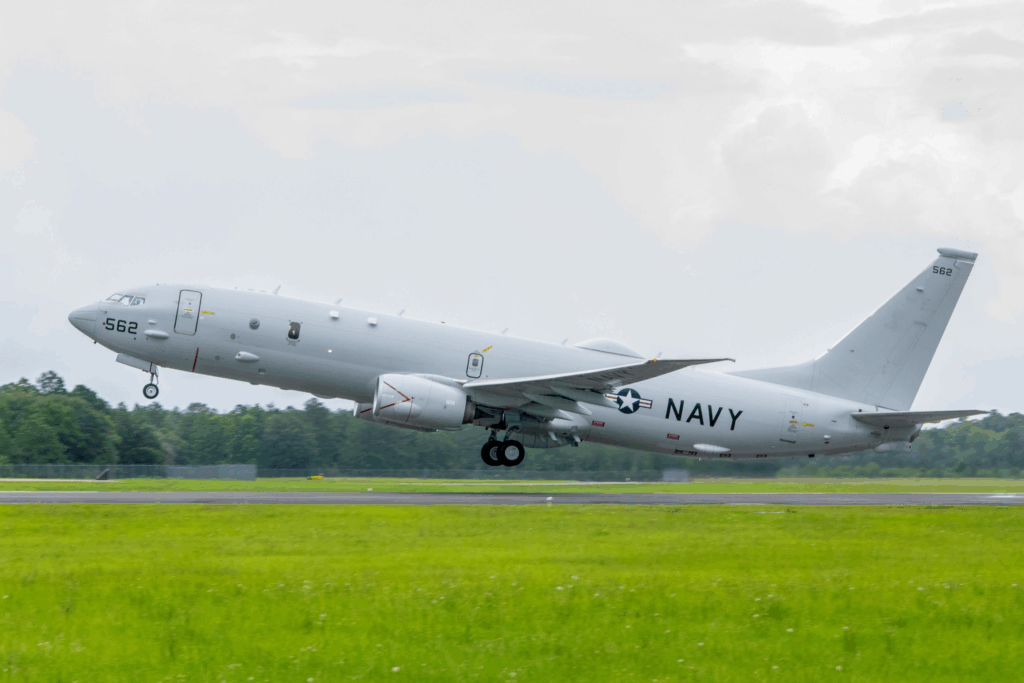
P-8A takes off with Increment 3 Block 2 in June 2025.
From Naval Air Systems Command, June 13, 2025
PATUXENT RIVER, Md. — Increment 3 Block 2 modifications are complete for the first P-8A Poseidon aircraft. The modifications outfit the P-8A with the full anti-submarine warfare (ASW), anti-surface warfare (ASuW), and intelligence, surveillance and reconnaissance (ISR) capabilities outlined in the P-8A program’s evolutionary acquisition strategy. The modifications began at Boeing’s Maintenance, Repair and Overhaul hangar at Cecil Airport in Jacksonville, Florida in March 2024.
“In today’s ever changing global environment, it is important to pace the threat in terms of lethality and survivability. The Increment 3 Block 2 modifications to the P-8A Poseidon will ensure they remain the most sophisticated and capable maritime patrol and reconnaissance aircraft in the world,” said Capt. Erik Thomas, Maritime Patrol and Reconnaissance Aircraft Program Office (PMA-290) program manager.
The P-8A is the Department of Defense’s only long-range full-spectrum ASW, cue-to-kill platform, with substantial armed ASuW and networked ISR capabilities. Increment 3 Block 2 provides a significant upgrade to the P-8A airframe and avionics systems, and includes new airframe racks, radome, antennas, sensors, and wiring. The modification incorporates a new combat systems suite with improved computer processing, higher security architecture, a wide band satellite communication system, an ASW signals intelligence capability, a track management system, and additional communications and acoustics systems to enhance search, detection and targeting capabilities.
In response to evolving threats around the world, future P-8A modifications will be made via a sequence of rapid capability insertion efforts that build upon this new Increment 3 Block 2 baseline.
PMA-290 manages the acquisition, development, support and delivery of the U.S. Navy’s maritime patrol and reconnaissance aircraft.
USS Cole Assists Royal Canadian Navy, U.S. Coast Guard, Transfer Intercepted Contraband
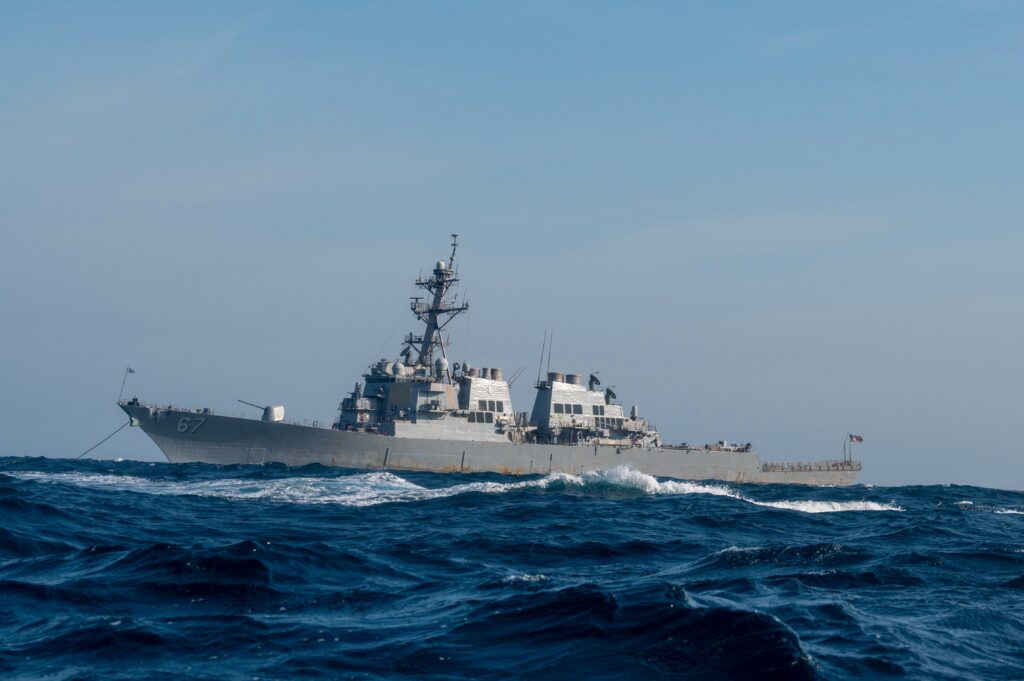
Arleigh Burke-class guided missile destroyer USS Cole (DDG-67) moors off the coast of Charleston, South Carolina, April 15, 2025, during Exercise Southern Lightning. (U.S. Air Force photo by Staff Sgt. Emily Farnsworth) [Stock Photo]
13 June 2025
From U.S. Northern Command, U.S. Naval Forces Southern Command Public Affairs
CARIBBEAN SEA – The Arleigh Burke-class guided missile destroyer USS Cole (DDG 67), supporting maritime southern border operations, conducted a hold-and-transfer of 245 kilograms of contraband recovered by the Royal Canadian Navy Harry DeWolf-class offshore patrol vessel HMCS William Hall (AOPV 433) in the Caribbean Sea June 9. The Reliance-class U.S. Coast Guard (USCG) Cutter Vigorous (WMEC 627) accepted the contraband from the Cole’s embarked USCG Law Enforcement Detachment (LEDET) June 11 during a rendezvous at sea in the Caribbean.
The Cole, with the embarked LEDET, provides a combination of U.S. Navy endurance, range, and capability with USCG law enforcement authorities, increasing protection to the U.S. southern border’s maritime approach.
The contraband’s transit was detected by Joint Interagency Task Force (JIATF) South, which collaborates with partner nations and leverages all-domain capabilities to detect and monitor illicit drug trafficking in the region.
The contraband and surrounding circumstances are considered under investigation and are subject to review and disposition through the U.S. Department of Justice.
The U.S. Coast Guard LEDET has unique legal authority to conduct U.S. law enforcement operations in support of border security missions under U.S. Northern Command. Utilizing the Coast Guard’s jurisdiction, the Cole will employ LEDET personnel to perform vessel boardings, searches, and seizures in U.S. and international waters, targeting drug trafficking, illegal immigration, and transnational crime with a nexus to the U.S. southern border. With LEDET’s tactical expertise guiding interdiction efforts, the Cole will harness its advanced surveillance systems and mobility to locate and intercept suspect vessels, effectively extending Coast Guard authority through naval power to enhance maritime security operations. This collaboration ensures a robust, legally empowered response to maritime threats, strengthening U.S. border protection efforts.
U.S. Naval Forces Southern Command/U.S. 4th Fleet serves as a trusted maritime partner for Caribbean, Central and South American maritime forces and promotes unity, security, and stability in the region.
For more USNAVSOUTH/4th Fleet news and photos, visit facebook.com/NAVSOUS4THFLT, https://www.fourthfleet.navy.mil/, X – @ NAVSOUS4THFLT, and https://www.linkedin.com/company/u-s-naval-forces-southern-command-u-s-4th-fleet
SECDEF Announces Flag and General Officer Nominations
From the Department of Defense, June 13, 2025
ARLINGTON, Va. — Secretary of Defense Pete Hegseth announced today that the president has made the following nominations:
Marine Corps Col. Christopher G. Tolar for appointment to the grade of major general, with assignment as staff judge advocate to the Commandant of the Marine Corps, Pentagon, Washington, D.C. Tolar is currently serving as command judge advocate, U.S. Africa Command, Stuttgart, Germany.
Navy Rear Adm. (lower half) Kristin Acquavella for appointment to the grade of rear admiral. Acquavella most recently served as commander, Naval Supply Systems Command Weapons Systems Support, Philadelphia, Pennsylvania.
Navy Rear Adm. (lower half) David M. Buzzetti for appointment to the grade of rear admiral. Buzzetti is currently serving as deputy joint staff surgeon/director, Reserve Medical Readiness Operations and Affairs, Joint Staff, Pentagon, Washington, D.C.
Navy Rear Adm. (lower half) Matthew Case for appointment to the grade of rear admiral. Case is currently serving as deputy to the Assistant Director Health Care, Defense Health Agency/chief, Medical Service Corps, Falls Church, Virginia.
Navy Rear Adm. (lower half) David J. Faehnle for appointment to the grade of rear admiral. Faehnle is currently serving as commandant, Naval District Washington, Washington Navy Yard, Washington, D.C.
Navy Rear Adm. (lower half) Joaquin J. Martinez de Pinillos for appointment to the grade of rear admiral. Martinez de Pinillos is currently serving as reserve director, Maritime Operations, U.S. Pacific Fleet, Pearl Harbor, Hawaii.
Navy Rear Adm. (lower half) Donald M. Plummer for appointment to the grade of rear admiral. Plummer is currently serving as reserve vice director, Joint Force Development, Joint Staff (J-7), Pentagon, Washington, D.C.
Navy Rear Adm. (lower half) Christopher D. Stone for appointment to the grade of rear admiral. Stone is currently serving as director, Strategy, Policy, Programs, and Logistics, J-5/4, U.S. Transportation Command, Scott Air Force Base, Illinois.
Navy Capt. Frank J. Brajevic for appointment to the grade of rear admiral (lower half). Brajevic is currently serving as chief of staff, Naval Medical Forces Pacific Navy Reserve, San Diego, California.
Navy Capt. Sharif H. Calfee for appointment to the grade of rear admiral (lower half). Calfee most recently served as senior military advisor to the Secretary of the Navy, Office of the Secretary of the Navy, Pentagon, Washington, D.C.
Navy Capt. Christopher A. Carter for appointment to the grade of rear admiral (lower half). Carter is currently serving as commander, Navy Reserve Naval Special Warfare Task Force Eighteen, San Diego, California.
Navy Capt. Kevin M. Corcoran has for appointment to the grade of rear admiral (lower half). Corcoran is currently serving as deputy commander, Navy Expeditionary Logistics Support Group, Williamsburg, Virginia.
Navy Capt. Matthew A. Hawkins for appointment to the grade of rear admiral (lower half). Hawkins is currently serving as chief of staff, Navy Reserve U.S. Naval Forces Europe/Africa, Naples, Italy.
Navy Capt. Jonathan J. Jettparmer for appointment to the grade of rear admiral (lower half). Jettparmer is currently serving as director, Navy Reserve Program Office, Naval Sea Systems Command, Washington Navy Yard, Washington, D.C.
Navy Capt. Suzanne J.M. Krauss for appointment to the grade of rear admiral (lower half). Krauss is currently serving as commanding officer, Navy Reserve Commander Sixth Fleet Headquarters, Naples, Italy.
Navy Capt. Anthony L. Lacourse for appointment to the grade of rear admiral (lower half). Lacourse is currently serving as force surgeon, Navy Reserve U.S. Marine Corps Forces, Central Command, MacDill Air Force Base, Florida.
Navy Capt. Kristin L. McCarthy for appointment to the grade of rear admiral (lower half). McCarthy is currently serving as director, Legal Services, Navy Reserve Office of the Judge Advocate General Headquarters, Washington Navy Yard, Washington, D.C.
Navy Capt. Lester Ortiz for appointment to the grade of rear admiral (lower half). Ortiz is currently serving as commodore, Navy Reserve Seventh Naval Construction Regiment, Gulfport, Mississippi.
Navy Capt. Quinton S. Packard for appointment to the grade of rear admiral (lower half). Packard is currently serving as a military fellow at the Center for Strategic and International Studies, Washington, D.C.
Navy Capt. Rigel D. Pirrone for appointment to the grade of rear admiral (lower half). Pirrone is currently serving as commanding officer, Navy Reserve N5/N7, U.S. Naval Forces Europe/Africa, Naples, Italy.
Navy Capt. Kimberly M. Sandberg for appointment to the grade of rear admiral (lower half). Sandberg is currently serving as chief of staff, Navy Reserve Naval Medical Forces Support Command, Houston, Texas.
Navy Capt. Michael J. Thornton for appointment to the grade of rear admiral (lower half). Thornton is currently serving as force surgeon, Navy Reserve Naval Forces Korea, Busan, Korea.
Navy Capt. Jonathan R. Townsend for appointment to the grade of rear admiral (lower half). Townsend is currently serving as commanding officer, Naval Support Activity South Potomac, Washington, D.C.
Navy Capt. Kelly C. Ward for appointment to the grade of rear admiral (lower half). Ward is currently serving as Reserve chief staff officer to commander, Navy Expeditionary Combat Command, Virginia Beach, Virginia.
Low-Risk AM Process Improving Readiness Generation
NAVAL STATION ROTA, Spain — An additive manufacturing machine prints an eductor, or jet pump, using stainless steel wire for the Arleigh Burke-class guided missile destroyer USS Arleigh Burke (DDG 51). Forward Deployed Regional Maintenance Center (FDRMC) Detachment Rota, in partnership with the Spanish Armada’s intermediate-level maintenance command and their embedded additive manufacturing (AM) contractor, manufactured parts for Arleigh Burke, generating timely readiness for the ship ahead of its planned patrol throughout U.S. Sixth Fleet.
By Naval Sea Systems Command Office of Corporate Communications
June 12, 2025
NAVAL STATION ROTA, Spain — Forward Deployed Regional Maintenance Center (FDRMC) Detachment Rota, in partnership with the Spanish Armada’s intermediate-level maintenance command and their embedded additive manufacturing (AM) contractor, manufactured parts for the Arleigh Burke-class guided missile destroyer USS Arleigh Burke (DDG 51) in early June. This innovative solution generated timely readiness for the ship ahead of its planned patrol throughout U.S. Sixth Fleet.
Expediting the process, the Naval Sea Systems Command (NAVSEA) engineering directorate empowered waterfront chief engineers to approve AM parts and components that carry little to no risk to the safety and operation of the ship. The NAVSEA guidance eliminated administrative barriers, effectively streamlining the process to support real-time needs during maintenance. This component is the 37th additively manufactured component installed in the Fleet since the process was adopted in 2023.
“We have empowered and equipped our waterfront and forward-deployed engineers and maintainers that directly support our warfighters,” said Rear Adm. Pete Small, NAVSEA chief engineer. “This project executed with our Spanish allies further proves the significant readiness AM generates for our ships, restoring a critical system while meeting the compressed timeline for the ship’s forward-deployed patrol.”
The FDRMC team utilized the low-risk AM approval process to manufacture and install two new eductors, or jet pumps, into the vacuum collection holding and transfer (VCHT) system during a maintenance period. The eductors had leaks that had been temporarily patched and needed full replacement prior to the next patrol to restore system readiness and safeguard against future system failure while deployed. New eductors, typically made of cast-bronze, require almost a year to receive and install, exceeding the maintenance timeline ahead of the ship’s upcoming patrol.
The FDRMC team partnered with a local AM contractor to manufacture the two replacement eductors with available corrosion-resistant stainless-steel wire. The first-time process took approximately two months to plan, scan, print, machine, weld and install aboard Arleigh Burke, shortening the timeline by more than 80% and meeting the ship’s operational schedule. Once the project was approved, the manufacturing only required seven days of work to complete the eductors ahead of install.
“FDRMC is the front-line readiness generator for our forward deployed naval forces in Fifth and Sixth Fleets,” said Capt. Mollie Bily, FDRMC commanding officer. “Our Rota AM team attacks each maintenance window looking for a way to use advanced AM to expedite parts and solutions for our homeported and deployed ships that must be ready for Fleet tasking at a moment’s notice.”
FDRMC provides emergent, intermediate and depot-level maintenance and modernization for Forward Deployed Naval Forces in U.S. 5th and 6th Fleets through fleet technical assistance, voyage repair, contract management oversight, assessments, and diving and salvage. FDRMC is the only forward-deployed RMC supporting two numbered fleets, serving three combatant commanders, and conducting work on three continents.
NAVSEA designs, builds, and maintains ships, submarines, and integrated warfighting systems for the US. Navy ensuring the warfighter is capable of projecting presence in peace, power in war, and assured maritime access.
Modern Trenches, Modern Threats: Combat Engineering in the Drone Age
U.S. Navy Sailors assigned to Naval Construction Battalion 14 and Marines assigned to 8th Engineering Support Battalion conduct trench reinforcement training to increase combat engineering capabilities during exercise Baltic Operations 2025 (BALTOPS 25), June 6, 2025, in Skrunda, Latvia.
By Chief Mass Communication Specialist Justin Stumberg, June 13, 2025
SKRUNDA, Latvia – In the wooded fields of western Latvia, lines of freshly turned earth snake across the terrain—dug not by history, but by engineers preparing for the future fight. A century after trench warfare defined conflict in Europe, the tactic is making a modern return, this time shaped by airborne threats that are autonomous, persistent, and digital.
As part of exercise Baltic Operations (BALTOPS) 2025, U.S. Navy Seabees, U.S. Marines from 8th Engineer Support Battalion (ESB), and Latvian Army engineers are constructing a fortified trench network designed for survivability in a drone-contested battlespace. The project serves both as a realistic rehearsal and a proof of concept for how modern combat engineers support maneuverability, concealment, and endurance in multi-domain operations.
“We are creating positions designed for modern combat environments,” said Lt. j.g. Wiatt Lewis, officer in charge of Naval Construction Battalion (NCB) 14. “These field fortifications are built to reduce detection, limit exposure to unmanned systems, and enhance force protection across the battlespace.”
Lewis emphasized that as the operational environment evolves, so must the approach to allied engineering and maneuver.
“Every trench, every covered position demonstrates a shared commitment to mobility, concealment, and resilience,” said Lewis.
A Classic Concept Meets a Modern Fight
Though trench warfare may evoke images of muddy stalemates and early 20th-century weaponry, recent conflicts have proven that the tactic is far from obsolete. The ongoing war in Ukraine has demonstrated how entrenched positions, overhead cover, and field fortifications can provide critical protection against modern threats including drones and precision fires. What was once viewed as a relic of past wars has reemerged as a vital component of survivability in high-intensity, large-scale ground combat.
Today’s engineers are applying that hard-earned relevance to modern doctrine. Using precision equipment, updated tactics, and threat-informed design, U.S. Navy Seabees, Marine Corps combat engineers, and allied forces are modernizing trenches for use in multi-domain environments.
Seabees provide the horizontal construction expertise—operating bulldozers, graders, and compactors to carve structured fighting positions into dense Baltic soil.
Meanwhile, Marines from 8th ESB bring combat engineering insight, ensuring the trench layout supports tactical movement, defensibility, and low visibility against drone reconnaissance and attack.
“We have trained for this kind of work in the United States, but doing it here alongside the Seabees and our Latvian partners adds a different level of complexity,” explained SSgt. Austin Leigh, combat engineer and platoon sergeant with 8th ESB. “We are always thinking about our visibility from above, the effects of thermal detection, and how to keep the position secure from multiple angles.”
Partnered, Resourceful, Ready
One of the most distinctive aspects of this multinational effort is the Latvian Army’s use of a field-deployable sawmill, providing raw timber milled on site. The lumber is then used to reinforce trench walls, build overhead cover and concealment, and create tactical infrastructure, eliminating the need for long-lead construction materials that are not always readily available.
“Having a sawmill out here and cutting our own lumber changes the game,” said Chief Construction Mechanic William Fox, NCB 14 senior enlisted leader. “We are not waiting on flatbeds or shipping containers. We’re using what is already around us to get the job done.
Fox explained that producing timber on site has helped his team stay on schedule and adapt in real time.
“Every board we cut with our own hands is one less we have to wait for,” he said. “It keeps the crew moving, keeps the project rolling, and honestly, it just feels good to build something right here with what we have.”
This effort also highlights the value of integrated training in a joint and allied environment. Seabees, Marines, and Latvian engineers have worked shoulder to shoulder, blending skills, sharing tools, and building trust through every shovel of earth and cut of timber.
“This has been some of the most valuable training I have had in my 12 years in the Navy,” said Builder 1st Class Nathan Burke, project supervisor with NCB 14. “It has been a true privilege to work alongside both ESB Marines and the Latvian forces. I only hope we will be able to expand upon what we have started here.”
Burke noted that the project not only benefited the mission—it also sharpened the warfighting instincts of the next generation.
“This trench project has provided a tremendous opportunity for our junior Bees and Marines to encounter and overcome some unique challenges,” he said. “It is these types of problem-solving skills that will be crucial when we are operating in a true wartime scenario.”
He added that the work accomplished in Skrunda is only the beginning of what is possible when allied engineers train together with a shared purpose.
“I am humbled by and incredibly proud of what our [team] has accomplished here these past weeks,” said Burke. “I feel as though we have just scraped the crust on what we could do here to develop and sharpen our skills, should we find ourselves fighting alongside our partners in the region.”
Preparing for the Next Fight
As training wraps in Skrunda, the trenches carved into the Latvian soil remain behind, standing as evidence of what can be accomplished when engineers from different nations work side by side. Built with shovels, saws, and shared experience, the project adds lasting value to the local training area and the forces who may use it in the future.
BALTOPS 2025 serves as a proving ground for ships, aircraft, and the people who build, dig, and design the infrastructure that supports them. In an era shaped by technology and unpredictability, the most effective tools are often the ones forged by hand, in the field, together.
For imagery, video, and updates, visit https://www.c6f.navy.mil. Media inquiries should be directed to U.S. Naval Forces Europe and Africa Public Affairs at: [email protected]
Pacific Partnership 2025 Commences Mission Stop in Suva, Fiji
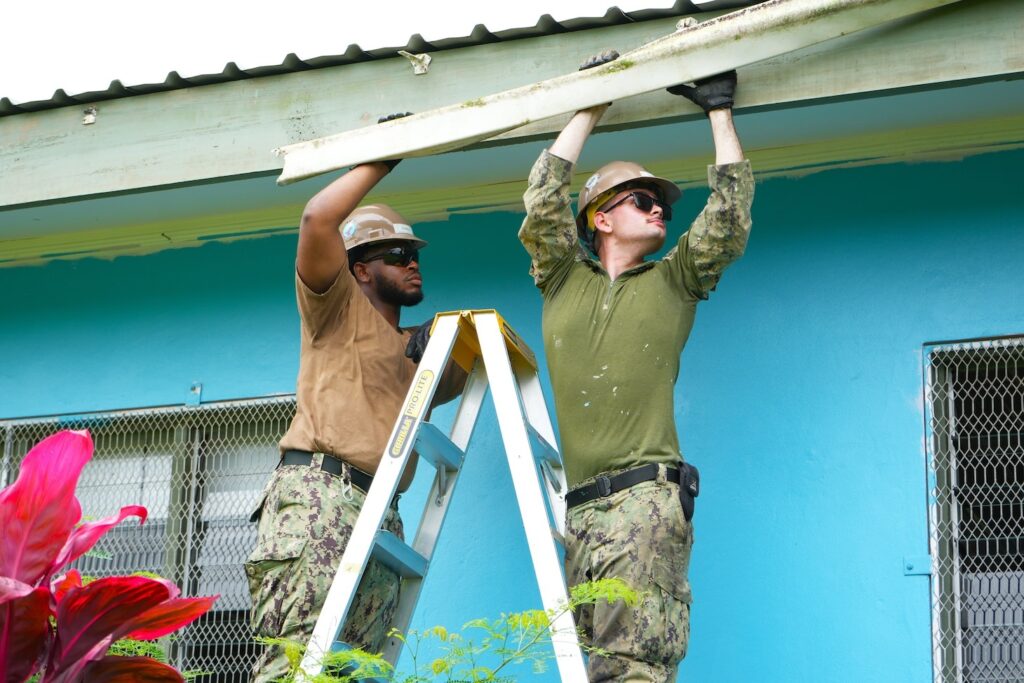
SUVA, Fiji (June 9, 2025) Engineering Aide 2nd Class Jordanne Jones, left, and Construction Electrician 2nd Class Connor Croissant, both assigned to Amphibious Construction Battalion 1, conduct construction repairs at Waiqanake School during Pacific Partnership 2025 in Suva, Fiji, June 9, 2025. (U.S. Navy photo by Mass Communication Specialist 2nd Class Moises Sandoval/Released)
11 June 2025
From Petty Officer 2nd Class Moises Sandoval, Logistics Group Western Pacific
SUVA, Fiji – Pacific Partnership has returned to Fiji to conduct the largest annual multinational humanitarian assistance and disaster response preparedness mission in the Indo-Pacific region, June 8, 2025. Pacific Partnership fosters collaboration to enhance natural disaster response preparedness and builds lasting relationships between Fiji, the United States, and participating nations. Engagements for this year’s iteration will occur in the cities of Suva and Nadi.
At Fiji’s invitation, Pacific Partnership’s mission is to collaborate in several humanitarian and civic readiness workshops in areas such as engineering, natural disaster response, public health, and Fijian community outreach projects. This year’s mission, featuring about 58 personnel, is primarily a collective effort between Fiji, New Zealand and the United States.
“I am honored to oversee this year’s return of Pacific Partnership to the nation of Fiji,” said U.S. Navy Capt. Mark B. Stefanik, mission commander. “The continued opportunity to build upon our enduring relationship with the Fijian community further emphasizes a shared support of a free and resilient Indo-Pacific.”
While in Fiji, the Pacific Partnership 2025 team will focus on subject-matter exchanges and community education in permaculture, spearhead emergency preparedness and disaster response training, and conduct the foundational construction of a local schoolhouse. Additionally, the U.S. Pacific Fleet Band, accompanied by members of the Scots Guard, Royal Australian and Royal Canadian navies, will perform during a variety of community outreach engagements.
“We really appreciate Fiji welcoming us for Pacific Partnership 2025,” said Chief Warrant Officer 2 Robert Gibson, Officer in Charge for the Fiji mission. “It’s awesome to be working alongside our Fijian counterparts, building a stronger, healthier, and more resilient Indo-Pacific together.”
Now in its 21st iteration, the Pacific Partnership series is the largest annual multinational humanitarian assistance and disaster management preparedness mission conducted in the Indo-Pacific. Pacific Partnership works collaboratively with host and partner nations to enhance regional interoperability and disaster response capabilities, increase security and stability in the region, and foster new and enduring friendships in the Indo-Pacific.
America ARG and 31st MEU Marines Conduct Integrated Operations in Solomon Sea
From Lt. Carolina Fernandez, USS America, June 10, 2025
SOLOMON SEA — Elements of the America Amphibious Ready Group (ARG) and the embarked 31st Marine Expeditionary Unit (MEU) are conducting integrated operations in the Solomon Sea, June 9.
The amphibious assault ship USS America (LHA 6), the amphibious transport dock ship USS San Diego (LPD 22), the amphibious transport dock landing ship USS Rushmore (LSD 47), and their Marine Corps 31st MEU embarked elements are the only forward-deployed ARG-MEU, and serve as the ready crisis-response force in the U.S. 7th Fleet area of operations.
“Operations at sea with our U.S. Marine Corps partners demonstrates the incredible capability of the America Amphibious Ready Group and strengthens Navy and Marine Corps integration at sea,” said Capt. Patrick German, commodore, Amphibious Squadron 11. “While underway, we look forward to advancing our capabilities through multi-domain operations.”
Deploying from USS America is a detachment of Marine Fighter Attack Squadron (VMFA) 242 consisting of F-35B Lighting II aircraft operating from USS America, which provide commanders more stealth and flexibility than any other aircraft.
“The forward positioning of this much combat power shows how much skin in the game we have and illustrates our capability and resolve – which is the core of deterrence,” said Col. Chris P. Niedziocha, commanding officer, 31st MEU.
Comprised of more than 5,000 Marines and Sailors, the America ARG is an integral part of forward-deployed U.S. naval power in 7th Fleet. 7th Fleet, the U.S. Navy’s largest forward-deployed numbered fleet, routinely interacts and operates with allies and partners in preserving a free and open Indo-Pacific region.
Follow USS America (https://www.facebook.com/USSAmerica/) and the 31st Marine Expeditionary Unit (https://www.facebook.com/31stMEU) on Facebook for regular updates throughout the patrol. For media inquiries, contact [email protected].
USNS Comfort Arrives in Grenada for Continuing Promise 2025
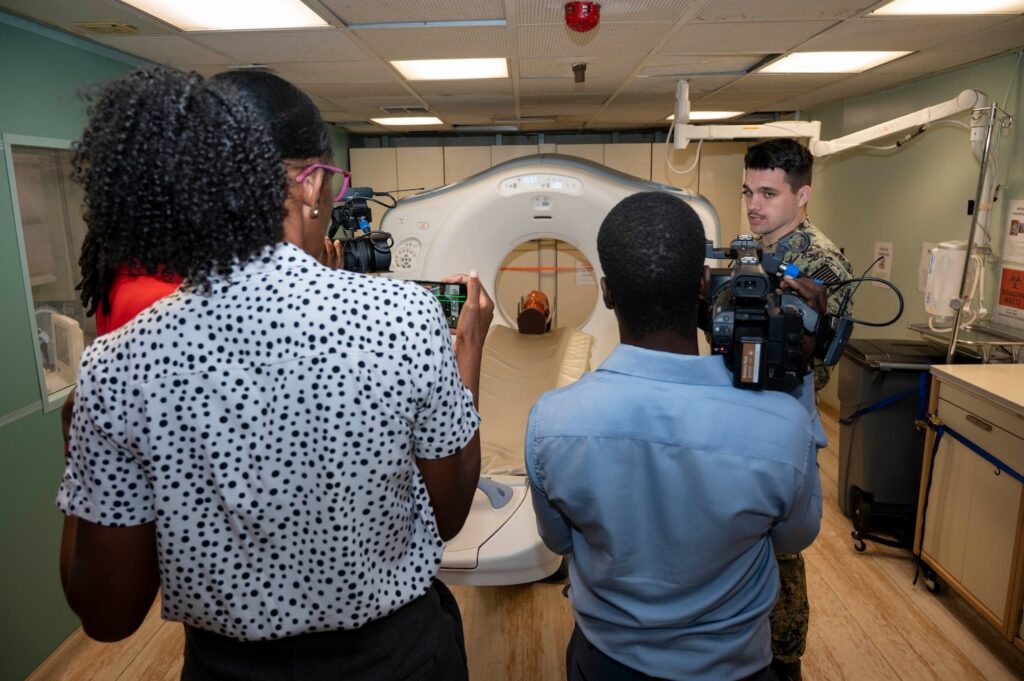
GEORGE’S, Grenada (June 10, 2025) Hospital Corpsman 3rd Class Dennis Begley explains the ship’s medical capabilities to Grenadian media aboard the Mercy-class hospital ship USNS Comfort (T-AH 20) during Continuing Promise 2025, June 10, 2025. (U.S. Navy photo by MC2 Deven Fernandez)
By U.S. Naval Forces Southern Command / U.S. 4th Fleet Public Affairs, June 11, 2025
ST. GEORGE’S, Grenada – The Mercy-class hospital ship USNS Comfort (T-AH 20) arrived in St.George’s, Grenada, to provide a variety of medical treatments to include: dental, family medicine, internal medicine, optometry, nursing, pharmacy, biomedical repair, lab, radiology, X-ray and veterinary medicine as a part of Continuing Promise 2025 (CP25), June 9.
“Our visit to Grenada reflects the enduring partnership between our nations and our shared commitment to health, security and stability in the region,” said Capt. Ryan Kendall, commodore, Destroyer Squadron 40 and Continuing Promise 2025 mission commander. “We’re excited to work alongside our partners in Grenada and provide high-quality care and support that reflects the strength of our collaboration.”
CP25 marks the 16th mission to the region since 2007 and the eighth aboard Comfort. The mission will foster goodwill, strengthen existing partnerships with partner nations, and encourage the establishment of new partnerships among countries, non-federal entities, and international organizations.
“Collaborations such as these bolster our efforts, allowing us to expand access to specialized care, improve diagnostic capabilities, and provide services that may not always be readily available,” said the Honorable Philip Telesford, Government of Grenada Minister for Health. “Through this mission, Grenadians will receive life-changing procedures in the areas of adult and pediatric surgery, ophthalmology, and plastic surgery.”
In addition to medical care, Comfort service members will work with communities in Grenada to perform renovations in buildings such as schools and repair infrastructure damaged by natural disasters.
“I’m excited to go out and help the people of Grenada,” said Utilitiesman 2nd Class Joshua Oun, a Seabee assigned to Naval Mobile Construction Battalion 11 (NMCB-11). “We look forward to doing good work and strengthening our relationship with Grenada.”
U.S. Naval Forces Southern Command/U.S. 4th Fleet supports U.S. Southern Command’s joint and combined military operations by employing maritime forces in cooperative maritime security operations to maintain access, enhance interoperability, and build enduring partnerships in order to enhance regional security and promote peace, stability and prosperity in the Caribbean, Central and South American region.
For more USNAVSOUTH/4th Fleet news and photos, visit facebook.com/NAVSOUS4THFLT, https://www.fourthfleet.navy.mil/, X – @ NAVSOUS4THFLT, and https://www.linkedin.com/company/u-s-naval-forces-southern-command-u-s-4th-fleet
Pacific Partnership Brings Disaster Response Training to Virac, Philippines
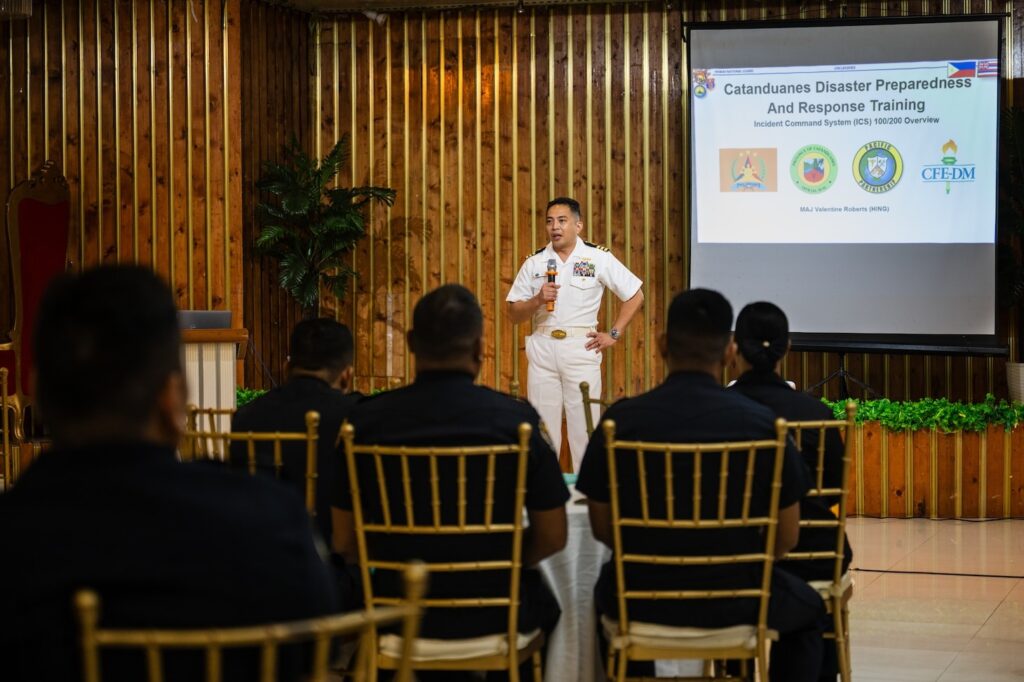
VIRAC, Philippines (June 2, 2025) – U.S. Navy Cmdr. Robert Reyes, gives opening remarks to Armed Forces of the Philippines personnel, local emergency responders, and civilian authorities before an Incident Command Systems training in Virac, Philippines, June 2, 2025. (U.S. Navy photo by MC2 Jordan Jennings)
By Mass Communication Specialist 2nd Class Jordan Jennings
VIRAC, Philippines – Pacific Partnership 2025 officially commenced its mission in Virac, Philippines, bringing together international expertise and local leadership to strengthen disaster response capabilities in the region and deepen strategic partnerships, June 1.
Members of the Hawaii National Guard, the Center for Excellence-Disaster Management and the Armed Forces of the Philippines (AFP) are conducting a series of intensive training events with local emergency responders and civilian authorities.
The training will focus on three core areas: urban search and rescue (USAR), Incident Command System (ICS) training, and a disaster management workshop. These activities are designed to enhance technical skills, exercise the use of coordination frameworks, and support community-based resilience initiatives. In the end, the intent is to increase natural disaster preparedness in Virac and the greater Catanduanes province.
“Pacific Partnership is about more than training; it’s about building lasting relationships that strengthen regional security and stability,” said U.S. Navy Cmdr. Robert Reyes, the officer in charge for the Philippines mission stop. “Each interaction brings us closer to achieving a shared goal of a safer, more resilient Indo-Pacific.”
The ICS and disaster management workshops are modelled after the U.S. National Incident Management System (NIMS), which provides a standardized framework for incident management to improve disaster preparedness and response capabilities. These sessions include command post simulations, interagency coordination exercises, and disaster response planning scenarios aimed at building a common operating framework between civilian and military organizations in the Philippines.
The Hawaii National Guard’s and AFP’s USAR component will focus on lifesaving operations in challenging environments. This includes practical, hands-on training in simulated collapsed structure rescue, shoring and stabilization techniques, confined space navigation, and rubble pile operations. The program concludes with a realistic disaster scenario to test coordination and execution of newly learned skills.
Now in its 21st iteration, the Pacific Partnership series is the largest annual multinational humanitarian assistance and disaster management preparedness mission conducted in the Indo-Pacific. Pacific Partnership works collaboratively with host and partner nations to enhance regional interoperability and disaster response capabilities, increase security and stability in the region, and foster new and enduring friendships in the Indo-Pacific.
For updates and multimedia from Pacific Partnership 2025, follow #PacificPartnership, #PP25, and #PacificPartnership25 on social media or visit: https://www.dvidshub.net/feature/PacificPartnership
‘All of Our Programs Are a Mess,’ SECNAV Said of Shipbuilding
By Richard R. Burgess, Senior Editor
ARLINGTON, Va. — The Secretary of the Navy (SECNAV) told Congress that many major shipbuilding and other programs are behind schedule and above planned cost, and he is looking for possible long-term solutions to correct the situation and rebuild readiness for the challenges of the future.
“All of our programs are a mess, to be honest,” said Navy Secretary John C. Phelan, who was testifying June 11 on Capitol Hill before the House Armed Services Committee along with Chief of Naval Operations James W. Philby and General Eric M. Smith, commandant of the Marine Corps.
“We are behind schedule, over budget,” Phelan said. “Our best-performing one [program] is six months late and 57% over budget. … So, we are working very hard to get these fixed. The Navy has begun to make some rapid changes at the public shipyards, and we’ve been talking with Electric Boat and Huntington Ingalls [HII].”
Of particular concern to the SECNAV are the Columbia-class ballistic-missile submarines and Virginia-class submarines, both classes of which are behind schedule.
Schedule and cost issues also plague the Constellation-class frigate program, and some Arleigh Burke-class guided-missile destroyers are behind schedule. Many amphibious warfare ships are in poor condition, Navy officials said.
“The United States Navy and Marine Corps are prepared and ready to fight and win, anytime and anywhere,” Phelan said. “However, our naval superiority is under threat. For too long we have allowed our shipbuilding industry to erode, hollowing out the very capacity we need to maintain credible naval deterrence. That must change.”
Phelan said he has had conversations with shipbuilders in South Korea, noting that a modern guided-missile destroyer built in South Korea — “10 5 bigger than ours” — cost one third that of its U.S. counterpart.
He said that rebuilding the maritime industrial base is a “national security imperative.”