Naval Foundry and Propeller Center Delivers Final Propulsor Component for First Columbia-class Submarine
Members of the Naval Foundry and Propeller Center (NFPC) celebrate the delivery of the final propulsor component for the Columbia-class lead ship, the future USS District of Columbia (SSBN 826). (U.S. Navy photo)
By Naval Foundry Propeller Center Public Affairs, April 11, 2025
PHILADELPHIA – The U.S. Navy’s Naval Foundry and Propeller Center (NFPC) delivered the final major propulsor component for the first Columbia-class ballistic missile submarine (SSBN), the future USS District of Columbia (SSBN 826), to General Dynamics-Electric Boat (GDEB) Apr. 8. GDEB accepted the component in Philadelphia, and transported it to the shipyard in Groton, CT, where it arrived April 10.
The delivery marks a historic milestone for NFPC, and the culmination of a years-long project. Well before the ship’s keel was laid in 2022, NFPC was working on patterns, molds and castings for the propulsor – with the first sub-component pour in 2019 and the final large component being cast in 2021.
NFPC’s journey to produce the propulsor for the District of Columbia has pushed engineering innovation to new heights, resulting in multiple record-breaking pours for nonferrous castings in the U.S. The largest casting was over 260,000 pounds and is already at GDEB for installation. Collectively, NFPC poured nearly 1 million pounds of bronze and removed well over 200,000 pounds of machine chips on the lead ship project.
Once completed, the District of Columbia will be the first ship of its kind, set to replace the Navy’s current Ohio-class SSBNs. The Columbia-class is the Nation’s future Sea Based Strategic Deterrent, the Navy’s number one acquisition priority, and will provide the most survivable leg of the Nation’s strategic triad. The class will ensure continuous sea-based strategic deterrence into the 2080s and will be the largest, most capable and most advanced submarine produced by our Nation.
NFPC has produced four components for District of Columbia. Once completed at the foundry, the components are transported by truck or barge to GDEB shipyard, which is responsible for final assembly of all Columbia-class submarines.
In addition to producing propulsors for the next three ships in the Columbia-class, NFPC continues work for the Navy’s Virginia-class fast attack submarines.
NFPC has been manufacturing propellors and propulsors for the U.S. Navy for more than 100 years in Philadelphia. The current workforce benefits from a wide range of individual experience, with team members ranging from trade school graduates to seasoned engineers and mechanics with over 40 years of service. NFPC offers unique capabilities and capacity, achieving its mission to design, manufacture and deliver precision machined propulsor castings for undersea superiority.
USS Minnesota Returns Home to Naval Base Guam
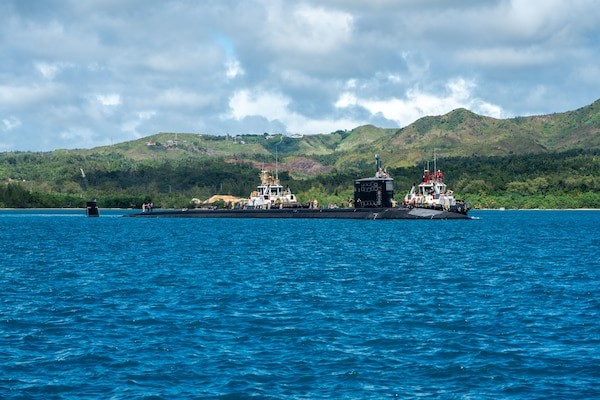
Cmdr. Jeffrey Cornielle, commanding officer of USS Minnesota (SSN 783), left, mans the conning tower as the boat transits Apra Harbor to Naval Base Guam. (Lt. James Caliva)
From Petty Officer 1st Class Nikita Custer, April 15, 2025
NAVAL BASE GUAM (April 14, 2025) – The Virginia-class fast-attack submarine USS Minnesota (SSN 783) returned to its homeport of Naval Base Guam following its first operational tasking while forward-deployed in the Indo-Pacific region, April 14, 2025.
“This first operational tasking following Minnesota’s recent homeport shift demonstrated the submarine’s operational readiness and the capabilities the Virginia-class brings to the Indo-Pacific region,” said Capt. Neil Steinhagen, commander, Submarine Squadron 15. “Their performance is a clear reflection of the high standards and strategic impact expected of our forward-deployed assets. Minnesota has proven itself ready to meet the sustained operational tempo of our Pacific Submarine Force—truly living up to its motto, From the North, Power!”
Minnesota’s operations included a port visit to Western Australia, marking the first of two planned U.S. Virginia-class fast-attack submarine visits to HMAS Stirling in 2025. While in the region, the crew took part in at-sea operations as part of the Submarine Command Course and participated in Exercise Lungfish, a tactical development exercise between the U.S. Navy and Royal Australian Navy. The submarine also visited Darwin in Australia’s Northern Territory, supporting bilateral engagements and hosting tours for local officials.
“These port visits were an outstanding opportunity to strengthen international partnerships and reinforce the Navy’s forward presence with our allies,” said Cmdr. Jeffrey Cornielle, commanding officer, USS Minnesota. “Working side-by-side with our Australian counterparts helped sharpen our undersea warfighting skills. That kind of tactical development is vital—not just for increasing our own readiness, but for enhancing interoperability with allied warfighters deployed shoulder-to-shoulder in support of a secure and prosperous Indo-Pacific.”
Beyond operations at sea, the crew engaged in community outreach throughout Australia, delivering STEM presentations at local schools and volunteering with programs for at-risk youth.
“The Sailors of Minnesota truly embodied what it means to serve, whether they were inspiring students with stories of life aboard a submarine or giving their time to support the local community,” said Master Chief Missile Technician Kevin Lewis, USS Minnesota, Chief of the Boat. “What they did went beyond the uniform. Every connection they made helped build trust, show our values in action, and strengthen the relationships that support our presence in the region.”
Commissioned on Sept. 7, 2013, in Norfolk, Virginia, Minnesota is the 10th Virginia-class submarine to enter service. On Nov. 26, 2024, Minnesota became the first Virginia-class submarine to join the U.S. Navy’s only forward-deployed submarine squadron, along with four Los Angeles-class fast-attack submarines based in Guam. Assigned to Commander, Submarine Squadron 15 at Polaris Point, Naval Base Guam, Minnesota operates at the tip of the spear, reaffirming the submarine force’s forward-deployed presence and supporting the vision of peace through strength and a free and open Indo-Pacific.
Navy Secretary Embarks Gerald R. Ford for First Carrier Visit
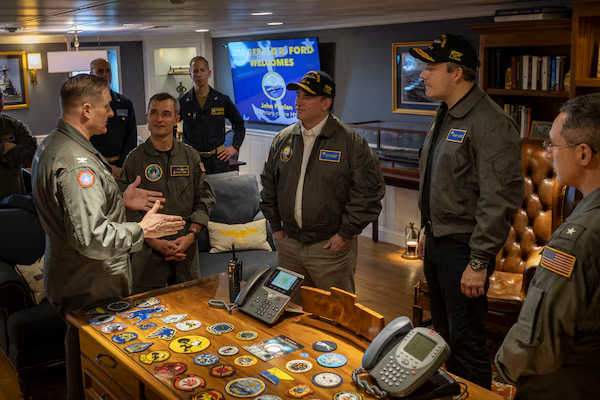
Capt. Rick Burgess, commanding officer of USS Gerald R. Ford (CVN 78), welcomes Secretary of the Navy John C. Phelan in the captain’s in-port cabin. (MC2 Jacob Mattingly)
15 April 2025
ATLANTIC OCEAN – Secretary of the Navy John Phelan embarked USS Gerald R. Ford (CVN 78), the flagship of Carrier Strike Group (CSG) 12, to observe the strike group’s Composite Training Unit Exercise (COMPTUEX), Apr. 10-11. The visit was the Secretary’s first visit to an operational carrier strike group since becoming the 79th Secretary of the Navy on March 25, 2025.
“There is nothing that compares to the strategic influence that the Gerald R. Ford Carrier Strike Group delivers to the Commander-in-Chief,” said Phelan. “All Americans should be proud of these men and women, whose grit and determination keeps our seas open and our nation safe.”
The Secretary joined the strike group during Composite Training Unit Exercise (COMPTUEX). The training environment delivers opportunities for carrier strike group commanders to integrate highly-capable, multi-mission teams through live, virtual, and constructive presentations of threats. CSG-12 coordinates and directs the actions of USS Gerald R. Ford (CVN 78), USS Winston S. Churchill (DDG 81), Carrier Air Wing (CVW) 8 with its nine accompanying squadrons, and Destroyer Squadron (DESRON) 2 and its four guided-missile destroyers.
“I can’t think of a better time, place, or team to introduce Secretary Phelan to strike group operations at sea,” said Rear Adm. Paul Lanzilotta. “It’s an honor and a privilege to lead this team, and I am grateful for the opportunity to highlight the team’s hard work, tactical acumen, and warfighting spirit to the Secretary.”
COMPTUEX is the Joint Force’s most complex training event which underscores the Navy’s commitment to deliver naval task forces for sustained high-end Joint and combined combat. The visit was also an opportunity for the crew of USS Gerald R. Ford (CVN 78) to present the ship to senior leadership.
“It is a great honor to host Secretary Phelan during his first trip to a ready aircraft carrier,” said Capt. Rick Burgess, commanding officer of Gerald R. Ford. “The crew demonstrated Ford’s ability to project power on demand anywhere across the globe.”
Following its return from its maiden deployment in January 2024, Ford completed a maintenance and training cycle.
“As the first aircraft carrier to deter aggression during the Israel-Hamas conflict, you stood tall in support of Israel’s right to defend itself, and you made America proud. But you didn’t just deter. You made a difference. and you showed the world what American naval power and strength looks like.” said Phelan.
The Gerald R. Ford Carrier Strike Group delivers the Joint force and Commander-in-Chief the combat capability to deter, and if necessary, defeat America’s adversaries in support of national security and economic prosperity. The strike group is comprised of its flagship, the world’s largest and most capable aircraft carrier USS Gerald R. Ford (CVN 78), USS Winston S. Churchill (DDG 81), Carrier Air Wing (CVW) 8 with nine accompanying squadrons, and Destroyer Squadron (DESRON) 2 and its four guided-missile destroyers.
For more information about the USS Gerald R. Ford (CVN 78), visit its official webpage at https://www.airlant.usff.navy.mil/cvn78/, or its Defense Visual Information Distribution site at www.dvids.net/CVN78. Follow the ship’s operations and upcoming deployment on Facebook at @USSGeraldRFord or on Instagram at @cvn78_grford.
USS Hershel “Woody” Williams Returns to Norfolk from Forward Deployment
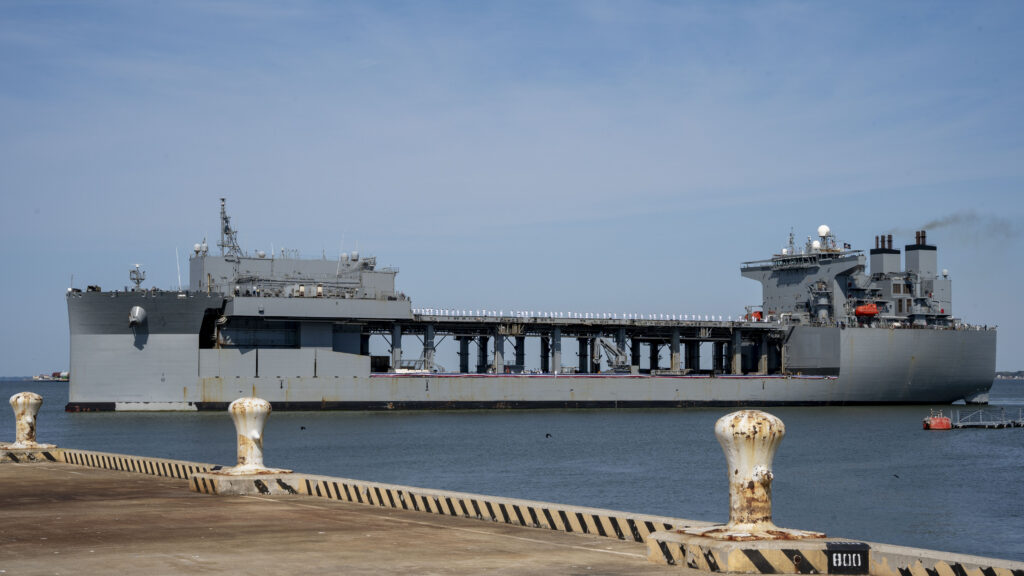
The Lewis B. Puller-class expeditionary mobile base USS Hershel “Woody” Williams (ESB 4) returns to Naval Station Norfolk, April 10, 2025. Photo credit: U.S. Navy | Mass Communication Specialist 2nd Class Derek Cole
NAVAL STATION NORFOLK, Va. – The U.S Navy expeditionary sea base USS Hershel “Woody” Williams (ESB 4) returns to Naval Station Norfolk, April 10, 2025, after operating forward deployed for almost five years, supporting U.S. Navy and allied efforts in the U.S. Naval Forces Europe and Africa / U.S. Sixth Fleet area of operations.
Hershel “Woody” Williams returns to Norfolk’s waters with a hybrid-manned crew of 44 Military Sealift Command (MSC) civil service mariners who operated, navigated, and maintained the vessel and 85 U.S Navy Sailors, Blue and Gold crews, who alternated manning the vessel and allowing for continuous strategic deterrence patrols.
“This is a unique opportunity to welcome home a hard-working ship from its historic tenure forward-deployed, and to welcome home its crew – its heart, soul and lifeblood – in classic Navy fashion,” said Rear Adm. Dave Walt, commander of Expeditionary Strike Group 2, who was on hand to welcome home the Hershel “Woody” Williams crew.
“This crew has punched above its weight and impressed leadership with its hard work, resourcefulness, and dedication.”
The evolution marks the completion of 59 months as a Forward Deployed Naval Force (FDNF) vessel homeported in Souda Bay, Crete, Greece, a journey that began in 2020. Hershel “Woody” Williams will spend a week at Naval Station Norfolk, offloading fuel before shifting to the East Coast Repair and Fabrication Shipyard in Newport News, Va., where the ship will be in lay berth awaiting its next tasking.
Built as a highly flexible mobile platform, capable of operating across a broad range of military sea-based operations, Hershel “Woody” Williams had several noteworthy highlights throughout this deployment.
In 2020, Hershel “Woody” Williams became the first U.S. Navy warship assigned to AFRICOM due to the ship’s ability to support maritime security and humanitarian operations.
In 2021, during AFRICOM’s largest, premier, joint, annual exercise, known as African Lion, Hershel “Woody” Williams participated in a key leader engagement with Morocco Armed Forces, hosted by Morocco, Tunisia, and Senegal.
“These engagements are critical as they allow Navy leaders to interact with partner nations to foster trust and build long-term partnerships,” said MSC’s ESB Project Officer William Revak.
In 2022, Williams joined forces with partners and allies for Obangame Express 22, the largest multinational maritime exercise in Western Africa, to improve communication and information sharing and to increase partner nation capability to further advance maritime security and stability, said MSC’s Program Manager, Prepositioning Ships, Lora Caldwell. Additionally, the ESB-4 platform was used to conduct visit, board, search, and seizure (VBSS) drills with French soldiers.
“VBSS training with partner nations contributes greatly to a more stable and secure global maritime environment,” Caldwell said.
In 2023, Hershel “Woody” Williams conducted humanitarian and disaster relief operations, delivering 113 pallets of disaster relief supplies, totaling nearly 40,000 pounds, to The Ministry of Interior Disaster and Emergency Management Presidency in Mersin, Türkiye for those citizens impacted by the Feb. 6, earthquakes.
In 2024, the Gold-military crew and MSC’s civilian mariners conducted community relation events in Tema, Ghana to continue building their mutual commitment to security and stability in the region which helps to enhance the Navy’s operational readiness. The Hershel “Woody” Williams crew also conducted a theater security cooperation mission during the ship’s visit to Luanda, Angola. Likewise, they managed regional cooperation operations (logistical and personnel support) while in Port Victoria, Seychelles. While there, the ship hosted U.S. Ambassador Henry Jardine and Brig. Gen. Michael Rosette, chief of the Seychelles Defense Forces.
“We will continue to share information with the United States of America in the fight against illegal activities within the Indian Ocean,” Rosette stated in Seychelles Nation, dated Sept. 4, 2024.
Throughout Williams 59-month deployment, MSC’s CVIMARS and the Navy’s Blue and Gold crews were instrumental in further enhancing Navy readiness, strengthening partnerships, and improving the combined capabilities of the U.S. Navy and partner nations’ responses to public crisis, Caldwell said.
ESBs primarily support aviation mine countermeasures and expeditionary forces missions. Additional ship features include a large flight deck and hanger with four aviation operating spots capable of handling MH-535E equivalent helicopters and MV-22 Osprey tiltrotor aircraft, berthing and messing accommodations, workspaces and ordnance storage for embarked forces.
ESB 4 is named in honor of Chief Warrant Officer Hershel “Woody” Williams, a decorated U.S. Marine who was awarded the Medal of Honor for his actions during the Battle of Iwo Jima during World War II.
USS Emory S. Land returns to Guam
From Seaman Apprentice Mario Reyes Villatoro, April 9, 2025
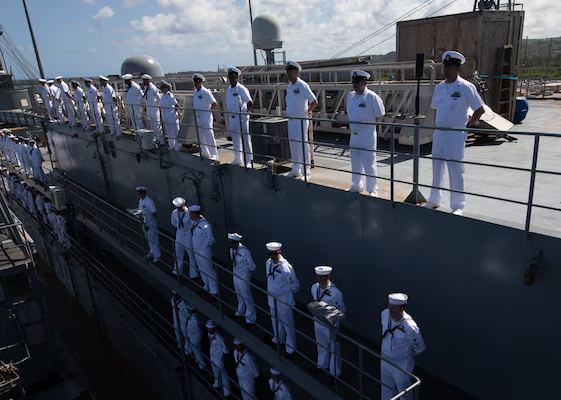
NAVAL BASE GUAM – The submarine tender USS Emory S. Land (AS 39) returned to its homeport in Apra Harbor, Guam, April 9, 2025. Emory S. Land’s arrival marked the completion of its expeditionary submarine tender deployment, which began May 17, 2024.
Emory S. Land conducted 17 port calls in the Indo-Pacific region over 11 months, strengthening relations with many allies and partners such as Australia, Japan, Republic of Korea, and Singapore. During its deployment, Emory S. Land played a pivotal role supporting Pillar 1 of the AUKUS security partnership between Australia, the United Kingdom, and the United States.
In the first half of deployment, Emory S. Land conducted a Submarine Tendered Maintenance Period, or STMP, with the Virginia-class fast-attack submarine USS Hawaii (SSN 776) in HMAS Stirling, Western Australia, Australia, from Aug. 22 to Sept. 10, 2024. Royal Australian Navy Sailors who had been attached to the submarine tender since January 2024 took the lead on conducting repairs aboard Hawaii. The STMP was the first time Australians had ever performed maintenance on a nuclear-powered submarine in Australia. Emory S. Land Sailors also worked in conjunction with the Royal Australian Navy’s Fleet Support Unit-West, which provides repair and maintenance services to the Australian fleet.
“It is an honor and pleasure to return home to Guam. The entire crew, military personnel and civil service mariners, have performed exceptionally well over the last 11 months and have lived up to the ship’s motto “Tireless Worker of the Sea,” and are ready to come home and enjoy quality time back at home with family and friends,” said Capt. Kenneth Holland, the ship’s commanding officer. “This whole deployment has been an incredible journey, to be able to form closer ties with our allies and interact with the locals by hosting tours of our ship and taking part in community relation events. It’s all been a wonderful experience.”
Emory S. Land departed from its final port of the deployment, Darwin, Northern Territory, Australia, on April 2nd, 2025. While in port, Emory S. Land provided logistical support to the Virginia-class fast-attack submarine USS Minnesota (SSN 783).
“I was glad we returned to Darwin and got to enjoy Australia again, and it was a great to spearhead support for the nuclear submarine in Darwin for the first time in 27 years,” said Chief Gunner’s Mate Brett Peterman. “I can’t wait to enjoy some rest and relaxation, and to spend time with the family, before getting back into supporting Guam deployed submarines.”
During its deployment, Emory S. Land visited Darwin, Cairns, Sydney, Eden, Melbourne, Adelaide, and Perth in Australia; Sasebo and Okinawa in Japan; Palau, Busan, Brunei, Singapore, Thailand, and Subic Bay, Philippines. In each port, Emory S. Land Sailors conducted community relations events by assisting local school programs, participating in beach cleanups, sorting food at foodbanks, and much more.
“It was a unique opportunity to conduct so many community relations events across the region. Reflecting on our tour, I believe the real impact is learning about the difference we’ve made with our allies around the world during each event,” said Religious Program Specialist Seaman Hunter Stewart. “The local community members were always grateful for our team.”
Guam is home to the U.S. Navy’s only submarine tenders, USS Emory S. Land (AS 39) and USS Frank Cable (AS 40), as well as four Los Angeles-class attack and one Virginia-class attack submarines. The submarine tenders provide maintenance, hotel services and logistical support to submarines and surface ships in the U.S. 5th and 7th Fleet areas of operation. The submarines and tenders are maintained as part of the U.S. Navy’s forward-deployed submarine force and are readily capable of meeting global operational requirements.
USS Shiloh Returns to Home Port After Oceania Maritime Security Initiative 2025
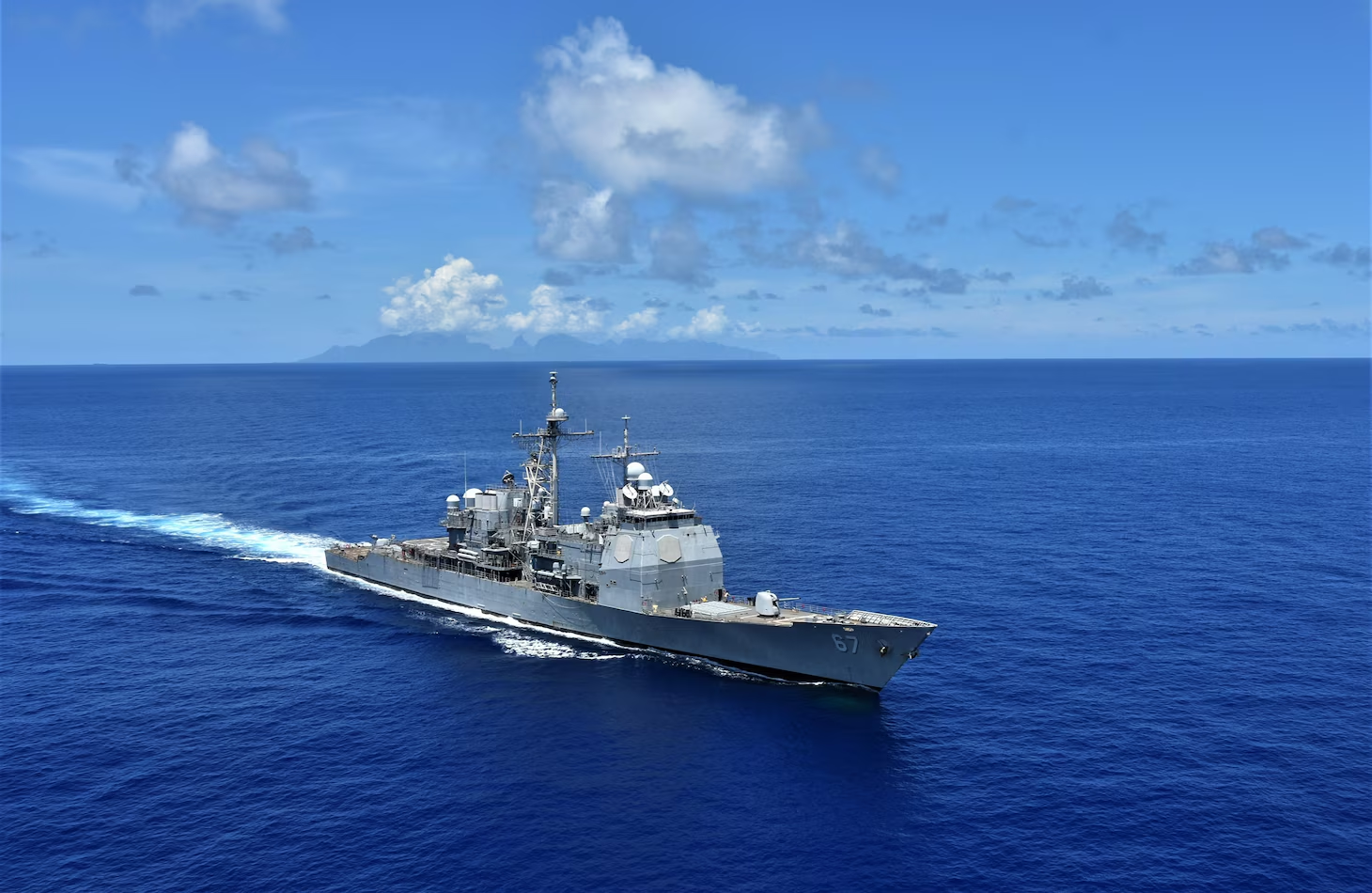
USS Shiloh (CG 67) patrolled, and conducted several boarding and intelligence gathering operations in the South Pacific region in support of Oceania Maritime Security Initiative 2025. Photo credit: U.S. Navy | Commander, U.S. 3rd Fleet.
From U.S. 3rd Fleet, April 7, 2025
PEARL HARBOR, Hawaii — The Ticonderoga-class guided-missile cruiser USS Shiloh (CG 67) returned to its home port, Joint Base Pearl Harbor-Hickam, April 4, 2025.
Shiloh, in partnership with an embarked Law Enforcement Detachment (LEDET) from USCG Pacific Tactical Law Enforcement Team, conducted several boarding and intelligence gathering operations in the South Pacific in support of Oceania Maritime Security Initiative (OMSI) 2025. OMSI is a Secretary of Defense program that leverages Department of Defense assets transiting the region to increase the USCG’s maritime domain awareness, ultimately supporting maritime law enforcement in Oceania.
From February 2025 to April 2025, Shiloh patrolled the South Pacific, strengthening relationship with partner nations and ensured maritime stability and security in the region. These actions were carried out through the enforcement of provisions of the Western and Central Pacific Fisheries Convention (WCPFC) and bilateral law enforcement agreements it has with specific countries in the region.
Captain Bryan E. Geisert is the commanding officer aboard Shiloh.
“I am proud of what our crew accomplished and the strong partnership with our Coast Guard Shipmates’. It is a critical and unique opportunity to assist in ensuring marine resources are protected through the enforcement of international laws to enhance regional stability.” said Capt. Geisert.
Shiloh is operating in the U.S. 3rd Fleet area of responsibility in support of the security and stability of the Indo-Pacific region. Shiloh is assigned to Commander, Naval Surface Group Middle Pacific, a combat-ready force that protects and defends the collective maritime interest of its allies and partners in the region.
Navy Commissions Attack Submarine USS Iowa
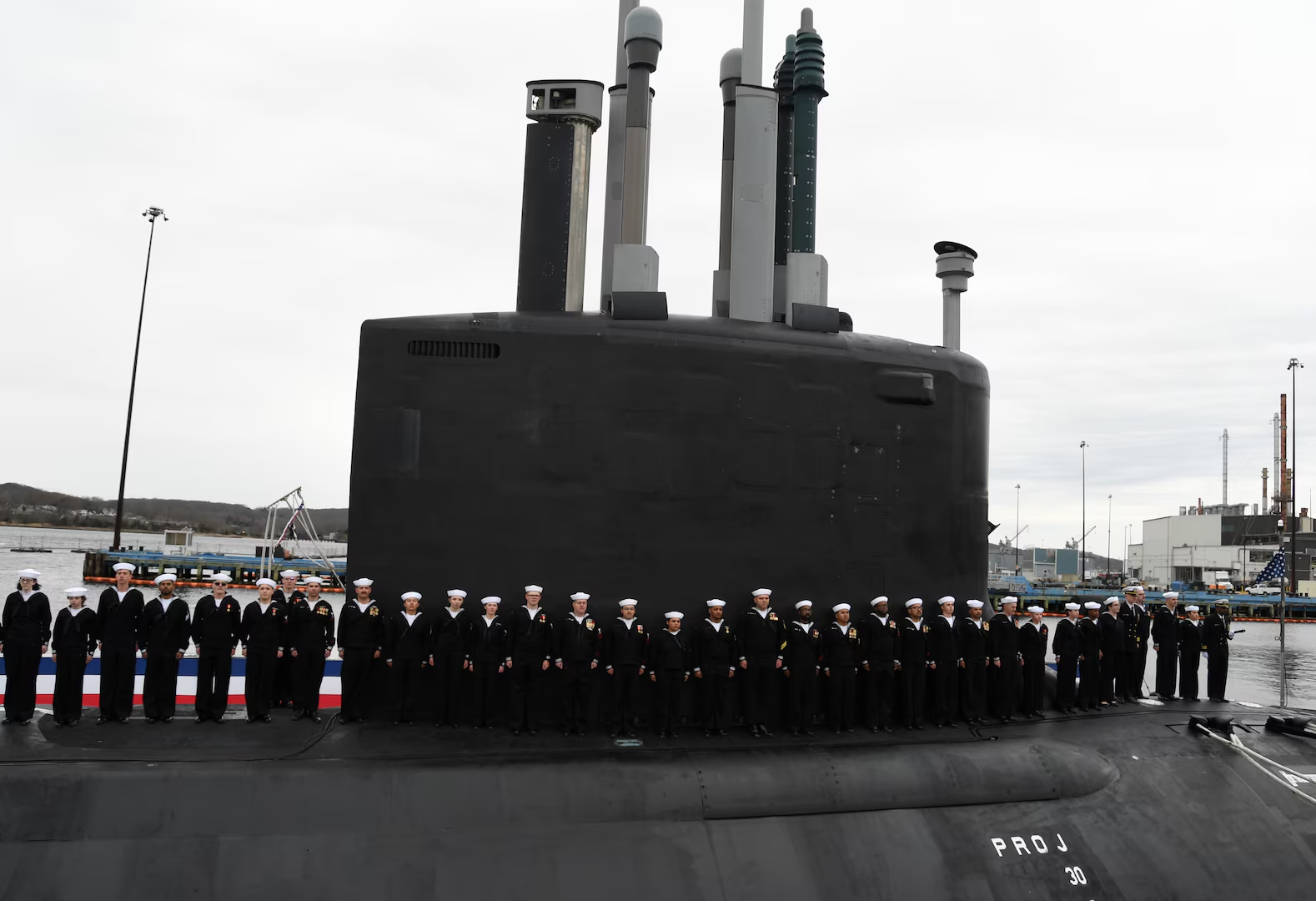
Sailors attached to the fast-attack submarine USS Iowa (SSN 797) man their newly commissioned submarine during a ceremony in Groton, Connecticut, April 5, 2025. Photo credit: U.S. Navy | Chief Petty Officer Joshua Karsten
By Joe Markowski, Submarine Readiness Squadron 32, April 7, 2025
GROTON, Conn. – Christie Vilsack, Iowa’s sponsor and former First Lady of Iowa, gave the crew the traditional order to “man our ship and bring her to life,” after which Iowa’s sailors responded “aye aye ma’am” before ceremonially running aboard the submarine.
The ceremony culminated a years-long process of commissioning SSN 797, the first submarine and third naval vessel named for the Hawkeye State. The most recent USS Iowa, the highly decorated WWII-era battleship BB 61 (1943-1990), saw action in World War II, the Korean War, and Gulf War. The first BB4 Iowa (1897-1919) saw action in the Spanish-American War and World War I.
Iowa’s commanding officer Cmdr. Gregory Coy, a Walnutport, Pennsylvania native and 2006 graduate of the U.S. Naval Academy, called the event “a historic milestone” during his speech, praising the crew, shipbuilders, and commissioning committee.
“This event is significant for both the life of a submarine and for the amazing people from the Hawkeye State,” Coy said. “To the plank owners, the shipbuilders, the commissioning committee, and our Navy and Submarine Force leaders, this is your submarine.”
Coy took command of Iowa in June 2024 and led the crew from the shipyard and through a series of sea trials, to today’s commissioning and subsequent underway operations.
“I am consistently humbled at what we have accomplished” Coy added. “Today, we become the ‘USS’ Iowa, and I intend to take her to the frontline, continuing the Navy’s overwhelming display of undersea dominance and lethality.”
Iowa’s youngest plankowner – an honor given to commissioning crewmembers – Seaman Lilly Runyon shared her excitement, saying “today’s a lot bigger than I thought it would be.”
“It’s kind of like I’m already used to this,” said Runyon of her sea trials as a PCU. “But now that we’re commissioned, it’s going to feel a little bit more official and I’m very excited for actual operations and figuring things out.”
Secretary of the Navy John Phelan praised the crew and the shipbuilders during his speech calling the ceremony an “opportunity to show Navy lethality and our unmatched undersea superiority.”
“It is an honor to commission the Navy’s newest nuclear-powered attack submarine, here at Groton, the submarine capital of the world,” Phelan said. “USS Iowa will make our fleet stronger and more lethal. As Iowa goes to sea, she does so with one mission: to ensure that America’s adversaries never doubt our resolve.”
Adm. Daryl Caudle, U.S. Fleet Forces commander and senior naval officer at the event, called his participation in the event a homecoming to the submarine capital of the world, a place he called “the nation’s center of gravity for the steely-eyed killers of the deep.”
“In this coming year, this crew of proud American sailors will put this warship to sea and carry the name ‘Iowa’ to the far-flung corners of the globe projecting combat power for decades to come,” Caudle said. “It is the fearless warriors before me that turn this piece of metal weighing almost 8,000 tons – with hundreds of miles of fiber, cable, and piping systems – into a combat ship, a warship designed to decisively win our nation’s battles. Your preparation and execution to get this ship to commissioning day is nothing short of amazing.”
Other platform guests at the commissioning ceremony included Iowa Governor Kim Reynolds; Vice Adm. Robert Gaucher, U.S. Submarine Force commander; representatives from General Dynamics Corp.’s Electric Boat shipyard, U.S. Sen. Richard Blumenthal and U.S. Rep. Joe Courtney of Connecticut. The master of ceremonies was Lt. Cmdr. Scott Carper, executive officer of the USS Iowa.
Capt. Jason Grizzle, commodore of Iowa’s parent Submarine Squadron (SUBRON) 4, likened the success of the crew to the “hard work and dedication that directly mirror people from the Hawkeye State.”
“Iowa’s motto states that ‘our liberties we prize and our rights we will maintain,’” Grizzle explained. “This crew lives by that creed, evidenced today by this fine ship – built, manned, and prepared – in record time, ready to get out to sea where she belongs.”
Iowa, whose keel was laid in August 2019 and christened in June 2023, was designed with stealth and surveillance capabilities, as well as special warfare enhancements, to meet the Navy’s multi-mission requirements. The submarine is 377 feet long, has a 34-foot beam, can dive to depths greater than 800 feet, and operate at speeds in excess of 25 knots. Iowa has a crew of approximately 135 Navy personnel. It is designed with a reactor plant that will not require refueling during the planned life of the ship, reducing lifecycle costs while increasing underway time. The submarine was built by General Dynamics Electric Boat shipyard facility in Groton, Connecticut.
Fast-attack submarines are multi-mission platforms enabling five of the six Navy maritime strategy core capabilities – sea control, power projection, forward presence, maritime security and deterrence. They are designed to excel in anti-submarine warfare, anti-ship warfare, strike warfare, special operations, intelligence, surveillance and reconnaissance, irregular warfare and mine warfare. Fast-attack submarines project power ashore with special operations forces and Tomahawk cruise missiles in the prevention or preparation of regional crises.
Sea-Air-Space: Navy Spearheads Historic Investments in Shore Infrastructure
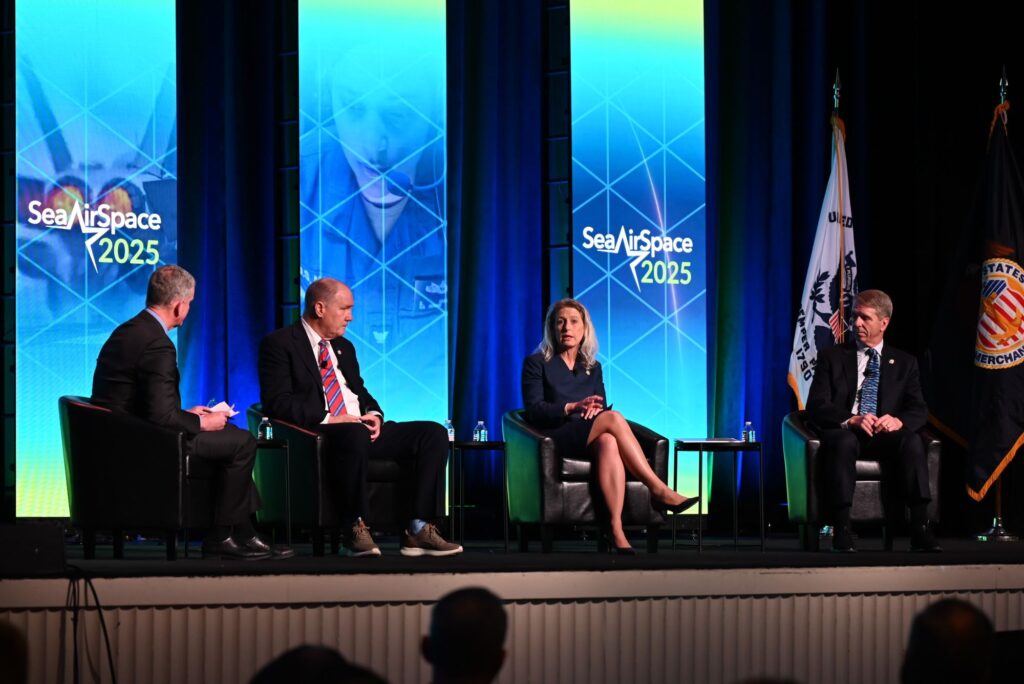
Representatives from government and industry discuss the need to update the nation’s aging shore infrastructure, including speeding ship construction through practical reforms. Photo credit: Erika Fitzpatrick
The U.S. Navy is modernizing the condition, configuration and affordability of its public shipyards and shore infrastructure, according to Rear Admiral Dean VanderLey, including by departing in some cases from traditional acquisition strategies.
“Our shore infrastructure on our Navy bases primarily [is] where we train our Sailors and maintain our ships and warfare platforms, and so is very critical to the ultimate readiness of our forces,” VanderLey, commander of Naval Facilities Engineering Systems Command, said April 8 in the panel discussion, “Revitalizing Shore Infrastructure: Meeting Modern Naval Demands.”
The Navy’s four public shipyards — Norfolk (Virginia) Naval Shipyard, Portsmouth (Maine) Naval Shipyard, Puget Sound (Washington) Naval Shipyard and Intermediate Maintenance Facility, and Pearl Harbor (Hawaii) Naval Shipyard and Intermediate Maintenance Facility — were first built in the 19th and 20th centuries.
“Now we’re using them to maintain nuclear-powered vessels,” VanderLey said. The youngest, Pearl Harbor, was founded in 1908 — the year the Ford Model T rolled off the assembly plant and was offered for sale at $850.
“After 100 years, it’s probably time to do something,” quipped panelist Mark Edelson, program executive officer for Industrial Infrastructure at the Department of the Navy. “Everything has gotten bigger and needs more power.”
Upgrading and Modernizing
Fortunately, Edelson said, the Navy has recognized the foundational element of naval installations to all the combat forces, and, in 2018, established the Navy’s Shipyard Infrastructure Optimization (SIOP) to upgrade shore infrastructure. Naval ports and bases face myriad issues, including aging facilities and equipment, insufficient utilities and information technology, lack of worker amenities, and rising waters in some places and diminishing sources of fresh water in others.
“We’re benefiting from historic investments in the shipyards to get after all of those things,” Edelson said.
SIOP, led by Program Executive Office, Industrial Infrastructure and supported by the Naval Facilities Engineering Systems Command, Naval Sea Systems Command and Commander, Navy Installations Command, to date has finished 44 facilities projects worth nearly $1.2 billion, according to the Navy. Another 48 projects are under contract for $6 billion in additional improvements, including construction of four dry docks and upgrades to shipyard utilities.
Some of these projects are hardly straightforward. A recent project to build a new Waterfront Production Facility at the Portsmouth Naval Shipyard required negotiating with the state historic preservation office to retain the building’s original architectural features while modernizing ship servicing capabilities and improving workflow.
“Now the light machine shop, the artisans, the engineers are all in the same building next to two dry docks to get the throughput that we need,” Edelson said.
Departing from Tradition
VanderLey said the Navy is making practical reforms to speed up infrastructure modernization by:
▪ Prioritizing resources. The Navy is first upgrading the most critical infrastructure, including dry dock improvements to support the “future force,” including USS Gerald R. Ford-class aircraft carriers, and future versions of the Virginia- and Columbia-class submarines.
▪ Reforming acquisition strategies.The Navy is in some cases departing from the traditional acquisition process, which typically involves firms bidding on Navy-defined requirements in design and construction. It’s now involving contractors earlier, to mold project design, VanderLey said. That’s helpful in complex infrastructure projects, he said, when cost and schedule are “less about what you’re building than about how you have to build it.”
The Navy is also awarding design-build-to-budget contracts, which allow flexibility and speed while controlling costs.
▪ Alternating construction methods. VanderLey said the Navy is capitalizing on the trend of “industrialized construction” or “off-site construction,” where certain parts or modules — child care centers, barracks, or dorms — are prefabricated off-site for later assembly into the overall build. “In Europe about 45% of their construction is done that way; in the United States, it’s about 5%,” he said.
“We see potential for savings in cost and schedule of roughly 30%,” VanderLey added. “So, we’re aggressively going after those types of approaches.”
Commercial shipbuilding faces similar challenges to the Navy in needing to upgrade its similarly aging infrastructure, in part to recruit and retain workers.
“People need infrastructure too,” said Roger Camp, senior director for Business Development, Naval Programs, at Hanwha Defense USA, a subsidiary of South Korean defense giant Hanwha Group, which purchased the Philly Shipyard last year for $100 million.
He said his firm is exploring ideas to make the maritime facility more attractive to workers, by locating parking closer to the plant, outfitting training areas with virtual reality tools, and expanding — not replacing — production resources through use of AI and robotics.
“We have to have technical infrastructure,” Camp said. “Not just piers not just buildings, but the actual facilities to be able to augment the humans that build our ships.”
Sea-Air-Space: Shipbuilding, Industrial Base Concerns Come to the Fore for SECNAV, Congress
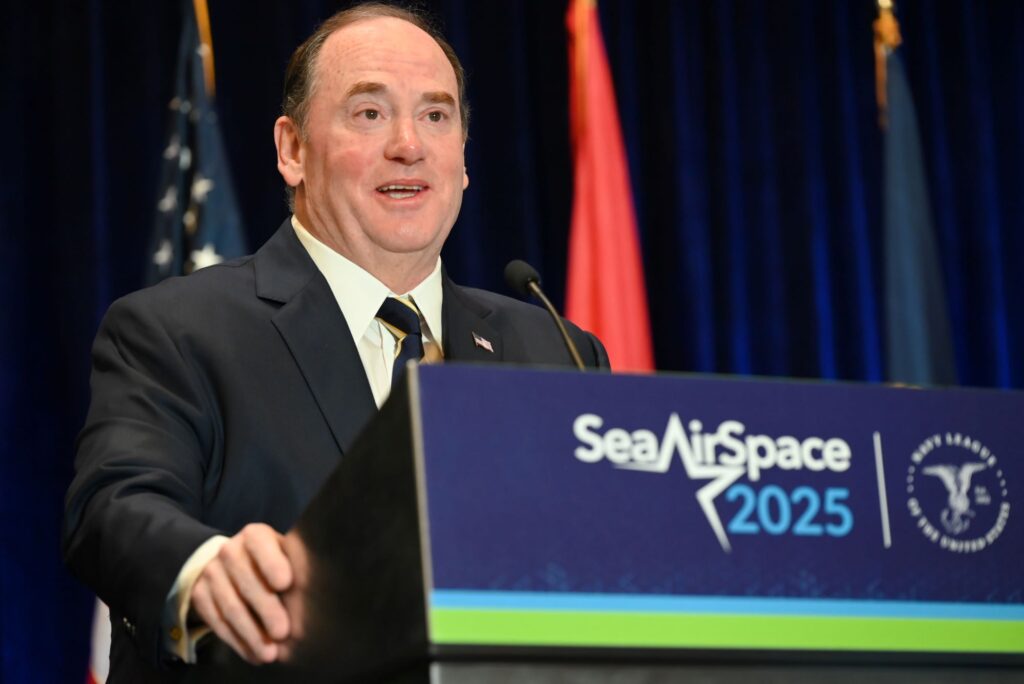
New Secretary of the Navy John Phelan addresses the audience on the final day of Sea-Air-Space. Photo credit: James Peterson
Fourteen days into his tenure as the 79th secretary of the Navy, John Phelan said he plans to focus on three things: strengthening the shipbuilding industry and defense industrial base; creating an accountable, adaptable warfighting culture; and improving the health, welfare and training of Department of the Navy personnel.
“My number one priority as SECNAV is readiness,” Phelan said in a breakfast address on the last day of Sea-Air-Space. “I wake up every day focused on our readiness, our ability to fight, and a modernization strategy going forward.”
For decades, the United States has enjoyed the benefits of being the world’s pre-eminent maritime power, he said, but that lack of competition, a bureaucratic inertia and a rigid adherence to the “old way of doing things” has led to complacency, he said.
“China constructed more ships last year alone than we have since World War II,” he said. “Our adversaries are not waiting on us to get our act together.”
Fourteen days in, “I may have underestimated just how complex this job is,” he said. “As everyone in the room knows, leading the Department of the Navy is anything but easy, but I didn’t come here for easy. I came here to solve problems.”
Among those problems are shipbuilding backlogs. Phelan has already visited the government shipyards in Connecticut and plans to visit the rest, public and private, to help understand the scope of the issue.
When he sat down with the shipyard workers, he was struck by their dedication and sense of mission, Phelan said.
“I said to them, you’re not just building ships. You’re contributing to our national security, and the president and I thank you for that. In my view, investing in people is as critical to our success as any weapon system or fighting strategy. We’re facing a serious shortage in our shipbuilding workforce, which is stressing our performance schedules, exacerbating the strain on our current forces, therefore leading to extended deployments” that put stress on the crews.
“These challenges are not hypothetical. They affect the lives of our Sailors and their families who feel the weight of these pressures every day. The Department of the Navy, working closely with industry, must offer a clear vision for the future of our shipbuilding workforce, one that includes career growth, competitive compensation and a strong sense of purpose,” Phelan said.
Acquisition reform is a perennial challenge for the Department of the Navy and the military at large. Phelan, with a background in business, said he wants to understand why the processes move so slow and why some programs cost so much.
He cited the construction of military barracks that cost $2 million per key, when his company was able to build a luxury hotel in Hawaii for $800,000 per key.
“In the coming weeks I’ll review our acquisition systems and identify how we can streamline and reform them. I’ll work across the department and especially with industry to find solutions,” Phelan said. “We’ll restore and maintain operational readiness, fiscal responsibility. In order to do so, I’ll rely on experience and insight from the people around me. I’m not interested in echo chambers. I want honest perspective and real results. General Patton said if everyone is thinking alike, someone’s not thinking.”
Asked how he plans to revitalize shipbuilding and growing the maritime industry, Phelan pointed out he’s still new on the job.
“I would say to that question, stay tuned. I’m on day 14. I intend to meet with all of our major contractors, and those who would like to become contractors. I think we have to really ensure that we have a huge, strong base, but we also have competition. And I think we need to provide that by expediting some of our processes and making it easier.”
Members of the House Armed Services Committee address the issues facing the maritime services. From left: Moderator Bryan Clark of the Hudson Institute and Reps. Trent Kelly, Jenn Kiggans and Rob Wittman. Photo credit: James Peterson
Congressional Insight
Some members of Congress with defense oversight duties spoke shortly after Phelan and said rebuilding the defense and shipbuilding industrial base means rebuilding the workforce and giving them steady demand signals.
Reps. Trent Kelly (R-Mississippi), Jennifer Kiggans and Rob Wittman, both Republicans from Virginia, and all of whom are members of the House Armed Services Committee, appeared on a panel and said there are options to revitalize shipbuilding and the industrial base.
“I think that the speech that you just heard from the secretary of the Navy, and what he reiterated from the president’s direction to him, was shipbuilding, shipbuilding, shipbuilding,” Wittman said. “I love it. But the key is, you have to get left of that enterprise. And being to the left of the enterprise means if you’re going to do shipbuilding, shipbuilding, shipbuilding, it starts with workforce, workforce, workforce.”
The Office of Management and Budget needs to give contractors the ability to move money payable at the end of a contract to the beginning to boost workers’ salaries and make the jobs more competitive, Wittman said.
“And listen, Congress can do that, but I can tell you by the time the Congress gets through the NDAA [National Defense Authorization Act] and appropriations and it gets in the hands of the Pentagon, that’s a 24-month window. Today, it could happen immediately by OMB allowing in those contracts for that money to be moved to the left.”
Kelly said the workers also need a steady demand signal, not working on multiple ships one year and none the next.
“We’ve got to have consistency,” Kelly said. “… If you don’t have a consistent demand, you can’t pay workers, you can’t make infrastructure investments, you can’t do any of that.”
Kiggans and Kelly also said the Navy shouldn’t be so quick to decommission ships at a time when it needs more to counter the burgeoning Chinese navy.
“I need the Navy again to come out and say, I want every ship I have. We’re keeping our older ships. Every single one of ‘em. Now is not the time to be decommissioning ships that we just sent on deployment,” Kiggans said.
Kelly blamed Navy officials for ignoring congressional directives to keep ships in play.
“We should not retire a ship, any ship, if we don’t have a replacement. Any,” Kelly said. “… And I’ll tell you, I’ve seen this … but a lot of times when we tell the Navy you’re not retiring a ship, the answer is, is we’ll just make sure it’s broke and we’ll just say it didn’t work, and see, we told you. So, there is no effort to actually make that piece of equipment work. It’s, we don’t want to do it and we’re going to ignore you, Congress, we’re going to ignore you, president, we’re just going to make sure that it doesn’t work.
“We have got to be committed to making sure that everything that we have can be operational at a moment’s notice and that we keep them operational and that we keep training those crews.”
Sea-Air-Space: Fighting from the MOC Requires Standardization, Speakers Say
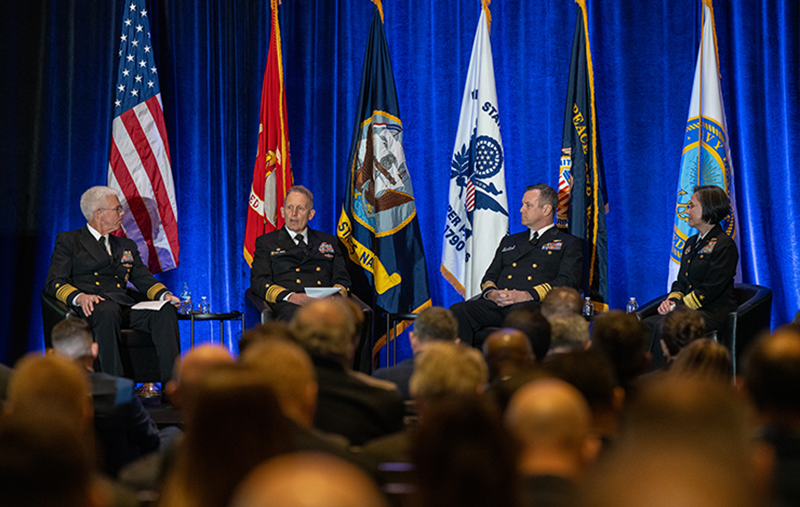
Vice Admirals Kurt Thomas, Michael Vernazza and Craig Clapperton and Rear Admiral Susan BryerJoyner discuss what needs to be done to fight from the MOC. Photo credit: Dan Goodrich
The concept of “fighting from the MOC” will require much greater standardization of Maritime Operations Centers, in training, equipping, resupplying and data management and protection, speakers said at a panel April 7 at Sea-Air-Space.
The MOCs are purpose-built for fleet commanders, but that makes them difficult to coordinate, said Vice Admiral Karl Thomas, the director of Naval Intelligence, who moderated the Monday panel on “Fighting from the MOC.”
“We would like to have them all configured in a standard manner … so we can modernize them in a better way,” Thomas said. “There’s a little tension in that, but it’s a good tension. In the pace of the fight today, we need to modernize.”
MOCs are how the Navy executes fleet-level warfare and facilitates mission command at lower echelons, but the Navy is seeking to use them as the centerpiece for the type of distributed warfare likely in the vast Pacific.
“We will treat and resource MOCs like the warfighting systems that they are, capable of operating on a decentralized and global battlefield just like all other weapons systems,” the Navy’s 2024 Navigation Plan says.
Vice Admiral Michael Vernazza, commander of Naval Information Forces, said his team is working with Navy personnel officialsto conduct a manpower review of each MOC, starting in the Pacific, focusing on the exact manning each will need to carry out the seven joint tasks outlined in the chief of naval operation’s Navigation Plan.
“By 2027, all fleet headquarters, starting in the Pacific Fleet, will have ready MOCs certified and proficient in command and control, information, intelligence, fires, movement and maneuver, protection, and sustainment functions as assessed by our MOC Training Teams,” the NAVPLAN says.
Investments
Admiral Susan BryerJoyner, director of the Warfighting Integration Directorate, said the main investment that needs to be made to be ready for 2027 is cloud infrastructure and supporting “zero trust” technology to make sure data going into and from MOCs is protected, and available to commanders who need it.
Data visualization doesn’t need to be standard, “but what does need to be standard is the data that underpins it,” BryerJoyner said.
“Every commander should not be able to pick and choose what data he or she wants to use for a specific warfighting function, because as soon as you start to add that variability in, now different commanders are going to see different things and come to different conclusions,” she said.
“This shift from MOC as a commander’s personalized way of fighting to a more standardized way of feeding into the joint force, is the journey that we’re going on now,” she said.