PteroDynamics Awarded U.S. Navy Contract to Develop Next-Gen Autonomous Transwing VTOL UAS

Expansion to 2021 Blue Water Logistics UAS Contract Calls for Development and Demonstration of Fleet-Deployable, 330-pound P5 Transwing for Critical Repair Cargo 

From Pterodynamics Inc.  

COLORADO SPRINGS, Colo. - February 18, 2025 – PteroDynamics Inc., an innovator in autonomous vertical takeoff and landing (VTOL) aircraft systems, today announced an expansion of its contract with the U.S. Naval Air Warfare Center Aircraft Division (NAWCAD) to design, develop, and demonstrate in a maritime environment the next generation of its Transwing® VTOL unmanned aerial system (UAS). The additional $4.65 million award is the sixth and most important expansion of the company’s 2021 Blue Water Logistics UAS (BWUAS) prototype contract and calls for a larger aircraft with more robust capabilities than the company’s P4 Transwing VTOL UAS that successfully demonstrated sea trials during last summer’s RIMPAC 2024 Exercise. The new autonomous P5 Transwing UAS aircraft will have a maximum takeoff weight of 330 pounds and a minimum range of 400 nautical miles carrying a 50-pound payload. It is designed to execute long-range tactical ship-to-ship, ship-to-shore, and shore-to-ship deliveries of critical repair cargo in contested maritime environments, currently performed by crewed aircraft. The new award raises the total contract value to over $7 million, nearly triple the original contract.  

“Working with NAWCAD since 2019 has enabled PteroDynamics to identify and achieve key performance parameters that make the Transwing a uniquely capable VTOL UAS. This sixth contract expansion is so significant because it calls for the clean-sheet design, build, and demonstration of the next-generation P5 Transwing aircraft that will give the U.S. Navy an effective solution for automated just-in-time delivery of critical repair parts and supplies at sea,” said PteroDynamics CEO Matthew Graczyk. “The size and capabilities of the P5 also hit a sweet spot in what we see in broader market demand, not only for other military branches like the Air Force, but also for commercial, governmental, and public safety operators around the world eager to leverage the key advantages of the Transwing platform.” 

Historical data from Navy casualty reports show that warships that move to non-mission capable or partially mission capable status often do so due to logistics-related issues like electronics parts or assemblies – 90% of which are logistical deliveries weighing less than 50 pounds. Today, the Navy’s fleet of MH-60 helicopters, V-22 tilt-rotor aircraft, and commercial helicopters fly these missions. Recognizing the cost and inefficiency of using manned aircraft in missions that could be completed by UAS, Military Sealift Command tapped NAWCAD to demonstrate how autonomous vehicles can optimize logistics in contested environments and beyond through the BWUAS program. 
 
“Maritime resupply missions are the lifeblood of naval operations, and for the U.S. Navy and our allies, there is a critical need to automate expensive, resource-intensive deliveries of critical payloads in strategic maritime environments like the Indo-Pacific region,” commented Graczyk. 

PteroDynamics’ Transwing is a revolutionary VTOL aircraft system that folds its wings to transition seamlessly between configurations optimized for vertical and winged horizontal flight. It requires no launch and recovery infrastructure and occupies one-third or less ground footprint than other VTOL aircraft with a comparable wingspan. 

NAWCAD awarded PteroDynamics the $4.65 million contract expansion, funded by the U.S. Defense Innovation Unit (DIU) via an Other Transaction Authority (OTA) agreement to the company’s existing 2021 BWUAS Innovative Wing Design contract, raising the current contract to over $7 million. Upon completion of this phase of the contract, the company will qualify for $5 million in supplemental program funding, bringing the total future contract value to $12 million.  

PteroDynamics will design, build, test, and demonstrate two P5 Transwing UAS prototypes in a maritime environment to meet the following specifications: 

●      330-pound maximum gross takeoff weight 

●      Ability to carry a 50-pound payload at least 400 nautical miles  

●      Hybrid electric/internal combustion engine powertrain that can burn JP-5 fuel 

●      Autonomous multi-aircraft operations 

●      Satellite communications for beyond visual line of sight (BVLOS) operation 

●      Detect and avoid (DAA) capability 

●      Operations in a broader range of environmental conditions 

●      Transportable via C-130 and C-17 fixed-wing and CH-53 and CH-47 rotor aircraft 


Commanding Officer of USS Harry S. Truman Relieved

U.S. 6th Fleet Public Affairs, Feb. 20, 2025 

SOUDA BAY, Greece – Capt. Dave Snowden, commanding officer of USS Harry S. Truman (CVN 75), was relieved Feb. 20 due to a loss of confidence in his ability to command. 

Snowden was relieved by Rear Adm. Sean Bailey, commander of Carrier Strike Group 8, after serving as the aircraft carrier’s commanding officer since December 2023. Snowden will be temporarily assigned to Naval Air Forces Atlantic. 

The relief occurred after Truman was involved in a collision with the merchant vessel Besiktas-M on Feb. 12, while operating in the Mediterranean Sea in the vicinity of Port Said, Egypt. 

The U.S. Navy holds commanding officers to the highest standard and takes action to hold them accountable when those standards are not met. Naval leaders are entrusted with significant responsibilities to their Sailors and their ships. 

Capt. Christopher Hill, commanding officer of USS Dwight D. Eisenhower (CVN 69), will temporarily serve as Harry S. Truman’s interim commanding officer. 

Dwight D. Eisenhower is currently undergoing scheduled maintenance at Norfolk Naval Shipyard after completing a nine-month deployment to U.S. Central Command and U.S. European Command in July 2024. 

There is no impact to Harry S. Truman’s mission or schedule due to the relief. The Nimitz-class aircraft carrier is currently deployed to the U.S. 6th Fleet area of operations. 


Readout of Navy Leadership’s Meeting with the Governor of Guam

Performing the Duties of Under Secretary of the Navy Victor Minella meets with Guam Governor Lou Leon Guerrero during a visit to the Pentagon, February 19. Minella emphasized the importance of working together while improving lethality, warfighting, and readiness. (U.S. Navy photo by Capt. Courtney Hillson).

From SECNAV Public Affairs, Feb.19, 2025  

Under Secretary of the Navy Spokesperson Capt. Courtney Hillson provided the following readout: 

Victor Minella, who is Performing the Duties of Under Secretary of the Navy, met with Guam’s Governor Lou Leon Guerrero at the Pentagon to discuss shared security concerns in the Indo-Pacific region.  They both committed to working together on shared goals.  Minella emphasized the importance of working together while improving lethality, warfighting, and readiness.  He noted the recent live intercept of a ballistic missile target from Guam as an example of how the Department is focused on deterrence and defending Guam. This was the first in-person meeting with the Governor and Minella. 


USCGC Clarence Sutphin Jr. Rescues Seven Mariners in Arabian Gulf 

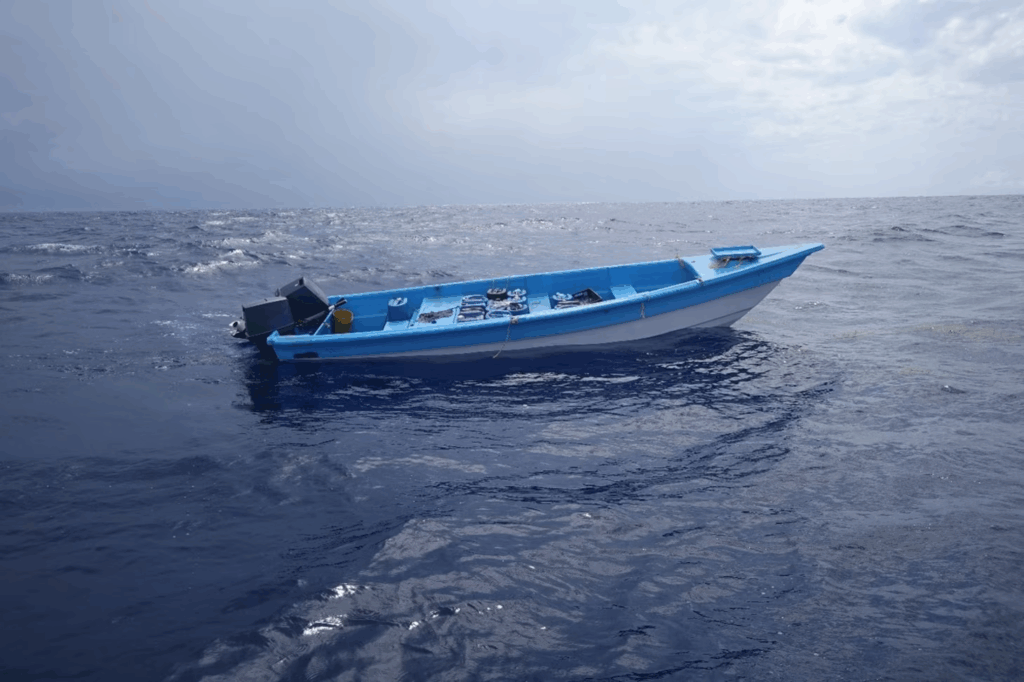
CENTRAL ARABIAN GULF – A U.S. Coast Guard team from the fast-response cutter USCGC Clarence Sutphin, Jr. (WPC 1147) rescue seven mariners as their vessel slowly sinks in the Central Arabian Gulf, Feb. 18. The mine countermeasures ship USS Devastator (MCM 6) watches over the scene as backup during the rescue operation. (Photo by U.S. Coast Guard)

By U.S. Naval Forces Central Command Public Affairs | February 19, 2025 

U.S. CENTRAL COMMAND AREA OF RESPONSIBILITY — Crewmembers of the U.S. Coast Guard fast-response cutter USCGC Clarence Sutphin, Jr. (WPC-1147) and the mine countermeasures ship USS Devastator (MCM 6) rescued seven mariners from a disabled vessel in the international waters of the Central Arabian Gulf, Feb. 18. 

Following a distress signal from the mariners, the Coastguardsmen embarked a rigid-hull inflatable boat to offer assistance. After determining the vessel was no longer sea worthy, the Coastguardsmen brought the mariners back to their ship. Devastator provided back-up support during the operation. 

None of the mariners appeared to be injured. 

“Providing assistance at sea to mariners in distress is a core Coast Guard mission,” said Coast Guard Lt. Michael O’Dell, Clarence Sutphin, Jr.’s commanding officer. “It is inherently dangerous, but the team executed without hesitation – without fear – to extend their compassion to people in a dire situation. I’m incredibly proud of to be a part of this team.” 

Clarence Sutphin, Jr. is forward deployed to the U.S. 5th Fleet area of operations as part of Patrol Forces Southwest Asia. Devastator is an Avenger-class mine countermeasures ship also forward deployed to U.S. 5th Fleet. Both ships help ensure maritime security and stability in the Middle East region. 

The U.S. 5th Fleet area of operations encompasses about 2.5 million square miles of water area and includes the Arabian Gulf, Gulf of Oman, Red Sea and parts of the Indian Ocean. The expanse is comprised of 20 countries and includes three critical choke points at the Strait of Hormuz, the Suez Canal and the Strait of Bab al Mandeb at the southern tip of Yemen. 


USS Harry S. Truman Conducts Emergent Repair Availability 

MEDITERRANEAN SEA (Feb. 15, 2024) An F/A-18E Super Hornet, attached to the “Pukin’ Dogs” of Strike Fighter Squadron (VFA) 143, lands on the flight deck of the Nimitz-class aircraft carrier USS Harry S. Truman (CVN 75) Feb. 15. (U.S. Navy photo by MCSN Mekhi Manson) 

By USS Harry S. Truman Public Affairs, Feb. 16, 2025 

SOUDA BAY, Greece – The Nimitz-class aircraft carrier USS Harry S. Truman (CVN 75) arrived at U.S. Naval Support Activity (NSA) Souda Bay, Greece, on Feb. 16 to conduct an Emergent Repair Availability (ERAV) on the ship’s starboard quarter following a recent collision. 
 
Damage assessed includes the exterior wall of two storage rooms and a maintenance space. External to the ship, damage assessed includes a line handling space, the fantail, and the platform above one of the storage spaces. Aircraft elevator number three sustained no damage and is fully operational. Forward Deployed Regional Maintenance Center (FDRMC) will lead the pier side ERAV, including an assessment and follow-on repairs to damages sustained. 
 
“While the ship is fully mission capable and the ship conducted flight operations following the collision, pulling into port for emergent repairs will enable the ship to continue deployment as scheduled,” said Capt. Dave Snowden, Harry S. Truman’s commanding officer. 
 
An assessment team will conduct a full survey of damaged areas and develop a repair plan to be executed immediately following completion of the assessment. The assessment team includes structural engineers, naval architects, and other personnel from FDRMC and Norfolk Naval Shipyard (NNSY). They will be supported by ship’s force personnel and local industry partners for the repair effort. 
 
“The Forward Deployed Regional Maintenance Center’s ability to mobilize resources within and outside the theater to conduct repairs underscores the warfighting capability of the world’s most powerful Navy,” said Vice Adm. J. T. Anderson, commander U.S. Sixth Fleet. 
 
Deployed U.S. Navy ships routinely undergo planned and emergent maintenance periods such as mid-deployment voyage repairs and ERAVs, allowing forward-deployed ships to sustain maximal operational readiness. The United States’ relationships with Allies and partners provides access to ports around the world, granting the U.S. Navy strategic pier availability and resources critical for operational flexibility. 
 
“The Harry S. Truman Carrier Strike Group (HSTCSG) units remain operational across geographic regions in support of their component commanders,” said Rear Adm. Sean Bailey, commander of HSTCSG. “Our mission has not changed and we remain committed to responding to any challenge in this dynamic and global security environment.” 
 
The carrier strike group includes the flagship USS Harry S. Truman (CVN 75); Carrier Air Wing (CVW) 1, with eight embarked aviation squadrons; staffs from CSG-8, CVW-1, and Destroyer Squadron (DESRON) 28; the Ticonderoga-class guided-missile cruiser USS Gettysburg (CG 64); and three Arleigh Burke-class guided-missile destroyers, USS Stout (DDG 55), USS The Sullivans (DDG 68), and USS Jason Dunham (DDG 109). 
 
HSTCSG’s mission is to conduct prompt and sustained combat operations at sea and maintain a forward presence through sea control and power projection capabilities. For more information, visit DVIDS at https://www.dvidshub.net/unit/CVN75. 


Fairbanks Morse Defense’s American Fan Awarded Contracts for U.S. Navy DDG Cooling and Ventilation Equipment 

American Fan working with Ingalls Shipbuilding and other shipbuilders to provide ventilation fans for ten Flight III destroyers 

From Fairbanks Morse Defense  

BELOIT, Wis. – February 18, 2025 – Fairbanks Morse Defense (FMD), a portfolio company of Arcline Investment Management (Arcline), has been awarded multiple purchase orders for its Ohio-based business unit, American Fan, to provide cooling and ventilation fans for ten Flight III Arleigh Burke guided-missile destroyers. The equipment will be installed on future destroyers, including USS Thomas Kelley (DDG 140), USS Ernest E. Evans (DDG 141), USS Charles J. French (DDG 142), USS Richard J. Danzig (DDG 143), USS Michael G. Mullen (DDG 144), and DDGs 145-149. 

The equipment installed on the destroyers will include Gas Turbine Room Blowers (GTRB), Collective Protection System (CPS) fans for ventilation against nuclear, biological, and chemical substances, and Vaneaxial and Centrifugal fans to provide machinery room and general shipboard cooling and ventilation. 

In August 2023, the Naval Sea Systems Command (NAVSEA) awarded contracts to HII’s Ingalls Shipbuilding division and another shipbuilder for the fiscal years (FY) 2023 – 2027 multi-year procurement of DDG 51 Arleigh Burke-class destroyers

HII’s Ingalls Shipbuilding division, in turn, awarded American Fan contracts for seven DDG 51 class ships, DDG 141, DDG 142, DDG 143, DDG 145, DDG 146, DDG  147, and DDG 149. These contracts are among the first to support the Navy’s FY 2023 plan to construct ten Flight III Arleigh Burke-class guided-missile destroyers over the next five years. 

“Fairbanks Morse Defense and American Fan have a long history of supporting national security equipment and services that ensure reliable operations and minimal downtime,” said American Fan Vice President and General Manager Paul Brown. “The selection of American Fan to provide ventilation equipment for the DDG, one of the Navy’s most important programs, reinforces their trust and value in our team and capabilities.” 

American Fan’s products are manufactured in Fairfield, Ohio, and are currently specified in over 35 U.S. Navy, Military Sea Lift Command, and U.S. Coast Guard shipbuilding programs, including CVN, LCS, LPD, LHA, DDG, FFG, and more. They are designed to withstand the harsh conditions of the marine environment, including saltwater exposure, high humidity, and fluctuating temperatures. These fans are utilized in various onboard air-moving applications, such as ventilation for engine rooms or living quarters, cooling electronic equipment, or maintaining air circulation below deck. 


BAE Systems Secures $251 Million Contract To Support U.S. Navy’s AEGIS Combat System 

From BAE Systems, Feb. 17, 2025 

Under this contract, BAE Systems will provide high-quality services in systems engineering, test and evaluation, logistics, system acquisitions, and cybersecurity. 

In November 2024, the U.S. Navy awarded BAE Systems a five-year, $251 million contract to provide the AEGIS Technical Representative (AEGIS TECHREP) organization with critical large-scale system engineering and on-site technical expertise for the complex combat system configurations for the U.S. Navy, the Missile Defense Agency, and the Foreign Military Sales program. 

“For more than 40 years, BAE Systems personnel have collaborated closely with Sailors and civilians to enhance and modernize the fleet of AEGIS-equipped surface ships,” said Lisa Hand, vice president and general manager of BAE Systems’ Integrated Defense Solutions business. “Our team possesses extensive expertise in AEGIS and Ship Self-Defense Combat Systems, combined with the agility, innovation, and technical skills necessary to provide the U.S. Navy with the safe and effective combat capabilities required to achieve its mission goals.” 

Under this contract, BAE Systems will provide high-quality services in systems engineering, test and evaluation, logistics, system acquisitions, and cybersecurity.  Most notably, the company has contributed to the acceleration of the Program Executive Office Integrated Warfare Systems digital transformation strategy by developing and deploying unparalleled digital analytic tools across all these task areas. 

These tools provide near real time mission impacts assessments caused by software deficiencies resulting in a greater focus on where best to invest in advancing critical combat capability to the Navy. The work will support Navy sites in Mt. Laurel, New Jersey; Bath, Maine; and Pascagoula, Mississippi. 


Navy Retires Last EP-3E Electronic Reconnaissance Aircraft

EAST CHINA SEA (Sept. 24, 2020) An EP-3E Airborne Reconnaissance Integrated Electronic System (ARIES) II, assigned to the “World Watchers” of Fleet Air Reconnaissance Squadron 1 (VQ-1), transits over the East China Sea. (U.S. Navy photo by MC3 Andrew Langholf) 

By Richard R. Burgess, Senior Editor 

ARLINGTON, Va. — The Navy has retired its last EP-3E Aries II electronic reconnaissance aircraft after the type’s 45 years of service to the fleet. 

In an informal Feb. 12, 2025, ceremony, at Naval Air Station Whidbey Island, Washington, Fleet Air Reconnaissance Squadron One (VQ-1), the sole remaining operator of the EP-3E, farewelled the last EP-3E. The aircraft was flown away on Feb. 13 for the last time. 

The aircraft, BuNo 159893, was the last of 26 EP-3Es that served the fleet beginning in 1970. Ten P-3A Orion patrol aircraft were converted to EP-3Es for operation by VQ-1 and VQ-1, joining two earlier EP-3B versions in service. This batch of EP-3Es were replaced beginning the 1990s by a new generation of EP-3Es converted from P-3C Orions, with ultimately 17 aircraft converted to sustain an operational fleet of 12 aircraft. 

The EP-3E fleet provided multi-intelligence support to the fleets and to theater combatant commanders with near-real-time signals intelligence and full-motion video, the Naval Air Systems Command said. The aircraft was equipped with sensitive electronic receivers and high-gain dish antennas. The large crew was able to fuse the intelligence it collected with offboard intelligence and provide threat warning and situational awareness in support of suppression of enemy air defenses, anti-air warfare, anti-submarine warfare, and anti-surface warfare. 

The EP-3E has been succeeded by the MQ-4C Triton high-altitude, long-endurance unmanned aerial vehicle operated by Unmanned Patrol Squadron 19. 

VQ-1 has one P-3C remaining, which it used as a utility training and transport aircraft. The aircraft, BuNO 161588, will be retired in an informal ceremony to be held at NAS Whidbey Island on Feb. 20, 2025. 

VQ-1 will hold its deactivation ceremony at Whidbey Island on March 28, 2025. The official date for the deactivation is March 31. 


USS Tripoli to forward deploy to Japan 

220917-M-MJ391-1231 Amphibious assault carrier USS Tripoli (LHA 7), right, sails next to amphibious assault carrier USS America (LHA 6) during a photo exercise in the East China Sea, Sept. 17, 2022. (U.S. Marine Corps photo by Lance Cpl. Christopher Lape) 

From Ladonna Singleton, Feb. 13, 2025 

The America-class amphibious assault ship USS Tripoli (LHA 7) will move to Sasebo, Japan, as part of a scheduled rotation of forces in the Pacific, the U.S. Navy announced today. 
 
Tripoli will replace USS America (LHA 6), which will depart Sasebo and move to San Diego. 
 
The forward presence of Tripoli supports the United States’ commitment to the defense of Japan, enhances the national security of the United States and improves its ability to protect strategic interests. Tripoli will directly support the Defense Strategic Guidance to posture the most capable units forward in the Indo-Pacific Region. 
 
The United States values Japan’s contributions to the peace, security and stability of the Indo-Pacific and its long-term commitment and hospitality in hosting U.S. forces forward deployed there. These forces, along with their counterparts in the Japan Self-Defense Forces, make up the core capabilities needed by the alliance to meet our common strategic objectives. 
 
The security environment in the Indo-Pacific requires that the U.S. Navy station the most capable ships forward. This posture allows the most rapid response times for maritime and joint forces, and brings our most capable ships with the greatest amount of striking power and operational capability to bear in the timeliest manner. 
 
Maintaining a forward-deployed naval force capability with the most advanced ships supports the United States’ commitment to the defense of Japan and the security and stability of the vital Indo-Pacific region. 


USS Harry S. Truman Involved in Collision at Sea

The Nimitz-class aircraft carrier USS Harry S. Truman (CVN 75), transits the Strait of Gibraltar, Nov. 25. (U.S. Navy Photo by MCSN Michael Gomez) 

By U.S. Sixth Fleet Public Affairs, Feb. 13, 2025 

MEDITERRANEAN SEA  –  The Nimitz-class aircraft carrier USS Harry S. Truman (CVN 75) was involved in a collision with the merchant vessel Besiktas-M at approximately 11:46 p.m. local time, Feb. 12, while operating in the vicinity of Port Said, Egypt, in the Mediterranean Sea. 

The collision did not endanger the Harry S. Truman (CVN 75) as there are no reports of flooding or injuries. The propulsion plants are unaffected and in a safe and stable condition. The incident is under investigation. More information will be released as it becomes available.